 WAR ATLAS MILITARY HISTORY MAGAZINE · WWI — WWII
Chiang Kai-shek
1. Lead
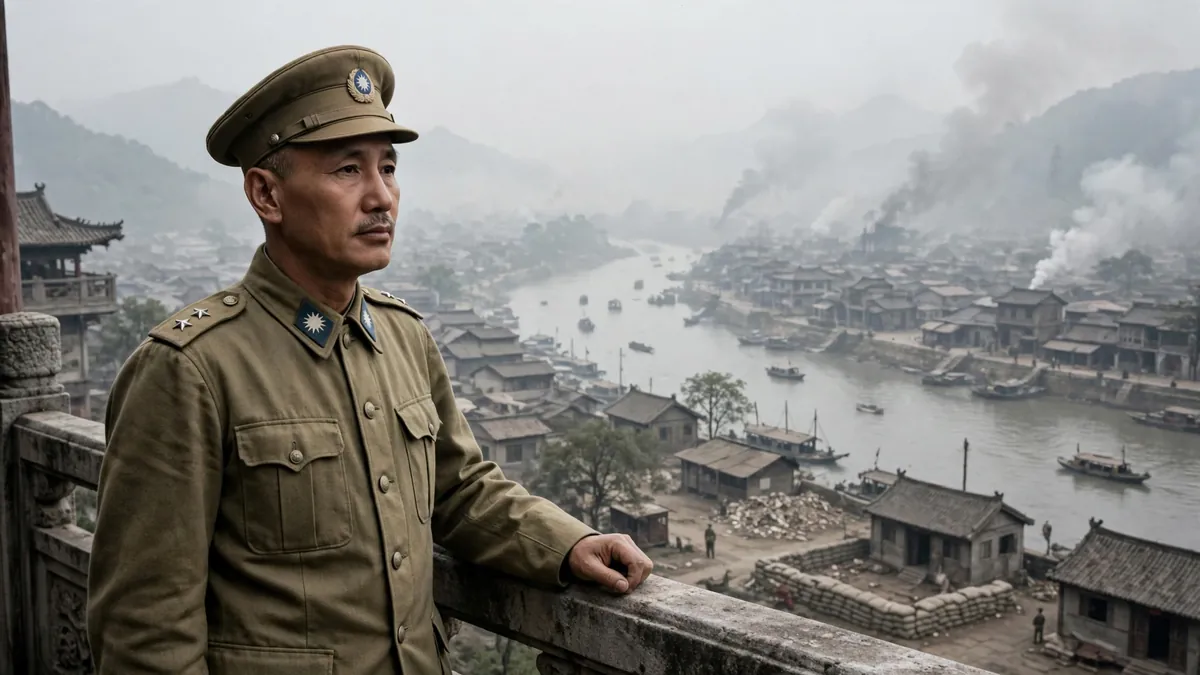
Chiang Kai-shek (31 October 1887 – 5 April 1975) was the military and political leader of Nationalist China for nearly half a century. Born Jiang Jieshi in the coastal province of Zhejiang, he rose from a provincial military academy to become the successor of Sun Yat-sen, the founder of the Republic of China, and the commander of the Northern Expedition that nominally unified China in 1928.
For the next two decades he ruled the Republic of China from Nanjing and then from Chongqing, first fighting Chinese Communists and regional warlords, then leading China’s long and costly resistance against the Japanese invasion from 1937 to 1945, and finally losing the renewed civil war to Mao Zedong’s Communists and retreating with his government and army to the island of Taiwan in 1949.
There he remained president of the Republic of China until his death in 1975, presiding over an authoritarian one-party state that nonetheless laid the foundations for Taiwan’s later economic growth.
Chiang’s place in the history of the Second World War is central and contested. China was the first country to fight a full-scale war against the Axis powers, beginning with Japan’s invasion of Manchuria in 1931 and the full invasion of July 1937 — years before the war began in Europe — and Chinese armies tied down more than a million Japanese soldiers for eight years, troops that Japan could not use against the United States, Britain or the Soviet Union.
Chiang was one of the Allied “Big Four” leaders, meeting Winston Churchill and Franklin D. Roosevelt at the Cairo Conference in November 1943, and China became one of the five permanent members of the United Nations Security Council. At the same time, his wartime leadership was marked by corruption, military defeats, disastrous decisions such as the breaching of the Yellow River dikes in 1938, and a refusal to give priority to the war against Japan over the struggle against the Communists — a choice that shaped the outcome of the civil war that followed.
Historians today argue over whether Chiang was a flawed but indispensable national leader or a stubborn general whose mistakes cost China dearly, but none dispute that his decisions shaped the fate of hundreds of millions of people.
2. Key Facts
| Born | 31 October 1887, Xikou, Fenghua County, Zhejiang Province, Qing China |
| Died | 5 April 1975 (aged 87), Taipei, Taiwan |
| Nationality | Chinese |
| Role / Office | Leader of the Republic of China and the Kuomintang (Nationalist Party); Generalissimo; President of the Republic of China (1928–1931, 1943–1949 in mainland China; 1950–1975 in Taiwan) |
| Known for | The Northern Expedition (1926–1928); leading China in the Second Sino-Japanese War (1937–1945); the Cairo Conference (1943); losing the Chinese Civil War and retreating to Taiwan (1949) |
| Spouse / Family | Mao Fumei (married 1901, died 1939); Soong Mei-ling (married 1927, died 2003); son Chiang Ching-kuo (later President of the Republic of China, 1978–1988) |
| Military rank | Generalissimo (highest rank in the National Revolutionary Army) |
3. Early Life and Education
Chiang Kai-shek was born on 31 October 1887 in the village of Xikou, in Fenghua County in the coastal province of Zhejiang, in the last decades of the Qing dynasty. His birth name was Jiang Ruiyuan; he later took the name Jiang Jieshi, rendered in the older Wade-Giles romanisation as Chiang Kai-shek.
His family were salt merchants of modest prosperity — not peasants, but far from the great landed families of China. His father, Jiang Zhaocong, died when Chiang was eight years old, and the boy was raised largely by his mother, Wang Caiyu, a strong-willed woman who, according to Chiang’s own later accounts, impressed on him the Confucian values of duty, discipline and filial loyalty.
He was a difficult and rebellious child, expelled from more than one school, and he developed early the stubbornness and temper that would mark his whole career.
As a young man Chiang was drawn to the revolutionary movement that sought to overthrow the Qing dynasty. In 1906 he entered the Baoding Military Academy in northern China, one of the new-style military schools created as part of the Qing government’s attempt to modernise its armed forces. The following year he won a place to study in Japan, then the model for military modernisation in Asia.
He studied at the Tokyo Shimbu Gakko, a preparatory school for Chinese military cadets, and then served as a cadet in the Imperial Japanese Army’s 19th Field Artillery Regiment in Niigata. In Japan he met other young Chinese revolutionaries, joined the Tongmenghui — Sun Yat-sen’s revolutionary alliance, the forerunner of the Kuomintang — and took part in the revolutionary ferment that led to the collapse of the Qing dynasty in 1911.
He returned to China to fight in the 1911 Revolution, serving in Shanghai under the revolutionary leader Chen Qimei, and he was involved in the violent factional politics of the early Republic, including the assassination of the revolutionary Tao Chengzhang in 1912 — an episode that later critics held against him, though his exact responsibility remains disputed.
The years after 1911 were chaotic. China broke apart into the rule of regional warlords, and Sun Yat-sen’s republican government in Guangzhou struggled to survive. Chiang became one of Sun’s closest military aides, though he also spent time in business in Shanghai, where he developed contacts — some of them with the city’s criminal underworld, the Green Gang — that later proved useful.
In 1923 Sun sent Chiang to Moscow to study the Soviet Red Army and the organisation of the Communist Party, a visit that left Chiang deeply suspicious of communism even as he admired Soviet military organisation. In 1924, when Sun founded the Whampoa Military Academy near Guangzhou with Soviet help, he appointed the thirty-six-year-old Chiang as its commandant.
Whampoa became the nursery of the Nationalist officer corps: its graduates — including many who later became Chiang’s most trusted generals, and also many who later joined the Communists, among them Lin Biao and Xu Xiangqian — formed the professional core of the army that would attempt to reunify China.
When Sun Yat-sen died of cancer in March 1925, Chiang, as commandant of Whampoa and commander of the National Revolutionary Army, was positioned to claim his inheritance.
4. Rise to Prominence
Chiang’s rise to power was swift, violent and methodical. In 1926 he launched the Northern Expedition, a military campaign to defeat the warlords of central and northern China and reunify the country under the Kuomintang government in Guangzhou. The National Revolutionary Army, advised by Soviet officers and fighting alongside Communist units under the First United Front between the Kuomintang and the Chinese Communist Party, advanced rapidly: it took Changsha in July 1926, Wuhan in October, and by the spring of 1927 it had captured Shanghai and Nanjing.
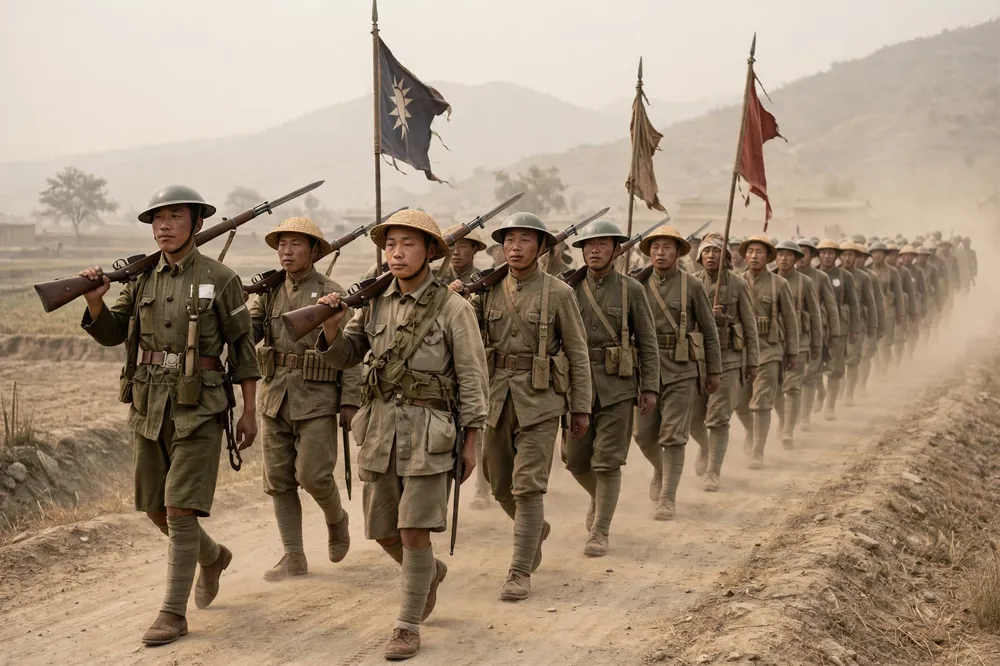
Chiang’s position as commander-in-chief made him the most powerful military figure in the Nationalist movement, and his Whampoa officers gave him a loyal base that his political rivals — notably Wang Jingwei, the civilian leader of the Kuomintang’s left wing — could not match.
In April 1927, at the moment of victory in Shanghai, Chiang turned against his Communist allies. On 12 April 1927 his forces, working with the Green Gang, arrested and executed hundreds — by some accounts thousands — of Communists and labour organisers in Shanghai in what became known as the Shanghai Massacre, or the 12 April Incident.
It was the opening of a bloody purge across Nationalist-held territory and the end of the First United Front. The Communists, nearly destroyed in the cities, retreated to the countryside, where Mao Zedong would rebuild them as a rural guerrilla movement.
Chiang’s decision has been judged ever since as both ruthless and fateful: it secured his control of the Kuomintang and the loyalty of China’s business and landowning classes, but it created an enemy that would destroy him twenty-two years later.
By 1928 the Northern Expedition had taken Beijing, and Chiang established a new Nationalist government in Nanjing, with himself as its chairman. China was nominally unified, though in practice powerful warlords still controlled much of the north and west, and Chiang spent the next decade consolidating his power through a series of wars against them, notably the Central Plains War of 1930, the largest civil conflict of the period.
He also launched a series of “encirclement campaigns” against the Communist base in Jiangxi, and in 1934 the Fifth Encirclement Campaign, advised by German military advisers, finally forced the Communists to abandon their Jiangxi Soviet and begin the Long March — the year-long retreat of 1934–1935 that carried them to a new base at Yan’an in the remote northwest.
Chiang’s government meanwhile undertook ambitious modernisation: new railways and roads, a central bank and a modern currency, a new legal code, and the New Life Movement of 1934, a Confucian-flavoured campaign for public morality and discipline that reflected Chiang’s personal beliefs.
But his rule was also corrupt and repressive: the secret police under Dai Li hunted Communists and critics, press freedom was curtailed, and the government depended heavily on the support of landlords and industrialists.
Chiang’s personal life changed decisively in December 1927, when he married Soong Mei-ling, the younger sister of Sun Yat-sen’s widow and the daughter of a wealthy Shanghai Christian family. The marriage — Chiang was already married, and he divorced his second wife to marry Soong — was politically important: it allied him with the powerful Soong family and with the Western-educated Christian elite of Shanghai, and it brought him into contact with American business and political circles.
Soong Mei-ling, educated at Wellesley College in the United States and fluent in English, became his closest political partner, his interpreter to the outside world, and during the war his most effective advocate in Washington. Chiang, who had been raised in Confucian tradition, converted to Methodism in 1930, a step that many historians regard as partly a matter of conviction and partly a political gesture towards the American public whose support he would need.
5. Chiang Kai-shek’s Role in World War II
The war with Japan
Japan had already seized Manchuria in 1931, creating the puppet state of Manchukuo, and in 1933 it took the province of Jehol and pressed into northern China. Chiang’s priority, however, remained the destruction of the Communists: his slogan was that internal pacification must come before resistance to foreign invasion.
That policy collapsed in December 1936, when the warlord Zhang Xueliang — the “Young Marshal” of Manchuria, whose father had been assassinated by the Japanese — arrested Chiang at Xi’an and held him for two weeks until he agreed to form a Second United Front with the Communists against Japan.
The Xi’an Incident, resolved partly through the mediation of the Communist envoy Zhou Enlai, forced Chiang into the war he had tried to avoid, and it made him the acknowledged leader of a nominally united Chinese resistance.
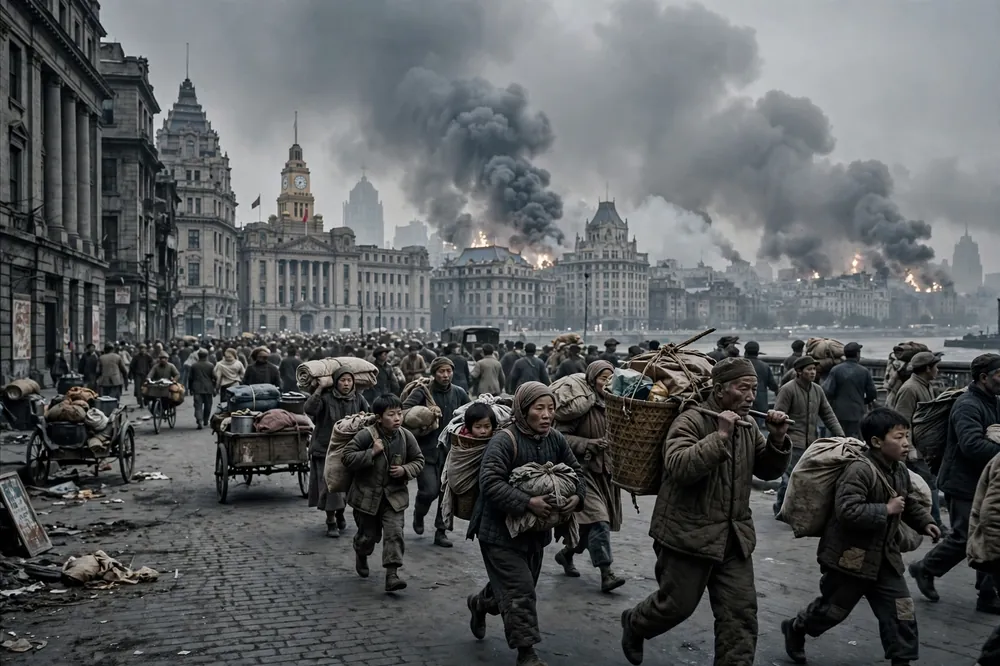
Full-scale war came on 7 July 1937, when Japanese and Chinese troops clashed at the Marco Polo Bridge outside Beijing. Japan rapidly seized Beijing, Tianjin and then Shanghai, where Chiang committed his best German-trained divisions to a three-month battle in the autumn of 1937 that cost China perhaps 250,000 casualties and destroyed the core of his modernised army.
Nanjing, the capital, fell in December 1937, and its capture was followed by the Nanjing Massacre, in which Japanese troops killed — according to the most widely cited estimates — around 200,000 to 300,000 Chinese civilians and prisoners of war over six weeks, and committed widespread rape and looting.
Chiang had already moved his government up the Yangtze River to the inland city of Chongqing, in Sichuan province, where it would remain for the rest of the war, beyond the reach of Japanese ground forces but under regular bombing — Chongqing was bombed by Japanese aircraft more than two hundred times between 1938 and 1943.
Chiang’s strategy after 1938 was one of attrition: trade space for time, refuse a negotiated peace, and wait for Japan to overextend itself and for the Western powers to enter the war. It was a strategy that depended on endurance, and the Chinese people paid a terrible price for it.
In June 1938, to slow the Japanese advance on Wuhan, Chiang ordered the breaching of the dikes of the Yellow River at Huayuankou. The resulting flood drowned, according to most modern estimates, between 400,000 and 900,000 Chinese civilians, destroyed millions of homes, and created a vast famine zone — and it delayed the Japanese advance by only a few months.
The decision remains the single most controversial act of Chiang’s wartime leadership, defended by some as a desperate measure in a war of survival and condemned by others as a crime against his own people.
The Allied leader
After the attack on Pearl Harbor in December 1941 brought the United States into the war, Chiang became one of the leaders of the Allied coalition. China received American aid through the Burma Road and, after Japan cut that route in 1942, by air over the Himalayas — the famous “Hump” airlift, in which American transport aircraft flew supplies from India to China.
Chiang’s relationship with his American advisers was stormy. General Joseph Stilwell, the American commander in China, despised Chiang, calling him “Peanut” in private, and demanded that Chiang reform his armies and use them aggressively against the Japanese; Chiang, in turn, distrusted Stilwell, suspected that the Americans wanted to supplant him, and refused to commit his best divisions to operations he believed served British and American interests rather than China’s.
The quarrel ended in October 1944, when President Franklin D. Roosevelt recalled Stilwell at Chiang’s insistence. Historians remain divided on the dispute: Stilwell’s supporters argue that Chiang hoarded American supplies for the coming civil war against the Communists, while Chiang’s defenders argue that he understood, better than Stilwell, that China could not afford a major offensive and that his armies, poorly supplied and underfed, were in no condition to fight one.
In November 1943 Chiang reached the height of his international standing at the Cairo Conference, where he met Roosevelt and Churchill as an equal and secured their agreement that Japan would return to China the territories it had seized, including Manchuria and Taiwan, and that Korea would become independent.
In 1945 China was a founding member of the United Nations and one of the five permanent members of its Security Council — a status that owed much to Roosevelt’s insistence that China be treated as a great power, and that Chiang’s government retained even after its defeat in the civil war.
But by 1944–1945 the reality behind the prestige was grim: Japan’s Operation Ichigo, launched in April 1944, overran large areas of central China, captured American air bases, and exposed the weakness of Chiang’s armies, which in some places collapsed without fighting.
American observers, including the Dixie Mission that visited the Communist base at Yan’an in 1944, reported that the Communist forces seemed more disciplined and more effective than the Nationalists — a comparison that alarmed Chiang and foreshadowed the outcome of the civil war.
6. Key Decisions
Breaking with the Communists (April 1927). The Shanghai purge ended the United Front and defined Chiang’s politics for the rest of his life. It gave him control of the Kuomintang and the backing of China’s propertied classes, but it drove the Communists into the countryside, where Mao rebuilt them into a movement Chiang could never destroy, and it committed him to a civil war that would run, with interruptions, for twenty-two years.
Refusing to resist Japan before 1936. Chiang’s policy of “internal pacification first” was strategically defensible — China was divided and unprepared — but it cost him enormous prestige, especially among students and intellectuals, and it allowed Japan to consolidate its hold on Manchuria and northern China. The Xi’an Incident forced him to change course, and he never fully regained the initiative.
The Yellow River flood (June 1938). The decision to breach the dikes at Huayuankou was Chiang’s most fateful wartime act. It slowed the Japanese advance on Wuhan for a few months at the cost of hundreds of thousands of Chinese civilian lives, and it became a lasting symbol, for his critics, of a leadership willing to sacrifice its own people.
Refusing Stilwell’s demands and securing his recall (1944). Chiang’s quarrel with the American commander was a political victory — he removed a general he distrusted — but it came at the cost of American confidence in his leadership. By 1944 many in Washington had concluded that Chiang’s government was corrupt, inefficient and unwilling to fight, a judgement that shaped American policy in the civil war that followed.
Retreating to Taiwan (1949). Rather than surrender or go into exile abroad, Chiang moved his government, his gold reserves, his best remaining troops and a large part of China’s cultural treasures to Taiwan. The decision preserved the Republic of China as a state and gave Chiang a second chance; it also separated Taiwan from the mainland for more than seventy-five years and created the unresolved question of China’s political future that persists today.
7. Controversies
Chiang Kai-shek is one of the most contested figures of the twentieth century, and the controversies around him are inseparable from the larger argument over modern China. The first and most persistent charge is that of corruption and misrule. His Nationalist government was widely regarded — by American observers, by Chinese intellectuals, and by many of his own officials — as corrupt, with military supplies sold on the black market, taxes collected by force, and public office used for private enrichment.
His family, particularly the Soong family and his brother-in-law H. H. Kung, accumulated great wealth while the government ran on American aid. Chiang’s defenders reply that corruption was endemic in a China emerging from a century of disorder, that Chiang himself lived relatively modestly, and that he was more a prisoner of the system than its architect.
The second controversy is military competence. Chiang insisted on personally directing operations, often overruling his generals, and he repeatedly committed troops to battles — Shanghai in 1937, for example — that his advisers warned would destroy his best forces. His critics argue that he was a mediocre strategist who valued political loyalty over military ability in his commanders and who hoarded American supplies for the civil war rather than using them against Japan. His defenders argue that he faced an impossible position: an enemy with overwhelming firepower, an army that was underfed and ill-equipped, and allies who demanded action while supplying too little to make it possible.
The third controversy concerns the human cost of his decisions, above all the Yellow River flood of 1938 and the Henan famine of 1942–1943, in which perhaps two to three million people died while the government, according to critics, continued to collect grain taxes and failed to organise relief.
Chiang’s government also bears responsibility for the suppression of dissent, the secret police, and the White Terror in Taiwan after 1949, during which tens of thousands of people were imprisoned and more than a thousand executed. In Taiwan itself, Chiang is remembered both as the leader who protected the island from Communist invasion and built its economy, and as the authoritarian who imposed martial law for thirty-eight years — the longest period of martial law in modern history.
Finally, there is the question of his historical responsibility for the loss of the mainland. Chiang’s critics argue that his refusal to reform, his reliance on landlords and generals, and his obsession with destroying the Communists made his defeat inevitable. His defenders argue that he held China together through eight years of war against Japan, prevented its partition, and kept it in the Allied camp — and that without his endurance, China might have collapsed entirely. The debate continues, and it is sharpened by the fact that the two regimes he fought — the People’s Republic of China on the mainland and the Republic of China on Taiwan — still tell his story in opposite ways.
8. Later Life and Death
The final chapter of Chiang’s life began in defeat. In 1949, after the Communist victories at Liaoshen, Huaihai and Pingjin, his armies disintegrated: whole divisions surrendered or defected, and the Nationalist government fled from Nanjing to Guangzhou to Chongqing and finally to Chengdu, before Chiang himself flew to Taiwan in December 1949. He took with him some two million soldiers, officials and refugees, the gold reserves of the central bank, and much of the collection of the Palace Museum in Beijing — treasures that remain in Taipei today. He also took the claim that his government in Taipei was the legitimate government of all China, a claim the United States and most of the Western world accepted until the 1970s.
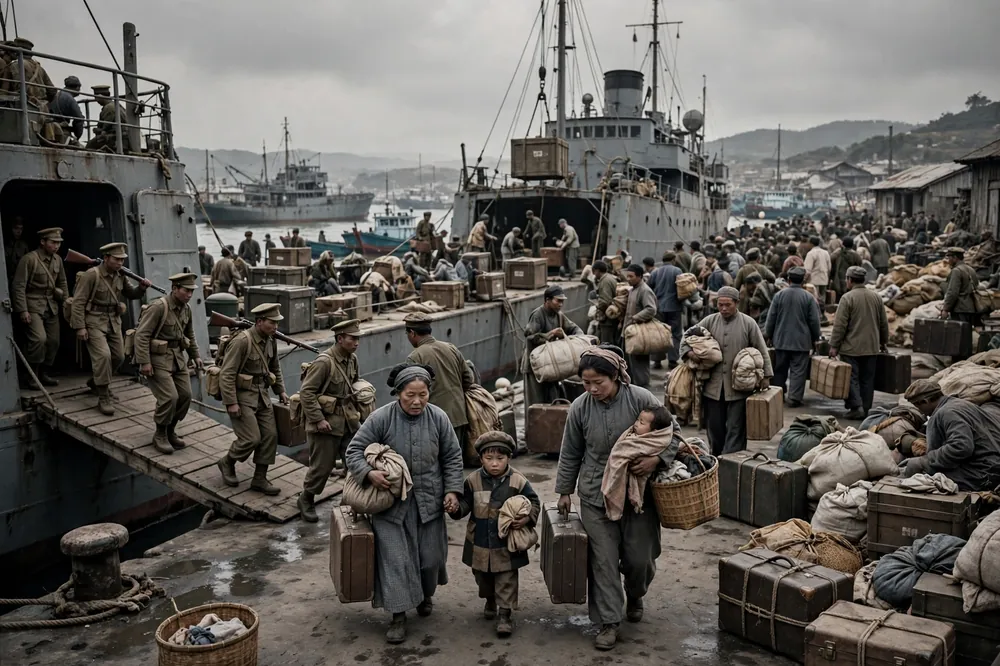
In Taiwan, Chiang rebuilt the Kuomintang as a disciplined Leninist-style party, imposed martial law in 1949, and ruled as an authoritarian president, re-elected repeatedly by a National Assembly that had itself been elected on the mainland in 1947 and never faced re-election.
His government carried out land reform in the 1950s — a policy he had resisted on the mainland — redistributing land to tenant farmers with compensation to landlords, and this, together with American aid and a programme of export-led industrialisation, laid the foundations for Taiwan’s economic growth.
But his rule was also marked by the White Terror: the suppression of real and imagined Communist infiltration, the imprisonment of dissidents, and the execution of opponents. Chiang survived assassination attempts and, in 1955, an attempt by Communist agents to bomb his aircraft; he also survived the loss of American diplomatic recognition in stages, culminating in the United States’ switch of recognition to Beijing in 1979 — four years after his death.
Chiang’s health declined in the early 1970s. He suffered a heart attack in 1972 and spent his last years largely bedridden, with his son Chiang Ching-kuo effectively running the government. He died of heart and kidney failure in Taipei on 5 April 1975, aged 87. His funeral was a state occasion, and his body was placed in a mausoleum at Cihu in Taoyuan County, in the expectation — never fulfilled — that it would one day be returned to his native Xikou for burial on the mainland. His son succeeded him as leader of the Kuomintang and, in 1978, as president of the Republic of China.
9. Legacy of Chiang Kai-shek
Chiang Kai-shek’s legacy is divided between two Chinas. On the mainland, the official history of the People’s Republic of China remembers him as a reactionary who betrayed the revolution, massacred Communists, and lost the civil war through corruption and incompetence — though in recent decades Chinese historians have begun to acknowledge his role in resisting Japan.
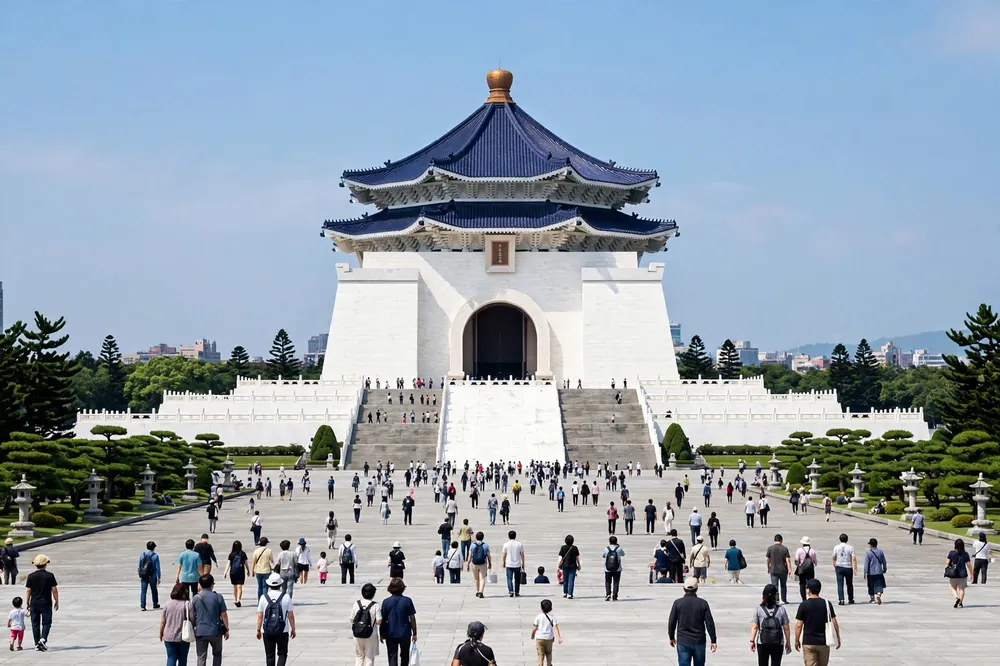
In Taiwan, he was for decades honoured as the saviour of the island and the father of its modernisation; since the end of martial law in 1987, that image has been reassessed, and the Chiang Kai-shek Memorial Hall in Taipei — one of the largest monuments in Taiwan — has become a subject of public debate, with proposals to rename it and to remove his statues from public places.
His concrete achievements are real and lasting. He unified China, however imperfectly, after the warlord era; he led the country’s resistance to Japan for eight years and kept China in the war when many expected it to collapse; he secured for China a permanent seat on the United Nations Security Council; and in Taiwan he presided over land reform and the beginnings of the economic transformation that made the island one of Asia’s “tiger” economies.
His failures are equally real: the corruption and repression of his government, the human cost of the Yellow River flood, the loss of the mainland, and thirty-eight years of martial law in Taiwan. The diaries he kept throughout his life — opened to researchers at Stanford University in 2006 — have added depth to the picture, revealing a man of intense self-discipline, deep religious faith, and a habit of self-criticism that sat uneasily beside his political ruthlessness.
Historians will continue to argue over the balance, but the scale of his life — from a village in Zhejiang to the leadership of a nation of hundreds of millions — is beyond dispute.
10. Assessment by Historians
Historians assess Chiang Kai-shek in sharply different ways, and the assessment has shifted over time. In the West, the dominant view in the 1940s and 1950s — shaped by wartime propaganda and by the writings of Stilwell’s supporters, notably Barbara Tuchman’s Stilwell and the American Experience in China (1971) — was of a corrupt and incompetent leader who wasted American aid and lost China.
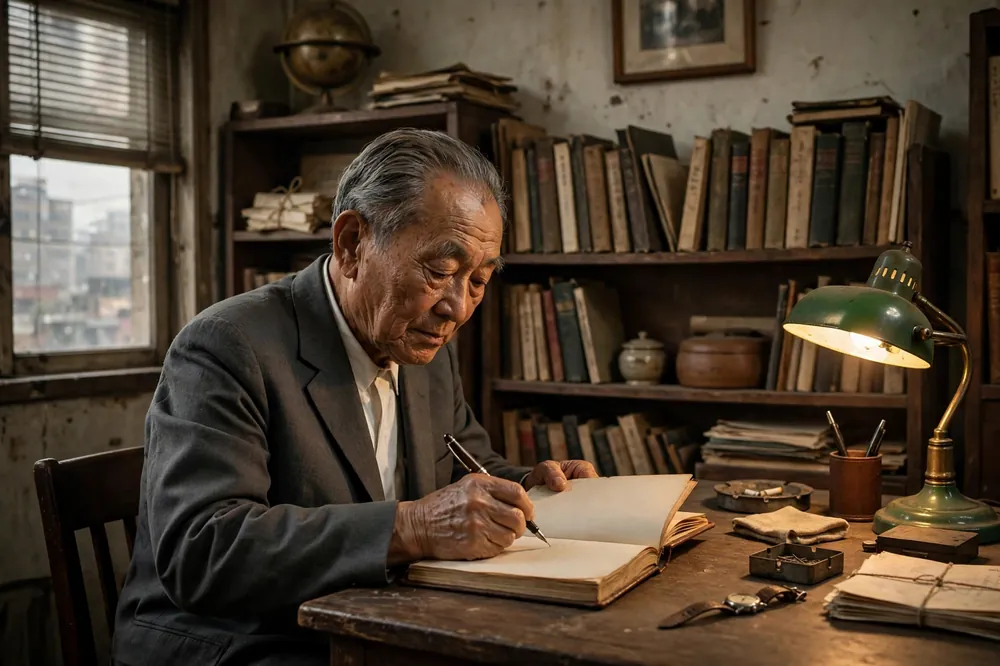
More recent scholarship, including Jay Taylor’s biography The Generalissimo: Chiang Kai-shek and the Struggle for Modern China (2009), based on Chiang’s diaries, has offered a more sympathetic account: a disciplined, patriotic leader who held a fragmented country together against a far stronger enemy, whose options were narrow, and whose refusal to surrender to Japan was itself a historic achievement.
Taylor’s work does not excuse the corruption or the Yellow River flood, but it argues that Chiang’s critics underestimated the constraints he faced.
Chinese historians on the mainland have moved in a similar direction, albeit more slowly: the official narrative still condemns him, but academic historians now credit him with a genuine role in the war of resistance, and the Nanjing Massacre Memorial Hall presents the war as a national struggle in which Chiang’s government played a part.
In Taiwan, the assessment has moved the other way: the democratisation of the island since 1987 has brought a critical re-examination of martial law and the White Terror, and Chiang is now assessed as both a nation-builder and an authoritarian.
The consensus that is emerging, among historians outside the political fray, is that Chiang was neither the hero of Nationalist propaganda nor the villain of Communist propaganda: he was a military ruler of considerable determination and limited imagination, who achieved the unification of China and its survival through the war with Japan, and who failed — through rigidity, corruption and a refusal to reform — to win the peace that followed.
Frequently Asked Questions
Who was Chiang Kai-shek?
Chiang Kai-shek (1887–1975) was the leader of Nationalist China and the Kuomintang for nearly fifty years. He unified China in 1928, led the country in the war against Japan from 1937 to 1945, and retreated to Taiwan after losing the civil war to the Communists in 1949.
Why did Chiang Kai-shek lose the Chinese Civil War?
His armies were exhausted and corrupt after eight years of war with Japan, his government had lost the support of peasants, students and the urban middle class, and the Communists under Mao Zedong fought more effectively, with better discipline and a popular programme of land reform. American aid continued, but it could not compensate for the collapse of Nationalist morale.
What was the Yellow River flood of 1938?
In June 1938 Chiang ordered the breaching of the Yellow River dikes at Huayuankou to slow the Japanese advance on Wuhan. The flood killed an estimated 400,000 to 900,000 Chinese civilians and destroyed millions of homes, while delaying the Japanese by only a few months.
Did Chiang Kai-shek attend the Cairo Conference?
Yes. In November 1943 he met President Franklin D. Roosevelt and Prime Minister Winston Churchill in Cairo, where the Allies agreed that Japan would return Manchuria and Taiwan to China and that Korea would become independent.
How long did Chiang Kai-shek rule Taiwan?
He ruled Taiwan from December 1949 until his death on 5 April 1975 — more than twenty-five years — under martial law, which remained in force until 1987.
What happened to Chiang Kai-shek’s son?
Chiang Ching-kuo succeeded his father as leader of the Kuomintang and became President of the Republic of China in 1978. He began the political liberalisation of Taiwan and lifted martial law in 1987, shortly before his death in January 1988.
Related articles
Sources
- Wikipedia, “Chiang Kai-shek” — consolidated biography: birth 31 October 1887, death 5 April 1975, Northern Expedition, Shanghai Massacre 1927, Xi’an Incident, Cairo Conference 1943, retreat to Taiwan 1949.
- Encyclopaedia Britannica, “Chiang Kai-shek” (britannica.com) — biography, leadership of the Kuomintang, Second Sino-Japanese War, Taiwan years.
- Jay Taylor, The Generalissimo: Chiang Kai-shek and the Struggle for Modern China (Harvard University Press, 2009) — biography based on Chiang’s diaries, opened at Stanford University in 2006.
- Jonathan Fenby, Chiang Kai-shek: China’s Generalissimo and the Nation He Lost (Carroll & Graf, 2003) — critical biography; Northern Expedition, wartime leadership, civil war defeat.
- Barbara Tuchman, Stilwell and the American Experience in China, 1911–45 (Macmillan, 1971) — the Stilwell–Chiang quarrel and American policy in China.
- Rana Mitter, Forgotten Ally: China’s World War II, 1937–1945 (Houghton Mifflin Harcourt, 2013) — China’s war with Japan; Yellow River flood; Chongqing; Cairo Conference.
- Diana Lary, The Chinese People at War: Human Suffering and Social Transformation, 1937–1945 (Cambridge University Press, 2010) — civilian cost of the war, including the Yellow River flood and the Henan famine.
Further reading
- Hans J. van de Ven, War and Nationalism in China, 1925–1945 (Routledge, 2003).
- Ray Huang, Chiang Kai-shek and His Times (in China: A Macro History, M. E. Sharpe, 1997).