 WAR ATLAS MILITARY HISTORY MAGAZINE · WWI — WWII
Arleigh Burke
1. Lead
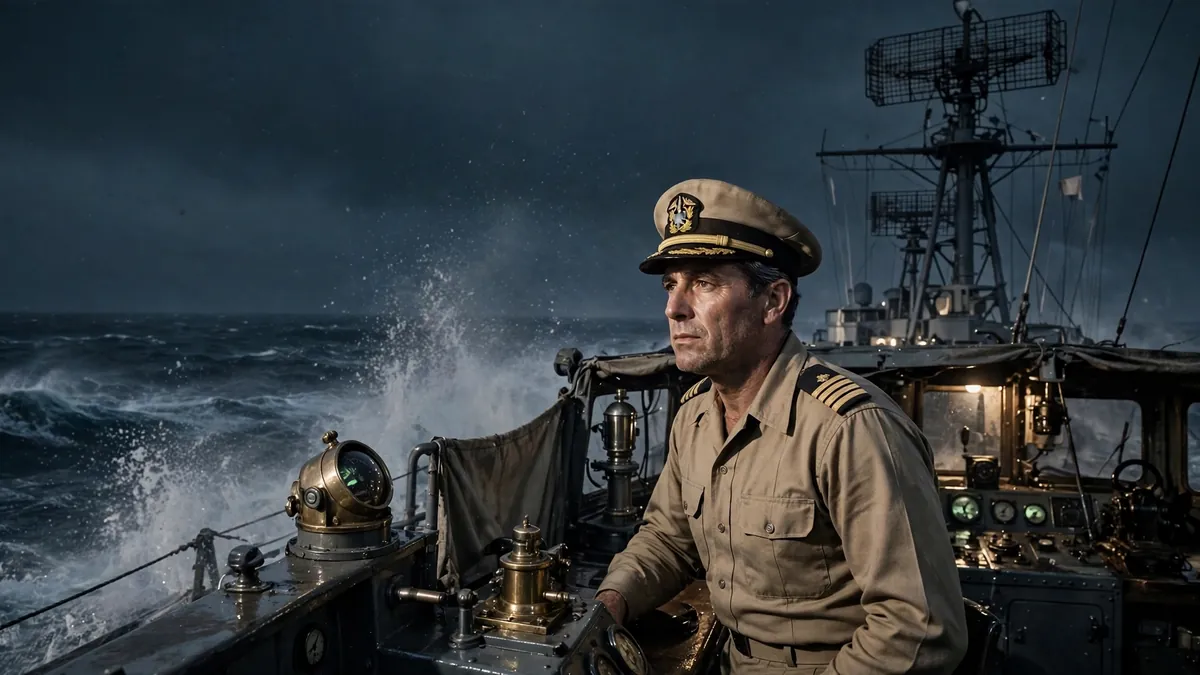
Arleigh Burke (19 October 1901 – 1 January 1996) was the American admiral who became the most celebrated destroyer commander of the Second World War and the longest-serving Chief of Naval Operations in the history of the United States Navy.
Born in Boulder, Colorado, and educated at the United States Naval Academy at Annapolis, he was a quiet, unassuming officer who had spent most of his career in ordnance and gunnery when the war broke out. In 1943, at the age of forty-two, he was given command of Destroyer Squadron 23 — the “Little Beavers” — in the Solomon Islands, and in a series of night battles in the waters around Bougainville he transformed the tactics of destroyer warfare, using radar, high speed and aggressive torpedo attacks to defeat Japanese forces that had, until then, dominated the night fighting in the Pacific.
His victory at the Battle of Cape St. George on 25 November 1943, in which his squadron sank three Japanese destroyers without losing a ship, was the last great destroyer action of the war and the model for a new kind of naval warfare.
After the war he became, in 1955, the youngest Chief of Naval Operations in the Navy’s history, and he served in that post for six years — longer than any of his predecessors or successors — guiding the Navy through the transition to nuclear weapons, nuclear submarines and the missile age.
Burke’s importance to the history of the Second World War is that of the fighting sailor who changed how a war was fought. The Pacific war was, above all, a war of carriers and of amphibious landings, but it was also a war of the night — of destroyers and cruisers fighting in the narrow waters of the Solomon Islands, where the Japanese, with their superior torpedoes and their skill at night fighting, had inflicted a series of defeats on the Americans in 1942, notably at Savo Island.
Burke’s contribution was to take the lessons of those defeats, to train his men to a new standard, and to prove that American destroyers could beat the Japanese at their own game. He did it not by inventing new weapons but by using the weapons he had — radar, torpedoes, and speed — more aggressively and more intelligently than anyone before him.
His squadron’s motto, “31-Knot Burke”, came from his order to his ships to steam at 31 knots into battle — a speed that was, for a destroyer squadron in formation, almost reckless. It became a legend, and Burke himself became a legend: the admiral who was known, in the Navy, simply as “31-Knot Burke”.
2. Key Facts
| Born | 19 October 1901, Boulder, Colorado, United States |
| Died | 1 January 1996 (aged 94), Bethesda, Maryland, United States |
| Nationality | American |
| Role / Office | Commander, Destroyer Squadron 23 (1943–1944); Chief of Staff to Admiral Marc Mitscher, Fast Carrier Task Force (1944–1945); Chief of Naval Operations (1955–1961) |
| Known for | The “Little Beavers” of Destroyer Squadron 23; the Battle of Cape St. George (25 November 1943); the longest-serving Chief of Naval Operations; the Arleigh Burke-class destroyers named for him |
| Spouse / Family | Roberta Gorsuch (married 1923, died 1991); son Arleigh A. Burke Jr. |
| Military rank | Admiral (four stars) |
3. Early Life and Education
Arleigh Albert Burke was born on 19 October 1901 in Boulder, Colorado, the son of Oscar Burke, a professor of mathematics at the University of Colorado, and Clara Mokler Burke. He grew up in Boulder, a university town at the foot of the Rocky Mountains, and he was a bright and energetic boy, interested in science and in the outdoors.

He entered the University of Colorado in 1919, intending to become an engineer, but in that year he won an appointment to the United States Naval Academy at Annapolis, Maryland, and he entered the Academy in the summer of 1919.
He was a good student — he graduated in 1923, ranked in the upper part of his class — and he was also a keen athlete, playing on the Academy’s football team. He married Roberta Gorsuch in 1923, shortly after his graduation, and the marriage lasted sixty-eight years, until her death in 1991.
Burke’s early naval career was conventional: he served in battleships and in destroyers, and he developed a reputation as a gunnery specialist. He served in the battleship USS Arizona — the ship that would be sunk at Pearl Harbor in 1941 — and in the destroyer USS Mahan, and he spent two years, from 1935 to 1937, as an instructor in ordnance at the Naval Academy.
In 1938 he was sent to the University of Michigan, where he earned a master’s degree in chemical engineering, and in 1939 he was assigned to the Bureau of Ordnance in Washington, where he worked on the development of naval guns and ammunition.
It was a career that seemed to be leading towards a staff post, not towards command at sea, and Burke, who was a quiet and modest man, was content with it. He was, in the words of one of his biographers, “a gunnery officer who had never fired a gun in anger”.
When the United States entered the Second World War in December 1941, Burke was still at the Bureau of Ordnance, and he was desperate to get to sea. He was given command of a destroyer division in the Atlantic in 1942, and he served in the escort of convoys to North Africa, but it was not until the spring of 1943 that he got the command that would make his name: Destroyer Squadron 23, in the South Pacific. He was forty-two years old, a captain, and he had never commanded a ship in battle. What he had was a thorough knowledge of gunnery, a clear mind, and a willingness to learn from the defeats of 1942.
4. Rise to Prominence
Burke’s rise to prominence was the story of Destroyer Squadron 23, the “Little Beavers”. The squadron, which Burke took command of in May 1943, consisted of eight destroyers — the Charles Ausburne, the Claxton, the Dyson, the Stanly, the Converse, the Thatcher, the Spence and the Foote — and it was assigned to the waters around the Solomon Islands, where the Americans were fighting to take Bougainville and where the Japanese were running the “Tokyo Express”, the nightly supply runs by destroyer that brought troops and supplies to their garrisons.
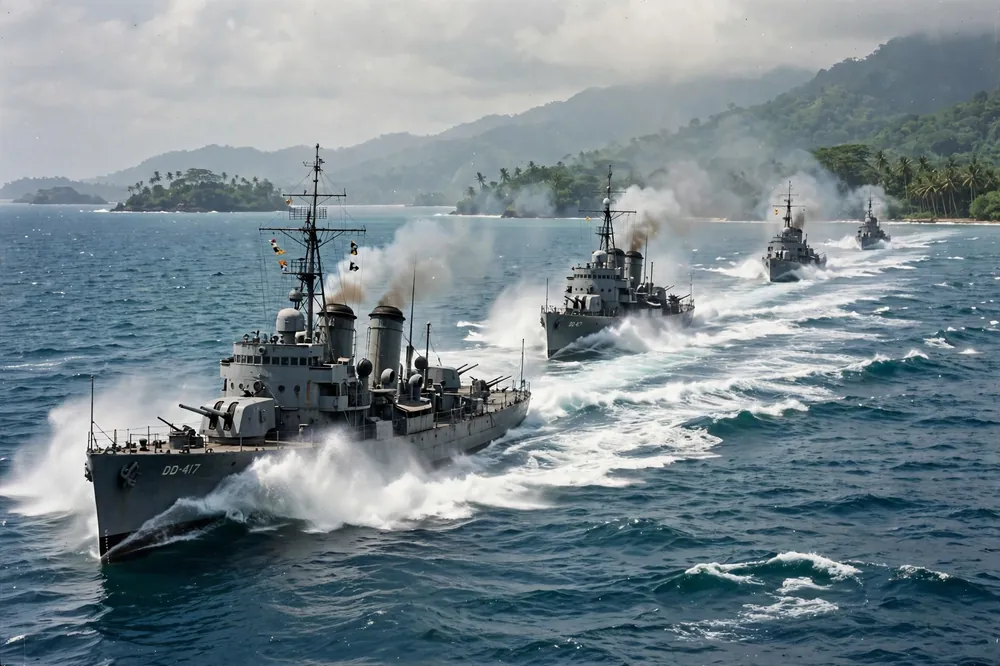
The Americans had suffered a series of defeats in night actions in 1942, above all at Savo Island in August 1942, where four Allied cruisers were sunk, and the Japanese, with their superior Long Lance torpedoes and their skill at night fighting, were regarded as the masters of the night.
Burke changed that. He trained his squadron relentlessly: he drilled his crews in night fighting, he insisted on the use of radar — which the Americans had and the Japanese, at first, did not — and he developed a new tactic, which he called “the doctrine of the aggressive torpedo attack”: his destroyers would approach the enemy at high speed, fire their torpedoes first, and then close to gun range, rather than waiting for the enemy to fire.
He also insisted on speed: his order to his ships, “Steam at 31 knots”, became the squadron’s motto and Burke’s nickname. The men of the squadron adopted a beaver as their emblem — the “Little Beavers” — and they painted it on their funnels.
In the autumn of 1943 Burke’s squadron fought a series of battles in the waters off Bougainville. At the Battle of Empress Augusta Bay on 2 November 1943, Burke’s destroyers helped to defeat a Japanese cruiser force that was attempting to attack the American landing at Bougainville. Later in November, his squadron fought in the Battle of Cape St. George, which became his most famous victory.
The squadron’s success was not only tactical but also moral: it proved that American destroyers could beat the Japanese at night, and it restored the confidence of the American navy in the Solomons. Burke was awarded the Navy Cross for his leadership, and he was promoted to rear admiral.
His squadron became the most decorated destroyer squadron of the war, and Burke himself became a national figure: the press called him “31-Knot Burke”, and his story was told in newspapers and in magazines across America.
5. Arleigh Burke’s Role in World War II
Cape St. George
The Battle of Cape St. George, fought on the night of 25 November 1943, was Burke’s masterpiece. Intelligence had reported that five Japanese destroyers were carrying troops to Bougainville, and Burke, with five of his own destroyers, set out to intercept them.
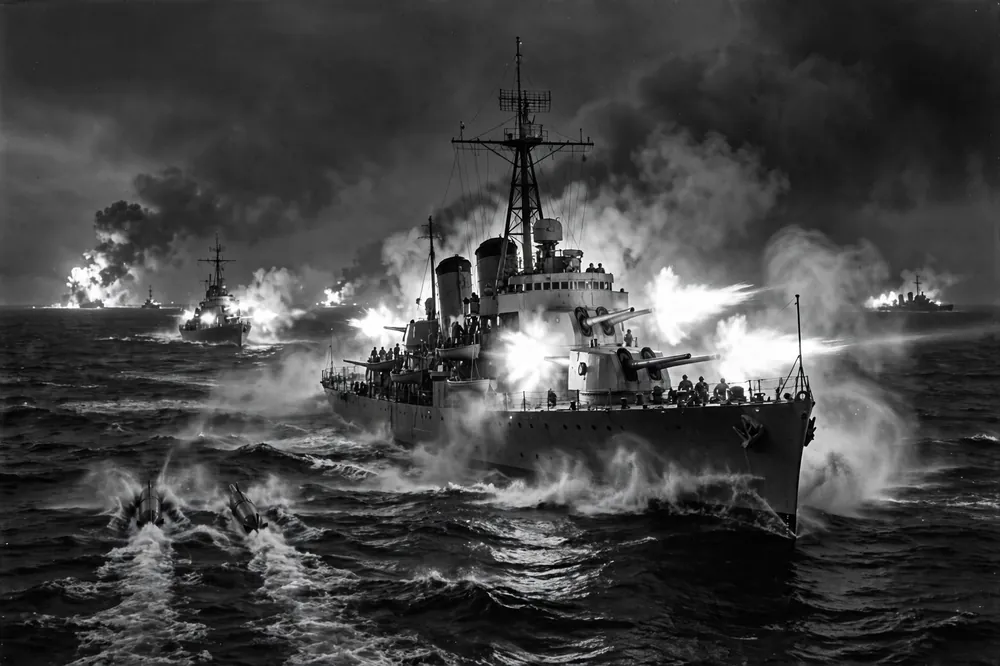
He approached at 31 knots, using radar to track the Japanese, and at 01:40 on 25 November his ships fired a spread of torpedoes at long range — a tactic that was, at the time, unusual, since American doctrine had been to close to gun range first. The torpedoes struck first: the Japanese destroyer Onami was hit and sunk, and the destroyer Makinami was crippled.
Burke’s ships then closed to gun range and, in a running fight that lasted for more than an hour, sank a third Japanese destroyer, the Yugiri, and damaged the others, which fled. Burke’s squadron suffered no losses — not a single American ship was hit — and no American sailor was killed.
It was, in the words of the naval historian Samuel Eliot Morison, “a perfect battle”, and it was the last great destroyer action of the Pacific war: after Cape St. George, the Japanese abandoned the Tokyo Express, and the Americans controlled the waters of the Solomons.
The victory at Cape St. George was the culmination of Burke’s work in the Solomons, and it was also the end of his command of Destroyer Squadron 23. In early 1944 he was promoted and assigned as chief of staff to Vice Admiral Marc Mitscher, the commander of the Fast Carrier Task Force — the great carrier force that would carry the war across the Pacific to Japan.
It was a different kind of war: Burke, who had been a destroyer commander, now found himself at the heart of the carrier war, planning the operations that would take the Americans to the Marianas, to Leyte Gulf, to Iwo Jima and to Okinawa.
He served with Mitscher through the Battle of the Philippine Sea in June 1944 — the “Great Marianas Turkey Shoot”, in which the Japanese carrier air force was destroyed — and through the Battle of Leyte Gulf in October 1944, the largest naval battle in history.
He was, by all accounts, an outstanding chief of staff: Mitscher, who was a difficult man to work for, trusted him completely, and Burke’s planning and his calm under pressure were, in the judgement of his contemporaries, a major contribution to the success of the Fast Carrier Task Force.
The Fast Carrier Task Force
Burke’s work with Mitscher was less dramatic than his work with the Little Beavers, but it was, in some ways, more important. The Fast Carrier Task Force was the instrument by which the United States won the Pacific war: it was a force of a dozen or more aircraft carriers, with their escorting battleships, cruisers and destroyers, that could strike anywhere in the Pacific, and it required a staff that could plan and coordinate operations of enormous complexity.
Burke, as chief of staff, was responsible for the planning of the task force’s operations, and he was known for his thoroughness, his attention to detail, and his ability to make decisions under pressure. He was also known for his loyalty to Mitscher, and for his willingness to take responsibility for difficult decisions.
After the war, Mitscher said of Burke that he was “the best chief of staff I ever had”, and the naval historian E. B. Potter, in his biography of Burke, called his service with Mitscher “the most important staff work of the Pacific war”.
6. Key Decisions
The aggressive torpedo attack. Burke’s decision to fire torpedoes at long range, before closing to gun range, was a break with American doctrine and a key to his success at Cape St. George. It exploited the Americans’ advantage in radar and it denied the Japanese the chance to fire their own torpedoes first. It was a decision that required confidence in his crews and in his weapons, and it worked.
Steaming at 31 knots. Burke’s order to steam at 31 knots into battle was a calculated risk: it closed the range quickly, it gave the enemy less time to react, and it demonstrated to his men that he intended to fight aggressively. It was also a risk — a destroyer squadron in formation at 31 knots at night was in danger of collision — but Burke judged the risk worth taking, and his men followed him.
Accepting the post of chief of staff to Mitscher. Burke’s decision to leave the command of his beloved destroyer squadron and to become a staff officer was a sacrifice of the kind of command he loved for a post where he could contribute more to the war. It was a decision that showed his understanding of the war: the carrier, not the destroyer, was now the decisive weapon, and the place to serve was at the heart of the carrier force.
Advocating for the Polaris submarine. As Chief of Naval Operations, Burke’s decision to champion the Polaris submarine-launched ballistic missile programme — against the opposition of the Air Force and of many in the Navy — was the decision that gave the United States a survivable nuclear deterrent and that defined the Navy’s role in the Cold War. The first Polaris submarine, USS George Washington, was launched in 1959, and the programme was delivered ahead of schedule and under budget, a rare achievement in defence procurement.
7. Controversies
Burke’s career was, by the standards of the Second World War, remarkably free of controversy. He was not a political figure, he did not quarrel with his superiors, and his wartime record was one of success. The controversies that do attach to him are those of his later career as Chief of Naval Operations, and they are, in the main, controversies of policy rather than of character.
The first concerns the “Revolt of the Admirals” — the dispute, in 1949, over the roles of the Navy and the Air Force in the delivery of nuclear weapons, in which Burke, then a rear admiral, testified before Congress in favour of the Navy’s carrier programme and against the Air Force’s B-36 bomber. The controversy was about the future of American defence, and Burke’s testimony, though it cost him the favour of the Secretary of Defense, was widely regarded as an act of professional integrity.
The second concerns his tenure as Chief of Naval Operations, from 1955 to 1961, and his relationship with the Eisenhower administration. Burke was a strong advocate of a large navy and of the Polaris programme, and he clashed with the administration over defence spending and over the Navy’s role in the missile age. His critics argue that he was too wedded to the carrier and to the surface navy, and that he was slow to appreciate the importance of the submarine; his defenders argue that he was the man who made the Navy relevant to the nuclear age, and that the Polaris programme was his greatest achievement.
The third controversy is a minor one, but it is worth noting: Burke’s nickname, “31-Knot Burke”, was, in part, a creation of the press, and some of his contemporaries argued that it exaggerated his daring and that his real contribution was not speed but thoroughness — the careful training, the attention to radar, and the planning that made his victories possible. Burke himself was modest about the nickname, and he always credited his men. The controversy, if it can be called one, is a reminder that legends are made as much by newspapers as by battles.
8. Later Life and Death
After the war, Burke’s career continued to rise. He served in a series of senior posts, and in August 1955 President Dwight D. Eisenhower appointed him Chief of Naval Operations — the Navy’s highest post — over the heads of more senior admirals, a decision that surprised many and that Eisenhower made because he wanted a man of energy and of vision.
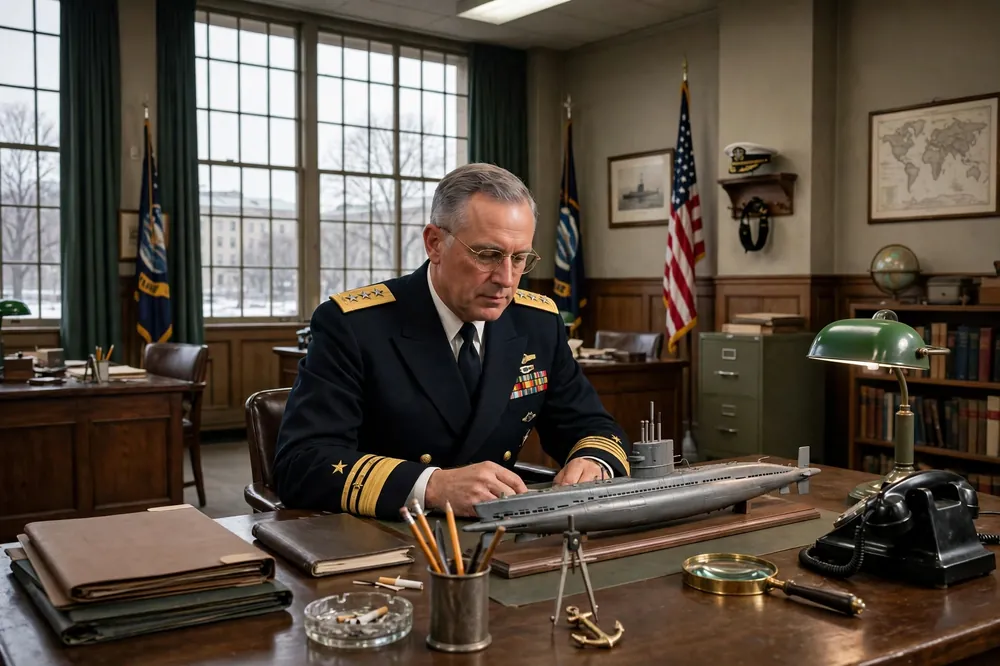
Burke served as Chief of Naval Operations for six years, from 1955 to 1961, under Eisenhower and under President John F. Kennedy, and he was the longest-serving chief in the Navy’s history. His tenure was marked by the transition to the nuclear navy: he championed the Polaris submarine programme, he supported the development of nuclear-powered aircraft carriers, and he guided the Navy through the crises of the Cold War, including the Lebanon crisis of 1958 and the Cuban Missile Crisis of 1962 — though by then he had retired, he was consulted by the Kennedy administration.
Burke retired from the Navy in 1961, after thirty-eight years of service, and he spent his retirement in Washington, writing, lecturing, and serving on the boards of corporations and of educational institutions. He was a modest man, and he disliked publicity, but he was widely honoured: he received the Presidential Medal of Freedom in 1977, and in 1991 the Navy named its new class of guided-missile destroyers for him — the Arleigh Burke class, which became the largest class of destroyers ever built by the United States and which remains in service today.
He died on 1 January 1996, at the National Naval Medical Center in Bethesda, Maryland, aged ninety-four, and he was buried at the United States Naval Academy Cemetery in Annapolis. His wife Roberta had died in 1991, and he was survived by his son and by his grandchildren.
9. Legacy of Arleigh Burke
Burke’s legacy is the modern United States Navy. As Chief of Naval Operations, he guided the Navy through the most important transition in its history — from the gun navy of the Second World War to the nuclear and missile navy of the Cold War — and the Polaris programme, which he championed, gave the United States a nuclear deterrent that remains the foundation of its security. The Arleigh Burke-class destroyers, named for him, are the workhorses of the modern Navy: more than seventy have been built, and they serve in every ocean, a tribute to the man who commanded destroyers in the Solomons.
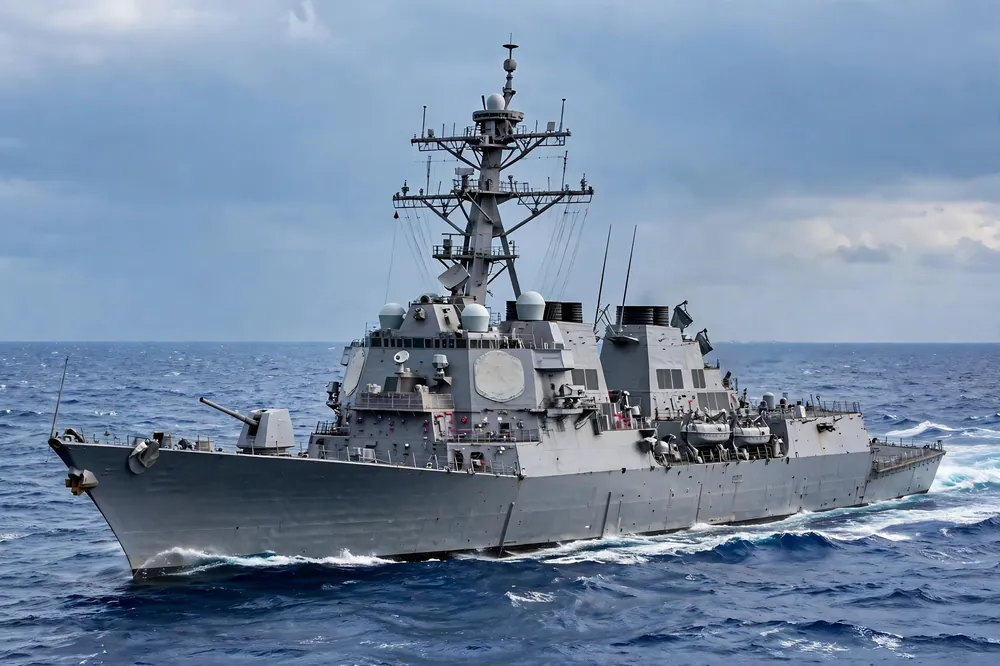
His wartime legacy is the doctrine of the aggressive destroyer. The tactics he developed — the use of radar, the torpedo attack at long range, the emphasis on speed and on training — became the standard doctrine of the American navy, and they are still taught at the Naval War College.
His squadron, the Little Beavers, remains one of the most celebrated units in naval history, and the beaver emblem is still worn by the destroyers that trace their lineage to Destroyer Squadron 23. Burke’s name is also remembered in the Navy’s culture: the phrase “31-Knot Burke” is still used, in the Navy, as a synonym for aggressive and decisive leadership, and the annual Arleigh Burke Award is given to the Navy’s outstanding destroyer squadron.
10. Assessment by Historians
Historians assess Arleigh Burke as one of the great naval leaders of the Second World War, and the assessment has been consistently positive. The naval historian Samuel Eliot Morison, who wrote the official history of the United States Navy in the Second World War, called the Battle of Cape St. George “a perfect battle” and Burke “a great destroyer commander”. E. B.
Potter, in his biography Admiral Arleigh Burke (1990), called Burke “the most important naval officer of the post-war era”, and argued that his contribution as Chief of Naval Operations — above all the Polaris programme — was as important as his wartime service.
The judgement rests on a combination of qualities: Burke was a tactician who changed the way destroyers fought, a staff officer who planned the operations of the Fast Carrier Task Force, and a chief who guided the Navy through the nuclear age.
The assessment is not without qualification. Some historians have argued that Burke’s reputation as a destroyer commander rests on a single battle — Cape St. George — and that his later career as Chief of Naval Operations, though long, was marked by conflict with the Eisenhower administration and by a reluctance to embrace the submarine as the Navy’s primary weapon.
But the consensus is that Burke was a man of exceptional ability and of exceptional character: a quiet, modest officer who, when given command, proved to be a bold and innovative leader, and who, when given the Navy’s highest post, proved to be a far-sighted administrator. He is remembered, in the Navy, as the admiral who was known by his speed — “31-Knot Burke” — and by his integrity.
Frequently Asked Questions
Who was Arleigh Burke?
Arleigh Burke (1901–1996) was an American admiral, the commander of Destroyer Squadron 23 — the “Little Beavers” — in the Pacific in 1943, and the Chief of Naval Operations from 1955 to 1961, the longest-serving chief in the Navy’s history.
What was the Battle of Cape St. George?
Fought on the night of 25 November 1943, it was the battle in which Burke’s five destroyers sank three Japanese destroyers without losing a ship. It was the last great destroyer action of the Pacific war and it ended the Japanese “Tokyo Express” supply runs to Bougainville.
Why was Burke called “31-Knot Burke”?
The nickname came from his order to his destroyers to steam at 31 knots into battle. It became the motto of Destroyer Squadron 23 and Burke’s enduring nickname in the Navy.
What were the “Little Beavers”?
They were the eight destroyers of Destroyer Squadron 23, commanded by Burke in the Solomon Islands in 1943. The squadron adopted a beaver as its emblem, and it became the most decorated destroyer squadron of the war.
What is the Arleigh Burke class of destroyers?
It is the class of guided-missile destroyers named for Burke and first commissioned in 1991. More than seventy have been built, making it the largest class of destroyers ever built by the United States, and it remains in service today.
How long did Burke serve as Chief of Naval Operations?
Six years, from 1955 to 1961 — longer than any other Chief of Naval Operations in the Navy’s history.
Related articles
Sources
- Wikipedia, “Arleigh Burke” — consolidated biography: birth 19 October 1901, death 1 January 1996, Destroyer Squadron 23, Cape St. George, Chief of Naval Operations 1955–1961.
- Encyclopaedia Britannica, “Arleigh Burke” (britannica.com) — biography, Little Beavers, Chief of Naval Operations.
- E. B. Potter, Admiral Arleigh Burke (Random House, 1990) — the standard biography; Destroyer Squadron 23, Cape St. George, the Fast Carrier Task Force, Polaris.
- Samuel Eliot Morison, History of United States Naval Operations in World War II, Volume VI: Breaking the Bismarcks Barrier (Little, Brown, 1950) — the official history; Empress Augusta Bay and Cape St. George.
- Naval History and Heritage Command, “Arleigh A. Burke” (history.navy.mil) — official biography and the Arleigh Burke-class destroyers.
- James D. Hornfischer, Neptune’s Inferno: The U.S. Navy at Guadalcanal (Bantam, 2011) — the night fighting in the Solomons and the background to Burke’s tactics.
Further reading
- Ken Jones and Hubert Kelley Jr., Admiral Arleigh (31-Knot) Burke: The Story of a Fighting Sailor (Chilton, 1962).
- David C. Fuquea, “Task Force One: The Heirs of Admiral Arleigh Burke” (Naval War College Review, 1997).