 WAR ATLAS MILITARY HISTORY MAGAZINE · WWI — WWII
Georgy Zhukov
1. Lead
Georgy Zhukov (1 December 1896 – 18 June 1974) was the Soviet marshal who became the most successful general of the Second World War and the man most closely associated, in the West as in Russia, with the Soviet victory over Nazi Germany.
Born the son of a poor peasant family in the village of Strelkovka, near Moscow, he was a cavalryman in the First World War, a Red Army commander in the Russian Civil War, and a general who had already defeated the Japanese at Khalkhin Gol in 1939 before the war with Germany began.
When Germany invaded the Soviet Union in June 1941, Zhukov was the Chief of the General Staff, and he was the man Stalin turned to in every crisis: he organised the defence of Leningrad in September 1941, he commanded the counter-offensive that saved Moscow in December 1941, he coordinated the encirclement of the German Sixth Army at Stalingrad in November 1942, he commanded the Soviet forces at Kursk in July 1943 — the largest tank battle in history — and he led the final assault on Berlin in April–May 1945.
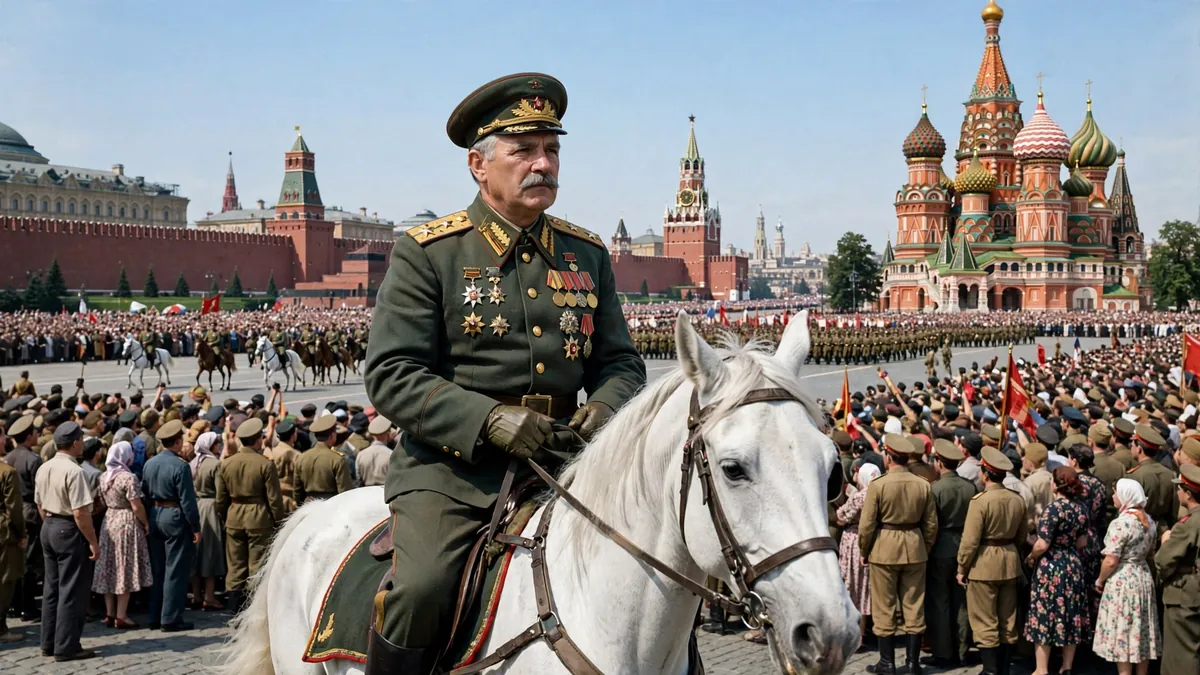
On 8 May 1945 he accepted the German surrender in Berlin on behalf of the Soviet Union, and on 24 June 1945 he took the salute at the Victory Parade in Red Square, riding a white horse.
Zhukov’s importance to the history of the Second World War is immense. The Soviet Union bore the overwhelming burden of the war against Germany — some 80 per cent of German combat deaths occurred on the Eastern Front — and Zhukov was the general who, more than any other, directed the great Soviet operations that destroyed the German army.
He was also a figure of controversy: his victories were won at an appalling cost in lives, his methods were brutal, and his relationship with Stalin was one of dependence and of fear. After the war he was, in turn, honoured and disgraced: Stalin, jealous of his popularity, demoted him and exiled him to a provincial command, and Khrushchev, who restored him in 1953, dismissed him again in 1957.
He died in 1974, largely forgotten by the Soviet leadership but remembered by the Soviet people as the marshal of victory. Historians debate whether he was a military genius or a blunt instrument who won by weight of numbers, but none dispute that his name is inseparable from the Soviet victory.
2. Key Facts
| Born | 1 December 1896, Strelkovka, Kaluga Governorate, Russian Empire |
| Died | 18 June 1974 (aged 77), Moscow, Soviet Union |
| Nationality | Soviet (Russian) |
| Role / Office | Chief of the General Staff (1941); commander of the Western Front (Moscow, 1941); Deputy Supreme Commander (1942–1945); commander of the 1st Belorussian Front (Berlin, 1945); Minister of Defence (1955–1957) |
| Known for | The defence of Moscow (1941); Stalingrad (1942–1943); Kursk (1943); Operation Bagration (1944); the capture of Berlin (1945); the Victory Parade (24 June 1945) |
| Spouse / Family | Alexandra Dievna Zuykova (married 1920, died 1967); daughters Era, Margarita, Maria; later companion Galina Semyonova |
| Military rank | Marshal of the Soviet Union (from January 1943) |
3. Early Life and Education
Georgy Konstantinovich Zhukov was born on 1 December 1896 in the village of Strelkovka, in the Kaluga Governorate, about a hundred miles south-west of Moscow, the son of Konstantin Zhukov, a poor peasant who worked as a shoemaker, and Ustin’ya Artemyevna, a peasant woman who worked as a labourer.
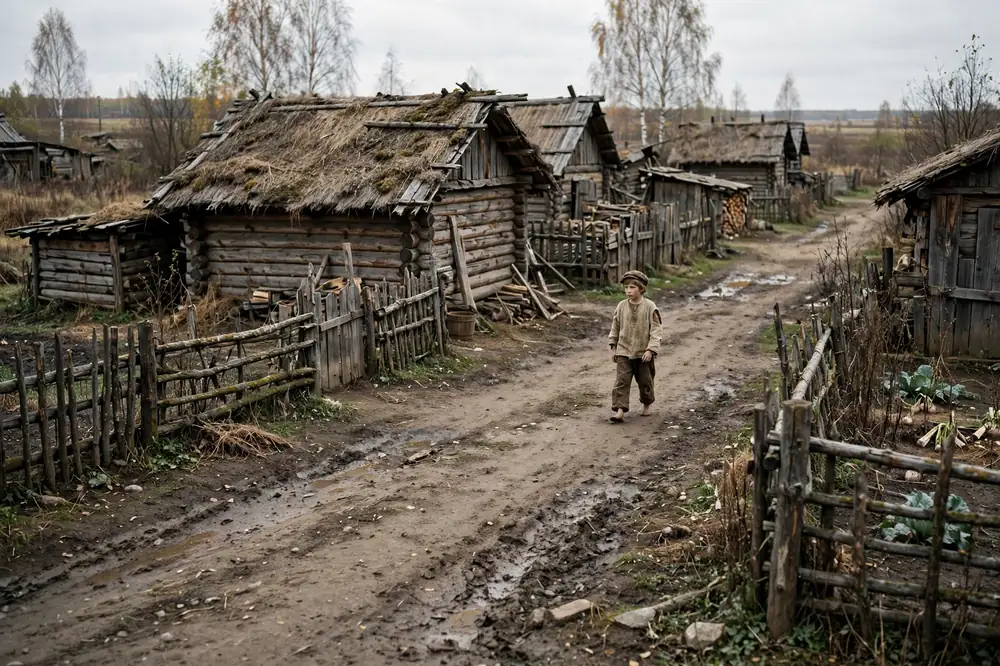
The family was very poor: the Zhukovs lived in a small wooden hut, and Georgy, like many peasant children, worked from an early age. He attended the local village school, where he was a good pupil, and at the age of eleven he was sent to Moscow to become an apprentice furrier — a trade that taught him discipline and hard work, and that he later said had taught him the value of a trade.
He was, by his own account, a strong and healthy boy, and he was interested in reading and in the military.
When the First World War broke out in 1914, Zhukov was conscripted into the Imperial Russian Army, and he served as a cavalryman in the 5th Reserve Cavalry Regiment and then in the 10th Novgorod Dragoon Regiment. He fought on the Eastern Front, and he was wounded and decorated twice with the Cross of St George, the Russian decoration for bravery.
He was a non-commissioned officer when the Russian Revolution broke out in 1917, and he joined the Red Army in 1918, fighting in the Russian Civil War as a cavalry commander. He fought against the White armies in the south and in the east, and he was wounded again and decorated with the Order of the Red Banner.
He was a tough and disciplined commander, and he rose steadily through the ranks: he commanded a cavalry regiment in the 1920s, a cavalry division in the early 1930s, and a cavalry corps in the late 1930s. He studied at the Frunze Military Academy in Moscow, and he was known as a demanding officer who insisted on discipline and on training, and who was not afraid to speak his mind to his superiors — a quality that would, in the years to come, both help him and endanger him.
In 1939 Zhukov was given his first great command: the Soviet forces in Mongolia, where Japan had launched an incursion at Khalkhin Gol, on the border between Mongolia and the Japanese puppet state of Manchukuo. Zhukov, who had never commanded a force of that size, organised a brilliant encirclement: in August 1939 he attacked the Japanese Sixth Army with tanks, aircraft and artillery, and he destroyed it, killing or capturing most of its men.
The victory at Khalkhin Gol was a turning point: it convinced the Japanese that the Soviet Union was too strong to attack, and it led Japan to turn south, towards the Pacific, rather than north, towards Siberia — a decision that had enormous consequences for the Second World War, since it meant that the Soviet Union did not have to fight a two-front war in 1941.
Zhukov was made a Hero of the Soviet Union for Khalkhin Gol, and he was appointed Chief of the General Staff in January 1941, five months before the German invasion.
4. Rise to Prominence
Zhukov’s rise to prominence was the story of the defence of Moscow. When Germany invaded the Soviet Union on 22 June 1941, in Operation Barbarossa, Zhukov was the Chief of the General Staff, and he was one of the few senior officers who understood the scale of the disaster: the German armies advanced hundreds of miles in weeks, encircling and destroying whole Soviet armies, and by the autumn of 1941 they were at the gates of Moscow.
Stalin, who had at first refused to believe the invasion was happening, turned to Zhukov in September 1941 and sent him to Leningrad, where the Germans were threatening the city, and Zhukov organised its defence — the city held, though it was besieged for nearly 900 days, and more than a million of its people died.
In October 1941 Stalin recalled Zhukov to Moscow and gave him command of the Western Front, with the task of defending the capital.
Zhukov’s defence of Moscow was a masterpiece of improvisation. He had few reserves, and he was forced to throw into the battle divisions that had been rushed from Siberia — divisions that Stalin released only after intelligence, from the spy Richard Sorge in Tokyo, confirmed that Japan would not attack Siberia.
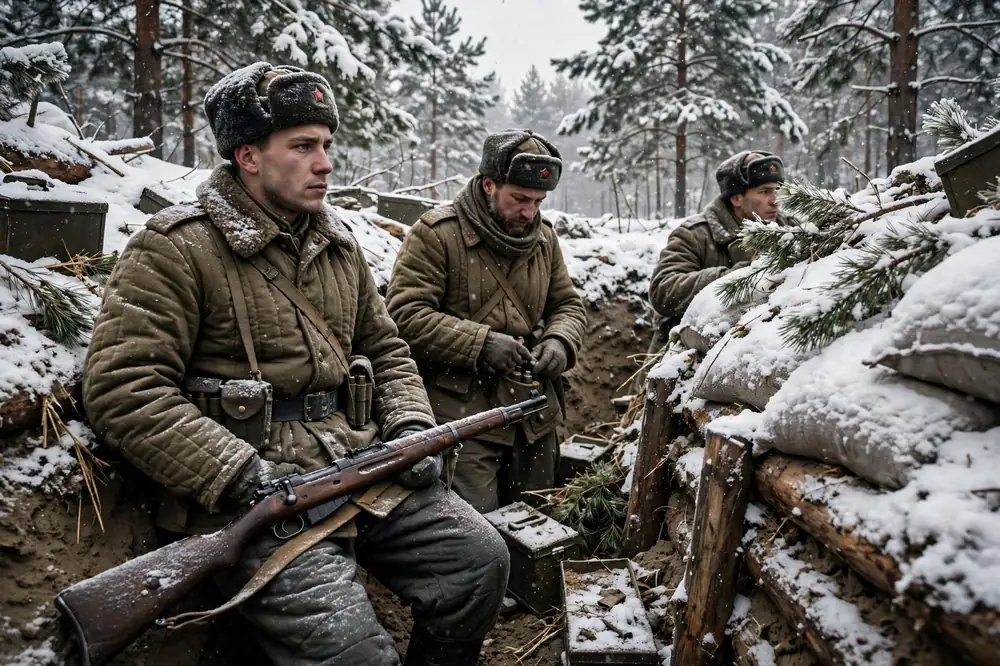
He organised the defence in depth, he used the winter — the coldest in decades — as a weapon, and on 5 December 1941, when the Germans were exhausted and frozen, he launched a counter-offensive that drove them back a hundred miles from Moscow. It was the first major defeat of the German army in the war, and it saved the Soviet capital.
Zhukov’s reputation was made: he was the general who had saved Moscow, and Stalin, who had once threatened to have him shot, now trusted him more than any other general.
In the years that followed, Zhukov became Stalin’s “fireman”: he was sent to every crisis, and he was given the task of coordinating the great operations of the war. He was, in effect, the deputy supreme commander, and he was present at every major decision.
He coordinated the encirclement at Stalingrad, he commanded at Kursk, he coordinated Operation Bagration — the destruction of German Army Group Centre in the summer of 1944, the greatest Soviet victory of the war — and he commanded the final assault on Berlin.
His rise was not only military but also political: he was, by 1945, the most popular man in the Soviet Union after Stalin himself, and his popularity was, in the end, his undoing.
5. Georgy Zhukov’s Role in World War II
Stalingrad and Kursk
Zhukov’s role at Stalingrad was that of the coordinator. In the autumn of 1942, while the German Sixth Army under General Friedrich Paulus fought its way into the ruins of Stalingrad on the Volga, Zhukov and the Chief of the General Staff, Alexander Vasilevsky, planned Operation Uranus: a great encirclement in which Soviet armies would attack the weak Romanian and Italian flanks to the north and south of the city, meet at Kalach, and trap the Sixth Army inside the city.
The operation was launched on 19 November 1942, and it succeeded brilliantly: within four days the encirclement was closed, and some 300,000 German and allied troops were trapped. The Germans attempted to break the encirclement in December, in Operation Winter Storm, but the attempt failed, and on 2 February 1943 the Sixth Army surrendered.
It was the greatest defeat the German army had suffered, and it marked the turn of the tide on the Eastern Front. Zhukov’s role was to coordinate the operation and to persuade Stalin to approve it — and to resist Stalin’s impatience, which had, in the past, led to premature offensives.
At Kursk, in July 1943, Zhukov commanded the Soviet defence against the last great German offensive on the Eastern Front, Operation Citadel. The Germans attacked the Kursk salient — a bulge in the front line — with some 900,000 men and 2,700 tanks, including the new Tiger and Panther tanks, and the Soviets, who had learned of the attack from intelligence, had prepared a defence in depth, with minefields, anti-tank guns and reserves.
The battle, which lasted from 5 to 23 July, was the largest tank battle in history, and it ended in a German defeat: the Germans lost, by most estimates, some 200,000 men and 1,500 tanks, and they never again launched a major offensive in the east.
Zhukov’s contribution was to insist on a defensive battle — to let the Germans exhaust themselves against the Soviet defences before counter-attacking — a decision that required him to resist the pressure from Stalin and from other generals to attack first. After Kursk, the initiative passed permanently to the Red Army, and the war in the east became a long Soviet advance to the west.
Bagration and Berlin
In the summer of 1944 Zhukov coordinated Operation Bagration, the Soviet offensive in Belorussia that destroyed German Army Group Centre — the largest German formation on the Eastern Front — and advanced the Red Army to the borders of Poland.
The operation, launched on 22 June 1944 — the third anniversary of the German invasion — was a masterpiece of deception: the Germans expected the main Soviet attack in the Ukraine, and they were caught unprepared in Belorussia. In six weeks the Soviets advanced some 600 kilometres, killed or captured some 400,000 German troops, and liberated Minsk and Vilnius.
It was, in the judgement of many historians, the greatest Soviet victory of the war, and it was also the operation that coincided with the Allied landings in Normandy — D-Day had taken place on 6 June, and Bagration ensured that the Germans could not transfer troops from the east to the west.
In April 1945 Zhukov commanded the 1st Belorussian Front in the final assault on Berlin. The operation, launched on 16 April, was the largest of the war: some 2.5 million Soviet troops, with 6,000 tanks and 7,500 aircraft, attacked the German defences on the Oder River and advanced on the capital.
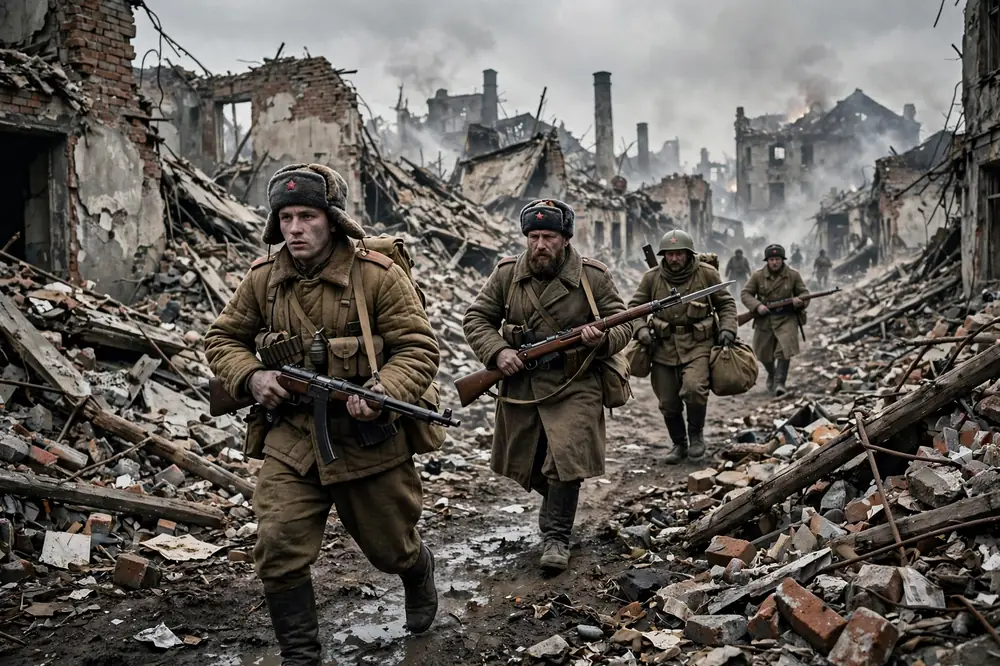
The fighting was ferocious: the Seelow Heights, the last defensive line before Berlin, were taken after three days of bloody fighting, and the battle for the city itself lasted from 23 April to 2 May, with house-to-house fighting and appalling casualties on both sides. On 30 April Hitler committed suicide in his bunker, and on 2 May the Berlin garrison surrendered.
On 8 May 1945, in a ceremony in the Berlin suburb of Karlshorst, Zhukov accepted the unconditional surrender of the German armed forces on behalf of the Soviet Union, and on 24 June he took the salute at the Victory Parade in Red Square. It was the culmination of his career, and of the Soviet war effort.
6. Key Decisions
Defending Moscow in depth (October–December 1941). Zhukov’s decision to organise the defence of Moscow in depth, to use the Siberian divisions, and to wait for the winter before counter-attacking, was the decision that saved the Soviet capital. It required him to resist Stalin’s demand for immediate counter-attacks, and it required him to husband his reserves for the moment when they would count.
The encirclement at Stalingrad (November 1942). Zhukov’s decision, with Vasilevsky, to plan Operation Uranus — the encirclement of the German Sixth Army — was the decision that turned the war. It was a bold plan, and it required Stalin’s approval, which Zhukov secured by presenting it as a limited operation and by insisting on the need for secrecy.
The defensive battle at Kursk (July 1943). Zhukov’s decision to fight a defensive battle at Kursk, to let the Germans exhaust themselves, was a decision that went against the Soviet tradition of the offensive and against Stalin’s instincts. It was vindicated by the result: the German offensive failed, and the Soviet counter-offensive that followed drove the Germans back to the Dnieper.
The assault on Berlin (April 1945). Zhukov’s decision to attack Berlin directly, in a frontal assault, was the most controversial of his career. The battle cost the Soviets, by most estimates, some 300,000 casualties, and critics have argued that Berlin could have been encircled and starved out, and that the assault was motivated by Zhukov’s rivalry with Marshal Ivan Konev, who was also advancing on the city, and by Stalin’s desire for a political prize. Zhukov’s defenders argue that the assault was necessary to end the war quickly and to prevent the Western Allies from taking Berlin first.
7. Controversies
The controversies over Zhukov are those of a general who won the war at an appalling cost, and they divide historians along the lines of the larger debate over the Soviet war effort. The first concerns the human cost of his victories.
Zhukov’s operations were characterised by massive frontal assaults, by the expenditure of men and material on a scale that no Western general would have contemplated, and by a willingness to accept casualties that shocked even his Soviet colleagues. The Soviet Union lost, by the most widely accepted estimates, some 27 million people in the war — military and civilian — and Zhukov’s operations accounted for a large part of that toll.
His critics, above all in the West, have called him a “butcher” and have argued that his victories were won by weight of numbers rather than by skill. His defenders reply that the Soviet Union faced an enemy that was, in 1941 and 1942, tactically superior, and that the only way to defeat it was by the methods Zhukov used, and that the cost, though terrible, was the price of survival.
The second controversy concerns Zhukov’s relationship with Stalin and with the Soviet system. Zhukov was, for most of the war, Stalin’s most trusted general, but he was also a man who lived in fear of Stalin: he was threatened with arrest, he was blamed for failures that were not his, and he was forced to accept decisions — above all the premature offensives of 1942 — that he knew were mistaken.
After the war, Stalin’s jealousy of his popularity led to his disgrace, and the pattern was repeated under Khrushchev. The controversy is whether Zhukov was a servant of a criminal regime or a soldier who served his country: he was, in the judgement of most historians, both, and the tension between the two is the central fact of his life.
The third controversy concerns the behaviour of the Red Army under Zhukov’s command, above all in the final months of the war, when Soviet troops committed widespread atrocities against German civilians — murder, rape and looting on a massive scale, notably in East Prussia and in Berlin.
Zhukov, as the commander of the 1st Belorussian Front, issued orders against looting and against the mistreatment of civilians, but the orders were, in many places, ignored, and the scale of the crimes was enormous. Historians debate the extent of Zhukov’s responsibility: he was the commander, and the crimes were committed by his troops, but he was also operating in a system that encouraged revenge, and Stalin himself had, in effect, sanctioned it.
The debate continues, and it is sharpened by the fact that the Soviet Union, for decades, suppressed any discussion of the crimes.
8. Later Life and Death
Zhukov’s later life was a story of honour and disgrace. After the war he was appointed commander of the Soviet occupation forces in Germany, and in 1946 he was made commander-in-chief of the Soviet ground forces. But Stalin, who was jealous of his popularity and who feared that he might become a political rival, moved against him: in 1946 Zhukov was accused of “Bonapartism” and of looting in Germany, and he was demoted to the command of the Odessa Military District, and then, in 1948, to the Urals Military District — a provincial post far from Moscow.
He remained in obscurity until Stalin’s death in March 1953, when he was recalled to Moscow by the new leadership and appointed First Deputy Minister of Defence. In 1955 he became Minister of Defence, and in 1957 he played a decisive role in saving Nikita Khrushchev from an attempt by his rivals to remove him: Zhukov flew the members of the Central Committee to Moscow in military aircraft, ensuring that Khrushchev had a majority.
But Khrushchev, like Stalin, came to fear Zhukov’s popularity, and in October 1957, while Zhukov was on a visit to Yugoslavia, he was dismissed from all his posts and retired from the army. He spent the last seventeen years of his life in retirement in Moscow, writing his memoirs — Reminiscences and Reflections — which were published in 1969 and which became a bestseller, though they were heavily censored by the Soviet authorities.
He died on 18 June 1974, aged seventy-seven, of a stroke, and he was buried in the Kremlin Wall Necropolis in Red Square, the highest honour the Soviet state could bestow.
9. Legacy of Georgy Zhukov
Zhukov’s legacy is the Soviet victory itself. In Russia today, he is remembered as the marshal of victory, the man who saved Moscow, who won Stalingrad and Kursk, and who took Berlin. His statue stands outside the State Historical Museum in Red Square, and his name is given to streets, to schools, and to a city in the Kaluga region.
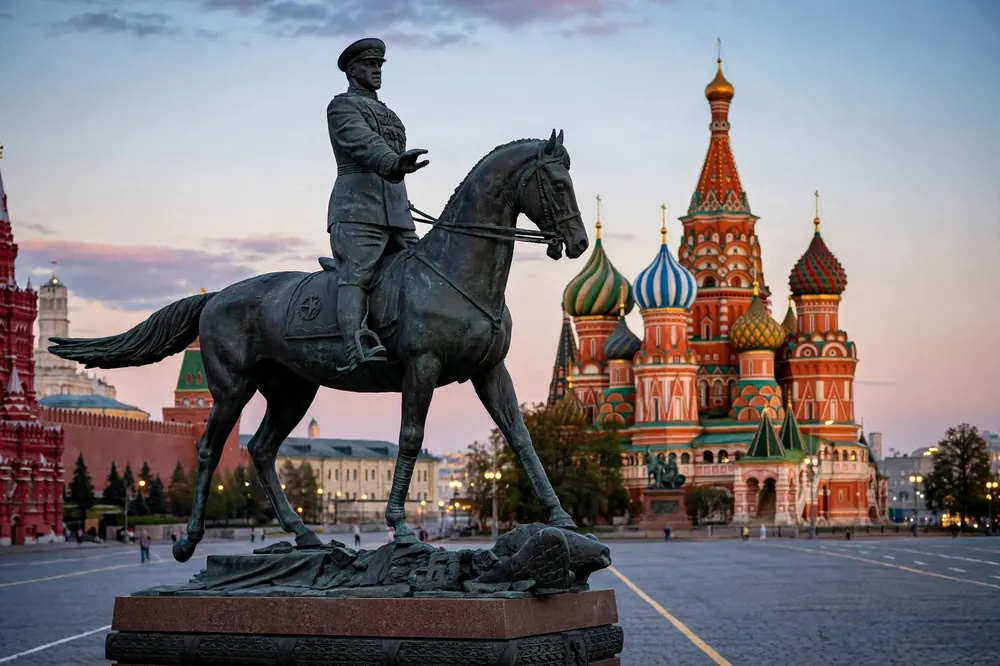
The Victory Parade of 24 June 1945, in which he rode a white horse, is commemorated every year on 9 May, Victory Day, and Zhukov’s image — the marshal on the white horse — is one of the most enduring images of the war in Russia.
His memoirs, though censored, remain one of the most widely read books in Russia, and his reputation has, if anything, grown since the fall of the Soviet Union: in the Russia of the twenty-first century, Zhukov is a symbol of national pride and of the sacrifice of the war generation.
Outside Russia, Zhukov’s legacy is more contested. In the West, he is respected as a general but criticised for the cost of his victories and for his service to Stalin’s regime. The debate over his legacy reflects the larger debate over the Soviet war effort: whether the Soviet Union’s victory was a triumph of the Soviet people or of the Soviet system, and whether the cost — 27 million dead — can ever be justified. Zhukov’s legacy is, in the end, the legacy of the Eastern Front itself: a victory of immense scale and immense cost, won by a general who was, in equal measure, a hero and a servant of a dictatorship.
10. Assessment by Historians
Historians assess Georgy Zhukov as the most successful general of the Second World War, and the assessment has been, on the whole, positive, though it has become more nuanced over time. In the Soviet Union, the official assessment was that Zhukov was a military genius, the architect of the victory, and his memoirs were presented as the definitive account of the war.
In the West, the assessment was, for many years, more sceptical: Zhukov was seen as a blunt instrument, a general who won by weight of numbers and by the willingness to accept casualties that no Western general would have accepted.
More recent scholarship, including the work of the British historian Geoffrey Roberts in Stalin’s General: The Life of Georgy Zhukov (2012), has taken a middle position: Zhukov was a general of real talent, who learned from his mistakes, who developed a sophisticated understanding of operational art, and who was, above all, a man who understood the political nature of the war he was fighting.
Roberts argues that Zhukov’s victories were not won by numbers alone, but by planning, by deception, and by the coordination of vast operations — and that his willingness to accept casualties was, in the context of the war the Soviet Union was fighting, a necessity rather than a choice.
The consensus today is that Zhukov was a great general and a flawed man: a man who saved his country, who won the war, and who did so at a cost that remains, to this day, difficult to comprehend. He is remembered, in Russia, as a hero, and in the West, as a general who, for all his faults, was the man who broke the German army. The verdict, if one can be given, is that Zhukov was the right general for the war the Soviet Union had to fight — a war of survival, in which defeat meant annihilation — and that his greatness lies not in his elegance but in his determination.
Frequently Asked Questions
Who was Georgy Zhukov?
Georgy Zhukov (1896–1974) was the Soviet marshal who commanded the defence of Moscow in 1941, coordinated the victory at Stalingrad, commanded at Kursk, and led the final assault on Berlin in 1945. He was the most successful general of the Second World War.
What was Zhukov’s role at Stalingrad?
Zhukov, with Alexander Vasilevsky, planned Operation Uranus, the encirclement of the German Sixth Army in November 1942. The operation trapped some 300,000 German and allied troops, and the Sixth Army surrendered on 2 February 1943.
What happened at Kursk?
At Kursk in July 1943, Zhukov commanded the Soviet defence against Operation Citadel, the last great German offensive in the east. It was the largest tank battle in history, and it ended in a German defeat from which the German army never recovered.
How did Zhukov take Berlin?
In April 1945 Zhukov commanded the 1st Belorussian Front in the assault on Berlin. His forces broke through the Seelow Heights, fought house-to-house in the city, and on 2 May the Berlin garrison surrendered. On 8 May Zhukov accepted the German surrender on behalf of the Soviet Union.
Why was Zhukov disgraced after the war?
Stalin was jealous of Zhukov’s popularity and feared him as a political rival. In 1946 Zhukov was accused of “Bonapartism” and demoted to provincial commands. He was restored after Stalin’s death, but Khrushchev dismissed him again in 1957.
What was the Victory Parade of 1945?
On 24 June 1945, Zhukov took the salute at the Victory Parade in Red Square, Moscow, riding a white horse. It was the celebration of the Soviet victory over Nazi Germany, and it remains one of the most famous images of the war.
Related articles
Sources
- Wikipedia, “Georgy Zhukov” — consolidated biography: birth 1 December 1896, death 18 June 1974, Moscow, Stalingrad, Kursk, Bagration, Berlin, Victory Parade.
- Encyclopaedia Britannica, “Georgy Zhukov” (britannica.com) — biography, defence of Moscow, Stalingrad, Berlin.
- Geoffrey Roberts, Stalin’s General: The Life of Georgy Zhukov (Random House, 2012) — the standard modern biography in English.
- Georgy Zhukov, Reminiscences and Reflections (Progress Publishers, 1969; English edition, 1971) — Zhukov’s memoirs, heavily censored in the Soviet edition.
- David M. Glantz and Jonathan House, When Titans Clashed: How the Red Army Stopped Hitler (University Press of Kansas, 1995) — the Eastern Front; Stalingrad, Kursk, Bagration, Berlin.
- Albert Axell, Marshal Zhukov: The Man Who Beat Hitler (Longman, 2003) — biography; the post-war disgrace.
- Otto Preston Chaney, Zhukov (University of Oklahoma Press, 1971) — early English biography.
Further reading
- William J. Spahr, Zhukov: The Rise and Fall of a Great Captain (Presidio Press, 1993).
- Boris Sokolov, Marshal Zhukov: The Man Who Knew No Fear (in Russian; English summary in Roberts, 2012).