 WAR ATLAS MILITARY HISTORY MAGAZINE · WWI — WWII
Chester W. Nimitz
1. Lead
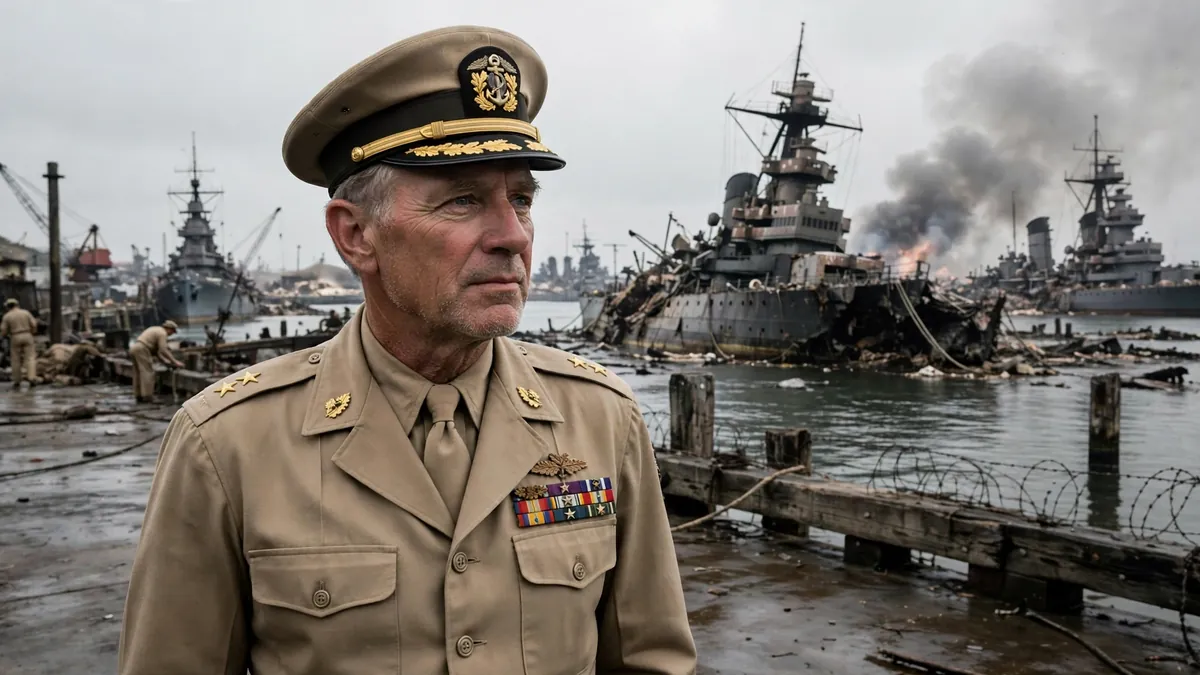
Chester W. Nimitz (24 February 1885 – 20 February 1966) was the American admiral who commanded the United States Pacific Fleet and the Pacific Ocean Areas throughout the Second World War, and who directed the naval campaign that defeated Japan.
Born in Fredericksburg, Texas, the son of a hotel keeper, and educated at the United States Naval Academy at Annapolis, he was a submarine officer in his early career and an expert on diesel engines and on naval administration. On 31 December 1941, three weeks after the Japanese attack on Pearl Harbor, he took command of the Pacific Fleet, relieving Admiral Husband Kimmel, whose fleet had been destroyed in the attack.
From his headquarters at Pearl Harbor, Nimitz rebuilt the fleet, and in June 1942 he won the Battle of Midway — the decisive naval battle of the Pacific war, in which the Japanese lost four aircraft carriers and the initiative passed to the United States.
In the years that followed he directed the island-hopping campaign across the Central Pacific — the Gilberts, the Marshalls, the Marianas, Iwo Jima and Okinawa — and the great naval battles of the Philippine Sea and of Leyte Gulf, the largest naval battle in history.
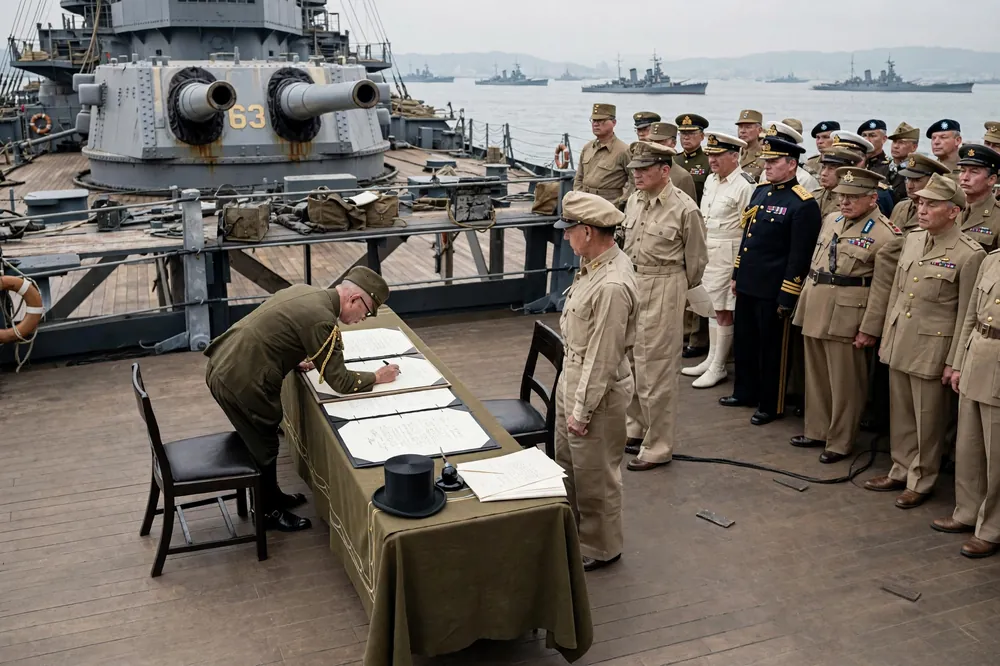
On 2 September 1945 he was present aboard the battleship USS Missouri in Tokyo Bay when the Japanese surrender was signed, and he signed the surrender document on behalf of the United States.
Nimitz’s importance to the history of the Second World War is that of the commander who won the Pacific war at sea. The Pacific war was, above all, a naval war — a war of carriers, of submarines and of amphibious landings across thousands of miles of ocean — and Nimitz was the man who directed it, from Pearl Harbor to Tokyo Bay.
He was also a commander of a particular kind: quiet, calm, and methodical, a man who trusted his subordinates, who listened to intelligence, and who was willing to take a calculated risk when the evidence justified it. His decision at Midway — to commit his three carriers to an ambush of the Japanese fleet, on the basis of intelligence that many of his superiors doubted — was one of the great gambles of the war, and it was vindicated by the result.
Historians debate whether Nimitz was a great strategist or merely a competent administrator who presided over a victory made inevitable by American industrial power, but none dispute that he was the central figure in the Pacific war, and that his leadership — above all his calm in the dark months of 1942 — was essential to the victory.
2. Key Facts
| Born | 24 February 1885, Fredericksburg, Texas, United States |
| Died | 20 February 1966 (aged 80), Yerba Buena Island, San Francisco Bay, California, United States |
| Nationality | American |
| Role / Office | Commander in Chief, United States Pacific Fleet and Pacific Ocean Areas (31 December 1941 – 1945); Chief of Naval Operations (1945–1947) |
| Known for | Rebuilding the Pacific Fleet after Pearl Harbor; the Battle of Midway (June 1942); the Central Pacific island-hopping campaign; the Battle of Leyte Gulf (October 1944); signing the Japanese surrender aboard USS Missouri (2 September 1945) |
| Spouse / Family | Catherine Vance Freeman (married 1913, died 1979); children Chester Jr., Anna, Mary and Catherine; father Chester B. Nimitz, a hotel keeper |
| Military rank | Fleet Admiral (five stars, from December 1944) |
3. Early Life and Education
Chester William Nimitz was born on 24 February 1885 in Fredericksburg, a German-settled town in the Texas Hill Country, the son of Chester Bernard Nimitz, who managed the Nimitz Hotel, and Anna Henke Nimitz. His grandfather, Charles Henry Nimitz, had been a German immigrant who became a Texas Ranger and a hotel keeper, and the young Chester grew up in the hotel, where he learned, from an early age, the value of hard work and of dealing with people.
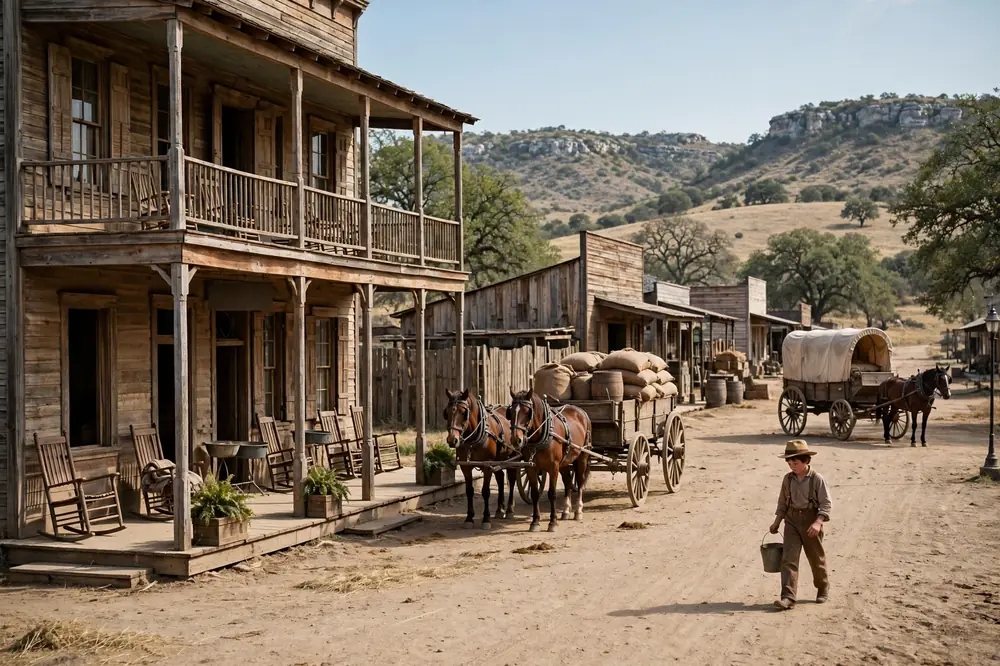
He was a bright and serious boy, and he wanted, at first, to go to West Point — the Military Academy — but there was no appointment available, and he was, instead, given an appointment to the Naval Academy at Annapolis, Maryland.
He entered the Academy in 1901, at the age of sixteen, and he graduated in 1905, seventh in a class of 114, a record that marked him as one of the most promising officers of his year.
Nimitz’s early naval career was spent, above all, in submarines. He served in the battleship USS Ohio and then, in 1909, he was given command of the submarine USS Plunger, and he became one of the Navy’s first submarine officers.
He was, in the years before the First World War, an expert on submarines and on diesel engines — he had studied diesel engineering in Germany, at the Maschinenfabrik Augsburg-Nürnberg (MAN) works, and he had supervised the building of the Navy’s first diesel-powered submarine, the USS Maumee.
In the First World War he served as the chief of staff to the commander of the Atlantic submarine force, and he was, by the end of the war, a commander. In the interwar years he served in a series of posts — as the commander of the battleship USS Arizona, as the chief of the Bureau of Navigation in Washington, and as the commander of the Battle Force — and he was known as a calm, methodical and thoroughly professional officer, a man who understood both the technical and the administrative sides of the Navy.
He was, in the words of one of his colleagues, “a man who never raised his voice, and who never made a mistake”.
4. Rise to Prominence
Nimitz’s rise to prominence came in the darkest moment of the Pacific war. On 7 December 1941 the Japanese attacked Pearl Harbor, sinking or damaging eight battleships and killing more than 2,400 Americans, and the Pacific Fleet was, in effect, destroyed. Admiral Husband Kimmel, the fleet’s commander, was relieved, and on 17 December 1941 President Roosevelt appointed Nimitz to succeed him.
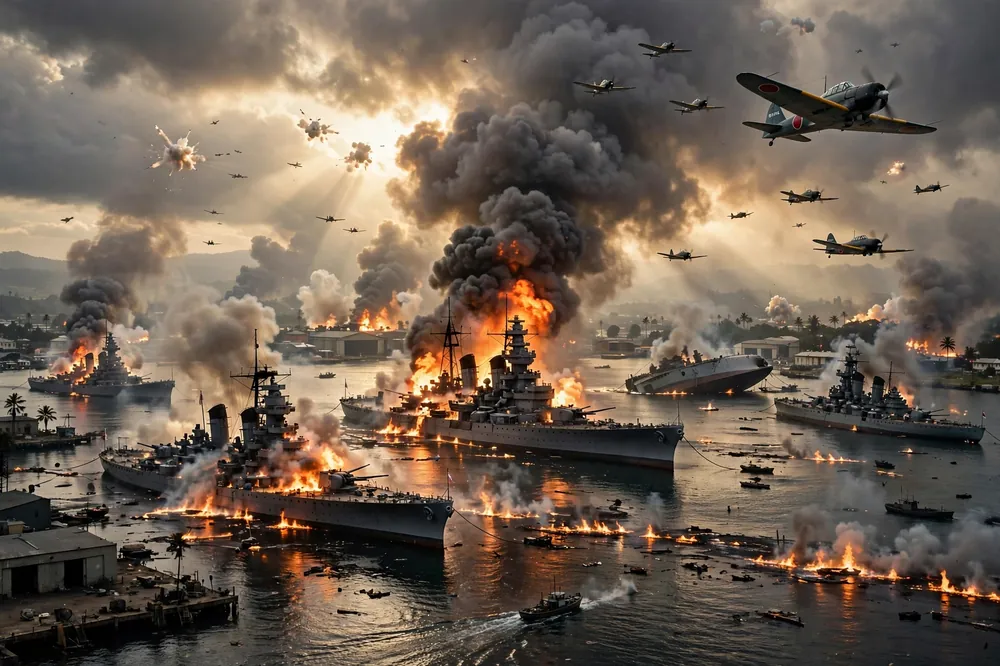
Nimitz took command on 31 December 1941, arriving at Pearl Harbor to find a scene of devastation: the battleships were sunk or burning, the harbour was full of wreckage, and the morale of the fleet was at its lowest. His first act was, in the words of one of his officers, to restore confidence: he toured the harbour, he talked to the men, and he told them that the fleet would be rebuilt.
He also made a decision that would shape the war: he kept the fleet’s carriers — the Enterprise, the Lexington and the Saratoga — at sea, and he refused to risk them in a premature battle. The carriers, which had been at sea on 7 December and had escaped the attack, were the future of the Pacific war, and Nimitz’s protection of them was, in the judgement of historians, the most important decision of the early war.
In the spring of 1942 Nimitz’s fleet fought its first battles: the Battle of the Coral Sea in May 1942, in which the Americans and the Japanese fought the first carrier battle in history — a battle fought entirely by aircraft, with the ships never seeing each other — and in which the Japanese invasion of Port Moresby was turned back, though the American carrier Lexington was lost.
And then, in June 1942, the Battle of Midway, in which Nimitz’s gamble — to commit his three carriers to an ambush of the Japanese fleet, on the basis of intelligence that the Japanese intended to attack Midway — won the decisive victory of the Pacific war.
Nimitz’s rise, from the commander of a shattered fleet to the victor of Midway, took six months, and it was the rise of a man who, in the words of the historian Walter Lord, “never lost his nerve”.
5. Chester W. Nimitz’s Role in World War II
Midway
The Battle of Midway, fought from 4 to 7 June 1942, was Nimitz’s masterpiece and the turning point of the Pacific war. The Japanese, under Admiral Isoroku Yamamoto, intended to lure the American carriers into a trap: they would attack the island of Midway, in the Central Pacific, and when the Americans came to its defence, the Japanese fleet — with four large carriers, the Akagi, the Kaga, the Soryu and the Hiryu — would destroy them.
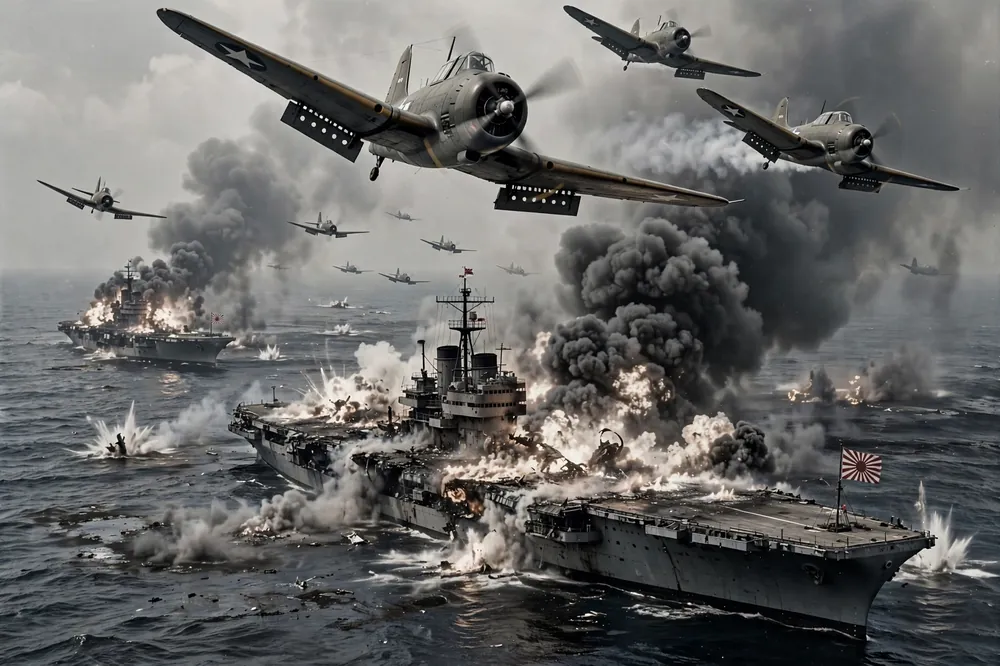
Nimitz, however, knew the Japanese plan: the American codebreakers at Pearl Harbor, under Commander Joseph Rochefort, had broken the Japanese naval code, JN-25, and had determined that “AF” — the target of the Japanese operation — was Midway. Nimitz, who trusted Rochefort’s intelligence, positioned his three carriers — the Enterprise, the Hornet and the Yorktown — north-east of Midway, in ambush, and he ordered his aircraft to attack the Japanese carriers when they were at their most vulnerable, with their decks crowded with aircraft being refuelled and rearmed.
The battle was a triumph of intelligence and of courage. On the morning of 4 June, American dive-bombers from the Enterprise and the Yorktown — led by Lieutenant Commander Wade McClusky and by Lieutenant Commander Max Leslie — found the Japanese carriers and, in the space of a few minutes, sank three of them, the Akagi, the Kaga and the Soryu.
The fourth, the Hiryu, launched a counter-attack that crippled the Yorktown, but it was, in turn, sunk by American aircraft later in the day. The Japanese lost four carriers, some 250 aircraft and more than 3,000 men, including many of their best pilots; the Americans lost one carrier, the Yorktown, and some 300 men.
The battle was, in the words of the historian Samuel Eliot Morison, “the most decisive naval battle since Trafalgar”, and it changed the course of the war: Japan, which had begun the war with six large carriers, now had two, and it never regained the initiative in the Pacific.
Nimitz’s decision to trust the intelligence and to risk his carriers was the gamble that won the battle, and it was a gamble that he took against the advice of many of his superiors in Washington, who doubted Rochefort’s analysis.
The island-hopping campaign
After Midway, Nimitz directed the Central Pacific campaign — the “island-hopping” advance across the Pacific towards Japan. The strategy was to capture key islands, to build airfields on them, and to bypass the Japanese strongholds that could be left to wither — a strategy that was, in the judgement of historians, both efficient and humane, since it avoided the cost of attacking every Japanese-held island.
The campaign began with the invasion of the Gilbert Islands in November 1943 — the Battle of Tarawa, in which the Americans suffered heavy casualties in taking the island of Betio — and it continued with the invasion of the Marshall Islands in January–February 1944, the Marianas in June–July 1944 — including the Battle of the Philippine Sea, the “Great Marianas Turkey Shoot”, in which the Japanese carrier air force was destroyed — and the invasions of Iwo Jima in February–March 1945 and of Okinawa in April–June 1945.
The campaign was directed by Nimitz from Pearl Harbor and, later, from Guam, and it was carried out by the Fifth Fleet, under Admiral Raymond Spruance, and the Third Fleet, under Admiral William Halsey, who alternated in command of the same ships.
Nimitz’s role was to direct the strategy, to allocate the resources, and to manage the rivalry between his two fleet commanders — a rivalry that, at Leyte Gulf in October 1944, nearly led to disaster.
Leyte Gulf
The Battle of Leyte Gulf, fought from 23 to 26 October 1944, was the largest naval battle in history, and it was the battle in which the Japanese navy was, in effect, destroyed. The Japanese, in a desperate plan, sent their remaining fleet — including the great battleships Yamato and Musashi — to attack the American invasion force at Leyte, in the Philippines, and they used their carriers as a decoy to lure Halsey’s Third Fleet away to the north.
Halsey took the bait, and the Japanese battleships, under Admiral Takeo Kurita, broke through the San Bernardino Strait and attacked the American escort carriers off Samar — the Battle off Samar, in which a small force of American escort carriers and destroyers fought off the Japanese battleships in one of the most heroic actions of the war.
Nimitz, who was at Pearl Harbor, sent Halsey a message — “Where is Task Force 34? The world wonders” — a message that, in its garbled form, seemed to be a rebuke, and that Halsey, who was furious, took an hour to answer.
The Japanese, in the end, withdrew, and the battle was an American victory: the Japanese lost three battleships, four carriers and ten cruisers, and they never again fought a major naval battle. Nimitz’s role at Leyte Gulf has been debated — his message to Halsey was, in the judgement of some historians, a mistake, and his failure to clarify the command arrangements was a factor in the confusion — but the battle was won, and the Japanese navy was broken.
6. Key Decisions
Protecting the carriers (December 1941). Nimitz’s decision, on taking command, to keep the Pacific Fleet’s carriers at sea and to refuse to risk them in a premature battle, was the decision that preserved the weapon with which the Pacific war would be won. The battleships had been destroyed at Pearl Harbor; the carriers had survived, and Nimitz understood that they were the future.
Trusting the intelligence at Midway (June 1942). Nimitz’s decision to act on Rochefort’s intelligence — that the Japanese intended to attack Midway — and to commit his three carriers to an ambush, was the gamble that won the decisive battle of the Pacific war. It was a decision that required him to overrule the doubts of his superiors in Washington, and to risk the fleet on the word of a codebreaker.
The island-hopping strategy (1943–1945). Nimitz’s decision to adopt the island-hopping strategy — to capture key islands and to bypass the Japanese strongholds — was the strategy that brought the Americans to Japan’s doorstep with the minimum of cost. It was a strategy that required patience and discipline, and it was vindicated by the result.
The surrender aboard the Missouri (2 September 1945). Nimitz’s decision, as the representative of the United States, to sign the Japanese surrender aboard the battleship Missouri in Tokyo Bay, was the act that closed the war. He signed the document with the pen that had been used by the Japanese representatives, and he did so in a ceremony that was, in the words of one observer, “a moment of history”.
7. Controversies
Nimitz’s career was, by the standards of the Second World War, remarkably free of controversy, but there are debates about his judgements, and they are worth stating plainly. The first concerns the Battle of Leyte Gulf and his message to Halsey. Nimitz’s message — “Where is Task Force 34?
The world wonders” — was, in its garbled form, taken by Halsey as a rebuke, and it has been criticised as a failure of communication. Nimitz’s defenders argue that the message was a legitimate enquiry, that the garbling was the fault of the communications staff, and that Nimitz’s real failure was in not clarifying the command arrangements before the battle.
His critics argue that he should have been more direct with Halsey, and that the confusion at Leyte Gulf was, in part, his responsibility.
The second controversy concerns the rivalry between Nimitz and MacArthur. The Pacific war was fought under two commands — Nimitz’s Pacific Ocean Areas and MacArthur’s Southwest Pacific Area — and the two commanders were rivals for resources and for the direction of the war. Nimitz’s defenders argue that his Central Pacific drive was the decisive campaign, and that MacArthur’s return to the Philippines was, in strategic terms, unnecessary. MacArthur’s defenders argue the opposite. The debate reflects the larger question of the Pacific strategy, and it is unlikely to be settled: both campaigns contributed to the victory, and both commanders were, in the end, successful.
The third controversy is about the atomic bomb. Nimitz, like many senior officers, was not consulted about the decision to use the atomic bomb, and he later said that he believed Japan was already defeated and that the bomb was unnecessary. His view — which was shared by Admiral William Leahy and by General Eisenhower — has been cited by historians who argue that the bomb was not needed to end the war, and it has been contested by historians who argue that it was. Nimitz’s position on the bomb is a reminder that the men who won the war did not always agree with the decisions that ended it.
8. Later Life and Death
After the war, Nimitz served as Chief of Naval Operations from December 1945 to December 1947, the Navy’s highest post, and he guided the Navy through the difficult transition to peacetime — the demobilisation of millions of men, the reduction of the fleet, and the beginning of the Cold War.
He retired in 1947, and he spent his remaining years in California, where he lived on Yerba Buena Island in San Francisco Bay, in the house that had been the commandant’s quarters when he was the commandant of the naval station.
He served as a special assistant to the Secretary of the Navy, he worked for the United Nations as a plebiscite administrator in Kashmir — a post he held from 1949 to 1950, though the plebiscite was never held — and he was active in civic affairs in San Francisco.
He was, in his retirement, a modest and unassuming man, and he was widely respected: he was, in the words of one of his biographers, “the most respected man in the Navy”.
Nimitz died on 20 February 1966, four days before his eighty-first birthday, of a stroke, at his home on Yerba Buena Island. He was buried at Golden Gate National Cemetery in San Bruno, California, beside his wife Catherine, who survived him by thirteen years and died in 1979, and was buried beside him. Nimitz’s funeral was a naval occasion, and he was honoured by the Navy he had led. His papers are preserved at the Naval History and Heritage Command, and his name is given to the aircraft carrier USS Nimitz (CVN-68), the lead ship of the Nimitz class, the largest class of aircraft carriers ever built, and to the Nimitz Freeway in California.
9. Legacy of Chester W. Nimitz
Nimitz’s legacy is the United States Navy’s victory in the Pacific, and the Navy that won it. The Pacific Fleet he rebuilt, the carriers he protected, and the strategy he directed — island-hopping, the Central Pacific drive, the great carrier battles — remain the foundation of American naval doctrine, and they are studied, to this day, at the Naval War College.
The aircraft carrier USS Nimitz, commissioned in 1975, is the lead ship of the class that bears his name, and it is, in the judgement of the Navy, a fitting tribute: the Nimitz class is the largest and most powerful class of warships ever built, and it is the instrument by which the United States projects its power across the oceans, as Nimitz’s fleet did in the Second World War.
His legacy is also a legacy of leadership. Nimitz was known, in the Navy, as a commander who trusted his subordinates, who listened to intelligence, and who remained calm under pressure — qualities that are, in the Navy’s culture, the model of command. The Nimitz Museum in Fredericksburg, Texas — the National Museum of the Pacific War — stands on the site of the Nimitz Hotel where he grew up, and it is one of the most visited military museums in the United States. His name is also remembered in the words of the historian Samuel Eliot Morison, who called Midway “the most decisive naval battle since Trafalgar”, and who called Nimitz “the admiral who won it”.
10. Assessment by Historians
Historians assess Chester Nimitz as one of the great naval commanders of the Second World War, and the assessment has been consistently positive. The naval historian Samuel Eliot Morison, who wrote the official history of the United States Navy in the Second World War, called Nimitz “a great commander”, and he called Midway “the most decisive naval battle since Trafalgar”. E. B.
Potter, in his biography Nimitz (1976), called him “the admiral who won the Pacific war”, and argued that his contribution — above all his calm, his trust in intelligence, and his willingness to take a calculated risk at Midway — was the decisive factor in the victory.
The judgement rests on a combination of qualities: Nimitz was a strategist who understood the nature of the Pacific war, a commander who trusted his subordinates, and a leader who remained calm in the darkest months of the war.
The assessment is not without qualification. Some historians have argued that Nimitz’s victory was made inevitable by American industrial power — that the United States, which built more than a hundred aircraft carriers during the war, could not have lost — and that Nimitz’s role was that of an administrator rather than a strategist.
Others have argued that his handling of Leyte Gulf was flawed, and that his message to Halsey was a mistake. But the consensus is that Nimitz was a commander of exceptional ability and of exceptional character: a man who, in the darkest moment of the war, rebuilt a shattered fleet, trusted his intelligence officers, and won the decisive battle of the Pacific.
He is remembered, in the Navy, as the admiral who, in the words of his own epitaph, “served his country well”.
Frequently Asked Questions
Who was Chester Nimitz?
Chester Nimitz (1885–1966) was the American admiral who commanded the Pacific Fleet and the Pacific Ocean Areas throughout the Second World War. He rebuilt the fleet after Pearl Harbor, won the Battle of Midway in June 1942, and signed the Japanese surrender aboard USS Missouri on 2 September 1945.
What was the Battle of Midway?
Fought from 4 to 7 June 1942, it was the decisive naval battle of the Pacific war. Nimitz, acting on intelligence that the Japanese intended to attack Midway, ambushed the Japanese fleet with three carriers and sank four Japanese carriers, at the cost of one American carrier, the Yorktown. Japan never regained the initiative in the Pacific.
How did Nimitz know the Japanese plan at Midway?
American codebreakers at Pearl Harbor, under Commander Joseph Rochefort, had broken the Japanese naval code JN-25 and had determined that “AF”, the target of the Japanese operation, was Midway. Nimitz trusted their analysis and positioned his carriers in ambush.
What was the island-hopping campaign?
It was Nimitz’s Central Pacific strategy of capturing key islands, building airfields on them, and bypassing Japanese strongholds that could be left to wither. It included the Gilberts, the Marshalls, the Marianas, Iwo Jima and Okinawa, and it brought the Americans to Japan’s doorstep.
What happened at Leyte Gulf?
Fought from 23 to 26 October 1944, it was the largest naval battle in history. The Japanese navy was effectively destroyed, losing three battleships, four carriers and ten cruisers. Nimitz’s message to Halsey — “Where is Task Force 34? The world wonders” — became famous for the confusion it caused.
Where is Nimitz buried?
He is buried at Golden Gate National Cemetery in San Bruno, California, beside his wife Catherine. The aircraft carrier USS Nimitz (CVN-68) and the National Museum of the Pacific War in his hometown of Fredericksburg, Texas, are named for him.
Related articles
Sources
- Wikipedia, “Chester W. Nimitz” — consolidated biography: birth 24 February 1885, death 20 February 1966, Pacific Fleet, Midway, Leyte Gulf, surrender aboard USS Missouri.
- Encyclopaedia Britannica, “Chester W. Nimitz” (britannica.com) — biography, Midway, island-hopping, Leyte Gulf.
- E. B. Potter, Nimitz (Naval Institute Press, 1976) — the standard biography; Pearl Harbor, Midway, the Central Pacific campaign, Leyte Gulf.
- Samuel Eliot Morison, History of United States Naval Operations in World War II, Volume IV: Coral Sea, Midway and Submarine Actions (Little, Brown, 1949) — the official history; Coral Sea and Midway.
- Walter Lord, Incredible Victory: The Battle of Midway (Harper & Row, 1967) — the classic account of Midway and of Rochefort’s intelligence.
- Thomas B. Buell, The Quiet Warrior: A Biography of Admiral Raymond A. Spruance (Little, Brown, 1974) — the Central Pacific campaign and the Spruance–Halsey alternation.
- Naval History and Heritage Command, “Chester W. Nimitz” (history.navy.mil) — official biography and the Nimitz-class carriers.
Further reading
- Craig L. Symonds, The Battle of Midway (Oxford University Press, 2011).
- Ian W. Toll, Pacific Crucible: War at Sea in the Pacific, 1941–1942 (W. W. Norton, 2011).