 WAR ATLAS MILITARY HISTORY MAGAZINE · WWI — WWII
Hawker Typhoon: The RAF’s Rocket-Firing Tank-Buster
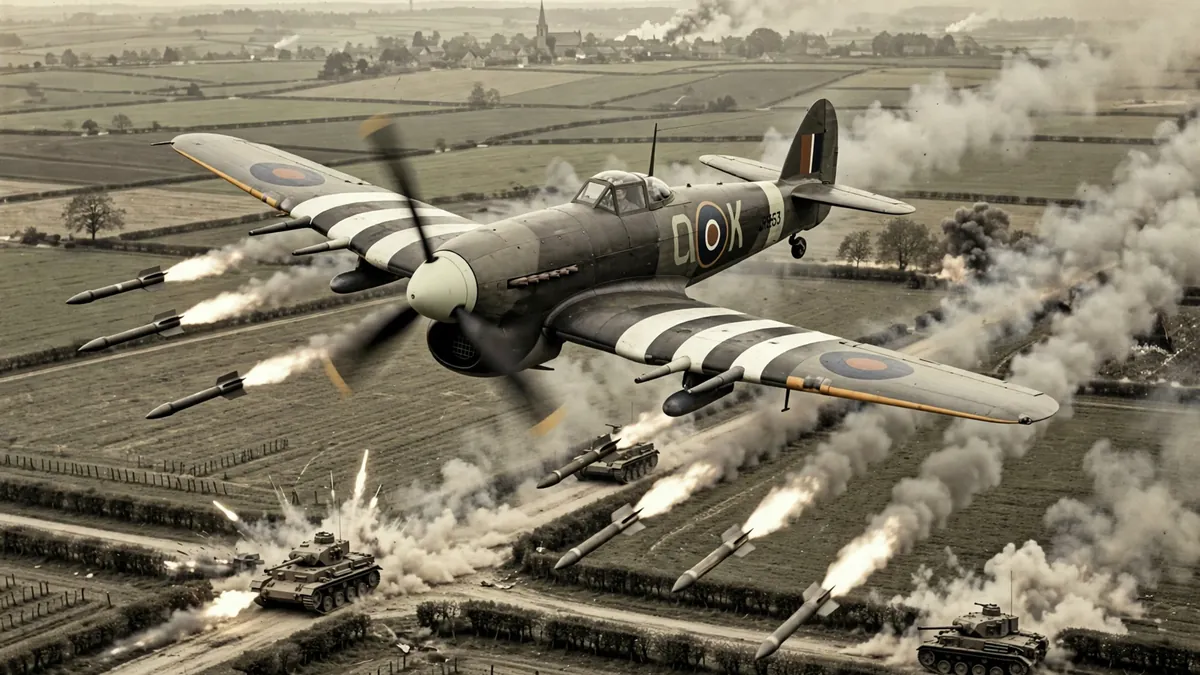
The Hawker Typhoon was a British single-seat fighter-bomber of the Second World War, designed by Sydney Camm at Hawker Aircraft and powered by the huge 24-cylinder Napier Sabre engine. It entered service with the Royal Air Force in 1941 as a high-altitude interceptor intended to replace the Hurricane, but it found its true role at low level, where its speed, its rugged construction and its heavy armament made it one of the most feared ground-attack aircraft of the war. Armed with four 20 mm cannon and, later, with eight rocket projectiles or two 1,000-pound bombs, the Typhoon became the RAF’s principal tank-buster, and its rocket attacks on German armour in Normandy in the summer of 1944 are among the most famous air operations of the war.
The Typhoon’s career was shaped by its engine. The Napier Sabre was the most powerful aero engine in service when the Typhoon entered production, producing over 2,000 horsepower, but it was also unreliable, and the Typhoon’s early service was marred by engine failures and by structural failures of the rear fuselage that cost the lives of several pilots. The aircraft was nearly cancelled. What saved it was the discovery that at low altitude it was faster than any other British fighter, and that its heavy armament and stable gun platform made it ideal for attacking ground targets. By 1944 the Typhoon was the RAF’s main close-support aircraft, and its squadrons flew thousands of sorties in support of the Allied armies in Normandy, the Low Countries and Germany.
The Typhoon is remembered today as a symbol of the RAF’s tactical air power and as the predecessor of the Hawker Tempest, one of the finest fighters of the war. A total of 3,317 Typhoons were built, and the aircraft served in the RAF and in Commonwealth air forces until the end of the war. A single complete Typhoon survives, under restoration, and the aircraft’s reputation — as the “Tiffy” that the soldiers on the ground called for when German tanks appeared — has endured in the memory of the Normandy campaign.
1. Key Facts
| Field | Value |
|---|---|
| Type | Single-seat fighter-bomber |
| Origin | United Kingdom |
| Designer | Sydney Camm, Hawker Aircraft |
| First flight | 24 February 1940 |
| In service | 1941–1945 (RAF) |
| Produced | 3,317 |
| Manufacturers | Hawker Aircraft, Gloster Aircraft |
| Crew | 1 (pilot) |
| Engine | Napier Sabre IIA/IIB/II, 24-cylinder H-block liquid-cooled, approximately 2,180–2,260 hp |
| Length | Approximately 9.73 m (31 ft 11 in) |
| Wingspan | Approximately 12.67 m (41 ft 7 in) |
| Height | Approximately 4.67 m (15 ft 4 in) |
| Weight | Approximately 5,170 kg empty; approximately 6,350 kg loaded (maximum about 6,900 kg) |
| Maximum speed | Approximately 663 km/h (412 mph) at 5,800 m; approximately 640 km/h at low level |
| Range | Approximately 1,510 km (940 miles) with drop tanks; approximately 820 km on internal fuel |
| Service ceiling | Approximately 10,700 m (35,000 ft) |
| Armament | 4 × 20 mm Hispano Mk II cannon (140 rounds per gun); 8 × 60 lb RP-3 rockets or 2 × 500 lb or 1,000 lb bombs |
| Notable users | RAF, Royal Canadian Air Force, Royal New Zealand Air Force |
| Fate | Replaced by the Hawker Tempest; last RAF Typhoons retired 1945; one complete survivor under restoration |
2. Background and Development
The Search for a Hurricane Successor
The Typhoon was designed in 1937 as a successor to the Hawker Hurricane, the RAF’s first monoplane fighter. The Air Ministry’s specification F.18/37 called for a fighter armed with twelve machine guns or four 20 mm cannon and powered by the new generation of high-powered engines then under development, the Napier Sabre and the Rolls-Royce Vulture. Sydney Camm’s design, initially known as the Hawker Tornado when fitted with the Vulture and the Typhoon when fitted with the Sabre, was a large, rugged aircraft with a thick wing that could house cannon and carry heavy loads. The first prototype flew in February 1940, and the aircraft was ordered into production before its trials were complete, a decision driven by the urgency of the war.
The Sabre Engine
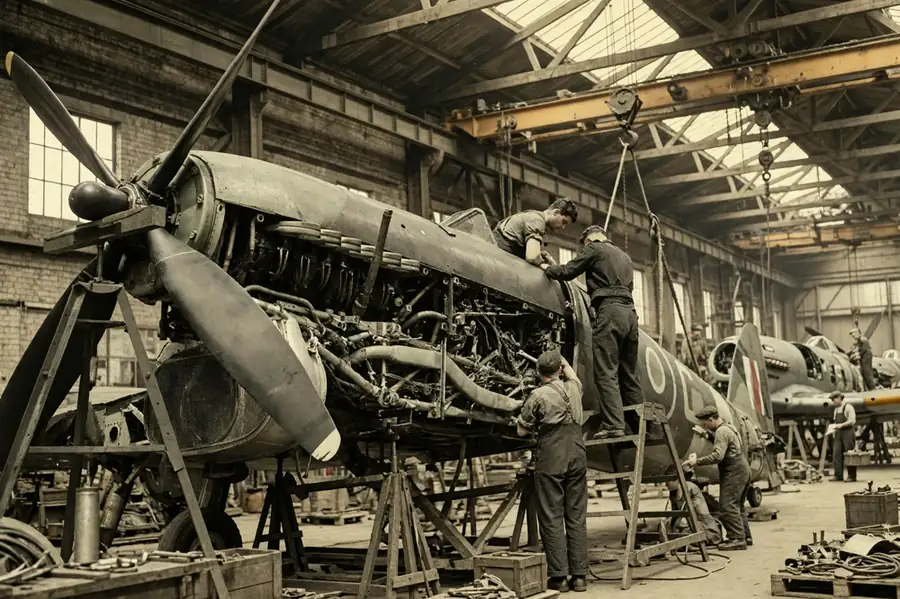
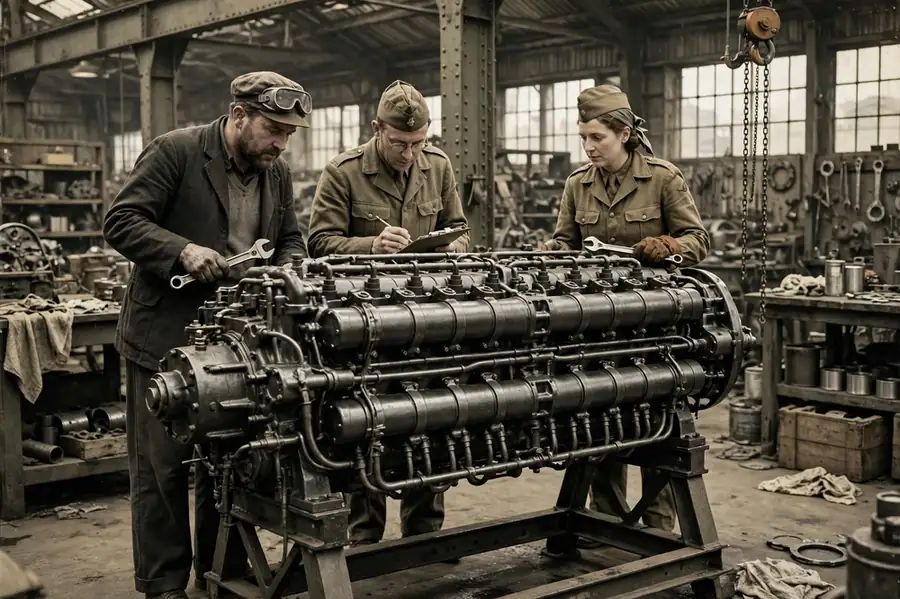
The Napier Sabre was the heart of the Typhoon and its greatest problem. The engine was a 24-cylinder H-block design, essentially two flat-twelve engines stacked one above the other, and it was the most powerful aero engine in the world when it entered service. But it was also complex, and its early versions suffered from sleeve-valve failures, overheating and oil leaks. The Sabre’s problems delayed the Typhoon’s entry into service and gave the aircraft a reputation for unreliability that it never fully shook off. Napier worked steadily to improve the engine, and by 1943 the Sabre II was a reliable powerplant, but the early failures had cost lives and had nearly led to the Typhoon’s cancellation.
A Troubled Introduction
The Typhoon entered service with No. 56 Squadron in September 1941, and its early months were unhappy. The aircraft suffered from engine failures, from carbon monoxide leaking into the cockpit, and from structural failures of the rear fuselage, where the tail would break away in flight. Several pilots were killed, and the RAF considered withdrawing the type. The problems were addressed by strengthening the fuselage, by improving the engine’s sleeve valves, and by fitting a better exhaust system, and by the end of 1942 the Typhoon was a reliable aircraft. But its career as a high-altitude interceptor was over: at altitude it was outperformed by the Focke-Wulf Fw 190, which had appeared in 1941, and the RAF decided to use the Typhoon at low level, where its speed and firepower were unmatched.
3. Design
Airframe, Wing and Structure
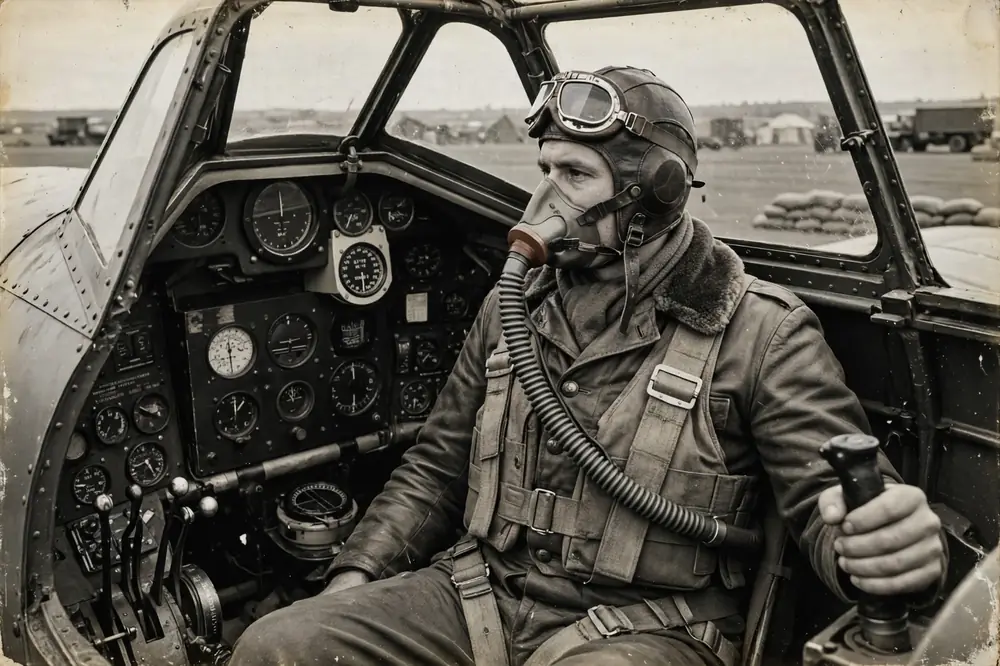
The Typhoon was a large, rugged aircraft, built around a steel-tube fuselage with a metal skin and a thick, low-set wing. The thick wing, which had been chosen to house cannon and fuel, gave the aircraft a stable gun platform and allowed it to carry heavy loads of rockets and bombs, but it limited its performance at altitude, where the thick wing produced too much drag. The aircraft’s size and weight — it was one of the heaviest single-seat fighters of the war — made it less agile than the Spitfire, but its ruggedness was an asset in the ground-attack role, where it could absorb battle damage and bring its pilot home. The cockpit was roomy and well equipped, and the pilot had a good view forward, although the view to the rear was poor.
The Sabre Engine and Performance
The Napier Sabre II engine produced about 2,180 horsepower, and later versions produced up to 2,260 horsepower, giving the Typhoon a top speed of about 412 mph at altitude and about 400 mph at low level. At low altitude the Typhoon was the fastest British fighter of its time, and it could outrun the Fw 190 at sea level. The engine drove a four-blade propeller of 4.27 metres diameter, one of the largest fitted to a single-engine fighter, and the aircraft’s acceleration was excellent. The Typhoon’s range was about 940 miles with drop tanks, and its service ceiling was about 35,000 feet, although it rarely operated at that height. The aircraft’s performance at low level was its defining characteristic, and it was the reason the RAF kept the type in service.
Armament and the Rocket
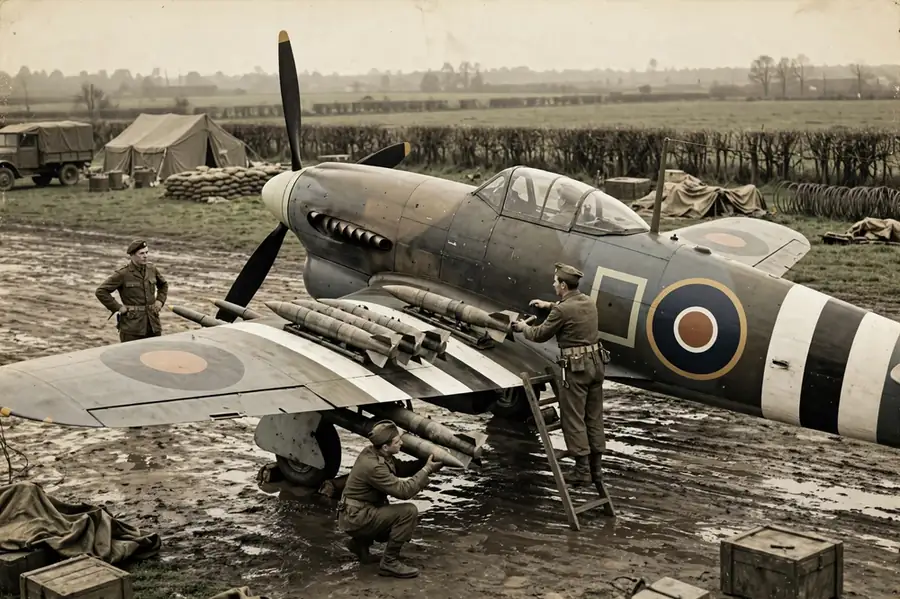
The Typhoon’s armament was its most important feature. The four 20 mm Hispano cannon, with 140 rounds per gun, gave it a devastating weight of fire against ground targets, and the aircraft was later fitted with rails for eight 60-pound RP-3 rockets, each with a 25-pound high-explosive warhead. The rockets were inaccurate — their dispersion was wide, and only a small proportion hit their targets — but their psychological effect was enormous, and their blast could destroy or disable a tank even with a near miss. The Typhoon could also carry two 500-pound or 1,000-pound bombs, and late-war Typhoons were fitted with a bubble canopy that improved the pilot’s view. The combination of cannon, rockets and bombs made the Typhoon the most heavily armed single-engine fighter in RAF service.
4. Variants
Typhoon Mk IA and Mk IB
The Typhoon Mk IA was the first production version, armed with twelve .303-inch machine guns, and only a small number were built. The Mk IB, armed with four 20 mm cannon, became the standard version, and it was the aircraft that fought in Normandy. The Mk IB was produced in large numbers by Hawker and by Gloster, and it was fitted with a series of improvements during its production run, including a strengthened rear fuselage, a better engine, a bubble canopy on late aircraft, and rocket rails. The Mk IB was the definitive Typhoon, and it served with more than twenty RAF squadrons and with Commonwealth units.
Night Fighter and Reconnaissance Versions
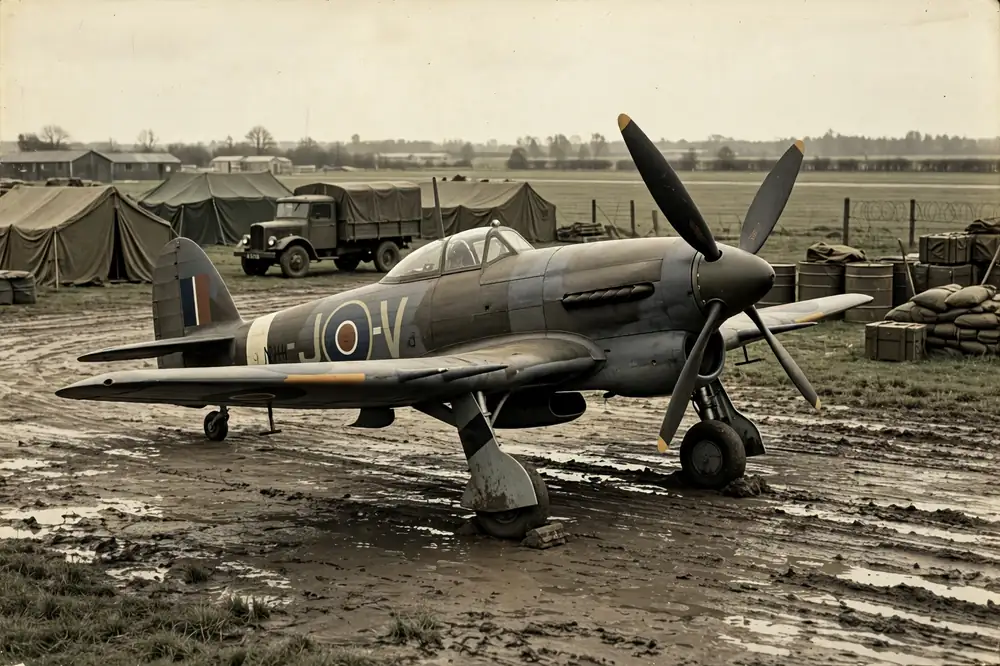
A small number of Typhoons were converted for other roles. The Typhoon NF Mk IB was a night fighter version, fitted with radar, but it was not a success and only a few were built. The Typhoon FR Mk IB was a fighter-reconnaissance version, fitted with cameras, and it served with several squadrons in the reconnaissance role. These versions were minor: the Typhoon’s real career was as a day fighter-bomber, and the variants that mattered were the successive improvements to the Mk IB, not the specialised conversions.
The Tempest Successor
The Typhoon’s successor was the Hawker Tempest, which was developed from the Typhoon by fitting a thinner wing and a more powerful Sabre engine. The Tempest was one of the finest fighters of the war, and it replaced the Typhoon in RAF service from 1944 onwards. But the Tempest was a new aircraft, not a Typhoon variant, and the Typhoon’s production continued until the end of the war, because the RAF needed every fighter-bomber it could get. The last Typhoons were retired in 1945, and the type was replaced in front-line service by the Tempest and by the de Havilland Hornet.
5. Operational History
Interceptor and Intruder, 1941–1943
The Typhoon’s first operational role was as an interceptor, defending southern England against German fighter-bombers. In this role it was only partly successful: it was fast at low level, but its engine was unreliable and its performance at altitude was poor. In 1942 the Typhoon was used as an intruder, attacking German airfields and transport in France and the Low Countries at night, and it performed well in this role. By 1943 the RAF had decided that the Typhoon’s future was as a fighter-bomber, and its squadrons were re-equipped and retrained for the ground-attack role. The aircraft’s first major ground-attack operations came in the summer of 1943, when Typhoons attacked German shipping and coastal targets in preparation for the invasion of France.
Normandy: The Tank-Buster
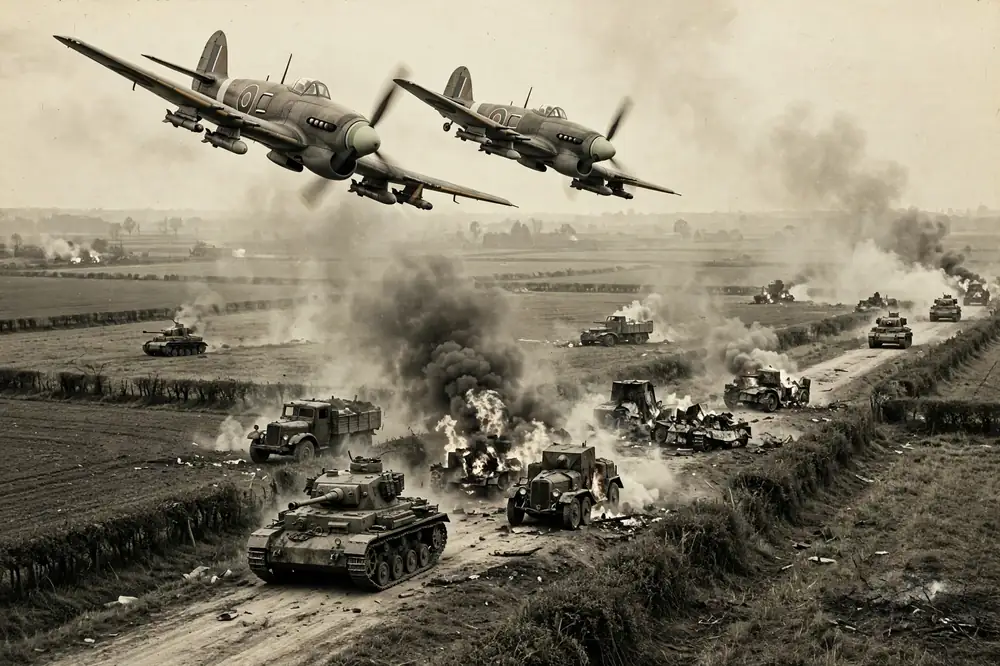
The Typhoon’s finest hour came in Normandy in the summer of 1944. Operating from airfields in southern England and then from forward strips in Normandy itself, Typhoon squadrons of the Second Tactical Air Force flew thousands of sorties in support of the Allied armies. Their rocket attacks on German armour became legendary: at the Falaise Pocket in August 1944, Typhoons claimed hundreds of German tanks and vehicles destroyed, and their attacks on the German columns retreating from Normandy were decisive in the destruction of the German Seventh Army. Later analysis showed that the Typhoon’s claims were exaggerated — many of the tanks credited to rockets were in fact destroyed by other means, or abandoned by their crews — but the psychological effect of the rocket attacks was real, and German commanders reported that their troops feared the Typhoon above all other Allied aircraft.
The Advance into Germany
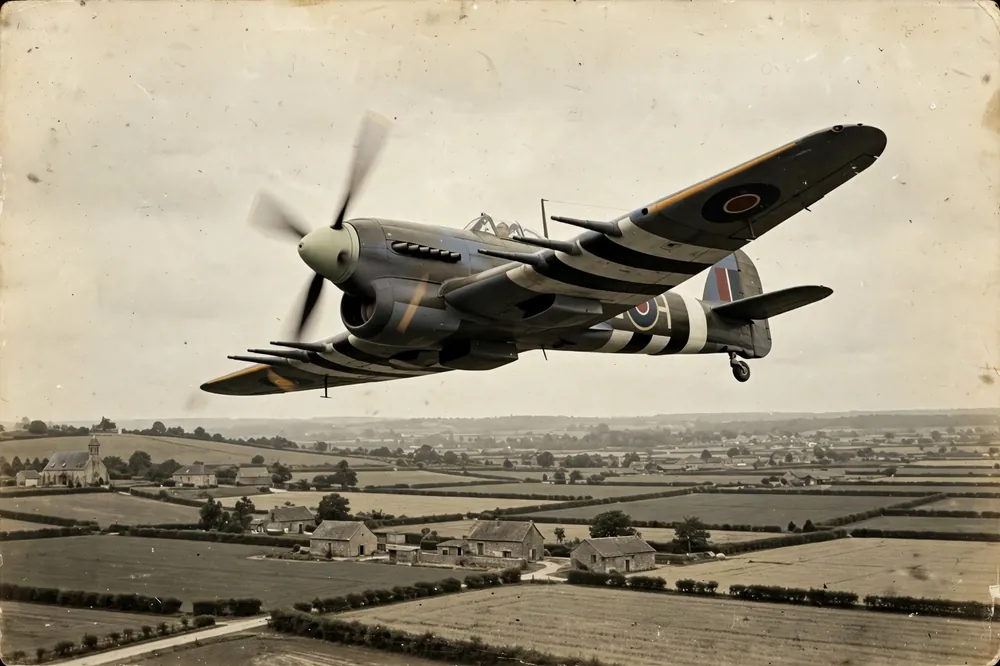
After Normandy, the Typhoons advanced with the Allied armies through France, Belgium and the Netherlands and into Germany. They supported the airborne landings at Arnhem, attacked German transport and armour in the Ardennes during the Battle of the Bulge, and flew in support of the Rhine crossing in March 1945. Their targets included tanks, trains, bridges and gun positions, and their operations were a model of tactical air support. The Typhoon’s last operations came in the final weeks of the war, when its squadrons attacked German forces in northern Germany and Denmark. By the end of the war, Typhoon squadrons had flown tens of thousands of sorties and had become the RAF’s most important close-support aircraft.
6. Performance and Specifications
Strengths on the Battlefield
The Typhoon’s strengths were its speed at low level, its ruggedness, and its firepower. At sea level it was faster than any German fighter except the Messerschmitt Me 262 jet, and its four cannon and eight rockets gave it a weight of fire that no other single-engine fighter could match. The aircraft was stable as a gun platform, and its pilots could deliver accurate attacks at low level. Its rugged construction meant that it could absorb battle damage — flak, small-arms fire and even collisions with the ground — and still bring its pilot home. The Typhoon’s pilots valued its reliability once the early engine problems were solved, and its ground crews valued its maintainability.
Weaknesses and Trade-offs
The weaknesses were those of an aircraft designed for one role and used in another. At altitude the Typhoon was outperformed by the Fw 190 and the Bf 109, and its thick wing limited its ceiling and its manoeuvrability. The Sabre engine, while powerful, was complex and required careful maintenance, and its fuel consumption was high. The Typhoon’s view to the rear was poor, which made it vulnerable to attack from behind, and its large size made it a conspicuous target for flak. The rockets, for all their psychological effect, were inaccurate, and the aircraft’s bomb load was limited compared with that of a dedicated bomber. The Typhoon was a specialist, and its speciality was low-level ground attack.
How the Typhoon Compared with Rivals
Compared with the German Fw 190, the Typhoon was faster at low level but slower at altitude, and less manoeuvrable in a dogfight. Compared with the American P-47 Thunderbolt, the other great Allied fighter-bomber, the Typhoon was smaller, faster at low level, and more lightly armed, but less rugged and with a shorter range. Compared with the Soviet Il-2 Sturmovik, the Typhoon was faster and more agile, but less heavily armoured and less able to absorb damage. Compared with its successor, the Tempest, the Typhoon was slower and less refined, but it was the aircraft that proved the concept of the rocket-firing fighter-bomber, and the Tempest built on its lessons.
7. Operators
The Royal Air Force
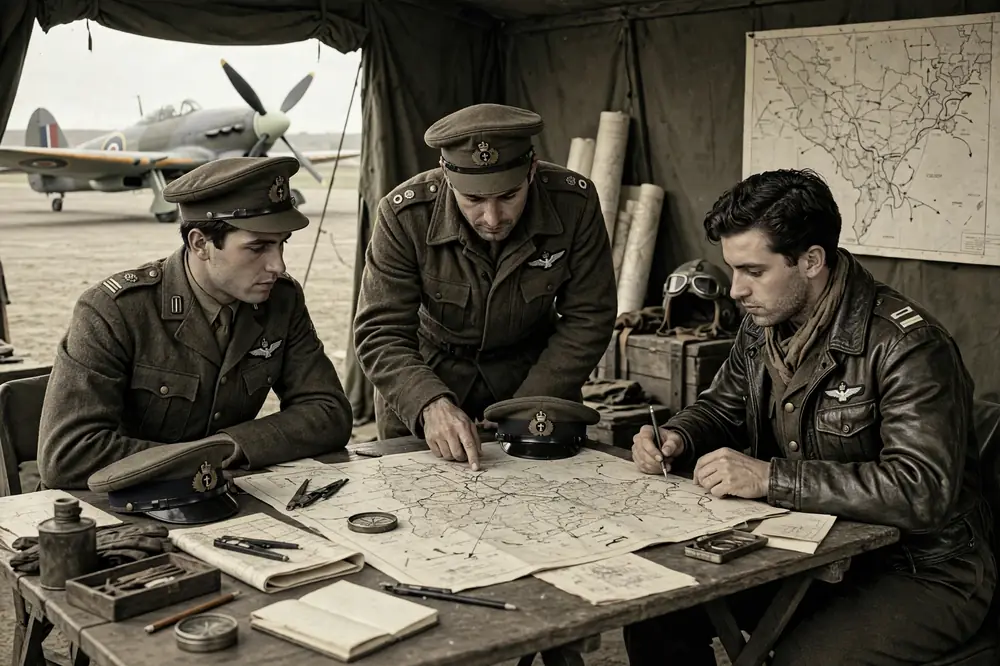
The principal operator of the Typhoon was the Royal Air Force, which operated the type with more than twenty squadrons, including Nos. 56, 197, 198, 245, 247, 257, 263, 266 and 609 Squadrons. The Typhoon squadrons of the Second Tactical Air Force were the core of the RAF’s close-support force in Normandy and in the advance into Germany, and their operations were among the most important of the war. The RAF’s Typhoon pilots included some of the most experienced fighter pilots of the war, and the type’s squadrons had a strong esprit de corps.
Commonwealth Air Forces
The Typhoon was also operated by the Royal Canadian Air Force, which flew the type with several squadrons in the Second Tactical Air Force, and by the Royal New Zealand Air Force, which operated Typhoons in the same force. Canadian Typhoon squadrons, notably No. 438, 439 and 440 Squadrons, flew in support of the Canadian Army in Normandy and in the Low Countries, and their operations were a significant part of the Canadian war effort. The Typhoon’s Commonwealth service was a measure of the aircraft’s importance: it was not a purely British type, but a Commonwealth fighter-bomber.
8. Legacy and Influence
The Tactical Air Force
The Typhoon’s legacy is the tactical air force itself. The aircraft demonstrated that a fighter-bomber, operating from forward airfields and controlled by forward air controllers, could provide close support to ground forces on a scale that had never been achieved before. The techniques developed by the Typhoon squadrons in Normandy — the cab rank system, the use of forward air controllers, the integration of air and ground operations — became the standard for tactical air support in the post-war period, and they remain the basis of close air support doctrine today. The Typhoon was the aircraft that made the tactical air force work.
Memory and the Tempest
The Typhoon is remembered in the popular memory of the Normandy campaign as the aircraft that the soldiers called for when German tanks appeared. The phrase “the Tiffies are coming” became a part of the mythology of the campaign, and the Typhoon’s rocket attacks have been depicted in films and books about D-Day. The aircraft’s successor, the Tempest, is better remembered as a fighter, but the Typhoon’s role as a ground-attack aircraft was more important to the outcome of the war. The single surviving complete Typhoon, under restoration in Britain, is a reminder of an aircraft that was once among the most numerous in RAF service.
Lessons for Later Aircraft
The Typhoon’s lessons were carried into the Tempest and into the post-war generation of fighter-bombers. The value of a rugged, heavily armed, low-level attack aircraft was confirmed by the Typhoon’s service, and the concept of the fighter-bomber became central to air force planning in the post-war period. The Typhoon also demonstrated the importance of engine reliability and of structural integrity, lessons that were learned at the cost of pilots’ lives in the aircraft’s early service. The Typhoon’s career is thus a story of an aircraft that overcame a troubled start to become one of the most important weapons of the war.
9. Surviving Examples
The Single Survivor
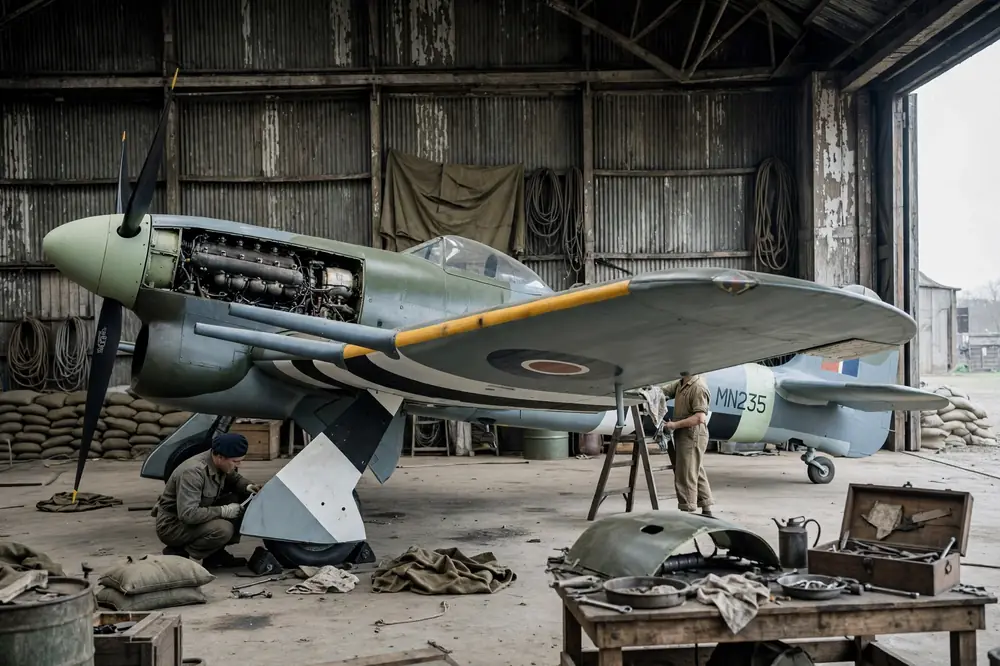
Only one complete Hawker Typhoon survives: serial number MN235, a Typhoon Mk IB that was preserved after the war and is now under restoration to flying condition in Britain. The aircraft was recovered from a crash site and has been the subject of a long restoration project by the Hawker Typhoon Preservation Group. When it flies, it will be the only airworthy Typhoon in the world, and its flight will be a major event for aviation heritage. The restoration has been a painstaking process, involving the rebuilding of the Napier Sabre engine and the reconstruction of the airframe from surviving parts.
Other Remains and Memorials
Other Typhoon remains survive in museums and in private collections. The Royal Air Force Museum at Hendon displays Typhoon components, including a Napier Sabre engine, and the Imperial War Museum at Duxford holds Typhoon artefacts. The Tangmere Military Aviation Museum, near the airfield where many Typhoon squadrons were based, displays material relating to the type. Wreckage from Typhoons lost in Normandy and in the Low Countries is still recovered from time to time, and the aircraft’s pilots are commemorated in memorials in Britain, France and the Netherlands. The Typhoon’s survival in a single complete example is a measure of how thoroughly the type was scrapped after the war, and it makes the restoration of MN235 all the more significant.
Frequently Asked Questions
What was the Hawker Typhoon?
The Hawker Typhoon was a British single-seat fighter-bomber of the Second World War, powered by the Napier Sabre engine and armed with four 20 mm cannon and eight rockets. It served as the RAF’s principal close-support aircraft in Normandy and in the advance into Germany, and it was famous as a tank-buster. The aircraft was designed by Sydney Camm as a successor to the Hurricane, and it entered service in 1941 as a high-altitude interceptor before finding its true role at low level, where its speed, its rugged construction and its heavy armament made it one of the most feared ground-attack aircraft of the war.
How many Typhoons were built?
A total of 3,317 Typhoons were built by Hawker and Gloster between 1941 and 1945. The aircraft served with more than twenty RAF squadrons and with Commonwealth air forces, including the Royal Canadian Air Force and the Royal New Zealand Air Force, and it was replaced in service by the Hawker Tempest. The production run was large because the RAF needed every fighter-bomber it could get, and the Typhoon remained in production until the end of the war, even after the Tempest had entered service, because the demand for close-support aircraft never slackened.
Was the Typhoon a good fighter?
The Typhoon was a poor high-altitude fighter but an outstanding low-level fighter-bomber. At low altitude it was the fastest British fighter of its time, and its heavy armament made it devastating against ground targets. Its early service was marred by engine and structural failures, but these were fixed by 1943, and by 1944 the Typhoon was a reliable aircraft. At altitude it was outperformed by the Focke-Wulf Fw 190, which is why the RAF moved it to the ground-attack role, where its speed at low level and its stable gun platform were decisive advantages.
Did Typhoons really destroy hundreds of tanks in Normandy?
Typhoon pilots claimed hundreds of German tanks destroyed in Normandy, especially at the Falaise Pocket, but later analysis showed the claims were exaggerated: many tanks were destroyed by other weapons or abandoned by their crews, and the rockets themselves were inaccurate, with only a small proportion hitting their targets. The rockets’ psychological effect, however, was real, and German troops feared the Typhoon above all other Allied aircraft. German commanders reported that their men dreaded the rocket attacks, and the Typhoon’s presence over the battlefield disrupted German movements even when it destroyed few vehicles.
What engine powered the Typhoon?
The Napier Sabre, a 24-cylinder H-block liquid-cooled engine producing about 2,180 horsepower. It was the most powerful aero engine in service when the Typhoon entered production, but it was also complex and unreliable in its early versions, and its problems nearly led to the Typhoon’s cancellation. The Sabre was essentially two flat-twelve engines stacked one above the other, and its sleeve valves gave trouble until Napier improved them. By 1943 the Sabre II was a reliable powerplant, and it gave the Typhoon its outstanding low-level speed.
How many Typhoons survive today?
Only one complete Typhoon survives, serial number MN235, which is under restoration to flying condition in Britain by the Hawker Typhoon Preservation Group. Other Typhoon components and wreckage survive in museums, including a Napier Sabre engine at the RAF Museum at Hendon, but MN235 is the only complete airframe. The survival rate is low because the type was thoroughly scrapped after the war, and the restoration of MN235, involving the rebuilding of its Sabre engine and the reconstruction of its airframe, has been a painstaking project lasting many years.
Sources
- Mason, Francis, Hawker Aircraft Since 1920 (Putnam).
- Thomas, Chris, and Shores, Christopher, The Typhoon and Tempest Story (Arms and Armour Press).
- Nijboer, Donald, Hawker Typhoon (Osprey Publishing, Air Vanguard series).
- Glancey, Jonathan, Spitfire: The Biography (for context on RAF fighter development).
- The Royal Air Force Museum, Hendon, Typhoon collection records.
-
The Hawker Typhoon Preservation Group, restoration records for MN235.
-
Shores, Christopher, 2nd Tactical Air Force (Osprey Publishing, Air Campaign series).
- The National Archives, Kew, RAF squadron operations record books, AIR 27 series.