 WAR ATLAS MILITARY HISTORY MAGAZINE · WWI — WWII
War of Annihilation
1. Lead
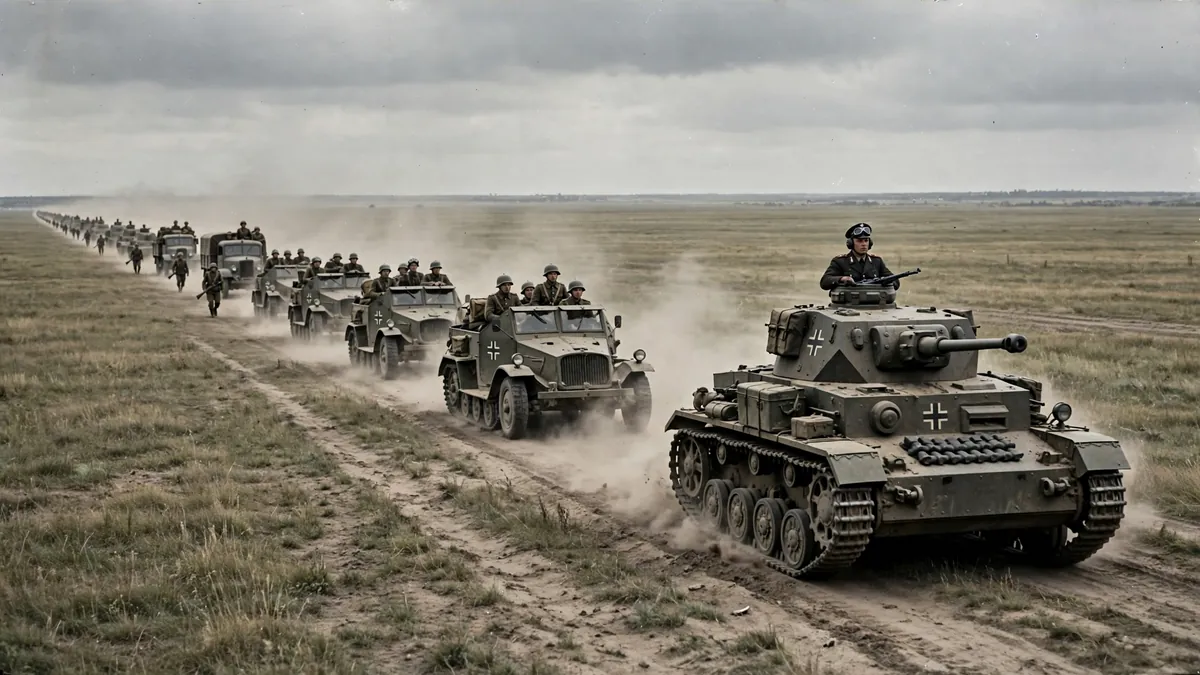
War of annihilation — in German, Vernichtungskrieg — is a concept of war in which the aim is not to force the enemy to accept limited terms, but to destroy the enemy’s armed forces completely, so that it can no longer resist at all. The idea is older than the name.
The Prussian theorist Carl von Clausewitz wrote in the early nineteenth century that the destruction of the enemy’s fighting power was the natural object of war, and that every other aim — the seizure of territory, the capture of a capital, the winning of an ally — was secondary to it.
Generations of German officers studied that argument, and in the twentieth century it hardened into a doctrine: battles were to be fought not for ground, but for the encirclement and destruction of whole enemy armies.
This article explains the doctrine on its own terms — what it meant, where it came from, how it was applied, and where it succeeded and failed — and it also draws a line that matters. A war of annihilation as a military concept, the destruction of an enemy army in the field, is not the same thing as the deliberate killing of civilians, prisoners or other non-combatants.
In the Second World War the two were tragically entangled on the Eastern Front, where the German invasion of the Soviet Union was waged both as a war against the Red Army and as a criminal campaign against whole populations. That entanglement is part of the history, and this article treats it plainly, without confusing the doctrine with the crimes committed in its name.
2. Key Facts
| Term | War of annihilation; German Vernichtungskrieg |
| Core idea | Destroy the enemy’s armed forces entirely, rather than seeking limited political gains |
| Key theorist | Carl von Clausewitz, On War (published 1832) |
| Classic example | Battle of Cannae, 216 BC — Hannibal’s double envelopment |
| Modern model | Encirclement battles (Kesselschlacht) of the German Army, 1939–1941 |
| Largest application | Eastern Front, 1941–1945, especially Operation Barbarossa |
| Opposite concept | Limited war (Clausewitz’s begrenzter Krieg) |
| Legal boundary | The laws of war (Hague and Geneva Conventions) protect prisoners and civilians; annihilation of an army does not justify crimes against them |
3. Origins
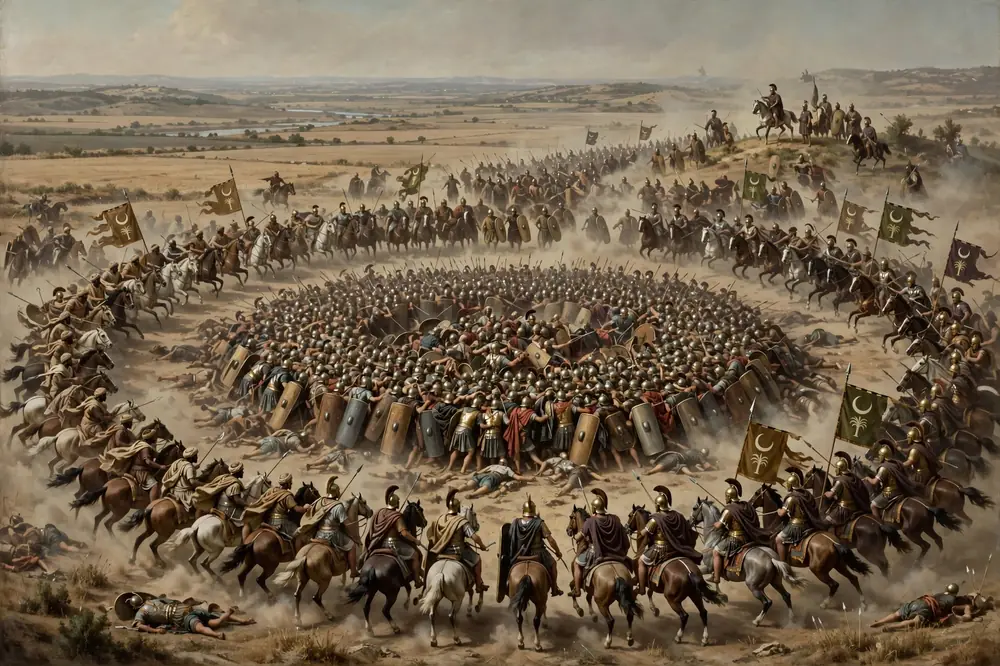
The idea of destroying the enemy army outright is as old as organised warfare. Ancient commanders understood that an enemy force left intact could return, regroup and fight again, and that a decisive battle which destroyed it settled a war in a single day. The most famous example is Cannae in 216 BC, where Hannibal’s Carthaginian army surrounded and destroyed a Roman army of about 70,000 men.
The Roman state survived Cannae because its political system could raise new armies, but the battle became the model of the perfect victory: the enemy force was not pushed back, it was annihilated. For two thousand years, generals studied Cannae as the ideal to imitate, and its lesson — that envelopment and destruction were better than a frontal shove — shaped the teaching of military academies across Europe.
The modern doctrine took shape in Prussia in the nineteenth century. After the Napoleonic Wars, the Prussian officer Carl von Clausewitz wrote On War, published after his death in 1832, in which he argued that war was the continuation of politics by other means, and that the military object of war was the destruction of the enemy’s armed forces.
Clausewitz did not use the word Vernichtungskrieg as a technical term, and he was careful to distinguish between wars of limited aim and wars fought for the overthrow of the enemy. But his argument that the enemy’s army was the true target — its “centre of gravity”, in the phrase later readers took from him — gave later German officers a theoretical foundation for seeking decisive battle.
The German General Staff
The doctrine hardened into practice under the German General Staff, above all under Helmuth von Moltke the Elder, who planned the wars of German unification in 1866 and 1870–71. Moltke’s campaigns were built around the Kesselschlacht, the battle of encirclement: separate armies would advance, converge on the enemy from several directions, and trap it in a pocket where it could be destroyed. At Königgrätz in 1866 and at Sedan in 1870, the plan worked. The French army at Sedan, about 100,000 men under Napoleon III, was surrounded and forced to surrender — a victory so complete that it ended the Second French Empire in a single battle.
Moltke’s younger successor, Alfred von Schlieffen, took the idea further. The Schlieffen Plan of 1905 was, in effect, a single giant battle of annihilation aimed at the French army: German forces would sweep through Belgium, wheel around Paris, and trap the French army against its own frontier, destroying it in one campaign of about six weeks. The plan failed in 1914 at the Battle of the Marne, when the German advance outran its supplies and the French counter-attacked. The failure mattered: it showed that a war of annihilation depended on speed, on railways and roads, and on an enemy that could be trapped — and that when the trap failed, the war could settle into a long and ruinous stalemate.
4. Principles
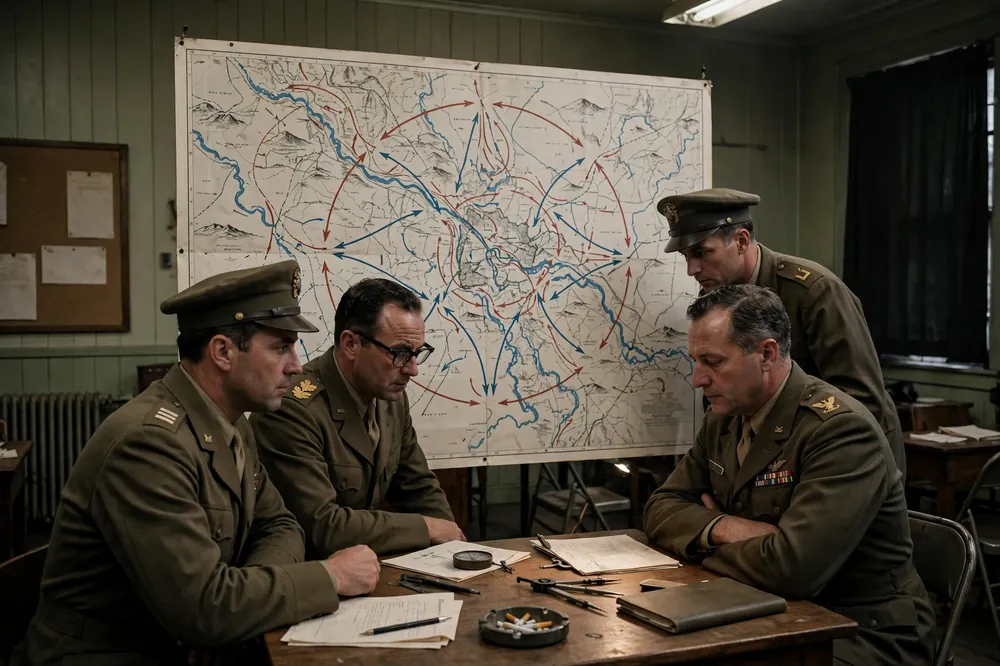
The doctrine of annihilation rests on a small number of principles, and they remained remarkably stable from Moltke to the Second World War. The first is that the enemy army, not territory, is the target. Ground can be taken and retaken; a destroyed army cannot fight again. A commander who captures a capital while the enemy army escapes has won a symbol, not a war. A commander who destroys the army, even at the cost of giving ground, has won the war’s substance. This is why German doctrine consistently preferred manoeuvre over frontal assault: the aim was to get around the enemy, cut its lines of retreat, and destroy it in the pocket.
Encirclement / Bao vây
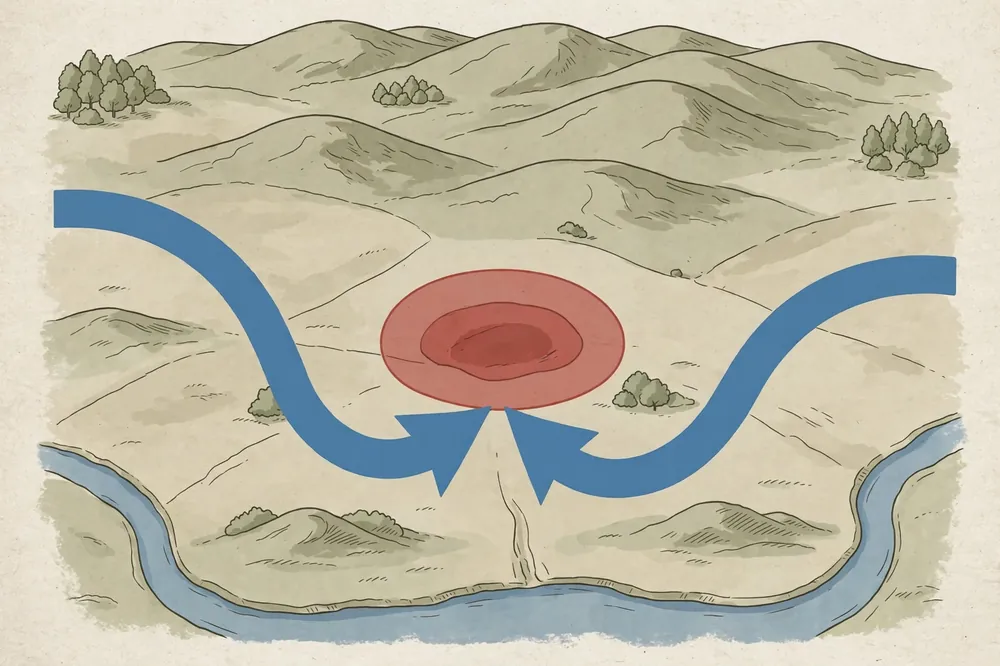
The second principle is encirclement. The ideal battle, in this doctrine, is a double envelopment: two arms close around the enemy like pincers, meet behind it, and seal the pocket. Hannibal did it at Cannae with infantry and cavalry; the German Army did it in 1941 with tanks and motorised infantry. The pocket — the Kessel, literally a cauldron — then had to be reduced: the trapped force was compressed, its supplies cut off, and it was destroyed piecemeal or forced to surrender. The doctrine accepted that encirclement was risky, because the arms of the pincer were themselves exposed while they moved, but it held that the payoff justified the risk.
Speed and decision
The third principle is speed. A war of annihilation must be short, because the attacker needs to destroy the enemy before the enemy can mobilise its full resources, bring in allies, or turn the war into a contest of production. This is the logic that connected the doctrine to blitzkrieg in 1939–41: tanks, aircraft and radios were not ends in themselves, they were the tools that made encirclement fast enough to work against a modern army. The corollary was that a failed annihilation — a pocket that leaked, an enemy that escaped — was worse than a modest limited victory, because it left the attacker deep in enemy territory with long supply lines and an enemy still in the field.
5. Application in Battle
The doctrine’s great test came in the Second World War, and its greatest successes came early. In Poland in September 1939, German armoured columns broke through, closed pincers behind the Polish armies, and destroyed them in pockets around Warsaw and the Bzura river. In France in May–June 1940, the German thrust through the Ardennes cut the Allied armies in two, and the pocket at Dunkirk trapped the British Expeditionary Force — although the British evacuation, and Hitler’s halt order, allowed most of it to escape. The campaign still ended with the French army destroyed as a fighting force and France defeated in six weeks, a result that seemed to prove the doctrine beyond doubt.
The Eastern Front
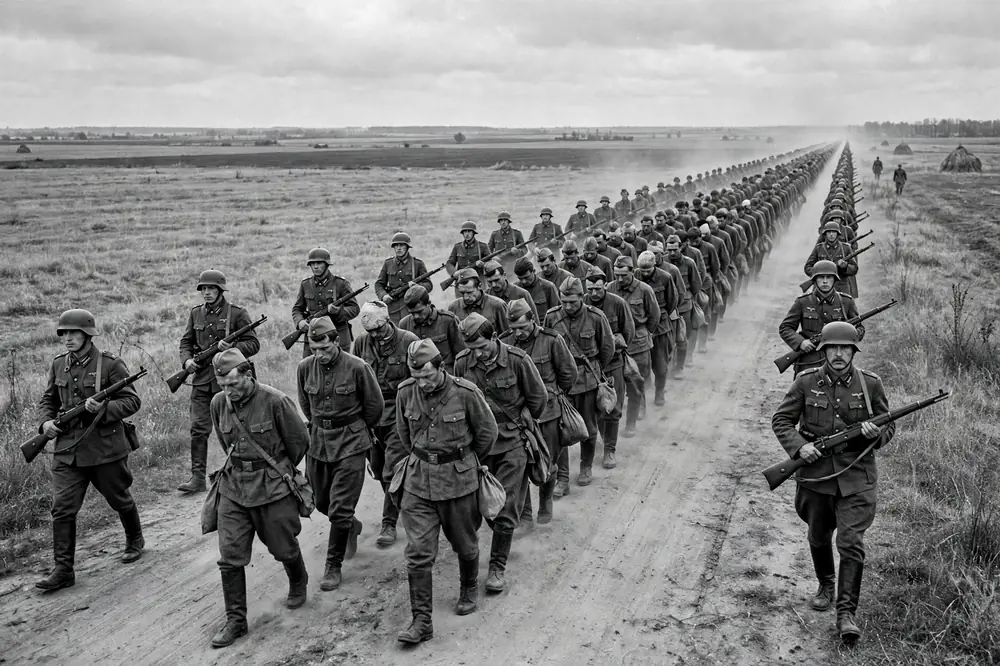
On the Eastern Front the scale became immense. During Operation Barbarossa in 1941, German encirclements at Minsk, Smolensk, Kiev and Vyazma-Bryansk destroyed or captured Soviet armies totalling millions of men. The Kiev pocket alone, in September 1941, trapped about 600,000 Soviet troops — the largest encirclement in history.
For a few months it appeared that the doctrine had reached its perfect form: whole Soviet fronts vanished from the order of battle, and the road to Moscow seemed open. Yet the Soviet Union did not collapse. New armies were raised from a population of about 190 million, factories were moved east of the Urals, and the German advance outran its supplies in the vast distances of Russia.
The doctrine had destroyed armies; it had not destroyed the Soviet state’s capacity to make new ones.
Annihilation turned against its authors
By 1943 the doctrine was being turned against its authors. At Stalingrad, the Soviet Operation Uranus encircled the German Sixth Army — about 250,000 men — in a classic double envelopment, the very manoeuvre the Germans had perfected, and destroyed it. At Kursk in 1943 the German offensive failed, and the Soviet counter-offensives encircled German forces at Korsun-Cherkassy in 1944 and in East Prussia in 1945. The war ended with the Red Army applying the doctrine of annihilation to the German Army itself, in the great encirclements of 1944–45, and with Berlin surrounded and taken. The doctrine, in other words, belonged to no nation: it was a method, and whichever side could execute it at scale won.
6. Strengths
The doctrine’s first strength was its clarity. It gave commanders a single, measurable objective: destroy the enemy force in front of you. That clarity simplified planning, concentrated effort, and made it possible to judge whether a campaign had succeeded — by counting the enemy divisions destroyed, not by counting kilometres of ground taken. In the campaigns of 1939–41, that clarity produced results of a speed and completeness that no other doctrine of the period could match. France fell in six weeks; the Soviet frontier armies were destroyed in months. For an attacker with limited resources and a need for a short war, the doctrine offered the only realistic path to victory.
Its second strength was psychological. The destruction of whole armies broke the enemy’s confidence and its political will faster than any campaign of attrition. The French collapse of 1940 was as much a collapse of will as of force: once the army was encircled and destroyed, the government saw no point in continuing. The doctrine also rewarded the qualities the German officer corps prized — initiative, speed, willingness to take risks — and it gave junior commanders a framework in which bold action was rewarded rather than punished. The German tradition of Auftragstaktik, mission command, fitted the doctrine well: a commander told his subordinates what to achieve, not how, and the encirclement depended on subordinates acting on their own initiative.
7. Weaknesses
The doctrine’s weaknesses were the mirror of its strengths. First, it assumed an enemy that could be trapped, and a war that could be kept short. Against an enemy with strategic depth — Russia in 1941, with its vast territory and population — encirclement destroyed armies but not the state’s capacity to raise new ones. The German Army destroyed Soviet armies faster than any army in history had ever been destroyed, and still lost, because the Soviet Union replaced them. The doctrine had no answer to the question of what to do when the enemy refused to collapse after the loss of its first armies.
Second, encirclement was logistically fragile. The pincers had to move fast and far, which stretched supply lines and exposed flanks. At Stalingrad, the German Sixth Army was itself encircled because it had advanced beyond the reach of its supplies and its flanks were held by weaker allied armies.
At El Alamein and in North Africa generally, the doctrine failed because the desert offered no flank to turn and no pocket to close. Third, the doctrine encouraged overreach: the promise of a single decisive battle tempted commanders and political leaders to keep attacking after the conditions for success had gone, as Hitler did in 1941 when he pushed on to Moscow after the Kiev encirclement had already consumed the campaign’s time and strength.
8. Evolution
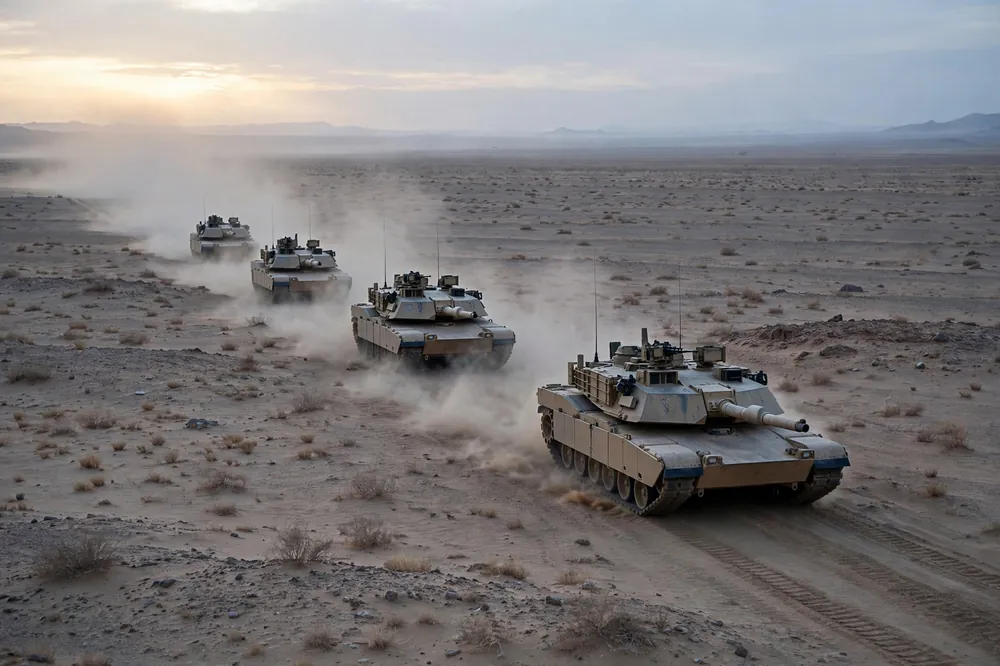
After the Second World War, the doctrine did not disappear, but it changed form. The arrival of nuclear weapons made the idea of a war of annihilation between great powers unthinkable as a practical plan, and the wars that followed were mostly limited wars — Korea, Vietnam, the Arab-Israeli wars — fought for limited aims. Yet the operational method survived.
The Israeli encirclement of the Egyptian Third Army in the Sinai in 1973, the American envelopment of Iraqi forces in the Gulf War of 1991, and the coalition operations of 2003 all used the same logic: bypass, encircle, and destroy the enemy force rather than grind through it frontally. Modern doctrine calls this “manoeuvre warfare”, and it owes a direct debt to the German tradition.
The word Vernichtungskrieg itself, however, acquired a second and darker meaning after 1945, and that meaning now dominates its use. Because the German war in the East was waged as a war of extermination against civilians — the mass murder of Soviet prisoners of war, the Holocaust, the siege and starvation of Leningrad — historians often use Vernichtungskrieg to describe the criminal character of that campaign, not merely its military method.
The 1995–99 Wehrmacht exhibition in Germany, which documented the German Army’s participation in crimes on the Eastern Front, made the term a subject of public debate. The two meanings must be kept apart in analysis, but they cannot be separated in the history: the same campaign that produced the great encirclements also produced the mass murder, and the doctrine’s language of total destruction was used by the Nazi regime to justify both.
9. Distinction from War Crimes
The distinction between the military doctrine and the crimes committed alongside it is not a technicality; it is the foundation of the modern laws of war. The Hague Conventions of 1899 and 1907, and the Geneva Conventions of 1949, accept that the destruction of an enemy’s armed forces is a lawful military aim, and they also set hard limits on how that aim may be pursued.
Prisoners of war must be treated humanely; civilians must not be deliberately attacked; the starvation of a population is not a lawful weapon. A commander who encircles and destroys an enemy army in the field is acting within the laws of war.
A commander who orders the murder of the prisoners taken in that encirclement, or the killing of the civilians living in the pocket, is committing a war crime, and no doctrine of annihilation can excuse it.

The Eastern Front is the clearest illustration of what happens when the line is crossed. About 3.3 million Soviet prisoners of war died in German custody, most of them in 1941–42, from starvation, disease and deliberate killing — a death rate of more than half of all Soviet prisoners taken. The Commissar Order of June 1941 instructed German troops to execute captured Soviet political officers on the spot.
These were not accidents of the encirclement battles; they were policies ordered from above, and they were tried as crimes at Nuremberg. The lesson, which the laws of war now state explicitly, is that the aim of destroying an army does not extend to the people who are not fighting, and that a doctrine of annihilation is lawful only so far as it stops at the battlefield.
Why the distinction matters today
The distinction still matters because the language of annihilation is still used, and still misused. Political leaders and commentators sometimes describe a war as a war of annihilation when they mean a war without limits, and military planners sometimes borrow the prestige of decisive battle to justify campaigns that target civilians. The historian’s task, and the reader’s, is to keep the two questions separate: was the enemy army destroyed, and were the laws of war obeyed? The first question is military; the second is legal and moral. A campaign can succeed at the first and fail at the second — and the German war in the East is the outstanding example of exactly that.
10. Legacy
The legacy of the war of annihilation is double, and it must be described as double. As a military method, it shaped the twentieth century. The encirclement battle became the standard against which offensive operations were measured, and its principles — target the army, move fast, close the pocket — survive in the manoeuvre doctrine of every modern army. The great encirclements of 1941 remain the largest battles of annihilation ever fought, and they are still studied in staff colleges as examples of operational art at its most ambitious, and of its limits.
As a word, it carries a warning. Vernichtungskrieg is now inseparable from the crimes of the Eastern Front, and its use reminds readers that a doctrine of total destruction, taken beyond the battlefield, becomes a doctrine of murder. The modern laws of war, the Nuremberg principles, and the military ethics taught in staff colleges all exist, in part, because the war of annihilation was taken that far, and the world decided it must never be taken there again.
The doctrine’s history therefore ends with a paradox: the most effective method of winning a war ever devised is also the method whose abuse produced some of the worst crimes of the twentieth century, and the difference between the two lies in a single line — the line between the soldier in the field and the person who is not fighting.
11. Frequently Asked Questions
What is a war of annihilation?
A war in which the aim is the complete destruction of the enemy’s armed forces, rather than limited political gains. The term is the German Vernichtungskrieg, and its classic military expression is the battle of encirclement. The doctrine’s classic expression is the battle of encirclement, in which the enemy army is surrounded and destroyed rather than pushed back. Its modern form was developed by the German General Staff in the nineteenth century, and its largest applications came on the Eastern Front in 1941, when German encirclements at Minsk, Smolensk and Kiev destroyed Soviet armies totalling millions of men.
Did Clausewitz invent the war of annihilation?
No. Clausewitz argued that the destruction of the enemy’s armed forces was the natural object of war, but he also described limited wars, and he did not use Vernichtungskrieg as a technical term. Later German officers developed his argument into a doctrine. His book On War was published after his death in 1832, and it was studied by officers in every European army. The doctrine of annihilation was developed by later German officers — above all by Moltke and Schlieffen — who took his argument about destroying the enemy’s forces and made it the centre of their planning for the wars of German unification and for the First World War.
What was the largest battle of annihilation in the Second World War?
The Kiev encirclement of September 1941, in which about 600,000 Soviet troops were trapped — the largest encirclement in history. The battles of Minsk, Smolensk and Vyazma-Bryansk in 1941 were also on an enormous scale. The encirclement was completed on 16 September 1941, and the Soviet armies trapped inside it fought on for about ten days before surrendering. The battle removed five Soviet armies from the order of battle and opened the road to Moscow, but it also consumed weeks of time and fuel that the German advance could not spare.
Is a war of annihilation the same as a war crime?
No. Destroying an enemy army in the field is a lawful military aim under the laws of war. Deliberately killing prisoners, civilians or other non-combatants is a war crime, and no doctrine can justify it. On the Eastern Front the two were entangled, which is why the distinction must be kept clear. The Nuremberg trials after the war established that superior orders and military doctrine are no defence to a charge of war crimes. The laws of war, now set out in the Geneva Conventions of 1949, protect prisoners, the wounded and civilians in all circumstances, and they bind every army, in every war, without exception.
Why did the doctrine fail in Russia in 1941?
Because the Soviet Union had the territory, population and industry to raise new armies after the first ones were destroyed. Encirclement destroyed armies; it could not destroy the state’s capacity to replace them, and the German advance outran its supplies. The Soviet Union also moved about 1,500 factories east of the Urals in 1941, beyond the reach of the German advance, and it called up millions of new soldiers. By December 1941 the German Army was exhausted, its supply lines were overstretched, and the Soviet counter-offensive before Moscow began the turn of the war.
Is the doctrine still used today?
Its method survives as manoeuvre warfare — bypass, encircle and destroy the enemy force — in the doctrine of modern armies. A war of annihilation between great powers is no longer a practical plan, above all because of nuclear weapons. Modern manoeuvre doctrine keeps the method — bypass, encircle and destroy the enemy force — but it is applied to enemy forces, not to populations, and it is constrained by the laws of war. The word Vernichtungskrieg itself is now used mainly by historians, and usually to describe the criminal character of the German war in the East.
12. Sources
- Wikipedia, “Vernichtungskrieg” and “War of annihilation” — the term, its history and its two meanings.
- Carl von Clausewitz, On War (1832), Book One — the destruction of the enemy’s armed forces as the object of war; limited war and absolute war.
- Wikipedia, “Battle of Cannae” — Hannibal’s double envelopment, 216 BC.
- Wikipedia, “Battle of Sedan (1870)” and “Battle of Königgrätz” — Moltke’s battles of encirclement.
- Wikipedia, “Schlieffen Plan” and “Battle of the Marne” — the plan’s failure in 1914.
- Wikipedia, “Battle of Kiev (1941)” — about 600,000 Soviet troops encircled, the largest encirclement in history.
- Wikipedia, “Battle of Stalingrad” and “Operation Uranus” — the encirclement of the German Sixth Army.
- Encyclopædia Britannica, “Laws of war” — the Hague and Geneva Conventions, protection of prisoners and civilians.
- United States Holocaust Memorial Museum, “Soviet prisoners of war” — about 3.3 million Soviet prisoners died in German custody.
- Wikipedia, “Wehrmacht exhibition” — the 1995–99 exhibition and the public debate on Vernichtungskrieg.