 WAR ATLAS MILITARY HISTORY MAGAZINE · WWI — WWII
RAF vs Luftwaffe Fighter Tactics
1. Lead
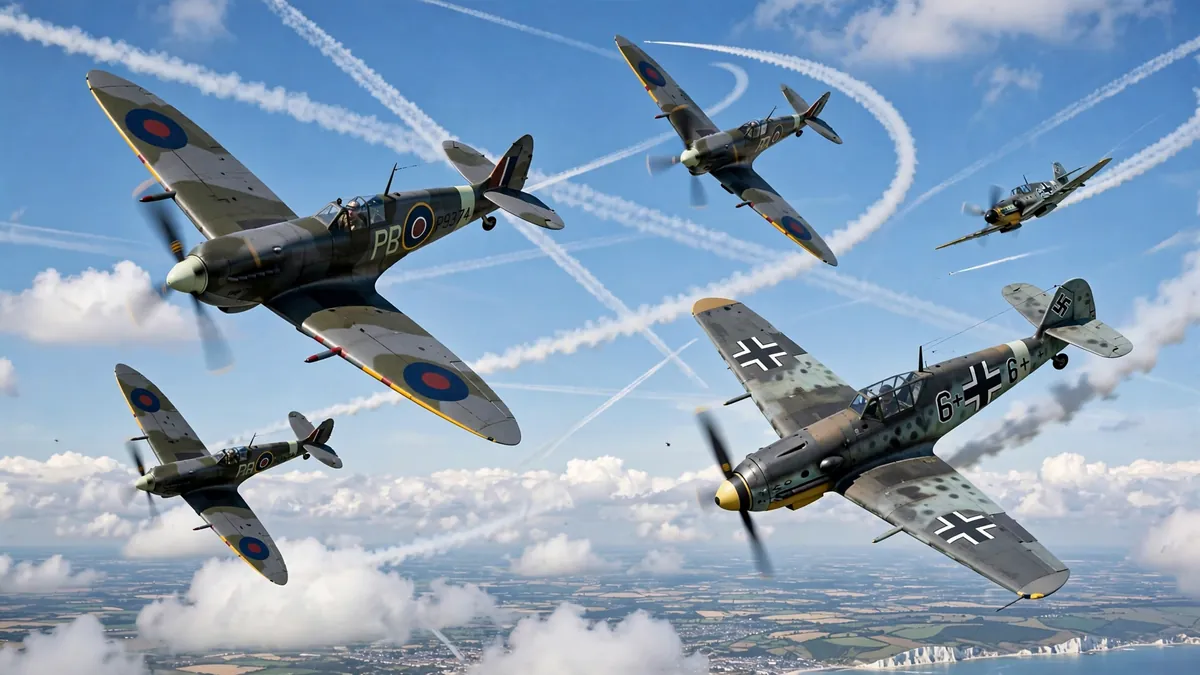
RAF vs Luftwaffe fighter tactics is the story of two air forces that fought the same war with different ideas about how a fighter should fly, how a squadron should fight, and how an air battle should be controlled. In the summer of 1940, over southern England, the two ideas met in the Battle of Britain, and the result decided the fate of the war in the west.
The Luftwaffe’s fighters — above all the Messerschmitt Bf 109 — were flown in loose, flexible formations, in pairs and fours, by pilots who had learned their trade in Spain and Poland. The Royal Air Force’s fighters — the Hawker Hurricane and the Supermarine Spitfire — were flown in tight formations of three, under a system of ground control that directed them to the enemy by radio and radar.
This article compares the two systems fairly, on their own terms. The Luftwaffe’s tactical formations were, in the judgement of most historians, better than the RAF’s in 1940, and the RAF learned from them. The RAF’s system of control — the Dowding system, built on radar, radio and a network of operations rooms — was better than anything the Luftwaffe possessed, and it was the decisive advantage. The comparison is not a matter of one side being right and the other wrong: it is a matter of two different answers to the same problem, and of a battle in which the better system, not the better formation, won.
2. Key Facts
| Comparison / So sánh | RAF Fighter Command vs Luftwaffe fighter force, 1940 |
| RAF fighters | Hawker Hurricane (about 1,700 built by 1940); Supermarine Spitfire |
| Luftwaffe fighter | Messerschmitt Bf 109E — the main German fighter in 1940 |
| RAF formation | The “Vic” — a tight V of three aircraft |
| Luftwaffe formation | The Rotte (pair) and Schwarm (four) — loose, flexible |
| RAF control | The Dowding system: radar, Observer Corps, operations rooms, radio direction |
| Luftwaffe control | Freie Jagd (free hunt) and close escort of bombers |
| Decisive battle | Battle of Britain, July–October 1940 |
| Result | Luftwaffe failed to gain air superiority; invasion of Britain postponed and then cancelled |
3. Origins
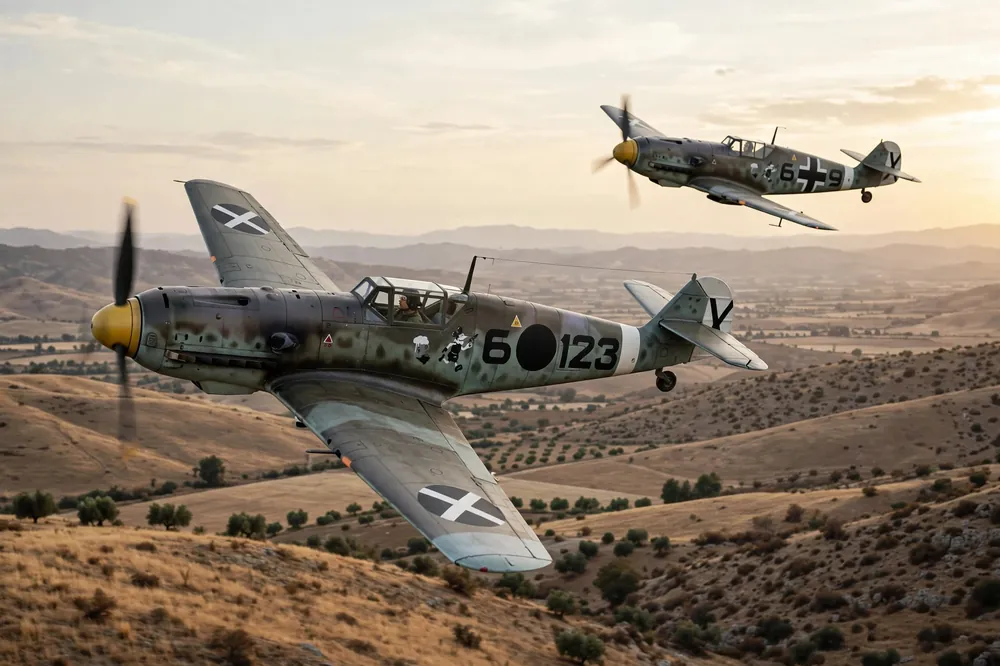
The two air forces came to 1940 from different histories. The Luftwaffe was the younger force, created in secret in the 1930s and blooded in the Spanish Civil War of 1936–39, where the Condor Legion tested its aircraft and its tactics against a real enemy.
In Spain, German pilots learned that the tight formations of the First World War were obsolete: a fighter that flew in a tight formation spent its time watching its leader instead of watching the sky, and it could not manoeuvre freely.
The Germans developed the Rotte — a pair, a leader and a wingman — and the Schwarm — two pairs, flying in a loose “finger-four” — and they proved the formations in Spain, in Poland and in France. By 1940, the Luftwaffe’s fighter pilots were the most combat-experienced in the world.
The RAF, by contrast, had spent the interwar years preparing for a different war: a war of bombers, in which the fighter was expected to intercept enemy bombers in daylight, in tight formations, under the direction of ground control. The RAF’s tactical manual, the Fighting Area Attacks, prescribed a set of rigid, numbered attacks in which a squadron of twelve aircraft flew in four Vics of three, and attacked in a fixed pattern.
The Vic was a formation for parade and for control, not for combat: the three aircraft flew close together, the wingmen watched the leader, and the leader — the only man who could see the enemy — made the decisions. The system had been designed for an enemy that flew in tight bomber formations, and it had never been tested against a fighter that fought in pairs.
The aircraft
The aircraft themselves were closely matched. The Spitfire, with its elliptical wing and Rolls-Royce Merlin engine, was faster and more manoeuvrable than the Bf 109 at most altitudes, and its pilots loved it. The Hurricane, older and slower, was a stable gun platform, easier to repair, and available in larger numbers: in the summer of 1940, there were more Hurricanes than Spitfires in Fighter Command, and the Hurricane shot down more German aircraft than any other type.
The Bf 109E was fast, well-armed with cannon, and flown by experienced pilots, but it had a short range — about 20 minutes of combat time over southern England — and its pilots, who flew from bases in France, fought with one eye on the fuel gauge. The three aircraft were close enough in performance that tactics, not technology, decided the battle.
4. Principles
The Luftwaffe’s tactical principle was the pair. In the Rotte, the leader attacked and the wingman protected him, watching his tail and warning him of danger. In the Schwarm, two Rotten flew together, mutually supporting, and the four aircraft could spread out, search the sky, and manoeuvre independently. The formation was loose — the aircraft flew hundreds of metres apart — and each pilot could look around, could see the enemy, and could fight. The Schwarm was a formation for a dogfight, and it was the formation that every air force in the world would adopt by the end of the war.
The RAF’s Vic
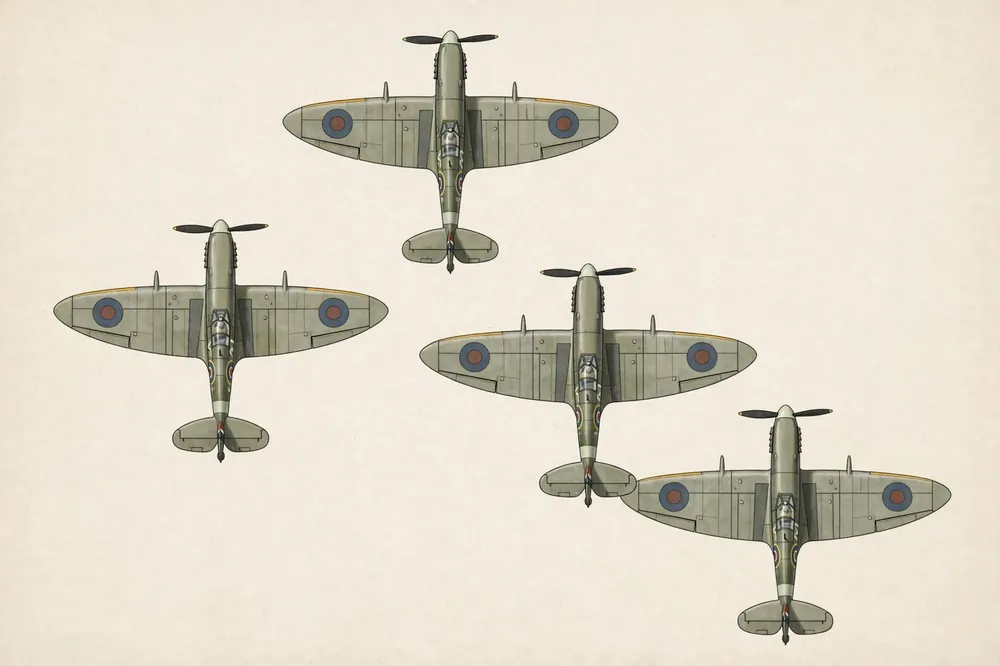
The RAF’s principle was the opposite: the Vic. Three aircraft flew in a tight V, wingtip to wingtip, and the two wingmen’s task was to stay in formation, not to fight. The Vic had been designed for a different purpose — to bring a squadron’s firepower to bear on a bomber formation in a single pass — and it had two fatal weaknesses in a fighter battle.
First, only the leader could see ahead, and the wingmen, who were watching the leader, could not see the enemy. Second, the formation could not manoeuvre: to turn, the Vic had to stay together, and the aircraft on the outside of the turn had to fly faster, and the aircraft on the inside had to fly slower, and the whole formation was slow and predictable.
German pilots learned to attack the Vic from behind and above, and to shoot down the wingmen before the leader knew they were there.
Control: the Dowding system
The RAF’s second principle was control, and it was here that the RAF was superior. The Dowding system, built by Air Chief Marshal Hugh Dowding, was a network: radar stations on the coast detected the incoming German formations, the Observer Corps tracked them over land, the information was plotted in operations rooms, and the controllers directed the fighters by radio to the point of interception.
The system meant that the RAF’s fighters were rarely surprised, that they could be concentrated at the right place, and that they could be spared when there was no raid to meet. The Luftwaffe had no comparable system: its fighters were controlled by the bomber formations they escorted, and they had no radar, no operations rooms, and no central direction.
5. Application in Battle
The Battle of Britain was fought in phases, and each phase tested the two systems differently. In July and August 1940, the Luftwaffe attacked the Channel convoys and the coastal airfields, and the RAF’s fighters, directed by the Dowding system, met them over the sea and over Kent. The Luftwaffe’s fighters, in their Schwärme, often had the tactical advantage in the dogfight, but the RAF’s fighters had the advantage of position: they were directed to the enemy, they fought over their own territory, and a pilot who baled out landed in England and could fly again the next day, while a German pilot who baled out was a prisoner.
The hard weeks
The hardest weeks were late August and early September, when the Luftwaffe attacked the RAF’s airfields in the south-east — Biggin Hill, Hornchurch, Northolt — and the RAF’s sector stations were damaged, its operations rooms were hit, and its pilots were exhausted. Fighter Command’s losses were heavy, and Dowding’s system was strained to the limit. But the system held, and the Luftwaffe’s fighters, tied to the bombers they were escorting, could not exploit their tactical advantage: they were ordered to stay close to the bombers, to fly at the bombers’ speed, and to fight on the bombers’ terms, and the freedom of the Schwarm was wasted on an escort task it had not been designed for.
15 September
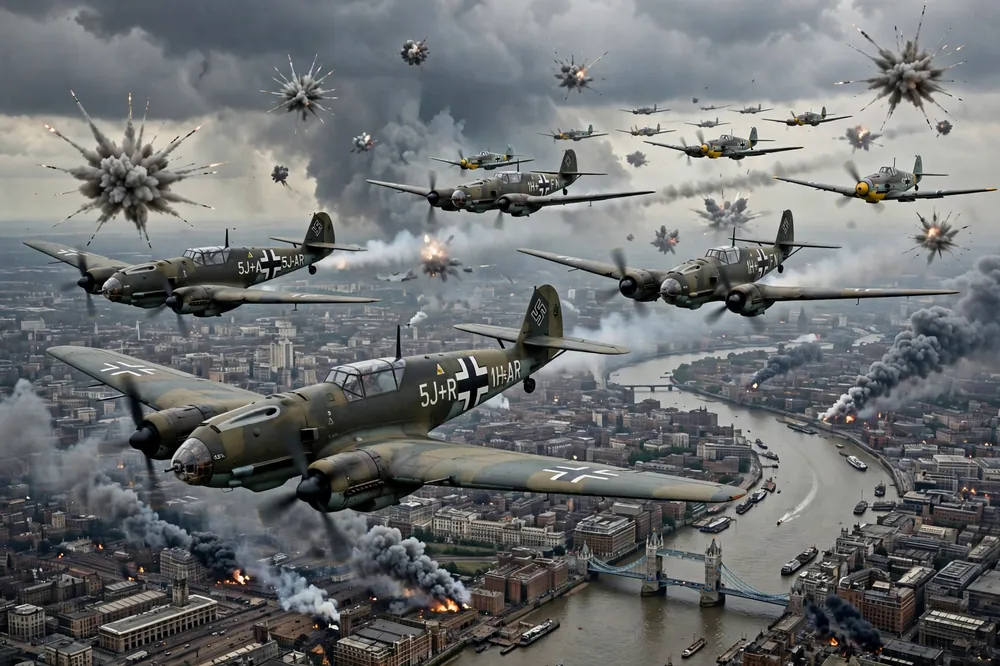
The decisive day was 15 September 1940, when the Luftwaffe launched its largest daylight attack on London, with about 1,000 aircraft, and the RAF, directed by the Dowding system, met it with every squadron it could put in the air. The battle was fought over London and the Thames estuary, and the German losses — about 60 aircraft — were heavier than the RAF’s.
The Luftwaffe’s fighter pilots, flying in Schwärme, fought well, but they were outnumbered at the point of contact, they were short of fuel, and they were fighting a battle whose purpose — the destruction of Fighter Command — they could not achieve. Two days later, Hitler postponed the invasion of Britain, and the Luftwaffe turned to night bombing — the Blitz — and the Battle of Britain was over.
6. Strengths
The Luftwaffe’s strength was its tactical formation. The Rotte and the Schwarm were, in 1940, the best fighter formations in the world, and they remained the best for the rest of the war. They allowed the pilot to see, to manoeuvre, and to fight, and they gave the wingman a real task — to protect the leader — instead of the Vic’s task of staying in formation.
The Luftwaffe’s pilots were also, in 1940, more experienced than the RAF’s, and their experience showed in the dogfight: German pilots, on average, shot down more enemy aircraft per pilot than their British opponents, and the Luftwaffe’s leading aces — Adolf Galland, Werner Mölders — were among the most successful fighter pilots of the war.
The RAF’s strength was its system. The Dowding system was the first integrated air defence system in history, and it was the reason the RAF could meet a larger enemy and win. The system gave the RAF’s fighters the advantage of position, of concentration, and of economy: they were not wasted on standing patrols, they were not surprised, and they were not committed when there was nothing to fight. The RAF’s pilots, too, had a strength that the Luftwaffe’s did not: they fought over home, and a pilot who survived could fly again. The Luftwaffe’s pilots, when they were shot down, were lost for good.
7. Weaknesses
The Luftwaffe’s weaknesses were strategic, not tactical. Its fighters had a short range, and they could not stay over England long enough to win the battle. Its bombers were medium bombers, not heavy bombers, and they could not destroy the RAF’s airfields or its factories. Its command, under Hermann Göring, made a series of errors: it underestimated Fighter Command’s strength, it changed its target from the airfields to London at the moment when the airfields were closest to collapse, and it tied its fighters to the bombers, wasting the Schwarm’s freedom on an escort task. The Luftwaffe’s tactics were excellent; its strategy was not.
The RAF’s weaknesses were tactical, and they were real. The Vic was a bad formation for a fighter battle, and it cost lives: RAF pilots in Vics were shot down by German pilots who had seen them first, and the RAF’s losses in the early weeks of the battle were heavy. The RAF’s rigid attack patterns — the Fighting Area Attacks — were also a weakness: they prescribed a fixed approach, and a fixed approach is predictable. The RAF learned, and it learned fast: by the end of the battle, the Vic was being replaced by the finger-four, copied from the Germans, and the rigid attacks were being abandoned. But the learning was paid for in pilots’ lives.
8. Evolution
After the Battle of Britain, the two air forces’ tactics converged. The RAF adopted the finger-four, and by 1941 its squadrons were flying in pairs and fours, like the Luftwaffe’s. The Luftwaffe, for its part, learned the value of ground control, and by 1943 it had built its own radar and control system — the Himmelbett system — to direct its night fighters against the RAF’s bombers. The two systems, which had been opposites in 1940, became mirror images: both sides flew in pairs and fours, and both sides were directed by radar and radio.
The longer evolution was the decline of the day fighter battle itself. By 1943–44, the air war was dominated by the American daylight bombing campaign, by the Luftwaffe’s defence of the Reich, and by the long-range escort fighters — the P-51 Mustang — that could fly to Berlin and back. The tactics of 1940 — the Vic, the Schwarm, the Dowding system — were the ancestors of the modern air battle, but the modern air battle is fought by radar, by missiles, and by aircraft that can see each other long before they can fight. The dogfight, in the sense of 1940, is a thing of the past.
9. Legacy
The legacy of the comparison is written in the air forces that followed. The finger-four, the pair, the wingman — the Luftwaffe’s tactical legacy — became the standard formation of every air force in the world, and it remains the standard today.
The Dowding system — the RAF’s legacy — became the model for every air defence system that followed, from the Cold War’s early-warning networks to the modern integrated air defence systems of today. The Battle of Britain is remembered, rightly, as the battle in which the system beat the formation: the Luftwaffe’s pilots were better in the dogfight, but the RAF’s system put them in the wrong place, at the wrong time, with too little fuel, and the battle was lost before the dogfight began.
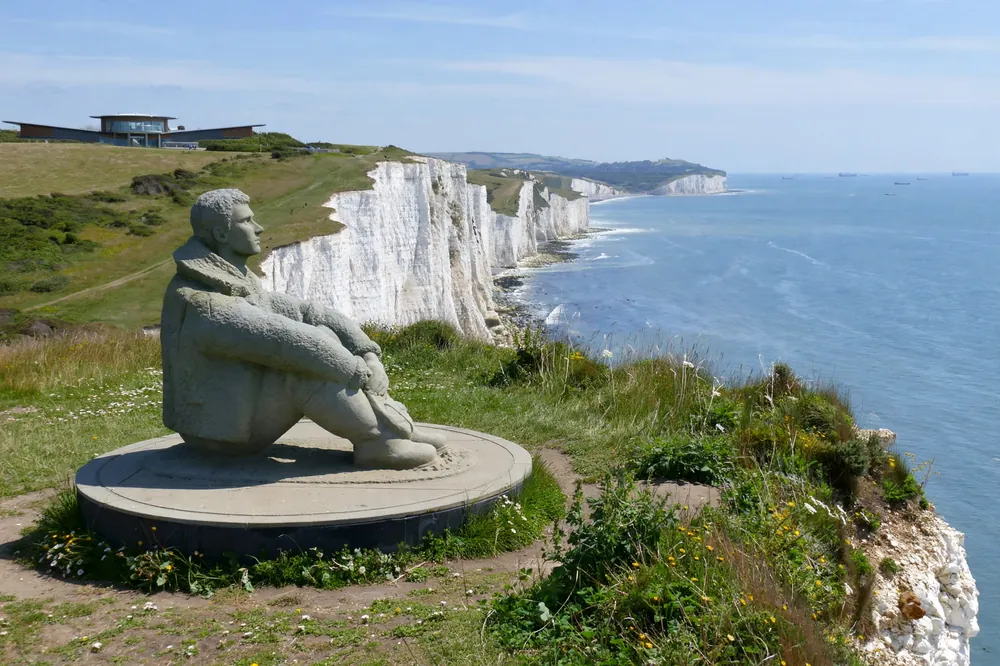
The human legacy is the pilots. The RAF’s pilots — “The Few”, in Winston Churchill’s phrase, about 3,000 men, of whom about 500 were killed in the battle — are remembered in Britain as the men who saved the country. The Luftwaffe’s pilots, who fought with equal courage and greater experience, are remembered less, and their story is a reminder that courage and skill are not enough: a battle is won by the system that puts the courage in the right place, and the Luftwaffe’s system, in 1940, did not.
10. Key Figures
Hugh Dowding (Britain). Air Chief Marshal, commander of RAF Fighter Command. Dowding built the system that won the Battle of Britain — radar, the Observer Corps, the operations rooms, the control of the fighters — and he husbanded his force, refusing to commit it in France in 1940. He was dismissed in November 1940, in a controversy that still divides historians, but his system was the decisive advantage of the battle.
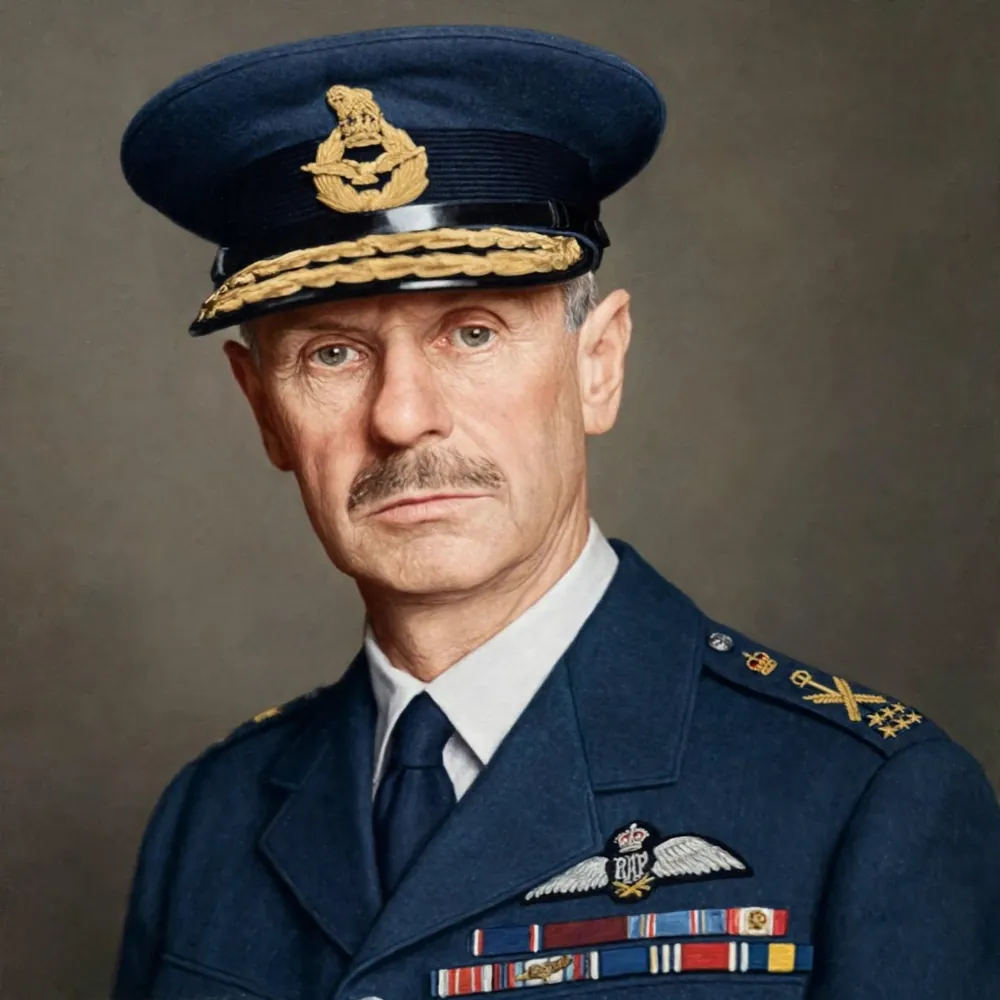
Keith Park (New Zealand / Britain). Air Vice-Marshal, commander of No. 11 Group, the group that bore the brunt of the battle over south-east England. Park’s handling of his squadrons — committing them in small numbers, at the right time, and refusing to be drawn into large formations — was the tactical expression of the Dowding system, and it is now regarded as the model of fighter control.
Adolf Galland (Germany). The Luftwaffe’s leading fighter pilot in 1940 and later General of the Fighter Arm. Galland, who flew the Bf 109 in the Battle of Britain, was one of the war’s most successful aces, with 104 victories. His criticism of Göring’s tactics — above all the tying of fighters to bombers — was famous, and he was dismissed in January 1945.
Werner Mölders (Germany). The Luftwaffe officer who developed the Rotte and Schwarm in Spain and who, as a wing commander in 1940, was one of the most respected German fighter leaders. Mölders, with 115 victories, was the first pilot to pass 100. He was killed in a flying accident in November 1941.
Douglas Bader (Britain). The legless RAF fighter pilot who became one of the most famous British aces of the battle, with 22 victories. Bader championed the “Big Wing” — large formations of several squadrons — in opposition to Park’s small-group tactics, and the controversy between the two men divided Fighter Command and contributed to Dowding’s dismissal.
11. Frequently Asked Questions
What was the difference between the RAF’s Vic and the Luftwaffe’s Schwarm?
The Vic was a tight V of three aircraft, in which the wingmen watched the leader and could not see the enemy. The Schwarm was a loose formation of four aircraft in two pairs, in which each pilot could see, manoeuvre and fight. The Schwarm was the better formation for a dogfight.
The Vic had two fatal weaknesses in a fighter battle: only the leader could see ahead, and the formation could not manoeuvre, because the aircraft on the outside of a turn had to fly faster and the aircraft on the inside had to fly slower. German pilots learned to attack the Vic from behind and above, and to shoot down the wingmen before the leader knew they were there.
What was the Dowding system?
The RAF’s integrated air defence system: radar stations detected incoming raids, the Observer Corps tracked them, operations rooms plotted the information, and controllers directed fighters by radio to the point of interception. It was the first such system in history, and the decisive RAF advantage in 1940. The system meant that the RAF’s fighters were rarely surprised, that they could be concentrated at the right place, and that they could be spared when there was no raid to meet. It was the first integrated air defence system in history, and it was the decisive RAF advantage in 1940: the Luftwaffe had no radar, no operations rooms, and no central direction of its fighters.
Which fighter was better, the Spitfire or the Bf 109?
They were closely matched. The Spitfire was faster and more manoeuvrable at most altitudes; the Bf 109 was well-armed and flown by more experienced pilots. The battle was decided by tactics and by the Dowding system, not by the aircraft. The Spitfire was faster and more manoeuvrable at most altitudes, and its pilots loved it; the Bf 109 was well-armed with cannon and flown by more experienced pilots, but it had a short range — about 20 minutes of combat time over southern England. The battle was decided by tactics and by the Dowding system, not by the aircraft, and the three types were close enough in performance for that to be true.
Why did the Luftwaffe lose the Battle of Britain?
Because its fighters had too little range and too little fuel over England, because its bombers could not destroy the RAF’s airfields, because Göring changed the target from the airfields to London at the critical moment, and because the Dowding system put the RAF’s fighters in the right place at the right time. Its bombers were medium bombers, not heavy bombers, and they could not destroy the RAF’s airfields or its factories. Its command, under Hermann Göring, underestimated Fighter Command’s strength and changed its target from the airfields to London at the moment when the airfields were closest to collapse, and its fighters were tied to the bombers, wasting the Schwarm’s freedom on an escort task.
What was the “Big Wing” controversy?
A dispute inside Fighter Command between Keith Park, who committed his squadrons in small groups at the right time, and Douglas Bader and Trafford Leigh-Mallory, who wanted large formations of several squadrons. The controversy contributed to Dowding’s dismissal in November 1940. Park committed his squadrons in small groups at the right time, while Bader and Trafford Leigh-Mallory wanted large formations of several squadrons. The controversy divided Fighter Command and contributed to Dowding’s dismissal in November 1940, but Park’s small-group tactics are now regarded as the model of fighter control, and the Big Wing is remembered as a dispute about method, not about courage.
Did the RAF copy the Luftwaffe’s formations?
Yes. By the end of the Battle of Britain the RAF was replacing the Vic with the finger-four, copied from the German Schwarm, and by 1941 the finger-four was standard in Fighter Command. By the end of the Battle of Britain the RAF was replacing the Vic with the finger-four, copied from the German Schwarm, and by 1941 the finger-four was standard in Fighter Command. The Luftwaffe, for its part, learned the value of ground control, and by 1943 it had built its own radar and control system — the Himmelbett system — to direct its night fighters against the RAF’s bombers.
12. Sources
- Wikipedia, “Battle of Britain” — dates, forces, losses and the course of the battle.
- Wikipedia, “Dowding system” — radar, the Observer Corps, operations rooms and radio control.
- Wikipedia, “Schwarm” and “Rotte” — the Luftwaffe’s fighter formations.
- Wikipedia, “Vic formation” — the RAF’s three-aircraft formation and its weaknesses.
- Wikipedia, “Hawker Hurricane” and “Supermarine Spitfire” — the RAF’s fighters and their numbers.
- Wikipedia, “Messerschmitt Bf 109” — the Luftwaffe’s main fighter and its short range over England.
- Stephen Bungay, The Most Dangerous Enemy: A History of the Battle of Britain (2000) — the standard modern history of the battle and the two systems.
- James Holland, The Battle of Britain (2010) — the battle, the pilots and the Dowding system.
- Adolf Galland, The First and the Last (1954) — Galland’s account of the Luftwaffe’s fighter tactics and Göring’s errors.