 WAR ATLAS MILITARY HISTORY MAGAZINE · WWI — WWII
M10 Achilles Tank Destroyer
1. Lead
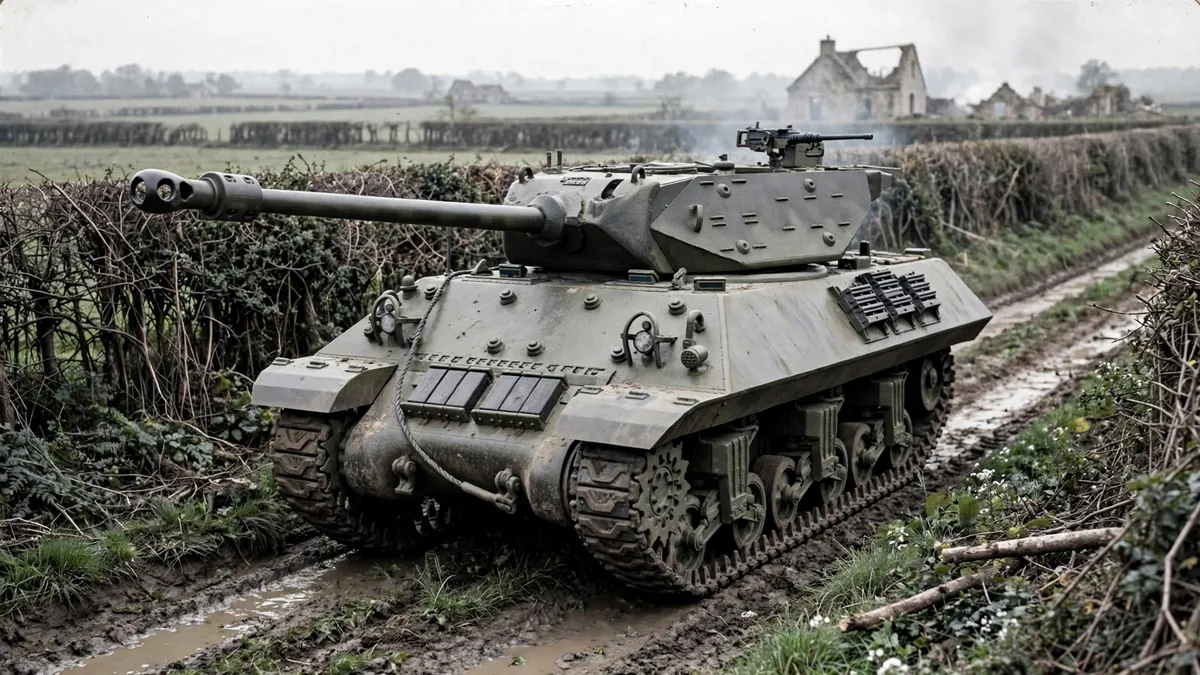
The M10 Achilles tank destroyer was Britain’s answer to the German Tiger and Panther tanks, and one of the most effective tank destroyers of the Second World War. The Achilles was an American M10 tank destroyer, built on the chassis of the M4 Sherman tank, re-armed by the British with the powerful 17-pounder (76.2 mm) anti-tank gun in place of the American 3-inch gun.
About 1,100 M10s were converted to Achilles standard in Britain in 1943–1944, and they served in the Royal Artillery’s anti-tank regiments and in the armoured divisions’ reconnaissance regiments from the Normandy landings in June 1944 until the end of the war in Europe.
The Achilles’ 17-pounder could penetrate the frontal armour of the Panther at normal combat ranges and the side armour of the Tiger, and it was the only Allied tank destroyer in Normandy that could reliably kill the German heavy tanks — a capability that made it one of the most valued vehicles in the British Army.
The Achilles was known officially as the 17-pounder, Self-Propelled, Achilles, and its name — after the Greek hero — was a British habit of naming American-supplied vehicles after classical figures. The vehicle was a compromise: an open-topped turret, thin armour, and a gun that was too powerful for the chassis it was mounted on, but it was a compromise that worked.
The Achilles fought in Normandy, in the breakout across France, in the Netherlands, and in Germany, and it was still in service when the war ended. Its story is the story of British improvisation in the Second World War: a story of taking an American vehicle, fitting a British gun, and producing a tank destroyer that could kill the best tanks Germany had.
2. Key Facts
| Vehicle | 17-pounder, Self-Propelled, Achilles (M10 Achilles), British tank destroyer |
| Built | 1943–1944; about 1,100 converted from American M10s |
| Base vehicle | American M10 tank destroyer, on M4 Sherman chassis |
| Weight | About 30 tons |
| Crew / Kíp lái | 5 (commander, gunner, loader, driver, assistant driver) |
| Main armament | 17-pounder (76.2 mm) gun; 1 × .50-calibre machine gun |
| Armour / Giáp | 12–57 mm; open-topped turret |
| Engine | General Motors 6046 diesel (twin), about 375 hp |
| Speed | About 48 km/h on roads |
| Range | About 320 km on roads |
| Service | Normandy 1944 to Germany 1945; Royal Artillery anti-tank regiments |
3. Design and Development
The 17-pounder gun
The Achilles was built around a gun: the British 17-pounder, the most powerful anti-tank gun in Allied service in 1943–1944. The 17-pounder fired a 76.2 mm armour-piercing shell at a muzzle velocity of about 900 metres per second, which could penetrate about 130 mm of armour at 1,000 metres — enough to defeat the Panther’s frontal armour and the Tiger’s side armour at normal combat ranges.
The gun had been designed as a towed anti-tank gun, and it was the weapon that armed the Sherman Firefly, the British tank that could kill a Tiger. But the towed 17-pounder was heavy and difficult to move, and the British Army needed a self-propelled version that could keep up with the armoured divisions.
The answer was to fit the 17-pounder into the American M10 tank destroyer, which was available in large numbers under Lend-Lease and which had a turret large enough to take the bigger gun.
The American M10
The American M10 tank destroyer was built on the chassis of the M4 Sherman medium tank, with a new, open-topped turret mounting a 3-inch (76.2 mm) gun. The M10 was designed for the American tank destroyer doctrine, which held that tank destroyers should be fast, lightly armoured vehicles that would rush to the scene of a tank attack and destroy the enemy tanks with their guns.
The M10 was a good vehicle for that doctrine, but its 3-inch gun was not powerful enough to defeat the Tiger and the Panther, and the British, who received large numbers of M10s under Lend-Lease, decided to re-arm them with the 17-pounder.
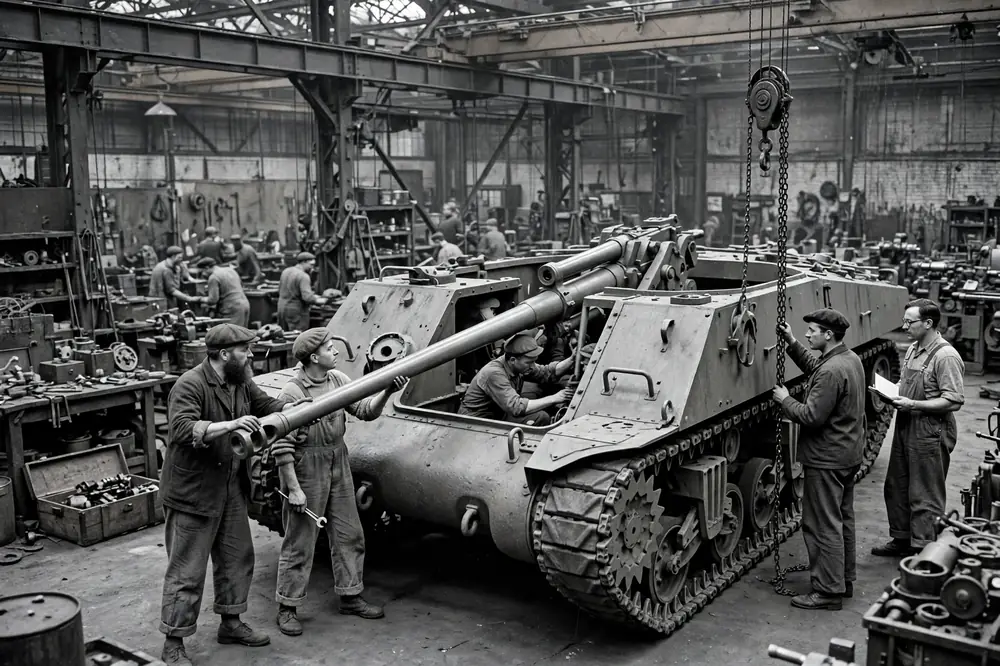
The conversion was carried out in Britain in 1943–1944, at the Royal Ordnance factories, and it involved fitting the 17-pounder gun, with its larger breech and its longer barrel, into the M10’s turret, together with a new gun mounting, a new sight, and a counterweight at the rear of the turret to balance the longer gun.
The conversion
The conversion was not simple. The 17-pounder was a larger and more powerful gun than the 3-inch, and it required a new mounting, a new recoil system, and a turret counterweight. The gun’s breech was so large that the loader had to work in a cramped space, and the gun’s muzzle brake — the distinctive, boxy muzzle brake of the 17-pounder — was necessary to control the recoil.
About 1,100 M10s were converted, in two versions: the Achilles Mk I, converted from the M10 with the General Motors diesel engine, and the Achilles Mk II, converted from the M10A1 with the Ford petrol engine. The Achilles Mk I was the more common version in British service, because the diesel engine was more economical and less prone to catching fire.
The conversion was completed in time for D-Day, and the Achilles regiments were among the first British armoured units to land in Normandy.
4. Armament and Protection
Firepower: the 17-pounder in action
The Achilles’ 17-pounder was the most powerful anti-tank gun in British service in Normandy, and it was the only Allied tank gun that could reliably kill a Panther from the front. The gun fired two main types of ammunition: armour-piercing capped ballistic cap (APCBC), which could penetrate about 130 mm of armour at 1,000 metres, and armour-piercing discarding sabot (APDS), a new type of ammunition with a tungsten core, which could penetrate about 200 mm of armour at 1,000 metres — enough to defeat the Tiger’s frontal armour at close range.
The APDS ammunition was in short supply, and it was less accurate than APCBC, but it was a weapon that gave the Achilles a chance against any German tank. The gun’s high-explosive shell was less effective than the Sherman’s 75 mm gun against infantry and soft targets, which was a limitation, but the Achilles was a tank destroyer, and its job was to kill tanks.
Thin armour and the open turret
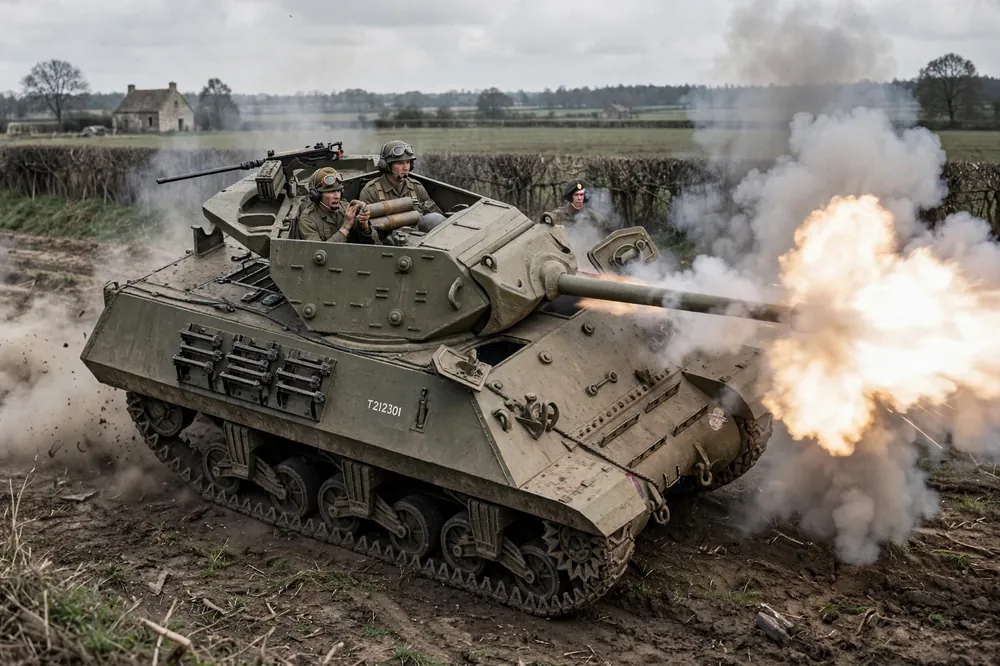
The Achilles’ armour was the M10’s armour: 12–57 mm, with the thickest armour on the hull front and the turret front. That was enough to stop machine-gun fire and shell splinters, but not enough to stop a tank gun or an anti-tank gun.
The turret was open-topped, which gave the crew excellent visibility and allowed them to load the gun quickly, but which left them exposed to artillery fire, to mortar fire, and to snipers — and to the rain. The open turret was the Achilles’ greatest weakness, and it was the reason the vehicle’s crews suffered heavy casualties from artillery and from infantry.
The crews learned to live with it: they fitted canvas covers over the turret in bad weather, they dug in when they were in a defensive position, and they relied on their gun to kill the enemy before the enemy could kill them.
Mobility and the Sherman chassis
The Achilles was built on the Sherman chassis, and it inherited the Sherman’s mobility and reliability. Its General Motors diesel engine produced about 375 horsepower, which gave the 30-ton vehicle a road speed of about 48 km/h and a cross-country speed of about 25–30 km/h.
The Sherman chassis was one of the most reliable tank chassis of the war, and the Achilles’ crews found it easy to maintain and to repair. The vehicle’s range of about 320 kilometres allowed it to operate with the armoured divisions, and its speed allowed it to keep up with the Shermans and the Cromwells it served alongside.
The Achilles was not a fast vehicle by the standards of a tank destroyer, but it was fast enough for its role, and its reliability was one of its greatest strengths.
5. Normandy
The landings and the bocage
The Achilles landed in Normandy on and after D-Day, 6 June 1944, as part of the Royal Artillery’s anti-tank regiments and the armoured divisions’ reconnaissance regiments. In the bocage — the hedgerow country of small fields bounded by thick earth banks — the Achilles’ long 17-pounder gun was a liability in the close-quarters fighting, and the open turret made the crews vulnerable to German infantry and snipers.
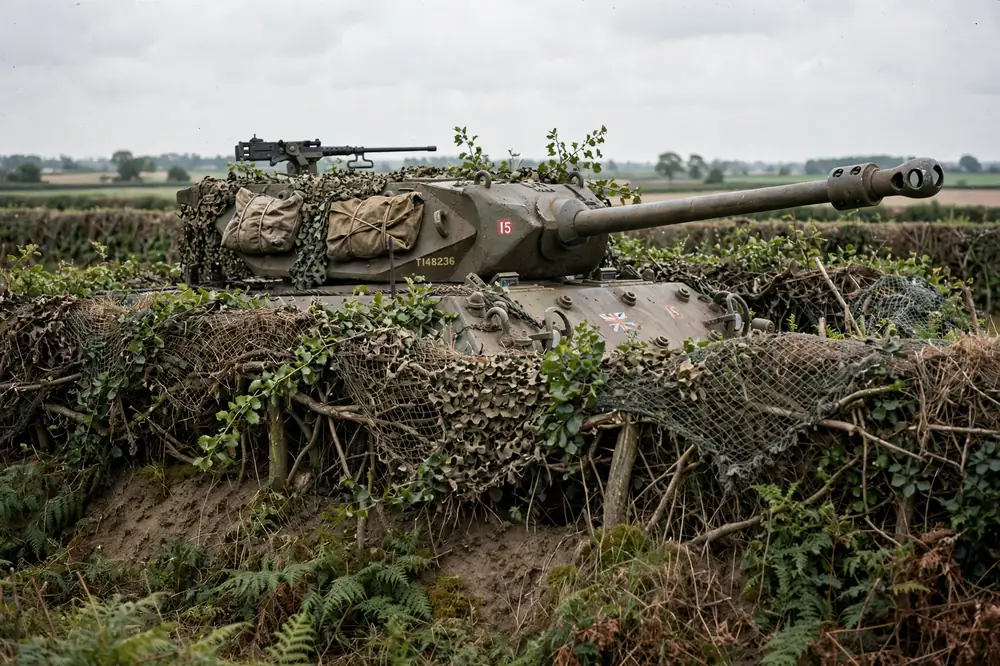
But the Achilles’ gun was also the only Allied weapon that could kill a Panther at long range, and the vehicle’s crews learned to use it in the bocage: to fight from hull-down positions, to engage the Germans at long range, and to withdraw before the Germans could close.
The Achilles fought in the battles around Caen, at Villers-Bocage, and in Operation Goodwood, and it was in Normandy that the vehicle earned its reputation as a Tiger-killer.
The Tiger-killer
The Achilles’ most famous action in Normandy was the destruction of German heavy tanks by the 1st Northamptonshire Yeomanry and other regiments, in which Achilles crews claimed kills against Tigers and Panthers at ranges of up to 1,000 metres and more.
The claims are difficult to verify in detail — tank kill claims in Normandy were often exaggerated, and the same tank was often claimed by several units — but the Achilles’ capability is not in doubt: the 17-pounder could kill a Panther from the front and a Tiger from the side, and the Achilles was the vehicle that brought that capability to the battlefield in numbers.
The German tank crews learned to respect the Achilles, and they learned to identify it by its long gun and its muzzle brake — and to engage it at long range, before it could engage them.
One action illustrates the Achilles’ value better than any statistic. In August 1944, during the fighting around Falaise, Achilles crews of the 1st Northamptonshire Yeomanry engaged German tanks withdrawing through the pocket, and in a single day’s fighting they claimed a large number of kills — including Tigers and Panthers — at ranges that the Shermans alongside them could not match.
The claims from that day, like all kill claims, must be treated with caution, but the pattern is consistent across the Normandy campaign: wherever the Achilles was present, the German heavy tanks were in danger, and wherever it was absent, the Shermans struggled.
The Achilles did not win the battle of Normandy on its own, but it gave the British Army a weapon that the Germans feared, and that fear mattered.
6. The Breakout and the Advance to Germany
Across France and the Low Countries
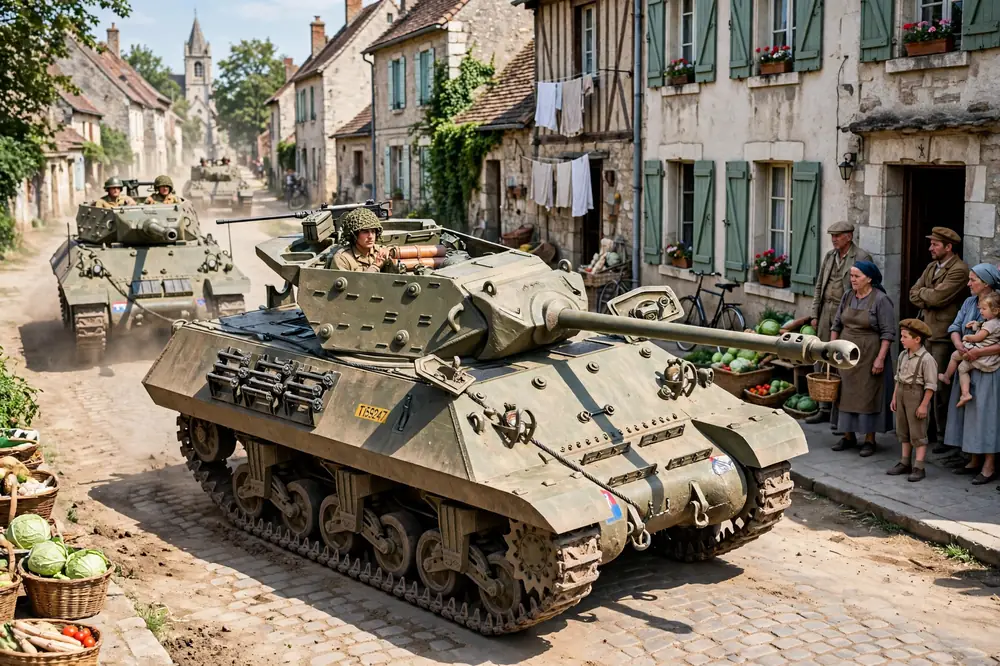
After the breakout from Normandy in August 1944, the Achilles regiments advanced across France, through Belgium and into the Netherlands, as part of the armoured divisions’ pursuit of the retreating Germans. In the open country of northern France, the Achilles’ long-range gun was an advantage, and the vehicle’s crews could engage German tanks at ranges where the Shermans could not. The Achilles fought in the battles for Antwerp, in Operation Market Garden, and in the fighting around Arnhem, where the 1st Airborne Division’s anti-tank guns — including Achilles — were among the few weapons that could stop the German tanks. The advance was fast, and the Achilles’ reliability and its range were valued by the divisions it served.
The Rhineland and the end of the war
In 1945, the Achilles fought in the Rhineland, in Operation Veritable and Operation Plunder, and in the advance into Germany. The vehicle’s crews fought in the Reichswald Forest, in the crossing of the Rhine, and in the final battles for Hamburg and for Bremen.
By then, the German tank force was a shadow of what it had been in Normandy, and the Achilles’ gun was more than adequate for the tanks it met. The Achilles was still in service when the war ended in May 1945, and it had served for eleven months in combat — from Normandy to Germany — without being replaced.
The vehicle’s service was a tribute to its design: a compromise that had worked, and a gun that had proved itself.
7. The Achilles in Other Armies
Commonwealth and post-war service
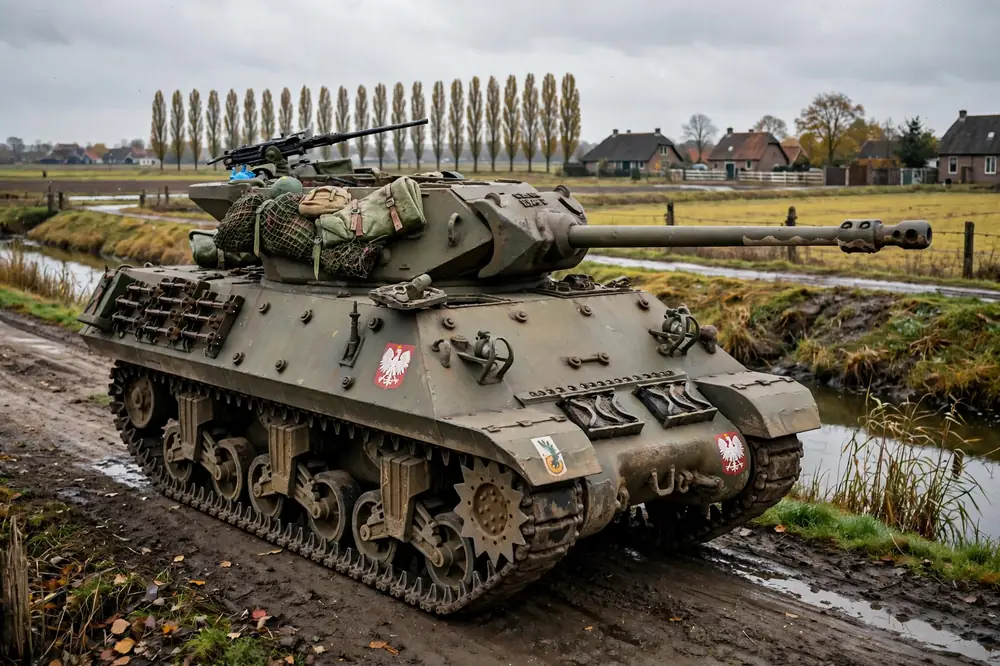
Achilles served not only in the British Army but also in the Canadian Army, in the Polish 1st Armoured Division, and in the New Zealand forces, all of which used the vehicle in Normandy and in the advance to Germany.
After the war, the Achilles served in the British Army of the Rhine, and it was exported to a number of countries, including Egypt, where it served in the 1948 Arab-Israeli War, and Yugoslavia. The vehicle’s post-war service was short — it was replaced by the Centurion tank and by the 17-pounder’s successor, the 20-pounder — but it was a service that showed the vehicle’s durability.
The Achilles was a wartime improvisation, but it was an improvisation that lasted, and it was still in service in some armies into the 1950s.
The Sherman Firefly and the Achilles
The Achilles is often compared with the Sherman Firefly, the other British 17-pounder vehicle of the war. The Firefly was a Sherman tank with a 17-pounder gun in a fully enclosed turret, and it served in the armoured regiments as a tank, while the Achilles served in the anti-tank regiments as a tank destroyer.
The Firefly was better protected, with its enclosed turret, and it was a tank, with all the advantages that implied. The Achilles was faster to produce, because it was a conversion of an existing vehicle, and it was available in larger numbers in Normandy.
The two vehicles complemented each other: the Firefly fought with the tanks, the Achilles fought with the anti-tank regiments, and together they gave the British Army a 17-pounder capability that the Germans could not match. The Achilles and the Firefly are the two great British 17-pounder vehicles of the war, and they are remembered together.
8. The Achilles in Detail
Crew and ergonomics
The Achilles’ five-man crew — commander, gunner, loader, driver and assistant driver — was a good crew for a tank destroyer, and the division of labour was better than in the Sherman, where the commander was often also the loader.
The loader, however, had a hard job: the 17-pounder ammunition was heavy and bulky, the turret was cramped, and the open top meant that the loader was exposed to the weather and to enemy fire. The gunner sat on the left of the gun, the commander sat behind him, and the loader stood on the right, and the three men worked in a space that was barely large enough for them.
The driver and the assistant driver sat in the hull, with the assistant driver also serving as the radio operator. The Achilles’ ergonomics were typical of a wartime conversion — functional, but not comfortable — and they were a reminder that the vehicle was an improvisation, not a purpose-built design.
The vehicle’s appearance
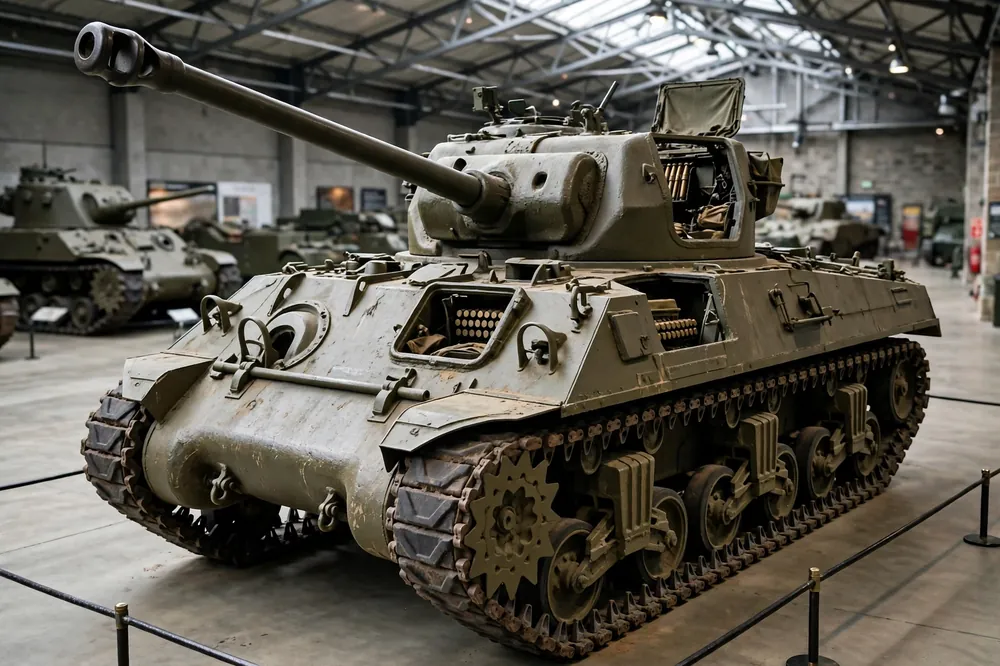
The Achilles was a distinctive-looking vehicle: the familiar Sherman hull, with its sloped front and its wide tracks, topped by a large, open-topped turret with a long 17-pounder gun and a boxy muzzle brake, and a counterweight at the rear of the turret. The vehicle’s appearance was the appearance of a tank destroyer: a gun on a chassis, with minimal armour and maximum firepower.
The Achilles’ long gun and its muzzle brake made it instantly recognisable, and its crews were proud of the vehicle’s appearance — it looked like a tank-killer, and it was a tank-killer. The vehicle’s markings — the Royal Artillery’s insignia, the regiment’s tactical signs, and the white stars of the Allied forces — were the markings of a vehicle that had fought from Normandy to Germany.
9. Survivors and Memory
The surviving Achilles
A number of Achilles survive today in museums in Britain, Canada and other countries, where they are displayed as the classic British tank destroyer of the Second World War. The best-known survivor is at the Tank Museum in Bovington, England, where an Achilles is displayed alongside the Sherman Firefly, so that visitors can see the two great British 17-pounder vehicles side by side. Other examples are preserved in the Imperial War Museum, in the Canadian War Museum, and in private collections. The survivors are a reminder of a vehicle that was built in large numbers, that fought in the most important campaign of the war in the West, and that is still remembered as the Tiger-killer of Normandy.
The Achilles in history
The Achilles is remembered today as the tank destroyer that gave the British Army a gun that could kill a Tiger, and as the vehicle that proved that a wartime improvisation could be a first-class fighting vehicle. It is a vehicle that is often overlooked — overshadowed by the Sherman, by the Firefly, and by the Tiger and the Panther — but it is a vehicle that mattered, because it was there in Normandy, in numbers, with a gun that worked. For the historian of the war in the West, the Achilles is the tank destroyer of Normandy, and for the British Army, it remains the proof that a good gun, on a reliable chassis, can win a battle.
10. Assessment and Legacy
The Achilles was a compromise that worked. It was not a purpose-built tank destroyer, and it was not a perfect vehicle: its armour was thin, its turret was open, and its gun was too powerful for its chassis. But it was available in numbers, it was reliable, and its gun could kill the best tanks Germany had.
In Normandy, where the British Army faced the Tiger and the Panther for the first time, the Achilles was the vehicle that gave the British a chance — and it was a chance the British took. The Achilles’ story is a story of British improvisation at its best: of taking an American vehicle, fitting a British gun, and producing a tank destroyer that could fight and win.
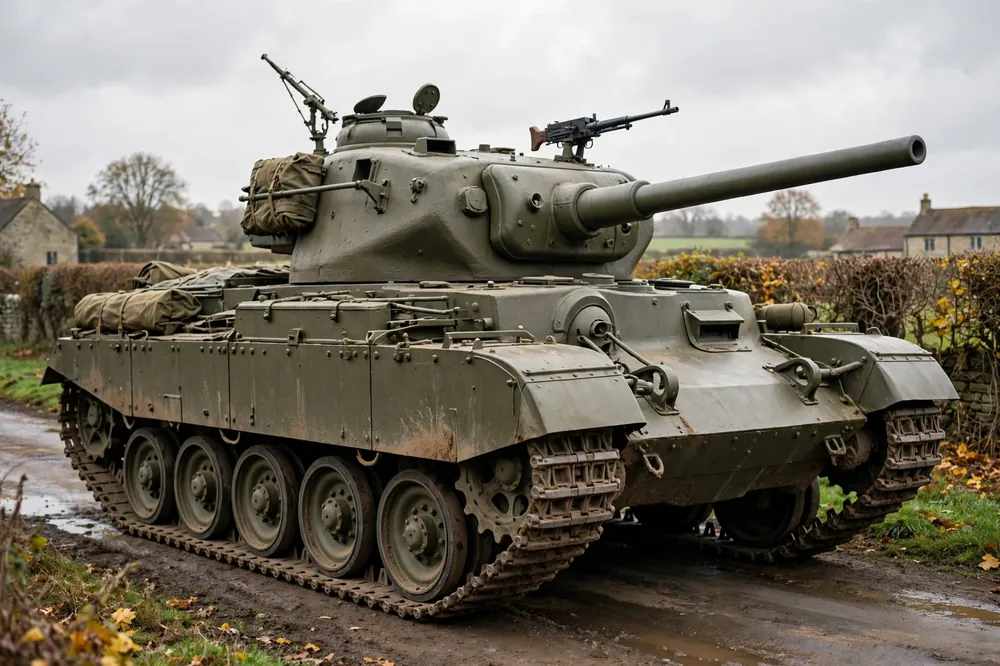
The Achilles’ legacy is the 17-pounder gun, and the lesson that a good gun, on a reliable chassis, is worth more than a perfect vehicle that arrives too late. The 17-pounder would arm the Sherman Firefly, the Comet, and the Centurion, and it would become the standard British tank gun of the post-war period. The Achilles itself was replaced by the Centurion, but its gun lived on, and its reputation as the Tiger-killer of Normandy lives on with it. For the historian, the Achilles is a reminder that in war, the best vehicle is often the one you have, not the one you want — and that the British Army, in 1944, had the Achilles, and it was enough.
11. Frequently Asked Questions
How many M10 Achilles were built?
About 1,100 American M10 tank destroyers were converted to Achilles standard in Britain in 1943–1944, by fitting the British 17-pounder gun in place of the American 3-inch gun. The conversions were carried out at the Royal Ordnance factories, and the vehicles were issued to the Royal Artillery’s anti-tank regiments and to the armoured divisions’ reconnaissance regiments in time for D-Day. The conversions mattered because they gave the British Army a 17-pounder capability in time for D-Day: no other Allied tank destroyer in Normandy could be relied on to kill a Panther from the front.
Could the Achilles kill a Tiger tank?
Yes. The Achilles’ 17-pounder gun could penetrate the Tiger’s side armour at normal combat ranges with standard APCBC ammunition, and with the newer APDS ammunition it could penetrate the Tiger’s frontal armour at close range. The Achilles was the only Allied tank destroyer in Normandy that could reliably kill a Panther from the front, and it was widely respected by German tank crews for that capability. The gun’s power is why the Achilles was so respected: with standard APCBC ammunition it could penetrate the Tiger’s side armour, and with the newer APDS ammunition it could penetrate the frontal armour at close range.
What is the difference between the Achilles and the M10?
The Achilles was an American M10 tank destroyer re-armed by the British with the 17-pounder gun in place of the American 3-inch gun. The conversion also added a turret counterweight to balance the longer gun, a new gun mounting and sight, and the distinctive boxy muzzle brake of the 17-pounder. The Achilles was otherwise identical to the M10, using the same Sherman chassis, engine and running gear. The conversion was more than a new gun: the longer 17-pounder needed a turret counterweight to balance it, and the new gun mounting, sight and muzzle brake changed the vehicle’s appearance.
Why was the Achilles’ turret open-topped?
The Achilles inherited the M10’s open-topped turret, which was designed to give the crew excellent visibility, to allow rapid loading of the gun, and to save weight. The open top was a disadvantage in combat, because it left the crew exposed to artillery, mortar fire and snipers, but it was accepted because the M10 was designed as a tank destroyer that would fight from ambush positions, where visibility mattered more than protection. The open top was a calculated risk: the M10 was built to fight from hidden positions, where seeing the enemy first mattered more than armour.
Where did the Achilles fight?
The Achilles fought in Normandy from D-Day in June 1944, in the breakout across France, in Belgium and the Netherlands, in Operation Market Garden and at Arnhem, and in the Rhineland and the advance into Germany in 1945. It served in the Royal Artillery’s anti-tank regiments and in the armoured divisions, and it was still in service when the war in Europe ended in May 1945. The Achilles fought in every campaign of the British Army in north-west Europe, from D-Day to the advance into Germany. Its 17-pounder made it the British Army’s answer to the Tiger and the Panther in every one of those campaigns.
How did the Achilles compare with the Sherman Firefly?
Both vehicles carried the 17-pounder gun, but the Firefly was a Sherman tank with a fully enclosed turret, serving in the armoured regiments as a tank, while the Achilles was a tank destroyer with an open-topped turret, serving in the anti-tank regiments. The Firefly was better protected, the Achilles was faster to produce and available in larger numbers in Normandy, and the two vehicles complemented each other in giving the British Army a 17-pounder capability. The two vehicles complemented each other: the Firefly brought the 17-pounder to the armoured regiments, as a tank, while the Achilles brought it to the anti-tank regiments, as a tank destroyer.
12. Sources
- Wikipedia, “M10 tank destroyer” and “17pdr SP Achilles” — conversion figures (about 1,100), specifications and service history.
- Steven J. Zaloga, M10 Tank Destroyer vs StuG III Assault Gun: Germany 1944 (Osprey Duel, 2013) — the M10 and the Achilles in Normandy.
- David Fletcher, Sherman Firefly (Osprey New Vanguard, 2008) — the 17-pounder gun and its vehicles, including the Achilles.
- Peter Gudgin, Armoured Firepower: The Development of Tank Armament 1939–45 (Sutton, 1997) — the 17-pounder and its ammunition, including APDS.
- Mark Hayward, Sherman Firefly vs Tiger: Normandy 1944 (Osprey Duel, 2013) — the 17-pounder against the Tiger and the Panther.
- George Forty, British Army Handbook 1939–1945 (Sutton, 1998) — the Royal Artillery’s anti-tank regiments and the Achilles in service.
- Steven J. Zaloga, M4 Sherman vs Type 97 Chi-Ha: The Pacific 1945 (Osprey Duel, 2012) — for the Sherman chassis.
- Bryan Perrett, The Sherman Firefly (in the Osprey New Vanguard series).