 WAR ATLAS MILITARY HISTORY MAGAZINE · WWI — WWII
Illustrious-class Aircraft Carrier
1. Lead
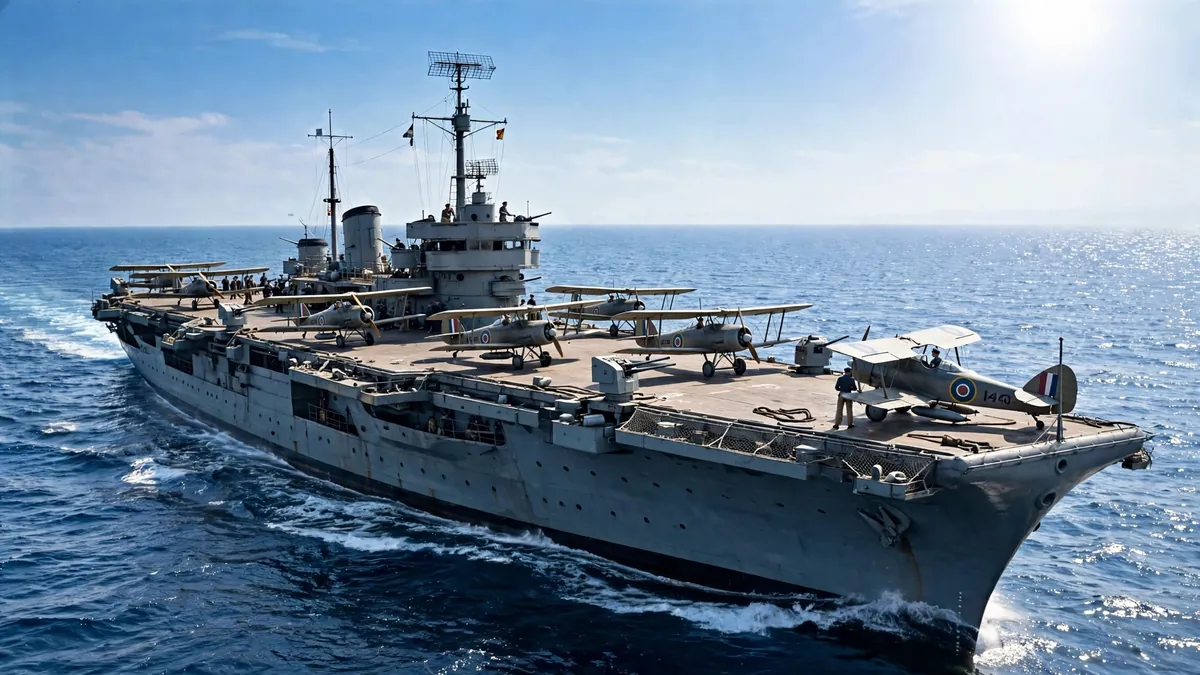
The Illustrious-class aircraft carrier was the Royal Navy’s armoured-deck aircraft carrier of the Second World War, and one of the most important carrier designs of the war. Four ships were built: Illustrious, Victorious, Formidable and Indomitable. They were designed with an armoured flight deck — 76 mm of armour over the hangar — to protect them against bombs in the confined waters of the Mediterranean, where the Royal Navy expected to fight within range of land-based aircraft.
The armoured deck was a controversial choice: it made the ships heavier, it reduced the size of their air groups to about 36 aircraft, against about 90 on an American carrier, and it made the ships more difficult to repair.
But it also made them extraordinarily tough: Illustrious survived six bomb hits in January 1941, Formidable survived bomb hits in the Mediterranean, and Indomitable survived bomb and torpedo damage in the Pacific. No other carrier of the war could have survived what the Illustrious class survived, and the class’s toughness was the reason it was chosen for the most dangerous carrier operations of the war.
The Illustrious class fought in every theatre of the war: in the Mediterranean, where Illustrious‘s aircraft attacked the Italian fleet at Taranto in November 1940 — the first carrier strike against a battle fleet in history, and the model for Pearl Harbor; in the Atlantic, where Victorious hunted the Bismarck; in the Indian Ocean and the Pacific, where the British Pacific Fleet’s carriers — including Illustrious, Victorious, Formidable and Indomitable — fought alongside the Americans against Japan in 1945. The class’s story is the story of the Royal Navy’s carrier war, and of a design that traded aircraft numbers for survival — and that, in the Mediterranean, was the right trade.
2. Key Facts
| Class | Illustrious-class fleet aircraft carrier, Royal Navy |
| Built | 1937–1941; 4 completed |
| Ships | Illustrious, Victorious, Formidable, Indomitable / Illustrious, Victorious, Formidable, Indomitable |
| Displacement | About 23,000 tons standard; about 28,600 tons full load |
| Length | About 225.6 m (740 ft) |
| Speed | About 30.5 knots |
| Armour / Giáp | Flight deck 76 mm; hangar sides 114 mm; belt 114 mm |
| Aircraft | About 36 (design); up to 50+ later in the war |
| Armament | 16 × 4.5-inch dual-purpose guns; anti-aircraft guns |
| Complement | About 1,200–1,400 officers and men (plus air group) |
| Famous actions | Taranto 1940; Bismarck 1941; Pedestal 1942; Okinawa 1945 / Taranto 1940; Bismarck 1941; Pedestal 1942; Okinawa 1945 |
3. Design and Development
The armoured deck
The Illustrious class was designed in the mid-1930s, when the Royal Navy expected its next war to be fought in the Mediterranean, within range of Italian land-based bombers. The lesson of the Spanish Civil War, and of the Abyssinian War, was that a carrier operating in confined waters, within range of land-based aircraft, would be bombed — and that an unarmoured carrier would be sunk.
The Admiralty’s answer was the armoured flight deck: 76 mm of armour over the hangar, with 114 mm of armour on the hangar sides, forming an armoured box that protected the aircraft, the fuel and the ammunition below the flight deck. The armoured deck was a radical departure from American and Japanese carrier design, which used unarmoured wooden flight decks and relied on the air group for defence.
The British design accepted a smaller air group in exchange for the ability to survive bomb hits — a trade that would be vindicated in the Mediterranean in 1941.
The cost of armour
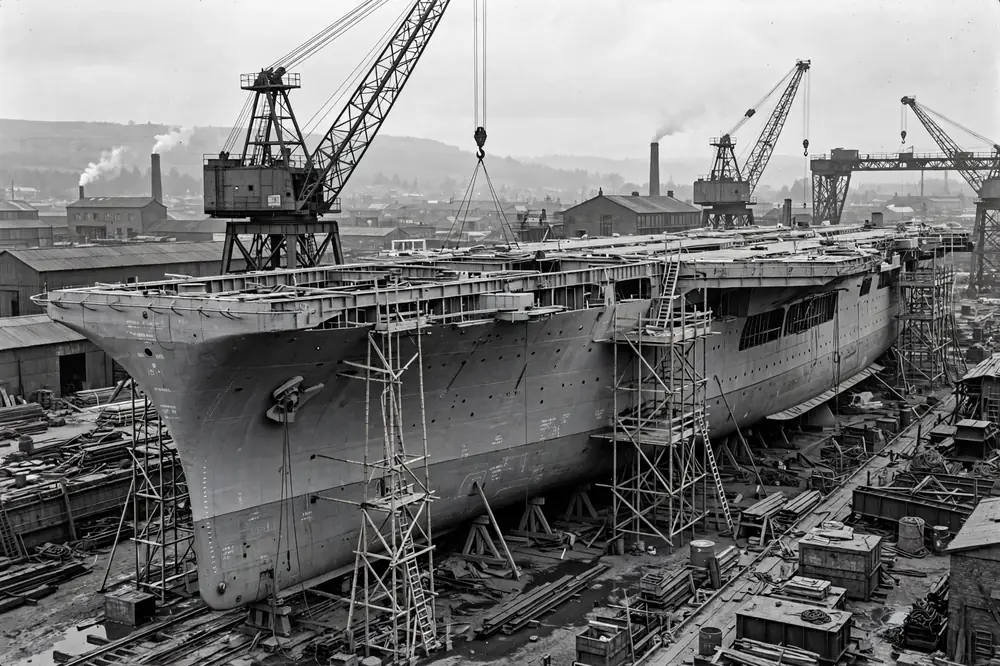
The armoured deck was expensive in every sense. It added about 2,000 tons to the ship’s displacement, it raised the ship’s centre of gravity, and it reduced the hangar height, which limited the size of the aircraft that could be carried. The air group was about 36 aircraft — 18 fighters and 18 torpedo bombers in the original design — against about 90 on an American Essex-class carrier.
The armoured deck also made the ships difficult to repair: a bomb that penetrated the flight deck could buckle the armoured deck, and the buckled deck could not be repaired at sea — it had to be repaired in a dockyard, which took months. The American carriers, with their wooden flight decks, could repair a bomb hole in hours, by patching the deck.
The British carriers could not, and the price of their toughness was a long repair time after every serious hit.
The four ships
The four ships of the class were built at Vickers-Armstrongs at Barrow-in-Furness (Illustrious and Indomitable) and at Harland & Wolff in Belfast (Formidable) and at Vickers-Armstrongs at Newcastle (Victorious). Illustrious was commissioned in May 1940, Victorious in March 1941, Formidable in November 1940, and Indomitable in October 1941. Indomitable differed from her sisters in having a second, half-length hangar below the main hangar, which increased her air group to about 48 aircraft, but which reduced her armour protection. The four ships were the Royal Navy’s first modern fleet carriers, and they were the ships that would fight the carrier war in the Mediterranean, the Atlantic and the Pacific.
4. Aircraft and Air Group
The Swordfish and the Fulmar
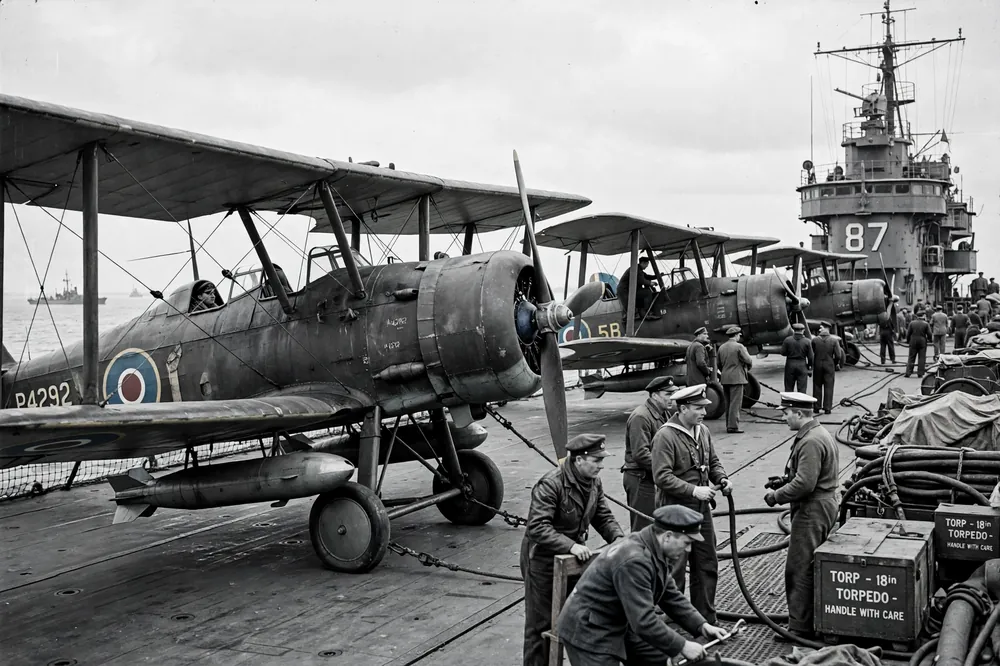
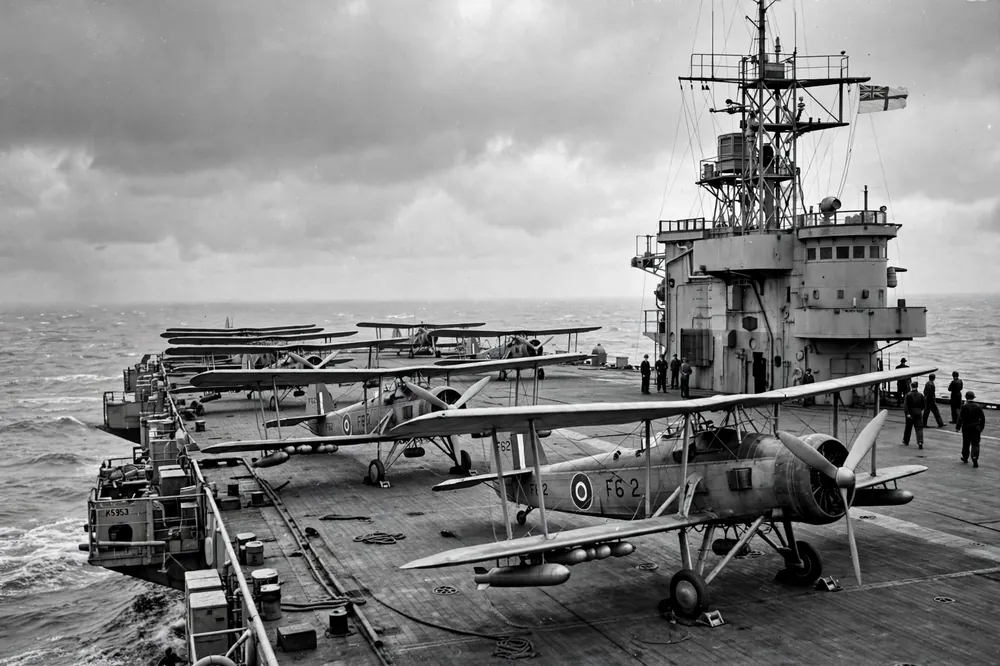
The Illustrious class’s original air group was built around two aircraft: the Fairey Swordfish torpedo bomber, a biplane that was obsolete by 1940 but that was rugged, reliable and devastatingly effective as a torpedo bomber, and the Fairey Fulmar fighter, a two-seat fighter that was slow but long-ranged and that was the Royal Navy’s standard fighter in 1940–1941.
The Swordfish was the aircraft that attacked Taranto, and it was the aircraft that crippled the Bismarck with a torpedo hit on her rudder. The Fulmar was the aircraft that defended the carriers against Italian and German bombers in the Mediterranean, and it was a better fighter than its reputation suggests.
The two aircraft were old, but they were the aircraft the Royal Navy had, and they were the aircraft that won the Mediterranean carrier war.
American aircraft and the Pacific
Later in the war, the Illustrious class’s air groups were re-equipped with American aircraft: the Grumman Wildcat and Hellcat fighters, and the Grumman Avenger torpedo bomber. The American aircraft were faster, better-armed and more modern than the British aircraft they replaced, and they transformed the Illustrious class’s fighting power.
In the Pacific in 1945, the British Pacific Fleet’s Illustrious-class carriers operated Hellcats and Avengers, and they fought alongside the American carriers against the Japanese, striking at Sakishima Gunto and at the Japanese home islands. The American aircraft were the reason the Illustrious class could fight in the Pacific at all — the British aircraft of 1940 could not have fought the Japanese Zero — and they were a measure of how much the carrier war had changed since Taranto.
The small air group
The Illustrious class’s small air group — about 36 aircraft, against about 90 on an American carrier — was the class’s greatest weakness, and it was the price of the armoured deck. In the Mediterranean, where the carriers operated within range of land-based aircraft and where the air group was used for defence as much as for attack, the small air group was adequate.
In the Pacific, where the carriers operated in the open ocean and where the air group was the carrier’s main weapon, the small air group was a handicap, and the British carriers relied on the American carriers for air cover.
The British Pacific Fleet’s carriers were used for a specific task — the bombardment of Sakishima Gunto, where their armoured decks protected them against kamikaze attacks — and for that task, their toughness mattered more than their air group size. The small air group was a weakness, but it was a weakness that the armoured deck compensated for.
5. Taranto: The First Carrier Strike
The attack on the Italian fleet
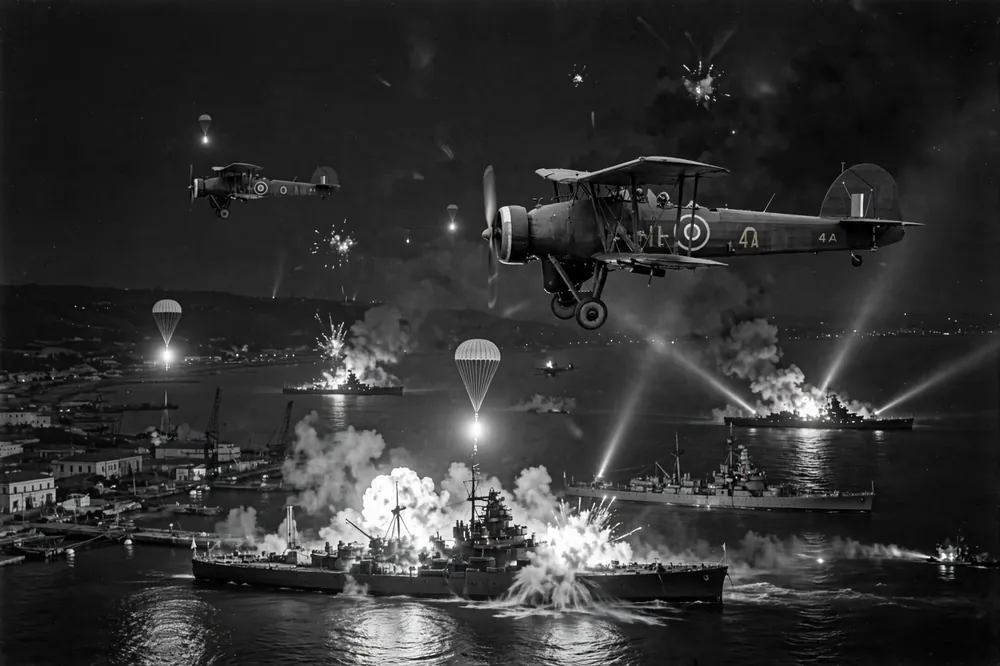
On the night of 11–12 November 1940, Illustrious launched 21 Swordfish torpedo bombers against the Italian fleet at anchor in Taranto harbour, in southern Italy. The attack — Operation Judgement — was the first carrier strike against a battle fleet in history, and it was a devastating success: three Italian battleships — Littorio, Conte di Cavour and Caio Duilio — were torpedoed and put out of action, Cavour was never repaired, and the Italian fleet’s ability to challenge the British in the Mediterranean was crippled.
The attack was carried out by slow, obsolete biplanes, at night, against a defended harbour, and it succeeded because of careful planning, because of the Swordfish’s ability to fly slowly and steadily, and because the Italians had not expected an attack. The Japanese studied Taranto closely, and the attack on Pearl Harbor, thirteen months later, was modelled on it.
The significance of Taranto
Taranto changed naval warfare. It showed that a carrier’s aircraft could cripple a battle fleet at anchor, without the carrier’s guns ever firing, and it showed that the battleship was no longer the dominant weapon at sea. The attack was a triumph for the Illustrious class and for the Royal Navy, and it was the moment the carrier came of age. The attack also had a strategic consequence: it gave the British control of the Mediterranean for the critical months of 1940–1941, when the British were fighting in North Africa and when the convoys to Malta were at their most vulnerable. Taranto was the Illustrious class’s finest hour, and it was the hour that made the class famous.
6. The Mediterranean Ordeal
Illustrious under attack
Two months after Taranto, Illustrious was nearly destroyed. On 10 January 1941, while escorting a convoy to Malta, she was attacked by German Ju 87 Stuka dive-bombers off Sicily. Six bombs hit her — one of them penetrated the armoured flight deck and exploded in the hangar — and she was set on fire from end to end.
Her crew fought the fires, and the ship survived, but she was so badly damaged that she had to be repaired in Malta, then in Alexandria, then in the United States, and she was out of action for more than a year.
The attack showed both the strength and the weakness of the armoured deck: the deck had saved the ship from being sunk, but the damage was so severe that the ship was out of action for a year. An American carrier, with a wooden flight deck, would have been sunk by six bomb hits — but it would also have been repaired in weeks, not in a year.
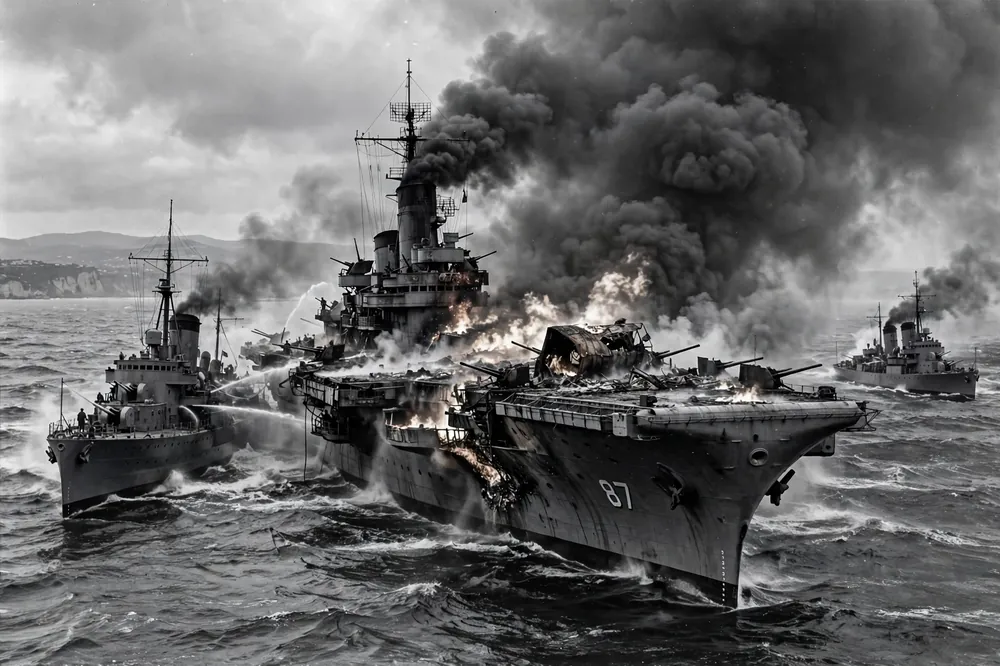
Formidable and the other carriers
Formidable also survived bomb hits in the Mediterranean, and she fought in the Battle of Cape Matapan in March 1941, where her aircraft torpedoed the Italian cruiser Pola and helped to sink three Italian heavy cruisers. Victorious served in the Atlantic and in the Arctic, and she took part in the hunt for the Bismarck in May 1941, when her Swordfish scored the first torpedo hit on the German battleship. Indomitable served in the Indian Ocean, where she was damaged by Japanese bombers, and in the Mediterranean, where she was torpedoed during Operation Pedestal in August 1942 — the great convoy operation to Malta — and survived.
The four ships’ Mediterranean service was a catalogue of bomb hits, torpedo hits, fires and repairs, and it was a service that proved the armoured deck’s worth: the ships were hit, and they survived, and they came back.
7. The Atlantic and the Arctic
Victorious and the Bismarck
Victorious‘s most famous action was the hunt for the Bismarck in May 1941. On 24 May 1941, the day the Bismarck sank HMS Hood in the Denmark Strait, Victorious launched nine Swordfish against the German battleship, and one of them scored a torpedo hit — the first torpedo hit on the Bismarck, and the hit that slowed her and allowed the British to catch her. Victorious‘s aircraft were obsolete biplanes, and they attacked in bad weather, against a battleship with heavy anti-aircraft guns, but they pressed home their attack, and their torpedo hit was the beginning of the end for the Bismarck.
The action was a reminder that the carrier’s aircraft, even obsolete aircraft, could cripple a battleship — and that the Illustrious class’s carriers were, by 1941, the Royal Navy’s most important ships.
Arctic convoys
The Illustrious-class carriers also served on the Arctic convoys, escorting the merchant ships that carried supplies to the Soviet Union through the Barents Sea, within range of German aircraft and U-boats based in Norway. The work was hard and dangerous: the weather was appalling, the German air threat was constant, and the carriers’ aircraft were the convoys’ only air cover. Victorious and Formidable both served on the Arctic run, and their aircraft defended the convoys against German bombers and shadowed the German battleship Tirpitz, which was based in Norway and which threatened the convoys throughout 1942–1943. The Arctic service was unglamorous, but it was essential, and it was a service that the Illustrious class performed well.
8. The Pacific War
The British Pacific Fleet
In 1945, the four Illustrious-class carriers — together with the newer Implacable-class carriers — formed the British Pacific Fleet, which fought alongside the American Fifth Fleet against Japan. The British carriers were assigned a specific task: the bombardment of Sakishima Gunto, the island chain between Formosa and Okinawa, where their aircraft attacked Japanese airfields and where their armoured decks protected them against kamikaze attacks.
The kamikaze was the ultimate test of the armoured deck: a Japanese aircraft, diving onto a carrier’s flight deck, would have sunk an American carrier with a wooden deck, but the British carriers’ armoured decks withstood the impacts, and the ships survived kamikaze hits that would have destroyed an unarmoured carrier. Formidable was hit by a kamikaze on 4 May 1945, and she survived; Victorious was hit by kamikazes, and she survived; Indomitable was hit, and she survived.
The armoured deck, which had been designed for the Mediterranean, proved its worth in the Pacific against a weapon its designers had never imagined.
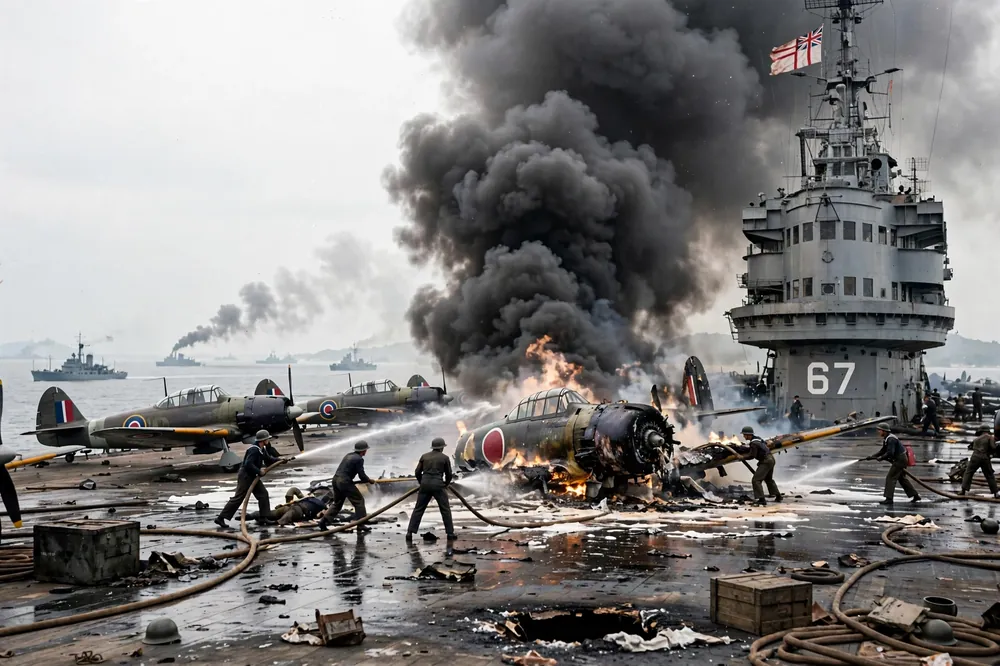
Okinawa and the end of the war
The British Pacific Fleet’s carriers fought at Okinawa in 1945, in the last great carrier battle of the war, and they were still in action when Japan surrendered in August 1945. The Illustrious class’s Pacific service was the class’s final campaign, and it was a campaign that showed the class at its best: tough, resilient, and able to survive the most dangerous weapon of the Pacific war. The four ships returned to Britain after the war, and they were the Royal Navy’s most decorated carriers — and the carriers that had proved, in the Mediterranean and in the Pacific, that the armoured deck was a design that worked.
9. Post-War Service and Fate
The post-war carriers
After the war, the Illustrious-class carriers were too small and too slow for the jet age, and they were gradually withdrawn from service. Victorious was rebuilt in the 1950s with an angled flight deck, a steam catapult and a new island, and she served until 1968 as the Royal Navy’s last Illustrious-class carrier in service. Illustrious was used as a training ship and was scrapped in 1956. Formidable was scrapped in 1953, after a fire in 1947 had damaged her beyond economical repair. Indomitable was scrapped in 1955.
None of the four ships survives today, and the class exists now only in photographs, in models, and in the memory of the men who served in her. The armoured-deck carrier, which the Illustrious class had pioneered, was carried on in the Implacable class and in the post-war Audacious class, and in the American Midway class, which adopted the armoured flight deck after the war.
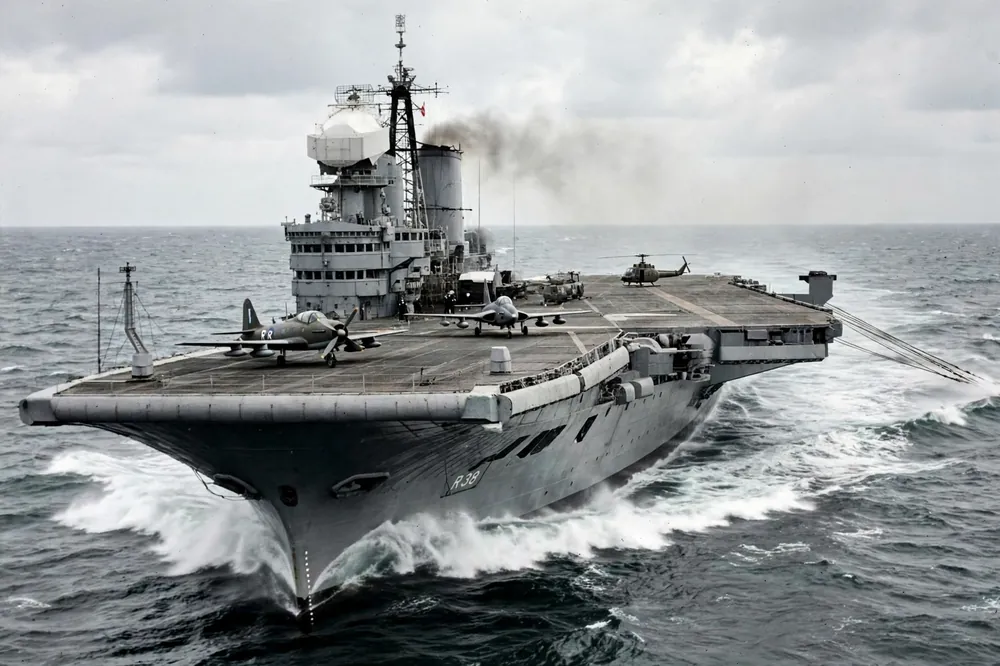
The armoured deck’s legacy
The Illustrious class’s armoured deck was a controversial design, and it is still debated by naval historians. The critics argue that the armoured deck reduced the air group too much, and that the Royal Navy would have been better served by larger air groups on unarmoured carriers.
The defenders argue that the armoured deck saved the ships in the Mediterranean and in the Pacific, and that a carrier that survives is worth more than a carrier that carries more aircraft but is sunk. The truth is that both sides are right: the armoured deck was the right design for the Mediterranean, where the carriers operated within range of land-based aircraft, and it was the wrong design for the Pacific, where the air group was the carrier’s main weapon.
The Illustrious class was a product of its time and of its expected war, and it was a design that worked — in the war it was designed for, and in the war it actually fought.
10. Assessment and Legacy
The Illustrious class was the Royal Navy’s most important carrier design of the Second World War, and it was a design that proved itself in the hardest carrier war of the war. The class’s ships fought in the Mediterranean, in the Atlantic, in the Arctic and in the Pacific, and they survived bomb hits, torpedo hits and kamikaze attacks that would have sunk any other carrier.
The class’s air groups were small, and its ships were difficult to repair, but its toughness was unmatched, and its service record — Taranto, the Bismarck, Matapan, Pedestal, Okinawa — is one of the most distinguished of any carrier class in history.
The Illustrious class is remembered today as the armoured-deck carrier, as the carrier of Taranto, and as the carrier that proved that a ship could be built to survive — and that survival, in the end, is the most important quality a warship can have.
The class’s legacy is the armoured flight deck, which the American Navy adopted after the war in the Midway class, and which remains a feature of modern carriers. The class’s legacy is also Taranto, the attack that changed naval warfare and that showed the world what a carrier could do. And the class’s legacy is the British Pacific Fleet, the fleet that fought alongside the Americans in the last months of the war and that proved that the Royal Navy could still fight a carrier war, in the Pacific, against the most formidable naval air force in the world. The Illustrious class is gone, but its lessons live on in every carrier built since.
11. Frequently Asked Questions
How many Illustrious-class aircraft carriers were built?
Four Illustrious-class aircraft carriers were built: Illustrious, Victorious, Formidable and Indomitable, commissioned between May 1940 and October 1941. They were the Royal Navy’s first modern fleet carriers with armoured flight decks, and they served in the Mediterranean, the Atlantic, the Arctic and the Pacific. The four ships were the Royal Navy’s first modern fleet carriers with armoured flight decks, and they were built for the Mediterranean, where the Navy expected to fight within range of land-based aircraft. They served in every theatre of the war — the Mediterranean, the Atlantic, the Arctic and the Pacific — and their armoured decks are why they survived hits that would have sunk other carriers.
What was the Battle of Taranto?
The Battle of Taranto, on the night of 11–12 November 1940, was the attack by 21 Swordfish torpedo bombers from HMS Illustrious on the Italian fleet at anchor in Taranto harbour. Three Italian battleships were torpedoed and put out of action, and the Italian fleet’s ability to challenge the British in the Mediterranean was crippled. It was the first carrier strike against a battle fleet in history, and the model for the Japanese attack on Pearl Harbor thirteen months later.
How did the armoured flight deck work?
The Illustrious class had 76 mm of armour on the flight deck, over the hangar, with 114 mm of armour on the hangar sides, forming an armoured box that protected the aircraft, fuel and ammunition below. The armour could stop a 500-pound bomb, and it allowed the ships to survive bomb hits that would have sunk an unarmoured carrier. The price was a smaller air group — about 36 aircraft against about 90 on an American carrier — and a longer repair time after serious damage.
Did the Illustrious class survive kamikaze attacks?
Yes. In the Pacific in 1945, the British Pacific Fleet’s Illustrious-class carriers were hit by kamikazes, and they survived — Formidable was hit on 4 May 1945, Victorious and Indomitable were also hit, and all three survived and remained in action. The armoured flight deck withstood kamikaze impacts that would have destroyed an American carrier with a wooden flight deck, and the British carriers’ survival was a vindication of the armoured-deck design. The survival was a vindication of the armoured-deck design: the armoured deck took kamikaze hits that would have sunk a carrier with a wooden flight deck.
What happened to the Illustrious-class carriers after the war?
After the war, the ships were gradually withdrawn. Victorious was rebuilt in the 1950s with an angled flight deck and served until 1968. Illustrious was used as a training ship and scrapped in 1956. Formidable was scrapped in 1953 after a fire in 1947, and Indomitable was scrapped in 1955. None of the four ships survives today. None of the four ships survives today, but their service after the war was long: Victorious was rebuilt in the 1950s with an angled flight deck and served until 1968, while the others were used as training ships or scrapped in the 1950s.
How did the Illustrious class compare with American carriers?
The Illustrious class was tougher but carried fewer aircraft than American carriers. An American Essex-class carrier carried about 90 aircraft, against about 36 on an Illustrious-class carrier, and it could repair bomb damage to its wooden flight deck in hours, while a British carrier needed months in dockyard. But the British carrier could survive bomb and kamikaze hits that would have sunk an American carrier, and in the Mediterranean and in the Pacific, that toughness mattered more than air group size. The American Navy adopted the armoured flight deck after the war in the Midway class.
12. Sources
- Wikipedia, “Illustrious-class aircraft carrier” — construction figures, specifications, service history and the armoured flight deck.
- David Brown, Carrier Operations in World War II: Volume 1, The Royal Navy (Naval Institute Press, 1968) — Taranto, the Mediterranean and the Pacific.
- Norman Friedman, British Carrier Aviation: The Evolution of the Ships and Their Aircraft (Naval Institute Press, 1988) — the armoured-deck design and its development.
- John Winton, Carrier Glorious: The Life and Death of an Aircraft Carrier and The Forgotten Fleet (Michael Joseph, 1969) — the British Pacific Fleet.
- David Hobbs, The British Pacific Fleet: The Royal Navy’s Most Powerful Strike Force (Seaforth, 2011) — the Illustrious class in the Pacific in 1945.
- Thomas P. Lowry and John W. G. Wellham, The Attack on Taranto (in the Naval Institute Press series) — Operation Judgement, 11–12 November 1940.
- H. T. Lenton, British and Empire Warships of the Second World War (Naval Institute Press, 1998).
- David Hobbs, British Aircraft Carriers: Design, Development and Service Histories (Seaforth, 2013).