 WAR ATLAS MILITARY HISTORY MAGAZINE · WWI — WWII
Heinkel He 219 Uhu
1. Lead
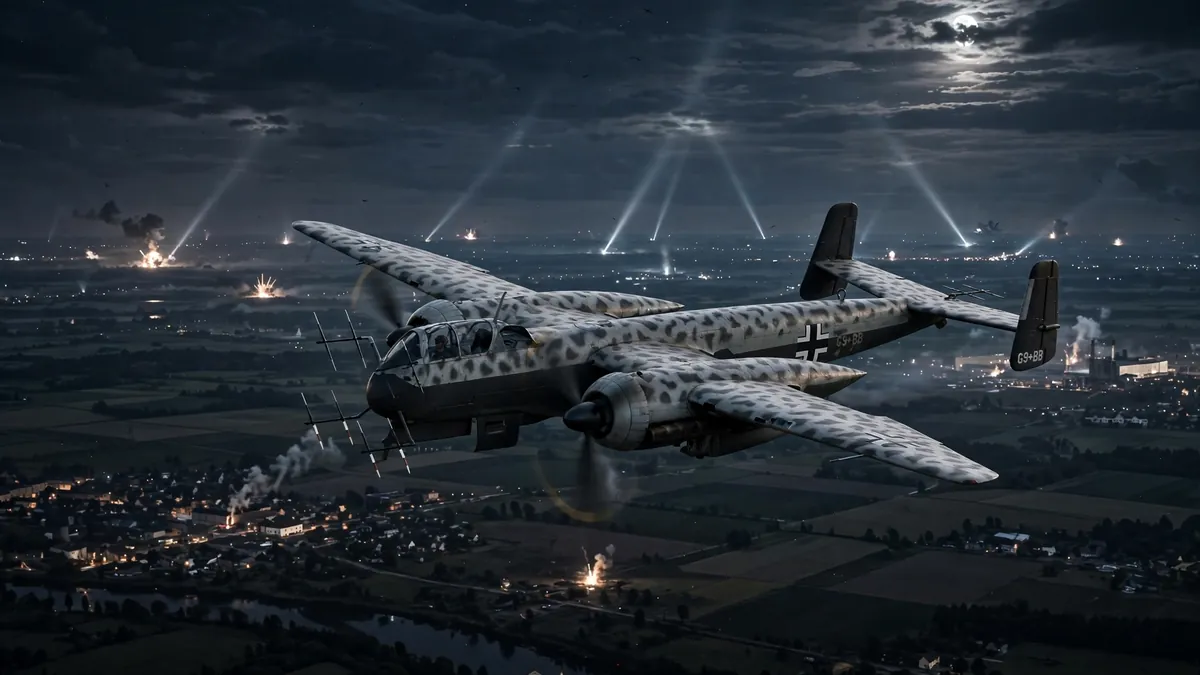
The Heinkel He 219 Uhu — the Eagle-Owl — was the most advanced night fighter built by Germany during the Second World War, and one of the most sophisticated combat aircraft of the conflict as a whole. A twin-engine, two-seat fighter designed from the outset for the night battle against the Royal Air Force’s bomber stream, the He 219 combined a speed that matched the best day fighters with a heavy cannon armament, an airborne interception radar, and a series of technical firsts: it was the first operational aircraft in the world to be fitted with ejection seats, and one of the first to carry the upward-firing Schräge Musik cannon that let it attack a bomber from below, where the bomber’s gunners could not see it.
On its first operational night, 11–12 June 1943, He 219s claimed five RAF bombers in a single sortie, and for the rest of the war the Uhu was the night fighter the RAF’s bomber crews feared most.
Only 268 He 219s were built, and the type’s career was hampered by political infighting, by engine problems and by the collapse of Germany itself, but its reputation has grown since the war, as historians have come to recognise it as one of the outstanding aircraft of the conflict. Its designer, Ernst Heinkel, regarded it as his finest work, and the RAF’s bomber crews, who met it over Germany in 1943 and 1944, regarded it as the most dangerous night fighter they faced. The He 219’s story is the story of German night-fighter development at its best and at its most tragic: a brilliant aircraft, built in too few numbers, fighting a battle its country had already lost.
2. Key Facts
| Role | Twin-engine night fighter (also day fighter and reconnaissance) |
| Manufacturer | Heinkel Flugzeugwerke, Germany |
| Designer | Ernst Heinkel; Robert Lusser (project lead) |
| First flight | 6 November 1942 |
| Introduced | June 1943 |
| Produced | About 268 |
| Crew | 2 (pilot and radar operator) |
| Engines | 2 × Daimler-Benz DB 603A V-12, about 1,750 hp each |
| Maximum speed | About 580–616 km/h depending on version and radar fit |
| Range | About 2,000 km (1,243 miles) |
| Armament | Up to 6 × 20 mm MG 151 cannon; some versions with 2 × 30 mm MK 108 cannon and 2 × 20 mm MG 151 in Schräge Musik |
| Radar / Radar | FuG 212 Lichtenstein C-1, later FuG 220 Lichtenstein SN-2 |
| Main users | Luftwaffe (Germany) |
| Fate | Withdrawn 1945; one complete original survives in the Smithsonian |
3. Origins and Requirements
The night war over Germany
By 1942 the air war over Germany had become a night war. The Royal Air Force’s Bomber Command, under Air Marshal Arthur Harris, had abandoned daylight bombing — the losses were too high — and had turned to the night, sending streams of hundreds of heavy bombers against German cities in the darkness.
The Luftwaffe’s answer was the night fighter: twin-engine aircraft, fitted with radar, that could find a bomber in the dark and shoot it down. The early night fighters — the Bf 110, the Ju 88 and the Do 217 — were adaptations of day aircraft, and they were effective, but they were not fast enough to catch the RAF’s new bombers, and they were not designed for the night battle.
The Luftwaffe needed a purpose-built night fighter, and Heinkel offered to build one.
Heinkel’s P.1060 proposal
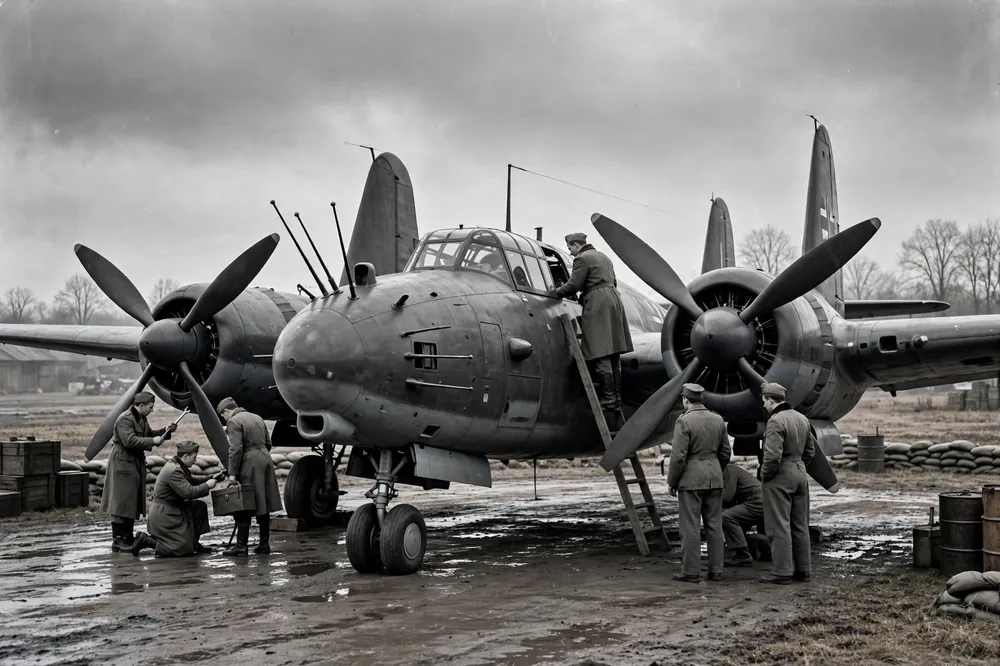
Heinkel’s proposal, the P.1060, was the work of Robert Lusser, Heinkel’s chief designer, and it was a radical aircraft: a twin-engine, two-seat fighter with a tricycle landing gear — the first German combat aircraft to use one — with ejection seats for both crewmen, with a heavy cannon armament and with the FuG 212 Lichtenstein radar.
The Reich Air Ministry, which had long favoured the established manufacturers, was slow to take the proposal seriously, and the project was delayed by indecision and by the opposition of General Josef Kammhuber, the commander of the night-fighter force, who preferred the Ju 88 and the Bf 110.
It was only after the prototype’s performance proved outstanding that the Air Ministry ordered the aircraft into production, as the He 219, and the first aircraft reached the squadrons in June 1943.
Politics, engines and delay
The He 219’s development was hampered by political infighting that wasted time Germany could not afford. The Air Ministry’s technical office, under Erhard Milch, opposed the He 219 on the grounds that it was too complex and too expensive, and that the Ju 88 and the Bf 110 were adequate for the night battle.
Heinkel, who had fallen out of favour with the Nazi leadership, fought for his aircraft, and it was only the intervention of the night-fighter pilots themselves — who flew the prototype and reported that it was the best night fighter they had ever flown — that secured the production order.
The engines, too, were a problem: the DB 603, the engine the He 219 was designed around, was in short supply, and the production aircraft were fitted with the DB 603A, a version of about 1,750 horsepower that was less powerful than the engine the designers had wanted.
4. Design and Development
Airframe, tricycle gear and ejection seats
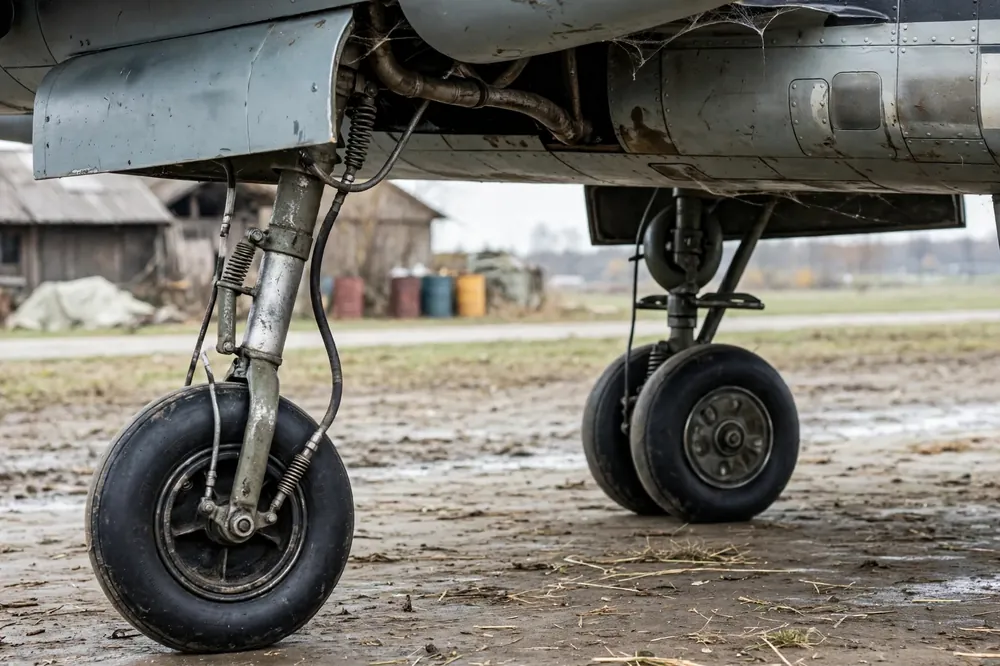
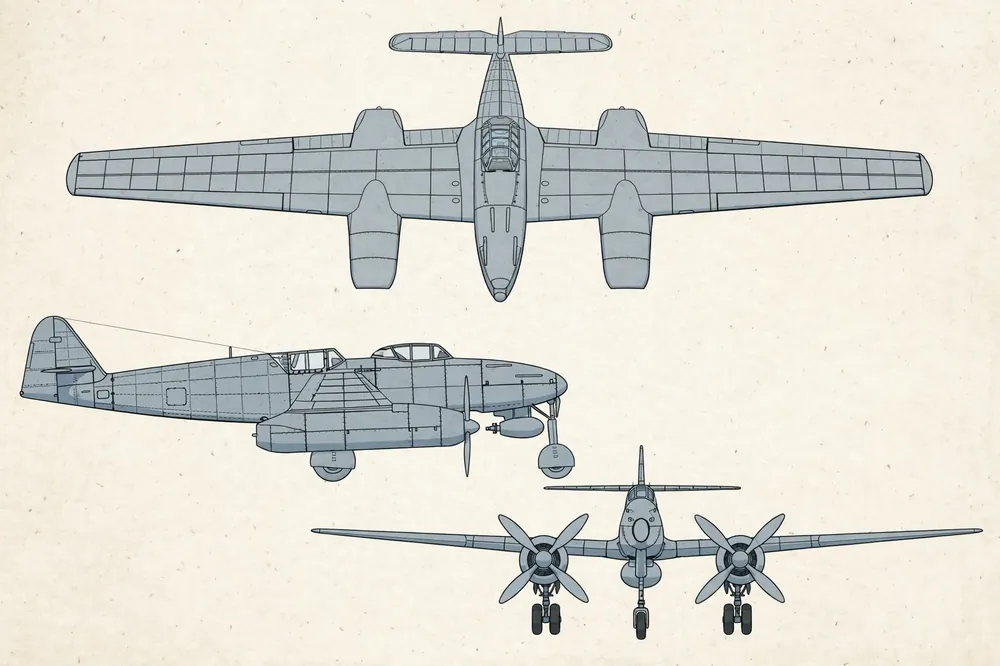
The He 219 was a mid-wing monoplane of all-metal construction, with a long, slender fuselage and a wing of about 18.5 metres span. Its most distinctive features were, in the first place, its tricycle landing gear — the nosewheel and the two main wheels, which retracted into the engine nacelles and the fuselage — and, in the second, its ejection seats.
The He 219 was the first operational aircraft in the world to be fitted with ejection seats, a Heinkel-designed system that used compressed air to blow the seat and its occupant clear of the aircraft, and it saved the lives of many crews who would otherwise have died in a burning aircraft at night.
The cockpit was pressurised in some versions, and it was set well forward, with a good view, and the aircraft’s tail was conventional, with a large fin and rudder.
The aircraft’s construction was, by the standards of 1943, advanced: it used a stressed-skin structure with a high proportion of light alloys, and its wing was designed for high speed, with a laminar-flow section and a low drag. The He 219’s handling was widely praised: it was stable, responsive and pleasant to fly, with a good view and a comfortable cockpit, and its tricycle gear made it easier to land at night than the tailwheel aircraft it replaced. Its one vice was a tendency to swing on take-off if the pilot was careless with the throttles, a trait shared with many powerful twin-engine aircraft of the period.
Engines and performance
The DB 603A was a twelve-cylinder, liquid-cooled, inverted-V engine of about 1,750 horsepower, and the He 219’s two engines gave it a maximum speed of about 580 to 616 km/h, depending on the version and on the radar fit — the radar aerials, mounted on the nose, added drag and reduced the speed by a significant margin.
The aircraft’s range, about 2,000 kilometres, was adequate for the night battle over Germany, and its climb rate let it reach the altitude of the bomber stream quickly. The He 219’s speed was its greatest advantage: it was faster than the Bf 110 and the Ju 88, and it could catch the RAF’s Lancasters and Halifaxes, which cruised at about 400 km/h, with ease.
The aircraft’s performance did decline with the later, heavier radar sets, and the He 219’s pilots complained that the drag of the SN-2 radar aerials — the large, antler-like “Hirschgeweih” array — cost them 30 to 40 km/h of speed, a complaint that was justified.
5. Technical Description
Radar: Lichtenstein C-1 and SN-2
The He 219’s radar was the heart of its mission. The early aircraft carried the FuG 212 Lichtenstein C-1, a radar with a range of about 4 kilometres and a set of aerials mounted on the nose, and the radar operator, seated behind the pilot, used it to guide the pilot onto the target in the dark.
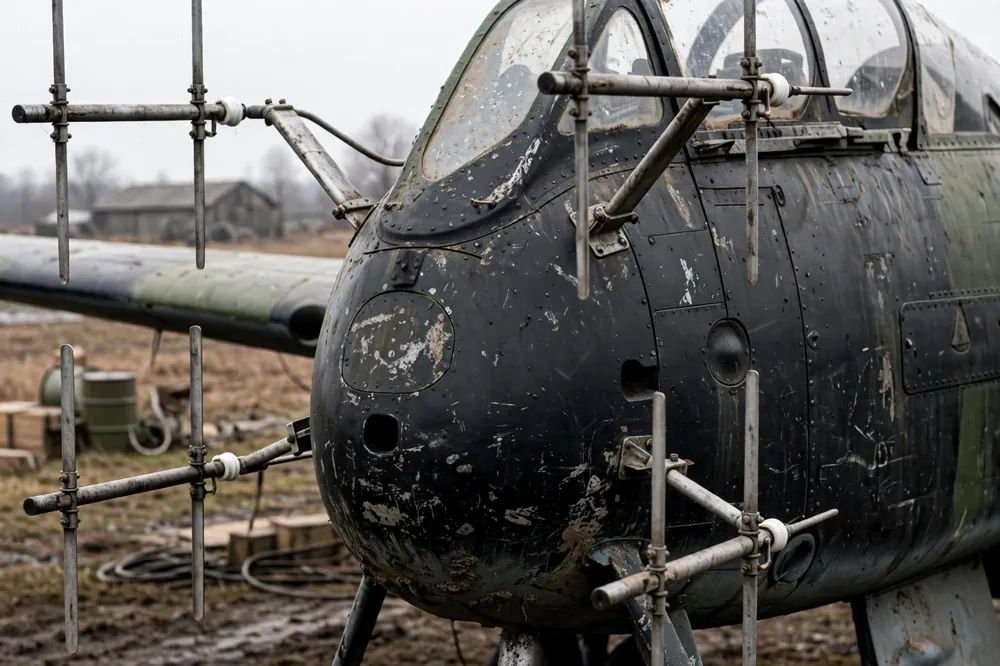
Later aircraft carried the FuG 220 Lichtenstein SN-2, a more powerful set with a range of about 6 kilometres and a distinctive array of aerials — the “Hirschgeweih”, or stag’s antlers — that became the He 219’s most recognisable feature.
The SN-2 was a better radar, but its aerials added drag and reduced the aircraft’s speed, and they could be detected by the RAF’s Serrate and Perfectos homing devices, which let Allied night fighters find the He 219 by its own radar emissions. The radar war was a constant contest of measure and countermeasure, and the He 219, like every night fighter, was caught in it.
The radar operator’s job
The radar operator’s job was demanding. He sat in the rear cockpit, watching the radar scope in the dark, calling out the range and the bearing of the target to the pilot, and guiding the aircraft into a firing position behind and below the bomber. The work required concentration, skill and teamwork, and the best He 219 crews — pilot and radar operator working together — became highly effective, claiming multiple bombers in a single night. The He 219’s radar, and the teamwork it demanded, were a measure of how far night fighting had come since 1940, when the first night fighters had flown without radar at all, guided only by searchlights and by the eyes of their pilots.
Armament and Schräge Musik
The He 219’s armament was the heaviest of any German night fighter. The standard fit was four 20 mm MG 151 cannon in the ventral tray beneath the fuselage, firing forward, and two 20 mm MG 151 cannon in the wing roots, for a total of six cannon — a firepower that could destroy a heavy bomber with a short burst.
Some versions carried, in addition, two 30 mm MK 108 cannon in the ventral tray, and some carried the Schräge Musik installation: two 20 mm MG 151 cannon mounted in the fuselage, firing upward and forward at an angle of about 70 degrees, which let the He 219 attack a bomber from below, where the bomber’s gunners could not see it, and where the bomber’s fuel tanks and engines were most vulnerable.
The Schräge Musik — “slanting music”, a slang term for jazz — was one of the most effective weapons of the night war. The night fighter would approach the bomber from below and behind, in its blind spot, and fire upward into the bomber’s wing and fuselage, where the fuel tanks were.
The bomber’s crew, who could not see the fighter below them, often did not know they were under attack until their aircraft caught fire, and the Schräge Musik accounted for a large proportion of the RAF’s bomber losses in 1944.
The He 219 was one of the first aircraft to carry the weapon, and its pilots, who had learned to use it in the Bf 110 and the Ju 88, found it even more effective in the faster, more agile Uhu.
6. Variants
The He 219 family included several production versions, and the differences between them were matters of engine, radar and armament. The He 219A-0, the pre-production version, was built in small numbers and used for service trials and for the training of the first operational crews. The He 219A-2, the first main production version, was powered by the DB 603A engine and armed with six 20 mm MG 151 cannon, with the FuG 212 Lichtenstein C-1 radar. The He 219A-5, the most numerous version, was powered by the DB 603A and armed with six cannon, with the FuG 220 Lichtenstein SN-2 radar and, in some aircraft, the Schräge Musik installation.
Later versions included the He 219A-6, a high-speed version with a reduced armament and the DB 603E engine, built in small numbers, and the He 219A-7, the last production version, with the DB 603E engine, a heavier armament including 30 mm MK 108 cannon, and the SN-2 radar. A day-fighter version, the He 219B, was proposed, and a reconnaissance version, the He 219C, was tested, but neither entered production in numbers. In total, about 268 He 219s were built, a small total that reflected the aircraft’s late arrival, the political opposition to it, and the collapse of the German aircraft industry in 1944 and 1945.
7. Combat Service
The first night: 11–12 June 1943
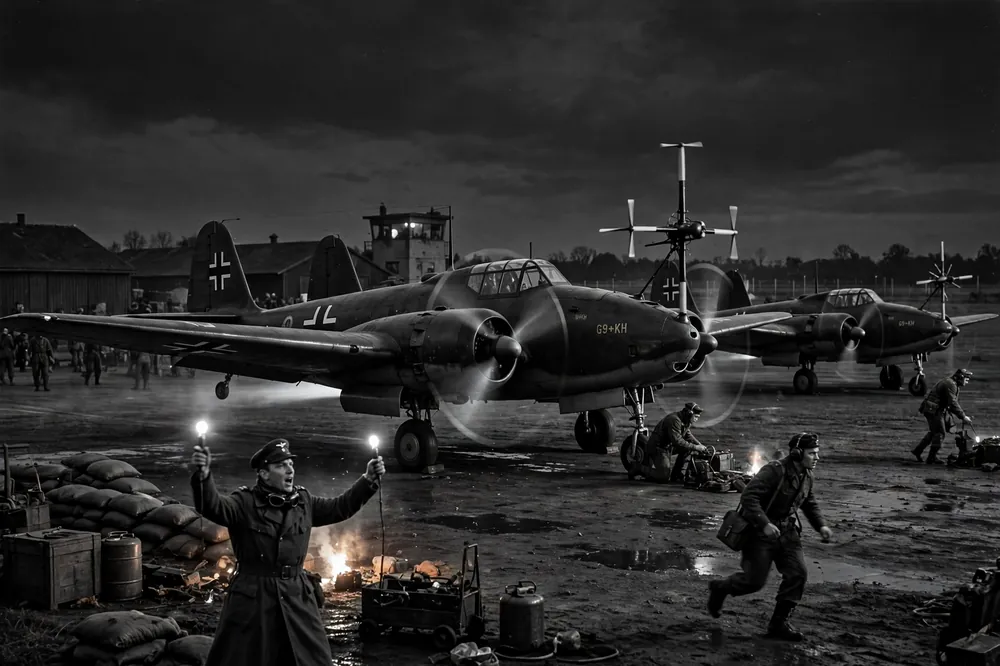
The He 219’s combat debut was spectacular. On the night of 11–12 June 1943, the RAF sent a force of bombers against Düsseldorf, and the He 219s of the 1st Night Fighter Wing, based at Venlo in the Netherlands, were scrambled to meet them.
The He 219s, flown by Major Werner Streib, the wing’s commander, and his fellow pilots, claimed five RAF bombers in a single sortie — a remarkable result for a new aircraft on its first operational night, and one that confirmed the pilots’ judgement that the He 219 was the best night fighter they had ever flown.
Streib himself claimed five bombers that night, a feat that made him the most successful night-fighter pilot of the war’s opening phase, though the exact number of his claims is, as with all air combat claims, disputed.
The night battle of 1943–1944
In 1943 and 1944 the He 219 served in the night-fighter wings that defended Germany against the RAF’s bomber offensive, and its crews claimed a substantial number of bombers, including Lancasters, Halifaxes and Stirlings. The aircraft’s speed and its heavy armament made it a formidable opponent, and the RAF’s bomber crews, who met it over Germany, reported that it was the most dangerous night fighter they faced. The He 219’s most successful pilots — Streib, who claimed 66 victories in total, and others of the 1st Night Fighter Wing — became aces, and their names are remembered in the history of the night war.
Limited by numbers
The He 219’s career was, however, limited by its numbers. With only 268 built, the type equipped only a handful of squadrons, and the bulk of the night battle was fought by the Bf 110 and the Ju 88, which were built in far greater numbers.
The He 219’s production was hampered by the political opposition to it, by the shortage of DB 603 engines, and by the Allied bombing of the Heinkel factory, and the aircraft never had the numbers to change the course of the night war.
By 1944, the RAF’s bombers were flying with electronic countermeasures — Window, the radar-jamming chaff, and the Serrate homing device — that reduced the effectiveness of the German night fighters, and the He 219, like every German night fighter, found its task harder.
The end of the war
In the last months of the war, the He 219s flew their final missions from bases in Germany and in the Netherlands, defending a country that was collapsing under the weight of the Allied bombing and the Allied advance. The aircraft’s last combats were fought in the spring of 1945, in the final weeks before the surrender, and the surviving He 219s were destroyed on the ground or captured by the Allies. One aircraft, an He 219A-2, was captured intact and shipped to the United States, where it was tested and then stored, and it survives today in the Smithsonian’s National Air and Space Museum, the only complete original He 219 in the world.
8. Specifications
The figures below are for the He 219A-2, the first main production version. Sources differ on maximum speed, which varied with the radar fit and the version, and the figures below give the commonly cited range.
| He 219A-2 | |
|---|---|
| Length | 15.54 m / 15,54 m |
| Wingspan | 18.50 m / 18,50 m |
| Height | 4.10 m / 4,10 m |
| Wing area | 44.4 m² / 44,4 m² |
| Empty weight | About 8,300 kg |
| Loaded weight | About 11,200 kg |
| Engines | 2 × Daimler-Benz DB 603A, about 1,750 hp each |
| Maximum speed | About 580–616 km/h |
| Cruising speed | About 500 km/h |
| Range | About 2,000 km |
| Service ceiling | About 12,700 m |
| Armament | 6 × 20 mm MG 151 (some versions with 2 × 30 mm MK 108 and Schräge Musik) |
| Radar / Radar | FuG 212 Lichtenstein C-1 (later FuG 220 SN-2) |
| Crew | 2 |
Against its contemporaries the He 219 was fast and heavily armed. The Bf 110G, the Luftwaffe’s standard night fighter, was slower and less well armed, and the Ju 88G, though a capable night fighter, was also slower. The British Mosquito NF Mk II, the RAF’s night fighter, was faster than the He 219 in some regimes, but it was less heavily armed. The He 219’s advantage lay in its combination of speed, armament, radar and crew comfort — a combination that made it, in the judgement of the pilots who flew it, the best night fighter of the war, and in the judgement of historians, one of the most advanced combat aircraft of the conflict.
9. Operators
The He 219 was operated exclusively by the Luftwaffe, and within the Luftwaffe it served in the night-fighter wings that defended Germany against the RAF’s bomber offensive. Its principal unit was the 1st Night Fighter Wing (Nachtjagdgeschwader 1), based at Venlo in the Netherlands and later in Germany, which flew the type from its introduction in June 1943 to the end of the war. Other units that operated the He 219 in small numbers included the 2nd and 3rd Night Fighter Wings, which received the type late in the war and flew it in the defence of Germany in 1944 and 1945.
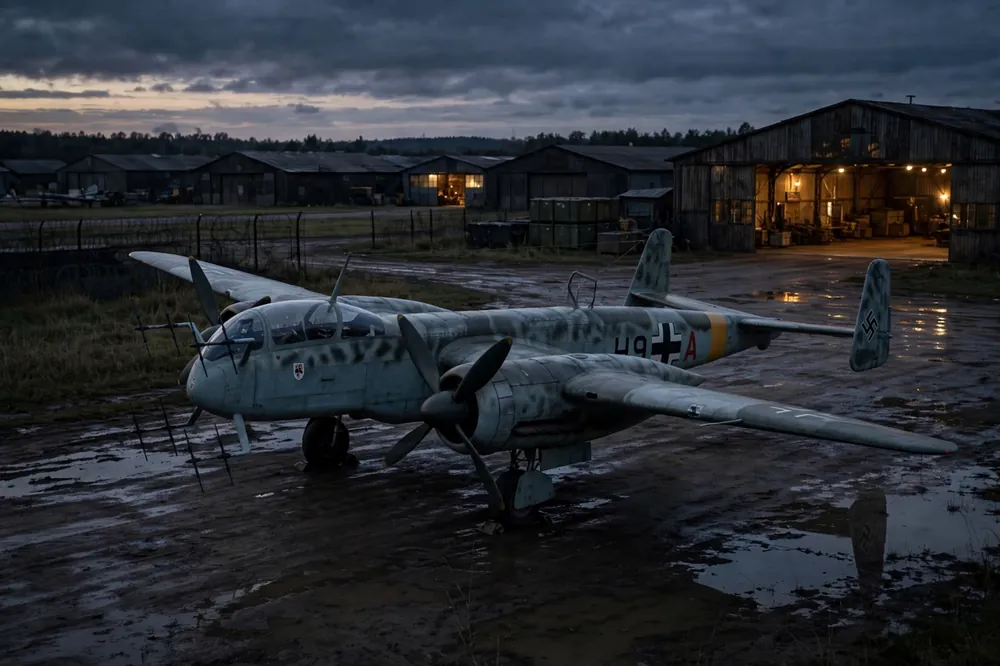
No other country operated the He 219 in combat during the war, though captured examples were flown and tested by the Allies after the war — most famously the He 219A-2 that was shipped to the United States and tested by the US Army Air Forces, and that survives today in the Smithsonian. After the war, no He 219s remained in service, and the type passed into history with the collapse of the Luftwaffe in May 1945.
10. Legacy and Assessment
The Uhu in history
The He 219’s legacy is that of a brilliant aircraft that came too late and in too few numbers. Historians judge it as one of the best night fighters of the Second World War, and as one of the most advanced combat aircraft of the conflict, and its reputation has grown since the war, as the records of its combat career have been studied and as the testimony of its pilots has been published.
The aircraft’s technical firsts — the ejection seats, the tricycle landing gear, the heavy cannon armament and the Schräge Musik — were all adopted, in one form or another, by the combat aircraft of the post-war era, and the He 219 is remembered as a pioneer, an aircraft that pointed the way to the future of air combat.
The He 219’s story is also a cautionary tale about the dangers of political infighting in wartime. The aircraft was delayed by the opposition of the Air Ministry’s technical office and by the rivalry between Heinkel and his competitors, and the months lost to that infighting were months in which the RAF’s bombers flew unopposed by the best night fighter Germany could build.
Had the He 219 entered service a year earlier, and in the numbers the Ju 88 achieved, the night war over Germany might have been a harder one for the RAF — though it would not, in the judgement of historians, have changed the outcome of the war, which was decided by the industrial might of the Allies and by the collapse of Germany on the ground.
Survivors
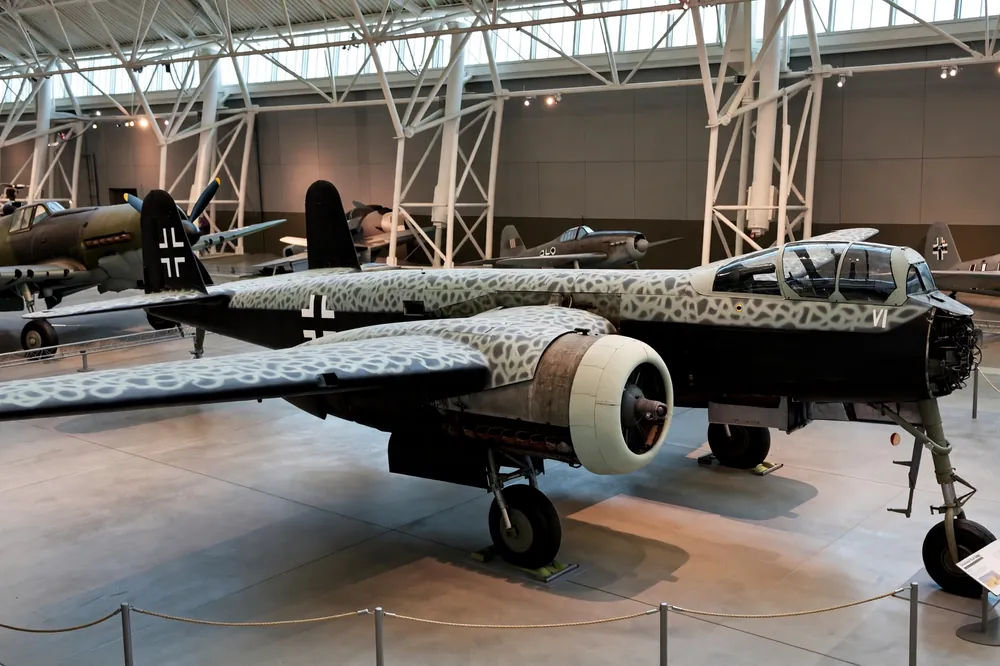
One complete original He 219 survives, an He 219A-2 preserved at the Smithsonian’s National Air and Space Museum in Washington, D.C., where it is displayed after a long restoration. It is the only intact Uhu in the world, and it is a reminder of an aircraft that was, in the judgement of the men who flew it, the best night fighter of the war. A small number of other He 219s survive in part, and the type lives on in models, in photographs and in the historical record.
11. FAQ
What was the Heinkel He 219 Uhu? / Heinkel He 219 Uhu là gì?
The Heinkel He 219 Uhu was a German twin-engine night fighter of the Second World War, designed by Robert Lusser and first flown on 6 November 1942. It was the most advanced night fighter Germany built during the war, with a crew of two, a maximum speed of about 615 km/h, a heavy armament of up to six 20 mm cannon and two 30 mm cannon, and the Lichtenstein SN-2 radar, which let it find a bomber in the dark at a range of several kilometres. It entered service in June 1943 and served in the defence of Germany against the British night bombing offensive, in a night-fighter war that lasted until the end of the war in May 1945.
How many He 219s were built?
About 300 He 219s were built in total, most of them the A-2 and A-7 versions, at Heinkel’s factories in Germany and in Poland. This was a small production run, reflecting the competition for resources with the Ju 88 and the Bf 110 night fighters, and the resistance of the German Air Ministry, which had initially rejected the design and only ordered it after the British bombing offensive made a dedicated night fighter a priority. The production run was spread over less than two years, from 1943 to the end of the war, and the type never had the numbers to change the course of the night war, however good it was as an aircraft.
What was Schräge Musik? / Schräge Musik là gì?
Schräge Musik — literally “slanting music” or “jazz music” — was the German system of upward-firing cannon, fitted to the He 219 and to other night fighters, with two 20 mm or 30 mm cannon mounted in the fuselage at an angle of about 65 to 70 degrees, firing upward and forward.
A night fighter would approach a bomber from below, where the bomber’s defences were weakest, and fire into its belly, where the fuel tanks and the bomb bay were, and the first the bomber crew knew of the attack was often the explosion of their own aircraft.
The system was first used operationally in the summer of 1943, and it was one of the most effective weapons of the night war, accounting for a large share of the bombers shot down by German night fighters.
Who flew the He 219?
The He 219 was flown by the night-fighter squadrons of the Luftwaffe, notably Night Fighter Wing 1 (NJG 1), the most successful night-fighter unit of the war, whose pilots included Werner Streib, the first pilot to fly the type in combat, and Heinz-Wolfgang Schnaufer, the most successful night-fighter pilot of the war, with 121 victories, many of them in the He 219.
Streib’s first combat flight in the type, on the night of 11–12 June 1943, was a famous one: he shot down five bombers in a single sortie, in a demonstration of the aircraft’s capabilities that convinced even its critics in the Air Ministry of its value.
The men who flew the He 219 were among the most experienced pilots in the Luftwaffe, and they regarded the aircraft as the best night fighter they had flown.
How did the He 219 compare with the Mosquito?
The He 219 and the de Havilland Mosquito were the two most advanced twin-engine aircraft of the night war, and they met as adversaries over Germany in 1944 and 1945, with the Mosquito as a night fighter and the He 219 as its opponent.
The Mosquito was faster, with a maximum speed of about 670 km/h against the He 219’s 615 km/h, and it was more versatile, serving as a bomber, a reconnaissance aircraft and a fighter, while the He 219 was a dedicated night fighter with a heavier armament and a better radar.
The two aircraft were closely matched, and the outcome of an encounter between them depended on the skill of the pilots and on the circumstances, rather than on any clear superiority of one aircraft over the other.
Does any He 219 survive today?
Yes. One complete He 219 survives, an A-2 preserved at the Smithsonian National Air and Space Museum in Washington, where it is displayed as the centrepiece of the museum’s Second World War collection, and it is the only intact Uhu in the world. It is a reminder of an aircraft that was, in the judgement of the men who flew it, the best night fighter Germany built during the war, and of a night war that cost the Royal Air Force dearly, with more than 55,000 aircrew killed, and that was, in the end, a war the Germans could not win, however good their night fighters were.
12. Sources
- Wikipedia, “Heinkel He 219” — production figures (about 268 built), first flight, performance data and service history.
- William Green, Warplanes of the Third Reich (Macdonald, 1970) — the standard English-language reference on the He 219’s design, development and variants.
- J. Richard Smith and Anthony L. Kay, German Aircraft of the Second World War (Putnam, 1972) — the He 219’s development and the work of Robert Lusser.
- Martin Streetly, Confounding the Reich: The RAF’s Secret War of Electronic Countermeasures in WWII (Jane’s, 1994) — the radar war and the He 219’s Lichtenstein sets.
- Alfred Price, The History of US Electronic Warfare, Volume 1 (Association of Old Crows, 1984) — the Schräge Musik and the night battle.
- United States Strategic Bombing Survey, The German Aircraft Industry (1947) — production figures and factory data.
- Roland Remp, Heinkel He 219 Uhu (in the Classic series).
- Jerry Scutts, German Night Fighter Aces of World War 2 (Osprey, 1998).