 WAR ATLAS MILITARY HISTORY MAGAZINE · WWI — WWII
15 cm sFH 18
1. Lead
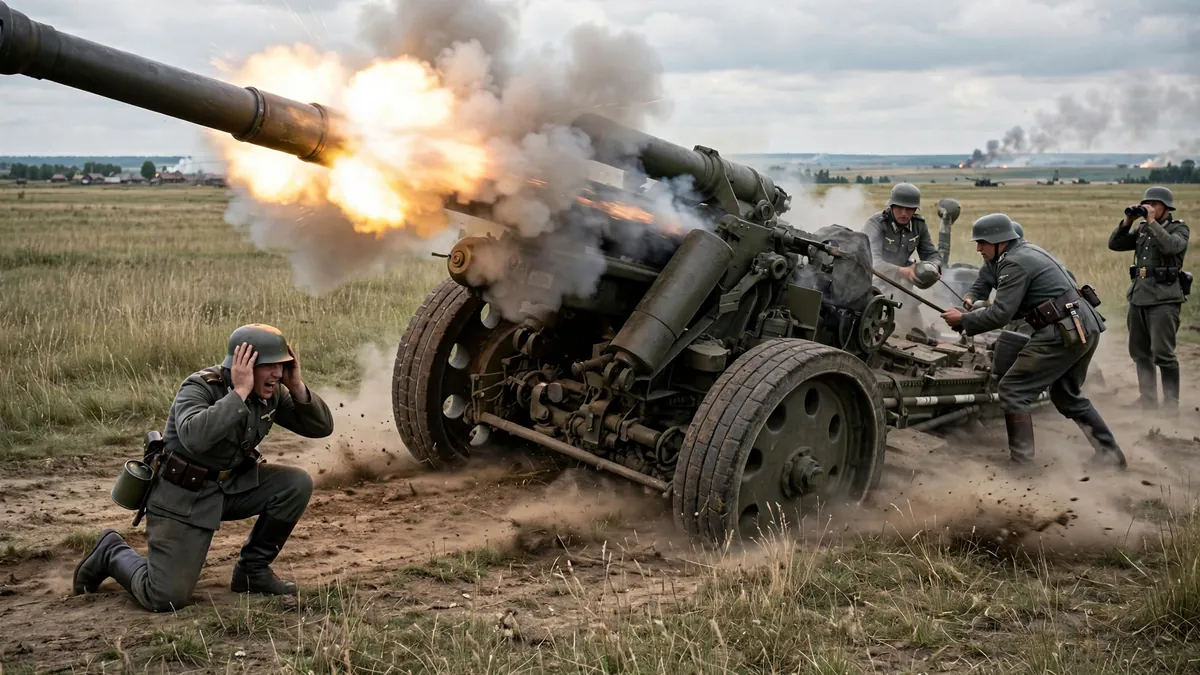
The 15 cm sFH 18 — the schwere Feldhaubitze 18, or heavy field howitzer 18 — was the German Army’s standard heavy field howitzer of the Second World War, and the workhorse of the divisional artillery. More than 6,700 were built between 1934 and 1945, and they equipped the heavy artillery battalions of every German infantry division, as well as the artillery of the panzer divisions, the mountain divisions and the fortress troops.
The sFH 18 fired a 43-kilogram high-explosive shell to a range of about 13,250 metres, and it was the gun that the German infantry relied on for heavy fire support: for destroying enemy strongpoints, for counter-battery fire, and for the preparatory bombardments that preceded every German attack.
The sFH 18 was not the most powerful German howitzer, and it was not the longest-ranged, but it was the gun the German Army had, in the numbers it needed, on every front of the war — from Poland and France to North Africa, Russia and Italy — and it was the gun that, more than any other, defined German divisional artillery in the Second World War.
The sFH 18’s story is the story of German artillery in the Second World War: a story of a gun that was well-designed, well-built and well-served, and that was let down not by its own failings but by the strategic situation in which it was used.
The sFH 18 was a horse-drawn gun in an army that was increasingly motorised, a gun with a range that was adequate in 1939 but inadequate by 1943, and a gun that was built in large numbers by an industry that could not build enough of the heavier guns that the war demanded.
But the sFH 18 did its job, and it did it for six years, on every front, and its crews — the gunners of the German divisional artillery — were among the best-trained artillerymen in the world.
2. Key Facts
| Gun | 15 cm sFH 18 (schwere Feldhaubitze 18), German heavy field howitzer |
| Built | 1934–1945; more than 6,700 built (sources give 6,700–7,000) |
| Manufacturers | Rheinmetall, Krupp, and others |
| Weight | About 5,512 kg in action; about 6,304 kg in transport |
| Crew | 10–12 gunners |
| Calibre | 149.1 mm (15 cm) / 149,1 mm (15 cm) |
| Shell weight | About 43 kg (high-explosive) |
| Muzzle velocity | About 520 m/s |
| Maximum range | About 13,250 m |
| Rate of fire | About 4 rounds per minute |
| Traction / Kéo | Horse-drawn (6 horses) or motorised |
| Service | Every German division, 1939–1945; also exported |
3. Design and Development
The Versailles legacy
The sFH 18 was designed in the 1920s and early 1930s, under the restrictions of the Treaty of Versailles, which limited the German Army to 100,000 men and forbade it to possess heavy artillery. The German Army, through the secret rearmament programme of the Weimar Republic, developed a new heavy field howitzer in the late 1920s, and the design was finalised in 1933–1934, after Hitler came to power and the Versailles restrictions were openly discarded.
The sFH 18 was a conventional design for its day: a 15 cm howitzer on a split-trail carriage, with a hydro-pneumatic recoil system, a horizontal sliding-block breech, and a gun shield to protect the crew. The design was the work of Rheinmetall and Krupp, the two great German armaments firms, and it was a design that reflected the German Army’s doctrine: the heavy field howitzer was the divisional artillery’s main weapon for destroying enemy strongpoints and for counter-battery fire.
The split-trail carriage
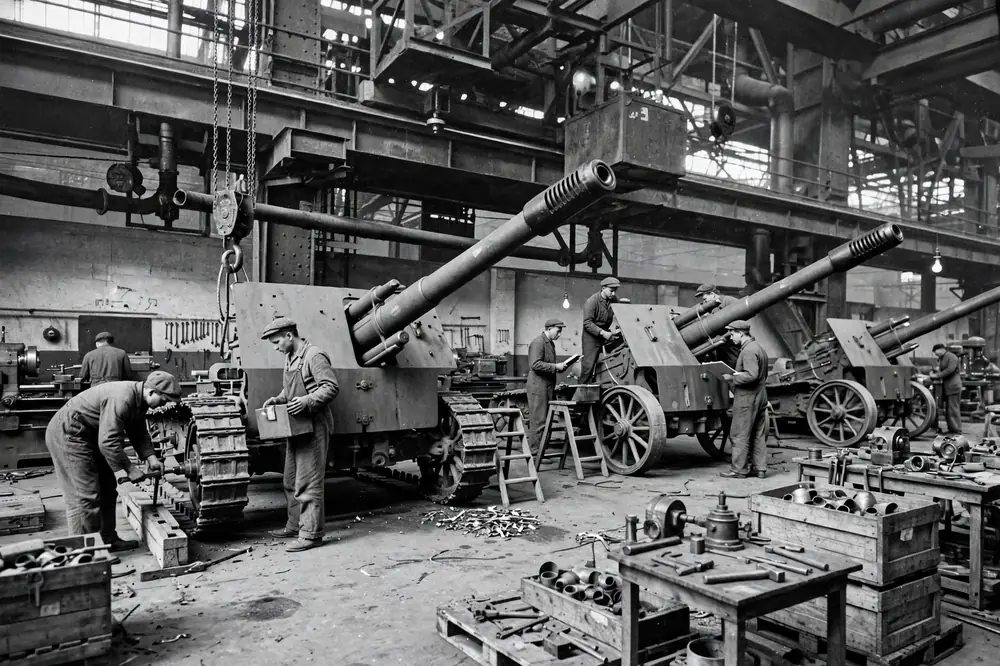
The sFH 18’s split-trail carriage was its most important design feature. The two trails could be spread apart to give the gun a wide traverse — about 60 degrees — and to provide a stable firing platform, and they could be closed together for transport. The carriage was made of steel, with wooden-spoked wheels for horse traction and, in the motorised version, with steel disc wheels and pneumatic tyres.
The gun could be elevated from -3 degrees to +45 degrees, which gave it a range of about 13,250 metres with the standard high-explosive shell. The split-trail design was a standard feature of field artillery in the 1930s, and it was a design that the sFH 18 shared with the French, British and American howitzers of the period.
The sFH 18’s carriage was robust and reliable, and it was one of the reasons the gun served for so long.
Production
The sFH 18 was ordered in 1934, and production began in 1935 at the Rheinmetall and Krupp factories. More than 6,700 were built between 1934 and 1945, with production peaking in 1942–1943, when the German Army’s demand for artillery was at its highest.
The sFH 18 was built in large numbers because it was the standard heavy howitzer of the divisional artillery, and every infantry division needed twelve of them — three batteries of four guns in the heavy battalion of the artillery regiment.
The production run was large by German standards, and it was a measure of how important the sFH 18 was to the German Army: it was the gun that every division had, and it was the gun that the German infantry relied on.
4. Ammunition and Firepower
The 43-kilogram shell
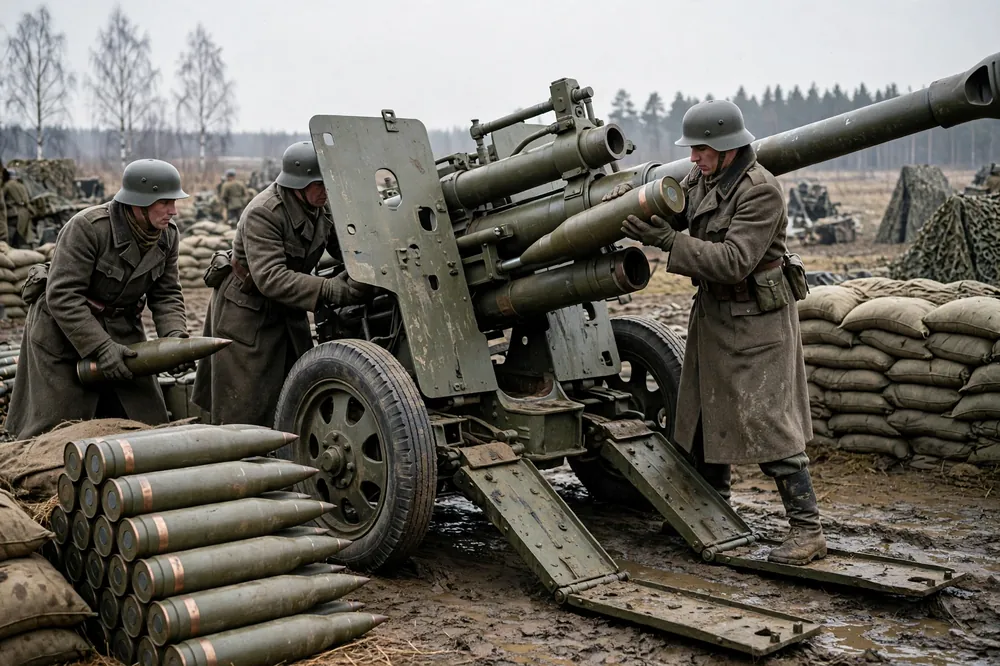
The sFH 18 fired a 43-kilogram high-explosive shell, with about 4 kilograms of explosive filler, to a range of about 13,250 metres. The shell was a powerful weapon against infantry in the open, against field fortifications, and against soft vehicles, and it was the shell that the German infantry called on when they needed heavy fire support.
The sFH 18 also fired a smoke shell, for screening, and a concrete-piercing shell, for use against fortifications, and it could fire a range of charges — from charge 1 to charge 8 — which allowed the gunners to vary the range and the trajectory.
The gun’s rate of fire was about 4 rounds per minute, which was a good rate for a heavy howitzer, and which allowed a battery of four guns to deliver a heavy weight of fire in a short time.
Counter-battery and destruction
The sFH 18’s main roles were counter-battery fire — the destruction of the enemy’s artillery — and the destruction of enemy strongpoints. The 15 cm shell was heavy enough to destroy a field gun, a machine-gun nest, or a concrete pillbox, and the sFH 18’s accuracy — with a well-trained crew and a good forward observer — was sufficient to hit a target at 10,000 metres.
The gun was also used for the preparatory bombardment that preceded a German attack, in which the sFH 18s, together with the lighter 10.5 cm leFH 18 howitzers, would bombard the enemy’s positions for hours before the infantry attacked. The sFH 18 was a versatile weapon, and it was used for every artillery task that the divisional artillery was called on to perform.
The range problem
The sFH 18’s range of about 13,250 metres was adequate in 1939, when the gun’s opponents were the Polish, French and British howitzers of similar range, but it was inadequate by 1943, when the Soviet 152 mm ML-20 howitzer, with a range of about 17,000 metres, and the American 155 mm M1 howitzer, with a range of about 14,600 metres, outranged it.
The German Army recognised the problem, and it developed the sFH 18M, a version with a muzzle brake and a larger charge that extended the range to about 15,000 metres, and the sFH 36 and sFH 43, new designs with longer ranges.
But the sFH 18M was built in small numbers, and the sFH 36 and sFH 43 were never built in quantity, and the sFH 18 remained the standard heavy howitzer for the rest of the war — outranged, but still in service, because Germany could not build enough of the better guns to replace it.
5. Organisation and Service
The divisional artillery
The sFH 18 served in the heavy battalion of the artillery regiment of every German infantry division. A standard infantry division’s artillery regiment had three light battalions, each with twelve 10.5 cm leFH 18 howitzers, and one heavy battalion, with twelve 15 cm sFH 18 howitzers — a total of 48 guns per division, of which twelve were sFH 18s. The panzer divisions’ artillery regiments had a similar organisation, with the sFH 18s in the heavy battalion, though the panzer divisions’ guns were motorised while the infantry divisions’ guns were horse-drawn. The sFH 18 was, therefore, the heavy gun of the divisional artillery, and it was the gun that the divisional commander called on when he needed heavy fire support.
Horse traction
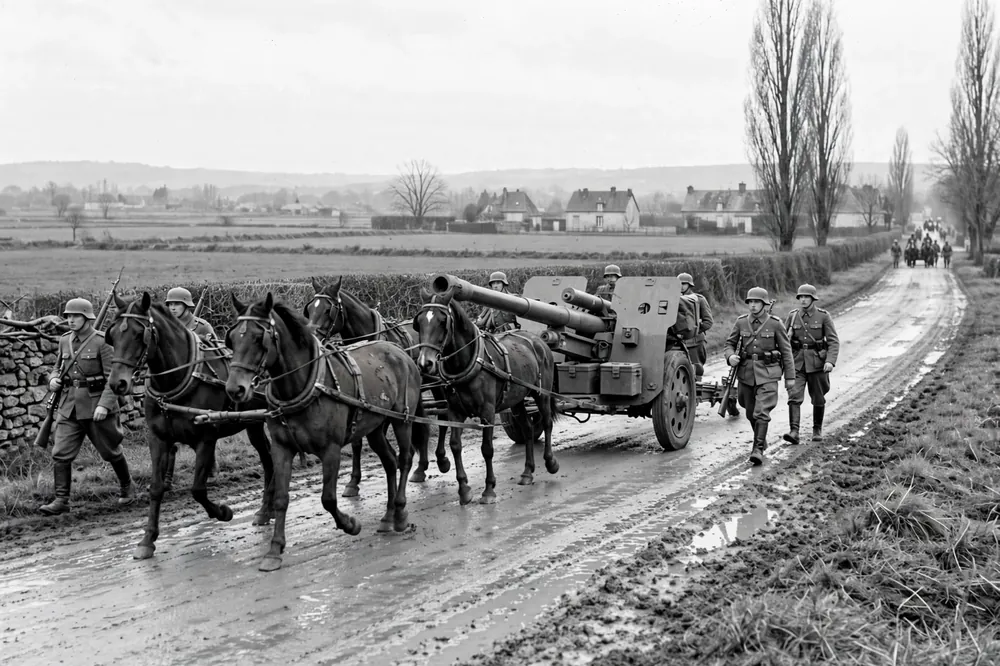
Most sFH 18s were horse-drawn, by teams of six horses, and the gun’s crew rode on the limber and on the gun itself. The horse-drawn sFH 18 was a slow weapon: it could move at about 8 km/h on roads, and it could not keep up with a motorised division.
The German Army’s reliance on horse traction — even in 1944, most German divisions were horse-drawn — was a consequence of Germany’s shortage of motor vehicles and of fuel, and it was a serious limitation on the sFH 18’s mobility. The motorised sFH 18s, in the panzer divisions and in the motorised infantry divisions, were towed by half-tracks or by trucks, and they were far more mobile.
The horse-drawn sFH 18 was a gun of the First World War, in a war that was increasingly motorised, and its lack of mobility was one of the reasons the German infantry divisions could not keep up with the panzer divisions.
The forward observer
The sFH 18’s effectiveness depended on the forward observer — the officer or non-commissioned officer who went forward with the infantry, observed the fall of shot, and corrected the guns’ fire by radio or by telephone. The German forward observer system was one of the best in the world: the observer was trained to locate a target, to call for fire, and to adjust the fire onto the target in a few rounds, and the sFH 18’s crews were trained to respond to a fire call within minutes.
The system was the reason the sFH 18 could deliver accurate fire at 10,000 metres, and it was the reason the German infantry trusted their artillery. The forward observer’s job was dangerous — he was often the first to be targeted by the enemy, and his life expectancy in a major battle was short — but it was essential, and the sFH 18 without its forward observers would have been a blind gun.
The German artillery’s doctrine, which placed the observer at the centre of the fire system, was one of the German Army’s great strengths, and it was a strength that the sFH 18’s crews relied on every day of the war.
The gunners
The sFH 18’s crews were among the best-trained artillerymen in the world. The German artillery school at Jüterbog trained the gunners in the theory and practice of artillery, and the sFH 18’s crews were skilled in the use of the gun, in the calculation of firing data, and in the cooperation with the forward observers who directed their fire.
The German artillery’s doctrine — the Feuerleitung, or fire direction, system — was one of the most advanced in the world, and it allowed the sFH 18s to deliver accurate fire quickly, in response to a call from the infantry.
The sFH 18’s crews were proud of their gun, and they were proud of their role: the divisional artillery was the infantry’s best friend, and the sFH 18 was the divisional artillery’s heaviest gun.
6. Combat Service: Poland, France and the Balkans
The early campaigns
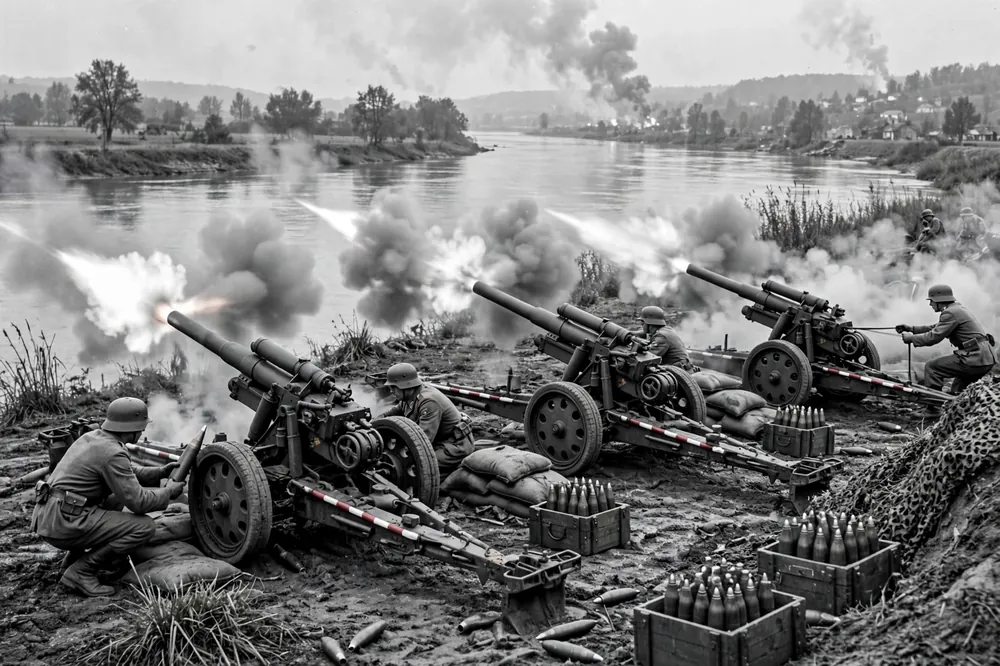
The sFH 18 first saw combat in the invasion of Poland in September 1939, where the German divisions’ sFH 18s provided the heavy fire support for the infantry’s attacks on the Polish positions. In France in May–June 1940, the sFH 18s were in the forefront of the German advance, bombarding the French positions on the Meuse and on the Somme, and supporting the infantry’s crossing of the rivers.
In the Balkans in April 1941, the sFH 18s supported the invasions of Yugoslavia and Greece, bombarding the Yugoslav and Greek positions in the mountains. The early campaigns were the sFH 18’s finest hour: the gun was new, the crews were well-trained, the enemy’s artillery was outranged and outnumbered, and the German combined-arms doctrine — infantry, tanks, artillery and aircraft working together — was at its best.
The gun in the blitzkrieg
In the blitzkrieg campaigns, the sFH 18’s role was to support the infantry, not to keep up with the tanks. The panzer divisions’ advance was led by the tanks and the motorised infantry, and the sFH 18s — horse-drawn in the infantry divisions, motorised in the panzer divisions — followed behind, bombarding the positions that the tanks had bypassed and supporting the infantry’s mopping-up operations.
The sFH 18 was not a blitzkrieg weapon, in the sense that it did not lead the advance, but it was an essential part of the blitzkrieg: without the sFH 18’s heavy fire support, the infantry could not have taken the positions that the tanks had bypassed, and the advance would have stalled.
The sFH 18’s service in the early campaigns was a reminder that the blitzkrieg was not just about tanks — it was about combined arms, and the artillery was as important as the tanks.
7. Combat Service: North Africa and Russia
The desert war
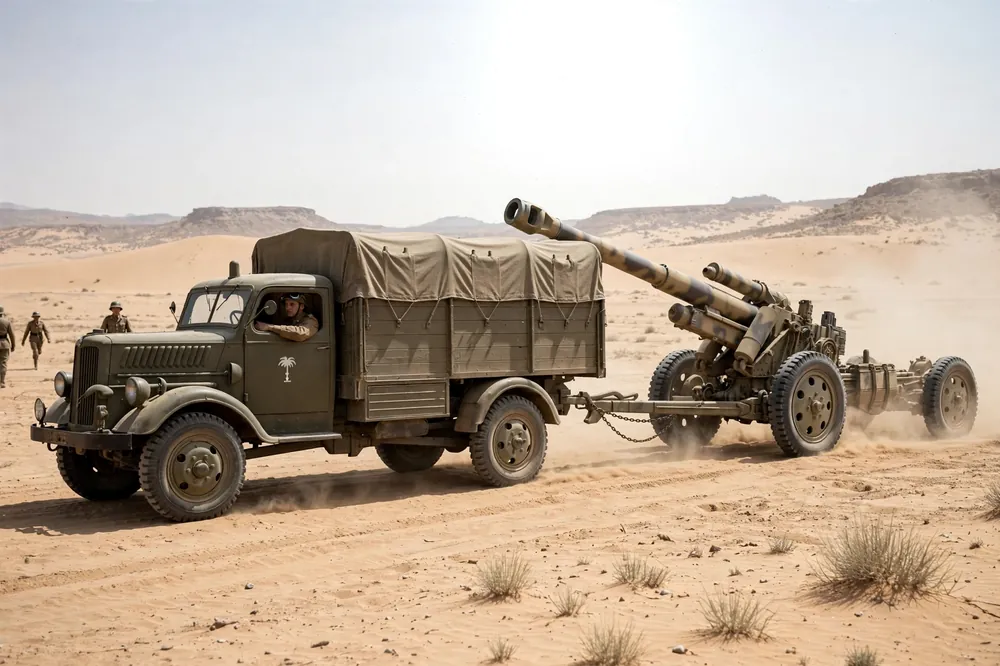
In North Africa, the sFH 18 served with the Afrika Korps, where its range and its firepower were valued in the open desert, and where its horse traction was a liability — the horses suffered in the heat, and the gun’s mobility was limited.
The sFH 18s in North Africa were motorised, towed by trucks and half-tracks, and they fought in the battles of Tobruk, Gazala and El Alamein, where they provided the heavy fire support for the German and Italian infantry. At El Alamein, the sFH 18s were outranged and outnumbered by the British 25-pounder and 5.5-inch guns, and the German artillery was systematically destroyed by the British counter-battery fire.
The desert war showed the sFH 18’s limitations: its range was inadequate, its mobility was limited, and it was outnumbered by the Allied artillery.
The Eastern Front
On the Eastern Front, the sFH 18 served from the invasion of the Soviet Union in June 1941 until the end of the war, and it was there that the gun fought its longest and hardest war. The sFH 18s provided the heavy fire support for the German infantry in the battles of Kiev, Moscow, Stalingrad and Kursk, and in the long retreat from Russia in 1943–1945.
On the Eastern Front, the sFH 18 was outranged by the Soviet 152 mm ML-20 howitzer, and it was outnumbered by the Soviet artillery, which, by 1943, was the largest artillery force in the world. The sFH 18’s crews fought well, but they were fighting a war of attrition against an enemy with more guns, more ammunition, and longer-ranged guns — and the sFH 18, for all its qualities, could not win that war.
The Eastern Front was the sFH 18’s hardest service, and it was the service that broke the German artillery.
8. Variants and Related Guns
The sFH 18M and the sFH 36
The sFH 18M was a version of the sFH 18 with a muzzle brake and a larger propellant charge, which extended the range to about 15,000 metres. The sFH 18M was built in small numbers, from 1942 onwards, and it was issued to selected units, but it did not replace the sFH 18 as the standard heavy howitzer.
The sFH 36 was a new design, with a longer barrel and a range of about 15,000 metres, but it was built in even smaller numbers, and it never entered large-scale service. The sFH 43 was a further development, with a range of about 18,000 metres, but it was never built in quantity.
The sFH 18 remained the standard heavy howitzer because Germany could not afford to retool its factories for a new gun, and because the sFH 18, for all its limitations, was a good gun that was available in numbers.
The sFH 18 on other mountings
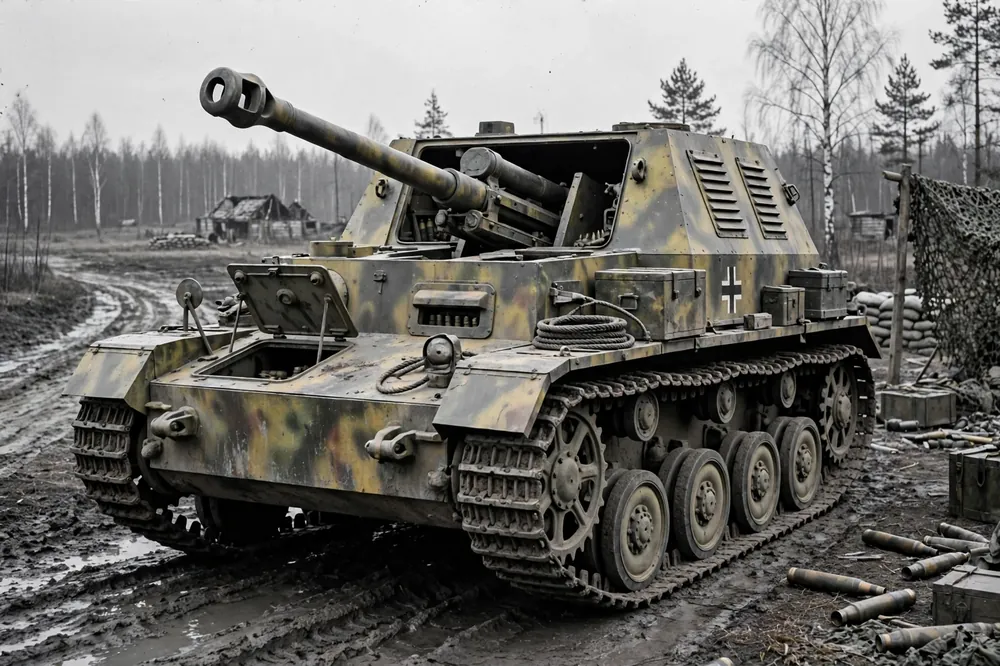
The sFH 18’s gun was also used on other mountings. The most famous was the Hummel self-propelled gun, which mounted the sFH 18 on a modified Panzer III/IV chassis, and which served as the heavy self-propelled artillery of the panzer divisions from 1943 onwards. The Hummel was a successful vehicle, and it was the mobile version of the sFH 18 that the horse-drawn gun could never be. The sFH 18 was also used as a coastal gun, in the Atlantic Wall and in Norway, and as a fortress gun. The gun’s versatility — its ability to serve as a field howitzer, as a self-propelled gun, and as a coastal gun — was a measure of the soundness of its design.
9. Comparison with Allied Howitzers
Against the Soviet ML-20
Compared with the Soviet 152 mm ML-20 howitzer-gun, the sFH 18 was outranged and outgunned. The ML-20 fired a 43-kilogram shell — the same weight as the sFH 18’s shell — to a range of about 17,000 metres, against the sFH 18’s 13,250 metres, and it was a more powerful weapon. The ML-20 was also built in larger numbers — more than 6,800 were built — and it was the standard heavy howitzer of the Soviet artillery. The sFH 18’s only advantage over the ML-20 was its lighter weight and its greater mobility, but on the Eastern Front, where the Soviet artillery outnumbered and outranged the German artillery, that advantage counted for little.
Against the American M1 155 mm
Compared with the American 155 mm M1 howitzer, the sFH 18 was also outranged and outgunned. The M1 fired a 43-kilogram shell to a range of about 14,600 metres, and it was built in large numbers — more than 6,000 were built — and it was the standard heavy howitzer of the American divisional artillery.
The M1 was also motorised, towed by trucks, and it was far more mobile than the horse-drawn sFH 18. The sFH 18’s only advantage was its lighter weight, but the M1’s range, its firepower and its mobility made it a better gun.
The comparison shows that by 1943, the sFH 18 was no longer the best heavy field howitzer in the world — it was a good gun, but it had been overtaken by the guns of its enemies.
10. Assessment and Legacy
The 15 cm sFH 18 was a good gun that served for a long time, in a war that outgrew it. Its design was sound, its crews were skilled, and its service record — from Poland to Russia, from France to Italy — is one of the longest of any German weapon of the war.
But the sFH 18 was a gun of the 1930s, in a war of the 1940s, and it was outranged by the Soviet and American howitzers, outnumbered by the Allied artillery, and limited by its horse traction. The sFH 18 did its job, and it did it well, but it could not win the artillery war — because the artillery war, like the tank war and the air war, was a war of production, and Germany could not produce enough guns, enough ammunition, or enough motor vehicles to match the Allies.
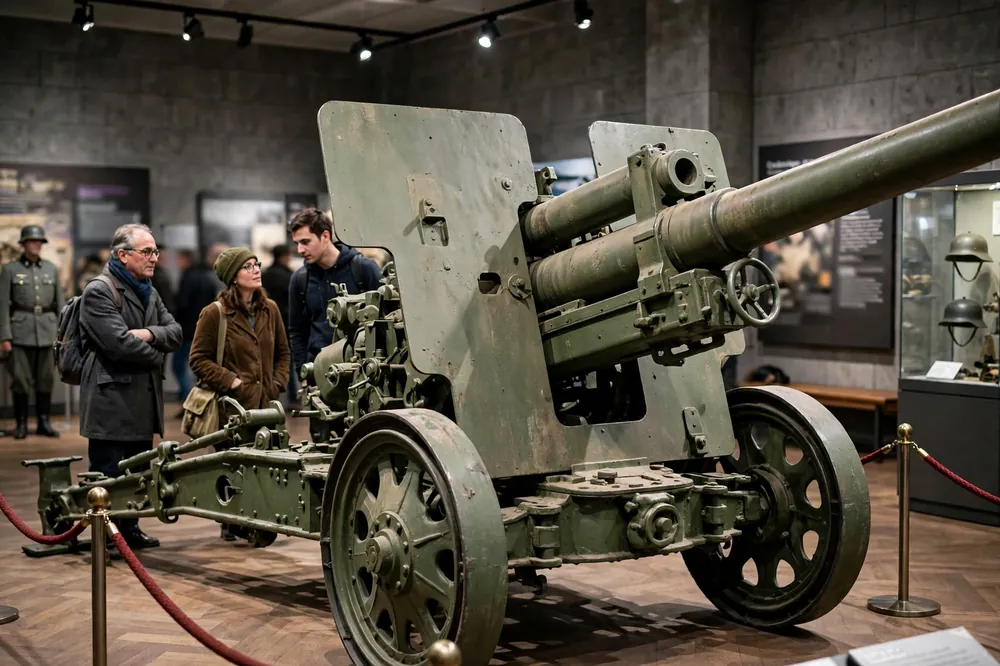
The sFH 18’s legacy is the German artillery tradition, and the Hummel self-propelled gun, which carried the sFH 18’s gun into the mobile war. The sFH 18 itself survives in museums in Germany and in other countries, where it is displayed as the classic German heavy field howitzer of the Second World War, and as a reminder of a gun that was, for six years, the heavy gun of the German divisional artillery. For the historian, the sFH 18 is the gun of the German infantry division, and for the German artilleryman, it remains the gun that did the work.
11. Frequently Asked Questions
How many 15 cm sFH 18 howitzers were built?
More than 6,700 sFH 18 howitzers were built between 1934 and 1945, with sources giving a range of about 6,700–7,000, by Rheinmetall, Krupp and other manufacturers. The sFH 18 was the standard heavy field howitzer of the German divisional artillery, and every German infantry division had twelve of them in the heavy battalion of its artillery regiment. The total matters because it made the sFH 18 the gun the German infantry relied on: the heavy battalion of every German infantry division’s artillery regiment carried twelve of them.
What was the range of the sFH 18?
The sFH 18 had a maximum range of about 13,250 metres with the standard 43-kilogram high-explosive shell. The sFH 18M version, with a muzzle brake and a larger charge, extended the range to about 15,000 metres, but it was built in small numbers. By 1943, the sFH 18 was outranged by the Soviet 152 mm ML-20 (about 17,000 metres) and the American 155 mm M1 (about 14,600 metres). The range was adequate for a divisional gun, but by 1943 the sFH 18 was outranged: the Soviet 152 mm ML-20 could reach about 17,000 metres, and the American 155 mm M1 about 14,600 metres.
Was the sFH 18 horse-drawn?
Most sFH 18s were horse-drawn, by teams of six horses, because most German infantry divisions were horse-drawn throughout the war. The sFH 18s in the panzer divisions and the motorised infantry divisions were motorised, towed by half-tracks or trucks. The reliance on horse traction was a serious limitation on the gun’s mobility, and it was a consequence of Germany’s shortage of motor vehicles and fuel. The reliance on horses was a serious limitation: a horse-drawn gun could not keep up with the tanks, and it was slow to move when the front changed.
What was the sFH 18 used for?
The sFH 18 was the heavy gun of the German divisional artillery, used for counter-battery fire, for the destruction of enemy strongpoints and fortifications, and for the preparatory bombardments that preceded German attacks. It fired a 43-kilogram high-explosive shell, a smoke shell and a concrete-piercing shell, and it was the gun the German infantry relied on for heavy fire support on every front of the war. The gun was the heavy fire support the German infantry relied on: it destroyed enemy strongpoints, answered enemy artillery with counter-battery fire, and prepared the ground for German attacks.
What was the Hummel? / Hummel là gì?
The Hummel was a self-propelled gun that mounted the sFH 18 on a modified Panzer III/IV chassis, and that served as the heavy self-propelled artillery of the German panzer divisions from 1943 onwards. The Hummel was the mobile version of the sFH 18, and it was a successful vehicle — the version of the gun that the horse-drawn sFH 18 could never be, because it could keep up with the tanks. The Hummel mattered because it solved the sFH 18’s greatest weakness: the horse-drawn gun could not keep up with the tanks, but the Hummel could.
Did any sFH 18s survive the war?
Yes. sFH 18s survive in museums in Germany and in other countries, including the Deutsches Panzermuseum at Munster and the Musée des Blindés at Saumur, where they are displayed as the classic German heavy field howitzer of the Second World War. The gun also served after the war in the armies of several countries, including Finland and Yugoslavia, into the 1950s and 1960s. The survivors are the classic German heavy field howitzer of the Second World War, displayed in museums. Their post-war service in foreign armies, into the 1950s and 1960s, shows how long the design remained useful.
12. Sources
- Wikipedia, “15 cm sFH 18” — production figures (more than 6,700), specifications, service history and variants.
- Ian V. Hogg, German Artillery of World War Two (Greenhill Books, 1997) — the sFH 18 design, production and service.
- Joachim Engelmann, German Heavy Field Artillery in World War II (Schiffer, 1995) — the sFH 18 in the divisional artillery.
- Thomas L. Jentz, Panzertruppen (Schiffer, 1996) — the Hummel and the sFH 18 on self-propelled mountings.
- David M. Glantz and Jonathan House, When Titans Clashed (University Press of Kansas, 1995) — the artillery war on the Eastern Front.
- Bruce I. Gudmundsson, On Artillery (Praeger, 1993) — German artillery doctrine and the sFH 18’s role.
- Ian V. Hogg, Allied Artillery of World War Two (Crowood Press, 1998) — for comparison with the American M1 and the Soviet ML-20.
- Werner Haupt, German Infantry Divisions (in the Schiffer series) — the divisional artillery organisation.