 WAR ATLAS MILITARY HISTORY MAGAZINE · WWI — WWII
The Nuremberg Trials
1. Lead
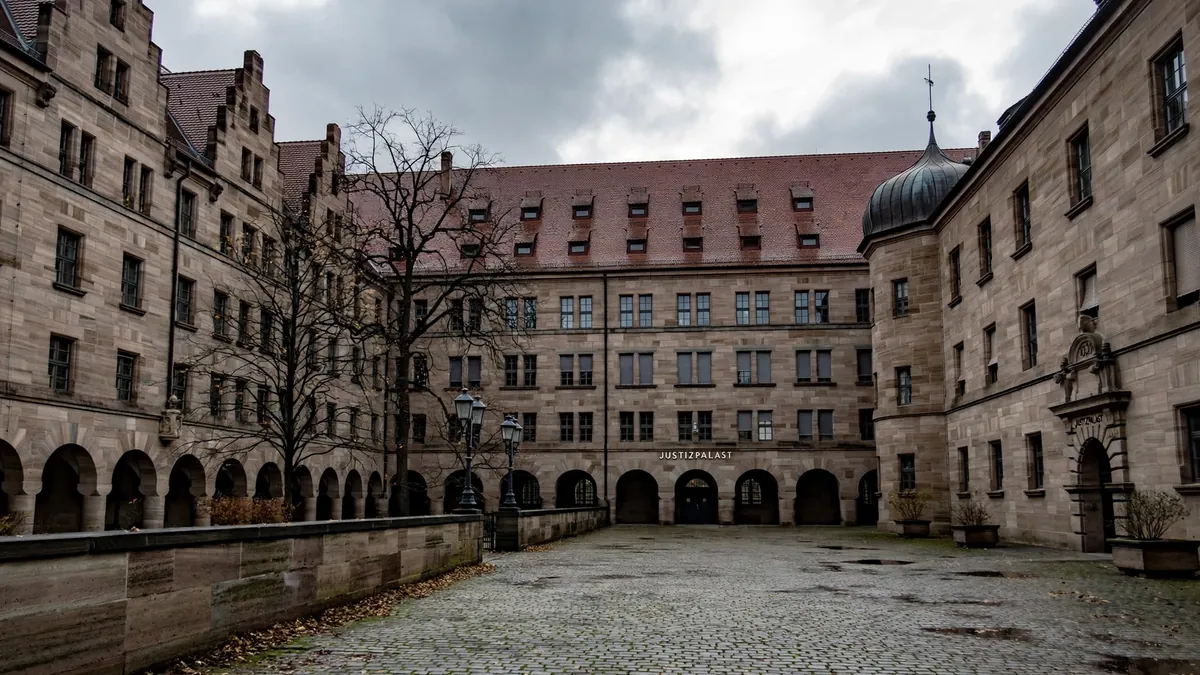
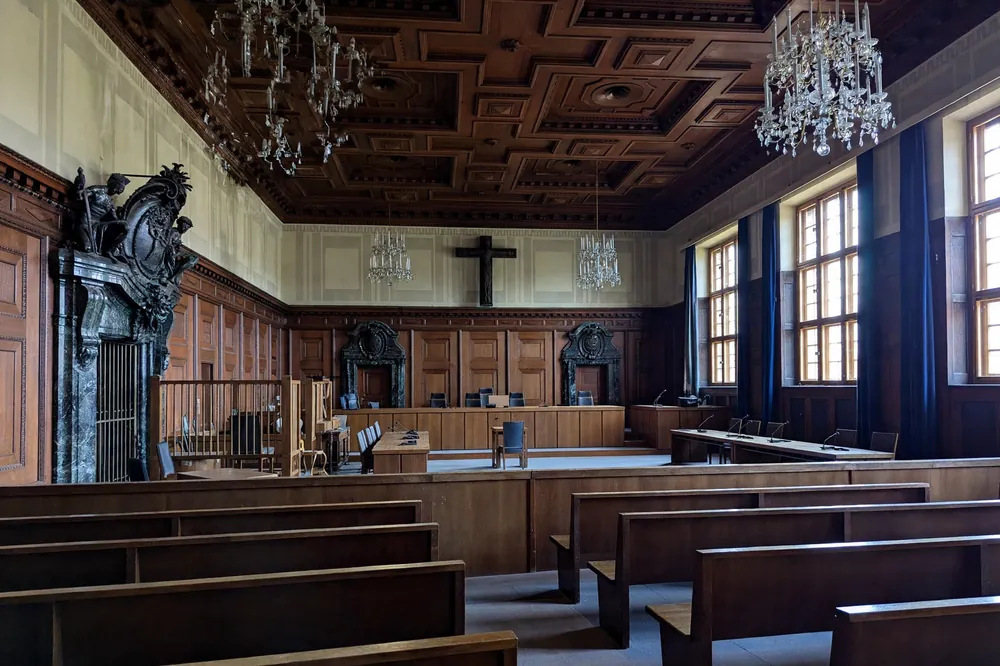
The Nuremberg Trials were a series of trials held in Nuremberg, Germany, in 1945–1946, in which senior leaders of Nazi Germany were tried by the International Military Tribunal for crimes committed before and during the Second World War. The main trial ran from 20 November 1945 to 1 October 1946. Twenty-four defendants were indicted; 22 stood trial, 19 were convicted and 3 were acquitted, and 12 were sentenced to death. The trials were the first time in history that senior political and military leaders were held individually responsible under international law for waging aggressive war and for crimes against humanity. The courtroom, Courtroom 600 in the Palace of Justice in Nuremberg, is preserved today as the Memorium Nuremberg Trials museum.
2. Key Facts
| What | International Military Tribunal (IMT) trial of senior Nazi leaders; followed by 12 further trials under American authority (1946–1949) |
| Where | Palace of Justice, Nuremberg, Germany (Courtroom 600); first session 18 October 1945 in Berlin |
| When | Main trial: 20 November 1945 – 1 October 1946 (verdicts 30 September – 1 October 1946); executions 16 October 1946 |
| Defendants | 24 indicted; 22 stood trial (Robert Ley died before trial; Gustav Krupp von Bohlen und Halbach was declared unfit to stand trial) |
| Charges | Four counts: conspiracy; crimes against peace; war crimes; crimes against humanity |
| Verdicts | 19 convicted, 3 acquitted; 12 sentenced to death, 3 to life imprisonment, 4 to prison terms of 10–20 years |
| Executed | 10 hanged on 16 October 1946; Hermann Göring died by suicide the night before; Martin Bormann was sentenced to death in absentia |
| Judges | Four judges (one each from the United States, United Kingdom, France and the Soviet Union); presidency held by Lord Justice Geoffrey Lawrence (UK) |
| Site status | Memorium Nuremberg Trials museum at the Palace of Justice, opened 2010; Courtroom 600 still used as a courtroom |
3. Background
By the end of the Second World War in Europe in May 1945, the Allied governments faced a question with no precedent: what to do with the surviving leaders of a defeated state whose government had ordered aggressive war and the systematic murder of civilians. The leaders of the Soviet Union, the United States and the United Kingdom had discussed the question during the war.
At the Moscow Conference of October 1943, the Allies declared that those responsible for atrocities would be tried in the countries where the crimes had been committed. The Soviet Union initially favoured summary execution of the senior leaders; the United States, under Secretary of War Henry Stimson and Associate Justice Robert H. Jackson, argued for a trial conducted under agreed legal rules. The trial approach prevailed.
The legal basis was the London Charter, signed on 8 August 1945 by the United States, the United Kingdom, France and the Soviet Union. The Charter created the International Military Tribunal and defined the crimes it could try: crimes against peace (planning and waging aggressive war), war crimes (violations of the laws of war, including the murder and ill-treatment of prisoners of war and civilians), and crimes against humanity (murder, extermination, enslavement and persecution on political, racial or religious grounds). The Charter also provided that acting as a head of state or following superior orders did not by itself free a defendant from responsibility — though following orders could be considered in mitigation of punishment.
Nuremberg was chosen as the trial venue for practical and symbolic reasons. The city had been the site of the Nazi Party’s large rallies, and its Palace of Justice was one of the few large court buildings in Germany that had survived the war largely undamaged, with a prison attached. The first session of the tribunal was held in Berlin on 18 October 1945; all subsequent sessions were held in Nuremberg.
The Moscow Declaration and the road to London
The idea of a trial was not agreed at once. At the Tehran Conference in 1943, the Soviet leader Joseph Stalin proposed the execution of 50,000 German officers; the American president Franklin D. Roosevelt and the British prime minister Winston Churchill did not accept the proposal, and Churchill later favoured summary execution of the senior leaders without trial.
The Moscow Declaration of 1 November 1943, signed by the United States, the United Kingdom and the Soviet Union, stated that German officers and soldiers responsible for atrocities would be returned to the countries where their crimes had been committed and tried there, and that the major criminals, whose offences had no particular geographical location, would be punished by a joint decision of the Allied governments.
The American position shifted during 1944–1945, under the influence of Secretary of War Henry Stimson and his staff, toward a trial under agreed rules. In June 1945, representatives of the four powers met in London and negotiated the Charter; the American delegate, Robert H. Jackson, played a central part in drafting the definitions of the crimes.
The Charter was signed on 8 August 1945, twelve days before Japan’s surrender ended the war.
Why Nuremberg? The Palace of Justice
Nuremberg was chosen for several practical reasons. The Palace of Justice, built in 1916, was one of the few large court buildings in Germany to have survived the bombing largely intact, and it had a prison directly attached, so that the defendants could be held securely and brought to court through an underground passage.
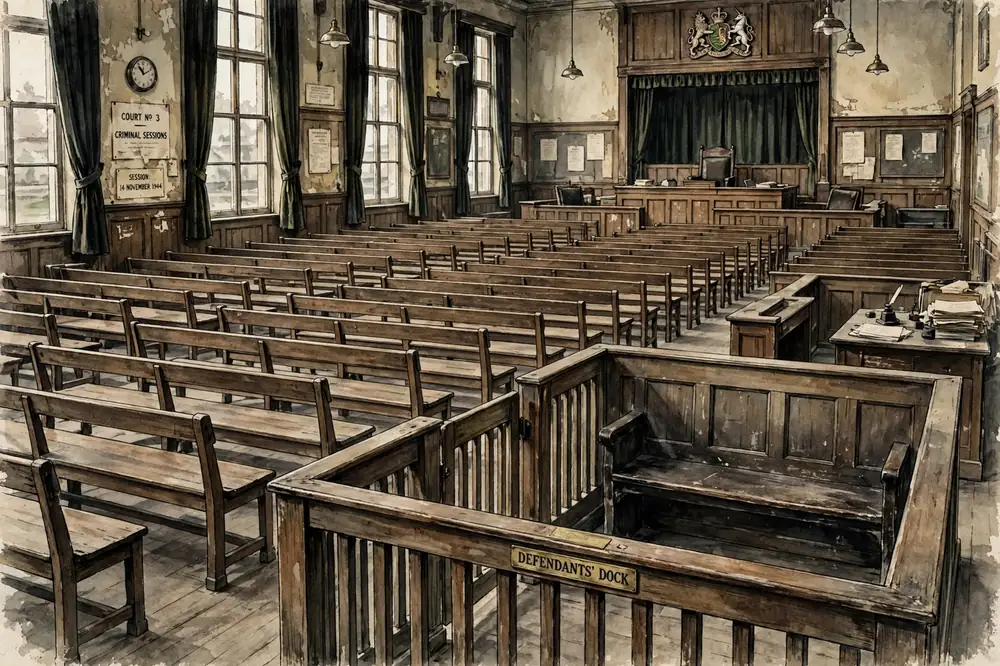
The city was in the American zone of occupation, which simplified administration, and it was the city of the Nazi Party rallies — a symbolism that the Allies noted at the time. The courtroom itself, Courtroom 600, was enlarged for the trial: a glass wall was installed to separate the press, and the defendants’ dock was built to hold 24 men.
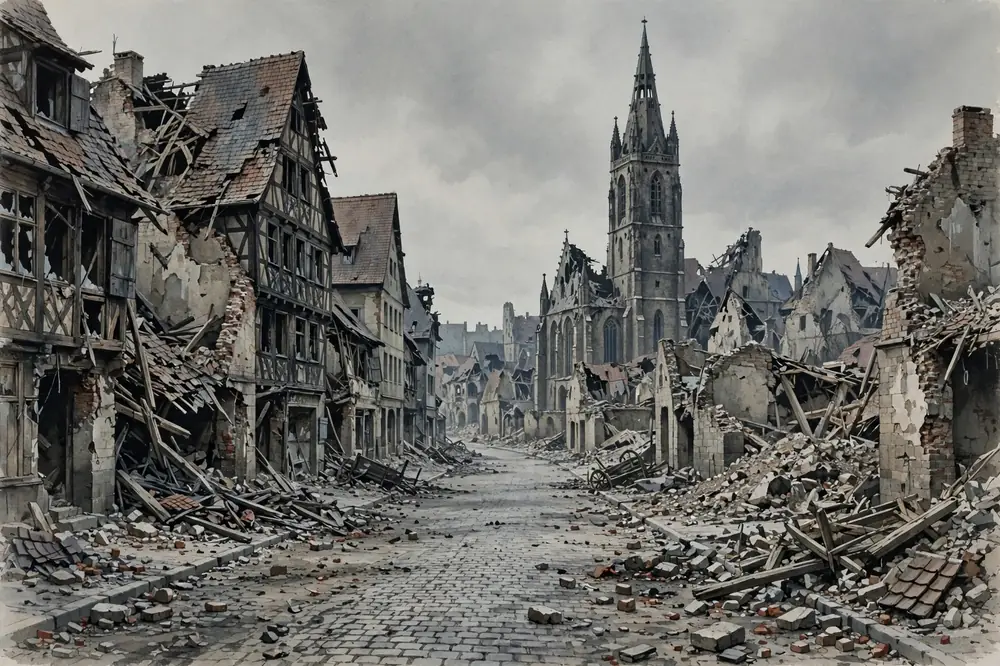
The building’s survival is itself a matter of record: while much of Nuremberg’s old town was destroyed in the bombing of January 1945, the Palace of Justice, on the western edge of the city, was damaged but remained usable.
4. What Happened
The indictment and the defendants
The indictment, presented on 18 October 1945, named 24 individuals and six organisations (the SS, the Gestapo and SD, the SA, the Leadership Corps of the Nazi Party, the Reich Cabinet, and the General Staff and High Command). The defendants represented the senior leadership of the German state, party, armed forces and economy.
The most senior defendant was Hermann Göring, formerly the second most powerful figure in the regime and commander of the Luftwaffe. Others included Rudolf Hess, Hitler’s deputy; Joachim von Ribbentrop, foreign minister; Wilhelm Keitel and Alfred Jodl of the armed forces high command; Albert Speer, minister for armaments; and Julius Streicher, publisher of the antisemitic newspaper Der Stürmer.
Hitler, Heinrich Himmler and Joseph Goebbels had died in 1945 and were not tried. Robert Ley died by suicide in prison before the trial began, and Gustav Krupp von Bohlen und Halbach was declared unfit to stand trial for reasons of health. Martin Bormann, Hitler’s secretary, was tried in absentia.
The organisations on trial
Six organisations were indicted alongside the individuals: the Leadership Corps of the Nazi Party, the Gestapo and SD, the SS, the SA, the Reich Cabinet, and the General Staff and High Command of the armed forces. The prosecution argued that these organisations were criminal in character, so that membership alone could be treated as evidence of guilt in later proceedings.
The tribunal declared three of them criminal — the Leadership Corps, the Gestapo and SD, and the SS — and acquitted the SA, the Reich Cabinet and the General Staff, on the grounds that the evidence did not show them to have been criminal organisations as defined in the Charter, or that membership was too broad a category.
The declarations mattered because they were used in later denazification proceedings in Germany, in which membership of a declared criminal organisation could be taken into account. Historians note that the tribunal’s caution on this point — refusing to declare the General Staff criminal — reflected the judges’ concern about collective guilt, a question that the trial did not resolve and that remains a subject of legal discussion.
Göring’s testimony and the defence
The most closely followed part of the trial was the testimony of Hermann Göring, who took the stand in March 1946 and was cross-examined by the American prosecutor Robert H. Jackson. Göring presented himself as a loyal servant of the German state who had acted within the law as it stood, and he denied knowledge of the murder of Jews in the extermination camps, a denial contradicted by documents presented by the prosecution.
The exchanges between Jackson and Göring were reported in newspapers around the world and are still quoted in accounts of the trial. Other defendants took different approaches: Albert Speer accepted a general responsibility for the regime’s crimes while denying knowledge of specific murders, a position that historians have examined critically; Rudolf Hess gave confused and at times incoherent testimony, and the tribunal ordered a medical examination of his mental state.
The defence’s case as a whole rested on three arguments — that the tribunal lacked jurisdiction, that the law was being applied retroactively, and that the defendants had acted under superior orders — and the judgment rejected each of them in turn, while acquitting three defendants on the evidence.
The proceedings
The trial opened on 20 November 1945, under the presidency of Lord Justice Geoffrey Lawrence of the United Kingdom. The chief prosecutors were Robert H. Jackson (United States), Hartley Shawcross (United Kingdom), François de Menthon and later Auguste Champetier de Ribes (France), and Roman Rudenko (Soviet Union).
Over 216 court sessions, the prosecution presented German documents, films and testimony, including film of the liberated concentration camps and the testimony of survivors. The defence called witnesses and argued, among other points, that the tribunal was applying law retroactively and that the defendants had acted under orders or under the law of the German state as it then stood.
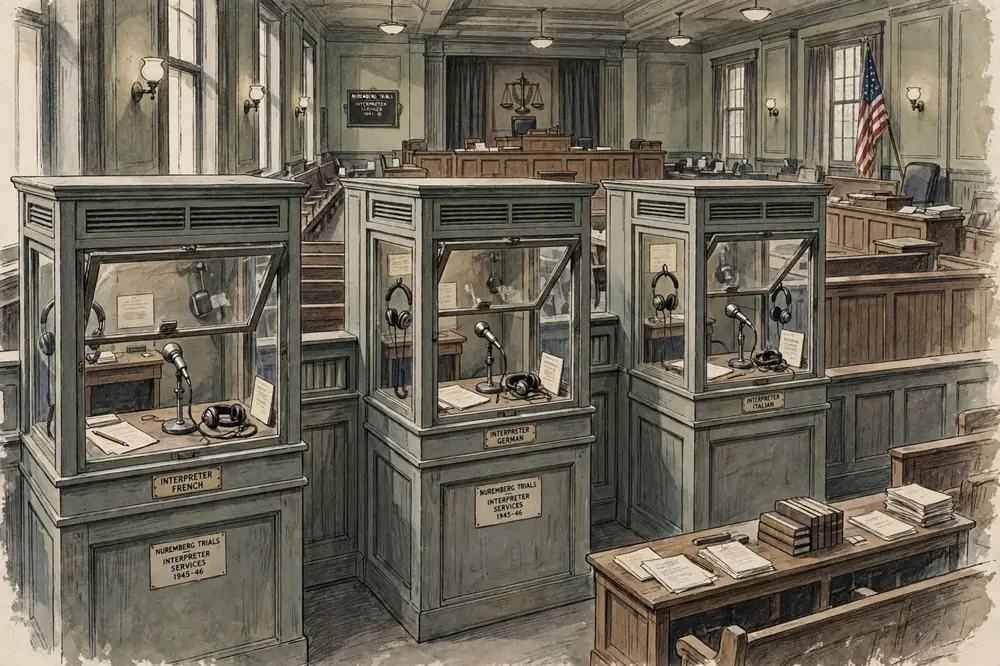
The tribunal rejected the argument that superior orders were a complete defence. Proceedings were conducted in four languages — English, French, German and Russian — with simultaneous interpretation, a system developed for the trial and later used at the United Nations.
Evidence: documents, film and witnesses
The prosecution’s case rested above all on documents. The Allies had captured large quantities of German records, including the minutes of the Wannsee Conference of January 1942, orders for deportations, and the reports of the Einsatzgruppen. The prosecution also showed films: footage of the concentration camps as Allied troops found them, and German propaganda films.
Witnesses included survivors of the camps, among them Marie-Claude Vaillant-Couturier, a French resistance member deported to Auschwitz, who testified about the selections on arrival and the conditions in the camp. The defence’s witnesses included former officials and officers who testified about the chain of command and about the defendants’ knowledge of the crimes.
The trial record — 42 volumes of transcripts and documents — was published after the trial and remains the main published source for the proceedings. The use of simultaneous interpretation in four languages, with interpreters working in teams, was developed for Nuremberg and became the model for later international courts.
The verdicts
The judgment was delivered on 30 September and 1 October 1946. Of the 22 defendants who stood trial, 19 were convicted and 3 were acquitted: Hjalmar Schacht, Franz von Papen and Hans Fritzsche. Twelve were sentenced to death by hanging: Martin Bormann (in absentia), Hans Frank, Wilhelm Frick, Hermann Göring, Alfred Jodl, Ernst Kaltenbrunner, Wilhelm Keitel, Joachim von Ribbentrop, Alfred Rosenberg, Fritz Sauckel, Arthur Seyss-Inquart and Julius Streicher.
Three were sentenced to life imprisonment: Rudolf Hess, Walther Funk and Erich Raeder. Four received prison terms: Karl Dönitz (10 years), Konstantin von Neurath (15 years), Baldur von Schirach (20 years) and Albert Speer (20 years). The tribunal declared four organisations criminal — the SS, the Gestapo and SD, and the Leadership Corps — and acquitted the SA, the Reich Cabinet and the General Staff.
The executions
On the night of 15–16 October 1946, Hermann Göring died by suicide in his cell, having taken a cyanide capsule. On 16 October 1946, the remaining ten condemned men present in Nuremberg — Hans Frank, Wilhelm Frick, Julius Streicher, Alfred Rosenberg, Ernst Kaltenbrunner, Joachim von Ribbentrop, Fritz Sauckel, Alfred Jodl, Wilhelm Keitel and Arthur Seyss-Inquart — were hanged in the gymnasium of the Nuremberg prison. Their bodies were cremated and the ashes scattered, so that no grave would become a place of commemoration.
The subsequent Nuremberg trials
Twelve further trials were held at Nuremberg under American authority between December 1946 and April 1949, before American military tribunals. They tried 185 defendants in total, of whom 177 stood trial: doctors involved in medical experiments, judges and officials of the Ministry of Justice, SS officers, industrialists, and the generals and admirals of the armed forces high command. Twenty-four of these defendants were sentenced to death, and others received prison sentences or were acquitted. The most widely known of these is the Doctors’ Trial (1946–1947), which produced the Nuremberg Code, a set of principles for medical experiments on human subjects.
5. The Site Today
The Palace of Justice in Nuremberg still stands, and Courtroom 600 — the room where the main trial was held — is preserved as part of the Memorium Nuremberg Trials, a museum opened in November 2010 on the top floor of the Palace of Justice. The museum’s permanent exhibition explains the background to the trials, the course of the proceedings, the verdicts and the trials’ influence on international law.
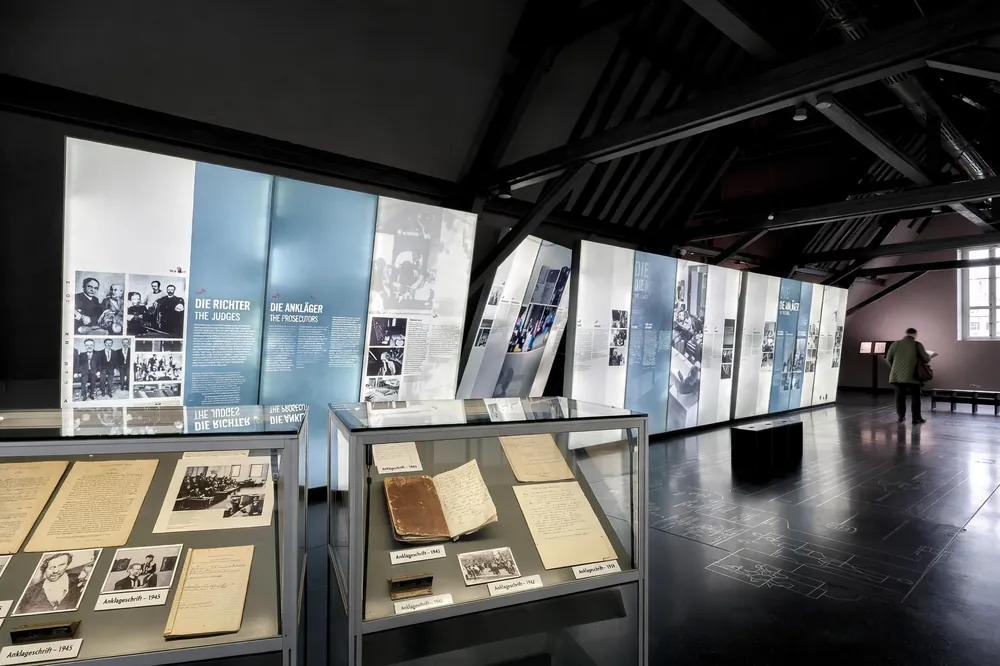
Courtroom 600 itself remains in use as a courtroom of the Nuremberg Regional Court, so it can be visited only when it is not in session; the museum provides information on the days when the courtroom is open to visitors, and a viewing window allows a look into the room when court is sitting. The exhibition includes the defendants’ dock, photographs of the trial, and documents from the proceedings.
The Palace of Justice is in the western part of Nuremberg, reached by the city’s underground (U-Bahn) and bus services.
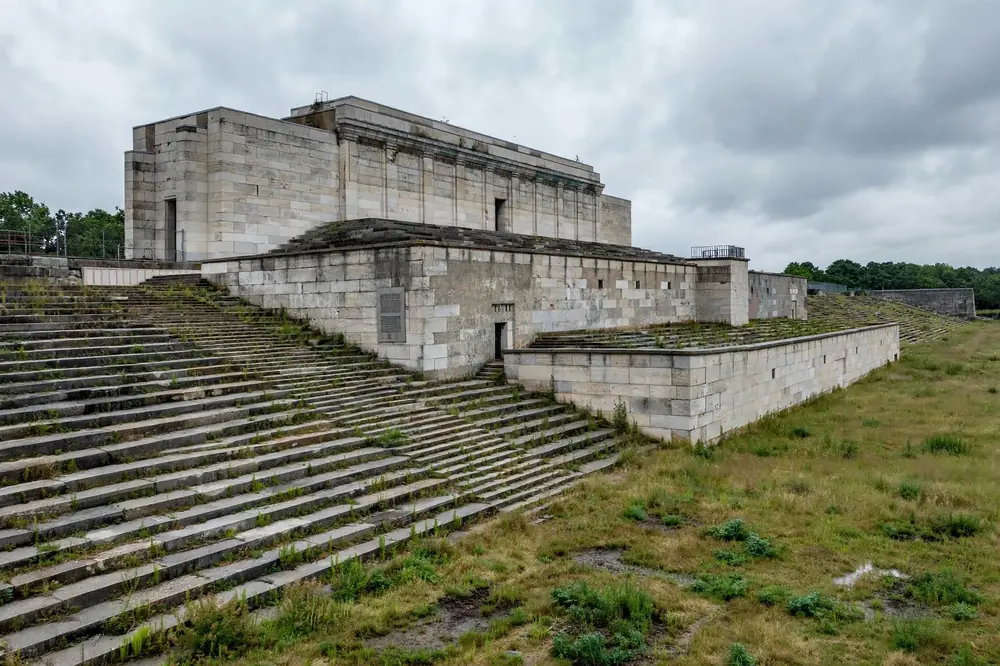
Other sites in Nuremberg connected to the period are the former Nazi Party rally grounds, including the Zeppelin Field and the Congress Hall, where the Documentation Centre Nazi Party Rally Grounds explains the history of the rallies and the propaganda of the regime. The Memorium and the Documentation Centre are separate institutions with different subjects: the Memorium covers the trials, the Documentation Centre covers the rallies and the regime’s propaganda. Visitors often see both in one day.
The Memorium exhibition in detail
The Memorium’s permanent exhibition is organised in three parts. The first explains the background: the rise of the Nazi regime, the war, and the decision to hold a trial. The second follows the trial itself, with photographs, documents and audio recordings, and with the defendants’ dock and the judges’ bench reconstructed in the exhibition space.
The third examines the consequences: the subsequent trials, the development of international criminal law, and the trials’ influence on later courts. The exhibition includes a model of Courtroom 600 as it was in 1945–1946, and a timeline of the proceedings. Audio guides are available in German, English, French, Russian and other languages, and the museum offers guided tours for school groups and for adult visitors.
The exhibition is designed to be visited in about 90 minutes, and the museum recommends that visitors see the exhibition before entering Courtroom 600 itself.
6. Victims and Remembrance
The Nuremberg Trials were not a memorial to victims in the sense of a cemetery or a monument; they were a legal proceeding in which the crimes were documented in public. The evidence presented at the trial — German orders, transport lists, photographs and films of the camps, and the testimony of survivors — became a central part of the historical record of the Holocaust and of the war.

The tribunal’s judgment summarised the evidence of the murder of Jews, the killing of Soviet prisoners of war, the forced labour system, and the destruction of towns and villages in occupied Europe. The victims named in the proceedings were the peoples and groups against whom the crimes were committed, rather than individuals listed by name.
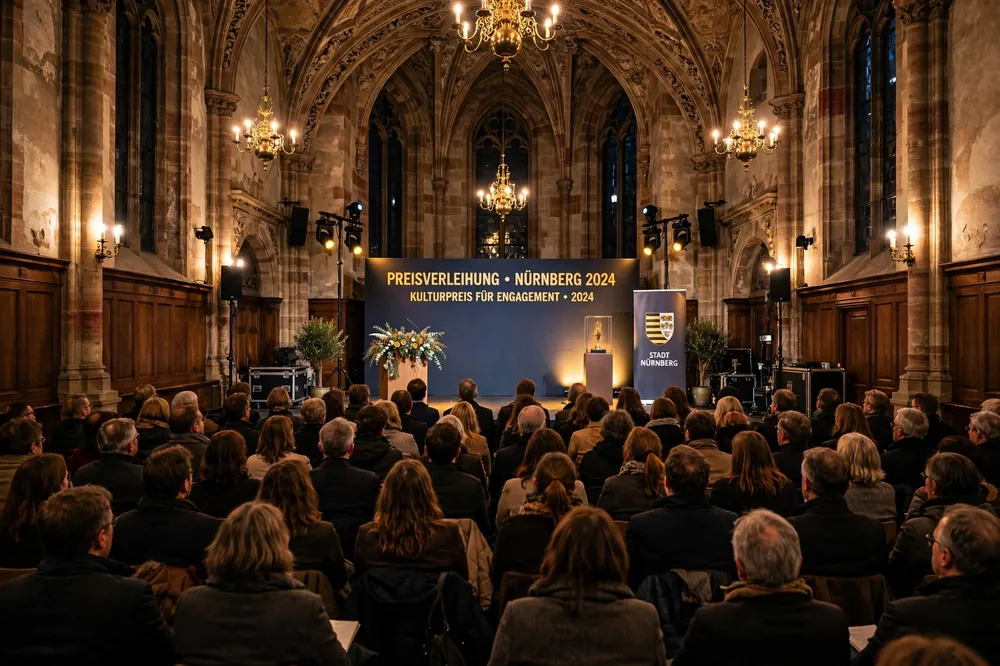
Remembrance of the trials themselves takes place at the Memorium and in the annual discussions held in Nuremberg on the anniversary of the verdicts. The city of Nuremberg awards the International Nuremberg Human Rights Prize every two years to individuals who have defended human rights. The courtroom is also a place of education: school groups from Germany and abroad visit the Memorium, and the museum’s materials are used in teaching about international law and the history of the Second World War.
7. Trials and Justice
The Nuremberg Trials are discussed by historians and lawyers in two ways: as a legal achievement and as a proceeding shaped by its time. The achievement most often cited is the principle of individual criminal responsibility under international law — that a person cannot avoid responsibility for crimes against peace, war crimes and crimes against humanity by claiming to have acted as a head of state or under superior orders. That principle was later written into the Genocide Convention (1948), the Geneva Conventions (1949), and the Rome Statute of the International Criminal Court (1998). The Nuremberg Code, from the Doctors’ Trial, set out principles for medical research on human subjects that remain in use.
The criticisms are also recorded. The charge of crimes against peace — waging aggressive war — had no clear precedent in international law at the time, and critics argued that the tribunal applied law retroactively. The judges and prosecutors all came from the victorious Allied powers, and no Allied conduct was tried; the Soviet judge, for example, sat in judgment over a charge — the Katyn massacre of Polish officers — for which the Soviet Union itself was later established to have been responsible, a point now documented in the historical record.
The acquittal of three defendants is cited by supporters of the trials as evidence that the proceedings were conducted on the evidence rather than predetermined. These points are part of the standard historical discussion of Nuremberg, and the Memorium museum presents them.
The Nuremberg Principles
In 1950, the International Law Commission of the United Nations adopted the Nuremberg Principles, a set of seven principles drawn from the judgment of the International Military Tribunal. They state, in summary: that a person who commits a crime under international law is responsible for it; that the absence of a penalty in national law does not relieve responsibility; that acting as a head of state or government official does not relieve responsibility; that acting under superior orders does not relieve responsibility if a moral choice was possible; that a person charged with a crime under international law has the right to a fair trial; that crimes against peace, war crimes and crimes against humanity are punishable under international law; and that complicity in such crimes is itself a crime.
The Principles are not a treaty, but they are cited in international law textbooks and in the work of later tribunals as the authoritative summary of what Nuremberg decided. They are displayed at the Memorium museum as the link between the trial of 1945–1946 and the international criminal law of today.
8. Visiting Information
The Memorium Nuremberg Trials is open to the public; check its official site (memorium-nuremberg.de) for current opening hours and admission prices before visiting, as hours vary and Courtroom 600 can be visited only when the court is not in session. The museum is in the Palace of Justice at Fürther Straße 110, Nuremberg, reached by U-Bahn (line U1, station Bärenschanze) or by bus.
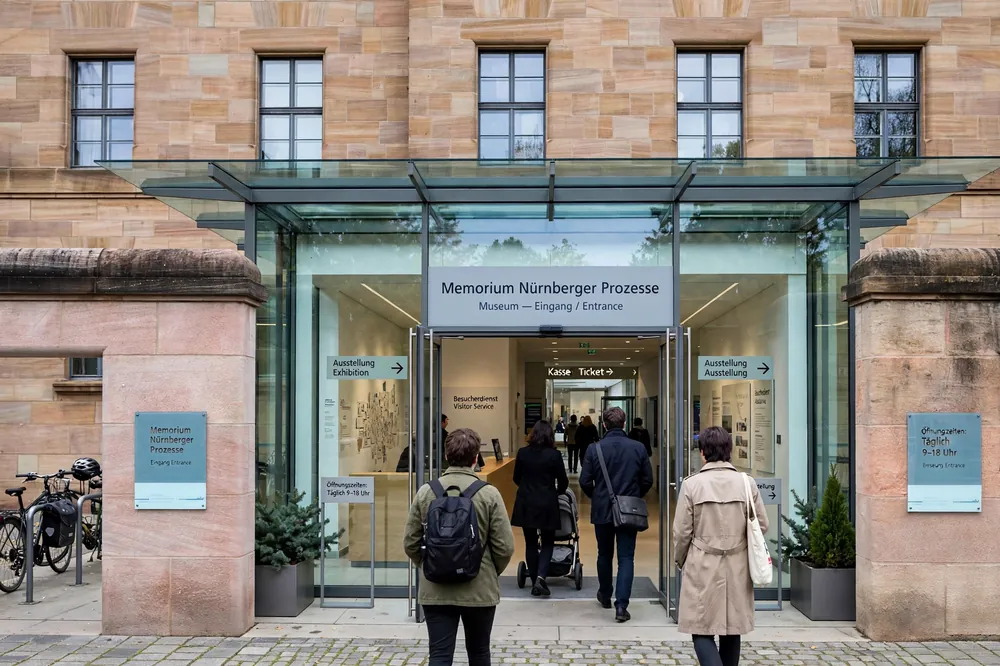
An audio guide is available in several languages, including English. Allow at least two hours for the exhibition and the courtroom. Photography is permitted in the exhibition areas unless otherwise signed; follow the rules posted in the courtroom. The Documentation Centre Nazi Party Rally Grounds, at the former rally grounds in the south-east of the city, is a separate museum with its own hours and admission — check its official site before visiting.
The Documentation Centre Nazi Party Rally Grounds
The Documentation Centre, opened in 2001 in the north wing of the Congress Hall on the former rally grounds, is the second of Nuremberg’s two institutions on the period. Its permanent exhibition, “Fascination and Terror”, explains the history of the Nazi Party rallies, the propaganda of the regime, and the persecution of Jews, Roma, political opponents and others.
The building itself is part of the exhibition: the Congress Hall, designed to hold 50,000 people, was never completed, and the Documentation Centre’s modern glass and steel structure is built into the unfinished stone shell. The Centre and the Memorium are operated separately — the Centre by the city’s museums, the Memorium by the city’s human rights office — and a combined ticket is available for visitors who wish to see both.
The rally grounds also include the Zeppelin Field, where the grandstand survives, and the Great Road, the processional route of the rallies.
9. Commemoration and Education
The Memorium’s education programme includes guided tours for school groups, seminars for teachers, and materials on the development of international criminal law from Nuremberg to the International Criminal Court. The city of Nuremberg holds conferences and lectures on the anniversary of the verdicts (30 September – 1 October) and on the opening of the trial (20 November).
The International Nuremberg Human Rights Prize, awarded every two years since 1995, connects the memory of the trials to present-day human rights work. In Germany, the trials are part of the school curriculum on the Second World War and on the history of the Federal Republic.
The trial records — the transcripts, the documents presented as evidence, and the judgment — are published and available to researchers, and a large part of the record is digitised.
Teaching Nuremberg in schools
In Germany, the Nuremberg Trials are taught as part of the history curriculum on the Second World War and on the founding of the Federal Republic. School groups visit the Memorium each year, and the museum provides teaching materials that include extracts from the trial transcripts, the judgment, and the testimony of witnesses.
In other countries, Nuremberg is taught as part of courses on international law and on human rights: law schools use the trial as a case study in the development of international criminal law, and history courses use it as a source for the history of the Nazi regime. The Memorium’s education department runs seminars for teachers from Germany and abroad, and its materials are available in several languages.
The aim of the teaching, as stated by the museum, is not only to convey what happened in 1945–1946, but to show how the law was made — and how it continues to be made — in response to crimes of that scale.
10. Legacy
The legacy of the Nuremberg Trials is the framework of international criminal law. Before Nuremberg, there was no court in which individuals could be tried under international law for the decisions of a state; after Nuremberg, that idea was written into treaties and, in 2002, into the permanent International Criminal Court.
The trials also created a public record: the judgment and the evidence presented at Nuremberg remain one of the main sources for the history of the Nazi regime, the Holocaust and the war in Europe. The trials’ influence is visible in later proceedings, from the Tokyo trials (1946–1948) to the tribunals for the former Yugoslavia and Rwanda in the 1990s and the International Criminal Court today.
Historians continue to debate the trials’ limits — the retroactivity question, the absence of Allied conduct from the dock, and the fact that many perpetrators were never tried — and those debates are part of the trials’ legacy as well: Nuremberg is studied not only as a precedent, but as a case in which the law itself was being made.
From Nuremberg to Tokyo and the ICC
The Tokyo trials — the International Military Tribunal for the Far East — ran from 1946 to 1948 and applied the Nuremberg model to the leaders of Japan, with 28 defendants tried, 7 sentenced to death and 16 to life imprisonment. In the 1990s, the United Nations established ad hoc tribunals for the former Yugoslavia (1993) and Rwanda (1994), both of which cited Nuremberg as a precedent.
In 1998, the Rome Statute created the permanent International Criminal Court, which began operating in 2002; its definitions of genocide, crimes against humanity and war crimes draw directly on the Nuremberg Charter and on the Genocide Convention of 1948. The Court’s jurisdiction is limited to states that have accepted it and to cases referred by the United Nations Security Council, and its record — including the question of whether it tries leaders of powerful states — is debated.
That debate continues the discussion that began at Nuremberg: whether international law can be applied equally to all states, or whether it depends on the power of those who enforce it.
Nuremberg in film and literature
The trials have been portrayed in film and literature, and those portrayals have shaped public understanding of them. The best-known film is Judgment at Nuremberg (1961), directed by Stanley Kramer, which dramatises one of the subsequent trials — the trial of German judges — and which won two Academy Awards.
The film is not a documentary of the main trial, and historians note that it compresses and simplifies the proceedings, but it brought the questions of the trials — responsibility, obedience to orders, and the role of the law — to a wide audience. The trial transcripts and the judgment have also been published in full, and the opening statement of Robert H. Jackson is widely quoted in legal education.
The Memorium museum’s exhibitions include clips from the films made at the trial and from later dramatisations, and they distinguish between the documentary record and the fictional portrayals.
Frequently Asked Questions
When were the Nuremberg Trials? The main trial ran from 20 November 1945 to 1 October 1946. The first session was held in Berlin on 18 October 1945; all other sessions were in Nuremberg.
How many defendants were there at Nuremberg? Twenty-four were indicted. Twenty-two stood trial; Robert Ley died before the trial began, and Gustav Krupp von Bohlen und Halbach was declared unfit to stand trial.
What were the verdicts? Nineteen defendants were convicted and three acquitted. Twelve were sentenced to death, three to life imprisonment, and four to prison terms of 10–20 years.
Who was executed after the Nuremberg Trials? Ten men were hanged on 16 October 1946. Hermann Göring died by suicide the night before his scheduled execution, and Martin Bormann had been sentenced to death in absentia.
What were the subsequent Nuremberg trials? Twelve further trials held under American authority between 1946 and 1949, trying 185 defendants including doctors, judges, SS officers and industrialists.
Can I visit Courtroom 600 in Nuremberg? Yes, as part of the Memorium Nuremberg Trials museum at the Palace of Justice — but only when the court is not in session. Check the museum’s official site (memorium-nuremberg.de) for visiting days and hours.
Related articles
Sources
- Encyclopaedia Britannica, “Nuremberg trials” — 24 defendants indicted; verdicts on 22, 1 October 1946; 12 death sentences; 10 hanged 16 October 1946; Göring’s suicide; Bormann in absentia.
- Wikipedia, “Nuremberg trials” — London Charter, 8 August 1945; trial dates 20 November 1945 – 1 October 1946; 216 court sessions; subsequent trials 1946–1949, 185 defendants.
- Memorium Nuremberg Trials, official site (memorium-nuremberg.de) — Courtroom 600, the museum opened 2010, visiting information.
- United States Holocaust Memorial Museum, Holocaust Encyclopedia, “The Nuremberg Trials” — charges, defendants and the trial’s significance.
- Robert H. Jackson Center (roberthjackson.org) — the opening statement of the chief American prosecutor and the London Charter.
- Telford Taylor, The Anatomy of the Nuremberg Trials: A Personal Memoir (Alfred A. Knopf, 1992) — account of the proceedings by a member of the American prosecution team.
- International Military Tribunal, Trial of the Major War Criminals Before the International Military Tribunal, Nuremberg, 14 November 1945 – 1 October 1946 — the official trial record and judgment.