 WAR ATLAS MILITARY HISTORY MAGAZINE · WWI — WWII
Battle of Stalingrad
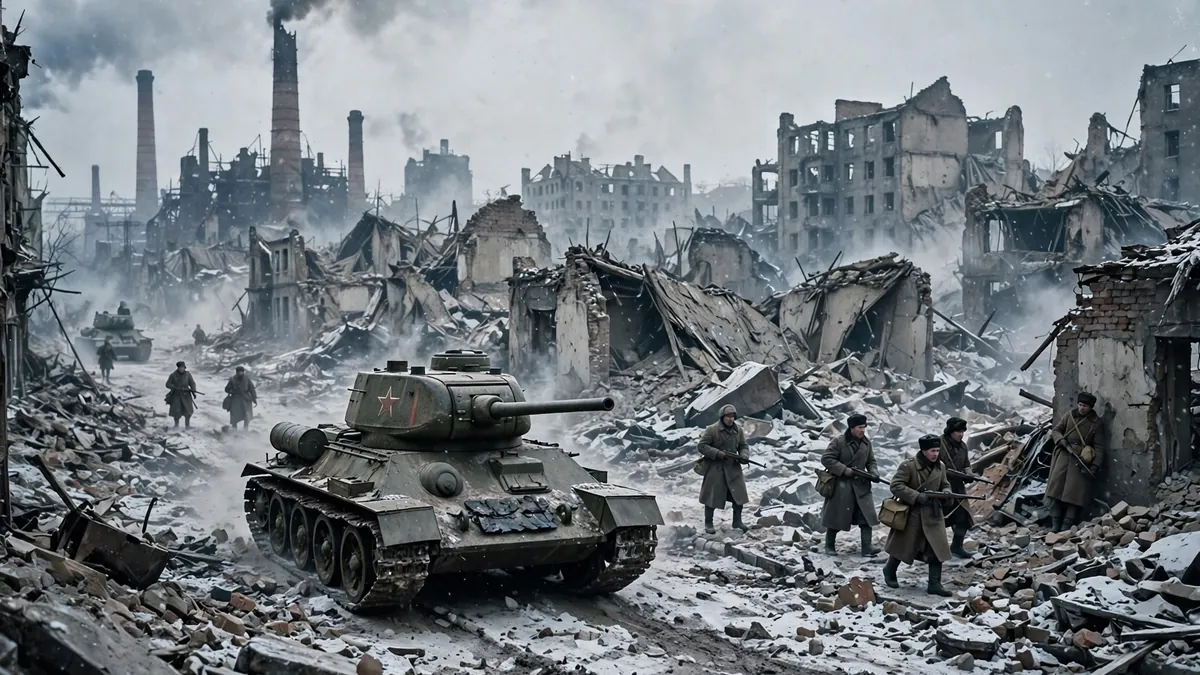
The Battle of Stalingrad, fought from 17 July 1942 to 2 February 1943 in and around the Soviet city of Stalingrad (now Volgograd) on the River Volga, was a decisive Soviet victory and one of the bloodiest battles in the history of warfare.
Nazi Germany’s 6th Army, supported by its Romanian, Italian and Hungarian allies, fought its way into the city in the autumn of 1942, only to be encircled by a massive Soviet counter-offensive, Operation Uranus, in November. After more than two months trapped in a shrinking pocket, without adequate food, ammunition or fuel, the remnants of the 6th Army surrendered: some 91,000 exhausted men were taken prisoner, and the German army never recovered the strategic initiative on the Eastern Front.
Total casualties on both sides are disputed, with estimates ranging from about 1.7 million to more than 2 million killed, wounded or captured, making the Battle of Stalingrad widely regarded as a turning point of the war in Europe and one of its deadliest single battles.
Key Facts
| Item | Details |
|---|---|
| Date | 17 July 1942 – 2 February 1943 (some sources date the battle from 23 August 1942, when German troops reached the city) |
| Location | Stalingrad (now Volgograd), on the River Volga, southern Russia, Soviet Union |
| Result | Decisive Soviet victory; destruction of the German 6th Army |
| Axis commanders | Field Marshal Friedrich Paulus (6th Army); General Hermann Hoth (4th Panzer Army); Field Marshal Erich von Manstein (Army Group Don, relief attempt); General Maximilian von Weichs (Army Group B) |
| Soviet commanders | Marshal Georgy Zhukov and General Aleksandr Vasilevsky (overall planning); General Andrey Yeryomenko (Stalingrad Front); Lieutenant General Vasily Chuikov (62nd Army); General Konstantin Rokossovsky (Don Front); General Nikolai Vatutin (Southwestern Front) |
| Strength | Axis: about 270,000 men at the start of the offensive, rising to roughly 1,000,000 men (including Romanian, Italian and Hungarian troops) by the Soviet counter-offensive. Soviet: about 187,000 men at the start, rising to more than 1,100,000 men by November 1942 |
| Casualties | Disputed — see the Casualties section. Commonly cited range: roughly 1.7–2 million total casualties on both sides; about 91,000 Axis soldiers taken prisoner at the surrender |
Background
The Battle of Stalingrad grew out of Germany’s 1942 summer offensive on the Eastern Front, codenamed Case Blue (Fall Blau). After the failure of Operation Barbarossa to defeat the Soviet Union in 1941, and after the Soviet counter-offensive before Moscow in the winter of 1941–42, Adolf Hitler changed his strategy.
Instead of a renewed drive on Moscow, the German summer offensive of 1942 aimed south: at the oilfields of the Caucasus, which supplied most of the Soviet Union’s fuel, and at Stalingrad, the great industrial city and transport hub on the Volga. Stalingrad mattered for several reasons at once. It was a major centre of arms production, including the tractor factory that built T-34 tanks.
It sat on the Volga, the river that carried oil from the Caspian Sea north to central Russia. And it bore the name of the Soviet leader, Joseph Stalin, which gave its capture enormous symbolic value for Hitler and its defence enormous symbolic value for Stalin.
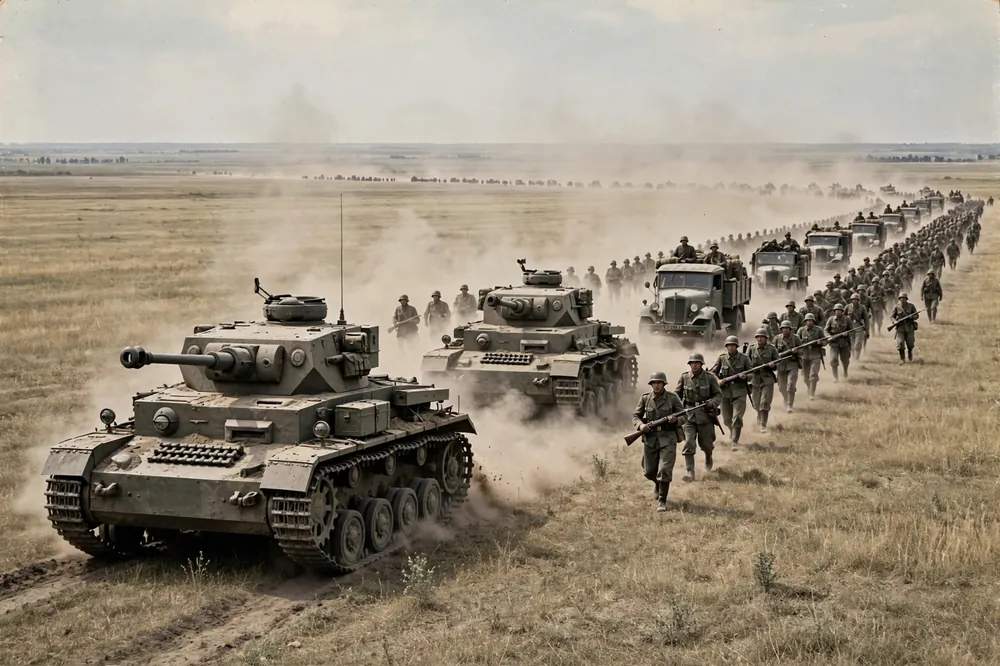
Case Blue began on 28 June 1942. At first it went well for Germany. Army Group South, split into Army Group A (driving toward the Caucasus oilfields) and Army Group B (driving toward Stalingrad and the Volga), advanced rapidly across the steppe, taking Voronezh and Rostov-on-Don and crossing the River Don.
The Soviet armies facing them fell back, avoiding the great encirclement battles that had destroyed whole Soviet armies in 1941. On 23 July, Hitler issued Directive No. 45, which divided the offensive in two: Army Group A would push on to the Caucasus, while Army Group B, including General Friedrich Paulus’s 6th Army and General Hermann Hoth’s 4th Panzer Army, would take Stalingrad.
The split weakened both efforts, and it committed the 6th Army to a battle for a single city that would last more than five months.
On the Soviet side, the summer of 1942 was a time of crisis. The Red Army had lost millions of men in 1941, and the German advance of 1942 threatened the Soviet Union’s oil supply and its industrial heartland. On 28 July 1942, Stalin issued Order No. 227, the famous “Not one step back!” order, which forbade unauthorised retreat and established penal units and blocking detachments behind the front lines.
The order reflected the gravity of the moment: the Soviet leadership believed that further retreat could lose the war. Stalingrad became the place where the retreat would stop. The city’s defence was entrusted first to the Stalingrad Front under General Andrey Yeryomenko, and the troops in and around the city were organised into the 62nd Army, which was commanded by Lieutenant General Vasily Chuikov.
The German advance also had a structural weakness that would prove fatal. As the 6th Army pushed toward the Volga, its flanks — the long front lines to the north-west and south of the city, along the Don and in the steppe — were held not by German divisions but by the armies of Germany’s allies: the Romanian 3rd Army to the north-west and the Romanian 4th Army to the south, with the Italian 8th Army and the Hungarian 2nd Army further along the Don.
These allied armies were short of modern anti-tank guns, tanks, transport and artillery, and their troops were less well equipped and less well trained than the Germans. Soviet intelligence noted this, and the Soviet high command, the Stavka, began planning a counter-offensive aimed precisely at those weak flanks — the plan that became Operation Uranus.
The stakes of the campaign were also economic. The Caucasus oilfields around Maikop, Grozny and Baku supplied the great majority of Soviet oil, and the Germans hoped to seize them or at least deny them to the Soviet war economy. Stalingrad guarded the Volga supply route from the Caspian, so taking the city was meant to cut that artery at the same time.
In the event, the German advance into the Caucasus stalled in the mountains and at the Terek River, and the oilfields that were captured — notably Maikop — had been so thoroughly wrecked by retreating Soviet engineers that they produced almost nothing for Germany.
The oil that was one of the main objectives of the southern offensive was never secured in usable quantities, and the army sent to take Stalingrad remained holding a ruined city on the Volga while the oilfields stayed out of reach.
Opposing Forces
The armies that met at Stalingrad were not evenly matched, and their balance changed radically between the summer of 1942 and the winter. At the start of the German offensive, the Axis had the advantage in men, tanks, artillery and, above all, aircraft.
The German 6th Army was one of the strongest field armies in the Wehrmacht: it had fought in Poland, France and Ukraine, and it was well equipped by the standards of the Eastern Front. Supporting it was the 4th Panzer Army, with its tank and motorised divisions, and Luftflotte 4, the Luftwaffe air fleet under General Wolfram von Richthofen, which by mid-September could put some 1,600 aircraft over the battle area.
Against them stood the Soviet forces of the Stalingrad Front, initially about 187,000 men with some 2,200 guns, 400 tanks and 300 aircraft — badly outnumbered, and still recovering from the disasters of 1941 and the spring of 1942.
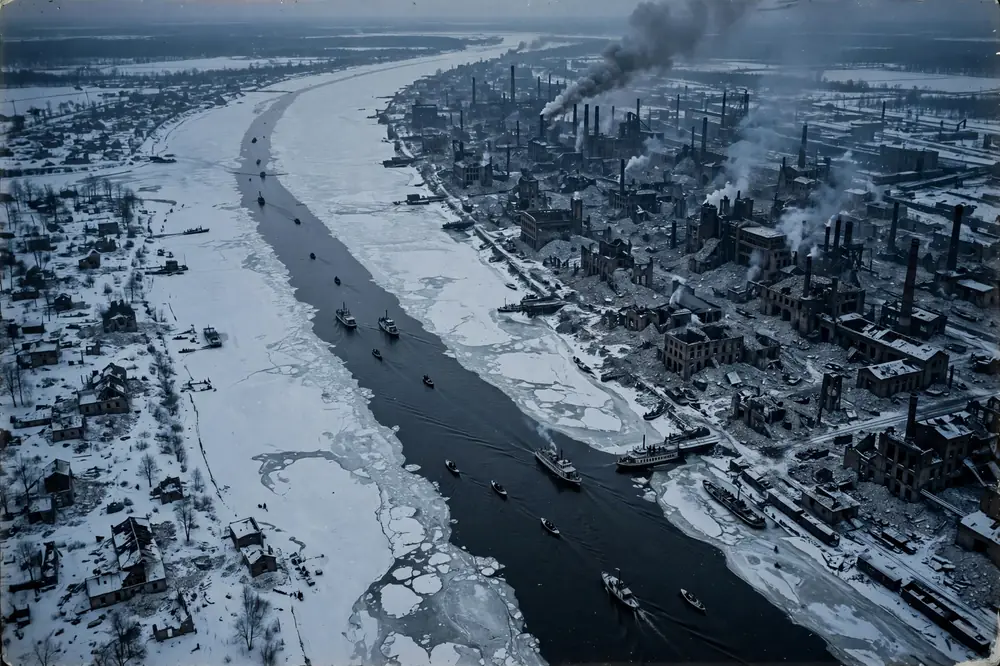
The Soviet side, however, had two advantages that grew with time. The first was the Volga itself. The river, hundreds of metres wide at Stalingrad, could not be crossed by the Germans, and Soviet reinforcements, ammunition and food crossed it at night in small boats and ferries, under German artillery fire and air attack, to feed men into the city.
The second was the Soviet Union’s capacity to raise new armies. While the 62nd Army fought inside the city, the Stavka quietly assembled fresh forces — the Southwestern Front, the Don Front and the Stalingrad Front — for the counter-offensive.
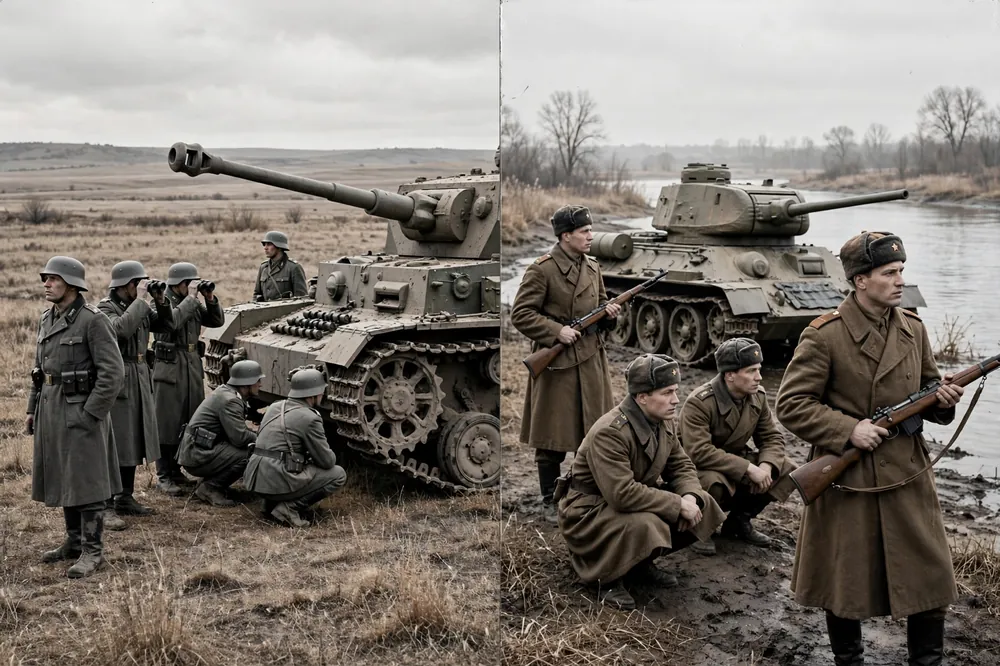
By the time Operation Uranus began on 19 November, the Soviets could field more than 1.1 million men, some 13,500 guns and mortars, about 900 tanks and more than 1,100 aircraft in the Stalingrad sector, against an Axis force of roughly 600,000 to 1,000,000 men (the figures vary by source, because they depend on whether allied armies and rear-area troops are counted), with about 640 tanks and some 730 aircraft, of which only about 400 were operational.
| Axis | Soviet Union | |
|---|---|---|
| Overall command | Army Group B (Gen. Maximilian von Weichs); later Army Group Don (Field Marshal Erich von Manstein) | Stavka; Generals Georgy Zhukov and Aleksandr Vasilevsky (coordination) |
| Main field armies | 6th Army (Gen. Friedrich Paulus); 4th Panzer Army (Gen. Hermann Hoth); Romanian 3rd and 4th Armies; Italian 8th Army; Hungarian 2nd Army | Stalingrad Front (Gen. Andrey Yeryomenko): 62nd Army (Lt. Gen. Vasily Chuikov), 64th Army; Don Front (Gen. Konstantin Rokossovsky); Southwestern Front (Gen. Nikolai Vatutin) |
| Men, start of offensive | About 270,000 | About 187,000 |
| Men, at Soviet counter-offensive | About 600,000–1,000,000 (sources vary) | About 1,100,000–1,140,000 |
| Tanks | About 500 at the start; about 640 at the counter-offensive | About 400 at the start; about 900 at the counter-offensive |
| Artillery | About 3,000 guns at the start | About 2,200 guns at the start; about 13,500 guns and mortars at the counter-offensive |
| Aircraft | About 600 at the start; about 1,600 by mid-September (Luftflotte 4) | About 300 at the start; about 1,100 at the counter-offensive |
| Key weakness | Flanks held by poorly equipped Romanian, Italian and Hungarian armies | |
| Key strength | Superior air power and an experienced 6th Army in the summer of 1942 |
The Battle of Stalingrad
The fighting that became the Battle of Stalingrad began on 17 July 1942, the date most historians use for the start of the battle, when the 6th Army met Soviet forces in the great bend of the Don River, west of the city. For five weeks the Germans fought their way eastward across the steppe.
Soviet resistance stiffened as the Germans approached the Don, but on 23 August the 6th Army reached the Volga north of Stalingrad at Rynok, cutting the city off from the north, while the 4th Panzer Army closed in from the south-west.
On the same day, the Luftwaffe launched a massive bombing raid on the city: hundreds of bombers dropped incendiary and high-explosive bombs, and the wooden buildings of the city centre burned. Estimates of civilian deaths in that first week of bombing range from about 25,000 to 40,000 — the figure is disputed, and the total number of civilians killed in the whole battle is not known with any precision.
The bombing destroyed much of the city centre and created a landscape of rubble that favoured the defender: German tanks could not move through the ruined streets, and collapsed buildings served as defensive positions.
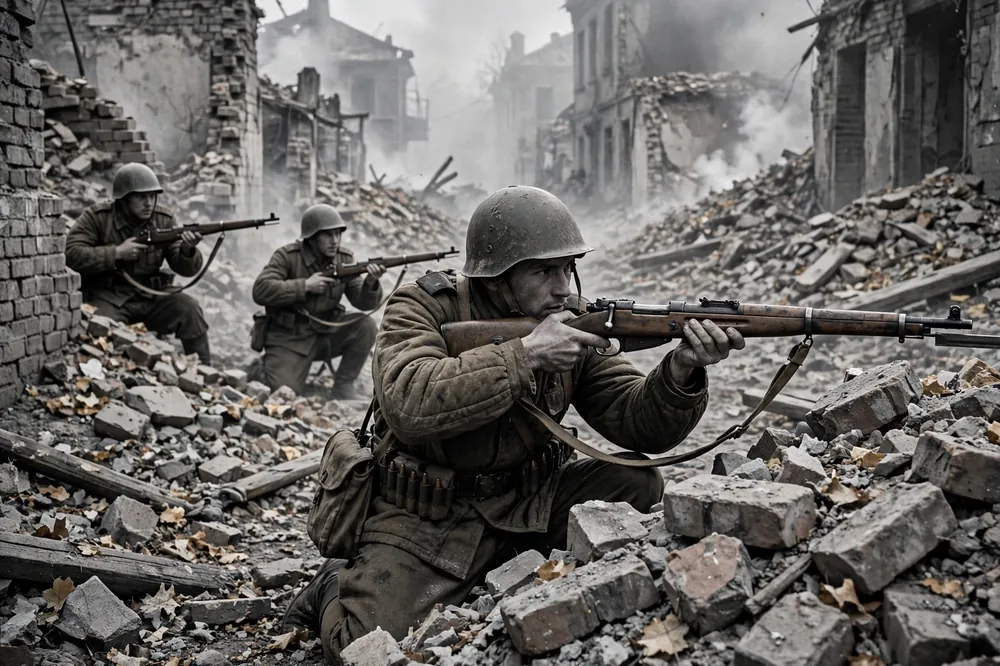
In mid-September 1942, Lieutenant General Vasily Chuikov took command of the Soviet 62nd Army, the force holding the city itself, with orders to defend Stalingrad at all costs. By then the 62nd Army had been reduced to roughly 20,000 men, about 90 tanks and 700 mortars, holding a strip of ruined city along the west bank of the Volga, in places only a few hundred metres deep.
Chuikov’s headquarters was dug in near the river, within range of German guns. His tactics were shaped by the situation: he ordered his men to stay as close to the Germans as possible — “hugging” the enemy — so that German artillery and aircraft could not fire without hitting their own troops.
Fighting was at point-blank range, room by room and floor by floor, in what German soldiers called the Rattenkrieg, the “war of the rats”.
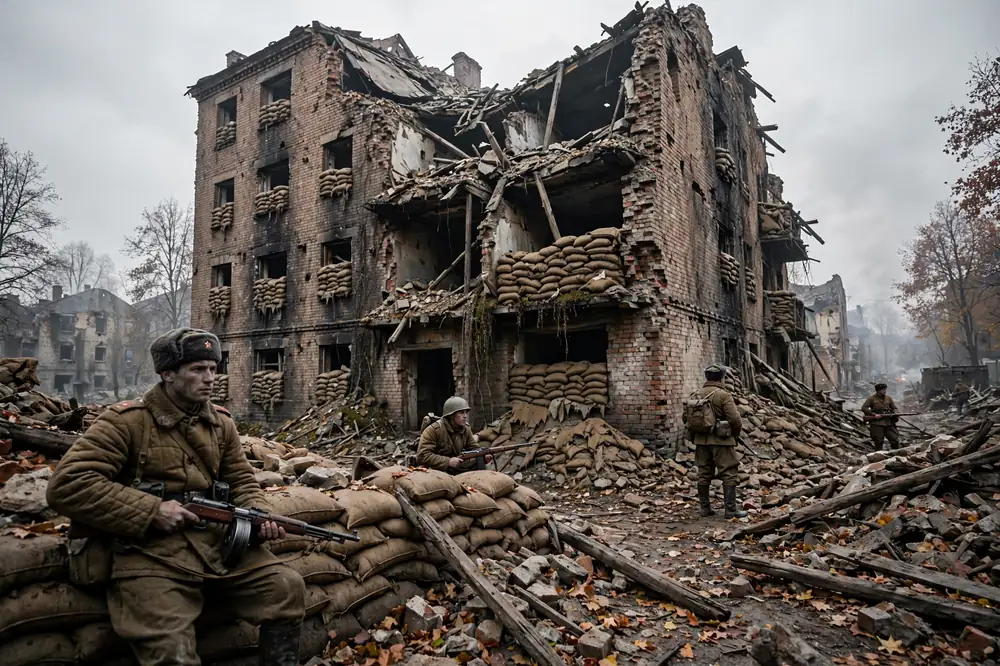
The German assault on the city began in earnest on 13–14 September. On 13 September, the 13th Guards Rifle Division under Major General Alexander Rodimtsev crossed the Volga under fire and counter-attacked at Mamayev Kurgan — Height 102.0, the hill that dominated the city — and at the central railway station, losing about a third of its strength in the first day of fighting.
Mamayev Kurgan changed hands repeatedly through the autumn; German troops are said to have stormed it many times a day, and the hill became one of the best-known features of the battle. At the same time, fighting raged at the grain elevator in the south of the city, where about fifty Soviet defenders, cut off from resupply, held out for days against repeated assaults, and at the central station, which changed hands more than a dozen times in a few days, according to Soviet accounts.
In the north of the city, the Germans attacked the great factories — the Dzerzhinsky Tractor Factory, the Barrikady (Barricades) gun factory and the Red October steelworks — where workers fought alongside soldiers among the machinery, and where the front line sometimes ran through the factory halls themselves.
One building became widely known as a symbol of the defence: Pavlov’s House, a four-storey apartment block on the edge of a square in the city centre. In late September, a platoon under Sergeant Yakov Pavlov seized the ruined building and held it for weeks against repeated German attacks, with reinforcements bringing the garrison to about two dozen men. The Germans marked the building as a fortress on their maps.
Soviet snipers were also widely reported during the battle, above all Vasily Zaitsev, who is credited with 225 confirmed kills during the battle and who trained dozens of other snipers. The duel between Zaitsev and a German sniper, dramatised in later films, is not reliably documented and should be treated as legend rather than established fact; what is documented is that Soviet snipers operated effectively in the ruins.
By mid-November, the Germans held about 90 per cent of the city — but the remaining strip along the Volga, a few hundred metres wide in places, held. The 62nd Army was still being supplied across the river at night, and it was still fighting. The 6th Army, meanwhile, was exhausted.
It had lost tens of thousands of men in the city fighting — German losses from August to November are estimated at about 60,000 killed alone, with many more wounded — and its divisions were worn down to a fraction of their strength. Its flanks, held by the Romanian armies, were thin and poorly equipped.
And unbeknown to Paulus, the Soviets had spent the autumn building up the forces for a counter-stroke that would change the war.
Operation Uranus, planned by Generals Zhukov, Vasilevsky and Voronov and approved by Stalin, was a classic double envelopment. On the morning of 19 November 1942, after a massive artillery bombardment, the Southwestern Front under General Nikolai Vatutin and the Don Front attacked the Romanian 3rd Army north-west of Stalingrad. The next day, 20 November, the Stalingrad Front under General Yeryomenko attacked the Romanian 4th Army to the south.
The Romanian lines, thinly held and short of anti-tank guns, broke quickly. Soviet tank and mechanised corps drove deep into the Axis rear, and on 22–23 November the two pincers met at Kalach-on-the-Don, about 60 kilometres west of Stalingrad, closing the ring.
Some 290,000 Axis soldiers were encircled, according to Soviet figures of the time — a figure that includes the 6th Army, elements of the 4th Panzer Army, and Romanian and other allied troops caught in the pocket. Other estimates put the encircled force at roughly 250,000–300,000 men. The exact number is disputed; what is not disputed is that an entire German field army was now trapped.
Hitler forbade any breakout. Instead, he ordered the 6th Army to hold its positions and promised that it would be supplied by air and relieved by a new force, Army Group Don, under Field Marshal Erich von Manstein. Neither promise could be kept. The Luftwaffe airlift, under Hermann Göring’s assurance that it could deliver 500 tons a day, in practice delivered far less — on many days under 100 tons, against a daily requirement of roughly 700 tons for the encircled army. Men and horses starved; the cold, which fell to −30 °C, killed the wounded and froze engines and weapons.
Life inside the pocket grew steadily worse through December and January. Rations were cut again and again, until soldiers were living on a few ounces of bread a day and horse meat from the army’s dying transport animals. Fuel ran so low that tanks could not move and wounded men could not be evacuated; the airfields inside the pocket, Pitomnik and later Gumrak, were fought over and eventually lost, and the last transport aircraft flew out with wounded men crammed aboard.
Frostbite and typhus spread through the freezing dugouts. By January, German divisions that had numbered 10,000 men in November were down to a few hundred, and whole regiments existed only on paper. The Soviet artillery bombardment never stopped, and the final offensive found an army that was already dying where it stood.
Manstein’s relief operation, Operation Winter Storm (Wintergewitter), launched on 12 December with the 4th Panzer Army, fought to within about 48 kilometres of the pocket by 19–23 December, but it was stopped — in part because Paulus, obeying Hitler’s order, refused to break out toward it, and in part because the Soviets launched Operation Little Saturn on 16 December, defeating the Italian 8th Army on the Don and threatening Manstein’s own flank. Winter Storm was called off on 23 December, and the 6th Army was left to its fate.
On 10 January 1943, the Don Front under General Konstantin Rokossovsky launched Operation Ring (Koltso), the final Soviet offensive to destroy the pocket. The encircled army, starving, freezing and short of ammunition, was split in two. Soviet surrender terms offered on 8 January had been rejected. By the end of January, German resistance was collapsing.
On 30 January, the tenth anniversary of Hitler’s rise to power, Hitler promoted Paulus to field marshal — a promotion widely understood as an invitation to suicide, since no German field marshal had ever been taken prisoner. Paulus did not take his own life. On 31 January 1943, he surrendered the southern pocket from his headquarters in the ruined Univermag department store in central Stalingrad, along with 22 generals.
The northern pocket, under General Karl Strecker, held out for two more days and surrendered on 2 February 1943. The battle was over. Some 91,000 German and allied soldiers were taken prisoner — the survivors of an army that had numbered some 250,000–300,000 men in the pocket.
Of those prisoners, only about 6,000 ever returned to Germany; most died in Soviet captivity in the years that followed, from disease, malnutrition and exhaustion.
Turning Point
The turning point of the Battle of Stalingrad was Operation Uranus, the Soviet counter-offensive of 19–23 November 1942. Before Uranus, the battle was a grinding German offensive: the 6th Army was winning ground, street by street, and it seemed only a matter of time before the last Soviet strip along the Volga was cleared.
After Uranus, the battle was a Soviet siege: the 6th Army, which had been attacking, was now itself besieged, and its fate depended on an airlift that could not feed it and a relief force that could not reach it.
Historians debate whether Stalingrad was the turning point of the whole war — some argue that Germany’s defeat was already assured by its failure before Moscow in 1941, or that the decisive blow came later at Kursk — but historians generally agree that Stalingrad was the moment Germany lost the strategic initiative on the Eastern Front and never regained it. The psychological effect was as important as the military one.
For the first time, an entire German field army had been destroyed, and a German field marshal had surrendered. In Germany, the news was announced after three days of national mourning; in the Soviet Union, it was reported as evidence that the German army could be defeated. The Battle of Midway had played a similar role in the Pacific five months earlier; Stalingrad played it in Europe.
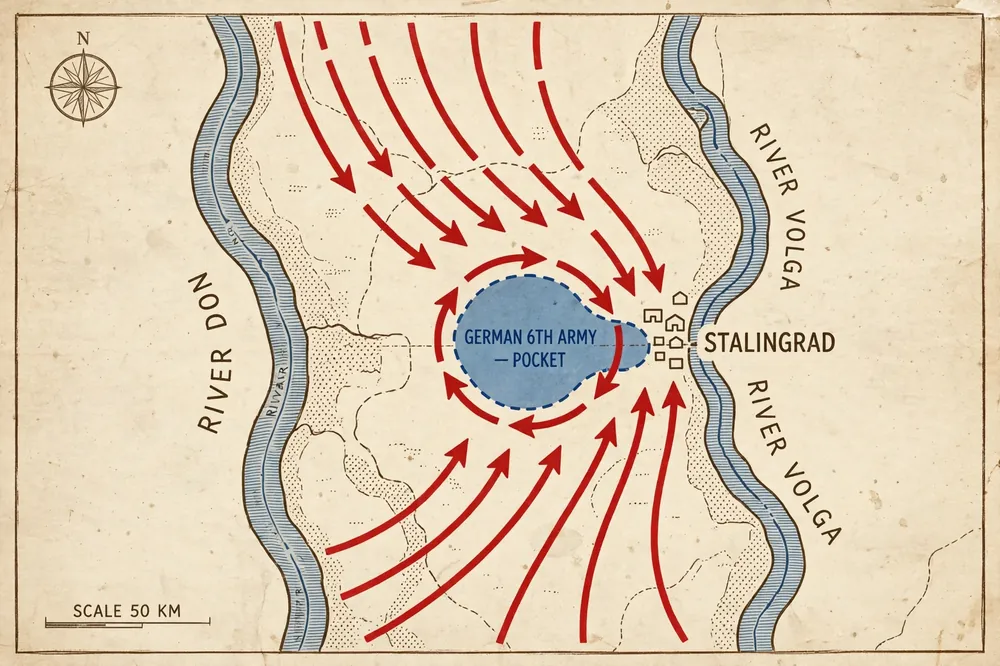
Within the battle itself there was a second, quieter turning point: the failure of the 6th Army to finish the job in September and October. Every week that Chuikov’s 62nd Army held its strip of the Volga was a week the Stavka used to build the forces for Uranus, and every German division consumed in the ruins was a division that could not guard the flanks. The German high command knew the flanks were weak — intelligence reports warned of Soviet build-ups — but Hitler and his generals believed the Red Army had no reserves left. They were wrong. The reserves were there, hidden behind the Volga and the Don, and on 19 November they struck.
Casualties and Losses in the Battle of Stalingrad
No battle of the Second World War has more disputed casualty figures than Stalingrad, and the honest answer is that the true total will never be known exactly. The figures depend on where the battle is taken to begin and end — the fighting in the city alone, or the whole campaign from the Don to the Volga between July 1942 and February 1943 — on which armies are counted, and on whose records are trusted. Soviet and German records disagree, and many records were destroyed. What follows is therefore a range, with the source of each figure stated, not a single settled number.
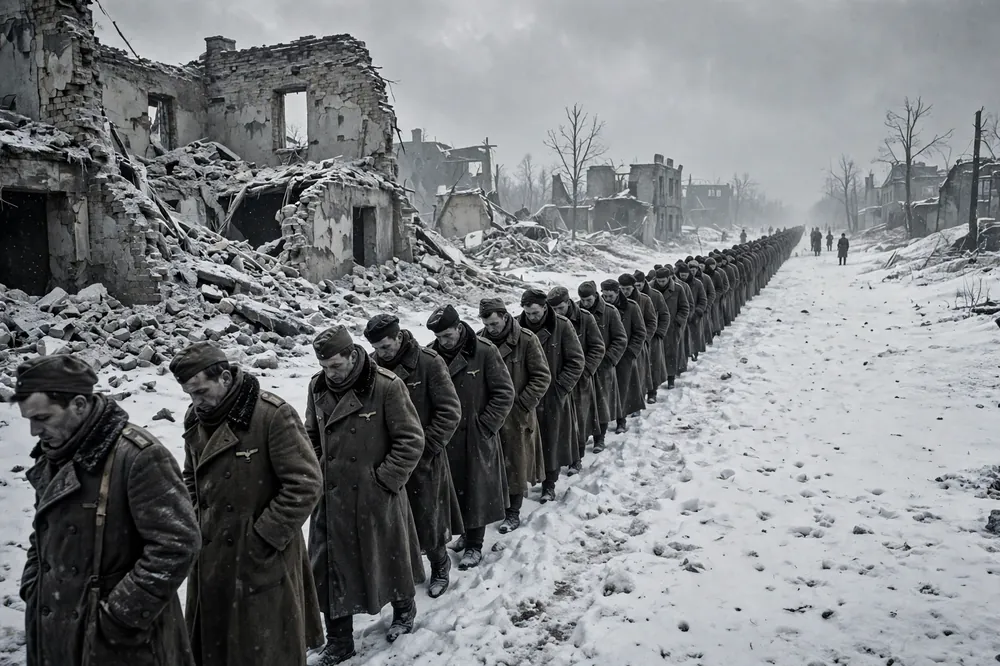
For the Soviet side, the most widely cited figure comes from the Russian historian Grigori Krivosheev, working from Soviet archival records: 1,129,619 total Soviet casualties for the Stalingrad strategic operation, of which 478,741 were killed or missing and 650,878 were wounded or sick.
A later reassessment by other Russian historians, cited on Wikipedia, puts the Soviet total higher, at about 1,347,214, with some 674,990 killed, missing or captured and 672,224 wounded or sick. Soviet material losses in the same operation were heavy: 4,341 tanks, 15,728 guns and 2,769 combat aircraft, according to Krivosheev’s figures. Civilian deaths are even less certain.
Between 25,000 and 40,000 Soviet civilians are estimated to have died in the first week of German bombing alone, and the total civilian death toll for the battle is commonly described as tens of thousands, with some estimates higher — but no reliable total exists, and this article does not state one as fact.
For the Axis side, the range is wider still. Wikipedia’s survey of the sources gives 800,000 to 1,500,000 Axis casualties (killed, wounded or captured) for the whole battle, including German, Romanian, Italian, Hungarian and auxiliary troops. Within that range, individual estimates differ sharply: the German 6th Army and 4th Panzer Army alone are estimated to have suffered over 300,000 casualties; other historians put total German casualties at about 400,000; and the multi-volume Soviet official history The Great Patriotic War 1941–1945 puts total Axis casualties as high as 1.5 million — a figure other historians regard as an overestimate.
Encyclopaedia Britannica gives a more conservative summary: about 800,000 Axis casualties and about 1,100,000 Soviet casualties. The figures most firmly established concern the surrender: about 91,000 Axis soldiers taken prisoner at the surrender, including 22 generals, and only about 6,000 of them ever returning home.
Axis material losses included about 900 aircraft destroyed, about 1,500 tanks destroyed and about 6,000 guns destroyed, with a further 744 aircraft, 1,666 tanks and 5,762 guns captured, according to the figures compiled on Wikipedia.
Adding the two sides together, the commonly cited total for the battle is roughly 1.7 to 2 million casualties, killed, wounded or captured — the figure given by several modern summaries. Some sources give a wider range, up to 3 million dead alone, but that upper figure is not supported by the archival-based estimates and is treated here as disputed. The responsible way to state it is this: Stalingrad cost both sides together on the order of two million casualties, with the Soviet Union bearing the larger share, and the precise total is disputed and probably unknowable.
| Axis | Soviet Union | |
|---|---|---|
| Total casualties (killed, wounded, captured/missing) | 800,000–1,500,000 (disputed range; Britannica: about 800,000) | 1,129,619 (Krivosheev, archival) to about 1,347,214 (later reassessment); Britannica: about 1,100,000 |
| Killed or missing | German 6th Army and 4th Panzer Army: over 300,000 casualties in total; total Axis dead estimated at about 500,000 (disputed) | 478,741 killed or missing (Krivosheev); up to about 674,990 killed, missing or captured (later reassessment) |
| Prisoners taken | About 91,000 at the surrender (including 22 generals); only about 6,000 ever returned to Germany | — |
| Civilian deaths | — | 25,000–40,000 in the first week of bombing alone (disputed); total for the battle unknown, described as tens of thousands |
| Tanks lost | About 1,500 destroyed; 1,666 captured | 4,341 destroyed or damaged |
| Aircraft lost | About 900 destroyed (including 274 transport aircraft); 744 captured | 2,769 combat aircraft |
| Guns lost | About 6,000 destroyed; 5,762 captured | 15,728 |
Map and Geography
Stalingrad stood on the west bank of the River Volga, in the steppe of southern Russia, at about 48°42′ N, 44°31′ E. The city stretched for some 30 kilometres along the river, but in most places it was only a few kilometres wide — a long, narrow ribbon of factories, apartment blocks, railway yards and workers’ settlements squeezed between the Volga on the east and the open steppe on the west.
That shape dictated the battle. The Germans attacked from the west, across the steppe, and drove the defenders back toward the river; the Soviets held a shrinking strip of riverbank, and every reinforcement, every crate of ammunition and every loaf of bread had to cross the Volga by boat, under fire, at night.
The river that made Stalingrad valuable — as a transport artery for Caucasus oil — also made it defensible: no German army could cross it in force, and the Soviet east bank, with its artillery, was never threatened.
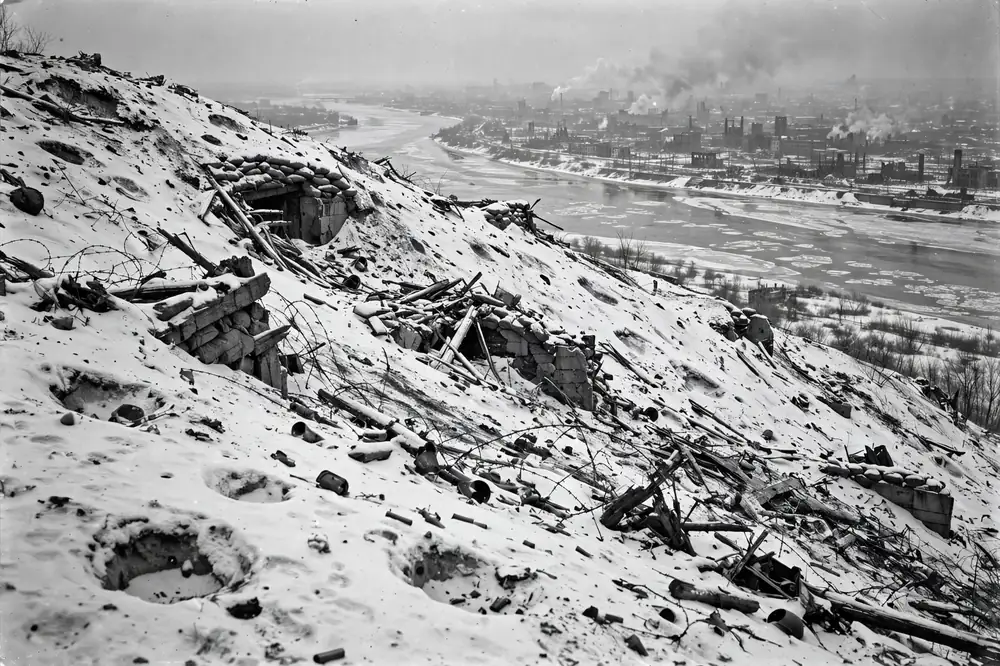
The terrain around the city mattered as much as the city itself. To the west lay the great bend of the Don River, the line the 6th Army fought across in July and August 1942, and the open steppe — flat, treeless country, ideal for tanks in summer and a frozen wasteland in winter.
To the north-west and south, the Don and the Kalmyk steppe formed the flanks where the Romanian armies stood, and where the Soviet pincers of Operation Uranus struck. The key ground inside the city was high ground: Mamayev Kurgan, Height 102.0, a burial mound rising above the city centre, from which observers could see the whole city and the Volga crossings.
Whoever held the Kurgan could direct artillery fire onto the river and the ferries; that is why it changed hands so often, and why it was fought over for months at heavy cost to both sides. Other key points were the central railway station, the grain elevator in the south, and the three great factories in the north — the Tractor Factory, Barrikady and Red October — whose massive concrete and steel buildings survived the bombing and became fortresses in their own right.
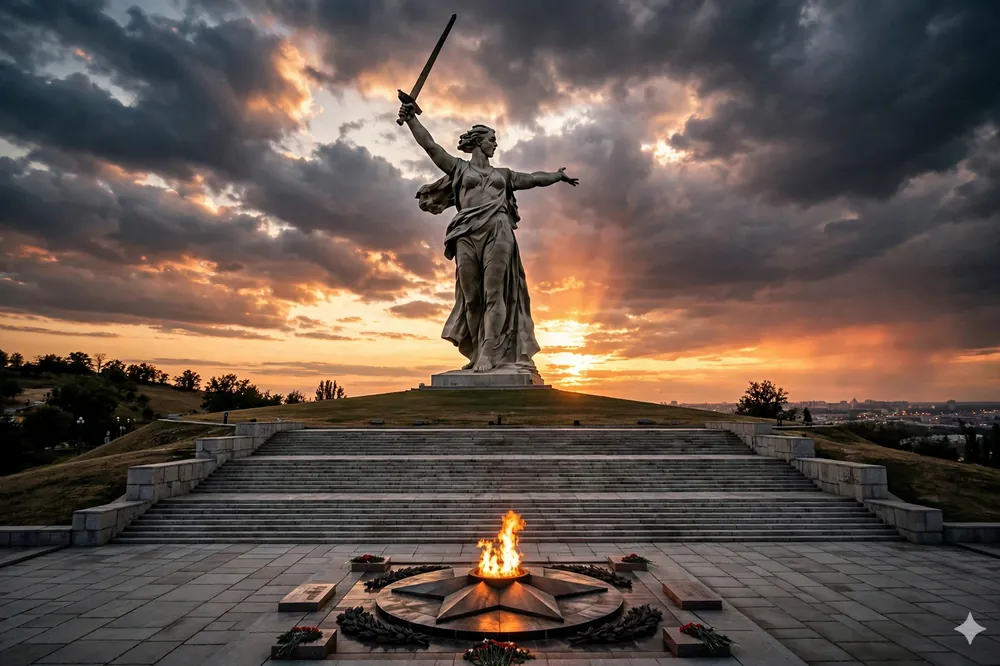
Today the battlefield is marked by the Mamayev Kurgan memorial complex, dominated by the 85-metre statue The Motherland Calls, and by the ruins of the Grudinin Mill, preserved as a memorial beside the Volga.
Outcome and Legacy
The Battle of Stalingrad ended with the destruction of the German 6th Army and the surrender of some 91,000 men, and with the Axis driven back from the Volga and the Caucasus. In the months that followed, the Red Army pressed westward, retaking Kursk, Kharkov and Rostov, and Germany, for the first time in the war, was forced onto the strategic defensive in the east.
The battle also showed that a German field army could be encircled and destroyed: the 6th Army — the army that had entered Paris in 1940 — had been surrounded, and a German field marshal had surrendered. In Germany, the regime declared three days of national mourning, and German planning after Stalingrad assumed a longer war and a Red Army capable of large-scale offensive operations.
For the Soviet Union, the victory came at a high cost — more than a million casualties, a city reduced to rubble, and heavy losses among its soldiers — but it demonstrated that the Red Army could encircle and destroy a German field army, as it did again in later operations, including at Kursk, in Belorussia and on the road to Berlin.
The defeat also weakened Germany’s alliance system in the east. Romania, Italy and Hungary lost whole armies on the Don and around Stalingrad — the Romanian 3rd Army was effectively destroyed in the Uranus offensive, the Italian 8th Army was defeated in Operation Little Saturn, and the Hungarian 2nd Army was heavily defeated in the Soviet offensive of January 1943. These were losses their smaller economies and populations could not replace, and all three allies began, in their own ways, to look for a way out of the war. Germany would fight on for more than two years, but it would do so increasingly alone, and increasingly on the defensive.
Stalingrad’s legacy extends far beyond the battlefield. In military history, it is studied as the classic example of a double envelopment — Operation Uranus — and of urban warfare, where a defender with inferior firepower can hold a ruined city by fighting at close quarters and denying the attacker the use of his tanks and aircraft. The battle also changed the politics of the war.
It encouraged the Western Allies, who were fighting in North Africa at the same time, and it stiffened Soviet determination to demand nothing less than unconditional surrender. In Russia, Stalingrad — renamed Volgograd in 1961, as part of the de-Stalinisation campaign — remains the central symbol of the Great Patriotic War: the city was awarded the title Hero City, and the Mamayev Kurgan memorial, with The Motherland Calls statue, is one of the most visited war memorials in the world.
The name “Stalingrad” itself has entered common usage as a term for a prolonged, costly battle of attrition, used far beyond military history. The casualty figures — disputed as they are — remain central to how the battle is remembered: estimates of about two million casualties on both sides make it one of the deadliest battles in recorded history.
Commanders
Friedrich Paulus (1890–1957). The commander of the German 6th Army, Paulus was an experienced staff officer — he had helped plan Operation Barbarossa — but he had never commanded an army in the field before Stalingrad. Historians describe him as a cautious and methodical commander, and assessments of his decisions at Stalingrad differ.
He obeyed Hitler’s order not to break out of the encirclement, even when a breakout in late November might have saved part of his army. Promoted to field marshal on 30 January 1943, he surrendered the next day, the first German field marshal ever taken prisoner. He spent ten years in Soviet captivity, was released in 1953, and died in Dresden in 1957.
Historians remain divided over him: some see a competent soldier trapped by Hitler’s orders, others a commander who lacked the independence to disobey them.
Vasily Chuikov (1900–1982). The commander of the Soviet 62nd Army, Chuikov was a general who had fought in the Russian Civil War and served as a military adviser in China. He took command of the 62nd Army in mid-September 1942 and held his headquarters a few hundred metres from the front line, under German fire, for the whole battle.
His tactics — close-quarters fighting, small assault groups, and the use of the ruins themselves as fortifications — kept the Germans from taking the last strip of the city. He was twice awarded the title Hero of the Soviet Union, and after the war he became a Marshal of the Soviet Union. He is buried on Mamayev Kurgan, the hill he fought to hold.
Georgy Zhukov (1896–1974) and Aleksandr Vasilevsky (1895–1977). Zhukov, the Deputy Supreme Commander, and Vasilevsky, the Chief of the General Staff, planned Operation Uranus together and coordinated the three fronts that carried it out. Zhukov was the Soviet Union’s best-known general, who commanded in the battles of Moscow, Stalingrad, Kursk and Berlin. Historians differ in their assessments of his methods, including his acceptance of high casualties. Vasilevsky was the architect of the Uranus plan and the coordinator of the fronts. Both men were later Marshals of the Soviet Union, and both are central figures in any history of the Eastern Front.
Erich von Manstein (1887–1973). Manstein, regarded by many historians as one of Germany’s most capable operational commanders, was given command of Army Group Don in November 1942 and ordered to relieve the 6th Army. His Operation Winter Storm came within about 48 kilometres of the pocket before it was stopped, and he later argued that Paulus should have broken out toward him. After Stalingrad he continued to command in the east, winning the Third Battle of Kharkov in 1943, before Hitler dismissed him in March 1944. After the war he was convicted of war crimes by a British military court and served four years in prison.
Konstantin Rokossovsky (1896–1968). The commander of the Don Front, Rokossovsky directed Operation Ring, the final destruction of the encircled 6th Army, in January 1943. A cavalryman of Polish origin who had survived Stalin’s purges and imprisonment in the 1930s, he went on to command at Kursk and in the Belorussian offensive of 1944, Operation Bagration, and ended the war as a Marshal of the Soviet Union and, later, Marshal of Poland.
Frequently Asked Questions
When was the Battle of Stalingrad? The battle is generally dated from 17 July 1942, when the German 6th Army first met Soviet forces in the Don bend, to 2 February 1943, when the last German pocket in the city surrendered. Some sources date it from 23 August 1942, when German troops reached Stalingrad itself.
Who won the Battle of Stalingrad? The Soviet Union won a decisive victory. The German 6th Army was encircled and destroyed, some 91,000 men were taken prisoner, and Germany lost the strategic initiative on the Eastern Front for the rest of the war.
How many people died at Stalingrad? The total is disputed. Commonly cited estimates put total casualties on both sides at roughly 1.7 to 2 million killed, wounded or captured. Soviet archival-based figures give about 1.13 million Soviet casualties; Axis casualties are estimated at 800,000 to 1.5 million. Civilian deaths are not known precisely but numbered in the tens of thousands at least.
What was Operation Uranus? Operation Uranus was the Soviet counter-offensive of 19–23 November 1942. Soviet forces attacked the weakly held Romanian flanks north and south of Stalingrad and met at Kalach-on-the-Don, encircling the German 6th Army and parts of the 4th Panzer Army — about 290,000 Axis soldiers, according to Soviet figures of the time.
Why was Stalingrad a turning point? Stalingrad was the first time an entire German field army was destroyed, and it ended Germany’s ability to mount strategic offensives in the east. After Stalingrad, the Red Army held the initiative, and Germany fought on the defensive until the end of the war.
What happened to Friedrich Paulus? Paulus, commander of the 6th Army, was promoted to field marshal on 30 January 1943 and surrendered the next day, disobeying Hitler’s order to fight to the death. He spent ten years in Soviet captivity and was released in 1953.
Related articles
Sources
- Wikipedia, “Battle of Stalingrad” — dates, strength, casualty ranges and per-army loss figures (Krivosheev’s Soviet archival totals; Axis range 800,000–1,500,000), cross-checked against Britannica.
- Encyclopaedia Britannica, “Battle of Stalingrad” (britannica.com) — battle summary, Operation Uranus as the turning point, 91,000 prisoners, about 800,000 Axis and about 1,100,000 Soviet casualties.
- Encyclopaedia Britannica, “Friedrich Paulus” (britannica.com) — Paulus’s promotion to field marshal on 30 January 1943, surrender on 31 January, and the fate of the prisoners (fewer than 6,000 returned).
- Wikipedia, “Operation Uranus” — dates 19–23 November 1942, the link-up at Kalach, and the encirclement of about 290,000 Axis personnel.
- U.S. Army Center of Military History / War Department historical studies and the Naval History and Heritage Command tradition of official campaign histories — background on Case Blue and the 1942 summer offensive (consulted for the operational context).
- Vasily Chuikov, The Battle for Stalingrad (Holt, Rinehart and Winston, 1964) — memoirs of the commander of the Soviet 62nd Army.
- Antony Beevor, Stalingrad (Viking, 1998) — the standard modern narrative history of the battle in English, used for the structure of the city fighting and the encirclement.
- William Craig, Enemy at the Gates: The Battle for Stalingrad (E. P. Dutton, 1973) — classic narrative history, including the defence of Pavlov’s House and the sniper war.
Further reading
- David M. Glantz and Jonathan M. House, Stalingrad (University Press of Kansas, 2009–2017, three volumes) — the most detailed operational history, based on Soviet and German archives.
- Geoffrey Jukes, Stalingrad: The Turning Point (Ballantine, 1968).