 WAR ATLAS MILITARY HISTORY MAGAZINE · WWI — WWII
Alan Turing
1. Lead
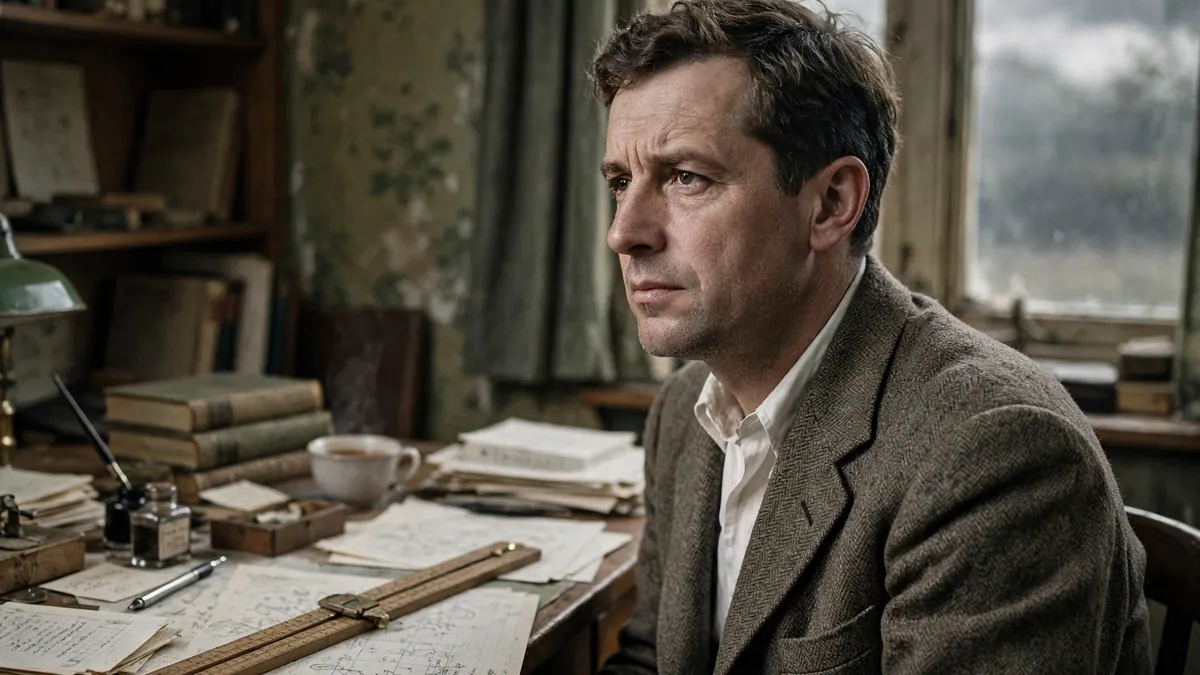
Alan Turing (23 June 1912 – 7 June 1954) was an English mathematician and logician whose work connects two fields that are usually treated separately: the theory of computing and the codebreaking of the Second World War. In 1936, before any electronic computer existed, he published “On Computable Numbers, with an Application to the Entscheidungsproblem”, in which he described an abstract device — now called the Turing machine — that formalised what it means for a machine to compute, and showed that there are mathematical problems no machine can solve.
During the Second World War he worked at Bletchley Park, Britain’s codebreaking centre, where he led Hut 8, the section responsible for German naval Enigma, and designed the Bombe, an electromechanical machine that searched for the daily settings of the Enigma cipher machine. His work contributed to the Allied reading of German naval signals in the Battle of the Atlantic.
After the war he worked on the design of early stored-program computers and, in 1950, published “Computing Machinery and Intelligence”, which proposed what is now called the Turing test. In 1952 he was convicted of “gross indecency” under the law then in force in Britain, which criminalised sexual acts between men, and was subjected to hormone treatment as an alternative to imprisonment.
He died in 1954, aged 41, of cyanide poisoning; the inquest returned a verdict of suicide, although the evidence has also been described as consistent with accidental poisoning. In 2009 the British government issued a formal apology for his treatment, in 2013 he received a posthumous royal pardon, and in 2017 legislation known as the “Alan Turing law” extended pardons to other men convicted under the same repealed offences.
2. Key Facts
| Born | 23 June 1912, Maida Vale, London, England |
| Died | 7 June 1954, Wilmslow, Cheshire, England (aged 41, cyanide poisoning; inquest verdict: suicide) |
| Nationality | British (English) |
| Role / Office | Mathematician, logician and cryptanalyst; head of Hut 8, Government Code and Cypher School, Bletchley Park (1939–1945); designer of the Bombe; reader in mathematics, University of Manchester (1948–1954) |
| Known for | The Turing machine and the 1936 paper “On Computable Numbers”; cryptanalysis of the Enigma; the Bombe; the Turing test (1950); morphogenesis |
| Spouse / Family | Never married. Son of Julius Mathison Turing, a civil servant in the Indian Civil Service, and Ethel Sara Turing. Engaged briefly to Joan Clarke, a fellow codebreaker, in 1941; the engagement was broken off by Turing |
3. Early Life
Alan Mathison Turing was born in Maida Vale, London, on 23 June 1912, the second son of Julius Mathison Turing and Ethel Sara Turing. His father worked for the Indian Civil Service, and Alan spent much of his childhood in southern England, living with foster families and attending boarding school while his parents were in India.
He was educated at Sherborne School in Dorset, where his abilities in mathematics and science were recognised, although his handwriting and his performance in other subjects were criticised by his teachers. A formative event of his school years was the death in 1930 of his close friend Christopher Morcom, from tuberculosis, which affected Turing deeply and, according to his biographer Andrew Hodges, shaped his later thinking about mind and machine.
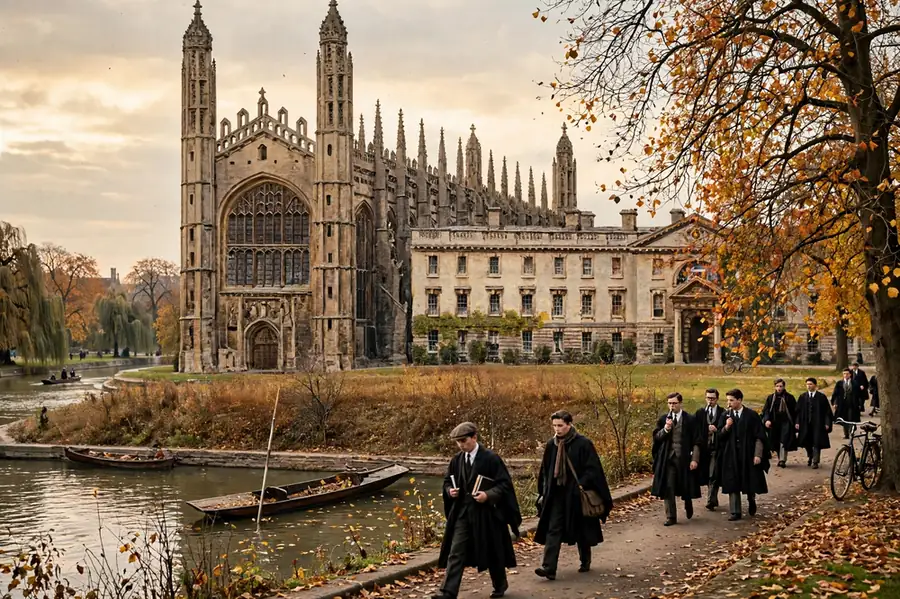
In 1931 Turing entered King’s College, Cambridge, to read mathematics. He graduated with first-class honours in 1934 and was elected a fellow of King’s College in 1935, at the age of 22. In 1936 he published the paper that made his reputation, and in the same year he went to Princeton University in the United States to study under the logician Alonzo Church, earning his doctorate in 1938.
His doctoral work concerned systems of logic based on ordinals. During his time at Cambridge he had also begun part-time work for the Government Code and Cypher School, the British codebreaking organisation, attending a training course in 1938 — a connection that would determine where he spent the war.
His fellowship dissertation, on which he was elected a fellow of King’s College in 1935, proved the central limit theorem — the result that the sum of a large number of independent random variables tends toward a normal distribution. Unknown to Turing and to his examiners, the theorem had already been proved in 1922 by the Finnish mathematician Jarl Waldemar Lindeberg. The examiners accepted Turing’s independent derivation as fellowship-worthy work, and the episode is recorded as an illustration of how much of the mathematical literature of the period was still difficult to survey. It was the last substantial piece of pure mathematics Turing completed before the 1936 paper that made his reputation.
4. Rise to Prominence
Turing’s reputation was established before the war, by a single paper. “On Computable Numbers, with an Application to the Entscheidungsproblem”, published in 1936 in the Proceedings of the London Mathematical Society, addressed a question posed by the German mathematician David Hilbert: whether there is a mechanical procedure that can decide the truth of any mathematical statement.
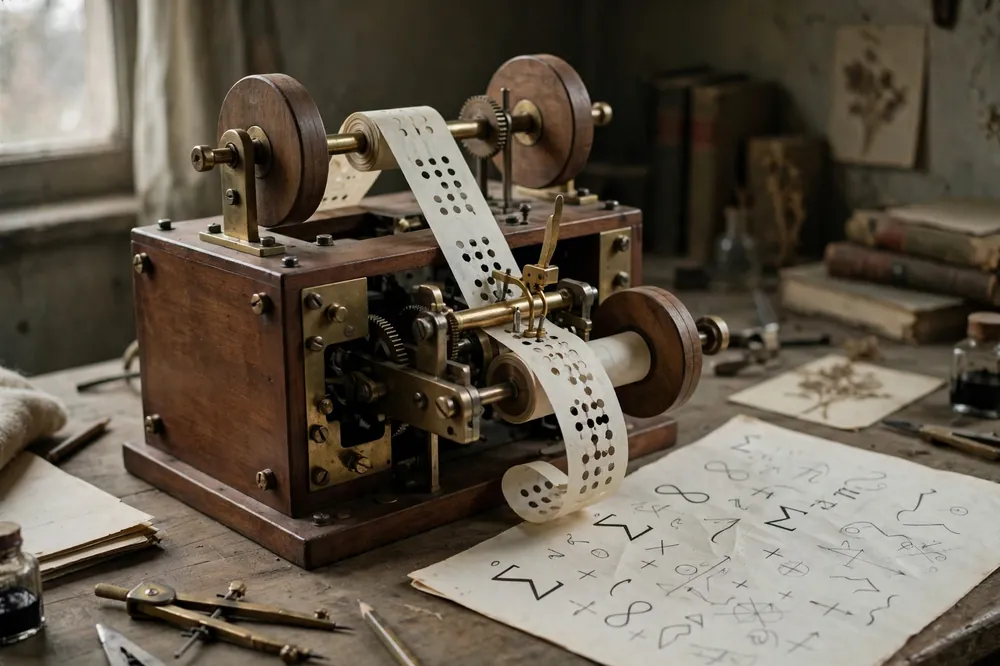
Turing answered it by describing an imaginary device — a machine that reads and writes symbols on an endless strip of tape according to a table of rules — and showing that such a machine could in principle carry out any computation that can be described as an algorithm, and also that some problems, including the question Hilbert had posed, cannot be solved by any such machine.
The device became known as the Turing machine, and the paper is now regarded as a founding document of theoretical computer science. Turing was 24 when it was published. He had submitted the paper on 28 May 1936, and it appeared in the Proceedings of the London Mathematical Society in the volume for 1936–37.
The paper was written in response to Hilbert’s Entscheidungsproblem, the decision problem, which asked whether a mechanical procedure could decide the truth of any mathematical statement; Turing’s answer — that no such procedure exists — was reached independently of the American logician Alonzo Church, who published a proof of the same result in the same year by a different method.
The paper also introduced the idea of a “universal machine”, a single machine that could simulate any other machine by reading its description — the theoretical basis for the stored-program computer. His doctorate at Princeton (1936–1938) extended this work, and his return to Britain in 1938 placed him, through his part-time connection with the Government Code and Cypher School, on the list of specialists who would be called up when war came.
When Britain declared war on Germany on 3 September 1939, Turing reported for duty at Bletchley Park the following day, 4 September.
5. Role in World War II
The German Enigma was an electromechanical cipher machine used by all branches of the German armed forces. It substituted each letter of a message for another letter, with the substitution changing with every keystroke according to the positions of a set of rotors; the number of possible settings was so large that the cipher could not be broken by hand.
The first successful attack on Enigma was made not in Britain but in Poland: from 1932, the mathematicians Marian Rejewski, Jerzy Różycki and Henryk Zygalski of the Polish Cipher Bureau reconstructed the internal wiring of the machine mathematically, and by November 1938 they had built six electromechanical devices called bomby to automate the search for daily settings.
In July 1939, shortly before the war, Polish intelligence shared its results with Britain and France. This Polish work is the groundwork on which the British effort at Bletchley Park was built, and historians of the subject are clear that the breaking of Enigma was a Polish achievement first, and a British and later American achievement afterwards.
Turing’s contribution was to extend the Polish method to the more complex wartime Enigma, in particular the naval Enigma, after German procedural changes in 1940 had made the Polish bomba ineffective against the new settings.
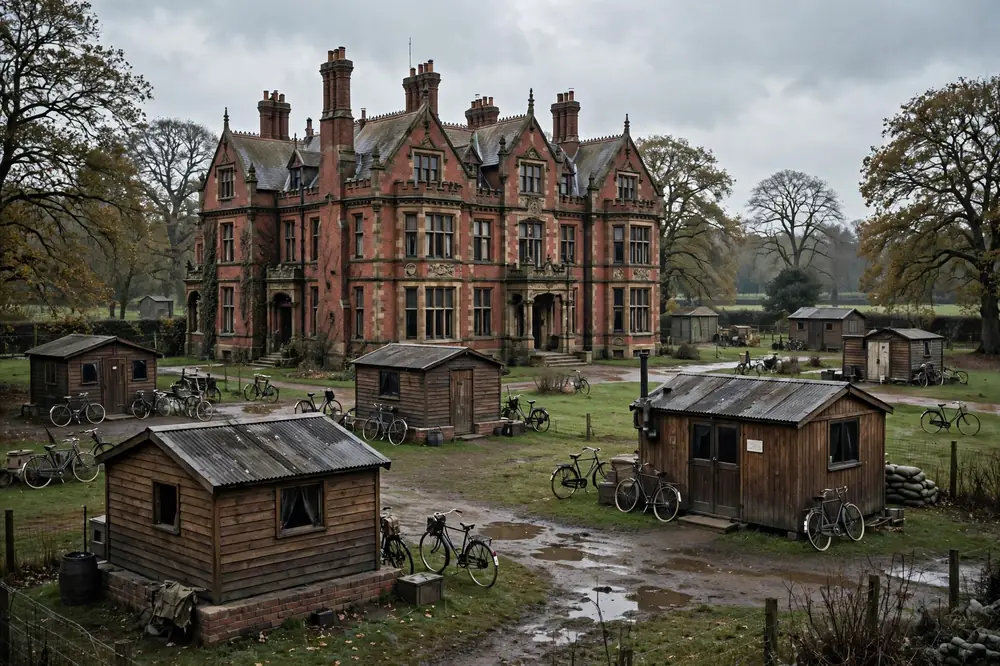
At Bletchley Park, Turing led Hut 8, the section responsible for German naval cryptanalysis, named after the wooden hut in which it was initially based. The German Navy’s Enigma was the most difficult variant: it used additional rotors and stricter procedures, and its messages — including the positions of U-boats — were the ones that mattered most in the Battle of the Atlantic.
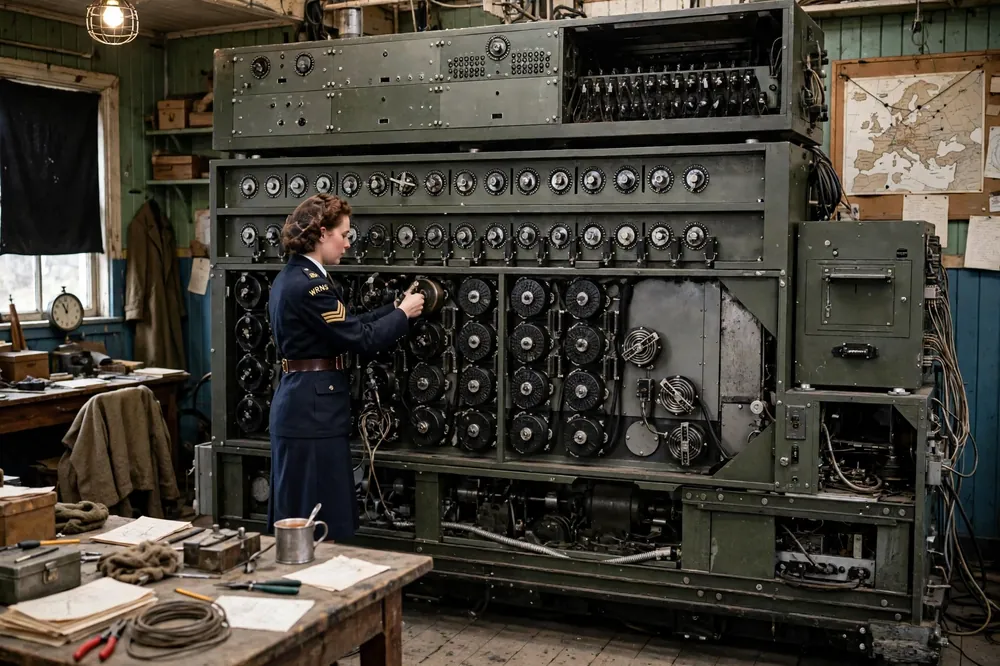
Turing devised a new and more powerful electromechanical machine for finding the daily Enigma settings, building on the Polish bomba but using a different method, based on the statistical technique he called Banburismus and on the logical structure of the cipher. The machine was called the Bombe. A fellow Cambridge mathematician at Bletchley Park, Gordon Welchman, added a component known as the diagonal board, which greatly increased the Bombe’s effectiveness.
The first Bombe, named Victory, was installed at Bletchley Park in the spring of 1940, and more than 200 Bombes were eventually built. The Bombe did not by itself break Enigma: it was one tool among several, used together with captured codebooks, cribs (guessed fragments of plaintext), and the work of hundreds of other cryptanalysts, engineers and operators, many of them women of the Women’s Royal Naval Service.
Its effect was to mechanise the search for settings, reducing a task that could take days or weeks to hours, and making it possible to read German naval traffic on a regular basis from 1941 onwards, with interruptions when the Germans changed their procedures.
The work developed in stages. In December 1939 Turing solved the essential part of the German naval indicator system, which was more complex than the indicator systems used by the other German services, and on the same night he conceived Banburismus, the sequential statistical technique used to reduce the number of Bombe runs needed. The first Bombe was installed at Bletchley Park on 18 March 1940.
In July 1942 Turing devised a further technique, called Turingery, for attacking the Lorenz cipher machine used by the German high command. In November 1942 he travelled to the United States to work with American cryptanalysts on naval Enigma and on the construction of the American Bombe, visiting the United States Navy’s Computing Machine Laboratory at Dayton, Ohio, and consulting with Bell Laboratories on the SIGSALY secure voice system.
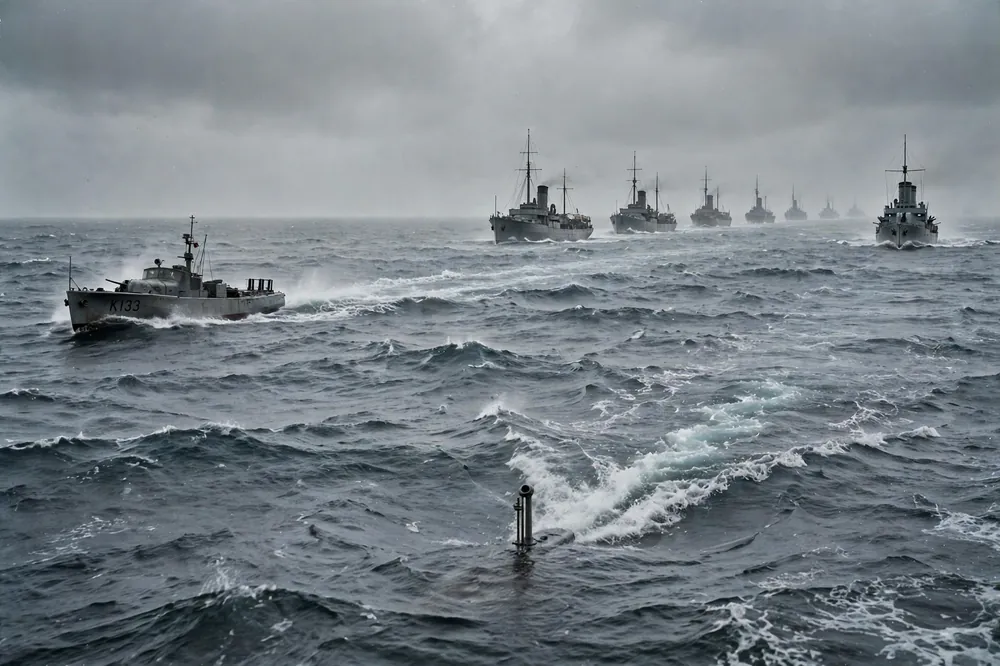
The intelligence produced at Bletchley Park was codenamed Ultra. Its value in the Battle of the Atlantic was that it allowed the Allies to route convoys around U-boat patrol lines and to direct escort forces toward U-boats. The effect is difficult to quantify precisely, and historians differ on the scale of it: it is often claimed, in popular accounts, that the breaking of Enigma shortened the war by two years, but this figure is an estimate rather than a measured fact, and it is not accepted as a precise claim by all historians.
What is established is that the reading of naval Enigma from 1941 onwards, and in particular the breaking of the four-rotor naval Enigma in late 1942 — a problem on which Turing’s earlier work on the Bombe and his statistical methods were directly relevant — contributed to the reduction of Allied shipping losses in 1943, the year in which the U-boat campaign was defeated.
Turing also worked on other problems during the war, including the “Turingery” method for attacking the Lorenz cipher machine used by the German high command, and the Delilah speech-scrambling device. In 1942 he travelled to the United States to liaise on joint codebreaking projects, including the American Bombe.
He was appointed an Officer of the Order of the British Empire (OBE) in 1946 for his wartime work, although the nature of that work remained classified for decades and was not publicly known until the 1970s.
6. Key Decisions
Three decisions in Turing’s life are usually singled out. The first was the decision, in 1936, to approach Hilbert’s problem by imagining a machine rather than by working within existing mathematical formalism — a choice that produced the Turing machine and, with it, the theoretical basis of computing.
The second was the wartime decision to mechanise codebreaking: where others at Bletchley Park worked primarily with paper methods and cribs, Turing argued that the scale of the Enigma problem required machines, and he designed the Bombe accordingly. The decision involved a judgement about resources — the Bombes were expensive, required industrial production, and consumed scarce engineering capacity — and it was contested at the time; in October 1941 Turing and three colleagues wrote directly to Winston Churchill to request more resources for Bletchley Park, a letter that produced an immediate response and the staff and machines they had asked for.
The third decision was a personal one: in January 1952, when his house was burgled and he reported the break-in to the police, he spoke openly about his sexual relationship with a young man, Arnold Murray, who was associated with the burglary. That openness led to his prosecution.
His biographers differ on how to interpret it: some describe it as a matter of principle, others as a failure to understand the risk he was taking under the law as it then stood. The decision is recorded here as a fact, with the interpretations attributed to those who have made them.
7. Controversies
The controversies around Turing concern his death, his prosecution, and the scale of his wartime contribution. On his death: the inquest on 7–8 June 1954 returned a verdict of suicide by cyanide poisoning, and a half-eaten apple was found by his bed.
The apple was not tested for cyanide, and the cyanide in his body could have come from other sources — Turing kept potassium cyanide in his house for use in a home electroplating hobby. On this basis, some writers, including the historian Jack Copeland, have argued that the evidence is also consistent with accidental poisoning, and that the suicide verdict should be treated as unproven rather than as established fact.
The question remains open in the literature. On his prosecution: there is no dispute about the facts — Turing was convicted in March 1952 of “gross indecency” under Section 11 of the Criminal Law Amendment Act 1885, and accepted probation on condition of hormone treatment with oestrogen, which caused physical changes including breast growth, and lost his security clearance.
What is debated is the responsibility: the prosecution was carried out under a law that applied to all men in the same position, and Turing was not singled out because of his wartime work; the injustice, as the 2009 apology framed it, lay in the law itself. On his wartime contribution: the popular claim that Turing “single-handedly” broke Enigma or “won the war” is not supported by the record.
The breaking of Enigma was a collective effort — Polish mathematicians first, then the staff of Bletchley Park, including Welchman, Hugh Alexander, Joan Clarke and many others, and later the American codebreakers — and Turing’s biographers, including Andrew Hodges, present his role as central to the naval Enigma problem rather than as the sole cause of the Allied success.
The estimate that codebreaking shortened the war by two years is, as noted above, an estimate and not a measured figure.
8. Later Life and Death
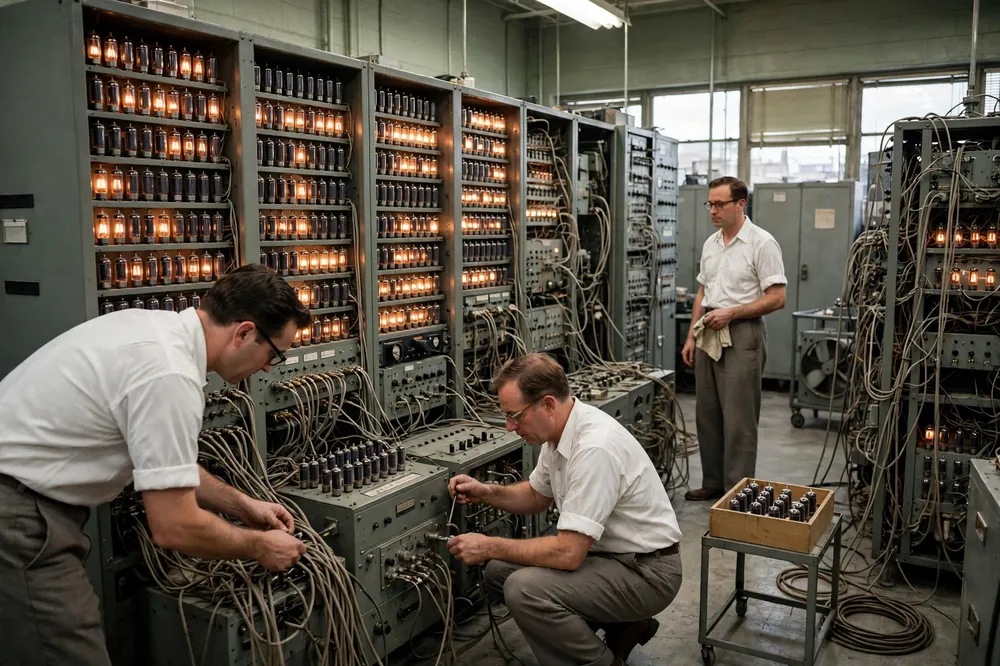
After the war Turing worked at the National Physical Laboratory in Teddington, where in 1945–1946 he designed the Automatic Computing Engine (ACE), a stored-program computer. The project moved slowly, and Turing, frustrated by delays and by the committee structure, left the laboratory in 1948 to take up a readership in mathematics at the University of Manchester, where he worked on the Manchester Mark 1 computer and on the theory of morphogenesis — the chemical basis of pattern formation in living organisms, published in 1952 as “The Chemical Basis of Morphogenesis”.
In 1950 he published “Computing Machinery and Intelligence” in the journal Mind, in which he proposed the imitation game, now known as the Turing test: if a machine could converse in a way that a human interrogator could not distinguish from a human, then, Turing argued, it would be reasonable to say the machine could think. The paper is now a founding text of artificial intelligence.
In January 1952 his house in Wilmslow was burgled. He reported the burglary to the police and, in the course of the investigation, disclosed his relationship with Arnold Murray. Both men were charged with gross indecency; Turing pleaded guilty on 31 March 1952.
He was given probation for twelve months on condition that he undergo hormone treatment, and he lost his security clearance and was barred from further work with the intelligence services. He continued to work at Manchester, publishing his paper on morphogenesis in the same year.
His post-war computing work deserves a fuller account. On 19 February 1946 he presented a paper setting out the first detailed design of a stored-program computer, the Automatic Computing Engine, based on his 1936 theoretical work and on what he had learned about electronics during the war.
The full ACE was not built in his lifetime: the project at the National Physical Laboratory moved slowly, and Turing left for Manchester in 1948. In his absence a smaller version, the Pilot ACE, was built at the laboratory, and it executed its first program on 10 May 1950. Later computers, including the English Electric DEUCE and the American Bendix G-15, drew on the Pilot ACE design.
During a sabbatical year at Cambridge in 1947–1948 Turing also wrote a paper on intelligent machinery, which was not published in his lifetime. He was found dead at his home on 8 June 1954, having died the previous day, 7 June, aged 41. The inquest returned a verdict of suicide by cyanide poisoning. He was cremated, and his ashes were scattered at Woking Crematorium.
9. Legacy
Turing’s legacy has grown in two stages: first, the recognition of his theoretical work, and second, the recognition of his wartime work and of the injustice of his prosecution. The Turing machine remains the standard formal model of computation, and the Turing test remains a reference point in discussions of machine intelligence, even though its interpretation is debated.
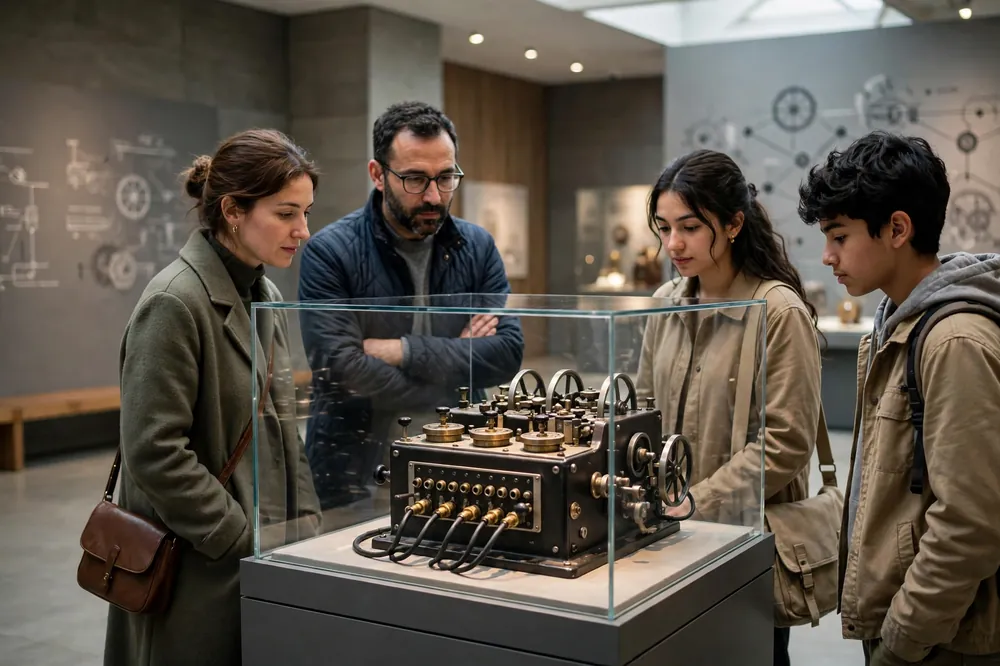
The ACE design influenced the development of British computing, and the Manchester work connected Turing to the first generation of stored-program computers. His wartime work remained classified until the 1970s, when F. W. Winterbotham’s The Ultra Secret (1974) first described the Bletchley Park operation to the public; since then the scale of the codebreaking effort, and Turing’s part in it, has been documented in detail by historians, notably in Andrew Hodges’s biography Alan Turing: The Enigma (1983).
The public rehabilitation came later: on 10 September 2009 Prime Minister Gordon Brown issued a formal apology on behalf of the British government; on 24 December 2013 Queen Elizabeth II granted a posthumous royal pardon; and in 2017 the Policing and Crime Act, in provisions known as the “Alan Turing law”, posthumously pardoned thousands of other men convicted under the repealed legislation.
In 2021 Turing’s portrait, based on a 1951 photograph held by the National Portrait Gallery, appeared on the Bank of England’s £50 note, together with a table from his 1936 paper, technical drawings of the Bombe, and a quotation from a 1949 interview. The Bletchley Park site is now a museum, and Hut 8 is preserved as part of it.
Turing’s name is also attached to the highest honour in computing. The ACM Turing Award, established by the Association for Computing Machinery in 1966 and often described as the Nobel Prize of computing, is named for him and is awarded annually for contributions of lasting importance to the field. A statue of Turing by the sculptor Stephen Kettle, made from half a million pieces of Welsh slate and commissioned by Sidney Frank, stands at Bletchley Park, and a memorial to Turing and to the codebreakers stands in Manchester, the city where he worked after the war.
10. Assessment by Historians
Historians assess Turing in two registers, and the distinction matters. As a mathematician, his standing is not seriously disputed: the 1936 paper is treated as a founding text, the Turing machine as the standard model of computation, and the 1950 paper as a founding text of artificial intelligence.

Andrew Hodges’s biography, which remains the standard account, presents the 1936 paper and the wartime work as parts of a single intellectual project — the question of what machines can and cannot do. As a codebreaker, his standing is high but carefully qualified: historians credit him with the design of the Bombe, the statistical methods used against naval Enigma, and the leadership of Hut 8, while insisting that the breaking of Enigma was a collective achievement in which Polish cryptologists, other Bletchley Park staff and American codebreakers all played essential parts.
The assessment of Bletchley Park’s historian, in the official history of British intelligence, is that Ultra shortened the war, but the official history does not attach a figure of two years to that judgement. On his prosecution and death, the historical literature is consistent that the law under which he was convicted is now regarded as unjust — a judgement reflected in the 2009 apology, the 2013 pardon and the 2017 legislation — and that the question of whether his death was suicide or accident remains open, because the evidence recorded at the inquest does not settle it.
Turing’s place in the history of the Second World War is therefore a documented one, but it is a place within a large organisation and a long chain of prior work, not a solitary one.
Two points in the literature deserve a final note. On the question of how far codebreaking shortened the war, the estimates in the literature range from about two years to as many as four years, and they are estimates rather than measurements; the official history of British intelligence records that Ultra shortened the war without attaching a figure to the judgement.
On the question of Turing’s death, the two principal biographical accounts differ: Andrew Hodges’s biography treats the inquest verdict of suicide as the best reading of the evidence, while Jack Copeland has argued that the evidence is consistent with accidental poisoning and that the verdict should be treated as unproven.
The difference turns on the same facts — the untested apple, the cyanide kept at home for electroplating, and the absence of a note — and the literature has not resolved it.
Frequently Asked Questions
Who was Alan Turing? Alan Turing was an English mathematician and logician who defined the theory of computing in his 1936 paper, led Hut 8 at Bletchley Park during the Second World War, and designed the Bombe machine used against the German Enigma cipher.
What did Alan Turing do at Bletchley Park? He led Hut 8, the section responsible for German naval Enigma, and designed the Bombe, an electromechanical machine that searched for the daily Enigma settings. His work contributed to the Allied reading of German naval signals in the Battle of the Atlantic.
What is the Turing machine? The Turing machine is an abstract device described in Turing’s 1936 paper “On Computable Numbers”: a machine that reads and writes symbols on a strip of tape according to a table of rules. It is the standard formal model of what a computer can do, and Turing used it to show that some mathematical problems cannot be solved by any machine.
Did Alan Turing break the Enigma code alone? No. Polish mathematicians — Marian Rejewski, Jerzy Różycki and Henryk Zygalski — first broke Enigma in the 1930s and shared their work with Britain in 1939. Turing built on that work at Bletchley Park, together with colleagues including Gordon Welchman, Hugh Alexander and Joan Clarke, and later with American codebreakers.
Why was Alan Turing prosecuted in 1952? He was convicted of “gross indecency” under Section 11 of the Criminal Law Amendment Act 1885, which criminalised sexual acts between men. He pleaded guilty, accepted probation on condition of hormone treatment, and lost his security clearance.
How did Alan Turing die? He died on 7 June 1954, aged 41, of cyanide poisoning. The inquest returned a verdict of suicide, but some historians have noted that the evidence is also consistent with accidental poisoning, because the apple found by his bed was never tested and he kept cyanide at home for a hobby. The question remains open.
Related articles
Sources
- Wikipedia, “Alan Turing” — dates, career, Hut 8, the Bombe, conviction and death, cross-checked against the sources below. Note: the article records both the inquest verdict of suicide and the view that the evidence is consistent with accidental poisoning.
- Encyclopædia Britannica, “Alan Turing” (britannica.com) — biography, Turing machine and Bletchley Park.
- Andrew Hodges, Alan Turing: The Enigma (Burnett Books, 1983; Princeton University Press, 2014) — the standard biography; 1936 paper, Hut 8, trial and death.
- B. Jack Copeland, Turing: Pioneer of the Information Age (Oxford University Press, 2012) — the Bombe, Hut 8 and the discussion of the circumstances of Turing’s death.
- Bletchley Park Trust (bletchleypark.org.uk) — Hut 8, the Bombe and the history of the site.
- Bank of England, “Alan Turing to be the face of the new £50 note” (15 July 2019) — 1936 paper, 1952 conviction, 2009 apology, 2013 pardon, 2017 legislation.
- UK Government, “Royal pardon for WW2 code-breaker Dr Alan Turing” (gov.uk, 2013) — the posthumous pardon.
Further reading
- Alan Turing, “On Computable Numbers, with an Application to the Entscheidungsproblem”, Proceedings of the London Mathematical Society, 1936.
- Alan Turing, “Computing Machinery and Intelligence”, Mind, 1950.
- David Leavitt, The Man Who Knew Too Much: Alan Turing and the Invention of the Computer (W. W. Norton, 2006).