 WAR ATLAS MILITARY HISTORY MAGAZINE · WWI — WWII
Iowa-class Battleship
1. Lead
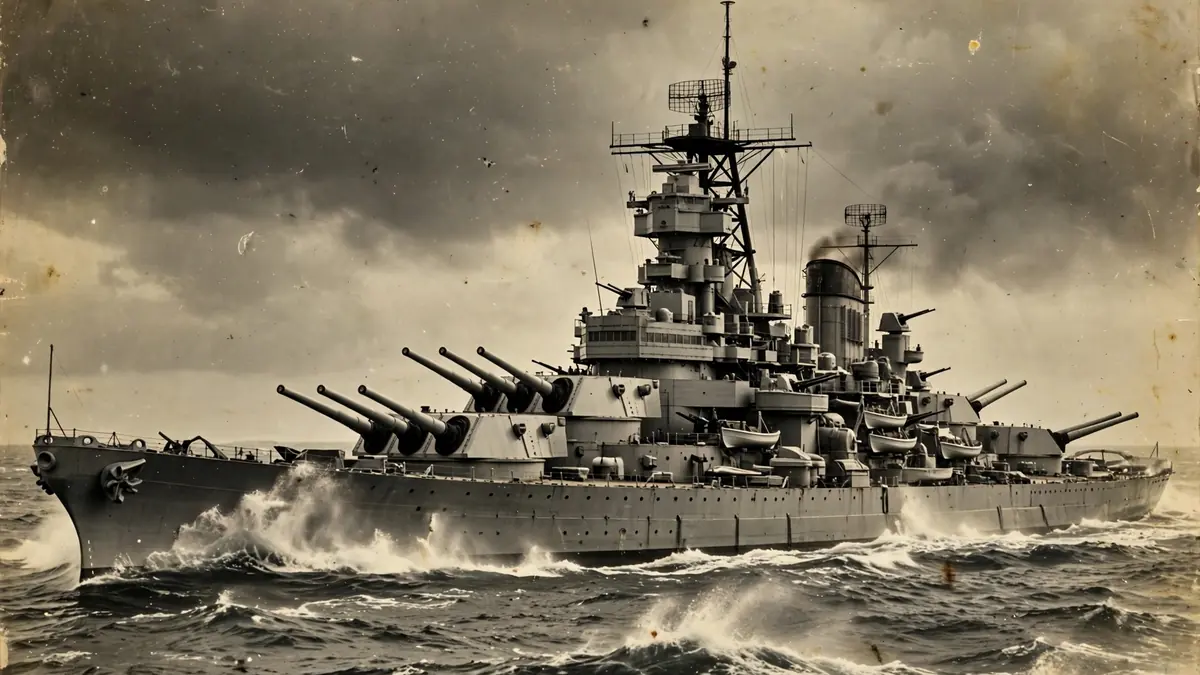
The Iowa-class battleships were the largest, fastest and longest-serving battleships ever built by the United States, and the last battleships ever to serve in the United States Navy. Four ships were completed — Iowa, New Jersey, Missouri and Wisconsin — and they served across five decades, from the Pacific War of 1944–1945 to the Gulf War of 1991.
They were designed to escort the fast aircraft carriers, and they were built around a single, uncompromising requirement: speed. At 33 knots they were faster than any other battleship in the world, fast enough to keep up with the carriers they protected, and they carried the most powerful naval guns ever mounted on an American ship, nine 16-inch/50-calibre rifles that could throw a 2,700-pound shell more than 20 miles.
The class is remembered for its firepower and its speed, but it is remembered above all for a single moment: on 2 September 1945, on the deck of the USS Missouri in Tokyo Bay, the Japanese Empire formally surrendered, and the Second World War came to an end.
The Missouri’s deck on that morning remains one of the most famous places in military history, and the four ships of the class are now preserved as museums, visited by millions of people who come to stand where history was made.
2. Key Facts
The table below summarises the Iowa class as completed in 1943–1944, with the main figures for the class as a whole.
| Type | Fast battleship |
| Country of origin | United States |
| Ships completed | 4: USS Iowa (BB-61), USS New Jersey (BB-62), USS Missouri (BB-63), USS Wisconsin (BB-64) |
| Laid down | 1940–1941 / 1940–1941 |
| Commissioned | 1943–1944 / 1943–1944 |
| Displacement | About 45,000 tons standard; about 57,000 tons full load |
| Length | 887 ft (270 m) / 270 m |
| Beam | 108 ft (33 m) / 33 m |
| Propulsion | 4 steam turbines, 212,000 shp, 4 shafts |
| Speed | 33 knots (61 km/h) |
| Range | About 15,000 nautical miles at 15 knots |
| Complement | About 2,700 officers and men (Second World War) |
| Main armament | 9 × 16 in (406 mm)/50-calibre guns in three triple turrets |
| Secondary armament | 20 × 5 in (127 mm)/38-calibre dual-purpose guns |
| Armour / Giáp | Belt 12.1 in (307 mm); turrets up to 19.7 in (500 mm); deck 6 in (152 mm) |
3. Background
3.1. The fast battleship idea
The Iowa class was born from a change in naval thinking that had been gathering force since the 1930s: the realisation that the battleship’s future lay not in fighting other battleships in a line of battle, but in escorting the fast aircraft carriers that had become the navy’s striking arm.
The carriers of the Essex class could steam at 33 knots, and any battleship that was meant to escort them had to be able to keep up, which meant a speed that no existing battleship could match. The American battleships of the North Carolina and South Dakota classes, powerful as they were, could make only 27 to 28 knots, and they would have been left behind by a carrier task force at full speed.
The Navy’s answer was a new design that traded some armour protection for speed, using a longer hull and a far more powerful propulsion plant to reach 33 knots while retaining the 16-inch guns and the heavy protection of a first-class battleship.
The design was a gamble: it required engines of 212,000 shaft horsepower, more than any battleship had ever carried, and it required a hull 887 feet long, the longest the Navy had ever built. But the gamble was justified by the strategic logic, and the Iowa class became the only battleship design in history that was built specifically to escort carriers.
3.2. The Second London Naval Treaty and the escalator clause
The Iowa class was also shaped by the naval treaties that had governed warship construction since the 1920s, and by the collapse of those treaties in the late 1930s. The Second London Naval Treaty of 1936 had limited battleships to 35,000 tons and guns to 14 inches, but it contained an “escalator clause” that allowed the limits to rise to 45,000 tons and 16-inch guns if any signatory failed to accept the treaty by 1 April 1937.
Japan refused to sign, and the escalator clause came into effect, which freed the United States to build a battleship of 45,000 tons with 16-inch guns. The Iowa class was designed to that limit, and it used every ton of it: the long hull, the powerful machinery and the heavy armament all pushed the design to the very edge of the treaty displacement, and the ships as completed displaced about 45,000 tons standard and about 57,000 tons at full load.
The treaty background mattered because it set the parameters within which the designers worked, and it explains why the Iowa class was so much larger than its predecessors: it was the first American battleship designed without the 35,000-ton limit, and it showed what American naval architects could do when the constraint was lifted.
3.3. Six ships planned, four completed
Six Iowa-class battleships were authorised, and four were completed. The first four — Iowa, New Jersey, Missouri and Wisconsin — were laid down in 1940 and 1941 and commissioned in 1943 and 1944, in time to serve in the Pacific War.
The last two, Illinois (BB-65) and Kentucky (BB-66), were laid down in 1942 but never completed: Illinois was cancelled in August 1945, when the war ended, and her hull was scrapped on the slipway, while Kentucky was launched in 1950 but never finished, and her hull was used as a source of spare parts before being scrapped in 1958.
The cancellation of the last two ships reflected a strategic judgement that had already been made by 1945: the aircraft carrier, not the battleship, was the capital ship of the future, and there was no longer a need for more battleships.
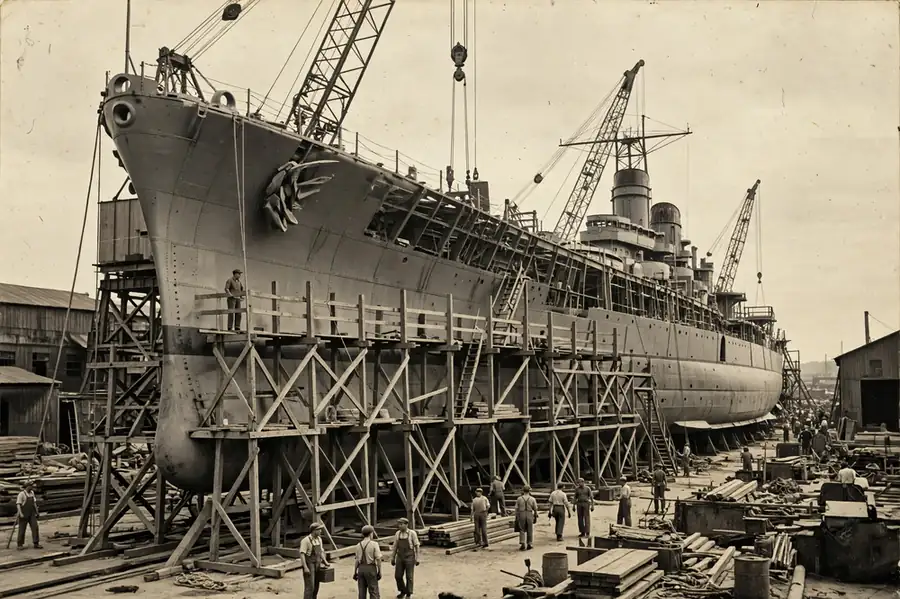
The four completed ships were the last battleships the United States would ever build, and they were also the last battleships to serve in any navy, a distinction that gives the class a special place in naval history. The four ships were built at three yards — the New York Naval Shipyard, the Philadelphia Naval Shipyard and the Norfolk Naval Shipyard — and their construction employed tens of thousands of workers at the height of the American wartime shipbuilding effort.
4. Design and Development
4.1. Hull, machinery and the 33-knot requirement
The defining feature of the Iowa design was its speed, and everything about the hull and the machinery was organised to achieve it. The hull was 887 feet long and only 108 feet wide, a length-to-beam ratio that gave the ship a fine, fast form, and the bow was long and sharp, designed to cut through the water at high speed rather than to push it aside.
The propulsion plant was the most powerful ever fitted to a battleship: eight Babcock & Wilcox boilers feeding four sets of geared steam turbines, producing 212,000 shaft horsepower on four shafts, which drove the ship to 33 knots on trials and to about 31 knots in service at full load.
The machinery spaces were arranged in four separate engine rooms and four boiler rooms, alternated so that a single hit could not disable the whole plant, and the ship could still make 27 knots on two shafts if half the plant was out of action.
The price of speed was protection: the Iowa’s belt armour was 12.1 inches thick, thinner than the 14-inch belt of the South Dakota class, and the deck armour was 6 inches, which was judged sufficient against the bombs and shells of the period but which left the ship more vulnerable than its predecessors to plunging fire.
The designers accepted that trade, because speed was the ship’s reason for existing, and because a battleship that could not keep up with the carriers was of no use at all.
4.1.1. The long hull and the Panama Canal
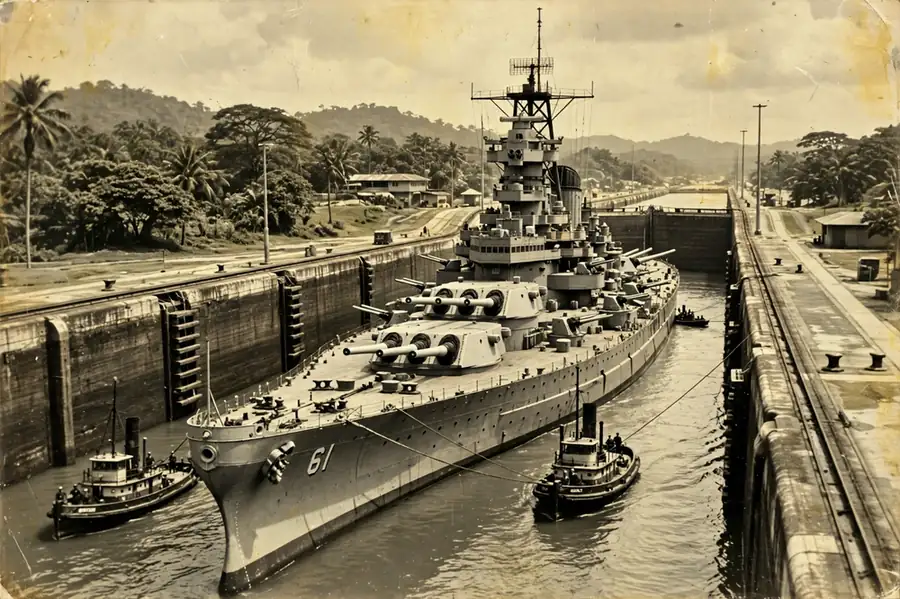
The Iowa’s hull was designed to the maximum dimensions that could pass through the Panama Canal, and that constraint shaped the ship in a way that is still visible in photographs. The canal’s locks were 110 feet wide, and the Iowa’s beam of 108 feet left only two feet of clearance on each side, which meant that the ship could transit the canal only with extreme care, and only with the assistance of tugs and of canal pilots who knew the ship’s handling.
The length of 887 feet was also close to the canal’s limit, and the ship’s great length gave it a turning circle that was wider than that of earlier battleships, which made it less manoeuvrable in confined waters. The canal constraint was a deliberate choice: the Navy insisted that its battleships be able to move between the Atlantic and the Pacific without sailing around South America, and the Iowa class was the largest battleship design that could still meet that requirement.
The constraint also explains the ship’s distinctive appearance: the long, narrow hull, the widely spaced funnels and the tall, slender superstructure were all consequences of fitting the largest possible battleship into the canal’s dimensions, and the result was a ship that looked fast even at anchor.
4.2. The 16-inch/50-calibre guns
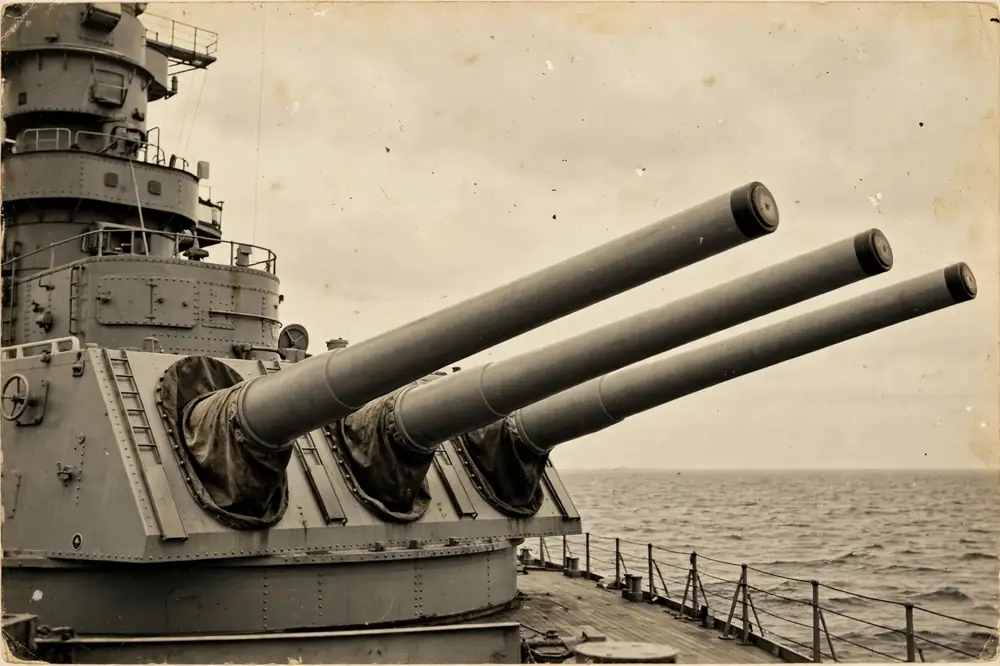
The Iowa’s main battery was the most powerful naval gun ever mounted on an American ship: nine 16-inch/50-calibre Mark 7 rifles, mounted in three triple turrets, two forward and one aft. Each gun was 66 feet long and weighed about 192,000 pounds, and it fired a 2,700-pound armour-piercing shell at a muzzle velocity of 2,500 feet per second, to a maximum range of about 23 miles.
The guns could fire about two rounds per minute, and the turrets were protected by armour up to 19.7 inches thick, the heaviest armour on the ship. The Mark 7 was a new design, longer and more powerful than the 16-inch/45-calibre guns of the North Carolina and South Dakota classes, and it was the finest battleship gun the United States ever built, combining long range, high accuracy and a very heavy shell.
The guns were served by a crew of about 75 men per turret, and the ammunition was stored in magazines deep inside the ship, protected by the belt and deck armour, and hoisted to the turrets by mechanical hoists that could keep up with the guns’ rate of fire.
The 16-inch guns were the Iowa’s reason for existing as a fighting ship, and they were the weapons that the class used in every war it fought, from the bombardment of Japanese-held islands in 1944 to the bombardment of Iraqi positions in 1991.
4.3. Secondary guns, anti-aircraft armament and radar
The Iowa’s secondary battery consisted of twenty 5-inch/38-calibre dual-purpose guns, mounted in ten twin turrets along the sides of the superstructure, which could engage both surface targets and aircraft. The 5-inch/38 was one of the finest naval guns of the war, and it was the standard secondary and anti-aircraft weapon of the American fleet, firing a 55-pound shell at a rate of about 15 rounds per minute.
The anti-aircraft battery was completed by large numbers of 40 mm Bofors guns and 20 mm Oerlikon cannon, which were mounted in quadruple and single mounts all over the ship, and which provided the close-range defence against dive bombers and torpedo aircraft.
The Iowa’s radar fit was the most advanced of any battleship of the period: the ship carried air-search radar, surface-search radar and fire-control radar for both the main and secondary batteries, which allowed the guns to be aimed accurately in darkness and in bad weather, and which made the Iowa’s gunnery far more effective than that of any battleship that had fought in the First World War.
The radar and the anti-aircraft guns reflected a lesson that the Navy had learned at Pearl Harbor and in the early Pacific battles: the battleship’s greatest enemy was no longer another battleship, but the aircraft, and the Iowa was designed to survive in a sky full of enemy planes.
5. Technical Specifications
5.1. Dimensions, displacement and speed
The Iowa class displaced about 45,000 tons standard and about 57,000 tons at full load, measured 887 feet in length and 108 feet in beam, and drew about 37 feet of water at full load. The ships were powered by four steam turbines producing 212,000 shaft horsepower, which drove them to 33 knots on trials and to about 31 knots in service, making them the fastest battleships ever built.
Their range was about 15,000 nautical miles at 15 knots, which allowed them to cross the Pacific without refuelling, and their fuel capacity was about 9,000 tons of oil. The ships carried a crew of about 2,700 officers and men in the Second World War, rising to about 2,900 in the 1980s when the Tomahawk missile systems and their crews were added.
The Iowa’s size was a consequence of its speed requirement: the long hull and the powerful machinery needed space, and the ship’s displacement grew to accommodate them, until the Iowa was the largest battleship the United States had ever built, and one of the largest warships of any kind in the world.
5.2. Armour and protection
The Iowa’s protection was based on the American “all or nothing” principle, which concentrated heavy armour on the magazines, the machinery spaces and the command positions, and left the rest of the ship unarmoured, on the theory that armour too thin to stop a heavy shell was worse than useless, because it would detonate the shell inside the ship rather than letting it pass through.
The belt armour was 12.1 inches thick, inclined at 19 degrees to improve its resistance, and it protected the magazines and the machinery spaces. The deck armour was 6 inches thick over the vital spaces, and the turrets were protected by up to 19.7 inches of armour on their faces.
The conning tower was protected by 17.3 inches of armour, and the ship’s underwater protection consisted of a system of liquid-loaded and empty compartments designed to absorb the blast of a torpedo. The Iowa’s protection was thinner than that of the slower South Dakota class, and the ship was more vulnerable to plunging fire and to torpedoes, but it was judged sufficient for the role the ship was designed to perform, and no Iowa-class ship was ever seriously damaged by enemy action.
| Iowa class | |
|---|---|
| Length | 887 ft (270.4 m) / 270,4 m |
| Beam | 108 ft (32.9 m) / 32,9 m |
| Draught | About 37 ft (11.3 m) full load |
| Displacement standard | About 45,000 tons |
| Displacement full load | About 57,000 tons |
| Power | 212,000 shp |
| Speed | 33 knots (61 km/h) |
| Range | About 15,000 nm at 15 knots |
| Main guns | 9 × 16 in/50 Mark 7 |
| Secondary guns | 20 × 5 in/38 |
| Belt armour | 12.1 in (307 mm) / 307 mm |
| Crew | About 2,700 (Second World War) |
5.3. Fire control and radar
The Iowa’s fire control was the most sophisticated of any battleship of the Second World War, and it was one of the reasons the class remained effective into the 1980s and 1990s. The main battery was controlled by two Mark 38 fire-control directors, one forward and one aft, each fitted with optical rangefinders and with Mark 8 fire-control radar, which could track a target at ranges of more than 20 miles and in any weather.
The directors fed data to a Mark 8 rangekeeper, an analogue computer that calculated the firing solution — the range, the bearing and the elevation — and transmitted it to the turrets, where the guns were laid automatically. The secondary battery was controlled by four Mark 37 directors, each with its own radar, which could engage both surface and air targets.
The system allowed the Iowa to open fire accurately at long range, to shift targets quickly, and to continue firing in darkness and in bad weather, capabilities that no earlier battleship had possessed. The fire-control system was updated in the 1980s with digital computers and with the Tomahawk missile system, and it remained in service until the ships were decommissioned in the early 1990s.
5.3.1. The Mark 8 rangekeeper
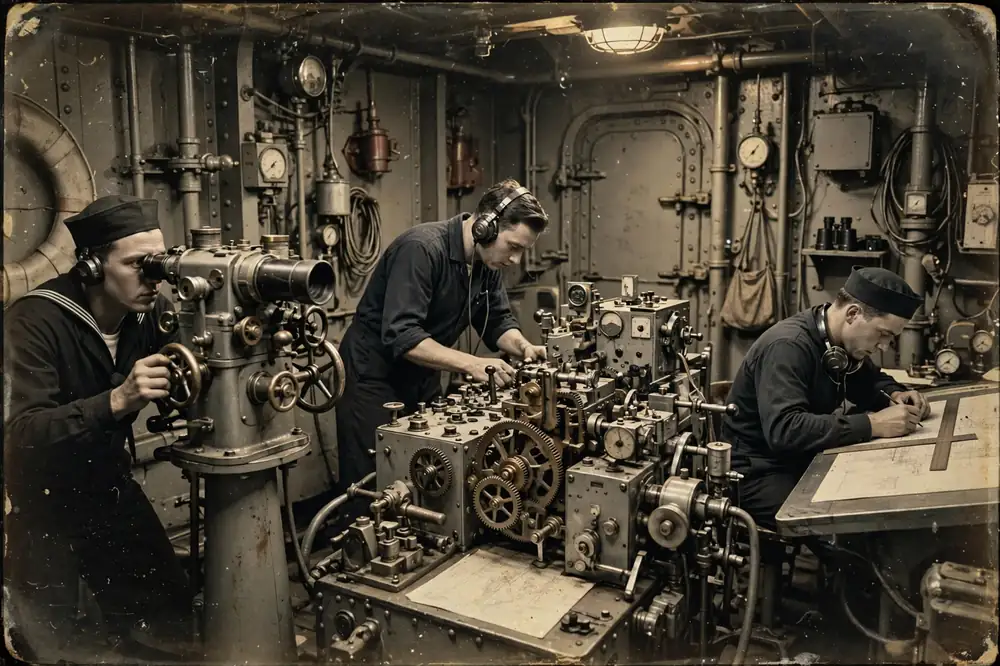
The Mark 8 rangekeeper was an analogue computer that sat at the heart of the Iowa’s fire-control system, and it was one of the most complex machines ever fitted to a warship. It received data from the fire-control directors — the range and bearing of the target, the ship’s own course and speed, the wind, the temperature and the state of the sea — and it calculated the firing solution continuously, updating it as the ship and the target moved.
The rangekeeper was a mechanical device, built from gears, cams and differentials, and it was operated by a team of men who fed it data and monitored its output, a process that required training and practice but which produced a firing solution that was far more accurate than any human calculation.
The system’s accuracy was demonstrated in the Pacific War, when the Iowa-class ships scored hits on Japanese targets at ranges of more than 20 miles, and it was demonstrated again in the 1980s, when the ships’ guns were used to bombard targets in Lebanon and in the Gulf War with a precision that surprised observers.
The rangekeeper was a product of the same industrial and scientific effort that produced the atomic bomb and the proximity fuse, and it was a reminder that the Iowa class was as much a product of American science as of American steel.
6. Variants
6.1. The four ships
The four completed Iowa-class ships were sisters, but they were not identical, and each had its own history and its own character. USS Iowa (BB-61) was the lead ship, commissioned on 22 February 1943, and she served as the flagship of the Atlantic Fleet before transferring to the Pacific, where she took part in the Marshall Islands campaign and in the Battle of Leyte Gulf.
USS New Jersey (BB-62), commissioned on 23 May 1943, was the most decorated battleship in American history, earning 19 battle stars across the Second World War, Korea and Vietnam, and she served as the flagship of the Fifth Fleet under Admiral Raymond Spruance, and later of the Third Fleet under Admiral William Halsey — the same fleet, renamed when command changed hands.
USS Missouri (BB-63), commissioned on 11 June 1944, is the most famous of the four, because it was on her deck that the Japanese surrender was signed on 2 September 1945. USS Wisconsin (BB-64), commissioned on 16 April 1944, served in the Pacific War, in Korea and in the Gulf War, where she fired the last 16-inch shells ever fired in anger by an American battleship.
The four ships were refitted in the 1980s with Tomahawk cruise missiles, Harpoon anti-ship missiles and the Phalanx close-in weapon system, which extended their service lives into the 1990s and made them the only battleships in the world to carry cruise missiles.
6.2. The 1980s reactivation
The Iowa class was decommissioned after the Second World War, reactivated for Korea, decommissioned again, and then reactivated a second time in the 1980s as part of President Ronald Reagan’s plan for a 600-ship Navy. The 1980s reactivation was a major refit: the ships received 32 Tomahawk cruise missiles in armoured box launchers, 16 Harpoon anti-ship missiles, four Phalanx close-in weapon systems, and modern digital fire control, communications and electronic warfare systems.
The refit cost about 500 million dollars per ship, a large sum, but it gave the Navy four ships that could deliver both the heavy gunfire of a battleship and the long-range precision of a cruise-missile platform. The reactivated ships served in the Mediterranean, in the Persian Gulf and in the Pacific, and they were used to bombard targets in Lebanon in 1983 and 1984 and in Iraq in 1991.
The reactivation also produced the class’s greatest tragedy: on 19 April 1989, an explosion in Turret Two of the USS Iowa killed 47 crewmen, an accident whose cause was never conclusively established, though the Navy’s investigation attributed it to an over-ram of the powder bags. The four ships were decommissioned for the final time in the early 1990s, and they were all preserved as museums.
7. Combat Service
7.1. The Pacific War, 1944–1945
The Iowa class entered combat in the Pacific in 1944, and its first actions were as escorts for the fast carrier task forces that were striking Japanese-held islands across the central Pacific. USS Iowa and USS New Jersey took part in the Marshall Islands campaign in early 1944, where their 16-inch guns bombarded Japanese airfields and shore defences, and in the Battle of Leyte Gulf in October 1944, the largest naval battle in history, where the New Jersey served as the flagship of Admiral William Halsey’s Third Fleet (the same fleet as Spruance’s Fifth Fleet, renamed when Halsey took command).
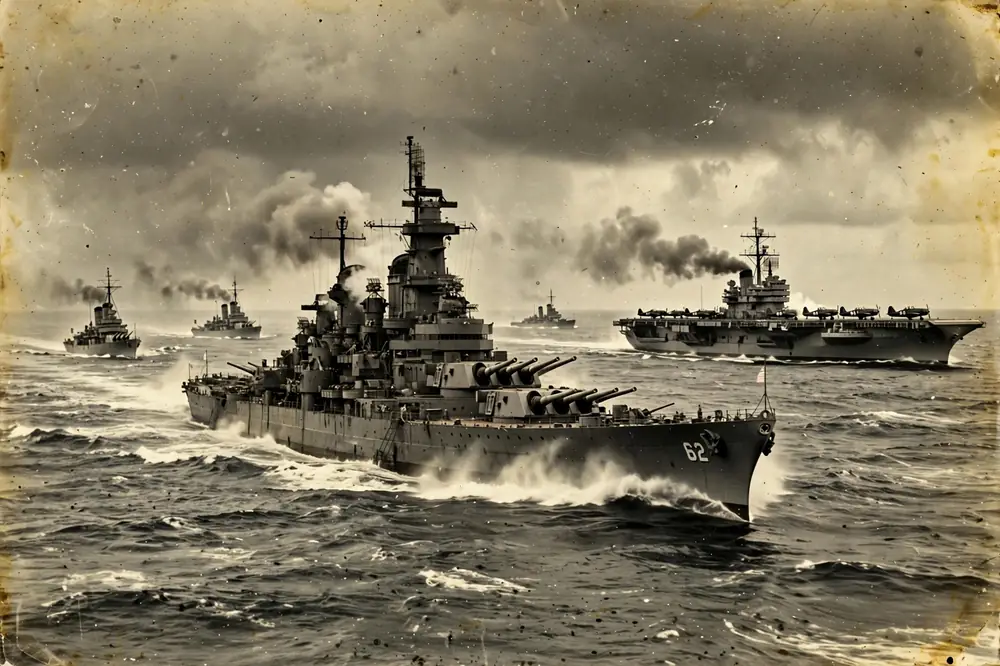
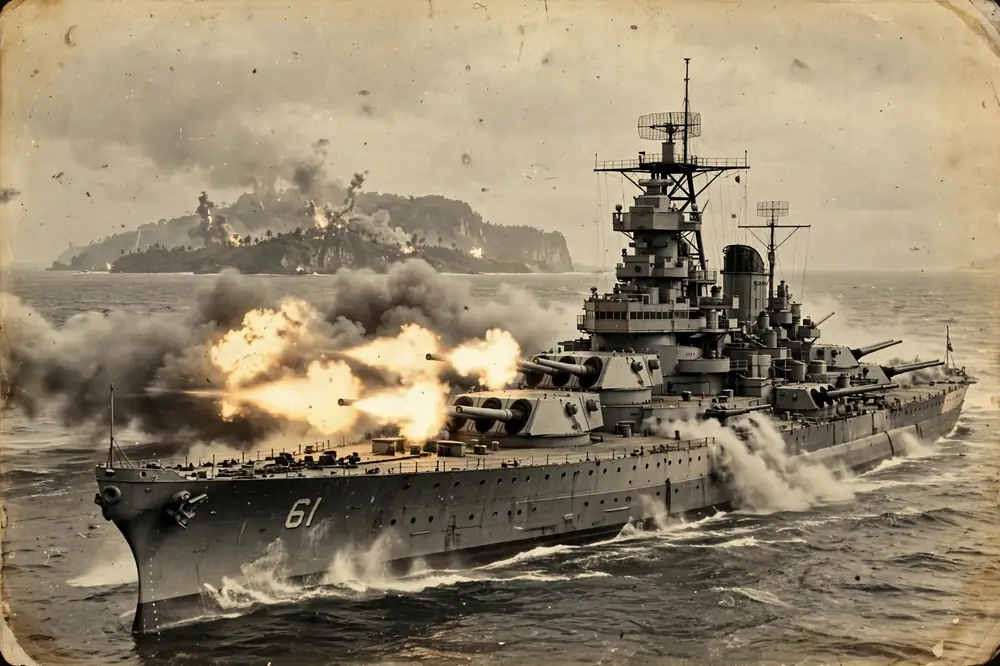
The Iowa-class ships were present at the battles for Iwo Jima and Okinawa in 1945, where they bombarded Japanese positions ashore and provided anti-aircraft protection for the carriers, shooting down kamikaze aircraft with their 5-inch and 40 mm guns. The ships’ most important contribution in the Pacific was not a single battle, but the sustained presence of fast, heavily armed escorts that allowed the carrier task forces to operate with confidence, and the sustained bombardment of Japanese-held islands that softened them for the landings.
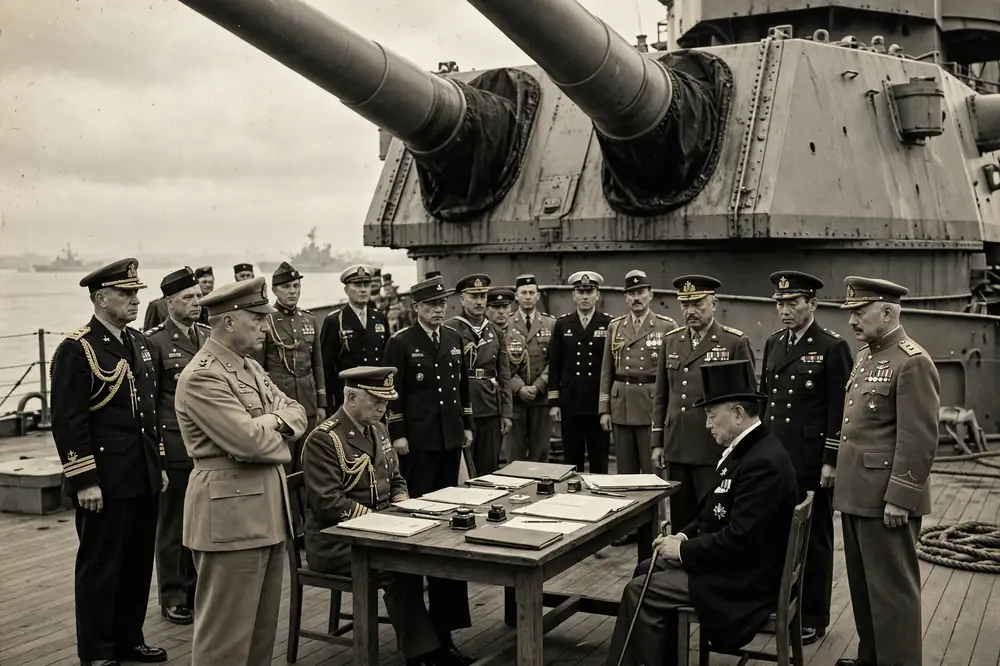
The Missouri’s most famous moment came at the end of the war, when she anchored in Tokyo Bay for the surrender ceremony, and her deck became the stage on which the Second World War ended.
7.2. Korea and Vietnam
The Iowa class was reactivated for the Korean War, where the ships’ 16-inch guns proved devastatingly effective against North Korean and Chinese positions ashore. USS Iowa, USS New Jersey, USS Missouri and USS Wisconsin all served in Korea, bombarding coastal targets, railways and troop concentrations, and their guns could reach targets 20 miles inland, far beyond the range of any other naval weapon.
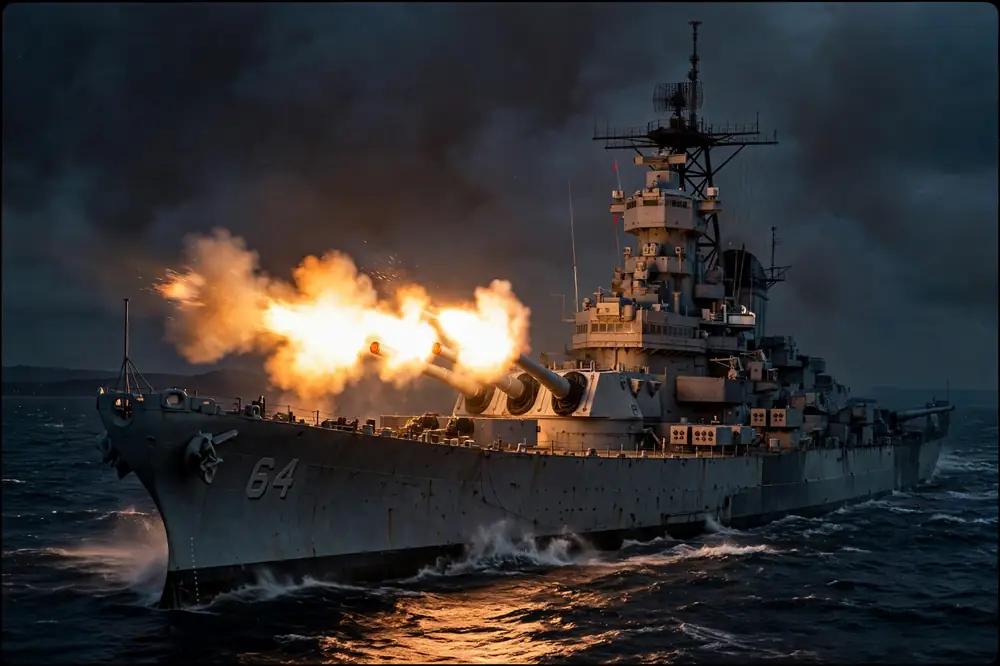
The ships’ fire was so accurate and so destructive that the North Koreans and the Chinese learned to respect the sound of a 16-inch salvo, and the ships were credited with destroying hundreds of targets. In Vietnam, only the New Jersey was reactivated, and she served a single tour in 1968 and 1969, bombarding North Vietnamese positions along the coast and providing gunfire support for American and South Vietnamese troops.
The New Jersey’s tour was cut short by the decision to decommission the ship, a decision that was controversial at the time, because the ship’s guns were widely regarded as the most effective naval gunfire support available. The Korean and Vietnam service proved that the battleship, though obsolete as a ship-to-ship weapon, remained unmatched as a platform for shore bombardment, and it was that capability that justified the class’s reactivation in the 1980s.
7.3. Lebanon and the Gulf War
The Iowa class’s final combat service came in the 1980s and in 1991, when the reactivated ships were used in Lebanon and in the Gulf War. In Lebanon in 1983 and 1984, the New Jersey bombarded Syrian and Druze positions in the hills above Beirut, firing her 16-inch guns in support of the American Marines ashore, and her fire was credited with silencing the guns that had been shelling the Marine positions.
In the Gulf War of 1991, the Missouri and the Wisconsin bombarded Iraqi positions along the Kuwaiti coast, firing more than 1,000 rounds of 16-inch ammunition and launching Tomahawk cruise missiles at targets deep inside Iraq. The Wisconsin’s bombardment was particularly effective, and her guns were credited with destroying Iraqi artillery, command posts and supply dumps, while her Tomahawk missiles struck targets in Baghdad.
The Gulf War was the last time that battleship guns were fired in anger, and the Wisconsin’s final 16-inch salvo, fired on 28 February 1991, was the last battleship gunfire in history. The two ships were decommissioned soon afterwards, and the era of the battleship came to an end.
7.3.1. The surrender on the Missouri
The most famous moment in the Iowa class’s history took place on the morning of 2 September 1945, on the deck of the USS Missouri in Tokyo Bay. The Japanese delegation, led by Foreign Minister Mamoru Shigemitsu, came aboard the Missouri to sign the instrument of surrender, and the ceremony was conducted on the ship’s starboard veranda deck, beneath the ship’s 16-inch guns.
General Douglas MacArthur presided, and the surrender was signed by the Japanese representatives, by MacArthur, and by the Allied commanders, including Admiral Chester Nimitz, who signed for the United States. The ceremony lasted 23 minutes, and it was broadcast around the world, bringing the Second World War to a formal end.
The Missouri’s deck on that morning was crowded with hundreds of American sailors and officers, and with the flags of the Allied nations, and the ship’s crew had prepared the deck with a display of the American flag that had flown over the United States Capitol on 7 December 1941, the day of the attack on Pearl Harbor.
The surrender plaque that marks the spot where the signing took place is still on the Missouri’s deck, and it is one of the most visited places on the ship, a reminder that the Iowa class’s greatest moment was not a battle, but the end of a war.
8. Strengths and Weaknesses
8.1. Strengths
The Iowa class’s strengths were speed, firepower and versatility, and they made the ships the most capable battleships ever built. Their speed of 33 knots allowed them to operate with the fast carrier task forces, and it gave them the ability to choose when and where to fight, a quality that no other battleship possessed.
Their 16-inch guns were the most powerful naval guns ever mounted on an American ship, and they could destroy any target ashore or afloat within their range, while their 5-inch secondary guns and their anti-aircraft batteries made them formidable against aircraft.
Their size allowed them to carry the fuel, the ammunition and the crew for long operations, and their radar and fire-control systems made their gunnery the most accurate of any battleship of the period. Their versatility was proven by their long service: they served as carrier escorts, as shore-bombardment ships, as flagships and as cruise-missile platforms, and they adapted to each new role without losing their effectiveness.
The Iowa class’s greatest strength was that it was never a one-role ship, and it was that adaptability that kept it in service for fifty years.
8.2. Weaknesses
The Iowa class’s weaknesses were the price of its speed and its size, and they were the reasons the battleship was eventually replaced by the carrier and the missile. Its armour was thinner than that of the slower South Dakota class, and it was more vulnerable to plunging fire and to torpedoes, though no Iowa-class ship was ever seriously damaged by enemy action.
Its size made it expensive to build, to operate and to maintain, and its crew of 2,700 men was far larger than the crew of any other warship of the period, which made it costly in manpower as well as in money.
Its 16-inch guns, though powerful, had a range that was far shorter than that of a carrier’s aircraft or a cruise missile, and by the 1980s the ship’s guns were useful only for shore bombardment, a role that could be performed more cheaply by other means.
Its speed, though unmatched among battleships, was irrelevant in an age of missiles and aircraft, and its great size made it a large and conspicuous target. The Iowa class was the finest battleship ever built, but it was built for a kind of naval warfare that had already passed, and its long service was a tribute to its quality rather than to its relevance.
9. Comparison with Rivals
9.1. Against the Japanese Yamato class
The Iowa class’s most famous comparison is with the Japanese Yamato class, the largest battleships ever built, and the comparison is a study in different design philosophies. The Yamato displaced about 65,000 tons at full load, against the Iowa’s 57,000 tons, and it carried nine 18.1-inch guns, the largest naval guns ever mounted on a ship, against the Iowa’s nine 16-inch guns.
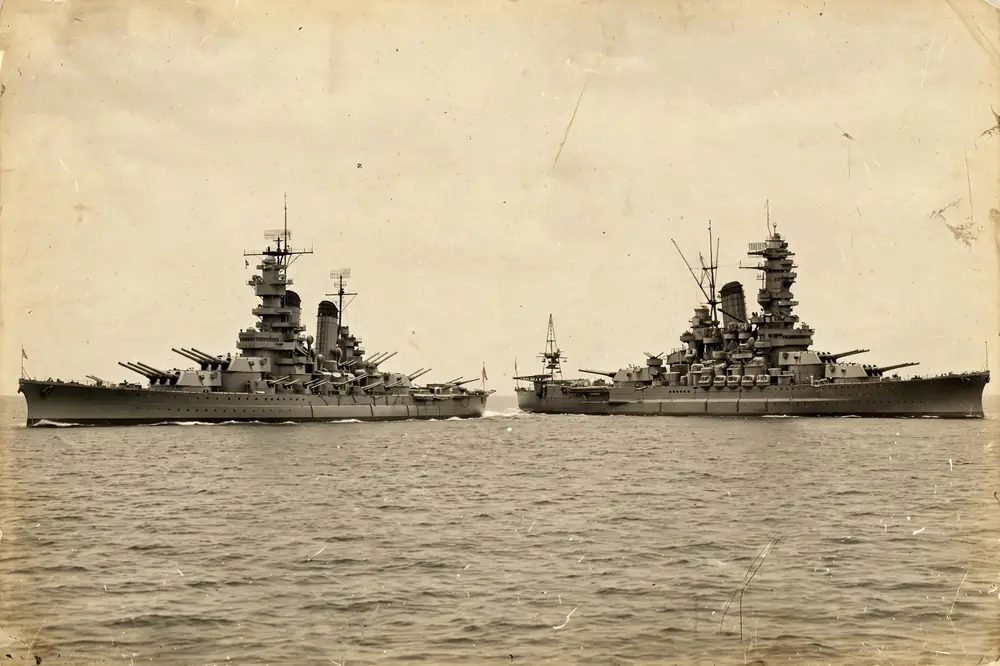
In a gun duel the Yamato would have had the advantage in firepower and in armour, and its 18.1-inch shells could have penetrated the Iowa’s belt at ranges where the Iowa’s shells would have struggled against the Yamato’s thicker armour.
But the Iowa was faster — 33 knots against the Yamato’s 27 knots — and it had far better radar and fire control, which would have allowed it to hit first and to hit accurately, and to dictate the range of the engagement.
The two classes never met in battle, and the comparison remains hypothetical, but most naval historians judge that the Iowa’s speed, its radar and its fire control would have given it the advantage in a real engagement, because the ship that hits first and hits accurately usually wins, even against a larger and more heavily armed opponent.
The Yamato and her sister Musashi were both sunk by American carrier aircraft, a fate that underlined the battleship’s vulnerability to air power, and the Iowa’s survival into the 1990s was a measure of its adaptability rather than of its superiority as a gun platform.
9.2. Against the German Bismarck class
Against the German Bismarck class, the Iowa’s advantages were clearer, because the Bismarck was a smaller and less advanced ship. The Bismarck displaced about 50,000 tons at full load and carried eight 15-inch guns, against the Iowa’s nine 16-inch guns, and it could make 30 knots, against the Iowa’s 33 knots.
The Bismarck’s armour was thick and well arranged, and its guns were accurate, but its radar and its fire control were far less advanced than the Iowa’s, and its anti-aircraft armament was weaker. The Bismarck’s most famous action was the sinking of HMS Hood in May 1941, a victory that demonstrated the German ship’s firepower, but the Bismarck was herself sunk three days later by British carrier aircraft and battleships, a fate that showed the vulnerability of even the finest battleship to air power and to a determined enemy.
The Iowa class, had it met the Bismarck, would have had the advantage in speed, in firepower, in radar and in fire control, and the comparison is a reminder that the Iowa was not just the fastest battleship, but the most advanced, a product of American industrial and scientific power at its height.
10. Legacy
10.1. The last battleships
The Iowa class’s legacy is that it was the last of its kind, and the finest of its kind. The four ships were the last battleships ever built by the United States, and the last battleships to serve in any navy, and their decommissioning in the early 1990s marked the end of an era that had begun with the ironclads of the 1860s.
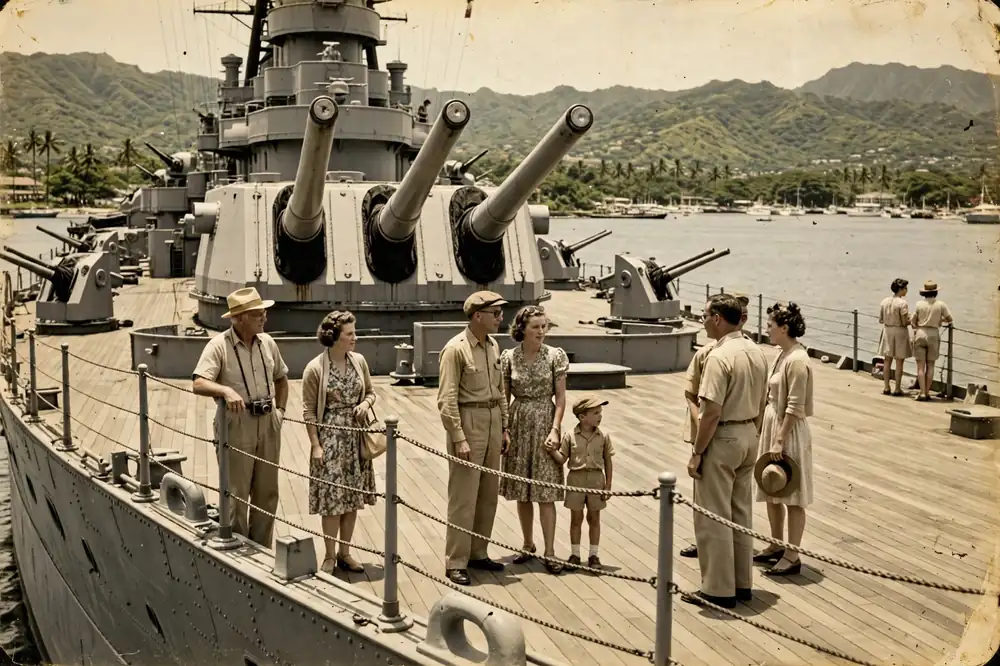
The class is remembered for its speed, its firepower and its long service, but it is remembered above all for the surrender on the Missouri, which made the class a symbol of the end of the Second World War. The four ships are now preserved as museums — the Iowa at Los Angeles, the New Jersey at Camden, the Missouri at Pearl Harbor, and the Wisconsin at Norfolk — and they are visited by millions of people each year, who come to see the 16-inch guns, to stand on the Missouri’s surrender deck, and to learn about the age of the battleship.
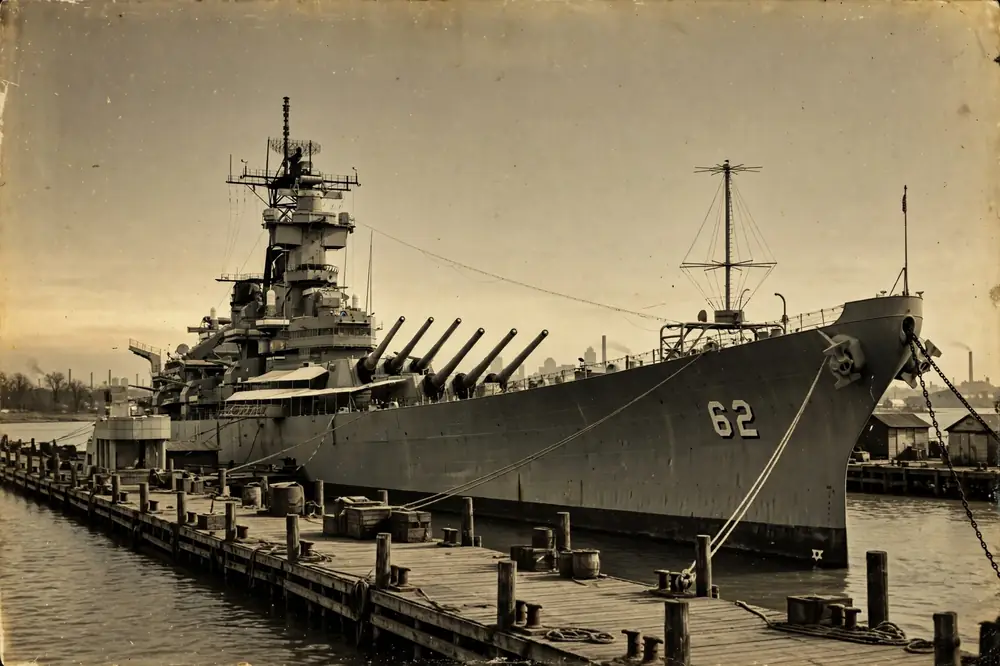
The class’s preservation as museums is a fitting end for ships that were built to be the ultimate expression of naval power, and that ended their careers as monuments to a vanished era.
10.2. The battleship in popular memory
The Iowa class holds a special place in popular memory, and it is the battleship that most people picture when they think of the type. The Missouri’s surrender deck is one of the most famous places in military history, and the ship’s image — the long, grey hull, the three triple turrets and the tall superstructure — is the visual shorthand for the battleship itself.
The class appears in films, in television programmes and in video games, and it is the subject of countless books, models and works of art, which have fixed its image in the public imagination. The Iowa class’s place in popular memory is also a measure of the battleship’s enduring appeal: the battleship was the most powerful and the most impressive weapon of its age, and the Iowa class was the most powerful and the most impressive battleship of all, a ship that combined speed, firepower and beauty in a way that no other warship has matched.
The four ships’ preservation as museums ensures that that image will endure, and that future generations will be able to stand on the decks where history was made and to understand what the age of the battleship meant.
11. Frequently Asked Questions
How many Iowa-class battleships were built?
Four were completed: USS Iowa (BB-61), USS New Jersey (BB-62), USS Missouri (BB-63) and USS Wisconsin (BB-64). Two more, Illinois (BB-65) and Kentucky (BB-66), were laid down but never completed.
How fast was the Iowa class?
The Iowa class could make 33 knots (61 km/h) on trials, making it the fastest battleship ever built. In service at full load the ships made about 31 knots, still faster than any other battleship.
What guns did the Iowa class carry?
Nine 16-inch/50-calibre Mark 7 guns in three triple turrets, which fired a 2,700-pound shell to a range of about 23 miles, plus twenty 5-inch/38-calibre dual-purpose guns and large numbers of 40 mm and 20 mm anti-aircraft guns.
Where was the Japanese surrender signed?
On the deck of the USS Missouri in Tokyo Bay, on 2 September 1945. The ceremony lasted 23 minutes and formally ended the Second World War. The surrender plaque still marks the spot on the Missouri’s deck.
Are the Iowa-class ships still in service?
No. All four were decommissioned for the final time in the early 1990s, and all four are now preserved as museums: Iowa at Los Angeles, New Jersey at Camden, Missouri at Pearl Harbor, and Wisconsin at Norfolk.
What happened in the USS Iowa turret explosion?
On 19 April 1989, an explosion in Turret Two of the USS Iowa killed 47 crewmen. The cause was never conclusively established, though the Navy’s investigation attributed it to an over-ram of the powder bags.
12. Sources
- Wikipedia, “Iowa-class battleship” — ships completed, dimensions, 33-knot speed, 16-inch guns and service history.
- Naval History and Heritage Command, “Iowa Class (BB-61 through BB-64)” — design, the Panama Canal constraint and the ships’ careers.
- USS Missouri Memorial Association, “The Surrender Ceremony” — 2 September 1945, 23 minutes, and the surrender plaque.
- Norman Friedman, U.S. Battleships: An Illustrated Design History (Naval Institute Press, 1985) — design, armour, fire control and the Mark 7 gun.
- William H. Garzke and Robert O. Dulin, Battleships: United States Battleships in World War II (Naval Institute Press, 1976) — the Iowa class, the Yamato comparison and Pacific service.
- Malcolm Muir, The Iowa Class Battleships (Blandford Press, 1987) — the 1980s reactivation, the Gulf War and the turret explosion.
Further reading
- Robert Sumrall, Iowa Class Battleships (Naval Institute Press, 1988).
- Stefan Terzibaschitsch, Battleships of the U.S. Navy in World War II (Brassey’s, 1977).