 WAR ATLAS MILITARY HISTORY MAGAZINE · WWI — WWII
Fairey Swordfish: The Biplane That Sank Battleships
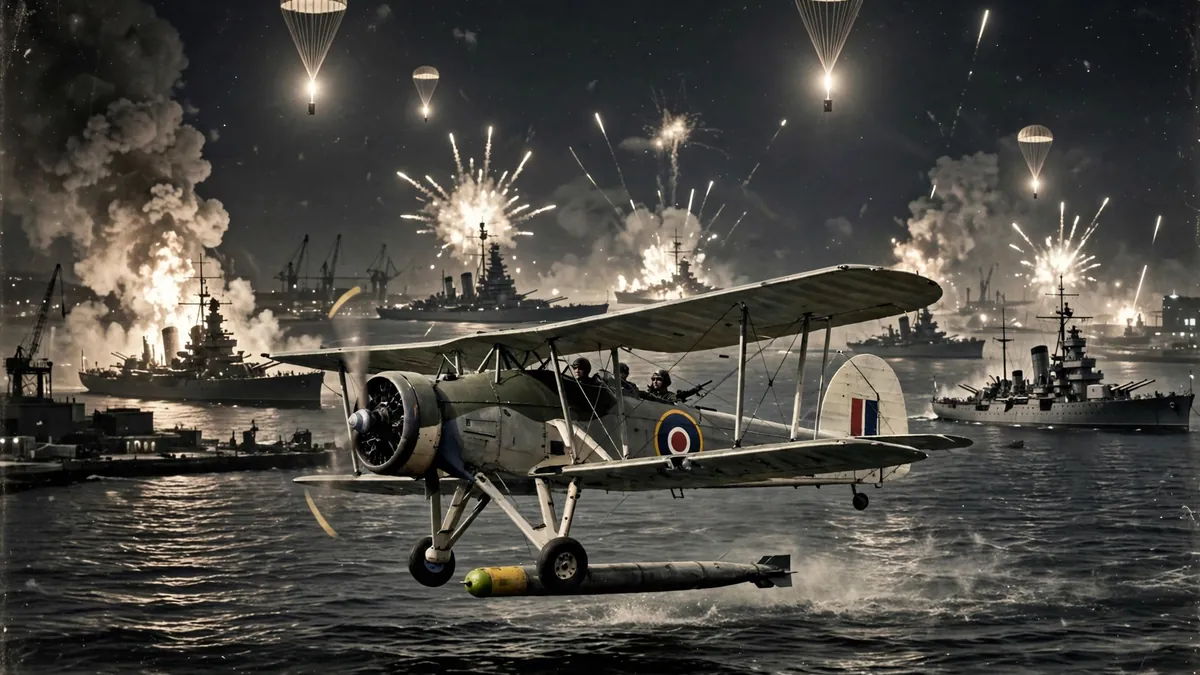
The Fairey Swordfish was a British biplane torpedo bomber of the Second World War, known affectionately to its crews as the “Stringbag” — a nickname that referred to its ability to carry almost anything, like a string shopping bag. It was an anachronism from the day it entered service: an open-cockpit biplane with fabric-covered wings, a fixed undercarriage and a top speed of barely 140 miles per hour, in an age when monoplane fighters were already flying at twice that speed. Yet the Swordfish became one of the most successful naval aircraft of the war. It crippled the Italian battle fleet at Taranto in November 1940, disabled the steering of the German battleship Bismarck in May 1941, and sank more tonnage of Axis shipping than any other Allied aircraft type.
The Swordfish’s success was a paradox, and it has fascinated historians ever since. The aircraft was slow, vulnerable and obsolescent, but it was also stable, rugged, easy to fly from the small deck of an escort carrier, and capable of operating in weather that grounded faster aircraft. Its low speed made it a difficult target for anti-aircraft gunners, whose fire-control systems were designed for faster aircraft, and its ability to fly slowly and steadily made it an ideal torpedo platform. The Swordfish served throughout the war, from the Atlantic to the Mediterranean to the Indian Ocean, and it outlasted the aircraft that were supposed to replace it, the Albacore and the Barracuda.
A total of 2,391 Swordfish were built, and the aircraft served with the Fleet Air Arm of the Royal Navy until the end of the war. It is remembered today as one of the great underdogs of aviation history: a biplane that sank battleships, a fabric-covered aircraft that survived in a war of metal monoplanes, and a machine whose crews loved it for its forgiving handling and its reliability. Several Swordfish survive in flying condition, and they remain among the most popular aircraft at air shows in Britain.
1. Key Facts
| Field | Value |
|---|---|
| Type | Torpedo bomber, spotter-reconnaissance biplane |
| Origin | United Kingdom |
| Designer | Fairey Aviation; designed by Marcel Lobelle |
| First flight | 17 April 1934 |
| In service | 1936–1945 (Fleet Air Arm) |
| Produced | 2,391 |
| Manufacturers | Fairey Aviation, Blackburn Aircraft |
| Crew | 3 (pilot, observer, telegraphist/air gunner) |
| Engine | Bristol Pegasus XXX radial, 690 hp (later versions up to 750 hp) |
| Length | Approximately 10.87 m (35 ft 8 in) |
| Wingspan | Approximately 13.87 m (45 ft 6 in) |
| Height | Approximately 3.76 m (12 ft 4 in) |
| Weight | Approximately 2,130 kg empty; approximately 3,900 kg loaded |
| Maximum speed | Approximately 222 km/h (138 mph) at 1,500 m |
| Range | Approximately 880 km (546 miles) with torpedo; approximately 1,650 km with extra fuel |
| Service ceiling | Approximately 5,900 m (19,300 ft) |
| Armament | 1 × 18 in (457 mm) torpedo or 680 kg of bombs/mines; 1 × .303 in Vickers gun forward; 1 × .303 in Lewis or Vickers K gun in rear cockpit |
| Nickname | “Stringbag” |
| Notable actions | Taranto (November 1940), Bismarck (May 1941), Channel Dash (February 1942) |
| Fate | Retired 1945; several survivors in flying condition |
2. Background and Development
A Specification from Another Era
The Swordfish was designed to Air Ministry specification S.15/33, issued in 1933 for a carrier-based torpedo bomber and spotter-reconnaissance aircraft. The specification called for a biplane, because the Admiralty believed that a biplane’s low landing speed and good handling made it ideal for carrier operations, and because the biplane’s large wing area gave it the lift needed to carry a heavy torpedo. Fairey’s designer, Marcel Lobelle, produced an aircraft that was conventional in every respect: a two-bay biplane with folding wings, a fixed undercarriage, an open cockpit for the three-man crew, and a Bristol Pegasus radial engine. The prototype first flew in April 1934, and the aircraft entered service with the Fleet Air Arm in 1936, replacing the earlier Fairey Seal.
The Stringbag Nickname
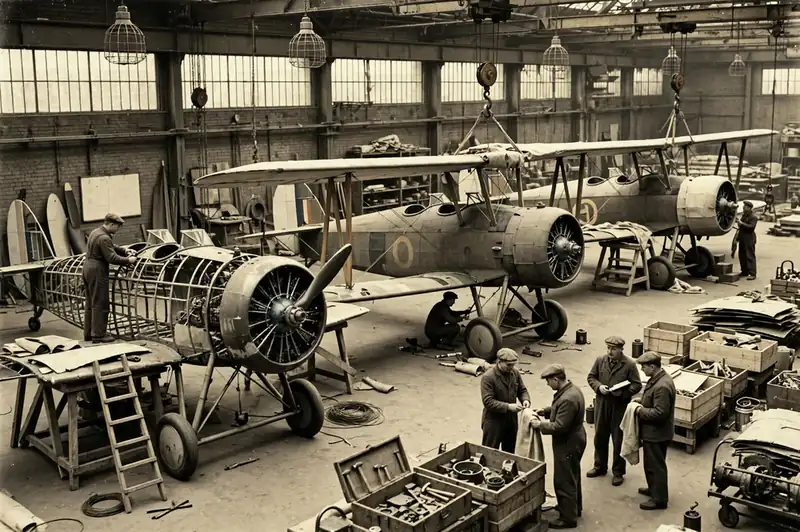
The nickname “Stringbag” was affectionate, not dismissive. It referred to the aircraft’s versatility: like a string shopping bag, the Swordfish could be loaded with almost anything — a torpedo, bombs, depth charges, mines, flares, extra fuel tanks, or a passenger in the rear cockpit. The nickname also reflected the crews’ fondness for the aircraft: it was forgiving to fly, easy to maintain, and reliable in the worst weather. The Swordfish’s fabric-covered wings and open cockpit made it seem old-fashioned even in 1936, but its crews trusted it, and that trust was vindicated in combat. The aircraft’s successor, the Fairey Albacore, was a more modern design, but it never matched the Swordfish’s popularity, and the Swordfish outlived it in service.
Obsolescent but Indispensable
By 1939 the Swordfish was already obsolescent. Monoplane torpedo bombers were faster and better armed, and the Swordfish’s top speed of 138 mph made it vulnerable to any modern fighter. But the Fleet Air Arm had no replacement ready, and the Swordfish’s ability to operate from small carriers, its stability as a torpedo platform, and its reliability kept it in front-line service throughout the war. The aircraft’s low speed, which seemed a fatal weakness, turned out to be an advantage in combat: anti-aircraft gunners found it difficult to track a slow, low-flying biplane, and the Swordfish could fly through flak that would have destroyed a faster aircraft. The Swordfish is a classic example of an aircraft that succeeded not because of its performance, but in spite of it.
3. Design
Airframe, Wings and Carrier Operation
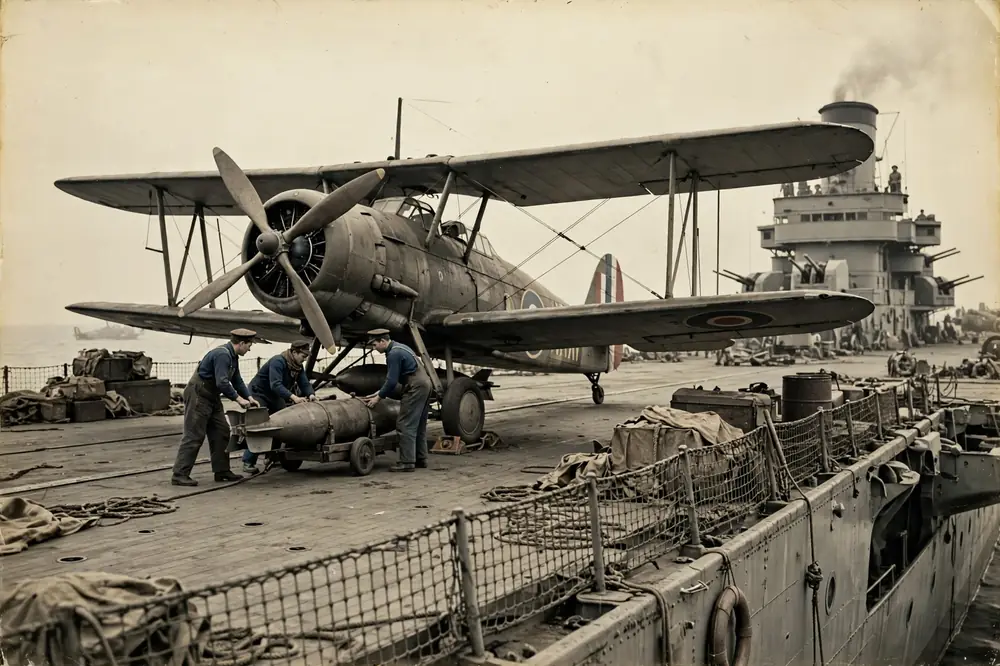
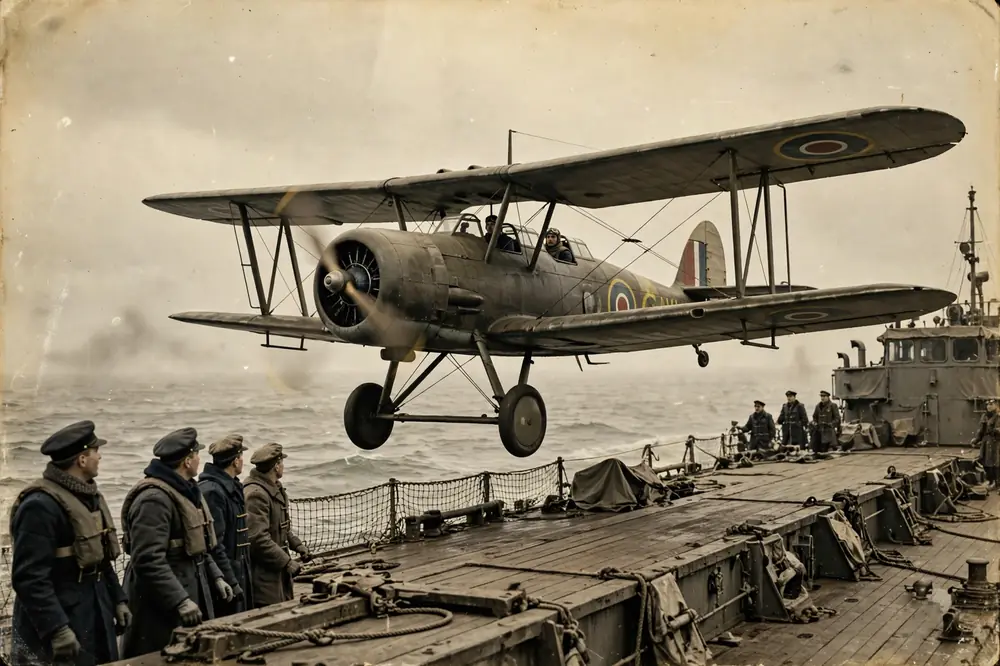
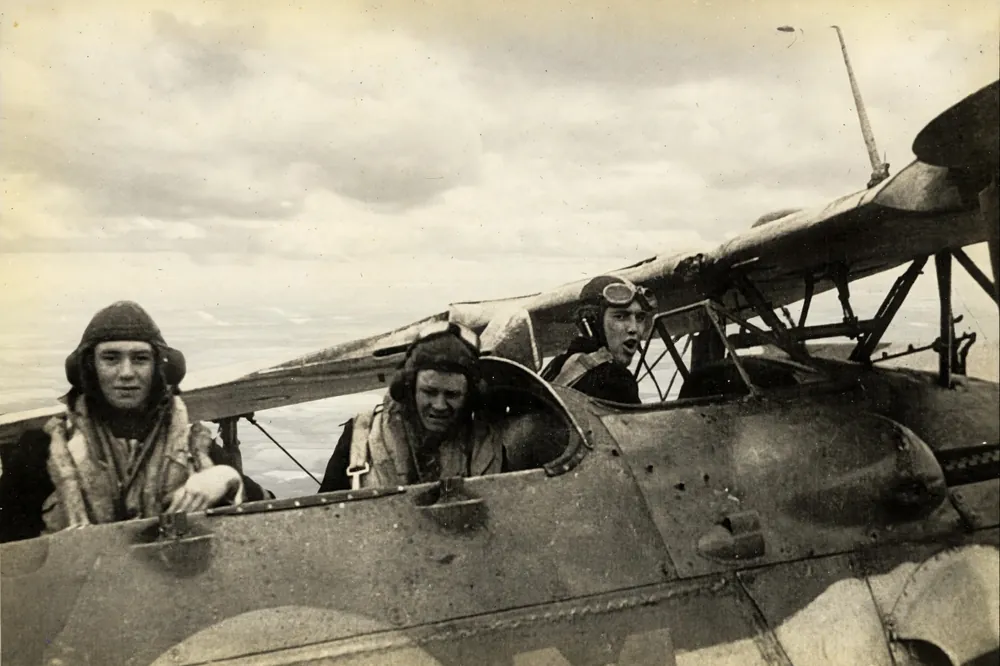
The Swordfish was a two-bay biplane with a steel-tube fuselage covered in fabric and metal panels, and wings of fabric-covered wood and metal construction. The wings folded back for stowage aboard carriers, a feature that was essential for operating from the small hangars of British carriers. The fixed undercarriage was rugged and simple, and the aircraft could be fitted with floats for operation from seaplane carriers and catapult ships. The open cockpit exposed the three-man crew — pilot, observer and telegraphist/air gunner — to the wind and the weather, and the crews flew in heavy clothing even in summer. The aircraft’s handling was gentle and forgiving, and it could be flown safely at very low speeds, which made it ideal for torpedo attacks and for landing on a carrier deck.
Engine and Performance
The Bristol Pegasus XXX radial engine produced 690 horsepower, and later versions produced up to 750 horsepower, giving the Swordfish a top speed of about 138 mph and a cruising speed of about 104 mph. The range was about 546 miles with a torpedo, and up to about 1,030 miles with extra fuel tanks in place of the torpedo. The service ceiling was about 19,300 feet, although the aircraft rarely operated at that height. The Swordfish’s performance was modest by any standard, but it was adequate for its role: the aircraft did not need speed, because it attacked ships at low level and at close range, and its low speed made it a stable torpedo platform. The engine was reliable and easy to maintain, and the aircraft could operate from the smallest escort carriers in the worst Atlantic weather.
Armament and the Torpedo
The Swordfish’s main weapon was the 18-inch Mark XII torpedo, a weapon of about 1,600 pounds that could be dropped at low speed and low altitude. The aircraft could also carry up to 1,500 pounds of bombs, depth charges or mines, and it was fitted with a forward-firing .303-inch Vickers machine gun and a rear .303-inch Lewis or Vickers K gun for defence. The torpedo was the weapon that made the Swordfish famous: at Taranto and against Bismarck, the torpedo attacks were delivered at close range and at low level, in conditions that demanded steady flying and great courage from the crews. The Swordfish’s ability to carry a torpedo, a heavy load for an aircraft of its size, was a testament to its design, and it was the reason the aircraft remained in service long after faster aircraft had replaced it in other roles.
4. Variants
Swordfish Mk I and Mk II
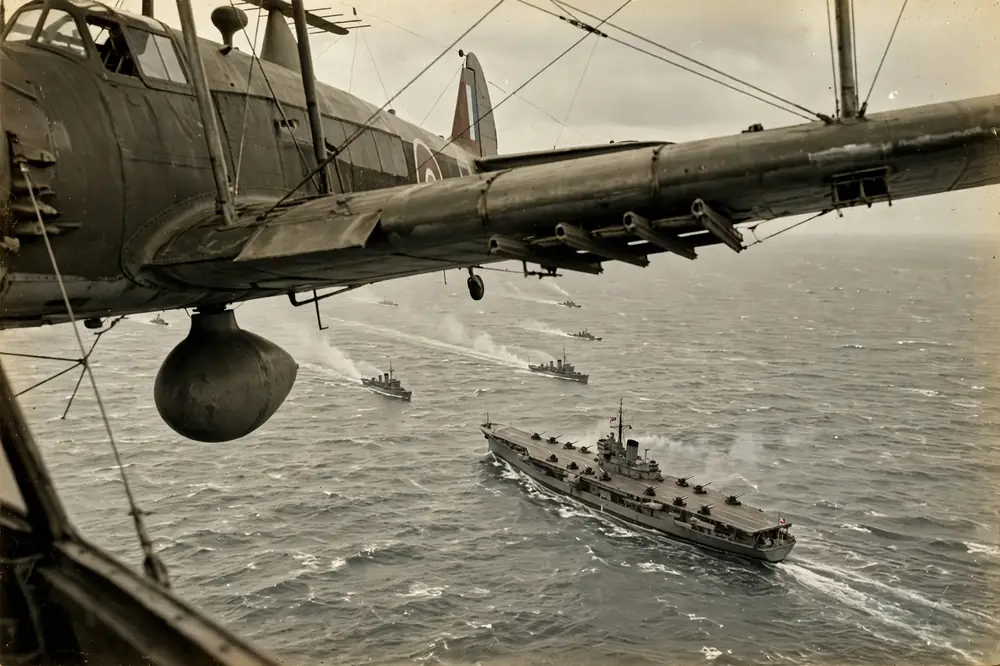
The Swordfish Mk I was the first production version, powered by the Bristol Pegasus IIIM.3 engine and fitted with a fixed undercarriage and, on some aircraft, floats. The Mk II, introduced in 1943, was powered by the more powerful Pegasus XXX engine and fitted with metal-covered lower wings to allow the carriage of rockets. The Mk II was the version that served in the anti-submarine role from escort carriers, and it was fitted with rocket rails and with improved radio equipment. The Mk II was the most numerous version in the later war, and it was the aircraft that sank U-boats in the Atlantic.
Swordfish Mk III and Mk IV
The Swordfish Mk III was fitted with centimetric radar in a radome between the undercarriage legs, for the anti-submarine role, and it became the standard escort-carrier aircraft in the Atlantic. The radar allowed the Swordfish to find U-boats at night and in bad weather, and the aircraft’s ability to operate from small carriers made it ideal for convoy escort. The Mk IV was the last production version, a Mk II with an enclosed cockpit, built in small numbers for the Royal Canadian Air Force. The Mk IV was the only Swordfish with a closed cockpit, and it was a reminder that even the Stringbag was eventually modernised.
Floatplane and Catapult Versions
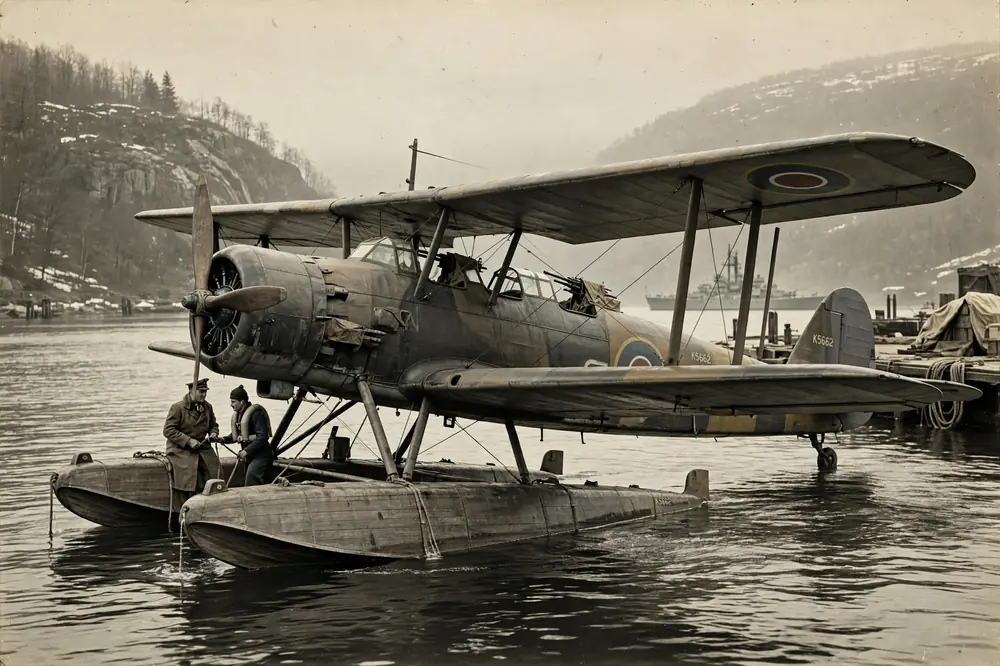
Some Swordfish were fitted with floats for operation from seaplane carriers and from catapult-equipped merchant ships, known as CAM ships. The floatplane Swordfish served in the early war as a spotter and reconnaissance aircraft, and it was used to search for German raiders and to spot for naval gunfire. The floatplane version was slower and less manoeuvrable than the wheeled version, but it extended the Swordfish’s usefulness to ships that had no flight deck. The floatplane Swordfish was withdrawn from service as more carriers became available, but it had played an important role in the early war.
5. Operational History
Taranto: The Night of 11–12 November 1940
The Swordfish’s most famous operation was the attack on the Italian fleet at Taranto on the night of 11–12 November 1940. Twenty-one Swordfish from the carrier HMS Illustrious, launched in two waves, attacked the Italian battleships at anchor in the harbour, in an operation that had been planned for years and rehearsed in secret. The Swordfish flew in at low level, through heavy anti-aircraft fire and barrage balloons, and dropped their torpedoes at close range. Three Italian battleships — Littorio, Caio Duilio and Conte di Cavour — were torpedoed and put out of action, and the Italian Navy’s battle fleet was crippled for months. The attack was a triumph for naval aviation: it showed that aircraft could sink battleships at anchor, and it was studied by the Japanese before their attack on Pearl Harbor a year later. The Swordfish’s slow speed and stability had made the attack possible, and the aircraft’s crews were decorated for their courage.
Bismarck: The Torpedo That Changed History
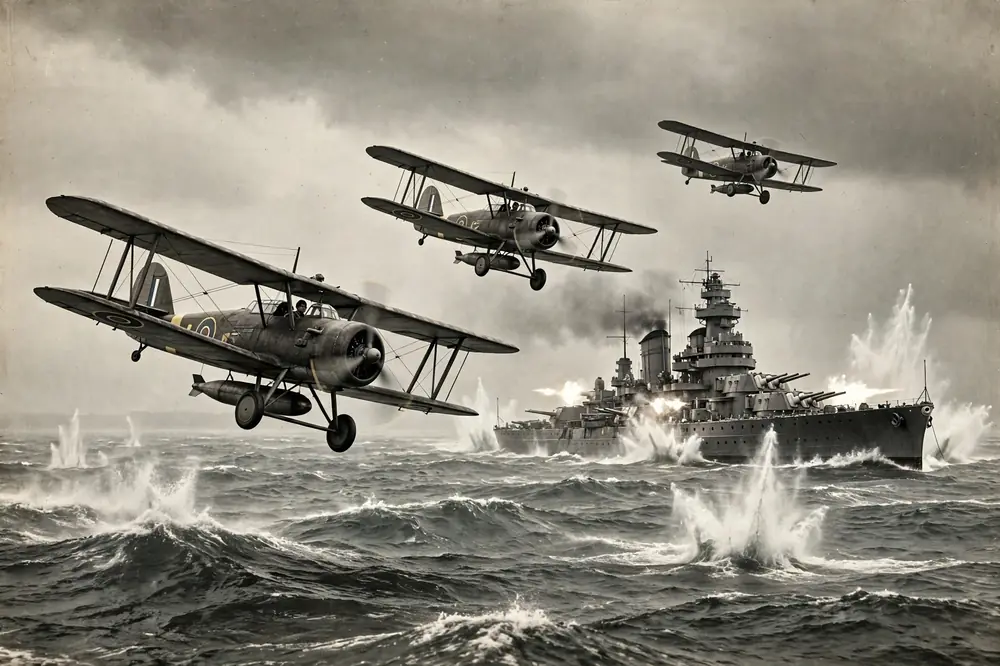
The Swordfish’s second famous action came in May 1941, in the hunt for the German battleship Bismarck. After Bismarck had sunk HMS Hood and damaged HMS Prince of Wales in the Denmark Strait, the Royal Navy pursued her across the Atlantic. On the evening of 26 May 1941, fifteen Swordfish from the carrier HMS Ark Royal attacked Bismarck in heavy weather, flying through intense anti-aircraft fire. Two torpedoes hit the battleship, and one of them jammed her rudder, leaving her unable to steer and circling helplessly in the Atlantic. The next morning British battleships caught and sank her. The Swordfish’s attack had been decisive: without the jammed rudder, Bismarck would have reached the safety of the French coast. The crews’ achievement was all the more remarkable because they had flown in weather that grounded other aircraft, and because they had attacked a battleship whose anti-aircraft fire was among the heaviest in the world.
The Channel Dash and the Atlantic
The Swordfish’s least successful operation was the Channel Dash in February 1942, when six Swordfish of 825 Naval Air Squadron attacked the German battleships Scharnhorst and Gneisenau as they sailed through the English Channel. The Swordfish were unescorted and were shot down by German fighters before they could launch their torpedoes, and all six aircraft were lost. The squadron’s leader, Lieutenant Commander Eugene Esmonde, was awarded a posthumous Victoria Cross. The Channel Dash showed the Swordfish’s vulnerability to fighters, but the aircraft’s later service in the Atlantic was more successful: operating from escort carriers, Swordfish Mk IIs and Mk IIIs sank U-boats and protected convoys, and the aircraft served in the anti-submarine role until the end of the war. The Swordfish’s Atlantic service was unglamorous but vital, and it was the role in which the aircraft spent most of its wartime career.
6. Performance and Specifications
Strengths on the Battlefield
The Swordfish’s strengths were its stability, its reliability, and its ability to operate from small carriers in bad weather. As a torpedo platform it was superb: it could fly slowly and steadily at low level, giving the pilot time to aim and the torpedo time to run straight. Its rugged construction meant it could absorb battle damage, and its simple design made it easy to maintain aboard a carrier. The aircraft’s crews loved it for its forgiving handling, and its ability to operate in weather that grounded other aircraft made it indispensable in the Atlantic, where the weather was often appalling. The Swordfish’s low speed, which seemed a weakness, was an advantage against anti-aircraft fire, whose predictors were designed for faster targets.
Weaknesses and Trade-offs
The weaknesses were obvious: the Swordfish was slow, vulnerable to fighters, and armed with only two light machine guns for defence. It could not survive in daylight against modern fighters, as the Channel Dash showed, and its open cockpit exposed its crew to the elements. Its range was limited, and its payload was modest compared with that of later torpedo bombers. The Swordfish was a product of the 1930s, and by 1942 it was hopelessly outclassed as a strike aircraft. But its weaknesses were also its strengths: the aircraft that was too slow to be shot down by flak predictors, too rugged to be grounded by bad weather, and too simple to break down, was the aircraft that could do the jobs no other aircraft could do.
How the Swordfish Compared with Rivals
Compared with the American Douglas TBD Devastator, the Swordfish was slower but more reliable and more successful: the Devastator was slaughtered at Midway, while the Swordfish sank battleships. Compared with the Japanese Nakajima B5N Kate, the Swordfish was slower and less well armed, but more rugged and more versatile. Compared with its intended replacement, the Fairey Albacore, the Swordfish was slower but more popular with its crews and more successful in combat. Compared with the Fairey Barracuda, which eventually replaced it, the Swordfish was slower and less capable, but the Barracuda’s early service was marred by accidents and unreliability. The Swordfish’s record stands comparison with any torpedo bomber of the war.
7. Operators
The Fleet Air Arm
The principal operator of the Swordfish was the Fleet Air Arm of the Royal Navy, which operated the type with more than twenty squadrons aboard fleet carriers, escort carriers, seaplane carriers and catapult ships. The Swordfish squadrons included Nos. 810, 812, 813, 815, 818, 820, 821, 825 and 830 Squadrons, among others. The Fleet Air Arm’s Swordfish crews were among the most experienced naval aviators of the war, and their operations at Taranto, against Bismarck, and in the Atlantic were among the most important naval air operations of the conflict.
Commonwealth and Other Users
The Swordfish was also operated by the Royal Canadian Air Force and the Royal Canadian Navy, which flew the type from escort carriers and from shore bases in the anti-submarine role. The Royal Netherlands Naval Air Service operated Swordfish from British carriers, and the aircraft was used by the Free French Naval Air Service. The Swordfish’s Commonwealth service was a measure of its importance: it was not a purely British aircraft, but a Commonwealth naval aircraft, and its crews came from across the British Empire.
8. Legacy and Influence
Taranto and Pearl Harbor
The Swordfish’s legacy is above all the attack on Taranto, which demonstrated that aircraft could cripple a battle fleet at anchor and which was studied by the Japanese before Pearl Harbor. The Taranto raid is often cited as the operation that proved the aircraft carrier had replaced the battleship as the capital ship, and the Swordfish was the aircraft that proved it. The attack on Bismarck demonstrated the same lesson in a different form: a slow biplane could disable the most powerful battleship in the world. The Swordfish’s career thus marks a turning point in naval history, the moment when naval aviation came of age.
Memory and the Stringbag
The Swordfish is remembered with affection by naval aviators and by the public. The nickname “Stringbag” has become a part of British naval folklore, and the aircraft is a popular subject at air shows, where the surviving flying Swordfish are among the most photographed aircraft. The Swordfish’s crews are remembered for their courage, particularly at Taranto and against Bismarck, and the aircraft’s story has been told in books, films and documentaries. The Swordfish is the great underdog of naval aviation, and its reputation has only grown with time.
Lessons for Later Aircraft
The Swordfish’s lessons were carried into the design of later naval aircraft. The value of a stable torpedo platform, of ruggedness and reliability, and of the ability to operate from small carriers in bad weather, were all demonstrated by the Swordfish, and they influenced the design of the Barracuda and of post-war naval aircraft. The Swordfish also demonstrated the importance of training and of crew morale: an aircraft that its crews trusted was an aircraft that could achieve the impossible. The Swordfish’s career is a reminder that in war, the best aircraft is not always the fastest or the most modern, but the one that can do the job in the conditions that exist.
9. Surviving Examples
Flying Swordfish
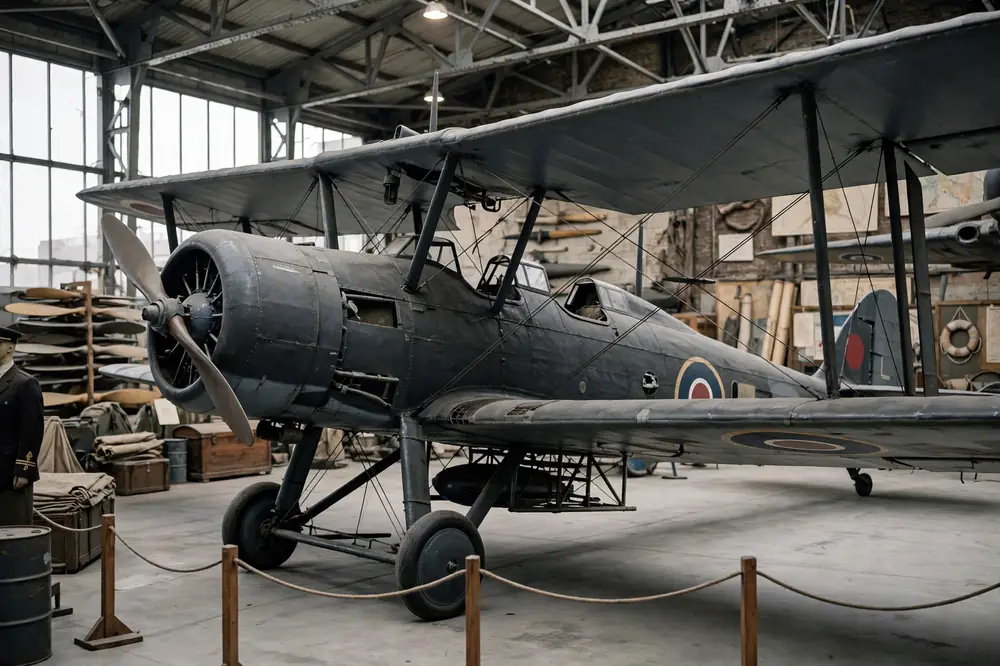
Several Swordfish survive in flying condition, a remarkable survival rate for a wartime aircraft. The Royal Navy Historic Flight, based at Yeovilton, operates a flying Swordfish, and the aircraft is a regular performer at air shows in Britain. The Imperial War Museum at Duxford displays a Swordfish, and the Fleet Air Arm Museum at Yeovilton holds several examples, including a Swordfish that flew at Taranto. The Canadian Warplane Heritage Museum in Hamilton, Ontario, operates a flying Swordfish, and the aircraft is a popular exhibit at Canadian air shows. The survival of so many Swordfish is a testament to the aircraft’s popularity and to the efforts of preservation groups.
Museum Examples
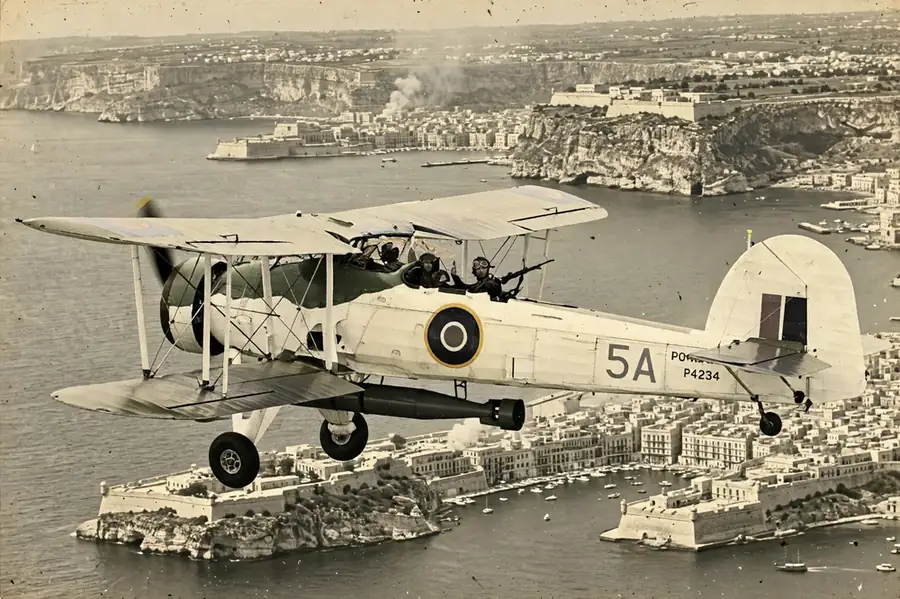
Other Swordfish are preserved in museums around the world. The Malta Aviation Museum displays a Swordfish that operated from Malta during the siege, and the Australian War Memorial holds Swordfish components. The Swordfish’s preservation in relatively large numbers reflects its production run and its long service, and it ensures that future generations can see the biplane that sank battleships. The flying examples are particularly valuable, because they demonstrate the Swordfish’s slow, steady flight and its distinctive engine note, which no photograph can convey.
Frequently Asked Questions
What was the Fairey Swordfish?
The Fairey Swordfish was a British biplane torpedo bomber of the Second World War, operated by the Fleet Air Arm of the Royal Navy. Known as the “Stringbag”, it was slow and obsolescent but highly successful, crippling the Italian fleet at Taranto and disabling the German battleship Bismarck. The aircraft was designed in 1933 to a specification for a carrier-based torpedo bomber, and it entered service in 1936, replacing the earlier Fairey Seal. Its three-man crew flew in open cockpits, and the aircraft’s fabric-covered wings and fixed undercarriage made it seem old-fashioned even when it was new.
Why was it called the Stringbag?
The nickname referred to the aircraft’s versatility: like a string shopping bag, the Swordfish could carry almost anything — a torpedo, bombs, depth charges, mines or extra fuel. The nickname was affectionate, reflecting the crews’ fondness for the aircraft’s forgiving handling and reliability. The Swordfish could be loaded with a remarkable variety of stores, and it was used as a torpedo bomber, a bomber, a spotter, a reconnaissance aircraft and an anti-submarine aircraft. The nickname has become a part of British naval folklore, and it captures the aircraft’s character better than any official designation.
How did a biplane sink battleships?
The Swordfish’s low speed made it a stable torpedo platform and a difficult target for anti-aircraft gunners, whose predictors were designed for faster aircraft. At Taranto in 1940, Swordfish torpedoed three Italian battleships at anchor, crippling the Italian battle fleet for months; against Bismarck in 1941, a Swordfish torpedo jammed the battleship’s rudder, leaving her helpless in the Atlantic. The attacks were delivered at close range and at low level, in conditions that demanded steady flying and great courage, and the Swordfish’s slow, steady flight was exactly what the torpedo attacks required.
How many Swordfish were built?
A total of 2,391 Swordfish were built by Fairey and Blackburn between 1936 and 1944. The aircraft served with the Fleet Air Arm until the end of the war, outlasting the Albacore and the Barracuda, the aircraft that were supposed to replace it. The Albacore was a more modern design, but it never matched the Swordfish’s popularity with its crews, and the Barracuda’s early service was marred by accidents and unreliability. The Swordfish’s long service was a testament to its ruggedness and to the absence of a satisfactory replacement.
Was the Swordfish obsolete?
Yes, by 1939 the Swordfish was obsolescent: it was slow, vulnerable to fighters and armed with only light machine guns. But it remained in service because it could operate from small carriers in bad weather, because it was a superb torpedo platform, and because no replacement was ready. Its record vindicated the decision to keep it: the aircraft sank more tonnage of Axis shipping than any other Allied aircraft type, and its operations at Taranto and against Bismarck were among the most important naval air operations of the war. The Swordfish is a classic example of an aircraft that succeeded in spite of its performance, not because of it.
How many Swordfish survive today?
Several Swordfish survive in flying condition, including aircraft operated by the Royal Navy Historic Flight and the Canadian Warplane Heritage Museum, and others are preserved in museums at Yeovilton, Duxford and Malta. The survival rate is unusually high for a wartime aircraft, and it reflects the Swordfish’s popularity and the efforts of preservation groups. The flying examples are among the most popular aircraft at air shows in Britain, where their slow, steady flight and distinctive engine note attract crowds. The Fleet Air Arm Museum at Yeovilton holds several examples, including a Swordfish that flew at Taranto.
Sources
- Harrison, W. A., Fairey Swordfish and Albacore (Hall Park Books).
- Sturtivant, Ray, The Swordfish Story (Cassell).
- Lamb, Charles, War in a Stringbag (Cassell) — memoir of a Swordfish pilot.
- Brown, David, The Royal Navy and the Mediterranean (various naval histories).
- The Fleet Air Arm Museum, Yeovilton, Swordfish collection records.
-
The Imperial War Museum, London, Taranto and Bismarck collection records.
-
Roskill, Stephen, The War at Sea 1939-1945, Volume I (HMSO).
- The National Archives, Kew, Admiralty records for the Fleet Air Arm, ADM 199 series.