 WAR ATLAS MILITARY HISTORY MAGAZINE · WWI — WWII
IS-3 Tank: The Soviet Heavy Tank with the Pike-Nose Hull
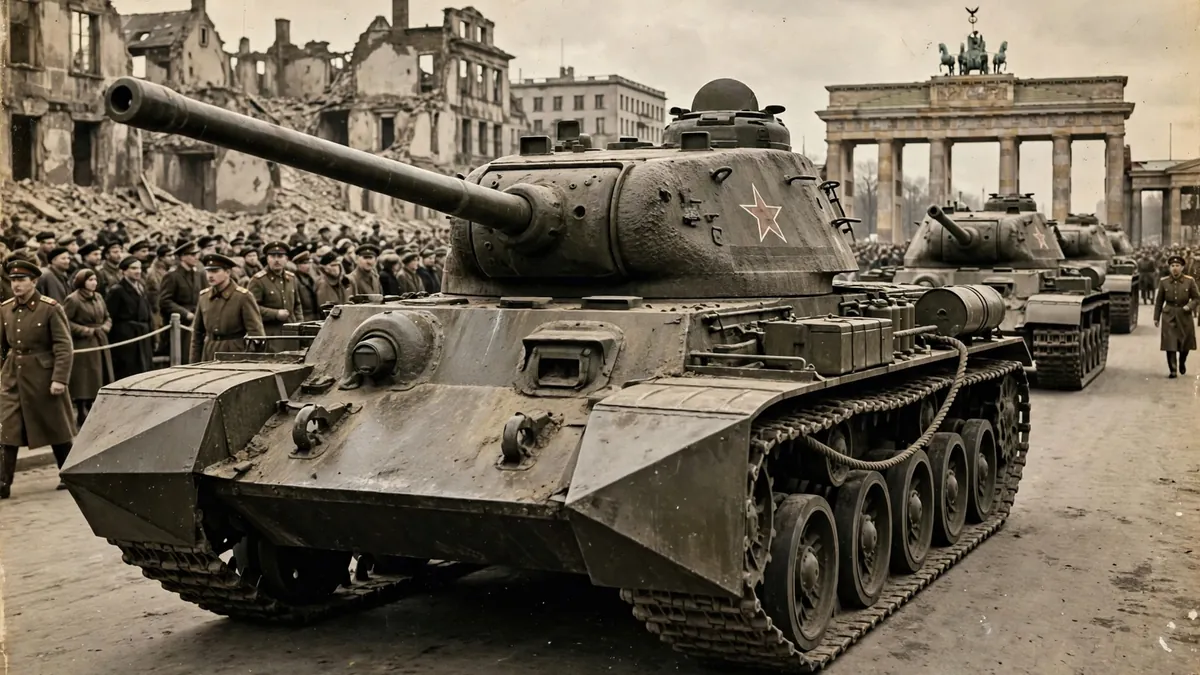
The IS-3 was the Soviet Union’s most advanced heavy tank of the Second World War, a vehicle that arrived too late to fight in the war in Europe but which became one of the most famous tanks of the Cold War. With its distinctive pike-nose hull, its low, hemispherical turret, and its powerful 122 mm D-25T gun, the IS-3 was a radical departure from earlier Soviet heavy tanks, and it stunned Western observers when it appeared in the Allied victory parade in Berlin on 7 September 1945. Approximately 2,311 IS-3 tanks were built between 1945 and 1946, and the type served in the Soviet Army and in the armies of many allied countries, fighting in the Six-Day War and in other conflicts, and remaining in service into the 1970s. The IS-3 is remembered as a symbol of Soviet tank design at its most innovative, and as a tank that influenced the design of heavy tanks around the world.
The IS-3 was developed in 1944, when Soviet designers at the Chelyabinsk Kirov Plant, led by Nikolai Dukhov, sought to improve on the IS-2, which had been the Red Army’s main heavy tank since late 1943. The IS-2 was a good tank, but its hull and turret were vulnerable to the German 88 mm gun, and its designers wanted a tank with better protection and a lower silhouette. The IS-3 used a new hull, with a pointed, pike-nose front that deflected anti-tank shells, and a new turret, with a low, rounded shape that was difficult to hit. The IS-3 kept the IS-2’s 122 mm gun and its V-2 diesel engine, but it was a new tank in every other respect, and it represented the peak of Soviet heavy tank design in the Second World War.
The IS-3 is remembered as one of the most influential tanks of the Cold War, a vehicle that shaped Western tank design and that served in combat in the Middle East, where its 122 mm gun and its thick armour made it a formidable opponent. It appears in museums in Russia, Egypt, Israel and Britain, and it is a popular subject for military historians and model makers. The IS-3’s distinctive pike nose and its low turret remain one of the most recognisable images of Soviet armour in the Cold War.
1. Key Facts
| Field | Value |
|---|---|
| Type | Heavy tank |
| Origin | Soviet Union |
| Designed | 1944-1945 (Object 703; Chelyabinsk Kirov Plant) |
| In service | 1945-1970s (Soviet Union; later with other users) |
| Produced | Approximately 2,311 |
| Manufacturer | Chelyabinsk Kirov Plant (ChKZ) |
| Crew | 4 (commander, gunner, loader, driver) |
| Weight | Approximately 46-49 tons |
| Length | Approximately 9.85 m (with gun); hull about 6.90 m |
| Width | Approximately 3.39 m |
| Height | Approximately 2.45 m |
| Armour | Up to 110-120 mm (hull front, pike nose); turret up to 220 mm |
| Main armament | 122 mm D-25T gun (28 rounds) |
| Secondary armament | 12.7 mm DShK heavy machine gun, 7.62 mm DT machine guns |
| Engine | V-11-IS-3 (V-2) V-12 diesel engine, approximately 520 hp |
| Speed | Approximately 37 km/h (23 mph) maximum on roads |
| Range | Approximately 200 km (125 miles) on roads |
| Notable variants | IS-3 (1945 model); IS-3M (modernised, 1950s) |
2. Background and Development
The Limits of the IS-2
The origins of the IS-3 lay in the limitations of the IS-2, which had been the Red Army’s main heavy tank since late 1943. The IS-2 was a good tank, with a powerful 122 mm gun and thick armour, but its hull front, with its stepped plate, was vulnerable to the German 88 mm gun, and its turret, with its flat front, was also vulnerable. Soviet designers at the Chelyabinsk Kirov Plant, led by Nikolai Dukhov, wanted a tank with better protection, a lower silhouette, and a more efficient use of armour. The result was the IS-3, which was designed in 1944 as the Object 703, and which used a new hull and a new turret, while keeping the IS-2’s gun and engine. The IS-3 was a radical departure from the IS-2, and it represented a new approach to heavy tank design.
Nikolai Dukhov and the Object 703
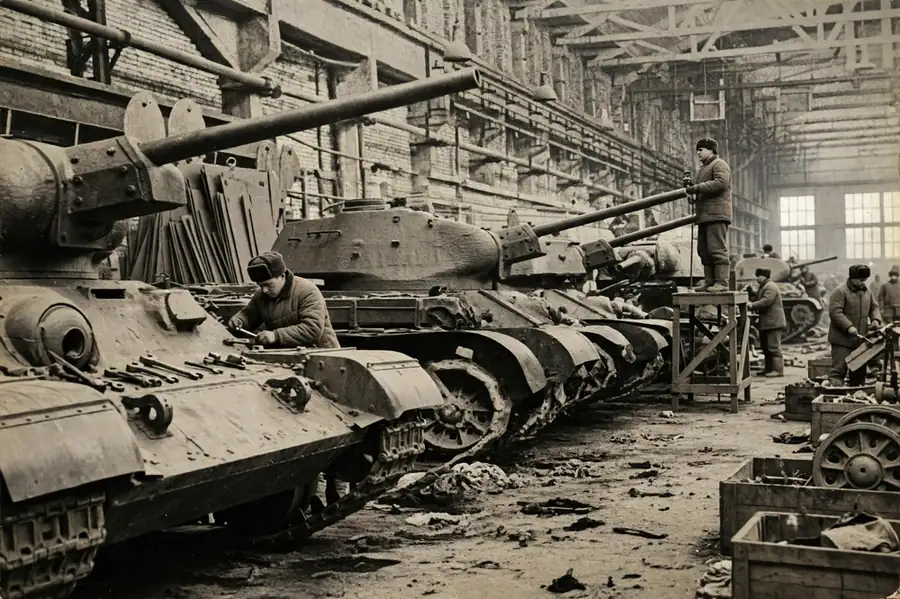
The IS-3 was developed by the design bureau of the Chelyabinsk Kirov Plant, under the direction of Nikolai Dukhov, the chief designer of Soviet heavy tanks. The project was designated Object 703, and it was based on the IS-2’s chassis and engine, but with a new hull and turret. The hull’s front was shaped like a pike nose, with two sloped plates meeting at a point, which deflected anti-tank shells and gave the tank better protection than the IS-2’s flat front. The turret was a low, hemispherical casting, with a thick front and a small silhouette, which made it difficult to hit. The first prototype was built in late 1944, and it was tested at the Kubinka proving ground, where its armour and its mobility were praised. The IS-3 was accepted for service in early 1945, and production began at Chelyabinsk in May 1945, just as the war in Europe was ending.
A Tank Designed for the Future
The IS-3 was designed not only for the Second World War, but for the future. Its pike-nose hull and its low turret were innovations that would influence tank design for decades, and its 122 mm gun was the most powerful tank gun in Soviet service. The IS-3’s designers believed that the tank would be the Red Army’s main heavy tank in the post-war era, and that it would serve for many years. The IS-3 was thus a tank designed for the Cold War, even though it was developed during the Second World War, and its design reflects the Soviet Union’s ambition to build the best heavy tank in the world.
3. Design
The Pike-Nose Hull and Armour
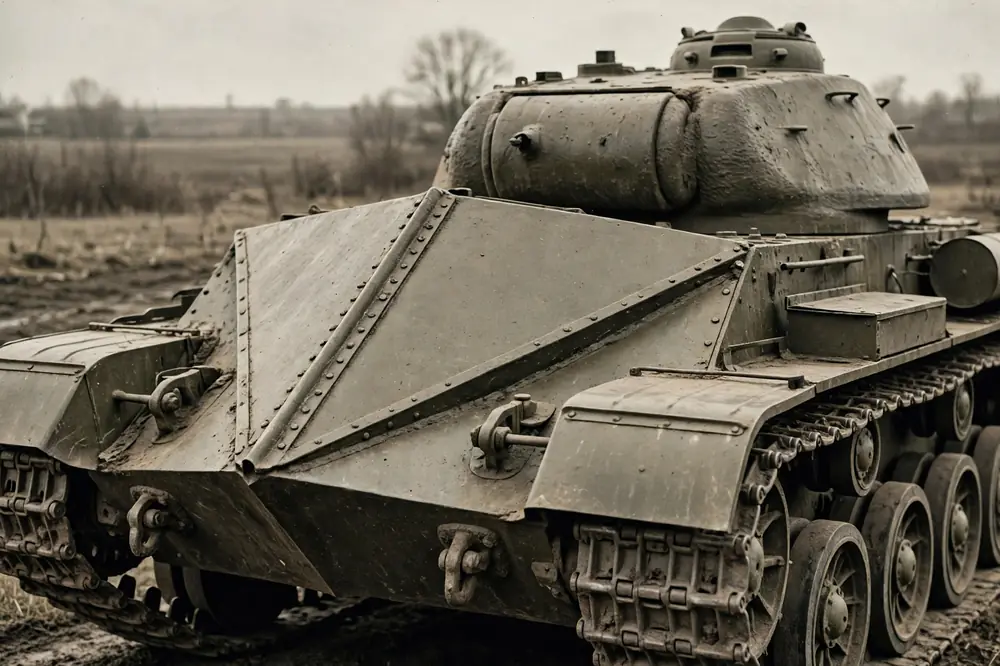
The IS-3’s most distinctive feature was its pike-nose hull, with two sloped frontal plates meeting at a sharp point, like the nose of a pike. The pike nose was designed to deflect anti-tank shells, and it gave the IS-3 better frontal protection than the IS-2, with up to 110 to 120 mm of armour on the hull front. The hull sides were protected by 90 mm of armour, and the turret, which was a low, hemispherical casting, had up to 220 mm of armour on its front. The IS-3’s armour was thicker and better shaped than the IS-2’s, and its low silhouette, at only 2.45 metres high, made it a difficult target. The IS-3’s hull was also wider than the IS-2’s, at about 3.39 metres, which gave it better stability and more room for the crew.
The Low Turret and the 122 mm Gun
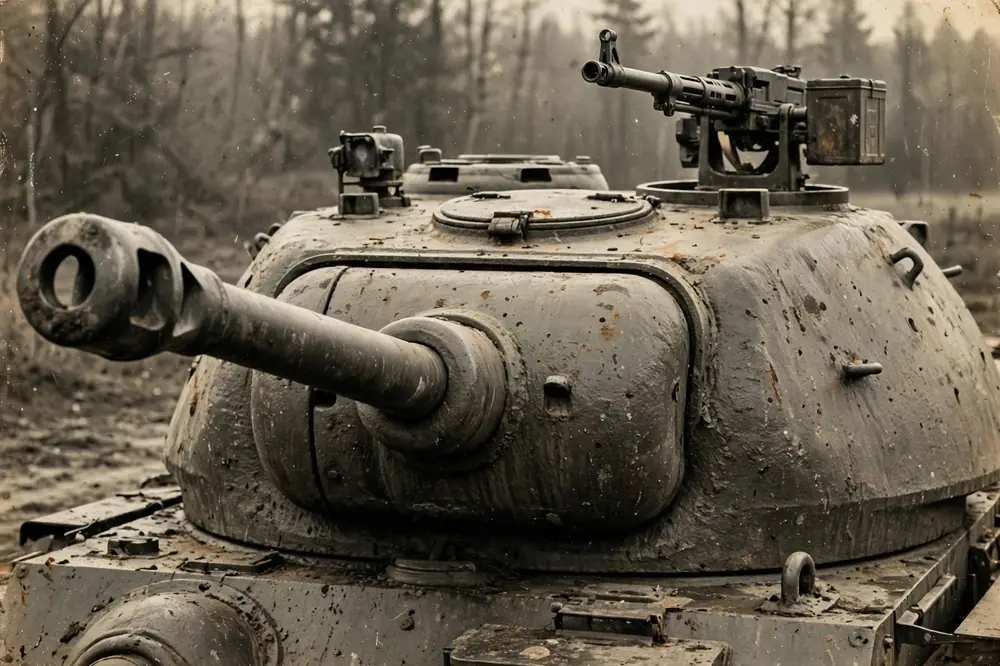
The IS-3’s turret was a low, hemispherical casting, with a thick front and a small silhouette, which made it difficult to hit and difficult to penetrate. The turret housed the 122 mm D-25T gun, the same gun as the IS-2, which fired a two-part round and had a rate of fire of about two to three rounds per minute. The IS-3 carried 28 rounds of ammunition, and its gun could penetrate about 140 mm of armour at 1,000 metres. The turret’s low shape meant that the gun had limited depression, only about 3 degrees, which made it difficult to fire from a hull-down position on a reverse slope. The IS-3’s turret was a significant advance over the IS-2’s, but its low shape also created problems, notably the limited gun depression and the cramped interior.
Engine, Mobility and Ergonomics
The IS-3 was powered by the V-11-IS-3 diesel engine, a development of the V-2, which produced about 520 horsepower, giving a top speed of about 37 kilometres per hour on roads. The IS-3’s mobility was similar to the IS-2’s, and its range was about 200 kilometres. The IS-3 carried a crew of four: a commander, a gunner, a loader and a driver. The driver’s position was in the front of the hull, and the commander, gunner and loader worked in the turret, which was cramped because of its low shape. The IS-3’s interior was spartan, and the loader’s job was physically exhausting, handling separate shells and charges that each weighed more than 20 kilograms. The IS-3’s crews praised its protection and its gun, but they complained about the cramped turret and the limited gun depression.
4. Variants
The IS-3 (1945 Model)
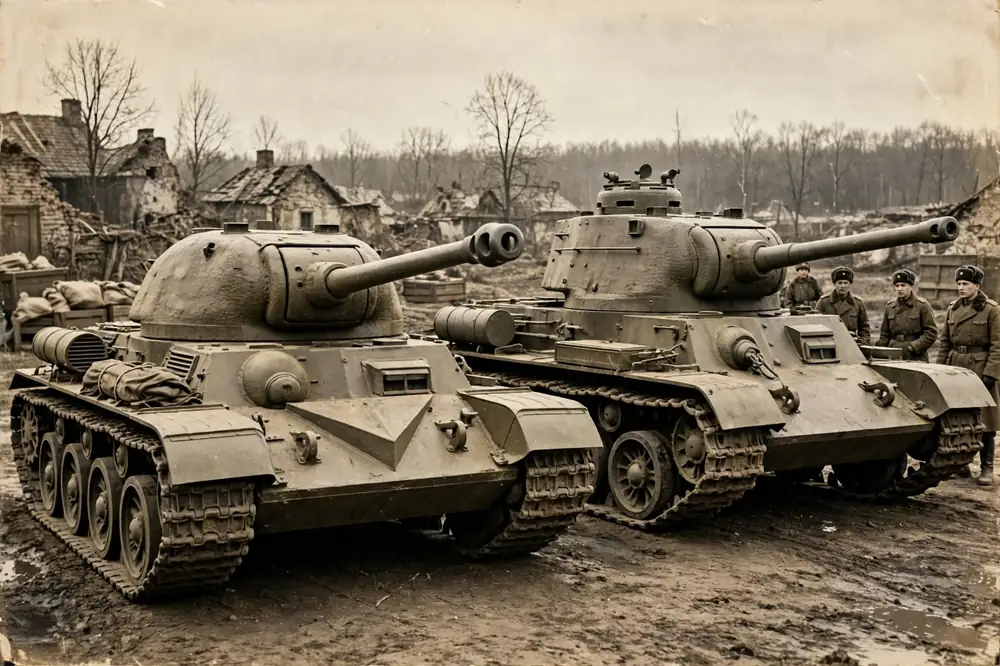
The IS-3 was built in a single main production version, the 1945 model, which was built between May 1945 and 1946. The 1945 model had the pike-nose hull and the low turret, and it was armed with the 122 mm D-25T gun. The production run of about 2,311 vehicles was built at the Chelyabinsk Kirov Plant, and the type was issued to the Soviet Army’s heavy tank regiments. The IS-3’s single version is a sign of its sound design, although the tank’s early production vehicles had problems with the engine and the transmission, which were later fixed in the IS-3M modernisation.
The IS-3M Modernisation
After the war, many IS-3 tanks were modernised to the IS-3M standard in the 1950s. The IS-3M received a new engine, improved fire control equipment, a new radio, additional fuel tanks and a revised ammunition stowage. The modernisation also included night-driving equipment and improved vision devices. The IS-3M remained in Soviet service into the 1970s, mainly with reserve and training units, and it was exported to several allied countries. The IS-3M is recognisable by its additional fuel tanks and by its revised stowage, and most of the IS-3 tanks preserved in museums today are IS-3M vehicles rather than wartime production tanks.
The IS-3 in the Middle East
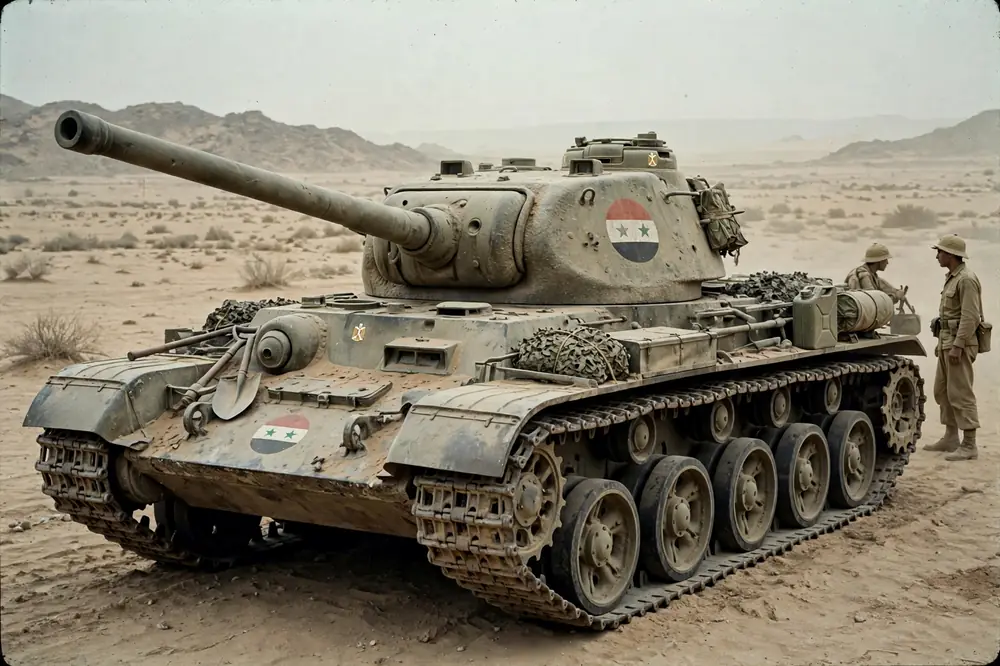
The IS-3 was exported to Egypt and Syria, where it fought in the Arab-Israeli wars of 1967 and 1973. The Egyptian and Syrian IS-3s were used in the Six-Day War in June 1967, where they were destroyed in large numbers by Israeli tanks and aircraft, although some IS-3s performed well in the fighting for the Sinai. The IS-3’s service in the Middle East was its only combat use, apart from the Berlin parade, and it showed that the tank, which had been designed in 1944, was already obsolete by 1967, when it faced the Israeli Centurion and M48 Patton. The IS-3’s Middle East service is a reminder that a tank’s design can become outdated quickly, and that a vehicle that was advanced in 1945 could be obsolete twenty years later.
5. Operational History
The Berlin Victory Parade
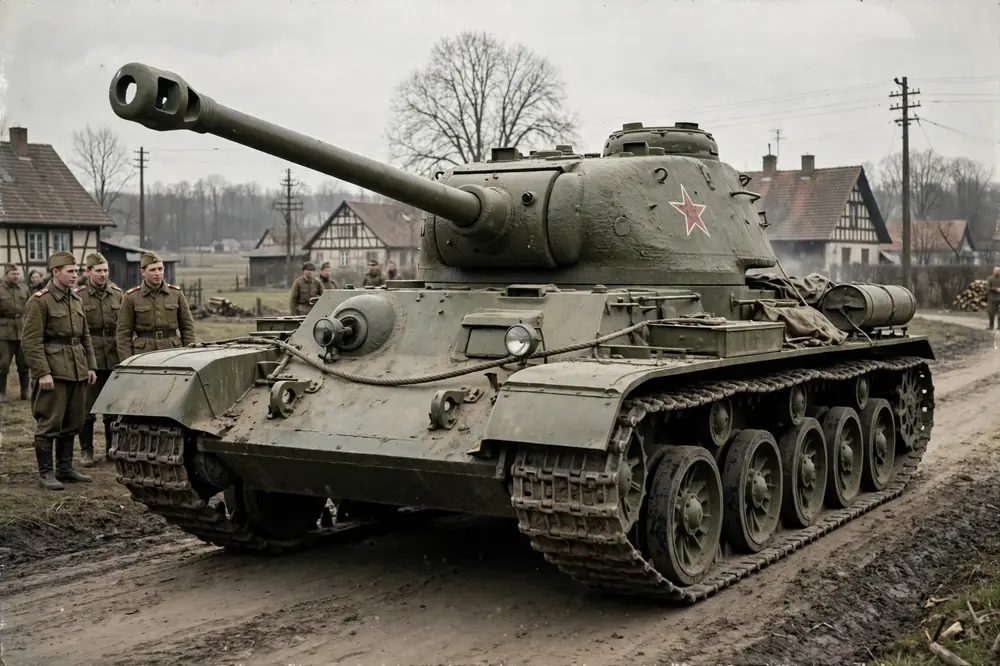
The IS-3’s most famous moment came on 7 September 1945, when a regiment of IS-3 tanks took part in the Allied victory parade in Berlin, alongside British, American and French troops. The IS-3’s appearance stunned Western observers, who had never seen a tank with a pike-nose hull and a low, hemispherical turret, and who realised that the Soviet Union had built a heavy tank that was more advanced than anything in the West. The Berlin parade was the IS-3’s debut, and it was a propaganda triumph for the Soviet Union, which used the parade to show the West the power of its armoured forces. The IS-3’s appearance in Berlin has become one of the most famous images of the Cold War, and it is often cited as the moment when the West realised that Soviet tank design was a serious threat.
The Cold War and the Soviet Army
After the Berlin parade, the IS-3 served in the Soviet Army, where it equipped the heavy tank regiments of the Group of Soviet Forces in Germany and of the Soviet Army’s western military districts. The IS-3 was the Soviet Army’s main heavy tank in the late 1940s and early 1950s, and it was a key part of the Soviet Union’s Cold War deterrent. The IS-3’s service in the Soviet Army lasted into the 1960s, when it was replaced by the T-10, a more advanced heavy tank. The IS-3’s Cold War service was its most important, and it shows how the tank, which had been designed for the Second World War, became a symbol of Soviet power in the Cold War.
The Six-Day War and the Middle East
The IS-3’s only combat came in the Middle East, where Egyptian and Syrian IS-3s fought in the Six-Day War in June 1967. The Egyptian IS-3s were used in the fighting for the Sinai, where they were destroyed by Israeli Centurions and by Israeli aircraft, although some IS-3s destroyed Israeli tanks before they were knocked out. The Syrian IS-3s were used in the fighting for the Golan Heights, where they also suffered heavy losses. The IS-3’s performance in the Six-Day War was poor, because the tank was obsolete by 1967 and because its crews were poorly trained, but the IS-3’s 122 mm gun was still a formidable weapon, and Israeli tank crews respected it. The IS-3’s Middle East service was the end of its combat career, and it was withdrawn from service in the 1970s.
The IS-3 as a Deterrent
The IS-3’s role in the Cold War was as a deterrent: its appearance in Berlin in 1945, and its service in the Soviet Army in Germany, sent a message to the West that the Soviet Union had a powerful heavy tank. The IS-3’s pike nose and its low turret influenced Western tank design, notably the British Conqueror and the American M103, which were designed to counter the IS-3. The IS-3’s influence on Western tank design is a significant part of its legacy, and it shows how a single tank can shape the armoured forces of an entire era.
6. Performance and Specifications
Strengths on the Battlefield
The IS-3’s greatest strength was its armour. Its pike-nose hull and its low, hemispherical turret gave it better protection than any other Soviet tank of the time, and its 122 mm gun was one of the most powerful tank weapons in service. The IS-3’s low silhouette made it a difficult target, and its diesel engine gave it a good range. The IS-3 was also more reliable than the IS-2, and its production was efficient. In the heavy tank role, the IS-3 was the best Soviet tank of its time, and it was a significant advance over the IS-2. The IS-3’s strengths were recognised by Western observers at the Berlin parade, and they influenced the design of Western heavy tanks for a decade.
Weaknesses and Trade-offs
The weaknesses were clear. The IS-3’s turret was cramped, and its gun had limited depression, only about 3 degrees, which made it difficult to fight from a hull-down position. The 122 mm gun had a slow rate of fire, and the tank carried only 28 rounds. The IS-3’s engine and transmission were prone to failure in early production vehicles, and the tank’s weight limited the bridges it could cross. The IS-3 was also expensive to build, and its production was limited to about 2,311 vehicles. Nevertheless, the IS-3’s overall record was impressive, and it was the most advanced Soviet heavy tank of the Second World War. The IS-3’s performance must be judged against its intended role: a heavy breakthrough tank, where it was among the best tanks of its time.
How the IS-3 Compared with Rivals
Compared with the German Tiger II, the IS-3 had a similar gun and similar armour, but it was lighter and more mobile. Compared with the American M103, which was designed to counter the IS-3, the IS-3 had a similar gun but a lower silhouette and better mobility. Compared with the British Conqueror, the IS-3 was smaller, lighter and more mobile, although the Conqueror had a more powerful gun. The IS-3’s combination of a pike-nose hull, a low turret and a 122 mm gun made it one of the most advanced heavy tanks of the late 1940s, and it was the only Soviet tank that could match the Western heavy tanks in a direct engagement.
7. Operators
The Soviet Union
The principal operator of the IS-3 was the Soviet Army, which used it in the heavy tank regiments of the Group of Soviet Forces in Germany and of the western military districts. The IS-3 equipped the Soviet Army’s heavy tank regiments from 1945 to the 1960s, when it was replaced by the T-10. The IS-3’s Soviet service lasted into the 1970s, mainly with reserve and training units, and the type was finally withdrawn when the T-10 and the T-55 had fully replaced it.
Export Users and Allies
The IS-3 was exported to several Soviet allies, including Egypt, Syria, Poland, Czechoslovakia, North Korea, China and Cuba. Egypt received IS-3 tanks in the 1950s and used them in the Six-Day War, and Syria received IS-3s and used them in the fighting for the Golan Heights. Poland and Czechoslovakia received IS-3s in the 1950s and used them in their armies until the 1960s. The IS-3’s export service shows how widely Soviet heavy tank doctrine was spread to allied armies, and how long the design remained in use after it had been superseded in the Soviet Union.
8. Legacy and Influence
The Peak of Soviet Heavy Tank Design
The IS-3 was the peak of Soviet heavy tank design in the Second World War, and it set the pattern for the heavy tanks that followed. The T-10, which entered service in the 1950s, used a pike-nose hull and a low turret similar to the IS-3’s, and it remained in Soviet service into the 1970s. The IS-3’s pike nose also influenced the design of Western tanks, including the British Conqueror and the American M103, which were designed to counter it. The IS-3’s legacy is thus not only its own service record, but the family of heavy tanks that it founded and the Western tanks that it inspired.
Cultural Memory and Historical Assessment
The IS-3 is one of the most famous tanks of the Cold War, and its image is closely associated with the Berlin victory parade of 1945. Historians have assessed the IS-3 as a significant advance in tank design, well suited to its role, although they note its cramped turret and limited gun depression. The IS-3’s reputation has been enhanced by its appearance in films, books and video games, where its pike nose and low turret make it instantly recognisable. In the end, the IS-3 stands as the high point of Soviet wartime heavy-tank thinking, a design whose ideas echoed in heavy tanks around the world.
The Berlin Parade and the Cold War
The IS-3’s appearance in the Berlin victory parade on 7 September 1945 is one of the most famous moments in the history of armoured warfare. The parade showed the West that the Soviet Union had built a heavy tank that was more advanced than anything in the West, and it set the tone for the Cold War, when tank design became a key part of the arms race. The IS-3’s Berlin parade is a reminder that a tank can be a political weapon as well as a military one, and that the appearance of a new tank can have a strategic impact.
9. Surviving Examples
Museums in Russia and Eastern Europe
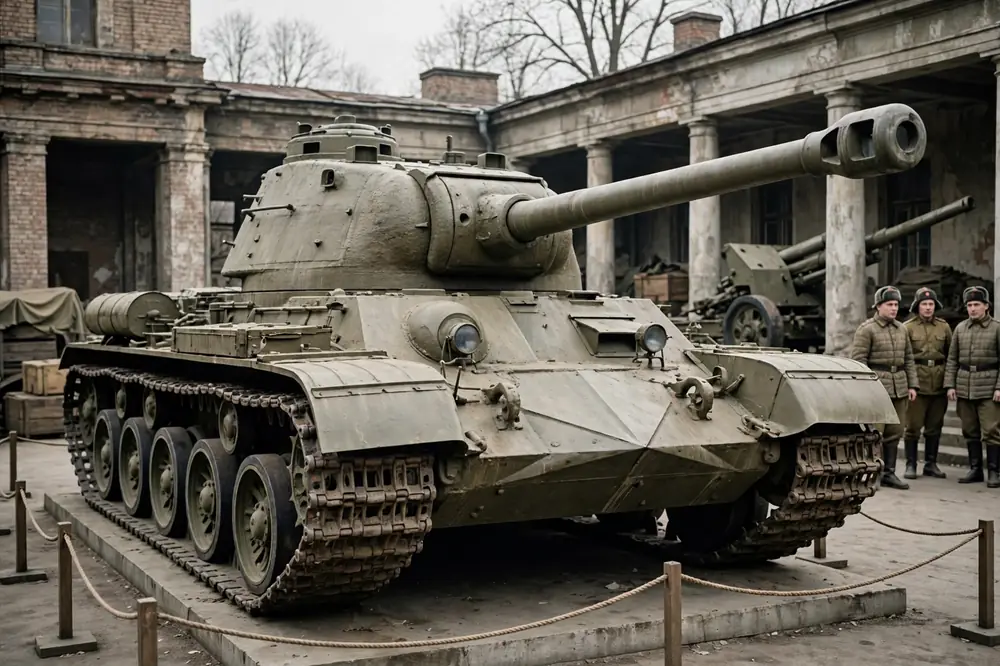
Many IS-3 tanks survive in museums and on memorials across Russia and Eastern Europe. The Central Armed Forces Museum in Moscow holds an IS-3, and the Kubinka Tank Museum displays several IS-3 tanks, including wartime production vehicles. The Museum of the Great Patriotic War in Moscow also holds an IS-3, and the tank appears on memorials in many Russian cities. In Belarus, the Museum of the Great Patriotic War in Minsk displays an IS-3, and in Ukraine, the National Museum of the History of Ukraine in the Second World War in Kyiv holds examples. The large number of surviving IS-3 tanks reflects the type’s production run and its long service.
Survivors Abroad and Running Examples
Other surviving IS-3 tanks include examples in the Egyptian Military Museum in Cairo, the Israeli Armoured Corps Museum at Latrun, the Tank Museum in Bovington in Britain, and the National Armor and Cavalry Museum at Fort Benning in the United States. Several IS-3 tanks are maintained in running condition by museums and private collectors, and they appear at military vehicle shows. The running examples are particularly valuable, because they demonstrate the IS-3’s distinctive engine note and its low, deliberate movement, which no photograph can convey.
Frequently Asked Questions
Did the IS-3 fight in the Second World War?
No. The IS-3 entered production in May 1945, just as the war in Europe was ending, and it did not see combat in the Second World War. Its first public appearance was in the Allied victory parade in Berlin on 7 September 1945, where it stunned Western observers.
How many IS-3 tanks were built?
Approximately 2,311 IS-3 tanks were built between 1945 and 1946, all at the Chelyabinsk Kirov Plant in the Urals. This was a large production run for a heavy tank, and it reflected the importance that the Soviet Union attached to the IS-3 as its main post-war heavy tank.
What was the IS-3’s pike nose?
The IS-3’s pike nose was its distinctive hull front, with two sloped plates meeting at a sharp point, like the nose of a pike. The pike nose was designed to deflect anti-tank shells, and it gave the IS-3 better frontal protection than the IS-2’s flat front.
Did the IS-3 fight in the Six-Day War?
Yes. Egyptian and Syrian IS-3 tanks fought in the Six-Day War in June 1967, where they were used in the fighting for the Sinai and the Golan Heights. The IS-3s suffered heavy losses against Israeli Centurions and aircraft, although some destroyed Israeli tanks before they were knocked out.
How long did the IS-3 remain in service?
The IS-3 remained in Soviet service into the 1970s, mainly with reserve and training units, and it was exported to allied countries where it served even longer. The type was finally withdrawn from service in the 1970s in most countries.
What replaced the IS-3?
The IS-3 was replaced by the T-10, a more advanced Soviet heavy tank that entered service in the 1950s and used a pike-nose hull and a low turret similar to the IS-3’s. The T-10 remained in Soviet service into the 1970s, when it was replaced by the T-55 and the T-62.
Sources
- Steven J. Zaloga, IS-2 Heavy Tank 1944-73 (Osprey Publishing, New Vanguard series).
- Mikhail Baryatinskiy, The IS Tanks: IS-1, IS-2, IS-3 (Russian Armour series).
- Steven J. Zaloga, T-54 and T-55 Main Battle Tanks 1944-2004 (Osprey Publishing).
- The Central Armed Forces Museum, Moscow, IS-3 collection records.
- The Kubinka Tank Museum, IS-3 collection records.
- David Glantz and Jonathan House, When Titans Clashed (University Press of Kansas).