 WAR ATLAS MILITARY HISTORY MAGAZINE · WWI — WWII
Messerschmitt Me 163 Komet: The Rocket Fighter
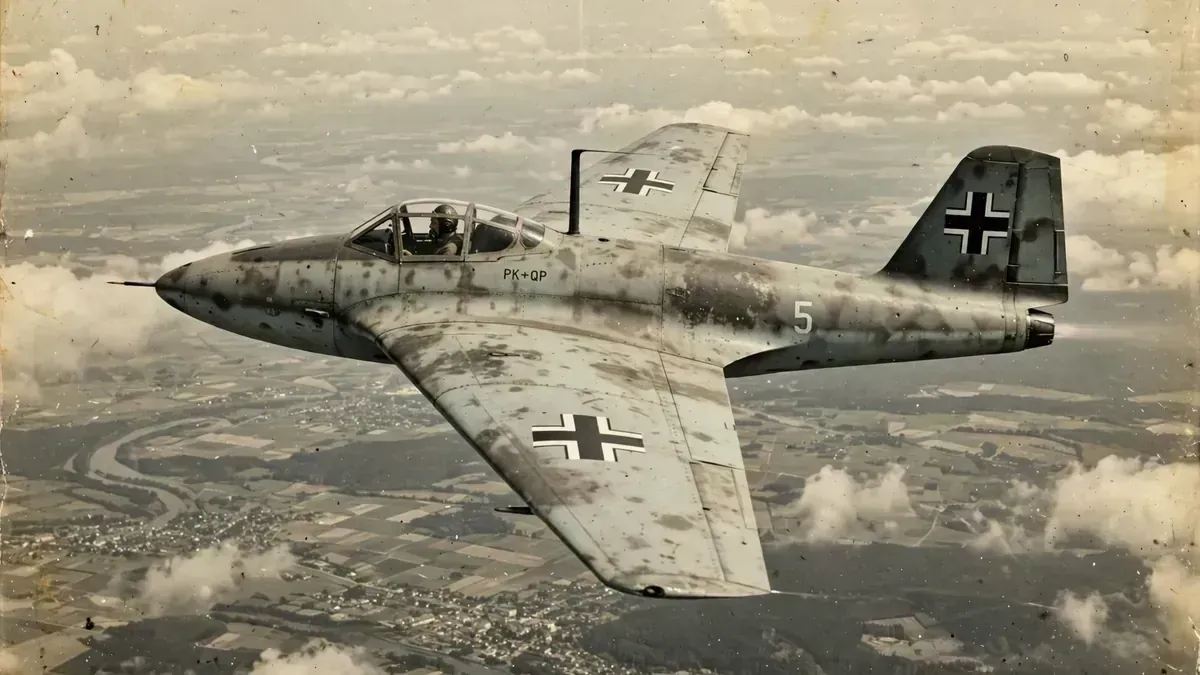
The Messerschmitt Me 163 Komet was the world’s first and only rocket-powered fighter to see combat, and the fastest aircraft of the Second World War. Powered by a Walter HWK 109-509 liquid-fuel rocket motor, the Komet could climb to 12,000 metres in under four minutes and reach a speed of about 960 km/h (596 mph), faster than any propeller-driven aircraft ever built. It was designed to intercept Allied bombers over Germany, climbing steeply to meet them, making a few high-speed firing passes with its two 30 mm cannon, and then gliding back to land. About 370 Komets were built, and the aircraft served with a single unit, Jagdgeschwader 400, in the defence of the Reich in 1944 and 1945.
The Komet was the product of the work of Alexander Lippisch, a pioneer of tailless aircraft design, and of Hellmuth Walter, whose rocket motors powered the aircraft. Its development began in the 1930s as a research aircraft, the DFS 194, and the first powered flight of the Me 163 took place in August 1941, when test pilot Heini Dittmar reached a speed of 1,004 km/h in a dive, the fastest speed ever achieved by an aircraft to that date. The Komet entered service in 1944, but by then it was too late: the aircraft was dangerous to fly, its fuel was volatile and corrosive, its endurance was only a few minutes, and it claimed few Allied bombers. More Komets were lost in accidents than in combat.
The Me 163 is remembered today as one of the most extraordinary aircraft of the Second World War: a rocket-powered interceptor that was decades ahead of its time, and a weapon that was as dangerous to its own pilots as it was to the enemy. Surviving Komets are preserved in museums in Germany, Britain, Canada and the United States, and the aircraft’s story has become a legend of aviation history — the story of a machine that flew faster than any aircraft before it, and that killed more of its own pilots than it did of the enemy.
1. Key Facts
| Field | Value |
|---|---|
| Type | Rocket-powered interceptor |
| Origin | Germany |
| Designer | Alexander Lippisch (Messerschmitt AG); rocket motor by Hellmuth Walter |
| First powered flight | 13 August 1941 (Me 163A prototype) |
| In service | 1944–1945 (Jagdgeschwader 400) |
| Produced | Approximately 370 (Me 163B production version) |
| Manufacturers | Messerschmitt, Klemm |
| Crew | 1 (pilot) |
| Engine | Walter HWK 109-509A-2 liquid-fuel rocket motor, approximately 1,700 kg thrust (later versions up to 2,000 kg) |
| Fuel | C-Stoff (methanol and hydrazine hydrate) and T-Stoff (high-test hydrogen peroxide) |
| Length | Approximately 5.7 m (18 ft 8 in) |
| Wingspan | Approximately 9.3 m (30 ft 6 in) |
| Height | Approximately 2.75 m (9 ft) |
| Weight | Approximately 1,900 kg empty; approximately 4,300 kg loaded |
| Maximum speed | Approximately 960 km/h (596 mph) at 12,000 m |
| Climb rate | To 12,000 m in under 4 minutes |
| Endurance | Approximately 7–8 minutes powered flight; total flight about 12 minutes |
| Service ceiling | Approximately 16,000 m (52,500 ft) |
| Armament | 2 × 30 mm MK 108 cannon (60 rounds per gun) |
| Combat claims | Approximately 9–16 Allied aircraft claimed (sources vary); more Komets lost in accidents than in combat |
| Fate | Retired 1945; survivors in museums in Germany, Britain, Canada and the United States |
2. Background and Development
Alexander Lippisch and the Tailless Aircraft
The Me 163 was the product of Alexander Lippisch, a German aerodynamicist who had spent the 1920s and 1930s designing tailless gliders and aircraft. Lippisch believed that the tailless configuration — a swept wing with no horizontal tail — offered lower drag and higher speed than a conventional layout, and his research aircraft, the DFS 39 and DFS 40, proved the concept in glider form. In 1939 Lippisch moved to Messerschmitt, where he was given the task of designing a rocket-powered interceptor, and the result was the Me 163. The aircraft’s swept wing, its small size, and its lack of a tail were all products of Lippisch’s research, and they made the Komet one of the most distinctive aircraft of the war.
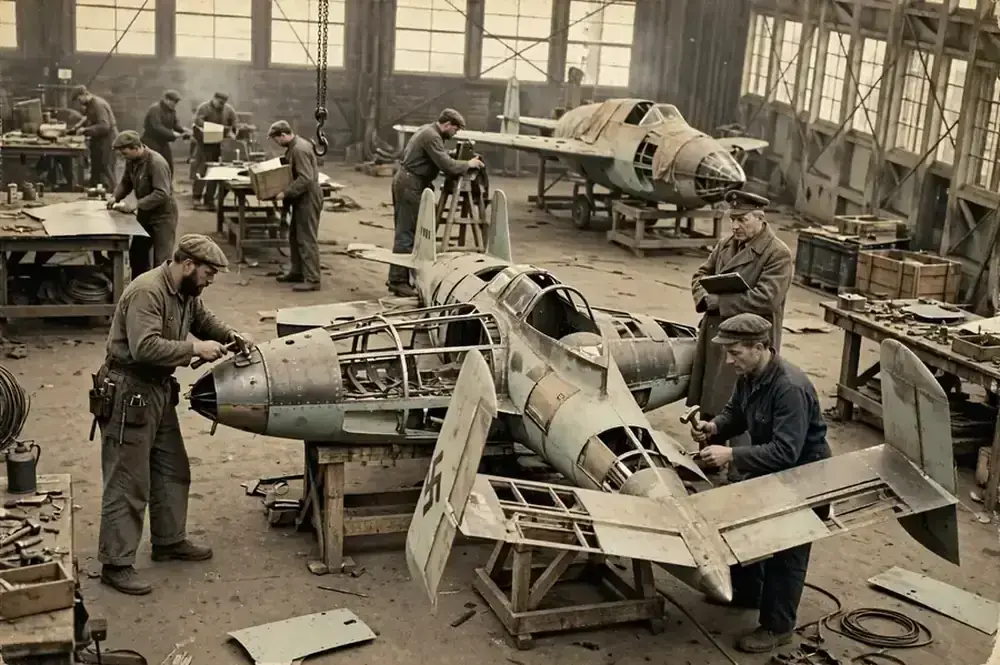
The Walter Rocket Motor
The Komet’s power came from the Walter HWK 109-509 rocket motor, designed by Hellmuth Walter. The motor burned two propellants, C-Stoff (a mixture of methanol and hydrazine hydrate) and T-Stoff (concentrated hydrogen peroxide), which reacted violently when mixed, producing a thrust of about 1,700 kilograms. The propellants were volatile, corrosive and toxic: T-Stoff would dissolve organic material on contact, and C-Stoff was highly flammable. The fuel system was a constant danger, and several Komets exploded on the ground when their fuel tanks leaked. The rocket motor gave the Komet its extraordinary performance, but it also made the aircraft one of the most dangerous to fly in the history of aviation.
The First Flights
The first powered flight of the Me 163 took place on 13 August 1941, when test pilot Heini Dittmar flew the Me 163A prototype and reached a speed of about 800 km/h. In October 1941 Dittmar reached 1,004 km/h in a dive, the fastest speed ever achieved by an aircraft, and a record that stood until the post-war period. The prototype’s success led to an order for the production Me 163B, which was larger, heavier and more heavily armed than the prototype. The Me 163B first flew in 1943, and it entered service with Jagdgeschwader 400 in 1944. The aircraft’s development had been rapid, but it had also been rushed, and the Me 163B entered service before its problems — the volatile fuel, the short endurance, the difficult landing — had been solved.
3. Design
Airframe, Wing and Layout
The Me 163 was a small, tailless aircraft, with a swept wing of about 9.3 metres span and a short, bullet-shaped fuselage. The wing was swept back at about 27 degrees, and it carried the aircraft’s elevons — combined elevators and ailerons — on its trailing edge. The aircraft had no horizontal tail, and its directional stability was provided by a single vertical fin. The cockpit was in the nose, with the pilot seated under a bubble canopy, and the rocket motor was in the rear fuselage, with its exhaust nozzle at the tail. The aircraft took off on a jettisonable two-wheeled dolly, because its landing gear was a single retractable skid, and it landed on the skid after gliding back to base. The design was radical, and it made the Komet one of the most advanced aircraft of the war.
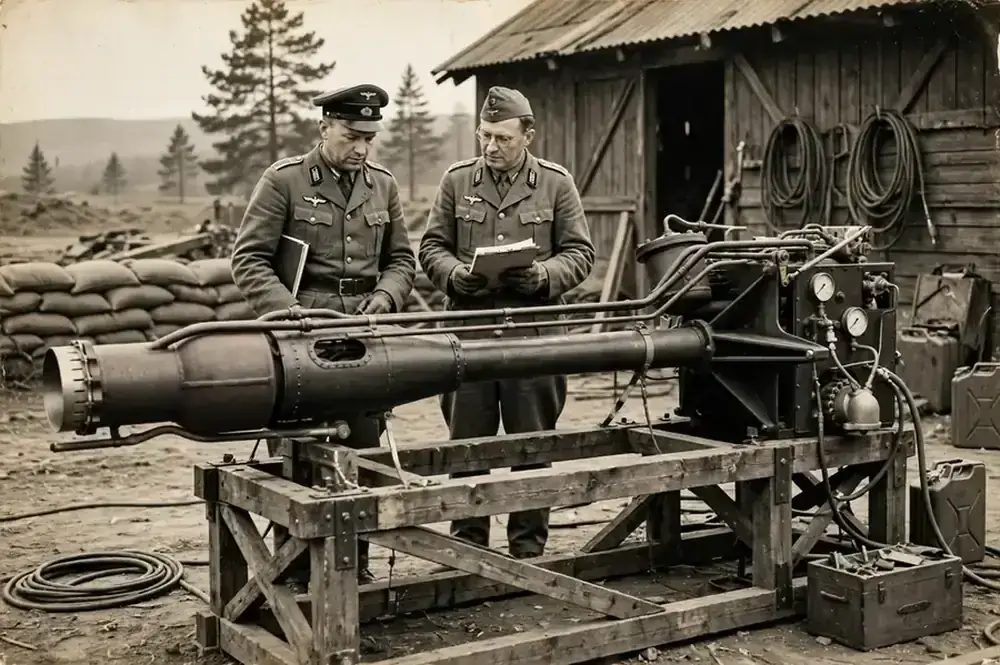
The Rocket Motor and Fuel System
The Walter HWK 109-509 rocket motor was a liquid-fuel motor that burned C-Stoff and T-Stoff, two propellants that reacted on contact to produce thrust. The motor could be throttled, and it produced about 1,700 kilograms of thrust, enough to accelerate the Komet to 960 km/h and to climb to 12,000 metres in under four minutes. The fuel was carried in tanks in the fuselage and in the wings, and the aircraft carried enough fuel for about seven to eight minutes of powered flight. After the fuel was exhausted, the Komet glided back to base, landing on its skid at a speed of about 220 km/h. The fuel system was the aircraft’s greatest weakness: the propellants were corrosive and volatile, and a leak could cause an explosion or dissolve the pilot’s flesh.
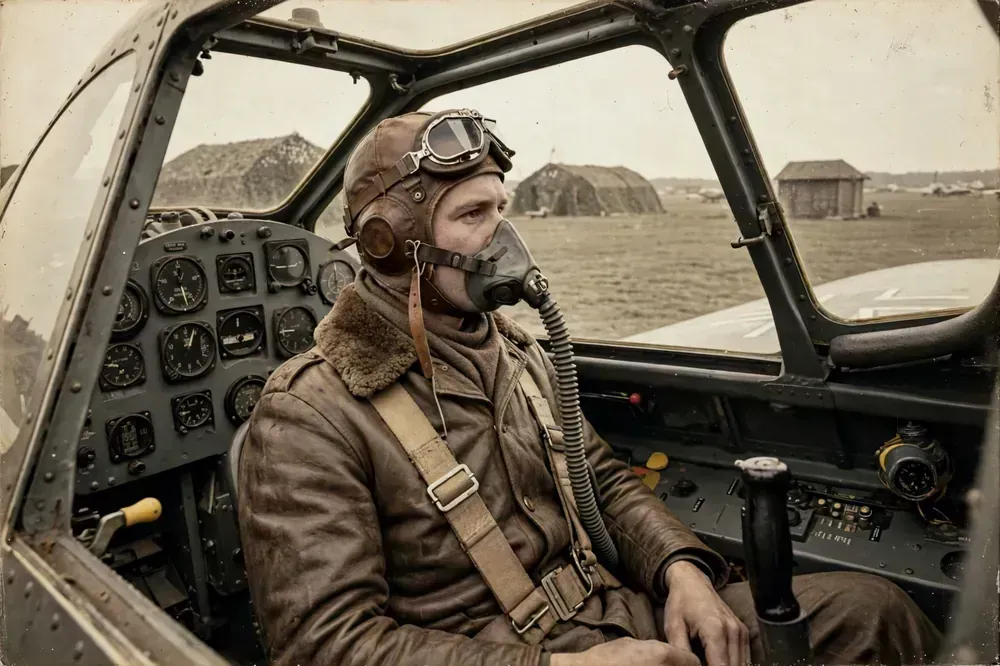
Armament and the Interceptor Role
The Me 163B was armed with two 30 mm MK 108 cannon, each with 60 rounds, mounted in the wing roots. The MK 108 was a short-barrelled, low-velocity cannon that fired a heavy explosive shell, and it was devastating against bombers at close range. The Komet’s tactic was to climb steeply to meet the bombers, make a high-speed firing pass, and then climb again for another pass, using its speed to avoid the bombers’ defensive fire. The tactic was sound in theory, but in practice the Komet’s high speed made aiming difficult, and the pilot had only a few seconds to fire before overshooting the target. The aircraft’s short endurance meant that it could make only a few passes before its fuel was exhausted, and its landing — a high-speed glide onto a skid — was dangerous.
4. Variants
Me 163A: The Prototype
The Me 163A was the prototype version, built in small numbers for testing. It was powered by the Walter HWK 109-509A motor and was unarmed, and it was used to test the aircraft’s handling and performance. The Me 163A’s flights in 1941 set speed records and proved the rocket-powered interceptor concept, but the aircraft was too small and too lightly built for operational service, and it was replaced by the larger Me 163B. The prototype’s success was remarkable: in October 1941, test pilot Heini Dittmar reached 1,004 km/h in a dive, the fastest speed ever achieved by an aircraft, and a record that stood until the post-war period. The Me 163A proved that Lippisch’s tailless design and Walter’s rocket motor could work together, and it paved the way for the production fighter.
Me 163B: The Production Fighter
The Me 163B was the production version, built in about 370 examples by Messerschmitt and Klemm. It was larger than the Me 163A, with a more powerful rocket motor, two 30 mm cannon, and a retractable landing skid. The Me 163B was the version that served with Jagdgeschwader 400 in 1944–1945, and it was the only rocket-powered fighter to see combat. The Me 163B’s production was hampered by Allied bombing and by shortages of materials, and the aircraft’s quality varied: some were well built, others were crudely finished, and the fuel system remained a constant danger.
Me 163C, Me 163D and the Japanese Copy
The Me 163C was a projected development with a more powerful rocket motor and a longer fuselage, but it was never built in numbers. The Me 163D was a further development that was cancelled before production. The Japanese built a copy of the Me 163, the Mitsubishi J8M Shusui, based on plans and a single example shipped to Japan, but the J8M never entered service, and the only prototype crashed on its first powered flight in July 1945. The Me 163’s influence extended beyond Germany: its design was studied by the Allies after the war, and its rocket motor technology influenced the development of post-war rocket aircraft.
5. Operational History
Jagdgeschwader 400
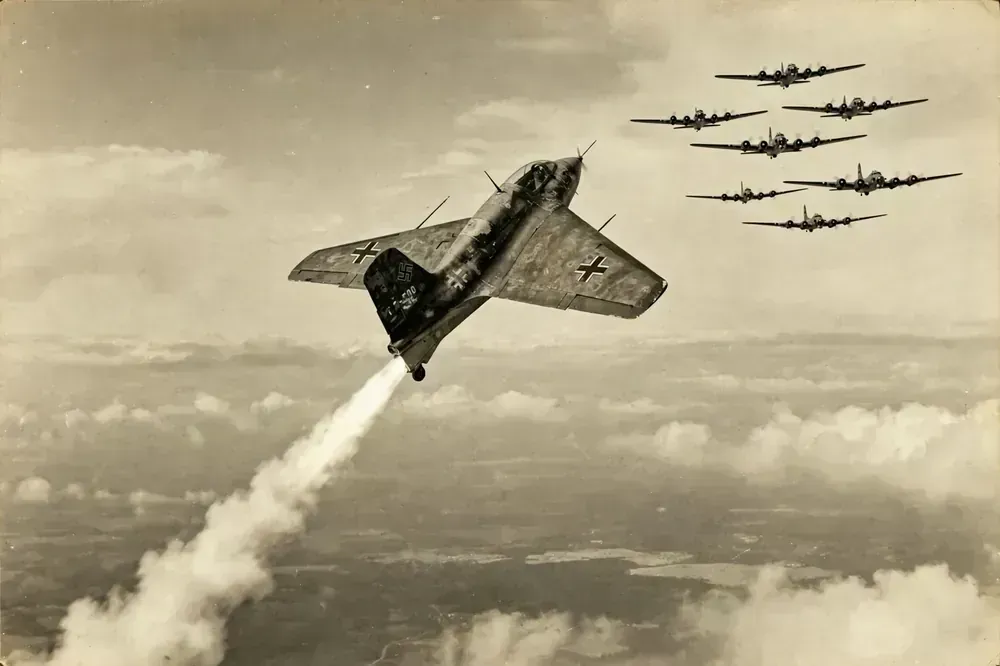
The Me 163 served with a single unit, Jagdgeschwader 400, which was formed in 1944 to operate the Komet in the defence of the Reich. The unit was based at Brandis, near Leipzig, and later at Husum, and its pilots were among the most experienced in the Luftwaffe. The unit’s first combat operations came in July 1944, when Komets intercepted American bombers over Germany, and the aircraft’s first confirmed victory was claimed on 16 August 1944, when a Komet shot down a B-17 Flying Fortress. The unit’s operations were hampered by the Komet’s short endurance, by the difficulty of intercepting bombers that flew at altitudes the Komet could reach only briefly, and by the danger of the fuel system.
Combat Record
The Me 163’s combat record was modest. The aircraft claimed about 9 to 16 Allied aircraft, according to different sources, mostly B-17s, and it lost about 10 aircraft in combat. More Komets were lost in accidents — take-off explosions, landing accidents, fuel leaks — than in combat, and the unit’s pilots suffered a high casualty rate. The Komet’s most famous action came on 7 October 1944, when a Komet shot down a B-17 over Germany, and the aircraft’s speed and climb rate impressed the Allied pilots who encountered it. But the Komet never achieved the impact its designers had hoped for: it was too few in number, too short-ranged, and too dangerous to change the course of the air war.
The End of the Komet
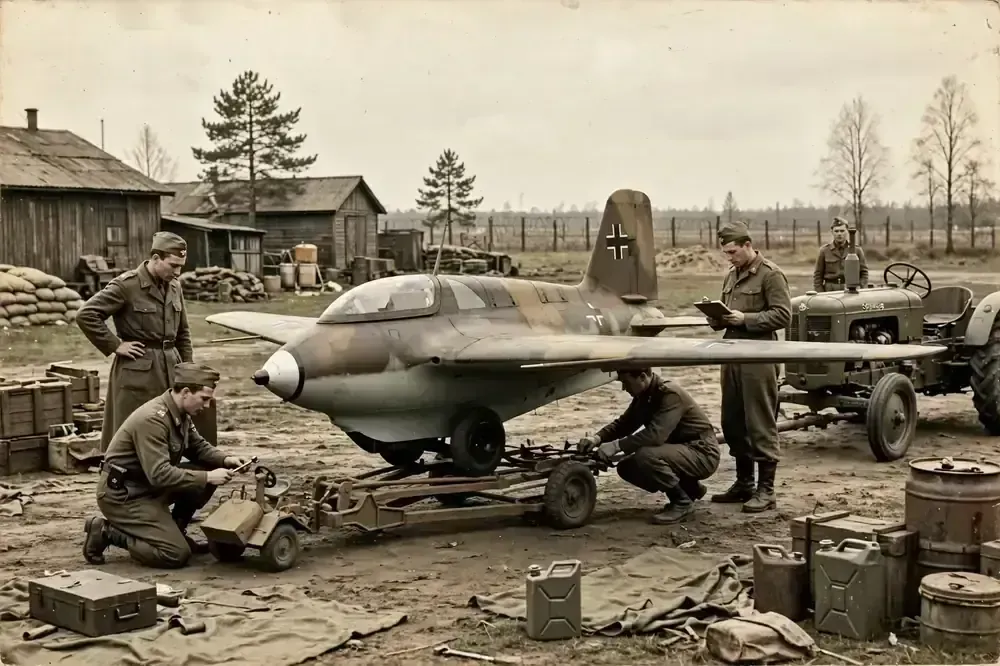
Jagdgeschwader 400 continued to operate the Komet until the end of the war, but its operations became increasingly desperate as the Allied advance overran its bases. In April 1945 the unit was disbanded, and its remaining Komets were destroyed or captured by the Allies. The Komet’s career ended as it had begun: as an experiment, a brilliant but flawed attempt to use rocket power to defend Germany against overwhelming Allied air power. The aircraft’s pilots, who had flown a machine that was faster than any other in the world and more dangerous than any other to fly, were among the bravest of the Luftwaffe, and their story is a part of the legend of the Komet.
6. Performance and Specifications
Strengths on the Battlefield
The Me 163’s strengths were its speed and its climb rate. At 960 km/h it was faster than any Allied aircraft, and its climb to 12,000 metres in under four minutes was unmatched. The aircraft could intercept bombers at altitudes that no other German fighter could reach, and its 30 mm cannon were devastating against bombers. The Komet’s tailless design gave it low drag and good handling at high speed, and its small size made it a difficult target. The aircraft’s performance was a generation ahead of its time, and it pointed the way to the rocket and jet aircraft of the post-war period.
Weaknesses and Trade-offs
The weaknesses were fatal. The Komet’s endurance was only seven to eight minutes of powered flight, which meant it could make only a few firing passes before gliding home. Its fuel was volatile, corrosive and toxic, and it killed more pilots in accidents than the enemy did in combat. Its landing, on a skid at high speed, was dangerous, and its take-off, on a jettisonable dolly, was hazardous. Its high speed made aiming difficult, and its armament was limited to 60 rounds per gun. The Komet was a brilliant concept that was not ready for operational service, and its weaknesses outweighed its strengths in combat.
How the Komet Compared with Rivals
Compared with the Messerschmitt Me 262, the other German jet fighter, the Komet was faster and climbed more quickly, but had a much shorter endurance and was far more dangerous to fly. Compared with the Allied fighters it faced, the Komet was faster than any of them, but its short endurance and its limited armament meant that it could not sustain a fight. Compared with the post-war rocket aircraft it inspired, the Komet was a pioneer, but its fuel system and its landing skid were dead ends. The Komet’s record stands as a reminder that speed alone does not make a fighter, and that an aircraft must be safe, reliable and practical to be useful in war.
7. Operators
The Luftwaffe
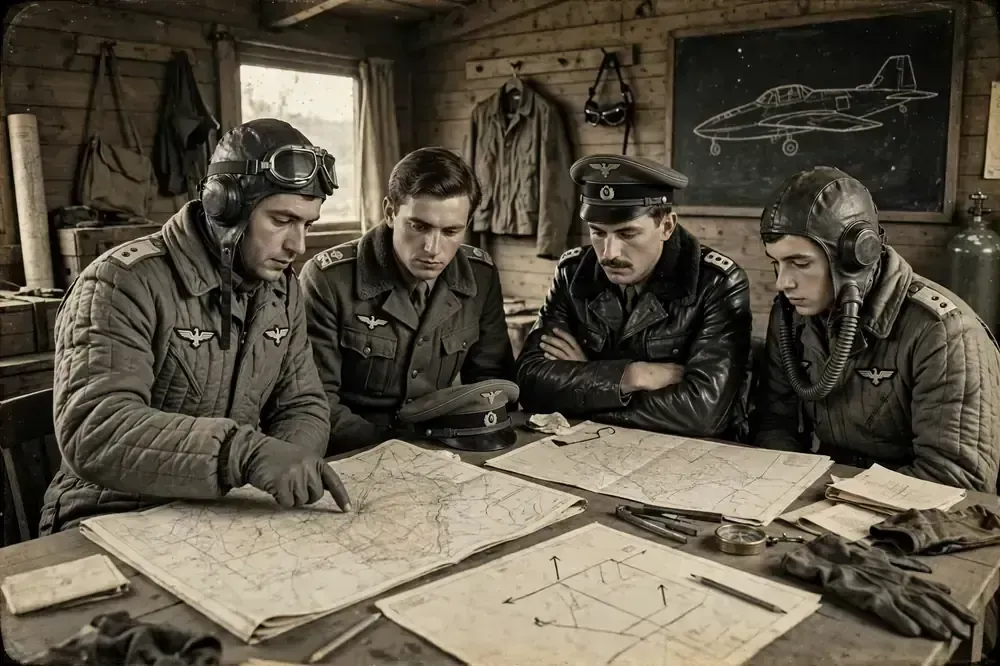
The only operator of the Me 163 was the Luftwaffe, which operated the type with Jagdgeschwader 400. The unit’s pilots were drawn from the Luftwaffe’s most experienced fighter pilots, and the unit’s ground crews were specialists in rocket propulsion. The Komet’s service was entirely German, and its history is a part of the history of the Luftwaffe in the defence of the Reich. The unit’s pilots included men who had flown in the Battle of Britain and on the Eastern Front, and their experience was a measure of the importance the Luftwaffe attached to the Komet.
No Other Users
No other air force operated the Me 163 in combat. The Japanese built a copy, the Mitsubishi J8M, but it never entered service, and the only prototype crashed on its first powered flight in July 1945. After the war, the Allies captured Komets and studied them: the British, American and Soviet air forces all tested captured examples, and the aircraft’s design influenced post-war research into rocket propulsion and tailless aircraft. The Komet’s influence was thus felt after the war, even though the aircraft itself never served with another air force. The captured Komets, preserved in museums in Britain, the United States and Canada, are the legacy of that post-war study, and they remain the most tangible evidence of the aircraft’s design.
8. Legacy and Influence
The Rocket Fighter
The legacy of the Me 163 is the rocket-powered aircraft. The Komet was the first rocket fighter to see combat, and it demonstrated that rocket propulsion could produce speeds and climb rates that no propeller aircraft could match. The aircraft’s design — the tailless swept wing, the rocket motor, the skid landing gear — was studied by the Allies after the war, and it influenced the design of post-war research aircraft, including the American X-1, which broke the sound barrier in 1947. The Komet was a pioneer, and its influence extended far beyond its modest combat record.
Memory and the Legend
The Me 163 is remembered in aviation history as one of the most extraordinary aircraft ever built, and as a symbol of German technological daring. The aircraft’s story — the fastest aircraft in the world, flown by brave pilots in a desperate defence — has become a legend, and the Komet is a popular subject for historians, modellers and aviation enthusiasts. The surviving Komets, in museums in Germany, Britain, Canada and the United States, are among the most visited exhibits in those museums, and they attract visitors who are fascinated by the aircraft’s speed and its danger.
Lessons for Later Aircraft
The Komet’s lessons were carried into the design of later aircraft. The value of rocket propulsion for high-speed flight was confirmed, but so were the dangers of volatile propellants and of short endurance. The post-war rocket aircraft that followed the Komet — the X-1, the X-15, and the Space Shuttle — used safer propellants and more practical designs, but they owed a debt to the Komet’s pioneering work. The Komet’s career is thus a story of both inspiration and caution: an aircraft that showed what was possible, and that showed the price of attempting the impossible before the technology was ready.
9. Surviving Examples
Museum Komets
Several Me 163s survive in museums around the world. The Deutsches Museum in Munich displays a Komet, and the Luftwaffenmuseum in Berlin holds another. The Royal Air Force Museum at Cosford displays a Komet, and the Imperial War Museum at Duxford holds one. The National Air and Space Museum in Washington displays a Komet, and the Canada Aviation and Space Museum in Ottawa holds one. The survival of so many Komets, relative to the small production run, is a testament to the aircraft’s fame and to the interest of museums in preserving it.
The Komet’s Preservation
The preserved Komets are among the most significant aircraft in their museums, and they are displayed with their rocket motors and with explanations of their fuel system. The aircraft’s small size and distinctive shape make it instantly recognisable, and its display is often accompanied by accounts of its pilots and its combat record. The Komet’s preservation ensures that future generations can see the world’s only rocket fighter, and can appreciate the daring and the danger of its design.
Frequently Asked Questions
What was the Messerschmitt Me 163 Komet?
The Messerschmitt Me 163 Komet was a German rocket-powered interceptor of the Second World War, the world’s first and only rocket fighter to see combat. It was powered by a Walter rocket motor, could reach about 960 km/h, and served with Jagdgeschwader 400 in the defence of Germany in 1944–1945. The aircraft was the product of Alexander Lippisch, a pioneer of tailless aircraft design, and of Hellmuth Walter, whose rocket motors powered it. Its swept wing, its small size, and its lack of a tail made it one of the most distinctive aircraft of the war, and its speed made it the fastest aircraft in the world when it entered service.
How fast was the Me 163?
The Me 163 could reach about 960 km/h (596 mph) at altitude, making it the fastest aircraft of the Second World War. It could climb to 12,000 metres in under four minutes, a climb rate unmatched by any propeller-driven aircraft. In October 1941, test pilot Heini Dittmar reached 1,004 km/h in a dive in the Me 163A prototype, the fastest speed ever achieved by an aircraft to that date, and a record that stood until the post-war period. The Komet’s speed was its defining characteristic, and it pointed the way to the rocket and jet aircraft of the post-war period, including the American X-1, which broke the sound barrier in 1947.
How many Me 163s were built?
About 370 Me 163Bs were built, plus a small number of prototypes. The aircraft served with a single unit, Jagdgeschwader 400, and its combat record was modest: about 9 to 16 Allied aircraft claimed, with more Komets lost in accidents than in combat. Production was hampered by Allied bombing and by shortages of materials, and the aircraft’s quality varied: some were well built, others were crudely finished, and the fuel system remained a constant danger. The small production run, compared with the thousands of conventional fighters built in the same period, was a measure of the Komet’s status as an experimental weapon rather than a front-line fighter.
Was the Me 163 dangerous to fly?
Yes, extremely. Its fuel, C-Stoff and T-Stoff, was volatile, corrosive and toxic, and several Komets exploded on the ground or dissolved their pilots’ flesh on contact. The aircraft landed on a skid at high speed, and its take-off on a jettisonable dolly was hazardous. More Komet pilots died in accidents than in combat, and the unit’s casualty rate was high. T-Stoff, concentrated hydrogen peroxide, would dissolve organic material on contact, and C-Stoff was highly flammable, so a leak in the fuel system could cause an explosion or kill the pilot. The Komet was one of the most dangerous aircraft to fly in the history of aviation.
Did the Me 163 shoot down many bombers?
No. The Me 163 claimed about 9 to 16 Allied aircraft, mostly B-17s, in 1944–1945. Its short endurance — only seven to eight minutes of powered flight — and its high speed, which made aiming difficult, limited its effectiveness, and it never changed the course of the air war. The Komet’s tactic was to climb steeply to meet the bombers, make a high-speed firing pass, and then climb again, but the pilot had only a few seconds to fire before overshooting the target. The aircraft’s first confirmed victory was claimed on 16 August 1944, when a Komet shot down a B-17, but the type’s overall record was modest.
How many Me 163s survive today?
Several survive in museums, including the Deutsches Museum in Munich, the RAF Museum at Cosford, the National Air and Space Museum in Washington, and the Canada Aviation and Space Museum in Ottawa. The survival rate is unusually high for a wartime aircraft of such a small production run, and it reflects the Komet’s fame and the interest of museums in preserving it. The preserved Komets are among the most significant aircraft in their museums, and they are displayed with their rocket motors and with explanations of their fuel system. The aircraft’s small size and distinctive shape make it instantly recognisable to visitors.
Sources
- Boyne, Walter, The Rocket Fighter (various aviation histories).
- Green, William, Rocket Fighter (Ballantine Books, Illustrated History of World War II).
- Ziegler, Mano, Rocket Fighter: The Story of the Messerschmitt Me 163 (Arms and Armour Press) — memoir of a Komet pilot.
- Spate, Wolfgang, Top Secret Bird: The Luftwaffe’s Me-163 Comet (Schiffer Publishing).
- The Royal Air Force Museum, Cosford, Me 163 collection records.
-
The National Air and Space Museum, Washington, Me 163 collection records.
-
Green, William, Warplanes of the Third Reich (Macdonald).
- Morgan, Hugh, and Weal, John, German Jet Aces of World War 2 (Osprey Publishing).