 WAR ATLAS MILITARY HISTORY MAGAZINE · WWI — WWII
Omaha Beach
1. Lead
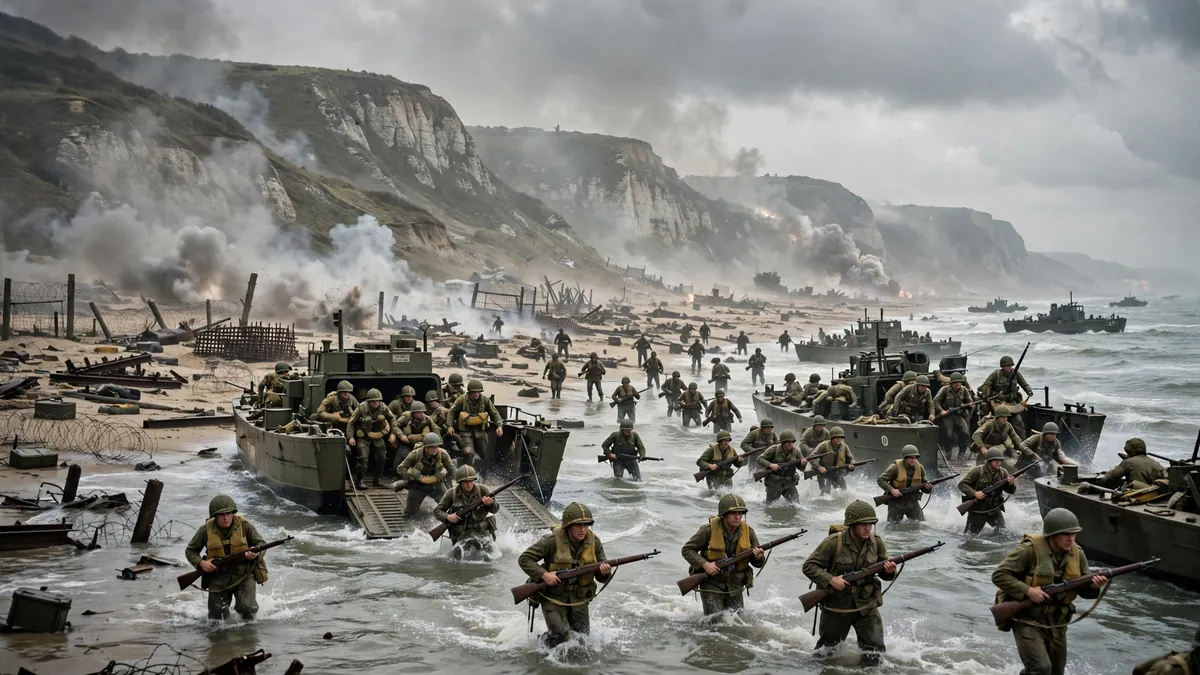
Omaha Beach was the bloodiest of the five Allied landing beaches on D-Day, 6 June 1944. On a stretch of Normandy coast about 8 kilometres long, the first waves of American infantry from the 1st and 29th Infantry Divisions were pinned down under the guns of the German 352nd Infantry Division, a formation the Allies had not expected to find there. Tanks sank offshore, landing craft were smashed, and for hours it looked as if the landing would fail. By nightfall, at a cost of roughly 2,400 American casualties, the Americans had clawed a shallow foothold a few hundred metres deep — the narrowest beachhead of the day, and the one that came closest to disaster.
2. Key Facts
| Date | 6 June 1944 (D-Day) |
| Location | Normandy coast between Sainte-Honorine-des-Pertes and Vierville-sur-Mer, France |
| Result | Allied victory; beachhead secured by nightfall, at heavy cost |
| Allied commanders | Maj. Gen. Clarence Huebner (1st Infantry Division); Maj. Gen. Charles Gerhardt (29th Infantry Division); Brig. Gen. Norman Cota (29th Division, assistant commander) |
| German commander | Generalleutnant Dietrich Kraiss (352nd Infantry Division) |
| Allied strength | About 43,250 men landed on 6 June; 2 infantry divisions, with naval and air support |
| German strength | About 7,800 men of the 352nd Infantry Division, in fortified positions |
| Allied losses | About 2,400 killed, wounded and missing on 6 June (see Casualties section) |
| German losses | Estimated 1,000–1,200 killed, wounded and captured on 6 June |
3. Background
Omaha Beach was the westernmost of the two American landing beaches in Operation Neptune, the seaborne part of Operation Overlord, the Allied invasion of Normandy. The overall commander of the invasion was General Dwight D. Eisenhower, Supreme Commander of the Allied Expeditionary Force. The American beaches were Utah, to the west on the Cotentin Peninsula, and Omaha, to the east. The three British and Canadian beaches — Gold, Juno and Sword — lay further east. Omaha was assigned to the US First Army under Lieutenant General Omar Bradley, and the landing itself was the responsibility of V Corps under Major General Leonard Gerow.
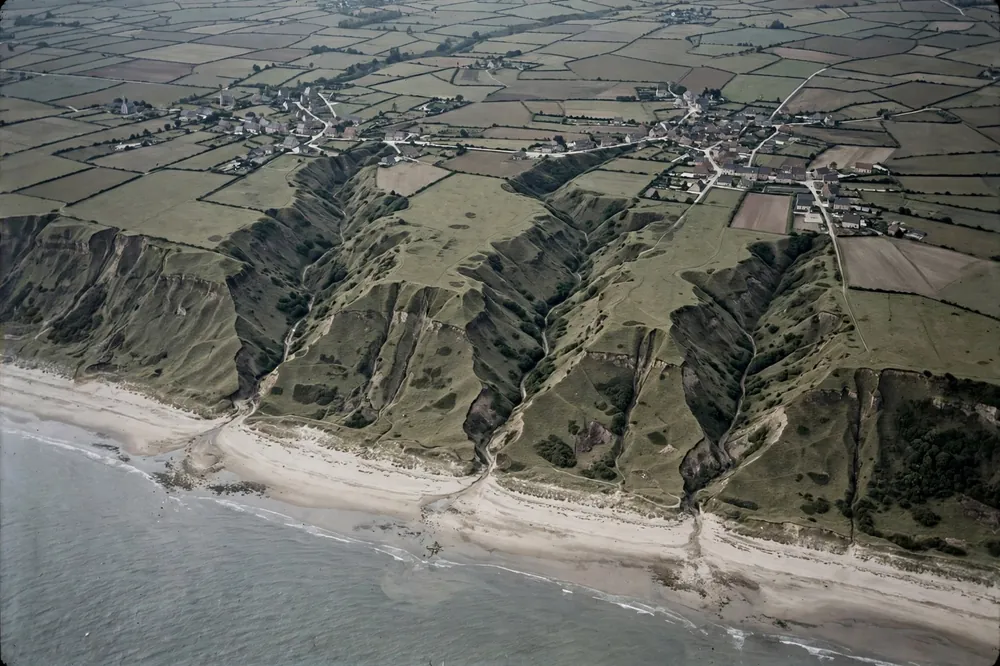
The beach the Americans called Omaha was a gently curving stretch of sand about 8 kilometres (5 miles) long, between the villages of Sainte-Honorine-des-Pertes in the east and Vierville-sur-Mer in the west. Behind the sand lay a low seawall, then a band of marshy ground and a road, and then a steep bluff, 30 to 50 metres high, cut by five narrow valleys — the “draws” — through which roads led inland. The draws were the only ways off the beach for vehicles, and therefore the keys to the whole landing. The Allies divided the beach into sectors, from west to east: Charlie, Dog Green, Dog White, Dog Red, Easy Green, Easy Red, Fox Green and Fox Red.
The plan looked sound on paper. Before H-Hour at 06:30, the beach would be pounded by naval guns and by heavy bombers, the defences would be smashed, and the first infantry waves would land on a beach already cleared. Engineers would blow gaps in the obstacles, tanks would come ashore to support the infantry, and within hours the troops would be off the beach and moving inland towards Bayeux and the road to Saint-Lô. The timetable allowed two hours to clear the beach.
Almost every part of that plan depended on an assumption that turned out to be wrong: that Omaha was defended by a single, second-rate German regiment. Allied intelligence believed the beach was held by the 716th Infantry Division, a static coastal division made up largely of older men and conscripts from occupied countries, with one regiment — the 726th — covering Omaha.
In fact, in March 1944 the Germans had moved the 352nd Infantry Division, a much stronger field division of about 7,800 men with artillery and combat experience on the Eastern Front, into the Omaha sector. The 352nd’s 916th Grenadier Regiment held the beach itself, with its artillery regiment behind the bluffs.
The Allies learned of the move only in late May, from Ultra intercepts and aerial photographs, and by then the invasion plan was fixed. The troops who landed on 6 June were told to expect light resistance. They met a division.
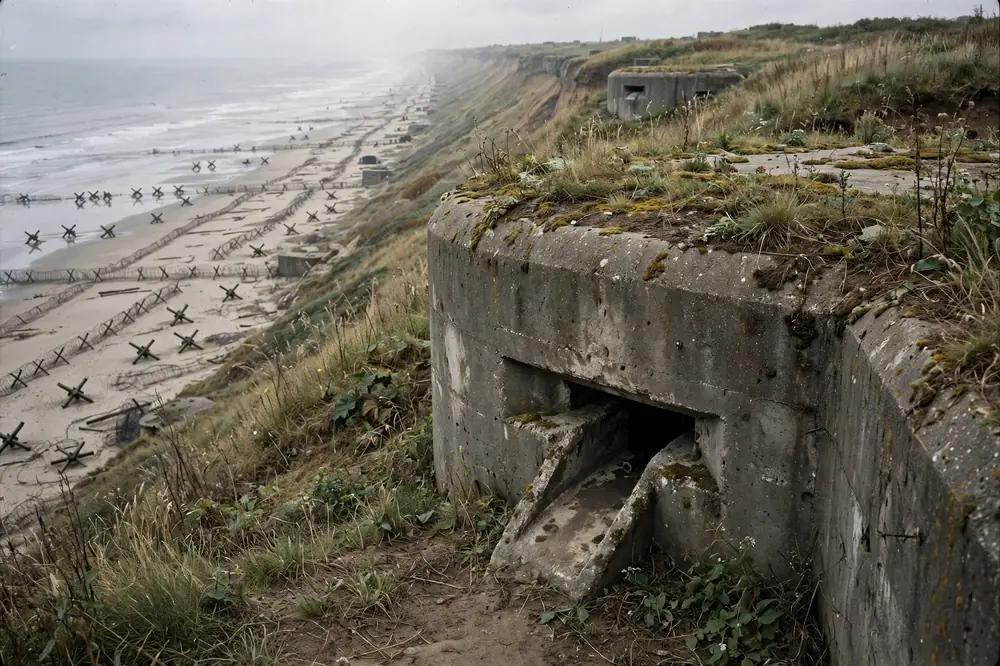
The defences themselves were part of the Atlantic Wall, the system of fortifications ordered by Hitler along the coast of occupied Europe. At Omaha the Germans had built concrete gun casemates, machine-gun nests and observation posts into the bluffs, protected by minefields, barbed wire and anti-tank obstacles on the beach: steel “hedgehogs”, Belgian gates and wooden stakes, many of them tipped with mines. The guns ranged from 75 mm and 88 mm pieces in casemates to heavy artillery further inland. The positions were sited to fire along the beach, not out to sea, so that every yard of sand was covered by enfilading fire — the classic killing ground.
There was a second problem with the plan, and it was the weather. The invasion had been set for 5 June, then postponed by a day because of a storm. On the morning of 6 June the sea was still rough, with a swell that made landing craft hard to handle and that swamped the amphibious tanks.
The low cloud and haze over the coast also affected the air support: the heavy bombers, ordered to drop their bombs just before the landing, released them late, through cloud, for fear of hitting their own troops — and most of the bombs fell inland, well behind the German positions.
The naval bombardment, though heavy, lasted only about forty minutes and was fired mostly at targets the gunners could not see; it damaged the defences but did not destroy them. The German guns, in concrete, waited.
4. Opposing Forces
The American landing force at Omaha was built around two infantry divisions, landing side by side. The 1st Infantry Division — the “Big Red One”, a veteran of North Africa and Sicily — landed on the eastern half of the beach (Easy Red, Fox Green, Fox Red).
The 29th Infantry Division, a National Guard division from Virginia and Maryland landing in combat for the first time, took the western half (Charlie, Dog, Easy Green). Behind them, as the day went on, came the 2nd and 5th Ranger Battalions, engineers, artillery and follow-on regiments.
In total about 43,250 men landed at Omaha on 6 June, supported by the guns of two battleships (Texas and Arkansas), three cruisers and eight destroyers offshore, and by the 8th and 9th US Air Forces overhead.
| United States | Germany | |
|---|---|---|
| Infantry | 1st Infantry Division (16th, 18th, 26th Regiments); 29th Infantry Division (115th, 116th, 175th Regiments) | 352nd Infantry Division: 914th, 915th, 916th Grenadier Regiments |
| Rangers | 2nd and 5th Ranger Battalions | — |
| Tanks | 2 tank battalions (741st and 743rd), mostly Sherman DD amphibious tanks | A small number of assault guns; no tanks on the beach itself |
| Artillery | Naval gunfire: battleships Texas, Arkansas; cruisers; destroyers | 352nd Artillery Regiment (105 mm and 150 mm howitzers); 75 mm and 88 mm guns in casemates |
| Air support | 8th and 9th US Air Forces; RAF | Luftwaffe: almost no aircraft over Normandy on 6 June |
| Engineers | Naval Combat Demolition Units and Army engineers to clear beach obstacles | Minefields, wire and beach obstacles |
The German defenders were fewer in number but held every advantage of ground. The 916th Grenadier Regiment manned the strongpoints — the Widerstandsnester, or “resistance nests” — numbered WN-60 to WN-74 along the beach, each a cluster of concrete bunkers, machine-gun positions and anti-tank guns.
The 352nd’s artillery, about 40 guns of 105 mm and 150 mm, was sited inland behind the bluffs and registered on the beach, so that its fire fell on pre-planned targets. The German troops were well dug in, well supplied with ammunition, and — unlike the troops on the other beaches — they were a field division that had fought in Russia and knew its business.
Their commander, Generalleutnant Dietrich Kraiss, had his headquarters at Saint-Lô and had spent the spring drilling his men in repelling a landing.
The American tanks were supposed to be the answer to the German concrete. The plan called for 32 Sherman DD (Duplex Drive) amphibious tanks from the 741st Tank Battalion to swim ashore ahead of the infantry at the eastern end of the beach, and 32 more from the 743rd at the western end.
The DD tank was a Sherman fitted with a canvas screen and propellers; in calm water it could swim, but in a rough sea it was a death trap. Off Omaha the sea was running at 1.5 to 2 metres. The 741st’s tanks were launched 5,000 yards offshore and almost all of them sank: 27 of 32 went down, most with their crews.
The 743rd’s commander, seeing the sea, ordered his tanks landed directly on the beach instead — and most of them got ashore, though several were knocked out within minutes. The infantry, in many places, went in without tank support.
5. The Battle
H-Hour, 06:30
The first infantry waves landed at 06:30, into a storm of fire that no rehearsal had prepared them for. The landing craft grounded on sandbars, and the men waded ashore in water up to their chests, weighed down by 30 to 45 kilograms of equipment, while machine guns fired down the length of the beach and artillery and mortars burst among them.
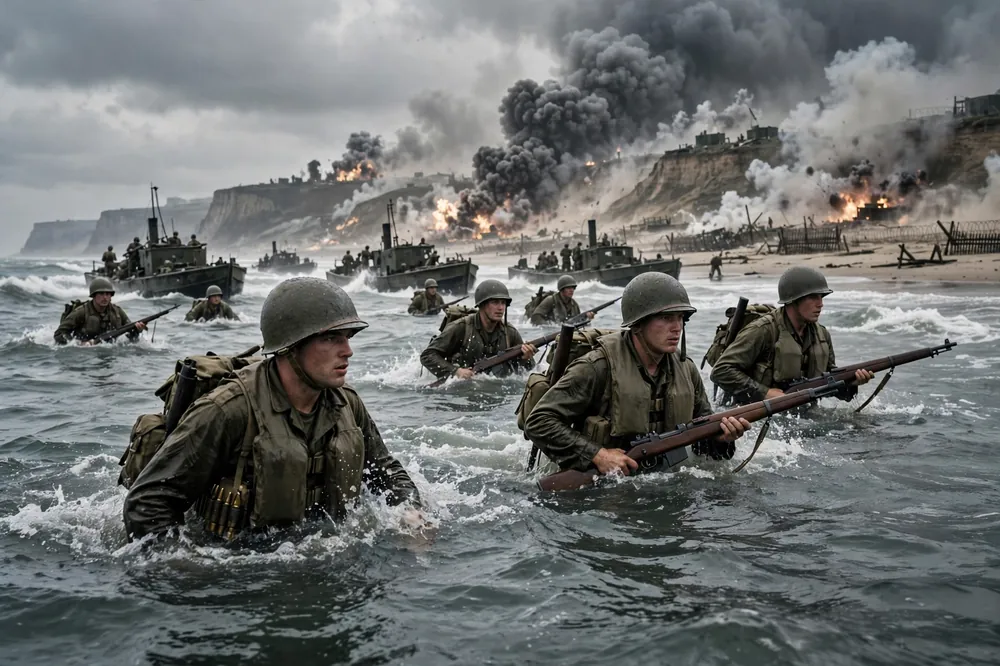
Many men were hit before they reached dry sand. The beach obstacles, still largely intact because the engineers’ demolition teams had been cut down or scattered, blocked the landing craft and funnelled the men into the killing zones. The naval bombardment and the bombing had failed to suppress the German guns, and the Germans, who had waited in their concrete, now fired with the deliberation of men shooting at a rifle range.
The worst of it was at Dog Green, the westernmost sector, where Company A of the 116th Regiment, 29th Division, landed. Of the roughly 200 men in the company, most were killed or wounded within minutes; by the end of the day the company had suffered more than 90 per cent casualties. At Easy Red and Fox Green the 1st Division fared little better: the first waves were pinned against the seawall, unable to advance and unable to retreat, while the tide came in behind them and shrank the beach to a strip a few metres wide.
For the first hours the landing was, in the words of one American officer, “a shambles”. Landing craft piled up on the beach, wrecked and burning. Wounded men lay in the surf. Units were mixed together, officers were killed, and radio communication broke down.
At 08:30, General Gerow, commanding V Corps from offshore, considered the possibility that the landing had failed and that the follow-up waves would have to be diverted to Utah or to the British beaches. Offshore, the naval commander ordered the destroyers to close in to the beach — some to within 800 metres — and fire directly at the German positions on the bluffs.
It was a desperate measure, and it worked: the destroyers’ 5-inch guns, firing at point-blank range, began to knock out machine-gun nests that the heavier ships, firing from further out, had missed.
The draws
The battle was won, slowly and at terrible cost, in the draws. Small groups of men — often no more than a squad, led by a junior officer or a sergeant — began to work their way up the bluffs by the gaps between the strongpoints, using the dead ground and the smoke to get close, then taking the German positions with grenades, satchel charges and rifle fire.
At Dog White, the gap called the Vierville draw, Brigadier General Norman Cota, the assistant commander of the 29th Division, came ashore at about 07:40, rallied the men sheltering behind the seawall, and led them up the draw himself. “Gentlemen,” he is reported to have said, “we are being killed on the beaches.
Let us go inland and be killed.” Cota’s words have become one of the best-known quotations of D-Day, though historians note that the exact wording is not certain. What is certain is that he walked up the Vierville draw under fire, and that the men followed him.
At Easy Red, Colonel George Taylor, commanding the 16th Regiment of the 1st Division, landed at about 08:00 and gave the order that became the second famous line of the day: “There are two kinds of people who are staying on this beach: those who are dead and those who are going to die. Now let’s get the hell out of here.” Taylor’s men began to climb the bluffs at the E-1 draw, and by late morning they were fighting through the villages behind the beach. At Fox Green, the 16th Regiment’s engineers blew a gap in the wire, and infantry began to filter inland.
The Rangers had their own mission. The 2nd Ranger Battalion, under Lieutenant Colonel James Rudder, landed at Pointe du Hoc, the cliff between Omaha and Utah, to destroy a battery of 155 mm guns that threatened both beaches. The guns, it turned out, had been moved inland before the landing, and the Rangers found empty casemates — but they held the point against German counterattacks for two days, losing about half their strength. The 5th Ranger Battalion landed at Omaha itself, at Dog White, and fought its way inland behind Cota.
By nightfall
By about noon the Germans were beginning to run out of ammunition, and their fire slackened. The American destroyers had silenced several strongpoints, and more tanks and artillery were coming ashore as the engineers cleared gaps in the obstacles. The beachhead grew slowly through the afternoon: by 20:00 the Americans held a strip about 1.5 to 2 kilometres deep in places, and the draws were open. The cost had been terrible — about 2,400 American casualties in a single day — but the beach was won. That night the men dug in on the bluffs above the beach they had nearly died on, and the follow-on divisions began to land.
The German 352nd Division, for its part, had fought well and had nearly succeeded. Its commander, Kraiss, had asked for reinforcements during the day, but the German command was slow to react: the armoured reserves were held back by Hitler’s orders, and the 352nd was left to fight alone. By the evening its artillery was running low on ammunition, its strongpoints were being overrun one by one, and its survivors were pulling back. Kraiss himself was killed by an Allied air attack on 2 August 1944, during the fighting around Saint-Lô.
6. Turning Point
The turning point at Omaha was not a single charge but a slow accumulation of small decisions — and the most important of them was made at sea. At about 08:30, when the landing seemed to be failing, the destroyers closed to within a few hundred metres of the beach and began firing directly at the German strongpoints.
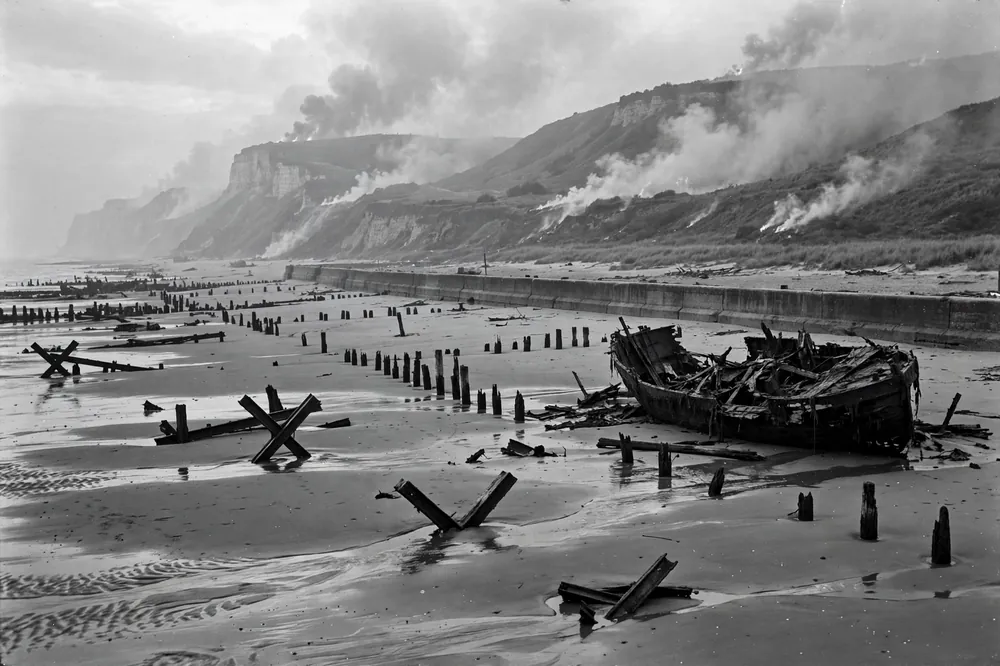
The destroyers Frankford, Carmick, McCook, Thompson and others risked running aground to bring their guns to bear, and their fire, aimed by observers on the beach, silenced position after position. Without that fire, the infantry pinned behind the seawall might never have moved at all.
The naval historian Samuel Eliot Morison called the destroyers’ action the decisive intervention of the day, and the men on the beach agreed: many survivors remembered the destroyers coming in close as the moment they believed they might live.
The second turning point was the infantry’s own initiative. Omaha was won not by a plan but by its abandonment: small groups of men, acting without orders from above, found the gaps between the German strongpoints and climbed the bluffs. Cota at the Vierville draw, Taylor at the E-1 draw, and dozens of unnamed sergeants and lieutenants did what the plan had not foreseen — they left the beach. Once the first men were on top of the bluffs, the German positions, built to fire down onto the sand, were vulnerable from behind. The strongpoints fell one by one, and the fire on the beach slackened.
The third turning point was German, and it was a failure to act. The 352nd Division had nearly won the battle by mid-morning, but it received no reinforcements. The German armoured reserves — the 21st Panzer Division and the Panzer Lehr Division — were held back by the command structure: Hitler had reserved the release of the armoured reserves to himself, and the local commanders could not move them without his order. By the time the order came, the beachhead was secure. Omaha’s narrow escape became, within days, a secure base for the breakout from Normandy.
7. Casualties and Losses
The casualty figures for Omaha Beach are approximate, and sources differ. The figure most often cited is about 2,400 American casualties on 6 June — killed, wounded and missing — out of the roughly 43,250 men landed. The US Army’s official history gives a range of 2,000 to 2,400, and the commonly quoted breakdown is about 1,000 killed and about 1,400 wounded and missing, though the exact split is not certain. The first waves suffered far worse than the later ones: Company A of the 116th Regiment lost more than 90 per cent of its men, and the 741st Tank Battalion lost 27 of its 32 DD tanks with most of their crews.
| United States | Germany | |
|---|---|---|
| Killed | About 1,000 (estimate) | About 400–500 (estimate) |
| Wounded and missing | About 1,400 (estimate) | About 600–700 (estimate) |
| Total | About 2,400 on 6 June | About 1,000–1,200 on 6 June |
| Tanks | 27 DD tanks of the 741st sunk offshore; others knocked out on the beach | Few armoured vehicles on the beach |
German losses are harder to establish. The 352nd Division’s records for 6 June are incomplete, and the figure of 1,000 to 1,200 German casualties is an estimate based on the division’s reported strength and its subsequent combat effectiveness. The division was badly hurt but not destroyed: it fought on around Saint-Lô through June and July, and was effectively destroyed there in the fighting around the city.
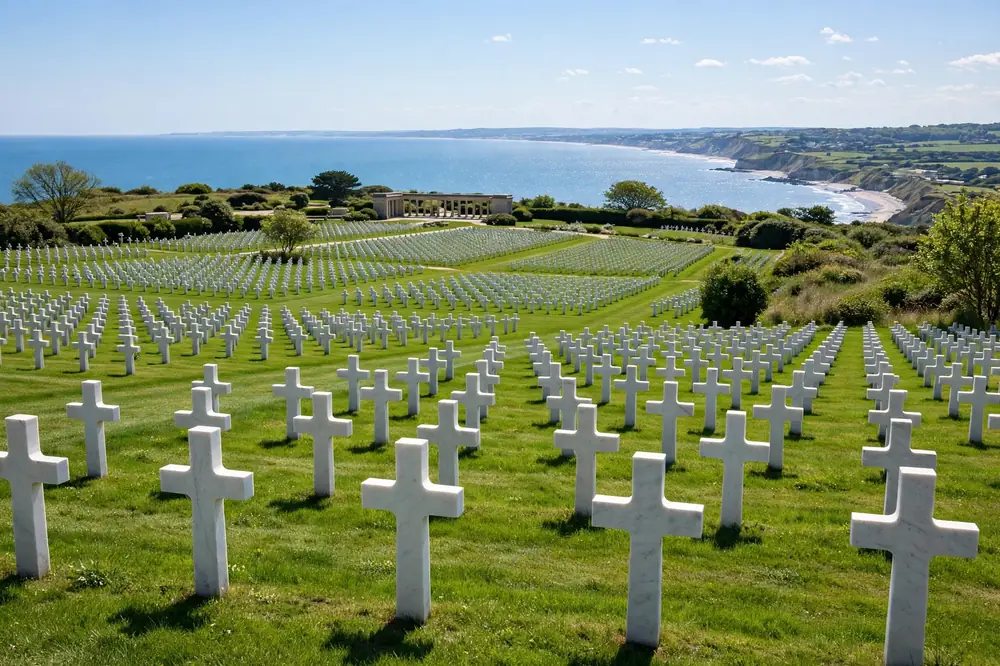
Omaha’s casualties were the heaviest of any of the five D-Day beaches. Utah, the other American beach, cost about 200 casualties on the day; Gold, Juno and Sword together cost roughly 3,000 British and Canadian casualties. Omaha alone accounted for nearly half of all Allied casualties on D-Day. The bodies of the American dead were gathered in a temporary cemetery above the beach at Colleville-sur-Mer, which became, in 1956, the Normandy American Cemetery: 9,388 graves, most of them men killed in the Normandy campaign, looking out over the beach where so many of them fell.
8. Map and Geography
Omaha Beach lies on the Calvados coast of Normandy, in north-western France, about 25 kilometres north-west of Bayeux and about 12 kilometres east of the Pointe du Hoc. The beach faces north-west, into the English Channel, and the tides there are large: at low tide the sand stretches 300 to 400 metres from the waterline to the seawall, and at high tide the water reaches the wall itself. That tidal range mattered on 6 June, because the landing was timed for low tide, so that the beach obstacles would be visible and the engineers could destroy them — but it also meant that the first waves had to cross hundreds of metres of open sand under fire.
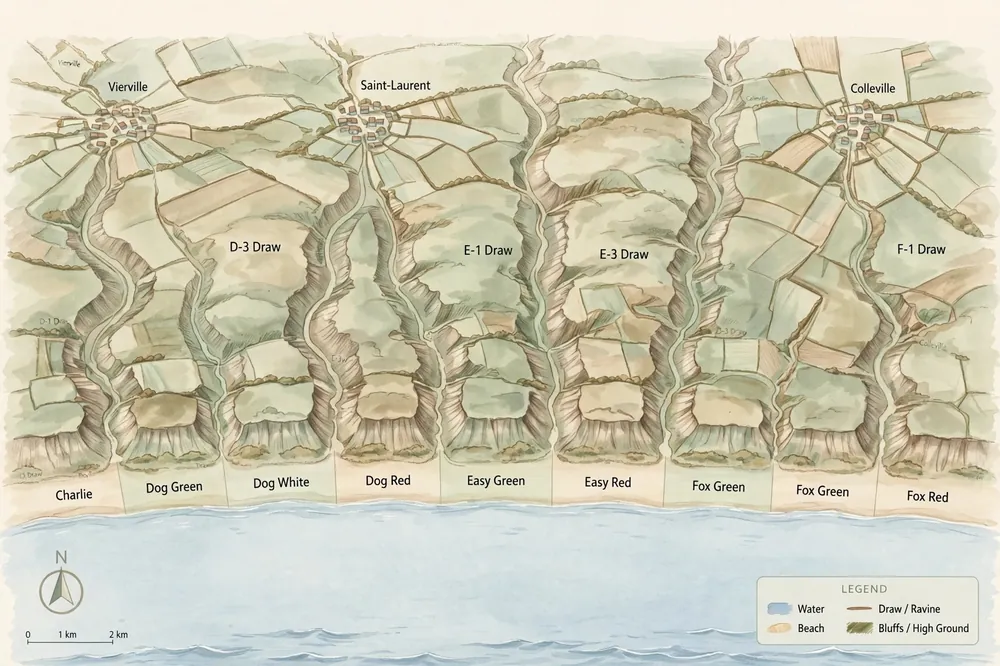
Behind the beach, the bluffs rise 30 to 50 metres, cut by the five draws: from west to east, the Vierville draw (D-1), the Les Moulins draw (D-3), the Saint-Laurent draw (E-1), the Colleville draw (E-3) and the eastern exit at F-1.
The draws were the only routes for vehicles, and the Germans knew it: each draw was covered by at least one strongpoint, and the roads through them were mined and blocked. The villages behind the bluffs — Vierville-sur-Mer, Saint-Laurent-sur-Mer and Colleville-sur-Mer — sit on the plateau above, and beyond them the ground rises gently towards Bayeux and Saint-Lô.
The bocage — the hedgerow country of small fields bounded by thick earth banks topped with trees — begins a few kilometres inland, and it would dominate the fighting in Normandy for the next two months.
The beach’s geography explains both the German plan and the American near-disaster. The bluffs gave the defenders a perfect field of fire over the whole beach, and the draws channelled the attackers into a few narrow killing zones. The tidal flats gave the attackers no cover at all.
The only redeeming feature of the ground, from the Allied point of view, was the seawall: a low concrete wall along the back of the beach that gave the pinned infantry some shelter from direct fire, and behind which Cota and Taylor rallied their men before the climb.
The geography also explains why Omaha, once won, was so valuable: it was the link between Utah in the west and the British beaches in the east, and without it the Allied lodgement would have been split in two.
9. Outcome and Legacy of Omaha Beach
By the end of 6 June, Omaha was secure, though the beachhead was only 1.5 to 2 kilometres deep — the shallowest of the five. Over the following days, the follow-on divisions poured in, the beach became a vast supply depot, and the Americans linked up with Utah to the west and Gold to the east. The 352nd Division was driven back, and by mid-June the Americans were fighting their way through the bocage towards Saint-Lô, the road junction whose capture would open the way for the breakout of late July. Omaha’s role in the campaign was as a doorway: it was never meant to be a battlefield in itself, but the doorway had nearly slammed shut.
The battle’s legacy has been shaped, more than any other D-Day beach, by memory and by film. The first twenty minutes of Steven Spielberg’s Saving Private Ryan (1998) recreated the landing at Dog Green with a vividness that fixed Omaha in the public imagination as the image of D-Day itself — the landing craft ramp dropping, the water red, the men cut down on the sand.
The film’s opening is not a documentary: it compresses events, invents characters and exaggerates some details. But its power, and the power of the veterans’ testimony it drew on, made Omaha the beach the world remembers. The real battle was longer, slower and less cinematic than the film — hours of men lying behind a seawall, waiting — but the film’s central truth is accurate: at Omaha, the landing came closer to failing than anywhere else on 6 June.
The ground itself is the memorial. The Normandy American Cemetery at Colleville-sur-Mer, with its 9,388 white crosses and Stars of David, stands on the bluff above the beach. The beach below is quiet now, a place of dog walkers and holidaymakers, and the German bunkers remain in the grass above the sand, their concrete still scarred. The draws are roads again. The cemetery’s visitor centre tells the story of the landing, and every 6 June veterans, families and French villagers gather there to remember the men who died on the sand. Omaha’s legacy is a simple one, and it is written on the cemetery’s wall in the words of the memorial’s dedication: the dead “gave their lives for freedom”.
Militarily, Omaha taught the Allies a lasting lesson about amphibious assaults: that a landing plan is only as good as its intelligence, that naval gunfire and air bombardment cannot be relied on to destroy concrete, and that the initiative of small units can rescue a plan that has failed. The American Army’s post-war doctrine on amphibious operations drew directly on Omaha — and on the destroyers that came in close, and on the sergeants who climbed the bluffs without orders.
10. Commanders
Major General Clarence Huebner (United States). Commander of the 1st Infantry Division, the “Big Red One”. Huebner was a veteran of the First World War and of the North African and Sicilian campaigns, and he commanded the division’s landing on the eastern half of Omaha. He later commanded V Corps and, after the war, served as the military governor of the American zone of Germany.
Major General Charles Gerhardt (United States). Commander of the 29th Infantry Division, a National Guard division landing in combat for the first time. Gerhardt’s division took the western half of Omaha and suffered the heaviest losses of the day, including the near-destruction of Company A, 116th Regiment, at Dog Green. He remained in command of the division through the Normandy campaign and the advance into Germany.
Brigadier General Norman Cota (United States). Assistant commander of the 29th Division, and the officer most associated with the turning of the battle. Cota landed at Dog White at about 07:40, rallied the pinned infantry behind the seawall, and led them up the Vierville draw. He later commanded the 28th Infantry Division in the Battle of the Bulge.
Colonel George Taylor (United States). Commander of the 16th Regiment, 1st Division. Taylor landed at Easy Red at about 08:00 and ordered his men off the beach with the words quoted above. He was later promoted to command the 1st Division and was awarded the Distinguished Service Cross for his actions on D-Day.
Lieutenant Colonel James Rudder (United States). Commander of the 2nd Ranger Battalion, which scaled the cliffs at Pointe du Hoc to destroy the German gun battery there. Rudder’s Rangers held the point for two days against counterattacks, at a cost of about half their strength. He later commanded the 109th Regiment and became president of Texas A&M University.
Generalleutnant Dietrich Kraiss (Germany). Commander of the 352nd Infantry Division. Kraiss had fought on the Eastern Front and had spent the spring of 1944 preparing his division to repel a landing. His men nearly stopped the invasion at Omaha; he received no reinforcements and was forced back. He was killed by an Allied air attack on 2 August 1944 near Saint-Lô.
Frequently Asked Questions
Related articles
Sources
- Wikipedia, “Omaha Beach” — dates, strength, casualty figures (about 2,400 American casualties), sector names and the 352nd Division.
- US Army Center of Military History, Omaha Beachhead (6 June–13 June 1944), American Forces in Action series — official history, unit dispositions and the destroyers’ role.
- Encyclopædia Britannica, “Omaha Beach” — background, the landing and its cost.
- National D-Day Memorial and American Battle Monuments Commission, Normandy American Cemetery — 9,388 graves and the cemetery’s history.
- Samuel Eliot Morison, History of United States Naval Operations in World War II, Vol. XI — the naval bombardment and the destroyers’ close support.
- Stephen E. Ambrose, D-Day, June 6, 1944: The Climactic Battle of World War II (Simon & Schuster, 1994) — the landing, Cota and Taylor, Company A at Dog Green.
- Joseph Balkoski, Omaha Beach: D-Day, June 6, 1944 (Stackpole, 2004).
- Adrian R. Lewis, Omaha Beach: A Flawed Victory (University of North Carolina Press, 2001).