 WAR ATLAS MILITARY HISTORY MAGAZINE · WWI — WWII
P-61 Black Widow
1. Lead
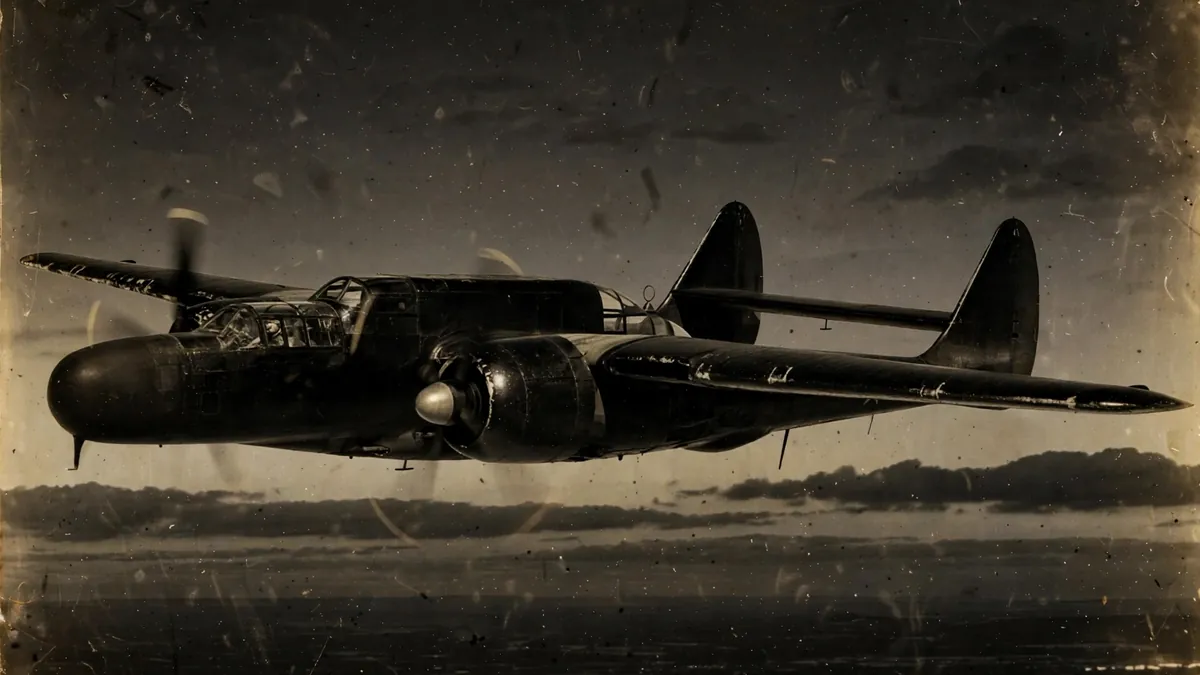
The Northrop P-61 Black Widow was the first American aircraft designed from the outset as a night fighter, and one of the most advanced aircraft of the Second World War. A large, twin-engined aircraft with a crew of three, it carried the SCR-720 airborne interception radar in its nose, and it was armed with four 20 mm cannon and four .50-calibre machine guns in a dorsal turret, and it could find, pursue and destroy an enemy bomber in the dark, without any help from the ground. The P-61 entered service in 1944, and it fought in Europe, where it defended London against the V-1 flying bomb and hunted German night bombers over France and Germany, and in the Pacific, where it flew night patrols over the Philippines, over Iwo Jima and over Okinawa, and where a P-61 is credited with one of the last air victories of the war, on the night of 14–15 August 1945. Only 706 P-61s were built, and the aircraft arrived too late to have a decisive effect on the war, but it was a triumph of American technology, and it is remembered as the aircraft that opened the age of the radar night fighter, and as one of the most beautiful and most feared aircraft of the war.
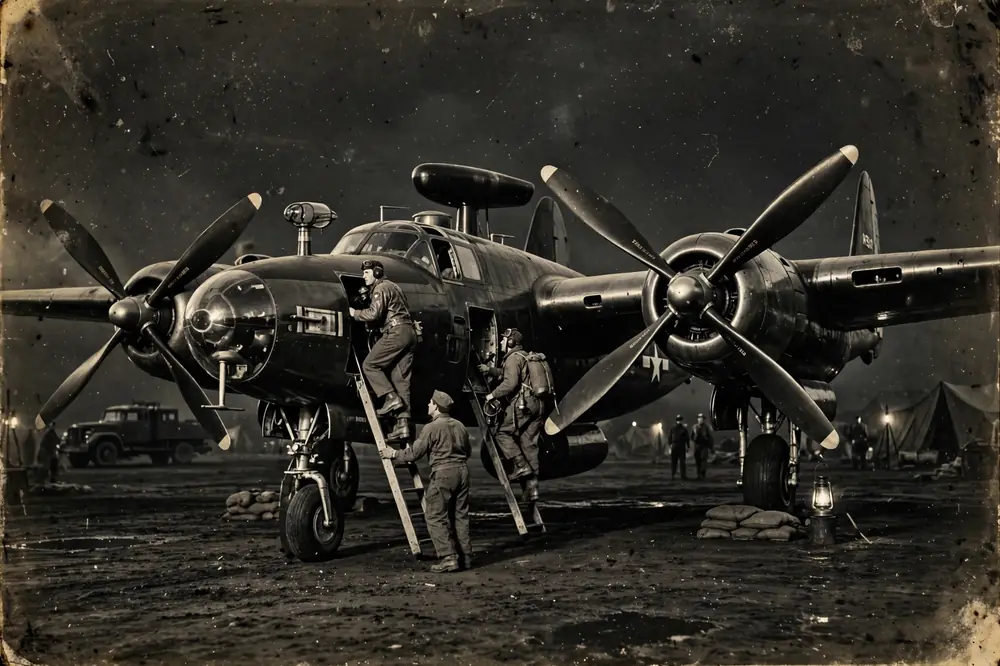
The P-61 was named the Black Widow after the spider, because it was black, because it hunted at night, and because it was deadly, and the name was painted on the aircraft with a spider’s web on its nose, and the crews who flew it were proud of the name and of the aircraft. The P-61 was the largest fighter ever built by the United States in the Second World War, and it was the first American fighter to be designed around its radar, and its crew of three — a pilot, a gunner and a radar operator — worked as a team, with the radar operator finding the target, the gunner firing the guns, and the pilot flying the aircraft, and the teamwork of the crew was the key to the P-61’s success. The P-61’s story is the story of the night fighter, from the first radar experiments of the 1930s to the jet night fighters of the Cold War, and it is the story of an aircraft that was ahead of its time, and that pointed the way to the future of air warfare.
2. Key Facts
| Type | Night fighter (twin-engined) |
| Origin | United States |
| Designer | Northrop (Jack Northrop and Vladimir Pavlecka) |
| Manufacturer | Northrop, Hawthorne, California |
| First flight | 26 May 1942 |
| In service | 1944–1954 (USAF) |
| Produced | 1942–1945; 706 built |
| Crew | 3 (pilot, gunner, radar operator); later 2 |
| Length | 15.1 m (49 ft 7 in) |
| Wingspan | 20.1 m (66 ft) |
| Height | 4.5 m (14 ft 8 in) |
| Max speed | About 589 km/h (366 mph) |
| Range | About 2,172 km; ferry range about 3,060 km |
| Service ceiling | 10,600 m (33,100 ft) |
| Engines | Two Pratt & Whitney R-2800-65 Double Wasp radials, 2,000 hp each |
| Armament | Four 20 mm Hispano M2 cannon; four .50-calibre M2 machine guns in a dorsal turret |
| Radar | SCR-720 airborne interception radar (later SCR-720C) |
| Bomb load | Up to 2,900 kg of bombs or rockets (P-61B) |
3. Background and Development
The British Requirement and the American Answer
The P-61 was born of a British requirement, and it was the answer to a problem that the British had faced since the Blitz of 1940: the German bombers attacked at night, and the British fighters could not find them in the dark, and the British needed a night fighter with radar, with heavy armament and with a crew that could work together to find and to destroy the bomber. The British asked the Americans to build such an aircraft, and the United States Army Air Corps issued a specification in 1940 for a night fighter, and Northrop answered with a large, twin-engined aircraft that was designed around its radar from the start. The P-61 was the first aircraft in the world to be designed as a night fighter from the outset, and it was the first American aircraft to be designed around its radar, and it was a triumph of American technology, and it showed that the United States could build an aircraft that was as advanced as any in the world.
Northrop and the Design
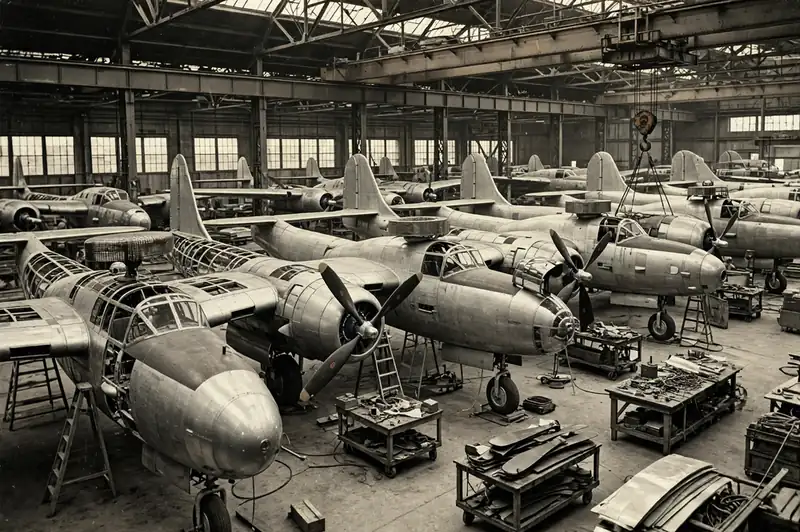
The P-61 was designed by Northrop, under Jack Northrop and Vladimir Pavlecka, and it was a radical design: a twin-boom aircraft, with two engines, two tail booms and a central nacelle that held the crew of three, the radar and the armament, and with a wing that was designed to give the aircraft a good performance at night, when it had to fly slowly and to manoeuvre in the dark. The aircraft’s radar, the SCR-720, was mounted in the nose, and it could detect a bomber at a range of several miles, and it let the radar operator guide the pilot to the target, and the pilot then fired the four 20 mm cannon that were mounted in the belly of the aircraft. The P-61 first flew on 26 May 1942, and it was a success, but its production was delayed by the need to develop the radar, and by the competition for engines and for materials, and the first P-61s did not reach the front until 1944, when the war was already turning in the Allies’ favour.
The Radar: SCR-720
The P-61’s radar, the SCR-720, was the key to its success, and it was one of the most advanced radars of the war. The SCR-720 was an airborne interception radar, developed from the British AI Mk. VIII radar, and it could detect a bomber at a range of about 8 kilometres, and it displayed the target on a cathode-ray tube in the radar operator’s compartment, and the radar operator guided the pilot to the target by voice, and the pilot then closed to visual range and fired. The radar was a secret, and the P-61’s crews were ordered not to fly over enemy territory in case the aircraft was shot down and the radar was captured, and the radar’s development was one of the great achievements of the war, and it showed that the United States could build a radar that was as good as the British radar that it was based on. The SCR-720 was later improved as the SCR-720C, and it was fitted to the P-61B, and it remained in service after the war, and it was the ancestor of the radars that are fitted to every fighter aircraft today.
4. Design
Twin Booms and a Crew of Three
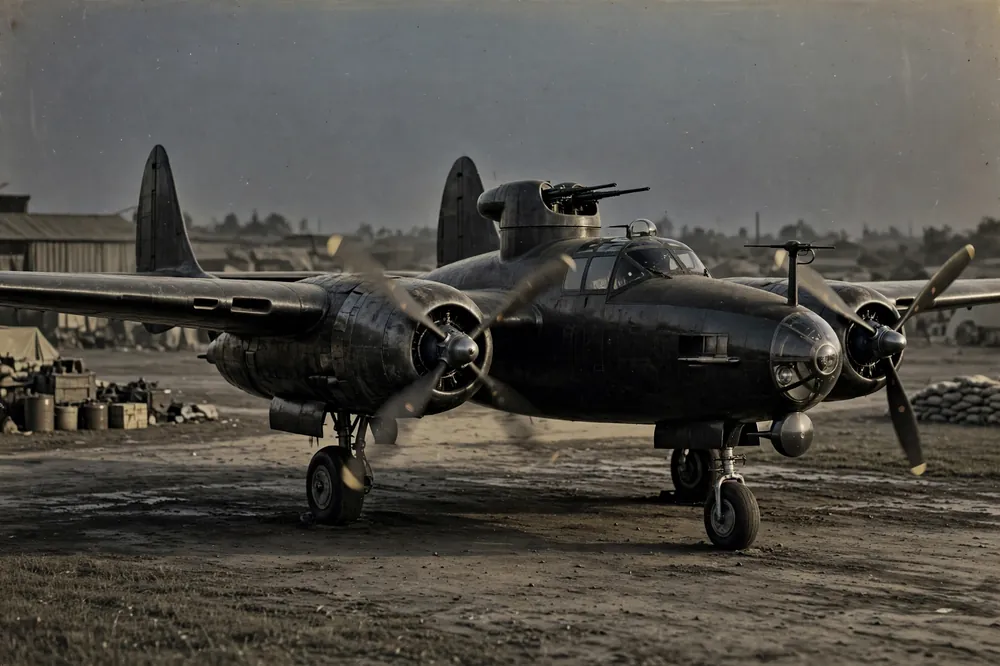
The P-61 was a twin-boom aircraft, with two Pratt & Whitney R-2800 Double Wasp radial engines of 2,000 horsepower each, mounted in nacelles that extended back into two tail booms, and with a central nacelle that held the crew of three, the radar and the armament, and with a wing that spanned 20.1 metres and that gave the aircraft a good performance at night. The aircraft’s crew consisted of a pilot, who sat in the front of the central nacelle, a gunner, who sat behind the pilot and who operated the dorsal turret, and a radar operator, who sat in the rear of the nacelle and who operated the radar, and the three men worked as a team, with the radar operator finding the target, the gunner firing the guns, and the pilot flying the aircraft. The P-61 was the largest fighter ever built by the United States in the Second World War, and it was 15.1 metres long, with a wingspan of 20.1 metres, and it weighed 8,618 kilograms empty, and it was a big aircraft for a fighter, but its size was necessary for its radar, its crew and its armament, and it gave the aircraft a stability and a range that a smaller fighter could not have.
Four 20 mm Cannon and the Dorsal Turret
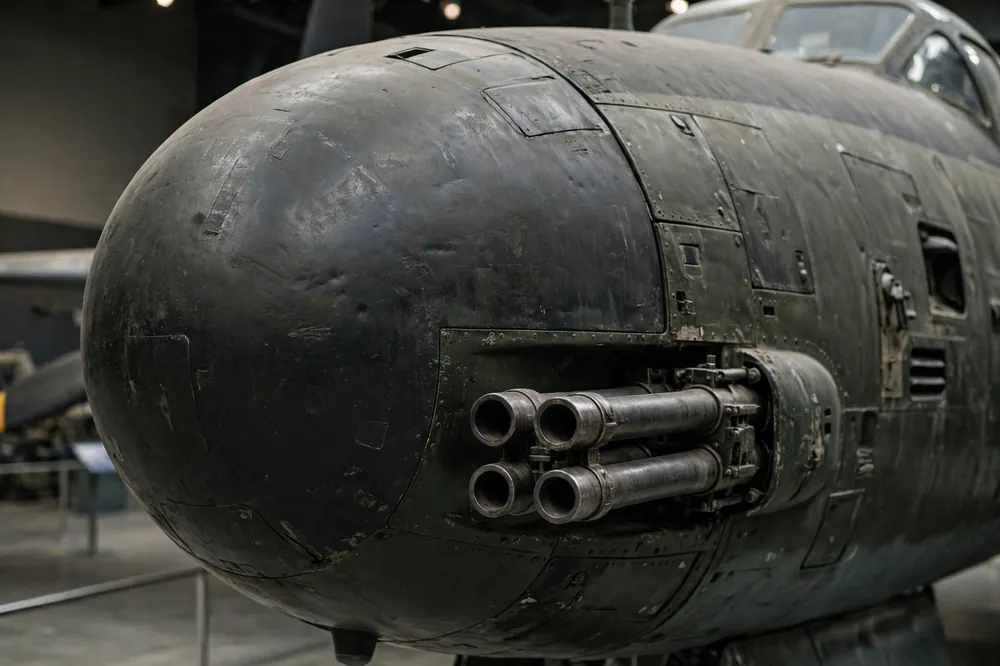
The P-61 was armed with four 20 mm Hispano M2 cannon, mounted in the belly of the central nacelle, and with four .50-calibre M2 machine guns in a dorsal turret, which was mounted on top of the central nacelle and which could be operated by the gunner or, in later versions, by the radar operator, and which could fire in almost every direction above and behind the aircraft. The 20 mm cannon were the P-61’s main armament, and they fired a shell that could destroy a bomber with a single hit, and they were the reason the P-61 was so feared by German and Japanese bomber crews. The dorsal turret, which was a power-operated turret with four machine guns, was a unique feature of the P-61, and it let the aircraft defend itself against the fighters that attacked it from above and behind, and it was later removed from some P-61s, because it was heavy and because it was rarely used, and the P-61B, which was the main production version, was built without the turret in its later batches. The P-61’s armament was the heaviest of any American fighter of the war, and it was the reason the aircraft was called the Black Widow, because it could kill with a single bite.
Performance and Handling
The P-61’s performance was good for a night fighter of its generation, and it was fast enough to catch the bombers that it hunted, with a top speed of about 589 kilometres per hour, and a range of about 2,172 kilometres, and a service ceiling of 10,600 metres. The aircraft’s handling was good for a large aircraft, and its pilots praised its stability and its responsiveness, and its twin engines gave it a safety margin that a single-engined fighter did not have, and its crew of three gave it a workload that was shared among the pilot, the gunner and the radar operator. But the P-61 was not a dogfighter, and it could not turn with a single-engined fighter, and its size made it an easy target for the German and Japanese fighters that attacked it in daylight, and the P-61’s crews therefore flew at night, when the darkness protected them, and when their radar gave them an advantage that no day fighter had. The P-61’s performance was the performance of a night fighter, and it was good enough for the job that it was designed to do.
5. Variants
| Variant | Years | Key features | Production |
|---|---|---|---|
| P-61A | 1943–1944 | Original version; dorsal turret; R-2800-10 engines | 200 |
| P-61B | 1944–1945 | Main production version; R-2800-65 engines; longer nose; later batches without turret | 450 |
| P-61C | 1945 | Turbo-supercharged R-2800-73 engines; higher speed | 41 |
| F-15 Reporter | 1945–1948 | Photo-reconnaissance version; glazed nose; no guns | 36 converted from P-61C airframes (included above) |
| P-61 (XP-61E) | 1945 | Long-range escort fighter prototype; two-seat | 2 prototypes converted from P-61B airframes (included above) |
| XP-61 / YP-61 | 1942–1943 | Prototypes and service-test aircraft | 15 |
P-61A
The P-61A was the original production version of the Black Widow, and it was built in a run of 200 aircraft, powered by Pratt & Whitney R-2800-10 Double Wasp engines of 2,000 horsepower, and armed with four 20 mm cannon and four .50-calibre machine guns in a dorsal turret. The P-61A was the version that first entered service in Europe in 1944, and it was the version that defended London against the V-1 flying bomb and that hunted German night bombers over France, and it was the version that the crews remembered as the original Black Widow, with its turret and its black paint and its spider’s web on the nose. The P-61A’s production was delayed by the need to develop the radar, and by the competition for engines, but it arrived in time to fight in the last year of the war in Europe, and it was a success, and it proved the concept of the radar night fighter.
P-61B: The Main Production Version
The P-61B was the main production version of the Black Widow, and it was built in a run of 450 aircraft, powered by Pratt & Whitney R-2800-65 Double Wasp engines, and fitted with a longer nose, with improved radar, and with the ability to carry bombs and rockets under its wings. The P-61B was the version that fought in the Pacific, where it flew night patrols over the Philippines, over Iwo Jima and over Okinawa, and it was the version that scored one of the last air victories of the war, on the night of 14–15 August 1945, when a P-61B named Lady in the Dark shot down a Japanese aircraft. The later batches of the P-61B were built without the dorsal turret, because it was heavy and because it was rarely used, and the P-61B’s production was the largest of any version, and it is the version that most people picture when they think of the Black Widow, and it is the version that survives in museums today.
F-15 Reporter and Post-War Versions
The F-15 Reporter was a photo-reconnaissance version of the P-61, built after the war, with a glazed nose in place of the radar and the guns, and with cameras that photographed the ground from high altitude, and it was used by the United States Air Force for mapping and for reconnaissance in the late 1940s, and it served in Japan and in Korea, where its cameras mapped the terrain for the American forces. The P-61C was a high-performance version, with turbo-supercharged R-2800-73 engines, and it was built in a run of 41 aircraft, but it arrived too late to see combat, and it was used for trials after the war. The XP-61E was a long-range escort fighter prototype, with two seats and a longer range, but it was not put into production, and the P-61’s post-war career was short, because the jet fighter had arrived, and the piston-engined night fighter was obsolete, and the P-61 was retired in 1954, ten years after it had entered service.
6. Operational History
Europe: Normandy and the V-1
The P-61’s first service was in Europe, where it arrived in the spring of 1944, just in time for the invasion of Normandy, and where it was used to defend London against the V-1 flying bomb, the German pilotless aircraft that attacked the city from June 1944. The P-61’s radar let it find the V-1 at night, and in a dive, its speed let it catch the V-1, which flew at about 640 kilometres per hour in level flight, and its guns let it shoot the V-1 down, and the P-61s of the 422nd and 425th Night Fighter Squadrons shot down V-1s over the English Channel and over southern England. The P-61’s service against the V-1 was its first combat, and it was a success, showing that the radar night fighter could defend a city against a pilotless weapon, and its V-1 kills were among the first victories of the type, scored in July 1944. After Normandy, the P-61s moved to France, and they flew as night intruders over Germany, hunting the German night bombers and the German transport aircraft that flew at night, and attacking German airfields, German railways and German road convoys, using their radar to find their targets in the dark. The night intruder missions were dangerous, because the German flak was heavy and the German night fighters were skilled, but the P-61’s crews were brave and well trained, and they scored victories against the German bombers and fighters, and helped to disrupt the German night operations. The P-61’s service as a night intruder was one of its most important roles, showing the versatility of the aircraft: it was not only a defensive fighter, but an offensive weapon as well, able to take the war to the enemy at night.
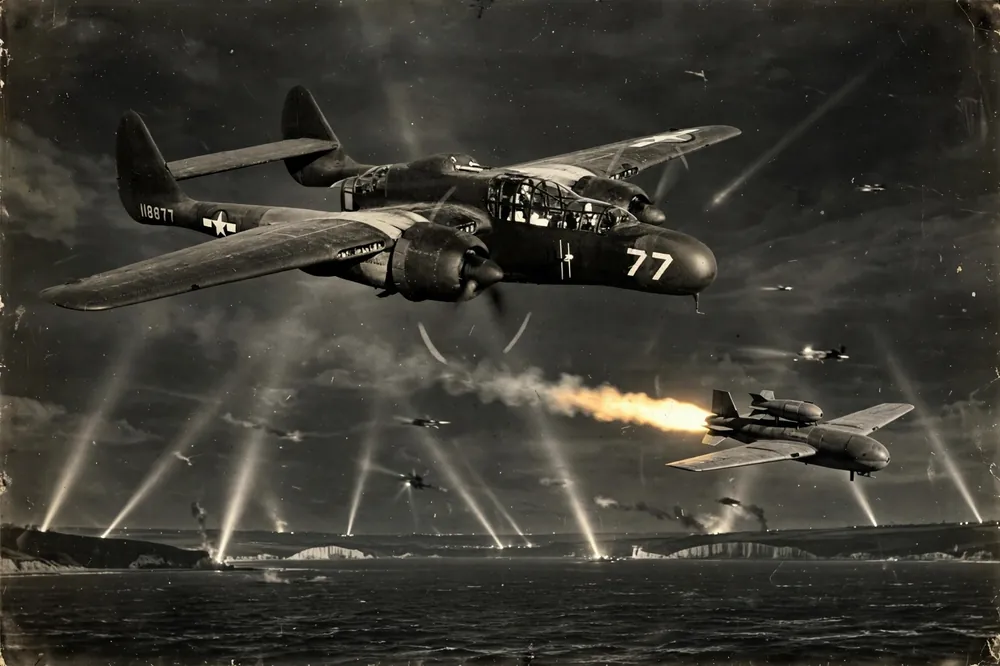
Defending London
The P-61’s first service was in Europe, where it arrived in the spring of 1944, just in time for the invasion of Normandy, and where it was used to defend London against the V-1 flying bomb, the German pilotless aircraft that attacked the city from June 1944. The P-61’s radar let it find the V-1 at night, and in a dive, its speed let it catch the V-1, which flew at about 640 kilometres per hour in level flight, and its guns let it shoot the V-1 down, and the P-61s of the 422nd and 425th Night Fighter Squadrons shot down V-1s over the English Channel and over southern England. The P-61’s service against the V-1 was its first combat, and it was a success, and it showed that the radar night fighter could defend a city against a pilotless weapon, and it was a measure of the P-61’s performance and of its crews’ skill. The P-61’s V-1 kills were among the first victories of the type, and they were scored in July 1944, when the V-1 campaign was at its height.
Night Intruders over Germany
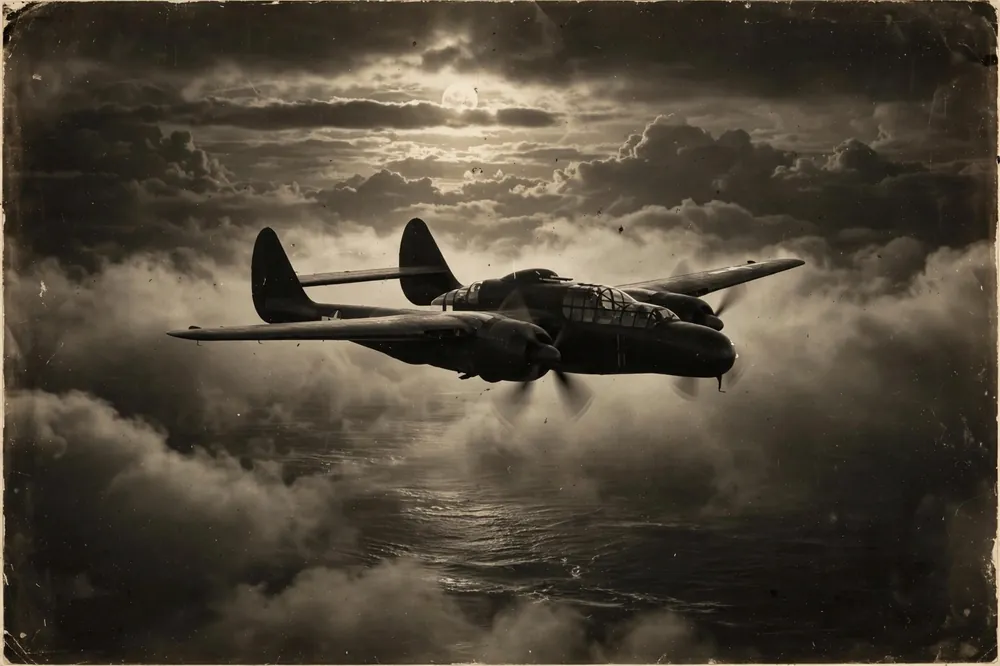
After Normandy, the P-61s moved to France, and they flew as night intruders over Germany, hunting the German night bombers and the German transport aircraft that flew at night, and they attacked German airfields, German railways and German road convoys, and they used their radar to find their targets in the dark. The P-61’s night intruder missions were dangerous, because the German flak was heavy and the German night fighters were skilled, but the P-61’s crews were brave and well trained, and they scored victories against the German bombers and the German fighters, and they helped to disrupt the German night operations. The P-61’s service as a night intruder was one of its most important roles, and it showed the versatility of the aircraft, and it is a reminder that the P-61 was not only a defensive fighter, but an offensive weapon as well, and that it could take the war to the enemy at night.
The Pacific: The Philippines and Okinawa
In the Pacific, the P-61 served with the night fighter squadrons that defended the American bases and that hunted the Japanese bombers that attacked at night. The P-61s arrived in the Pacific in the summer of 1944, and they flew from New Guinea, from the Philippines, from Iwo Jima and from Okinawa, and they patrolled the night sky over the American bases and over the fleet, and they shot down Japanese bombers that attacked the bases and the ships. The P-61’s service in the Pacific was a long campaign, and it was the campaign in which the P-61 proved itself as a night fighter, and in which its crews learned to work with the radar and with each other, and in which the aircraft’s toughness and its reliability were tested in the tropical heat and the rain of the Pacific. The P-61’s Pacific service ended with the war, and its last victory, on the night of 14–15 August 1945, was one of the last air victories of the war, and it is the victory for which the P-61 is best remembered.
The Last Victory: 14–15 August 1945
The P-61’s last victory is one of the most famous episodes of the Pacific War, and it is the story of the Lady in the Dark, a P-61B of the 548th Night Fighter Squadron, based on Ie Shima, near Okinawa. On the night of 14–15 August 1945, after the Emperor of Japan had announced the surrender but before the formal surrender had been signed, the Lady in the Dark, flown by Lieutenant Robert W. Clyde and with Lieutenant Bruce K. Petersen as radar operator, intercepted a Japanese Nakajima Ki-44 fighter over the sea near Okinawa, and shot it down, in what is credited as one of the last air victories of the Second World War. The victory was scored hours after the war had effectively ended, and it was a reminder that the war did not end in a single moment, and that men were still fighting and dying after the surrender had been announced. The Lady in the Dark is remembered as the aircraft that scored one of the last victories, and its story is told in every history of the P-61, and in every history of the last days of the war.
7. Performance and Specifications
| Specification | P-61B |
|---|---|
| Crew | 3 |
| Length | 15.1 m |
| Wingspan | 20.1 m |
| Height | 4.5 m |
| Empty weight | About 8,618 kg |
| Maximum take-off weight | About 13,471 kg |
| Engines | Two Pratt & Whitney R-2800-65 Double Wasp radials, 2,000 hp each |
| Max speed | About 589 km/h |
| Range | About 2,172 km |
| Service ceiling | 10,600 m |
| Armament | Four 20 mm Hispano M2 cannon; four .50-calibre M2 machine guns (dorsal turret) |
| Radar | SCR-720 airborne interception radar |
| Bomb load | Up to 2,900 kg of bombs or rockets |
Night-Fighting Performance
The P-61’s night-fighting performance was good for a night fighter of its generation, and it was the result of its radar, its armament and its crew. The SCR-720 radar could detect a bomber at a range of about 8 kilometres, and it let the radar operator guide the pilot to the target, and the pilot then closed to visual range and fired the four 20 mm cannon, which could destroy a bomber with a single burst. The P-61’s top speed of about 589 kilometres per hour was fast enough to catch the German and Japanese bombers that it hunted, and its range of about 2,172 kilometres let it patrol for hours, and its service ceiling of 10,600 metres let it fly above the worst of the flak. But the P-61’s night-fighting performance was limited by its radar, which was primitive by modern standards, and by its crew, who had to work together in the dark, and by the darkness itself, which made it hard to identify a target and to aim. The P-61’s night-fighting performance was therefore a matter of teamwork, and of the radar operator, the gunner and the pilot working together, and it is the teamwork that made the P-61 effective.
Comparison with the Mosquito and the Ju 88
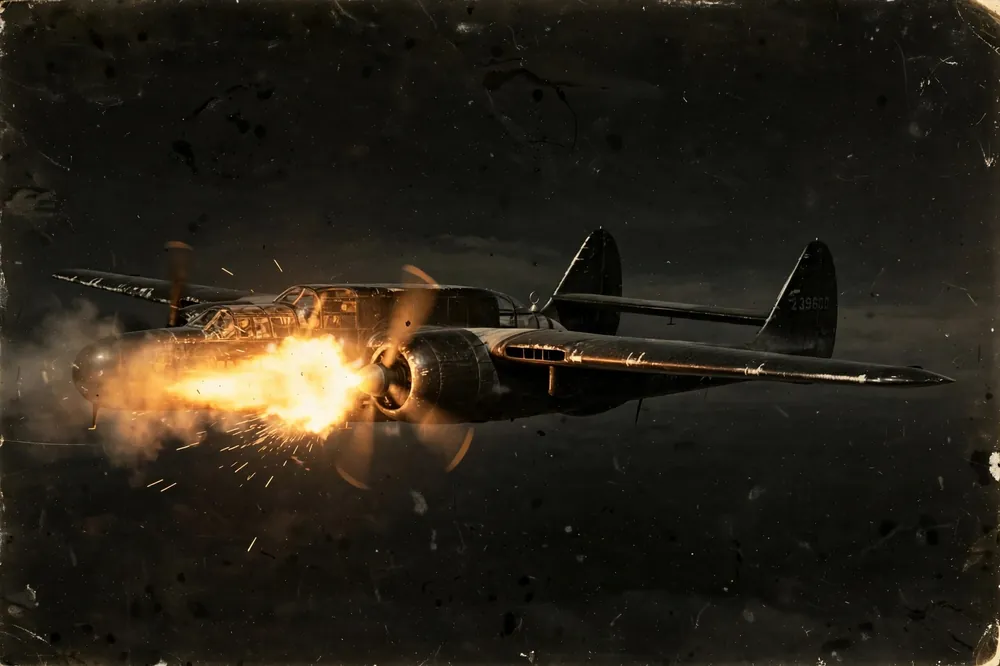
Compared with the British de Havilland Mosquito, the P-61 was larger, heavier and more heavily armed, but the Mosquito was faster, with a top speed of about 640 kilometres per hour, and it had a longer range, and it was a better night fighter in the hands of a skilled crew, and it was built in far larger numbers, with 7,781 built against the P-61’s 706. Compared with the German Junkers Ju 88, which was the Luftwaffe’s main night fighter, the P-61 was faster and more heavily armed, and it had a better radar, but the Ju 88 was built in larger numbers and its crews were more experienced, and it was a formidable opponent. The P-61’s place in history is that of the first purpose-built night fighter, and it is remembered as the aircraft that opened the age of the radar night fighter, and that pointed the way to the jet night fighters of the Cold War, and its comparison with the Mosquito and the Ju 88 shows that it was a good aircraft, but not the best, and that its importance lies in its concept rather than in its performance.
8. Operators
The United States
The P-61 was used only by the United States during the war, and it served with the United States Army Air Forces, in the night fighter squadrons of the Ninth Air Force in Europe and of the Fifth and Thirteenth Air Forces in the Pacific. The P-61’s squadrons were the 422nd, 425th, 426th and 427th Night Fighter Squadrons in Europe, and the 418th, 419th, 421st, 547th and 548th Night Fighter Squadrons in the Pacific, and they were the squadrons that defended London against the V-1, that hunted German night bombers over France, and that patrolled the night sky over the Philippines and Okinawa. The P-61 remained in service with the United States Air Force after the war, and it was used as a night fighter and as a reconnaissance aircraft, and it was finally retired in 1954, ten years after it had entered service. The P-61’s service with the United States was the only service of the type in the war, and it is the service for which the aircraft is remembered.
No Other Operator
No other country operated the P-61 during the war, and the aircraft was never exported, because it was a secret weapon, and because its radar was a secret, and because the United States did not want the radar to fall into enemy hands. After the war, the P-61 was not exported, because it was obsolete, and because the jet fighter had arrived, and because the night fighter of the future would be a jet, not a piston-engined aircraft. The P-61’s lack of export is a measure of its secrecy and of its specialisation: it was a weapon built for a specific purpose, and for a specific war, and it served that purpose, and it was retired when the war was over and when the jet had arrived. The P-61’s story is therefore an American story, and it is the story of an aircraft that was built for the United States, and that served the United States, and that is remembered in the United States.
9. Legacy and Influence
The First Purpose-Built Night Fighter
The P-61’s legacy is that of the first purpose-built night fighter, and it is remembered as the aircraft that opened the age of the radar night fighter, and that pointed the way to the jet night fighters of the Cold War. Before the P-61, night fighters were day fighters that had been adapted for night fighting, with radar added to an aircraft that had not been designed for it, and they were a compromise, and the P-61 was the first aircraft to be designed as a night fighter from the outset, with its radar, its crew and its armament designed together, and it showed that a night fighter could be a specialised aircraft, and that it could be more effective than an adapted day fighter. The P-61’s concept — a large, twin-engined aircraft, with a crew of three, with radar and with heavy armament — became the concept of the night fighter of the Cold War, and it is the concept of the interceptor that followed it, and the P-61’s legacy is therefore the legacy of the night fighter itself.
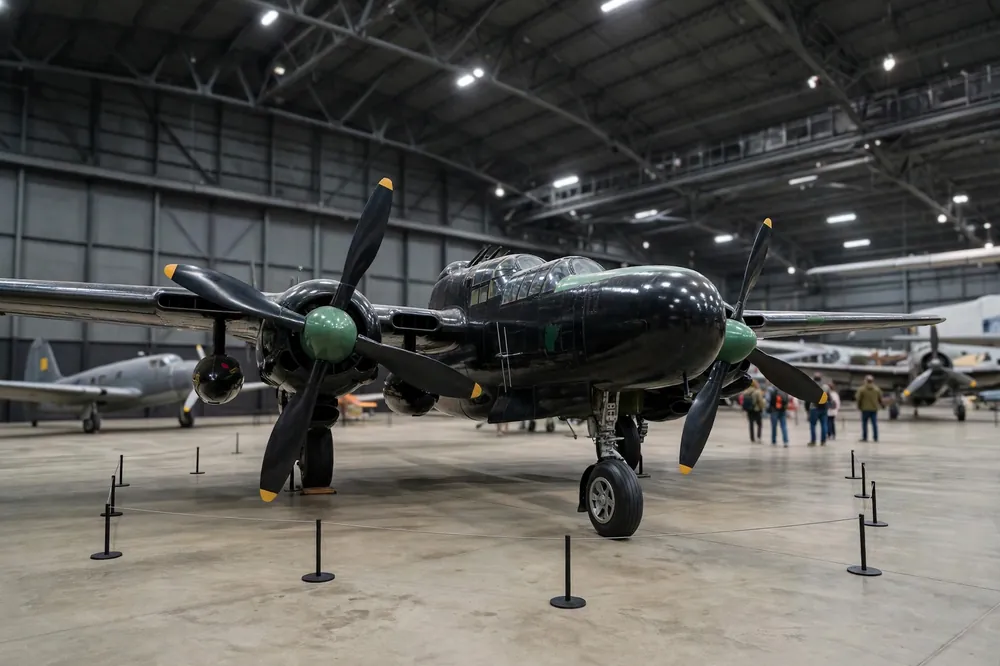
The Black Widow in Memory
The P-61 is remembered as the Black Widow, and its name, its black paint and its spider’s web are among the most famous markings of any American aircraft of the war. The P-61’s crews were proud of the name, and they painted it on their aircraft with pride, and the aircraft’s reputation as a killer, a spider that hunted at night, was a source of pride for the men who flew it, and a source of fear for the men who faced it. The P-61’s memory lives on in the books and the films that tell its story, in the museums that display it, and in the restoration of the Moonlight Serenade, the P-61 that is being restored to flying condition, and that will be the only flying Black Widow in the world. The P-61’s legacy is therefore not only its service in the war, but its place in the memory of the war, and in the memory of the men who flew it, and in the imagination of the people who remember it as the Black Widow.
10. Surviving Examples
Surviving Aircraft
Only four P-61s survive, and none of them flies, though one is being restored to flying condition. The survivors are the P-61C at the National Museum of the United States Air Force in Dayton, Ohio, the P-61B at the Smithsonian National Air and Space Museum in Washington, D.C., the P-61B at the Beijing Military Museum in China, which was captured during the Chinese Civil War, and the P-61B Moonlight Serenade at the Mid-Atlantic Air Museum in Reading, Pennsylvania, which is being restored to flying condition. The P-61’s rarity is a measure of its small production run: only 706 were built, and most were scrapped after the war, and the four survivors are among the rarest American aircraft of the war. For the visitor, the P-61 is one of the most impressive aircraft in the museums that display it, and it is a reminder of the night fighter and of the men who flew it.
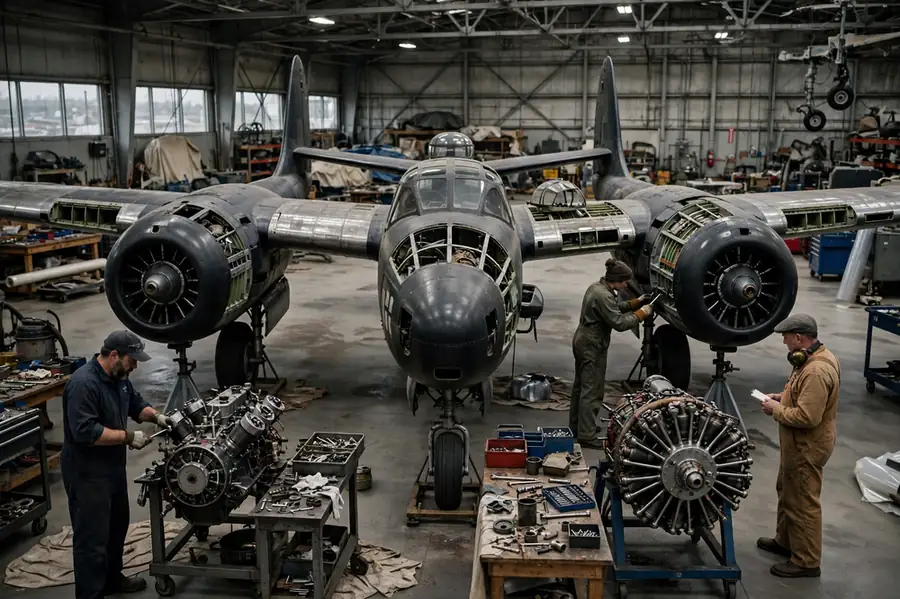
The Restoration of Moonlight Serenade
The Moonlight Serenade, a P-61B that crashed in New Guinea in 1945 and that was recovered from the jungle in 1991, is being restored to flying condition by the Mid-Atlantic Air Museum in Reading, Pennsylvania, and it will be the only flying Black Widow in the world when it flies. The restoration is a long and difficult project, because the aircraft was badly damaged in the crash and in the decades that it lay in the jungle, and because many of its parts have to be made from scratch, and because the museum is a volunteer organisation with limited funds, but the restoration is progressing, and the aircraft’s engines have been run, and its airframe has been rebuilt, and it is hoped that it will fly in the coming years. The restoration of the Moonlight Serenade is a tribute to the men who flew the P-61, and to the aircraft that they flew, and it is a reminder that the Black Widow will fly again, and that its story will continue to be told in the air, as well as in the museums.
Frequently Asked Questions
What is the P-61 Black Widow?
The P-61 Black Widow was the first American aircraft designed from the outset as a night fighter, built by Northrop. It carried SCR-720 radar, four 20 mm cannon and four .50-calibre machine guns, and it served in Europe and the Pacific in 1944–1945.
How many P-61s were built?
706 P-61s were built by Northrop between 1942 and 1945, of which 200 were P-61As, 450 were P-61Bs and 41 were P-61Cs.
What radar did the P-61 carry?
The P-61 carried the SCR-720 airborne interception radar, developed from the British AI Mk. VIII radar. It could detect a bomber at a range of about 8 kilometres and guide the pilot to the target.
What was the P-61’s last air victory of the war?
A P-61B named Lady in the Dark, of the 548th Night Fighter Squadron, is credited with one of the last air victories of the war, shooting down a Japanese Ki-44 fighter on the night of 14–15 August 1945, after Japan had announced its surrender.
How fast was the P-61?
The P-61’s top speed was about 589 kilometres per hour (366 mph), with a range of about 2,172 kilometres and a service ceiling of 10,600 metres.
Where can I see a P-61 today?
P-61s are displayed at the National Museum of the United States Air Force in Dayton, Ohio, and the Smithsonian National Air and Space Museum in Washington, D.C., and a P-61B named Moonlight Serenade is being restored to flying condition at the Mid-Atlantic Air Museum in Reading, Pennsylvania.
Sources
- Wikipedia, “Northrop P-61 Black Widow” — development, production of 706, SCR-720 radar, service in Europe and the Pacific.
- Jeff Kolln, Northrop’s Night Hunter: P-61 Black Widow (Specialty Press, 2008) — the aircraft’s design and its combat record.
- Garry R. Pape and Ronald C. Harrison, Queen of the Midnight Skies (Schiffer, 1992) — the P-61’s squadrons and their victories.
- Warren Thompson, P-61 Black Widow Units of World War 2 (Osprey Publishing, 1998) — the P-61’s operational history.
- United States Air Force, The P-61 Black Widow (Air Force Historical Studies) — the aircraft’s specifications and its post-war service.
- The Mid-Atlantic Air Museum, Reading, Pennsylvania, “Moonlight Serenade” — the restoration of the P-61B to flying condition.