 WAR ATLAS MILITARY HISTORY MAGAZINE · WWI — WWII
Panther II Tank: Germany’s Panther Successor That Never Fought
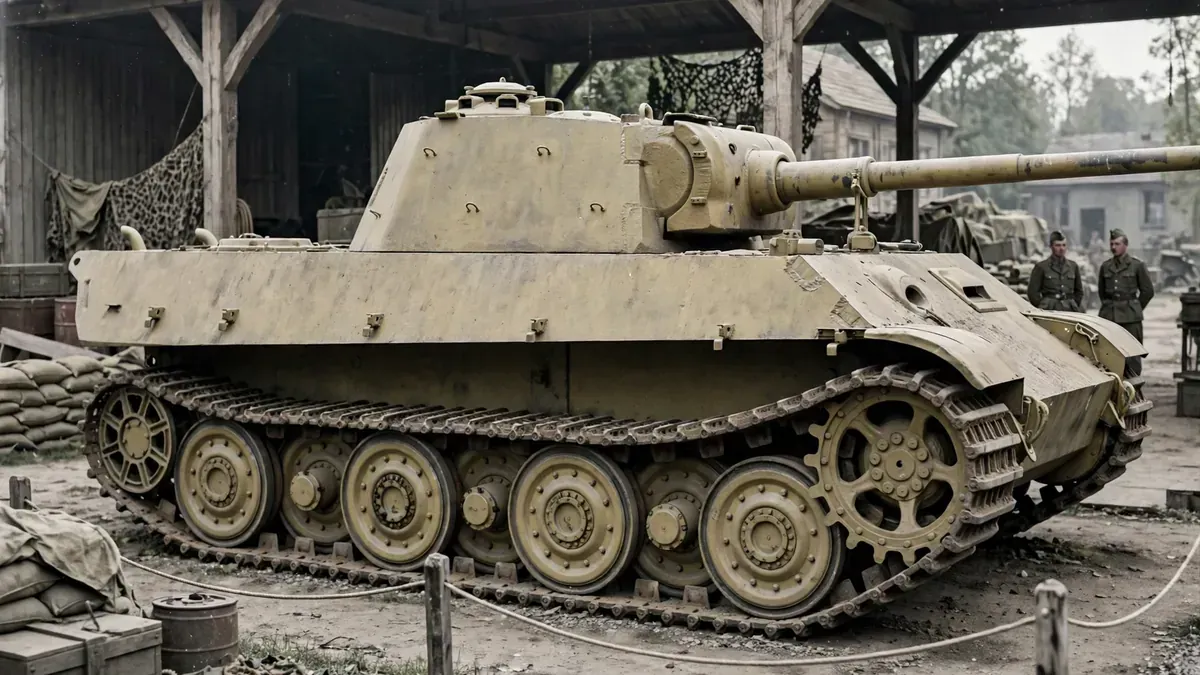
The Panther II was Germany’s planned successor to the Panther medium tank, a design that was intended to standardise components with the Tiger II and to improve the Panther’s armour and firepower, but which never progressed beyond a single prototype hull. Conceived in 1943, when the Panther was already in production, the Panther II was meant to address the Panther’s weaknesses, notably its thin side armour and its unreliable final drive, and to prepare for the next generation of German tanks. The project was cancelled in 1944, before a complete vehicle had been built, and the only surviving Panther II is a hull, fitted with a Panther Ausf. G turret by the Americans after the war, which is now displayed at the National Armor and Cavalry Museum at Fort Benning in the United States. The Panther II is remembered today as a symbol of the German tank industry’s ambitions and its difficulties in the final years of the war.
The Panther II’s story is one of ambition, confusion and wasted effort. In 1943, the German Army’s ordnance office, the Heereswaffenamt, ordered the development of a new medium tank that would use the same components as the Tiger II, including its engine, transmission and running gear, in order to simplify production and maintenance. The design was entrusted to MAN, the manufacturer of the Panther, and to Daimler-Benz, and the first prototype hull was built by MAN in 1943. But the project was plagued by changing requirements: the Army wanted a thicker glacis plate, a new turret, a more powerful gun and, at one point, a completely new hull. By the time the prototype hull was completed, the Panther II had become a different tank from the one that had been ordered, and the German high command decided that the resources would be better spent on the Panther itself.
The Panther II is a fascinating subject for historians of armoured warfare, because it shows how the German tank industry, under the pressure of Allied bombing and material shortages, struggled to develop new designs while keeping existing production lines running. The Panther II’s hull, with its thicker armour and its improved running gear, was a significant advance over the Panther, but it was never tested in combat, and its performance remains a matter of speculation. The surviving hull, with its American-fitted turret, is a reminder of a tank that might have been, and of the German Army’s desperate search for a weapon that could match the Allied tanks of 1944 and 1945.
1. Key Facts
| Field | Value |
|---|---|
| Type | Medium tank (planned successor to the Panther) |
| Origin | Germany |
| Designed | 1943-1944 (MAN, Daimler-Benz) |
| In service | Never entered service |
| Produced | 1 prototype hull (no complete vehicle built) |
| Manufacturer | MAN (prototype hull) |
| Crew | 5 (planned: commander, gunner, loader, driver, radio operator) |
| Weight | Approximately 47 tons (planned) |
| Length | Approximately 6.60 m (hull, planned); about 8.86 m with gun |
| Width | Approximately 3.29 m (planned) |
| Height | Approximately 2.90 m (planned) |
| Armour | Up to 100 mm (hull front, planned); side armour 60 mm (planned) |
| Main armament | 7.5 cm KwK 42 L/70 gun (planned); 8.8 cm KwK 43 considered |
| Secondary armament | 7.92 mm MG 34 machine guns (planned) |
| Engine | Maybach HL 230 P30 V-12 petrol engine, approximately 700 hp (planned) |
| Speed | Approximately 46 km/h (planned) maximum on roads |
| Range | Approximately 200 km (planned) on roads |
| Notable variants | Panther II hull only; no production variants |
2. Background and Development
The Panther’s Problems
The origins of the Panther II lay in the problems of the Panther itself. The Panther, which entered service in 1943, was one of the best tanks of the war, with a powerful 7.5 cm gun, thick sloped frontal armour and good mobility. But it was also mechanically unreliable, particularly in its final drive, which was prone to failure, and its side armour was thin, making it vulnerable to Soviet anti-tank guns and to the Allied 75 mm and 76 mm guns. The German Army’s ordnance office wanted a new tank that would address these weaknesses, and in early 1943 it ordered the development of the Panther II. The new tank was to use the same components as the Tiger II, which was also under development, in order to simplify production and maintenance, and it was to have thicker side armour, a more powerful engine and a new turret.
MAN, Daimler-Benz and the Heereswaffenamt
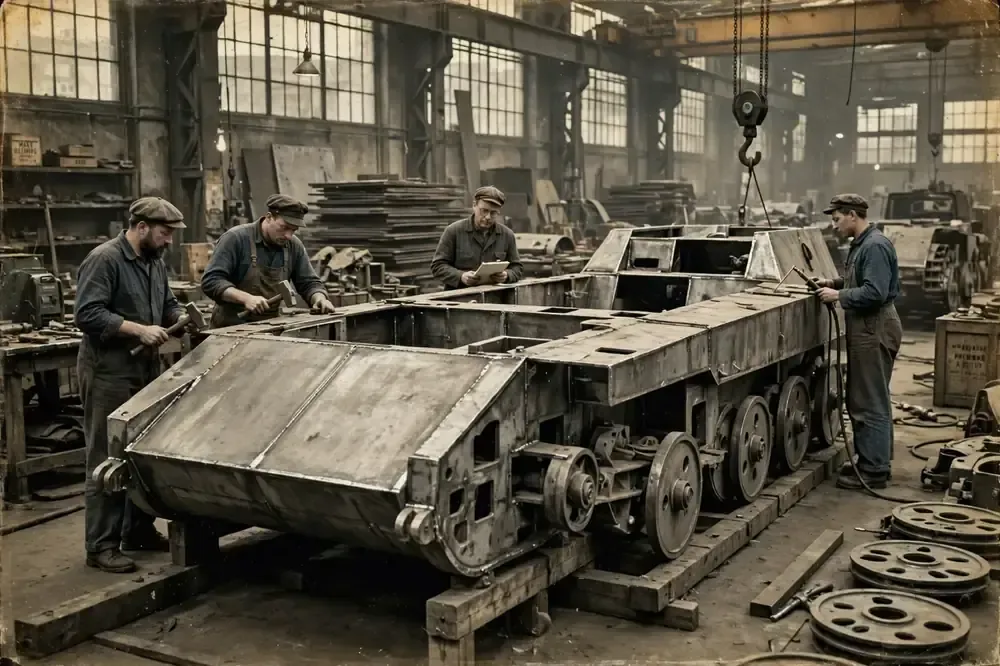
The Panther II project was entrusted to MAN, the manufacturer of the Panther, and to Daimler-Benz, which had also submitted a design for the Panther. The Heereswaffenamt, the German Army’s ordnance office, set the requirements: the Panther II was to have a thicker glacis plate, a new turret with a narrower front, and a more powerful gun, either the 7.5 cm KwK 42 or the 8.8 cm KwK 43. The design was to use the Tiger II’s engine, transmission and running gear, and it was to be built by the same factories that built the Panther. The first prototype hull was built by MAN in late 1943, and it was sent to the Kummersdorf proving ground for testing. But the project was already in trouble: the requirements had changed several times, and the design team was struggling to meet them.
Changing Requirements and Confusion
The Panther II project was plagued by changing requirements. In 1943, the Army wanted a tank with a thicker glacis plate and a new turret. In early 1944, it wanted a tank with a completely new hull and a more powerful gun. By mid-1944, the Army had decided that the Panther II was not needed, and that the resources would be better spent on the Panther itself, which was being improved in the Ausf. G and Ausf. F versions. The Panther II’s prototype hull was never fitted with a turret in Germany, and the project was cancelled in 1944. The hull was captured by the Americans at the end of the war and shipped to the United States, where it was fitted with a Panther Ausf. G turret for display. The Panther II’s story is thus one of a project that was overtaken by events, and of a design that was never given a chance to prove itself.
3. Design
Hull, Armour and Running Gear
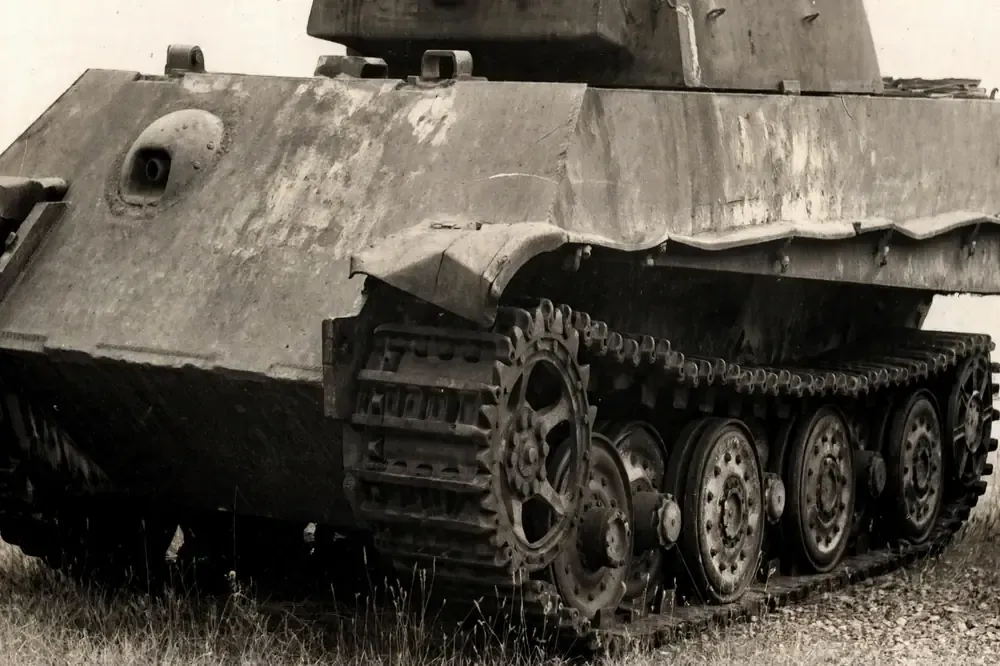
The Panther II’s hull was a development of the Panther’s, but it was redesigned to use the Tiger II’s components and to carry thicker armour. The hull front was to be protected by up to 100 mm of armour, compared with 80 mm on the Panther, and the side armour was to be increased from 40 mm to 60 mm, which would have made the Panther II much more resistant to Soviet anti-tank guns and to Allied tank guns. The hull was wider than the Panther’s, at about 3.29 metres, and it used the Tiger II’s running gear, with larger road wheels and a more robust suspension. The prototype hull, which is the only part of the Panther II that was built in Germany, shows the thicker glacis plate and the revised hull shape, and it is a significant advance over the Panther’s hull. The Panther II’s hull was also designed to accept a new turret, with a narrower front and a more powerful gun, although the turret was never built.
The Planned Turret and Gun
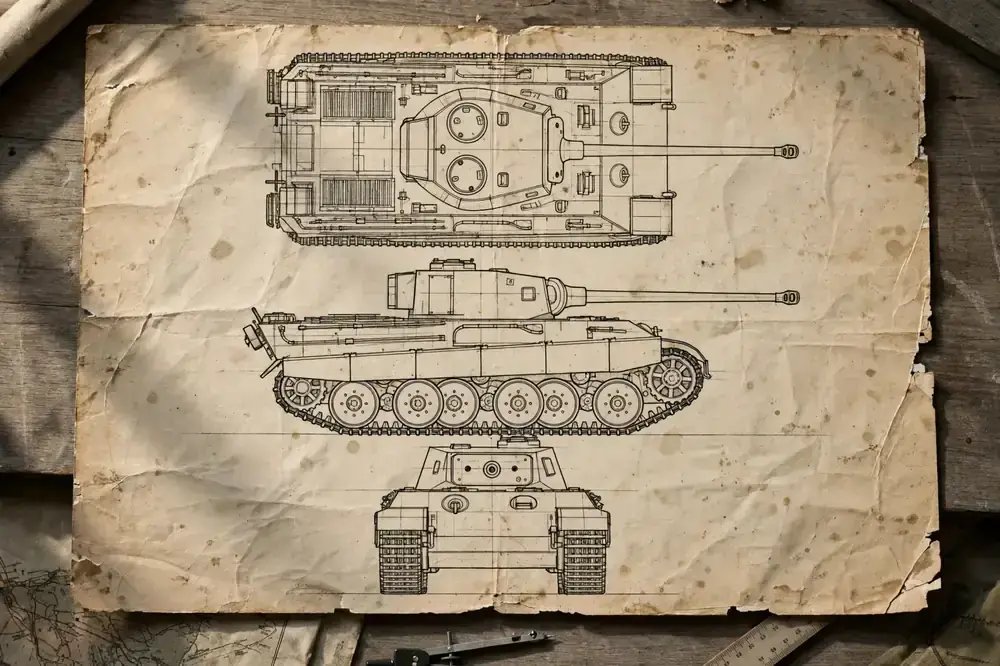
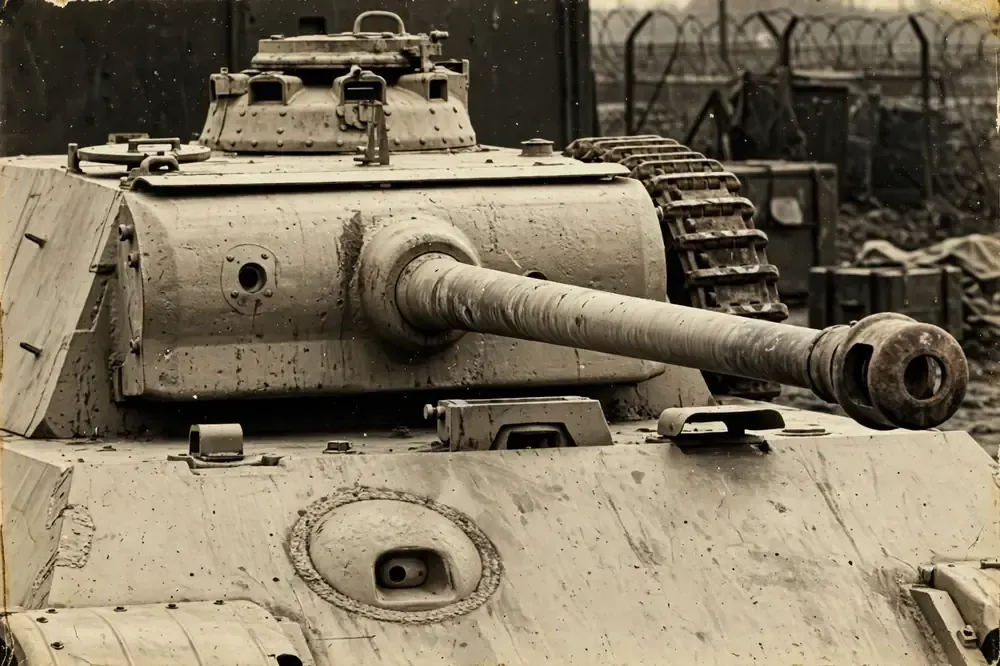
The Panther II was to have a new turret, designed by Daimler-Benz, with a narrower front and a more powerful gun. The original plan was to use the 7.5 cm KwK 42 L/70 gun, the same gun as the Panther, but the Army also considered the 8.8 cm KwK 43 gun, which was the Tiger II’s main armament. The turret was to have a thicker front plate and a new gun mantlet, and it was to be fitted with a stereoscopic rangefinder, which would have improved the gunner’s accuracy at long range. The turret was never built, and the prototype hull was fitted with a Panther Ausf. G turret by the Americans after the war, for display purposes. The Panther II’s planned armament shows the German Army’s ambition: a medium tank with the firepower of a heavy tank, and the armour to match.
Engine, Transmission and Mobility
The Panther II was to be powered by the Maybach HL 230 P30 V-12 petrol engine, which produced about 700 horsepower, the same engine as the Panther and the Tiger II. The engine was to be coupled to the Tiger II’s transmission, which was more robust than the Panther’s, and the tank’s top speed was planned to be about 46 kilometres per hour on roads. The Panther II’s weight was planned to be about 47 tons, heavier than the Panther’s 45 tons, but its power-to-weight ratio was to be similar, and its mobility was expected to be comparable. The Panther II’s running gear, with its larger road wheels and its improved suspension, was designed to address the Panther’s reliability problems, particularly in the final drive, which had been the Panther’s greatest weakness. The Panther II’s mobility, like its armour and its gun, remains a matter of speculation, because the tank was never tested in combat.
4. Variants
The Single Prototype Hull
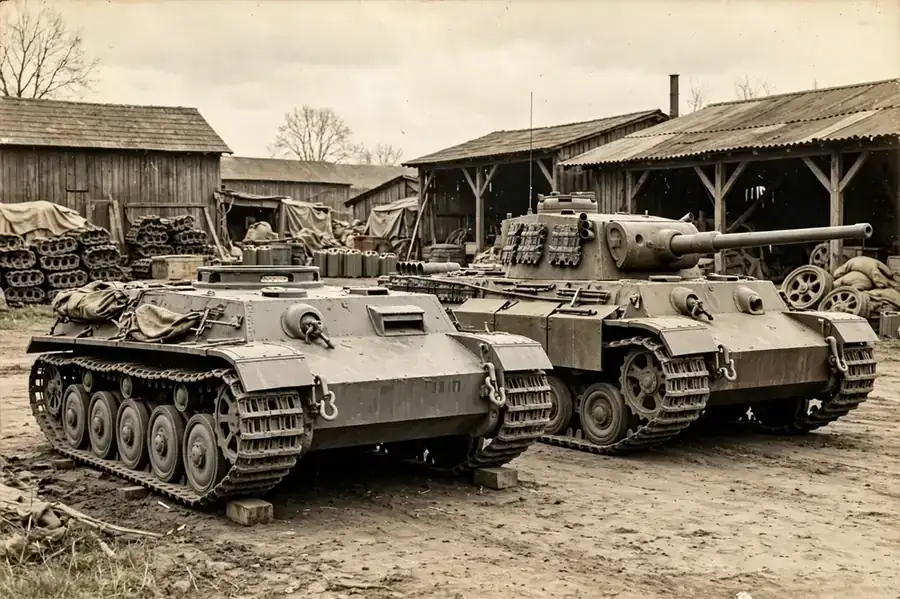
The Panther II was built in only one form, a single prototype hull, and there were no production variants. The hull was built by MAN in 1943 and was sent to the Kummersdorf proving ground for testing, where it was evaluated without a turret. The hull was captured by the Americans in 1945 and shipped to the Aberdeen Proving Ground in the United States, where it was fitted with a Panther Ausf. G turret for display. The hull is now at the National Armor and Cavalry Museum at Fort Benning, where it is displayed with the Ausf. G turret. The Panther II’s single hull is thus the only physical evidence of the project, and it is a valuable artefact for historians of German tank design.
The Panther Ausf. F Connection
The Panther II project was closely related to the Panther Ausf. F, the final production version of the Panther, which was designed in 1944 and which used a new turret, the Schmalturm, with a narrower front and a more powerful gun. The Ausf. F was to have been the Panther’s successor in production, and it incorporated many of the Panther II’s ideas, including the narrower turret and the improved gun mounting. The Ausf. F was never put into production, although a few prototype turrets were built, and the Panther II’s hull and the Ausf. F’s turret were both part of the German Army’s attempt to improve the Panther. The Panther II and the Ausf. F show how the German tank industry, in the final year of the war, was trying to develop a new generation of tanks while keeping the Panther in production.
Paper Designs and Proposals
In addition to the prototype hull, the Panther II project produced a number of paper designs and proposals, including designs for a Panther II with an 8.8 cm gun, a Panther II with a new hull and a Panther II with a diesel engine. These designs were never built, and they exist only in the archives of the German Army’s ordnance office. The paper designs show the range of ideas that were considered for the Panther II, and they illustrate the confusion that surrounded the project. The Panther II’s paper designs are a reminder that the German tank industry, in 1943 and 1944, was exploring many different directions, and that the Panther II was only one of several projects that were cancelled before they could be built.
5. Operational History
Testing at Kummersdorf
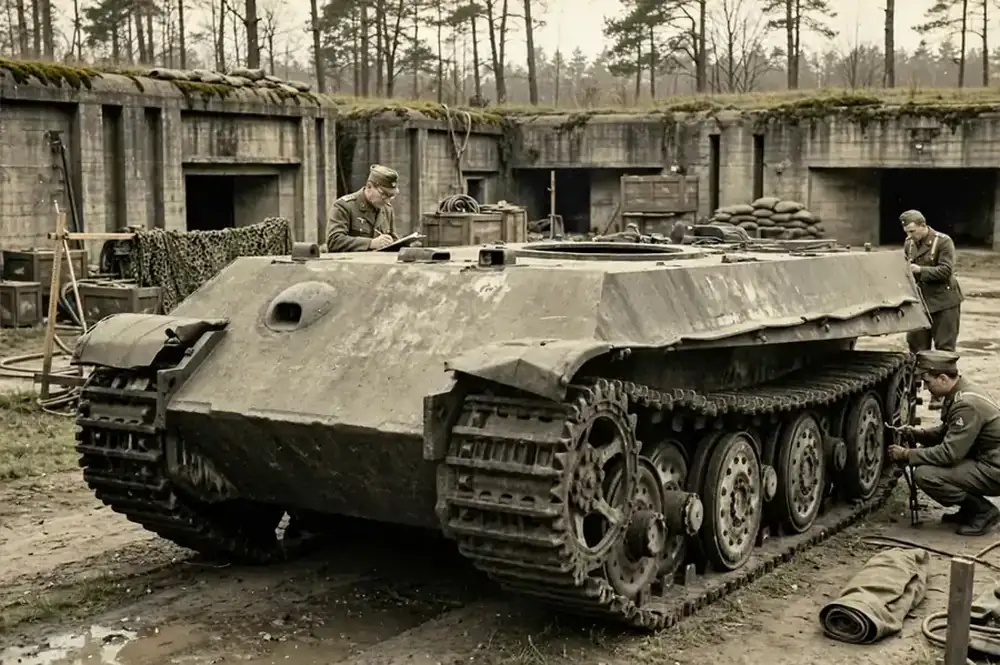
The Panther II’s operational history is brief, because the tank never entered service. The prototype hull was tested at the Kummersdorf proving ground in 1943 and 1944, where it was evaluated for its mobility and its armour, although it was never fitted with a turret or a gun. The tests showed that the hull was well designed and that its running gear was an improvement over the Panther’s, but the project was cancelled before the hull could be fitted with a turret. The Panther II’s testing was thus incomplete, and its performance in combat remains unknown. The hull was captured by the Americans at the end of the war, and it was shipped to the United States for evaluation.
Capture and American Evaluation
The Panther II hull was captured by American troops in 1945, at the MAN factory in Nuremberg, and it was shipped to the Aberdeen Proving Ground in Maryland, where it was evaluated by the US Army’s ordnance corps. The Americans fitted the hull with a Panther Ausf. G turret, which was available at Aberdeen, and they displayed the vehicle as a complete Panther II, although the turret was not the one that had been designed for the tank. The Panther II remained at Aberdeen for many years, and it was later moved to the Patton Museum at Fort Knox, and then to the National Armor and Cavalry Museum at Fort Benning, where it is displayed today. The American evaluation of the Panther II hull was limited, because the vehicle was incomplete, but it provided valuable information about German tank design.
The Panther II in the Final Year of the War
The Panther II project was cancelled in 1944, when the German high command decided that the resources would be better spent on the Panther itself. The Panther Ausf. G, which was in production in 1944, was a significant improvement over the earlier Panther models, and the Ausf. F, which was designed in 1944, incorporated many of the Panther II’s ideas. The Panther II’s cancellation was thus not a rejection of its design, but a recognition that the German tank industry could not afford to develop a new tank while keeping the Panther in production. The Panther II’s story is a reminder of the difficulties that the German tank industry faced in the final year of the war, when Allied bombing, material shortages and the demands of the front made it impossible to develop new designs.
Why the Panther II Was Cancelled
The Panther II was cancelled for several reasons. The first was the changing requirements: the Army’s demands for the tank changed so often that the design team could not keep up. The second was the pressure on the German tank industry: the Panther was already in production, and the factories that built it could not afford to retool for a new tank. The third was the German high command’s decision that the Panther itself, with improvements, was good enough, and that the resources would be better spent on increasing Panther production. The Panther II’s cancellation was thus a practical decision, not a judgement on the design, and it reflects the realities of the German war economy in 1944.
6. Performance and Specifications
Strengths on Paper
On paper, the Panther II was a significant improvement over the Panther. Its frontal armour was to be 100 mm thick, compared with 80 mm on the Panther, and its side armour was to be 60 mm, compared with 40 mm, which would have made it much more resistant to Allied and Soviet anti-tank guns. Its running gear, based on the Tiger II’s, was to be more robust and more reliable than the Panther’s, and its planned gun, either the 7.5 cm KwK 42 or the 8.8 cm KwK 43, was to be more powerful than the Panther’s. The Panther II’s weight was planned to be about 47 tons, and its top speed was to be about 46 kilometres per hour, which would have given it mobility comparable to the Panther’s. On paper, the Panther II was a formidable tank, and it would have been a significant threat to Allied and Soviet tanks in 1944 and 1945.
Weaknesses and Trade-offs
The Panther II’s weaknesses were also clear, even on paper. Its weight of 47 tons would have made it heavier than the Panther, and its fuel consumption would have been higher. Its planned 8.8 cm gun would have required a larger turret and a heavier ammunition load, and its rate of fire would have been slower than the Panther’s. The Panther II’s production would have required retooling the factories that built the Panther, which would have disrupted production at a time when the German Army needed every tank it could get. The Panther II’s design was also incomplete: the turret was never built, and the tank’s performance in combat was never tested. The Panther II’s strengths and weaknesses thus remain a matter of speculation, and historians have debated whether it would have been a significant improvement over the Panther or a costly distraction.
How the Panther II Might Have Compared
If the Panther II had entered service, it would have been compared with the Allied tanks of 1944 and 1945, notably the Soviet T-34-85 and IS-2, the American M4 Sherman and M26 Pershing, and the British Comet and Centurion. The Panther II’s 100 mm frontal armour and its 7.5 cm or 8.8 cm gun would have made it a formidable opponent for all of these tanks, and its improved running gear would have made it more reliable than the Panther. But the Panther II would also have faced the same problems as the Panther: its fuel consumption, its weight, and the difficulty of maintaining it in the field. The Panther II’s hypothetical performance is a subject of debate among historians, and it is impossible to know whether it would have been a significant improvement over the Panther or a marginal one.
7. Operators
Germany: The Only Intended Operator
The Panther II was intended for the German Army, and no other country was ever considered as an operator. The tank was designed for the German panzer divisions, which were the main users of the Panther, and it was to have been issued to the same units that operated the Panther. The Panther II’s cancellation meant that it never served with any unit, and its only operator, in a sense, was the US Army, which captured the prototype hull and displayed it at Aberdeen. The Panther II’s story is thus one of a tank that was designed for the German Army but never served with it.
The American Display
The Panther II hull, fitted with a Panther Ausf. G turret, was displayed by the US Army at the Aberdeen Proving Ground for many years, and it was later moved to the Patton Museum and then to the National Armor and Cavalry Museum at Fort Benning. The American display of the Panther II has made it one of the most famous German prototype tanks, and it is a popular exhibit for visitors to the museum. The Panther II’s American service, as a museum piece, is a reminder of the tank’s strange history: a German tank that was never built in Germany, and that was completed, in a sense, by the Americans who captured it.
8. Legacy and Influence
A Symbol of German Ambition
The Panther II’s legacy is that of a symbol of German ambition and of the difficulties of the German tank industry in the final years of the war. It shows how the German Army, in 1943 and 1944, was trying to develop a new generation of tanks while keeping the Panther in production, and how the changing requirements and the pressure on the industry made it impossible to do both. The Panther II’s hull, with its thicker armour and its improved running gear, was a significant advance over the Panther, and it influenced the design of the Panther Ausf. F, which used a similar turret and a similar gun mounting. The Panther II’s legacy is thus not as a tank that fought, but as a design that pointed the way to the next generation of German tanks.
Cultural Memory and Historical Assessment
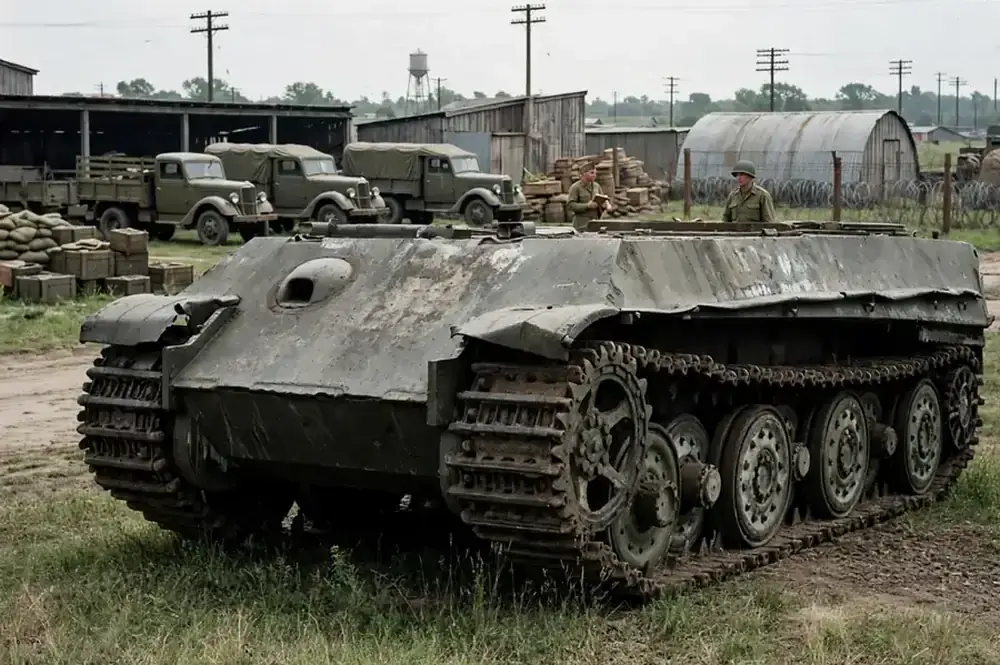
The Panther II is one of the most famous German prototype tanks, and its image, with its American-fitted turret, is widely recognised. Historians have assessed the Panther II as a sound design that was overtaken by events, and as a reminder of the German tank industry’s difficulties in 1944. The Panther II’s reputation has been enhanced by its appearance in video games and popular culture, where it is often depicted as a powerful tank that never fought. The Panther II is remembered as a symbol of the German Army’s desperate search for a weapon that could match the Allied tanks of 1944 and 1945, and of the industrial and organisational problems that made that search futile.
The Panther II in Popular Culture
The Panther II appears in many video games, books and models about the Second World War, and it is a popular subject for military historians and enthusiasts. Its distinctive hull, with its thicker glacis plate and its American-fitted turret, makes it instantly recognisable, and it is often used as a symbol of the German tank industry’s ambitions. The Panther II’s appearance in popular culture has ensured that it will be remembered long after the last surviving hull has gone, and it is a reminder of the fascination that prototype tanks hold for the public.
9. Surviving Examples
The Single Hull at Fort Benning
The only surviving Panther II is the prototype hull, fitted with a Panther Ausf. G turret, which is displayed at the National Armor and Cavalry Museum at Fort Benning in Georgia, in the United States. The hull is the only physical evidence of the Panther II project, and it is a valuable artefact for historians of German tank design. The hull’s display at Fort Benning, with its American-fitted turret, is a reminder of the tank’s strange history, and it is one of the most popular exhibits in the museum. The Panther II hull is maintained by the museum, and it is displayed alongside other German tanks, including the Panther and the Tiger II.
No Other Survivors
No other Panther II was ever built, and there are no other surviving examples. The Panther II’s single hull is thus unique, and its preservation is a testament to the interest that the tank holds for historians and for the public. The Panther II’s hull is a reminder of the German tank industry’s ambitions in 1943 and 1944, and of the difficulties that made those ambitions impossible to realise. The hull’s survival ensures that future generations can see the tank that might have been, and that they can appreciate the scale of the German Army’s search for a new medium tank in the final year of the war.
Frequently Asked Questions
Did the Panther II ever fight in combat?
No. The Panther II never entered service and never fought in combat. Only a single prototype hull was built, and it was never fitted with a turret or a gun in Germany. The hull was captured by the Americans in 1945 and fitted with a Panther Ausf. G turret for display.
How was the Panther II different from the Panther?
The Panther II was planned to have thicker armour, with a 100 mm frontal plate and 60 mm side armour, compared with 80 mm and 40 mm on the Panther. It was also to use the Tiger II’s running gear and transmission, which were more robust, and it was to have a new turret with a more powerful gun.
Why was the Panther II cancelled?
The Panther II was cancelled in 1944 because the German high command decided that the resources would be better spent on the Panther itself, which was being improved in the Ausf. G and Ausf. F versions. The project’s changing requirements and the pressure on the German tank industry also contributed to the cancellation.
Where is the Panther II today?
The only surviving Panther II, a prototype hull fitted with a Panther Ausf. G turret by the Americans, is displayed at the National Armor and Cavalry Museum at Fort Benning in Georgia, in the United States. It was previously displayed at the Aberdeen Proving Ground and the Patton Museum.
What gun was the Panther II to have?
The Panther II was originally planned to use the 7.5 cm KwK 42 L/70 gun, the same gun as the Panther, but the German Army also considered the 8.8 cm KwK 43 gun, which was the Tiger II’s main armament. The turret was never built, so the Panther II’s gun remains a matter of speculation.
Was the Panther II a heavy tank?
No. The Panther II was a medium tank, planned as the successor to the Panther. Its weight was planned to be about 47 tons, heavier than the Panther’s 45 tons, but it was still a medium tank by German standards, and it was not intended to replace the Tiger II.
Sources
- Thomas L. Jentz and Hilary Doyle, Panther Variants 1942-1945 (Osprey Publishing, New Vanguard series).
- Thomas L. Jentz, Germany’s Panther Tank (Schiffer Publishing).
- Steven J. Zaloga, Panther vs Sherman (Osprey Publishing, Duel series).
- The National Armor and Cavalry Museum, Fort Benning, Panther II collection records.
- Chamberlain, Peter, and Doyle, Hilary, Encyclopedia of German Tanks of World War Two (Arms and Armour Press).
- David Fletcher, The Great Tank Scandal: British Armour in the Second World War (HMSO).