 WAR ATLAS MILITARY HISTORY MAGAZINE · WWI — WWII
Prinz Eugen
1. Lead
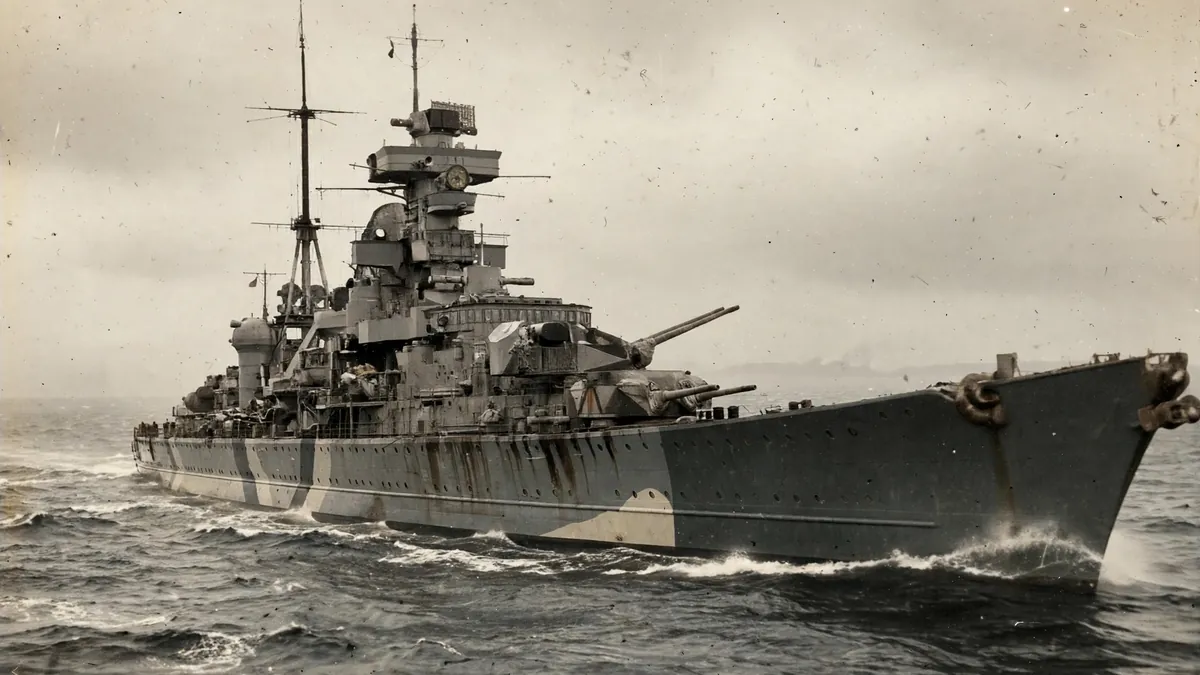
The German heavy cruiser Prinz Eugen was one of the most famous warships of the Second World War, and the ship that sailed with the battleship Bismarck on her last voyage. Named for Prince Eugene of Savoy, the great Austrian general of the seventeenth century, she was the third ship of the Admiral Hipper class, and she was commissioned in August 1940, and she fought in the Atlantic, in the Channel, in Norway and in the Baltic, and she survived the war, when almost every other German warship was sunk, and she was taken as a war prize by the United States, and she survived the atomic bomb tests at Bikini Atoll in 1946, only to capsize at Kwajalein later that year. Prinz Eugen is remembered for the Battle of the Denmark Strait on 24 May 1941, when she and the Bismarck sank the British battlecruiser Hood, the pride of the Royal Navy, in a battle that lasted less than ten minutes, and for the Channel Dash of February 1942, when she and the battleships Scharnhorst and Gneisenau sailed through the English Channel in daylight, under the noses of the British, and reached Germany safely. Prinz Eugen’s story is the story of the German surface fleet, from its greatest triumph to its final defeat, and of a ship that survived when her sisters did not, and that ended her life as a victim of the atomic age.
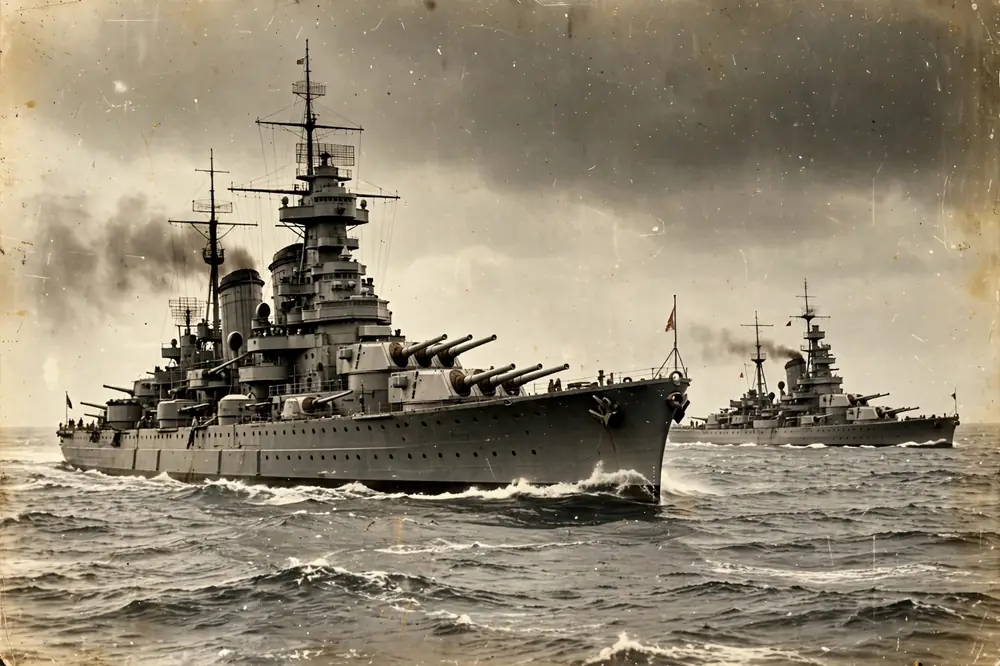
Prinz Eugen was the only ship of her class to survive the war, and her survival was a matter of luck, of the skill of her crew and of the decisions of her captains, who kept her out of the battles that destroyed her sisters. Her first captain, Helmuth Brinkmann, commanded her at the Denmark Strait and in the Channel Dash, and her later captains commanded her in Norway and in the Baltic, where she bombarded the Soviet armies that advanced on East Prussia, and where she evacuated German civilians and soldiers from the ports that the Red Army overran. Prinz Eugen’s story is therefore the story of a ship that fought from the first year of the war to the last, and that saw the German Navy rise and fall, and that ended her life not in battle, but in the atomic tests that opened a new age of warfare, and that made the battleship and the cruiser obsolete.
2. Key Facts
| Type | Heavy cruiser (Admiral Hipper class) |
| Origin | Germany |
| Builder | Germaniawerft, Kiel |
| Laid down | 23 April 1936 |
| Launched | 22 August 1938 |
| Commissioned | 1 August 1940 |
| Displacement | 14,680 tons standard; about 18,750 tons full load |
| Length | 212.5 m (697 ft 2 in) |
| Beam | 21.8 m (71 ft 6 in) |
| Draught | 7.2 m (23 ft 7 in) |
| Propulsion | Three shafts; geared steam turbines; 132,000 shp |
| Top speed | 32.5 knots (60 km/h) |
| Range | About 7,200 nautical miles at 20 knots |
| Complement | About 1,382 officers and men (up to about 1,600 in wartime) |
| Main armament | Eight 20.3 cm (8 in) SK C/34 guns in four twin turrets |
| Secondary armament | Twelve 10.5 cm AA guns; twelve 3.7 cm AA guns; eight 2 cm AA guns |
| Torpedo tubes | Twelve 53.3 cm (21 in) tubes |
| Aircraft | Three Arado Ar 196 floatplanes |
| Armour | Belt 80 mm; deck 30–50 mm; turrets 105 mm |
| Fate | Surrendered 1945; US prize; survived atomic tests at Bikini, 1946; capsized at Kwajalein, 22 December 1946 |
3. Background and Development
The Admiral Hipper Class and the Anglo-German Naval Agreement
Prinz Eugen was the third ship of the Admiral Hipper class, a class of five heavy cruisers — Admiral Hipper, Blücher, Prinz Eugen, Seydlitz and Lützow — that were built under the Anglo-German Naval Agreement of 1935, which allowed Germany to build a navy up to 35 per cent of the size of the Royal Navy. The Admiral Hipper class was designed to be the best heavy cruiser that Germany could build within the limits of the Washington Naval Treaty, which restricted heavy cruisers to 10,000 tons and to 8-inch guns, though the German ships, like those of other navies, exceeded the treaty’s limits, and Prinz Eugen displaced 14,680 tons standard, far more than the 10,000 tons that the treaty allowed. The class was named for the admirals of the First World War, and Prinz Eugen was named for Prince Eugene of Savoy, the Austrian general who had fought the Turks in the seventeenth century, and who was a hero in both Austria and Germany. Prinz Eugen was laid down at the Germaniawerft in Kiel on 23 April 1936, she was launched on 22 August 1938, and she was commissioned on 1 August 1940, under the command of Captain Helmuth Brinkmann.
Building the Ship: Germaniawerft, Kiel
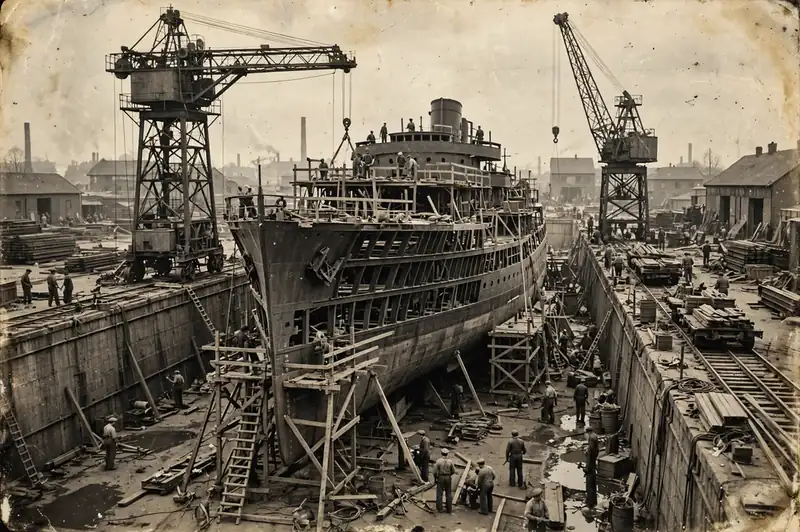
Prinz Eugen was built at the Germaniawerft in Kiel, one of the great German shipyards, and her construction was a triumph of German shipbuilding. The ship was laid down in 1936, and she was launched in 1938, in a ceremony attended by the Hungarian regent, Admiral Miklós Horthy, whose wife christened the ship, because Prince Eugene of Savoy had been a hero in Hungary as well as in Austria and Germany. The ship’s construction was delayed by the need to develop her engines, which were high-pressure steam turbines, and by the competition for materials and for labour, and she was not commissioned until August 1940, a year after the war had begun, and she was the last of the Admiral Hipper-class cruisers to enter service, after the Admiral Hipper and the Blücher, and before the Seydlitz, which was never completed as a cruiser, and the Lützow, which was sold to the Soviet Union before she was completed. Prinz Eugen’s construction was therefore a long process, and it was a measure of the German Navy’s ambitions, and of the difficulties that it faced in building the ships that it wanted.
The German Surface Fleet and Plan Z
Prinz Eugen was built as part of Plan Z, the German Navy’s plan to build a great surface fleet that could challenge the Royal Navy, and that was ordered by Hitler in 1939, and that called for ten battleships, four aircraft carriers, fifteen pocket battleships, five heavy cruisers and dozens of light cruisers and destroyers. Plan Z was never completed, because the war began in 1939, before the ships could be built, and the German Navy went to war with a fleet that was far smaller than the one that Plan Z had promised, and with only a handful of heavy ships, including the Bismarck, the Tirpitz, the Scharnhorst, the Gneisenau and the Admiral Hipper-class cruisers. Prinz Eugen was one of the few ships of Plan Z that was completed, and she was the ship that sailed with the Bismarck on the operation that was the German Navy’s greatest triumph and its greatest disaster, and her story is the story of Plan Z, and of the German surface fleet that was never built, and of the ships that fought the war that Plan Z had not foreseen.
4. Design
Hull, Propulsion and Speed
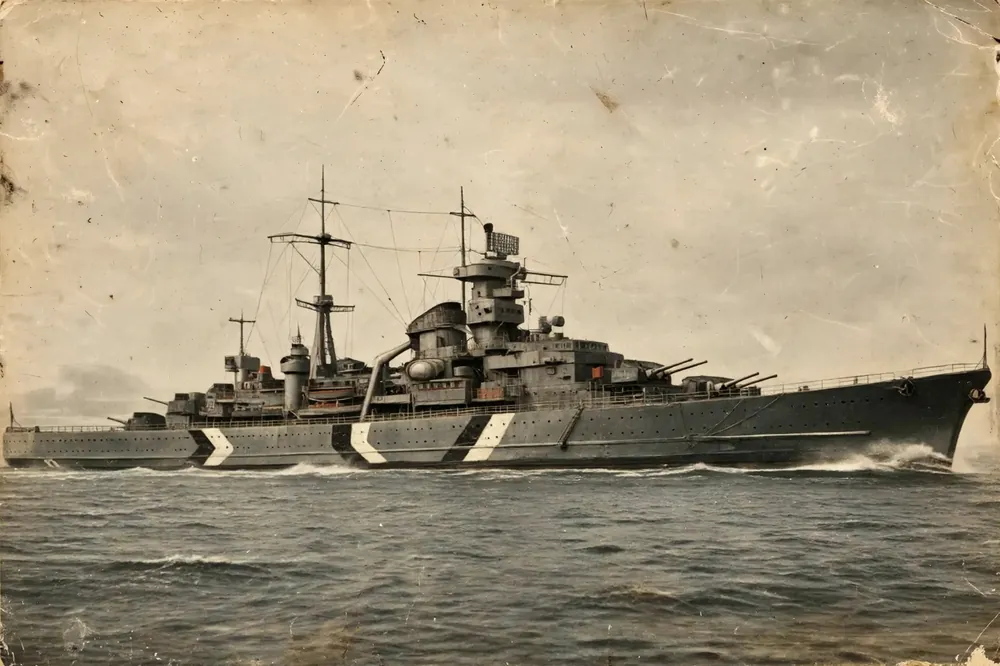
Prinz Eugen was a large heavy cruiser, 212.5 metres long, with a beam of 21.8 metres and a displacement of 14,680 tons standard, and she was powered by three sets of geared steam turbines driving three shafts, producing 132,000 shaft horsepower and giving her a top speed of 32.5 knots. That speed made her one of the fastest heavy cruisers in the world, and it let her keep up with the Bismarck, which was her consort on Operation Rheinübung, and it let her outrun the British cruisers that pursued her. Her range was about 7,200 nautical miles at 20 knots, which let her operate in the Atlantic without refuelling, and her crew of about 1,382 officers and men, which rose to about 1,600 in wartime, was a small town in itself, with its own bakeries, laundries, workshops and sick bays. Prinz Eugen’s design was a compromise between speed, protection and armament, and it was a successful compromise: she was fast enough to keep up with the fleet, she was protected enough to survive the battles that she fought, and she was armed enough to sink the Hood.
Eight 20.3 cm Guns and the Secondary Battery
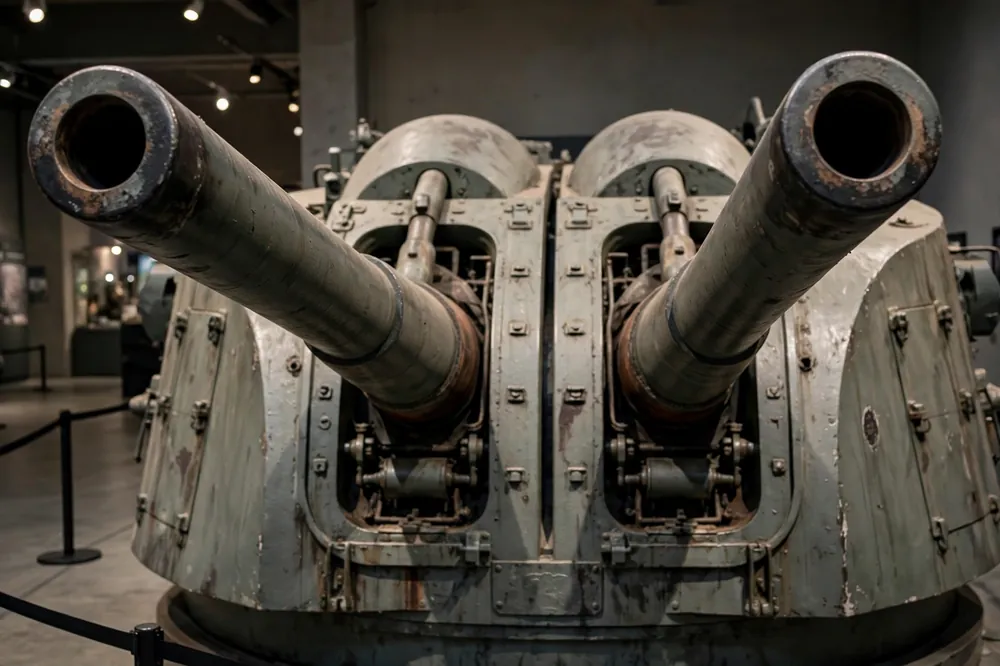
Prinz Eugen’s main armament was eight 20.3 cm (8-inch) SK C/34 guns, mounted in four twin turrets, two forward and two aft, and they could fire a shell of 122 kilograms to a range of about 33,500 metres, and they were the most powerful guns ever fitted to a German heavy cruiser. The guns were accurate, and they were served by a crew that was trained to a high standard, and at the Denmark Strait they hit the Hood and the Prince of Wales, while the Bismarck’s fifth salvo struck the Hood’s magazine and sank her, and they proved that the German 20.3 cm gun was one of the best naval guns in the world. Prinz Eugen’s secondary armament consisted of twelve 10.5 cm anti-aircraft guns, twelve 3.7 cm anti-aircraft guns and eight 2 cm anti-aircraft guns, and twelve 53.3 cm torpedo tubes, and three Arado Ar 196 floatplanes, which were launched from a catapult and which were used for reconnaissance. The ship’s anti-aircraft armament was strengthened through the war, as the threat from the air grew, and by 1945 she carried a formidable battery of light anti-aircraft guns, and her gunners were among the best in the German Navy.
Protection: Belt, Deck and Turrets
Prinz Eugen’s protection was that of an Admiral Hipper-class cruiser: she had an armour belt 80 millimetres thick over her machinery spaces and magazines, and an armoured deck 30 to 50 millimetres thick, and turrets with 105 millimetres of armour, and a torpedo defence system, and she was designed to survive a hit from an 8-inch shell, though her armour was thinner than that of the British and American heavy cruisers, and her protection was a compromise between speed and armour, and it was the reason she was so fast. The ship’s protection was tested at the Denmark Strait, where she emerged undamaged, and in the Channel Dash, where she was attacked by British aircraft and by British torpedo boats, and in Norway, where she was torpedoed by the British submarine Trident, and in each case she survived, and her damage-control parties saved her, and she was repaired and returned to service. Prinz Eugen’s protection was not the best in the world, but it was good enough, and it was the reason she survived the war when her sisters did not.
5. Variants
| Variant | Years | Key features | Notes |
|---|---|---|---|
| Admiral Hipper | 1939–1945 | Lead ship; fought in Norway and the Atlantic; scuttled 1945 | Sunk in Kiel, 1945 |
| Blücher | 1939–1940 | Sunk by Norwegian coastal guns at Oslo, 9 April 1940 | Lost on her first operation |
| Prinz Eugen | 1940–1946 | Third ship; sailed with Bismarck; survived the war | Survived Bikini; capsized at Kwajalein, 1946 |
| Seydlitz | — | Never completed as a cruiser; conversion to a carrier begun, never finished | Scrapped |
| Lützow | — | Sold to the Soviet Union in 1940 as the Petropavlovsk | Sunk as a floating battery, 1941 |
Admiral Hipper and Blücher
The Admiral Hipper class consisted of five ships, of which only three entered service as cruisers, and Prinz Eugen was the only one of them to survive the war. The lead ship, Admiral Hipper, was commissioned in April 1939, and she fought in Norway, in the Atlantic and in the Arctic, and she was damaged by British cruisers and by bombing, and she was scuttled at Kiel in May 1945, when the war ended. The Blücher, the second ship, was commissioned in September 1939, and she was sunk on her first operation, on 9 April 1940, when she was hit by the Norwegian coastal guns at Oscarsborg Fortress, in Oslofjord, and by torpedoes from the fortress, and she sank with the loss of about 600 of her crew. The Blücher’s loss was a shock to the German Navy, and it was a reminder that a cruiser, for all its armour and its guns, could be sunk by shore batteries, and that the invasion of Norway was a dangerous operation.
Seydlitz and Lützow
The last two ships of the Admiral Hipper class, the Seydlitz and the Lützow, were never completed as cruisers, and their stories are a measure of the German Navy’s ambitions and of its failures. The Seydlitz was launched in 1939, and she was to have been completed as a cruiser, but in 1942 it was decided to convert her to an aircraft carrier, and the conversion was begun, and it was never finished, and she was scrapped after the war. The Lützow was launched in 1939, and she was sold to the Soviet Union in 1940, before she was completed, as the Petropavlovsk, and she was towed to Leningrad, and she was sunk as a floating battery during the siege of Leningrad, and she was raised after the war and scrapped. The Seydlitz and the Lützow are a reminder that Plan Z, the German Navy’s plan to build a great surface fleet, was never completed, and that the ships that were built were the exception, not the rule, and that Prinz Eugen, which was completed and which survived, was the lucky one.
Prinz Eugen’s Refit
Prinz Eugen was refitted several times during the war, and each refit made her a more effective ship. In 1942, after she was torpedoed by the British submarine Trident, she was repaired at Kiel, and her stern was rebuilt, and her anti-aircraft armament was strengthened, and she returned to service in 1943. In 1944, she was refitted again, and her radar was improved, and her anti-aircraft armament was strengthened further, and she was fitted for shore bombardment, with her guns trained to fire at land targets, and she was used to bombard the Soviet armies that advanced on East Prussia. Prinz Eugen’s refits kept her in service until the end of the war, and they are a measure of the German Navy’s ability to repair and to improve its ships, even as the war was being lost, and of the ship’s importance to the German Navy, which kept her in service when her sisters were lost.
6. Operational History
Rheinübung and the Denmark Strait
On 18 May 1941, Prinz Eugen sailed from Gotenhafen with the battleship Bismarck, on Operation Rheinübung, the German Navy’s attempt to break out into the Atlantic and to attack the British convoys, and on 24 May 1941, in the Denmark Strait, between Greenland and Iceland, the two German ships met the British battlecruiser Hood and the battleship Prince of Wales. The battle lasted less than ten minutes, and it was one of the most famous naval battles in history: the Bismarck’s fifth salvo hit the Hood’s magazine, and the Hood exploded and sank, with the loss of 1,415 of her crew of 1,418, and only three men survived, and the Prince of Wales was hit by Prinz Eugen and by the Bismarck, and she withdrew, damaged and on fire. Prinz Eugen’s guns had hit the Hood and the Prince of Wales, and her crew had seen the Hood explode, and the battle was a triumph for the German Navy, and a disaster for Britain. After the Denmark Strait, Prinz Eugen and the Bismarck separated, because the Bismarck had been damaged and was leaking fuel, and because the two ships had different orders: the Bismarck was to make for the French port of St. Nazaire, and Prinz Eugen was to continue into the Atlantic and to attack the convoys alone. Prinz Eugen sailed south, but her engines broke down, and she was forced to make for Brest, in France, where she arrived on 1 June 1941, and where she was based for the next eight months, and where she was attacked by British bombers, and where she was damaged, but where she survived. The Bismarck, meanwhile, was hunted by the Royal Navy, and she was sunk on 27 May 1941, with the loss of more than 2,000 of her crew, and Prinz Eugen, which had sailed with her, was the only German ship to survive Operation Rheinübung, and her survival was a matter of luck, and of the decision to separate.
The Sinking of the Hood
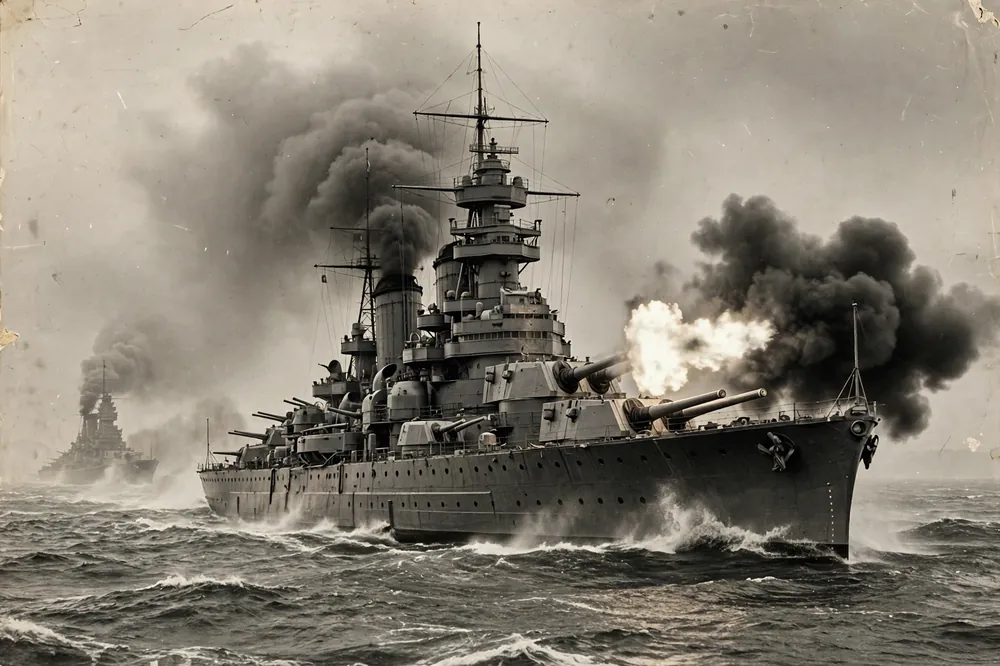
On 18 May 1941, Prinz Eugen sailed from Gotenhafen with the battleship Bismarck, on Operation Rheinübung, the German Navy’s attempt to break out into the Atlantic and to attack the British convoys, and on 24 May 1941, in the Denmark Strait, between Greenland and Iceland, the two German ships met the British battlecruiser Hood and the battleship Prince of Wales. The battle lasted less than ten minutes, and it was one of the most famous naval battles in history: the Bismarck’s fifth salvo hit the Hood’s magazine, and the Hood exploded and sank, with the loss of 1,415 of her crew of 1,418, and only three men survived, and the Prince of Wales was hit by Prinz Eugen and by the Bismarck, and she withdrew, damaged and on fire. Prinz Eugen’s guns had hit the Hood and the Prince of Wales, and her crew had seen the Hood explode, and the battle was a triumph for the German Navy, and a disaster for the Royal Navy, and it is the battle for which Prinz Eugen is best remembered.
Separation and the Voyage to Brest
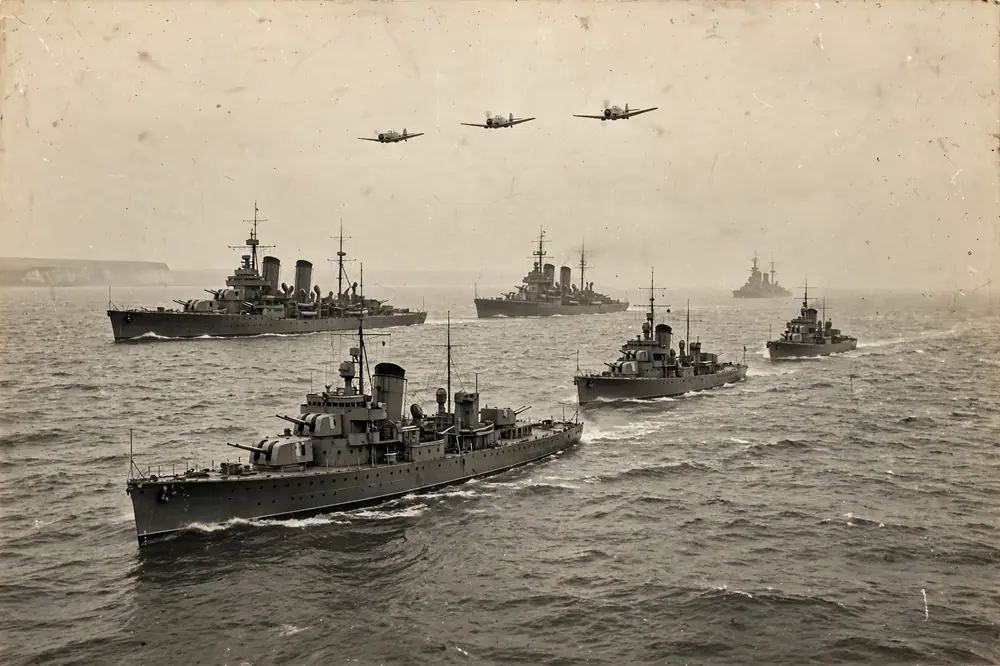
After the Denmark Strait, Prinz Eugen and the Bismarck separated, because the Bismarck had been damaged and was leaking fuel, and because the two ships had different orders: the Bismarck was to make for the French port of St. Nazaire, and Prinz Eugen was to continue into the Atlantic and to attack the convoys alone. Prinz Eugen sailed south, but her engines broke down, and she was forced to make for Brest, in France, where she arrived on 1 June 1941, and where she was based for the next eight months, and where she was attacked by British bombers, and where she was damaged, but where she survived. The Bismarck, meanwhile, was hunted by the Royal Navy, and she was sunk on 27 May 1941, with the loss of more than 2,000 of her crew, and Prinz Eugen, which had sailed with her, was the only German ship to survive Operation Rheinübung, and her survival was a matter of luck, and of the decision to separate, and of the breakdown of her engines, which forced her to make for Brest, and which saved her from the fate of the Bismarck.
The Channel Dash
On 11 February 1942, Prinz Eugen sailed from Brest with the battleships Scharnhorst and Gneisenau, on Operation Cerberus, the Channel Dash, in which the three German ships sailed through the English Channel in daylight, under the noses of the British, and reached Germany safely. The Channel Dash was a triumph for the German Navy, and a humiliation for the British, who had expected the German ships to sail around Scotland, and who were caught by surprise, and whose aircraft and torpedo boats attacked the German ships but failed to stop them. Prinz Eugen was the only ship of the three to reach Germany undamaged, because the Scharnhorst and the Gneisenau were both damaged by mines, and Prinz Eugen’s survival was a matter of luck, and of the skill of her crew, and of the German air cover, which protected the ships from the British aircraft. The Channel Dash is remembered as one of the great naval operations of the war, and Prinz Eugen’s part in it is one of the most famous episodes in her history.
Norway and the Baltic, 1942–1945
After the Channel Dash, Prinz Eugen sailed to Norway, where she was torpedoed by the British submarine Trident on 23 February 1942, off Trondheim, and where her stern was badly damaged, and she was repaired at Kiel, and she returned to Norway in 1943, and she served as a training ship, and she was based in Norway until 1944, when she was transferred to the Baltic. In the Baltic, Prinz Eugen bombarded the Soviet armies that advanced on East Prussia, and she evacuated German civilians and soldiers from the ports that the Red Army overran, and she was the largest German warship to serve in the Baltic in the last year of the war, and she was the ship that the German civilians remembered, because she carried them to safety, and because she fired her guns at the Soviet armies that pursued them. Prinz Eugen’s service in Norway and in the Baltic was the end of her wartime career, and it was a fitting end: the ship that had sailed with the Bismarck, and that had dashed through the Channel, ended her war as a transport and as a gunfire support ship, and as the ship that saved the lives of the civilians that she carried.
7. Performance and Specifications
| Specification | Prinz Eugen |
|---|---|
| Displacement | 14,680 tons standard; about 18,750 tons full load |
| Length | 212.5 m |
| Beam | 21.8 m |
| Draught | 7.2 m |
| Propulsion | Geared steam turbines, three shafts, 132,000 shp |
| Top speed | 32.5 knots |
| Range | About 7,200 nautical miles at 20 knots |
| Main armament | Eight 20.3 cm SK C/34 guns |
| Secondary armament | Twelve 10.5 cm AA guns; twelve 3.7 cm AA guns; eight 2 cm AA guns |
| Torpedo tubes | Twelve 53.3 cm tubes |
| Aircraft | Three Arado Ar 196 floatplanes |
| Armour | Belt 80 mm; deck 30–50 mm; turrets 105 mm |
| Complement | About 1,382 (up to about 1,600 in wartime) |
Gunnery Performance
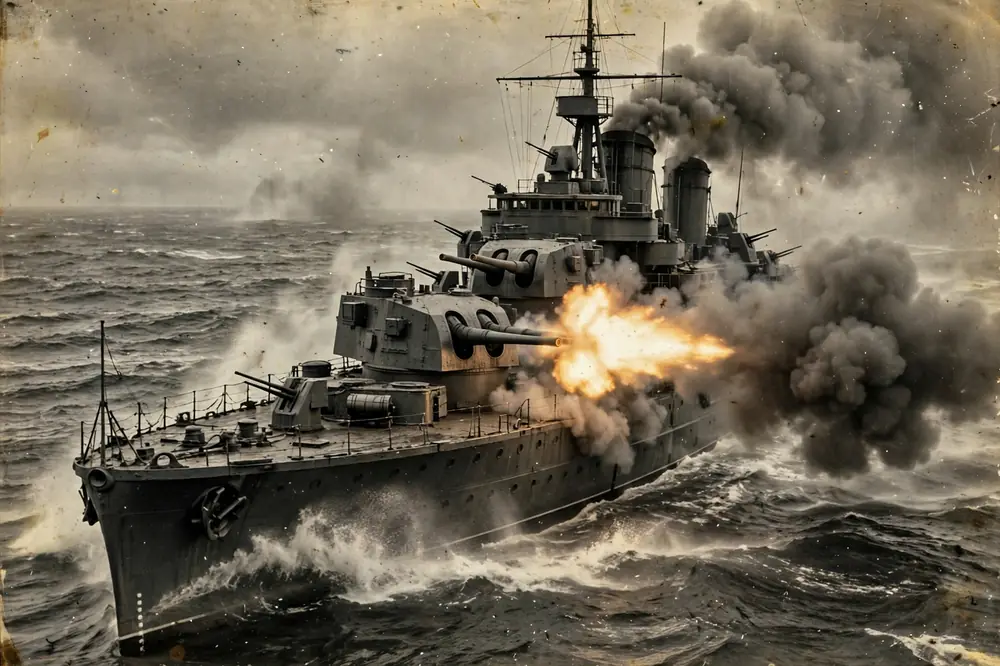
Prinz Eugen’s gunnery performance was excellent, and it was the result of her guns, her fire control and her crew. Her eight 20.3 cm guns could fire a shell of 122 kilograms to a range of about 33,500 metres, and they were accurate, and they were served by a crew that was trained to a high standard, and at the Denmark Strait they hit the Hood and the Prince of Wales, while the Bismarck’s fifth salvo struck the Hood’s magazine and sank her, and they proved that the German 20.3 cm gun was one of the best naval guns in the world. The ship’s fire control was based on a stereoscopic rangefinder and on a mechanical computer, and it was the equal of the British and American fire control systems, and it let the ship engage a target at long range and hit it with its first salvoes. Prinz Eugen’s gunnery performance was therefore a matter of technology and of training, and it is the performance that made the ship famous, and that is remembered when the ship is remembered.
Comparison with British and American Cruisers
Compared with the British heavy cruisers, Prinz Eugen was faster, more heavily armed and better protected, but the British cruisers were more numerous, and they were better supported by the Royal Navy, and they were the ships that hunted the German cruisers and that sank them. Compared with the American heavy cruisers, Prinz Eugen was similar in size and speed, but the American cruisers had better fire control, with radar, and they had better damage control, and they were built in larger numbers, and they were the ships that won the Pacific War. Prinz Eugen’s strength was her speed and her guns, and her survival was the result of her crew and of her captains, and she is remembered as the German cruiser that survived, not because she was the best cruiser in the world, but because she was the cruiser that was lucky, and that was well handled, and that fought in the battles that she could win, and that avoided the battles that she could not.
8. Operators
Germany
Prinz Eugen served only with the German Navy, from her commissioning in August 1940 until her surrender in May 1945, and she was never exported, and no other navy operated a ship of her class in the war. Her service was entirely with the Kriegsmarine, and for most of the war she was the most famous ship in the German Navy, after the Bismarck and the Tirpitz, and her crew were among the most experienced sailors in the German Navy, and her captains were among the best officers in the Navy. Her first captain, Kapitän zur See Helmuth Brinkmann, commanded her through the Bismarck operation and the Channel Dash, and he was awarded the Knight’s Cross for his leadership, while her later captains included officers who had served on destroyers and cruisers throughout the Norwegian campaign. Prinz Eugen’s service with Germany ended with the war, and she was surrendered at Copenhagen in May 1945, and she was taken as a war prize by the United States, and her German crew were taken prisoner, and her story as a German ship ended, and her story as an American prize ship began.
The United States: Prize Ship IX-300
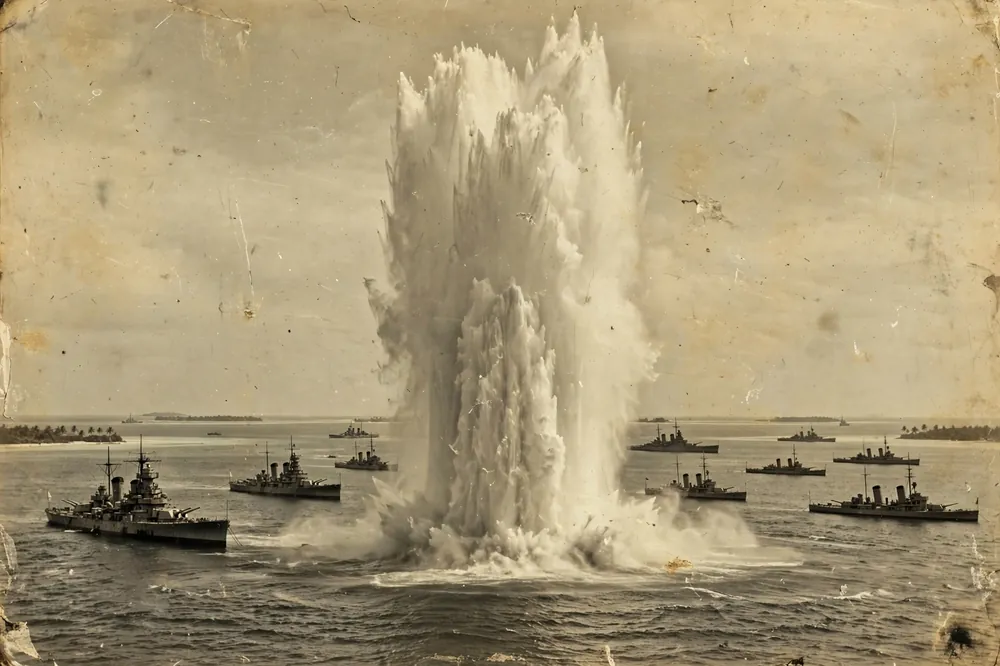
After the war, Prinz Eugen was taken as a war prize by the United States, and she was commissioned in the United States Navy as the USS Prinz Eugen (IX-300), and she was sailed to the United States, where she was studied by American naval architects, who were interested in her design, and in her engines, and in her guns. The ship was then used in Operation Crossroads, the atomic bomb tests at Bikini Atoll in July 1946, where she survived two atomic explosions, Test Able and Test Baker, and where she was heavily contaminated by radiation, and where she was towed to Kwajalein Atoll, and where she capsized and sank on 22 December 1946, because she was too radioactive to be repaired, and because no one would go aboard her to save her. Prinz Eugen’s service with the United States was short, but it was the end of her story, and it is the story of a ship that survived the war, only to be lost after the atomic bomb tests, and that is remembered as the victim of the atomic age.
9. Legacy and Influence
The Ship That Survived
Prinz Eugen’s legacy is that of the ship that survived, and it is remembered as the only ship of her class to survive the war, and as the ship that sailed with the Bismarck and that lived to tell the tale, and as the ship that was there at the Denmark Strait, at the Channel Dash, in Norway and in the Baltic. Prinz Eugen’s survival was a matter of luck, of the skill of her crew and of the decisions of her captains, and it is the reason she is remembered, and it is a reminder that in war, survival is often a matter of luck, and that the ship that survives is not always the best ship, but the ship that is in the right place at the right time, and that is handled well. Prinz Eugen’s legacy is also the legacy of the German surface fleet, and of the ships that fought the war that Plan Z had not foreseen, and of the men who sailed them, and who are remembered as the sailors of the Kriegsmarine, and whose story is told in the histories of the German Navy.
Bikini and the Atomic Age
Prinz Eugen is remembered for her fate at Bikini Atoll, where she survived two atomic explosions, and where she was left too radioactive to repair, and where she became a victim of the atomic age. The atomic bomb tests at Bikini, Operation Crossroads, were the first tests of the atomic bomb against warships, and they showed that a warship could survive an atomic explosion, but that it could not survive the radiation, and that the age of the battleship and the cruiser was over, and that the future of naval warfare was the aircraft carrier and the submarine. Prinz Eugen’s fate at Bikini is therefore a symbol of the end of an age, and of the beginning of a new one, and it is the reason the ship is remembered, not only as the ship that sailed with the Bismarck, but as the ship that died in the atomic age, and that is a reminder that war changes, and that the weapons of one age become the victims of the next.
10. Surviving Examples
The Wreck at Kwajalein
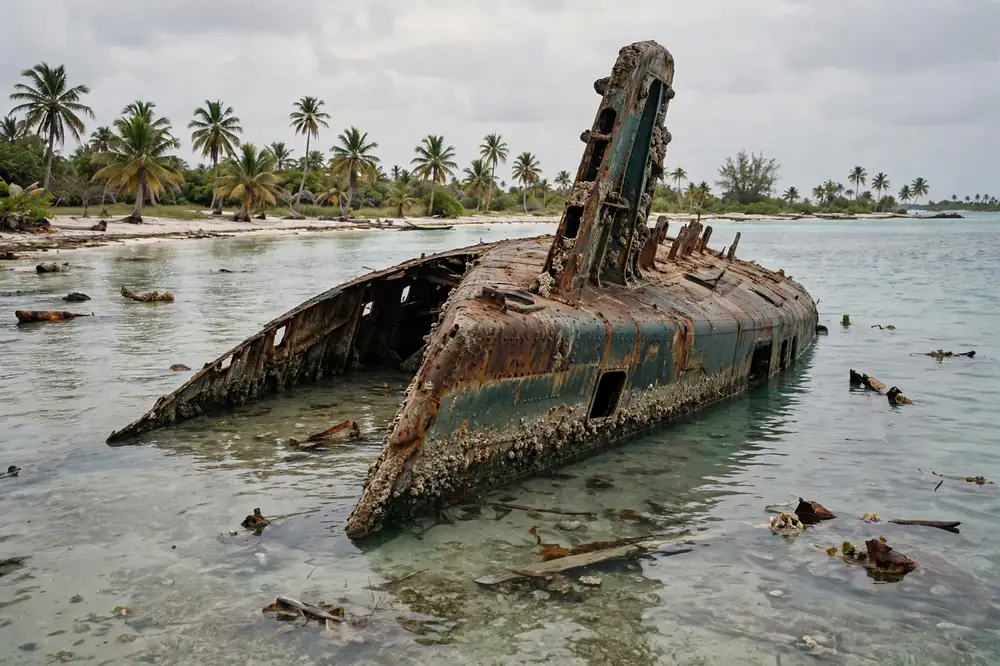
Prinz Eugen’s wreck lies at Kwajalein Atoll, in the Marshall Islands, where she capsized and sank on 22 December 1946, and where she lies upside down in shallow water, with her keel above the surface, and where she is a hazard to navigation, and where she is visited by divers, who dive on the wreck and who see the ship that sailed with the Bismarck, and that survived the atomic bomb, and that lies in the lagoon at Kwajalein. The wreck is contaminated by radiation, though the radiation has decayed to safe levels, and it is protected by the United States, and it is a reminder of the ship that survived the war, and that was lost in the atomic age, and that lies in the Pacific, where she ended her life. The wreck at Kwajalein is the only wreck of a German heavy cruiser that can be visited, and it is a place of remembrance for the ship and for the men who sailed her.
Relics: The Propeller at Laboe
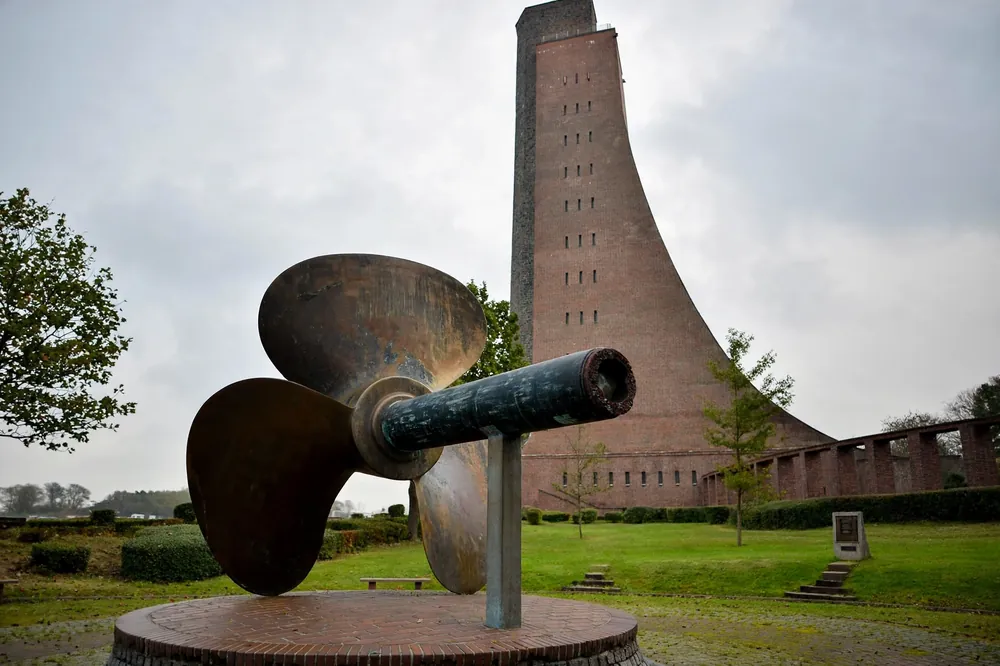
The relics of Prinz Eugen survive in museums and in memorials, and the most famous is one of her propellers, which is displayed at the Laboe Naval Memorial in Germany, near Kiel, where it stands as a memorial to the ship and to the men who sailed her, and where it is visited by thousands of people every year. The ship’s bell is held by the United States Navy, and it is displayed at the National Museum of the United States Navy in Washington, D.C., and the ship’s teak decking was salvaged and used in the memorial at Laboe, and the ship’s artefacts are a reminder of the ship that sailed with the Bismarck, and that survived the war, and that was lost after Bikini. For the visitor, the propeller at Laboe is the best way to remember Prinz Eugen, and it is a reminder of the ship’s size, and of her power, and of the men who built her and who sailed her, and of the war that she fought, and of the atomic age that ended her.
Frequently Asked Questions
What was the Prinz Eugen?
Prinz Eugen was a German heavy cruiser of the Admiral Hipper class, commissioned in August 1940. She sailed with the battleship Bismarck on Operation Rheinübung, took part in the sinking of HMS Hood, and survived the war, only to survive the atomic bomb tests at Bikini Atoll in 1946 and capsize at Kwajalein later that year.
What happened at the Denmark Strait?
On 24 May 1941, Prinz Eugen and Bismarck met the British battlecruiser Hood and the battleship Prince of Wales in the Denmark Strait. In a battle lasting less than ten minutes, Bismarck’s shells hit Hood’s magazine, and Hood exploded and sank with the loss of 1,415 of her crew of 1,418.
What was the Channel Dash?
The Channel Dash, Operation Cerberus, was the voyage of Prinz Eugen, Scharnhorst and Gneisenau through the English Channel in daylight on 11 February 1942, from Brest to Germany, under the noses of the British. Prinz Eugen was the only ship of the three to reach Germany undamaged.
How did Prinz Eugen survive the war?
Prinz Eugen survived because she was lucky, because her captains kept her out of the battles that destroyed her sisters, and because her damage-control parties saved her when she was attacked in the Channel Dash and torpedoed off Norway in February 1942.
What happened to Prinz Eugen at Bikini?
Prinz Eugen was used in Operation Crossroads, the atomic bomb tests at Bikini Atoll in July 1946. She survived two atomic explosions, Test Able and Test Baker, but she was heavily contaminated by radiation, and she was towed to Kwajalein Atoll, where she capsized and sank on 22 December 1946.
Where is the wreck of Prinz Eugen today?
Prinz Eugen’s wreck lies upside down in shallow water at Kwajalein Atoll in the Marshall Islands, with her keel above the surface. One of her propellers is displayed at the Laboe Naval Memorial in Germany, near Kiel.
Sources
- Wikipedia, “German cruiser Prinz Eugen” — the Admiral Hipper class, Operation Rheinübung, the Denmark Strait, the Channel Dash, Bikini.
- Fritz-Otto Busch, Prinz Eugen: The Story of the German Cruiser (Hutchinson, 1956) — the ship’s wartime career, by a member of her crew.
- Vincent P. O’Hara, The German Fleet at War, 1939–1945 (Naval Institute Press, 2004) — the German surface fleet and Prinz Eugen’s operations.
- Robert K. Massie, Castles of Steel (Random House, 2003) — the naval war and the Denmark Strait (context).
- Jak P. Mallmann Showell, The German Navy in World War Two (Naval Institute Press, 1979) — Prinz Eugen’s service in Norway and the Baltic.
- The United States Navy, Operation Crossroads (1946) — the atomic bomb tests at Bikini and Prinz Eugen’s fate.