 WAR ATLAS MILITARY HISTORY MAGAZINE · WWI — WWII
P-47 Thunderbolt
1. P-47 Thunderbolt — At a Glance
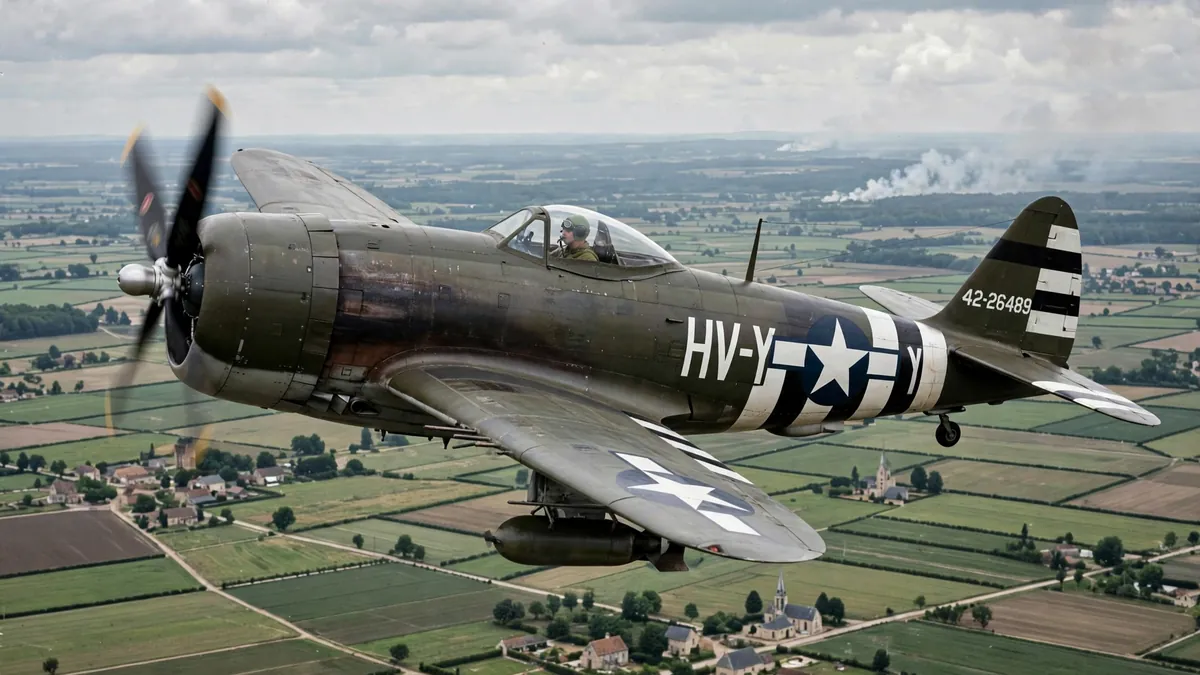
The P-47 Thunderbolt was an American fighter aircraft of the Second World War, and the most-produced American fighter of the war. Designed by Alexander Kartveli of Republic Aviation around the powerful Pratt & Whitney R-2800 Double Wasp radial engine, it first flew on 6 May 1941 and entered service in 1942.
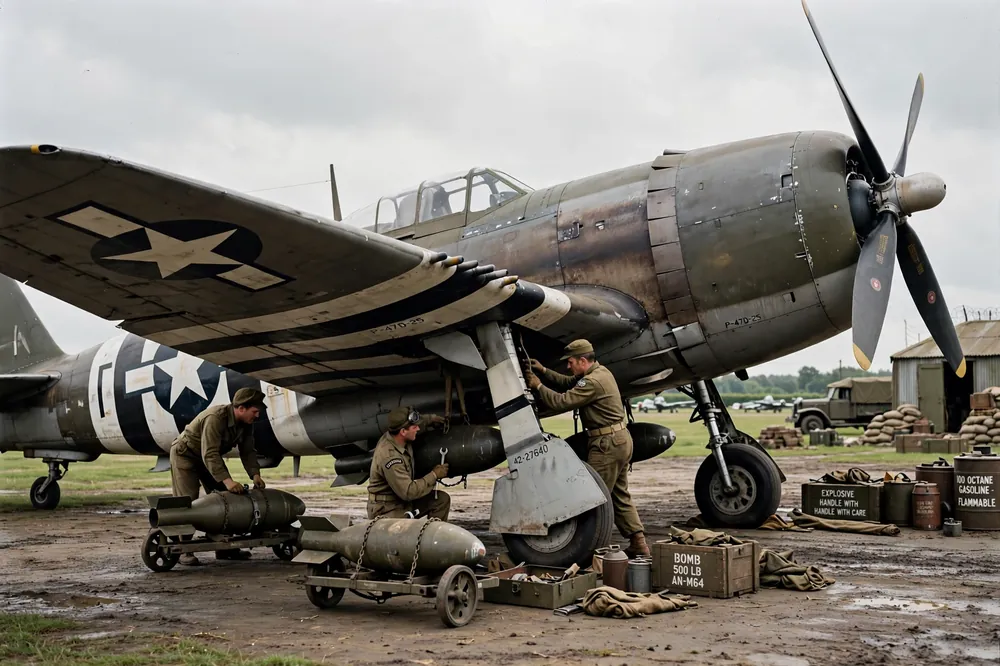
A total of 15,636 Thunderbolts were built according to most sources, although some references, including the aviation historian Joe Baugher, give 15,683 — a difference that reflects how late-war production and cancelled orders were counted. The P-47 Thunderbolt was the largest and heaviest single-engine, single-seat fighter built by any nation during the war, and its eight .50-calibre machine guns, heavy bomb load and ability to absorb damage made it one of the most effective fighter-bombers of the conflict.
It began the war as a high-altitude day fighter escorting bombers over Germany, and by 1944 it had become the United States Army Air Forces’ principal ground-attack aircraft in Europe, flying close-support missions from the Normandy landings through the Battle of the Bulge to the crossing of the Rhine.
The name “Thunderbolt” was given to the aircraft by Republic Aviation, and it suited a fighter built around the largest engine available to the American aircraft industry. The P-47 was the first American fighter to be designed around the Pratt & Whitney R-2800, and its size — a wingspan of more than 40 feet and a weight of up to 17,500 pounds — set it apart from every other single-engine fighter of the war. It flew its first combat mission on 10 April 1943, and by the end of the war it had flown more sorties in Europe than any other American fighter type.
2. Key Facts
| Field | Detail |
|---|---|
| Type | Fighter / fighter-bomber |
| Origin | United States |
| Designer | Alexander Kartveli, Republic Aviation |
| Manufacturer | Republic Aviation (Farmingdale, New York, and Evansville, Indiana); Curtiss built the P-47G |
| First flight | 6 May 1941 (XP-47B prototype) |
| In service | 1942–1953 (USAF); other air forces into the 1960s |
| Number produced | 15,636 (most sources); 15,683 per Joe Baugher — disputed |
| Crew | 1 |
| Length | 36 ft 1 in (11.00 m) |
| Wingspan | 40 ft 9 in (12.42 m) |
| Engine | 1 × Pratt & Whitney R-2800-59 Double Wasp 18-cylinder radial, 2,000 hp (up to 2,300 hp with water injection) |
| Maximum speed | 426 mph (686 km/h) at 30,000 ft (P-47D-40); 433 mph (697 km/h) at 29,000 ft (P-47D-30) |
| Range | 1,030 mi (1,660 km) combat; 1,800 mi (2,900 km) ferry |
| Service ceiling | 42,000 ft (12,800 m) |
| Armament | 8 × .50 cal (12.7 mm) M2 Browning machine guns (425 rounds each); up to 2,500 lb (1,130 kg) of bombs or 10 × 5 in rockets |
3. Background and Development
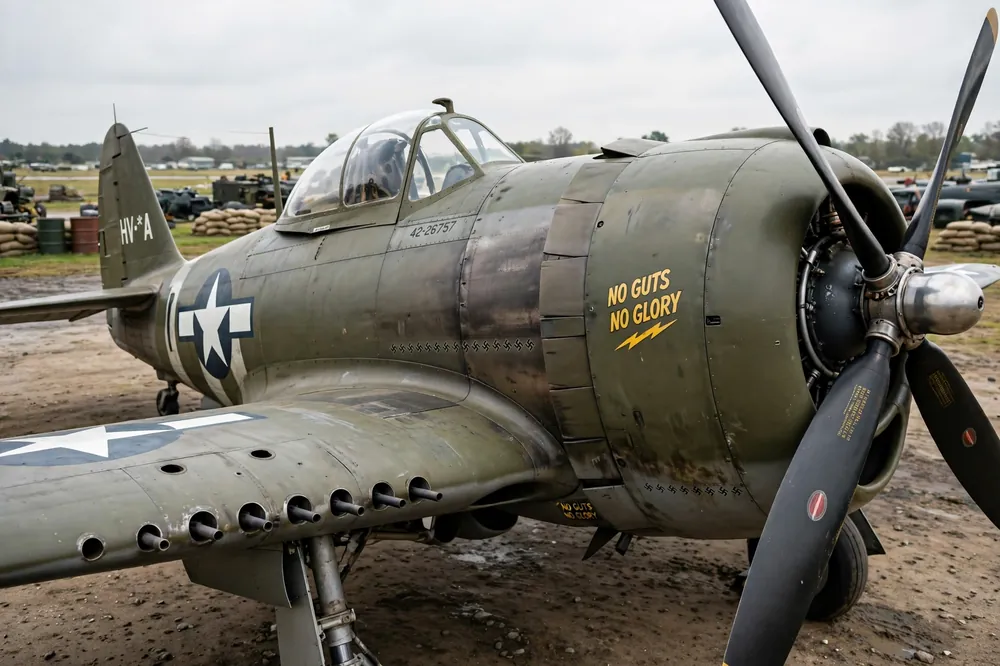
The P-47 Thunderbolt began with an engine. In the late 1930s, the Pratt & Whitney R-2800 Double Wasp was the most powerful aircraft engine in America: an 18-cylinder, twin-row radial producing 2,000 horsepower. Republic Aviation’s chief designer, Alexander Kartveli, a Georgian-born engineer who had emigrated to the United States, set out to build the smallest possible airframe around the largest available engine, fitted with a General Electric turbo-supercharger that would preserve its power at high altitude.
The first design, the XP-47, was a lightweight fighter that the Army Air Corps rejected as too small. Kartveli returned with a much larger aircraft, the XP-47B, built entirely around the R-2800 and its turbo-supercharger, with the supercharger mounted in the rear fuselage and its exhaust ducted through the tail.
The XP-47B first flew on 6 May 1941 at Farmingdale, New York, and reached 412 mph (663 km/h) at 25,800 feet — fast for its time, and a sign of what the big engine could do. The Army ordered 171 production aircraft, the first being delivered in December 1941, the same month as the attack on Pearl Harbor.
Early production was slow: the Thunderbolt was a complex aircraft, and Republic was still learning to build it. The first combat P-47s reached England in early 1943 with the 56th Fighter Group, and the type flew its first combat mission on 10 April 1943. Production accelerated through 1943 and 1944 at Republic’s two plants in Farmingdale and Evansville, Indiana, plus a Curtiss plant in Buffalo that built the P-47G.
By the end of the war, more than 15,600 had been built — more than any other American fighter — and orders for a further 5,934 were cancelled when the war ended.
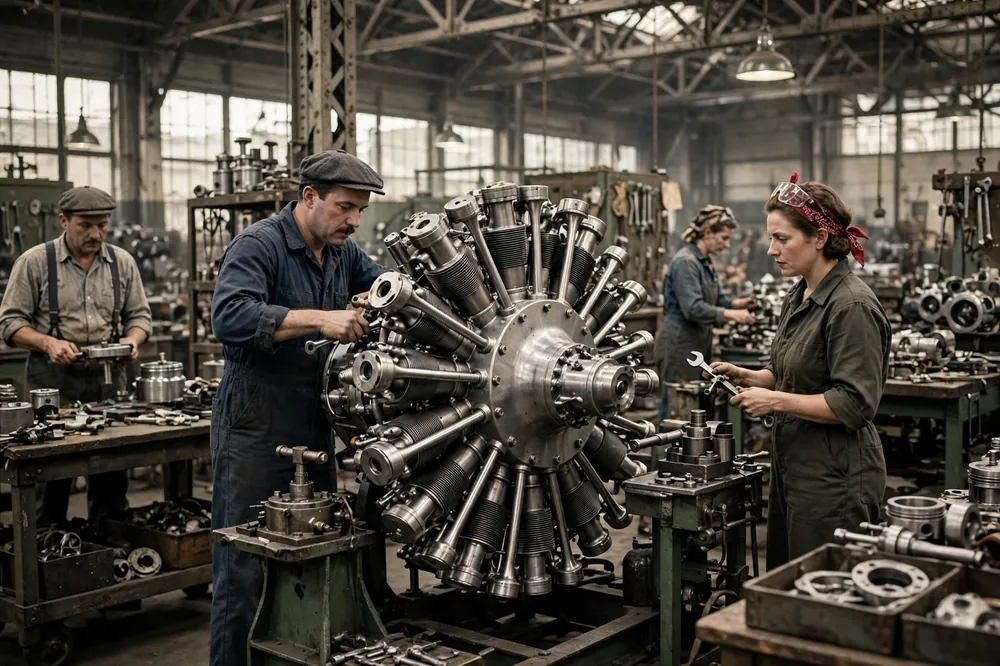
The P-47 Thunderbolt’s production was spread across three plants, and the largest of them was not the original one. Republic’s Farmingdale factory on Long Island built the first Thunderbolts, but it was too small for the numbers the Army wanted, and in 1942 Republic opened a second plant at Evansville, Indiana, built with government money on the site of a former refrigerator factory.
The Evansville plant grew quickly: by 1944 it employed thousands of workers, many of them women and men who had never built an aircraft before, and it produced more Thunderbolts than Farmingdale. A third source, the Curtiss plant at Buffalo, New York, built 354 P-47Gs. Together, the plants produced 15,636 Thunderbolts, of which 12,558 were P-47Ds — the most-produced single variant of any American fighter of the war.
Production was organised in blocks: each block introduced small changes — a new radio, a different propeller, a revised fuel system — so that the P-47D of 1945 was a different aircraft in detail from the P-47D of 1943, even though the designation was the same.
The most important change came in the D-25 block, when the “razorback” fuselage was replaced by a bubble canopy that gave the pilot an all-round view. The production ramp was not smooth: early aircraft needed rework, the turbo-supercharger system was complex to assemble, and shortages of engines and propellers slowed output in 1942.
But by 1944 the lines were producing hundreds of Thunderbolts a month, and the aircraft was available in numbers that allowed the Eighth and Ninth Air Forces to equip whole fighter groups with it.
4. Design
The P-47 Thunderbolt was built around its engine, and everything about the design followed from that choice. The Pratt & Whitney R-2800 Double Wasp was a large, 18-cylinder radial, and to keep it cool and fed with air, Kartveli gave the Thunderbolt a deep, oval fuselage and a large cowling with a distinctive oval air intake.
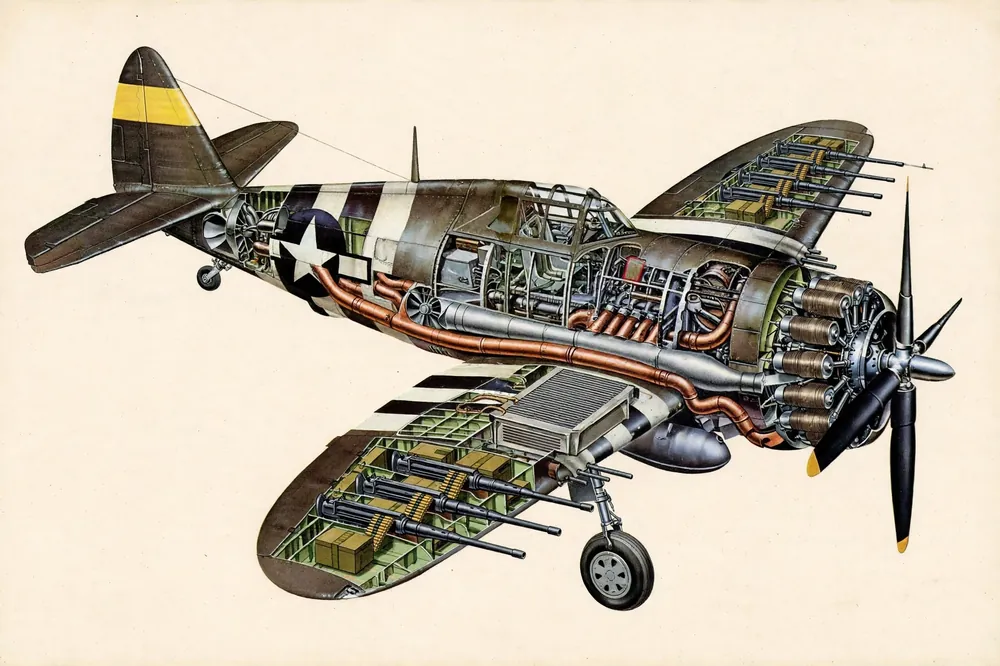
The turbo-supercharger sat in the rear fuselage, fed by exhaust pipes running along the belly, and its intercooler was cooled by air ducted from intakes in the wing roots. The arrangement was complex and heavy, but it gave the P-47 full power at altitudes where other fighters faded: the engine produced 2,000 horsepower at takeoff and, with water injection, up to 2,300 horsepower in combat.
The result was the largest and heaviest single-engine fighter of the war. A P-47D weighed 10,000 pounds (4,540 kg) empty and up to 17,500 pounds (7,940 kg) at maximum takeoff — roughly twice the weight of a Spitfire. Its armament was equally heavy: eight .50-calibre machine guns, four in each wing, with 425 rounds per gun, giving the Thunderbolt the greatest weight of fire of any American single-engine fighter. Under the wings it could carry up to 2,500 pounds of bombs, or ten 5-inch high-velocity aircraft rockets, or drop tanks that extended its range to 1,800 miles.
The Thunderbolt’s size and weight gave it two qualities that pilots valued in combat. First, it could dive faster than any other fighter of the war: in a dive it could exceed 500 mph, and its rugged airframe could take the strain. Second, it could absorb damage that would have destroyed a lighter aircraft.
The big radial engine would keep running with cylinders shot away, the airframe was heavily built, and the pilot sat behind armour plate with a self-sealing fuel system. Many Thunderbolts returned to base with damage that their pilots described as unsurvivable in any other fighter.
The price of the size was manoeuvrability: at low and medium altitudes the P-47 could not turn with the Bf 109 or the Fw 190, and its climb rate was modest. Its early “razorback” fuselage also restricted the pilot’s rearward view, a problem solved in late-production P-47Ds by the “bubble” canopy, which gave an all-round view and became the standard for later fighters.
The heart of the P-47 Thunderbolt’s performance was its turbo-supercharger, a system that was both the aircraft’s greatest advantage and its greatest complication. The General Electric turbosupercharger sat in the rear fuselage, behind the pilot, and was driven by the engine’s exhaust gases, which were ducted from the engine in the nose, along the belly of the aircraft, to the turbine at the back.
The turbine drove a compressor that forced air into the engine at high pressure, preserving the engine’s power at altitudes where the air was thin. Between the compressor and the engine sat an intercooler, cooled by air ducted from intakes in the wing roots, which cooled the compressed air before it entered the engine.
The whole system added weight and complexity: the ducting ran the length of the fuselage, and a hit to the ducting could rob the engine of power even if the engine itself was undamaged. But it gave the Thunderbolt full power at 30,000 feet, where most fighters of the period had lost a large part of theirs.
Late in the war, the system was supplemented by water injection — a mixture of water and methanol sprayed into the engine’s intake, which cooled the charge and allowed higher boost pressures. With water injection, the R-2800-59 produced 2,300 horsepower, and the P-47D could reach 433 mph at 29,000 feet.
The pilot controlled the system with a throttle and a boost control, and managing the turbo-supercharger — watching the exhaust temperature, avoiding over-boosting at low altitude — was a skill that Thunderbolt pilots had to learn. The system also protected the pilot in one unexpected way: the long exhaust ducting and the turbo-supercharger itself sat between the engine and the cockpit, and armour plate behind the pilot shielded him from fire from the rear.
The Thunderbolt’s reputation for bringing its pilot home owed as much to this rugged, redundant layout as to the strength of its airframe.
5. Variants
| Variant | Built | Role and notes |
|---|---|---|
| XP-47B | 1 | Prototype; first flew 6 May 1941 |
| P-47B | 171 | First production version; sliding canopy, no combat use |
| P-47C | 602 | Longer fuselage, improved radio and oxygen systems |
| P-47D | 12,558 | Most-produced variant; razorback early blocks, bubble canopy from D-25 |
| P-47G | 354 | Curtiss-built version of the D; used mainly for training |
| P-47M | 130 | High-speed version for the 56th Fighter Group; up to 473 mph |
| P-47N | 1,816 | Long-range version for the Pacific; larger wing, more fuel |
| XP-72 | 2 | Experimental successor with a 3,450 hp engine; never entered production |
6. Operational History
The Eighth Air Force over Germany
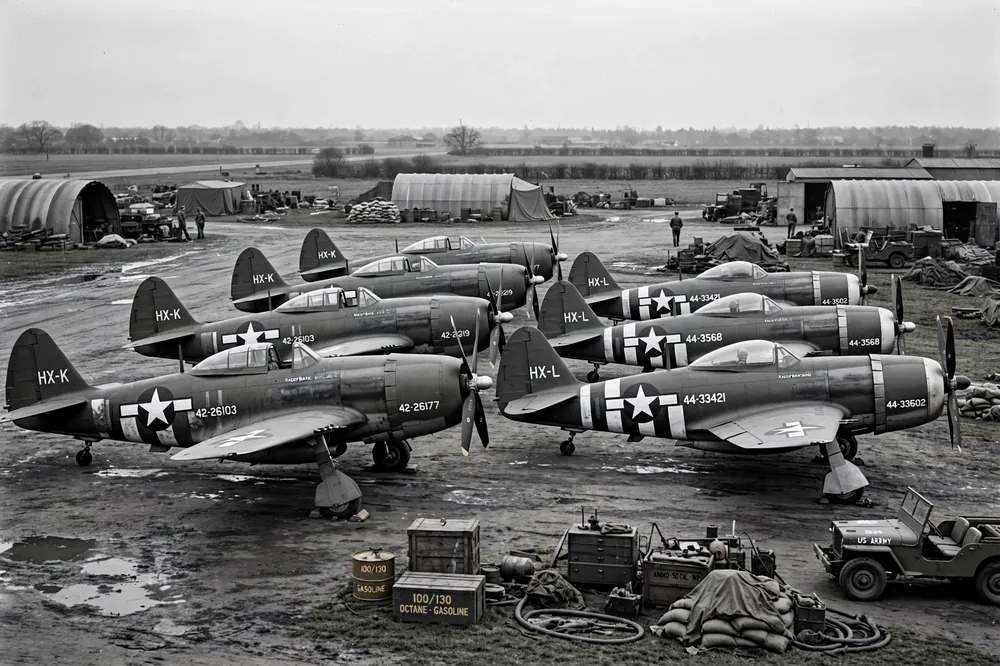
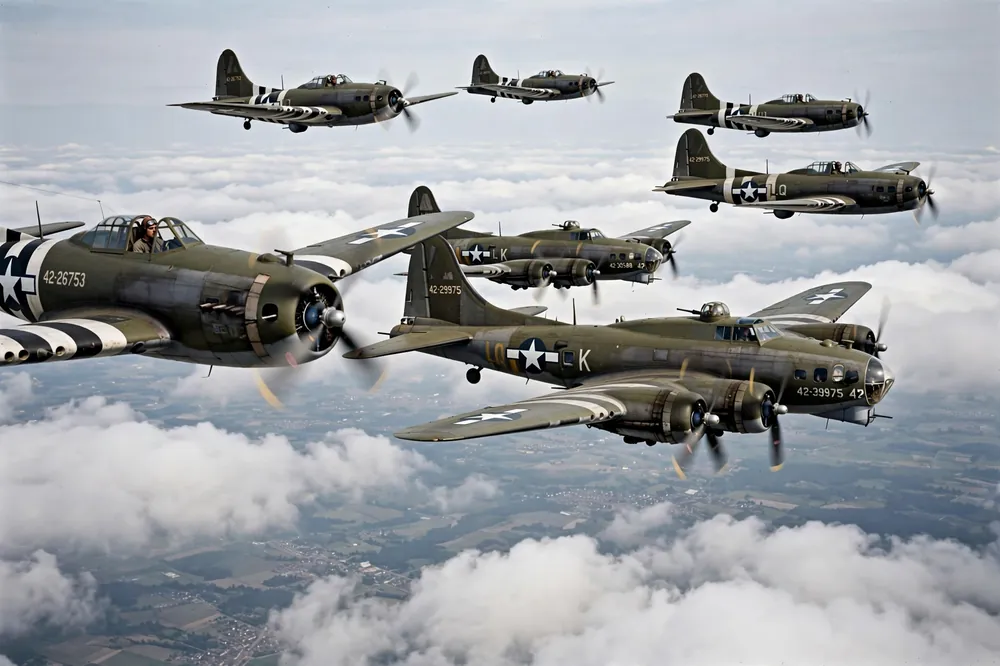
The P-47 Thunderbolt flew its first combat mission on 10 April 1943, escorting bombers over France with the 56th Fighter Group. In the first year of operations, the Thunderbolt served as the Eighth Air Force’s principal high-altitude escort fighter, before the P-51 Mustang arrived in numbers.
Its range with drop tanks allowed it to escort bombers as far as the German border, but not deep into Germany, and its turning performance put it at a disadvantage against German fighters at medium altitude. The 56th Fighter Group, commanded by Colonel Hubert Zemke and known as “Zemke’s Wolfpack”, nevertheless recorded the highest number of air victories of any fighter group in the Eighth Air Force — 665.5 aircraft credited as destroyed in the air — and its pilots included the two highest-scoring American aces in Europe: Captain Francis Gabreski with 28 victories and Captain Robert S.
Johnson with 27. In 1944, as Mustangs took over the long-range escort role, the Thunderbolt groups were transferred to the Ninth Air Force for ground attack.
Ground attack in France and Germany
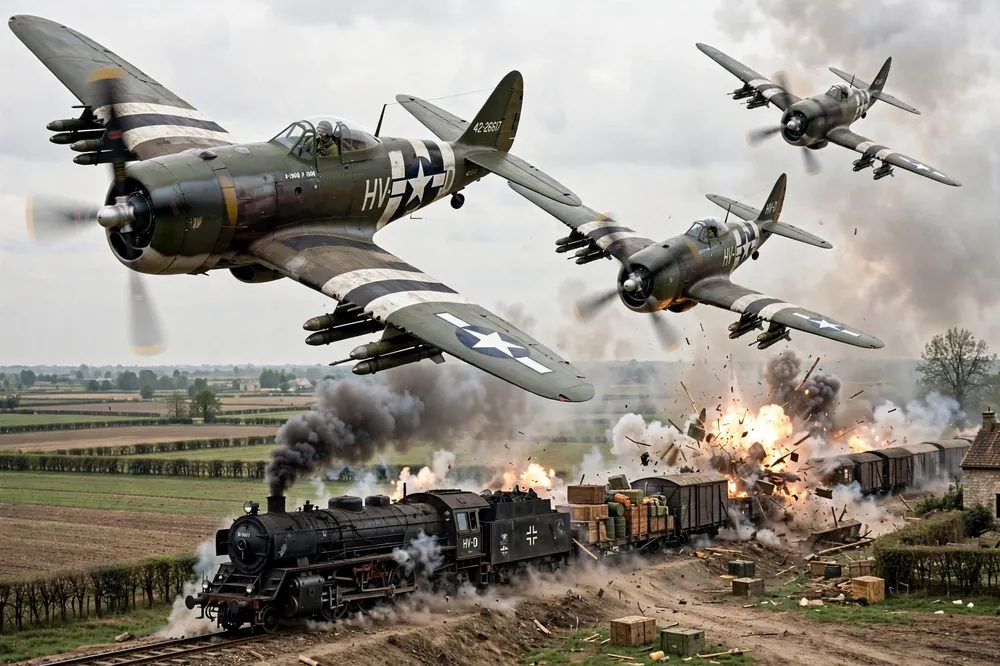
From the spring of 1944, the P-47 Thunderbolt became the United States Army Air Forces’ principal ground-attack aircraft in Europe. Flying from airfields in southern England and then from hastily built strips in Normandy, Thunderbolts attacked German transport, armour, artillery and airfields ahead of the advancing Allied armies.
On D-Day, 6 June 1944, P-47s flew close-support missions over the Normandy beaches, and in the weeks that followed they were called in repeatedly against German counter-attacks and supply columns. During the Battle of the Bulge in December 1944, when bad weather grounded most Allied air power, the clearing skies on 23 December allowed Thunderbolts to fly in large numbers against German armour and transport around Bastogne, where American troops were encircled.
The aircraft’s eight machine guns, bombs and rockets were effective against trains, trucks and tanks — the last of these usually attacked from the side or rear, where the armour was thinner — and the Thunderbolt’s ruggedness allowed it to operate from rough forward airfields and to return with heavy battle damage.
By the end of the war in Europe, Thunderbolt units had flown more than 545,000 sorties, and the type was credited with destroying large numbers of German aircraft on the ground as well as in the air.
The Mediterranean and the Pacific
In the Mediterranean, P-47s served with the Twelfth Air Force in Italy, flying escort and ground-attack missions against German forces in Italy and the Balkans. In the Pacific, the Thunderbolt arrived later and in smaller numbers than in Europe, but the long-range P-47N, with its larger wing and extra fuel, was designed for the distances of the Pacific war. P-47Ns flew from Iwo Jima and Okinawa, escorting B-24 Liberators and B-29s over Japan and attacking Japanese airfields. The type also served with the Royal Air Force in Burma, where it was used as a fighter-bomber against Japanese forces, and with the air forces of Brazil, Mexico and the Soviet Union under Lend-Lease.
The most successful fighter group to fly the P-47 Thunderbolt was the 56th Fighter Group of the Eighth Air Force, commanded for much of the war by Colonel Hubert Zemke. The 56th was the first group to take the Thunderbolt into combat, in April 1943, and it was the only group in the Eighth Air Force to fly the P-47 for the entire war — the other groups converted to the P-51 Mustang when it became available.
Under Zemke, the group developed tactics that played to the Thunderbolt’s strengths: attacking from above with its diving speed, using its eight guns in a single pass, and avoiding turning fights with German fighters. The group’s pilots included Captain Francis Gabreski, with 28 victories the highest-scoring American ace in Europe, and Captain Robert S. Johnson, with 27.
By the end of the war, the 56th was credited with 665.5 aircraft destroyed in the air — the highest total of any fighter group in the Eighth Air Force — and a further 311 destroyed on the ground. The group’s record was achieved in an aircraft that was, on paper, less manoeuvrable than its opponents, and historians have studied it as an example of how tactics, training and leadership could make the difference between an aircraft’s paper performance and its combat record.
The 56th’s Thunderbolts were also among the first to carry the bubble canopy, and the group’s aircraft, with their distinctive markings, became some of the most photographed fighters of the war. When the war ended, the 56th’s pilots had flown the Thunderbolt longer than any other group, and the group’s history remains closely tied to the aircraft’s reputation.
7. Performance and Specifications
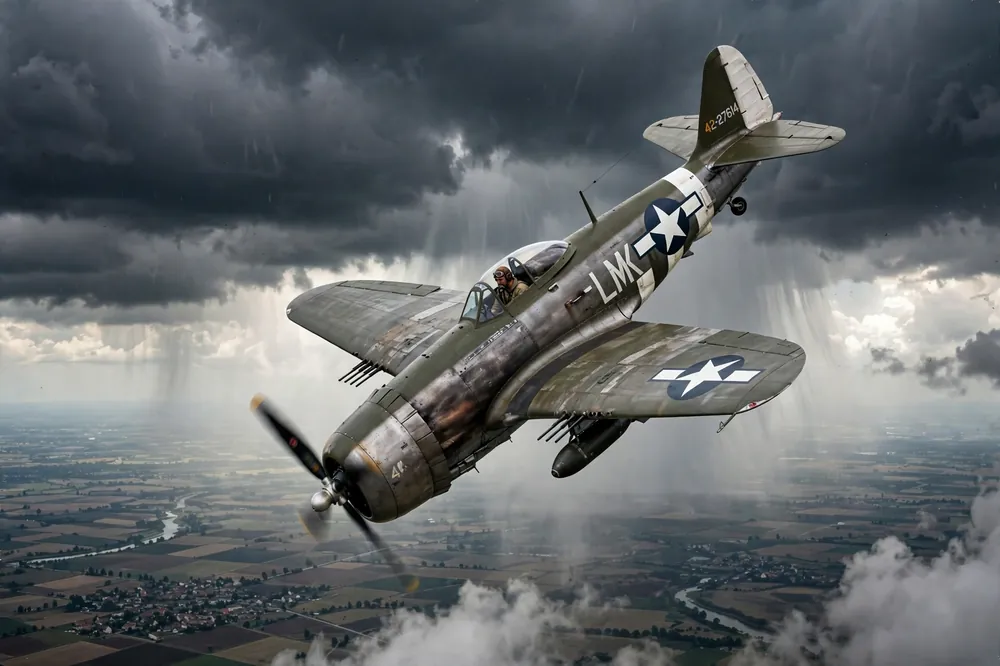
Specifications for the P-47D-40, the standard late-war version.
| Specification | Value |
|---|---|
| Crew | 1 |
| Length | 36 ft 1 in (11.00 m) |
| Wingspan | 40 ft 9 in (12.42 m) |
| Height | 14 ft 8 in (4.47 m) |
| Wing area | 300 sq ft (27.9 m²) |
| Empty weight | 10,000 lb (4,536 kg) |
| Loaded weight | 14,500 lb (6,577 kg) |
| Maximum takeoff weight | 17,500 lb (7,938 kg) |
| Powerplant | 1 × Pratt & Whitney R-2800-59 Double Wasp, 2,000 hp (2,300 hp with water injection) |
| Maximum speed | 426 mph (686 km/h) at 30,000 ft; 433 mph (697 km/h) at 29,000 ft (D-30) |
| Cruise speed | 350 mph (563 km/h) |
| Range | 1,030 mi (1,660 km) combat; 1,800 mi (2,900 km) ferry |
| Service ceiling | 42,000 ft (12,800 m) |
| Rate of climb | 3,120 ft/min (15.9 m/s) |
| Guns | 8 × .50 cal M2 Browning (425 rounds each) |
| Bombs / rockets | Up to 2,500 lb (1,130 kg) of bombs or 10 × 5 in HVAR rockets |
8. Operators
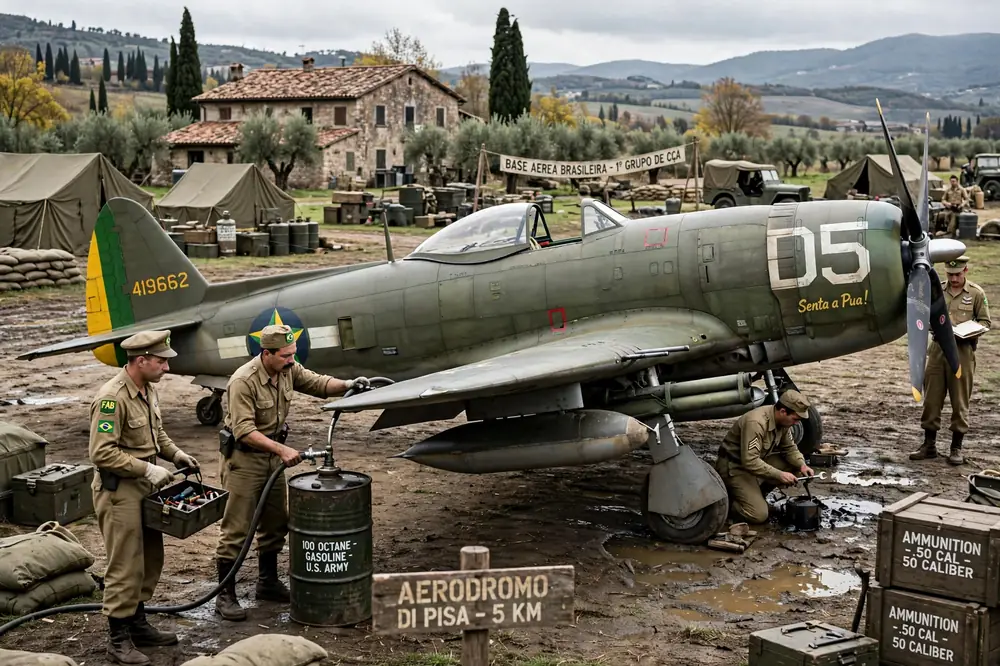
The P-47 Thunderbolt served above all with the United States Army Air Forces, which used it in Europe, the Mediterranean and the Pacific. It was also supplied under Lend-Lease to the Royal Air Force, which flew it as a fighter-bomber in Burma; to the Soviet Union, which received 203 aircraft; to Brazil, whose 1st Fighter Group flew Thunderbolts in Italy; and to Mexico, France, China and several Latin American countries.
After the war, the United States Air Force retired its last Thunderbolts in 1953, but the type continued in service elsewhere for years: the air forces of Portugal, Turkey, Italy, Yugoslavia, Iran, Peru and several other nations flew surplus P-47s into the 1950s and 1960s, and Peru operated the type until 1966.
The Thunderbolt’s long post-war career reflected its ruggedness and the large numbers available at low cost after the war.
The P-47 Thunderbolt’s service outside the United States is less well known than its record in Europe, but it was extensive. The Royal Air Force received 826 Thunderbolts, designated the Thunderbolt Mk I and Mk II, and used them as fighter-bombers in Burma, where the type’s heavy armament and bomb load were suited to attacking Japanese positions in the jungle and along the supply routes from Thailand.
RAF Thunderbolt squadrons flew in support of the Fourteenth Army’s advance through Burma in 1944–45, attacking Japanese troops, bridges and supply dumps, and the type remained in RAF service in the Far East until after the war. Brazil’s 1st Fighter Group flew P-47Ds in Italy from October 1944, operating as part of the United States’ 350th Fighter Group and flying ground-attack missions against German forces in northern Italy until the end of the war; the Brazilian pilots flew hundreds of sorties and the group’s service became a source of national pride in Brazil.
Mexico’s 201st Fighter Squadron, known as the “Aztec Eagles”, flew P-47Ds in the Philippines in 1945, supporting American forces on Luzon — the only Mexican combat unit to serve overseas in the Second World War. The Soviet Union received 203 Thunderbolts under Lend-Lease, though they were used mainly for training and air defence rather than at the front.
These smaller operators show how widely the Thunderbolt was distributed: by the end of the war, it had served with the air forces of more than a dozen nations, and its ruggedness and ease of maintenance made it attractive to air forces that could not support more complex types.
9. Legacy and Influence
The P-47 Thunderbolt’s legacy is that of the most-produced American fighter of the Second World War and one of the most effective ground-attack aircraft of the conflict. Its record — more than 15,600 built, more than 545,000 sorties flown in Europe, and the highest air-victory total of any Eighth Air Force fighter group — reflects a design that was adapted successfully from one role to another: from high-altitude escort fighter to low-level fighter-bomber. The Thunderbolt also demonstrated the value of a large, powerful radial engine and a rugged airframe in the ground-attack role, a lesson that influenced the design of later American attack aircraft, including the A-10 Thunderbolt II, which carries the Thunderbolt name in its honour.
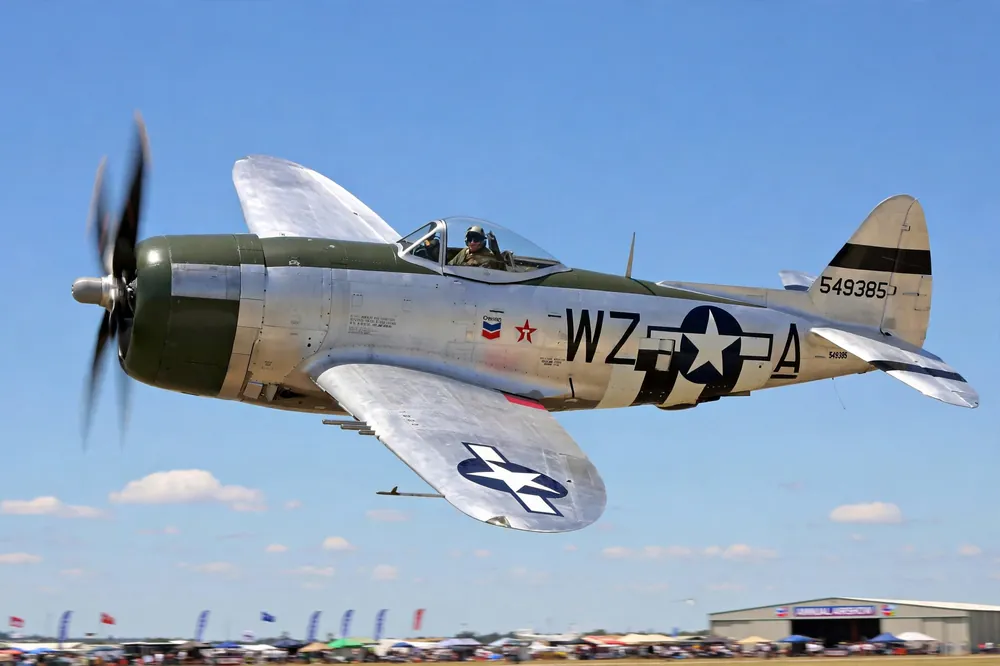
Pilots remembered the P-47 for its diving speed and its ability to bring them home damaged. Its designer, Alexander Kartveli, went on to design the F-84 and the F-105 for Republic Aviation, carrying forward the company’s experience with large, powerful fighters.
Of more than 15,600 built, relatively few survive: about a dozen are airworthy and a larger number are preserved in museums, a smaller survival rate than the P-51 Mustang, because most Thunderbolts were scrapped after the war or sold to foreign air forces that flew them until they wore out.
The type’s nickname, the “Jug” — short for “Juggernaut” — has entered the language of aviation history, and the aircraft remains one of the most recognisable American fighters of the war.
The P-47 Thunderbolt’s nickname, the “Jug”, has two explanations, and both are probably true. The first is that “Jug” was short for “Juggernaut”, a reference to the aircraft’s size and weight — at 17,500 pounds at maximum takeoff, it was the heaviest single-engine fighter of the war, and its bulk was its most obvious feature. The second is that the fuselage’s shape, deep and rounded, resembled a milk jug.
Pilots used the nickname with a mixture of respect and humour: the Jug was big, heavy and ungainly on the ground, but in the air it was fast, rugged and heavily armed, and it brought its pilots home. The nickname survived the war and was revived in the 1970s, when the United States Air Force named its new close-support aircraft the A-10 Thunderbolt II — the “Warthog” to its crews — in honour of the P-47.
The choice was deliberate: like the P-47, the A-10 was designed around a single powerful weapon system, built to absorb damage, and intended to support ground troops at low altitude. The A-10’s designers studied the P-47’s record, and the connection between the two aircraft is still noted in the Air Force’s own histories.
The P-47’s other legacy is quieter: its turbo-supercharger system, its water injection and its bubble canopy all became standard features of later fighters, and Alexander Kartveli’s work on the Thunderbolt led directly to the F-84 and the F-105, the fighters that carried Republic Aviation into the jet age.
10. Surviving Examples
About a dozen P-47 Thunderbolts are airworthy today, and a larger number are preserved in museums. The National Museum of the United States Air Force at Dayton, Ohio, displays a P-47D, and the Smithsonian National Air and Space Museum holds a P-47D-30, serial 44-32691.
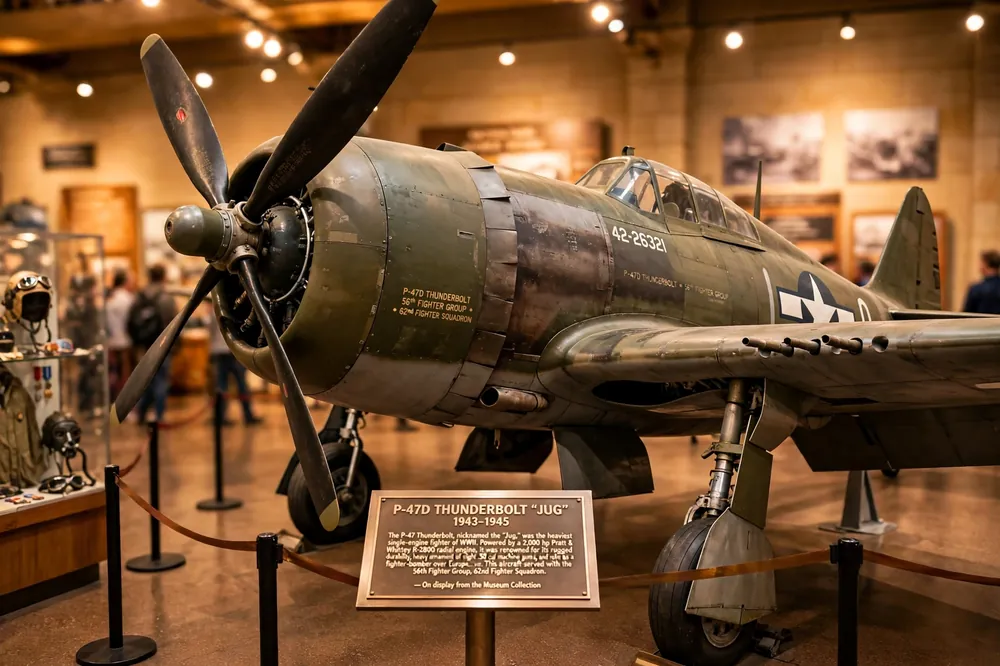
The Planes of Fame Air Museum in Chino, California, flies a P-47G known as Snafu, and the Fantasy of Flight collection in Florida holds Dottie Mae, a P-47D recovered from a lake in Austria in 1992, where it had crashed in 1945, and restored to flying condition. In Britain, the Imperial War Museum at Duxford displays a P-47, and the Royal Air Force Museum at Hendon holds another.
Several airworthy Thunderbolts fly regularly at airshows in the United States, where their large radial engines and eight-gun armament make them among the most distinctive warbirds still flying.
One of the most remarkable P-47 survivors was found at the bottom of a lake. Dottie Mae, a P-47D of the 406th Fighter Group, crashed into the Traunsee, a lake in Austria, on 8 May 1945 — the last day of the war in Europe — after its engine failed on a flight from Germany.
The pilot, Lieutenant Henry Mohr, survived the crash and was taken prisoner by German forces, only to be released days later when the war ended. The aircraft lay in the cold, fresh water of the lake for 47 years, preserved by the low oxygen levels at depth, until it was located and raised in 1992.
Its recovery was a substantial undertaking: the aircraft was lifted from the lakebed by a crane and a barge, and then restored over many years. Dottie Mae now flies with the Fantasy of Flight collection in Florida, one of only a few Thunderbolts still airworthy, and its story is told at airshows as an example of how an aircraft lost on the last day of a war could return to the air nearly half a century later.
Frequently Asked Questions
How many P-47 Thunderbolts were built? Most sources give 15,636; the aviation historian Joe Baugher gives 15,683. The difference reflects different ways of counting late-war production.
What was the P-47 Thunderbolt’s top speed? The P-47D had a maximum speed of 426 mph (686 km/h) at 30,000 feet, or 433 mph (697 km/h) at 29,000 feet for the D-30 version.
Why was the P-47 called the “Jug”? “Jug” was short for “Juggernaut”, a reference to the aircraft’s large size and weight. Pilots also used the nickname affectionately for its ruggedness.
How many guns did the P-47 have? Eight .50-calibre M2 Browning machine guns, four in each wing, with 425 rounds per gun — the heaviest gun armament of any American single-engine fighter.
What was the P-47’s main role? It began as a high-altitude escort fighter over Germany, but from 1944 its main role in Europe was ground attack: bombing, strafing and rocket attacks against German transport, armour and airfields.
Are any P-47 Thunderbolts still flying? Yes — about a dozen are airworthy, including Snafu at the Planes of Fame Air Museum and Dottie Mae at Fantasy of Flight in Florida.
Related articles
Sources
- Wikipedia, “Republic P-47 Thunderbolt” — production total 15,636, P-47D specifications, variant figures.
- National Museum of the United States Air Force, “Republic P-47D Thunderbolt” fact sheet — specifications and service history.
- Joe Baugher, “Republic P-47 Thunderbolt” (joebaugher.com) — production total 15,683, variant details.
- National WWII Museum, New Orleans — P-47 Thunderbolt and the 56th Fighter Group.
- Warren M. Bodie, Republic’s P-47 Thunderbolt: From Seversky to Victory (Widewing Publications, 1994).
- Thomas E. Doll, The P-47 Thunderbolt in Action (Squadron/Signal Publications, 1986).
- Steve Zaloga, P-47 Thunderbolt vs Bf 109G/K: Europe 1943–45 (Osprey Publishing, 2008).
Further reading
- Francis H. Gabreski, Gabby: A Fighter Pilot’s Life (Schiffer Publishing, 1991).
- Robert S. Johnson, Thunderbolt! (Ballantine Books, 1958).