 WAR ATLAS MILITARY HISTORY MAGAZINE · WWI — WWII
Siege of Malta
1. Lead
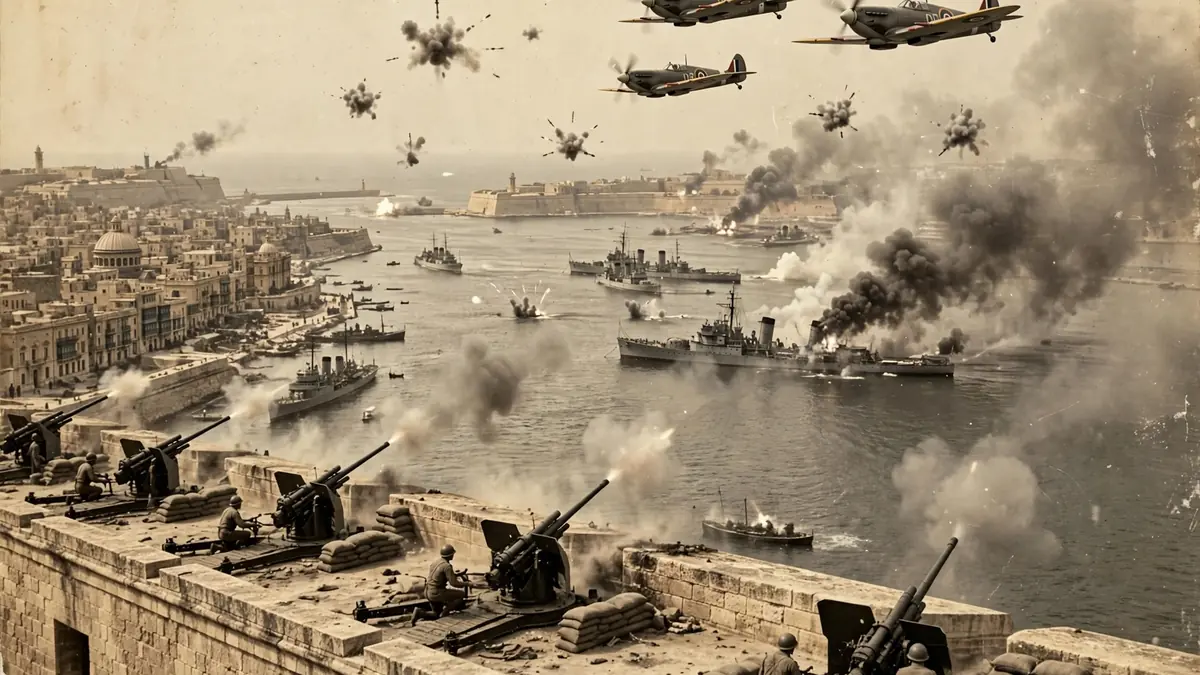
The Siege of Malta lasted from June 1940 to November 1942, and it was one of the longest and most bitter sieges of the Second World War. Malta, a small British island in the middle of the Mediterranean, sat astride the supply route between Italy and North Africa, and for two and a half years the Axis tried to bomb it, starve it and invade it into submission.
The island was bombed more heavily, in proportion to its size, than any other place in the war: some 3,000 air raids, more than 14,000 tons of bombs, and about 1,500 civilians killed. Food ran so short that the garrison and the people lived on rations that would not have kept a child alive, and the convoys that tried to resupply the island were attacked so fiercely that the survival of each one became a national event in Britain.
But Malta never surrendered. Its fighters, its anti-aircraft guns, its submarines and its people held on, and in return Malta’s aircraft and submarines sank so much Axis shipping that Erwin Rommel’s armies in North Africa were starved of the fuel and ammunition they needed — a contribution to the Allied victory that Winston Churchill called one of the greatest in the war.
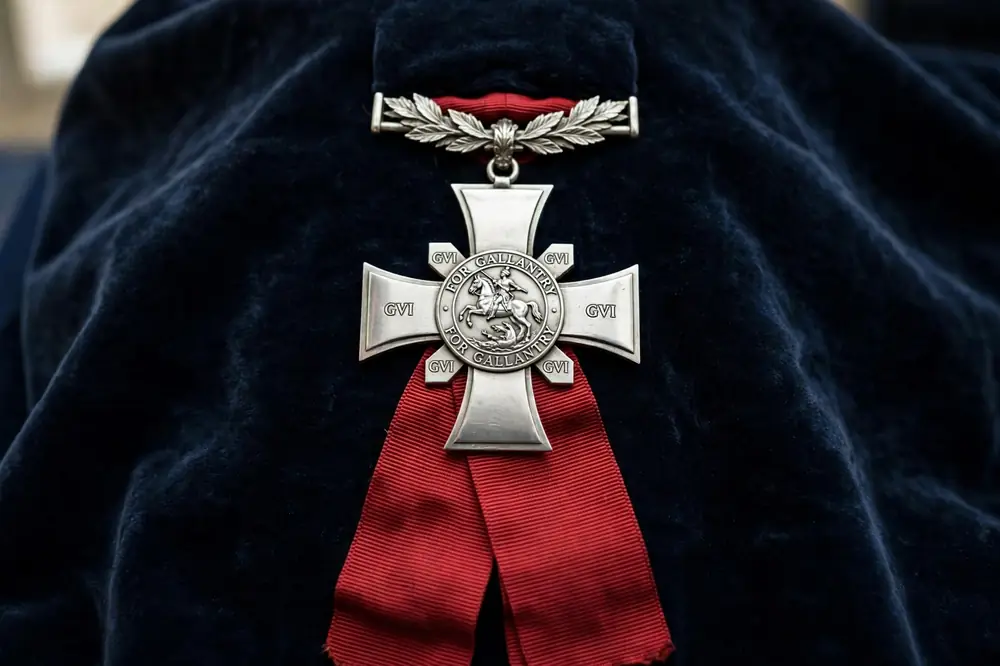
On 15 April 1942, in the middle of the worst bombing, King George VI awarded the island the George Cross, the highest British decoration for gallantry, “to honour her brave people” — the only time the Cross has been awarded to a whole community.
2. Key Facts
| Date | 10 June 1940 – November 1942 (siege effectively lifted after Operation Torch and El Alamein) |
| Location | Malta, in the central Mediterranean, 93 km south of Sicily |
| Result | Allied victory; Malta held, and Axis supply lines to North Africa were crippled |
| Allied commanders | Lt. Gen. Sir William Dobbie, then Lt. Gen. Lord Gort (Governors); Air Vice-Marshal Keith Park (RAF) |
| Axis commanders | Field Marshal Albert Kesselring (Luftflotte 2); Italian Regia Aeronautica |
| Allied strength | Garrison of about 15,000–25,000 men; RAF fighters (at peak about 100 aircraft); 10th Submarine Flotilla |
| Axis strength | Luftflotte 2 (about 400 aircraft at peak); Italian Regia Aeronautica; invasion force planned (Operation Hercules) |
| Allied losses | About 1,500 civilians killed; about 30,000 buildings damaged or destroyed; many merchant ships and warships lost in the convoys |
| Axis losses | Estimated 1,600+ aircraft lost over Malta; large tonnage of Axis shipping sunk by Malta-based forces |
3. Background
An Island on the Supply Route
Malta’s importance was geographical, and it was absolute. The island lies in the narrow central Mediterranean, 93 kilometres south of Sicily and about 300 kilometres north of Libya, directly astride the sea route between Italy and the Axis armies in North Africa.
Every ton of fuel, ammunition and food that reached Rommel’s Afrika Korps had to pass within range of Malta’s aircraft and submarines, and every ship that sailed that route was at risk. The British had held Malta since 1800, and by 1939 it was a major naval base, with the great harbour of Valletta, dockyards, and a garrison — but it was also, in 1940, almost defenceless.
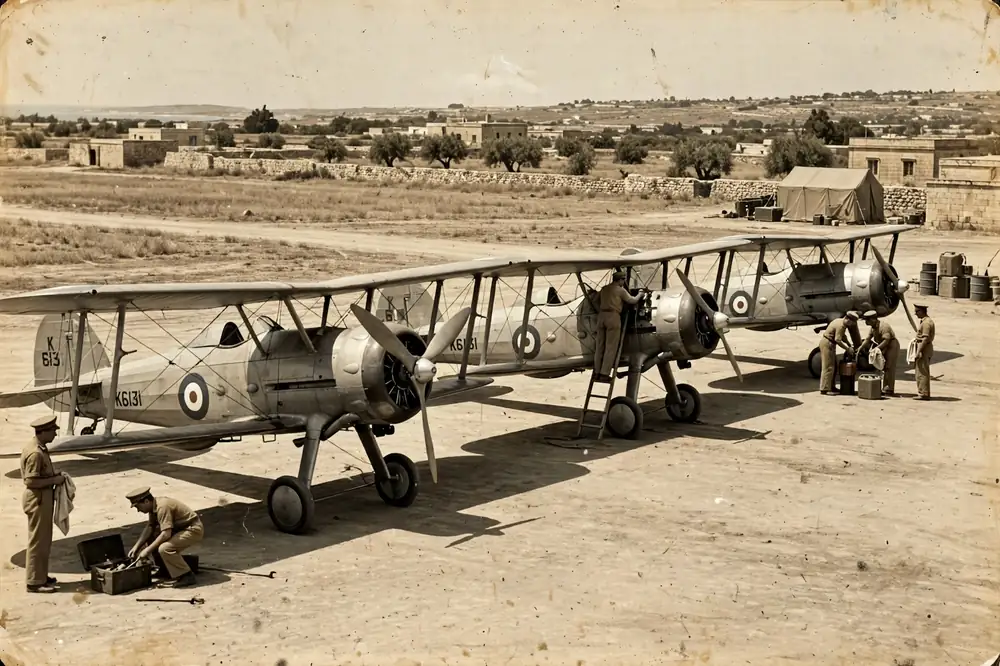
The island had only a handful of anti-aircraft guns, a few obsolete Gloster Gladiator biplane fighters, and no radar of any consequence. When Italy declared war on 10 June 1940, the first Italian bombers arrived over Malta within hours, and the islanders, who had been told for years that Malta was impregnable, discovered that it was not.
The Italian plan was to bomb Malta into submission, and the Germans, when they arrived in the Mediterranean in 1941, took up the task with far greater force. The island’s defenders, at first, had almost nothing to fight back with: the three Gladiators — Faith, Hope and Charity, as the Maltese called them — were the island’s only fighters for months, and the anti-aircraft guns were so few that the gunners had to choose which targets to defend.
But the island held, and it held because the British, understanding what was at stake, poured reinforcements into it by every means they could: fighters flown off aircraft carriers in the famous “Club Runs”, anti-aircraft guns and radar brought in by submarine and by fast merchant ships, and convoys that ran the gauntlet of Axis bombers, submarines and surface ships to bring in food, fuel and ammunition.
The First Year of the Siege
The first year of the siege, from June 1940 to the spring of 1941, was fought mainly by the Italians, and it was a year of improvisation on both sides. The Italian Regia Aeronautica bombed Malta regularly, but its bombers were not accurate, its fighters were not numerous, and its attacks, though frightening, did not close the harbour or destroy the island’s defences.
The Maltese, meanwhile, learned to live with the bombing: they dug shelters in the rock, they moved into the catacombs and the old tunnels, and they went on working in the dockyards under fire. The RAF, reinforced by Hurricanes flown in from carriers, began to fight back, and the island’s submarines, operating from Malta, began to sink Italian supply ships bound for Libya.
By the end of 1940, Malta was not only surviving but fighting back, and the Italians, who had expected a quick victory, were no closer to taking the island than they had been in June.
Everything changed in January 1941, when the Germans arrived. Hitler, alarmed by the Italian failures in North Africa and in Greece, sent the Luftwaffe’s Fliegerkorps X to Sicily, and then, in December 1941, Field Marshal Albert Kesselring’s Luftflotte 2, with some 400 aircraft, including the dreaded Ju 87 Stuka dive-bombers and Ju 88 bombers.
The German bombing was heavier, more accurate and more sustained than anything the Italians had managed, and in the first months of 1942 it brought Malta to the edge of defeat. The island’s fighters were shot down faster than they could be replaced, the harbour was closed by mines and wrecks, and the convoys that tried to reach Malta were being destroyed.
In March and April 1942, Malta suffered the heaviest bombing of the whole war, and the island’s Governor, Lieutenant General Sir William Dobbie, warned London that Malta could not hold out much longer without relief.
The George Cross
On 15 April 1942, at the height of the bombing, King George VI awarded the George Cross to Malta. The award, announced in a letter from the King to the Governor, was made “to honour her brave people”, and it was the first and only time the George Cross — the highest British decoration for gallantry not in the face of the enemy — has been awarded to a whole community.
The Cross, which is now incorporated into the Maltese national flag, became the symbol of the island’s resistance, and it arrived at a moment when the islanders needed it most: food was running out, the bombing was at its worst, and the convoys were failing.
The award did not change the military situation, but it changed the islanders’ sense of themselves, and it told the world that Britain would not abandon Malta. In the months that followed, the island held on, the convoys got through, and the siege was broken — not by a single battle, but by endurance.
4. Opposing Forces
The siege of Malta was a war of air power, sea power and endurance, and the two sides were mismatched in almost every respect except determination.
| Allies | Axis | |
|---|---|---|
| Fighters | Gladiators (1940), then Hurricanes, then Spitfires (from March 1942); at peak about 100 aircraft | Bf 109 and Macchi C.202 fighters; at peak about 150 fighters over Malta |
| Bombers | Malta-based bombers (Wellingtons, Beauforts) attacking Axis shipping | Ju 87 Stuka, Ju 88, He 111 bombers; Italian SM.79 bombers; about 400 aircraft at peak |
| Anti-aircraft guns | At peak about 100 heavy and 100 light guns; radar-directed | — |
| Naval forces | 10th Submarine Flotilla; Force K (cruisers and destroyers, 1941); Mediterranean Fleet | Italian Navy (Regia Marina); German U-boats in the Mediterranean from 1941 |
| Ground forces | Garrison of 15,000–25,000 men, including Maltese regiments | Invasion force planned for Operation Hercules: about 30,000 airborne and seaborne troops (never launched) |
The Island’s Defenders
The defence of Malta rested on three things: its fighters, its guns and its people. The fighters were the most famous part of the defence. In 1940, the island had only the three Gladiators, Faith, Hope and Charity, and then a handful of Hurricanes flown in from the carrier Argus.
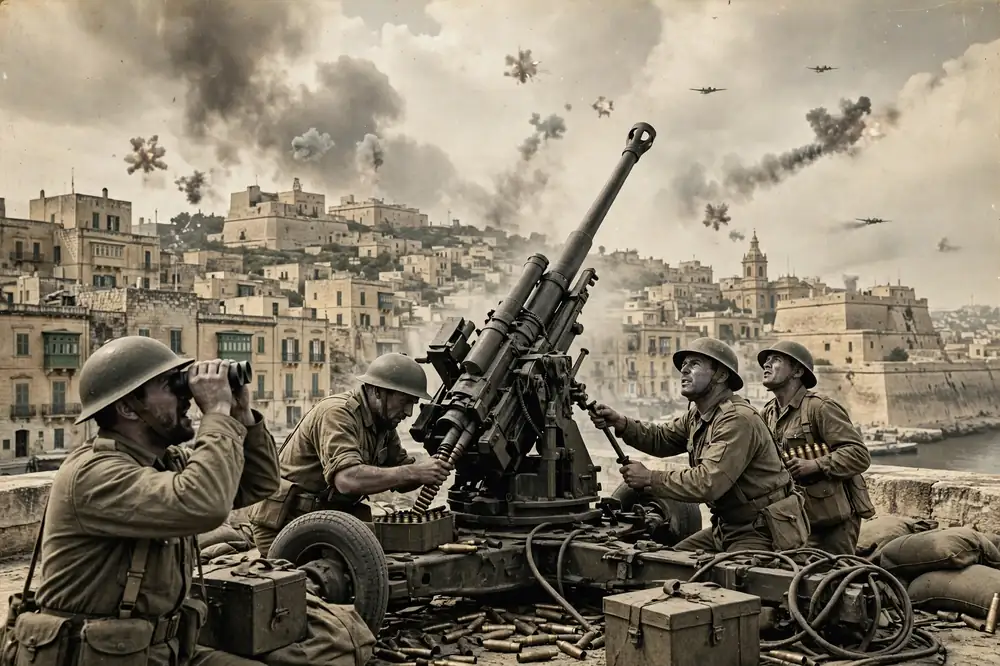
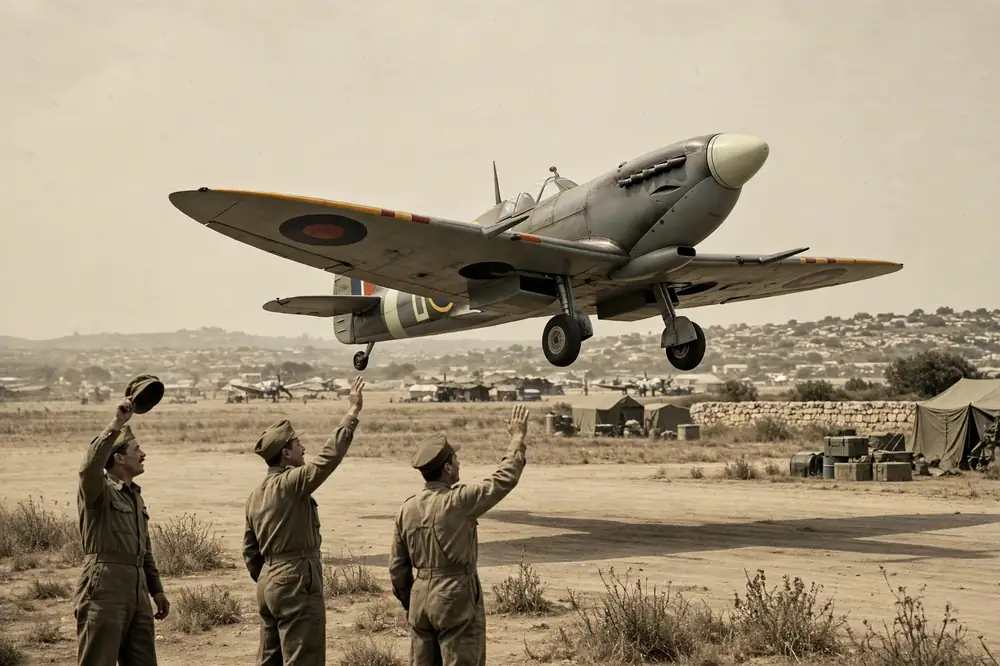
In 1941 and 1942, the Hurricanes were joined by Spitfires, flown in from carriers in the “Club Runs” — operations in which a carrier would steam to within flying range of Malta, launch its Spitfires, and turn back before the Axis bombers could find it.
The Spitfire, faster and more manoeuvrable than anything the Italians had, and a match for the Bf 109, transformed the air battle: in May 1942, when 64 Spitfires were flown in during Operation Bowery, the island’s air defences were, for the first time, strong enough to challenge the Luftwaffe on equal terms.
The anti-aircraft guns, directed by radar, were the second line of defence, and they shot down hundreds of Axis aircraft over the course of the siege. The third line was the people themselves: the Maltese, who dug shelters, who worked in the dockyards under fire, and who endured rationing that left them hungry for two years.
The Axis Attackers
The Axis forces that besieged Malta were formidable, but they were never united in their purpose. The Italians, who had the most to gain from Malta’s fall — the island was, after all, in what Mussolini called Mare Nostrum, “our sea” — wanted to invade it, and they drew up a plan, Operation Hercules, for a combined airborne and seaborne assault.
The Germans, who had the aircraft to bomb it, were less enthusiastic about an invasion: Kesselring, who commanded the air campaign, believed that bombing alone could force Malta to surrender, and Hitler, who was preoccupied with Russia, was unwilling to commit the troops.
The result was that the Axis never invaded Malta, and the bombing campaign, though it came close to success in the spring of 1942, was never quite enough. The Luftwaffe’s aircraft, moreover, were needed elsewhere: in the summer of 1942, many of Kesselring’s bombers were diverted to North Africa, to support Rommel’s advance on Egypt, and the pressure on Malta eased at the critical moment.
The Convoys and the Submarines
The third element of the siege, and the one that decided it, was the war at sea. Malta could not survive without convoys, and the convoys could not survive without the island’s fighters and guns. The great convoys of 1941 and 1942 — Halberd, Harpoon, Vigorous and, above all, Pedestal — were among the most fiercely fought naval operations of the war, and they cost the Royal Navy dearly: aircraft carriers, cruisers and destroyers were sunk, and merchant ships were lost in numbers that shocked the British public.
But the convoys got through, and each one that did brought food, fuel and ammunition that kept the island alive for a few more months. The island’s submarines, the 10th Flotilla, played the opposite role: operating from Malta, they sank Axis supply ships bound for North Africa, and their successes — together with those of Malta’s bombers — were so great that, by the autumn of 1942, the Axis armies in North Africa were receiving only a fraction of the supplies they needed.
The siege of Malta was, in the end, a war of supply, and Malta won it because its convoys got through and the Axis convoys did not.
5. The Battle
The Blitz of 1942
The worst period of the siege came in the spring of 1942, and it is remembered in Malta as the Blitz. In March and April, Kesselring’s Luftflotte 2 flew more than 6,000 sorties against the island, dropping some 6,500 tons of bombs in two months, and the island was bombed, on some days, for 24 hours without a break.
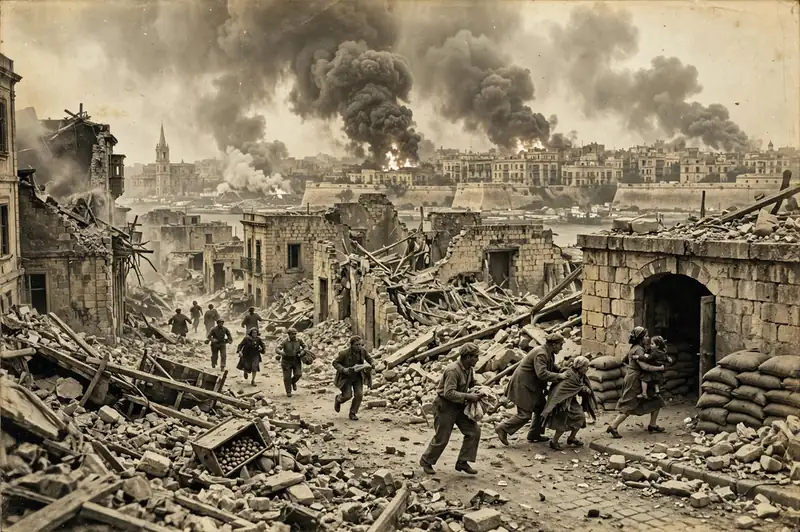
The harbour was closed, the airfields were cratered, and the fighters, which had been shot down faster than they could be replaced, were reduced to a handful. On 7 March 1942, the first Spitfires arrived, flown off the carrier Eagle, but there were only 15 of them, and most were destroyed on the ground within days.
The island’s Governor, Dobbie, warned London that Malta was “in a very bad way”, and the British government, which had been debating whether Malta was worth the cost of supplying it, decided that it was — and that the island must be held at all costs.
The decision was made just in time: on 20 April, the American carrier Wasp flew in 47 Spitfires, and on 9 May, in Operation Bowery, the Wasp and the Eagle together flew in 64 more. The new Spitfires, flown by experienced pilots, challenged the Luftwaffe over the island, and the bombing, though it continued, never again reached the intensity of March and April.
Operation Pedestal
Operation Pedestal, in August 1942, was the most important convoy of the Mediterranean war, and it was the convoy that saved Malta from starvation. By the summer of 1942, the island was dying: its food stocks were measured in weeks, its aviation fuel was almost gone, and its Governor had warned London that Malta would have to surrender if a convoy did not get through.
The British government, which had debated whether Malta was worth the cost of supplying it, decided that it was, and it assembled a convoy of a size that the Mediterranean had never seen: 14 merchant ships, escorted by two battleships, three aircraft carriers, seven cruisers and 24 destroyers.
The convoy was an enormous gamble, and it was fought, from the first day to the last, against everything the Axis could throw at it — submarines, bombers, cruisers and E-boats — and it was won, at a terrible cost, by the courage of the men who sailed it.
The Most Important Convoy
The turning point of the siege at sea was Operation Pedestal, the great convoy of August 1942, which the Maltese still remember as the Santa Marija convoy, because its most famous ship arrived on the feast of the Assumption. By the summer of 1942, Malta was starving: food stocks were measured in weeks, aviation fuel was almost gone, and the island’s Governor warned that Malta would have to surrender if a convoy did not get through.
The British assembled the largest convoy of the Mediterranean war: 14 merchant ships, escorted by two battleships, three aircraft carriers, seven cruisers and 24 destroyers — a force so large that it stripped the Home Fleet and the Eastern Fleet of their escorts.
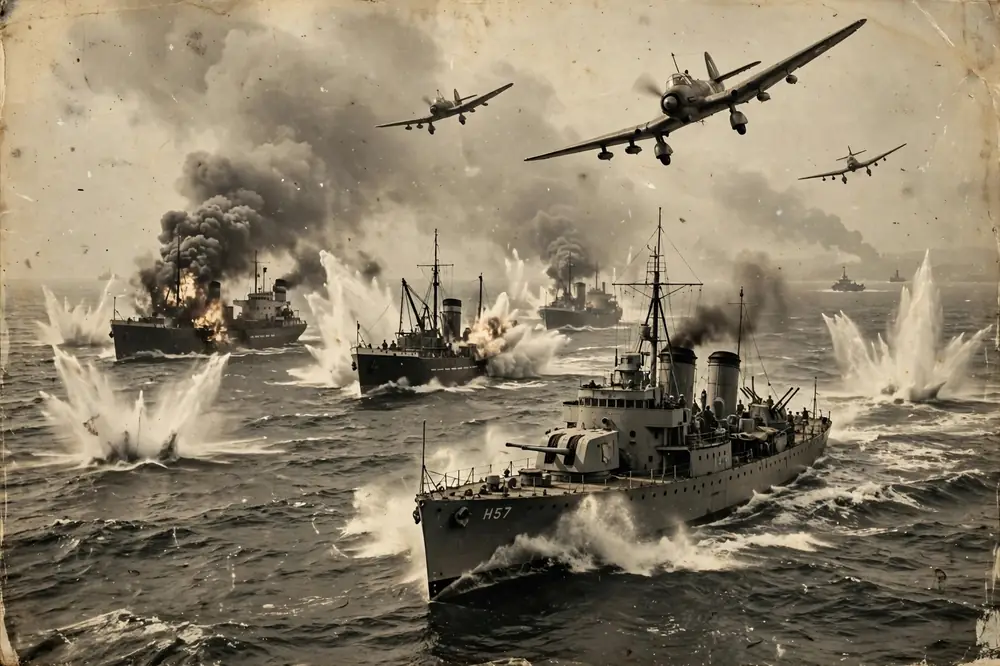
The convoy sailed from Gibraltar on 10 August, and from the first day it was attacked: by German and Italian submarines, by bombers from Sicily and Sardinia, by Italian cruisers, and by E-boats in the narrow waters off Tunisia. The carrier Eagle was sunk on the first day, by a U-boat, and the cruisers Manchester and Cairo and the destroyer Foresight were lost in the days that followed.
Of the 14 merchant ships, five were sunk in the first attacks, and the rest were scattered.
The Ohio
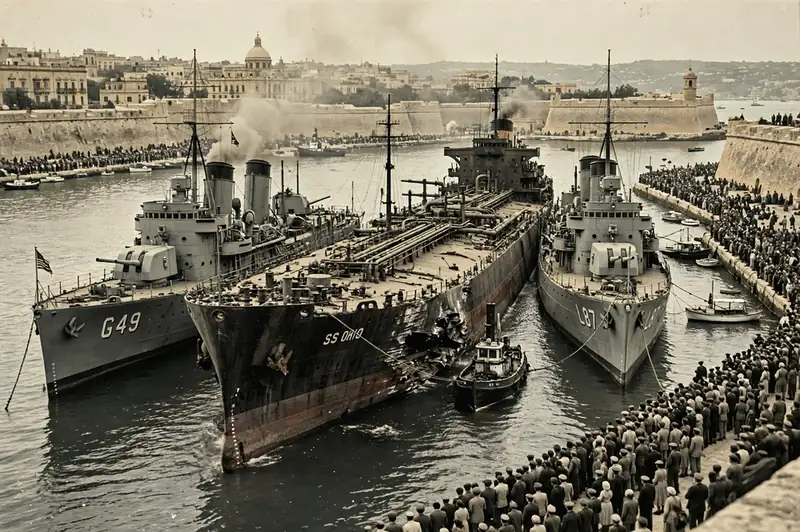
The convoy’s fate hung on a single ship: the American tanker Ohio, carrying 11,500 tons of oil — the fuel that Malta’s fighters and the island’s power stations needed to keep going. The Ohio was attacked again and again: by Stukas, by torpedo bombers, by submarines, and by E-boats, and by the time it reached Malta it had been hit by bombs and torpedoes, its decks were awash, its engines were dead, and it was being towed and pushed into harbour by two destroyers, with its crew still aboard.
It arrived at Valletta on 15 August, the feast of the Assumption, and it was greeted by crowds who had come down to the harbour to see it, and who sang hymns as it was brought in. Of the 14 merchant ships that had sailed from Gibraltar, only five reached Malta, but those five — and above all the Ohio — brought enough food, fuel and ammunition to keep the island alive until the next convoy, and to keep the fighters flying.
The convoy had cost the Royal Navy dearly, but it had saved Malta, and the islanders, who had been on the edge of starvation, never forgot it. The Ohio itself never sailed again: it was so badly damaged that it was scuttled in the harbour after its cargo had been discharged, and its wreck remained there for years.
The Siege is Lifted
The last months of the siege, from September to November 1942, saw the balance tip decisively in Malta’s favour. The Spitfires, now numerous and well flown, controlled the air over the island, and the Luftwaffe, which had lost more than 1,600 aircraft over Malta and which was being drawn away to North Africa and to Russia, could no longer sustain the bombing.
The convoys, which had been so costly, began to get through more easily, and the island’s food stocks, which had been measured in weeks, began to recover. The decisive change came in November 1942, with two events that ended the siege: Operation Torch, the Allied landings in North Africa on 8 November, which opened a new front behind the Axis armies, and the Second Battle of El Alamein, which broke Rommel’s army and drove it back across Libya.
With the Axis armies in retreat, the threat to Malta vanished, and the island, which had been besieged for two and a half years, was free. The last air raid on Malta came in July 1943, and by then the island was not a besieged fortress but a base for the invasion of Sicily.
6. Turning Point
The Spitfires Arrive
The turning point of the siege in the air came in the spring of 1942, with the arrival of the Spitfires. Until then, Malta’s fighters — first the Gladiators, then the Hurricanes — had been outnumbered and outclassed, and the island’s air defences had been a matter of endurance rather than of victory. The Spitfire changed that.
In Operation Bowery, on 9 May 1942, 64 Spitfires were flown in from the carriers Wasp and Eagle, and within days they were challenging the Luftwaffe over the island, shooting down bombers and fighters in numbers that the Germans had not experienced before. The Luftwaffe, which had been used to bombing Malta almost unopposed, suddenly found itself in a real air battle, and its losses mounted.
The arrival of the Spitfires did not end the bombing, but it ended the Luftwaffe’s mastery of the air over Malta, and it gave the islanders, for the first time in two years, the sight of their own fighters winning in the sky above them.
Pedestal and the Breaking of the Siege
The turning point at sea was Operation Pedestal, in August 1942. Before Pedestal, Malta was starving, and the island’s Governor had warned that surrender was a matter of weeks away. After Pedestal, Malta had food, fuel and ammunition, and the island’s fighters could fly again.
The convoy’s cost — the carrier Eagle, two cruisers, a destroyer, and nine merchant ships — was terrible, but its achievement was greater: it proved that the Royal Navy could still get a convoy through to Malta, even against everything the Axis could throw at it, and it proved to the Maltese that Britain would not abandon them.
The two turning points, in the air and at sea, came together in the autumn of 1942, and by November, with the Axis armies in retreat in North Africa, the siege was over. Malta had survived, and it had survived because, at the critical moment, the Allies had been willing to pay the price of supplying it.
7. Casualties and Losses
Civilian Losses
The civilian cost of the siege was heavy, and it fell on a small population. About 1,500 Maltese civilians were killed by bombing during the siege, and about 3,700 were wounded, out of a population of about 270,000 — a death toll that, in proportion to population, was among the highest of any place in the war.
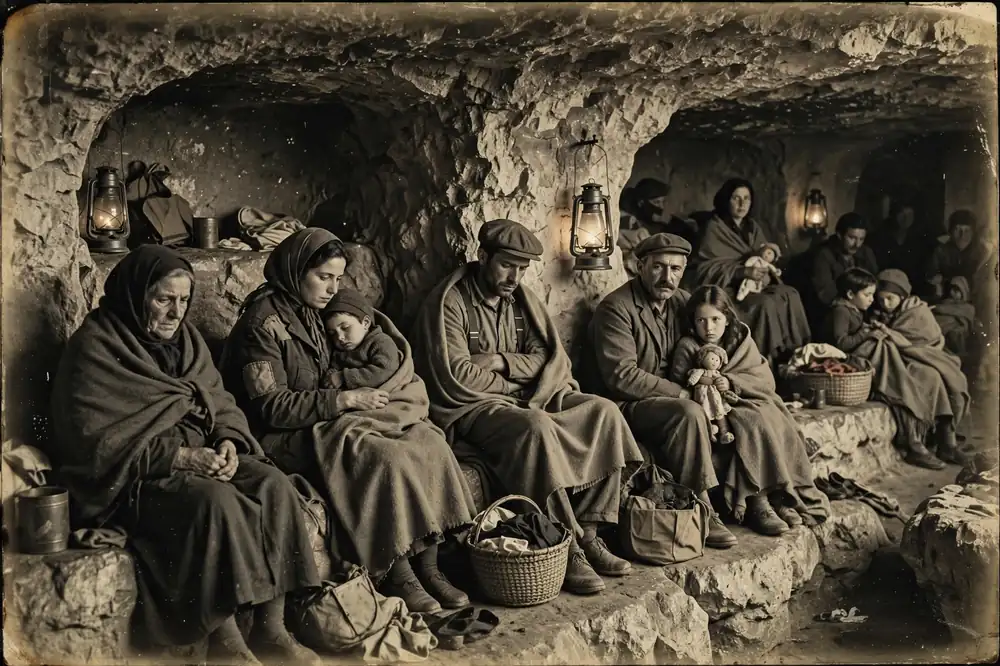
About 30,000 buildings were damaged or destroyed, including some of the island’s oldest churches and the Royal Opera House in Valletta, which was destroyed by bombing in April 1942 and never rebuilt. The islanders lived for two years in shelters dug into the rock, in the catacombs and in the old tunnels, and they endured rationing that, by the summer of 1942, had reduced their diet to a level that would not have sustained a child.
The hunger, the bombing and the fear were the price of Malta’s resistance, and the islanders paid it without surrendering.
| Allies | Axis | |
|---|---|---|
| Civilians killed | About 1,500 Maltese | |
| Civilians wounded | About 3,700 | |
| Buildings damaged or destroyed | About 30,000 | |
| Military personnel killed | About 800–1,000 (estimate, including RAF and naval personnel) | |
| Aircraft lost | About 200 RAF aircraft (estimate) | |
| Axis aircraft lost | Estimated 1,600+ over Malta | |
| Merchant ships lost in Malta convoys | About 30 merchant ships (estimate) |
Military and Naval Losses
The military losses of the siege were also heavy, though they are harder to count precisely. The RAF lost about 200 aircraft over Malta, and the Royal Navy lost an aircraft carrier (Eagle), two cruisers, a destroyer and many smaller ships in the convoys, along with about 30 merchant ships.
The Axis losses were heavier: more than 1,600 German and Italian aircraft were lost over Malta, a drain on the Luftwaffe that it could ill afford, and the Axis lost, in addition, hundreds of thousands of tons of shipping to Malta’s submarines and bombers — shipping that Rommel’s armies in North Africa desperately needed.
The siege, in the end, cost both sides heavily, but it cost the Axis more, because it cost them the supplies that would have let them win in North Africa. The island’s own losses, though heavy, were borne by a population that had chosen to endure them, and the convoys that had cost so much had, in the end, bought the island’s survival.
8. Map and Geography
The Island and Its Harbours
Malta is a small archipelago, only 27 kilometres long and 14 kilometres wide, with a total area of about 316 square kilometres — smaller than the Isle of Wight, and home, in 1940, to about 270,000 people. The main island, Malta, is dominated by its harbours: the Grand Harbour at Valletta, one of the finest natural harbours in the Mediterranean, and Marsaxlokk Bay in the south.
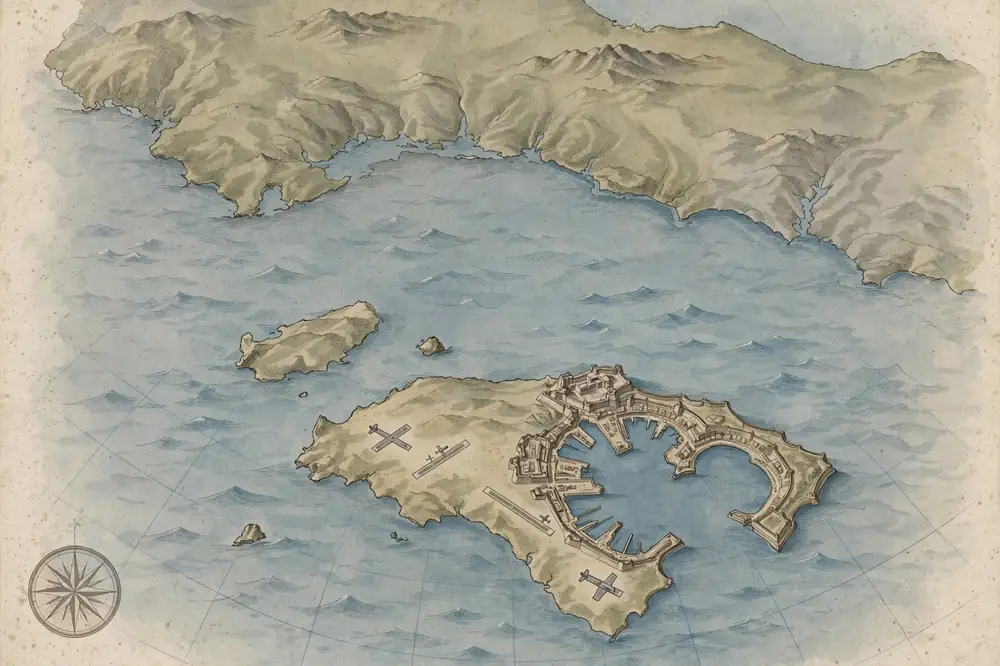
The Grand Harbour, with its dockyards, its dry docks and its underground storage, was the reason the British held Malta, and it was the reason the Axis wanted it: whoever held the Grand Harbour held the central Mediterranean. The island’s airfields — Hal Far, Luqa and Ta’ Qali — were built on the flat limestone plateau in the centre of the island, and they were the targets of most of the bombing.
The rest of the island is dry, rocky and treeless, with terraced fields and stone walls, and with villages built of the same golden limestone that built Valletta.
Malta’s Position in the Mediterranean
Malta’s position, 93 kilometres south of Sicily and 300 kilometres north of Libya, made it the key to the central Mediterranean. From Malta, British aircraft and submarines could reach the Axis supply route to North Africa in a matter of hours, and the island’s radar could track Axis aircraft and ships across the whole of the central Mediterranean.
The Axis, for their part, could bomb Malta from airfields in Sicily, only a few minutes’ flying time away, and their bombers could reach the island, drop their bombs and return to base in less than an hour. The island was, in effect, an unsinkable aircraft carrier in the middle of the enemy’s sea — and, like an aircraft carrier, it was vulnerable to air attack and dependent on resupply from the sea.
Its survival depended on the convoys, and the convoys depended on the island’s fighters and guns. The geography of the siege was, in the end, a simple one: a small island, in the middle of a hostile sea, holding out against an enemy that could reach it in minutes.
9. Outcome and Legacy of the Siege of Malta
The Strangling of Rommel’s Supply Lines
The most important consequence of Malta’s survival was the strangling of the Axis supply lines to North Africa. Malta’s submarines and bombers, operating from the island, sank so much Axis shipping that, by the autumn of 1942, Rommel’s armies were receiving only a fraction of the fuel, ammunition and food they needed.
In some months, less than half of the supplies dispatched from Italy reached North Africa, and the rest lay on the bottom of the Mediterranean. The effect on the desert war was decisive: at El Alamein, in October and November 1942, Rommel’s tanks ran out of fuel, his guns ran out of ammunition, and his men, though they fought bravely, could not hold the line against Montgomery’s Eighth Army.
The victory at El Alamein, and the Allied victory in North Africa that followed, owed a great deal to Malta — and to the men and women who had held the island through two and a half years of bombing and hunger.
Malta After the Siege
After the siege, Malta became a base for the Allied invasions of Sicily and Italy. In July 1943, the invasion of Sicily was launched from Malta, and the island’s airfields and harbours were crowded with the aircraft and ships of the invasion fleet.
In September 1943, the Italian fleet surrendered at Malta, sailing into the Grand Harbour under the guns of the island’s defences — a moment that the Maltese, who had been bombed by the Italians for three years, did not forget. The island was awarded the George Cross in 1942, and the Cross, which is now part of the Maltese flag, remains the symbol of the island’s resistance.
Malta became independent in 1964, and it remains, to this day, one of the most densely populated and most historically rich islands in the Mediterranean. The island’s wartime experience shaped its identity for a generation, and the George Cross, which Malta still bears on its flag, remains the most visible reminder of the siege and of the price that a small island paid to change the course of a war.
Legacy
The siege of Malta is remembered as one of the great sieges of history, and as a demonstration of what a determined population can endure. It is studied in military schools as an example of the importance of sea power, of air power, and of the human will to resist.
The island’s memorials — the George Cross, the Siege Bell in Valletta, which rings every day at noon in memory of the dead, and the National War Museum in Fort St Elmo — keep the memory alive, and the Maltese, who still call themselves the children of the siege, are proud of what their grandparents endured.
The siege also left a lesson for the future: that an island, however small, can change the course of a war, if it is held by people who refuse to surrender. The siege is still commemorated every year in Malta, and the names of the convoys — above all Pedestal — are still remembered by the families of the men who sailed them.
10. Commanders
Allied Commanders
Lieutenant General Sir William Dobbie (Britain). Governor of Malta from April 1940 to May 1942, and the man who held the island through the worst of the bombing. Dobbie, a deeply religious man, believed that Malta’s survival was a matter of faith as well as of arms, and he inspired the islanders by his own example, visiting the shelters and the dockyards under fire. He was replaced in May 1942, when London decided that a younger man was needed, but the islanders never forgot him.
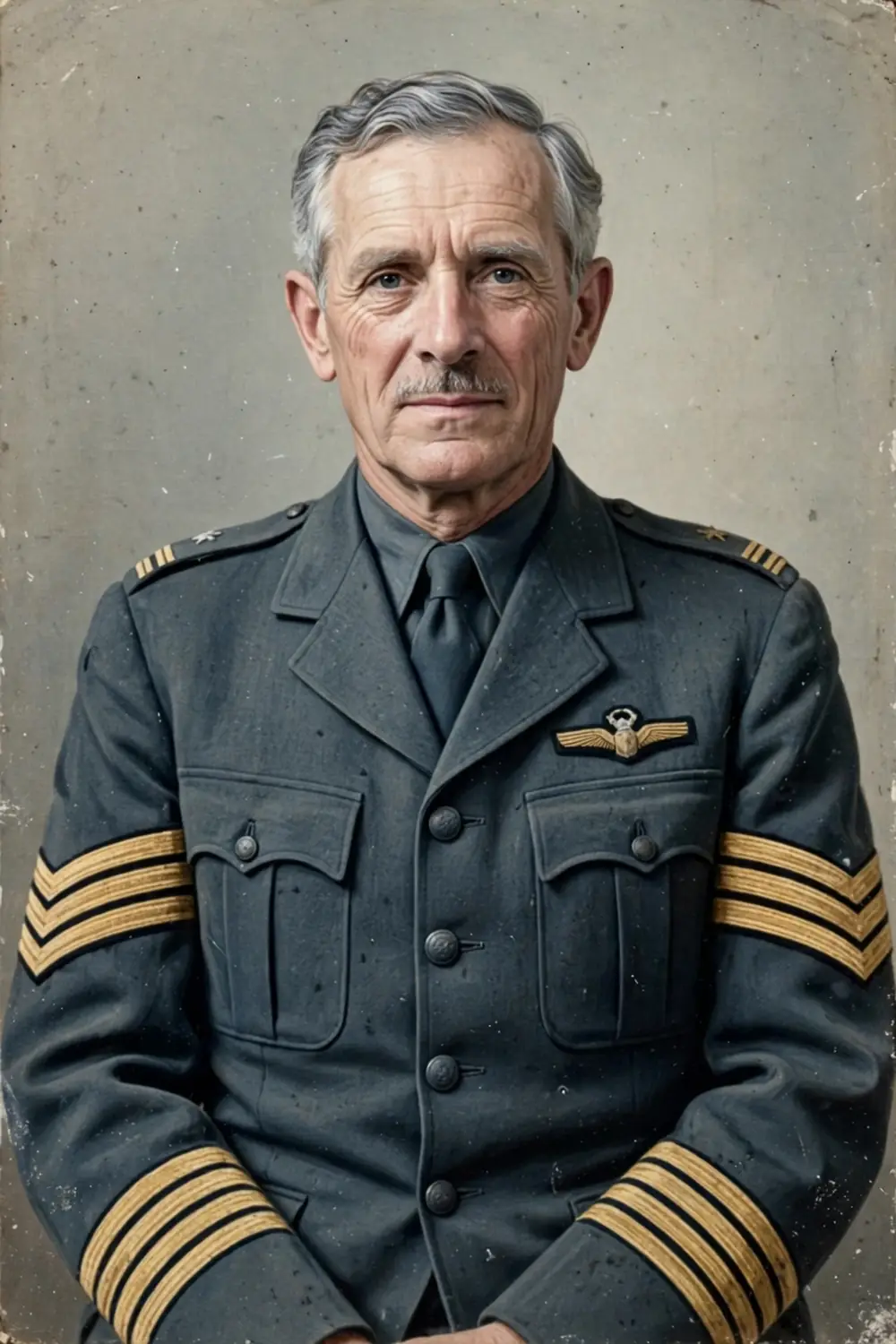
Lieutenant General Lord Gort (Britain). Governor of Malta from May 1942 to September 1944, and the man who saw the siege through to its end. Gort, who had commanded the British Expeditionary Force in France in 1940, was a soldier of great personal courage, and he reorganised the island’s defences, improved the air-raid shelters, and saw Malta through the critical months of the summer of 1942.
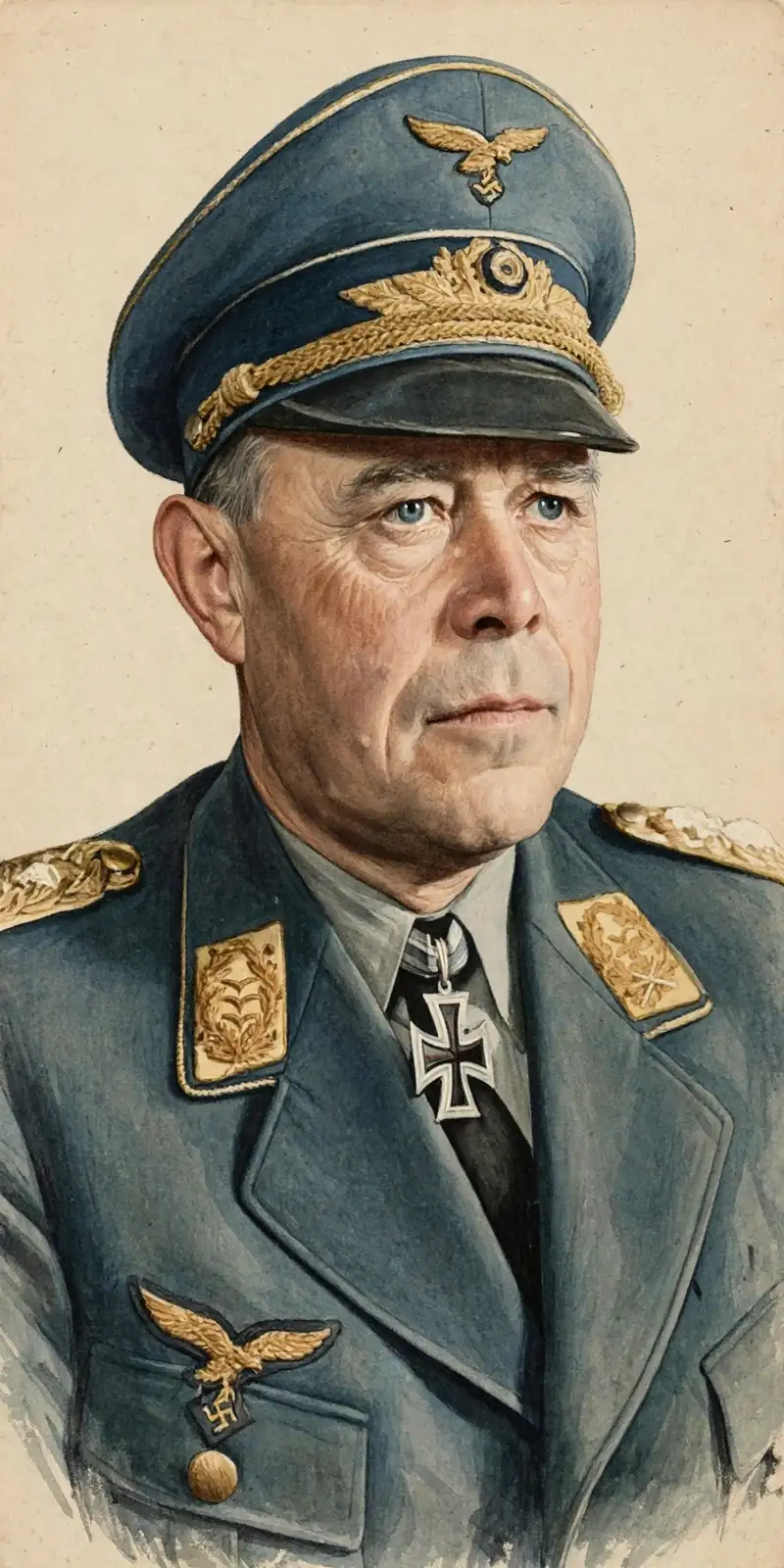
Air Vice-Marshal Keith Park (Britain). Commander of the RAF in Malta from July 1942, and the man who won the air battle over the island. Park, a New Zealander who had commanded the defence of London in the Battle of Britain, applied the same principles to Malta: he concentrated his fighters, he used radar to direct them, and he attacked the bombers before they reached the island. Under Park, the Spitfires took control of the air over Malta, and the bombing was broken.
Axis Commanders
Field Marshal Albert Kesselring (Germany). Commander of Luftflotte 2 and of all German forces in the Mediterranean, and the man who directed the bombing of Malta. Kesselring, one of the ablest German commanders of the war, believed that bombing alone could force Malta to surrender, and he came closer to succeeding than any other Axis commander. He later commanded the German armies in Italy, where he conducted one of the most skilful defensive campaigns of the war, and he was convicted of war crimes after the war.
Air Marshal Italo Balbo (Italy). The Italian governor of Libya and the commander of the Italian air forces in the Mediterranean at the start of the siege. Balbo, a pioneer of Italian aviation and one of Mussolini’s most prominent followers, was killed in June 1940, in the first days of the war, when his aircraft was shot down by Italian anti-aircraft guns over Tobruk — a friendly-fire incident that deprived the Italians of one of their ablest commanders.
General Mario Roatta (Italy). The Italian commander who drew up Operation Hercules, the plan to invade Malta. Roatta’s plan, which called for a combined airborne and seaborne assault by some 30,000 men, was never carried out, because Hitler and Kesselring would not support it. Roatta later commanded the Italian forces in Yugoslavia, where his troops committed war crimes against the civilian population.
11. Malta in World War II
Malta’s war did not begin or end with the siege. The island was a British crown colony and one of the Royal Navy’s great Mediterranean bases, and its position — between Sicily and North Africa, astride the sea route from Italy to Libya — made it important from the first day of the war in the Mediterranean to the last. Before the siege, during it, and after it was lifted, Malta shaped the war in the Mediterranean out of all proportion to its size: 316 square kilometres of rock, with a population of about 270,000 people.
Before the siege: an island fortress
When Italy declared war on 10 June 1940, Malta was almost defenceless in the air: three obsolete Gloster Gladiator biplanes — Faith, Hope and Charity, as legend named them — were the island’s only fighters. The first Italian air raid came the next day, 11 June 1940.
The island’s real strength was its harbours: Grand Harbour at Valletta was one of the finest natural harbours in the Mediterranean, and from it British submarines and, later, aircraft could strike at the Axis convoys carrying fuel and supplies to Rommel’s armies in North Africa. That was why the Axis wanted Malta gone, and why Britain refused to give it up.
The island’s governor, Lieutenant General William Dobbie, and later Lord Gort, organised the defence around the harbours, the airfields at Luqa, Hal Far and Ta’ Qali, and a civilian population that endured bombing on a scale few places in the war experienced.
After the siege: from besieged island to springboard
The siege was lifted in November 1942, when the Operation Stoneage convoy reached Grand Harbour, and Malta’s role changed overnight from a fortress under attack to an offensive base. Submarines of the 10th Flotilla and aircraft from the island’s airfields sank so much Axis shipping that by 1943 Rommel’s supply line across the Mediterranean was collapsing.
In July 1943 Malta was the springboard for Operation Husky, the Allied invasion of Sicily: General Eisenhower had his headquarters in the Lascaris War Rooms in Valletta, and the invasion fleet sailed from Maltese harbours. Malta remained an Allied base for the rest of the war, and in January–February 1945 it hosted the Malta Conference, where Churchill and Roosevelt met on the island before travelling on to Yalta.
The island that had been bombed for two and a half years became, in the last year of the war, a meeting place of the Allied leaders.
The George Cross and Malta’s legacy
On 15 April 1942, at the height of the bombing, King George VI awarded the George Cross to the whole island of Malta — the only time the decoration has been given to an entire population. The citation praised the heroism and devotion of the Maltese people. The George Cross still appears on Malta’s national flag. Around 1,500 Maltese civilians were killed during the bombing, and thousands of homes were destroyed, but the island never surrendered and never stopped fighting. Malta’s war is remembered in the National War Museum in Valletta and in the Lascaris War Rooms, and the George Cross remains the symbol of an island that held the Mediterranean.
Frequently Asked Questions
How long did the Siege of Malta last?
From 10 June 1940 to November 1942 — about two and a half years, one of the longest sieges of the Second World War.
Why was Malta so important?
Malta sat astride the Axis supply route between Italy and North Africa. Its aircraft and submarines sank so much Axis shipping that Rommel’s armies in North Africa were starved of fuel and ammunition.
How many civilians died in the Siege of Malta?
About 1,500 Maltese civilians were killed by bombing, and about 3,700 were wounded, out of a population of about 270,000.
What was the George Cross awarded to Malta?
The highest British decoration for gallantry, awarded by King George VI on 15 April 1942 “to honour her brave people”. It was the only time the Cross has been awarded to a whole community, and it is now part of the Maltese flag.
What was Operation Pedestal?
The great convoy of August 1942 that saved Malta from starvation. Of 14 merchant ships, only five reached Malta, but they included the tanker Ohio, whose oil kept the island’s fighters flying. The convoy cost the Royal Navy an aircraft carrier, two cruisers and a destroyer.
Why didn’t the Axis invade Malta?
The Italians drew up an invasion plan, Operation Hercules, but the Germans would not support it. Kesselring believed bombing alone could force a surrender, and Hitler, preoccupied with Russia, would not commit the troops. The invasion was never launched.
Related articles
Sources
- Wikipedia, “Siege of Malta (World War II)” — dates, bombing figures (about 3,000 raids), civilian losses (about 1,500 killed) and the George Cross.
- James Holland, Fortress Malta: An Island Under Siege, 1940–1943 (Orion, 2003) — the standard history of the siege, its convoys and its people.
- Ernle Bradford, Siege: Malta 1940–1943 (William Morrow, 1985) — the classic account of the island’s resistance.
- National War Museum, Malta, and the Malta George Cross Memorial — the George Cross award of 15 April 1942 and the island’s memorials.
- Samuel Eliot Morison, History of United States Naval Operations in World War II, Vol. II — Operation Pedestal and the Malta convoys.
- Imperial War Museum, “The Siege of Malta” — the bombing, the convoys and the island’s civilian experience.
Further reading
- Joseph M. P. G. Attard, Malta at War (various editions).
- Brian Cull, Spitfires Over Malta (Grub Street, 2005).