 WAR ATLAS MILITARY HISTORY MAGAZINE · WWI — WWII
Amiens 1918
1. Lead
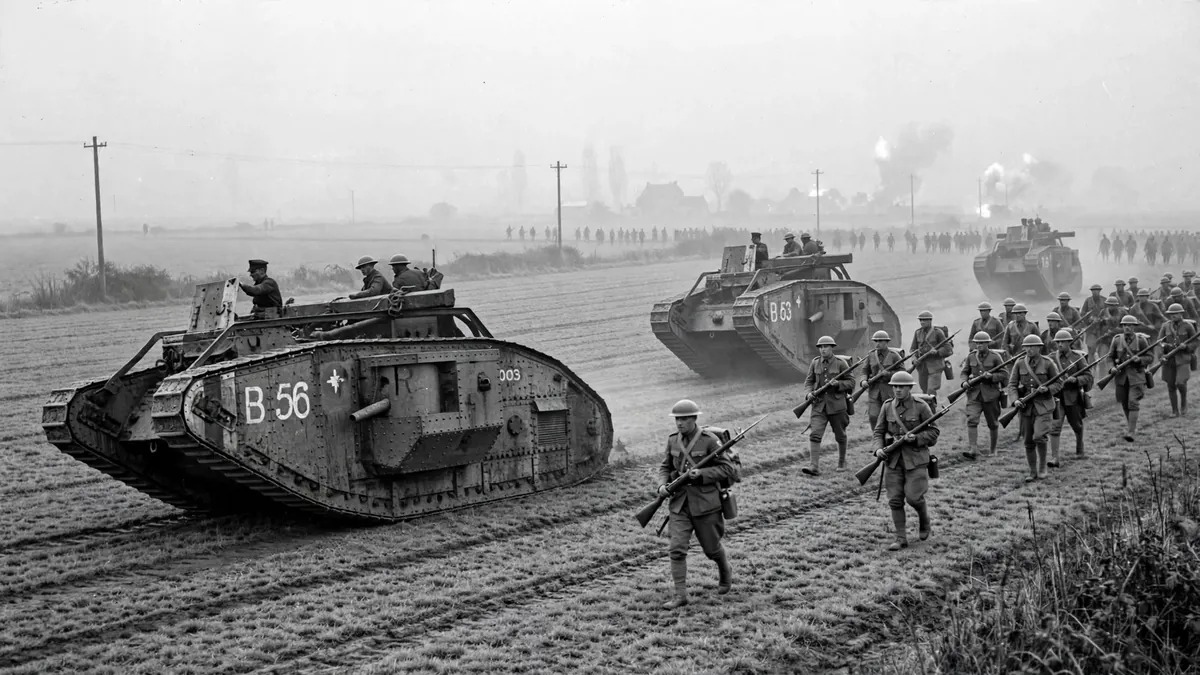
Amiens 1918 was the opening battle of the Hundred Days Offensive, the Allied campaign that ended the First World War. On 8 August 1918, the British Fourth Army under General Henry Rawlinson, with the Canadian Corps, the Australian Corps and the French First Army, attacked the German Second Army east of Amiens in northern France.
The attack was a model of the new Allied way of war: more than 500 tanks, nearly 2,000 guns firing a short hurricane bombardment, and hundreds of aircraft working with the infantry. On the first day the Allies advanced 11 kilometres (7 miles) — a distance that had taken months to win on the Somme two years before — and took about 16,000 prisoners.
The German commander, General Erich Ludendorff, called 8 August “the black day of the German Army”. The battle lasted until 11 August, by which time the Allies had advanced up to 19 kilometres and the German front in the west had begun to break.
2. Key Facts
| Date | 8–11 August 1918 |
| Location | East of Amiens, Picardy, northern France |
| Result | Decisive Allied victory; opening of the Hundred Days Offensive |
| Allied commanders | Gen. Henry Rawlinson (British Fourth Army); Lt. Gen. Arthur Currie (Canadian Corps); Lt. Gen. John Monash (Australian Corps); Gen. Marie-Eugène Debeney (French First Army) |
| German commander | Gen. Georg von der Marwitz (Second Army); Gen. Erich Ludendorff (Quartermaster General) |
| Allied strength | About 340,000 men; 1,900+ guns; 500+ tanks; 800+ aircraft |
| German strength | About 180,000–200,000 men of the Second Army, in six divisions on the front |
| Allied losses | About 22,000 killed, wounded and missing (estimates vary) |
| German losses | About 30,000, including about 17,000–27,000 prisoners (estimates vary) |
3. Background
The spring of 1918
In the spring of 1918 Germany had come closer to winning the war than at any time since 1914. In five great offensives between March and July — the Kaiserschlacht, or Kaiser’s Battle — the German Army drove the British and French back across the old Somme battlefield and to within 60 kilometres of Paris.
The offensives used new infiltration tactics, stormtroopers who bypassed strongpoints and struck deep into the Allied rear, and they gained more ground in weeks than either side had gained in years of trench warfare. But the offensives had cost Germany heavily: about a million casualties, including its best troops, and its army was now stretched along a longer front, short of men, horses and supplies, and facing an enemy that was growing stronger every week.
The United States, which had entered the war in 1917, was landing about 250,000 fresh troops a month in France.
The Allied counter-offensive
By July 1918 the German offensives had run out of strength. At the Second Battle of the Marne, fought from 15 July to 6 August, the French and Americans stopped the last German attack and counter-attacked, driving the Germans back across the Marne.
The Allied supreme commander, Marshal Ferdinand Foch, now had the initiative, and he planned a series of offensives along the whole Western Front: the British would attack at Amiens, the French in the centre, and the Americans at Saint-Mihiel and in the Meuse-Argonne.
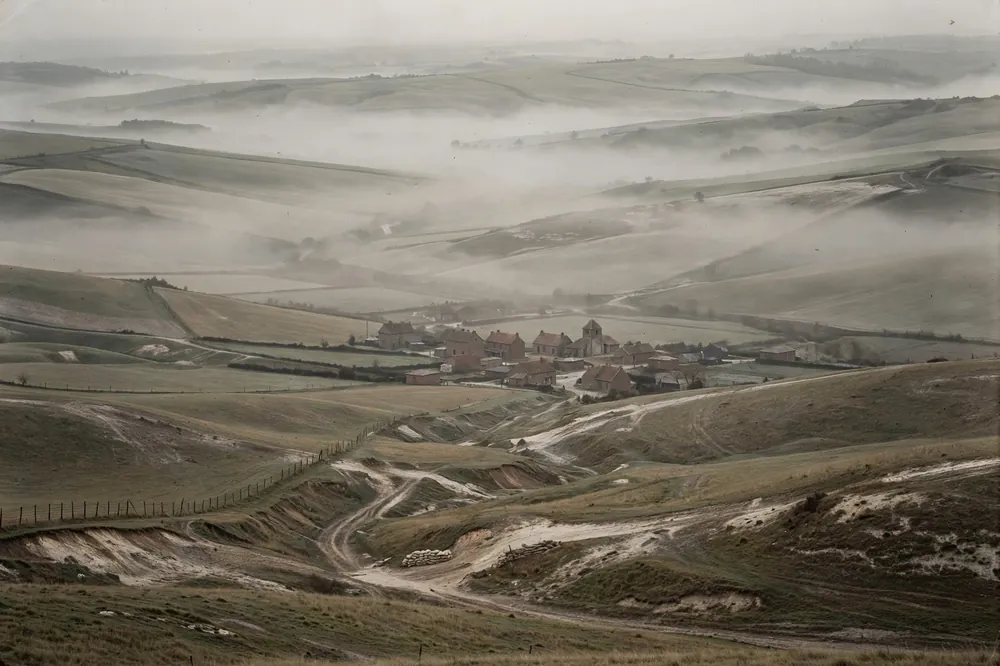
Amiens was chosen because the ground there — the open, rolling chalk plain of Picardy — was ideal for tanks, because the German defences there were thin after the spring offensives, and because a success at Amiens would free the Amiens–Paris railway, which German guns had threatened all summer.
Secrecy and the plan
Secrecy was the key to the battle. The Allies went to extraordinary lengths to hide the attack: the Canadian Corps, the shock troops of the British Army, was moved openly towards Flanders in the north, while its men were in fact moved secretly to Amiens by night; dummy tanks and wireless traffic were used to suggest an attack elsewhere; and the troops were forbidden to talk about the operation.
The attack itself was planned by the Fourth Army’s staff under Rawlinson, with the Australian Corps commander, Lieutenant General John Monash, playing a leading part. The plan was a model of combined arms: the infantry would advance behind a creeping artillery barrage, the tanks would crush the German wire and machine-gun posts, the cavalry would exploit the breakthrough, and the aircraft — more than 800 of them — would attack German headquarters, railways and reserves, and drop supplies to the advancing troops.
There would be no long preliminary bombardment to warn the Germans; instead, the guns would open fire at the moment of attack.
4. Opposing Forces
The Allied attack was made by the British Fourth Army, about 340,000 men in total, with the French First Army on its right. The striking force was the Canadian Corps, under Lieutenant General Arthur Currie, and the Australian Corps, under Lieutenant General John Monash — the two Dominion corps that had become the shock troops of the British Army, known for their careful planning and their habit of taking objectives on time.
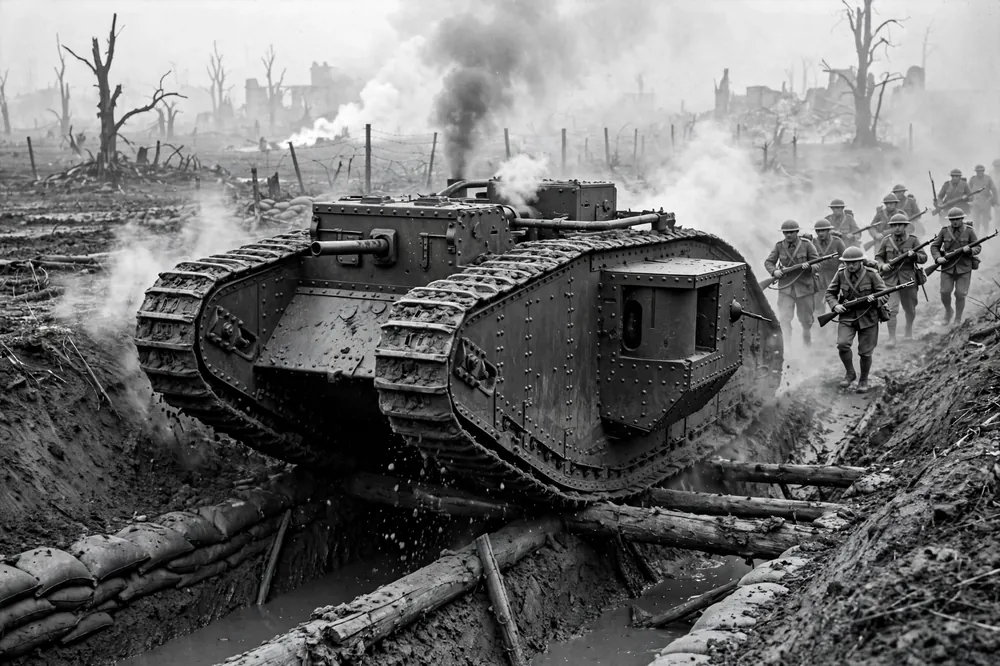
Behind them stood the British III Corps, and the whole attack was supported by the Tank Corps, with more than 500 tanks, including the new, faster Whippet tanks, and by the Royal Air Force, with over 800 aircraft. The artillery numbered more than 1,900 guns, and it fired a short, intense bombardment — only about four minutes of fire before the infantry went in — so that the Germans would have no warning.
| Allies | Germany | |
|---|---|---|
| Infantry | Canadian Corps (4 divisions); Australian Corps (5 divisions); British III Corps; French First Army (3 divisions) | Second Army: 6 divisions on the front, with reserves behind |
| Tanks | 500+ Mark V and Whippet tanks; 72 Whippets for exploitation | Almost no tanks; a few captured British tanks |
| Artillery | 1,900+ guns, firing a short hurricane bombardment | About 500 guns, many captured in the spring offensives |
| Aircraft | 800+ RAF aircraft; close support and supply drops | About 350 aircraft, outnumbered and outmatched |
| Cavalry | 3 cavalry divisions for exploitation | Little cavalry; reserves moved on foot |
The German defence was the Second Army under General Georg von der Marwitz, holding a front about 25 kilometres wide east of Amiens. Its divisions were tired, understrength and thinly spread after the spring offensives, and their defences were shallow: a forward zone of outposts, a main line of trenches, and almost no defences in depth.
The German Army in August 1918 was a different army from the one that had attacked in March. Its best men were dead, its replacements were young and poorly trained, and its morale was sinking — the German High Command knew that its soldiers were deserting and surrendering in growing numbers.
Ludendorff, the effective commander of the German Army, had gambled everything on the spring offensives, and when they failed he had no plan for what came next.
5. The Battle
8 August: the black day
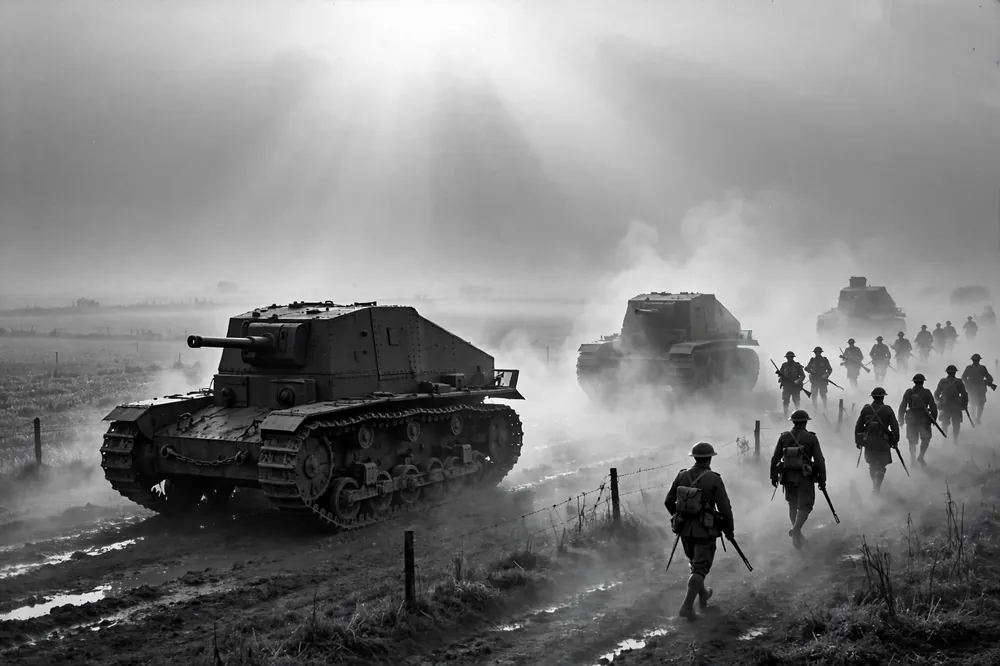
The attack began at 04:20 on 8 August 1918, in thick fog. The guns opened fire without warning, the tanks moved forward, and the infantry followed close behind the creeping barrage. The fog, which the Allies had counted on, hid the attack from the German guns and allowed the tanks to get among the German positions before the defenders could react.
On the Canadian and Australian front, the German forward defences collapsed within hours. By midday the Allies had advanced 11 kilometres, and by nightfall they had taken about 16,000 prisoners and 450 guns. The German front had been broken open, and the cavalry and the Whippet tanks pushed on through the gap, reaching the old Somme battlefield of 1916.
It was the largest single-day advance by the British Army in the whole war, and the first time the German Army had been driven back so far in a single day.
9–11 August: the advance slows
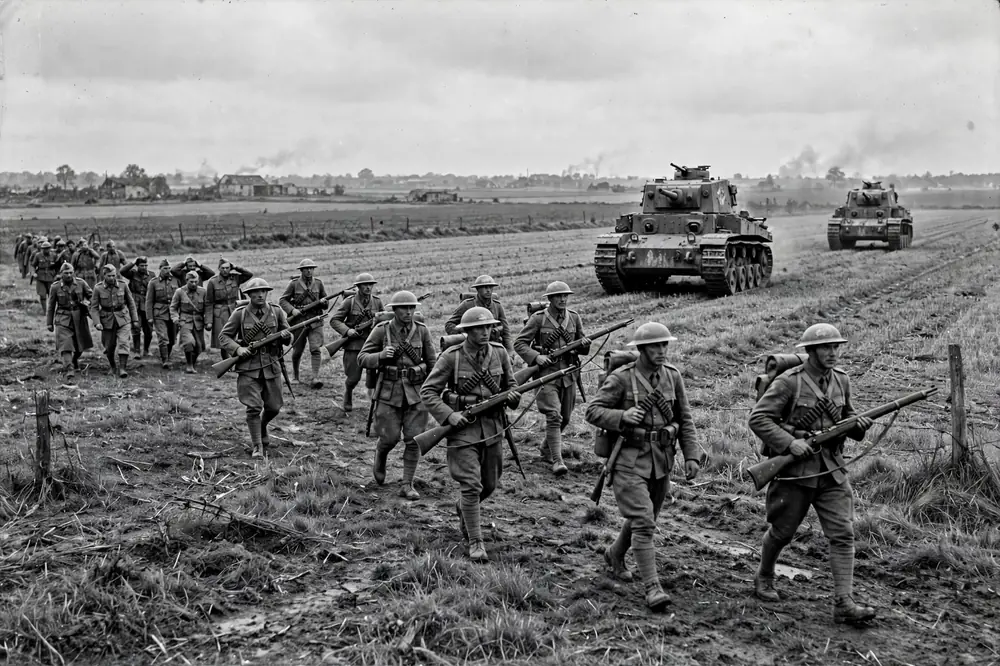
On 9 August the attack continued, but the advance slowed. The fog had lifted, the German reserves were arriving, and the tanks — many of which had broken down or run out of fuel — were fewer. The infantry was tired, the artillery was struggling to move forward over the broken ground, and the supply lines were stretched.
The Allies advanced another few kilometres, but the breakthrough was narrowing, and the Germans were bringing up fresh divisions and digging in on new positions along the old Hindenburg Line. On 10 and 11 August the fighting grew harder and the gains smaller.
Foch and the British commander-in-chief, Field Marshal Douglas Haig, considered continuing the attack, but Rawlinson argued that the battle had achieved its purpose and that to push on would only waste men against prepared defences. On 11 August the attack was called off. The Allies had advanced up to 19 kilometres and taken about 27,000 prisoners and more than 500 guns in four days.
The air battle
The air battle over Amiens was one of the largest of the war, and it showed how far air power had come since 1914. The Royal Air Force flew more than 800 aircraft, and its bombers attacked German headquarters, railway junctions and troop columns behind the front, while its fighters fought the German Air Service for control of the sky.
The RAF also flew a new kind of mission: dropping ammunition, food and water to the advancing infantry by parachute, and using aircraft to carry messages when the telephone lines were cut. The German Air Service, with about 350 aircraft, fought hard but was outnumbered, and it lost heavily.
The most famous air action of the battle was the work of the Australian Flying Corps, whose aircraft attacked German transport columns on the roads behind the front and helped to turn the German retreat into a rout.
6. Turning Point
The collapse of German morale
The turning point of Amiens was not a place or an hour but a change in the German Army’s spirit. On 8 August, whole German units surrendered without fighting, and others broke and ran — something that had not happened on this scale before in the war.
Ludendorff, in his memoirs, wrote that 8 August was “the black day of the German Army in the history of this war”, and he meant it literally: it was the day the German Army’s will to fight began to break. The German High Command had always believed that its army, however outnumbered, would hold its ground, and Amiens showed that it would not.
The surrender of so many men, and the loss of so many guns, told the German generals that their army was no longer the army of 1914, and that the war could not be won. Within weeks, Ludendorff was pressing the German government to seek an armistice.
Why the attack stopped
The second turning point was the decision to stop. On 11 August, Rawlinson called off the attack, and Haig agreed — a decision that has been debated ever since. Some historians argue that the Allies should have pressed on, and that a continued attack might have broken the German Army completely.
Others argue that Rawlinson was right: the tanks were worn out, the infantry was exhausted, the artillery could not keep up, and a continued attack would have run into the same kind of prepared defences that had stopped every offensive of the war. What is certain is that the decision to stop did not end the offensive.
Foch’s plan was not for one great battle but for a series of attacks, each one stopping before it exhausted itself, and each one followed by a fresh attack somewhere else. Amiens was the first of those attacks, and the Hundred Days Offensive that followed — at Bapaume, at the Hindenburg Line, at Cambrai — never gave the Germans time to recover.
7. Casualties and Losses
Casualty figures for Amiens are estimates, and sources differ. Allied losses for the four days are generally put at about 22,000 killed, wounded and missing, including about 9,000 Canadians and about 6,000 Australians. German losses were heavier: about 30,000 in total, including about 17,000 to 27,000 prisoners, depending on the source, and the loss of more than 500 guns.
The German figures are the more important of the two, because they show what had changed: in the battles of 1916 and 1917, the Germans had rarely lost so many men as prisoners, and the loss of so many guns — the backbone of their defence — could not be replaced. The battle also cost the Germans heavily in morale, which no casualty table can measure.
| Allies | Germany | |
|---|---|---|
| Killed | About 5,000–6,000 (estimate) | About 6,000–8,000 (estimate) |
| Wounded and missing | About 16,000 (estimate) | About 20,000+ (estimate) |
| Prisoners | Small numbers | About 17,000–27,000 |
| Total | About 22,000 | About 30,000 |
| Guns lost | Few | More than 500 |
The Canadian and Australian losses, though heavy, were lighter than in the great battles of 1916 and 1917, and they were bought at a price the Allies could afford: the advance of 19 kilometres in four days, the capture of a great haul of prisoners and guns, and the breaking of the German Army’s morale. The German losses, by contrast, were losses the German Army could not afford. Its divisions were already understrength, its reserves were exhausted, and its soldiers were deserting in growing numbers. Amiens was not the bloodiest battle of the war — the Somme and Passchendaele had cost far more — but it was the battle in which the German Army began to fall apart.
8. Map and Geography
The Picardy plain
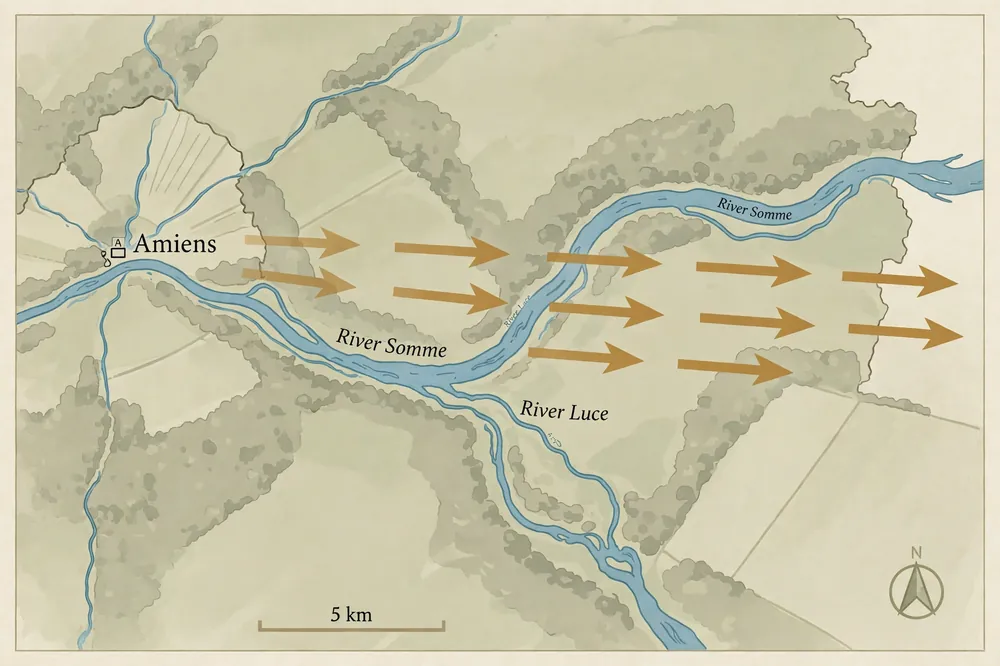
Amiens lies on the River Somme in Picardy, about 120 kilometres north of Paris, on the edge of the great chalk plain of northern France. The ground east of the city is open, rolling and almost treeless, cut by shallow valleys and by the small River Luce, which ran across the line of the attack.
The chalk soil drained well, so the ground was firm even in wet weather, and the open country gave tanks room to move — a sharp contrast to the mud of Flanders, where tanks had bogged down in 1917. The villages of the plain — Villers-Bretonneux, Hangard, Marcelcave, Rosieres — were small and built of brick, and they became the strongpoints of the German defence.
The railway from Amiens to Paris ran through the plain, and its security was one of the reasons the Allies chose to attack here.
The old Somme battlefield
The attack of 8 August crossed the ground of the Battle of the Somme of 1916, and the men who advanced that day walked through a landscape that was still scarred by the earlier battle: shell holes, ruined villages, abandoned trenches and cemeteries. The old battlefield mattered for the attack in two ways.
First, the Germans had not had time to build deep defences on it, because they had only recaptured the ground in the spring of 1918, and their positions were shallow. Second, the broken ground of the old battlefield slowed the artillery and the supply wagons, and it was one of the reasons the advance ran out of momentum after the first day.
The battle was, in this sense, fought on the ruins of an earlier battle, and its success was measured against the failure of 1916: in one day, the Allies advanced further than the British Army had advanced in four months on the Somme.
9. Outcome and Legacy of Amiens 1918
The Hundred Days
Amiens was the first battle of the Hundred Days Offensive, the campaign that ended the war. After Amiens, Foch launched attack after attack along the front: the British broke the Hindenburg Line at the end of September, the Americans fought in the Meuse-Argonne, and the French pushed forward in Champagne.
The German Army, which had held its ground for four years, was driven back steadily, and on 11 November 1918 Germany signed the armistice. Amiens did not win the war by itself — the war was won by the cumulative pressure of the Hundred Days, by the Allied blockade, and by the arrival of American troops — but it was the battle that showed the war could be won, and it was the battle that broke the German Army’s will to fight.
Ludendorff himself said so: 8 August was the day the German Army began to lose the war.
A new way of war
Amiens is also remembered as the battle that showed what modern war would look like. The combination of tanks, aircraft, artillery and infantry, the use of secrecy and surprise, the short bombardment and the exploitation by mobile forces — all of these became the standard practice of the armies of the Second World War, and the British and German staffs studied Amiens carefully in the years that followed.
The battle is studied in military schools today not because it was the largest battle of the war, but because it was the first battle in which the Allies fought the way they would fight for the rest of the century: with all arms together, in a single plan, against an enemy that could not respond in kind.
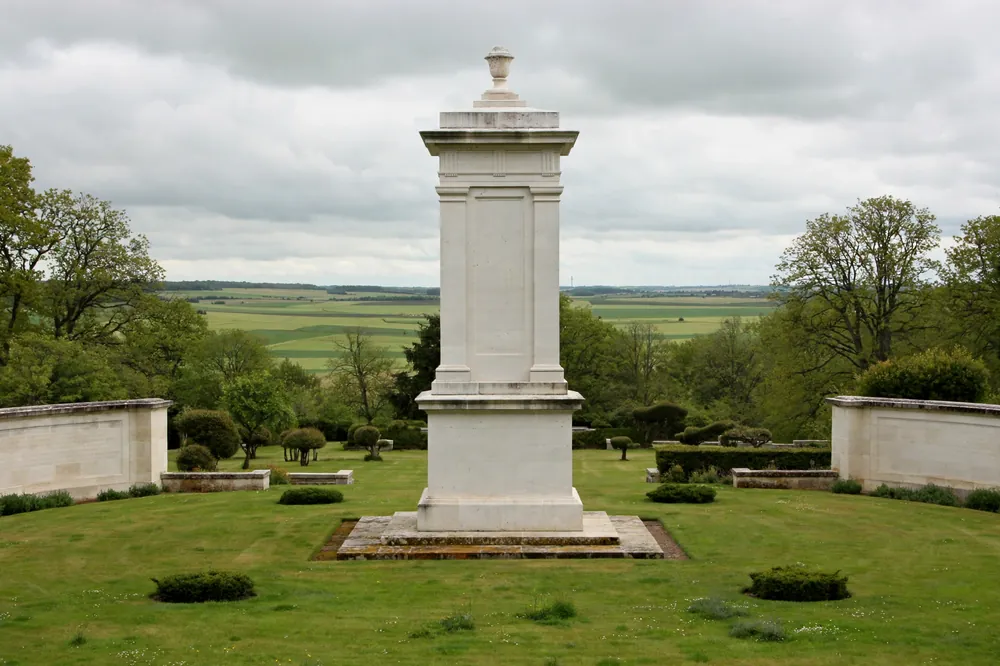
The memorials at Villers-Bretonneux, where the Australian National Memorial stands, and at the Canadian memorial at Vimy, remember the Dominion troops who fought at Amiens, and every 8 August, veterans and their families gather there to mark the day.
10. Commanders
General Henry Rawlinson (Britain). Commander of the British Fourth Army at Amiens. Rawlinson, who had commanded the Fourth Army on the Somme in 1916, planned the Amiens attack with his staff and argued for stopping it on 11 August, when the advance had run out of momentum. He later commanded the Fourth Army through the Hundred Days and was raised to the peerage as Lord Rawlinson.
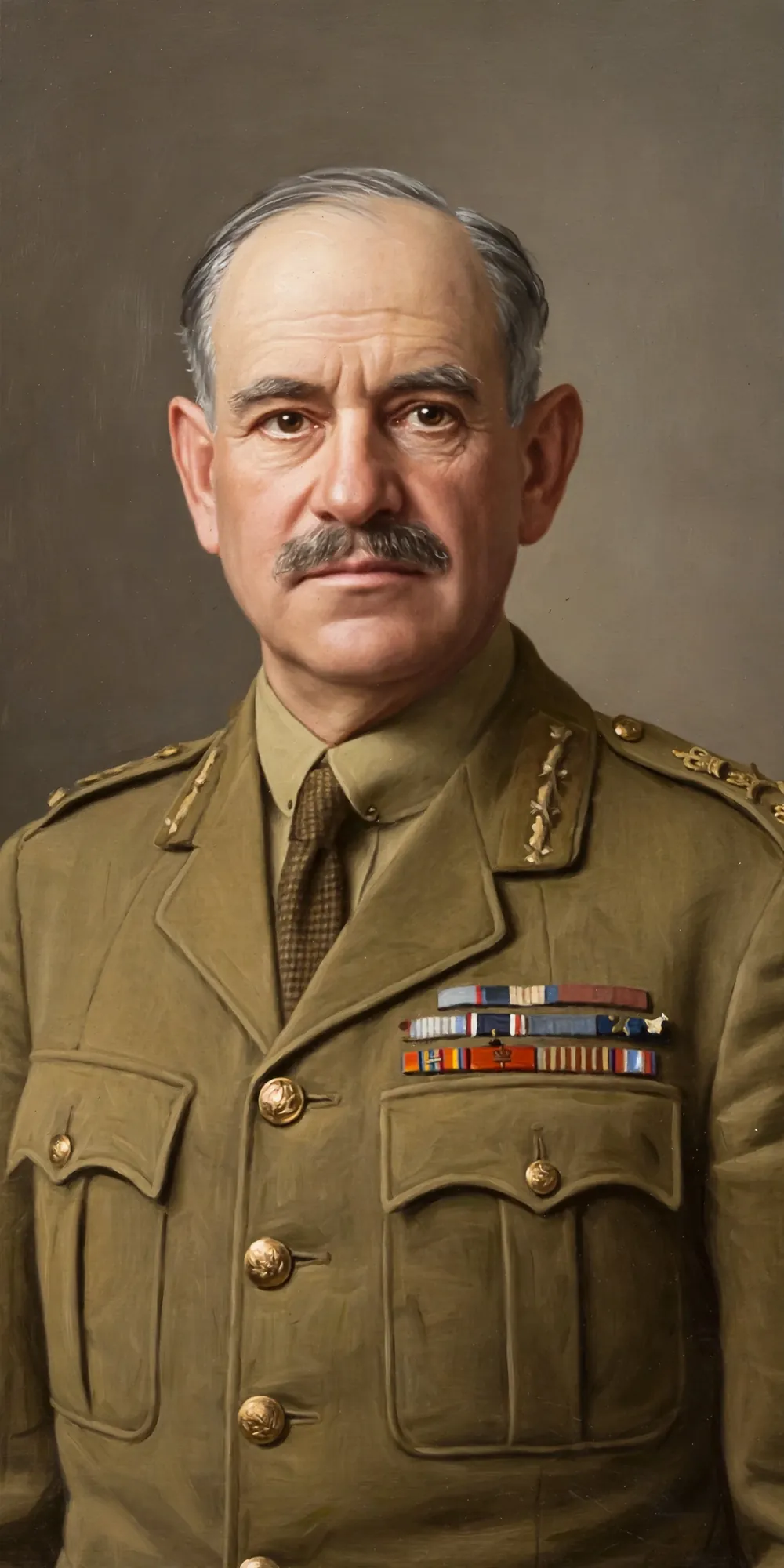
Lieutenant General Arthur Currie (Canada). Commander of the Canadian Corps, the finest corps in the British Army. Currie, a former schoolteacher and militia officer, had built the Canadian Corps into a formidable fighting force, and his corps took its objectives on time on 8 August. He later commanded the Canadian Corps through the Hundred Days and became the first Canadian to command a field army in the field.
Lieutenant General John Monash (Australia). Commander of the Australian Corps and one of the leading planners of the battle. Monash, a civil engineer in civilian life, was famous for his meticulous planning — his orders for Amiens ran to more than a hundred pages — and his corps advanced 11 kilometres on the first day. He later commanded the Australian Corps through the Hundred Days and was knighted in the field by King George V.
General Erich Ludendorff (Germany). Quartermaster General of the German Army and its effective commander. Ludendorff planned the spring offensives of 1918 and, when they failed, had no answer to the Allied counter-offensive. He called 8 August “the black day of the German Army”, and within weeks he was pressing for an armistice. He resigned in October 1918.
General Georg von der Marwitz (Germany). Commander of the German Second Army at Amiens. Marwitz, a cavalry officer, had commanded the Second Army since 1917 and was responsible for the defence east of Amiens. His army was broken on 8 August, and he was relieved of command soon afterwards.
Marshal Ferdinand Foch (France). Supreme Allied Commander, who planned the series of offensives of which Amiens was the first. Foch, a French general who had commanded at the Marne in 1914, coordinated the British, French and American attacks of the Hundred Days and was made a Marshal of France after the war.
11. Frequently Asked Questions
Why is 8 August 1918 called the black day of the German Army?
Because General Erich Ludendorff, the German Army’s effective commander, called it that in his memoirs. On that day the Allies advanced 11 kilometres, took about 16,000 prisoners and 450 guns, and whole German units surrendered — the first time the German Army had broken on this scale in the war. The phrase stuck because it captured a collapse that no German commander had expected: whole units surrendered, guns were abandoned, and the front that had held for years broke in a single day. Ludendorff’s words became the shorthand for that shock, and they are still quoted whenever the battle is described.
How far did the Allies advance at Amiens?
About 11 kilometres on the first day, and up to 19 kilometres by the time the battle ended on 11 August. The first day’s advance was the largest single-day advance by the British Army in the whole war. The distance mattered because it was won in hours, not months: on the Somme two years earlier, the same ground had cost months of fighting and tens of thousands of casualties. The first day’s advance showed what the new combination of tanks, artillery and aircraft could do, and it broke the stalemate that had defined the Western Front since 1914.
What was the role of tanks at Amiens?
More than 500 tanks took part, the largest tank force yet assembled. They crushed the German wire and machine-gun posts, led the infantry forward, and — in the case of the fast Whippet tanks — exploited the breakthrough. Many tanks broke down or ran out of fuel, which was one reason the advance slowed after the first day. The tanks mattered most on the first morning, when they crossed ground that infantry alone could not have crossed under fire. After that, breakdowns and empty fuel tanks did as much to slow the attack as the Germans did, which is why the advance lost momentum after the first day.
Who were the Canadian and Australian Corps?
The two Dominion corps of the British Army, made up of volunteers from Canada and Australia. By 1918 they had become the shock troops of the British Army, known for careful planning and for taking objectives on time. At Amiens they formed the striking force of the Fourth Army. Their reputation came from hard experience: by 1918 the Canadians and Australians had fought in the war’s worst battles, and they had learned to plan attacks in detail and to rehearse them before the day. At Amiens that preparation showed, because their divisions took their objectives on time while the attack was still moving fast.
Why did the Allies stop the attack on 11 August?
Because the advance had run out of momentum: the tanks were worn out, the infantry was exhausted, the artillery could not keep up, and the Germans were bringing up fresh divisions. Rawlinson argued that to push on would waste men against prepared defences, and Foch’s plan was for a series of attacks, not one great battle. The decision showed how the new way of war worked: Foch and Rawlinson preferred a series of fresh attacks at different places to one great battle fought until it bled itself dry. Stopping at Amiens kept the army strong for the next attack, and the Hundred Days Offensive was a succession of such blows.
Did Amiens end the First World War?
Not by itself. Amiens opened the Hundred Days Offensive, the campaign that ended the war, but the war was won by the cumulative pressure of those attacks, by the Allied blockade and by the arrival of American troops. Germany signed the armistice on 11 November 1918, three months after Amiens. Amiens mattered because it broke the pattern of the war: for the first time, the Allies attacked, advanced and kept advancing, and the German Army never recovered its balance. The three months that followed were a steady Allied advance, and by November the German government, facing defeat in the field and collapse at home, asked for an armistice.
12. Sources
- Wikipedia, “Battle of Amiens (1918)” — dates, strength, casualties and the course of the battle.
- Encyclopædia Britannica, “Battle of Amiens” — background and Ludendorff’s “black day”.
- J. P. Harris, Amiens to the Armistice: The BEF in the Hundred Days’ Campaign, 8 August–11 November 1918 (Brassey’s, 1998) — the Hundred Days and the British Army.
- Tim Cook, Shock Troops: Canadians Fighting the Great War 1917–1918 (Viking, 2008) — the Canadian Corps at Amiens.
- Peter Pedersen, Monash as Military Commander (Oxford University Press, 1985) — Monash and the Australian Corps.
- Erich Ludendorff, My War Memories 1914–1918 (Hutchinson, 1919) — Ludendorff’s account and the “black day”.
- James McWilliams and R. James Steel, Amiens: Dawn of Victory (Dundurn, 2001).
- Gregory Blaxland, Amiens 1918 (Frederick Muller, 1968).