 WAR ATLAS MILITARY HISTORY MAGAZINE · WWI — WWII
Neuve Chapelle
1. Lead
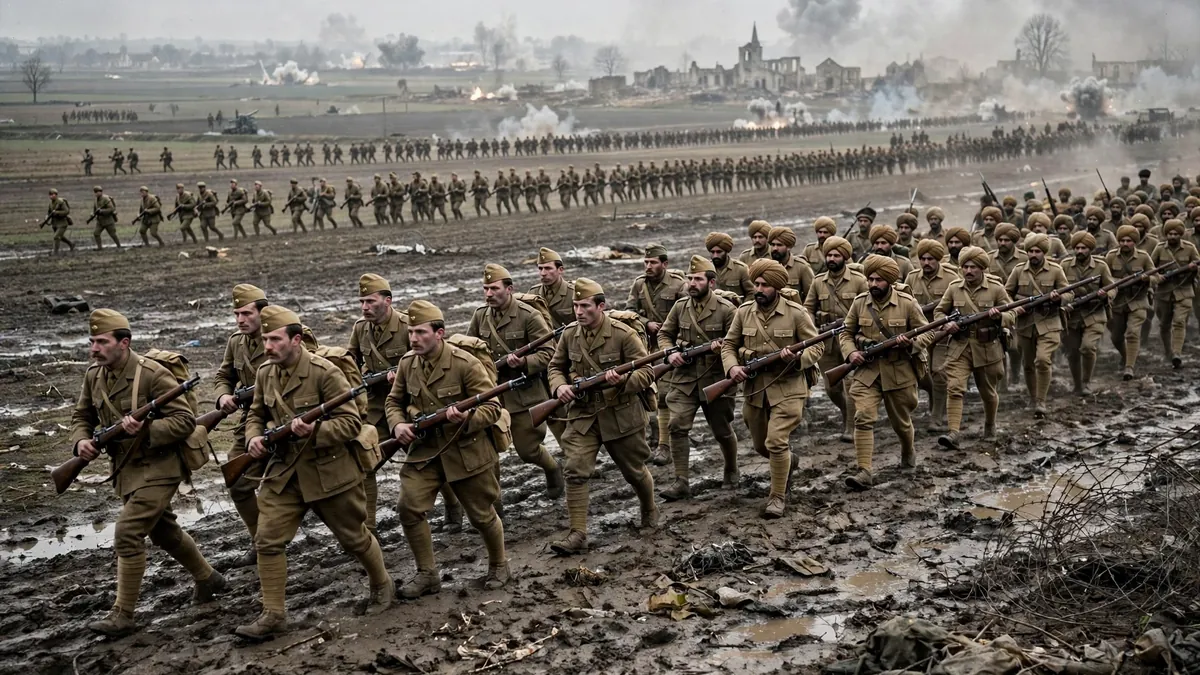
Neuve Chapelle was the first major British offensive of the First World War, fought from 10 to 13 March 1915 in the Artois region of northern France. The British First Army, under General Douglas Haig, attacked the German Sixth Army with a short, intense artillery bombardment — 342 guns firing on a front of only 3 kilometres — and took the village of Neuve Chapelle in a few hours.
It was the first time the British Army had attacked on the Western Front with a planned artillery programme, and the first time Indian troops had fought in a major battle in Europe. The success, however, could not be exploited: the artillery ran out of shells, the communications broke down, and the German reserves arrived in time to stop the advance.
The battle ended after four days, with the British holding the village and a small salient, at a cost of about 11,200 British and Indian casualties and about 10,000 German casualties. Neuve Chapelle taught the British Army the lesson that would dominate the war: that a breakthrough without enough shells, and without the means to exploit it, was no breakthrough at all.
2. Key Facts
| Date | 10–13 March 1915 |
| Location | Neuve Chapelle, Artois, northern France, near La Bassée |
| Result | Limited British victory; village captured, advance halted |
| British commander | Gen. Douglas Haig (First Army); Gen. Henry Horne (IV Corps); Gen. James Willcocks (Indian Corps) |
| German commander | Crown Prince Rupprecht of Bavaria (Sixth Army) |
| British strength | About 40,000 men (IV Corps and Indian Corps); 342 guns |
| German strength | About 30,000–35,000 men of the Sixth Army on the front, with reserves |
| British losses | About 11,200 killed, wounded and missing (estimates vary) |
| German losses | About 10,000 killed, wounded and missing (estimates vary) |
3. Background
The winter of 1914–1915
By the winter of 1914–1915, the war on the Western Front had settled into trench warfare. The British Expeditionary Force, which had fought at Mons and the Marne and Ypres in 1914, was holding a line in Flanders and Artois, alongside the French, against the German Army.
The British commander-in-chief, Field Marshal John French, was under pressure from London to attack: the French were planning an offensive in Artois, and the British were asked to support it by attacking at Neuve Chapelle, a village on the road from La Bassée to Lille.
The attack was also intended to relieve the pressure on the Russians, who were being attacked in the east, and to show that the British Army, which was growing with the New Armies of volunteers, could take the offensive.
The plan
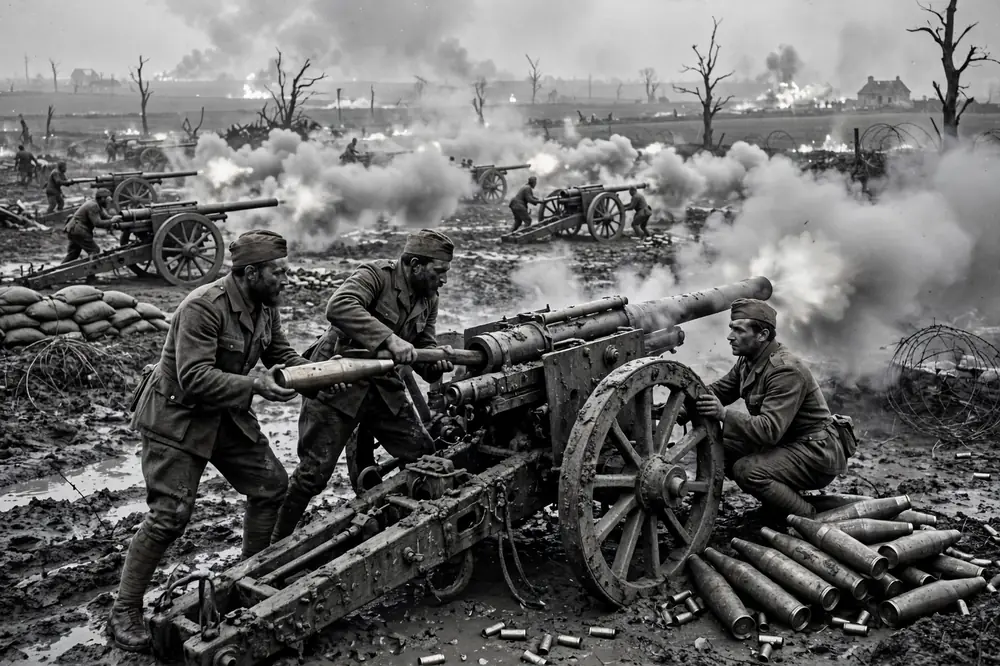
The plan was drawn up by General Douglas Haig, commander of the First Army, and it was a new kind of plan for the British Army. Instead of a long preliminary bombardment, which would warn the Germans and destroy the ground, Haig planned a short, intense bombardment — 35 minutes — by 342 guns, concentrated on a front of only 3 kilometres, followed by an infantry attack in waves.
The attack would be made by IV Corps, under Lieutenant General Henry Horne, and the Indian Corps, under Lieutenant General James Willcocks, and it would be supported by the Royal Flying Corps, which would observe the artillery fire and bomb the German communications.
The objective was the village of Neuve Chapelle, and then the Aubers Ridge, a low ridge beyond the village from which the Germans could be seen for miles. Haig believed that if the village could be taken quickly, the ridge could be taken too, and the German front in Artois would be broken.
The Indian Corps
The Indian Corps was one of the most remarkable features of the battle. Indian troops — the Garhwal Rifles, the Gurkhas, the Sikhs and others — had been fighting on the Western Front since the autumn of 1914, and Neuve Chapelle was their first major battle in Europe.
The Indian soldiers, many of whom had never seen snow before, fought in the cold and mud of Flanders with a courage that impressed the British, and their officers, British and Indian, led them with a skill that belied the prejudice of the time.
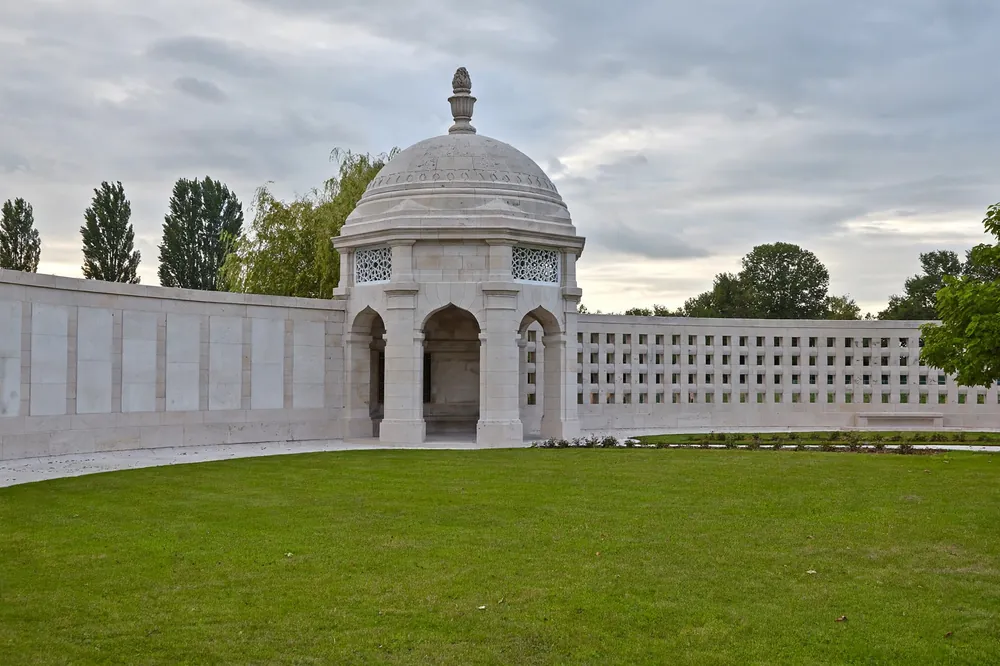
The battle is remembered in India as one of the great moments of the Indian Army’s history, and the Indian Memorial at Neuve Chapelle, built after the war, stands as a reminder of the 4,700 Indian soldiers who died in France and have no known grave.
4. Opposing Forces
The British attacking force numbered about 40,000 men, in two corps: IV Corps, under Lieutenant General Henry Horne, with the 7th and 8th Divisions, and the Indian Corps, under Lieutenant General James Willcocks, with the Lahore and Meerut Divisions. The force was supported by 342 guns, including 40 heavy guns, and by the Royal Flying Corps, with about 30 aircraft.
The artillery was the key to the plan: it was to destroy the German wire and trenches in 35 minutes, and then to support the infantry as it advanced. The British infantry was well trained and well led, but it was still a small army — the New Armies of volunteers were still training in England — and it had no reserves to exploit a breakthrough.
| Britain | Germany | |
|---|---|---|
| Infantry | IV Corps (7th, 8th Divisions); Indian Corps (Lahore, Meerut Divisions) | Sixth Army: VII Corps and XIX Corps on the front |
| Guns | 342 guns, including 40 heavy guns | About 200 guns on the front, with reserves behind |
| Aircraft | About 30 RFC aircraft; artillery observation and bombing | Few aircraft; German air service still small |
| Machine guns | Limited; each battalion had 2 machine guns | German battalions had 6 machine guns; strong defensive fire |
| Supply | Shells short: the bombardment used most of the available ammunition | Shells adequate; German supply lines short |
The German defence was the Sixth Army, under Crown Prince Rupprecht of Bavaria, holding a front in Artois that ran from La Bassée to Lille. Its divisions on the Neuve Chapelle front were the 7th and 14th Divisions, with reserves behind, and its defences were the standard German defences of 1915: a front line of trenches, a support line, and strongpoints in the villages, with machine guns sited to fire across the front.
The German Army of 1915 was a formidable defensive force: its soldiers were well trained, its machine guns were numerous, and its artillery was well supplied. Its weakness was that its defences were shallow — there was no defence in depth — and that its command was slow to react to a surprise attack.
5. The Battle
10 March: the village falls
The attack began at 07:30 on 10 March 1915, with a 35-minute bombardment by 342 guns. The bombardment was the most intense yet fired by the British Army, and it destroyed much of the German front line: the wire was cut, the trenches were smashed, and the German defenders were stunned.
The infantry went in at 08:05, in waves, and within two hours the village of Neuve Chapelle was in British hands. The Indian Corps, on the left, and IV Corps, on the right, advanced together, and by midday the British had taken the village and the ground beyond it.
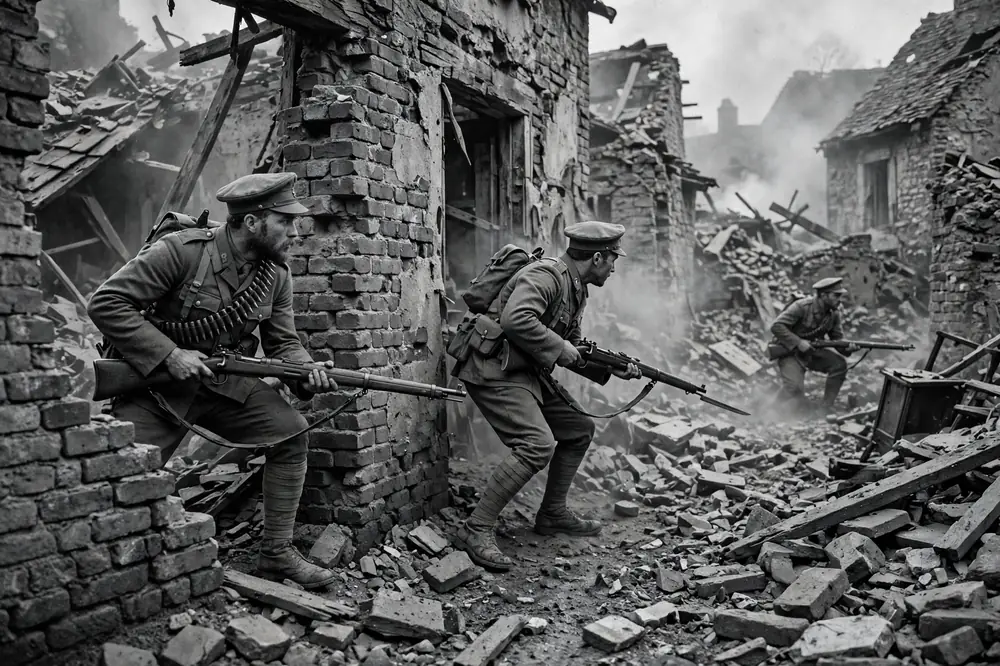
It was the most successful British attack of the war so far, and for a few hours it looked as if the breakthrough Haig had hoped for was within reach. The Garhwal Rifles, in particular, distinguished themselves, fighting through the village house by house, and their commander, Lieutenant Colonel H. F. H. B. de Lisle, was killed leading the attack.
11–12 March: the advance stalls
On 11 March, the attack was renewed, but it made little progress. The artillery had run out of shells — the 35-minute bombardment had used most of the available ammunition, and the guns could not be supplied fast enough — and the infantry, which had advanced beyond the range of its own guns, was stopped by German machine guns and by the arrival of German reserves.
The communications broke down: the telephone lines were cut by shellfire, and the runners who carried messages were killed, so that Haig and his corps commanders did not know what was happening at the front. The Germans, who had been surprised on 10 March, recovered quickly: Crown Prince Rupprecht brought up fresh divisions, and the German artillery, which had not been destroyed, began to fire on the British positions.
On 12 March, the British attacked again, but the attack was called off after heavy losses, and the battle settled into a stalemate.
13 March: the end
On 13 March, the battle ended. Haig, who had hoped to take the Aubers Ridge, called off the attack, and the British dug in on the ground they had taken — the village of Neuve Chapelle and a small salient around it.
The Germans, who had lost the village, counter-attacked, but they could not retake it, and the front settled into the trench line that would remain, with small changes, for the rest of the war. The battle had lasted four days, and it had cost the British about 11,200 casualties and the Germans about 10,000. The village itself was destroyed, and it would not be rebuilt until after the war.
Neuve Chapelle was, in the words of one British officer, “a victory that led nowhere”.
6. Turning Point
The shell shortage
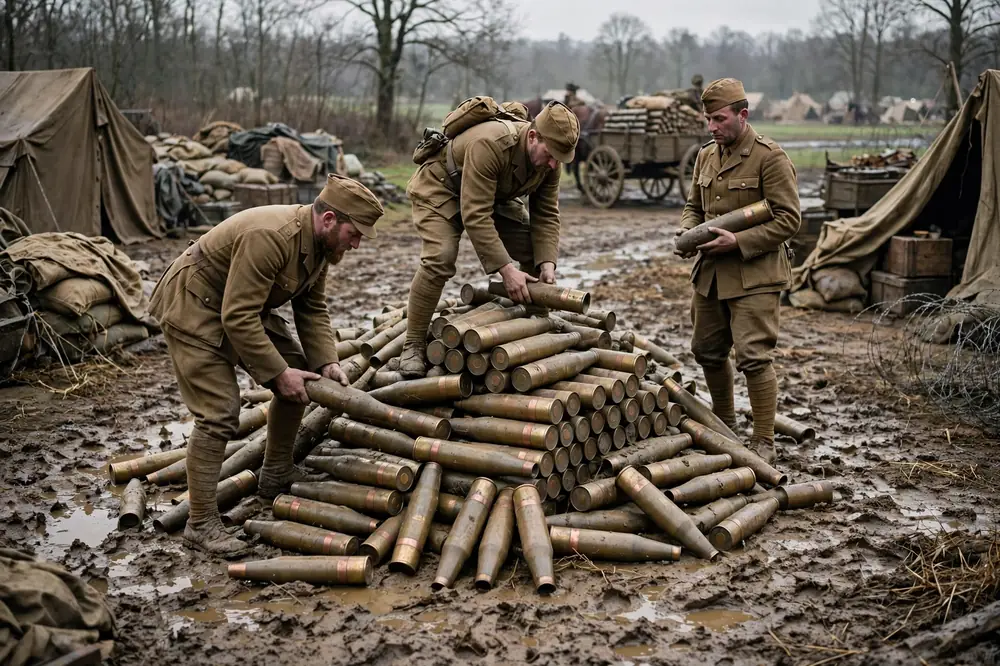
The turning point of Neuve Chapelle was the shortage of shells. The British Army of 1915 had not enough guns, and not enough shells, to fight the war it was trying to fight. The 35-minute bombardment on 10 March used most of the shells available to the First Army, and when the infantry needed artillery support on 11 March, the guns were silent.
The shortage was not an accident: it was the product of a British munitions industry that had not yet been mobilised for war, and of a government that had not understood the scale of the war it had entered. The battle exposed the shortage to the public, and it led to the “Shell Scandal” of 1915, in which the British press accused the government of failing to supply the army, and to the creation of the Ministry of Munitions under David Lloyd George.
The shell shortage was the turning point of the battle, and it was the turning point of the British war effort.
The failure to exploit
The second turning point was the failure to exploit the success of 10 March. The village was taken, but the Aubers Ridge, which was the real objective, was never taken, because the British had no reserves to send forward, and because the communications broke down.
The battle showed that a breakthrough was not enough: an army needed the means to exploit it — reserves, shells, and communications — and the British Army of 1915 had none of these. The lesson was learned, slowly and at great cost, in the battles that followed: at Loos in 1915, at the Somme in 1916, and at Passchendaele in 1917, the British Army would attack, break through, and fail to exploit, until, in 1918, it learned to do all three together.
Neuve Chapelle was the first lesson, and it was the cheapest of them.
7. Casualties and Losses
Casualty figures for Neuve Chapelle are estimates, and sources differ, but the figures are generally agreed to be about 11,200 British and Indian casualties and about 10,000 German casualties. The British losses included about 4,200 Indian casualties, a heavy price for the Indian Corps, and the German losses included about 1,700 prisoners. The losses were heavy for a battle that gained so little ground — a village and a few hundred metres of trenches — and they were heavy for a battle that lasted only four days. The battle is remembered, in part, because of the disproportion between its cost and its result: 11,000 men for a village that was destroyed in the fighting.
| Britain | Germany | |
|---|---|---|
| Killed | About 2,500–3,000 (estimate) | About 2,000–2,500 (estimate) |
| Wounded and missing | About 8,000–9,000 (estimate) | About 7,000–8,000 (estimate) |
| Prisoners | Small numbers | About 1,700 |
| Total | About 11,200 | About 10,000 |
| Indian losses | About 4,200 of the British total | — |
The Indian losses deserve a note of their own. The Indian Corps, which had fought in the cold and mud of Flanders since the autumn of 1914, lost about 4,200 men at Neuve Chapelle, including many of its best officers, and its divisions were so weakened that they were withdrawn from the Western Front later in 1915 and sent to Mesopotamia and Egypt.
The battle is remembered in India as a sacrifice, and the Indian Memorial at Neuve Chapelle, which records the names of 4,700 Indian soldiers who died in France and have no known grave, is visited by Indian families to this day. The German losses, though similar in number, were losses the German Army could afford: its divisions were larger, its reserves were closer, and its front was held.
8. Map and Geography
Artois and the Aubers Ridge
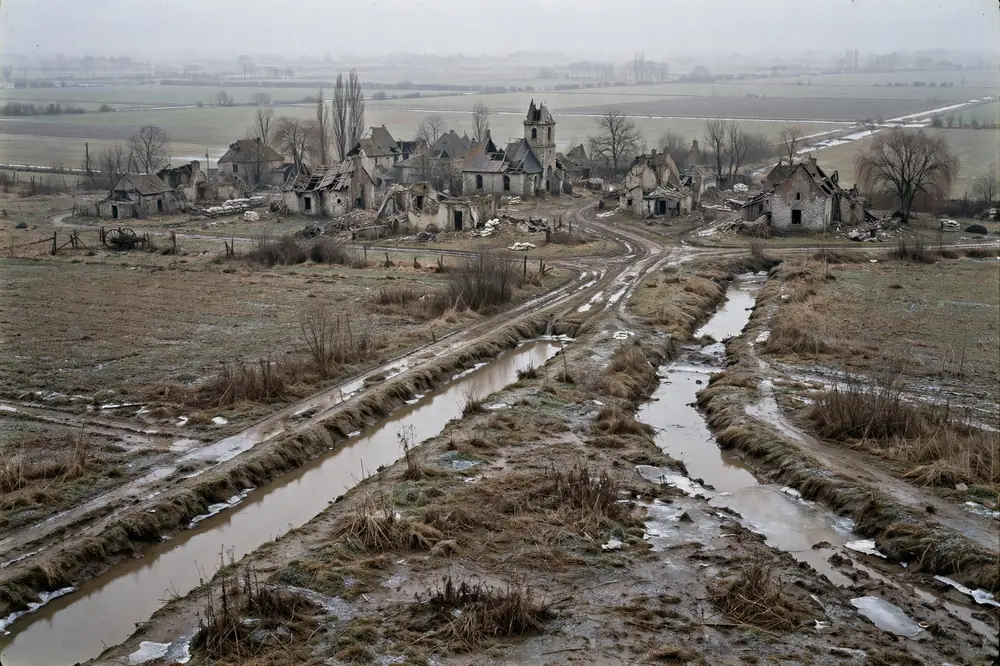
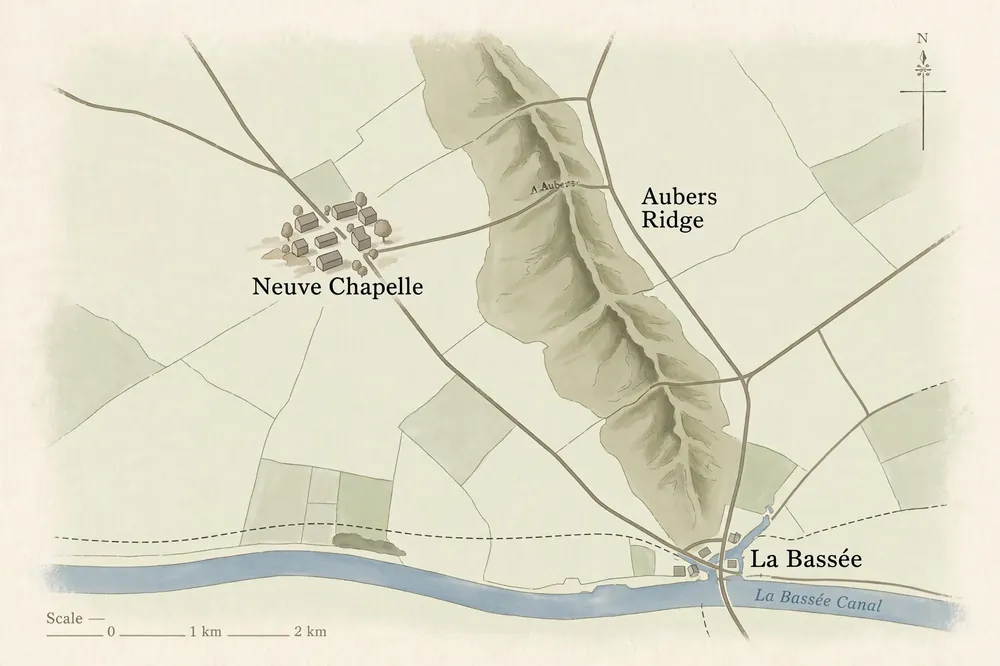
Neuve Chapelle lies in Artois, in northern France, about 25 kilometres south-west of Lille, on the flat, low-lying plain of Flanders. The ground is almost level, cut by drainage ditches and by the small rivers that flow towards the sea, and it is overlooked, to the east, by the Aubers Ridge, a low ridge about 20 metres high that runs from north to south.
The ridge was the key to the battle: from it, the Germans could see the British positions for miles, and from it, their artillery could fire on the British front. The village of Neuve Chapelle itself lay on the road from La Bassée to Lille, and it was a strongpoint in the German line, with its church and its houses turned into fortifications.
The flat ground, which made the attack possible, also made it difficult: there was no cover for the infantry, and the German machine guns, sited in the village and on the ridge, could fire across the whole front.
Mud and water
The ground at Neuve Chapelle was wet, and it stayed wet. The plain of Flanders is low and flat, and the water table is high, so that the trenches filled with water and the ground turned to mud in wet weather.
The battle was fought in March, when the ground was still wet from the winter, and the mud slowed the infantry, clogged the rifles, and made it difficult to move the guns. The mud also made the bombardment less effective: the shells sank into the soft ground and did not destroy the German wire, which had to be cut by hand.
The geography of Neuve Chapelle — flat, wet and overlooked by a ridge — explains both the success of the first day and the failure of the days that followed: the flat ground allowed the attack, the mud slowed it, and the ridge stopped it.
9. Outcome and Legacy of Neuve Chapelle
The Shell Scandal
The most important consequence of Neuve Chapelle was political, not military. The battle exposed the shortage of shells, and the British press, led by the Times, accused the government of failing to supply the army. The “Shell Scandal” of 1915 led to the fall of the Liberal government, the formation of a coalition under Herbert Asquith, and the creation of the Ministry of Munitions under David Lloyd George, which transformed the British war effort. The scandal also led to a vast expansion of the munitions industry, and by 1916 the British Army had the guns and shells it needed. Neuve Chapelle, a small battle in Artois, changed the way Britain fought the war.

The Indian Memorial
Neuve Chapelle is remembered, above all, in India. The Indian Memorial at Neuve Chapelle, designed by the architect Herbert Baker and unveiled in 1927, stands on the site of the battle, and it records the names of 4,700 Indian soldiers who died in France and have no known grave. The memorial is a place of pilgrimage for Indian families, and it is maintained by the Commonwealth War Graves Commission.
The battle is also remembered in the Indian Army, where the Garhwal Rifles and the other regiments that fought at Neuve Chapelle still celebrate the battle as a regimental honour. In Britain, the battle is remembered as the first great offensive of the war, and as the battle that taught the British Army that it needed more guns, more shells, and a better way of fighting.
The village of Neuve Chapelle was rebuilt after the war, and its church, which was destroyed in the battle, was rebuilt with money raised in India.
The battle in British memory
In Britain, Neuve Chapelle is remembered as the first great offensive of the war, and as the battle that exposed the shell shortage. The village was rebuilt after the war, and its church, which had been destroyed in the fighting, was rebuilt with money raised in India, a reminder of the Indian troops who had fought there.
The battle is studied in military schools as an example of artillery planning — the short, intense bombardment that took the village — and as an example of the failure to exploit a breakthrough, a lesson that the British Army would relearn, at great cost, on the Somme in 1916 and at Passchendaele in 1917.
The Garhwal Rifles, who had fought through the village house by house, still celebrate Neuve Chapelle as a regimental honour, and the Indian Memorial, which stands on the site of the battle, is visited by Indian families to this day. The battle was small, but its lessons were large, and they shaped the way the British Army fought for the rest of the war.
10. Commanders
General Douglas Haig (Britain). Commander of the First Army and the planner of the attack. Haig, a cavalry officer who had commanded I Corps in 1914, believed that the attack would break the German front and take the Aubers Ridge. When it failed, he blamed the shortage of shells. He later became commander-in-chief of the British Expeditionary Force and commanded it through the Somme and the Hundred Days.
Field Marshal John French (Britain). Commander-in-chief of the British Expeditionary Force. French, who had commanded the army in 1914, ordered the attack at Neuve Chapelle to support the French offensive in Artois. He was criticised for the Shell Scandal and was replaced by Haig in December 1915.
Lieutenant General Henry Horne (Britain). Commander of IV Corps, which attacked on the right of the Indian Corps. Horne, an artillery officer, later commanded the First Army and was one of the most successful British generals of the war.
Lieutenant General James Willcocks (Britain). Commander of the Indian Corps. Willcocks, an Indian Army officer, commanded the Indian troops at Neuve Chapelle and was criticised for the losses they suffered. He was later replaced, and the Indian Corps was withdrawn from the Western Front.
Crown Prince Rupprecht of Bavaria (Germany). Commander of the German Sixth Army. Rupprecht, the heir to the Bavarian throne, commanded the Sixth Army throughout the war in Artois and Flanders, and he recovered quickly from the surprise of 10 March, bringing up reserves that stopped the British advance. He later commanded an army group on the Western Front.
Lieutenant General Karl von Fasbender (Germany). Commander of the German I Bavarian Corps, which held the Neuve Chapelle front. Fasbender’s troops defended the village and the Aubers Ridge, and his corps bore the brunt of the British attack on 10 March.
11. Frequently Asked Questions
When was the Battle of Neuve Chapelle fought?
From 10 to 13 March 1915, in the Artois region of northern France. The village was taken on the first day, 10 March, and the battle ended on 13 March, when Haig called off the attack. The dates are short because the battle was short: the village fell on the first morning, and the attack was called off three days later when it became clear that the advance could not be exploited. The four days of Neuve Chapelle were the first test of the new British way of attacking, and their failure shaped everything the British Army did on the Western Front for the next two years.
Why is Neuve Chapelle important?
It was the first major British offensive of the First World War, and the first time the British Army attacked with a planned artillery programme. It exposed the shortage of shells, which led to the Shell Scandal of 1915 and the creation of the Ministry of Munitions, and it taught the British Army that a breakthrough without shells and reserves was no breakthrough at all. The lesson was expensive: the army had shown it could break into the German line, but not break through it. That gap between breaking in and breaking through became the central problem of the war on the Western Front.
What was the Shell Scandal?
The Shell Scandal of 1915 was a political crisis in Britain, in which the press accused the government of failing to supply the army with shells. Neuve Chapelle exposed the shortage, and the scandal led to the fall of the Liberal government, the formation of a coalition, and the creation of the Ministry of Munitions under David Lloyd George. The scandal mattered because it changed how Britain ran the war: the new Ministry of Munitions, under Lloyd George, took control of shell production. Neuve Chapelle is therefore remembered not only as a battle, but as the battle that forced Britain to organise its war industry.
How many Indian soldiers fought at Neuve Chapelle?
The Indian Corps, with the Lahore and Meerut Divisions, formed about half of the attacking force, and it lost about 4,200 men at Neuve Chapelle. The Indian Memorial at Neuve Chapelle records the names of 4,700 Indian soldiers who died in France and have no known grave. The Indian Corps mattered because it was the first time Indian troops had fought in a major battle in Europe. Their losses were heavy, and the memorial at Neuve Chapelle still records the names of the Indian soldiers who died in France with no known grave, a reminder that the battle was fought by an empire, not by Britain alone.
What was the Aubers Ridge?
The Aubers Ridge is a low ridge, about 20 metres high, east of Neuve Chapelle, from which the Germans could see the British positions for miles. Haig hoped to take it after the village, but the attack was called off before it could be taken, and the ridge remained in German hands. The ridge mattered because it overlooked everything: from its crest the Germans could watch every British move for miles, and any attack on it would have to cross open ground under their guns. That is why Haig wanted it, and why its loss would have mattered more than the village itself.
Did the British win at Neuve Chapelle?
They took the village, but they did not take the Aubers Ridge, and they did not break the German front. The battle is usually described as a limited British victory — a tactical success that led nowhere, at a cost of about 11,200 casualties. The verdict is mixed because the battle gave the British both a success and a warning: they had taken the village, but they had also learned that taking ground was not the same as winning a battle. Neuve Chapelle is therefore called a limited victory, a success that pointed nowhere.
12. Sources
- Wikipedia, “Battle of Neuve Chapelle” — dates, strength, casualties and the course of the battle.
- Encyclopædia Britannica, “Battle of Neuve Chapelle” — background and the shell shortage.
- John Terraine, Douglas Haig: The Educated Soldier (Hutchinson, 1963) — Haig and the planning of the attack.
- George Morton-Jack, The Indian Army on the Western Front (Cambridge University Press, 2014) — the Indian Corps at Neuve Chapelle.
- David Lloyd George, War Memoirs (Odhams, 1933) — the Shell Scandal and the Ministry of Munitions.
- Commonwealth War Graves Commission, Indian Memorial, Neuve Chapelle — the memorial and the 4,700 names.
- Peter Hart, The Great War: A Combat History of the First World War (Profile, 2013).
- Nick Lloyd, The Amiens Dispatch — for the context of the British offensives of 1915.