 WAR ATLAS MILITARY HISTORY MAGAZINE · WWI — WWII
B-24 Liberator
1. Lead
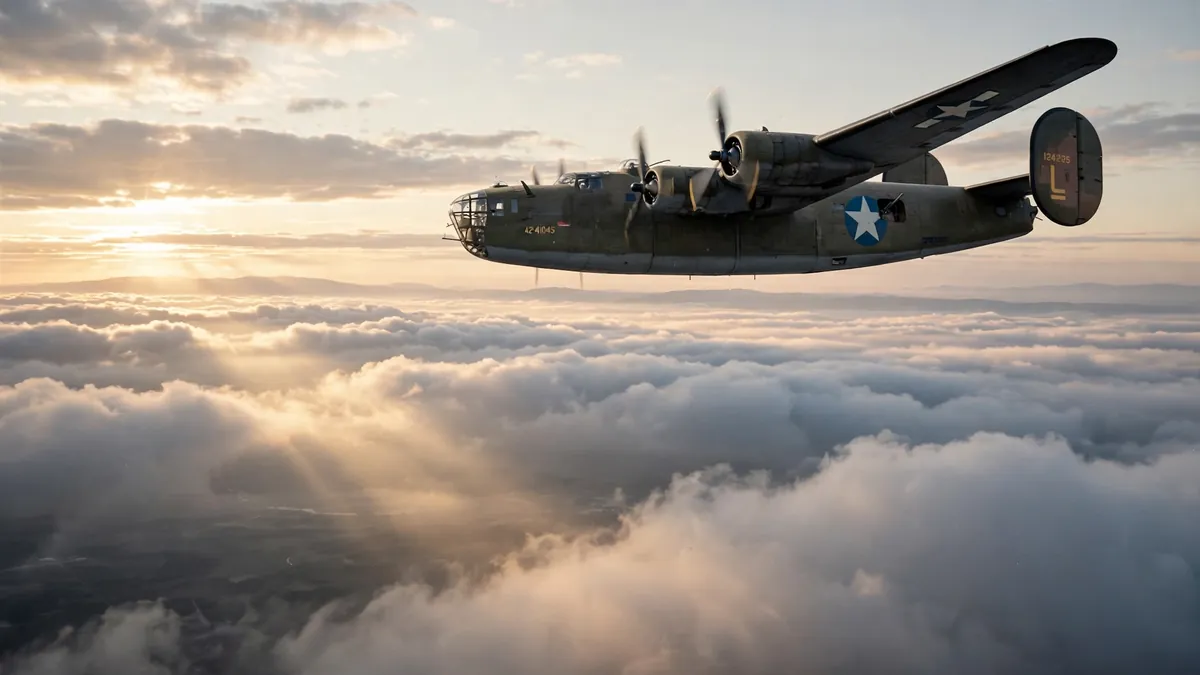
The B-24 Liberator was an American heavy bomber of the Second World War, and the most-produced bomber in history. Designed by Consolidated Aircraft of San Diego, California, it first flew on 29 December 1939 and entered service with the United States Army Air Forces in 1941.
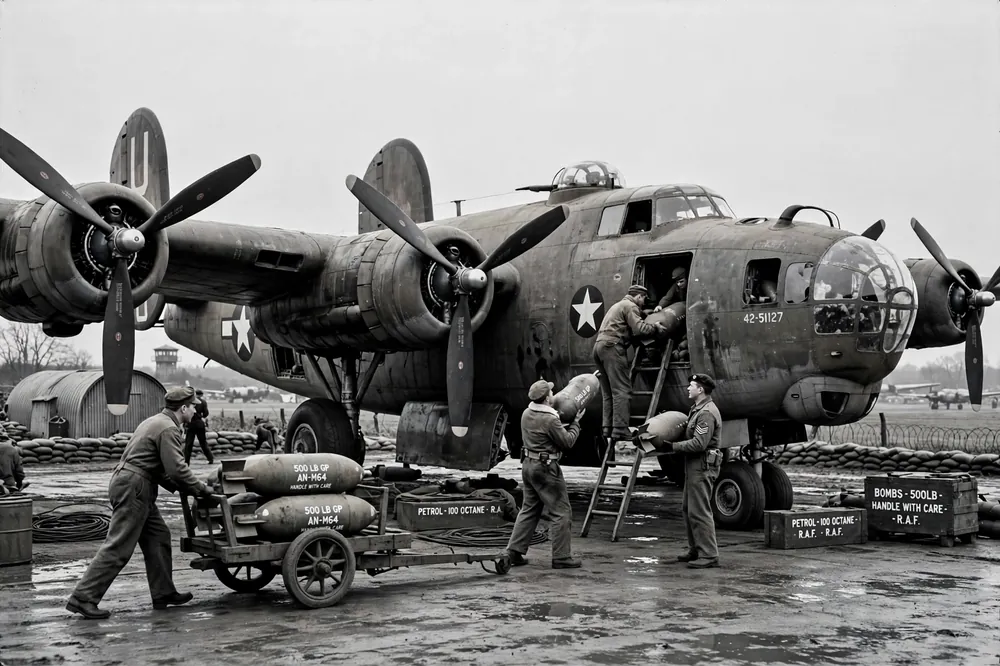
A total of 18,188 Liberators were built between 1940 and 1945 — more than any other American military aircraft ever made — and they served in every theatre of the war, from the daylight bombing campaign over Germany to the long-range patrols that helped close the gap in the middle of the Atlantic.
The B-24 Liberator was slightly faster than its famous rival, the B-17 Flying Fortress, carried a heavier bomb load, and could fly farther, which made it the bomber of choice whenever range mattered most. Its most famous — and most costly — mission was the low-level attack on the oil refineries at Ploiești, Romania, on 1 August 1943, in which 53 of the 177 bombers dispatched were lost.
2. Key Facts
| Field | Detail |
|---|---|
| Type | Heavy bomber (also maritime patrol, transport and reconnaissance) |
| Origin | United States |
| Designer | Consolidated Aircraft (chief designer Isaac M. Laddon; Davis wing by David R. Davis) |
| Manufacturer | Consolidated Aircraft, Ford Motor Company, Douglas Aircraft, North American Aviation |
| First flight | 29 December 1939 (XB-24 prototype) |
| In service | 1941–1945 (USAAF); last operator, the Indian Air Force, retired it in 1968 |
| Number produced | 18,188 (1940–1945), including 8,685 built by Ford at Willow Run |
| Crew | 10 (B-24J) |
| Length | 67 ft 8 in (20.6 m) |
| Wingspan | 110 ft (33.5 m) |
| Engines | 4 × Pratt & Whitney R-1830 Twin Wasp radial engines, 1,200 hp each |
| Maximum speed | 297 mph (478 km/h) at 25,000 ft |
| Range | 2,100 mi (3,400 km) with 5,000 lb bomb load; 3,700 mi (6,000 km) ferry range |
| Service ceiling | 28,000 ft (8,500 m) |
| Armament | 10 × .50 cal (12.7 mm) M2 Browning machine guns; up to 8,000 lb (3,600 kg) of bombs |
3. Background and Development
The B-24 Liberator began in January 1939, when the United States Army Air Corps asked Consolidated Aircraft to build the B-17 Flying Fortress under licence. Consolidated’s chief designer, Isaac M. Laddon, and company president Reuben Fleet believed they could design a better bomber from scratch, and the Air Corps agreed to let them try.
The result was the Consolidated Model 32, a clean-sheet design built around two ideas: a long, slab-sided fuselage with a large bomb bay, and a new high-aspect-ratio wing designed by David R. Davis. The Davis wing was long and narrow, which reduced drag and gave the aircraft a high cruising speed, a long range and the ability to carry a heavy load — exactly what the Air Corps had asked for in its Type Specification C-212 of February 1939, which called for a bomber faster than 300 mph, with a range of 2,000 miles and a ceiling of 35,000 feet.
The prototype, the XB-24, flew for the first time on 29 December 1939 at San Diego, piloted by William Wheatley. It was promising but not yet fast enough: on its first flights it reached only about 273 mph, below the promised 311 mph, and the Air Corps ordered changes. By early 1941, after new superchargers and other refinements, the prototype reached 310 mph.
Meanwhile, war in Europe was already driving orders. France ordered Liberators in 1940, and after France fell, those orders passed to Britain, which named the aircraft the “Liberator” — a name the Americans adopted. The first production aircraft were export models designated LB-30, and the United States Army Air Corps received its first B-24As in mid-1941.
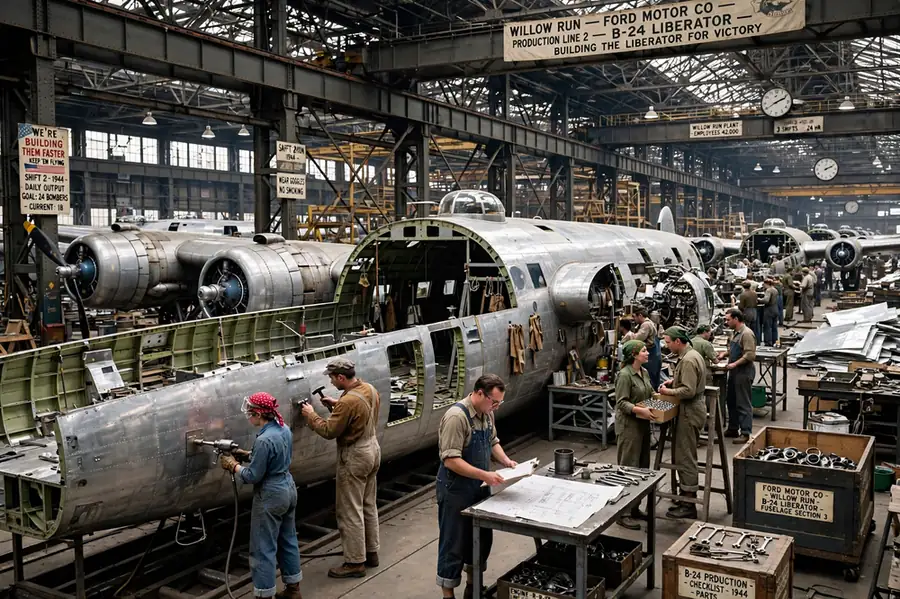
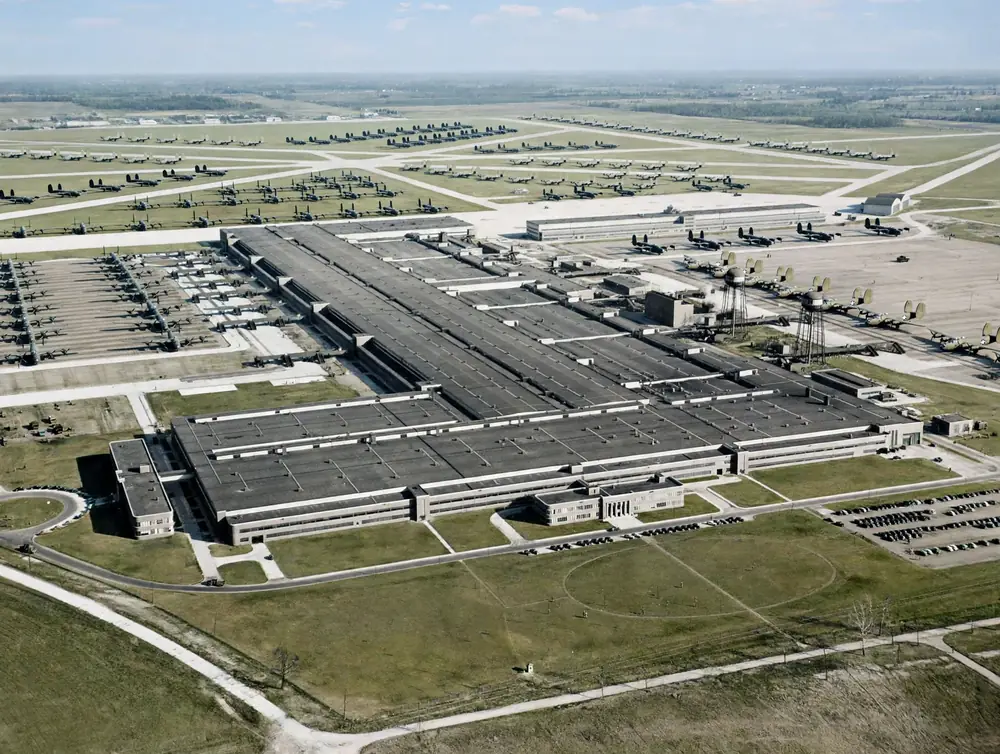
The attack on Pearl Harbor in December 1941 turned the Liberator from an export project into the centrepiece of American heavy-bomber production, and the government built a vast new plant at Willow Run, Michigan, where the Ford Motor Company applied automobile assembly-line methods to aircraft production. At its peak, Willow Run completed one B-24 every 63 minutes, and Ford alone built 8,685 Liberators — nearly half the total.
The scale of B-24 Liberator production depended on a system, not a single factory. Five plants built Liberators: Consolidated at San Diego and Fort Worth, Douglas at Tulsa, North American at Dallas, and Ford at Willow Run, Michigan. The Ford plant was the largest.
Built in 1941 on farmland near Ypsilanti, it covered about 3.5 million square feet under one roof and employed more than 40,000 workers at its peak, including many women who had not previously worked in heavy industry. Ford’s engineers broke the aircraft down into sub-assemblies — wings, fuselage sections, turrets — that moved along a line nearly a mile long, with the aircraft itself moving on a conveyor.
The first Ford-built B-24 was completed in September 1942, and output rose steadily through 1943 and 1944. At the peak of production, Willow Run completed a Liberator roughly every hour, and Ford built 8,685 of the 18,188 total. The other plants contributed the rest: Consolidated at San Diego built the prototype and the early production aircraft, Fort Worth built large numbers of the B-24D and later models, and Douglas and North American added several thousand more.
The programme also depended on thousands of subcontractors supplying engines, propellers, instruments and turrets, and on a standardised design that allowed parts from one plant to fit aircraft built at another. The production system had its costs: early Ford-built aircraft needed extensive rework, and the pace of change — new turrets, new radios, new fuel systems introduced while production continued — meant that no two production blocks were exactly alike.
But the system delivered what the Air Corps had asked for: more heavy bombers, faster, than any other country could produce.
4. Design
The B-24 Liberator looked unlike any other bomber of its day, and its shape explains both its strengths and its weaknesses. The fuselage was a deep, slab-sided box, built around two central bomb bays that could hold up to 8,000 pounds (3,600 kg) of bombs — more than the B-17 could carry. Because the fuselage was so roomy, the Liberator was easily adapted to other roles: maritime patrol, photographic reconnaissance, cargo and personnel transport. The bomb bay doors were unusual, too: instead of swinging open, they rolled up on tracks like a roller shutter, which reduced drag and let the aircraft keep its speed while the bombs fell.
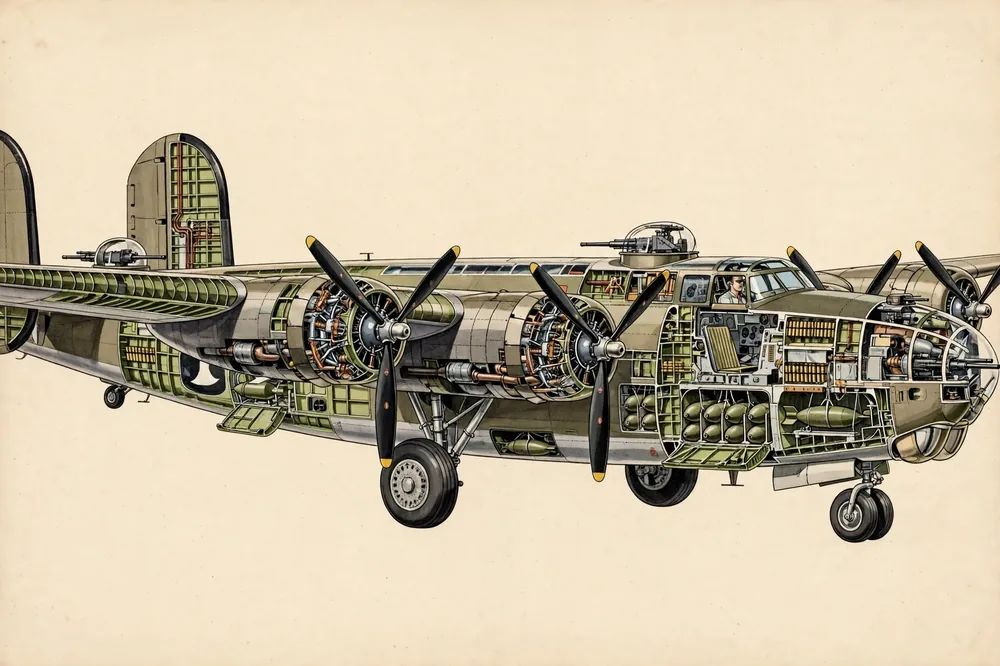
The Davis wing was the aircraft’s defining feature. Long, narrow and mounted high on the fuselage, it gave the B-24 its long range and high cruising speed, but it was also thin, with little internal space for fuel, and it flexed in flight. Pilots found the Liberator heavier on the controls than the B-17, and harder to hold in the tight formations that daylight bombing demanded.
The wing’s other weakness was structural: it was more vulnerable to battle damage than the B-17’s thicker wing, and a damaged Liberator was harder to bring home. Crews respected the aircraft’s performance but rarely loved it; the B-17 was the bomber they called beautiful, while the B-24 was the one that got the job done farther from base.
Defensive armament grew steadily through the war. Early Liberators carried a handful of hand-aimed guns and were vulnerable from the front and from below. The B-24D added a nose turret in some aircraft, the B-24H introduced a powered nose turret as standard, and the B-24J, the most numerous version, carried ten .50-calibre machine guns in four powered turrets — nose, top, ball and tail — plus two waist guns.
Four Pratt & Whitney R-1830 Twin Wasp radial engines, each producing 1,200 horsepower and fitted with turbo-superchargers, gave the B-24J a maximum speed of 297 mph (478 km/h) at 25,000 feet and a service ceiling of 28,000 feet. Its normal crew of ten was a pilot, co-pilot, navigator, bombardier, radio operator, flight engineer and four gunners.
The B-24 Liberator’s crew of ten worked in conditions that were cramped, cold and noisy. The pilot and co-pilot sat side by side on the flight deck, behind them the navigator and radio operator, and the bombardier in the glazed nose. The flight engineer, who also operated the top turret, stood behind the pilots, while the waist gunners, the ball-turret gunner and the tail gunner occupied the rear fuselage.
At altitudes of 20,000 to 25,000 feet, the temperature inside the unpressurised aircraft could fall well below freezing, and the crew wore electrically heated suits and oxygen masks for missions lasting six to eight hours. The waist positions were the coldest and the most exposed: the waist gunners stood at open windows, and in the B-24J their guns were mounted in open hatches with only a small wind deflector for protection.
The Sperry ball turret, slung beneath the fuselage, was the most confined station on the aircraft — the gunner sat curled inside a sphere barely larger than his body, with his knees against his chest, and could only enter or leave the turret when the guns were pointed down.
Communication between the crew depended on the intercom, and when it failed, as it often did, the crew used hand signals and written notes. Crews also lived with the aircraft’s reputation: the B-24’s fuel was carried in wing tanks and in the fuselage, and a hit in the wing could start a fire that spread quickly.
The crew’s best protection was the aircraft’s speed and its defensive guns, and the discipline of holding formation, where the overlapping fields of fire from neighbouring bombers covered the gaps in any one aircraft’s defences.
5. Variants
| Variant | Built | Role and notes |
|---|---|---|
| XB-24 | 1 | Prototype; first flew 29 December 1939 |
| LB-30 | ~165 | Early export model for Britain; some served as transports |
| B-24A | 18 | First USAAF version; unarmed in early deliveries |
| B-24C | 9 | First with turbo-supercharged R-1830-41 engines |
| B-24D | 2,738 | First major production version; first to see combat in numbers |
| B-24E | 801 | Ford-built version of the D with different engines |
| B-24G | 430 | North American-built; first with powered nose turret |
| B-24H | 3,100 | Powered nose turret standard; most numerous early combat version |
| B-24J | 6,678 | Most-produced variant; nose turret, improved systems |
| B-24L | 1,667 | Lighter version with hand-aimed tail guns to save weight |
| B-24M | 2,593 | Final production version; lighter tail turret |
| C-87 Liberator Express | 287 | Unarmed transport conversion; carried cargo and passengers |
| F-7 | ~180 | Photo-reconnaissance conversion of the B-24 |
| PB4Y-2 Privateer | 739 | US Navy patrol bomber with a single large tail fin |
6. Operational History
The Mediterranean and Ploiești
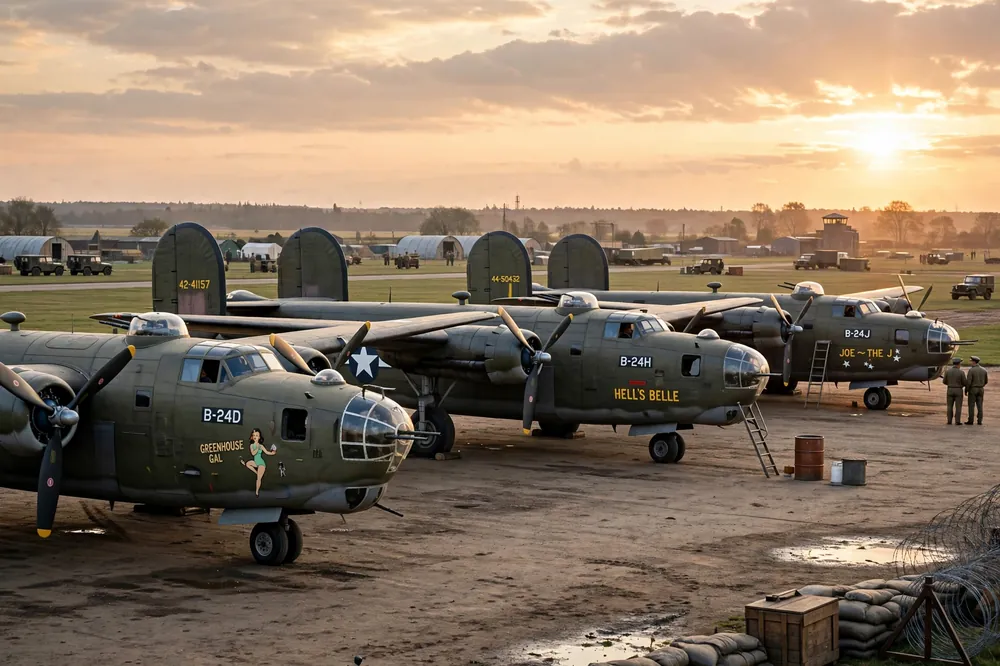
The B-24 Liberator first went to war in the Mediterranean. In June 1942, thirteen B-24Ds of the HALPRO detachment flew from Egypt to bomb the oil refineries at Ploiești, Romania — the first American bombing of a target in Europe from the Middle East, and a sign of what the Liberator’s range made possible.
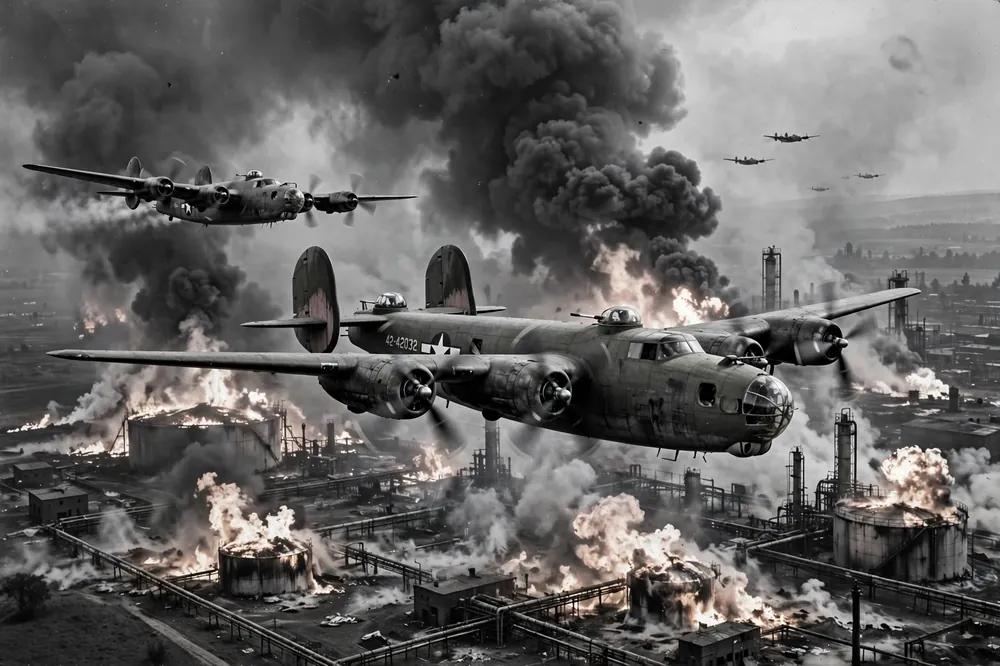
A year later, on 1 August 1943, the Liberator flew its most famous mission: Operation Tidal Wave, a low-level attack on the same refineries by 177 B-24s from five bomb groups based in Libya. The plan called for the bombers to fly at treetop height to achieve surprise, but navigation errors, alerted defences and heavy flak resulted in heavy losses.
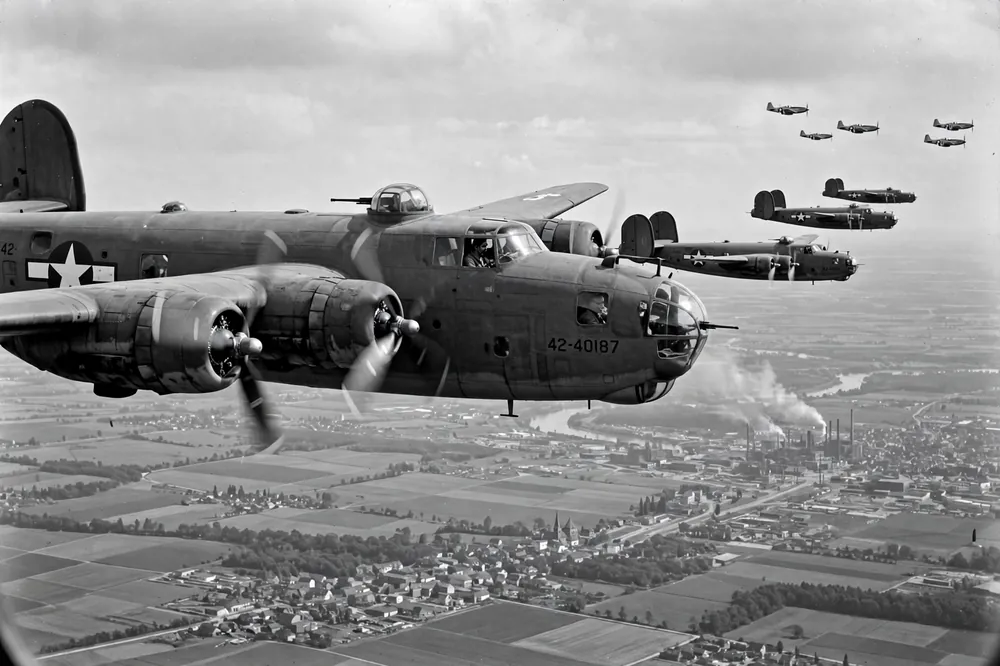
Fifty-three bombers were lost — about a third of the force — and 310 airmen were killed or missing, with a further 108 captured and 78 interned in Turkey. Five Medals of Honor were awarded for the mission, three of them posthumously, more than for any other single American air mission of the war.
The refineries were damaged but repaired within weeks, and the raid remains one of the most debated operations of the air war.
The Eighth Air Force over Germany
In England, the Eighth Air Force flew both B-17s and B-24s against Germany, and the Liberator’s longer range made it the natural choice for the deepest targets. B-24 groups took part in the great daylight battles of 1943 — Schweinfurt, Regensburg and the attacks on the German aircraft industry — and suffered accordingly.
The 93rd Bomb Group, the 44th and the 389th flew sustained operations against heavily defended targets, and their losses were heavy: in 1943, before long-range fighter escort arrived in strength, a bomber crew’s chance of completing a 25-mission tour was poor.
By 1944, with P-51 Mustangs and P-47 Thunderbolts escorting them all the way to the target, the Liberator groups joined in the systematic bombing of Germany’s oil industry and transport network that continued through to the end of the war in Europe in May 1945.
The Battle of the Atlantic
The Liberator’s greatest contribution may have been over the sea. In 1941, the Royal Air Force’s Coastal Command began using very-long-range (VLR) Liberators to patrol the “Atlantic Gap” — the stretch of ocean beyond the reach of land-based aircraft, where German U-boats attacked convoys without fear of air attack.
A VLR Liberator, fitted with extra fuel tanks and radar, could stay in the air for more than 16 hours and cover the gap entirely. From 1943, as more VLR Liberators arrived and escort carriers joined the convoys, U-boat losses rose sharply and the balance in the Battle of the Atlantic shifted in the Allies’ favour.
Liberators are credited with a major share of the U-boats sunk by aircraft, and their presence alone forced U-boats to stay submerged, where they were slow and blind.
The Pacific and China-Burma-India
In the Pacific, the B-24’s range was decisive. It was the main American heavy bomber in the South West Pacific, flying from Australia and New Guinea against Japanese bases at Rabaul, in the Netherlands East Indies and the Philippines. Liberators of the Fifth Air Force bombed Japanese airfields and shipping, and in 1944–45 they supported the invasions of the Philippines and Borneo. In China-Burma-India, B-24s flew from India against targets in Burma, Thailand and Indochina, and their transport version, the C-87, flew the “Hump” route over the Himalayas to supply China. By the end of the war, Liberators had flown in every theatre, and more of them had been built than any other bomber in history.
After the costly low-level raid of August 1943, the campaign against Ploiești did not end — it changed. In November 1943, the Fifteenth Air Force was formed in Italy, flying from airfields around Foggia, and its B-24 groups returned to Ploiești at high altitude, in repeated raids through the spring and summer of 1944.
The defences were still formidable: flak batteries, fighter squadrons and smoke screens that hid the refineries, and the losses remained heavy, but the raids were now part of a sustained campaign rather than a single attempt. The Fifteenth Air Force’s B-24s also attacked refineries and oil installations at Vienna, Budapest and in southern Germany, and bombed railway yards, bridges and airfields across the Balkans and northern Italy.
The campaign’s results were gradual rather than immediate. Romanian oil production, which had supplied a large share of Germany’s fuel, fell sharply through 1944 as refineries were damaged and transport was disrupted, and in August 1944 Romania changed sides, cutting off the oil supply entirely.
The Fifteenth Air Force’s Liberators also supported the Allied advance in Italy, bombing German supply lines and positions ahead of the ground forces, and in 1944–45 they flew missions as far afield as southern France and Austria. By the end of the war, the Fifteenth Air Force had flown more than 150,000 sorties, and its B-24 groups had been among the most heavily engaged bomber units of the war.
7. Performance and Specifications
Specifications for the B-24J, the most-produced variant.
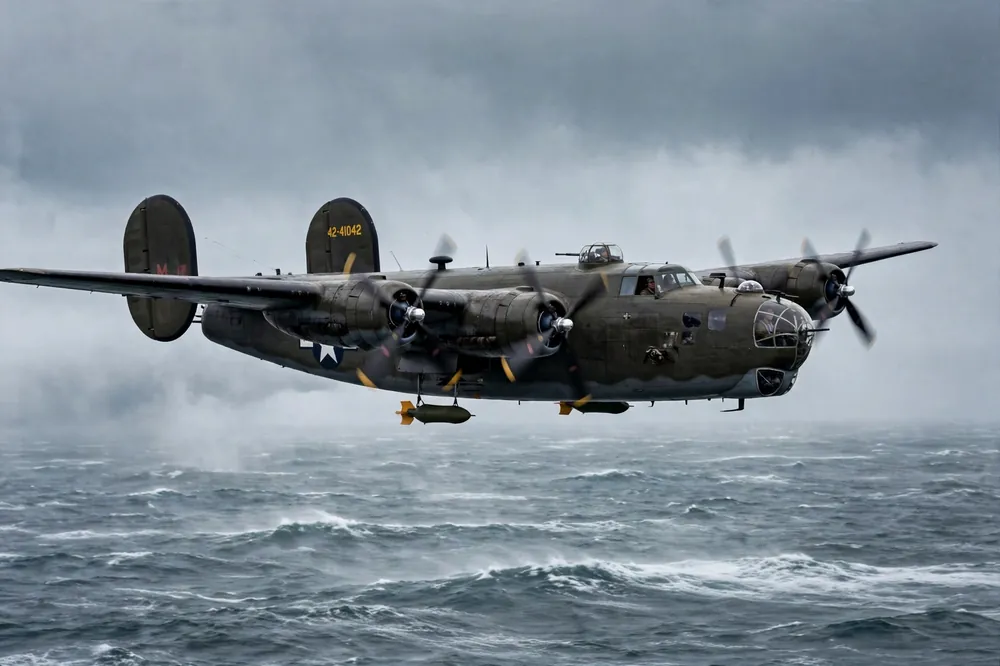
| Specification | Value |
|---|---|
| Crew | 10 |
| Length | 67 ft 8 in (20.6 m) |
| Wingspan | 110 ft 0 in (33.5 m) |
| Height | 18 ft 0 in (5.5 m) |
| Wing area | 1,048 sq ft (97.4 m²) |
| Empty weight | 36,500 lb (16,556 kg) |
| Gross weight | 55,000 lb (24,948 kg) |
| Maximum takeoff weight | 65,000 lb (29,484 kg) |
| Powerplant | 4 × Pratt & Whitney R-1830-35/-41/-65 Twin Wasp, 1,200 hp each |
| Maximum speed | 297 mph (478 km/h) at 25,000 ft (7,600 m) |
| Cruise speed | 215 mph (346 km/h) |
| Range | 1,540 mi (2,480 km) with maximum bomb load; 2,100 mi (3,400 km) with 5,000 lb load |
| Ferry range | 3,700 mi (6,000 km) |
| Service ceiling | 28,000 ft (8,500 m) |
| Rate of climb | 1,025 ft/min (5.2 m/s) |
| Guns | 10 × .50 cal (12.7 mm) M2 Browning machine guns |
| Bombs | Up to 8,000 lb (3,600 kg) at short range; 5,000 lb (2,300 kg) at 800 mi; 2,700 lb (1,200 kg) at 1,200 mi |
8. Operators
The B-24 Liberator served with the United States Army Air Forces and the United States Navy (as the PB4Y-1 and PB4Y-2) above all, but it was also one of the most widely exported American aircraft of the war. The Royal Air Force was the second-largest user, flying Liberators as bombers in the Middle East and Far East, as very-long-range anti-submarine aircraft with Coastal Command, and as transports.
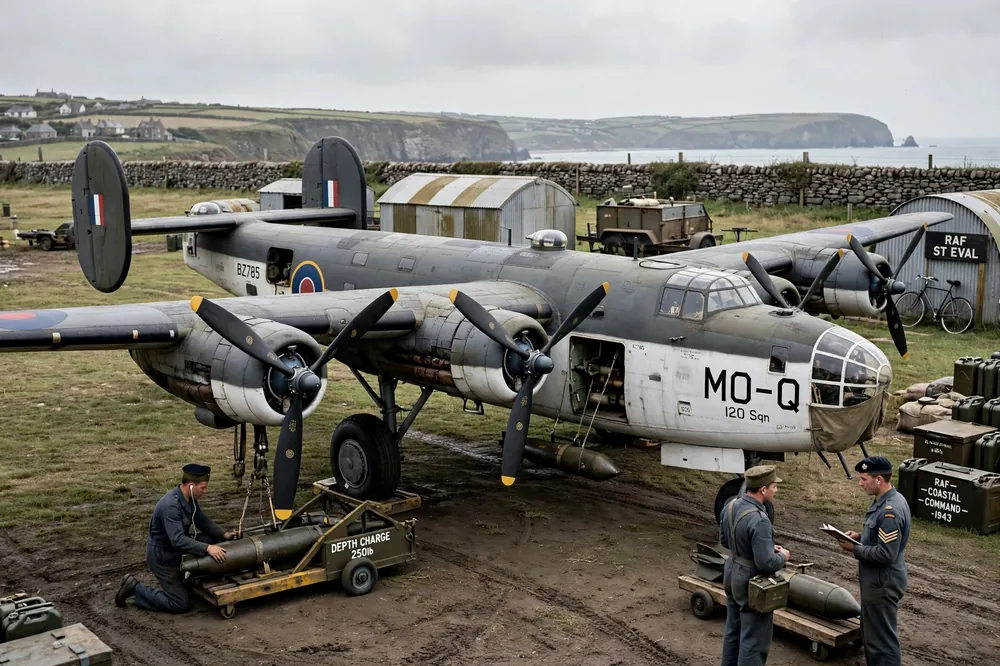
The Royal Canadian Air Force used Liberators for anti-submarine patrols over the Atlantic, and the Royal Australian Air Force flew them against Japanese targets from northern Australia. Smaller numbers served with the air forces of South Africa, India, France, the Soviet Union (received under Lend-Lease), China, Brazil and several other Allied nations.
After the war, Liberators continued in service with India until 1968 — the last military operator of the type — and a few served in civilian roles as transports and survey aircraft into the 1950s.
The Royal Air Force was the second-largest user of the B-24 Liberator, and it used the aircraft in ways the Americans had not originally intended. The first Liberators to reach Britain were LB-30s, early export models that the RAF used as long-range transports — including a transatlantic ferry service that carried crews and priority cargo between Britain and North America — before the bomber versions arrived.
The RAF’s most important use of the Liberator was with Coastal Command, the service responsible for protecting convoys in the Atlantic. From 1941, Coastal Command operated very-long-range (VLR) Liberators, fitted with extra fuel tanks in the bomb bays and with radar, from bases in Northern Ireland, Iceland and Cornwall. No.
120 Squadron was the first to operate the VLR Liberator, and its aircraft could stay airborne for more than 16 hours, covering the “Atlantic Gap” — the stretch of ocean beyond the reach of other land-based aircraft — where U-boats had previously attacked convoys without interference from the air.
The VLR Liberators were later fitted with the Leigh Light, a powerful searchlight used to illuminate surfaced U-boats at night, and with depth charges and, from 1943, with acoustic homing torpedoes. RAF Liberators also served as bombers in the Middle East and the Far East, where No. 159 Squadron and other units flew long-range missions against Japanese targets in Burma and the Netherlands East Indies.
The RAF’s Liberators were mostly supplied under Lend-Lease, and the type remained in RAF service until 1947. The RAF’s experience with the VLR Liberator demonstrated a point that applied to the whole aircraft: the Liberator’s value lay less in its bomb load than in its range, and the roles that needed range — maritime patrol, transport and reconnaissance — were the ones in which it made its most distinctive contribution.
9. Legacy and Influence
The B-24 Liberator’s legacy is written in numbers. With 18,188 built, it remains the most-produced bomber in history, the most-produced multi-engine aircraft, and the most-produced American military aircraft of any type — records that still stand. It proved that a heavy bomber could be built on an automobile-style assembly line, and the Willow Run plant became an example of large-scale American industrial production: at its peak, it turned out a complete four-engine bomber every hour. The Liberator’s long range shaped strategy in two theatres: it closed the Atlantic Gap and helped win the Battle of the Atlantic, and in the Pacific it gave American air power a reach no other heavy bomber of 1942–43 could match.
The aircraft’s post-war influence was quieter but real. Its transport version, the C-87, and its naval patrol derivative, the PB4Y-2 Privateer, served for years after the war, and the Privateer’s single-tail design influenced later American patrol aircraft. The Davis wing, with its high aspect ratio, pointed the way toward the long, efficient wings of later transport and patrol aircraft. Yet the Liberator never won the affection the B-17 enjoyed.
Its slab-sided fuselage and demanding handling made it a workhorse rather than a legend, and after the war it was retired quickly — the United States Air Force had disposed of its last B-24s by the end of 1945 — while the B-17 lingered in service and in memory.
Historians now judge the Liberator on its record rather than its reputation: it flew farther, carried more, and was built in greater numbers than any bomber before or since.
The B-24 Liberator’s service did not end with the war in Europe. In the China-Burma-India theatre, a transport version of the Liberator, the C-109, was used as a flying fuel tanker to supply the B-29 bombers operating from China against Japan: stripped of armament and fitted with extra fuel tanks in its bomb bays, the C-109 carried aviation fuel over the Himalayas on the “Hump” route, one of the most demanding airlift operations of the war.
After the war, most Liberators were scrapped quickly — the United States had thousands of surplus bombers and no use for them — but a small number continued in service. The Indian Air Force, which had received Liberators during the war, operated them until 1968, the last military operator of the type, using them as bombers, transports and maritime patrol aircraft.
A few Liberators served in civilian roles into the 1950s, including survey and transport work. The aircraft’s production record still stands: no bomber before or since has been built in greater numbers, and the Willow Run plant that built nearly half of them remains a landmark in the history of industrial production.
Of the 18,188 built, about a dozen complete airframes survive, and two still fly — a survival rate that reflects how thoroughly the type was discarded once the war ended.
10. Surviving Examples
Only about a dozen complete B-24 Liberators survive today, out of 18,188 built — a reminder of how thoroughly the type was scrapped after the war. The best-known is Diamond Lil, a B-24A (originally an LB-30) flown by the Commemorative Air Force; restored to B-24A configuration and renamed Ol’ 927, it is one of only two Liberators still flying.
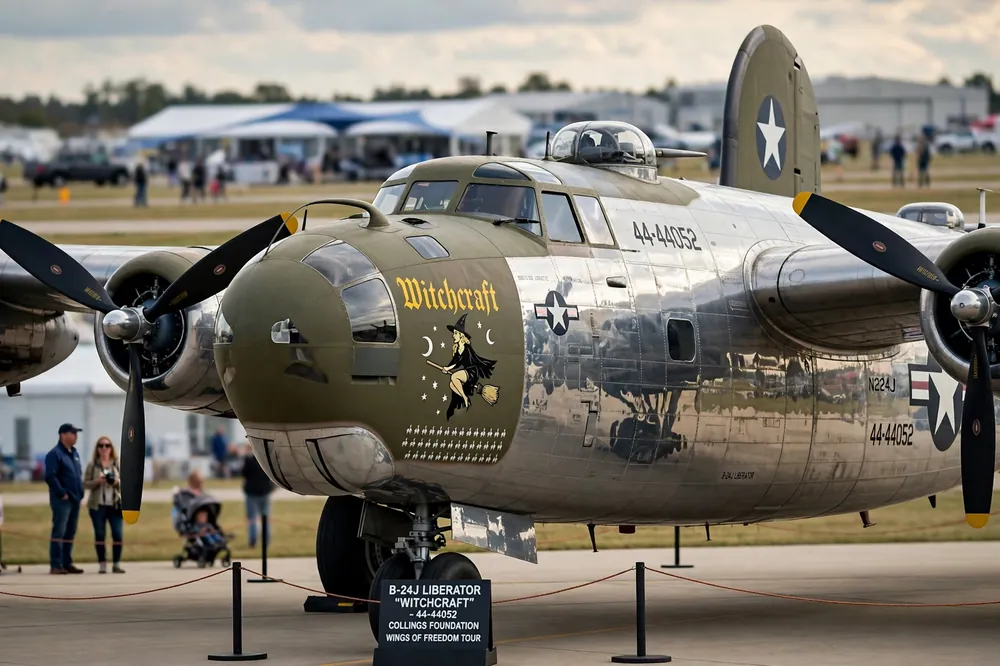
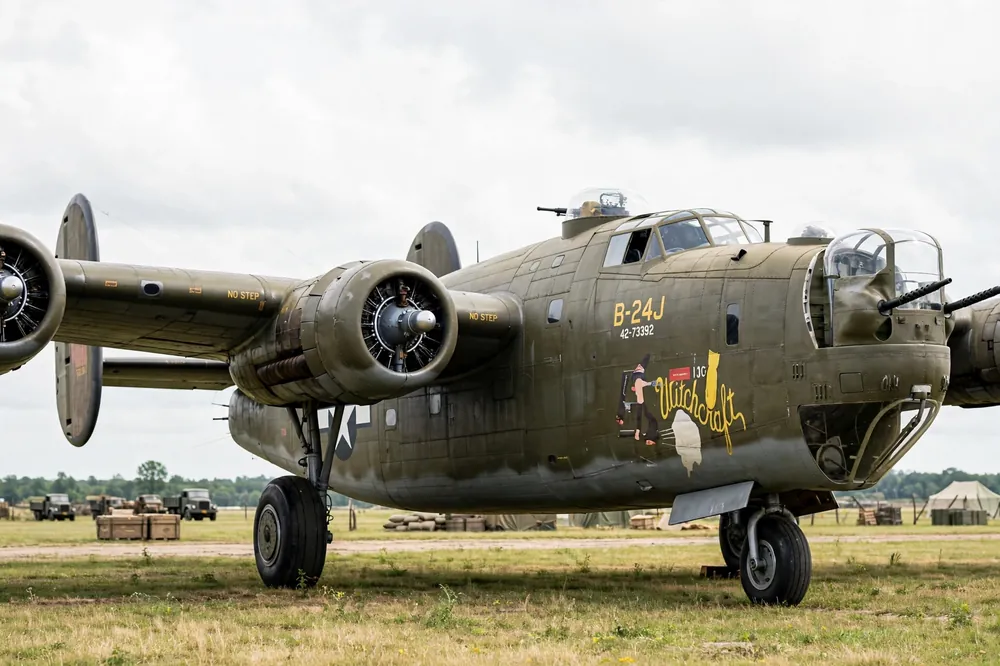
The other is Witchcraft, a B-24J operated by the Collings Foundation, painted in the markings of the 467th Bomb Group. The National Museum of the United States Air Force at Dayton, Ohio, displays Strawberry Bitch, a B-24D that flew 63 combat missions in North Africa — the longest-serving Eighth and Ninth Air Force Liberator.
The Royal Air Force Museum at Hendon, London, displays a B-24L, and the Pima Air & Space Museum in Arizona holds a B-24J. The most famous lost Liberator is Lady Be Good, a B-24D that vanished over the Libyan desert in April 1943; its wreck was found in 1958, almost perfectly preserved by the dry desert air, and parts of it are now displayed in museums.
The most widely known lost B-24 Liberator is Lady Be Good, a B-24D of the 376th Bomb Group that disappeared on 4 April 1943. Returning from a bombing mission against Naples, Italy, the aircraft overflew its base in Libya in darkness, its crew unaware that they had passed it, and continued south into the desert until its fuel ran out.
The crew bailed out and died of thirst in the desert; the aircraft belly-landed almost intact on a flat stretch of sand. Its wreck was found by an oil survey team in 1958, fifteen years later, almost perfectly preserved by the dry desert air: the guns still worked, the radio still functioned, and supplies were still aboard.
The remains of the crew were found in the years that followed, up to 100 miles from the crash site, and the story of their attempt to walk out of the desert became one of the most widely reported episodes of the air war in North Africa.
Parts of the aircraft, including one of its engines, are now displayed in museums, and the wreck itself was removed from the desert in 1994.
Frequently Asked Questions
How many B-24 Liberators were built? A total of 18,188 B-24 Liberators were built between 1940 and 1945, making it the most-produced bomber in history. Ford Motor Company built 8,685 of them at Willow Run, Michigan.
What was the B-24 Liberator’s top speed? The B-24J had a maximum speed of 297 mph (478 km/h) at 25,000 feet, with a cruising speed of about 215 mph (346 km/h).
How many bombs could a B-24 carry? A B-24 could carry up to 8,000 lb (3,600 kg) of bombs at short range, 5,000 lb (2,300 kg) at a range of 800 miles, and 2,700 lb (1,200 kg) at 1,200 miles.
What happened at Ploiești on 1 August 1943? In Operation Tidal Wave, 177 B-24s attacked the oil refineries at Ploiești, Romania, at low level. Fifty-three bombers were lost and 310 airmen were killed or missing, making it one of the costliest single air missions of the war for the USAAF.
Was the B-24 better than the B-17? The B-24 was faster, carried a heavier bomb load and flew farther than the B-17, but it was harder to fly in formation and more vulnerable to battle damage. The B-17 was more popular with crews; the B-24 was the better long-range bomber.
Are any B-24 Liberators still flying? Yes — two. Diamond Lil (Commemorative Air Force) and Witchcraft (Collings Foundation) are the only airworthy B-24s, out of about a dozen complete survivors.
Related articles
Sources
- Wikipedia, “Consolidated B-24 Liberator” — production total 18,188, B-24J specifications, variant production figures.
- Wikipedia, “Operation Tidal Wave” — 177 B-24s dispatched, 53 lost, 310 aircrew killed or missing, 108 captured, 78 interned.
- National Museum of the United States Air Force, “Consolidated B-24D Liberator” fact sheet — aircraft history and Strawberry Bitch.
- National WWII Museum, New Orleans — B-24 Liberator and Willow Run production history.
- Martin W. Bowman, B-24 Liberator: A Pictorial History (Pen & Sword, 2019).
- Steven J. Zaloga, Ploesti 1943: The Great Raid on Hitler’s Romanian Oil Refineries (Osprey Publishing, 2019).
- William N. Hess, B-24 Liberator Units of the Eighth Air Force (Osprey Publishing, 1999).
Further reading
- Allan G. Blue, The B-24 Liberator: A Pictorial History (Ian Allan, 1975).
- Robert F. Dorr, B-24 Liberator Units of the Fifteenth Air Force (Osprey Publishing, 2000).