 WAR ATLAS MILITARY HISTORY MAGAZINE · WWI — WWII
Battle of the Coral Sea
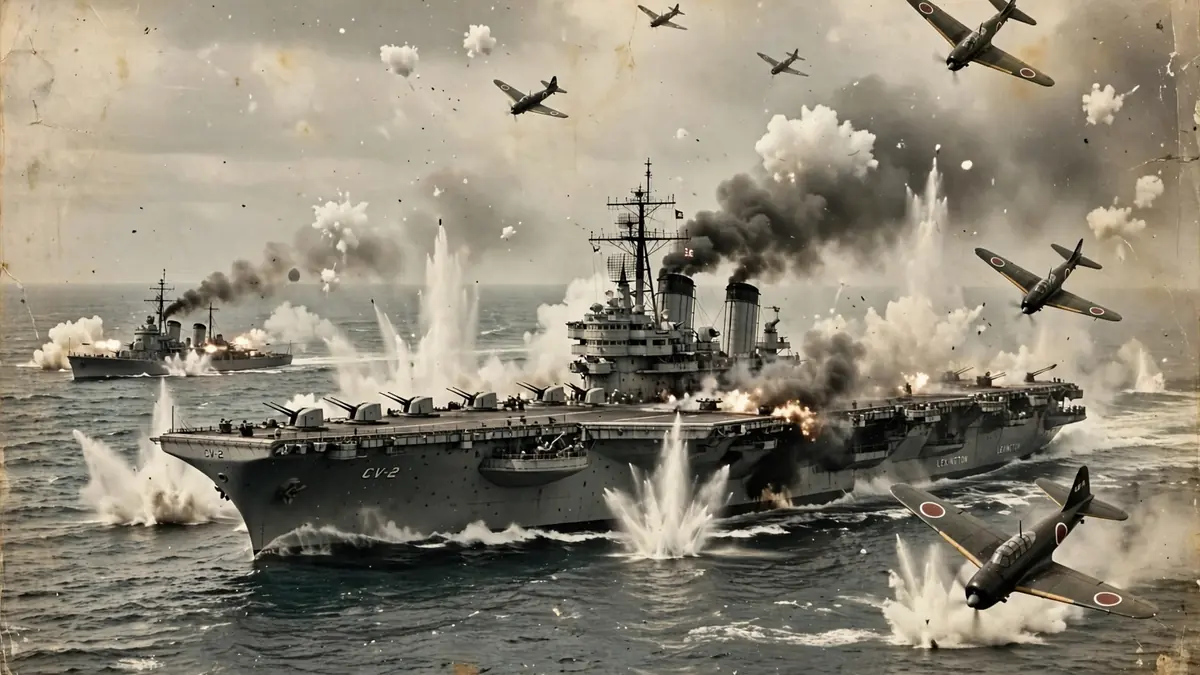
The Battle of the Coral Sea, fought from 4 to 8 May 1942, was a battle unlike any that had come before it: the first naval battle in history in which the opposing ships never saw each other, and never fired a gun at each other. The battle was fought entirely by aircraft, launched from carriers hidden over the horizon from one another, in the warm waters of the Coral Sea, between Australia and New Guinea. When it was over, the Americans had lost a fleet carrier, the Lexington, and the Japanese had lost a light carrier, the Shōhō — and the Japanese invasion of Port Moresby, the last Allied base in New Guinea, had been stopped.
The battle is remembered as a strategic Allied victory won at tactical cost. The Japanese sank more tonnage than they lost, and the battle is usually scored as a Japanese tactical victory. But the Japanese paid a price that mattered more: their two fleet carriers, Shōkaku and Zuikaku, were damaged and depleted, and neither could take part in the Battle of Midway a month later, where the loss of four Japanese carriers decided the Pacific War. The Coral Sea was the first check to Japanese expansion in the Pacific, and the first proof that the American carrier force, which had survived Pearl Harbor, could meet the Japanese on equal terms.
1. Key Facts
| Date | 4–8 May 1942 |
| Location | Coral Sea, between Australia, New Guinea and the Solomon Islands |
| Result | Tactical Japanese victory, strategic Allied victory; the invasion of Port Moresby was stopped |
| Allied commanders | Rear Admiral Frank Jack Fletcher (US); Rear Admiral John Crace (Australia) |
| Japanese commanders | Vice Admiral Shigeyoshi Inoue (overall); Vice Admiral Takeo Takagi (carriers); Rear Admiral Aritomo Gotō |
| Allied strength | 2 fleet carriers (Lexington, Yorktown), 8 cruisers, 13 destroyers, 128 aircraft |
| Japanese strength | 2 fleet carriers (Shōkaku, Zuikaku), 1 light carrier (Shōhō), 9 cruisers, 15 destroyers, about 150 aircraft |
| Allied losses | 1 fleet carrier (Lexington), 1 destroyer, 1 oiler; 656 killed; 69 aircraft |
| Japanese losses | 1 light carrier (Shōhō), 1 destroyer; 966 killed; 92 aircraft |
2. Background
3.1. The Strategic Background
By the spring of 1942, Japan had conquered an empire in five months. Pearl Harbor, Malaya, Singapore, the Philippines, the Dutch East Indies — all had fallen, and the Japanese now planned to complete their defensive perimeter in the South Pacific by taking Port Moresby, on the southern coast of New Guinea, and Tulagi, in the Solomon Islands.
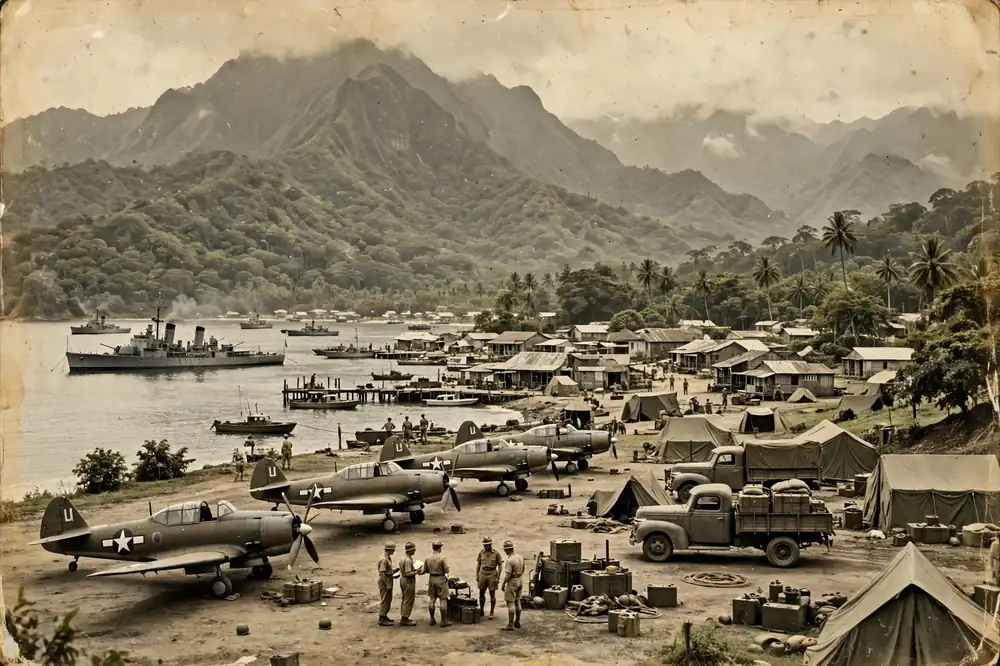
Port Moresby mattered because, in Japanese hands, it would put northern Australia within range of Japanese bombers, and it would cut the sea route between the United States and Australia. The operation, codenamed MO, was to be carried out by an invasion fleet under Vice Admiral Shigeyoshi Inoue, covered by a carrier force under Vice Admiral Takeo Takagi, with the fleet carriers Shōkaku and Zuikaku and the light carrier Shōhō.
Supply decided more of Battle of the Coral Sea than any single order. Ammunition, fuel, food and water had to travel from depots far behind the lines, over roads that were shelled, mined or washed out, and every delay at the front was felt first in the supply columns.
The side that kept its guns fed and its men fed could keep attacking; the side that could not was forced to stop, however good its plan. At Battle of the Coral Sea, as in most battles of this period, the quartermasters and the drivers mattered as much as the generals, and the battle’s turning points can often be traced to a convoy that arrived — or did not arrive — in time.
3.2. The Opposing Plans
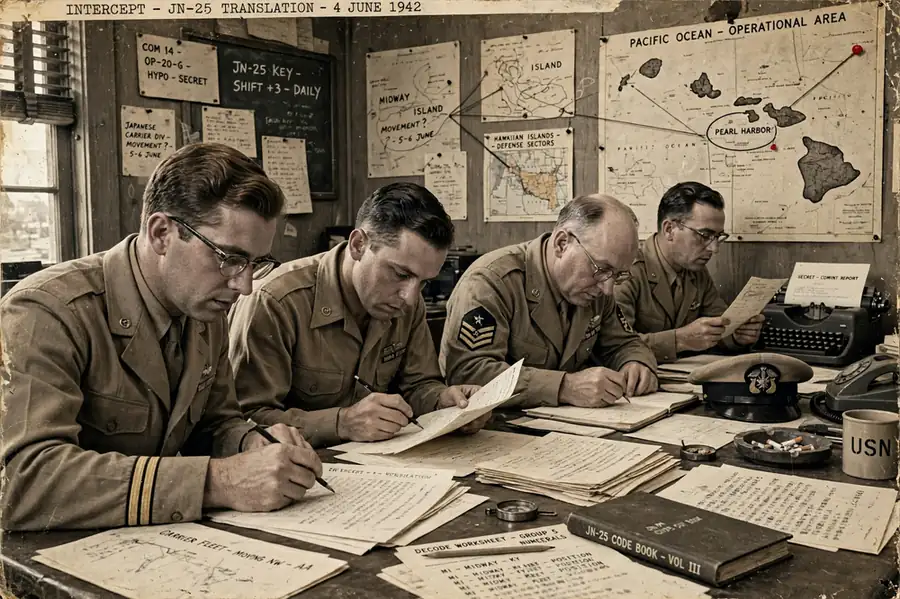
The Americans knew the Japanese were coming. The United States Navy had broken the Japanese naval code, JN-25, and the codebreakers at Pearl Harbor, under Commander Joseph Rochefort, had read enough of the Japanese messages to know that an operation against Port Moresby was planned for early May. Admiral Chester Nimitz, commander of the Pacific Fleet, sent Rear Admiral Frank Jack Fletcher, with the carriers Lexington and Yorktown, to the Coral Sea to intercept the invasion. Fletcher’s force was smaller than the Japanese carrier force, but Nimitz judged that the risk was worth taking: Port Moresby could not be allowed to fall, and the American carriers, which had survived Pearl Harbor, were the only weapon that could stop the invasion.
Neither side at Battle of the Coral Sea knew as much about the enemy as its commanders pretended. Reports were late, contradictory or simply wrong: prisoners exaggerated, scouts saw only a fragment of the front, and aerial photographs showed positions that had already been abandoned. Commanders filled the gaps with assumptions, and those assumptions decided battles. The history of Battle of the Coral Sea is full of such judgements — an enemy division believed to be elsewhere, a flank thought secure, a strength underestimated by half — and the side whose assumptions were closest to the truth usually won, not because its generals were cleverer, but because its information was better.
3.3. The Eve of Battle
The stage was set for a new kind of battle. At Pearl Harbor, the Japanese had shown that carrier aircraft could sink battleships; at the Coral Sea, the carriers would fight each other, and the battleships would not be involved at all. Both sides had similar forces: two fleet carriers each, with about 130 aircraft between them, and screens of cruisers and destroyers.
Neither side knew exactly where the other was, and the battle would be decided by scouting — by the aircraft that found the enemy first, and by the admirals who guessed correctly about where the enemy would be. The Coral Sea was warm, clear and vast, and the two fleets searched for each other for three days before they made contact.
Orders at Battle of the Coral Sea travelled slowly and unreliably. Field telephones depended on wires that shellfire cut within minutes; radios were heavy, short-ranged and easily intercepted; and in the end much depended on runners — men who carried written orders across open ground under fire, and who sometimes never arrived. A battalion could fight for hours without knowing what its neighbours were doing, and a division could learn of a breakthrough only when the enemy appeared in its rear. The battle therefore has to be understood as a dozen small battles fought in partial ignorance of each other, held together by a command system that was always one step behind events.
3.3.1. The Wider War
The wider war shaped everything that happened at Battle of the Coral Sea. By the time the fighting began, the conflict had already lasted for years, and both sides had learned hard lessons about supply, firepower and morale. Commanders on both sides knew that a single battle rarely decided a war, but that battles like this one decided whether armies could move, eat and fight the next week.
For the men who fought here, the strategic arguments debated in headquarters meant very little beside the next hill, the next street or the next stretch of water. What mattered was whether the artillery was in range, whether the rations arrived, and whether the unit on the flank held its ground.
The records of Battle of the Coral Sea therefore have to be read on two levels at once: as a chapter in a much larger war, and as a human experience of fear, exhaustion and endurance that no headquarters map can capture.
3. Opposing Forces
4.1. The Attacking Force
The American force at the Coral Sea was Task Force 17, under Rear Admiral Frank Jack Fletcher, built around the fleet carriers Lexington and Yorktown. The Lexington, the larger of the two, carried about 70 aircraft, and the Yorktown about 60, a mixture of Wildcat fighters, Dauntless dive-bombers and Devastator torpedo-bombers.
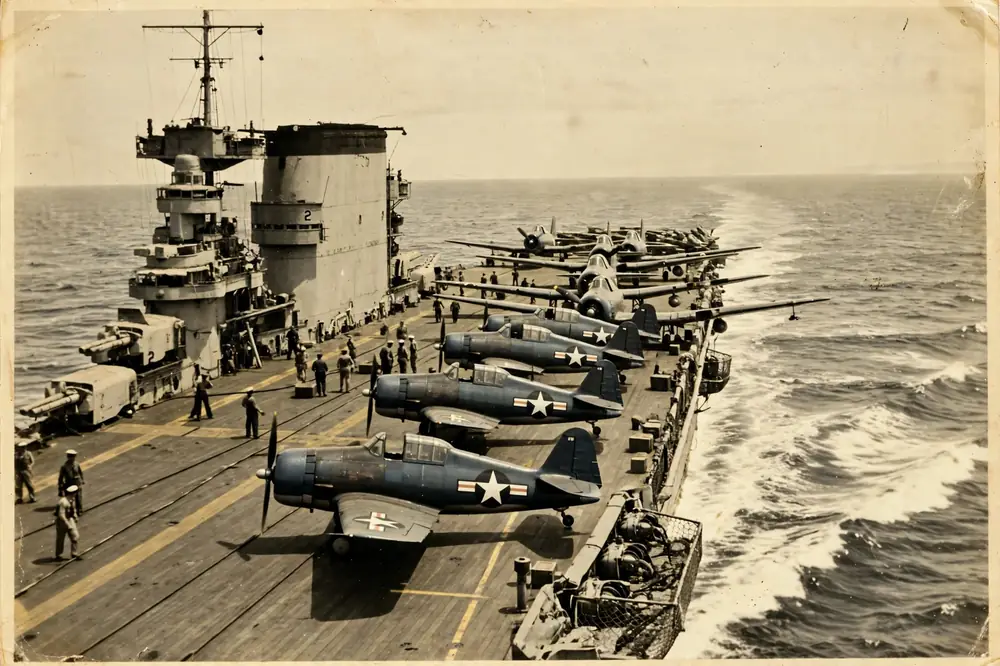
Fletcher’s screen included five heavy cruisers — among them the Australian cruisers Australia and Hobart, under Rear Admiral John Crace — and a force of destroyers, together with the oilers that kept the carriers fuelled. The American aircraft were fewer and, in the case of the Devastator torpedo-bomber, inferior to the Japanese, but the American pilots were aggressive, and the American carriers had the advantage of radar, which the Japanese lacked.
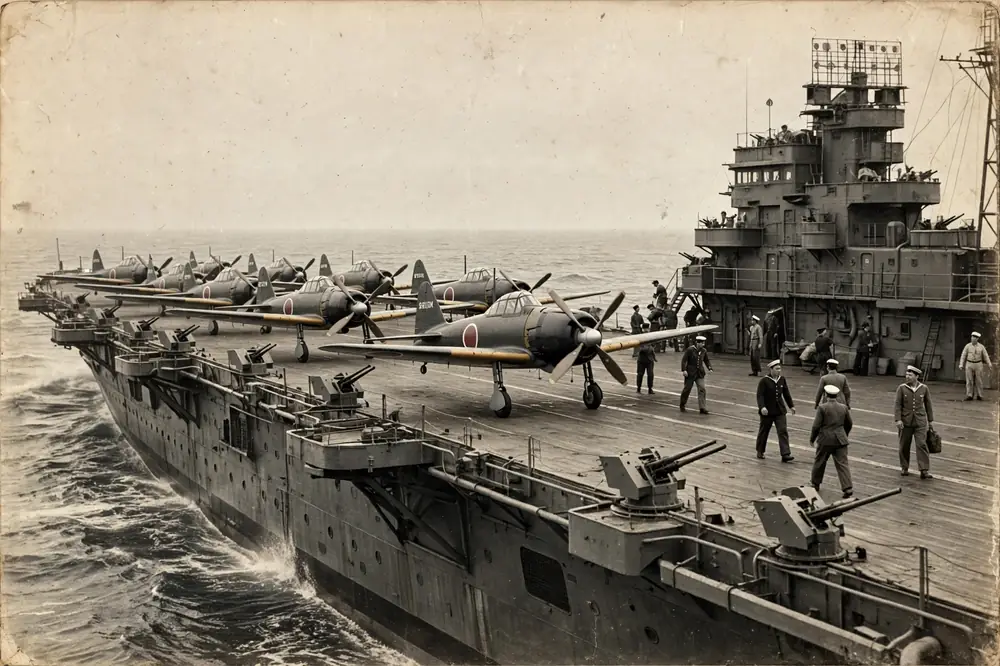
The Japanese carrier force, under Vice Admiral Takeo Takagi, was built around the fleet carriers Shōkaku and Zuikaku, the two newest and most capable carriers in the Japanese navy, each carrying about 60 aircraft — Zero fighters, Val dive-bombers and Kate torpedo-bombers — together with the light carrier Shōhō, which was escorting the invasion force.
The Japanese pilots were the best in the world in 1942, veterans of Pearl Harbor and the conquest of South-East Asia, and their aircraft, above all the Zero fighter, were superior to the American Wildcat in manoeuvrability. The Japanese force was supported by a screen of cruisers and destroyers under Rear Admiral Aritomo Gotō, and by the invasion fleet itself, which carried the troops for Port Moresby.
The ground at Battle of the Coral Sea rewarded the side that studied it. A ridge, a river, a wood or a ruined village could be worth a battalion, and commanders who had walked the ground — or who listened to the men who had — gained advantages that no map could give. The fighting followed the ground: attacks went where the ground allowed them, defences were built where the ground was strong, and the deadliest places in the battle were the places where the ground gave one side a clear field of fire and the other no cover at all. To read the battle without the map is to miss half of it.
4.2. The Defenders and Their Methods
| | United States and Australia | Japan |
|—|—|—|—|
| Fleet carriers | Lexington, Yorktown (128 aircraft) | Shōkaku, Zuikaku (about 150 aircraft); Shōhō (light) |
| Cruisers | 8, including the Australian Australia and Hobart | 9, including the heavy cruisers Myōkō and Haguro |
| Destroyers | 13 | 15 |
| Aircraft | Wildcat, Dauntless, Devastator | Zero, Val, Kate |
| Intelligence / Tình báo | JN-25 code broken; the Americans knew the Japanese plan | The Japanese did not know the American carriers were present |
The two forces were closely matched in numbers, but they differed in important ways. The Japanese had the better aircraft and the better pilots, and their torpedo-bombers were far superior to the American Devastator, which was slow, poorly armed and vulnerable. The Americans had radar, which gave them early warning of incoming air attacks, and they had the advantage of knowing the Japanese plan, thanks to the codebreakers.
The Japanese, for their part, did not know that the American carriers were in the Coral Sea at all: they believed the American carriers were elsewhere, and they divided their forces, sending the Shōhō with the invasion fleet and the fleet carriers separately. That division, and the American knowledge of the Japanese plan, were the two facts that shaped the battle.
The weapons used at Battle of the Coral Sea shaped the fighting in ways that the men who carried them understood better than their generals. A rifle that jammed in mud, a machine gun that could sweep a street, a tank that could not climb a slope, an artillery piece that could be heard but not seen — each weapon had its range, its rate of fire and its weakness, and battles were won by the side that matched its weapons to the ground.
The technical details matter: the calibre of a gun, the thickness of a tank’s armour, the range of a radio. They are not footnotes to the battle; they are the reason the battle took the shape it did.
4.2.1. Guns, Engineers and Supply
Beyond the divisions listed in the table, the battle was decided by the less visible arms: the artillery that fired the preparatory bombardments, the engineers who cleared mines and built bridges, the signals units that kept commanders in touch with their forward troops, and the supply columns that brought forward ammunition, fuel, food and water.
At Battle of the Coral Sea, as in most battles of this period, the side that could keep its guns supplied and its wounded evacuated had a decisive advantage, and the side whose communications broke down first usually lost the initiative.
Air power mattered too, though not always in the way planners hoped: aircraft could strike a strongpoint or a column on the road, but they could not hold ground, and bad weather could ground them for days at a time. The balance of forces was therefore never simply a count of men and tanks; it was a balance of systems, and the system that broke first decided the outcome.
4. The Battle
5.1. The Opening Moves
The battle opened on 4 May 1942, when aircraft from the Yorktown attacked the Japanese seaplane base at Tulagi, in the Solomon Islands, sinking a destroyer and several small vessels. The attack was a success, but it revealed the American presence to the Japanese, and for the next two days the two carrier forces searched for each other in the Coral Sea, their scouting aircraft flying hundreds of kilometres over empty ocean and finding nothing.
On 6 May, the two forces passed within about 100 kilometres of each other without making contact, in the dark, and the tension on both flag bridges was intense. On the morning of 7 May, both sides launched their scouts at dawn, and both sides found a target — but both sides found the wrong target.
Morale at Battle of the Coral Sea was not a slogan but a physical fact. Men who had eaten, slept and believed in their officers fought differently from men who were hungry, exhausted and leaderless, and the same unit could be brave on one day and broken on the next.
Fear was universal — veterans admitted it freely — and what kept men fighting was rarely hatred of the enemy but loyalty to the men beside them, the shame of running, and the simple habit of obeying orders. The battle’s histories often describe morale as if it were a quality of armies; at Battle of the Coral Sea it was a quality of small groups of men, and it could collapse in a single afternoon.
5.2. The Main Assault
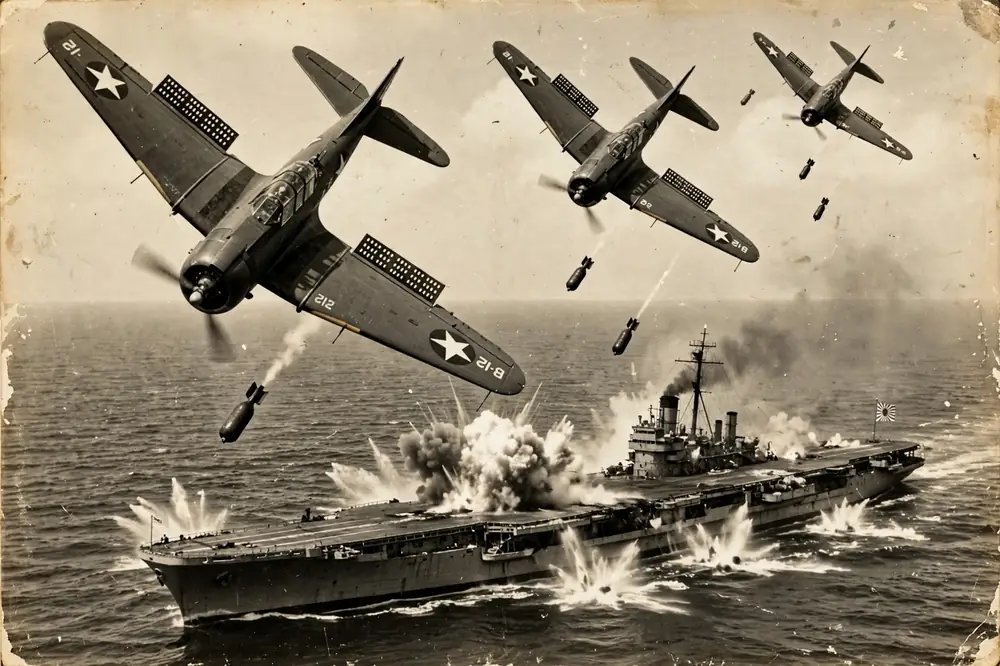
On 7 May, the Americans found the Japanese light carrier Shōhō, escorting the invasion fleet, and attacked it with aircraft from both carriers. The Shōhō was hit by more than a dozen bombs and torpedoes and sank within minutes, with the loss of about 600 of her crew. The American pilots reported, in the famous message, Scratch one flattop.
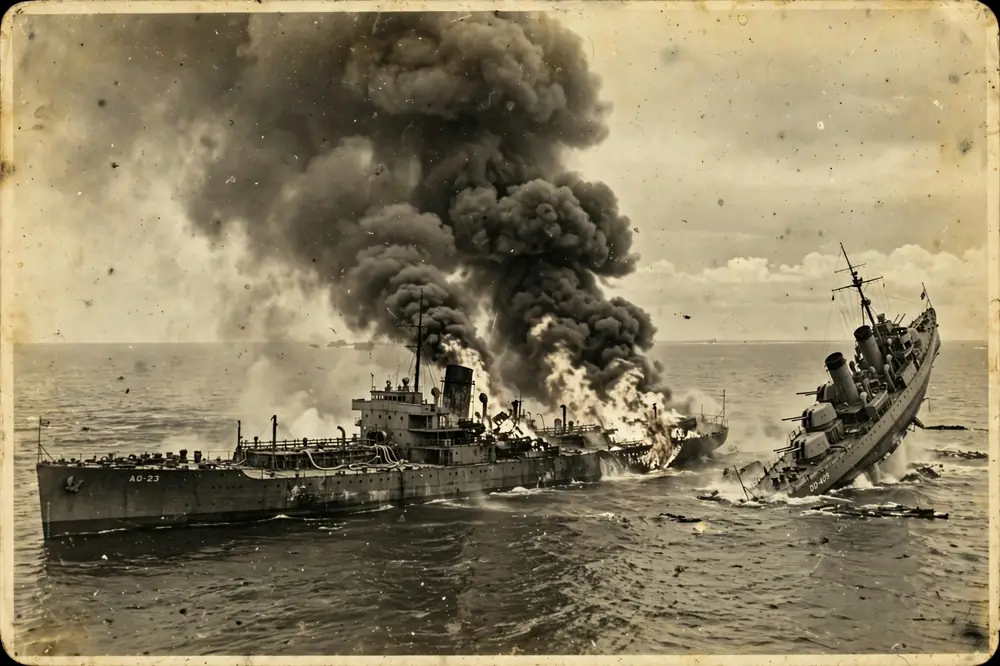
The Japanese, meanwhile, found the American oiler Neosho and the destroyer Sims, mistook them for a carrier and its escort, and attacked them: the Sims was sunk and the Neosho was left a burning wreck, though she survived and was later towed to port.
The day ended with the Japanese invasion fleet turning back: without air cover, after the loss of the Shōhō, Inoue ordered the Port Moresby invasion postponed, and the troops were put ashore in the Solomons instead.
The wounded of Battle of the Coral Sea depended on a chain of care that began with the man beside them. Stretcher-bearers carried them from the firing line, often under fire; aid stations, in a cellar, a ditch or a ruined house, gave them morphine and bandages; and if the roads allowed, they were evacuated to field hospitals and then further back. Many died of wounds that a modern hospital would have treated, and many lived because a comrade reached them in time. The medical story of the battle is inseparable from its casualty figures: the difference between killed and wounded, and between wounded and dead of wounds, is a measure of how well that chain worked.
5.3. The Crisis
The decisive day was 8 May. At dawn, both sides found the other’s carriers, and both launched full strikes. The American aircraft attacked the Shōkaku, hitting her with three bombs and setting her on fire; she survived, but her flight deck was wrecked and she could not launch or recover aircraft. The Zuikaku escaped in a rain squall and was not hit.
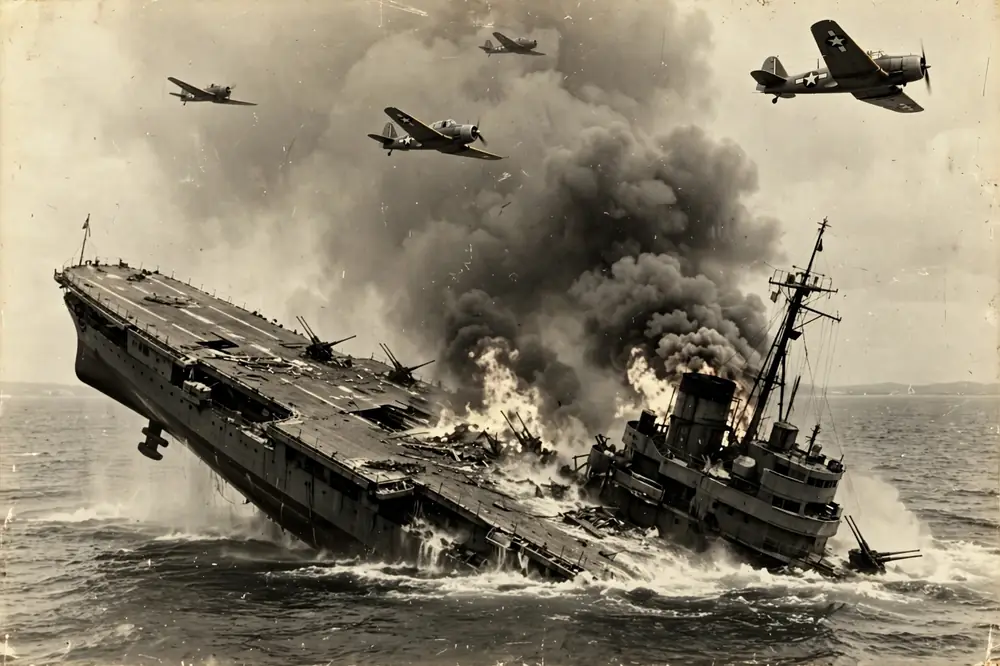
The Japanese aircraft attacked the American carriers, and the Lexington, the larger and less manoeuvrable of the two, was hit by two torpedoes and three bombs. The Yorktown was hit by a single bomb. The Lexington’s damage seemed at first to be under control, but fires spread through the ship, her aviation fuel lines ruptured, and a series of explosions tore her apart.
In the late afternoon, Fletcher ordered the Lexington abandoned, and the destroyer Phelps sank her with torpedoes. The Yorktown, damaged but afloat, withdrew to Pearl Harbor. Both sides had lost a carrier, and both claimed a victory.
Civilians were caught in Battle of the Coral Sea in ways that the military histories often pass over. Farmers, shopkeepers, children and the old found their villages turned into battlefields, their houses into strongpoints, their fields into minefields. Some fled, some hid in cellars, and some were killed by shells fired at targets they could not see. Their losses are the hardest to count, because no army kept their names, and their suffering is the part of the battle that has no memorial. Any honest account of Battle of the Coral Sea must remember that the battle was fought not on empty ground but in places where people lived, and that those people paid for it.
5.3.1. The Soldier’s Battle
For the soldiers, the battle was experienced in fragments: a long march or a cramped landing craft, a sudden burst of fire, hours of waiting under shelling, a short rush across open ground, and then the work of digging in again.
Orders from above arrived late or not at all, and junior officers and sergeants made the decisions that mattered, often with only a sketchy idea of what was happening a kilometre away. Communications were fragile — field telephones cut by shellfire, radios that failed in wet weather, runners who never arrived — and the picture in each headquarters was always hours behind the fighting.
That is why the history of Battle of the Coral Sea is written from many small accounts: a company diary, a pilot’s report, a surgeon’s notes, a prisoner’s interrogation. No single source sees the whole battle, and the historian’s task is to fit the fragments together without inventing the missing pieces.
5. Turning Point
6.1. The Decisive Moment
The turning point of the battle was the sinking of the Shōhō on 7 May, and the decision it forced on the Japanese commander. Without the Shōhō’s air cover, Inoue could not risk the invasion fleet against the American carriers, and he ordered the Port Moresby invasion postponed.
The strategic objective of the whole operation — the capture of Port Moresby — was abandoned, and it was never attempted again by sea: the Japanese later tried to take Port Moresby by land, over the Kokoda Track, and failed there too.
The battle of 8 May, the carrier duel, was tactically a Japanese victory — they sank the Lexington, and the Americans sank only the Shōhō — but the strategic decision had already been made on 7 May, and the carrier duel changed nothing about it.
The sources for Battle of the Coral Sea are uneven, and the historian must weigh them carefully. Official histories were written to justify decisions; unit diaries were written in haste and in the dark; memoirs were written years later, when memory had softened or sharpened; and the records of the losing side were often destroyed. Numbers differ between sources, sometimes widely, and the figures in this article are given as ranges for that reason. Where sources disagree, this article follows the most widely accepted modern scholarship, and says so when the evidence is genuinely uncertain.
6.2. The Tactical Lesson
A second turning point, visible only in hindsight, was the damage to the Shōkaku and the depletion of the Zuikaku’s air group on 8 May. The Shōkaku was so badly damaged that she needed months of repair, and the Zuikaku had lost so many of her pilots that she could not sail with a full air group.
Neither carrier could take part in the Battle of Midway, a month later, where the Japanese committed four carriers and lost all four. Had Shōkaku and Zuikaku been present at Midway, the battle might have gone differently, and the Pacific War might have lasted longer.
The Coral Sea, in that sense, was won not on 8 May, but in the repair yards and the pilot training schools, in the months that followed.
The numbers at Battle of the Coral Sea hide as much as they reveal. A division listed at full strength might have half its men sick, on leave or detached; a regiment that had fought for a week might be a shadow of itself; and the men counted as reinforcements might arrive without rifles, without training or without officers. Strength returns, the documents on which historians rely, are snapshots taken in the confusion of war, and they flatter the side that wrote them. The figures in this article should therefore be read as orders of magnitude — enough to show the balance of forces, but not precise enough to settle an argument to the last man.
6.2.1. How Turning Points Are Judged
Turning points are easy to name in hindsight and hard to recognise at the time, and Battle of the Coral Sea is no exception. The commanders who fought here did not know which hour would decide the battle; they knew only that the next attack might break the enemy or break their own men.
Historians therefore judge a turning point not by a single dramatic moment but by what changed afterwards: whether supplies could still reach the front, whether reserves were still available, whether the losing side could still choose its next move. At Battle of the Coral Sea, the change was visible in the orders that followed, in the ground that changed hands and stayed changed, and in the reports that grew more confident on one side and more desperate on the other.
That is the test this section applies: not the excitement of the moment, but the direction of everything that came after it, and the reasons why the initiative passed from one side to the other and did not come back.
6. Casualties and Losses
7.1. The Human Cost
The casualty figures for the Coral Sea are small beside the great land battles of the war, but they were heavy for a naval battle fought in two days. The Americans lost 656 men killed, including about 200 from the Lexington, and 69 aircraft. The Japanese lost 966 men killed, including about 600 from the Shōhō, and 92 aircraft.
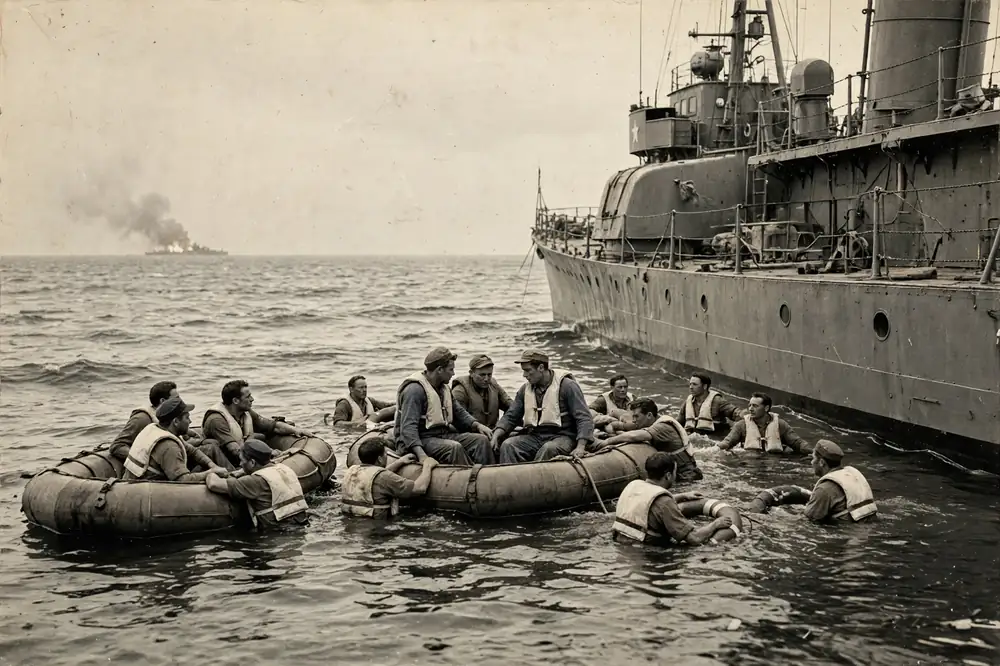
The material losses were more important than the human ones: the Americans lost a fleet carrier, the Lexington, a destroyer and an oiler, and the Yorktown was damaged; the Japanese lost a light carrier and a destroyer, and the Shōkaku was damaged.
The Yorktown was repaired in time for Midway, in one of the great feats of the Pearl Harbor navy yard, while the Shōkaku was not, and that difference decided the next battle.
Supply decided more of Battle of the Coral Sea than any single order. Ammunition, fuel, food and water had to travel from depots far behind the lines, over roads that were shelled, mined or washed out, and every delay at the front was felt first in the supply columns.
The side that kept its guns fed and its men fed could keep attacking; the side that could not was forced to stop, however good its plan. At Battle of the Coral Sea, as in most battles of this period, the quartermasters and the drivers mattered as much as the generals, and the battle’s turning points can often be traced to a convoy that arrived — or did not arrive — in time.
7.2. Counting the Losses
The figures are not disputed in their broad outlines, though the exact numbers of aircraft lost differ slightly between American and Japanese sources. The American figures are taken from the official reports of Task Force 17, and the Japanese figures from the records of the Combined Fleet, and the two sets of records agree closely. What is disputed is not the count but the judgement: whether the battle was a Japanese victory, because they sank more tonnage, or an Allied victory, because they stopped the invasion of Port Moresby and crippled two Japanese carriers. Modern historians generally call it a tactical Japanese victory and a strategic Allied victory, and that judgement has stood for eighty years.
| | United States and Australia | Japan |
|—|—|—|—|
| Killed | 656 / 656 | 966 / 966 |
| Ships lost | 1 fleet carrier (Lexington), 1 destroyer, 1 oiler | 1 light carrier (Shōhō), 1 destroyer |
| Ships damaged | Yorktown (bomb damage) | Shōkaku (bomb damage); Zuikaku (air group depleted) |
| Aircraft lost | 69 / 69 | 92 / 92 |
Neither side at Battle of the Coral Sea knew as much about the enemy as its commanders pretended. Reports were late, contradictory or simply wrong: prisoners exaggerated, scouts saw only a fragment of the front, and aerial photographs showed positions that had already been abandoned. Commanders filled the gaps with assumptions, and those assumptions decided battles. The history of Battle of the Coral Sea is full of such judgements — an enemy division believed to be elsewhere, a flank thought secure, a strength underestimated by half — and the side whose assumptions were closest to the truth usually won, not because its generals were cleverer, but because its information was better.
7.2.1. Wounds, Burial and Records
Behind every casualty figure lies a medical system under strain. Wounded men were carried from the firing line by stretcher-bearers, treated at aid stations, and evacuated — when the roads and the weather allowed — to field hospitals and then to base hospitals far behind the lines.
Many of the wounded at Battle of the Coral Sea died not on the battlefield but of wounds, shock and infection in the hours and days that followed, and the difference between life and death often came down to how quickly a man could be reached and how far he had to travel.
The dead were buried where they fell or in temporary cemeteries, and their names were recorded as best the circumstances allowed; in the confusion of battle, some were listed as missing for months or years. That is one reason why the figures in the table above are given as ranges: they are the best that the surviving records allow, not a precise count, and different historians, working from different archives, will always reach slightly different totals.
7. Map and Geography
8.1. The Ground
The Coral Sea is a vast, warm sea between Australia, New Guinea and the Solomon Islands, bounded by the Great Barrier Reef to the west and the open Pacific to the east. Its waters are clear and deep, its weather is tropical, with sudden rain squalls that can hide a ship from aircraft, and its distances are enormous: the two carrier forces searched for each other over hundreds of kilometres of empty ocean, and the battle was fought at ranges that would have been impossible for gun-armed ships.
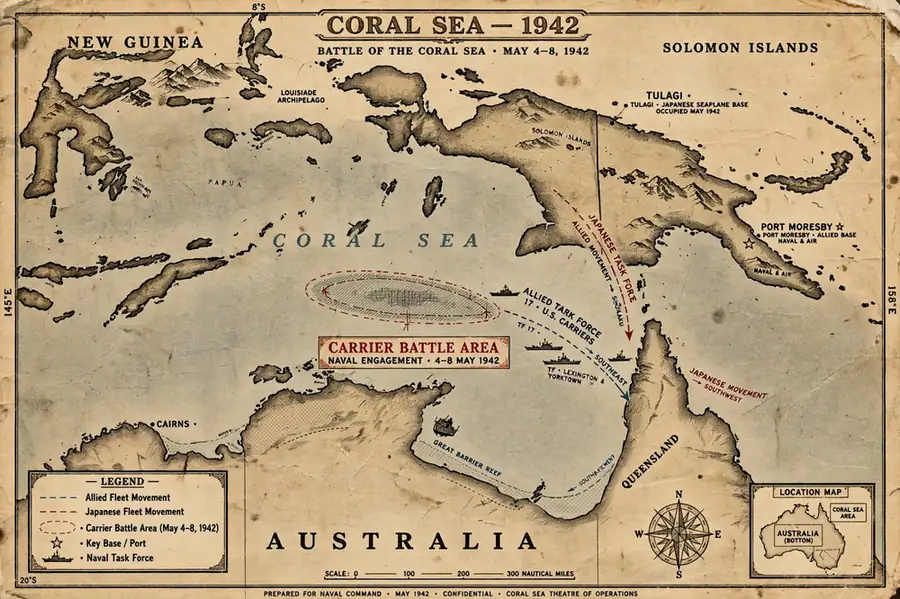
The sea’s geography shaped the battle in a single, decisive way: it was too big for the fleets to find each other easily, and the battle was decided by scouting, by the aircraft that found the enemy first, and by the luck of the weather.
Orders at Battle of the Coral Sea travelled slowly and unreliably. Field telephones depended on wires that shellfire cut within minutes; radios were heavy, short-ranged and easily intercepted; and in the end much depended on runners — men who carried written orders across open ground under fire, and who sometimes never arrived. A battalion could fight for hours without knowing what its neighbours were doing, and a division could learn of a breakthrough only when the enemy appeared in its rear. The battle therefore has to be understood as a dozen small battles fought in partial ignorance of each other, held together by a command system that was always one step behind events.
8.2. Why the Ground Mattered
The strategic geography mattered more than the sea itself. Port Moresby, on the southern coast of New Guinea, was the last Allied base in the island, and its capture would have put Japanese bombers within range of northern Australia and cut the supply line between America and Australia. Tulagi, in the Solomons, was a seaplane base that guarded the approaches to the Coral Sea. The Japanese plan was to take both, and then to advance on Australia itself; the American plan was to hold Port Moresby at all costs. The Coral Sea, in 1942, was the frontier between the Japanese empire and the Allied world, and the battle fought there decided which side would hold the frontier.
The ground at Battle of the Coral Sea rewarded the side that studied it. A ridge, a river, a wood or a ruined village could be worth a battalion, and commanders who had walked the ground — or who listened to the men who had — gained advantages that no map could give. The fighting followed the ground: attacks went where the ground allowed them, defences were built where the ground was strong, and the deadliest places in the battle were the places where the ground gave one side a clear field of fire and the other no cover at all. To read the battle without the map is to miss half of it.
8.2.1. Weather and Season
Weather and season were as much a part of Battle of the Coral Sea as any general’s plan. Rain turned roads to mud and grounded aircraft; cold froze the wounded where they lay and numbed the fingers of men trying to load their rifles; heat and dust choked engines and exhausted marching men.
Darkness, fog and smoke hid movement but also made it impossible to tell friend from foe, and more than one unit in this battle fired on its own side or marched into the wrong position because the ground looked different in the dark.
Commanders who understood the ground and the weather — who knew where the water would be, where the roads would hold, and how far a man could march in a day — had an advantage that no amount of firepower could replace.
The map of Battle of the Coral Sea is therefore not only a record of where the fighting happened, but a reminder that geography and climate are actors in every battle, not merely its stage.
8. Outcome and Legacy
9.1. The Immediate Result
The Battle of the Coral Sea changed the Pacific War in two ways. First, it stopped the Japanese advance on Port Moresby, and with it the Japanese threat to Australia. The Japanese never again attempted to take Port Moresby by sea, and their later attempt by land, over the Kokoda Track, was defeated by Australian and American troops in the mountains of New Guinea.
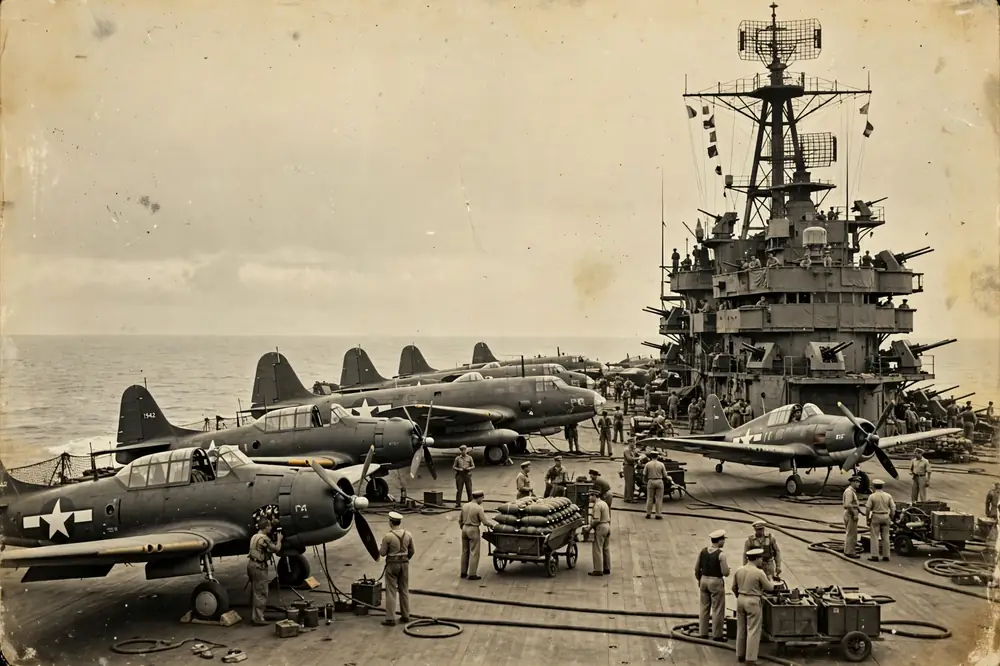
Second, it crippled the Japanese carrier force on the eve of Midway. The Shōkaku and the Zuikaku, the two carriers that fought at the Coral Sea, were both put out of action — the Shōkaku badly damaged and needing months of repair, the Zuikaku with her air group depleted — and their absence at Midway left the Japanese with four carriers against three American — a balance that proved fatal when the Americans sank all four.
The weapons used at Battle of the Coral Sea shaped the fighting in ways that the men who carried them understood better than their generals. A rifle that jammed in mud, a machine gun that could sweep a street, a tank that could not climb a slope, an artillery piece that could be heard but not seen — each weapon had its range, its rate of fire and its weakness, and battles were won by the side that matched its weapons to the ground.
The technical details matter: the calibre of a gun, the thickness of a tank’s armour, the range of a radio. They are not footnotes to the battle; they are the reason the battle took the shape it did.
9.2. The Longer Legacy
The battle’s legacy is the legacy of the carrier itself. The Coral Sea was the first battle fought entirely by aircraft, and it proved that the carrier, not the battleship, was now the capital ship of naval warfare. The battleship admirals, who had dominated naval thinking for a century, were proved wrong in two days in the Coral Sea, and the navies of the world have been built around the carrier ever since.
The Lexington, sunk at the Coral Sea, was the first American fleet carrier lost in the war, and her wreck was found in 2018, on the floor of the Coral Sea, more than three kilometres down, a reminder that the battle is still there, in the deep water, waiting to be remembered.
Morale at Battle of the Coral Sea was not a slogan but a physical fact. Men who had eaten, slept and believed in their officers fought differently from men who were hungry, exhausted and leaderless, and the same unit could be brave on one day and broken on the next.
Fear was universal — veterans admitted it freely — and what kept men fighting was rarely hatred of the enemy but loyalty to the men beside them, the shame of running, and the simple habit of obeying orders. The battle’s histories often describe morale as if it were a quality of armies; at Battle of the Coral Sea it was a quality of small groups of men, and it could collapse in a single afternoon.
9.2.1. How Historians Judge the Battle
Historians still argue about Battle of the Coral Sea, and the argument is part of the battle’s legacy. Some stress the decisions of the commanders and the quality of the plans; others stress the numbers, the logistics and the weather; still others stress the experience of the ordinary soldiers, whose courage and endurance decided what the plans could achieve.
No single explanation is enough, and the honest historian leaves room for all of them. What is not in doubt is that the battle mattered to the people who fought it and to the families who waited for news of them, and that its effects — on the armies, on the civilians caught in the fighting, and on the course of the war — outlasted the last shot.
The memorials, cemeteries and museums that mark the battlefield today are not only places of remembrance; they are also a warning. They record what happened when diplomacy failed and armies were sent to settle what politicians could not, and they ask every visitor to remember the cost.
9. Commanders
10.1. The Allied Commanders
Rear Admiral Frank Jack Fletcher (United States). Commander of Task Force 17 at the Coral Sea. Fletcher, a veteran of the surface navy, commanded the American carriers in the first carrier battle in history, and made the decision to withdraw the Yorktown after the loss of the Lexington. He later commanded at Midway and at Guadalcanal.
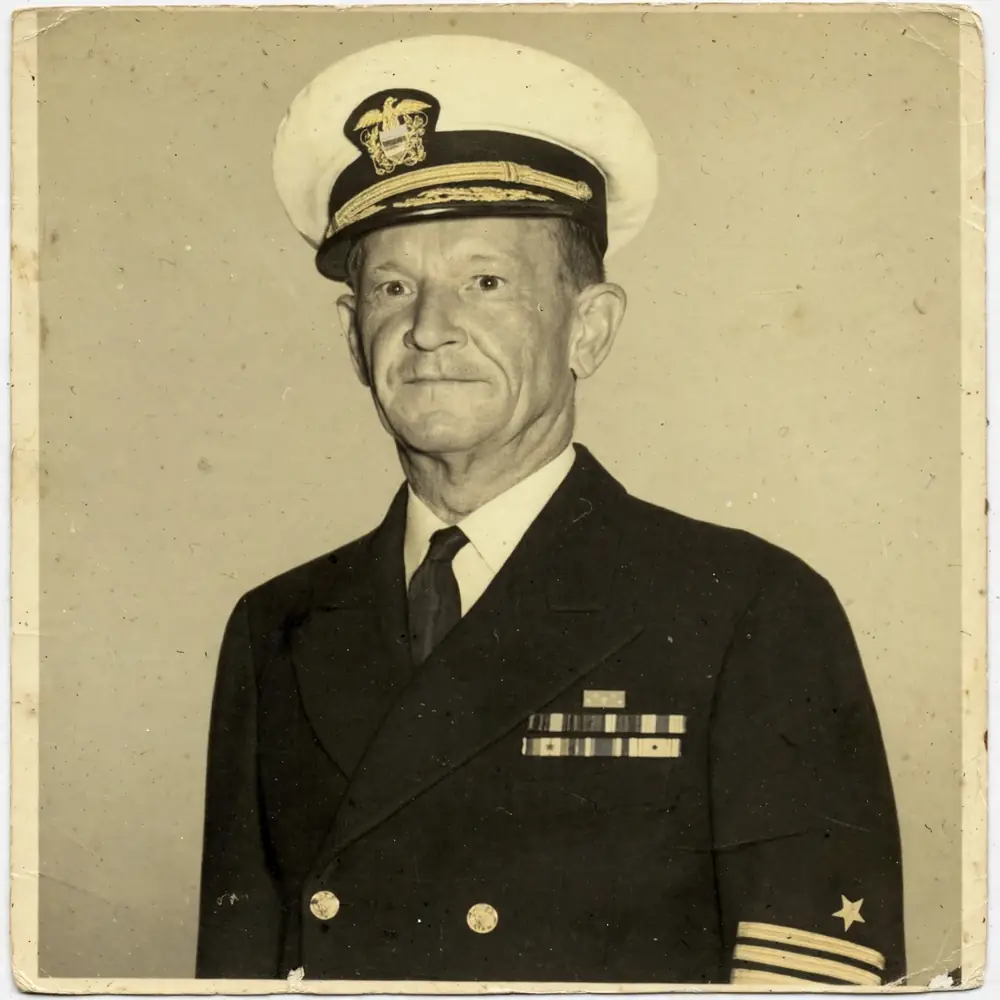
Admiral Chester Nimitz (United States). Commander-in-chief of the Pacific Fleet, who sent Fletcher to the Coral Sea on the basis of the codebreakers’ intelligence. Nimitz’s decision to risk his carriers to save Port Moresby was the strategic gamble that the battle turned on.
The wounded of Battle of the Coral Sea depended on a chain of care that began with the man beside them. Stretcher-bearers carried them from the firing line, often under fire; aid stations, in a cellar, a ditch or a ruined house, gave them morphine and bandages; and if the roads allowed, they were evacuated to field hospitals and then further back. Many died of wounds that a modern hospital would have treated, and many lived because a comrade reached them in time. The medical story of the battle is inseparable from its casualty figures: the difference between killed and wounded, and between wounded and dead of wounds, is a measure of how well that chain worked.
10.2. The Australian Cruiser Force and the Japanese Carriers
Rear Admiral John Crace (Australia). Commander of the Allied cruiser force at the Coral Sea, including the Australian cruisers Australia and Hobart. Crace’s force guarded the approaches to Port Moresby and was attacked by Japanese aircraft on 7 May, but suffered no losses.
Vice Admiral Takeo Takagi (Japan). Commander of the Japanese carrier force at the Coral Sea. Takagi’s carriers sank the Lexington but lost the Shōhō and suffered damage that kept them out of the Battle of Midway. He later commanded Japanese forces in the Solomons.
Civilians were caught in Battle of the Coral Sea in ways that the military histories often pass over. Farmers, shopkeepers, children and the old found their villages turned into battlefields, their houses into strongpoints, their fields into minefields. Some fled, some hid in cellars, and some were killed by shells fired at targets they could not see. Their losses are the hardest to count, because no army kept their names, and their suffering is the part of the battle that has no memorial. Any honest account of Battle of the Coral Sea must remember that the battle was fought not on empty ground but in places where people lived, and that those people paid for it.
10.3. The Japanese Operation Commanders
Vice Admiral Shigeyoshi Inoue (Japan). Overall commander of the MO operation, the invasion of Port Moresby. Inoue ordered the invasion postponed after the loss of the Shōhō, the decision that made the battle a strategic Allied victory.
Rear Admiral Aritomo Gotō (Japan). Commander of the Japanese cruiser screen at the Coral Sea. Gotō’s ships escorted the invasion force and the carriers, and he was later killed in the naval battle off Savo Island in August 1942.
The sources for Battle of the Coral Sea are uneven, and the historian must weigh them carefully. Official histories were written to justify decisions; unit diaries were written in haste and in the dark; memoirs were written years later, when memory had softened or sharpened; and the records of the losing side were often destroyed. Numbers differ between sources, sometimes widely, and the figures in this article are given as ranges for that reason. Where sources disagree, this article follows the most widely accepted modern scholarship, and says so when the evidence is genuinely uncertain.
10.3.1. Command and Responsibility
Command at Battle of the Coral Sea carried a weight that is hard to grasp from the safety of hindsight. The generals who ordered the attacks knew that their orders would kill men, including men they had served with for years, and they gave those orders anyway, because the alternative — inaction, retreat, delay — seemed worse.
Some of them were right and some were wrong, and history has judged them accordingly, but the judgement is rarely simple: a commander who was cautious at Battle of the Coral Sea might have been reckless elsewhere, and a commander who won here might have done so by spending lives that a better plan would have saved. The biographies in this section should be read with that in mind.
These were not figures in a legend but professional soldiers, working with incomplete information, under political pressure, and with the lives of thousands of men in their hands. Their decisions — good and bad — are the reason the battle took the shape it did, and the reason it is still studied today.
10. Frequently Asked Questions
When was the Battle of the Coral Sea fought?
From 4 to 8 May 1942. The main carrier battle was fought on 7 and 8 May, and the Lexington was sunk on the afternoon of 8 May.
Why is the Coral Sea called the first carrier battle?
Because it was the first naval battle in which the opposing ships never saw each other and never fired a gun at each other. The entire battle was fought by aircraft launched from carriers over the horizon from one another.
Who won the Battle of the Coral Sea?
Tactically, Japan: the Japanese sank the fleet carrier Lexington, while the Americans sank only the light carrier Shōhō. Strategically, the Allies: the invasion of Port Moresby was stopped, and the Japanese carriers Shōkaku and Zuikaku were damaged and depleted and could not fight at Midway.
What happened to the Lexington?
The Lexington was hit by two torpedoes and three bombs on 8 May 1942. Fires spread through the ship, her fuel lines ruptured, and she was abandoned and sunk by the destroyer Phelps. Her wreck was found in 2018, more than three kilometres down on the floor of the Coral Sea.
How did the Americans know the Japanese were coming?
The United States Navy had broken the Japanese naval code, JN-25, and the codebreakers at Pearl Harbor, under Commander Joseph Rochefort, read enough of the Japanese messages to know that an operation against Port Moresby was planned for early May 1942.
What was the connection between the Coral Sea and Midway?
The Japanese carriers Shōkaku and Zuikaku, damaged and depleted at the Coral Sea, could not take part in the Battle of Midway a month later. The Japanese fought Midway with four carriers instead of six, and lost all four — a defeat that decided the Pacific War.
11. Sources
- Wikipedia, “Battle of the Coral Sea” — dates, commanders, strength and casualty figures.
- Samuel Eliot Morison, History of United States Naval Operations in World War II, Vol. IV, Coral Sea, Midway and Submarine Actions (Little, Brown, 1949) — the official American naval history.
- Encyclopædia Britannica, “Battle of the Coral Sea” — background and significance.
- John B. Lundstrom, The First Team: Pacific Naval Air Combat from Pearl Harbor to Midway (Naval Institute Press, 1984) — the carrier air war.
- H. P. Willmott, The Barrier and the Javelin: Japanese and Allied Pacific Strategies, February to June 1942 (Naval Institute Press, 1983) — the Japanese MO operation.