 WAR ATLAS MILITARY HISTORY MAGAZINE · WWI — WWII
Battle of Verdun
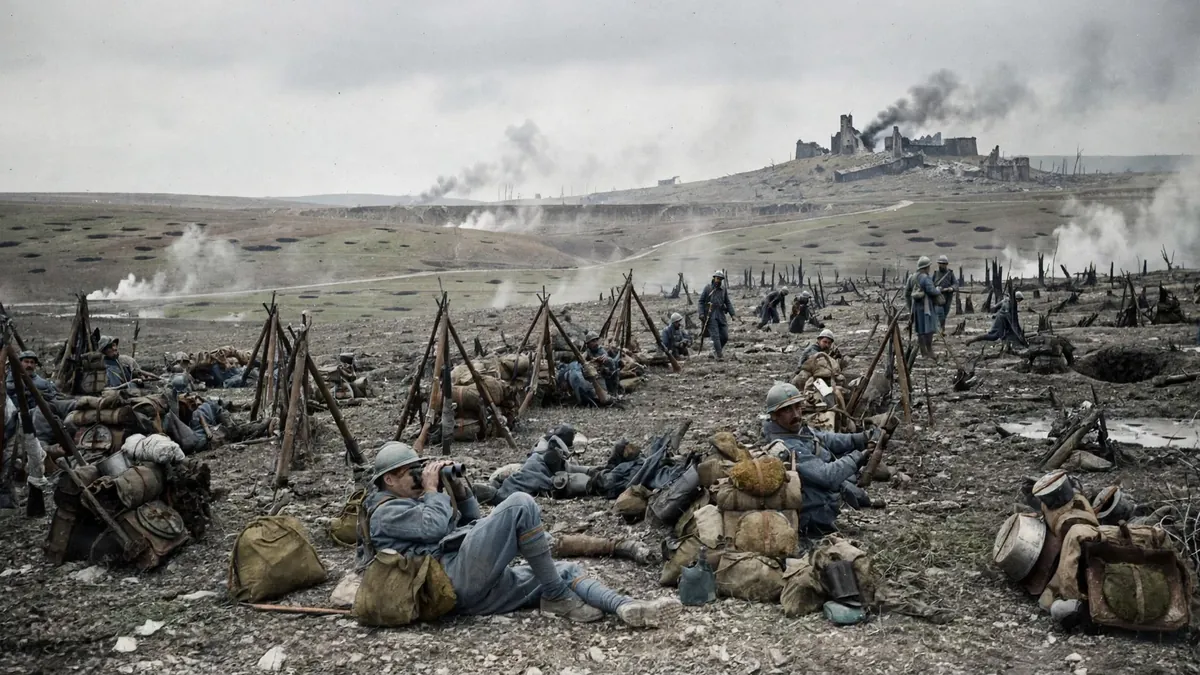
The Battle of Verdun was the longest battle of the First World War, fought from 21 February to 18 December 1916, around the fortress city of Verdun in north-eastern France. It was the battle the German Chief of Staff, Erich von Falkenhayn, designed not to take ground, but to kill Frenchmen: he would attack a place the French could not abandon, and he would bleed the French Army white.
The battle did bleed France white — and it bled Germany white too. About 700,000 men were killed or wounded on both sides, for a few kilometres of shattered ground, and the battle’s two forts — Douaumont and Vaux — changed hands in fighting that lasted months.
Verdun became the symbol of French resistance, and of the horror of the First World War: the French cry “Ils ne passeront pas!” — “They shall not pass!” — is still, in France, the motto of the battle, and the ossuary at Douaumont, which holds the bones of 130,000 unidentified soldiers, is still the most visited battlefield memorial in France.
1. Key Facts
| Date | 21 February – 18 December 1916 |
| Location | Verdun, Meuse, north-eastern France |
| Result | French victory; the Germans fail to take Verdun; the front returns to roughly its starting position |
| French commanders | Gen. Joseph Joffre (commander in chief); Gen. Philippe Pétain (2nd Army, February–May); Gen. Robert Nivelle (2nd Army, May–December) |
| German commanders | Gen. Erich von Falkenhayn (Chief of Staff, author of the plan); Crown Prince Wilhelm (5th Army) |
| French strength | About 30 divisions in the line at the start; about 70 divisions rotated through Verdun during the battle |
| German strength | About 20 divisions at the start; about 50 divisions during the battle |
| French losses | About 350,000–400,000 killed, wounded and missing |
| German losses | About 330,000–350,000 killed, wounded and missing |
2. Background
Verdun was a fortress city on the River Meuse, in north-eastern France, about 250 kilometres east of Paris. It had been a fortress since the Romans, and in the 19th century it had been fortified by the engineer Séré de Rivières into a ring of forts — Douaumont, Vaux, Souville, Moulainville and others — that guarded the approaches to the city. Verdun was also a symbol: it was the city where, in 843, the Treaty of Verdun had divided the empire of Charlemagne, and it was the place where, in 1792, the French had stopped the Prussian invasion. The French could not abandon Verdun, and the Germans knew it.
The German plan, drawn up by the Chief of Staff, Erich von Falkenhayn, in December 1915, was not to take Verdun, but to use it to destroy the French Army. Falkenhayn’s memorandum to the Kaiser, written on Christmas Day 1915, is one of the most famous documents of the war: he argued that Germany could not win the war by a breakthrough on the Western Front, because the Allies were too strong, and that the war would be won by attrition — by killing more of the enemy than Germany lost.
France, he argued, was the weak point: its army was smaller than Germany’s, its population was smaller, and if Germany attacked a place France could not abandon, the French would send division after division to defend it, and the German artillery would kill them.
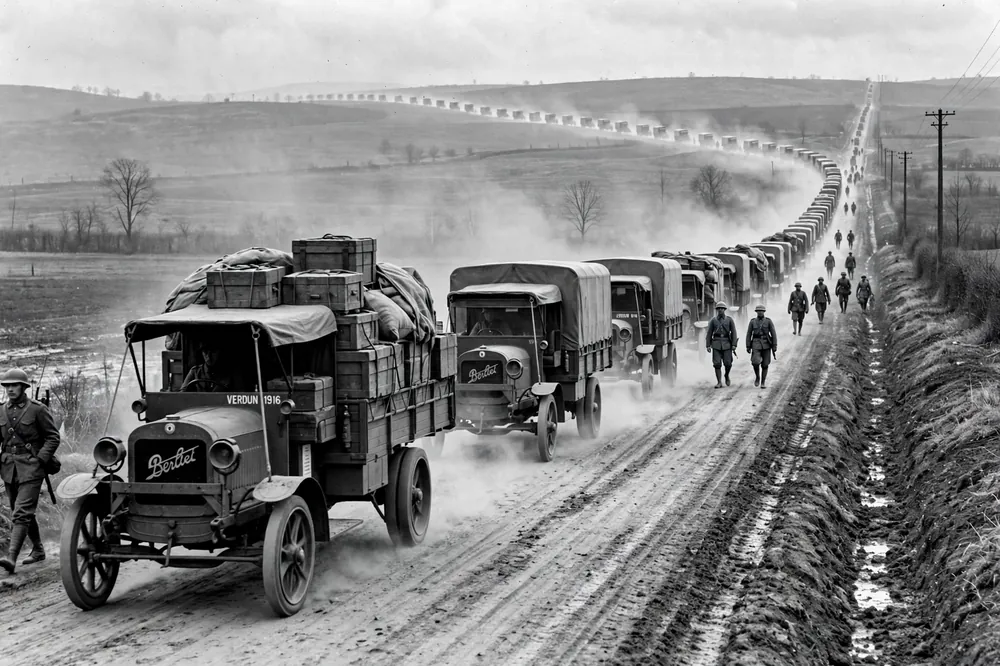
Verdun was the place: it was a salient, a bulge in the French line, surrounded on three sides by the Germans, and it was connected to the rest of France by a single narrow road — the Voie Sacrée, the Sacred Way — and a single narrow-gauge railway. The Germans would attack, the French would defend, and the German guns would do the killing.
The French, for their part, had neglected Verdun. The fortress’s guns had been removed in 1915, to arm the field armies, and the forts had been stripped of their garrisons. The French commander in chief, Joseph Joffre, believed that Verdun was a quiet sector, and he had sent its best divisions to other fronts.
When the German attack came, on 21 February 1916, the French were caught by surprise: the forts were empty, the trenches were shallow, and the men who held the line were second-line troops. The German bombardment — the heaviest of the war to that point, with about 1,200 guns firing about 2 million shells in the first days — shattered the French defences, and the German infantry advanced.
The French response was to send a general who would become the hero of Verdun: Philippe Pétain, commander of the 2nd Army, who took command of the defence on 25 February. Pétain’s first order was to hold the line, and his second was to organise the supply: the Voie Sacrée, the single road from Bar-le-Duc to Verdun, became the lifeline of the battle, with a truck passing every 14 seconds, day and night, carrying men, food and ammunition to the front, and carrying the wounded back.
Pétain also introduced the system of rotation — the noria, the waterwheel — by which French divisions were sent to Verdun for a few weeks, and then withdrawn to rest, so that no division was destroyed outright. The system meant that, by the end of the battle, about 70 French divisions — most of the French Army — had fought at Verdun.
3. Opposing Forces
The German attack was made by the 5th Army, under Crown Prince Wilhelm, the Kaiser’s eldest son, with about 20 divisions at the start, and with about 1,200 guns — the largest concentration of artillery in the war to that point.
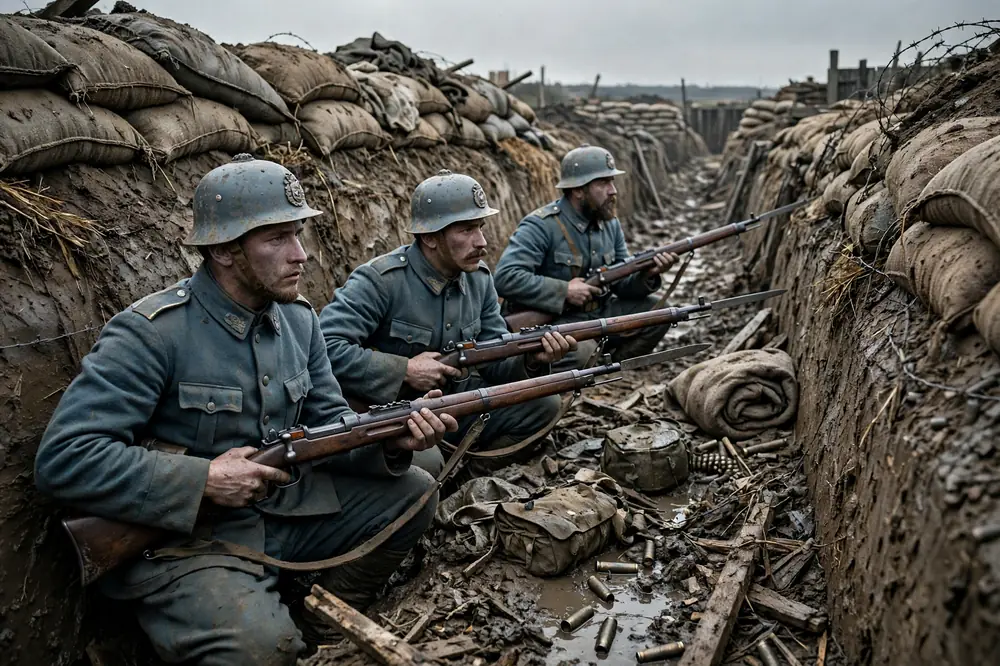
The German infantry were veterans, and they were supported by the new weapons of the war: flamethrowers, which were used for the first time on a large scale at Verdun, and poison gas. The French defence was made by the 2nd Army, under Pétain, with about 30 divisions in the line at the start, and with the forts — Douaumont, Vaux, Souville — as the anchors of the defence.
The French artillery was weaker than the German, at first, but it grew stronger as the battle went on, and by the autumn the French had more guns than the Germans.
| France | Germany | |
|---|---|---|
| Divisions at the start | About 30 | About 20 |
| Divisions during the battle | About 70 rotated through | About 50 |
| Guns | About 800 at the start; rising to over 2,000 by the autumn | About 1,200 at the start |
| Aircraft | Growing air force; the escadrilles of the French Air Service | Growing air force; the first fighter squadrons |
| Forts | Douaumont, Vaux, Souville, Moulainville and others — the ring around Verdun | — |
| Supply | The Voie Sacrée — a single road, a truck every 14 seconds | Railways from the German rear |
| Commanders | Joffre (commander in chief); Pétain (February–May); Nivelle (May–December) | Falkenhayn (Chief of Staff); Crown Prince Wilhelm (5th Army) |
The French system of rotation — the noria — was the key to the French defence. No French division stayed at Verdun for more than a few weeks, and no division was destroyed outright. The system meant that the French Army as a whole was bled, but no single division was annihilated, and the French could keep feeding men into the battle.
The Germans, by contrast, kept their divisions in the line for longer, and their divisions were worn down. The German plan — to bleed France white — bled Germany white too, because the German artillery, which was supposed to do the killing, could not kill the French faster than the French could replace them, and the German infantry, which was supposed to take the ground, had to fight for every metre.
The battle was also an air battle: Verdun was the first battle in which air power played a major role, with the French and German air services fighting for control of the skies over the battlefield. The French ace Georges Guynemer, and the German ace Oswald Boelcke, fought over Verdun, and the battle saw the first use of fighter squadrons — the escadrilles de chasse — as a distinct arm. The air war over Verdun was a prelude to the air wars of the later war.
4. The Battle
The German attack, February–March 1916
The battle began on 21 February 1916, with a bombardment of unprecedented intensity: about 1,200 German guns fired about 2 million shells in the first days, and the French trenches on the right bank of the Meuse were shattered. The German infantry, attacking on a front of about 15 kilometres, advanced rapidly: by 24 February they had taken the French first line, and on 25 February they took Fort Douaumont — the largest and most important fort in the ring around Verdun — almost without a fight.
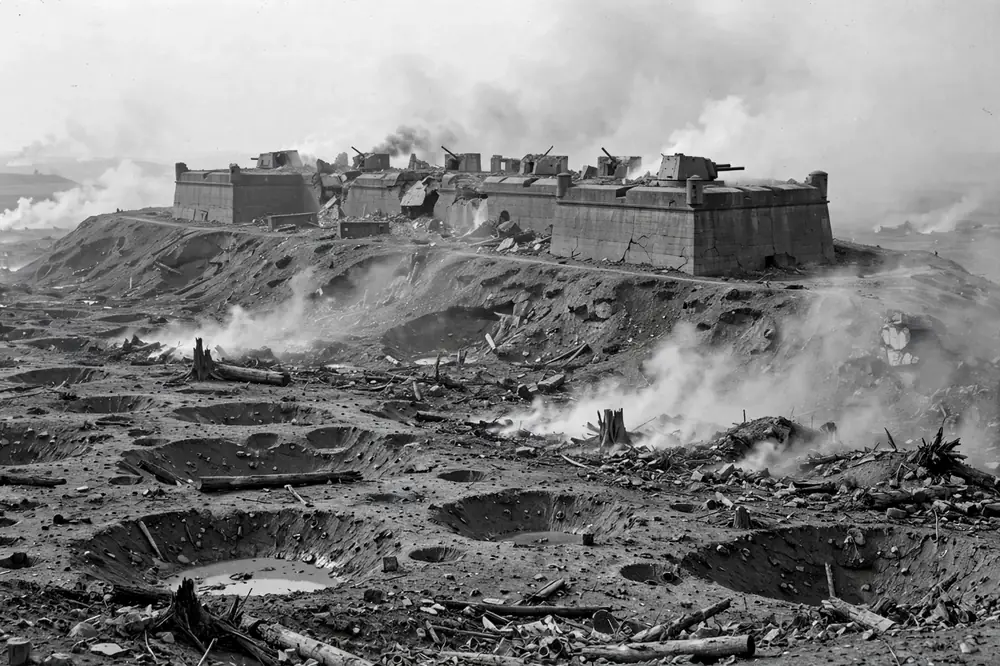
The fort’s garrison, a handful of men, had been caught by surprise, and the Germans walked in through an unguarded entrance. The fall of Douaumont was a shock to France, and it was the moment when Verdun became a national cause: the French press, the French government and the French people demanded that Verdun be held, and Pétain, who had taken command on 25 February, gave the order that became the battle’s motto: “Ils ne passeront pas!” — “They shall not pass!”
The German advance continued through March, but it slowed: the French, reinforced by Pétain’s noria, held the line on the left bank of the Meuse, at the Mort-Homme and Côte 304 — the two hills that guarded the approaches to Verdun from the west — and on the right bank, at Fort Vaux and Fort Souville. The fighting was in the mud and the shattered woods of the Meuse heights, and it was fought at close quarters, with flamethrowers, grenades and bayonets. The German infantry, which had advanced easily in February, found itself fighting for every metre, and the German artillery, which had destroyed the French trenches, could not destroy the French will to hold.
Fort Vaux, June 1916
The fighting for Fort Vaux, in June 1916, was the most famous episode of the battle after Douaumont. The fort, a small concrete fort on the right bank of the Meuse, was held by a garrison of about 250 men under Major Sylvain-Eugène Raynal.
The Germans attacked the fort on 2 June, and the garrison held out for five days, fighting in the dark, in the tunnels of the fort, with grenades and bayonets, and without water — the fort’s water supply had been cut, and the men were dying of thirst.
Raynal sent a last message by carrier pigeon: “We are still holding, but we are dying of thirst.” On 7 June, the garrison surrendered, after five days of fighting, and the Germans took the fort. The defence of Vaux became a legend in France, and Raynal became a national hero. The fort was retaken by the French in November, after a long siege.
The French counteroffensive, October–December 1916
The battle turned in the autumn. In October, General Robert Nivelle, who had succeeded Pétain as commander of the 2nd Army in May, launched a counteroffensive, with a new tactic: the creeping barrage, in which the artillery fired a moving curtain of shells just ahead of the infantry, and the infantry advanced behind it.
The French retook Fort Douaumont on 24 October, and Fort Vaux on 2 November, and by December they had retaken most of the ground lost in February and March. The battle ended on 18 December 1916, with the front roughly where it had been in February.
The Germans had failed to take Verdun, and they had failed to bleed France white: the French had lost about 350,000 to 400,000 men, and the Germans had lost about 330,000 to 350,000. The battle was a French victory, but it was a victory that had cost France a generation.
5. Turning Point
The turning point of the Battle of Verdun was 25 February 1916 — the day Fort Douaumont fell, and the day Pétain took command. The fall of Douaumont was a shock, but it was also the moment when Verdun became a national cause, and when the French committed themselves to holding the city at any cost. Pétain’s organisation — the Voie Sacrée, the noria, the order to hold — turned a disaster into a defence, and the defence held. Had the French abandoned Verdun after Douaumont, the battle would have ended in February, and the Germans would have won. Instead, the French held, and the battle became a ten-month siege.
The second turning point was the failure of the German plan itself. Falkenhayn’s plan — to bleed France white by attacking a place France could not abandon — assumed that the German artillery would kill the French faster than the French could replace them. It did not: the French, through the noria, replaced their losses, and the Germans, who kept their divisions in the line longer, were worn down. The battle bled both armies white, and by the summer of 1916, Falkenhayn’s plan had failed. Falkenhayn was dismissed in August 1916, and replaced by Hindenburg and Ludendorff, who ended the offensive at Verdun and turned to other fronts.
The third turning point was the French counteroffensive of October 1916. Nivelle’s use of the creeping barrage, and the recapture of Douaumont and Vaux, proved that the French could attack as well as defend, and that the Germans could be driven back. The counteroffensive did not win the war, but it won the battle: by December, the front was back where it had been in February, and Verdun was still French. The battle’s outcome — a French victory, at a terrible cost — was decided in the autumn, not in the spring.
6. Casualties and Losses
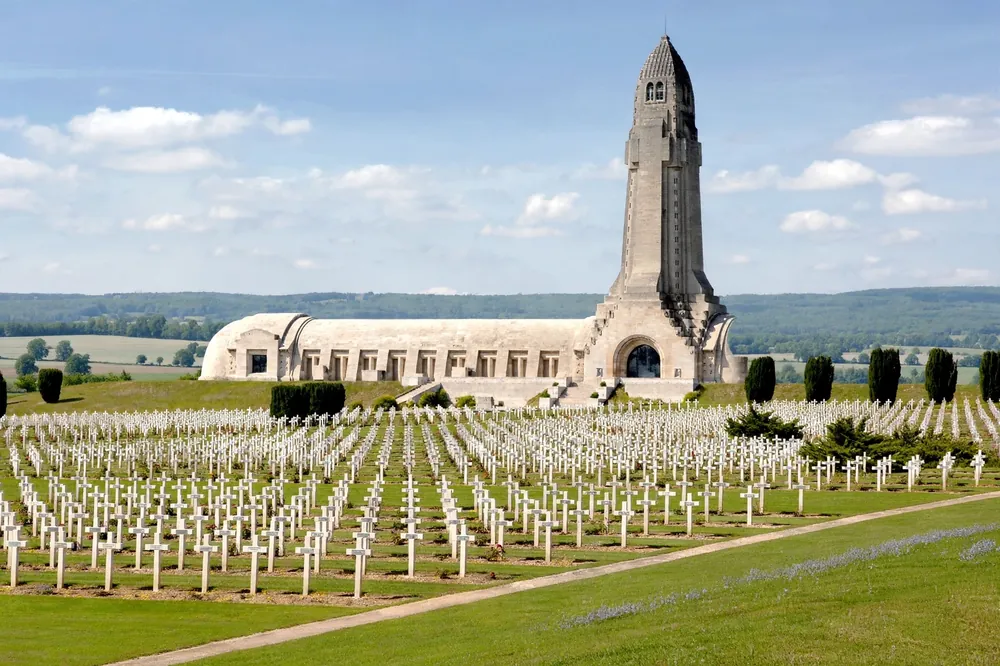
The casualties of the Battle of Verdun were about 700,000 in total, and the figures are among the most debated of the First World War. The French official history gives about 350,000 to 400,000 French casualties, and the German official history gives about 330,000 to 350,000 German casualties. The combined total was about 700,000 men killed, wounded or missing in ten months, for a few kilometres of ground.
| France | Germany | |
|---|---|---|
| Killed | About 160,000–200,000 (estimates vary) | About 140,000–160,000 (estimates vary) |
| Wounded and missing | About 200,000 | About 190,000 |
| Total | About 350,000–400,000 | About 330,000–350,000 |
| Divisions engaged | About 70 | About 50 |
The French losses fell on the whole army: about 70 French divisions — most of the French Army — fought at Verdun, and the battle’s losses were spread across the country. The German losses fell on the 5th Army, and on the divisions that were sent to reinforce it. The battle’s most terrible monument is the Douaumont Ossuary, which holds the bones of about 130,000 unidentified French and German soldiers, collected from the battlefield after the war. The ossuary, and the cemetery beside it, with its 15,000 graves, are the most visited battlefield memorial in France, and they are a reminder that Verdun was not a battle for ground, but a battle for men — and that both sides lost.
The battle’s losses were also a political fact: Verdun bled France white, in the sense that Falkenhayn had intended, but it bled Germany white too, and it left both armies exhausted. The French Army, which had fought at Verdun, was the army that mutinied in 1917, after the failure of Nivelle’s offensive on the Chemin des Dames. The German Army, which had fought at Verdun, was the army that could not win the war in 1918. Verdun did not decide the war, but it decided that the war would be long, and that it would be won by attrition, not by a breakthrough.
7. Map and Geography
Verdun lies on the River Meuse, in north-eastern France, about 250 kilometres east of Paris and about 50 kilometres south of the Belgian border. The city sits in a bend of the Meuse, and it is surrounded by a ring of hills — the Meuse heights — on both banks of the river.
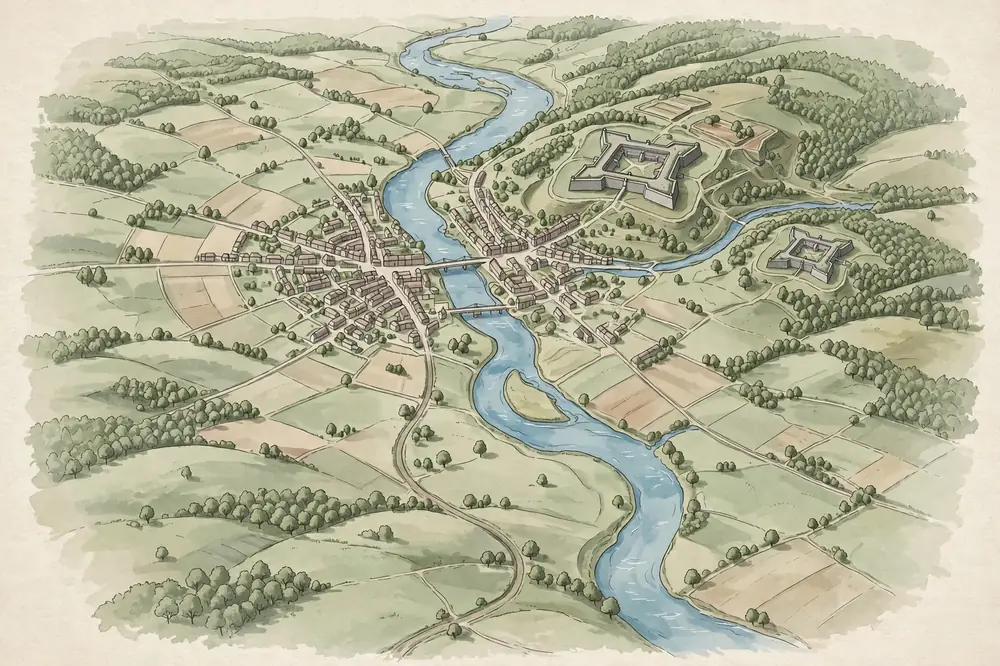
The hills on the right bank — the Douaumont ridge, the Vaux ridge, the Souville ridge — are about 300 to 400 metres high, and they overlook the city; the hills on the left bank — the Mort-Homme and Côte 304 — are about 250 to 300 metres high, and they guard the approaches from the west.
The forts — Douaumont, Vaux, Souville, Moulainville — were built on the hills, and they were the anchors of the defence.
The geography of Verdun shaped the battle. The city was a salient, a bulge in the French line, surrounded on three sides by the Germans, and it was connected to the rest of France by a single road — the Voie Sacrée — and a single railway. The Germans could attack from three sides, and the French could supply the city from only one direction.
The hills, with their woods and their ravines, were the battlefield: the fighting was in the woods of the Meuse heights, in the mud and the shattered trees, and it was fought hill by hill, fort by fort. The Meuse itself was a barrier: the river divided the battlefield into two halves, the right bank and the left bank, and the battle was fought on both banks, with the Germans attacking on the right bank first, and then on the left bank, and the French defending both.
The battlefield of Verdun is still, today, a landscape of war: the woods are still full of shell holes, the ground is still dangerous with unexploded shells, and the forts — Douaumont, Vaux, Souville — still stand, their concrete scarred by the bombardment. The Voie Sacrée is still a road, and the Douaumont Ossuary still stands on the ridge above the city. The geography of Verdun — a fortress city, on a river, surrounded by hills — was the reason it was attacked, and the reason it could be held.
8. Outcome and Legacy of the Battle of Verdun
The Battle of Verdun ended on 18 December 1916, with the front roughly where it had been in February. The French had held Verdun, and the Germans had failed to take it, and they had failed to bleed France white. The battle was a French victory, but it was a victory that had cost about 350,000 to 400,000 French casualties and about 330,000 to 350,000 German casualties, for a few kilometres of ground. The battle did not decide the war, but it decided that the war would be long, and that it would be won by attrition.
Verdun’s legacy in France is a national one. The battle became the symbol of French resistance, and of the sacrifice of the French soldier — the poilu — and the cry “Ils ne passeront pas!” is still, in France, the motto of the battle. The Douaumont Ossuary, with its 130,000 unidentified dead, is the most visited battlefield memorial in France, and the battle is still, in France, the defining battle of the First World War — more so than the Somme, which is the British battle, or the Marne, which was the first battle. Verdun is remembered in France as the battle where France held, and where France bled, and where France proved that it would not be beaten.
The battle’s legacy is also a political one. Pétain, the hero of Verdun, became a national hero, and he later became the head of the Vichy government in the Second World War — a fall from grace that still shadows his memory in France. Nivelle, who succeeded Pétain and who retook Douaumont and Vaux, became commander in chief, and his offensive of 1917 — the Chemin des Dames — failed, and the French Army mutinied. The battle’s generals — Pétain, Nivelle, Falkenhayn, Crown Prince Wilhelm — were all marked by Verdun, and the battle’s shadow fell over the rest of the war.
Militarily, Verdun was the battle that proved that attrition could not win the war: Falkenhayn’s plan — to kill more Frenchmen than Germans — failed, because the French could replace their losses, and the Germans could not replace theirs any faster. The battle’s lesson, for both sides, was that the Western Front could not be broken by artillery and infantry alone, and that the war would have to be won by other means — by the tank, by the aeroplane, and by the blockade. Verdun was the longest battle of the war, and it was the battle that showed that the war had no short end.
9. Commanders
General Philippe Pétain (France). Commander of the 2nd Army at Verdun from 25 February to May 1916, and the hero of the battle. Pétain organised the defence — the Voie Sacrée, the noria, the order to hold — and he became a national hero. He later became commander in chief of the French Army, and, in the Second World War, head of the Vichy government. He died in 1951, in prison.
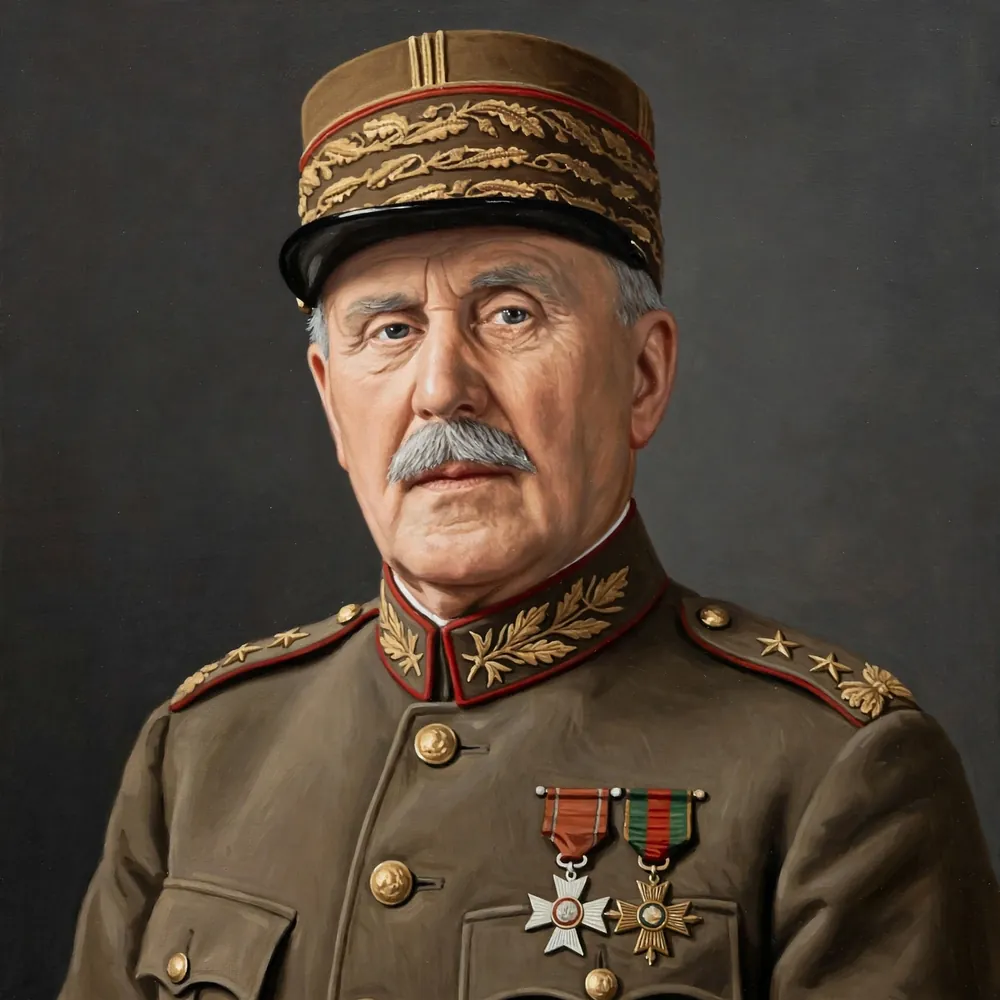
General Robert Nivelle (France). Commander of the 2nd Army from May to December 1916, and the officer who retook Douaumont and Vaux in the autumn counteroffensive. Nivelle became commander in chief in December 1916, and his offensive of 1917 — the Chemin des Dames — failed, and the French Army mutinied. He was dismissed in May 1917.
General Joseph Joffre (France). Commander in chief of the French Army, who had neglected Verdun before the battle, and who sent Pétain to defend it. Joffre was replaced as commander in chief in December 1916.
General Erich von Falkenhayn (Germany). Chief of the German General Staff, and the author of the Verdun plan. Falkenhayn’s memorandum of December 1915 — to bleed France white at Verdun — was the plan for the battle, and its failure cost him his command: he was dismissed in August 1916, and replaced by Hindenburg and Ludendorff.
Crown Prince Wilhelm (Germany). Commander of the 5th Army, which attacked Verdun. The Crown Prince, the Kaiser’s eldest son, commanded the attack, and he was the officer who ordered the assault on Fort Douaumont. He survived the war and died in 1951.
Frequently Asked Questions
Related articles
Sources
- Wikipedia, “Battle of Verdun” — dates, strength, casualty figures (about 700,000 total) and the course of the battle.
- Encyclopædia Britannica, “Battle of Verdun” — background, Falkenhayn’s plan and the battle’s outcome.
- Alistair Horne, The Price of Glory: Verdun 1916 (Macmillan, 1962) — the classic English-language history of the battle.
- Paul Jankowski, Verdun: The Longest Battle of the Great War (Oxford University Press, 2013) — the battle, the Voie Sacrée and the noria.
- Malcolm Brown, Verdun 1916 (Tempus, 1999) — the battle through the voices of the men who fought it.
- German Federal Archives (Bundesarchiv), Falkenhayn’s memorandum of 25 December 1915 — the plan to bleed France white.
- Ian Ousby, The Road to Verdun (Jonathan Cape, 2002).
- Christina Holstein, Fort Douaumont (Pen & Sword, 2010).