 WAR ATLAS MILITARY HISTORY MAGAZINE · WWI — WWII
Battle of the Atlantic
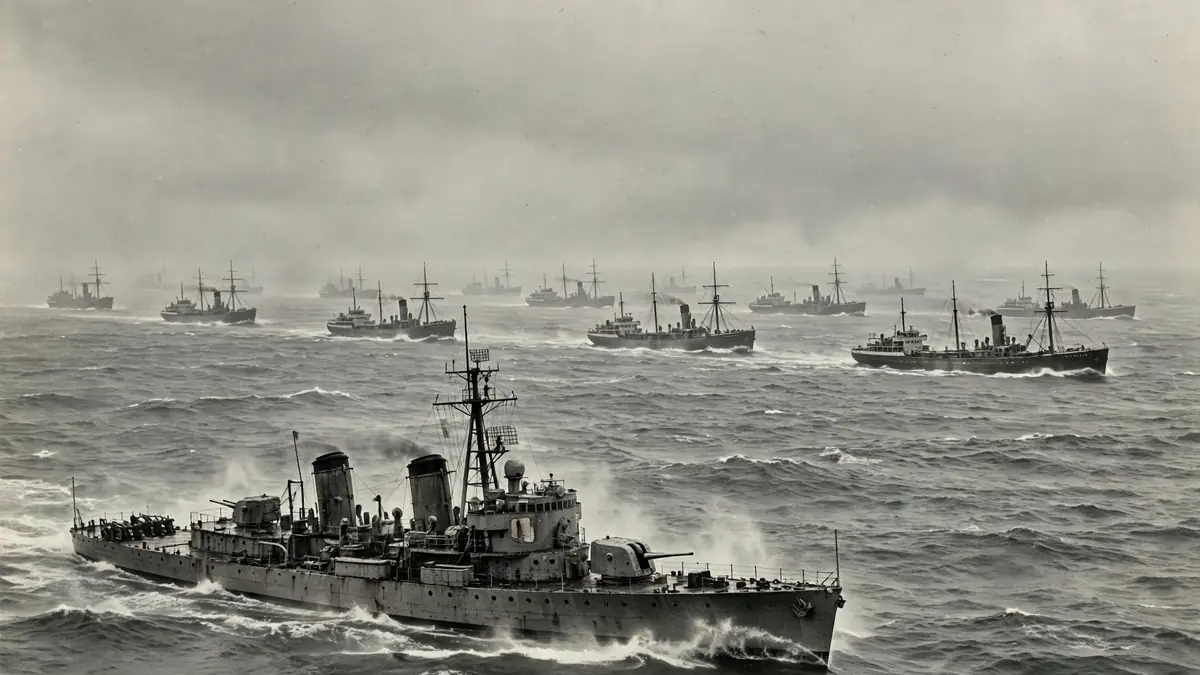
The Battle of the Atlantic was the longest continuous campaign of the Second World War, lasting from 3 September 1939 to the German surrender on 8 May 1945. It was not a single battle but a grinding struggle for control of the sea lanes between North America and Britain, fought by German U-boats against Allied merchant ships and their escorts.
Britain, an island nation, imported most of its food, fuel and raw materials by sea; if the U-boats had cut that lifeline, Britain would have been starved into surrender, and there could have been no D-Day and no liberation of Europe. Winston Churchill later wrote that the only thing that ever really frightened him during the war was the U-boat peril, and the figures explain why: the Allies lost around 3,500 merchant ships and 175 warships, while Germany lost 783 U-boats and about 28,000 of the roughly 41,000 men who served in them.
For nearly four years the outcome hung in the balance. In the spring of 1943 the U-boats came closer than ever to winning — and then, in a single month that the Germans called “Black May”, the balance tipped, and it never tipped back.
1. Key Facts
| Date | 3 September 1939 – 8 May 1945 |
| Location | North Atlantic Ocean, between North America and Britain, and the Arctic convoy routes to the Soviet Union |
| Result | Allied victory; the sea lanes stayed open and Britain was supplied throughout the war |
| Allied commanders | Admiral Sir Max Horton (Western Approaches Command); Admiral Ernest J. King (US Navy); Admiral Sir Percy Noble |
| German commander | Grand Admiral Karl Dönitz, Commander-in-Chief of U-boats (BdU) |
| Allied strength | Convoy escorts, escort carriers, long-range aircraft, and at peak more than 3,000 merchant ships at sea |
| German strength | About 1,150 U-boats commissioned during the war; around 200 operational at the peak in 1943 |
| Allied losses | About 3,500 merchant ships and 175 warships sunk; roughly 30,000 British merchant seamen killed |
| German losses | 783 U-boats lost; about 28,000 of about 41,000 U-boat men killed |
2. Background
The Convoy and the Wolf Pack
When Britain declared war on Germany on 3 September 1939, the Royal Navy was still the largest in the world, but it faced a problem that had nearly defeated Britain a generation earlier. In the First World War, German U-boats had come close to starving Britain out; only the belated introduction of the convoy system in 1917 had saved the country.
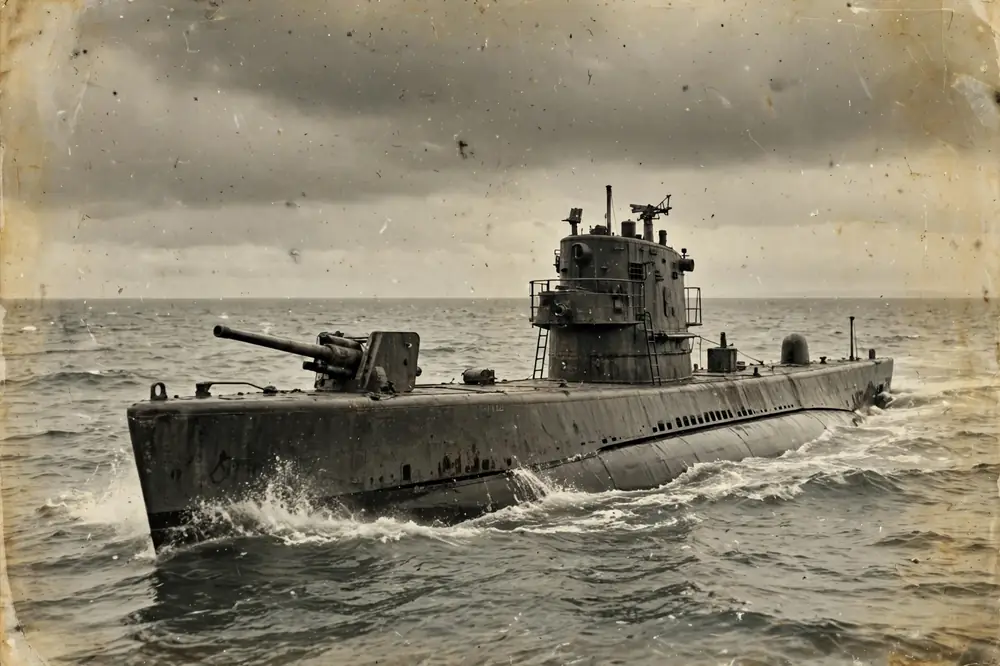
The lesson had been learned, and on the first day of the new war the convoy system was in place. But Germany had learned its own lessons too. Under the terms of the Anglo-German Naval Agreement of 1935, Germany had been allowed to build a submarine fleet, and by 1939 it had 57 U-boats, of which 39 were suitable for Atlantic operations.
Their commander was Karl Dönitz, a First World War U-boat officer who had spent the interwar years thinking about how submarines should be used. Dönitz did not believe in lone submarines hunting alone. His doctrine was the Rudeltaktik, the “wolf pack”: U-boats would spread out in a long patrol line across the expected path of a convoy, and when one boat found it, it would shadow the convoy and radio the others in.
At night, on the surface, where a U-boat was faster than most merchant ships, the pack would attack together from several directions at once, overwhelming the escorts.
France Falls and the Stakes Rise
The fall of France in June 1940 transformed the Atlantic war more completely than any single event since its beginning. Until then, the U-boats had operated from German ports, and they had to make the long and dangerous passage around the north of Scotland to reach the Atlantic convoy routes, a voyage that cost them days of patrol time and exposed them to British patrols.
After the fall of France, they operated from the Atlantic ports of Brest, Lorient, Saint-Nazaire, La Rochelle and Bordeaux, and they could reach the convoy routes in hours, stay on patrol for weeks, and return to bases that were beyond the reach of British bombers.
The Germans also gained airfields on the French coast, from which the long-range Fw 200 Condor reconnaissance aircraft could shadow the convoys and guide the U-boats to them. The fall of France, which had been a disaster for the Allies on land, was a disaster for them at sea as well, and it set the stage for the darkest years of the Atlantic campaign.
The Fall of France
In the first months the U-boats were few and their results were modest. The sinking of the passenger liner Athenia on the first day of the war, with the loss of 112 lives including 28 Americans, showed the world what the campaign would mean, and the sinking of the battleship Royal Oak at anchor in Scapa Flow by U-47 in October 1939, with 833 men killed, showed that no ship was safe.
But the convoy system worked: ships that sailed in convoy were far safer than ships that sailed alone. The real crisis came later, when the fall of France in June 1940 gave Germany the Atlantic ports of Brest, Lorient, Saint-Nazaire, La Rochelle and Bordeaux.
From these bases U-boats could reach the Atlantic convoy routes directly, without the long and dangerous passage around the north of Scotland, and they could stay on patrol far longer. At the same time, Italy’s entry into the war opened the Mediterranean, and the siege of Malta began, stretching British naval resources further.
Why the Sea Lanes Mattered
The stakes were existential. Britain imported about two-thirds of its food and nearly all of its oil. Every tank, every aircraft, every ton of steel that Britain produced depended on raw materials that arrived by sea, and after 1941 the flow of American Lend-Lease supplies — and, from 1942, the American troops and equipment needed for the invasion of Europe — depended on the same sea lanes.
The U-boat campaign was therefore not a sideshow but the central strategic question of the first half of the war. If the U-boats won, there would be no second front, no Battle of Britain sustained, and no Britain left in the war at all.
Even the air battle over southern England and the later campaigns in North Africa depended on supplies that crossed the Atlantic, and every delay to a convoy was felt in the factories, on the airfields and at the front.
Happy Times and Crisis
The campaign went through distinct phases, which the Germans called the “happy times” and the Allies called the crises. The First Happy Time, from mid-1940 to early 1941, saw U-boats sinking ships faster than the Allies could build them, with the famous “aces” — Günther Prien, Otto Kretschmer and Joachim Schepke — becoming household names in Germany.
The Second Happy Time came in early 1942, when the United States entered the war and Dönitz sent U-boats to the American east coast, where ships still sailed alone, lit up against the lights of coastal cities, in what the U-boat men called the “American shooting season”. More than 600 ships were sunk off the American coast in 1942.
The third crisis came in the winter of 1942–43, when the U-boats, now more than 200 strong, sank ships in the mid-Atlantic “air gap” — the stretch of ocean beyond the reach of land-based aircraft — faster than the Allies could replace them. In March 1943 the Allies lost 108 ships of 627,000 tons, the worst month of the war.
It looked, for a time, as though the U-boats might win after all.
3. Opposing Forces
The two sides in the Atlantic fought with very different weapons and very different doctrines. The Germans bet almost everything on the U-boat. The Allies bet on the convoy — and on a steadily growing system of science, intelligence and air power built around it.
| Allies | Germany | |
|---|---|---|
| Merchant fleet | About 3,000 British and Allied merchant ships at sea at any time; 25,000+ convoy voyages during the war | — |
| Escorts | Destroyers, frigates, corvettes and sloops; escort groups under Western Approaches Command | — |
| Submarines | Small numbers of Allied submarines; not a major factor in the Atlantic | About 1,150 U-boats commissioned; Type VII (the workhorse) and Type IX (long-range) |
| Air power | RAF Coastal Command, US Navy patrol aircraft, escort carriers from 1943, very-long-range Liberators | Fw 200 Condor long-range reconnaissance aircraft, operating from France |
| Intelligence / Tình báo | Ultra (Enigma decrypts) from Bletchley Park; HF/DF radio direction-finding (“Huff-Duff”) | B-Dienst, the German naval signals intelligence service, which read Allied convoy codes for much of the war |
| Technology | ASDIC/sonar, radar (including centimetric radar from 1943), Hedgehog and depth charges, Leigh Light | Enigma-encrypted radio; schnorkel (from 1944); acoustic torpedoes; Type XXI (too late) |
The U-boat
The U-boat of the Atlantic campaign was, for most of the war, the Type VII, a 700-ton boat with a crew of about 44 to 52 men, armed with 14 torpedoes and an 88 mm deck gun. On the surface it could make about 17 knots; submerged, on electric motors, only about 7 knots, and only for an hour or two before the batteries ran down.
That limitation shaped the whole campaign: a U-boat was not really a submarine in the modern sense but a surface torpedo boat that could dive to escape. It attacked on the surface at night, where it was fast, hard to see, and invisible to ASDIC, which could only detect submerged targets.
The larger Type IX boats, with a range of over 12,000 nautical miles, were the ones sent to American waters and the South Atlantic. Life aboard was cramped, damp and foul-smelling, with men sharing bunks in shifts, and a patrol could last ten weeks or more, most of it spent on the surface in all weathers.
The Convoy System
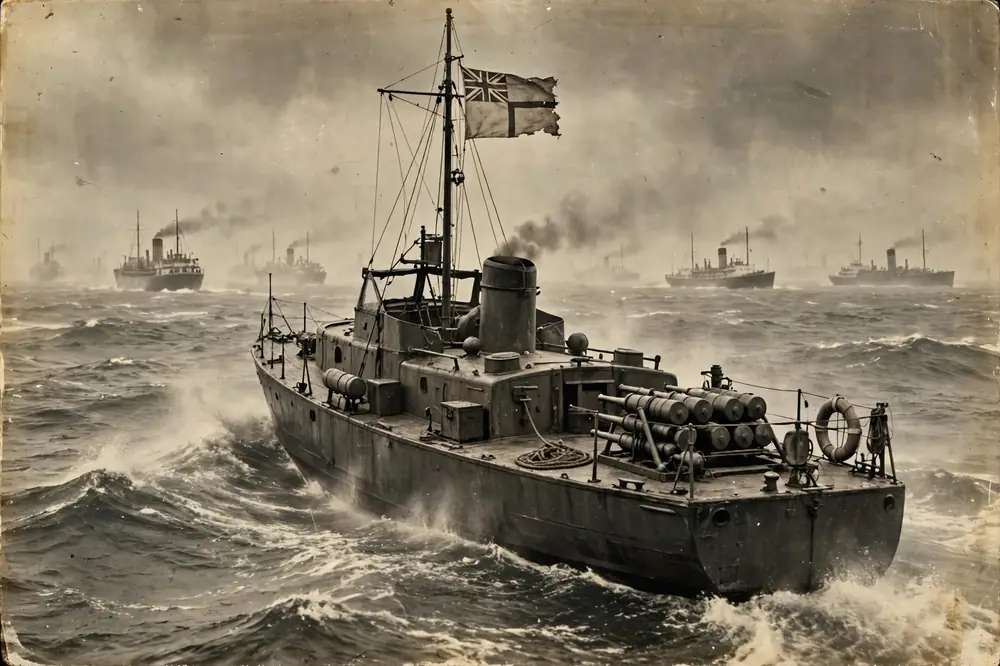
Against them, the convoy was the Allies’ answer. A typical Atlantic convoy was 30 to 60 merchant ships sailing in columns, escorted by a handful of warships — in the early years often only two or three, later a full escort group of six or more, with an escort carrier and long-range aircraft overhead.
The escorts’ job was not primarily to sink U-boats, though they sank many; it was to keep the U-boats away from the merchant ships, to force them to dive, and to make them lose contact. A U-boat that was forced underwater was slow, blind and harmless.
The system was not perfect: convoys were slow, they tied up escorts that were needed elsewhere, and a convoy that lost its escorts was defenceless, but the statistics were clear — a ship in convoy was many times safer than a ship sailing alone, and the convoy, for all its faults, was the foundation on which the whole Allied war effort at sea was built.
The convoy commodore, usually a retired naval officer embarked in one of the merchant ships, controlled the formation, while the senior officer of the escort commanded the defence.
Codebreakers and New Technology
Behind the escorts stood an intelligence and scientific effort that grew steadily more powerful. At Bletchley Park, the Government Code and Cypher School broke the German naval Enigma, allowing the Admiralty’s Operational Intelligence Centre to route convoys around known U-boat patrol lines — when the code could be read.
The Germans, for their part, through their B-Dienst service, read the British naval codes for much of the war, and Dönitz often knew where the convoys were before the Allies knew where his U-boats were. It was a secret war of codebreakers on both sides, and the advantage swung back and forth.
HF/DF, the shipborne radio direction-finding sets nicknamed “Huff-Duff”, let escorts take a bearing on a U-boat the moment it transmitted, and centimetric radar, fitted to aircraft and ships from 1943, could detect a surfaced U-boat at night — taking away the wolf pack’s favourite hunting conditions. The Leigh Light, a powerful searchlight fitted to patrol aircraft, let them attack U-boats on the surface at night.
4. The Battle
The Early War at Sea
The first two years of the Atlantic campaign were a war of learning on both sides. In September and October 1939 the U-boats scored spectacular single successes — the Athenia, the aircraft carrier Courageous, sunk by U-29 with 519 men killed, and the Royal Oak at Scapa Flow — but the convoy system held, and shipping losses remained bearable.
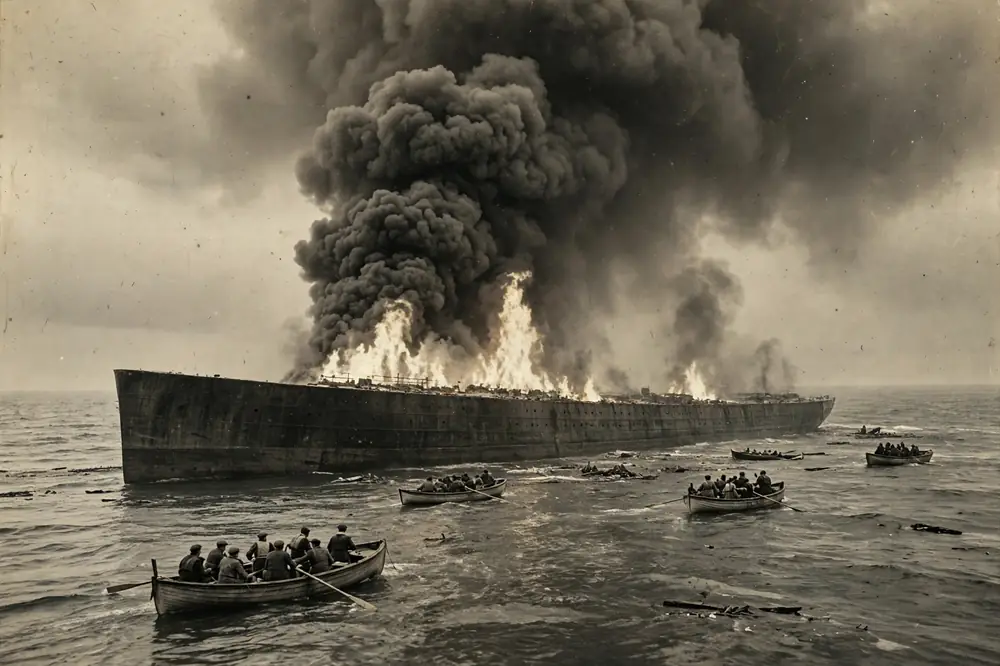
The turning point of the early war came in the autumn of 1940, when Dönitz had enough boats to try the wolf pack in earnest. In October 1940, the convoys SC 7 and HX 79 were found by patrol lines east of Rockall, and in a few nights the packs sank 32 ships between them, for the loss of no U-boats at all.
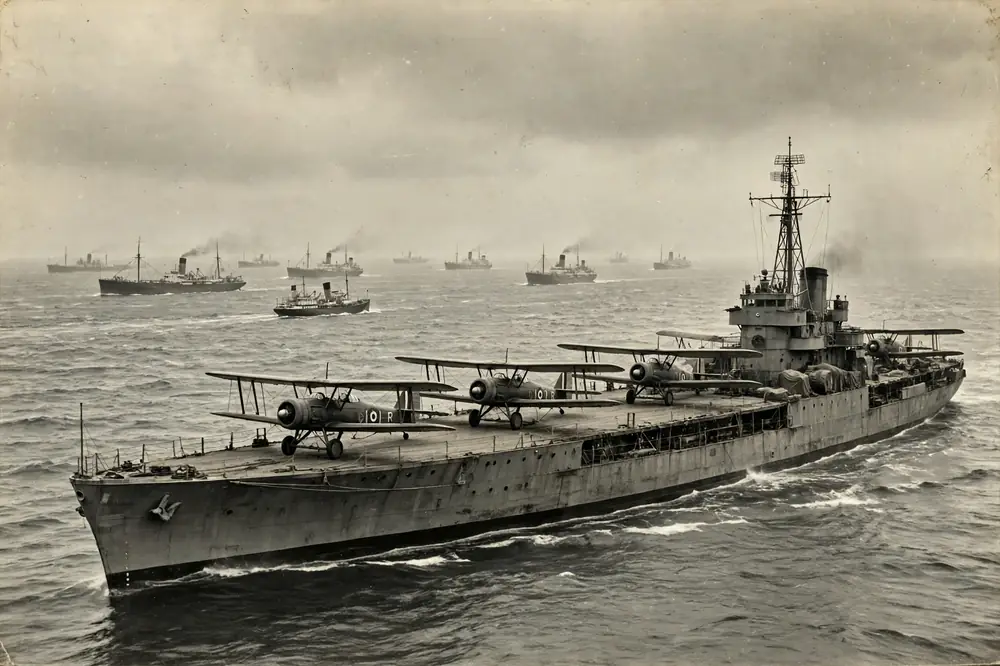
The escorts, usually only two or three warships, were overwhelmed, and the merchant ships, sailing without air cover, were picked off one by one in the dark. It was the first demonstration of what the wolf pack could do, and it frightened the Admiralty badly.
The winter of 1940–41 saw the rise of the U-boat “aces”. Otto Kretschmer, the most successful U-boat commander of the war, sank 47 ships, and his tactics — attacking on the surface at night, inside the convoy columns themselves, firing torpedoes at point-blank range — became the model for the whole arm. Günther Prien, the hero of Scapa Flow, and Joachim Schepke completed the trio.
But the spring of 1941 brought the first reverses. In March 1941, Prien and Schepke were both killed in action against convoys, and Kretschmer was captured when U-99 was sunk by the destroyer Walker. In the same weeks, the Royal Navy’s escort groups began to improve, the first escort carriers and catapult aircraft were appearing, and the breaking of the U-boat Enigma — first in February 1941, when the destroyer Bulldog captured U-110 with its Enigma machine and code books intact — began to let the Admiralty route convoys around the patrol lines.
By the summer of 1941, shipping losses had fallen sharply, and Dönitz, short of boats, moved many of his U-boats south and west, away from the increasingly dangerous North Atlantic convoy routes.
The Second Happy Time
The United States entered the war in December 1941, and Dönitz at once saw his greatest opportunity. American coastal shipping still sailed alone, without convoys, without blackouts, and with the lights of the coastal cities silhouetting the ships against the shore. In January 1942 Dönitz launched Operation Paukenschlag — “Drumbeat” — sending five long-range Type IX boats to the American east coast.
In the first weeks they sank ships almost at will, often in sight of land, while the American authorities, who had resisted the convoy system, argued about who was responsible for coastal defence. The U-boat men called it the “American shooting season”, and the figures were appalling: in the first six months of 1942, U-boats sank more than 600 ships off the American coast and in the Caribbean, many of them tankers carrying the oil that Britain and the Allied war effort depended on.
The crisis was made worse by the fact that American shipyards were only beginning to build the Liberty ships that would eventually replace the losses, and by the diversion of American escorts to the Pacific after Wake Island and Pearl Harbor.
The American response, when it finally came, was decisive. By the summer of 1942 the United States had introduced a full coastal convoy system, with blackouts along the coast, and the sinkings off America fell away sharply. But Dönitz simply moved his boats back to the mid-Atlantic, where the convoys were still thinly escorted and the “air gap” — the stretch of ocean beyond the range of land-based aircraft from Newfoundland, Iceland and Northern Ireland — offered a hunting ground where U-boats could operate on the surface in daylight.
The winter of 1942–43 became the most dangerous period of the whole campaign, and the Admiralty, the Royal Canadian Navy and the United States Navy, between them, had to find an answer before the losses became unsustainable.
The Crisis of 1942–43
The winter of 1942–43 was the most dangerous period of the whole Atlantic campaign, and it was the period in which the U-boats came closest to winning the war at sea. Dönitz now had more than 200 U-boats at his disposal, and he concentrated them in the mid-Atlantic, in the air gap where no Allied aircraft could reach them, and where the convoys were thinly escorted and vulnerable.
The Allies, for their part, were stretched to the limit: their shipyards were building Liberty ships as fast as they could, but the U-boats were sinking ships faster than the yards could replace them, and the Admiralty, which had warned the War Cabinet that the situation was grave, was running out of escorts, out of aircraft, and out of time.
The crisis of 1942–43 was not a single battle but a slow strangulation, and it was only broken, in the spring of 1943, by the arrival of the weapons and the organisation that would turn the campaign around.
The Air Gap
The heart of the crisis was geography. Between the air cover that could be provided from Newfoundland in the west and from Northern Ireland and Iceland in the east lay a gap of some 600 miles in the mid-Atlantic where no land-based aircraft could reach. In that gap, a U-boat on the surface was safe from air attack, and a convoy had only its escorts for protection.
Dönitz concentrated his boats there, in patrol lines of ten, twenty or thirty boats, and waited for the convoys to come to him. The winter weather made it worse: gales and heavy seas scattered convoys, broke up escort screens, and made it hard for the escorts to use their ASDIC.
In the last months of 1942 and the first months of 1943, the U-boats sank ships faster than the Allied shipyards could build them — a rate of loss that, if it had continued, would have strangled Britain within a year.
The Admiralty’s figures for March 1943, the worst month of the war, were 108 ships of 627,000 tons lost in the Atlantic alone, and the First Sea Lord warned the War Cabinet that the situation was “very grave”.
Convoy HX 229 and SC 122
The crisis reached its peak in March 1943, in the largest convoy battle of the war. Two eastbound convoys, the fast HX 229 and the slow SC 122, sailed from New York a few days apart and, by bad luck, converged in the air gap at the same time that three U-boat patrol lines — Raubgraf, Stürmer and Dränger, more than 40 boats in all — were waiting for them.
The battle lasted four days, from 16 to 20 March. The U-boats attacked in waves, night after night, and the escorts, outnumbered and exhausted, could not be everywhere at once. When it was over, the two convoys had lost 22 ships between them, and only one U-boat had been sunk.
It was the greatest single U-boat success of the war, and it seemed to prove that the wolf pack had finally mastered the convoy. But the victory was hollow: the U-boats had used up much of their torpedo stock, several boats had been damaged, and the Allies, for the first time, had the weapons in hand — escort carriers, very-long-range Liberators, centimetric radar and the new support groups — that would turn the tables within weeks.
Black May and the Turn of the Tide
May 1943 is remembered in the German navy as “Black May”. In a single month the U-boats lost 41 boats — about a fifth of the operational force — while sinking only 58 ships, the lowest monthly total for two years.
The disaster began with convoy ONS 5, a slow westbound convoy of 42 ships that was attacked by a pack of more than 30 U-boats in the last days of April and the first days of May. This time the convoy fought back. Its escorts, reinforced by a support group and by air cover from Iceland, sank six U-boats and damaged several more, while losing 13 merchant ships.
It was the first time a wolf pack had been beaten off with heavy losses, and it broke the U-boats’ confidence. In the weeks that followed, escort carriers closed the air gap, very-long-range Liberators patrolled the mid-Atlantic, and centimetric radar let aircraft and escorts find surfaced U-boats at night.
Dönitz, who had lost 41 boats in May and could not replace the trained crews, ordered his U-boats to withdraw from the North Atlantic on 24 May 1943. The battle was not over — U-boats would fight on until the last day of the war — but the initiative had passed to the Allies, and it never came back.
The sea lanes were open, and the build-up for D-Day could begin in earnest.
5. Turning Point
Closing the Air Gap
The turning point of the Atlantic campaign was not a single battle but a convergence of technologies and organisation that arrived together in the spring of 1943. The most important was air power. The very-long-range Liberator, fitted with extra fuel tanks, could at last patrol the whole of the mid-Atlantic, and the escort carrier — a small, cheap carrier built on a merchant hull — put aircraft over every convoy, even in the middle of the ocean.
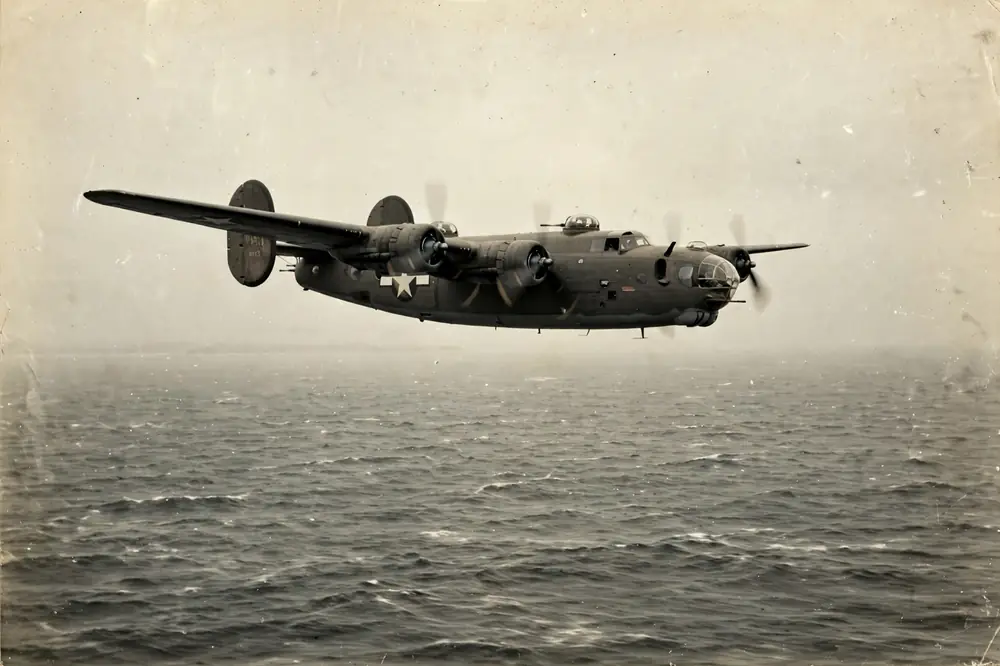
Together, they closed the air gap, and a U-boat that surfaced to charge its batteries or to attack now risked being seen from the air at any hour. Centimetric radar, small enough to fit in an aircraft, could pick up a surfaced U-boat at night or in cloud, and the Leigh Light let the aircraft attack it at once.
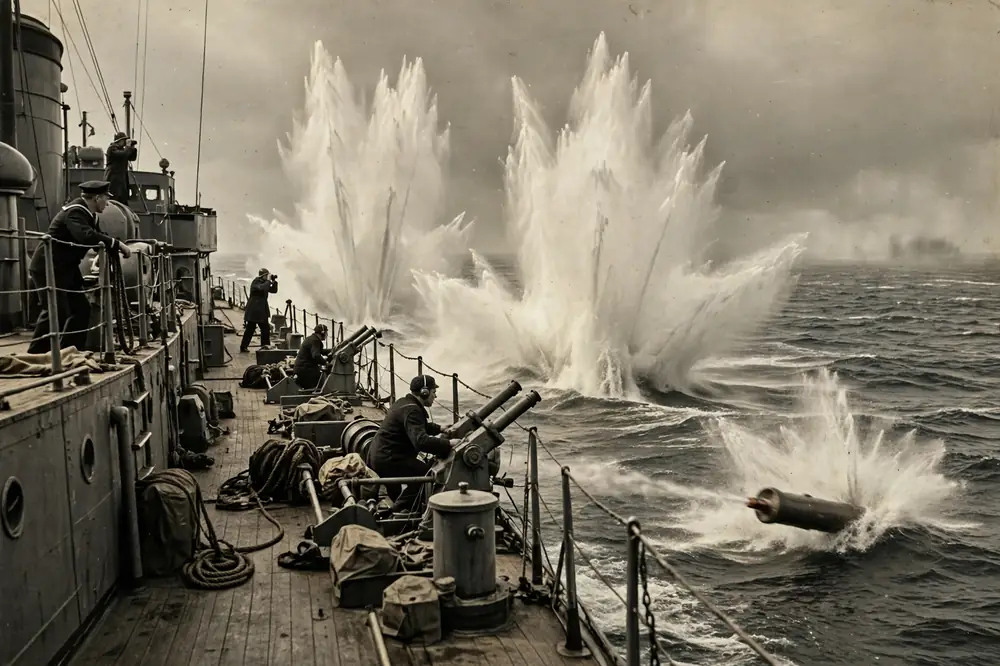
The wolf pack’s favourite conditions — the dark, empty ocean, far from land — were gone.
The Hunter Becomes the Hunted
The second change was organisation. Admiral Sir Max Horton, who took command of Western Approaches in November 1942, reorganised the escorts into permanent groups that trained and fought together, and he created the support groups — roving bands of escorts, free of the convoy itself, whose job was to hunt U-boats wherever they were found.
The hunter-killer groups built around escort carriers, led by men like Captain Frederic Walker, the most successful U-boat hunter of the war, took the offensive into the Atlantic. At the same time, the breaking of the U-boat Enigma in December 1942, after a ten-month blackout, let the Admiralty route convoys around the patrol lines again, and HF/DF let escorts fix a U-boat’s position the moment it radioed home.
The U-boat arm, which had been the hunter for three years, became the hunted, and its losses — 41 boats in May 1943, and more than 200 in the year that followed — were losses of trained men that Germany, with its shrinking training pipeline, could not replace.
Dönitz kept fighting, and his new Type XXI boats might have changed the war had they arrived in time, but they did not arrive in time, and the Atlantic was lost.
6. Casualties and Losses
Merchant Seamen and the Human Cost
The human cost of the Atlantic campaign fell most heavily on the merchant seamen, the civilians who sailed the convoys. About 30,000 British merchant seamen were killed during the war, out of a wartime Merchant Navy of about 185,000 men — a death rate higher than that of any of the armed services except the U-boat arm itself.
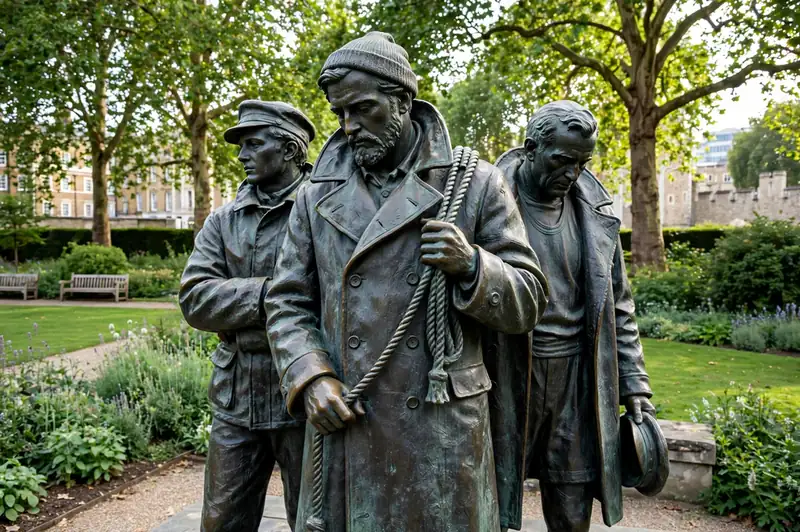
American, Canadian, Norwegian, Dutch and other Allied merchant seamen died in their thousands as well, and the total Allied merchant seaman death toll is estimated at roughly 35,000–45,000, though exact figures vary because many ships were lost with all hands and no witnesses.
The losses were not only in lives: around 3,500 merchant ships were sunk, carrying food, fuel, tanks, aircraft and raw materials, and with them went the cargoes that Britain and the Soviet Union needed to keep fighting. The men who sailed in the convoys knew the odds, and they sailed anyway, in ships that were slow, unarmoured and, for much of the war, without adequate lifeboats or rescue ships.
| Allies | Germany | |
|---|---|---|
| Merchant ships lost | About 3,500 ships (about 14.5 million gross tons) | |
| Warships lost | 175 warships | |
| Merchant seamen killed | About 30,000 British; total Allied estimated 35,000–45,000 | |
| Naval personnel killed | About 36,000 Royal Navy and Allied naval personnel (estimate) | |
| U-boats lost | — | 783 of about 1,150 commissioned |
| U-boat men killed | — | About 28,000 of about 41,000 who served |
The U-boat Arm’s Losses
No branch of any armed service in the Second World War suffered a higher death rate than the German U-boat arm. Of the roughly 41,000 men who served in U-boats, about 28,000 were killed — a death rate of around 70 per cent — and some 5,000 more were taken prisoner. Of the roughly 1,150 U-boats commissioned, 783 were lost, most of them with all or most of their crews.
The losses were worst in the last two years of the war, when the average life expectancy of a U-boat on patrol was measured in weeks, and when the new boats were manned by young, hastily trained crews who had never known the “happy times”.
The U-boat men were volunteers, and they were among the best-trained sailors in the German navy; their courage is not in doubt, and neither is the fact that the cause they served was a criminal regime. Their memorial stands at Laboe, near Kiel, where the names of the dead are recorded, and where the U-boat U-995 is preserved as a museum.
The Atlantic campaign, for all its scale, was in the end a war of attrition, and attrition is a war that the side with the greater resources — and the side that could replace its losses — wins.
7. Map and Geography
The Convoy Routes
The Atlantic campaign was fought across an ocean, and its geography was its strategy. The main convoy routes ran in a great arc from Halifax and New York, through the waters south of Greenland and Iceland, to the ports of Liverpool, the Clyde and Londonderry.
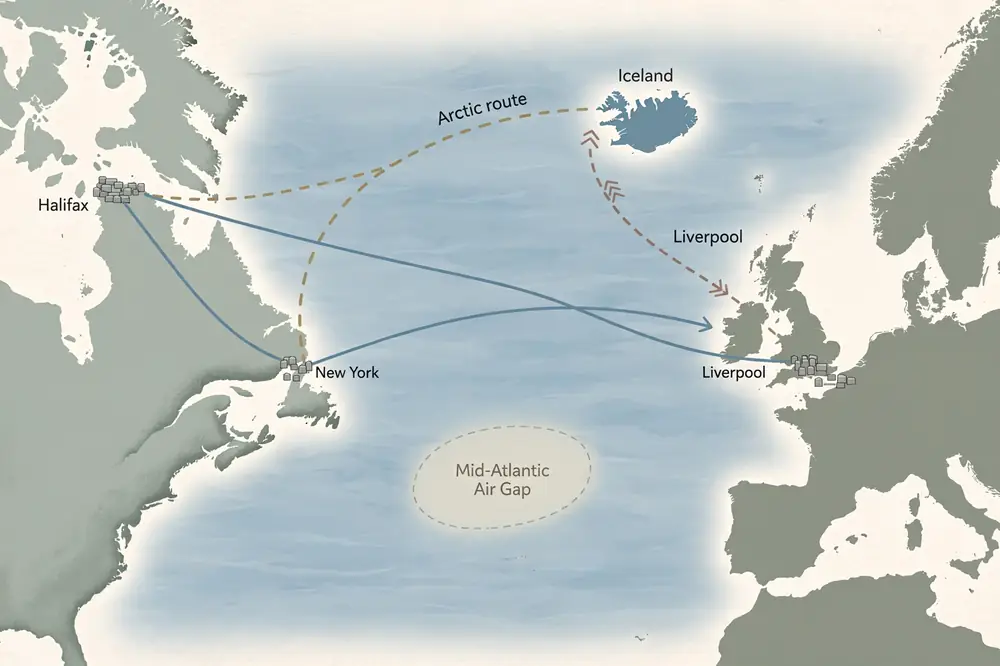
The HX convoys — fast, from Halifax — and the SC convoys — slow, from Sydney, Nova Scotia — carried the bulk of the traffic, while the ON convoys sailed westbound, often in ballast, to fetch the next cargo. The great circle route, which took ships far to the north, was shorter but colder and rougher, and it passed through the Denmark Strait and the waters where the German battleships and the U-boats waited.
The southern route, through the Azores, was longer but safer, and it was used by the troop convoys and by ships that could not keep up with the fast convoys. The ports mattered as much as the routes: Liverpool, the great western port, handled more of the Atlantic trade than any other British port, and its docks, warehouses and railways were the throat through which Britain’s supplies passed.
The Air Gap and the Hunting Grounds
The most important piece of Atlantic geography was the air gap, the stretch of mid-ocean beyond the reach of land-based aircraft. Before 1943 it was roughly 600 miles wide, centred on the waters south of Greenland, and it was there that the U-boats did their worst work.
The gap was closed from both ends: from Newfoundland and Iceland in the west, and from Northern Ireland and later the Azores in the east, and its closing in the spring of 1943 was the single most important geographical change of the campaign.
The second great hunting ground was the American east coast in 1942, where the U-boats found ships sailing alone in coastal waters, and the third was the Arctic route to the Soviet Union, where convoys to Murmansk and Archangel sailed through waters patrolled by German aircraft and U-boats based in Norway, in appalling weather and, in summer, in perpetual daylight.
The Arctic convoys — PQ 17, whose scattering in July 1942 cost 24 ships, is the most famous — were a campaign within the campaign, and their losses, though smaller than those of the Atlantic, were among the most bitter of the war.
8. Outcome and Legacy of the Battle of the Atlantic
The Atlantic After May 1943
After May 1943 the Atlantic campaign changed its character. The U-boats did not stop fighting — Dönitz sent them back to the Atlantic in the autumn of 1943 with new weapons, including acoustic torpedoes and the schnorkel, which let a boat recharge its batteries without surfacing — but they never again threatened the sea lanes.
Shipping losses fell from 627,000 tons in March 1943 to a fraction of that by the end of the year, and the great build-up of American men and material for the invasion of Europe crossed the Atlantic in safety. The convoys grew larger and better protected, and the hunter-killer groups took the war to the U-boats, sinking them faster than Germany could build them.
By the end of the war, the Allies had won the Atlantic so completely that the last U-boat operations were little more than gestures, and the final boats surrendered at sea in May 1945.
The Arctic Convoys
The Arctic convoys deserve a place of their own in the story, because they were among the most dangerous voyages of the war. From August 1941 to May 1945, 78 convoys sailed to Murmansk and Archangel, carrying tanks, aircraft and supplies to the Soviet Union, and 1,400 merchant ships made the voyage.
The route took them past German air and U-boat bases in northern Norway, through storms, fog and, in winter, darkness that lasted for weeks, and in summer, daylight that never ended. The convoy PQ 17, in July 1942, was ordered to scatter on the false report that the battleship Tirpitz was at sea, and 24 of its 35 ships were sunk by aircraft and U-boats.
The Arctic convoys lost 85 merchant ships and 16 Royal Navy warships, and more than 3,000 men, but they delivered some 4 million tons of supplies to the Soviet Union, and the Soviet Union, which fought the largest land battles of the war, did not forget them.
The veterans of the Arctic convoys, British and Russian alike, were still being honoured decades later, and the Arctic Star, the British campaign medal for the convoys, was not issued until 2013.
Legacy
The Battle of the Atlantic left a legacy that outlived the war. It proved that the convoy, an idea as old as sailing itself, was still the answer to the submarine, and it proved that a war at sea is won as much by scientists, codebreakers and shipyard workers as by sailors.
The technologies developed for the Atlantic — sonar, radar, the escort carrier, the long-range patrol aircraft, the merchant ship built by the thousand — shaped the navies of the Cold War, and the lessons of the campaign were studied by every navy that followed.
The human legacy is quieter: the memorials at Liverpool and Londonderry, the Merchant Navy memorial at Tower Hill in London, and the U-boat memorial at Laboe, where the dead of both sides are remembered. The Atlantic was the longest battle of the war, and it was, as Churchill said, the battle that had to be won first, because without it there could have been no victory anywhere else.
9. Commanders
Allied Commanders
Admiral Sir Max Horton (Britain). Commander-in-Chief of Western Approaches from November 1942, and the man who won the Atlantic. Horton, himself a First World War submariner, reorganised the escorts into permanent groups, created the support groups, and insisted that the escort’s job was to hunt U-boats, not merely to guard convoys. His reforms, together with the new technology of 1943, turned the campaign around in a matter of months.
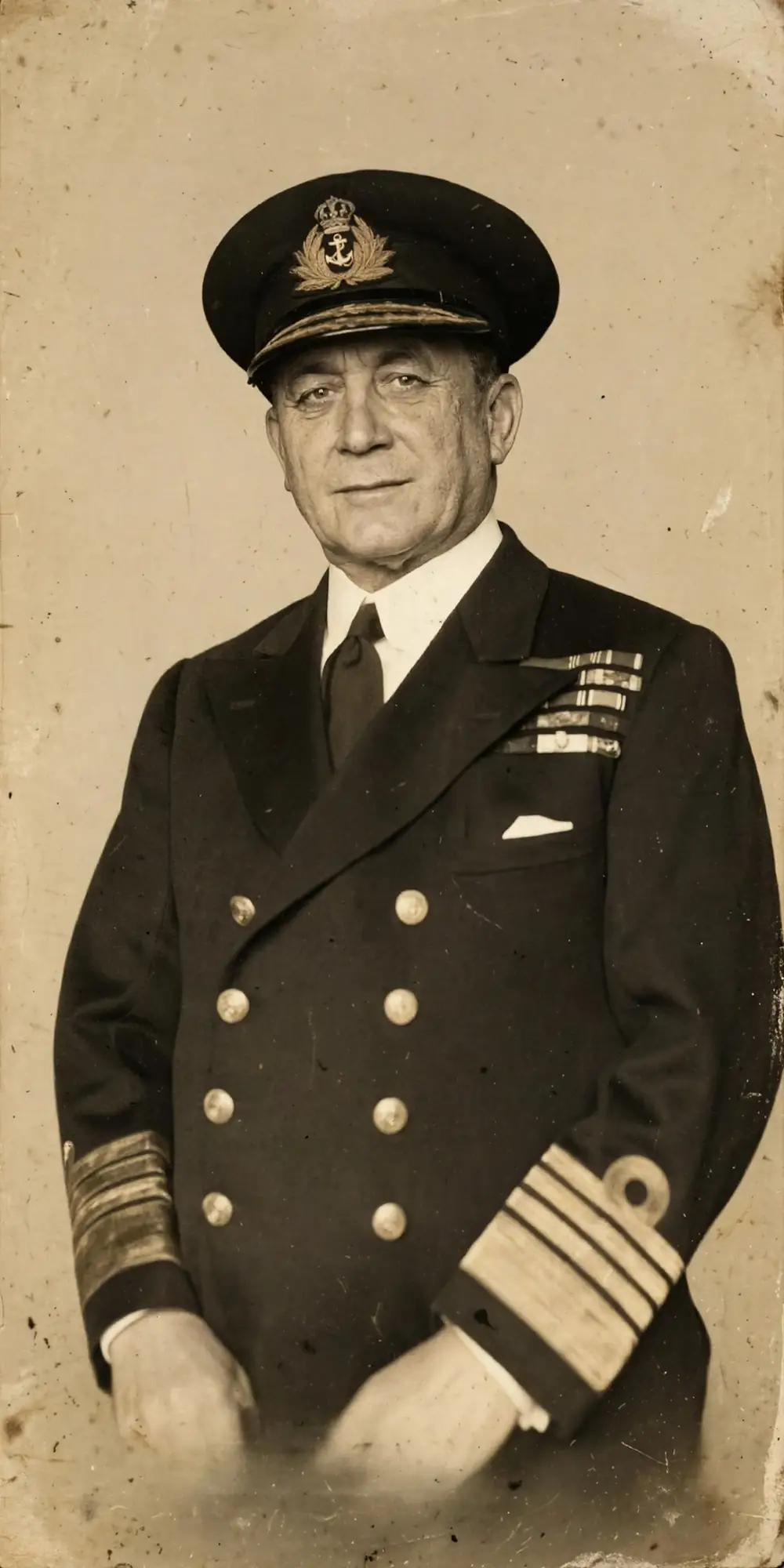
Admiral Ernest J. King (United States). Chief of Naval Operations and Commander-in-Chief of the United States Navy. King was slow to accept the convoy system for American coastal shipping in early 1942, a delay that cost hundreds of ships, but once the system was in place he drove the American shipbuilding and escort programme that overwhelmed the U-boat threat, and he insisted on the American share of the Atlantic battle.
Admiral Sir Percy Noble (Britain). Commander-in-Chief of Western Approaches from 1941 to 1942, and Horton’s predecessor. Noble built the Western Approaches Command at Liverpool, organised the escort groups, and laid the foundations on which Horton built. He later became head of the British naval delegation in Washington.
Captain Frederic Walker (Britain). The most successful U-boat hunter of the war, commander of the 2nd Support Group. Walker’s group sank more U-boats than any other, and his tactics — the “creeping attack”, in which two escorts worked together, one holding contact with ASDIC while the other dropped depth charges — became standard practice. He died of a stroke in July 1944, exhausted by three years of continuous operations.
German Commanders
Grand Admiral Karl Dönitz (Germany). Commander-in-Chief of U-boats throughout the war, and from January 1943 Commander-in-Chief of the German Navy. Dönitz invented the wolf pack, built the U-boat arm from almost nothing, and directed the campaign from his headquarters, first at Lorient and later in Berlin. He was a brilliant tactician and a ruthless one: his “Laconia order” of September 1942 forbade U-boats from rescuing survivors, and he was convicted at Nuremberg for waging unrestricted submarine warfare. He succeeded Hitler as head of state in the last days of the war and signed the surrender.
Kapitänleutnant Otto Kretschmer (Germany). The most successful U-boat commander of the war, with 47 ships sunk. Kretschmer’s tactics — surface attacks at night, inside the convoy — made him a legend in Germany, and his capture in March 1941, when U-99 was sunk, was a heavy blow to the U-boat arm. He survived the war as a prisoner in Canada and later served in the post-war German navy.
Kapitänleutnant Günther Prien (Germany). The hero of Scapa Flow, who took U-47 into the British fleet anchorage in October 1939 and sank the battleship Royal Oak. Prien became the most famous U-boat commander in Germany, and his death in March 1941, when U-47 was lost with all hands, was kept secret from the German public for weeks.
Frequently Asked Questions
How long did the Battle of the Atlantic last?
From 3 September 1939 to 8 May 1945 — five years and eight months, the longest continuous campaign of the Second World War.
How many ships were sunk in the Battle of the Atlantic?
About 3,500 Allied merchant ships and 175 warships were sunk, while Germany lost 783 U-boats. The merchant ships totalled about 14.5 million gross tons.
What was the wolf pack tactic?
U-boats spread out in a patrol line across a convoy’s expected route. When one boat found the convoy it radioed the others in, and the pack attacked together at night, on the surface, from several directions at once.
What was “Black May” 1943?
May 1943, when the U-boats lost 41 boats — about a fifth of their operational force — in a single month, while sinking only 58 ships. It was the turning point of the campaign.
What was the air gap?
A stretch of mid-Atlantic, about 600 miles wide, beyond the reach of land-based aircraft from Newfoundland, Iceland and Northern Ireland. U-boats hunted there in safety until very-long-range Liberators and escort carriers closed it in 1943.
Why was the Battle of the Atlantic so important?
Britain depended on the sea for food, fuel and raw materials, and the invasion of Europe depended on American troops and supplies crossing the Atlantic. If the U-boats had cut the sea lanes, Britain would have been starved out and there could have been no liberation of Europe.
Related articles
Sources
- Wikipedia, “Battle of the Atlantic” — dates, shipping losses (about 3,500 merchant ships, 175 warships), U-boat losses (783 boats) and the “Black May” figures.
- Clay Blair, Hitler’s U-Boat War: The Hunters, 1939–1942 and The Hunted, 1942–1945 (Random House, 1996–1998) — the standard history of the U-boat campaign.
- Samuel Eliot Morison, History of United States Naval Operations in World War II, Vol. I and Vol. X — the American coastal crisis of 1942 and the Atlantic campaign.
- Marc Milner, Battle of the Atlantic (Tempus, 2005) — the convoy battles, the air gap and the turning point of 1943.
- Jürgen Rohwer, The Critical Convoy Battles of March 1943 (Naval Institute Press, 1977) — HX 229, SC 122 and ONS 5.
- Imperial War Museum, “Battle of the Atlantic” — merchant seamen losses (about 30,000 British) and the Arctic convoys.
Further reading
- Jonathan Dimbleby, The Battle of the Atlantic: How the Allies Won the War (Oxford University Press, 2015).
- Ed Offley, Turning the Tide: How a Small Band of Allied Sailors Defeated the U-boats and Won the Battle of the Atlantic (Basic Books, 2011).