 WAR ATLAS MILITARY HISTORY MAGAZINE · WWI — WWII
Franklin D. Roosevelt
1. Lead
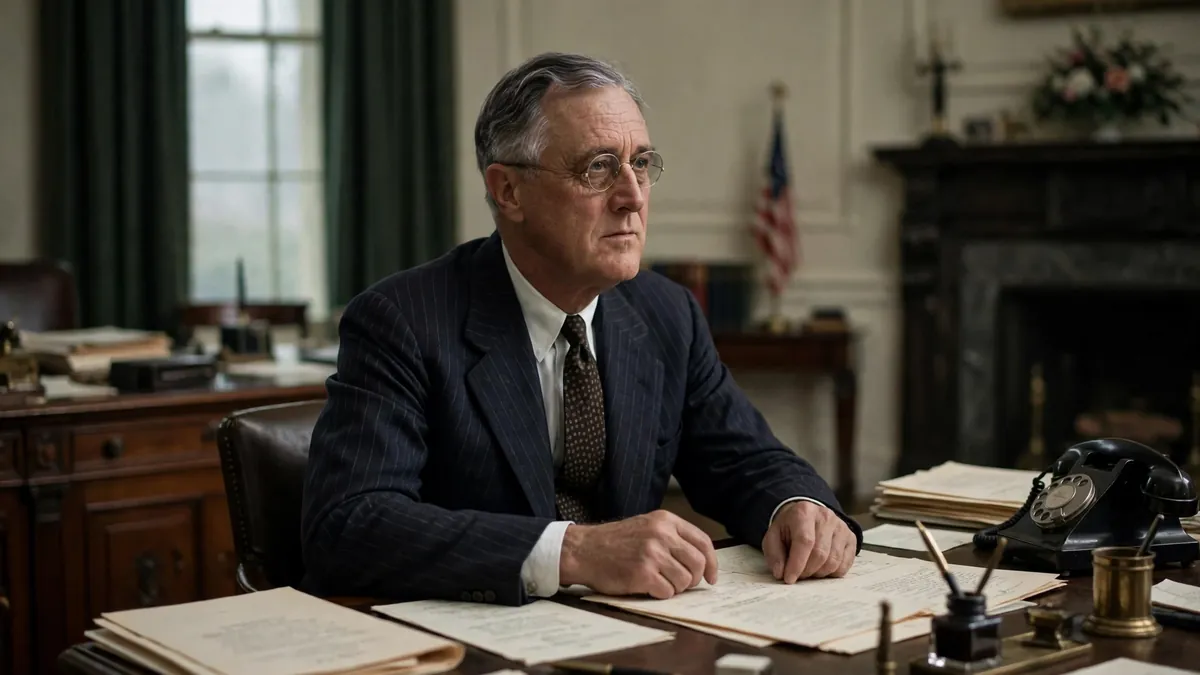
Franklin D. Roosevelt (30 January 1882 – 12 April 1945), known as FDR, was the 32nd President of the United States, serving from 4 March 1933 until his death in 1945 — the longest-serving president in American history and the only one elected to four terms.
He led the United States through two of the defining crises of the twentieth century: the Great Depression, which he addressed with the programme of economic reforms known as the New Deal, and the Second World War, in which he directed the American war effort from the attack on Pearl Harbor in December 1941 until weeks before the German surrender.
As a wartime leader he worked with Winston Churchill and Joseph Stalin at the conferences of Casablanca, Tehran and Yalta, and he was the principal author of the plan for the United Nations. His presidency expanded the role of the federal government in American life, a change that remains a subject of political debate, and his record on civil rights and on the internment of Japanese Americans is assessed critically by historians today.
2. Key Facts
| Born | 30 January 1882, Hyde Park, New York, United States |
| Died | 12 April 1945 (aged 63), Warm Springs, Georgia, United States |
| Nationality | American |
| Role / Office | 32nd President of the United States, 4 March 1933 – 12 April 1945; Governor of New York, 1929–1932; Assistant Secretary of the Navy, 1913–1920 |
| Known for | The New Deal; the Four Freedoms; Lend-Lease; leadership of the United States in the Second World War; the founding of the United Nations |
| Spouse / Family | Eleanor Roosevelt (married 1905, died 1962); children Anna, James, Elliott, Franklin Jr. (died in infancy 1909), Franklin Jr. and John |
3. Early Life and Education
Franklin Delano Roosevelt was born on 30 January 1882 at Springwood, the family estate at Hyde Park, New York, the only child of James Roosevelt, a businessman and landowner, and his second wife, Sara Ann Delano. He was raised in a wealthy household, educated by tutors until the age of fourteen, and sent to Groton School in Massachusetts, where he was a conscientious but not outstanding pupil.

In 1900 he entered Harvard University, where he studied history and economics, edited the student newspaper The Harvard Crimson, and was elected to the Fly Club. He graduated in 1903 and entered Columbia Law School, leaving in 1907 without taking a degree, after passing the New York bar examination.

In 1905 he married his distant cousin Eleanor Roosevelt, the niece of President Theodore Roosevelt, with whom he had six children, one of whom died in infancy.
Roosevelt entered politics in 1910, when he was elected to the New York State Senate as a Democrat, in a district that had been held by Republicans for decades. In 1913 President Woodrow Wilson appointed him Assistant Secretary of the Navy, a post he held until 1920, in which he oversaw the expansion of the Navy during the First World War and gained administrative experience that he later used as president. In 1920 he was the Democratic candidate for Vice President, on the ticket headed by James M. Cox; the ticket lost to the Republicans, and Roosevelt returned to private life.
In August 1921, at the age of 39, Roosevelt was struck by poliomyelitis while on holiday at Campobello Island, New Brunswick, in Canada. The illness left him paralysed from the waist down, and he never walked unaided again. The diagnosis was recorded at the time as polio; some later medical historians have suggested that the illness may have been Guillain–Barré syndrome, a paralytic condition with similar symptoms, but the contemporary diagnosis of polio is the one recorded in the historical sources and the one Roosevelt himself accepted.
The illness transformed his life: he spent years in rehabilitation, established a treatment centre at Warm Springs, Georgia, in 1926, and in 1938 founded the National Foundation for Infantile Paralysis, later known as the March of Dimes. He concealed the extent of his disability from the public for the rest of his life, appearing in public in a wheelchair only rarely and arranging to be photographed standing, supported by braces and by the arm of an aide.
Historians have debated the effect of the illness on his character: some argue that it deepened his empathy and his determination, while others caution that the evidence for such a transformation is largely anecdotal.
4. Rise to Prominence
Roosevelt returned to politics in 1928, when he was elected Governor of New York, a post he held from 1929 to 1932. As governor he responded to the onset of the Great Depression with relief programmes for the unemployed and with public works, and he established the Temporary Emergency Relief Administration, the first state relief agency of its kind in the United States. His record as governor made him the leading Democratic candidate for the presidency in 1932, and he was nominated on the fourth ballot at the Democratic National Convention in Chicago.
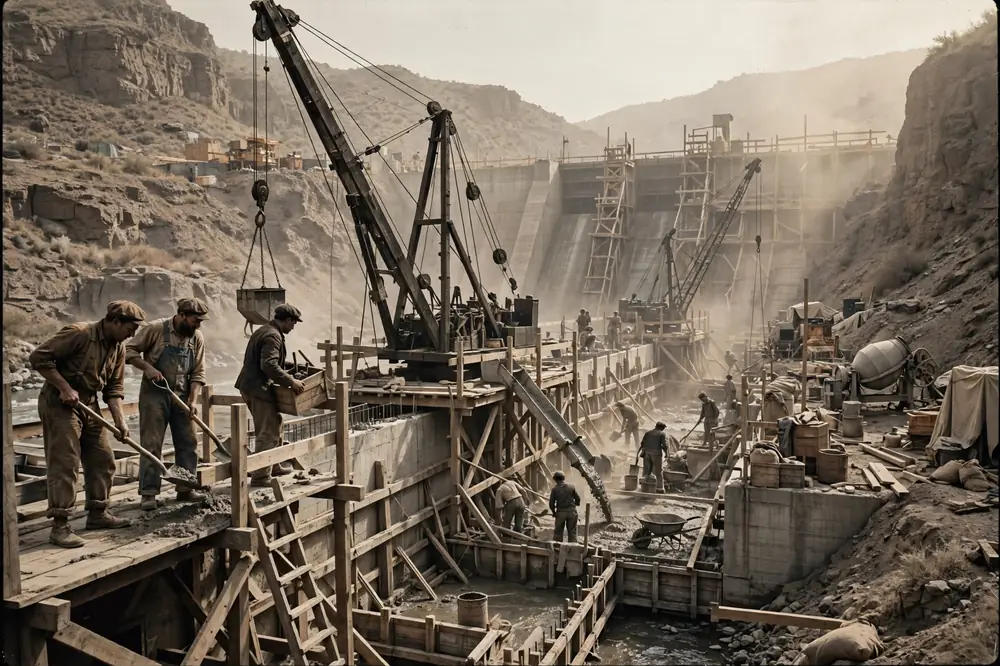
In the election of November 1932, Roosevelt defeated the incumbent Republican president, Herbert Hoover, by a wide margin, winning 472 electoral votes to Hoover’s 59. He took office on 4 March 1933, at the lowest point of the Depression: unemployment stood at about 25 per cent of the workforce, according to the figures of the Bureau of Labor Statistics, thousands of banks had failed, and the banking system was on the verge of collapse. In his inaugural address he told the American people that “the only thing we have to fear is fear itself”, and in his first hundred days in office he pushed through Congress a series of measures that became known as the New Deal.
The New Deal was a programme of relief, recovery and reform. Its first measures included the Emergency Banking Act, which closed the banks temporarily and reopened those judged sound; the Civilian Conservation Corps, which employed young men on public works; the Agricultural Adjustment Act, which paid farmers to reduce production; and the National Industrial Recovery Act, which set codes for industry.
In 1935 a second phase of the New Deal created the Works Progress Administration, which employed millions of people on public works, and the Social Security Act, which established old-age pensions and unemployment insurance — the foundation of the American welfare state.
The New Deal did not end the Depression: unemployment remained above 14 per cent in 1937 and rose again in the recession of 1937–1938, and it was the expansion of war production after 1940 that finally brought unemployment down. The economic effects of the New Deal remain a subject of debate among economists and historians: supporters argue that it provided relief, restored confidence and reformed the financial system; critics argue that its measures prolonged the Depression by discouraging private investment and that the recovery was driven by other factors.
What is not in dispute is that the New Deal expanded the role of the federal government in American life and established a set of institutions — Social Security, the Securities and Exchange Commission, the Federal Deposit Insurance Corporation — that remain in place today.
Roosevelt was re-elected in 1936 by a landslide, winning 523 electoral votes to 8 for his Republican opponent, Alf Landon. In 1937 he proposed a plan to enlarge the Supreme Court, which had struck down several New Deal measures as unconstitutional; the plan was defeated in Congress and is generally regarded by historians as a political error, though it was followed by a change in the Court’s approach to New Deal legislation. He was re-elected for a third term in 1940, breaking the two-term tradition established by George Washington, and for a fourth term in 1944. The Twenty-second Amendment to the Constitution, ratified in 1951, limited future presidents to two terms.
Roosevelt also changed the way presidents communicated with the public. Beginning on 12 March 1933, he delivered a series of radio addresses known as “fireside chats”, in which he explained government policy in plain language, directly to the American people.
The first chat explained the banking crisis and the reasons for the bank holiday; later chats explained the New Deal, the declaration of a national emergency and, after 1941, the progress of the war. Some 30 fireside chats were delivered between 1933 and 1944, and they were listened to by tens of millions of Americans.
Historians of the presidency generally credit the chats with building public confidence in the government at a time of crisis, and they remain a model for presidential communication. Eleanor Roosevelt, for her part, held regular press conferences — the first by a First Lady — and wrote a syndicated newspaper column, “My Day”, from 1935 to 1962, in which she discussed public affairs and her own activities.
5. Franklin D. Roosevelt’s Role in World War II
Roosevelt’s wartime role falls into three phases: the period of neutrality and aid to Britain and the Soviet Union in 1939–1941; the entry of the United States into the war after Pearl Harbor and the direction of the war effort in 1941–1943; and the diplomacy of the final years, 1943–1945.
Neutrality and aid, 1939–1941
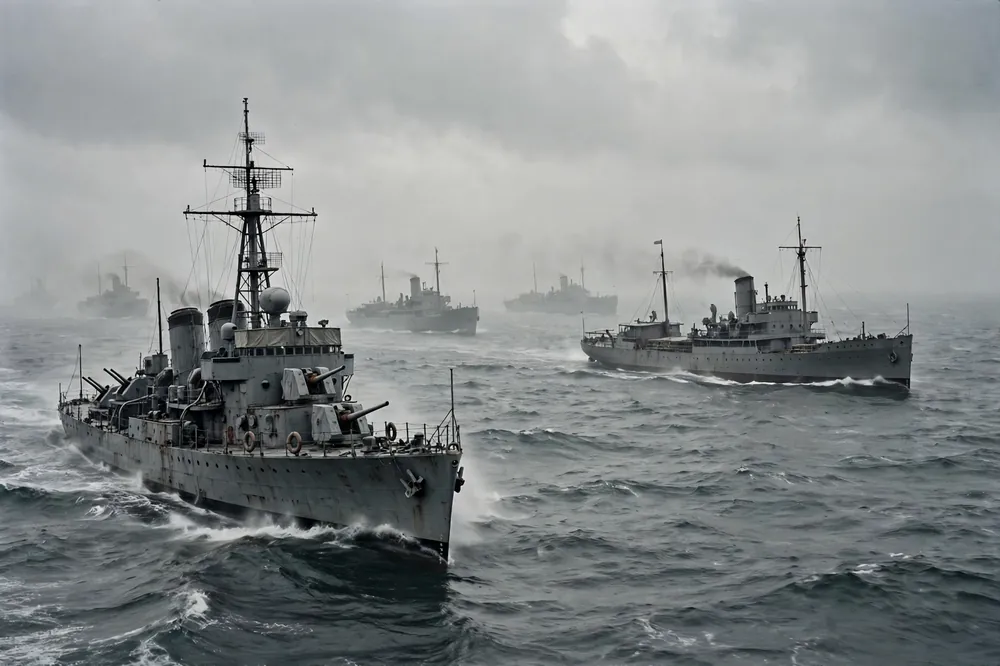
When the Second World War began in Europe in September 1939, the United States was bound by the Neutrality Acts, which prohibited the sale of arms to belligerents. Roosevelt, who believed that the United States would eventually be drawn into the war, moved gradually to support Britain.
In November 1939 Congress amended the Neutrality Acts to allow “cash and carry” sales of arms to belligerents; in September 1940 the United States transferred fifty destroyers to Britain in exchange for leases on British bases in the Atlantic; and in March 1941, after his re-election, Roosevelt signed the Lend-Lease Act (11 March 1941), which authorised the United States to supply weapons, food and equipment to Britain and, after June 1941, to the Soviet Union and China, without immediate payment.
By the end of the war, Lend-Lease aid totalled some $50 billion, according to the figures of the United States government, of which about $31 billion went to Britain and about $11 billion to the Soviet Union.
In January 1941 Roosevelt set out the aims of American policy in his “Four Freedoms” speech to Congress, in which he described a world founded on freedom of speech, freedom of worship, freedom from want and freedom from fear. In August 1941 he met Churchill off Newfoundland and issued the Atlantic Charter, a joint statement of war aims.
Throughout 1941, American and German forces clashed in the Atlantic, where German U-boats attacked American shipping, and in the Pacific, where the United States imposed an oil embargo on Japan in July 1941 in response to the Japanese occupation of French Indochina.
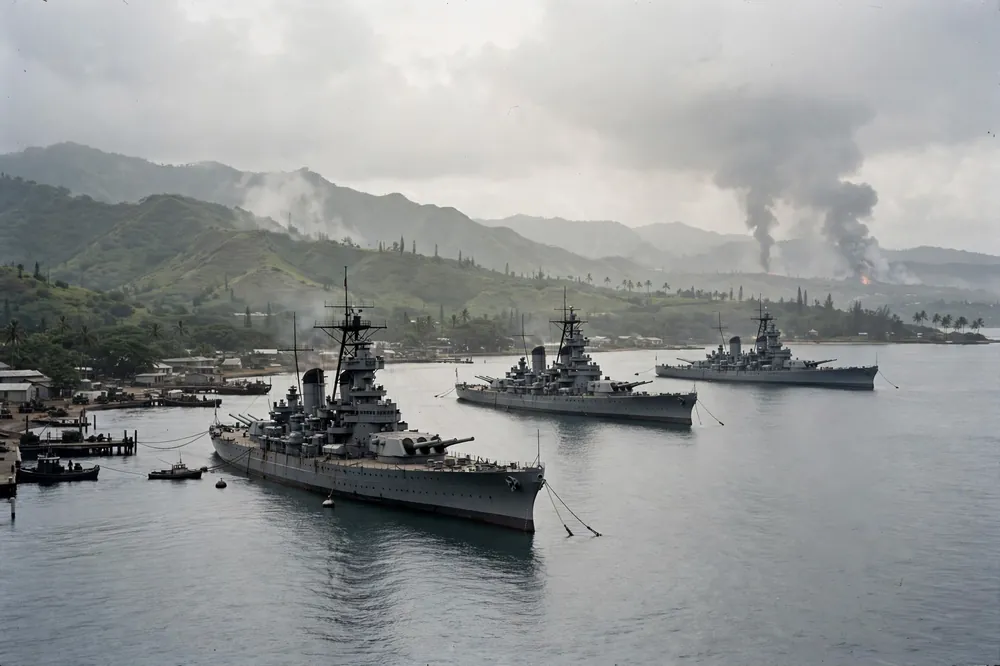
The embargo, combined with the freezing of Japanese assets, left Japan with a choice between withdrawing from China and Indochina or seizing the oil fields of the Dutch East Indies. Japan chose the second course, and on 7 December 1941 it attacked the American naval base at Pearl Harbor in Hawaii, killing 2,403 Americans, according to the figures of the United States Navy, and sinking or damaging eight battleships.
Pearl Harbor and the entry into the war
On 8 December 1941, Roosevelt addressed a joint session of Congress and asked for a declaration of war against Japan, describing 7 December as “a date which will live in infamy”. Congress declared war on Japan the same day, and on 11 December Germany and Italy declared war on the United States.
Roosevelt’s speech, and the phrase “a date which will live in infamy”, became one of the most quoted passages in American history. The question of whether Roosevelt had advance knowledge of the attack on Pearl Harbor — the claim that he allowed the attack to happen in order to bring the United States into the war — has been investigated by nine official inquiries, including a congressional investigation in 1945–1946, and none found evidence to support it.
The historical consensus is that the attack was the result of intelligence failures and of the misreading of Japanese intentions, not of a deliberate decision by Roosevelt. The claim continues to appear in popular accounts, and this article records that the official inquiries rejected it.
As commander-in-chief, Roosevelt directed the American war effort through the Joint Chiefs of Staff, chaired by Admiral William Leahy, and through his personal relationship with Churchill, with whom he exchanged more than 1,700 messages during the war, according to the records of the Roosevelt Library.
In December 1941 he met Churchill in Washington at the Arcadia Conference, where they agreed on the “Germany first” strategy and on the creation of a combined Anglo-American command. In January 1943, at the Casablanca Conference, he and Churchill announced the policy of unconditional surrender.
In November–December 1943, at the Tehran Conference, he met Stalin for the first time, and the three leaders agreed on the invasion of France in 1944 and on the creation of a United Nations organisation after the war.
The arsenal of democracy and the final years
Roosevelt’s most important contribution to the war was, in the judgement of many historians, the mobilisation of the American economy. In December 1940 he described the United States as “the arsenal of democracy”, and under his direction American industry produced, between 1941 and 1945, some 300,000 aircraft, 88,000 tanks and 1,500 major warships, according to the figures of the United States government.
The production was achieved through the War Production Board, the Office of Price Administration and the expansion of the federal government into areas of the economy it had never controlled before. The war also transformed American society: some 16 million Americans served in the armed forces, women entered the workforce in large numbers, and the migration of workers to war industries accelerated the movement of African Americans from the rural South to the industrial North and West.
In February 1945 Roosevelt attended the Yalta Conference (4–11 February), where he, Churchill and Stalin agreed on the structure of the United Nations, on the occupation zones of Germany, and on Soviet entry into the war against Japan. Roosevelt’s health was visibly failing at Yalta — he had been suffering from advanced arteriosclerosis for more than a year, according to his medical records — and his performance at the conference has been debated by historians ever since.
Some argue that his illness impaired his judgement and that he made concessions to Stalin, particularly on Poland, that he would not have made in better health; others argue that the agreements at Yalta reflected the military realities of the time — the Red Army occupied Eastern Europe — and that no American president could have changed the outcome.
The debate continues, and the documentary record — including the minutes of the Yalta Conference — does not resolve it.
6. Key Decisions
The New Deal (1933–1938). Roosevelt’s decision to use the federal government to provide relief, to regulate the financial system and to employ millions of people on public works was the foundation of his presidency. The measures are assessed in section 4 above: they expanded the role of government, created institutions that remain in place, and did not, by themselves, end the Depression.
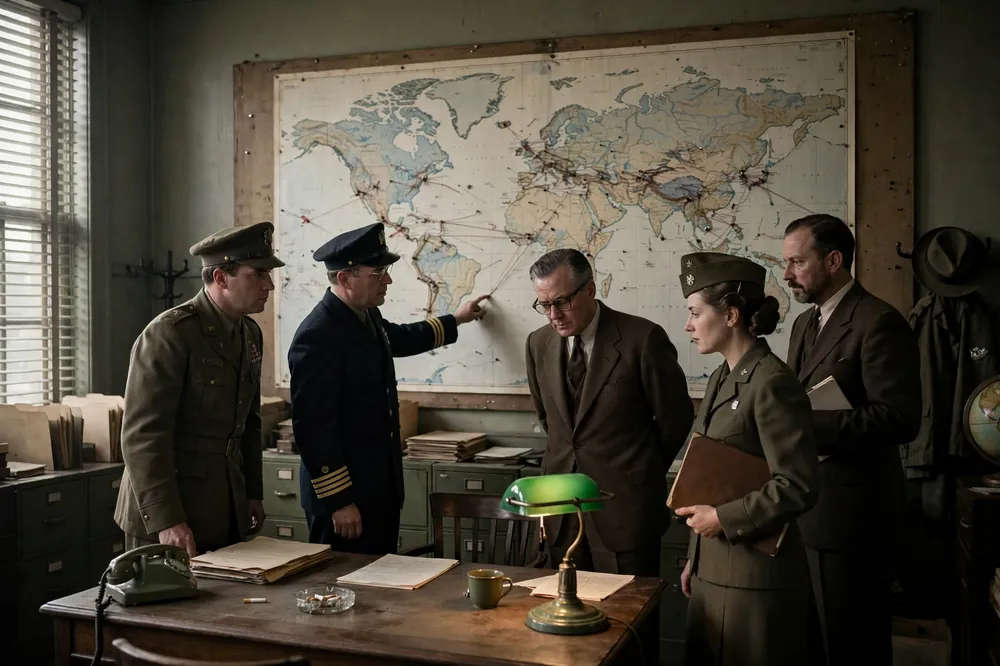
Lend-Lease (11 March 1941). The decision to supply Britain and the Soviet Union with American weapons and materials before the United States entered the war was, in the judgement of many historians, Roosevelt’s most consequential act before Pearl Harbor. It kept Britain supplied at a point when its own production was insufficient, and it supplied the Soviet Union with trucks, food and other materials that, according to Soviet records, accounted for a significant share of Soviet supply in 1942–1943. The decision was controversial in the United States at the time: isolationists in Congress argued that it would draw the country into the war, and the Act passed the Senate by 60 votes to 31.
The internment of Japanese Americans (Executive Order 9066, 19 February 1942). After Pearl Harbor, Roosevelt signed an executive order authorising the military to remove persons of Japanese ancestry from the West Coast. About 120,000 people of Japanese descent, most of them American citizens, were removed from their homes and held in internment camps for the duration of the war. The decision is discussed in section 7 below. In 1988 the United States government formally apologised for the internment and paid compensation to surviving internees, under the Civil Liberties Act signed by President Ronald Reagan.
Unconditional surrender (Casablanca, January 1943). The policy, announced jointly with Churchill, is discussed in the Churchill article and in section 5 above. Roosevelt is generally credited with originating the formulation, which he announced at a press conference at Casablanca without prior consultation with his advisers, according to the records of the conference.
The United Nations. Roosevelt was the principal author of the plan for a post-war international organisation to replace the League of Nations. The name “United Nations” was his, first used in the Declaration by United Nations of 1 January 1942, and the structure agreed at Yalta — including the Security Council and the veto power of its permanent members — reflected his design. He did not live to see the organisation founded: the United Nations Charter was signed in San Francisco on 26 June 1945, two months after his death.
7. Controversies
Roosevelt’s controversies concern his economic record, his handling of civil rights, and his wartime decisions. They are presented here as historians present them, with the evidence on both sides.
The economic record of the New Deal. The debate is summarised in section 4 above. Economists and historians disagree on whether the New Deal shortened or prolonged the Depression, and the disagreement reflects different methods as much as different politics: those who measure the New Deal by unemployment and output find that the recovery was slow and incomplete until war production began, while those who measure it by relief, by the restoration of the banking system and by the creation of lasting institutions find that it achieved its aims. The debate is not resolved, and this article does not resolve it.
Civil rights. Roosevelt’s record on civil rights is assessed critically by historians. He did not support federal anti-lynching legislation, which was blocked in Congress by Southern Democrats, and he did not desegregate the armed forces, which remained segregated throughout the war. In 1941, under pressure from the labour leader A.
Philip Randolph, who threatened a march on Washington, Roosevelt issued Executive Order 8802, which prohibited racial discrimination in defence industries and established the Fair Employment Practices Committee — the first federal action against employment discrimination. His wife Eleanor was more outspoken on civil rights than he was, and historians have debated whether Roosevelt’s caution reflected political necessity — the need to retain the support of Southern Democrats for the New Deal and the war effort — or a lack of personal commitment.
The documentary record shows that he was aware of the issue and that he chose, repeatedly, to prioritise other objectives.
The internment of Japanese Americans. Executive Order 9066 is the most widely criticised decision of Roosevelt’s presidency. The order was issued on the advice of the Secretary of War, Henry Stimson, and the commanding general of the Western Defense Command, John DeWitt, who argued that persons of Japanese ancestry posed a security risk.
No evidence of espionage or sabotage by Japanese Americans was presented at the time, and the Commission on Wartime Relocation and Internment of Civilians, established by Congress in 1980, concluded in 1983 that the internment was the result of “race prejudice, war hysteria and a failure of political leadership”. The Supreme Court upheld the internment in Korematsu v.
United States (1944), a decision that was formally repudiated by the Court in 2018. The internment is recorded here as a decision for which Roosevelt bears responsibility as president, and for which the United States government apologised in 1988.
The response to the Holocaust. Roosevelt’s record on the Holocaust is the subject of continuing debate. The United States government received reports of the mass murder of European Jews from 1942 onward, and Roosevelt’s administration did not admit Jewish refugees in large numbers, did not bomb the rail lines to Auschwitz, and did not establish the War Refugee Board until January 1944.
Historians who criticise Roosevelt, notably David Wyman in The Abandonment of the Jews (1984), argue that more could have been done — in particular, that the United States could have admitted more refugees and that the bombing of Auschwitz was feasible.
Historians who defend Roosevelt, notably Richard Breitman and Allan Lichtman, argue that the constraints were real: immigration was restricted by law and by public opinion, the bombing of Auschwitz was opposed by the military on the grounds that it would divert resources from the war effort, and the War Refugee Board, once established, saved tens of thousands of lives.
The debate continues, and the documentary record — including the minutes of the Bermuda Conference of April 1943, at which Britain and the United States declined to take specific action on refugees — is cited by both sides.
8. Later Life and Death
Roosevelt’s final months were marked by declining health. He had been suffering from advanced arteriosclerosis and high blood pressure for more than a year before the Yalta Conference, and his doctors, according to the medical records released after his death, had advised him to rest.
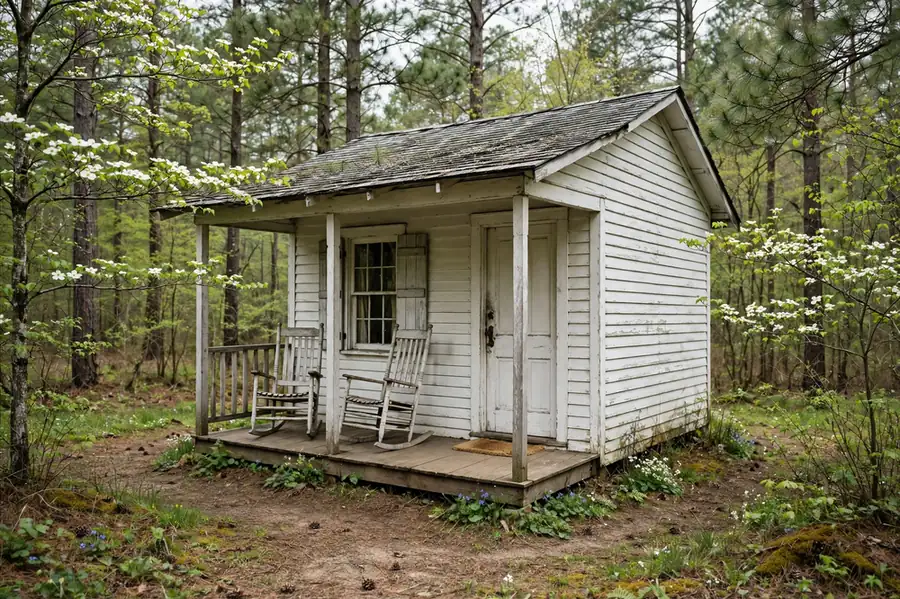
After returning from Yalta, he addressed Congress on 1 March 1945, seated for the first time in his presidency — a visible sign of his frailty that was noted by contemporary observers. At the end of March 1945 he travelled to his cottage at Warm Springs, Georgia — the “Little White House” — to rest.
On the afternoon of 12 April 1945, while sitting for a portrait, he suffered a massive cerebral haemorrhage and died a few hours later, aged 63. His death came three weeks before the end of the war in Europe and four months before the end of the war against Japan. He was succeeded by Vice President Harry S.
Truman, who had been in office for less than three months and who had not been briefed on the atomic bomb programme. Roosevelt was buried at Springwood, the family estate at Hyde Park, on 15 April 1945.
9. Legacy of Franklin D. Roosevelt
Roosevelt’s legacy is the subject of continuing political debate in the United States, and the terms of the debate have changed little since his death. Supporters argue that the New Deal saved American capitalism from collapse, that the Social Security system remains the foundation of the American welfare state, and that Roosevelt’s wartime leadership — the mobilisation of the American economy, the “Germany first” strategy and the creation of the United Nations — made the Allied victory possible.
Critics argue that the New Deal prolonged the Depression, that the expansion of the federal government under Roosevelt was the beginning of a permanent increase in the size and scope of government, and that his wartime decisions — the internment of Japanese Americans, the agreements at Yalta and the failure to act on the Holocaust — are a permanent stain on his record.
Both positions are represented in the historical literature, and the assessment of Roosevelt’s presidency remains divided along lines that reflect broader disagreements about the role of government in American life.
The institutional legacy is concrete: the Social Security Administration, the Securities and Exchange Commission, the Federal Deposit Insurance Corporation and the Federal Housing Administration all date from the New Deal; the United Nations, the International Monetary Fund and the World Bank all date from the wartime and post-war planning in which Roosevelt was the principal author; and the Twenty-second Amendment, which limits presidents to two terms, was a direct response to Roosevelt’s four elections.
The Roosevelt Library at Hyde Park, established in 1941, was the first presidential library in the United States and remains a major archive for the study of the Depression and the war. In polls of historians, Roosevelt is generally ranked among the three most highly regarded presidents in American history, alongside George Washington and Abraham Lincoln — a ranking that reflects the judgement of the historians polled rather than a settled historical fact.
10. Assessment by Historians
Historians assess Franklin D. Roosevelt as the central figure of American public life in the 1930s and 1940s, and as a president whose record is inseparable from the two crises he faced. The assessment of his handling of the Depression is that he was a pragmatist rather than an ideologue: the New Deal was a series of experiments, some of which failed and were abandoned, rather than a single coherent programme, and Roosevelt’s willingness to try new measures and to discard those that did not work is, in the judgement of the historian William Leuchtenburg, the defining characteristic of his presidency.
The assessment of his wartime leadership is that he was an effective commander-in-chief who delegated military decisions to his generals and admirals, who maintained the alliance with Britain and the Soviet Union through personal diplomacy, and who understood, earlier than most of his contemporaries, that the United States would have to take a leading role in the post-war world.
The historian Robert Dallek, in his biography of 2017, argues that Roosevelt’s greatest achievement was the mobilisation of American power — economic, military and diplomatic — on a scale that no previous president had attempted.
The critical assessment is that Roosevelt’s presidency had serious failures, and that these failures are part of the record rather than footnotes to it. The internment of Japanese Americans, the failure to act on the Holocaust, the agreements at Yalta and the expansion of presidential power are all, in the judgement of the historians who have studied them, decisions for which Roosevelt bears responsibility.
The historian David Kennedy, in his study of the Depression and the war, concludes that Roosevelt was “a president of extraordinary political skill and of ordinary human limitations” — a formulation that captures the division in the historiography between the assessment of his achievements and the assessment of his failures.
The debate over Roosevelt’s presidency, like the debate over the New Deal itself, has not been closed, and it is unlikely to be closed, because it reflects a continuing disagreement about the role of government in American life.
Frequently Asked Questions
Who was Franklin D. Roosevelt? Franklin D. Roosevelt (1882–1945) was the 32nd President of the United States, serving from 1933 until his death in 1945. He was the only president elected to four terms, and he led the United States through the Great Depression and most of the Second World War.
What was the New Deal? The New Deal was Roosevelt’s programme of relief, recovery and reform in response to the Great Depression, including the Civilian Conservation Corps, the Works Progress Administration and the Social Security Act of 1935.
What was Lend-Lease? The Lend-Lease Act, signed on 11 March 1941, authorised the United States to supply weapons, food and equipment to Britain, the Soviet Union and China without immediate payment. Total aid by the end of the war was about $50 billion.
What did Roosevelt do after Pearl Harbor? On 8 December 1941 he asked Congress for a declaration of war against Japan, describing 7 December as “a date which will live in infamy”. He then directed the American war effort as commander-in-chief and worked with Churchill and Stalin at the Allied conferences.
What was Roosevelt’s role at Yalta? At the Yalta Conference (4–11 February 1945) Roosevelt, Churchill and Stalin agreed on the structure of the United Nations, the occupation zones of Germany and Soviet entry into the war against Japan. His performance at Yalta, when his health was failing, remains debated by historians.
How did Franklin D. Roosevelt die? He died on 12 April 1945 at Warm Springs, Georgia, aged 63, of a massive cerebral haemorrhage, three weeks before the end of the war in Europe.
Related articles
Sources
- Wikipedia, “Franklin D. Roosevelt” — consolidated biography: born 30 January 1882, 32nd president 4 March 1933 – 12 April 1945, died 12 April 1945.
- Encyclopaedia Britannica, “Franklin D. Roosevelt” (britannica.com) — biography, New Deal, wartime leadership, four terms.
- Franklin D. Roosevelt Presidential Library and Museum, Hyde Park, New York — the Four Freedoms speech (6 January 1941), the “date which will live in infamy” address (8 December 1941), Lend-Lease records, medical records.
- William E. Leuchtenburg, Franklin D. Roosevelt and the New Deal, 1932–1940 (Harper & Row, 1963) — the standard study of the New Deal.
- Robert Dallek, Franklin D. Roosevelt: A Political Life (Viking, 2017) — modern biography.
- David M. Kennedy, Freedom from Fear: The American People in Depression and War, 1929–1945 (Oxford University Press, 1999) — the Depression and the war.
- Richard Breitman and Allan J. Lichtman, FDR and the Jews (Harvard University Press, 2013) — Roosevelt and the Holocaust debate.
- Commission on Wartime Relocation and Internment of Civilians, Personal Justice Denied (1983) — the internment of Japanese Americans.
Further reading
- Jean Edward Smith, FDR (Random House, 2007).
- H. W. Brands, Traitor to His Class: The Privileged Life and Radical Presidency of Franklin Delano Roosevelt (Doubleday, 2008).