 WAR ATLAS MILITARY HISTORY MAGAZINE · WWI — WWII
M3 Grease Gun
1. Lead
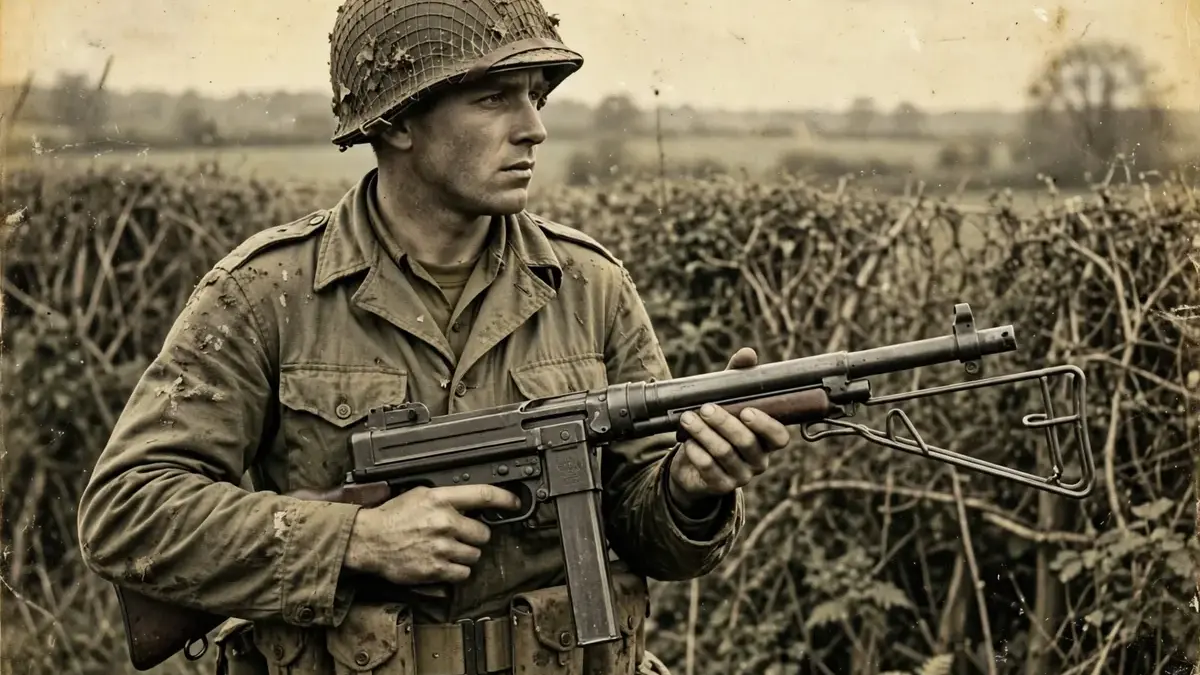
The M3 submachine gun — universally known as the Grease Gun — was one of the most unglamorous and most successful weapons of the Second World War. It was a tube of stamped sheet steel with a wire stock, a crude cocking handle and a slow, thumping rate of fire, and it looked more like a mechanic’s tool than a soldier’s weapon, which is exactly how it got its nickname.
Yet the M3 did everything the United States Army asked of it: it was cheap, it was simple, it was reliable, and it could be made in enormous numbers by factories that had never built a gun before. Adopted in December 1942 as a replacement for the expensive and complicated Thompson submachine gun, the M3 cost about 20 dollars to produce, against more than 200 dollars for an early Thompson, and roughly 615,000 were built during the war, with about 700,000 in total including post-war production.
It armed tank crews, truck drivers, paratroopers and officers who needed a compact automatic weapon, it fought in Normandy, in the Battle of the Bulge, in Korea and in Vietnam, and it remained in American service — chiefly with armoured vehicle crews — until the 1990s.
The Grease Gun’s story is the story of wartime industrial logic: a weapon designed not to be the best, but to be good enough, and to be available in the numbers a global war demanded.
2. Key Facts
The table below summarises the M3 Grease Gun in its standard wartime form, with the main figures for the improved M3A1.
| Type | Submachine gun, blowback-operated, selective fire |
| Country of origin | United States (General Motors, Guide Lamp Division) |
| Designer | George J. Hyde; developed 1942 |
| Entered service | December 1942 |
| Number built | About 615,000 during the war; about 700,000 in total including post-war production (M3 and M3A1) |
| Calibre | .45 ACP (11.43×23 mm); 9 mm conversion kits existed |
| Weight | About 8 lb (3.6 kg) unloaded |
| Length | About 29.8 in (757 mm) stock extended; 22.5 in (570 mm) folded |
| Barrel length | 8 in (203 mm) / 203 mm |
| Rate of fire | About 450 rounds per minute |
| Muzzle velocity | About 920 ft/s (280 m/s) |
| Feed | 30-round detachable box magazine |
| Effective range | About 100 yards (90 m) |
| Unit cost | About $20.94 (1943) |
3. Background
3.1. The Thompson problem
When the United States entered the Second World War in December 1941, its standard submachine gun was the Thompson, a finely machined weapon with a long and distinguished history, and a price to match. The Thompson M1928A1 cost the government more than 200 dollars per gun in 1941, and even the simplified wartime M1 and M1A1 models cost around 45 dollars, a large sum for a weapon that was meant to be issued in the hundreds of thousands.
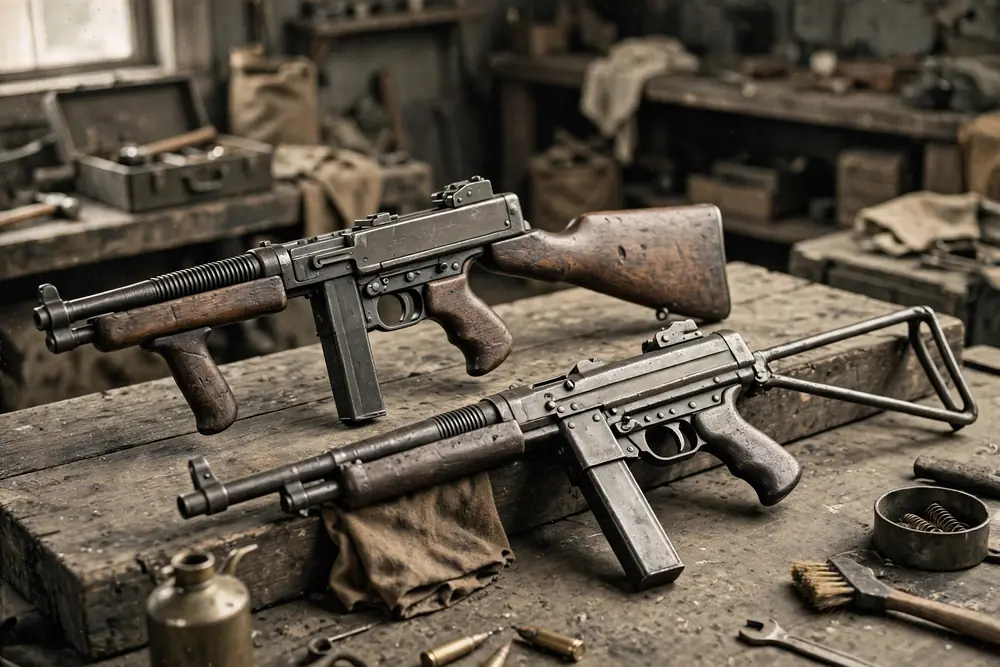
Worse, the Thompson was slow to make: it was built from machined steel forgings, it required skilled labour, and its production consumed machine-tool time that was desperately needed for other weapons. The Army’s Ordnance Department knew that a global war would require a submachine gun in numbers the Thompson could never reach, and it knew that the men who needed the weapon most — tank crews, drivers, mortar crews, paratroopers and officers — needed something compact, cheap and reliable rather than elegant.
The search for a replacement began in 1942, and it drew directly on the example of the enemy: the German MP 40 and the British Sten gun had both shown that a submachine gun could be built from stamped sheet steel, quickly and cheaply, and still work in combat.
3.2. Stamped steel and the German example
The key insight behind the M3 was that a submachine gun did not need to be machined from solid steel. The German MP 40 had pioneered the use of stamped sheet-metal parts, and the British Sten Gun had taken the idea further, building a workable weapon from little more than a steel tube, a bolt and a magazine. The American designers — principally George J.
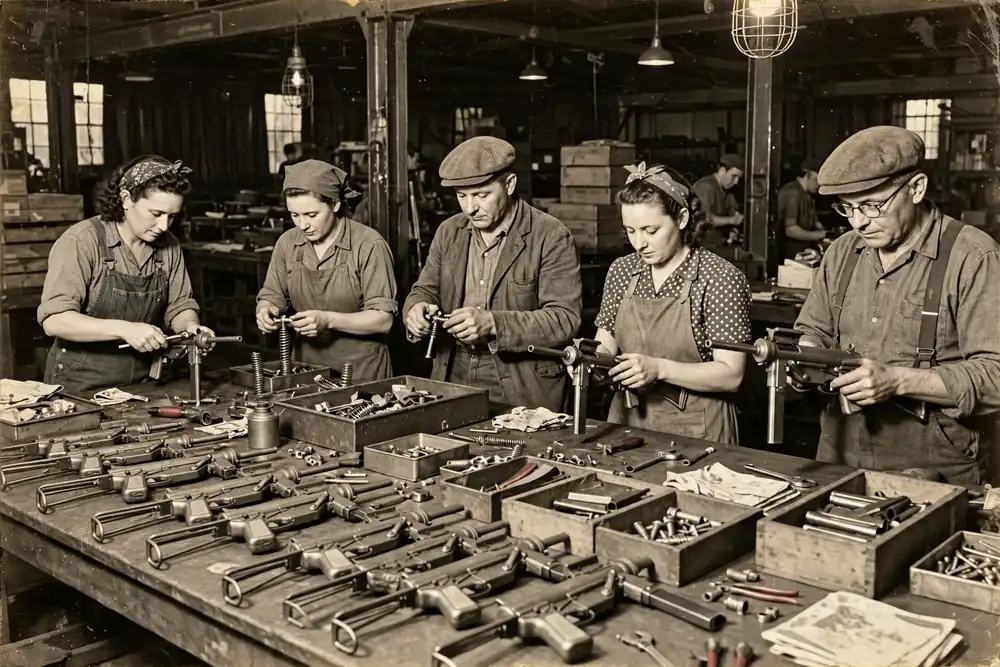
Hyde, working with the Inland Division of General Motors — applied the same logic to the American .45 ACP cartridge, which was larger and more powerful than the 9 mm round used by the German and British guns. The result was a weapon with only about thirty parts, most of them stampings or simple tubes, that could be assembled by workers with no gunsmithing experience.
The design was deliberately crude: the receiver was a tube made from two stamped halves welded together, the barrel screwed into the front, the stock was a length of wire, and the sights were fixed and rudimentary. There was no wooden furniture, no fine finish and no unnecessary machining, and the whole gun could be produced by an automobile lamp factory — which is exactly what happened, when production was assigned to General Motors’ Guide Lamp Division in Anderson, Indiana.
3.3. Adoption in December 1942
The M3 was adopted by the United States Army on 12 December 1942, after trials in which it proved reliable, accurate enough at short range and dramatically cheaper than the Thompson. The first production guns reached troops in 1943, and the Army’s intention was that the M3 would progressively replace the Thompson across the whole force.
In practice the replacement was never complete: the Thompson remained in service throughout the war, because production of the M3 was slow to reach full speed and because many soldiers preferred the Thompson’s familiar handling and higher rate of fire. But the M3 found its own niche, and it was a large one.
It was issued to the crews of tanks and other armoured vehicles, who needed a weapon that could be stowed inside a cramped fighting compartment and brought into action quickly if the vehicle was hit; to drivers, radio operators and mortar crews; to paratroopers, for whom its folding stock and compact length were valuable; and to officers, who carried it as a personal weapon.
By the time of the Normandy landings in June 1944, the M3 was a familiar sight in American units, and its strange, tool-like appearance had already earned it the nickname that would follow it for the next fifty years.
4. Design and Development
4.1. A tube, a bolt and a spring
The M3’s mechanism was about as simple as a military automatic weapon can be. It worked on the straight blowback principle: the bolt was a heavy steel cylinder that was held forward by a spring, and when the gun fired, the pressure of the cartridge drove the bolt backwards, ejecting the spent case and compressing the spring, which then drove the bolt forward again, stripping a fresh cartridge from the magazine and chambering it.
There was no locking mechanism, no gas system and no complicated trigger group. The bolt was cocked by a handle on the right side of the receiver, which the firer pulled back and which then remained stationary while the gun fired — a design that kept the cocking handle out of the way but which proved to be the weapon’s weak point, because the handle could break or work loose in service.
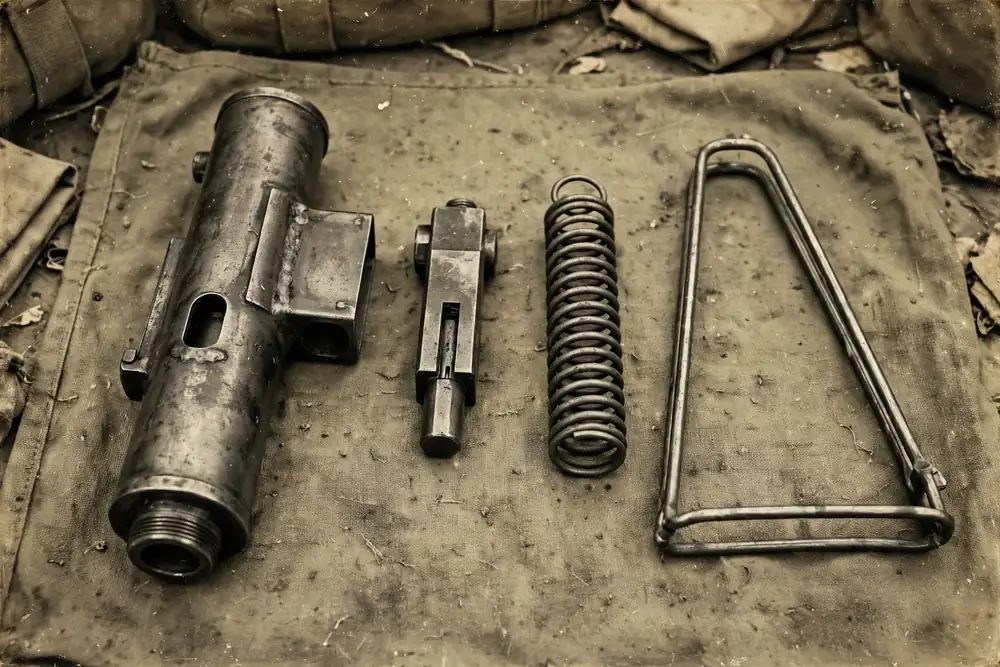
The gun fired from the open bolt, which meant that the bolt stayed back between shots and slammed forward when the trigger was pulled, a system that was simple and tolerant of dirt but which made the weapon less accurate than a closed-bolt design.
The barrel was only eight inches long, it was held in place by a simple nut, and it could be removed in seconds for cleaning or for fitting a flash hider.
4.1.1. Why it looked like a grease gun
The M3’s nickname came from its appearance, and the resemblance was not accidental in the eyes of the soldiers who used it. The receiver was a plain steel tube, the cocking handle stuck out of the side like a lever, and the whole weapon had the same utilitarian, workshop look as the grease guns that mechanics used to lubricate vehicles — the hand-pumped tools that forced grease into bearings through a nozzle.
The wire stock, which folded along the side of the receiver, added to the impression of a tool rather than a weapon, and the gun’s matt, Parkerised finish gave it a dull grey colour that reinforced the workshop comparison. Soldiers also noted that the M3 felt like a tool in the hand: it was heavy for its size, its controls were crude, and it had none of the balance or elegance of the Thompson.
The nickname was affectionate rather than contemptuous, and it stuck so firmly that the M3 is still universally known as the Grease Gun, while its official designation is remembered only by collectors and historians. The name was also a fair description of the weapon’s philosophy: like a grease gun, it was a tool built for a job, and it did the job without pretension.
4.2. The slow rate of fire
One of the M3’s most distinctive characteristics was its slow cyclic rate of about 450 rounds per minute, roughly half the Thompson’s 700 to 800 rounds per minute and far slower than the German MP 40’s 500 to 550. The slow rate was partly deliberate and partly a consequence of the heavy bolt, which took longer to travel back and forth, and it turned out to be an advantage in practice.
A soldier firing the M3 could control it in short bursts, and the slow, rhythmic thump of the gun made it possible to fire single shots with a careful trigger finger, which conserved ammunition and made the weapon more accurate than its crude sights suggested.
The .45 ACP cartridge was a heavy, slow bullet that hit hard at short range and was widely regarded as a good man-stopper, though its curved trajectory limited the weapon’s effective range to about 100 yards. The thirty-round magazine was a double-column, single-feed design copied from the Thompson’s stick magazine, and it was the M3’s most troublesome feature: it was difficult to load by hand, the feed lips could bend if the magazine was dropped, and a damaged magazine was the most common cause of stoppages.
Soldiers learned to load magazines with a loading tool and to treat them with care, and the problem was manageable, but it was never fully solved.
4.3. The M3A1 improvement
Combat experience in 1943 and 1944 exposed the M3’s weaknesses, and in December 1944 the Army adopted the improved M3A1, which addressed the most serious of them. The troublesome cocking handle was removed entirely: the M3A1 was cocked by putting a finger through a hole in the bolt and pulling it back, a cruder method that nevertheless could not break, because there was no handle to break.
The ejection port was enlarged to improve reliability, the barrel and the magazine well were strengthened, and a number of small simplifications reduced the number of parts still further. About 15,000 M3A1s were built before the end of the war, a small number beside the roughly 600,000 M3s, but the M3A1 became the standard post-war model, and it was the version that served in Korea and Vietnam.
The Army also produced 9 mm conversion kits for the M3, with a different barrel, bolt and magazine adapter, so that the gun could use captured German ammunition or the standard British 9 mm round. These kits were issued in small numbers, mainly to the Office of Strategic Services for use behind enemy lines, and they were a practical recognition that a weapon designed for one cartridge could be adapted to another when the mission required it.
5. Technical Specifications
5.1. Dimensions and weight
The M3 was a compact weapon by the standards of the Second World War, and its size was one of the reasons it was issued to vehicle crews. With the wire stock extended it measured about 29.8 inches (757 millimetres) in length, and with the stock folded it shrank to about 22.5 inches (570 millimetres), short enough to be stowed inside a tank or carried slung under a jacket.
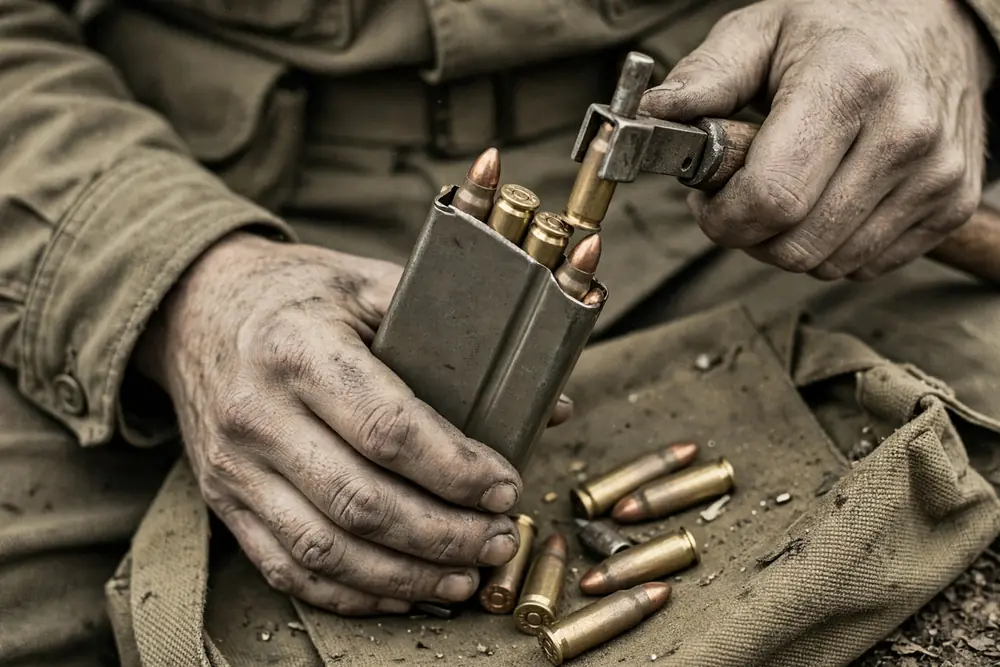
It weighed about 8 pounds (3.6 kilograms) unloaded and about 10 pounds (4.5 kilograms) with a loaded thirty-round magazine, which made it noticeably lighter than the Thompson, which weighed about 10.8 pounds unloaded. The barrel was eight inches long, with a simple fixed front sight and a fixed rear aperture, and the gun was fitted with a threaded muzzle that could accept a flash hider.
The wire stock doubled as a cleaning rod and, in the M3A1, as a tool for removing the barrel, a piece of design economy that was characteristic of the whole weapon. The M3’s compactness came at a price: the short barrel and the crude sights limited its accuracy, and the wire stock was uncomfortable to shoot from for long periods, but for a weapon that was meant to be carried rather than fired at distance, the compromise was the right one.
5.2. Cartridge, magazine and ballistics
The M3 fired the .45 ACP cartridge, the same round used by the Thompson submachine gun and the M1911 pistol, which simplified ammunition supply across the American forces. The cartridge fired a heavy 230-grain (15-gram) bullet at a muzzle velocity of about 920 feet per second (280 metres per second), giving it a muzzle energy of roughly 400 foot-pounds.
The bullet was subsonic, which made the gun relatively quiet by submachine-gun standards and made it suitable for use with a suppressor, a quality that later made the M3 popular with special forces. The thirty-round magazine was loaded with a tool, because the stiff spring made hand-loading slow and painful, and the magazine’s single-feed design meant that the cartridges stacked in a single column at the top, which required precise feed-lip geometry.
When the magazine was in good condition the gun was reliable; when the feed lips were bent or the magazine was dirty, stoppages followed. The effective range was about 100 yards, and beyond that the heavy bullet dropped quickly and the fixed sights made accurate fire difficult.
Within 50 yards, however, the M3 was a formidable weapon, and its slow rate of fire meant that a trained soldier could place his shots rather than spraying them.
| M3 Grease Gun / M3 Grease Gun | |
|---|---|
| Calibre | .45 ACP (11.43×23 mm) / .45 ACP (11,43×23 mm) |
| Weight unloaded | About 8 lb (3.63 kg) |
| Length stock extended | 29.8 in (757 mm) / 757 mm |
| Length stock folded | 22.5 in (570 mm) / 570 mm |
| Barrel / Nòng | 8 in (203 mm) / 203 mm |
| Rate of fire | About 450 rounds/min |
| Muzzle velocity | About 920 ft/s (280 m/s) |
| Magazine | 30-round box |
| Effective range | About 100 yards (90 m) |
| Unit cost | About $20.94 (1943) |
5.3. Reliability and maintenance
The M3’s reliability in the field was good, though not perfect, and its reputation among the soldiers who used it was better than its crude appearance suggested. The open-bolt blowback mechanism had few parts to fail, and it tolerated dust, mud and cold better than more complex weapons, which was one reason it remained popular with tank crews, who worked in filthy conditions and needed a weapon that would fire when it was needed.
The gun’s main reliability problems came from the magazine rather than the mechanism, and from the cocking handle on the early M3, which could snap off and leave the gun impossible to cock. Field stripping was simple: the gun could be taken apart into its main groups without tools, and the barrel could be removed by unscrewing a nut, which made cleaning straightforward.
The M3 required little lubrication, and it would function with the cheap, corrosive-primed ammunition of the war years, though soldiers were taught to clean it after firing. The Army’s own tests found that the M3 would fire thousands of rounds between stoppages when it was properly maintained and fed with good magazines, a record that compared favourably with the Thompson, and it was this practical reliability — rather than any theoretical excellence — that kept the weapon in service for half a century.
5.3.1. The magazine problem
The M3’s thirty-round magazine deserves its own discussion, because it was the weapon’s most persistent weakness and the source of most of its stoppages. The magazine was a double-column, single-feed design inherited from the Thompson, and it was loaded by pressing cartridges down against a stiff spring, a process that was slow and hard on the fingers without a loading tool.
The feed lips at the top of the magazine were thin stampings, and if the magazine was dropped on a hard surface or carried loose in a pocket, the lips could bend just enough to cause misfeeds. The Army issued a loading tool with the gun, and soldiers were taught to keep their magazines clean and to discard any that showed damage, but in combat these precautions were not always possible.
The problem was never fully solved during the war, and it was one of the reasons some soldiers preferred the Thompson, whose magazines were more robust. The M3A1 did not change the magazine, and the issue followed the weapon into Korea and Vietnam, where it remained the most common complaint about an otherwise well-liked gun.
6. Variants
6.1. M3: the wartime standard
The original M3 was produced from 1942 to 1944 in a run of roughly 600,000 guns, and it was the version that fought in Normandy, in Italy and in the Pacific. It is recognisable by its cocking handle on the right side of the receiver, a crank-like lever that the firer pulled back to cock the bolt.
The handle was the gun’s most obvious weakness, and it was the subject of constant complaint: it could break off, it could work loose, and if it was lost the gun could not be cocked at all. The M3 also had a small oil can fitted into the pistol grip, a practical touch that reflected the Army’s expectation that the gun would be used by men who had no armourer’s support.
The wartime M3 was issued with a flash hider that screwed onto the muzzle, and with a 9 mm conversion kit in small numbers for special operations. The gun’s production was shared between the Guide Lamp Division and the Inland Division of General Motors, and it was one of the first American small arms to be built entirely by the automobile industry, a fact that the Army publicised as evidence of American industrial power.
6.2. M3A1 and post-war service
The M3A1, adopted in December 1944, removed the cocking handle, enlarged the ejection port and strengthened the barrel and magazine well, and about 15,000 were built before the war ended. The M3A1 became the standard model after the war, and it was the version issued in Korea, where it was carried by tank crews, officers and support troops, and in Vietnam, where it was used by tank crews, helicopter crews and special forces, including the Military Assistance Command, Vietnam — Studies and Observations Group, whose operators valued its quiet report and its reliability with a suppressor.
The M3A1 remained in the American inventory until the 1990s, when it was finally replaced as a tank crew weapon by the M4 carbine, and it was also widely exported, serving with the armed forces of dozens of countries. The Philippine armed forces and the armed forces of several Latin American countries used the M3A1 into the twenty-first century, and the gun is still encountered in the inventories of police and reserve forces.
Its longevity is a testament to the soundness of its basic design: a weapon that was cheap, simple and good enough outlasted several generations of more sophisticated successors.
7. Combat Service
7.1. Normandy and Northwest Europe
The M3’s first large-scale combat service came in Normandy in June 1944, where it was carried by the tank crews of the armoured divisions that landed on D-Day and by the paratroopers who had dropped behind the beaches the night before.
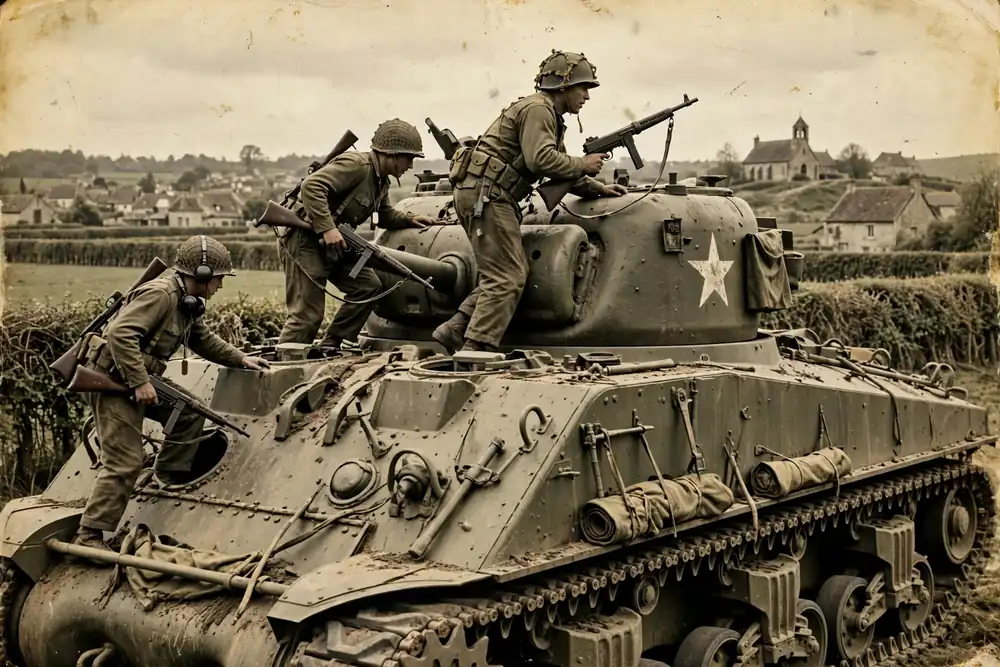
For a tank crewman, the M3 was a weapon of last resort: if his tank was knocked out, he needed something compact that he could grab as he bailed out, and the Grease Gun’s folding stock and short length made it the right tool for that moment.

Infantry officers also carried it, and it became a familiar sight in the photographs of the Normandy campaign — slung over the shoulder of a lieutenant, or held by a sergeant directing traffic at a crossroads. The weapon’s slow rate of fire and its heavy .45 bullet proved well suited to the close-range fighting of the bocage, where engagements took place at distances of a few dozen yards and a short, controlled burst was more useful than a long spray of fire.
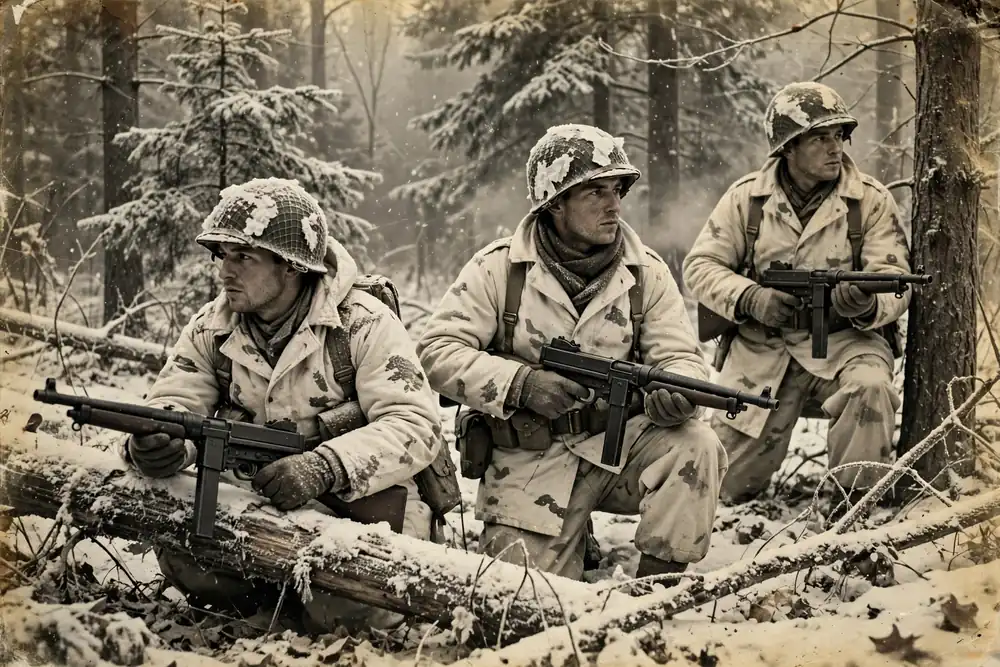
The M3 also saw service in the airborne divisions during Operation Market Garden in September 1944, where its compactness was valued by paratroopers who had to carry everything they owned on their backs, and it fought through the winter of the Battle of the Bulge, where its reliability in the cold was noted by the men who carried it.

7.2. The Pacific and the Mediterranean
In the Pacific the M3 was issued to the crews of the tanks that supported the island landings, and to the Marines and soldiers who fought in the close, confused fighting of the jungle. The weapon’s compactness was valuable in the dense vegetation, where a long rifle was a hindrance, and its heavy bullet was effective against an enemy who often attacked at very short range, in darkness or in the confusion of a night infiltration.
The M3 also served in the Mediterranean, in Italy and in southern France, where it was carried by the crews of the tanks and half-tracks that advanced up the Italian peninsula and by the officers of the infantry regiments that fought through the mountains.
The gun’s reputation in the Pacific was good: the Marines, who had a long tradition of preferring the Thompson, found the M3 reliable and easy to maintain in the tropical conditions, and they appreciated its slow rate of fire, which conserved ammunition on islands where resupply was uncertain.
The M3’s service in the Pacific also included use by the Office of Strategic Services, whose operatives carried the gun — sometimes in its 9 mm form — on missions behind Japanese lines, where its quiet report and its compactness were valuable assets.
7.3. Korea, Vietnam and the long afterlife
The M3A1’s longest service came after the Second World War, in Korea and Vietnam, where it remained the standard personal weapon of American tank crews for half a century. In Korea the M3A1 was carried by the crews of the M26 Pershing and M46 Patton tanks that fought in the mobile battles of 1950 and 1951, and it was valued for the same reasons it had been valued in the Second World War: it was compact, it was reliable, and it fired a heavy bullet at close range.
In Vietnam the M3A1 was carried by the crews of the M48 Patton and M113 armoured personnel carriers, by helicopter crews, and by the special forces of the Military Assistance Command, Vietnam — Studies and Observations Group, whose operators used the gun with a suppressor on reconnaissance missions into Laos and Cambodia.
The suppressed M3A1 was one of the quietest automatic weapons in the American inventory, because the .45 ACP cartridge was naturally subsonic, and it became a favourite of special operators for that reason. The M3A1 was finally retired from American service in the 1990s, when the M4 carbine replaced it as the tank crew weapon, but by then it had served for nearly fifty years — a longer career than any other American submachine gun, and a testament to the soundness of a design that had been drawn up in a hurry in 1942.
7.3.1. The suppressed Grease Gun
The suppressed M3 deserves a special mention, because it was one of the most effective silenced weapons of its era and it explains why the gun remained in special-forces service long after it had left the regular infantry. The .45 ACP cartridge was subsonic, which meant that it produced no supersonic crack, and the M3’s slow rate of fire and its heavy bolt made it easy to suppress: a simple suppressor fitted to the muzzle reduced the weapon’s report to a dull thump that was difficult to locate at any distance.
Special forces in Vietnam used the suppressed M3A1 for the close-range killing of sentries and for reconnaissance patrols in which silence was a matter of survival, and the gun’s reliability with a suppressor — a combination that often causes stoppages in other weapons — was consistently good.
The suppressed Grease Gun was never a standard-issue weapon, and it was used in small numbers, but its reputation among the men who carried it was high, and it is one of the reasons the M3 is remembered as a special-forces weapon as well as a tank crew’s gun.
The same qualities that made the M3 a good suppressed weapon — a heavy, slow bullet and a simple mechanism — also made it a poor choice for any role that required range or accuracy, and the gun’s long service was confined to the close-range roles for which it had been designed.
8. Strengths and Weaknesses
8.1. Strengths
The M3’s strengths were the direct consequence of its design philosophy: it was cheap, it was simple, and it was good enough. Its unit cost of about 20 dollars meant that the Army could issue it in the numbers a global war required, and its stamped-steel construction meant that it could be built by factories that had never made a weapon, which freed the skilled gunsmiths for more demanding work.
Its mechanism had few parts, and it was tolerant of dirt, cold and poor maintenance, which made it reliable in the field in a way that more sophisticated weapons were not. Its slow rate of fire made it controllable, and it allowed a trained soldier to fire single shots or short bursts, which conserved ammunition and improved accuracy.
Its compactness and its folding stock made it the ideal weapon for a vehicle crewman, who needed a gun that could be stowed in a cramped compartment and brought into action in seconds. And its .45 ACP cartridge hit hard at close range, which was the range at which the weapon was meant to be used.
None of these strengths was glamorous, but together they made the M3 one of the most cost-effective weapons of the war, and they explain why it remained in service for half a century.
8.2. Weaknesses
The M3’s weaknesses were equally direct, and they were the price of its cheapness. Its magazine was its most persistent problem: the feed lips bent easily, the spring was stiff, and a damaged magazine was the most common cause of stoppages, a fault that was never fully corrected.
Its sights were crude and fixed, and its short barrel and its open-bolt mechanism made it inaccurate beyond 100 yards, which confined it to the close-range role and made it useless as a general infantry weapon. Its cocking handle on the early M3 could break and leave the gun unusable, a fault that was serious enough to justify the redesign that produced the M3A1.
Its wire stock was uncomfortable and gave the shooter a poor cheek weld, which made accurate fire harder, and its overall finish was rough, which offended soldiers who were used to better-made weapons. Finally, the M3’s slow rate of fire, which was an advantage in controlled shooting, was a disadvantage in a close-range emergency, where a higher rate of fire could put more bullets into a target in the first second.
These weaknesses did not prevent the M3 from doing its job, but they defined the limits of that job, and they are the reason the weapon was never adopted as the standard infantry submachine gun.
9. Comparison with Rivals
9.1. Against the Thompson
The M3’s most important comparison was with the Thompson, the weapon it was meant to replace, and the comparison shows both the M3’s logic and its limits. The Thompson was a better weapon in almost every respect that a soldier could feel: it was better balanced, it had better sights, it had a higher rate of fire, its magazines were more robust, and its wooden furniture made it more comfortable to shoot.
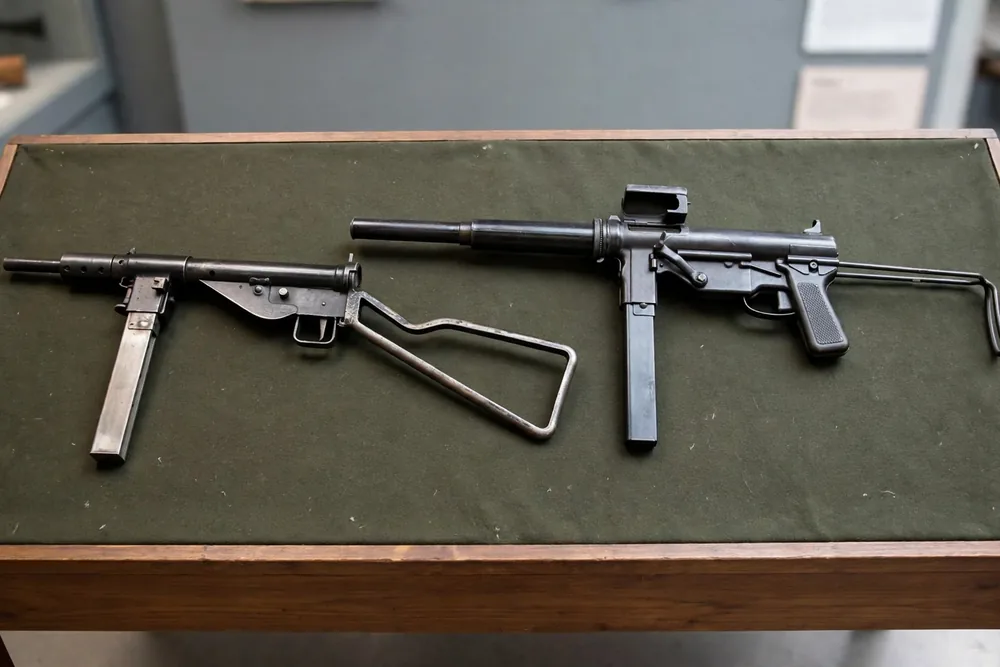
It was also far more expensive and far slower to make, and it was that economic fact, rather than any battlefield superiority, that decided the M3’s adoption. The Army’s calculation was that a weapon that was good enough and available in the hundreds of thousands was worth more than a weapon that was excellent and available in the tens of thousands, and the M3 proved the calculation right: it armed the men who needed a submachine gun, and it did so at a cost that the Thompson could never have matched.
Soldiers who had a choice often preferred the Thompson, and the Thompson remained in service throughout the war, but the M3’s cheapness and its availability meant that it reached the men who would otherwise have had no automatic weapon at all, and that was the point.
9.2. Against the Sten and the MP 40
Against its foreign rivals, the M3 compared favourably, and the comparison shows that the American designers had learned the right lessons from the European stamped-steel guns. The British Sten Gun was cheaper still — about 10 dollars per gun — but it was also cruder, less reliable and more dangerous to its user, with a reputation for accidental discharges that the M3 never acquired.
The German MP 40 was a better-made weapon than the M3, with a smoother action and a more comfortable grip, but it was also more expensive to build, and its 9 mm cartridge was less powerful than the M3’s .45 ACP at close range.
The M3 sat between the two: it was better finished and more reliable than the Sten, and it was cheaper and more powerful than the MP 40, though it lacked the German gun’s refinement. The three weapons together defined the stamped-steel submachine gun of the Second World War, and the M3’s place in that trio was the practical one: it was the gun that combined low cost with acceptable quality, and it was the one that stayed in service the longest, outliving both of its European rivals by decades.
10. Legacy
10.1. The logic of cheap and good enough
The M3 Grease Gun’s legacy is the logic that produced it: the recognition that in a global war, a weapon’s cost and its availability can matter more than its excellence. The M3 was never the best submachine gun of the Second World War, and no soldier who had a choice would have chosen it over a Thompson or an MP 40 for a firefight.
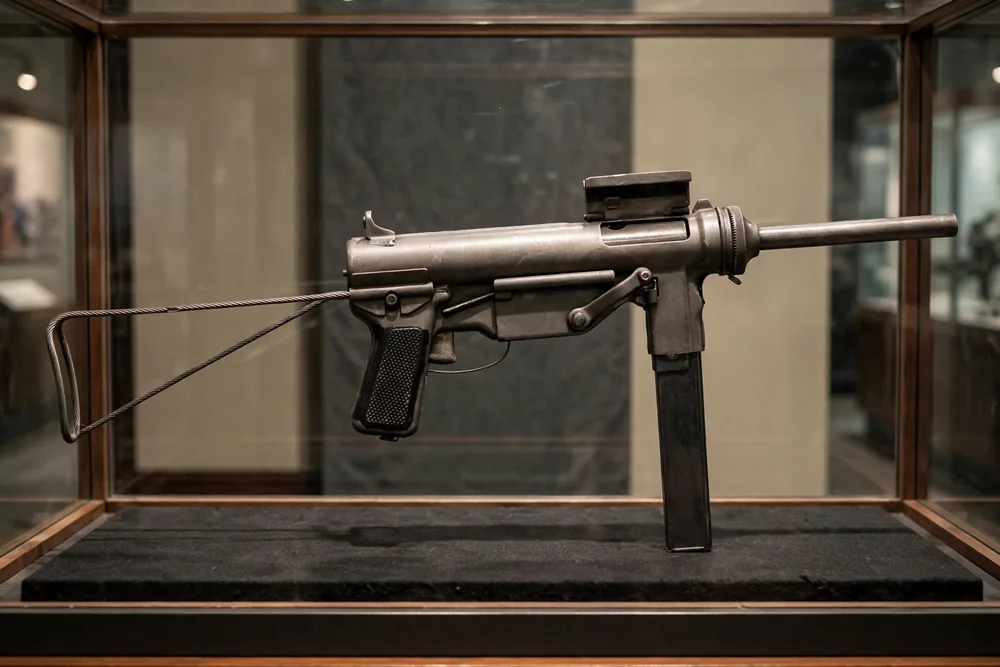
But the M3 was the submachine gun that the United States could make in the numbers the war demanded, and it was the submachine gun that reached the tank crews, the drivers, the radio operators and the officers who would otherwise have gone into combat with a pistol or with nothing at all.
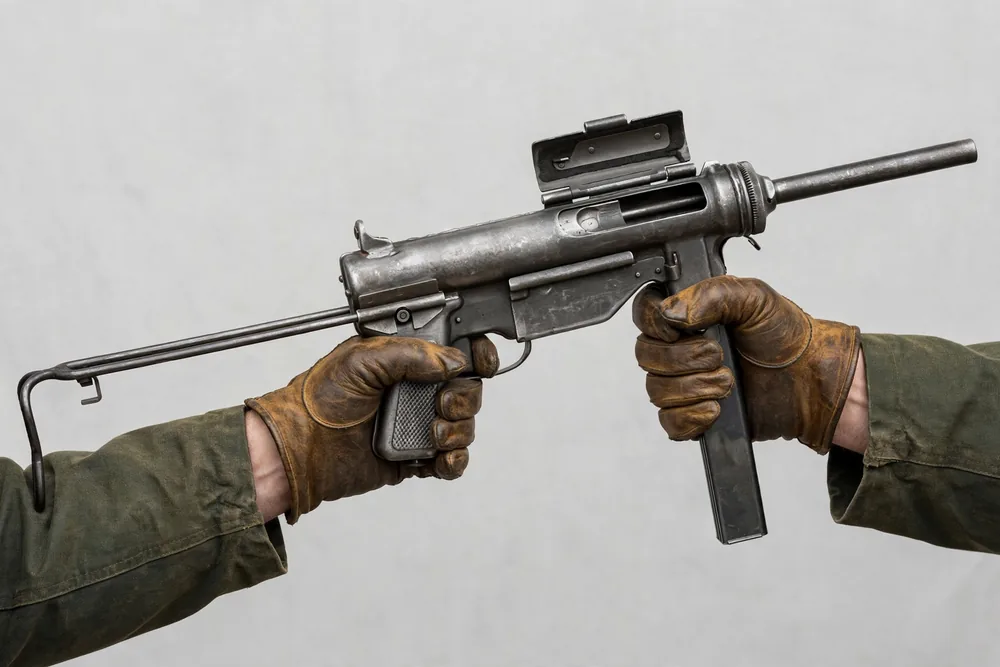
Its fifty years of service — from Normandy to Vietnam, and from the Guide Lamp factory in Indiana to the armouries of dozens of allied nations — proved that a simple, cheap and reliable weapon can outlast several generations of more sophisticated successors.
The M3’s story is often told as a joke about a gun that looked like a tool, but its real lesson is a serious one about industrial warfare: the best weapon is not always the finest weapon, but the one that is there, in the hands of the men who need it, when the fighting starts.
10.2. Survivors and collectors
Surviving M3 and M3A1 submachine guns are held in museums and in private collections in the United States and around the world, and the weapon is a popular item with collectors of Second World War small arms, though its status as a fully automatic weapon means that transferable examples in the United States are strictly regulated and command high prices.
Museums that hold the M3 include the National Firearms Museum in Fairfax, Virginia, the Imperial War Museum in London and the United States Army Ordnance Museum, and the gun appears in the displays of many smaller military museums, usually alongside the Thompson and the Sten Gun, as an illustration of the three nations’ different approaches to the same problem.
The M3’s appearance in films and in video games has kept it in the public eye, and it is a familiar weapon in depictions of the Normandy campaign, the Korean War and the Vietnam War. For historians of small arms, the M3 remains a key example of the stamped-steel revolution that transformed the manufacture of military weapons in the Second World War, and of the way in which industrial logic — rather than battlefield performance alone — shapes the weapons that armies actually carry.
11. Frequently Asked Questions
Why was the M3 called the Grease Gun?
Because it looked like the mechanic’s grease gun used to lubricate vehicles: a plain steel tube with a lever sticking out of the side, a wire stock and a dull grey finish. The nickname was affectionate, and it stuck so firmly that the M3 is still universally known by it.
How much did the M3 cost?
About $20.94 per gun in 1943, against more than $200 for an early Thompson and about $45 for the simplified wartime Thompson. The low cost was the main reason the Army adopted it, and it allowed production of about 700,000 guns.
How many M3 Grease Guns were built?
About 700,000 M3 and M3A1 submachine guns were built in total, of which roughly 600,000 were the original M3 and about 15,000 were the improved M3A1 built before the end of the war, with the remainder produced after the war.
What calibre was the M3?
The standard calibre was .45 ACP, the same cartridge as the Thompson submachine gun and the M1911 pistol. A 9 mm conversion kit was also produced in small numbers, mainly for the Office of Strategic Services.
When was the M3 retired?
The M3A1 remained in American service until the 1990s, when it was finally replaced as a tank crew weapon by the M4 carbine. It served in the Second World War, Korea and Vietnam, a career of nearly fifty years.
Was the M3 reliable?
Yes, with good magazines. The mechanism itself was simple and tolerant of dirt and cold, and Army tests found it would fire thousands of rounds between stoppages. Most stoppages came from damaged magazines, whose feed lips bent easily, rather than from the gun itself.
12. Sources
- Wikipedia, “M3 submachine gun” — adoption date, production total of about 700,000, unit cost of $20.94 and service history.
- US Army Ordnance Department, TM 9-215: .45 Caliber Submachine Guns M3 and M3A1 (1943) — technical manual, specifications and maintenance.
- National Firearms Museum, M3 Grease Gun collection records — design, the Guide Lamp Division and the cocking-handle problem.
- Imperial War Museum, M3 submachine gun collection — British and Commonwealth use, comparison with the Sten gun.
- Frank Iannamico, The U.S. M3–M3A1 Submachine Gun (Moose Lake Publishing, 1999) — development, production and the M3A1 improvement.
- Leroy Thompson, The M3 “Grease Gun” (Osprey Weapon Series, 2016) — combat service, the suppressed M3 and post-war use.
Further reading
- George M. Chinn, The Machine Gun, Vol. IV (US Government Printing Office, 1955).
- Peter G. Kokalis, Weapons Tests and Evaluations (Paladin Press, 2001).