 WAR ATLAS MILITARY HISTORY MAGAZINE · WWI — WWII
Nakajima B5N Kate
1. Lead
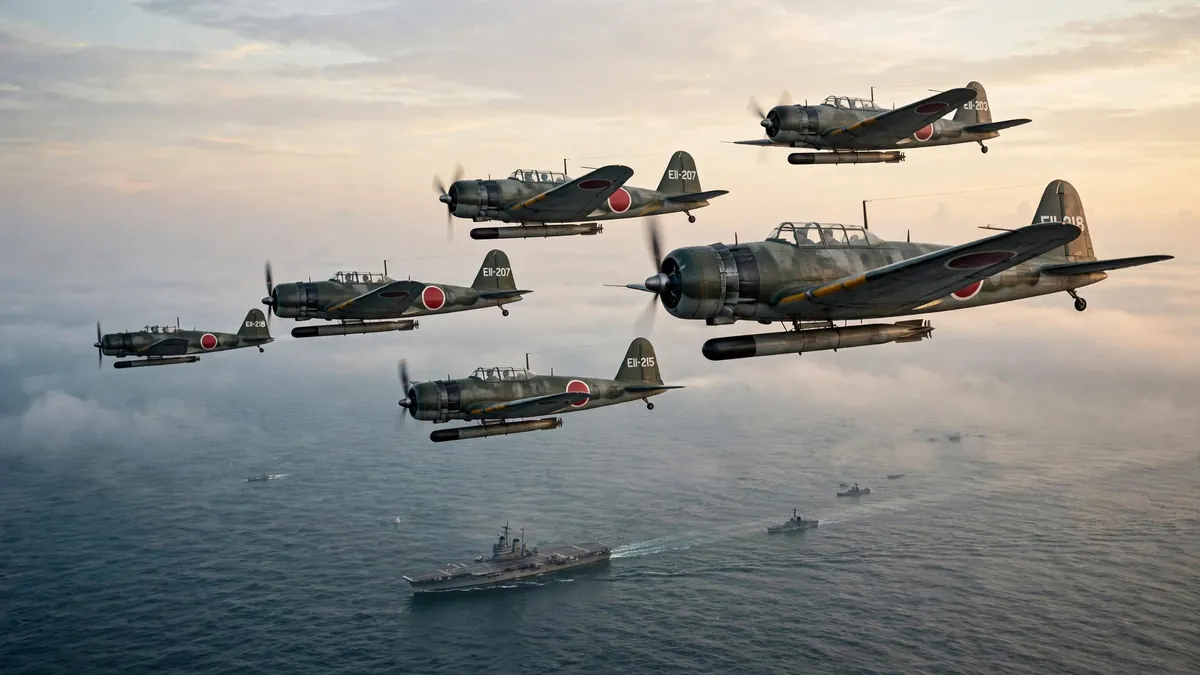
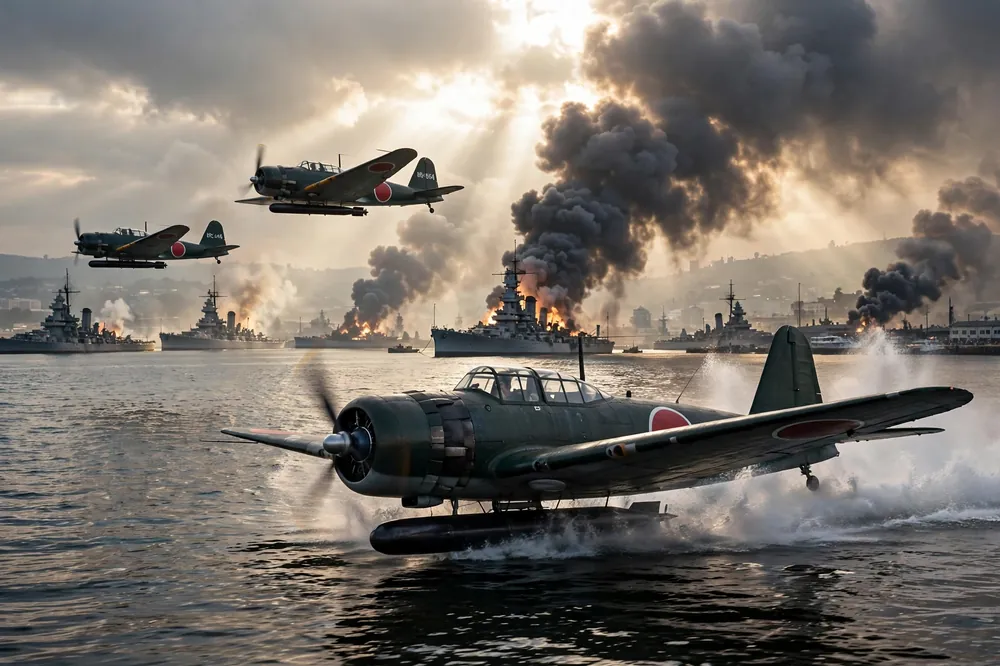
The Nakajima B5N Kate was the Imperial Japanese Navy’s standard carrier-based torpedo bomber at the outbreak of the Pacific War, and the aircraft that carried Japan’s opening blow against the United States. On the morning of 7 December 1941, B5N torpedo bombers of the first wave at Pearl Harbor dropped the shallow-running torpedoes that crippled the American battleship fleet, while their bomb-carrying sister aircraft attacked airfields and ships across the harbour.
The type, given the Allied reporting name “Kate”, went on to serve in every major Japanese carrier operation of the first year of the war, from the Indian Ocean raid to the Battle of Midway and the long attrition of the Solomons, before age, mounting losses and the arrival of its successor pushed it into training and second-line roles.
The B5N was a product of Japan’s interwar carrier doctrine, which placed the torpedo bomber at the centre of the fleet’s striking power. Its design was remarkably advanced for 1937: a low-wing monoplane with retractable landing gear, folding wings for carrier stowage and a clean, all-metal airframe that gave it a speed and range its contemporaries could not match.
At the time of its introduction it was arguably the best carrier torpedo bomber in the world, faster than the American Douglas TBD Devastator and the British Fairey Swordfish, and able to carry a full-size 800-kilogram torpedo over a combat radius that let Japanese carriers strike from beyond the reach of their enemies.
Yet the same design philosophy that made it fast — light construction, no armour, no self-sealing fuel tanks — made it desperately vulnerable once the Allies fielded fast fighters and effective anti-aircraft fire in 1942.
Only about 1,149 B5Ns were built, a modest total by the standards of the war, and almost none survive today. The type’s historical importance, however, far exceeds its production numbers. It was the weapon of the Pearl Harbor attack, the instrument of the sinking of the British capital ships Prince of Wales and Repulse off Malaya in December 1941, and a participant in the destruction of the American carriers Lexington and Yorktown.
Its story is therefore not only the story of an aircraft, but of the rise and fall of Japanese naval air power itself: brilliant, audacious and technically advanced in 1941, and steadily ground down by attrition until, by 1944, the Kate was a trainer, a target tug and, in the war’s last months, a kamikaze.
2. Key Facts
| Role | Carrier-based torpedo bomber (also level bomber and reconnaissance) |
| Manufacturer | Nakajima Aircraft Company, Japan |
| First flight | January 1937 |
| Introduced | 1938 |
| Produced | About 1,149 (including prototypes) |
| Crew | 3 (pilot, navigator/bombardier, radio operator/gunner) |
| Engine | 1 × Nakajima Sakae 11 (B5N1) or Sakae 21 (B5N2), about 1,000 hp |
| Maximum speed | About 378 km/h (235 mph) at 3,600 m |
| Range | About 1,935 km (1,200 miles) |
| Armament | 1 × 800 kg torpedo or up to 800 kg of bombs; 1 × 7.7 mm rear machine gun |
| Allied reporting name | “Kate” / “Kate” |
| Main users | Imperial Japanese Navy Air Service |
| Fate | Withdrawn from front-line service 1943–1944; used as trainer and kamikaze aircraft to 1945; no complete original survives |
3. Origins and Requirements
The 1935 naval requirement
In 1935 the Imperial Japanese Navy issued a specification, known as the 10-Shi requirement, for a new carrier-based torpedo bomber to replace the Yokosuka B4Y biplane then in service. The B4Y was a sound aircraft for its day, but the Navy knew that the biplane era was ending: the new aircraft had to be a monoplane, it had to be fast enough to survive over a defended target, and it had to carry the Navy’s standard 800-kilogram Type 91 aerial torpedo.
The specification called for a three-seat aircraft with a maximum speed of about 330 km/h, a range sufficient to strike at long distance from the carrier, and the ability to fold its wings for stowage below decks. Two manufacturers were invited to compete: Nakajima and Mitsubishi.
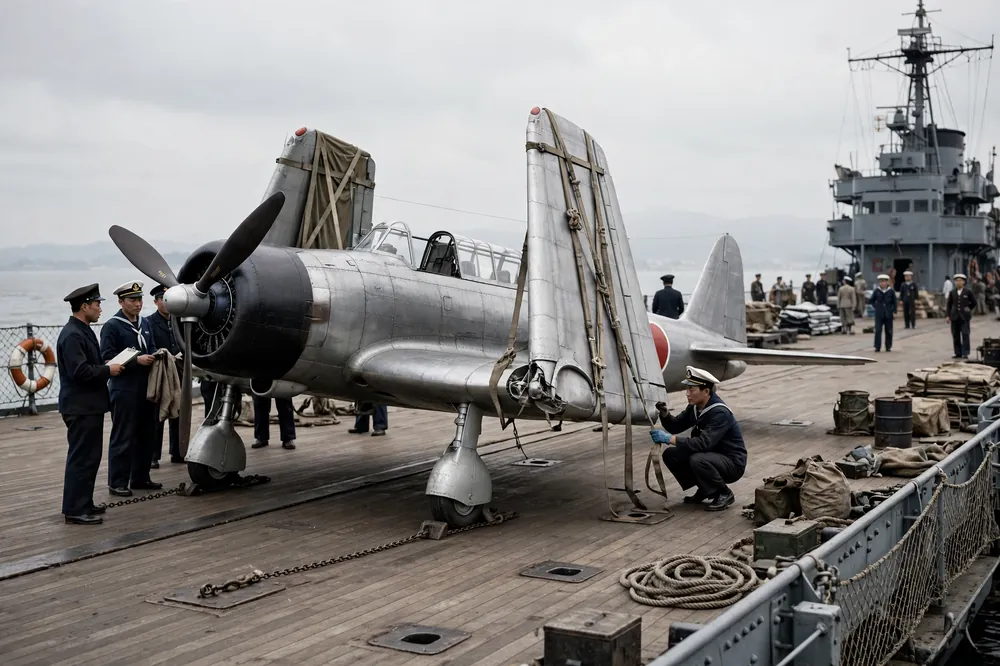
Nakajima’s design team, led by Katsuji Nakamura, produced an aircraft that was strikingly modern. The B5N — Nakajima’s internal designation — was an all-metal, low-wing monoplane with a fully enclosed cockpit for its three crewmen, hydraulically operated retractable landing gear, and wings that folded upward just outboard of the landing gear. The first prototype flew in January 1937, powered by a Nakajima Hikari radial engine of about 840 horsepower. Mitsubishi’s competing B5M was also a competent design, but it was slower and its fixed landing gear betrayed its more conservative approach. After competitive trials in 1937 the Navy selected the Nakajima design, ordering it into production as the Navy Type 97 Carrier Attack Bomber.
Combat debut in China
The B5N entered service in 1938 and saw its first combat over China during the Second Sino-Japanese War, operating from carriers and from land bases against Chinese forces. These early operations were valuable proving grounds: crews learned to handle the new monoplane, mechanics learned its maintenance demands, and the Navy gathered data on the reliability of the Hikari engine in tropical conditions.
The experience also exposed the engine’s limitations, and the second production version, the B5N2, adopted the more powerful Nakajima Sakae 21 radial of about 1,000 horsepower, which became the definitive engine of the type. By the time Japan went to war with the Western Allies in December 1941, the B5N2 equipped the torpedo squadrons of all six fleet carriers of the First Air Fleet.
4. Design and Development
Airframe and carrier features
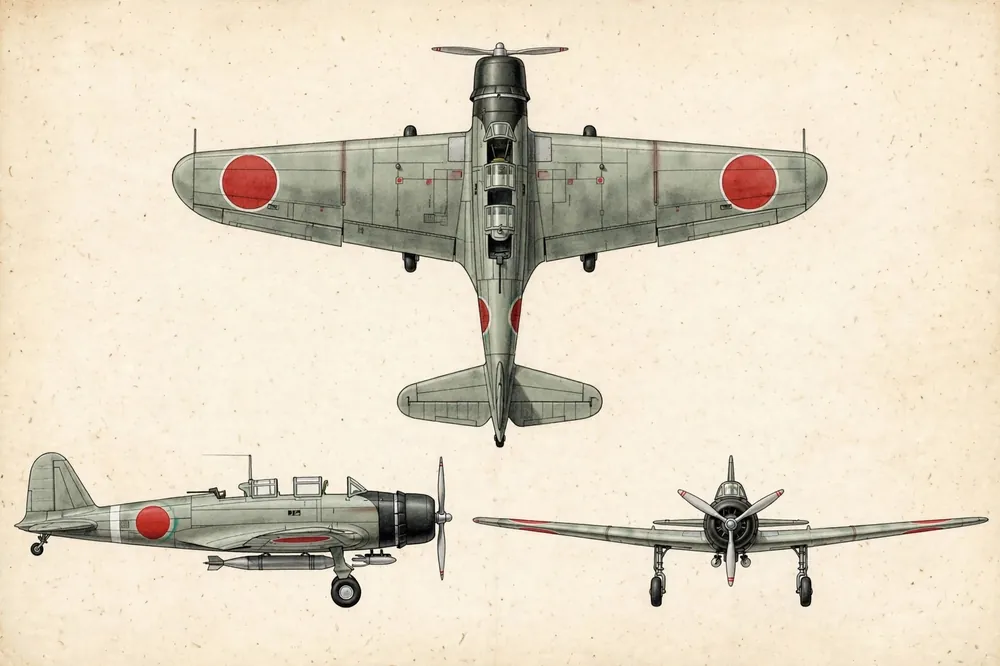
The B5N’s airframe was built around the demands of carrier operation. The low wing carried the main landing gear, which retracted rearward into the wing, and the outer wing panels folded upward by hand, reducing the aircraft’s span from about 15.5 metres to a stowage width that let the carriers pack their hangars tightly.
The fuselage was a semi-monocoque metal structure with a long, glazed canopy covering all three crew positions in tandem: the pilot forward, the navigator-bombardier in the middle, and the radio operator-gunner aft. The navigator’s position had a glazed floor panel for aiming bombs and torpedoes, and the rear gunner operated a single flexible 7.7 mm Type 92 machine gun.
The tail was conventional, with a fixed tailplane and a large rudder that gave the pilot good control at the low speeds of a torpedo run.
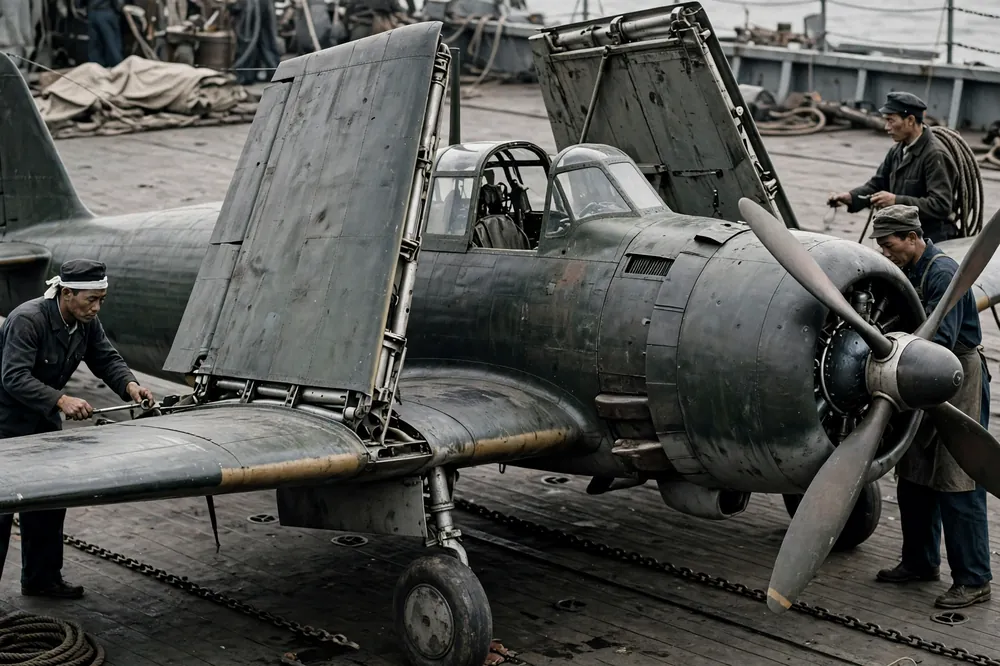
The aircraft’s handling was widely praised by its crews. It was stable, responsive and forgiving to fly, with a good view from the cockpit and a landing speed low enough for safe carrier deck operations. Its one serious vice was a tendency to ground-loop on landing if the pilot was careless, a trait shared with many tailwheel aircraft of the period. The folding wings, though operated by hand, were simple and reliable, and the aircraft could be struck below and respotted quickly — an important consideration for a carrier air group that had to launch a large strike in a short time.
Engines and performance
The first production model, the B5N1, used the Nakajima Hikari 3 radial engine rated at about 840 horsepower, and 200 of this version were built. The B5N2, which followed in 1939, used the Sakae 11 and later the Sakae 21, both rated at about 1,000 horsepower, and it was this version that fought the Pacific War.
The Sakae was a compact, reliable fourteen-cylinder radial that also powered the Mitsubishi A6M2 Zero, and its commonality with the Zero simplified logistics aboard the carriers. With the Sakae, the B5N2 could reach about 378 km/h at altitude and cruise at roughly 260 km/h, with a maximum range of about 1,935 kilometres — enough, with a reduced bomb load, to give the aircraft a useful combat radius of several hundred kilometres from its carrier.
The cost of lightness
The price of that performance was protection — or rather, the absence of it. Like the Zero, the B5N had no armour plate for the crew and no self-sealing fuel tanks. A single burst from an enemy fighter, or a near miss from an anti-aircraft shell, could turn the aircraft into a fireball.
In 1938 and 1941, when the opposition was weak, this was an acceptable trade for speed and range. By 1942, when American fighters such as the Grumman F4F Wildcat and later the F6F Hellcat appeared in numbers, it became a death sentence, and the B5N’s loss rates in 1942 and 1943 were appalling.
The Navy understood the problem but had no replacement ready: the intended successor, the Nakajima B6N Tenzan, did not reach the fleet in numbers until 1944.
5. Technical Description
Armament and torpedo attack
The B5N’s principal weapon was the Type 91 aerial torpedo, a 450-millimetre weapon weighing about 800 kilograms, carried on a rack beneath the fuselage. The Type 91 was one of the best aerial torpedoes of the war, and Japanese engineers had fitted it with wooden stabilising fins — the so-called “Kyoban” — that let it be dropped from higher altitudes and at higher speeds than other torpedoes of the period, and, crucially, let it run true in the shallow waters of Pearl Harbor, where a conventional torpedo would have struck the harbour bottom.
For level bombing the aircraft could carry up to 800 kilograms of bombs, typically one 800-kilogram bomb or three 250-kilogram bombs, aimed by the navigator-bombardier through the glazed floor panel. For self-defence it had only the single rear 7.7 mm machine gun, and later aircraft added a second gun in some cases, but the Kate was never a well-armed aircraft: its defence was its speed, its escort fighters and the element of surprise.
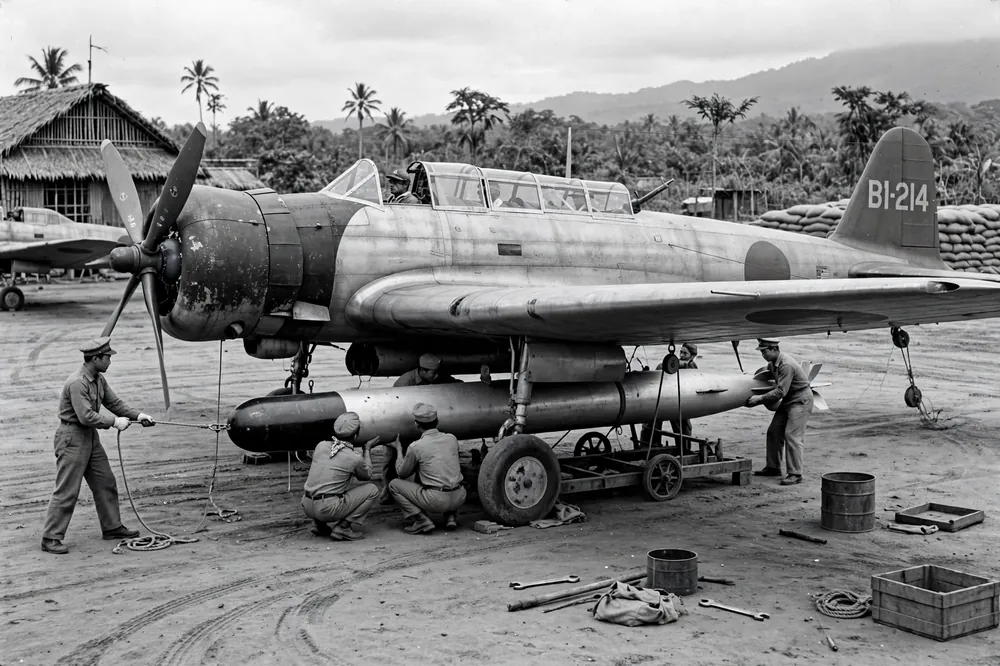
A torpedo attack in a B5N was a disciplined, dangerous manoeuvre. The formation would approach the target at about 3,000 metres, then descend in a shallow dive to the release height of about 20 to 30 metres above the water, levelling off at a speed of roughly 200 to 250 km/h.
The pilot had to hold the aircraft absolutely steady for the last seconds of the run while the navigator called the release, and the torpedo had to enter the water at the correct angle or it would broach, dive or run erratically.
During those final seconds the aircraft was flying straight and level at low altitude, directly into the fire of every gun on the target ship and its escorts — the most dangerous moment of the mission, and the moment at which the lack of armour mattered most.
Crew roles and equipment
The three-man crew divided the work of the mission between them. The pilot flew the aircraft and, in the final torpedo run, held the course and height that the navigator demanded. The navigator-bombardier, seated in the middle, navigated the aircraft to the target over open ocean — a demanding task in an era before reliable radio navigation — and aimed the torpedo or the bombs.
The radio operator-gunner, in the rear, handled communications, operated the trailing aerial for long-range Morse signals, and manned the rear gun. The aircraft carried a radio, a drift sight and a bombsight of Japanese design, and a camera in some aircraft for reconnaissance work. It had no radar, and its crews relied on visual navigation, dead reckoning and the skill of their navigators to find a moving fleet at sea.
6. Variants
The B5N family was small, and the differences between its versions were matters of engine and detail rather than of role. The B5N1, of which about 200 were built, was the first production version, powered by the Hikari 3 engine of about 840 horsepower and fitted with a three-blade propeller. The B5N2, the main production version with about 930 built, used the Sakae 11 and later the Sakae 21 engine of about 1,000 horsepower, with a slightly larger propeller and minor changes to the cowling and the oil cooler. The B5N2 was the version that fought at Pearl Harbor, Midway and in the Solomons, and it is the version most people mean when they speak of the Kate.
In addition to the two production models there were a handful of prototypes and trials aircraft. The first prototype, flown in January 1937, was powered by the Hikari engine and differed in detail from the production B5N1. A few B5N1s were converted for trials with different propellers and engine installations, and at least one aircraft was tested as a floatplane torpedo bomber, though the idea went no further.
No dedicated reconnaissance or trainer version was built in numbers; instead, worn-out front-line B5Ns were simply transferred to training units, where they served until they were worn out entirely or expended as kamikazes. The successor design, the Nakajima B6N Tenzan, was a larger, faster aircraft with a more powerful engine, but it arrived too late and in too few numbers to replace the Kate before Japan’s carrier force was destroyed.
7. Combat Service
Pearl Harbor and the opening offensive
The B5N’s finest hour — and its most infamous — came on 7 December 1941. The six carriers of Vice Admiral Nagumo’s striking force launched 183 aircraft in the first wave, including 40 B5Ns armed with torpedoes and 49 B5Ns carrying 800-kilogram armour-piercing bombs converted from naval shells.
The torpedo bombers, led by Lieutenant Commander Shigeharu Murata, attacked the battleships moored along Battleship Row, and their torpedoes struck home against Oklahoma, West Virginia, California and Nevada, capsizing the first and sinking two others at their moorings. The bomb-carrying B5Ns attacked the airfields and the ships in the harbour, and the second wave added more B5Ns to the assault.
Japanese losses in the attack were light: nine B5Ns were lost in total, a small price for the destruction inflicted.
The sinking of Prince of Wales and Repulse
Three days later, on 10 December 1941, B5Ns of the 22nd Air Flotilla, operating from land bases in Indochina, took part in the sinking of the British battleship Prince of Wales and the battlecruiser Repulse off the east coast of Malaya.
The two ships, sailing without air cover, were attacked by waves of Japanese bombers, and torpedoes from B5Ns and Mitsubishi G4M Betty bombers struck both vessels repeatedly until they sank with the loss of more than 800 men. It was the first time in history that capital ships at sea had been sunk by air attack alone, and it sent a shock through the Royal Navy and through every navy in the world.
In the months that followed, B5Ns supported the Japanese advance across South-East Asia, striking at Allied shipping and bases from the Philippines to the Dutch East Indies and the Indian Ocean, where in April 1942 they took part in the raid that sank the British carrier Hermes off Ceylon.
Midway, the Solomons and decline
The turning point for the B5N, as for the Japanese Navy as a whole, was the Battle of Midway in June 1942. The Kates of the four Japanese carriers flew strike missions against the island and, in the confused fighting that followed, against the American carriers.
They achieved hits — B5Ns helped to cripple the carrier Yorktown, which was later finished off by a submarine — but the cost was terrible. All four Japanese carriers were sunk, and with them went the core of Japan’s trained torpedo bomber crews. The men who had practised torpedo attack for years, who had struck Pearl Harbor, were dead, and the Navy could not replace them.
From Midway onward, the B5N’s combat record is a story of steady attrition: at the Battle of the Eastern Solomons in August 1942 and at Santa Cruz in October 1942, Kates attacked American carriers and took heavy losses from fighters and anti-aircraft fire, and each battle left the Japanese carrier air groups weaker than before.
By 1943 the B5N was obsolescent, but it kept flying because there was nothing else. It served from land bases in the Solomons and New Guinea, where it attacked Allied shipping at night and flew reconnaissance missions, and it served in the defence of Rabaul, where its crews faced overwhelming Allied air power.
In June 1944, at the Battle of the Philippine Sea, the few Kates still embarked on Japanese carriers were swept from the sky in the “Great Marianas Turkey Shoot”, and after that battle the type effectively ceased to exist as a front-line carrier aircraft. The survivors were transferred to training units in Japan, and in 1945 some were expended in kamikaze attacks against the American fleet off Okinawa.
The last B5Ns were destroyed on the ground or scrapped after the surrender, and no complete example survives in any museum today.
8. Specifications
The figures below are for the B5N2, the main production version, and are approximate: sources differ slightly on speed, range and weights, and the aircraft’s performance varied with load, altitude and the condition of the individual machine. Japanese wartime records are incomplete, and post-war assessments by Allied technical teams and historians have produced ranges rather than single definitive numbers.
| B5N2 | |
|---|---|
| Length | 10.30 m / 10,30 m |
| Wingspan | 15.52 m / 15,52 m |
| Height | 3.70 m / 3,70 m |
| Wing area | 37.7 m² / 37,7 m² |
| Empty weight | About 2,279 kg |
| Loaded weight | About 4,100 kg |
| Engine | 1 × Nakajima Sakae 21, about 1,000 hp |
| Maximum speed | About 378 km/h at 3,600 m |
| Cruising speed | About 260 km/h |
| Range | About 1,935 km |
| Service ceiling | About 8,260 m |
| Armament | 1 × 800 kg torpedo or 800 kg bombs; 1 × 7.7 mm machine gun |
| Crew | 3 |
Compared with its contemporaries, the B5N2 was fast and long-ranged: the American TBD Devastator, its direct counterpart, managed only about 332 km/h and had a shorter range, while the British Swordfish was slower still, though far more forgiving to fly and, paradoxically, more survivable in some roles because it could operate in weather the Kate could not. The Kate’s advantage lay in its combination of speed, range and payload in a single carrier aircraft — a combination no other navy matched in 1941. Its disadvantage, the lack of protection, was shared with the Zero and with Japanese naval aircraft generally, and it was a disadvantage that only became decisive when the Allies began to win the air war.
9. Operators
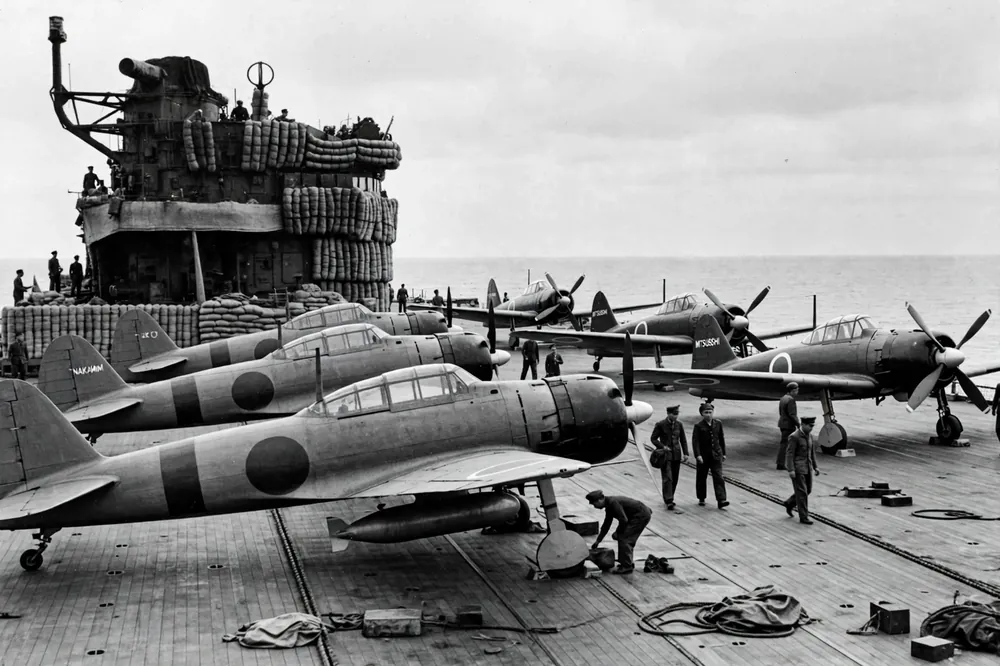
The B5N was operated exclusively by the Imperial Japanese Navy Air Service, and within the Navy it served in both the carrier air groups and the land-based air flotillas. At the start of the Pacific War its carrier squadrons flew from the six fleet carriers Akagi, Kaga, Soryu, Hiryu, Shokaku and Zuikaku, the ships of the First Air Fleet that struck Pearl Harbor.
Each carrier embarked a torpedo squadron of eighteen B5Ns, giving the striking force more than a hundred Kates for the opening operations of the war. As the war went on and the fleet carriers were lost, the aircraft served from the light carriers and from land bases across the Pacific, including Rabaul, Truk and the airfields of New Guinea and the Solomons.
No other country operated the B5N in combat. After the war, Allied technical teams examined captured examples in Japan, and at least one aircraft was shipped to the United States for evaluation, but the type was never adopted by any other air force. Its influence, however, was felt more widely: the lessons of the Kate’s early success and later vulnerability were studied by every navy that operated carrier aircraft, and the aircraft’s design — a fast, long-range, single-engine torpedo bomber — became the template for the carrier strike aircraft of the post-war era, from the American Douglas AD Skyraider onward.
10. Legacy and Assessment
Why the Kate mattered
The B5N matters to history because it was the aircraft of Pearl Harbor. The image of the torpedo bomber skimming the water of the harbour, and the battleships rolling over under its torpedoes, is one of the defining images of the Second World War, and it fixed the Kate in the public memory as the symbol of Japanese naval air power.
Historians also value the type as a case study in the strengths and weaknesses of Japanese aircraft design: the B5N was, in 1937 and 1941, a genuinely advanced aircraft, faster and longer-ranged than anything its enemies could put into the air from a carrier, and it was flown by crews whose training in torpedo attack was the best in the world.
That combination produced the most devastating carrier strike of the war’s opening months.
The Kate’s decline is equally instructive. It shows how a design philosophy that traded protection for performance could succeed brilliantly while the enemy was weak and fail catastrophically once the enemy caught up. It also shows how irreplaceable trained aircrew were: Japan lost its best torpedo crews at Midway and in the Solomons, and no amount of aircraft production could replace them. The B5N’s story is therefore a warning about the limits of technology without the human capital to use it, and about the danger of a design that has no margin for the day the enemy gets better.
Survivors and memory
No complete original B5N survives. A wreck recovered from the Pacific has been displayed in parts, and a full-scale replica built for the film Tora! Tora! Tora! (1970) — converted from an American Vultee BT-13 trainer — is sometimes mistaken for a real Kate, but it is a movie prop, not a wartime aircraft.
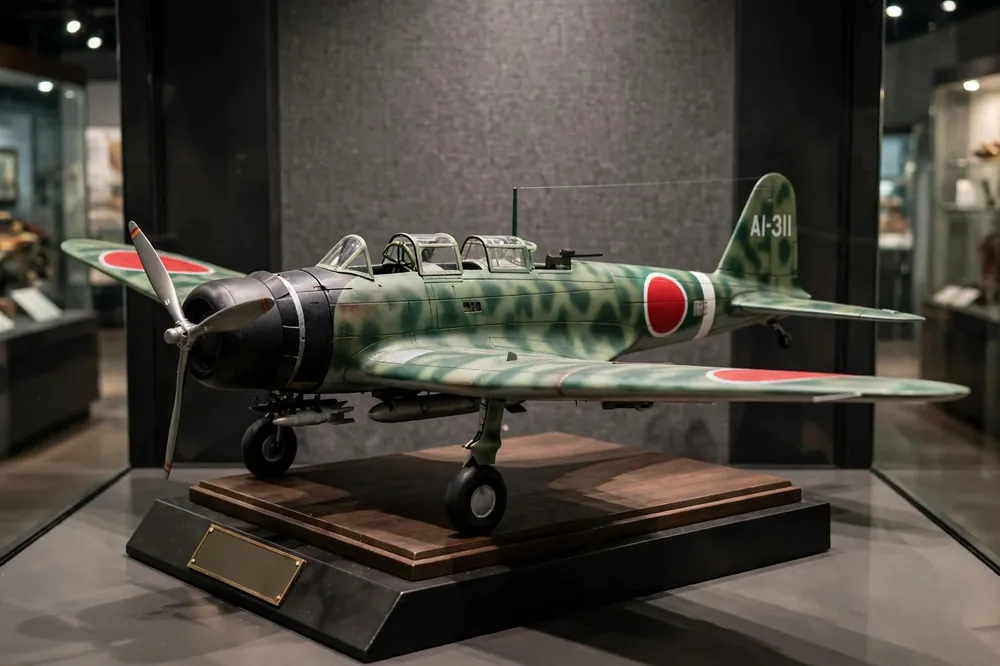
The type lives on in museum models, in flight simulators, and in the historical record, where it remains one of the most studied Japanese aircraft of the war. Its Allied reporting name, Kate, is still the name by which it is best known in the English-speaking world, a reminder of the system by which Allied intelligence gave Japanese aircraft simple, memorable names — “Kate” for a torpedo bomber, “Zero” for a fighter, “Betty” for a bomber — that have outlived the war itself.
11. FAQ
What was the Nakajima B5N Kate? / Nakajima B5N Kate là gì?
The Nakajima B5N Kate was the Imperial Japanese Navy’s standard carrier-based torpedo bomber of the Second World War, a three-seat, single-engine monoplane designed to carry the Navy’s 800-kilogram Type 91 aerial torpedo. It first flew in January 1937 and entered service in 1938, and by December 1941 it equipped the torpedo squadrons of all six fleet carriers of the First Air Fleet. The aircraft was fast and long-ranged for its day, with folding wings for carrier stowage and a clean, all-metal airframe, and it was the aircraft that led the attack on Pearl Harbor on 7 December 1941, where its torpedoes crippled the American battleship fleet.
How many B5N Kates were built?
About 1,149 B5Ns were built in total, including prototypes: roughly 200 B5N1s with the Hikari engine of about 840 horsepower, and roughly 930 B5N2s with the Sakae engine of about 1,000 horsepower. This was a small production run compared with the thousands of Zeros and American carrier aircraft built during the war, and it reflected the limited capacity of the Japanese aircraft industry and the Navy’s decision to concentrate its resources on fighters and on the B5N’s successor, the B6N Tenzan, which arrived too late and in too few numbers to replace the Kate before Japan’s carrier force was destroyed.
What role did the B5N play at Pearl Harbor?
B5Ns flew in both waves of the attack on Pearl Harbor on 7 December 1941. Forty torpedo-armed B5Ns in the first wave, led by Lieutenant Commander Shigeharu Murata, struck the battleships on Battleship Row, sinking or crippling Oklahoma, West Virginia, California and Nevada, while forty-nine bomb-carrying B5Ns attacked the airfields and the ships in the harbour. Their specially fitted torpedoes, with wooden stabilising fins, could run in the shallow harbour water where ordinary torpedoes would have struck the bottom, and the attack’s success owed much to this technical preparation. Japanese losses in the attack were light, with only nine B5Ns lost in total.
Why was the B5N so vulnerable?
The B5N had no armour for its crew and no self-sealing fuel tanks, a deliberate trade for speed and range that was shared with the Zero and other Japanese naval aircraft. The design philosophy behind it held that a fast, long-ranged aircraft that struck first would not need protection, and in 1941, when the opposition was weak, this was a reasonable calculation. Once American fighters such as the Wildcat and the Hellcat appeared in numbers in 1942, and once Allied anti-aircraft fire improved, a single burst could set the aircraft on fire, and loss rates became very high. The Navy understood the problem but had no replacement ready, and the Kate kept flying because there was nothing else.
What replaced the B5N?
The intended replacement was the Nakajima B6N Tenzan, a larger and faster torpedo bomber with a more powerful engine, designed to carry the same 800-kilogram torpedo at a higher speed and with better protection for its crew. The B6N first flew in 1941, but its development was delayed by engine problems and by the demands of production, and it reached the fleet in numbers only in 1944, too late to save Japan’s carrier air arm, which had already been destroyed at Midway and in the Solomons. The B6N was itself built in only modest numbers, about 1,268 aircraft, and it fought the last year of the war alongside the surviving Kates, which were by then serving as trainers and kamikazes.
Does any B5N survive today?
No complete original B5N survives. Wreckage recovered from the Pacific has been displayed in part, including a fuselage section raised from the sea, and a full-scale replica built for the film Tora! Tora! Tora! (1970) — converted from an American Vultee BT-13 trainer — is sometimes mistaken for a real Kate, but it is a movie prop, not a wartime aircraft. The type lives on in museum models, in flight simulators and in the historical record, where it remains one of the most studied Japanese aircraft of the war, and its Allied reporting name, Kate, is still the name by which it is best known in the English-speaking world.
12. Sources
- Wikipedia, “Nakajima B5N” — production figures (about 1,149 built), first flight, performance data and combat history.
- René J. Francillon, Japanese Aircraft of the Pacific War (Putnam, 1970) — the standard English-language reference on the B5N’s design, development and variants.
- Mark R. Peattie, Sunburst: The Rise of Japanese Naval Air Power, 1909–1941 (Naval Institute Press, 2001) — the doctrine and the 10-Shi requirement behind the Kate.
- Jonathan Parshall and Anthony Tully, Shattered Sword: The Untold Story of the Battle of Midway (Potomac Books, 2005) — the B5N’s role at Midway and the loss of the trained torpedo crews.
- Gordon Prange, At Dawn We Slept: The Untold Story of Pearl Harbor (McGraw-Hill, 1981) — the Kate’s role in the Pearl Harbor attack and the shallow-water torpedo.
- United States Strategic Bombing Survey, The Japanese Aircraft Industry (1947) — wartime production figures and engine data.
- Osamu Tagaya, Imperial Japanese Naval Aviator 1937–45 (Osprey, 2003).
- Henry Sakaida, Imperial Japanese Navy Aces 1937–45 (Osprey, 1998).