 WAR ATLAS MILITARY HISTORY MAGAZINE · WWI — WWII
North Africa Campaign
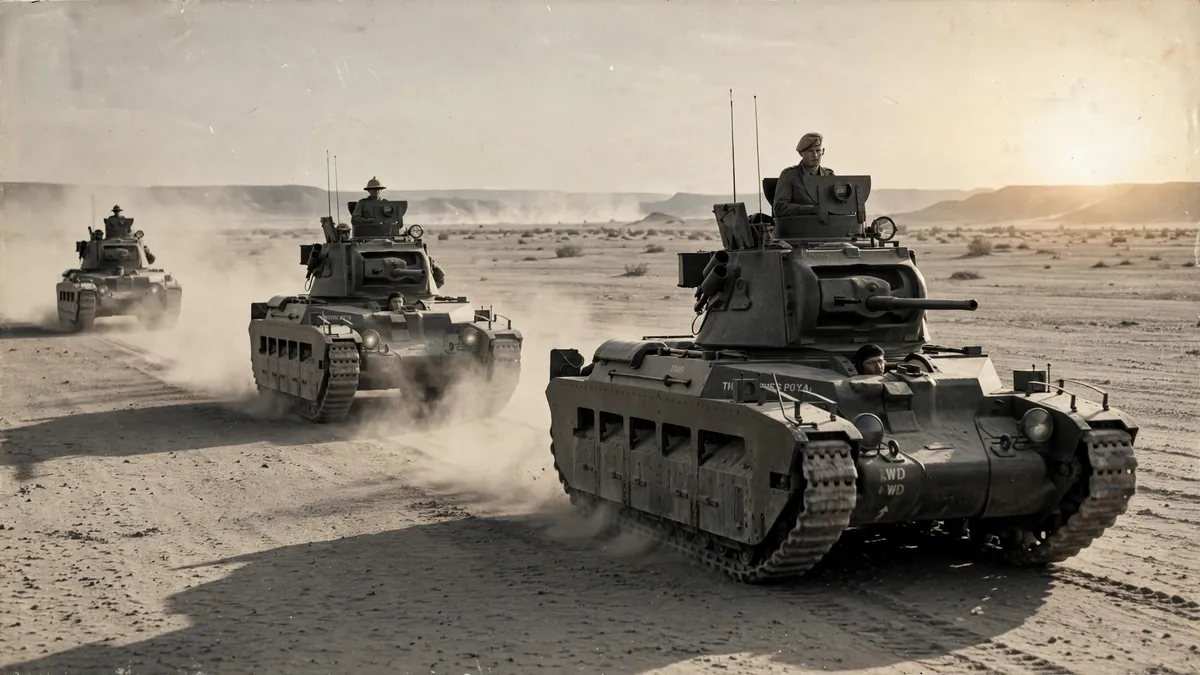
Lead
The North Africa Campaign was fought across the deserts and coasts of Libya, Egypt and Tunisia from 11 June 1940 to 13 May 1943, and it was the longest continuous land campaign the Western Allies fought against Germany before the invasion of Normandy.
It began as a colonial war between Italy and Britain, became a duel between two of the war’s most famous generals — Erwin Rommel and Bernard Montgomery — and ended with the surrender of some 250,000 German and Italian soldiers in Tunisia, the largest Axis surrender of the war up to that point.
In between, the front line swept back and forth across 1,400 miles of desert, from Tobruk to El Alamein and back again, in a war of tanks, supply trucks and air power in which logistics mattered as much as courage.
The campaign mattered because of what lay behind the desert: the Suez Canal and the oil of the Middle East. If the Axis had broken through to Egypt, Britain would have lost the short route to India and the Persian Gulf, and the Middle Eastern oilfields would have been within reach of German armies. That never happened, but for two years it was a real danger.
The campaign also mattered because it was the school in which the British and American armies learned to fight the German army. The defeats of 1941 and 1942 — at Gazala, at Tobruk, at Kasserine Pass — taught hard lessons about combined arms, air support and supply; the victories of El Alamein and Tunisia showed that those lessons had been learned.
Only one paragraph of wider theater context belongs here: the North Africa Campaign was one campaign within the Mediterranean Theater, the Allied struggle for the Mediterranean Sea that ran from 1940 to 1945. The rest of this article is the campaign itself — its battles, its commanders, its deserts and its cost.
The campaign is often remembered as a “clean” war, a war without civilians, fought by professional soldiers in an empty desert. That memory is misleading. The desert was not empty: Libyans and Egyptians lived, worked and died in it, and the war brought bombing, mines and displacement to their towns and villages. Nor was the fighting gentlemanly in the way later legend suggests: both sides shot prisoners on occasion, and the war’s end brought the Axis occupation of Tunisia and the persecution of its Jewish population. This article tells the campaign as it was fought — a long, hard, mobile war decided as much by fuel and trucks as by tanks.
Key Facts
| Dates | 11 June 1940 – 13 May 1943 |
| Theater / Location | Libya, Egypt and Tunisia, from the Egyptian frontier to the Tunisian coast |
| Result | Allied victory; the Axis was driven from North Africa, and about 250,000 German and Italian troops surrendered in Tunisia |
| Allied commanders | Archibald Wavell, Claude Auchinleck, Bernard Montgomery, Dwight D. Eisenhower, Harold Alexander, Kenneth Anderson |
| Axis commanders | Erwin Rommel, Rodolfo Graziani, Italo Gariboldi, Ettore Bastico, Giovanni Messe, Hans-Jurgen von Arnim |
| Allied strength | At El Alamein, more than 200,000 men and over 1,000 tanks; in Tunisia, more than 500,000 Allied troops from Britain, the United States, France and the Commonwealth |
| Axis strength | At El Alamein, about 100,000 men and some 500 tanks; in Tunisia, more than 250,000 German and Italian troops at the surrender |
| Losses | Allied casualties are estimated to range from about 200,000 to about 250,000 killed, wounded, missing and captured; Axis losses are estimated to range from about 550,000 to about 950,000, including about 250,000 prisoners taken in Tunisia |
Background
The Desert Before the War
North Africa in 1940 was a colonial frontier. Libya had been an Italian colony since 1912, ruled from Tripoli and Benghazi, with Italian settlers, a coastal road — the Via Balbia — running 1,100 miles along the shore, and a large Italian garrison. Egypt was formally independent but in practice a British protectorate, with British troops guarding the Suez Canal under a 1936 treaty.
Tunisia, Algeria and Morocco were French, and after the fall of France in June 1940 they were ruled by the Vichy government, which was neutral in name and sympathetic to the Axis in practice. The desert between the Libyan coastal towns and the Nile was one of the emptiest places on earth: a flat, stony plain broken by escarpments and depressions, with almost no water and only a handful of wells.
Armies in the desert lived on what they could carry, and a tank without fuel was a steel box in the sand.
The strategic geography was simple and brutal. The coastal road was the only good route along the shore, and the ports — Tobruk, Benghazi, Tripoli in Libya; Alexandria in Egypt — were the only places where large quantities of supplies could be landed. An army that advanced beyond its port starved; an army that lost its port retreated.
The desert flank, to the south, was open: there was no front line in the European sense, and a mobile force could sweep around the enemy’s southern flank through the open desert, as both sides repeatedly did. The Qattara Depression, a vast hollow below sea level south of El Alamein, was one of the few natural obstacles in the desert, and it anchored the British defensive line in 1942 because tanks could not cross it.
Italy’s War in the Desert
Italy declared war on 10 June 1940, and the desert war began the next day with skirmishes along the Libyan-Egyptian frontier. Mussolini’s aim was Egypt and the Suez Canal, and in September 1940 the Italian Tenth Army under Marshal Rodolfo Graziani invaded Egypt with about 250,000 men, advancing some 60 miles to Sidi Barrani, where it stopped to build fortified camps and wait for supplies.
Graziani’s army was large but slow: it had few trucks, its tanks were light and thinly armoured, and its infantry marched on foot. The British force facing it, the Western Desert Force under Major General Richard O’Connor, had only about 30,000 men — but it had more trucks, better tanks, and a commander willing to take risks.
Britain’s position was precarious. The army in Egypt was the only British force facing the Axis on land, and London was simultaneously fighting the Battle of Britain in the air. But the Royal Navy held the sea, the Royal Air Force held the air over Egypt, and British intelligence was beginning to read Italian codes. The stage was set for the first great desert battle, and it would be a British victory so complete that it changed the campaign’s character overnight — and brought Germany into the desert war to save its Italian ally.
Opposing Forces
The Axis Armies
The Axis armies in North Africa were two armies that never quite became one. The Italian army supplied the bulk of the troops: in 1940 the Tenth Army in Libya numbered more than 200,000 men, and Italian divisions fought throughout the campaign, from Sidi Barrani to Tunisia. Italian infantry was brave and enduring, but Italian equipment was poor — light tanks that could not stand up to British cruisers and Matildas, artillery that was outranged, and a chronic shortage of trucks that left infantry marching while British and German forces rode. Italian commanders, above all Graziani, were cautious, and Mussolini interfered constantly from Rome.
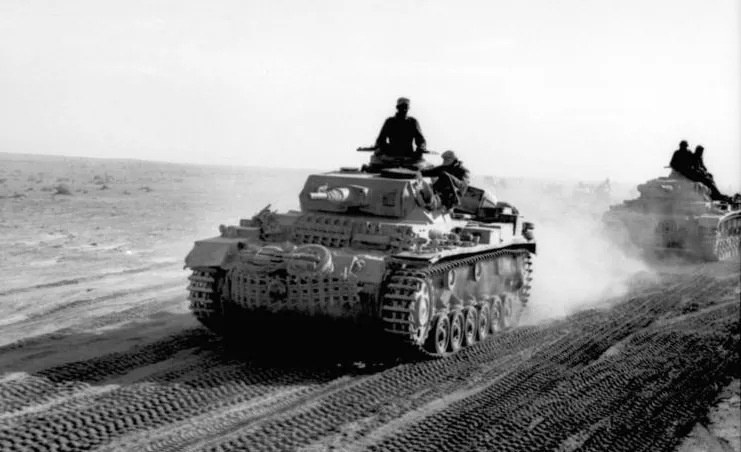
The German contribution was small in numbers and decisive in quality. The Afrika Korps, which began arriving in Tripoli in February 1941 under Rommel, was at first a single light division and a panzer division — fewer than 30,000 men — but it brought modern Panzer III and Panzer IV tanks, the 88 mm anti-aircraft gun used as a tank killer, a doctrine of fast, concentrated armoured attack, and a commander who led from the front.
Over the campaign the German force grew into the Panzer Army Africa, with German and Italian divisions mixed together, but the Germans never numbered more than about a third of the Axis force in the desert. Their strength was in tanks, anti-tank guns and air support; their weakness, shared with the Italians, was supply.
Every German tank, litre of fuel and shell had to be shipped from Italy across the Mediterranean, past Malta, and landed at Tripoli or Benghazi — and then trucked hundreds of miles to the front.
The Allied Armies
The Allied armies changed more than the Axis ones over the campaign, and the change was the story of the war. The Western Desert Force of 1940 was a small, professional, highly mobile force built around the 7th Armoured Division, the “Desert Rats,” and the 4th Indian Division.
It won the campaign’s first victories, but it was repeatedly stripped of its best divisions for other theaters — Greece in 1941, the Far East in 1942 — and its replacements were often inexperienced. The Eighth Army, formed in September 1941 under Auchinleck, was a larger, more complex force, built from British, Australian, New Zealand, South African, Indian, Polish and Free French troops.
It fought the desert war through 1941 and 1942, losing battles as often as it won them, until Montgomery took command in August 1942 and rebuilt it into a methodical, well-supplied, overwhelmingly powerful army.
The Americans arrived in November 1942 with Operation Torch, landing in Morocco and Algeria and advancing into Tunisia from the west. The American II Corps, under Major General Lloyd Fredendall and later George Patton, was inexperienced and was badly beaten at Kasserine Pass in February 1943, but it learned fast, and by the spring of 1943 American troops were fighting alongside the British in the final offensive. By the end of the campaign the Allies had more than 500,000 men in North Africa, with thousands of tanks, guns and aircraft, and complete command of the sea and the air. The Axis, by contrast, was fighting at the end of a long and broken supply line, and it showed.
Tanks, Guns and Aircraft
The desert war was a war of machines, and the machines changed over three years. In 1940 the British Matilda tank, slow but heavily armoured, was almost invulnerable to Italian guns; by 1942 the German Panzer IV with its long 75 mm gun, and the British Grant and Sherman tanks supplied by the United States, had changed the balance again.
The 88 mm gun, used by the Germans as an anti-tank weapon, was the most feared gun in the desert, and British tank crews learned to respect it. The air war was equally important: the Desert Air Force, flying from airfields that moved forward with the armies, gave the British close air support and reconnaissance, while the Luftwaffe, though outnumbered by 1942, fought skilfully to the end.
In the end, the Allied advantage in machines was overwhelming: at El Alamein the British had more than twice as many tanks as the Axis, and by Tunisia the Allies had thousands of aircraft against a few hundred. The desert rewarded the side that could supply its machines, and that was the Allies.
The North African Campaign, 1940–1943
Operation Compass: The Italian Collapse
The campaign’s first great battle was a British offensive that began on 9 December 1940. Operation Compass, planned by O’Connor and ordered by Wavell, was meant to be a five-day raid against the Italian camps at Sidi Barrani. It became a rout. British and Indian troops, supported by Matilda tanks that Italian guns could not penetrate, broke into the Italian camps and took thousands of prisoners.
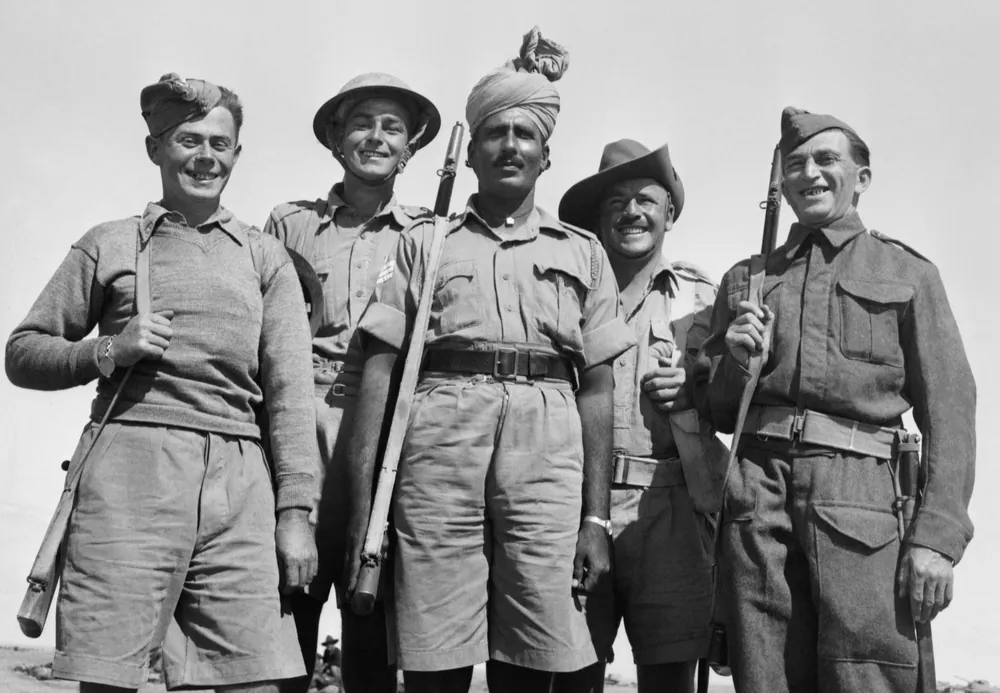
The advance did not stop: in ten weeks O’Connor’s force advanced 500 miles, took Tobruk, Benghazi and El Agheila, destroyed the Italian Tenth Army, and captured about 130,000 prisoners, along with hundreds of tanks and guns, at a cost of fewer than 2,000 British casualties. It was one of the most complete victories of the war.
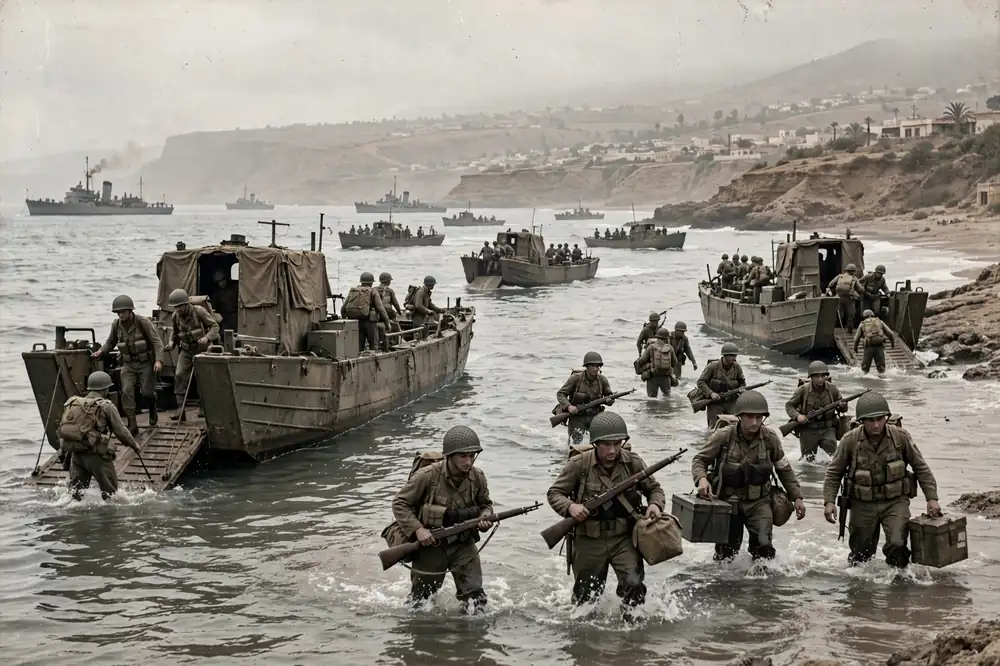
It was also, in hindsight, a victory Britain could not exploit: in February 1941 Wavell’s best divisions were sent to Greece, and the desert force was left thin — just as the first German troops landed at Tripoli.
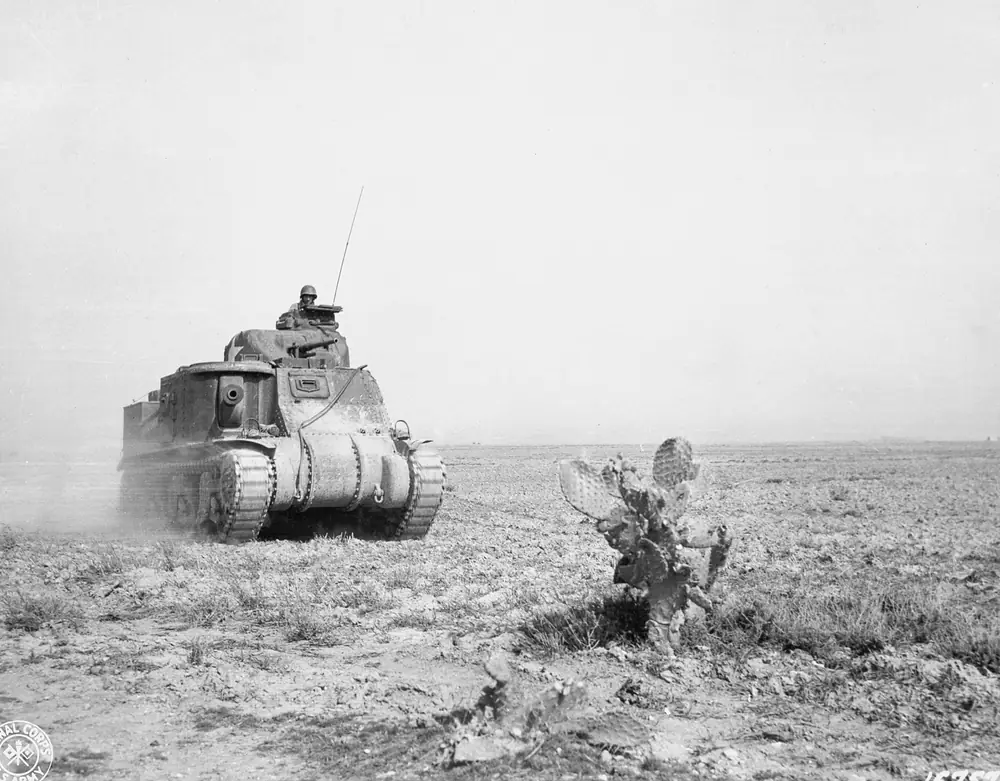
Rommel Arrives
Erwin Rommel arrived in Tripoli on 12 February 1941 with orders to hold Libya and prevent a total Italian collapse. He did far more than hold it. Within weeks, with only a fraction of his force ashore, he attacked, and by April 1941 he had driven the British back across Libya to the Egyptian frontier, retaking Benghazi and El Agheila and besieging Tobruk, the port the British held in his rear.
The siege of Tobruk lasted from April to December 1941 and became one of the war’s great epics: the Australian garrison, later relieved by British and Polish troops, held the port against repeated German and Italian attacks, supplied by sea under fire. The “Rats of Tobruk” became a legend, and their stand denied Rommel the port he needed to supply an advance on Egypt.
The British tried twice to relieve Tobruk in 1941 — Operation Brevity in May and Operation Battleaxe in June — and both failed, with heavy tank losses to German 88 mm guns. In November 1941 the Eighth Army launched Operation Crusader, a larger offensive that finally lifted the siege and drove Rommel back to El Agheila.
The battle was confused and costly — British tank losses were heavy, and Rommel’s counterattacks nearly broke the offensive — but by January 1942 Tobruk was free and Rommel was back where he had started. The first year of the desert war had shown a pattern that would repeat: each side could win battles, but neither could hold its gains, because neither could supply an army at the end of a 1,000-mile supply line.
Gazala, Tobruk and the Retreat to El Alamein
The second year began with Rommel’s counterstroke. In January 1942 he attacked again, recapturing Benghazi, and in May he launched his greatest offensive, the Battle of Gazala. The British Eighth Army under General Neil Ritchie held a defensive line from Gazala on the coast to Bir Hakeim in the south, where a Free French brigade held out heroically for two weeks against overwhelming odds.
Rommel outflanked the line through the desert, destroyed British tank brigades piecemeal, and broke through. On 21 June 1942 Tobruk fell — a disaster for Britain, which lost some 30,000 men taken prisoner and huge stocks of supplies. Churchill, in Washington at the time, called it a heavy blow, and it was.
Rommel, promoted to field marshal, pursued the Eighth Army into Egypt, reaching El Alamein, only 60 miles from Alexandria, in early July.
At El Alamein the retreat stopped. The line there was narrow — only 40 miles wide, between the Mediterranean and the impassable Qattara Depression — and it could not be outflanked. Auchinleck, who had taken personal command of the Eighth Army, fought the First Battle of El Alamein through July 1942, stopping Rommel’s attacks and wearing his army down.
Rommel’s last offensive, at Alam el Halfa in late August, was beaten off by Montgomery, who had taken command on 13 August and had spent weeks building up supplies, training and defences. By the autumn of 1942 the balance had shifted decisively: the Eighth Army had more than 200,000 men, over 1,000 tanks, and overwhelming air support, while Rommel had about 100,000 men, some 500 tanks, and almost no fuel.
The Second Battle of El Alamein
The Second Battle of El Alamein began on the night of 23 October 1942, with a massive artillery bombardment — more than 800 guns — and infantry attacks through the German and Italian minefields. The battle lasted twelve days. Montgomery’s plan was methodical: infantry would open lanes through the minefields, armour would pass through and engage the German tanks, and the Axis line would be worn down by attrition.
The fighting was bitter and costly, and for days the outcome was uncertain; Rommel’s counterattacks, above all by the 15th and 21st Panzer Divisions, came close to breaking the British advance. But the British had the numbers, the guns and the air power, and on 2 November the Axis line broke. Rommel, short of fuel and with his army in ruins, retreated.
The British pursued him across Libya — Tobruk was retaken on 13 November, Benghazi on 20 November, Tripoli on 23 January 1943 — and the desert war’s center of gravity moved west, toward Tunisia, where a second Allied army was now landing.
Operation Torch
Operation Torch, the Allied landings in French North Africa on 8 November 1942, was the largest amphibious operation of the war to that date. American and British forces under Eisenhower landed at Casablanca, Oran and Algiers, in Morocco and Algeria.
The landings met resistance from Vichy French forces for two to three days, and then the French commander in North Africa, Admiral Darlan, ordered a ceasefire, and the French joined the Allies. The political consequences were messy — Darlan was a collaborator, and his assassination in December 1942 solved one problem and created others — but the military consequences were clear: the Allies now held the western end of North Africa, and Rommel’s army was caught between Montgomery in the east and the Torch forces in the west.
Germany reacted by rushing reinforcements into Tunisia by air and sea, and the race for Tunis, which the Allies hoped to win by Christmas 1942, turned into a six-month campaign.
The Tunisian Campaign
Tunisia was a different war from the desert. The country is mountainous, cut by ridges and passes, and the winter of 1942–1943 brought rain and mud that bogged down tanks and grounded aircraft. The Allied advance from Algeria stalled in the hills short of Tunis, and in February 1943 the Germans struck back.
At Kasserine Pass, American troops of the II Corps were outmanoeuvred and badly beaten, losing thousands of men and much equipment. It was the American army’s first serious battle against the Germans, and it was a humiliation — but also a lesson. Eisenhower replaced the corps commander with Patton, reorganised the command, and the Americans learned fast.
Through March and April 1943, Montgomery’s Eighth Army attacked from the south, breaking the Mareth Line, while the First Army and the Americans attacked from the west. On 7 May 1943 British troops entered Tunis and American troops entered Bizerte. On 13 May the last Axis forces surrendered. Some 250,000 German and Italian soldiers went into captivity, and the North Africa Campaign was over.
Turning Point
El Alamein and the End of the Axis Advance
The turning point of the North Africa Campaign was the Second Battle of El Alamein, fought from 23 October to 11 November 1942. It was the first battle in the desert in which the Allies had a clear and overwhelming superiority in men, tanks, guns and aircraft, and the first in which Rommel could not recover from defeat by counterattacking. The reasons were logistical as much as tactical.
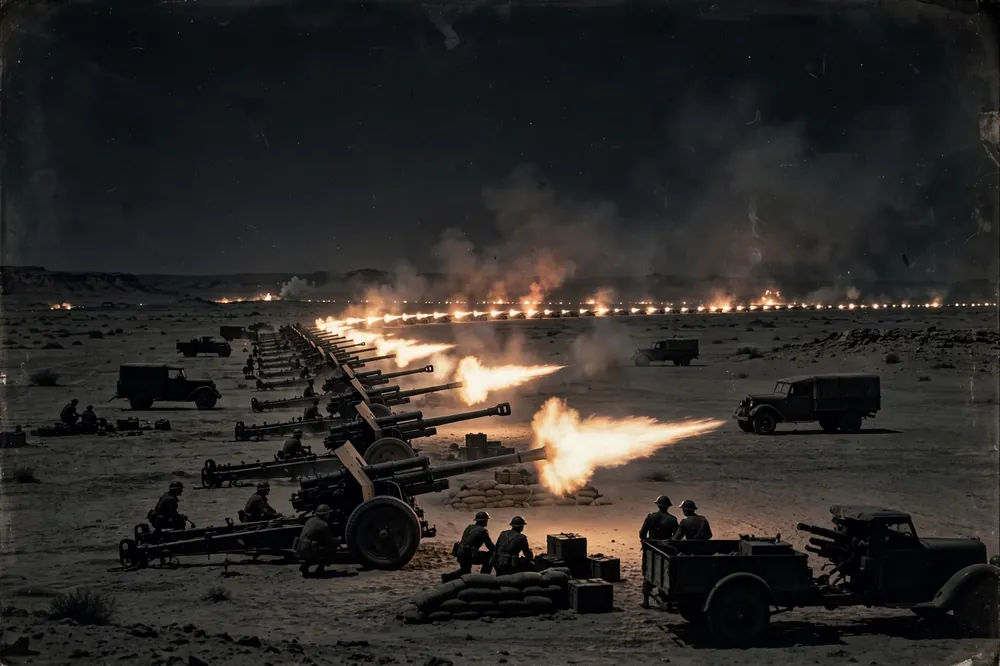
By October 1942, British aircraft and submarines based on Malta, together with the Royal Navy, were sinking a large share of the fuel and supplies shipped from Italy to Libya, and Rommel’s army was running on empty: at the start of the battle he had only a few days’ fuel for his tanks, and the fuel he was promised never arrived.
Montgomery, by contrast, had spent two months building up stocks at El Alamein, and his army was supplied by a short line from Alexandria. When the Axis line broke on 2 November, Rommel had no reserves and no fuel to mount a counterattack, and his retreat became a rout.
El Alamein was decisive because it was irreversible. In the earlier desert battles, defeat had always been followed by a counteroffensive and a recovery; after El Alamein, the Axis never again advanced in North Africa. The Eighth Army pursued Rommel 1,400 miles to Tunisia, and the Axis army that surrendered there in May 1943 was the same army that had been broken at El Alamein, reinforced but never rebuilt.
The battle also had a political importance that went beyond the desert: it was the first land victory over the German army that the British could celebrate, and it came at a moment when Britain had suffered defeats in the Far East and at Tobruk. Churchill’s phrase — that El Alamein was “the end of the beginning” — captured the mood in London, and it was justified by what followed.
Torch and the Closing of the Trap
Operation Torch, launched two weeks after El Alamein began, was the second half of the turning point. On its own, El Alamein would have driven the Axis out of Libya; Torch made the loss of all of North Africa inevitable by placing a second Allied army in Rommel’s rear and denying the Axis any line of retreat.
The landings also brought the United States into the Mediterranean ground war, and with it the industrial power that would decide the campaign: American tanks, trucks and aircraft arrived in numbers that the Axis could not match. The two offensives, east and west, converged on Tunisia, and the Axis, which had rushed reinforcements into the country, found itself trapped in a bridgehead with the sea behind it and two Allied armies in front of it.
The turning point of the campaign was therefore not a single battle but a pair of blows, one from the east and one from the west, that arrived within three weeks of each other and left the Axis with nowhere to go.
Suez Canal in World War II
The Suez Canal was the reason the North Africa Campaign was fought. The canal, opened in 1869, was the short route between Britain and India, Australia and the oilfields of the Persian Gulf: a ship sailing from London to Bombay saved thousands of miles by using the canal instead of sailing around Africa.
In 1940 the canal carried the bulk of Britain’s trade with the East, and the oil that fuelled the British war effort came through it. If the Axis had taken the canal, Britain would have had to send every ship the long way around the Cape of Good Hope, adding weeks to every voyage and straining a merchant fleet already under attack by U-boats.
The defense of the canal was therefore the first priority of British strategy in the Middle East, and every battle of the desert war was fought, in the end, to keep the canal out of Axis hands.
The Axis understood the prize. Mussolini’s invasion of Egypt in September 1940 was aimed at the canal, and Rommel’s offensives in 1941 and 1942 were aimed at Alexandria and then at the canal itself. The closest the Axis ever came was in July 1942, at the First Battle of El Alamein, when Rommel’s army stood some 60 miles from Alexandria and roughly 200 miles from the canal.
That was as far as it got. The British line at El Alamein held, and after the Second Battle of El Alamein the Axis never threatened Egypt again. The canal was never closed by enemy action during the war, and it remained open to Allied shipping throughout — a fact that owed as much to geography as to arms, because the desert between El Alamein and the canal was itself a barrier, and because the British had built a formidable defensive system around the canal zone, with airfields, anti-aircraft guns and troops.
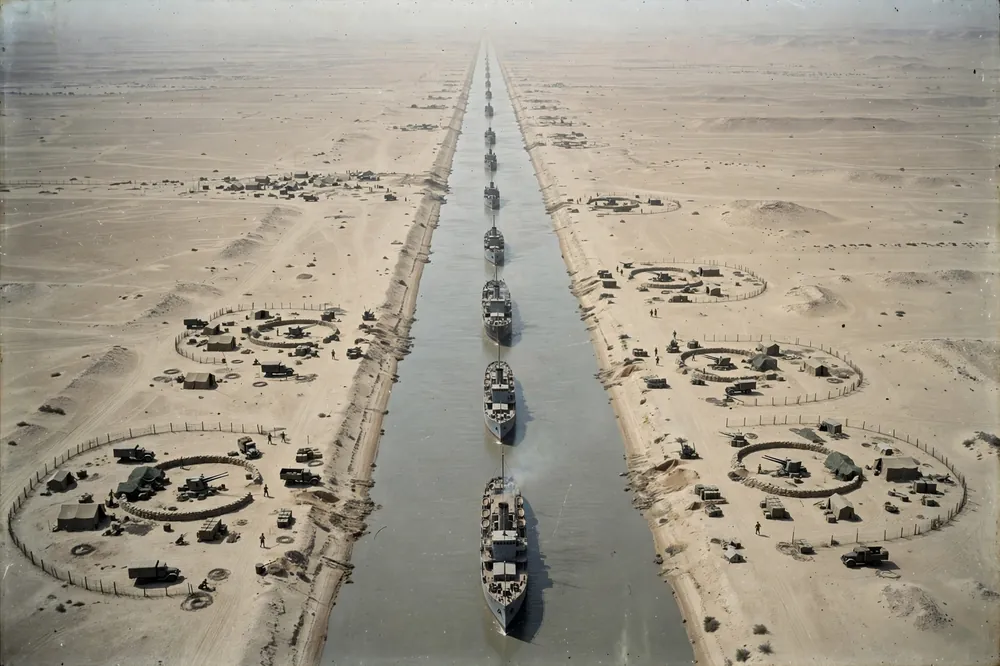
The canal’s wartime role went beyond shipping. The Canal Zone was one of the largest British military bases in the world, with camps, workshops, hospitals and airfields that supported the desert war and, later, the campaigns in Italy. British, Commonwealth and American troops passed through it in their hundreds of thousands, and the canal’s workshops repaired tanks and vehicles for the Eighth Army.
The canal was also a political question: Egypt, though formally independent, was occupied by British troops, and Egyptian nationalists resented the British presence. In February 1942 British tanks surrounded the royal palace in Cairo and forced King Farouk to accept a pro-British government — an episode that humiliated the king and fuelled Egyptian nationalism after the war.
The canal itself remained under British control until the Suez Crisis of 1956, when Egypt nationalised it. In the Second World War, however, its story was a simple one: it was the prize the Axis wanted and never took, and the reason the desert war was fought where and when it was.
Casualties and Losses
No exact casualty total exists for the North Africa Campaign, so the figures that follow are ranges that acknowledge the gaps in the record rather than concealing them. The fighting lasted nearly three years and involved the armies of six or seven nations, while Italian army records in particular survive only in part. The scale, however, is beyond doubt: the campaign cost hundreds of thousands of men, and the Axis bore the heaviest losses, above all in prisoners.
Allied casualties — killed, wounded, missing and captured — across the whole campaign from 1940 to 1943 are estimated to range from about 200,000 to about 250,000 men. British and Commonwealth losses were the largest part of this total, with American losses concentrated in Tunisia in 1943, including the defeat at Kasserine Pass, where American casualties ran into the thousands. French losses, both Vichy and Free French, were smaller. The single worst Allied loss was the fall of Tobruk in June 1942, when some 30,000 men, mostly British and South African, were taken prisoner in a single day.
Axis losses were far heavier, and estimates range from about 550,000 to about 950,000 men killed, wounded, missing and captured. The wide range reflects uncertainty over Italian losses, which are poorly documented, and over how many Axis soldiers were taken prisoner at different stages of the campaign.
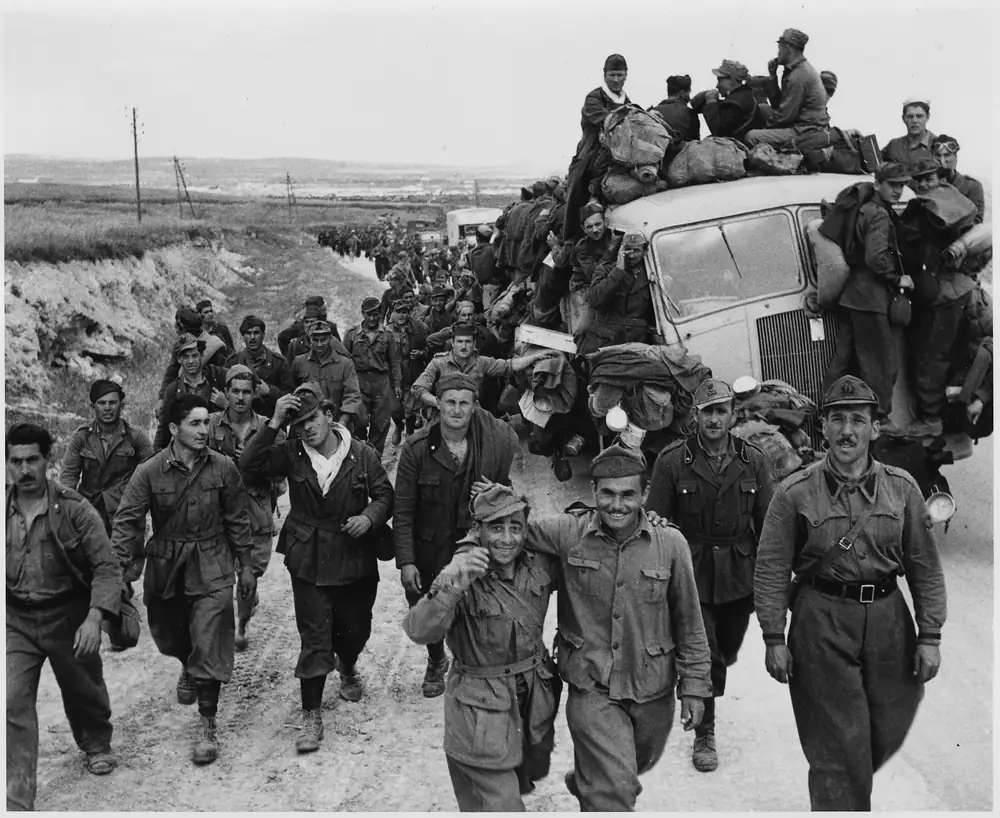
The best-documented figures are the great surrenders: about 130,000 Italians were captured in Operation Compass in 1940 and 1941, and about 250,000 German and Italian soldiers surrendered in Tunisia in May 1943. German losses in the desert were smaller in absolute numbers than Italian losses, but they were proportionally heavier, because the Afrika Korps was a small force that was fought to exhaustion and could not be replaced.
Material losses were also enormous: the Axis lost thousands of tanks, guns and aircraft, and hundreds of thousands of tons of shipping in the supply war across the Mediterranean.
Civilian losses in North Africa were smaller than in the campaigns in Europe, but they were real. Libyan and Egyptian civilians were killed by bombing and by mines, and the war displaced communities along the coastal road. Tunisia suffered the most: the fighting in 1942 and 1943 passed through towns and farmland, and the German occupation brought the persecution of Tunisian Jews, hundreds of whom were sent to labour camps. The desert war is often remembered as a war without civilians; that memory is incomplete, and the campaign’s cost to the people of North Africa should not be forgotten.
Map and Geography
The Coastal Corridor
The North Africa Campaign was fought along a narrow coastal corridor. The Via Balbia, the Italian-built coastal road, ran 1,100 miles from Tripoli in the west to the Egyptian frontier, and almost every battle of the desert war was fought within a few dozen miles of it, because away from the road there was no water, no fuel and no way to move supplies.
The ports along the coast — Tripoli, Benghazi, Tobruk, Bardia, Alexandria — were the campaign’s real objectives, because an army lived or died by its port. Tobruk, with its deep harbour, was the most fought-over port of the war: besieged in 1941, captured in 1942, retaken later the same year.
The campaign’s front line moved with the ports: when an army took a port, it could advance; when it outran its port, it had to stop. The railway that the British built and extended behind the front was the only alternative to the road, and it mattered at El Alamein, where it brought up the supplies for Montgomery’s offensive.
The Open Desert and the Qattara Depression
South of the coastal corridor lay the open desert, a flat, stony plain where a mobile force could move freely and outflank a fixed defence. The desert flank decided battle after battle: Rommel’s outflanking moves at Gazala and elsewhere, and the British outflanking moves at Compass and Crusader, were all made through the open desert to the south.
The one great exception was the Qattara Depression, a vast hollow below sea level that lay south of El Alamein. Tanks could not cross it, and its presence meant that the El Alamein line, only 40 miles wide between the sea and the depression, could not be outflanked.
That single geographical fact is why the retreat stopped at El Alamein in 1942, and why the battle fought there was a frontal battle of attrition rather than a battle of manoeuvre. Geography decided the campaign’s turning point.
Tunisia: Mountains and Winter
Tunisia was a different country from the desert of Libya and Egypt. It is mountainous, cut by ridges and passes, with rivers and farmland, and its winter brings rain and mud. The fighting in Tunisia in 1942 and 1943 was therefore a different kind of war: infantry fighting through passes, artillery duels across valleys, and tanks bogged down in the mud.
The Mareth Line in the south, the Dorsale mountains in the center, and the hills around Tunis were all defensive positions that took weeks to break. The contrast between the open desert war and the Tunisian mountain war shows how much geography shaped the campaign: the same armies that had swept hundreds of miles across Libya in weeks took six months to advance a hundred miles through Tunisia.
Outcome and Legacy of the North Africa Campaign
The North Africa Campaign ended in complete Allied victory. On 13 May 1943 the last Axis forces in Tunisia surrendered, and North Africa passed entirely into Allied hands. The victory had immediate consequences: the Mediterranean was opened to Allied shipping, the southern shore of the sea was secure from Morocco to Egypt, and the Allies could invade Sicily and Italy from bases in North Africa.
The campaign also destroyed the Italian army as a fighting force — Italy had lost its empire in East Africa in 1941 and its army in North Africa in 1943 — and it wore down the German army and air force. The Afrika Korps, which had been one of the German army’s most effective formations, ceased to exist.
The campaign’s longer legacy was in what it taught the Allies. The British army learned, through defeat, how to fight a modern combined-arms battle: how to coordinate tanks, infantry, artillery and air power, how to supply an army across long distances, and how to plan a set-piece offensive, as Montgomery did at El Alamein.
The American army learned its own lessons, more painfully, at Kasserine Pass, where inexperience, poor coordination and bad leadership produced a defeat — and where the reforms that followed, under Patton and then Bradley, produced an army that would fight its way across Europe.
The amphibious landings of Torch taught the Allies how to mount a large seaborne invasion, a lesson applied at Sicily, at Salerno, at Anzio and at Normandy. In that sense the North Africa Campaign was the training ground for the liberation of Europe.
The campaign also left a legacy in North Africa itself. Libya, which had been an Italian colony, passed under British and French administration and became independent in 1951. Egypt’s experience of British occupation during the war fuelled the nationalist movement that would overthrow the monarchy in 1952. Tunisia, Algeria and Morocco, which had been under Vichy rule in 1942, returned to French control after the war, but the war had shown that French rule was not inevitable, and the independence movements of the post-war years drew strength from it. The desert war’s military legacy is well known; its political legacy, in the decolonisation of North Africa, is equally real.
Commanders
Allied Commanders
The North Africa Campaign had many Allied commanders, and the campaign’s history is in part the story of London searching for a general who could beat Rommel. Archibald Wavell commanded in the Middle East in 1940 and 1941 and won the victories of Operation Compass and East Africa, but he was fighting on too many fronts at once and was replaced by Claude Auchinleck, who commanded through the battles of 1941 and 1942 and personally stopped Rommel at the First Battle of El Alamein. Bernard Montgomery took command of the Eighth Army on 13 August 1942 and won the Second Battle of El Alamein, the campaign’s decisive victory, before pursuing Rommel across Libya to Tunisia. Dwight D.
Eisenhower commanded Operation Torch and the Allied forces in North Africa, holding together a coalition of British, American and French forces; his deputy and later successor in the theater, Harold Alexander, commanded the final offensive in Tunisia. Among the Americans, George Patton took command of the II Corps after Kasserine Pass and rebuilt it, and Omar Bradley succeeded him.
Richard O’Connor, the commander who won Operation Compass, was captured by the Germans in 1941 and spent most of the war as a prisoner; his early victories are sometimes overlooked, but they were the campaign’s first.
Axis Commanders
The Axis commanders were dominated by one man. Erwin Rommel commanded the Afrika Korps from February 1941 and the Panzer Army Africa until March 1943, when he was recalled to Germany, and he remains the campaign’s central figure: a commander of extraordinary boldness and tactical skill, whose offensives repeatedly surprised the British, but who also outran his supplies, underestimated the importance of logistics, and was worn down by a war of attrition he could not win.
His Italian counterparts — Rodolfo Graziani, who led the invasion of Egypt in 1940; Italo Gariboldi and Ettore Bastico, who commanded Italian forces in Libya; and Giovanni Messe, who commanded the Italian First Army in Tunisia in 1943 and fought with skill in the campaign’s final months — were capable soldiers working within an army that was poorly equipped and poorly supplied.
The German commander in Tunisia in 1943, Hans-Jurgen von Arnim, fought a skilled defensive campaign but could not save an army that was trapped, outnumbered and out of supplies. The Axis command in North Africa was divided between German and Italian headquarters that never fully cooperated, and that division was one reason for the Axis defeat.
Related articles
Frequently Asked Questions
How long did the North Africa Campaign last?
It lasted almost three years, from 11 June 1940, the day after Italy declared war, to 13 May 1943, when the last Axis forces in Tunisia surrendered. Some accounts date its start to 10 June 1940, the day of Italy’s declaration of war.
Who won the North Africa Campaign?
The Allies won decisively. The Axis was driven from North Africa, and about 250,000 German and Italian soldiers surrendered in Tunisia in May 1943, the largest Axis surrender of the war up to that point.
What was the most important battle of the campaign?
The Second Battle of El Alamein, fought from 23 October to 11 November 1942. It ended the Axis threat to Egypt and the Suez Canal, and it was the first clear-cut British land victory over the German army.
Why was Tobruk so important?
Tobruk was a deep-water port on the Libyan coast, and whoever held it could supply an army in the desert. The British held it through a siege in 1941, lost it in June 1942, and retook it in November 1942. Its loss in 1942 was one of Britain’s worst defeats of the war.
What was Operation Torch?
Operation Torch was the Allied invasion of French North Africa on 8 November 1942, when American and British forces landed in Morocco and Algeria. It placed a second Allied army in Rommel’s rear and made the Axis defeat in Africa inevitable.
Why did Rommel lose in North Africa?
Rommel was a brilliant tactician but he was beaten by logistics. His supplies had to cross the Mediterranean past Malta, and British aircraft and submarines sank a large share of them. By El Alamein he was short of fuel, tanks and men, while the Allies grew steadily stronger.