 WAR ATLAS MILITARY HISTORY MAGAZINE · WWI — WWII
Treaty of Versailles
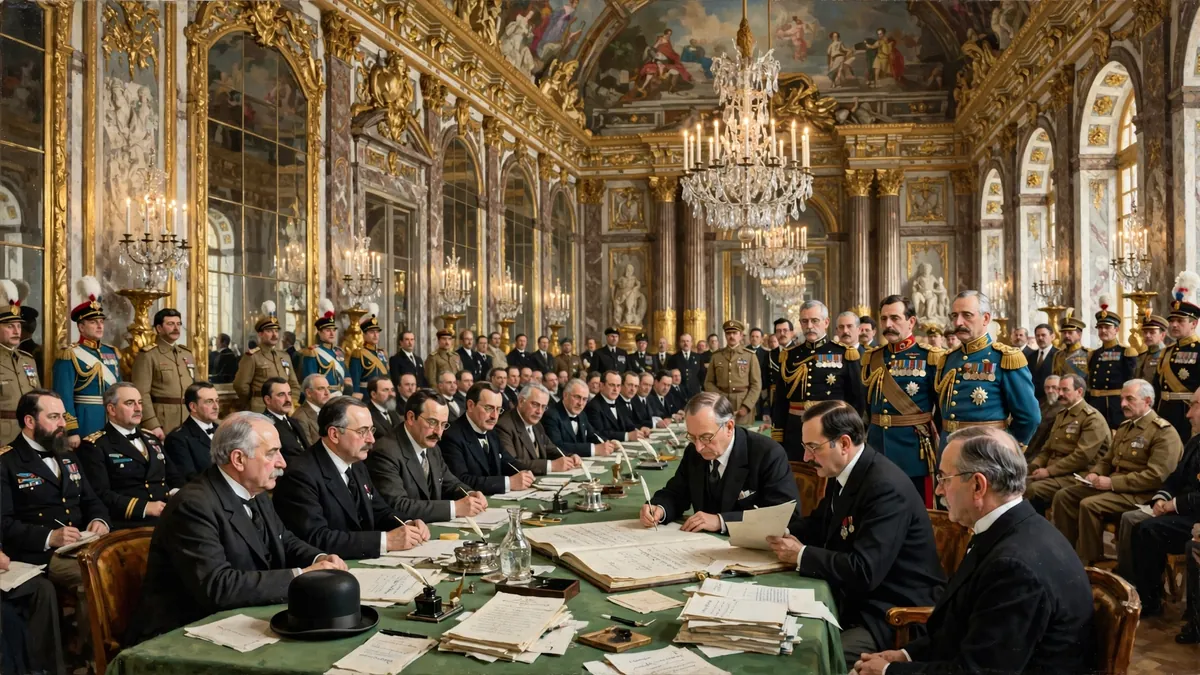
The Treaty of Versailles was the peace settlement that formally ended World War I between Germany and the Allied Powers. It was signed on 28 June 1919 in the Hall of Mirrors at the Palace of Versailles, exactly five years after the assassination of Archduke Franz Ferdinand in Sarajevo that had triggered the war, and it came into force on 10 January 1920.
The treaty did far more than end a war: it redrew the map of Europe, created new nations, founded the League of Nations, and imposed on Germany a set of terms so harsh that many Germans called it a Diktat — a dictated peace.
Its most famous clause, Article 231, the “war guilt” clause, declared Germany solely responsible for the war and made it liable for all the damage the Allies had suffered.
The treaty stripped Germany of about 13 percent of its territory and 10 percent of its population, took away its colonies, limited its army to 100,000 men, forbade it to have an air force, submarines, or tanks, and demanded reparations that were fixed in 1921 at 132 billion gold marks — a sum equivalent to about $33 billion at the time. Germany’s representatives were not allowed to negotiate the terms; they were summoned to Versailles, presented with the treaty, and told to sign or face a renewed Allied invasion. Two German delegates signed under protest, and the German National Assembly ratified the treaty by a narrow vote.
The Treaty of Versailles is one of the most debated documents in modern history. Its defenders argue that it was, by the standards of the time, relatively moderate — far less harsh than the peace Germany itself had imposed on Russia at Brest-Litovsk in 1918 — and that Germany’s later claims of victimhood were exaggerated.
Its critics argue that it humiliated Germany without permanently weakening it, created resentments that Adolf Hitler later exploited, and failed to build a lasting peace: within 20 years, Europe was at war again. The British economist John Maynard Keynes, who attended the Paris Peace Conference as a Treasury official, resigned in protest and wrote The Economic Consequences of the Peace (1919), warning that the treaty would impoverish Europe and breed future conflict.
Whether he was right is still argued — but no one disputes that Versailles shaped the 20th century.
1. Key Facts
| Signed | 28 June 1919, Hall of Mirrors, Palace of Versailles |
| Came into force | 10 January 1920 |
| Parties | Germany and the Allied Powers (Britain, France, Italy, Japan, the United States and others) |
| War guilt | Article 231: Germany accepted sole responsibility for the war |
| Territory lost | About 13% of pre-war territory (about 65,000 km²) and about 10% of population |
| Colonies | All overseas colonies taken and distributed as League of Nations mandates |
| Army limit | 100,000 professional soldiers; no conscription; no air force, tanks, or submarines |
| Navy limit | 6 battleships, 6 cruisers, 12 destroyers, 12 torpedo boats; no submarines |
| Reparations | Fixed in 1921 at 132 billion gold marks (about $33 billion) |
| Rhineland | Demilitarised; occupied by the Allies until 1930 (in practice until 1930, with early withdrawal) |
| League of Nations | Founded by the treaty’s Covenant (Part I); headquarters in Geneva |
| Other treaties | Saint-Germain (Austria, 1919), Trianon (Hungary, 1920), Neuilly (Bulgaria, 1919), Sèvres (Ottoman Empire, 1920) |
2. The Paris Peace Conference
The Treaty of Versailles was negotiated at the Paris Peace Conference, which opened on 18 January 1919 and lasted for months. It was the largest diplomatic gathering in history to that point: delegates from 32 countries attended, though the real decisions were made by the “Big Four” — the leaders of Britain, France, the United States, and Italy. Germany and its allies were not invited to negotiate; they were excluded from the conference entirely and only presented with the finished treaty in May 1919.
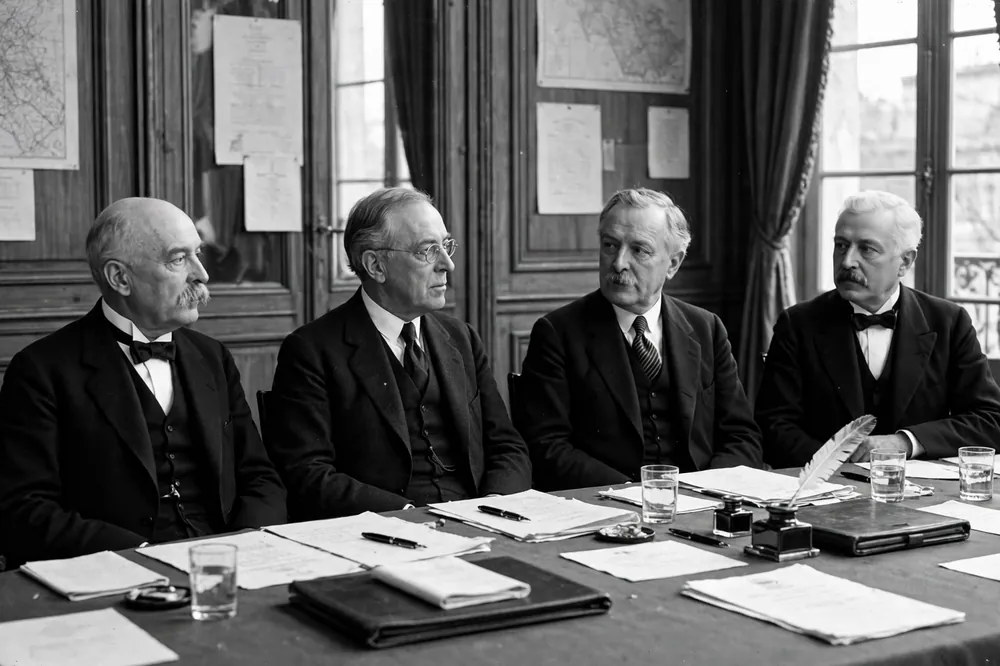
The four leaders brought very different aims to Paris. President Woodrow Wilson of the United States arrived as a hero, carrying his Fourteen Points — a programme for a just peace based on self-determination, free trade, disarmament, and a League of Nations to prevent future wars. Wilson wanted a “peace without victory”, one that would not humiliate Germany and breed future revenge.
Prime Minister Georges Clemenceau of France — known as “the Tiger” — wanted the opposite: security. France had been invaded by Germany twice in living memory, in 1870 and 1914, and had lost about 1.4 million soldiers in the war. Clemenceau wanted Germany permanently weakened, the Rhineland as a buffer, and heavy reparations to rebuild France’s ruined north.
Prime Minister David Lloyd George of Britain was caught between the two: he wanted Germany punished but not destroyed, because Britain needed a stable Germany as a trading partner and as a bulwark against communism. Vittorio Orlando of Italy wanted territory promised to Italy in a secret 1915 treaty — the Adriatic coast and parts of the Balkans — and walked out of the conference when he did not get it.
The conference worked through an enormous agenda: the future of Germany, the break-up of the Austro-Hungarian and Ottoman empires, the creation of new states in Eastern Europe, the fate of Germany’s colonies, and the founding of the League of Nations. The negotiations were slow, bitter, and often conducted in secret.
Wilson compromised on many of his Fourteen Points to secure agreement on the League of Nations, which he considered his greatest achievement. Clemenceau compromised on his demand to annex the Rhineland, accepting instead a 15-year Allied occupation and a demilitarised zone, in exchange for an Anglo-American guarantee of French security — a guarantee that became worthless when the United States Senate refused to ratify the Treaty of Versailles and the United States never joined the League of Nations.
3. The Terms: Territory, Disarmament and Reparations
The territorial terms of the treaty were sweeping. Germany lost Alsace-Lorraine to France, which had held the provinces before 1871. It lost about a third of its eastern territory to the new state of Poland — including the “Polish Corridor” that gave Poland access to the Baltic Sea and cut East Prussia off from the rest of Germany — and the port of Danzig became a free city under League of Nations supervision.
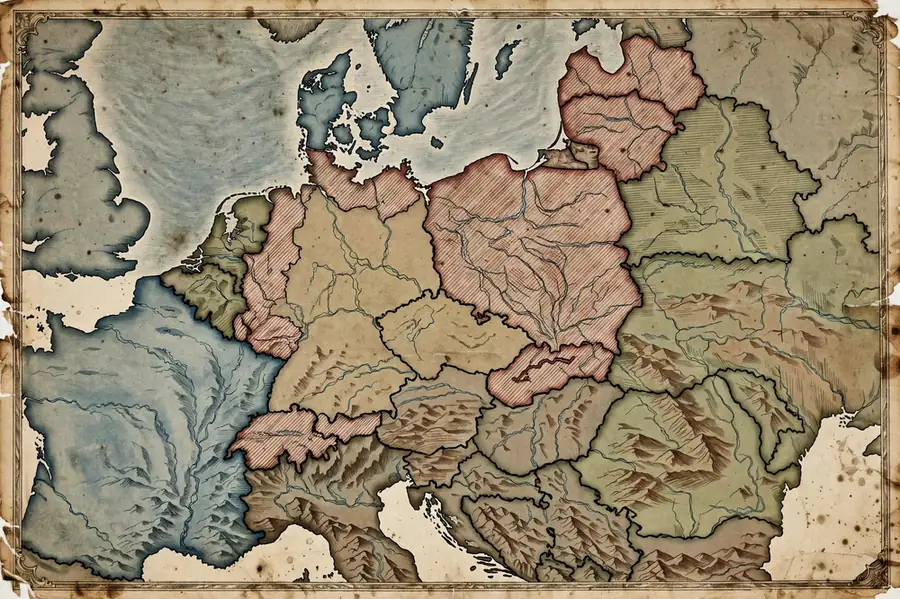
Germany lost Eupen-Malmedy to Belgium, Northern Schleswig to Denmark (after a plebiscite), and Memel to Lithuania. The Saar coalfields were placed under League of Nations control for 15 years, with France receiving the coal output. In total, Germany lost about 13 percent of its pre-war territory and about 10 percent of its population, including about seven million people who became citizens of other states.
All of Germany’s overseas colonies — in Africa, China, and the Pacific — were taken away and distributed among the Allies as League of Nations mandates.
The military terms were designed to make it impossible for Germany to wage war again. The German army was limited to 100,000 professional soldiers, with no conscription and no general staff. The navy was limited to six battleships, six cruisers, 12 destroyers, and 12 torpedo boats, with no submarines. Germany was forbidden to possess military aircraft, tanks, heavy artillery, or poison gas. The Rhineland — the German territory west of the Rhine — was demilitarised and occupied by Allied troops, and the German fortifications there were to be destroyed. The treaty also required Germany to hand over much of its existing military equipment and to pay for the costs of the Allied occupation.
The financial terms were the most controversial. Article 231, the war guilt clause, declared that Germany accepted responsibility for “causing all the loss and damage” of the war. On that basis, the treaty required Germany to pay reparations, but it did not fix the amount — that was left to a Reparations Commission, which in 1921 set the total at 132 billion gold marks (about $33 billion).
Germany paid reparations through the 1920s, though the schedule was repeatedly revised downward — by the Dawes Plan of 1924 and the Young Plan of 1929 — and payments were suspended during the Great Depression. In total, Germany paid about 20 billion gold marks before reparations were effectively abandoned in 1932, and the last payment on post-war bonds was made by Germany in 2010 — 92 years after the war ended.
4. The Signing and the German Reaction
The German delegation arrived in Versailles in May 1919 and was presented with the treaty as a finished document. The Germans were not permitted to negotiate; they were allowed only to submit written comments, most of which were rejected. The German government considered refusing to sign, but the Allies made clear that refusal would mean a resumption of the war — and Germany, its army collapsing, its people hungry from the Allied naval blockade, and its government in the midst of revolution, had no means to resist.
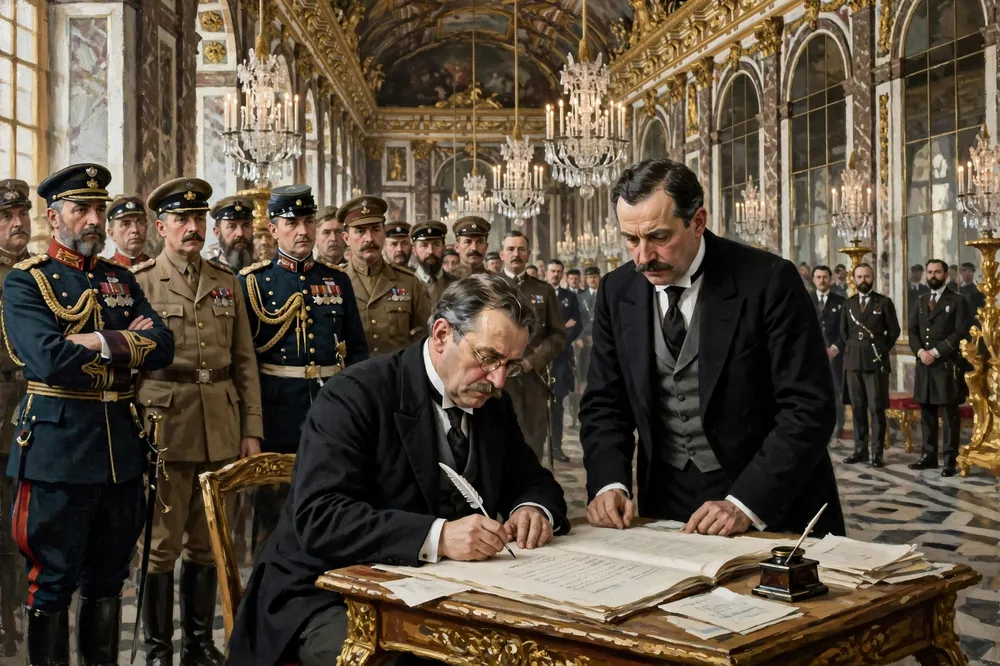
The National Assembly voted to sign by 237 votes to 138. On 28 June 1919, two German representatives — Foreign Minister Hermann Müller and Colonial Minister Johannes Bell — signed the treaty in the Hall of Mirrors, the same room where the German Empire had been proclaimed in 1871. The symbolism was deliberate and humiliating.
The reaction in Germany was one of shock and outrage. Across the political spectrum, Germans denounced the treaty as unjust. The war guilt clause was felt as a particular insult: most Germans believed their country had fought a defensive war, or at least that the blame was shared. The reparations were seen as an attempt to enslave Germany economically.
The territorial losses — especially the Polish Corridor and the loss of Danzig — were seen as a dismemberment of the nation. The myth of the “stab in the back” (Dolchstoßlegende) — the claim that the German army had not been defeated on the battlefield but betrayed by politicians, revolutionaries, and Jews at home — gained currency, and the politicians who signed the treaty were denounced as the “November criminals”.
These resentments did not cause the rise of Nazism by themselves, but Adolf Hitler and the Nazi Party exploited them relentlessly, promising to tear up the treaty, restore Germany’s lost territories, and rebuild its armed forces.
In the Allied countries the reaction was more mixed. In France, Clemenceau was criticised for not securing the Rhine frontier and for accepting a treaty that many French people thought too lenient. In Britain, opinion was divided: some thought the treaty too harsh, others too soft. In the United States, the Senate refused to ratify the treaty in November 1919 and again in March 1920, largely because of opposition to the League of Nations — and the United States eventually made a separate peace with Germany in 1921. The treaty’s most ambitious creation, the League of Nations, thus began its life without its most powerful advocate.
5. The League of Nations
Part I of the Treaty of Versailles was the Covenant of the League of Nations — the first permanent international organisation dedicated to keeping the peace. The League was Woodrow Wilson’s great project, and its creation was the one part of the settlement that most of the victors could agree was a genuine advance. The League’s headquarters were in Geneva, Switzerland.
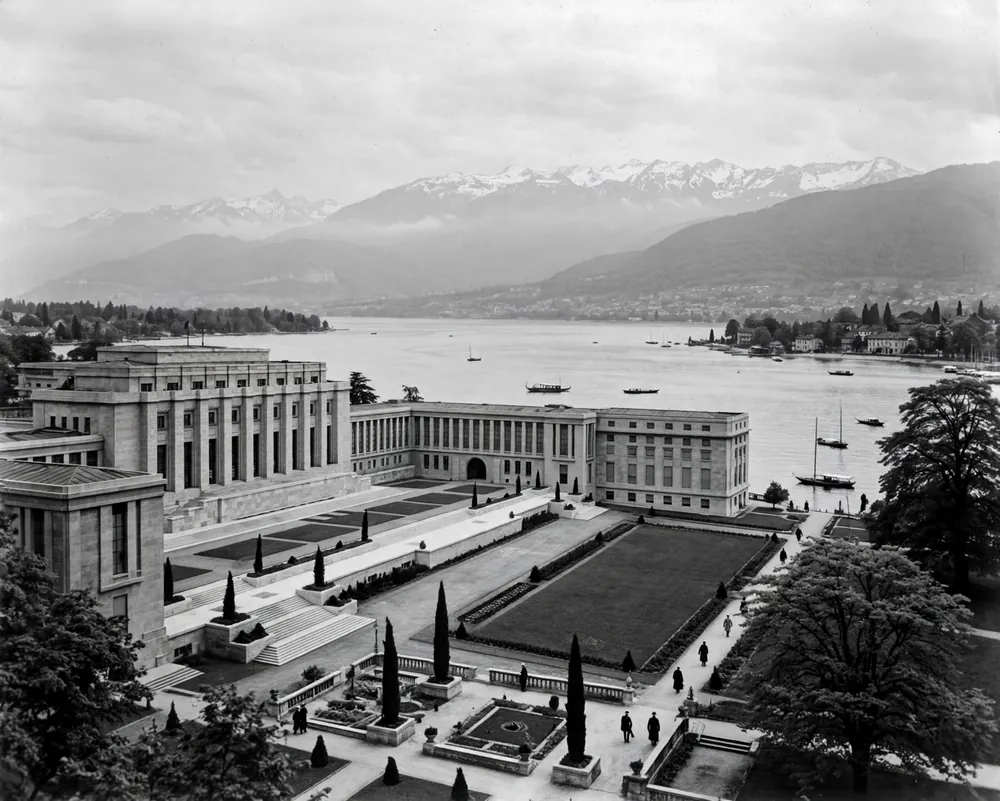
Its members pledged to settle disputes by negotiation or arbitration, to reduce armaments, and to take collective action — including economic sanctions and, in principle, military force — against any member that resorted to war. The League also took on responsibilities for refugees, health, labour standards, and the administration of former German and Ottoman territories as “mandates”, to be governed until their peoples were deemed ready for self-rule.
In practice, the League was weakened from the start by the absence of the United States, which never joined because the Senate refused to ratify the treaty. Germany was not admitted until 1926, and the Soviet Union not until 1934 — and it was expelled in 1939 after invading Finland.
The League had no army of its own and depended on its members to enforce its decisions; when they were unwilling, it was powerless. It had some successes — settling border disputes between Sweden and Finland, Greece and Bulgaria, and others, and doing important humanitarian work — but it failed in the great tests of the 1930s.
It could not stop Japan’s invasion of Manchuria in 1931, Italy’s invasion of Ethiopia in 1935, or Germany’s remilitarisation of the Rhineland in 1936. When World War II began in 1939, the League was effectively finished; it was formally dissolved in 1946 and replaced by the United Nations.
Yet the League was not a complete failure. Its institutions — the Permanent Court of International Justice, the International Labour Organization, the health organisation that became the World Health Organization — survived into the United Nations system. The idea that international disputes should be settled by law and negotiation rather than by war, which the League embodied for the first time, became a permanent part of international politics. The League’s failure taught the founders of the United Nations a lesson: the new organisation would need the great powers inside it, with a Security Council that gave them a veto, rather than outside it.
6. The New Map of Europe
The Treaty of Versailles, together with the separate treaties of Saint-Germain (Austria), Trianon (Hungary), Neuilly (Bulgaria), and Sèvres (Ottoman Empire), redrew the map of Europe more radically than any settlement since 1815. Three empires disappeared: the German Empire became a republic, the Austro-Hungarian Empire was broken into Austria, Hungary, Czechoslovakia, and Yugoslavia (along with territories transferred to Poland, Romania, and Italy), and the Ottoman Empire was reduced to the Turkish republic. Nine new states appeared or were restored: Finland, Estonia, Latvia, Lithuania, Poland, Czechoslovakia, Austria, Hungary, and Yugoslavia. The principle behind the new map was national self-determination — the idea, championed by Wilson, that peoples should govern themselves in states of their own.
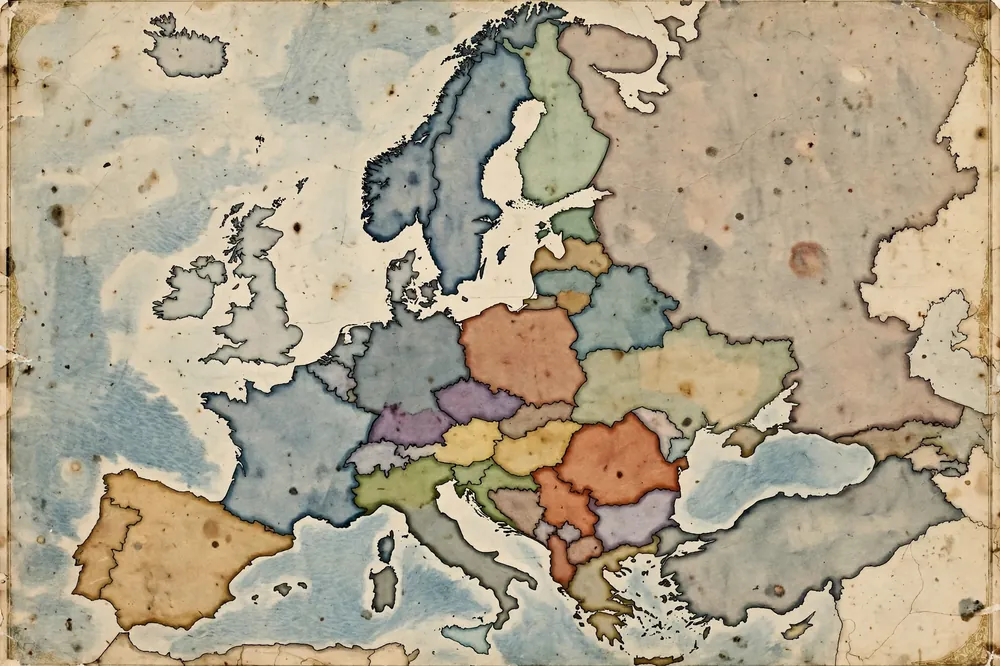
In practice, self-determination was applied unevenly. The new states contained large minorities — about 25 million people in Eastern Europe belonged to ethnic minorities in the new borders — and the treaties created as many problems as they solved. About three million Germans found themselves in Czechoslovakia, in the Sudetenland; about three million Germans lived in Poland’s new western territories; Hungarians were left in Romania, Czechoslovakia, and Yugoslavia; and the new Polish state contained large Ukrainian, Belarusian, and Jewish minorities.
The treaties required the new states to sign minority-protection agreements, but these were weakly enforced. The grievances of minorities — above all the Sudeten Germans — became tools that Hitler later used to justify aggression: he claimed to be “liberating” Germans who had been placed under foreign rule by Versailles.
The new map also reflected the limits of Wilson’s ideals. The victors applied self-determination to Europeans but not to the peoples of Asia and Africa, whose claims to independence were ignored. Germany’s colonies and the Arab provinces of the Ottoman Empire were distributed as League of Nations mandates, not granted independence — a decision that stored up resentment for the future. The treaty system, for all its flaws, did create a Europe of nation-states that, in broad outline, survives to this day: the borders drawn in 1919–1920 are recognisable in the map of modern Europe, and the states created then — Poland, Czechoslovakia’s successors, the Baltic states, Finland — remain independent nations.
7. Economic Consequences
The economic consequences of Versailles were severe, both for Germany and for Europe as a whole. Germany lost about 13 percent of its territory, but the losses were disproportionately valuable: it lost about 75 percent of its iron ore, about 25 percent of its coal, and much of its most productive farmland. It lost its merchant fleet, its overseas investments, and its colonies.
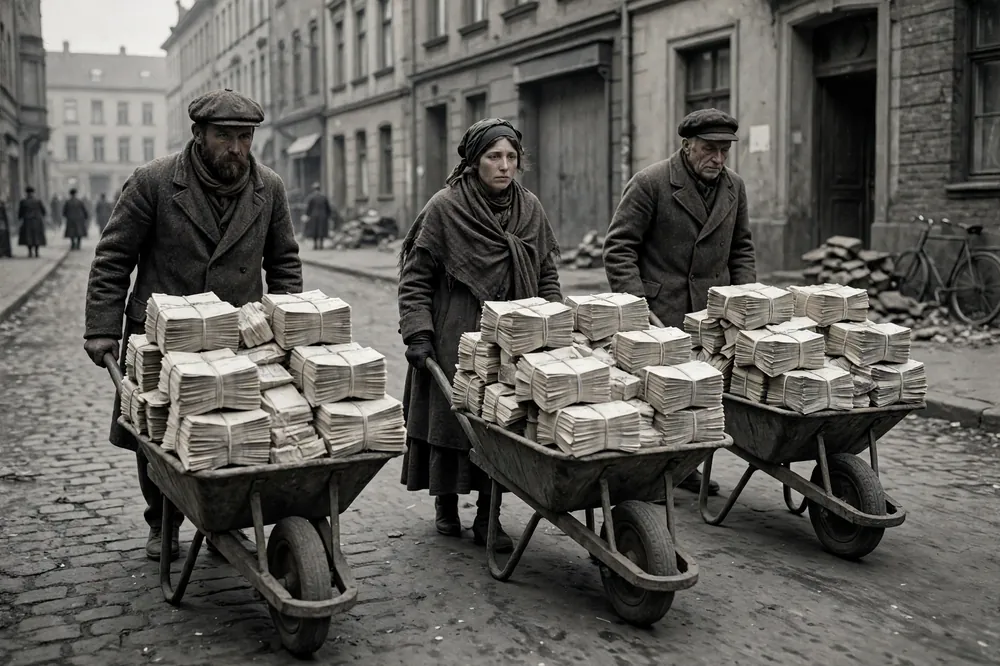
The reparations burden, combined with the costs of the war itself, left the German government with enormous debts. In 1921–1923, when Germany fell behind on reparations payments, France and Belgium occupied the Ruhr — Germany’s industrial heartland — to seize coal and steel directly. The German government responded with passive resistance and printed money to pay striking workers; the result was hyperinflation.
By November 1923, a loaf of bread cost billions of marks, savings were wiped out, and the German middle class was ruined. The crisis was eventually stabilised by the Dawes Plan of 1924, which restructured reparations and brought American loans to Germany — but the memory of hyperinflation scarred German politics for a generation.
Keynes’s warning in The Economic Consequences of the Peace was that the treaty would impoverish Europe as a whole by crippling its largest economy. Modern historians are more sceptical: they note that Germany actually paid only a fraction of the headline reparations figure, that the German economy recovered strongly in the late 1920s, and that the Great Depression — not reparations — was the main cause of Germany’s economic collapse in the early 1930s.
But the political effects were real enough. Reparations became a symbol of national humiliation, and every German government was judged by its success or failure in revising the treaty. The “fulfilment” policy of the early 1920s — paying reparations to show they could not be paid — gave way to open revisionism, and by the early 1930s all the major German parties, not only the Nazis, demanded an end to reparations and a revision of Versailles.
For the victors, the economics of Versailles were also disappointing. France and Britain had borrowed heavily from the United States during the war, and they hoped German reparations would help them repay their debts; in practice, the flow of money — American loans to Germany, German reparations to France and Britain, French and British debt payments to the United States — created a fragile circle that collapsed when American lending stopped in 1929. The treaty’s economic settlement, like its political settlement, depended on American engagement — and the United States, having refused to ratify the treaty, was not engaged.
8. Versailles and the Road to World War II
Did the Treaty of Versailles cause World War II? This is one of the great questions of modern history, and historians still disagree. The traditional view — that the treaty was a vindictive peace that humiliated Germany and made another war inevitable — was widely held in the 1920s and 1930s, and it shaped British and French policy: fear of repeating the “mistakes of Versailles” contributed to the appeasement of Hitler in the 1930s. Hitler himself made Versailles the centrepiece of his propaganda, promising to tear it up, and each of his early successes — remilitarising the Rhineland in 1936, annexing Austria in 1938, taking the Sudetenland later that year — was presented as the reversal of a Versailles injustice.
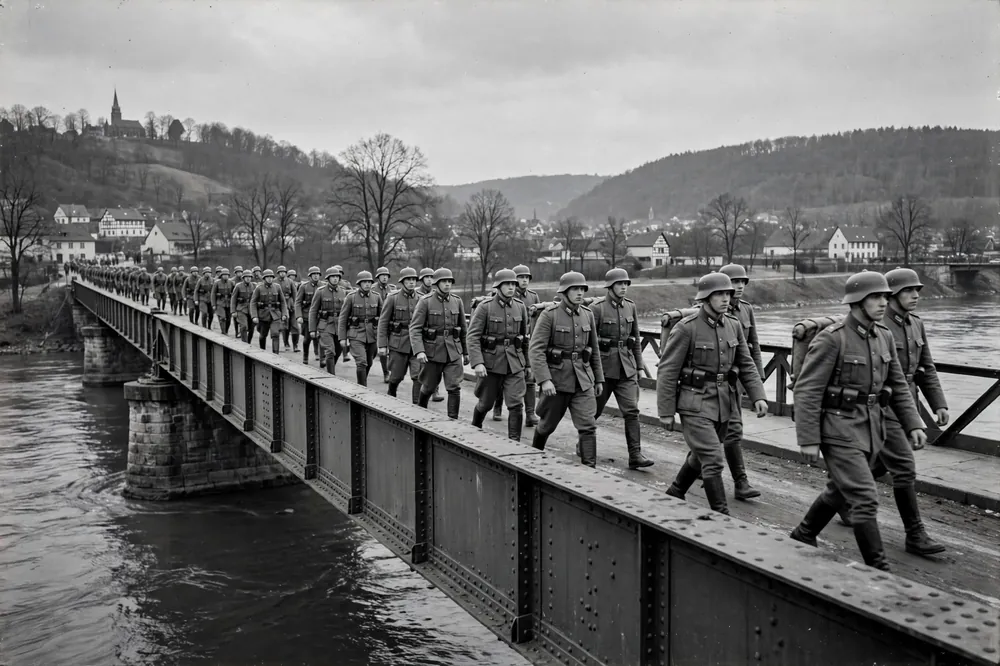
Modern historians are more cautious. They point out that the treaty left Germany as the largest and most populous state in Central Europe, with its industrial core intact, and that Germany’s economy recovered strongly in the late 1920s. The treaty did not make Hitler’s rise inevitable: the Nazi Party won only 2.6 percent of the vote in the 1928 election, and it was the Great Depression, not Versailles, that brought Hitler to power in 1933.
The treaty’s harshest provisions — disarmament and the Rhineland occupation — were enforced only weakly, and by the mid-1930s Germany was openly violating them with little consequence. The failure, these historians argue, was not that Versailles was too harsh but that it was not enforced: the victors lacked the will to uphold the settlement they had made, and the League of Nations lacked the power to do so.
What is not in doubt is that Versailles shaped the world in which World War II happened. It created the grievances Hitler exploited, the new states whose borders he attacked, and the international institutions that failed to stop him. It also created the conditions for the war’s outbreak: Poland, whose creation Versailles had made possible, was the country whose invasion in September 1939 began the war — and Britain and France’s guarantee of Poland, given in March 1939, was the commitment that turned a German-Polish war into a world war.
The lesson drawn after 1945 was the opposite of Versailles: the victors of World War II rebuilt Germany and Japan as democracies and integrated them into a new international order, rather than punishing them — a conscious attempt not to repeat the mistakes of 1919.
9. Key Figures
Woodrow Wilson (United States). President of the United States (1913–1921) and author of the Fourteen Points. Wilson came to Paris as the most popular leader in the world, but his idealism collided with the demands of his allies, and he compromised repeatedly to save the League of Nations. He suffered a stroke in October 1919 while campaigning for the treaty in the United States, and the Senate’s refusal to ratify it was the great disappointment of his presidency. He died in 1924.
Georges Clemenceau (France). Prime Minister of France (1917–1920), known as “the Tiger” for his determination. Clemenceau’s priority was French security, and he fought for a harsh peace with Germany. He was disappointed by the final treaty — he had wanted the Rhine frontier — but accepted it as the best obtainable. He left office in 1920 and died in 1929.
David Lloyd George (Britain). Prime Minister of Britain (1916–1922). Lloyd George balanced the demand for a harsh peace — he had won the 1918 election promising to “make Germany pay” — against the need for a stable, trading Germany. He was the most flexible of the Big Four, mediating between Wilson and Clemenceau. He left office in 1922.
John Maynard Keynes (Britain). Economist and Treasury official at the Paris conference. Keynes resigned in protest at the treaty’s economic terms and wrote The Economic Consequences of the Peace (1919), which became one of the most influential books of the 20th century. He later became the most important economist of his generation.
Hermann Müller and Johannes Bell (Germany). The two German delegates who signed the treaty on 28 June 1919. Müller was Foreign Minister and later Chancellor of Germany (1928–1930). Both men were denounced in Germany as traitors for signing, though they had no realistic alternative.
Frequently Asked Questions
Related articles
Sources
- Encyclopædia Britannica, “Treaty of Versailles” — terms, dates and consequences.
- Wikipedia, “Treaty of Versailles” — full text summary, reparations figures (132 billion gold marks) and territorial losses, cross-checked against scholarly sources.
- Margaret MacMillan, Paris 1919: Six Months That Changed the World (Random House, 2001) — the standard modern history of the peace conference.
- John Maynard Keynes, The Economic Consequences of the Peace (1919) — contemporary critique of the treaty’s economic terms.
- Zara Steiner, The Lights That Failed: European International History 1919–1933 (Oxford University Press, 2005).
- The National Archives (UK), “The Treaty of Versailles” — original documents and teaching resources.
- League of Nations archives, United Nations Library, Geneva — the Covenant and the mandate system.
- Alan Sharp, The Versailles Settlement: Peacemaking After the First World War, 1919–1923 (Palgrave Macmillan, 2018).
- David Stevenson, 1914–1918: The History of the First World War (Allen Lane, 2004).