 WAR ATLAS MILITARY HISTORY MAGAZINE · WWI — WWII
Lee-Enfield SMLE
1. Lead
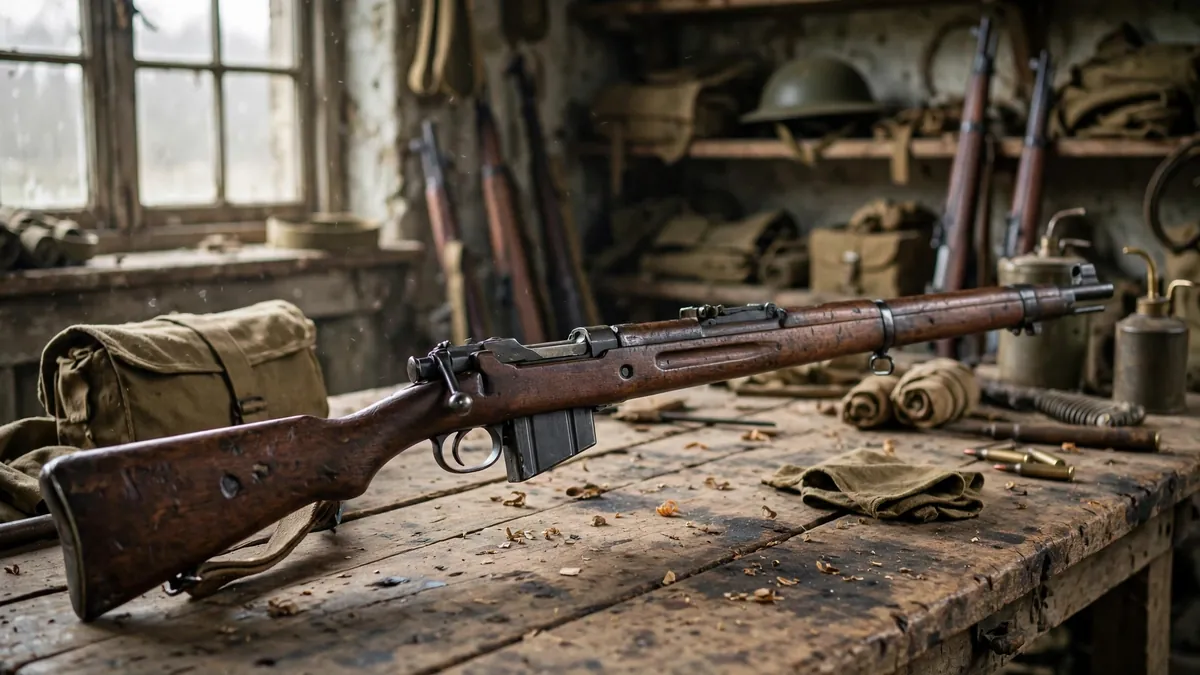
The Lee-Enfield SMLE (Short Magazine Lee-Enfield) was the standard rifle of the British Army in the First and Second World Wars, and one of the most widely used bolt-action rifles in history. Designed in 1907, it combined the Lee bolt-action and detachable 10-round magazine with a short barrel, and it was famous for its smooth, fast bolt — the fastest of any bolt-action rifle in service — which allowed a trained soldier to fire 20 to 30 aimed shots per minute, a rate of fire that German troops in 1914 mistook for machine-gun fire.
The SMLE served in every theatre of both world wars, and it remained in British service into the 1950s, and in the service of other armies — above all India and Australia — for decades afterwards. More than 17 million Lee-Enfields of all types were built, and the rifle is still used today by police and ceremonial units in several countries.
2. Key Facts
| Type | Bolt-action rifle |
| Origin | United Kingdom |
| Designers | James Paris Lee (bolt and magazine); Royal Small Arms Factory, Enfield (rifle) |
| Manufacturer | Royal Small Arms Factory, Enfield; Birmingham Small Arms (BSA); Lithgow (Australia); Ishapore (India); Savage Arms (USA); Long Branch (Canada) |
| In service | 1907–1957 (British service as standard rifle); used by other armies into the 1980s and later |
| Produced | 1907–1970s; more than 17 million Lee-Enfields of all types |
| Weight | About 3.9 kg empty (SMLE Mk III); about 4.1 kg (No. 4 Mk I) |
| Length | 1,130 mm (SMLE Mk III); 1,128 mm (No. 4 Mk I) |
| Barrel length | 640 mm (SMLE Mk III); 640 mm (No. 4 Mk I) |
| Cartridge | .303 British (7.7×56 mm R) |
| Action | Bolt-action, Lee bolt; 10-round detachable box magazine |
| Rate of fire | 20–30 aimed shots per minute (trained soldier) |
| Muzzle velocity | About 744 m/s |
| Effective range | About 550 m; sights adjustable to 2,000 yards (volley sights) |
| Feed system | 10-round detachable box magazine, loaded by 5-round charger clips |
3. Background and Development
The Lee-Enfield was the product of two traditions: the Lee bolt-action, designed by the Scottish-born Canadian-American inventor James Paris Lee, and the rifling developed at the Royal Small Arms Factory at Enfield in London. Lee’s bolt, which cocked on closing and used a detachable box magazine, was adopted by the British Army in the Lee-Metford rifle of 1888, and then in the Lee-Enfield of 1895, which used the Enfield rifling.
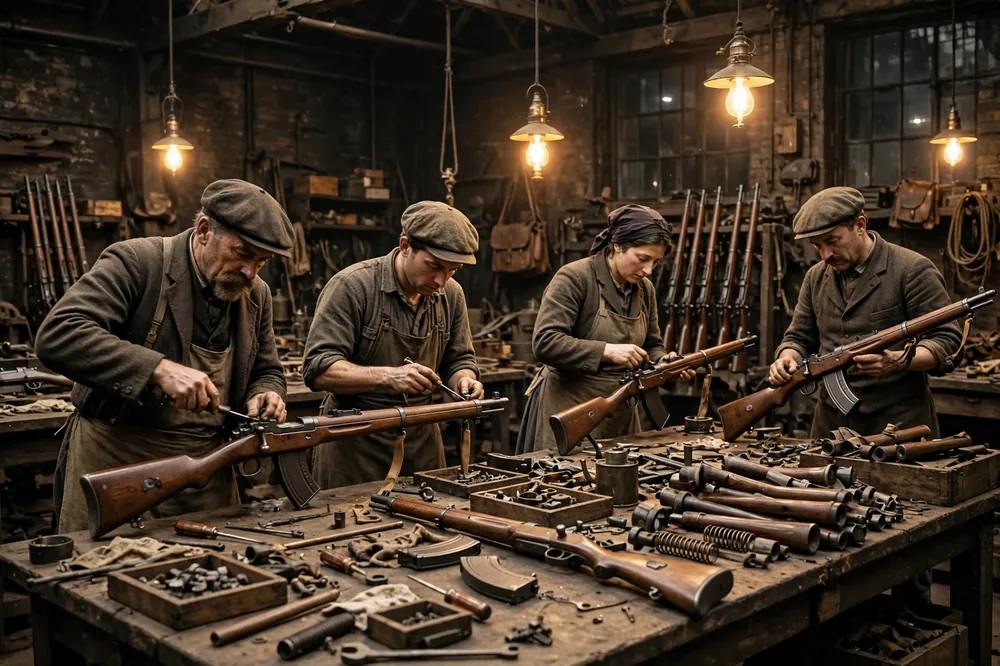
The Boer War (1899-1902) exposed the weaknesses of the long Lee-Enfield rifle: it was too long for mounted troops, and its magazine was too small for the firepower the British needed. The answer was the Short Magazine Lee-Enfield, the SMLE, adopted in 1907: a rifle with a barrel shortened to 640 mm, a 10-round magazine, and a stock that extended almost to the muzzle, which made it a single rifle for infantry, cavalry and artillery alike.
The SMLE’s bolt was its defining feature. Unlike the Mauser bolt, which cocked on opening, the Lee bolt cocked on closing, and its bolt handle was close to the trigger, so that the soldier could work the bolt with his thumb and forefinger without taking his hand from the grip or his eye from the sights.
A trained British soldier could fire 15 aimed shots in a minute in the “mad minute” — the rapid-fire test of the British Army — and the best soldiers could fire 30 or more. At the Battle of Mons in August 1914, German troops, facing the rapid fire of the British Expeditionary Force, reported that they were facing machine guns; in fact, they were facing riflemen with SMLEs.
The SMLE’s magazine, which held 10 rounds — twice the capacity of the German Mauser — was loaded by two 5-round charger clips, and the soldier carried spare magazines and clips in his pouches.
4. Design
The SMLE Mk III, adopted in 1907 and refined as the Mk III* in 1916, was a wooden-stocked, bolt-action rifle with a 10-round magazine, a 640 mm barrel, and a nose cap that protected the muzzle and held the bayonet. The rifle’s sights were a blade front sight, protected by wings, and a tangent rear sight adjustable to 2,000 yards, with a volley sight for long-range fire.
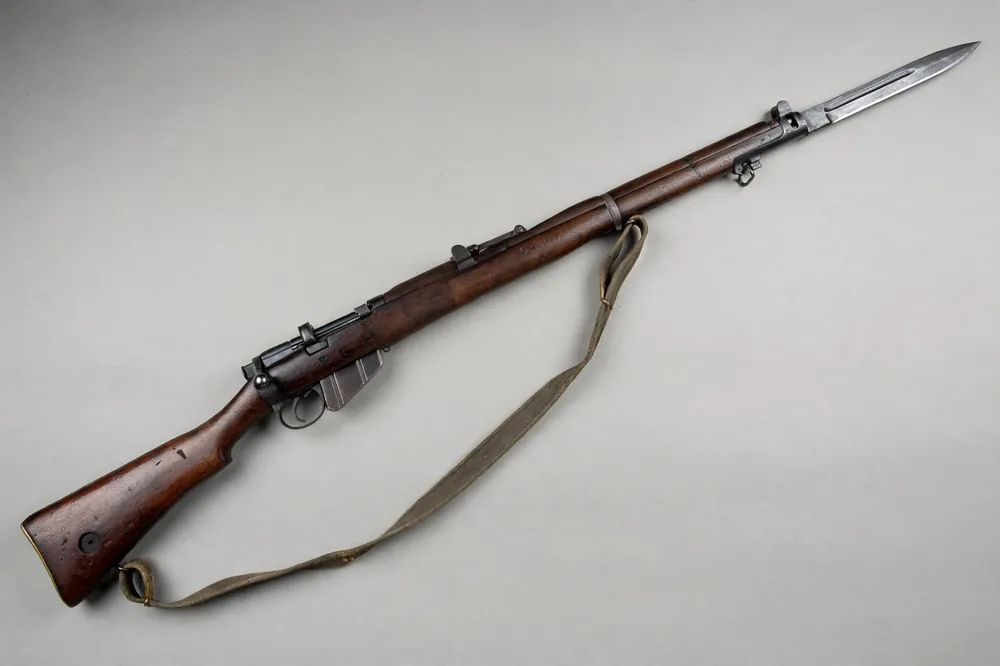
The rifle was fitted with a 17-inch sword bayonet, the Pattern 1907, which was one of the longest bayonets in service. The SMLE’s stock was made of walnut, and the rifle’s metal parts were blued steel. The rifle’s bolt had two locking lugs at the rear, which made it less strong than the Mauser’s front-locking bolt, but which made it smoother and faster to operate — a trade that the British accepted, because the .303 cartridge was less powerful than the German 7.92 mm cartridge and did not need the Mauser’s strength.
The No. 4 Mk I, which replaced the SMLE as the standard British rifle in 1941, was a simplified and strengthened version: it had a heavier barrel, a simpler rear sight (a flip-up aperture sight), a shorter spike bayonet, and a stock that was easier to manufacture. The No.
4 was produced in Britain, Canada and the United States, and it was the rifle carried by British and Commonwealth troops in the Second World War. The No. 5 Mk I, the “Jungle Carbine”, was a shortened and lightened version of the No.
4, produced in 1944-1947 for use in the Far East; it was lighter and handier, but its recoil was severe and its accuracy was poorer, and it was not popular with the troops.
5. Variants
| Variant | Years | Key features | Production |
|---|---|---|---|
| SMLE Mk I | 1907 | First short rifle; charger loading; magazine cut-off | — |
| SMLE Mk III | 1907–1916 | Standard First World War rifle; 10-round magazine; Pattern 1907 bayonet | Millions |
| SMLE Mk III* | 1916–1940s | Simplified wartime version; no magazine cut-off or volley sights | Millions |
| No. 4 Mk I | 1941–1945 | Standard Second World War rifle; aperture sights; spike bayonet | About 4 million |
| No. 4 Mk I (T) | 1942–1945 | Sniper version with telescopic sight; about 23,000 built | About 23,000 |
| No. 5 Mk I “Jungle Carbine” | 1944–1947 | Shortened, lightened version for the Far East | About 250,000 |
| Ishapore 2A/2A1 | 1960s | Indian version in 7.62 mm NATO | About 100,000+ |
| L42A1 | 1970–1990s | British sniper rifle based on the No. 4 Mk I (T), in 7.62 mm NATO | About 1,000 |
The Lee-Enfield family was produced in Britain, Australia (at Lithgow), India (at Ishapore), Canada (at Long Branch) and the United States (at Savage Arms), and the total production of all Lee-Enfield types is more than 17 million rifles. The SMLE Mk III* was the rifle of the First World War, and the No. 4 Mk I was the rifle of the Second; the No.
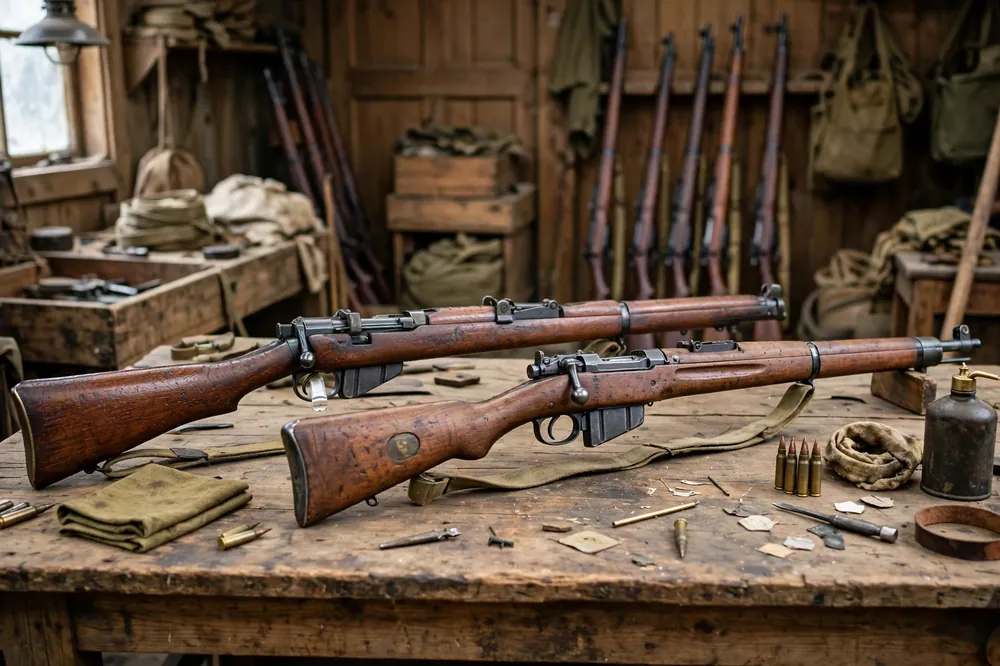
4 Mk I (T), the sniper version, was one of the best sniper rifles of the war, and it remained in British service as the L42A1 until the 1990s. The Indian Ishapore 2A, chambered for the 7.62 mm NATO cartridge, was the last Lee-Enfield to be produced in large numbers, and it remained in Indian police service into the 21st century.
6. Operational History
The First World War
The SMLE’s first war was the First World War, in which it was the standard rifle of the British and Commonwealth armies. At Mons in August 1914, the British Expeditionary Force’s rapid rifle fire held the German advance, and the SMLE’s reputation was made.
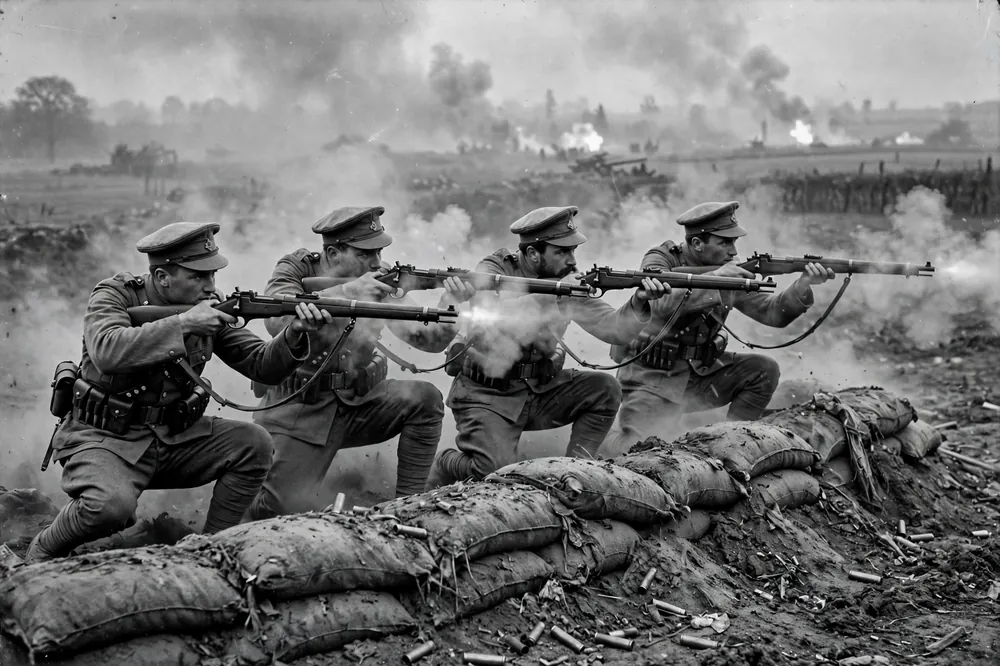
In the trenches of the Western Front, the SMLE was the infantryman’s weapon: it was reliable in mud and rain, it could be fired rapidly, and its 10-round magazine gave the soldier a firepower that the German Mauser, with its 5-round magazine, could not match.
The SMLE was also used in Gallipoli, in the Middle East and in East Africa, and it was the rifle of the Australian and New Zealand troops at Gallipoli and on the Western Front. By the end of the war, millions of SMLEs had been built, and the rifle had become a symbol of the British soldier.
The Second World War
In the Second World War, the SMLE and the No. 4 were the standard rifles of the British and Commonwealth armies in every theatre: in France in 1940, in North Africa, in Italy, in Normandy, in Burma and in the Pacific. The No.
4 Mk I, which replaced the SMLE in 1941, was the rifle carried by British troops at El Alamein, at Normandy and at Arnhem, and by Australian troops in New Guinea and by Indian troops in Burma. The No. 4 Mk I (T) sniper rifle was used by British snipers throughout the war, and it was regarded as one of the best sniper rifles of the war.
The Lee-Enfield’s reliability in the desert, in the jungle and in the cold of the Russian winter — where it was supplied to the Soviet Union under Lend-Lease, though in small numbers — was praised by the troops who carried it.
The rifle’s main disadvantage, by the standards of the Second World War, was that it was a bolt-action rifle in an age of semi-automatic and automatic weapons: the American M1 Garand and the German StG 44 could fire faster, and the Lee-Enfield’s rate of fire, though high for a bolt-action rifle, could not match them.
Korea, Malaya and after
The Lee-Enfield’s service did not end in 1945. It was carried by British and Commonwealth troops in the Korean War, in the Malayan Emergency, and in the early years of the Vietnam War, where Australian troops used it alongside the new self-loading rifles. The British Army replaced the Lee-Enfield with the FN FAL (the L1A1) in the 1950s, but the No.
4 Mk I (T) remained in service as the L42A1 sniper rifle until the 1990s, and the Lee-Enfield remained in service with the Indian Army and police, and with the armies of Pakistan, Bangladesh and Nepal, into the 21st century.
In Canada, the Lee-Enfield was the standard rifle of the Canadian Rangers — the Arctic patrol force — until 2018, when it was replaced by the C19 rifle; the Rangers’ Lee-Enfields, which had been in service for more than seventy years, were retired with ceremony.
7. Performance and Specifications
| Specification | SMLE Mk III | No. 4 Mk I |
|---|---|---|
| Cartridge | .303 British (7.7×56 mm R) | .303 British (7.7×56 mm R) |
| Action | Bolt-action, Lee bolt | Bolt-action, Lee bolt |
| Weight (empty) | About 3.9 kg | About 4.1 kg |
| Length | 1,130 mm | 1,128 mm |
| Barrel length | 640 mm | 640 mm |
| Magazine | 10-round detachable box | 10-round detachable box |
| Rate of fire | 20–30 aimed shots per minute | 20–30 aimed shots per minute |
| Muzzle velocity | About 744 m/s | About 744 m/s |
| Effective range | About 550 m | About 550 m |
| Sights | Blade front; tangent rear to 2,000 yd | Blade front; aperture rear |
| Bayonet | Pattern 1907 sword bayonet (17 in) | Spike bayonet |
Compared with its contemporaries, the Lee-Enfield was the fastest bolt-action rifle in service, and the only one with a 10-round magazine. The German Mauser Karabiner 98k held 5 rounds and was slower to operate; the American Springfield M1903 held 5 rounds; the Soviet Mosin-Nagant held 5 rounds; and the French Lebel held 8 rounds in a tubular magazine that was slow to reload.
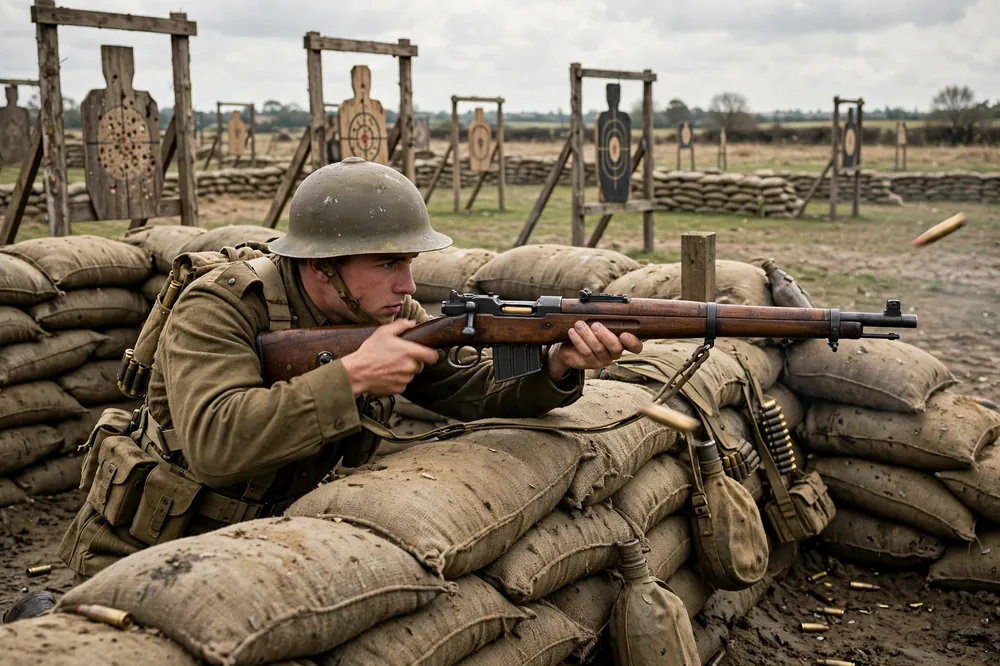
The Lee-Enfield’s advantage was its rate of fire and its magazine capacity; its disadvantage was its rear-locking bolt, which was less strong than the Mauser’s, and its .303 cartridge, which was less powerful than the German 7.92 mm cartridge at long range. For the infantry combat of the two world wars, in which most engagements took place at less than 500 metres, the Lee-Enfield’s advantages outweighed its disadvantages.
8. Operators
The Lee-Enfield was used by Britain and by the Commonwealth — Australia, New Zealand, Canada, India, South Africa and New Zealand — and by many other countries. It was the standard rifle of the Indian Army, which used it in both world wars and in the wars with Pakistan and China, and of the Australian Army, which used it in both world wars, in Korea and in Vietnam.
It was supplied to the Soviet Union under Lend-Lease, to China, to France and to the resistance movements of occupied Europe, and it was used by the armies of Pakistan, Bangladesh, Nepal, Sri Lanka and many African countries after independence.
The Lee-Enfield’s wide distribution is one reason it appears in the photographic record of almost every conflict of the twentieth century, from the trenches of the Western Front to the jungles of Malaya and the mountains of Afghanistan.
9. Legacy and Influence
The Lee-Enfield’s legacy is the bolt-action rifle itself, and the standard it set for infantry firepower. The “mad minute” — the rapid-fire test that the Lee-Enfield made possible — became a legend of the British Army, and the rifle’s smooth bolt and 10-round magazine influenced the design of later rifles, including the American M1 Garand, which was designed in part to match the Lee-Enfield’s rate of fire.
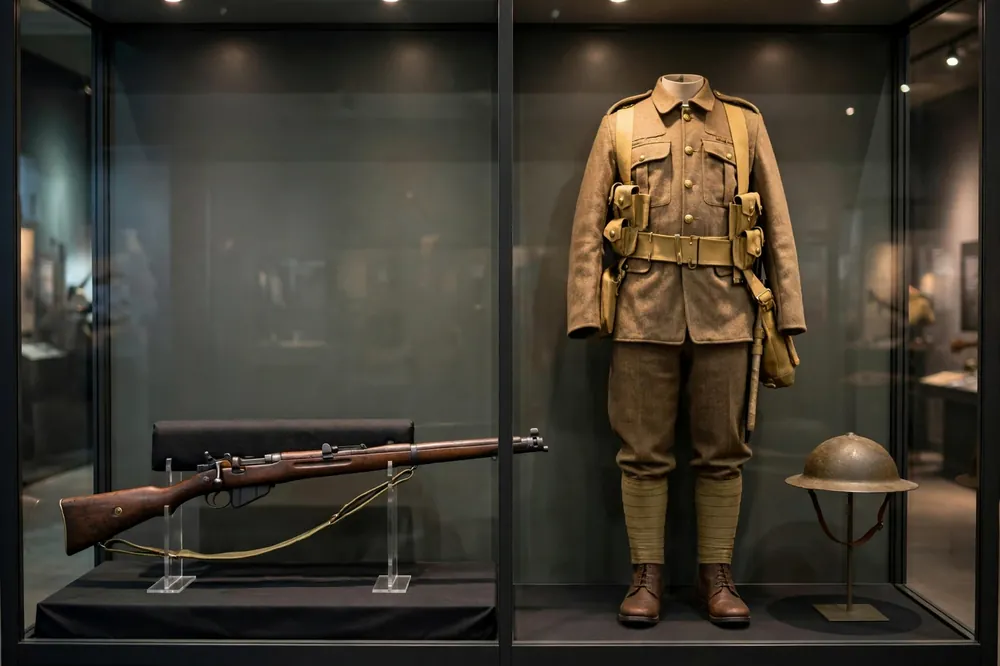
The Lee-Enfield also left a cultural legacy: it is the rifle of the British Tommy in the popular imagination, of the ANZAC at Gallipoli, and of the Indian soldier in the Second World War, and it appears in films, novels and memorials across the Commonwealth.
The rifle’s long service — from 1907 to the 1990s in British service as a sniper rifle, and to the 2010s in Canadian service — is a measure of its design: a rifle designed before the First World War was still in service a century later.
10. Surviving Examples
Because more than 17 million Lee-Enfields were built, surviving examples are common, and the rifle is one of the most widely held military rifles in private collections. Museums that hold Lee-Enfields include the Imperial War Museum in London, the National Army Museum in London, the Australian War Memorial in Canberra, the National WWII Museum in New Orleans, and the Royal Armouries in Leeds.

The Canadian Rangers’ retired Lee-Enfields were distributed to museums and to the Rangers themselves as mementoes, and the rifle is still used by ceremonial units in India and by police forces in several countries. For most visitors, the easiest way to see a Lee-Enfield SMLE is in a museum display on the First or Second World War, where it almost always appears alongside the story of the ordinary infantryman who carried it.
Frequently Asked Questions
What is the Lee-Enfield SMLE?
The Short Magazine Lee-Enfield was the standard rifle of the British Army in the First and Second World Wars, a bolt-action rifle chambered for the .303 British cartridge, with a 10-round magazine.
How many Lee-Enfield rifles were built?
More than 17 million Lee-Enfields of all types were built, in Britain, Australia, India, Canada and the United States.
What is the “mad minute”?
The “mad minute” was the British Army’s rapid-fire test, in which a trained soldier fired 15 aimed shots in a minute with the SMLE; the best soldiers could fire 30 or more.
What is the difference between the SMLE and the No. 4?
The No. 4 Mk I, adopted in 1941, was a simplified and strengthened version of the SMLE, with aperture sights, a spike bayonet and a heavier barrel. The SMLE was the rifle of the First World War; the No. 4 was the rifle of the Second.
Is the Lee-Enfield still in use today?
The Lee-Enfield was retired by the Canadian Rangers in 2018, but it is still used by ceremonial units in India and by police forces in several countries, and by collectors and target shooters around the world.
What cartridge did the Lee-Enfield use?
The .303 British cartridge (7.7×56 mm R), a rimmed cartridge adopted in 1888 and used by the British Army until the 1950s.
Related articles
Sources
- Wikipedia, “Lee–Enfield” — production of more than 17 million, specifications, the SMLE Mk III and No. 4 Mk I, the “mad minute”.
- Ian Skennerton, The Lee-Enfield: A Century of Lee-Metford and Lee-Enfield Rifles and Carbines (Arms & Armour Press, 2007) — the standard history of the Lee-Enfield family.
- Imperial War Museum, London — the SMLE in the First World War and the “mad minute” at Mons.
- National Army Museum, London, “Lee-Enfield rifle” — service history and variants.
- Martin Pegler, The Lee-Enfield Rifle (Osprey Publishing, 2012) — development, variants and operational use.
- Australian War Memorial, Canberra — the Lee-Enfield in Australian service at Gallipoli and in the Second World War.