 WAR ATLAS MILITARY HISTORY MAGAZINE · WWI — WWII
Axis Powers

1. Lead
The Axis Powers were the coalition of Germany, Italy, and Japan that fought against the Allies in World War II. The name came from a speech by the Italian dictator Benito Mussolini in November 1936, in which he described the new friendship between Italy and Germany as an “axis” around which the states of Europe would revolve.
The alliance was formalised by the Tripartite Pact, signed in Berlin on 27 September 1940, in which the three powers recognised each other’s leadership in their respective regions — Germany and Italy in Europe, Japan in Asia — and promised to help each other if any of them was attacked by a power not already involved in the war, a clause aimed squarely at the United States.
The Axis was never as united as the Allies. Its members had different aims, different enemies, and different ideas about the war. Germany, under Adolf Hitler, sought to conquer Eastern Europe, destroy the Soviet Union, and build a racial empire in the east. Italy, under Mussolini, sought a new Roman Empire in the Mediterranean and North Africa.
Japan sought a Greater East Asia Co-Prosperity Sphere — an empire across China and Southeast Asia that would give it the oil, rubber, and raw materials its industry needed. The three powers rarely coordinated their strategy: Germany invaded the Soviet Union in June 1941 without consulting Japan, Japan attacked Pearl Harbor in December 1941 without consulting Germany, and the three capitals often learned of each other’s decisions from the newspapers.
Yet together they conquered much of Europe, North Africa, and Asia in 1939–1942, and it took the combined strength of the Soviet Union, the United States, Britain, and China to defeat them.
The Axis was defeated in 1945. Italy surrendered in September 1943 (though German forces continued to fight in Italy until the end of the war), Germany surrendered unconditionally on 8 May 1945, and Japan surrendered on 2 September 1945 after the atomic bombings of Hiroshima and Nagasaki and the Soviet declaration of war. The leaders of the Axis were tried for war crimes at Nuremberg and Tokyo, and the three countries were occupied, disarmed, and rebuilt as democracies. The Axis alliance remains a study in how a coalition of aggressive powers can achieve spectacular early victories — and how the lack of a common strategy, combined with the industrial superiority of their enemies, can turn those victories into defeat.
2. Key Facts
| Members | Germany, Italy, Japan (core); Hungary, Romania, Bulgaria, Slovakia, Croatia, Finland (co-belligerent) |
| Name origin | Mussolini’s speech, November 1936: the Rome–Berlin “axis” |
| Tripartite Pact | Signed 27 September 1940 in Berlin |
| Anti-Comintern Pact | Germany–Japan, 25 November 1936; Italy joined 1937 |
| Leaders | Adolf Hitler (Germany), Benito Mussolini (Italy), Emperor Hirohito and Prime Minister Hideki Tojo (Japan) |
| Territory at peak | Most of Europe (1941–1942), much of North Africa, and a vast empire across Asia and the Pacific (1942) |
| Defeat | Italy surrendered September 1943; Germany 8 May 1945; Japan 2 September 1945 |
| War crimes trials | Nuremberg Trials (1945–1946), Tokyo Trials (1946–1948) / Phiên tòa Nuremberg (1945–1946), Phiên tòa Tokyo (1946–1948) |
| Main weakness | No common strategy; industrial inferiority to the Allies; two-front war for Germany; overextended empire for Japan |
3. How the Axis Formed
The Axis did not appear overnight. It grew from a series of agreements in the 1930s between three countries that shared a rejection of the post-World War I order and a belief in expansion by force. The first step was the Anti-Comintern Pact, signed by Germany and Japan on 25 November 1936 and joined by Italy in 1937. Ostensibly directed against the Communist International (Comintern), the pact was in practice an alignment against the Soviet Union and a signal that the three revisionist powers were drawing together. In the same month, Mussolini proclaimed the Rome–Berlin Axis, describing the new friendship between Italy and Germany as the axis around which Europe would turn.
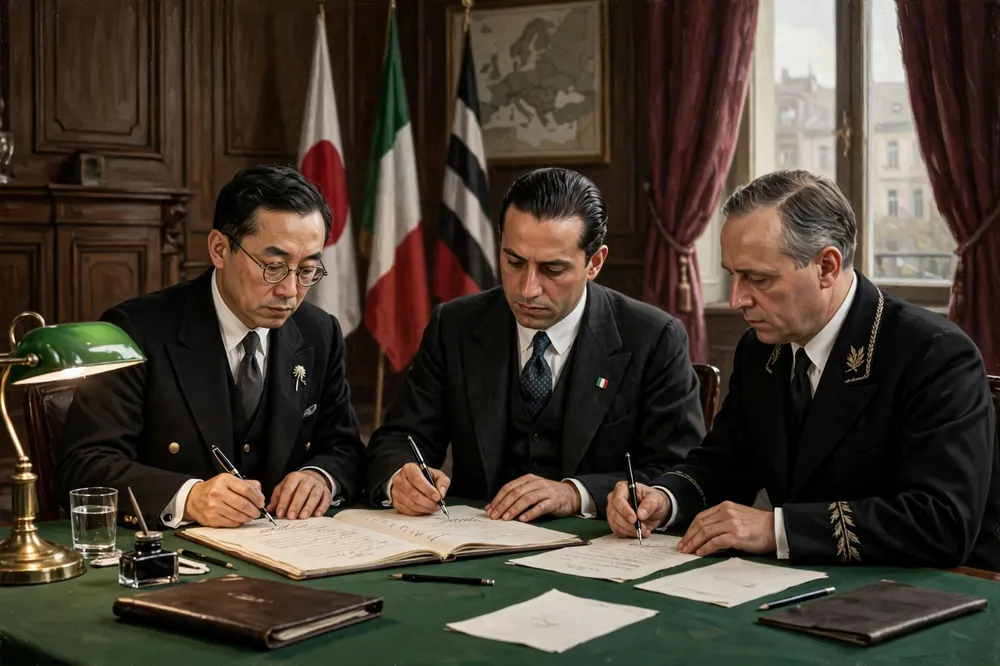
The second step was the Pact of Steel, signed by Germany and Italy on 22 May 1939. This was a full military alliance: each country promised to support the other with all its military forces if either went to war.
Mussolini signed it expecting a war in the early 1940s, not in 1939 — he told Hitler that Italy would not be ready for war until 1942 or 1943 — but when Germany invaded Poland in September 1939, Italy stayed neutral for nine months, joining the war only in June 1940, after France was already collapsing.
Japan, meanwhile, had signed a neutrality pact with the Soviet Union in April 1941, and it never declared war on the Soviet Union — a decision that allowed the Soviet Union to move its Siberian divisions west to defend Moscow in December 1941.
The Tripartite Pact of 27 September 1940 completed the alliance. Its most important clause was Article 3, which promised mutual assistance if any signatory was attacked by a power not yet involved in the European war or the Sino-Japanese conflict — meaning the United States. The pact was intended as a warning to Washington: if America entered the war against one Axis power, it would face all three.
In practice, the warning backfired: when Japan attacked Pearl Harbor in December 1941, Hitler declared war on the United States four days later, honouring a commitment the pact did not strictly require and bringing the world’s largest industrial power into the war against Germany.
The Axis also attracted smaller allies: Hungary, Romania, and Bulgaria joined the Tripartite Pact in 1940–1941, Slovakia and Croatia became German satellites, and Finland fought alongside Germany against the Soviet Union from 1941 to 1944 (though Finland always insisted it was a co-belligerent, not an Axis ally, and it never signed the Tripartite Pact).
4. Germany: The Dominant Partner
Germany was the dominant power of the Axis and the engine of its early victories. Under Adolf Hitler, who became Chancellor in January 1933 and Führer in 1934, Germany rearmed in defiance of the Treaty of Versailles, built the most powerful army in Europe, and pursued a foreign policy of expansion — Lebensraum, or “living space” — in Eastern Europe. Hitler’s ideology combined extreme nationalism, antisemitism, and the belief that the German “Aryan” race was destined to rule Europe. That ideology drove both the war and the Holocaust, the systematic murder of about six million Jews and millions of others.
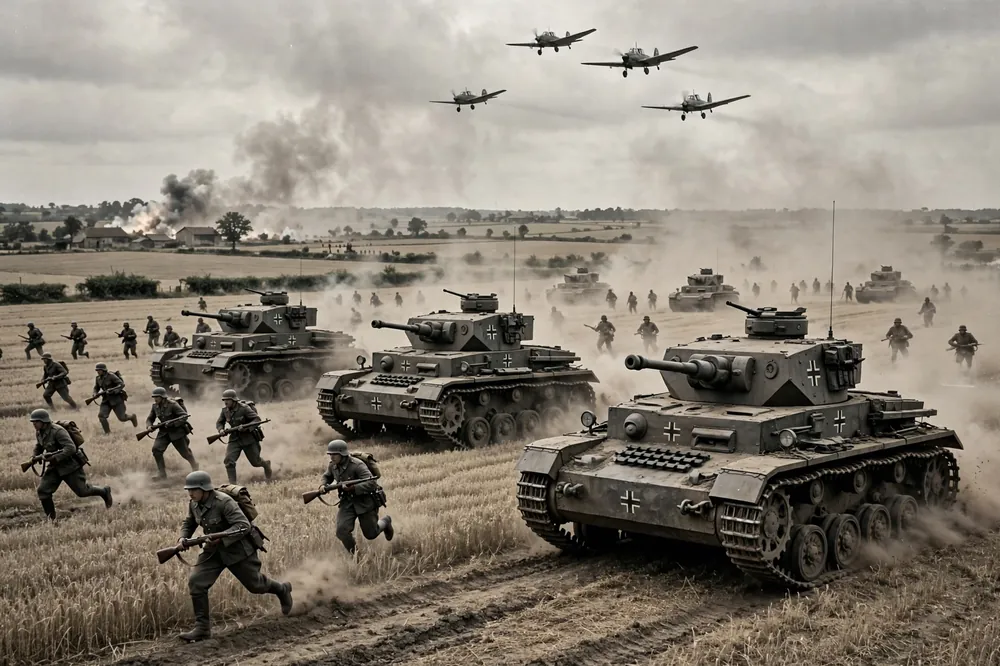
Germany’s military successes in 1939–1941 were extraordinary. The Wehrmacht conquered Poland in five weeks, Denmark and Norway in the spring of 1940, and France, Belgium, and the Netherlands in six weeks in May–June 1940. In the Balkans it overran Yugoslavia and Greece in the spring of 1941.
In June 1941 it launched Operation Barbarossa, the invasion of the Soviet Union, with about three million men — the largest invasion in history. By the end of 1941 Germany controlled most of continental Europe, from Norway to Greece and from France to the gates of Moscow.
But the invasion of the Soviet Union was also Germany’s fatal error: it opened a front that consumed the bulk of the German army for four years and ended in the destruction of the Third Reich.
Germany’s economy was the largest in Europe, but it was not large enough for the war Hitler wanted. Germany lacked oil, rubber, and many raw materials, and it depended on imports — above all on Romanian oil and on Soviet supplies under the Nazi–Soviet Pact of 1939–1941. Its war production, though impressive, was outmatched by the combined output of the Soviet Union, the United States, and Britain.
Germany produced about 100,000 tanks during the war and about 120,000 aircraft; the Soviet Union produced more than 100,000 tanks alone, and the United States produced about 300,000 aircraft. Germany’s greatest strength was tactical and operational: its generals and soldiers fought with great skill, and its Blitzkrieg — fast-moving combined-arms warfare — revolutionised military doctrine. But skill could not overcome the arithmetic of industrial war.
5. Italy and Japan
Italy was the weakest of the three major Axis powers, and its war was a catalogue of failures that repeatedly required German rescue. Mussolini had ruled Italy since 1922 as the founder of Fascism — the first of the great totalitarian movements of the 20th century — and he dreamed of a new Roman Empire in the Mediterranean.
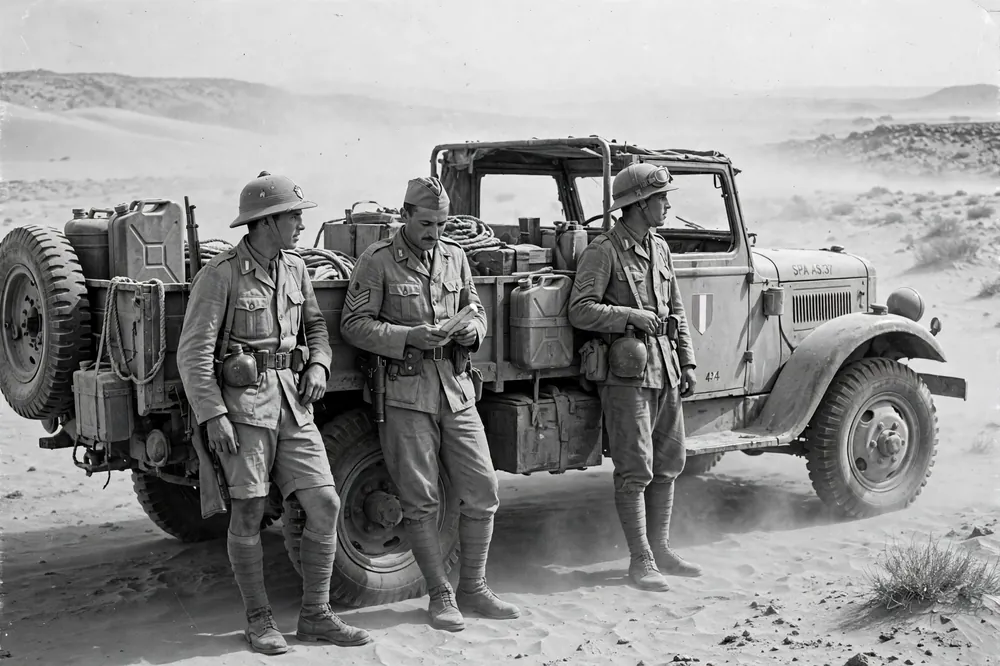
Italy invaded Ethiopia in 1935 and Albania in 1939, and it joined World War II in June 1940, expecting a short war and easy gains. Instead, Italian forces were defeated in Greece in 1940–1941 (they had to be rescued by Germany), driven out of Libya by the British, and humiliated in East Africa.
Italian industry was small — it produced only a fraction of Germany’s steel and coal — and its armed forces were poorly equipped, poorly led, and often poorly motivated. In July 1943, after the Allied invasion of Sicily, Mussolini was overthrown and arrested; Italy signed an armistice in September 1943 and joined the Allies, while German forces occupied northern Italy and fought on until 1945.
Mussolini, freed by German commandos, led a puppet state in the north until he was captured and executed by partisans in April 1945.
Japan was a very different partner: a formidable military power with the world’s third-largest navy and a modern army, but an economy far smaller than America’s and dependent on imported oil. Japan had been at war in China since 1937, and its leaders believed that survival required an empire in Southeast Asia — the Greater East Asia Co-Prosperity Sphere — that would supply oil, rubber, tin, and rice.
In July 1941 the United States imposed an oil embargo that cut off almost all of Japan’s oil imports; Japanese leaders calculated that their reserves would last less than two years. The decision to attack Pearl Harbor on 7 December 1941 was a gamble: a surprise strike would destroy the American Pacific Fleet and buy Japan time to seize the resource-rich south. The gamble failed.
The carriers were not at Pearl Harbor, the United States mobilised its enormous industry, and within six months Japan had lost four of its six fleet carriers at Midway. Japan fought on for three more years with great tenacity, but it could not replace its ships, aircraft, or trained pilots, and its merchant fleet was destroyed by American submarines.
Japan surrendered in September 1945 after the atomic bombings and the Soviet invasion of Manchuria.
6. The Axis at Its Peak
At the end of 1941 and in the first half of 1942, the Axis stood at the height of its power. In Europe, Germany controlled France, the Low Countries, Denmark, Norway, Poland, Czechoslovakia, Austria, Yugoslavia, Greece, and large parts of the Soviet Union; its allies and satellites controlled Hungary, Romania, Bulgaria, Slovakia, Croatia, and Finland; and only Britain, Sweden, Switzerland, Spain, Portugal, and Turkey remained outside Axis control.
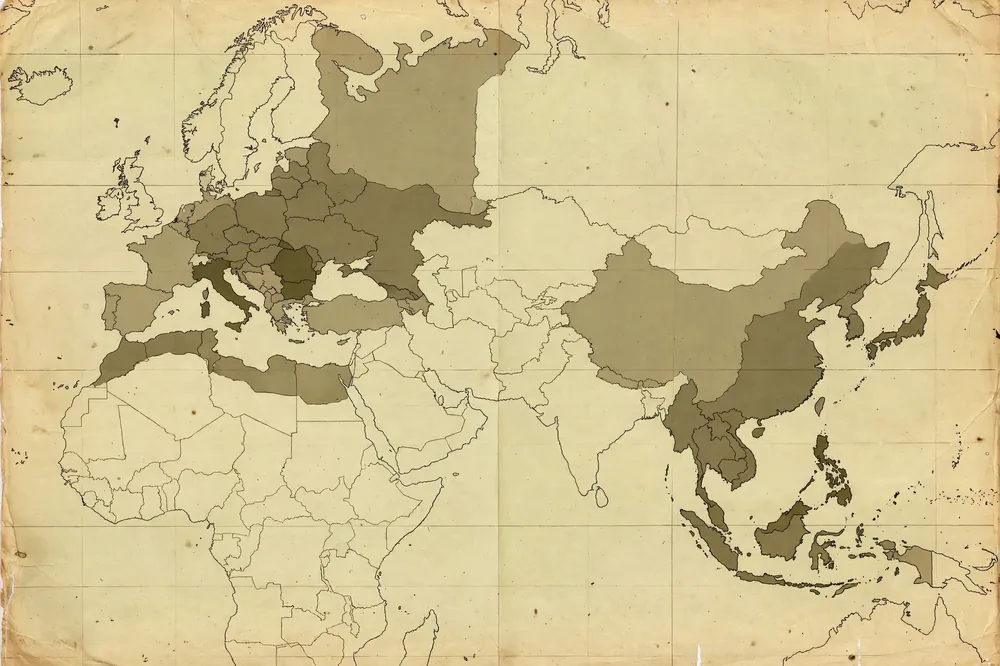
In North Africa, Rommel’s Afrika Korps had advanced to El Alamein in Egypt, 60 miles from Alexandria. In Asia, Japan controlled Manchuria, much of China, Indochina, Thailand, Burma, Malaya, Singapore, the Philippines, the Dutch East Indies, and a chain of Pacific islands stretching to the edge of Australia.
The Axis controlled more territory, more people, and more resources than it had ever controlled before — and more than it could defend.
The peak was also the turning point. In 1942 the Axis suffered three great defeats that reversed the course of the war: Midway in June, where Japan lost four fleet carriers; El Alamein in October–November, where the British defeated Rommel; and Stalingrad, where the Soviet Union destroyed the German Sixth Army between November 1942 and February 1943. After 1942 the Axis never again won a major campaign.
The reasons were structural: the Axis had conquered too much, too fast, and its supply lines were overstretched; its economies could not match the Allies’ production; and its members were fighting separate wars — Germany in Russia, Japan in the Pacific, Italy in the Mediterranean — without a common strategy.
The Allies, by contrast, coordinated their strategy at conferences in Casablanca, Tehran, and Yalta, pooled their resources through Lend-Lease, and concentrated their forces where they mattered most.
The Axis also suffered from a fatal political weakness: the peoples it conquered hated it. Resistance movements sprang up across occupied Europe — in Yugoslavia, Greece, France, Poland, and the Soviet Union — tying down German divisions that were desperately needed at the front. In Asia, Japan’s brutal occupation policies, including the Nanjing Massacre and the forced labour of millions, turned the peoples of China and Southeast Asia against it and fuelled guerrilla wars that consumed Japanese troops. The Axis empires were built on coercion, and coercion required soldiers to enforce it — soldiers the Axis could not spare.
7. Why the Axis Lost
The Axis lost for several interconnected reasons. The first was industrial inferiority. In 1942 the combined industrial output of the Allies already exceeded that of the Axis, and the gap grew every year. The United States alone produced about 300,000 aircraft during the war, more than Germany and Japan combined; the Soviet Union produced more than 100,000 tanks. The Axis could win battles, but it could not replace its losses. Japan, which began the war with six fleet carriers, built only a handful more; the United States built more than 100 carriers of all types during the war. Germany’s U-boats sank millions of tons of Allied shipping, but American shipyards built ships faster than the U-boats could sink them.
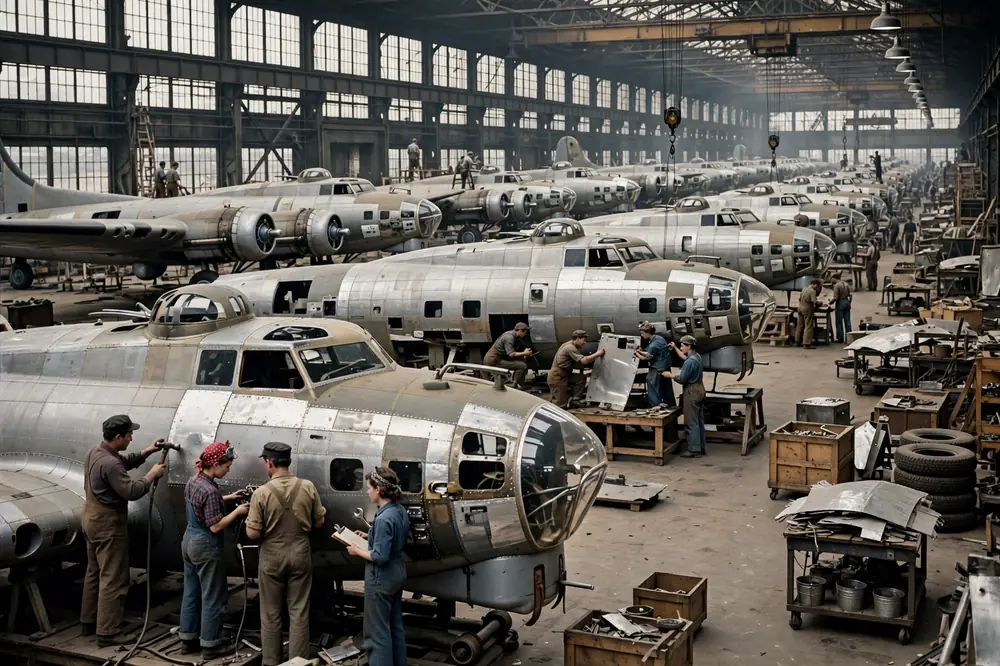
The second reason was strategic overreach. Germany fought a two-front war from June 1941, the situation its generals had feared since World War I. Japan fought across an empire stretching thousands of miles, with supply lines that American submarines systematically destroyed. Italy fought in the Balkans, North Africa, and the Soviet Union simultaneously, with an economy that could not support even one of those campaigns. The Axis powers never developed a joint strategy: Germany and Japan never coordinated their operations against the Soviet Union, and Japan never attacked the Soviet Union from the east while Germany attacked from the west — the one combination that might have changed the outcome.
The third reason was the nature of the regimes themselves. The Axis states were dictatorships that suppressed dissent, persecuted minorities, and murdered millions of their own subjects and of the peoples they conquered. The Holocaust consumed railway capacity, administrative effort, and manpower that Germany needed for the war, and it turned the peoples of occupied Europe into enemies. Japan’s atrocities in China and Southeast Asia did the same. The Axis regimes could command obedience, but they could not inspire loyalty — and in a long war, loyalty matters. The Allies, for all their flaws, offered the peoples they liberated a better future; the Axis offered them subjugation or death.
8. Defeat and Surrender
The Axis collapsed in stages. Italy was the first to fall. After the Allied invasion of Sicily in July 1943, Mussolini was overthrown and arrested on 25 July 1943. The new Italian government signed an armistice on 3 September 1943 (announced on 8 September), and Italy declared war on Germany in October 1943. German forces occupied northern and central Italy and fought a slow, grinding campaign against the Allies up the Italian peninsula until the final surrender in Italy on 2 May 1945. Mussolini, installed by Germany as head of a puppet state, was captured by partisans and executed on 28 April 1945.
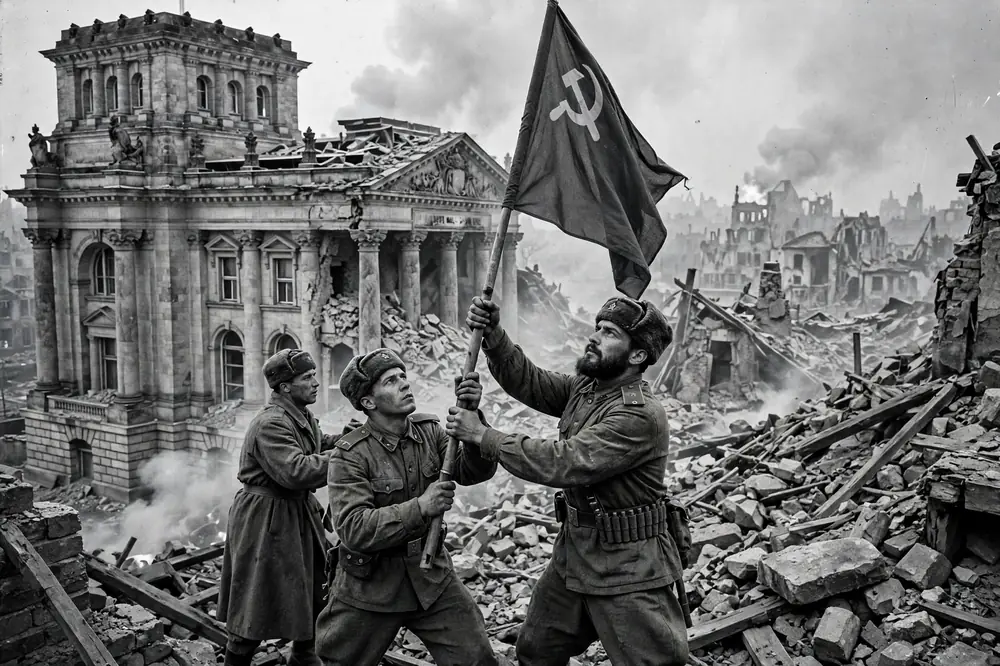
Germany was the second to fall. By early 1945 Soviet armies were advancing from the east and American and British armies from the west. Berlin was encircled in April 1945, and Hitler killed himself in his bunker on 30 April 1945. Germany signed an unconditional surrender at Reims on 7 May 1945 and again in Berlin on 8 May 1945 — VE Day. The Third Reich, which Hitler had promised would last a thousand years, had lasted twelve.
Japan was the last to surrender. After the fall of Okinawa in June 1945, American bombers devastated the Japanese home islands, and American submarines had cut Japan off from food and fuel. On 6 August 1945 the United States dropped an atomic bomb on Hiroshima, and on 9 August a second bomb on Nagasaki; on 8–9 August the Soviet Union declared war on Japan and invaded Manchuria. Emperor Hirohito announced Japan’s surrender in a radio broadcast on 15 August 1945, and the formal surrender was signed aboard USS Missouri in Tokyo Bay on 2 September 1945. World War II was over, and the Axis was finished.
9. War Crimes and the Trials
The defeat of the Axis led to the first international war crimes trials in history. At Nuremberg, Germany, from November 1945 to October 1946, 22 leading Nazi officials were tried by an international tribunal for crimes against peace, war crimes, and crimes against humanity. Twelve were sentenced to death, including Hermann Göring (who killed himself before the sentence could be carried out), Joachim von Ribbentrop, and Wilhelm Keitel; others received prison sentences. The Nuremberg Trials established the principle that individuals, including heads of state, can be held responsible for aggressive war and for crimes against humanity — and that “I was only following orders” is not a defence.
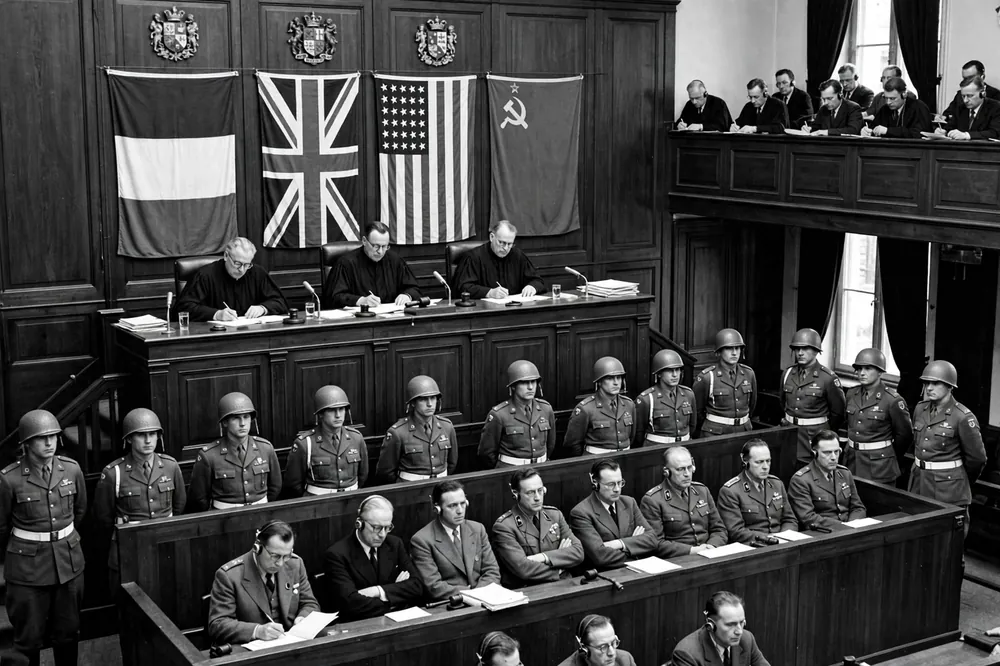
At Tokyo, from 1946 to 1948, the International Military Tribunal for the Far East tried 28 Japanese leaders, including former Prime Minister Hideki Tojo, who was sentenced to death and executed in December 1948. The Tokyo Trials were more controversial than Nuremberg — Emperor Hirohito was not tried, and critics argued that the proceedings reflected victors’ justice — but they established the same principles for Asia.
The trials also documented the crimes of the Axis in detail: the Holocaust, in which about six million Jews were murdered; the murder of about 3.3 million Soviet prisoners of war; the Nanjing Massacre, in which Japanese forces killed an estimated 200,000 to 300,000 people; the use of forced labour and the abuse of prisoners of war; and the medical experiments carried out by Unit 731 in Manchuria.
The trials did not punish everyone responsible — many perpetrators escaped, and the Cold War soon made further prosecutions politically inconvenient — but they created a permanent record and a legal precedent. The principles of Nuremberg were adopted by the United Nations in 1946 and later embodied in the Geneva Conventions of 1949 and the Rome Statute of 1998, which created the International Criminal Court. The idea that aggressive war is a crime, and that those who order it can be tried for it, was born from the defeat of the Axis.
10. Legacy
The legacy of the Axis is the legacy of the war it caused. Germany, Italy, and Japan were occupied, disarmed, and rebuilt as democracies — a deliberate contrast with the punitive peace of Versailles after World War I. West Germany and Japan became economic powerhouses and close allies of the United States; Italy became a founding member of the European Economic Community. The division of Germany into East and West, and the division of Europe by the Iron Curtain, were direct consequences of the war the Axis had started. The United Nations, the Geneva Conventions, and the modern system of international law were all created in response to the crimes of the Axis.
The Axis also left a warning that remains relevant: that aggressive alliances of authoritarian states can achieve rapid success, that democratic states can be slow to respond, and that the price of stopping aggression late is far higher than the price of stopping it early. The failure of the League of Nations and the appeasement of the 1930s are still cited in debates about how to respond to aggression today. The Axis Powers are remembered not as a model of alliance but as a caution — of what happens when states that reject the existing order join together to overturn it by force, and of what it costs the world to put that order back together.
Frequently Asked Questions
Related articles
Sources
- Encyclopædia Britannica, “Axis Powers” and “Tripartite Pact” — membership, dates and terms.
- Wikipedia, “Axis powers” — formation, members, production figures and surrender dates, cross-checked against scholarly sources.
- Richard Overy, Why the Allies Won (W. W. Norton, 1995) — the industrial balance and the reasons for the Axis defeat.
- Gerhard L. Weinberg, A World at Arms: A Global History of World War II (Cambridge University Press, 1994).
- Ian Kershaw, Hitler 1936–1945: Nemesis (W. W. Norton, 2000) — Hitler’s decisions and the German war effort.
- United States Holocaust Memorial Museum (ushmm.org) — the Holocaust and Nazi crimes.
- National WWII Museum (nationalww2museum.org) — the Tripartite Pact and the course of the war.
- Antony Beevor, The Second World War (Weidenfeld & Nicolson, 2012).
- Max Hastings, Inferno: The World at War, 1939–1945 (Alfred A. Knopf, 2011).