 WAR ATLAS MILITARY HISTORY MAGAZINE · WWI — WWII
Central Powers
1. Lead
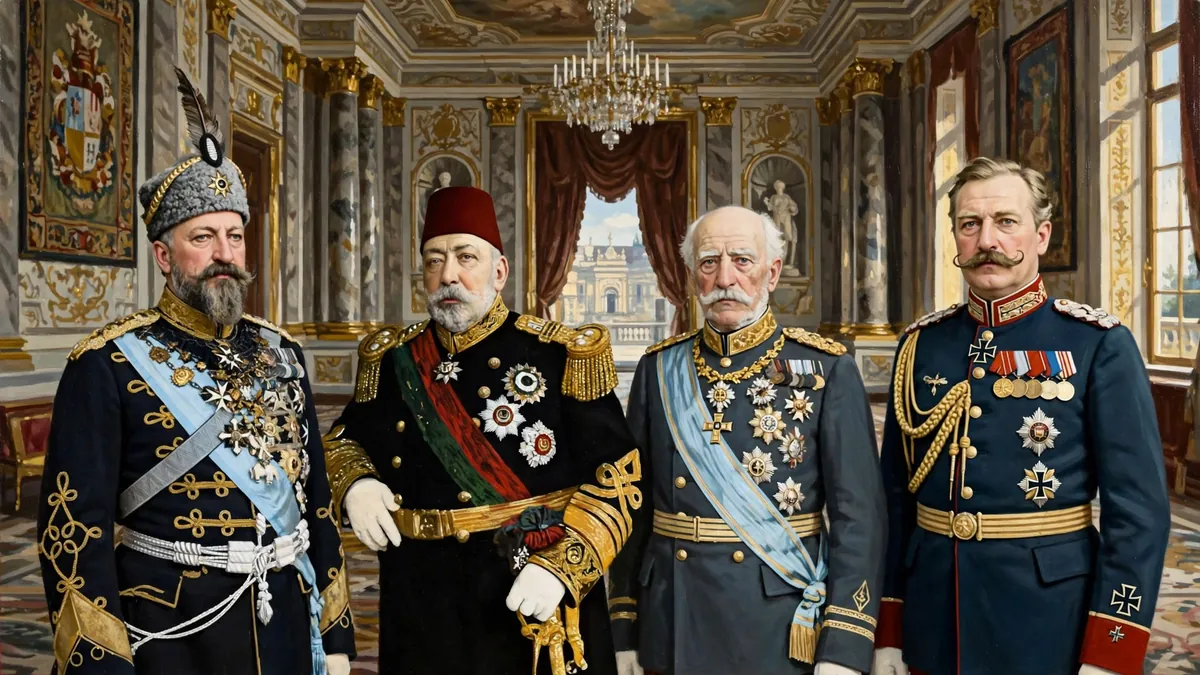
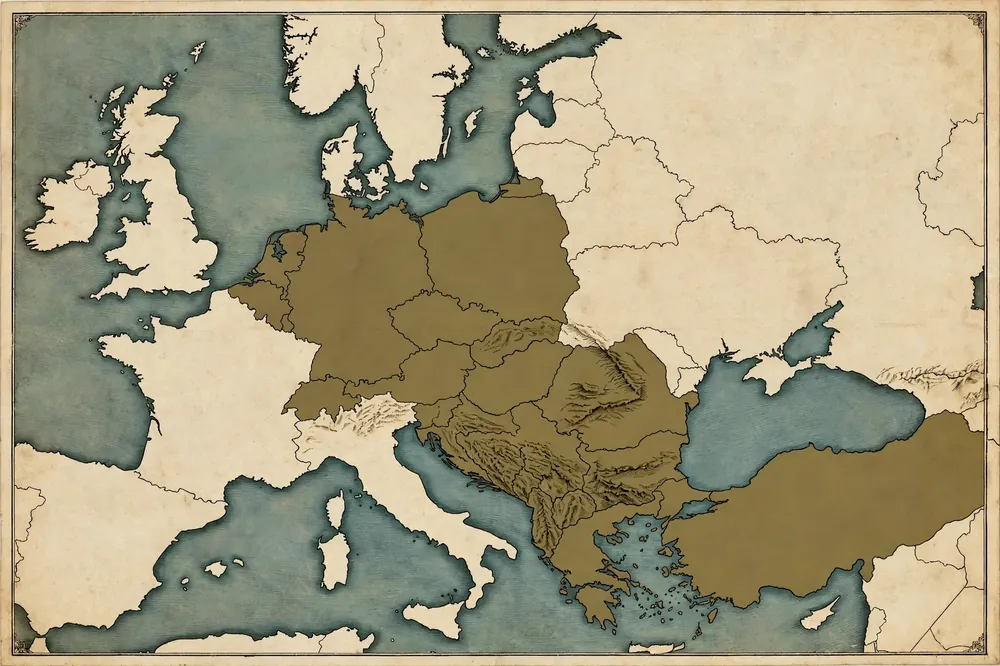
The Central Powers were the coalition of states that fought against the Allies in the First World War: the German Empire and Austria-Hungary, the two partners of the Triple Alliance that had gone to war in 1914, joined by the Ottoman Empire in October–November 1914 and by the Kingdom of Bulgaria in October 1915.
The name came from their geography — they occupied the centre of Europe, between the Allies in the west (France and Britain) and the Allies in the east (Russia), with the Ottoman Empire guarding the straits to the south. At their height, the Central Powers fielded some of the most formidable armies in the world: the German army, the best-trained and best-equipped in Europe; the Austro-Hungarian army, large but riven by national divisions; the Ottoman army, resilient and well-led in defence; and the Bulgarian army, small but tough and effective in the Balkans.
Together they held off enemies on every side for four years. In the autumn of 1918, within six weeks, the coalition collapsed: Bulgaria asked for an armistice on 29 September, the Ottoman Empire on 30 October, Austria-Hungary on 3 November, and Germany on 11 November.
The Central Powers were an alliance of unequals, held together less by common purpose than by common enemies and by German power. Germany was by far the strongest member, and by 1916 it had effectively taken command of the coalition’s war effort: German generals directed Austro-Hungarian operations on the Eastern Front, German officers stiffened the Ottoman and Bulgarian armies, and German industry supplied the allies with arms, money and coal.
Austria-Hungary, the power that had started the war, became increasingly dependent on Berlin, and by 1918 it was, in the words of one historian, a “satellite” of Germany. The Ottoman Empire fought its own war, largely on its own fronts, and pursued its own aims in the Caucasus and the Middle East. Bulgaria fought for one thing only: the recovery of Macedonia, lost in the Second Balkan War of 1913.
The coalition’s story is therefore not a single story but four stories, bound together by a war that each member understood differently — and that, in the end, destroyed all four of them. The German, Austro-Hungarian, Ottoman and Bulgarian monarchies all fell in 1918, and none of the four empires that had gone to war in 1914 survived it in its old form.
2. Key Facts
| Members | German Empire, Austria-Hungary, Ottoman Empire, Kingdom of Bulgaria |
| Also called | The Quadruple Alliance (after Bulgaria joined in 1915) |
| Germany enters war | 1 August 1914 (declares war on Russia); 3 August (on France) |
| Austria-Hungary enters war | 28 July 1914 (declares war on Serbia) |
| Ottoman Empire joins | 29 October 1914 (naval attack on Russia); formal declarations early November 1914 |
| Bulgaria joins | 14 October 1915 (declares war on Serbia) |
| Total population (1914) | About 150 million (Germany ~68 million, Austria-Hungary ~53 million, Ottoman Empire ~21 million, Bulgaria ~5 million) |
| Total military deaths | Roughly 4 million (Germany ~2 million, Austria-Hungary ~1.2 million, Ottoman Empire ~770,000, Bulgaria ~90,000; figures vary by source) |
| Collapse | Bulgaria 29 September 1918; Ottoman Empire 30 October 1918; Austria-Hungary 3 November 1918; Germany 11 November 1918 |
| Peace treaties | Versailles (Germany, 1919), Saint-Germain (Austria, 1919), Trianon (Hungary, 1920), Neuilly (Bulgaria, 1919), Sèvres (Ottoman, 1920, superseded by Lausanne, 1923) |
3. How the Coalition Was Formed
The Central Powers were not created by a single treaty. They were assembled, one by one, in the first fifteen months of the war, and each addition had its own logic. The core was the Dual Alliance of 1879 between Germany and Austria-Hungary, the foundation of the Triple Alliance of 1882.
When Austria-Hungary declared war on Serbia on 28 July 1914, Germany was bound by the Dual Alliance to support Vienna if Russia intervened — and Russia, as the protector of Serbia, did intervene. Germany declared war on Russia on 1 August and on France on 3 August, and invaded Belgium on 4 August, bringing Britain into the war.
Italy, the third member of the Triple Alliance, declared its neutrality on 3 August, arguing that the Alliance was defensive and that Austria-Hungary was the aggressor. The Triple Alliance had thus become, in effect, a Dual Alliance again — and it would remain so until the Ottoman Empire joined in the autumn.
The Ottoman Empire’s entry was the result of a secret alliance signed on 2 August 1914, two days before Britain declared war on Germany. The Ottoman government — dominated since 1913 by the Young Turk triumvirate of Enver Pasha, Talaat Pasha and Djemal Pasha — feared Russia above all: Russia had fought the Ottomans in twelve wars since the seventeenth century, and the Young Turks believed that the Entente intended to partition the Ottoman Empire when the war was over.
Germany offered what the Ottomans needed: money, arms, and a guarantee against Russia. In return, the Ottomans promised to enter the war. The formal entry was engineered by the German admiral Wilhelm Souchon, commander of the two German warships — the battlecruiser Goeben and the light cruiser Breslau — that had escaped the British and French fleets in the Mediterranean in August 1914 and taken refuge in Constantinople.
On 29 October, Souchon, flying the Ottoman flag but under German orders, led the Ottoman fleet in a bombardment of Russian Black Sea ports. Russia declared war on 2 November, and Britain and France followed on 5 November. The Ottoman Empire was at war.
Bulgaria’s entry, a year later, was the result of a bidding war between the two sides. Bulgaria had been the loser of the Second Balkan War of 1913, in which it had lost Macedonia to Serbia and Greece and southern Dobruja to Romania.
King Ferdinand and his prime minister, Vasil Radoslavov, were determined to recover Macedonia, and both sides offered it to them: the Allies offered Macedonia if Bulgaria would join them, but they could not deliver it, because Serbia — their ally — refused to give it up.
The Central Powers offered it without qualification, and they offered something else as well: money, arms, and the support of German and Austro-Hungarian troops for the campaign against Serbia. On 6 September 1915, Bulgaria signed a secret treaty with Germany and Austria-Hungary, and on 14 October it declared war on Serbia.
The coalition was complete: four powers, fighting on four fronts, against an alliance that would eventually number more than twenty states.
4. Germany: The Engine of the Coalition
Germany was the Central Powers’ centre of gravity — its largest army, its largest economy, its most advanced industry, and, from 1916, its effective high command. The German war plan, the Schlieffen Plan, had been designed for a short war: a rapid victory over France in the west, by a great wheeling movement through Belgium, followed by a turn east to deal with Russia.
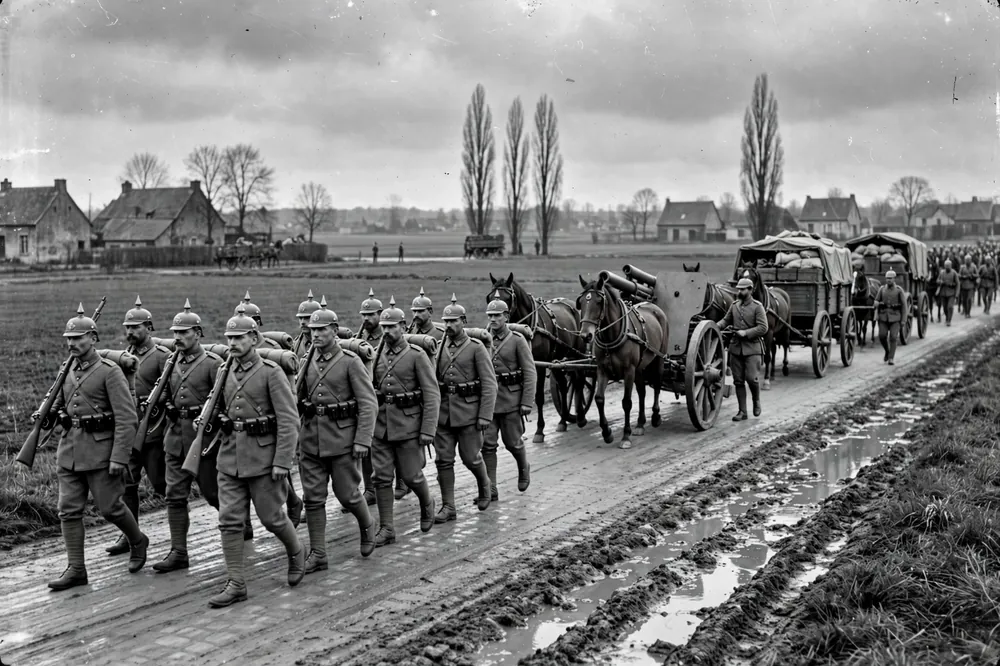
The plan failed at the Battle of the Marne in September 1914, and Germany found itself in the two-front war it had feared, fighting a war of attrition on the Western Front and a war of movement on the Eastern Front.
The German army adapted: on the Western Front it built the most formidable defensive system in military history, and held it against every Allied attack; on the Eastern Front, under Hindenburg and Ludendorff, it won the greatest victories of the war — Tannenberg in August 1914, the Gorlice–Tarnów offensive of May 1915, which drove the Russians out of Poland, and the campaigns of 1916–17 that carried German troops to the gates of Riga and into Romania.
Germany’s war was also an economic and social war, and it was here that the coalition’s weaknesses began to show. Britain’s naval blockade cut Germany off from overseas food and raw materials, and by 1916 the German people were hungry: the “turnip winter” of 1916–17, when the potato crop failed and turnips became the staple food, killed hundreds of thousands of civilians from malnutrition and disease — the exact number is disputed, with estimates commonly ranging from several hundred thousand.
The German government responded with the Hindenburg Programme of 1916, an attempt to mobilise the whole economy for war under the direction of the military, and with unrestricted submarine warfare, resumed in February 1917 in a gamble to starve Britain before American power could arrive.
The gamble failed: the submarine campaign brought the United States into the war in April 1917, and the American declaration of war sealed the coalition’s fate, even though American troops would not reach the front in large numbers until 1918.
By 1916, Germany had also taken effective command of the coalition. The Supreme War Council, created in 1916, was dominated by the German high command — the OHL, under Hindenburg and Ludendorff, who from August 1916 were effectively the rulers of Germany, with the Kaiser a figurehead.
German officers were attached to the Austro-Hungarian, Ottoman and Bulgarian armies; German money financed the allies’ war efforts; and German troops were sent wherever the front was in danger — to Serbia in 1915, to Romania in 1916, to Italy after Caporetto in 1917, to Palestine and Mesopotamia in support of the Ottomans.
The arrangement kept the coalition fighting, but it also bred resentment: the Austrians resented being treated as subordinates, the Ottomans resented German interference in their affairs, and the Bulgarians resented being used as auxiliaries in campaigns that served German, not Bulgarian, interests. The coalition held together as long as it was winning, or at least not losing. When it began to lose, in the summer of 1918, it fell apart.
5. Austria-Hungary: The Power That Started the War
Austria-Hungary was the power that had started the war, and it was the power least able to fight it. The Dual Monarchy — the Austrian Empire and the Kingdom of Hungary, joined under a single emperor since the Compromise of 1867 — was a multinational state of some 53 million people, of whom only about 44 per cent were German-speakers or Hungarians; the rest were Czechs, Slovaks, Poles, Ukrainians, Romanians, Serbs, Croats, Slovenes, Bosnians and Italians.
The army reflected that diversity: its regiments were organised by nationality, its officers gave orders in German, and its soldiers often did not understand each other. The Monarchy’s war aims were defensive — to crush Serbia, to hold its empire together, and to survive — but the war itself accelerated the forces that were pulling it apart.
The Austro-Hungarian war began in disaster. The army’s chief of staff, Conrad von Hötzendorf, launched simultaneous offensives against Serbia and Russia in the summer of 1914, and both failed: the Serbian campaign ended in a humiliating retreat, with the army driven out of Serbia by December 1914, and the Russian campaign ended in the loss of Galicia and the great fortress of Przemyśl, which fell in March 1915 after a siege of six months.
The Monarchy lost over a million men in the first year of the war — dead, wounded and prisoners — and it never recovered. From 1915 onwards, the Austro-Hungarian army could only operate with German help: German troops and German generals were needed for every major offensive, from the Gorlice–Tarnów breakthrough of 1915 to the conquest of Serbia later that year, the conquest of Romania in 1916, and the victory at Caporetto in 1917, which drove the Italian army back to the Piave.
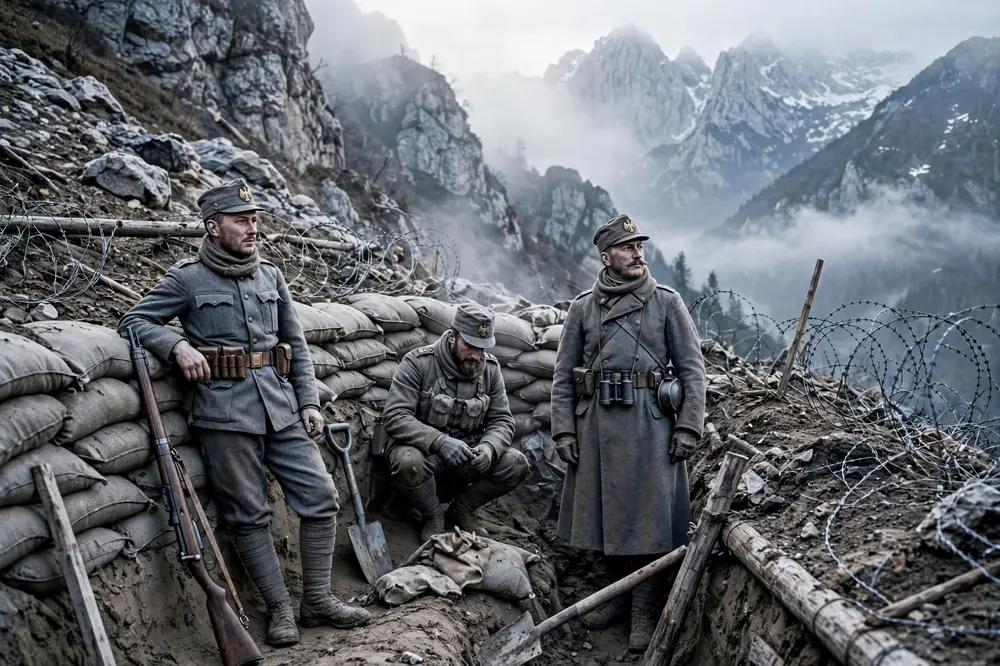
The one front where Austria-Hungary fought alone was the Italian Front, in the Alps and on the Isonzo, where eleven battles were fought along the Isonzo river between 1915 and 1917 — and where, in the end, the Monarchy’s army held, at terrible cost, until the final collapse.
At home, the Monarchy was dying. Food shortages, caused by the Allied blockade and by the breakdown of transport, hit the cities hardest: Vienna, which had a population of two million, was hungry by 1916 and starving by 1918. The nationalities, promised autonomy and reform, grew restless: the Czechs, Slovaks, Poles, South Slavs and Romanians all looked to the Allies and to President Wilson’s Fourteen Points for the promise of self-determination.
Emperor Franz Joseph died in November 1916, after sixty-eight years on the throne, and his successor, the young Charles I, tried to make a separate peace with the Allies in 1917 — the Sixtus Affair — and failed, leaving Austria-Hungary more dependent on Germany than ever.
By the summer of 1918, the army was disintegrating: soldiers deserted in large numbers, national committees proclaimed independence, and on 28 October 1918, Czechoslovakia declared its independence, followed by the State of Slovenes, Croats and Serbs the next day. On 3 November, Austria-Hungary signed the Armistice of Villa Giusti. On 11 November, Charles renounced participation in state affairs; the empire had ceased to exist.
6. The Ottoman Empire and Bulgaria
The Ottoman Empire fought the longest and, in some ways, the most remarkable war of any of the Central Powers. Its armies held the Dardanelles against the great Allied naval and land assault at Gallipoli in 1915–16, inflicting a humiliating defeat on Britain and France; they held Kut in Mesopotamia in 1916, capturing a British army; and they held Palestine and Syria for three years before being driven back by the British under Allenby in 1917–18.
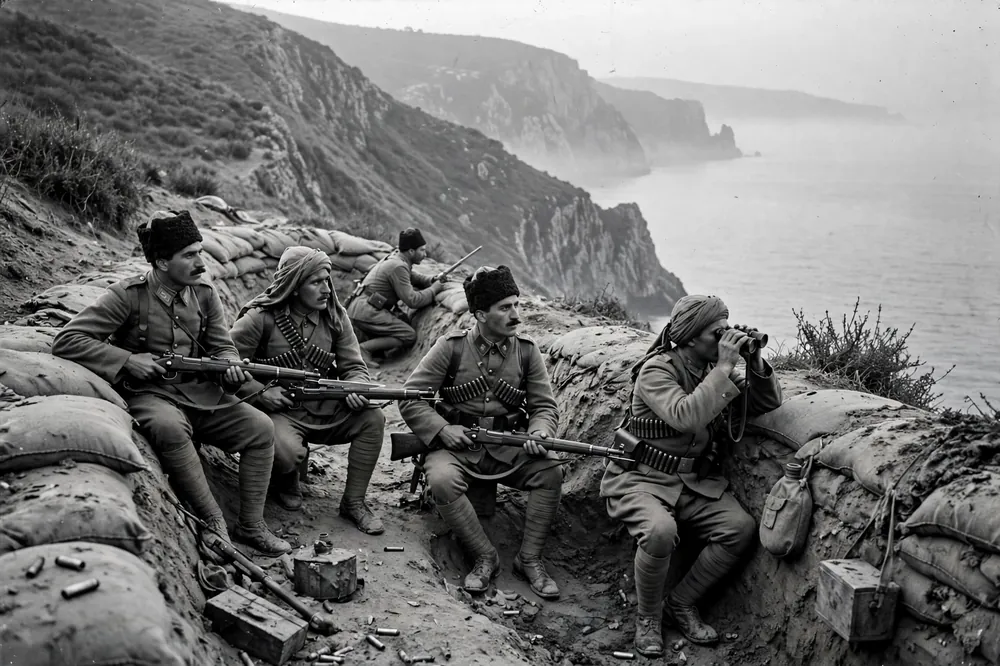
The Ottoman war was fought on five fronts — the Caucasus against Russia, the Dardanelles against Britain and France, Mesopotamia and Palestine against Britain, and the Sinai against Britain and the Arab Revolt — and it was fought with an army that was poorly equipped, poorly supplied and often poorly led, but that proved extraordinarily resilient in defence.
The empire’s war effort was directed, in practice, by Enver Pasha, the minister of war, and by the German military mission under Liman von Sanders, who commanded the defence of Gallipoli.
The Ottoman war also had a dark side that must be stated plainly. In 1915, the Ottoman government ordered the deportation of the Armenian population of eastern Anatolia, in the course of which — through massacre, starvation, disease and exposure on forced marches — very large numbers of Armenians died.
Historians’ estimates of the death toll vary widely, commonly from around 600,000 to 1.5 million, and the events are recognised as genocide by many governments and historians, while the government of Turkey disputes that characterisation. The deportations were presented by the Ottoman government as a security measure against Armenian support for Russia, but the scale and the systematic character of the killing, including the killing of Armenian men, women and children who posed no military threat, have led most historians outside Turkey to conclude that the intent was the destruction of the Armenian community in Anatolia.
The Armenian Genocide is the subject of a separate article on this site, and it is recorded here because no honest account of the Ottoman war can omit it. The Assyrian and Greek Christian communities of the empire also suffered large-scale killing and deportation in the same period.
Bulgaria’s war was smaller, shorter and more single-minded. The Bulgarian army, about 800,000 men at full mobilisation, was one of the best in the Balkans, and it played a decisive part in the conquest of Serbia in 1915 and in holding the Macedonian front against the Allied army at Salonika for three years.
Bulgaria’s war aim was Macedonia, and Bulgaria got it: the conquest of Serbia gave it the Vardar Macedonia it had lost in 1913, and the campaign against Romania in 1916 recovered southern Dobruja. But Bulgaria’s gains depended entirely on German support, and Bulgaria’s economy — poor, agrarian and dependent on food imports — could not sustain a long war.
By 1918, the Bulgarian army was starving, desertion was widespread, and the country was on the edge of revolution. On 14 September 1918, the Allies launched the Vardar Offensive from Salonika; within two weeks, the Bulgarian front collapsed, and on 29 September Bulgaria signed the Armistice of Salonika — the first of the Central Powers to leave the war.
The Bulgarian collapse opened the road to Austria-Hungary and to Germany, and it set off the chain reaction that destroyed the coalition.
7. The War Effort: Strengths and Weaknesses
The Central Powers’ greatest strength was the German army, and their greatest weakness was everything else. The German army of 1914 was the product of forty years of investment in training, staff work and industrial mobilisation, and it remained, until the last months of the war, the most effective fighting force in Europe.
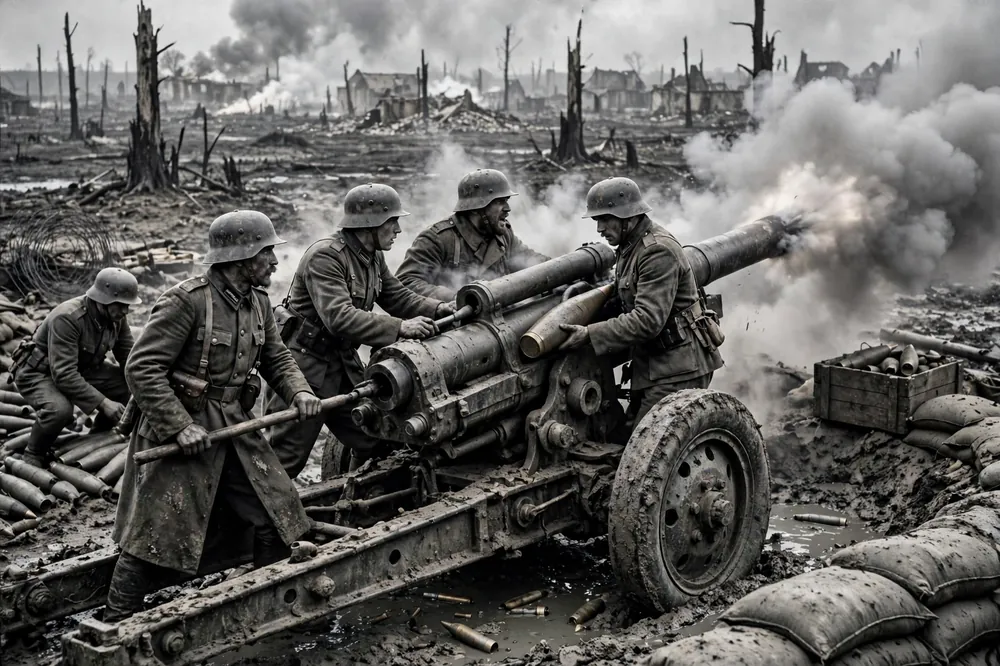
The German general staff system, the Auftragstaktik — the doctrine of mission command, in which subordinate commanders were given objectives and left to decide how to achieve them — and the German artillery and machine-gun tactics were widely copied by the Allies.
On the defensive, the German army was almost unbeatable: it held the Western Front for four years against attacks of ever-increasing scale, and it did so, for most of the war, with fewer men than the Allies. On the offensive, it won the greatest victories of the war on the Eastern Front and, in the spring of 1918, came closer to winning the war in the west than at any time since 1914.
The coalition’s weaknesses were structural. It was outnumbered and outproduced from the start: the Allies, even before the United States joined, had a larger combined population and a larger combined industrial output, and the British blockade ensured that the Central Powers could not make up the difference by importing food and raw materials.
The coalition was also divided by geography: its members were connected by land, but their communications were poor — the single railway line through the Balkans that linked Germany to Constantinople, opened only after the conquest of Serbia in 1915, was the coalition’s lifeline, and it was never enough.
And the coalition was divided by politics: each member had its own war aims, its own enemies and its own fears, and Germany — the only member strong enough to impose a common strategy — was unwilling to do so until it was too late, because imposing a common strategy would have meant taking responsibility for the allies’ failures as well as their own.
The coalition’s strategy, such as it was, was set by Germany, and it was a strategy of holding in the west and winning in the east. It worked, in the sense that Russia was knocked out of the war: the Treaty of Brest-Litovsk of March 1918, imposed on the Bolshevik government after its revolution, gave Germany control of Ukraine, the Baltic states and a vast stretch of Russian territory, and freed dozens of German divisions for the west.
But the strategy failed in the sense that mattered: the victory in the east came too late, the divisions freed from the east were not enough to win in the west, and the attempt to win in the west — the great spring offensives of 1918, the Kaiserschlacht — exhausted the German army without achieving a decision.
By the summer of 1918, the German army was spent, the Allies — reinforced by the Americans — were advancing on every front, and the coalition’s members were leaving, one by one.
8. Collapse: Six Weeks in the Autumn of 1918
The collapse of the Central Powers was the fastest collapse of a great coalition in modern history. It began in the Balkans. On 14 September 1918, the Allied Army of the Orient, under the French general Franchet d’Espèrey, launched the Vardar Offensive from Salonika, breaking through the Bulgarian lines at Dobro Pole.
Within two weeks the Bulgarian army was in full retreat, and on 29 September Bulgaria signed the Armistice of Salonika at the Allied headquarters. The armistice opened the road to the Danube and to Austria-Hungary, and it removed the last barrier between the Allies and Constantinople.
The Ottoman government, which had been negotiating for a separate peace for months, signed the Armistice of Mudros on 30 October, ending the Ottoman war. The Austro-Hungarian army, already disintegrating, collapsed on the Italian Front at Vittorio Veneto on 24 October–3 November, and the Monarchy signed the Armistice of Villa Giusti on 3 November.
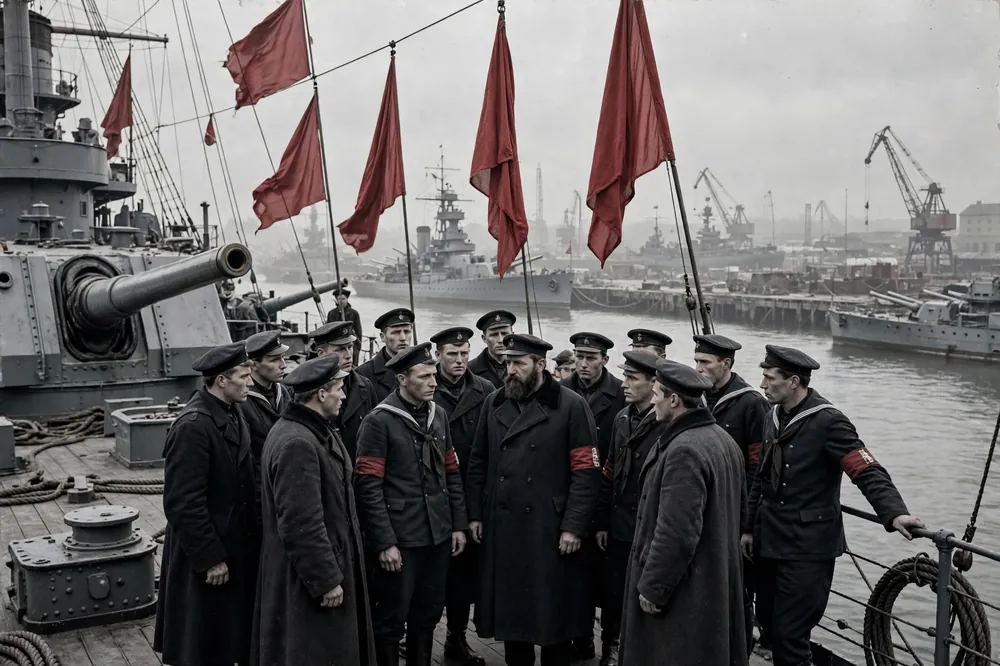
In Germany, the navy mutinied at Kiel on 3 November, revolution spread across the country, and on 9 November the Kaiser abdicated and fled to the Netherlands. On 11 November, at 11 a.m., the Armistice of Compiègne came into effect, and the war was over.
The speed of the collapse surprised everyone, including the Allies. The German army, which had seemed invincible on the defensive for four years, had been broken by the Hundred Days Offensive — the Allied counter-offensive that began at Amiens on 8 August 1918, the day Ludendorff called “the black day of the German army” — and by the collapse of its allies, which left its southern flank open and its supply lines threatened.
But the collapse was also political: the peoples of the Central Powers were starving, the soldiers were deserting, and the nationalities of Austria-Hungary were declaring independence faster than the Allies could recognise them. The war had been lost on the battlefield, but it had also been lost at home — in the bread queues of Vienna and Berlin, in the mutinies of the fleet at Kiel, and in the national committees of Prague, Zagreb and Warsaw.
9. Legacy: Four Empires Fall
The legacy of the Central Powers is written in the map of Europe and the Middle East that emerged from the peace settlements of 1919–23. The German Empire became the Weimar Republic, shorn of its colonies, of Alsace-Lorraine, of the Polish Corridor and of a tenth of its territory, and burdened with reparations and the “war guilt” clause of the Treaty of Versailles.
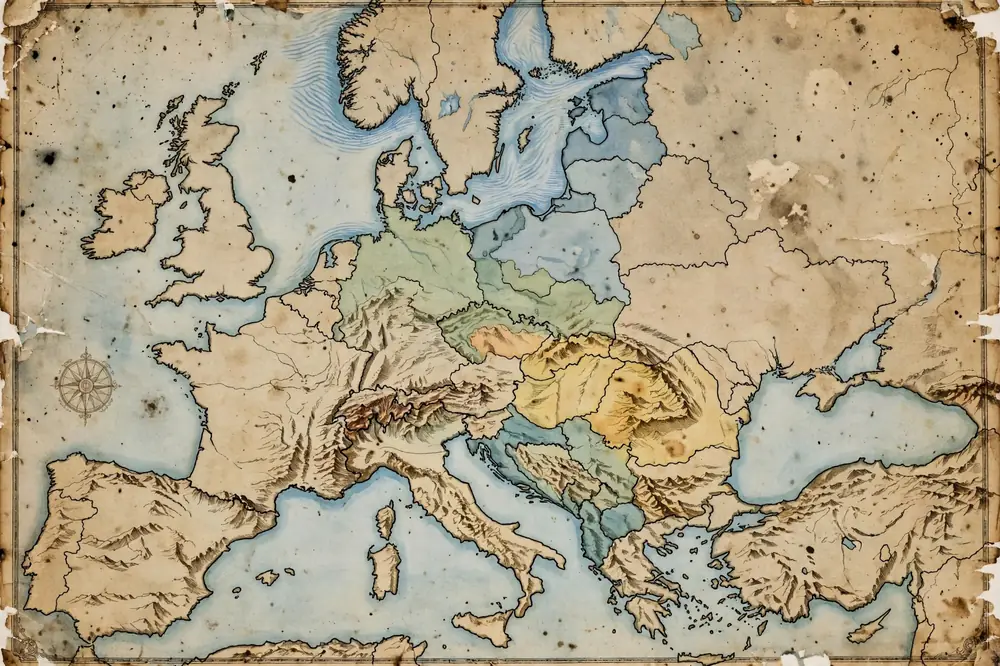
Austria-Hungary ceased to exist: Austria became a small republic, Hungary a truncated kingdom without a king, and the rest of the Monarchy became Czechoslovakia, Yugoslavia, Poland, Romania and Italy. The Ottoman Empire was partitioned: its Arab provinces became the mandates of Syria, Lebanon, Palestine, Transjordan and Iraq, and its Turkish heartland became the Republic of Turkey under Mustafa Kemal, after the War of Independence overturned the Treaty of Sèvres.
Bulgaria lost its Aegean coastline, southern Dobruja and parts of Macedonia, and became a small, embittered state that would seek revenge in the Second World War. Four empires had gone to war in 1914; none survived.
The human legacy was heavier still. The Central Powers lost roughly four million soldiers killed, and many millions more wounded, and their civilian populations suffered from hunger, disease and the influenza pandemic of 1918–19, which killed tens of millions worldwide.
The war’s end did not bring peace to the lands of the former Central Powers: revolution and civil war followed in Germany and Hungary, war between Greece and Turkey followed in Anatolia, and the new states of Eastern Europe fought each other over the borders the peace had drawn.
The bitterness of defeat — the sense, above all in Germany, that the army had not been defeated in the field but betrayed at home, the “stab-in-the-back” legend — became the central myth of German politics in the 1920s, and the seed of the National Socialist movement.
The Central Powers’ war had been fought, in the end, for nothing: the empires it was meant to save were destroyed by it, and the order it was meant to preserve was replaced by a new order that none of its leaders had foreseen.
There is also a strategic legacy. The First World War showed that a coalition of the centre — however strong its armies — could not prevail against a coalition that controlled the seas, the world’s industry and, eventually, the world’s largest economy. The lesson was not lost on the next generation of German leaders: in the Second World War, Germany would again fight a coalition of the centre against the sea powers, and again it would lose. The Central Powers remain, in military history, the classic example of a coalition that was tactically brilliant and strategically doomed — an alliance that could win battles on every front and still lose the war.
10. Key Figures
Wilhelm II (Germany). German Emperor and King of Prussia from 1888 to 1918. Wilhelm’s dismissal of Bismarck in 1890, his naval rivalry with Britain, and his support for Austria-Hungary in the July Crisis of 1914 all contributed to the war. During the war he became increasingly a figurehead, with real power passing to Hindenburg and Ludendorff. He abdicated on 9 November 1918 and lived in exile in the Netherlands until his death in 1941.
Paul von Hindenburg and Erich Ludendorff (Germany). The victors of Tannenberg (1914) and, from August 1916, the effective rulers of Germany as chief of the general staff and first quartermaster-general. Hindenburg became president of the Weimar Republic in 1925; Ludendorff became a leading figure of the German nationalist right and took part in the Beer Hall Putsch of 1923.
Franz Joseph I (Austria-Hungary). Emperor of Austria and King of Hungary from 1848 to 1916. Franz Joseph’s long reign saw the Monarchy’s slow decline, and his decision — with Conrad and Berchtold — to issue the ultimatum to Serbia in July 1914 was the act that began the war. He died in November 1916, before the Monarchy’s collapse.
Charles I (Austria-Hungary). Franz Joseph’s successor, emperor from 1916 to 1918. Charles tried to make a separate peace with the Allies in 1917 and failed. He renounced participation in state affairs on 11 November 1918, and the Monarchy dissolved.
Enver Pasha (Ottoman Empire). Minister of war and the dominant figure of the Young Turk government. Enver brought the Ottoman Empire into the war in 1914, commanded the disastrous Sarikamish campaign against Russia in the winter of 1914–15, and was one of the architects of the Armenian deportations of 1915. He fled the empire in 1918 and was killed in Central Asia in 1922.
Liman von Sanders (Germany/Ottoman Empire). The German general who commanded the Ottoman Fifth Army at Gallipoli in 1915 and later commanded the Ottoman forces in Palestine. His defence of Gallipoli was one of the great defensive victories of the war.
Ferdinand I (Bulgaria). King (later Tsar) of Bulgaria from 1887 to 1918. Ferdinand brought Bulgaria into the war in 1915 to recover Macedonia, and abdicated on 3 October 1918, days after Bulgaria’s armistice.
Frequently Asked Questions
Related articles
Sources
- Encyclopædia Britannica, “Central Powers” — the members, the formation of the coalition and its collapse.
- Wikipedia, “Central Powers” — dates of entry, population and casualty figures, and the armistices of 1918.
- Hew Strachan, The First World War, Volume I: To Arms (Oxford University Press, 2001) — the outbreak of the war and the formation of the coalition.
- David Stevenson, 1914–1918: The History of the First World War (Allen Lane, 2004) — the war as a whole, the German command of the coalition and the collapse of 1918.
- Sean McMeekin, The Ottoman Endgame: War, Revolution, and the Making of the Modern Middle East, 1908–1923 (Penguin, 2015) — the Ottoman war, Gallipoli and the Armenian deportations.
- Richard C. Hall, The Balkan Wars 1912–1913: Prelude to the First World War (Routledge, 2000) — Bulgaria’s aims and the road to its entry into the war.
- Norman Stone, The Eastern Front 1914–1917 (Hodder & Stoughton, 1975) — the German and Austro-Hungarian war in the east.
- Margaret MacMillan, The War That Ended Peace: The Road to 1914 (Random House, 2013).
- Christopher Clark, The Sleepwalkers: How Europe Went to War in 1914 (Harper, 2012).
- Ronald Grigor Suny, “They Can Live in the Desert but Nowhere Else”: A History of the Armenian Genocide (Princeton University Press, 2015).