 WAR ATLAS MILITARY HISTORY MAGAZINE · WWI — WWII
Western Front (World War I)
1. Lead
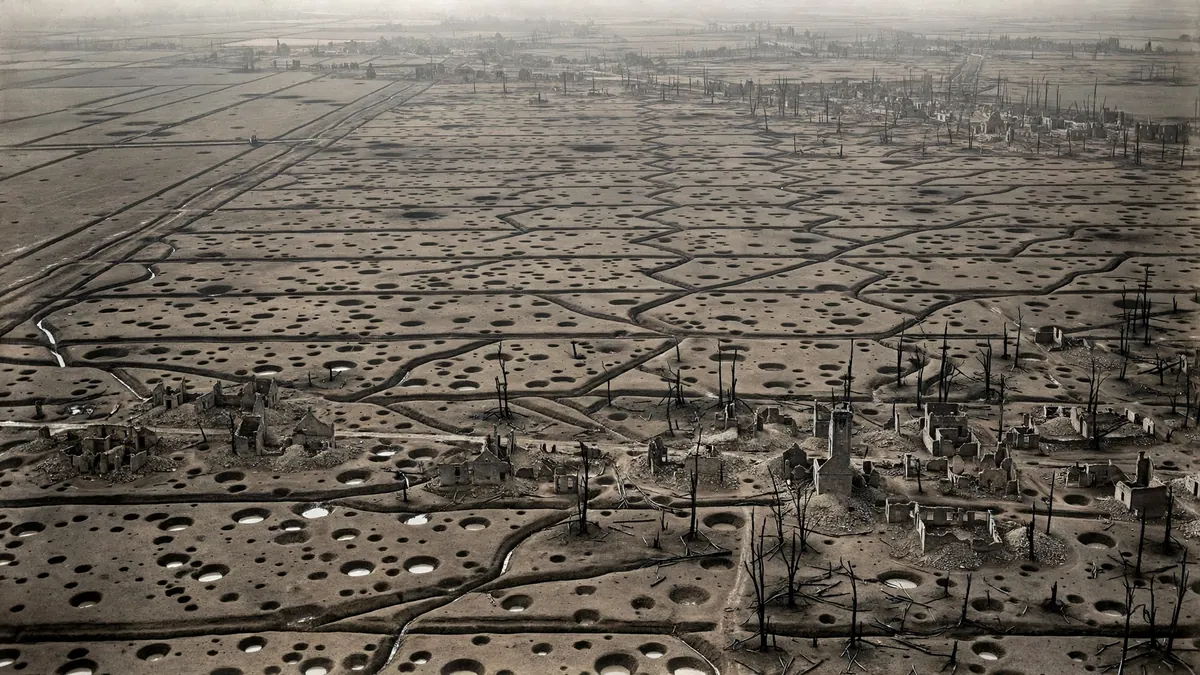
The Western Front was the main theatre of the First World War, the line of trenches and battlefields that ran for some 700 kilometres from the North Sea coast of Belgium, through northern France, to the Swiss border. It was here, between August 1914 and November 1918, that the German army faced the armies of France and the British Empire — and, from 1917, the United States — in the war’s decisive struggle.
The Western Front began as a war of movement, with the German invasion of Belgium and France in August 1914 and the Allied counter-attack at the Battle of the Marne in September. By the end of 1914 it had become a war of trenches: two lines of fortified earthworks, separated by a strip of shattered ground called No Man’s Land, that barely moved for three years, while millions of men were killed trying to move them.
The great battles of the Western Front — Ypres, Verdun, the Somme, Passchendaele, the German spring offensives of 1918 and the Allied Hundred Days Offensive — are among the most famous and the most terrible in military history. When the war ended on 11 November 1918, the Western Front had consumed the flower of a generation: the British, French and German armies had each lost well over a million men dead, and the landscape of northern France and Belgium was a wasteland of craters, ruined villages and military cemeteries that can still be seen today.
The Western Front is often remembered as a byword for futility — for generals sending men to die in attacks that gained a few hundred yards of mud. That memory is not wrong, but it is incomplete. The Western Front was also the place where modern warfare was invented: the machine gun, the tank, the aeroplane, poison gas, the creeping barrage, the stormtroop, the deep defensive system — all were developed, tested and refined on the Western Front, and all shaped the wars that followed.
It was the place where the British army was transformed from a small professional force into a mass citizen army, where the French army held the line at Verdun at a cost that scarred France for a generation, and where the German army — the best in Europe in 1914 — was finally broken, not by a single battle, but by four years of attrition that it could not sustain.
This article tells the story of that front: how it came into being, how it was fought, and how it ended.
2. Key Facts
| Location | From the North Sea coast of Belgium to the Swiss border — about 700 km |
| Duration | August 1914 – 11 November 1918 |
| Belligerents | German Empire vs France, British Empire (from 1914), Belgium (from 1914), United States (from 1917), Portugal (from 1916) |
| Opening battles | Battle of the Frontiers (August 1914); Battle of the Marne (6–12 September 1914); Race to the Sea (September–November 1914) |
| Great battles | Ypres (1914, 1915, 1917), Verdun (1916), the Somme (1916), Arras (1917), Cambrai (1917), the German spring offensives (1918), the Hundred Days Offensive (1918) |
| Military deaths (approx.) | France about 1.4 million; Germany about 1.8 million on the Western Front (of about 2 million total); British Empire about 900,000; United States about 53,000 in battle |
| New weapons | Machine gun, heavy artillery, poison gas (first used at Ypres, April 1915), tank (first used on the Somme, September 1916), aircraft, flamethrower |
| End | Armistice of Compiègne, 11 November 1918 |
3. Background: The Schlieffen Plan and the Invasion
The Western Front was created by a plan — and by the plan’s failure. The German war plan, the Schlieffen Plan, had been drawn up by Count Alfred von Schlieffen, chief of the German general staff from 1891 to 1905, and revised by his successor, Helmuth von Moltke the Younger.
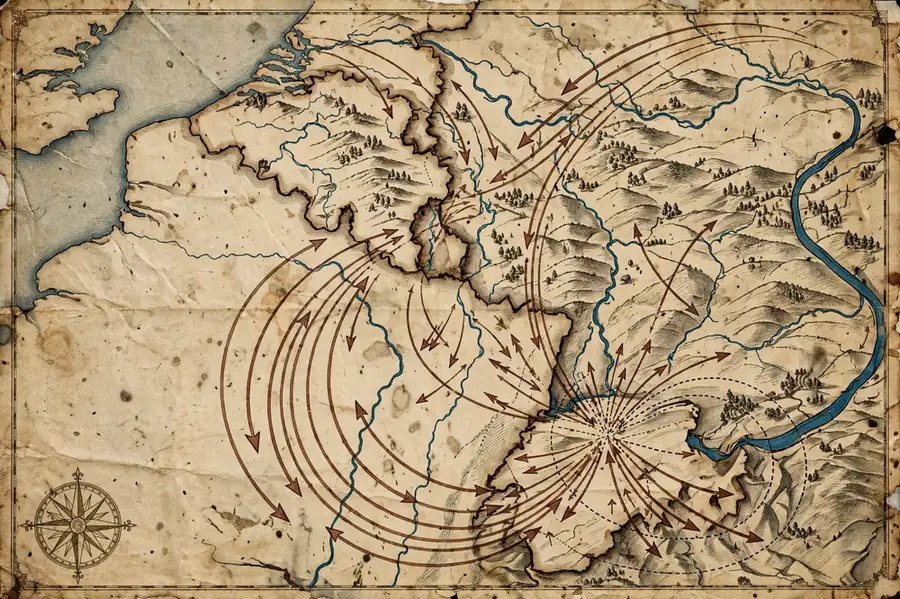
It was designed to solve Germany’s central strategic problem: a war on two fronts, against France in the west and Russia in the east. Schlieffen’s answer was to win in the west first, and quickly: the bulk of the German army would sweep through neutral Belgium, outflank the French armies on the Franco-German border, wheel around Paris and crush the French army against its own frontier fortresses, all within six weeks — before Russia could mobilise in the east.
The plan required speed, precision and the violation of Belgian neutrality, which Britain had guaranteed by the Treaty of London of 1839. The German leadership accepted the risk: the invasion of Belgium, they calculated, would bring Britain into the war, but Britain’s small professional army would arrive too late to matter.
In August 1914, the plan was put into action. On 4 August, German troops crossed the Belgian frontier; on the same day, Britain declared war on Germany. The Belgian army, small but determined, held the fortress of Liège for twelve days — long enough to disrupt the German timetable — and then fell back to Antwerp.
The French army, following its own plan, Plan XVII, attacked into Alsace-Lorraine and was driven back with heavy losses in the Battle of the Frontiers (14–24 August). The British Expeditionary Force, 120,000 men under Sir John French, landed in France and fought its first battle at Mons on 23 August, where it held the German advance for a day before retreating.
The German armies swept on, through Belgium and northern France, and by early September they were within 40 kilometres of Paris. The French government fled to Bordeaux. The Schlieffen Plan seemed, for a moment, to be working.
It was not. The German advance had outrun its supplies, its troops were exhausted after marching 400 kilometres in a month, and Moltke had weakened the right wing — the wing that was supposed to wheel around Paris — by detaching troops to the east and to the siege of Antwerp.
The French commander, General Joseph Joffre, saw the opportunity: the German right wing, under General von Kluck, had turned east of Paris, exposing its flank, and Joffre — with the help of General Gallieni, the military governor of Paris, who famously sent reinforcements to the front in Parisian taxis — struck it on 6 September.
The Battle of the Marne (6–12 September 1914) was the first great battle of the Western Front, and the most consequential: the German advance was halted, the German armies were driven back to the river Aisne, and the Schlieffen Plan was dead. Germany would not win a quick victory in the west. The war would be long.
4. The Race to the Sea and the Birth of the Trenches
After the Marne, both sides tried to outflank each other to the north, in a series of battles known as the Race to the Sea (September–November 1914). The French and British moved north, the Germans moved north to meet them, and the front extended, week by week, until it reached the North Sea coast at Nieuport, in Belgium, in November 1914.
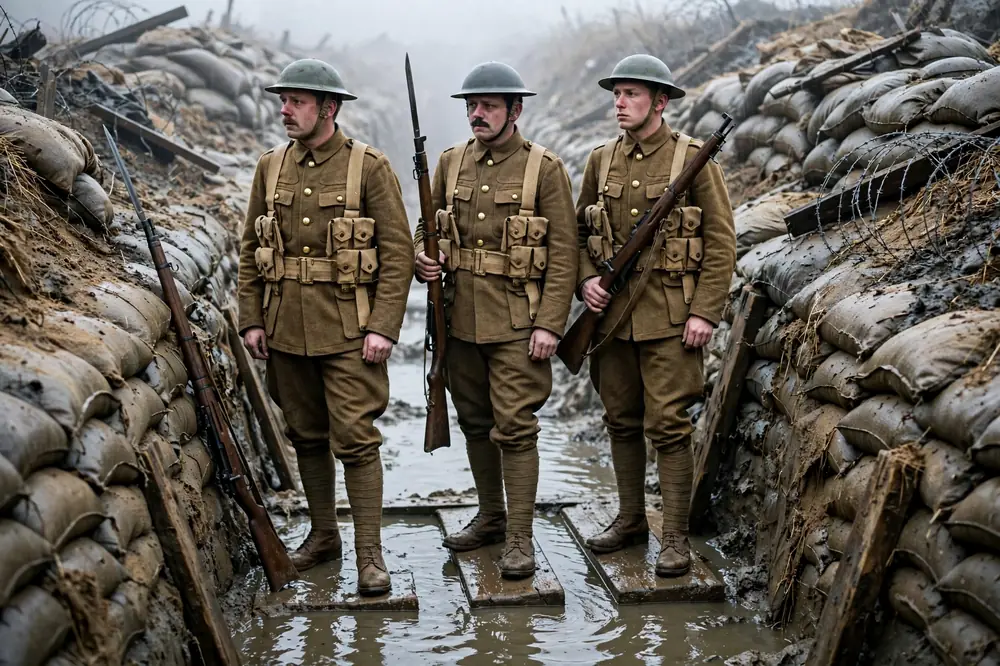
The last battle of the Race was the First Battle of Ypres (19 October–22 November 1914), in which the British Expeditionary Force — the “Old Contemptibles”, the professional soldiers of 1914 — held the town of Ypres against repeated German attacks, at the cost of some 58,000 British casualties.
By the end of the battle, the original British Expeditionary Force had effectively ceased to exist as a fighting force; it had been destroyed, but it had held the line, and Ypres — a small Flemish town that would become the most famous name on the Western Front — remained in Allied hands.
By December 1914, the front had stabilised into a continuous line from the North Sea to Switzerland, and both sides began to dig. The trenches of the Western Front were not the simple ditches of popular imagination: they were elaborate systems of fortification, with a front-line trench, a support trench and a reserve trench, connected by communication trenches, protected by barbed wire, and provided with dugouts, machine-gun posts, artillery observation posts and, behind the lines, railways, hospitals and supply depots.
The German trenches, built on the high ground for most of the front, were generally deeper, better built and more comfortable than the Allied ones; the British trenches, in the low-lying Flanders plain, were often waterlogged, and the men lived with their feet in water.
Between the two lines lay No Man’s Land, a strip of ground from a few dozen to a few hundred metres wide, churned by shellfire into a landscape of craters, shattered trees and unburied dead.
Life in the trenches was a routine of danger, discomfort and boredom. Soldiers spent about a third of their time in the front line, a third in support and a third in rest behind the lines, in a rotation that lasted, for the British, about twelve days.
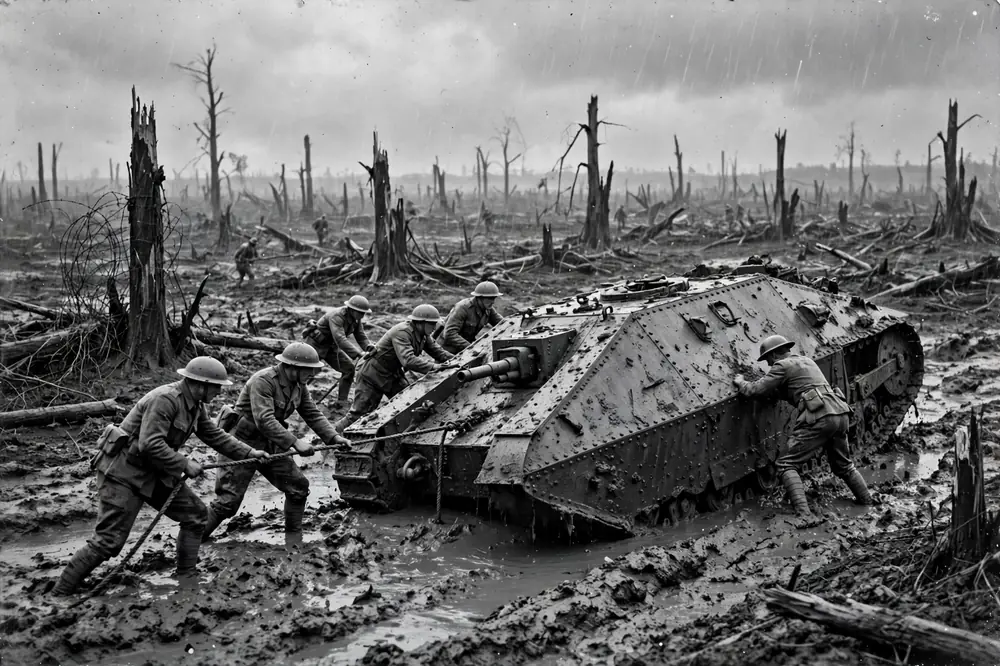
In the front line, they stood watch, repaired the trenches, and endured the shelling — the artillery bombardments that were the great killer of the Western Front, responsible for about two-thirds of all casualties. They lived with rats, lice and the smell of the dead; they suffered from “trench foot”, a painful condition caused by standing in cold water; and they endured the cold of winter and the mud of autumn and spring, when the trenches filled with water and the duckboards — the wooden walkways laid over the mud — sank beneath the surface.
The most famous episode of the first winter was the Christmas Truce of December 1914, when German and British soldiers, in places along the front, stopped fighting on Christmas Day, exchanged gifts, sang carols and buried their dead together. The truce was unofficial, it was condemned by the high commands on both sides, and it never happened again on the same scale.
But it has become the most remembered moment of the war — a reminder that the men in the trenches were not the monsters of propaganda, but soldiers like any other.
5. The Great Battles: Ypres, Verdun and the Somme
The years 1915 and 1916 were the years of the great set-piece battles of the Western Front, and they were the years in which the war’s reputation for futile slaughter was made. The pattern of these battles was the same: a massive artillery bombardment, lasting days or weeks, intended to cut the barbed wire and destroy the enemy’s defences; an infantry attack across No Man’s Land, in waves, toward the enemy trenches; and a result measured in yards gained and tens of thousands of men lost.
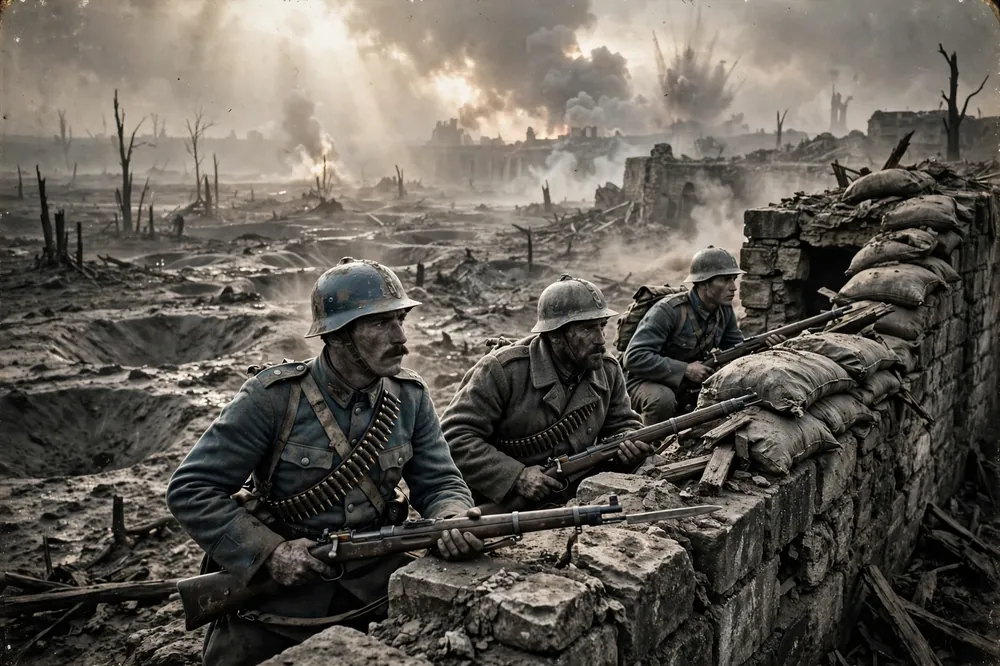
The Second Battle of Ypres (22 April–25 May 1915) is remembered for the first large-scale use of poison gas: on 22 April, the Germans released chlorine gas from cylinders along a four-mile front, and the yellow-green cloud drifted over the French and Algerian troops, who broke and fled.
The gas attack opened a gap in the Allied line, but the Germans, who had not planned to exploit it, did not advance, and the Allies closed the gap. The battle cost the Allies about 70,000 casualties and the Germans about 35,000, and it established a pattern that would be repeated throughout the war: a new weapon, used for the first time with devastating effect, and then adopted by both sides, so that within a year both armies were fighting in gas masks, and gas — chlorine, phosgene and, from 1917, mustard gas — had become a permanent part of the battlefield.
The Battle of Verdun (21 February–18 December 1916) was the longest battle of the war, and the most terrible. The German chief of staff, Erich von Falkenhayn, chose Verdun — a fortress town on the Meuse, of great symbolic importance to France — not to capture it, but to “bleed the French army white”: by attacking a position the French could not abandon, he would force them to feed men into a battle of attrition in which German artillery, firing from the surrounding heights, would kill them faster than Germany lost men.
The plan worked, in the sense that the battle became a slaughterhouse: the French, under General Philippe Pétain — who organised the defence and coined the phrase “They shall not pass” — held Verdun, but at a cost that is still debated.
The commonly cited figures are about 377,000 French casualties and about 337,000 German casualties — a total of more than 700,000 men killed, wounded and missing, for a battlefield that, at the end of the year, was almost exactly where it had begun.
Verdun became the symbol of French endurance, and of the war’s horror: the ossuary at Douaumont, which holds the bones of some 130,000 unidentified soldiers of both sides, is one of the most visited memorials of the war.
The Battle of the Somme (1 July–18 November 1916) was the British army’s great offensive, launched in part to relieve the pressure on Verdun. Its first day, 1 July 1916, was the worst day in the history of the British army: some 57,470 British casualties, including about 19,240 killed, in a single day — the great majority of them in the first hour, as the infantry advanced in waves across No Man’s Land into German machine-gun fire that the week-long artillery bombardment had failed to suppress.
The battle continued for four and a half months, and by its end the Allies had advanced about ten kilometres, at a cost of more than a million casualties on both sides — the commonly cited figures are about 620,000 Allied and about 450,000–600,000 German casualties, though the German figures are disputed.
The Somme is remembered for the first day, and for the first use of the tank: on 15 September 1916, at Flers-Courcelette, 49 British Mark I tanks went into action, of which only a handful reached the German lines — but the tank had arrived, and it would transform warfare within two years.
6. 1917: Passchendaele, Cambrai and the Crisis of Morale
If 1916 was the year of Verdun and the Somme, 1917 was the year in which the armies of the Western Front came close to breaking. The French army, bled white at Verdun and disappointed by the failure of the Nivelle Offensive at the Chemin des Dames in April 1917 — an attack that promised a breakthrough in 48 hours and produced, instead, some 187,000 French casualties in a week — mutinied.
The mutinies of May–June 1917 affected, by the French army’s own later admission, about half of its divisions: soldiers refused to go into the attack, though they would still hold the line in defence. General Pétain, who replaced Nivelle, restored discipline by a combination of firmness — a small number of ringleaders were tried and executed, though far fewer than legend claims — and reform: better food, more leave, and a promise that there would be no more futile offensives.
The French army held, but it would not attack in strength again until 1918.
The British army’s great battle of 1917 was the Third Battle of Ypres, better known as Passchendaele (31 July–10 November 1917). The objective was to break through the German defences in Flanders and capture the Belgian ports of Ostend and Zeebrugge, from which German U-boats operated.
The battle was fought in the worst weather of the war: the autumn rains turned the Flanders plain — already churned by shellfire, its drainage destroyed — into a sea of mud, in which men and horses drowned and tanks sank to their hulls. The British advanced about eight kilometres in three months, at a cost commonly estimated at about 325,000 British and Commonwealth casualties and about 260,000 German casualties.
The village of Passchendaele, the objective, was finally captured on 6 November by Canadian troops, at a cost that made the name a byword for the futility of the war. The battle’s commander, General Douglas Haig, has been the most controversial figure of the Western Front ever since: to his critics, he was the “butcher” who sent men to die in the mud for nothing; to his defenders, he was a commander who understood that the war could only be won by wearing Germany down, and that Passchendaele — for all its horror — was part of that wearing down.
The one bright spot of 1917 was the Battle of Cambrai (20 November–7 December 1917), in which the British used 476 tanks in a massed attack, without a preliminary artillery bombardment, and broke through the German Hindenburg Line — the great defensive system the Germans had built in the winter of 1916–17 — to a depth of eight kilometres in a day.
The breakthrough could not be exploited, because the British had no reserves to follow it up, and a German counter-attack retook most of the ground. But Cambrai showed what the tank could do when used in mass, and it pointed the way to the tactics of 1918.
The same year saw the arrival of the first American troops in France — the United States had declared war on Germany in April 1917 — and the collapse of Russia, whose revolution and withdrawal from the war would free dozens of German divisions for the west in 1918.
7. 1918: The German Spring Offensives and the Hundred Days
The year 1918 began with Germany in its strongest position on the Western Front since 1914. The Treaty of Brest-Litovsk, signed with the Bolshevik government in March 1918, had taken Russia out of the war, and some 50 German divisions were transferred from the east to the west.
The German high command, under Ludendorff, decided to use them before the Americans could arrive in strength: a series of great offensives — the Kaiserschlacht, the “Kaiser’s Battle” — aimed at splitting the British and French armies, capturing the Channel ports, and winning the war before the summer.
The first offensive, Operation Michael, launched on 21 March 1918, was the greatest German success on the Western Front since 1914: in five days, the German army advanced 65 kilometres, retook all the ground the Allies had won on the Somme in 1916, and came within reach of Amiens.
The second offensive, Georgette, in April, drove the British back in Flanders; the third, Blücher, in May, reached the Marne, within 60 kilometres of Paris; the fourth, Gneisenau, in June, was stopped; and the fifth, the Champagne-Marne offensive of July, was the last — it was met by a French counter-attack, supported by American troops, that drove the Germans back across the Marne.
The spring offensives failed for the same reason the Schlieffen Plan had failed: the German army could break through, but it could not sustain the breakthrough. The stormtroop tactics — small groups of elite infantry, infiltrating the enemy’s defences and bypassing strongpoints — were brilliantly effective at the tactical level, but the German army had no tanks to exploit the gaps, no motor transport to supply the advance, and no reserves to replace the losses.
The offensives cost Germany some 800,000 casualties, including its best troops — the stormtroopers, who could not be replaced — and they gained territory that Germany could not hold and could not supply. By July 1918, the German army was exhausted, and the Allies — now under a single supreme commander, the French Marshal Ferdinand Foch, and reinforced by more than a million American troops — were ready to counter-attack.
The Allied counter-offensive, the Hundred Days Offensive (8 August–11 November 1918), was the most successful campaign of the war on the Western Front. It began at Amiens on 8 August — the “black day of the German army”, in Ludendorff’s phrase — when British, Commonwealth and French troops, supported by 600 tanks and 2,000 aircraft, broke through the German lines and advanced 12 kilometres in a day.
The offensives that followed — the British at Arras and Cambrai, the French in Champagne, the Americans at Saint-Mihiel and in the Meuse-Argonne — drove the German army back, step by step, to the Hindenburg Line, and then through it. The German army did not collapse in a rout — it fought a disciplined retreat — but it was beaten, and it knew it.
On 29 September, Ludendorff told the Kaiser that the war was lost and that an armistice must be sought. On 3 November, the German navy mutinied at Kiel; on 9 November, the Kaiser abdicated; on 11 November, at 11 a.m., the Armistice of Compiègne came into effect. The Western Front fell silent.
8. Weapons and Tactics: The Invention of Modern War
The Western Front was the laboratory of modern war. The machine gun — the weapon that made the trench possible, by giving a few men the firepower to stop an infantry attack — was the war’s most important weapon: it killed more men than any other, and it dictated the tactics of the whole front.
The artillery — the great killer, responsible for about two-thirds of casualties — grew steadily in power and sophistication: by 1918, the Allies were firing millions of shells in a single offensive, and the “creeping barrage”, a wall of shellfire that advanced just ahead of the infantry, had become the standard method of attack.
Poison gas, first used in 1915, became a routine weapon, and the gas mask became a permanent part of the soldier’s equipment. The aeroplane, which began the war as a reconnaissance tool, became a fighter, a bomber and an artillery spotter, and by 1918 the Allies had air superiority over the front.
The tank, invented by the British and first used in 1916, was the weapon that finally broke the deadlock: at Cambrai in 1917 and at Amiens in 1918, massed tanks, working with infantry and artillery, achieved what four years of infantry attacks had not.
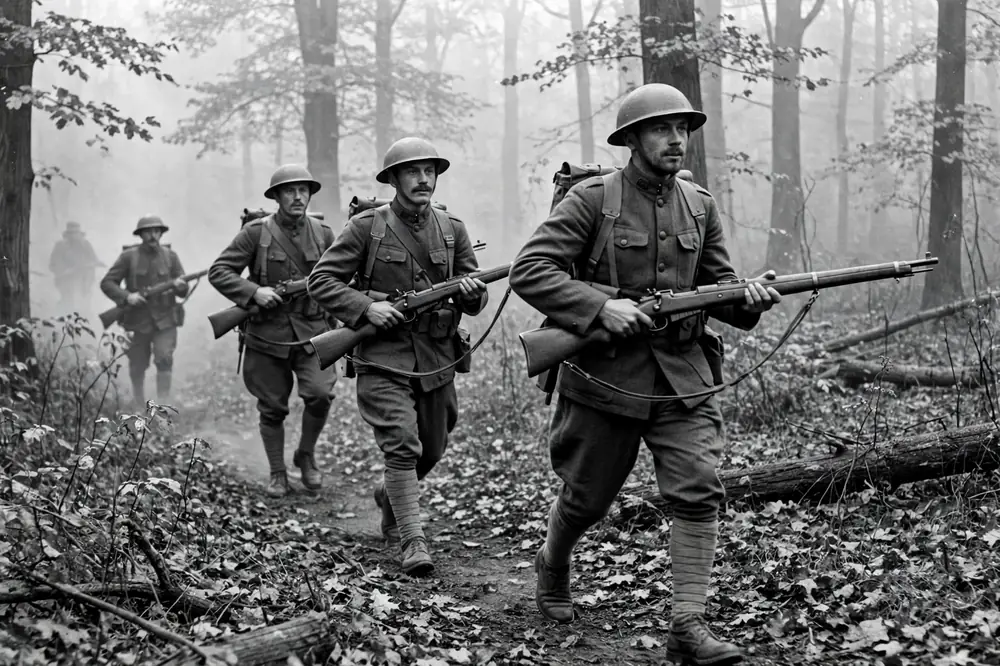
The tactics evolved as well. The Germans developed the stormtroop — small, elite infantry groups, armed with light machine guns, grenades and flamethrowers, trained to infiltrate the enemy’s defences and to bypass strongpoints — and the deep defensive system, the defence in depth, in which the front line was held lightly and the main resistance was organised in depth, so that an attacker who broke through the first line would be caught in a killing zone and counter-attacked.
The Allies developed the “bite and hold” tactic — limited attacks, with limited objectives, supported by overwhelming artillery — and the combined-arms attack, in which infantry, tanks, artillery and aircraft worked together. By 1918, the war on the Western Front was no longer the war of 1914: it was a war of machines, of logistics, of industrial production, and of the side that could produce more shells, more tanks and more aircraft.
Germany, blockaded and starving, could not. The Allies, with American industry behind them, could.
9. Legacy: The Front That Shaped the Twentieth Century
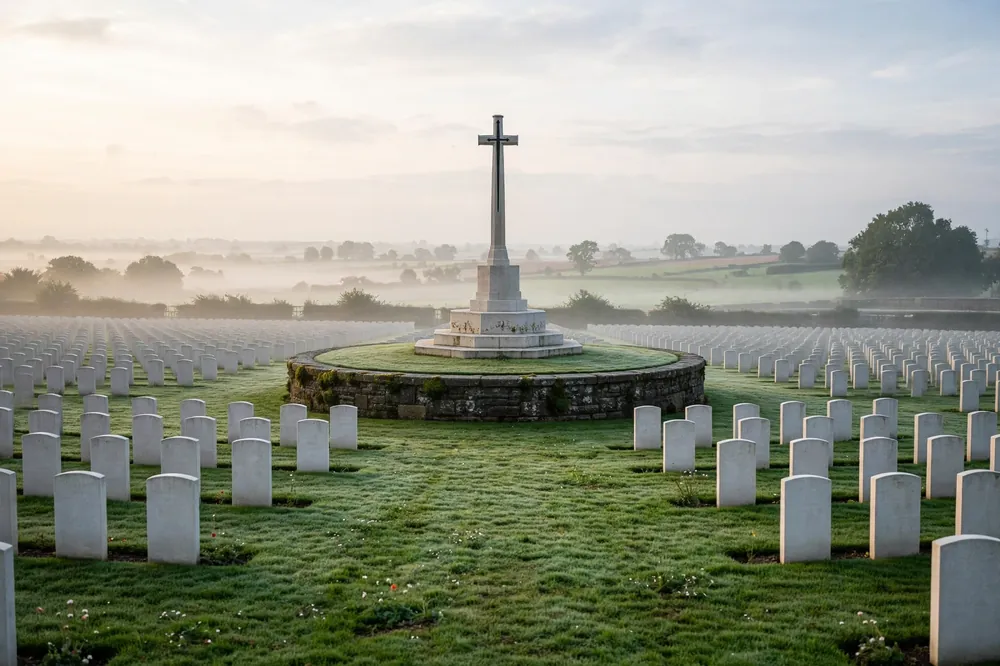
The Western Front’s legacy is everywhere in the twentieth century. It is in the cemeteries — the great Commonwealth War Graves Commission cemeteries at Tyne Cot, with nearly 12,000 graves, and at Étaples, and the German cemeteries at Langemark and Neuville-St Vaast, and the French ossuary at Douaumont — which are visited by millions of people every year.
It is in the literature — the poetry of Wilfred Owen, Siegfried Sassoon and Rupert Brooke, the novels of Erich Maria Remarque (All Quiet on the Western Front, 1929) and Henri Barbusse (Under Fire, 1916), the memoirs of Robert Graves and Vera Brittain — which shaped how the war was remembered.
It is in the politics: the sense, above all in Britain and France, that the war had been a waste, and that another such war must never happen, shaped the appeasement of the 1930s; and the sense, in Germany, that the army had been “stabbed in the back”, shaped the rise of National Socialism.
The Western Front did not cause the Second World War, but it created the conditions — the bitterness, the debt, the disillusion — in which the Second World War became possible.
Militarily, the Western Front’s legacy is the modern way of war. The combined-arms battle — infantry, tanks, artillery and aircraft, working together under a single plan — was invented on the Western Front, and it has been the basis of warfare ever since, from the German Blitzkrieg of 1940 to the Allied offensives of 1944–45 and to the wars of the twenty-first century.
The defensive system in depth, the stormtroop, the creeping barrage, the tank — all were products of the Western Front. So, too, was the idea of total war: the Western Front was the first war in which the whole of a nation’s industry, economy and population was mobilised for war, and in which the distinction between the front and the home front began to disappear.
The blockade of Germany, the bombing of cities, the mobilisation of women into the workforce — all were rehearsals for the Second World War.
The landscape of the Western Front is itself a memorial. In the Somme, in Flanders, in the Argonne, the ground is still scarred by craters, the woods still grow over the trenches, and the farmers still unearth shells, helmets and bones — the “iron harvest” that is gathered every year.
The Menin Gate at Ypres, where the names of 54,896 British and Commonwealth soldiers with no known grave are inscribed, is the site of a ceremony every evening at 8 p.m., when the Last Post is sounded — a ceremony that has been held, with only a brief interruption during the Second World War, since 1928. The Western Front is not history in the sense of something finished and past.
It is history that is still present, in the ground, in the names on the memorials, and in the memory of the nations that fought there.
10. Key Figures
Joseph Joffre (France). Commander-in-chief of the French army from 1911 to 1916. Joffre won the Battle of the Marne in 1914 and held the French army together through the first two years of the war. He was replaced by Nivelle in December 1916, after the failures of 1916, and was made a Marshal of France.
Philippe Pétain (France). The hero of Verdun, who organised the defence in 1916 and became commander-in-chief in 1917, restoring the army after the mutinies. Pétain’s reputation was destroyed in the Second World War, when he led the Vichy government that collaborated with Germany. He died in 1951, a disgraced figure, but his role at Verdun remains a central part of French memory.
Ferdinand Foch (France). Supreme commander of the Allied armies from March 1918. Foch coordinated the Allied counter-offensive of the Hundred Days and accepted the German request for an armistice at Compiègne. He was made a Marshal of France and an honorary field marshal of Britain.
Douglas Haig (Britain). Commander-in-chief of the British Expeditionary Force from December 1915 to the end of the war. Haig commanded the Somme, Arras, Passchendaele and the Hundred Days Offensive. He remains the most controversial British commander of the war — condemned by some as a butcher, defended by others as the general who, in the end, won the war.
Erich von Falkenhayn (Germany). German chief of staff from 1914 to 1916. Falkenhayn planned the Battle of Verdun as a battle of attrition, and was replaced by Hindenburg and Ludendorff in August 1916.
Paul von Hindenburg and Erich Ludendorff (Germany). The victors of Tannenberg on the Eastern Front, who took command of the German war effort in August 1916 and directed the spring offensives of 1918. Their failure in 1918 led to Ludendorff’s demand for an armistice and to the collapse of the German war effort.
John J. Pershing (United States). Commander of the American Expeditionary Forces in France. Pershing insisted that American troops fight as a separate army, under American command, and led them in the Saint-Mihiel and Meuse-Argonne offensives of 1918 — the largest battles in American history to that date.
Frequently Asked Questions
Related articles
Sources
- Encyclopædia Britannica, “Western Front” — overview of the front, its battles and its casualties.
- Wikipedia, “Western Front (World War I)” — the Schlieffen Plan, the Race to the Sea, Verdun, the Somme, Passchendaele and the Hundred Days Offensive.
- John Keegan, The First World War (Hutchinson, 1998) — the war as a whole, with a full account of the Western Front.
- Hew Strachan, The First World War, Volume I: To Arms (Oxford University Press, 2001) — the outbreak of the war, the Marne and the Race to the Sea.
- Martin Gilbert, The Somme: Heroism and Horror in the First World War (Henry Holt, 2006) — the Battle of the Somme and its first day.
- Alistair Horne, The Price of Glory: Verdun 1916 (Macmillan, 1962) — the classic account of the Battle of Verdun.
- Paul Fussell, The Great War and Modern Memory (Oxford University Press, 1975) — the literature and memory of the Western Front.
- Erich Maria Remarque, All Quiet on the Western Front (1929).
- Lyn Macdonald, They Called It Passchendaele (Michael Joseph, 1978).
- Gary Sheffield, The Somme (Cassell, 2003).