 WAR ATLAS MILITARY HISTORY MAGAZINE · WWI — WWII
Triple Alliance
1. Lead
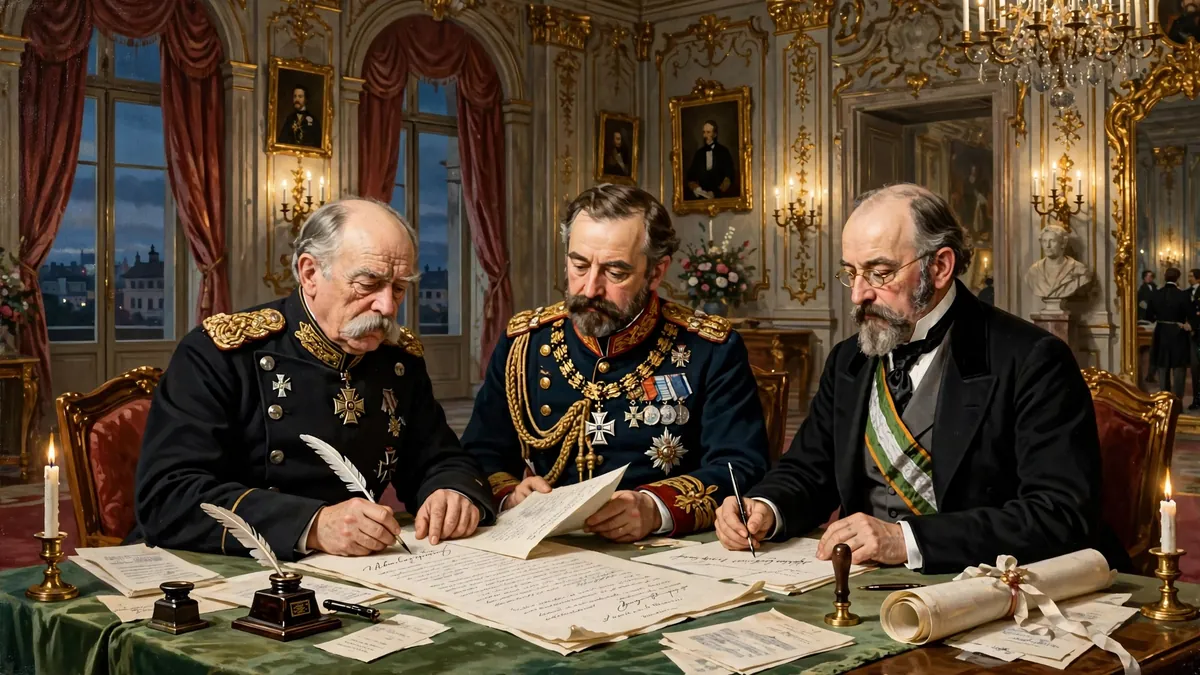
The Triple Alliance was a defensive military alliance between the German Empire, Austria-Hungary and the Kingdom of Italy, signed in Vienna on 20 May 1882 and renewed four times before it collapsed in the first year of the First World War.
For thirty-three years it was the central pillar of the European alliance system created by the German chancellor Otto von Bismarck, designed to isolate France, to keep Italy out of the French orbit, and to give Austria-Hungary a powerful friend against Russia in the Balkans.
In 1914, when the alliance was put to its first real test, it failed: Italy declared itself neutral, arguing that the alliance was defensive and that Austria-Hungary had been the aggressor against Serbia, and in May 1915 Italy joined the Allies instead, declaring war on its former allies.
The Triple Alliance thus became the only one of Europe’s great pre-war alliances that did not survive the outbreak of the war it was meant to deter — a fact that says a great deal about the fragility of the alliance system itself.
The Triple Alliance is often presented as one of the two great armed camps that made the First World War inevitable — the Triple Alliance against the Triple Entente of France, Russia and Britain. The picture is misleading. The Alliance was never a bloc of three equal partners with identical interests.
Germany and Austria-Hungary were bound together by the Dual Alliance of 1879, a close and genuinely felt partnership; Italy was a junior partner whose interests pointed in the opposite direction from Austria-Hungary’s, above all in the Adriatic and the Balkans, where Italian nationalists claimed the “unredeemed” Italian-speaking lands of the Habsburg Empire — the Trentino, Trieste and the Dalmatian coast.
Italy joined the Alliance not out of friendship for Austria-Hungary but out of fear of France and of isolation, and it kept its options open from the first day, signing a secret agreement with France in 1902 that effectively neutralised its obligations to the Alliance.
Understanding the Triple Alliance means understanding a bargain that was useful to all three members for different reasons, that held together as long as there was no war, and that broke apart the moment war came.
2. Key Facts
| Members | German Empire, Austria-Hungary, Kingdom of Italy |
| Signed | 20 May 1882, Vienna (secret treaty, published in 1888) |
| Architect | Chancellor Otto von Bismarck of Germany |
| Predecessor | Dual Alliance of Germany and Austria-Hungary, 7 October 1879 |
| Nature | Defensive alliance: members promised mutual support if any one was attacked by two or more great powers, or by one great power supported by another |
| Renewals | 1887, 1891, 1902, 1912 (each time for five years) |
| Rival bloc | Triple Entente: France, Russia, Britain (Franco-Russian Alliance 1892, Entente Cordiale 1904, Anglo-Russian Convention 1907) |
| Italy and France | Secret Franco-Italian agreement of 1902: each promised neutrality if the other was attacked |
| Collapse | Italy declared neutrality on 3 August 1914; declared war on Austria-Hungary on 23 May 1915 and on Germany on 28 August 1916 |
| Successor | The Central Powers (Germany, Austria-Hungary, Ottoman Empire, Bulgaria) fought on without Italy |
3. Background: Bismarck’s System
The Triple Alliance was the product of the most feared man in Europe: Otto von Bismarck, the Prussian statesman who had unified Germany by “blood and iron” in the wars of 1864, 1866 and 1870–71, and who then spent the next twenty years trying to keep the peace he had made.
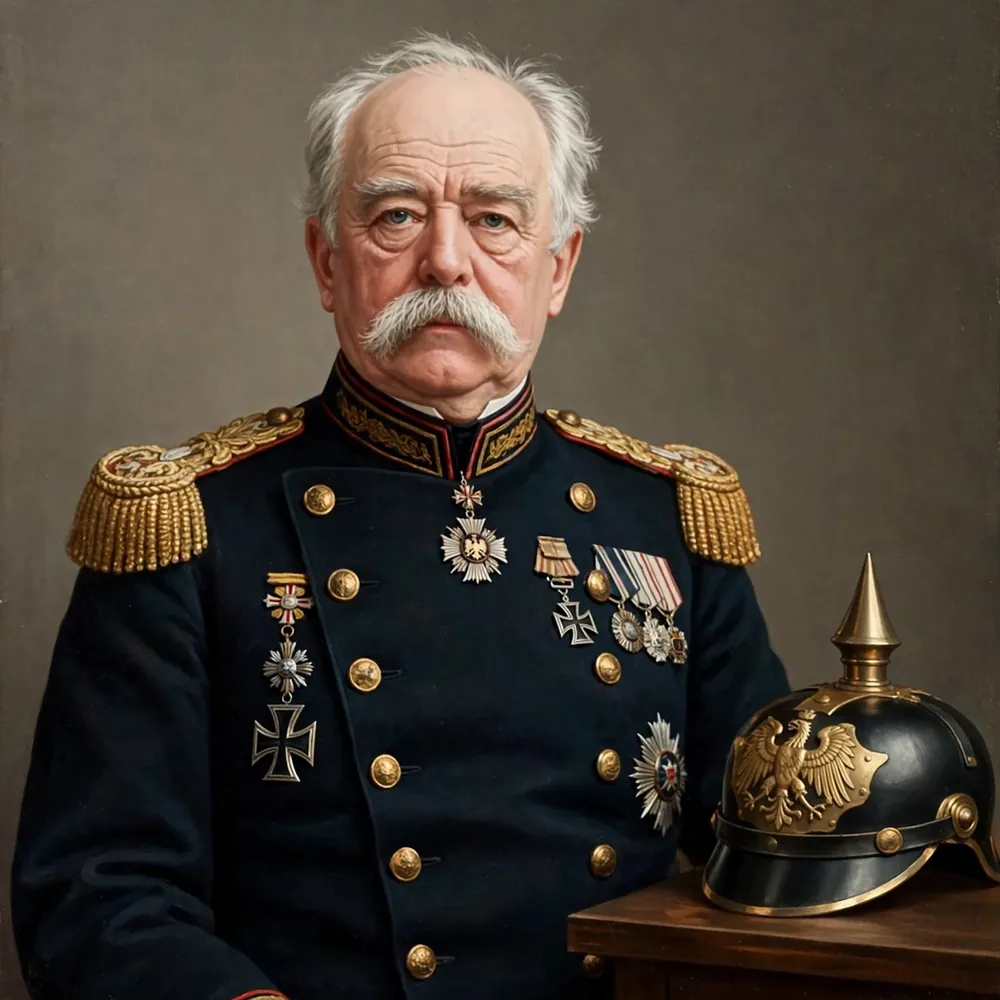
Bismarck’s nightmare was a war on two fronts — France in the west, seeking revenge for the loss of Alsace-Lorraine in 1871, and Russia in the east, expanding into the Balkans and the Near East. His solution was a system of alliances that would leave France isolated and keep Russia friendly, or at least neutral.
The first step was the Dual Alliance of 7 October 1879, a defensive treaty between Germany and Austria-Hungary that promised mutual support if either was attacked by Russia, or by Russia supported by another power. It was the closest alliance in Europe — the two emperors called it an alliance “of peace” — and it survived until 1918.
The second step was to bring Russia itself into the system. In 1881 Bismarck negotiated the Three Emperors’ League between Germany, Austria-Hungary and Russia, in which the three conservative empires promised neutrality if any one of them went to war with a fourth power, and agreed to consult on the Balkans. The League was renewed in 1884, but it collapsed in 1887 when Austria-Hungary and Russia fell out over Bulgaria.
Bismarck then replaced it with the Reinsurance Treaty of 1887, a secret agreement in which Germany and Russia promised neutrality if either went to war with a third power — except that the promise did not apply if Germany attacked France or Russia attacked Austria-Hungary. The system was intricate, secretive and held together by Bismarck’s personal skill.
It was also, as his critics pointed out, built on contradictions: Germany was allied to Austria-Hungary against Russia, and at the same time bound to Russia by a treaty that promised neutrality in a Russo-Austrian war.
Italy entered this system in 1882, almost by accident. The immediate cause was the French occupation of Tunis in May 1881. Tunis, in North Africa, was a prize the Italians had coveted since unification — a large Italian community lived there, and Italian nationalists regarded it as a natural extension of Italy across the Mediterranean.
France’s seizure of Tunis, with British acquiescence, humiliated Italy and convinced the Italian government that France was its principal enemy in the Mediterranean. Italy turned to Germany and Austria-Hungary for protection. Bismarck, who had long wanted to add Italy to his system as a counterweight to France, welcomed the approach.
Austria-Hungary was reluctant — the Italians claimed its territory, and the Austrian foreign minister, Count Kálnoky, distrusted Rome — but Bismarck overcame the objections, and the treaty was signed in Vienna on 20 May 1882.
4. The Treaty of 1882: What the Alliance Promised
The Treaty of the Triple Alliance was a defensive alliance, and its text — kept secret until 1888 — was careful and limited. Its core provisions, as published, were these. First, if Italy were attacked by France without provocation, Germany and Austria-Hungary would come to Italy’s aid with all their forces; and if Germany were attacked by France, Italy would do the same.
Second, if any one of the three were attacked by two or more great powers, the other two would come to its aid. Third, if any one of the three were attacked by a single great power, the other two would observe a benevolent neutrality.
Fourth, none of the three would conclude a separate peace or armistice with an enemy, and none would enter into an engagement directed against any of the others. The treaty was to last for five years, and it contained a provision — crucial to Italy — that it could in no case be regarded as directed against Britain, with whom Italy maintained friendly relations and whose naval power protected Italian trade.
The military arrangements that followed were as important as the treaty itself. The three general staffs drew up joint plans, and the Italian army was assigned a specific role in the event of war with France: Italian troops would be sent to the Rhine to reinforce the German army, while the German navy and the Austrian fleet covered the Mediterranean.
The Italian navy was expected to cooperate with the Austro-Hungarian navy against the French fleet. These plans were revised at each renewal of the treaty, and they became steadily more detailed — but they were also, from the start, a source of friction, because the Italians and the Austrians could not agree on the Adriatic.
The Austrian navy regarded the Adriatic as its own lake; the Italian navy regarded it as the sea Italy had to dominate if it was to be a great power. Joint naval planning between the two was always polite, and always hollow.
The treaty was renewed in 1887, 1891, 1902 and 1912. Each renewal was an occasion for renegotiation, and each time Italy extracted concessions. In 1887, the renewal was accompanied by separate agreements in which Germany promised to support Italian claims in North Africa, and Austria-Hungary promised to consult Italy on any change in the Balkans — the first recognition of Italy as a Balkan power.
In 1891, the treaty was expanded to cover the possibility of a war with Russia as well as with France. In 1902, the renewal came after Italy had already signed its secret agreement with France, and the treaty text was amended to state explicitly that the alliance was not directed against France in any aggressive sense.
In 1912, the last renewal, the treaty was extended despite growing Italian-Austrian tension over the Balkans and despite the Italo-Turkish War of 1911–12, in which Italy had seized Libya from the Ottoman Empire and alarmed Vienna by its ambitions in the Adriatic and the Aegean.
5. Italy’s Double Game: The Agreement with France
The most important fact about the Triple Alliance after 1902 is that Italy was, in effect, a member of two alliances at once. The Franco-Italian agreement of 1 November 1902, negotiated by the French foreign minister Théophile Delcassé and the Italian foreign minister Giulio Prinetti, provided that if either France or Italy were attacked by a third power, or found itself compelled to take up arms in defence of its honour or its security, the other would observe a strict neutrality.
The agreement was secret, and it directly contradicted Italy’s obligations under the Triple Alliance: if France attacked Germany, Italy was bound by the Alliance to help Germany; by the agreement with France, Italy was bound to remain neutral. The two obligations could not both be kept, and Italy had ensured that, when the moment came, it would be free to choose.
Why did Italy play this double game? The reasons were commercial, colonial and national. Commercially, Italy’s trade depended on the sea, and the sea was controlled by Britain and France; a war against France would have cut Italy off from its markets and its coal.
Colonially, Italy wanted a free hand in North Africa — in Tripoli, which it seized in 1911, and in the wider Mediterranean — and France, which controlled Algeria and Tunisia, could either block those ambitions or accept them. The 1902 agreement was part of a bargain in which France accepted Italian ambitions in Tripoli in exchange for Italian acceptance of French ambitions in Morocco.
Nationally, and most importantly, Italy’s real enemy was not France but Austria-Hungary. The Italian nationalist movement, the irredentismo, claimed the Italian-speaking territories still held by the Habsburg Empire: the Trentino in the Alps, the port of Trieste, the Istrian peninsula and the Dalmatian coast.
As long as Italy was allied to Austria-Hungary, it could not claim those territories; as long as it was allied to France, it could hope to win them in a war against Austria. The 1902 agreement kept that door open.
Germany knew about the Franco-Italian agreement — or suspected it — and tolerated it. Berlin’s calculation was that Italy, even if unreliable, was still worth having: an Italy inside the Alliance could not join the other side without breaking its word, and an Italy outside the Alliance would certainly join France.
The Germans also believed, not without reason, that Italy’s army would be useful on the Rhine in a war with France, and that the Italian fleet would at least keep the French fleet busy in the Mediterranean. The Austrians were less forgiving.
The Austro-Hungarian chief of staff, Conrad von Hötzendorf, regarded Italy as the Monarchy’s most likely enemy after Russia, and from 1907 onwards he repeatedly urged a preventive war against Italy — a proposal the emperor Franz Joseph always rejected. The distrust was mutual and open: in 1911, during the Italo-Turkish War, Austria-Hungary mobilised troops on the Italian frontier, and Italy did the same.
6. The Alliance against the Entente: Two Armed Camps
By 1907, Europe was divided into two alliance systems. On one side stood the Triple Alliance of Germany, Austria-Hungary and Italy. On the other stood the Triple Entente: the Franco-Russian Alliance of 1892, the Anglo-French Entente Cordiale of 1904, and the Anglo-Russian Convention of 1907.
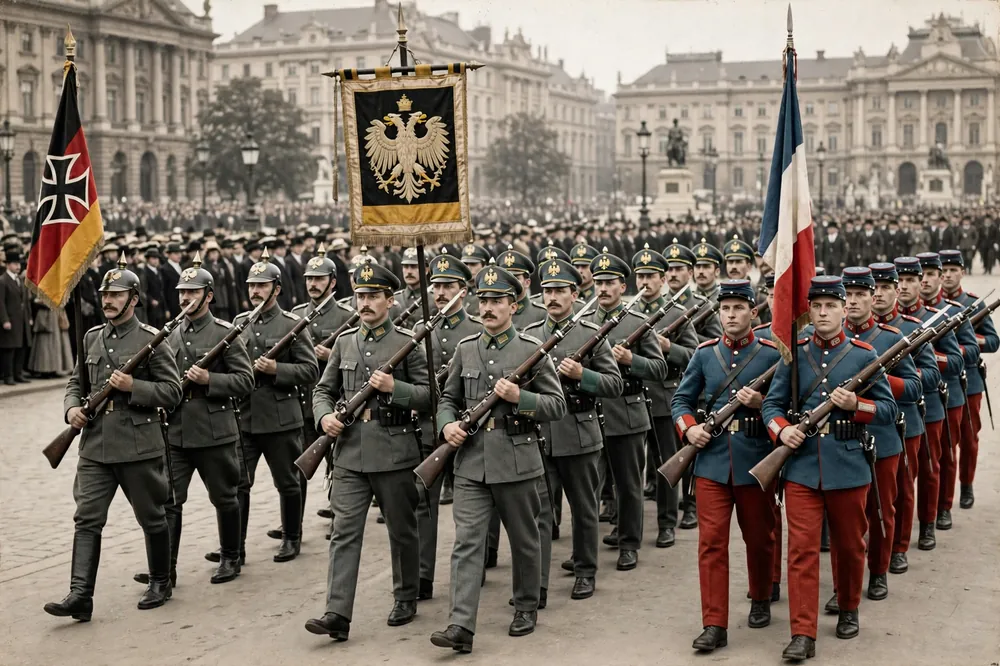
The Entente was not a formal military alliance — Britain had promised nothing in writing to France or Russia, and the agreements of 1904 and 1907 were colonial settlements, not treaties of mutual defence. But the two systems were increasingly treated, by the press and by the general staffs, as two armed camps, and each crisis — Morocco in 1905 and 1911, Bosnia in 1908, the Balkan Wars of 1912–13 — was read as a test of strength between them.
The Triple Alliance’s record in these crises was mixed, and it exposed the Alliance’s weaknesses. In the First Moroccan Crisis of 1905, Germany challenged French influence in Morocco and demanded an international conference; the conference, at Algeciras in 1906, ended in a diplomatic defeat for Germany, and Austria-Hungary was the only great power to support Berlin — the German chancellor Bernhard von Bülow called Austria “the one faithful friend” and spoke of the Alliance as a “rock of bronze”.
In the Bosnian Crisis of 1908, Austria-Hungary annexed Bosnia-Herzegovina, which it had administered since 1878, and Germany backed Vienna with a threat of war against Russia; the crisis ended with Russia humiliated and the Alliance apparently vindicated. But the two Balkan Wars of 1912–13 showed the limits of the system: Austria-Hungary and Italy were on opposite sides of the Balkan questions — Vienna wanted to contain Serbia, Rome wanted to contain Austria — and the Alliance could not produce a common policy.
During the First Balkan War, Italy and Austria-Hungary came close to war with each other over Albania, which Italy wanted as a protectorate and Austria wanted as a barrier against Serbia. Germany had to mediate between its own allies.
The naval rivalry in the Mediterranean was another running sore. The Triple Alliance had been conceived, in part, as a Mediterranean combination: the Italian and Austro-Hungarian fleets together were supposed to match the French Mediterranean fleet and to keep the sea open for German trade. In practice, the two fleets were built to fight each other.
Austria-Hungary built its dreadnoughts for the Adriatic; Italy built its dreadnoughts for the Adriatic; and the two navies’ war plans each assumed that the other might be the enemy. When the Anglo-French naval agreement of 1912 concentrated the French fleet in the Mediterranean and the British fleet in the North Sea, the Triple Alliance’s naval position in the Mediterranean actually worsened — and the German Mediterranean squadron, the Mittelmeerdivision, was too small to change the balance.
By 1914, the Alliance’s military value in the Mediterranean was largely notional.
7. The July Crisis and Italy’s Neutrality
The Triple Alliance was destroyed by the July Crisis of 1914 — not by a failure of diplomacy between the allies, but by the fact that the alliance’s terms did not cover what Austria-Hungary did. On 28 June 1914, the Archduke Franz Ferdinand, heir to the Habsburg throne, was assassinated at Sarajevo by a Bosnian Serb nationalist.
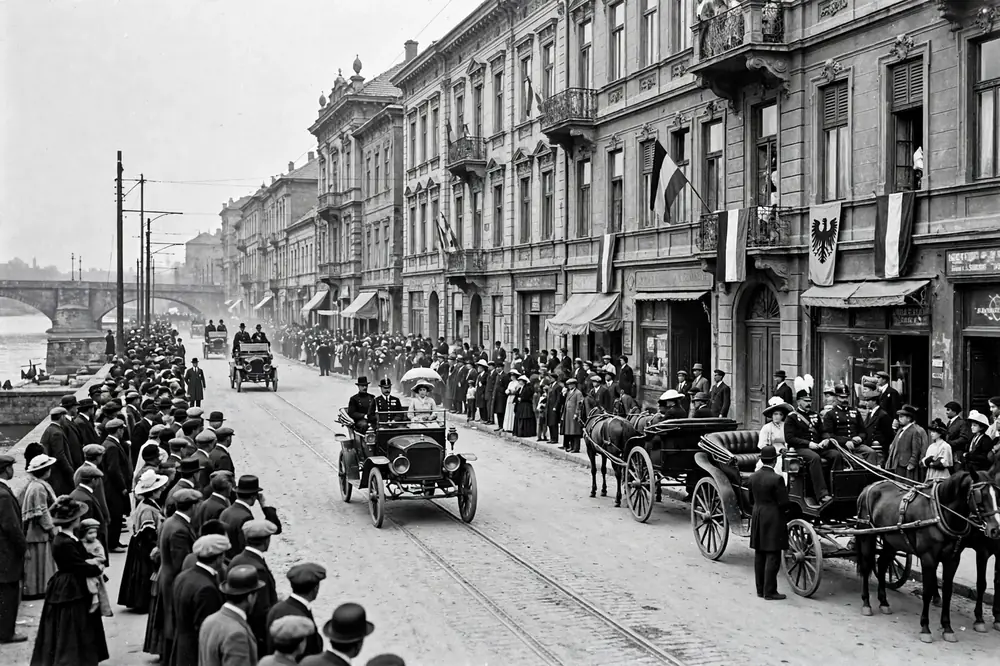
Austria-Hungary, with Germany’s support — the “blank cheque” of 5 July — decided to use the assassination as the pretext for a reckoning with Serbia. On 23 July, Vienna delivered an ultimatum to Belgrade that was designed to be rejected; on 28 July, Austria-Hungary declared war on Serbia. The alliance’s casus foederis — the condition that would bring it into operation — was an attack on one of its members.
But Austria-Hungary was not attacked; it was the attacker. Italy’s foreign minister, the Marquis di San Giuliano, argued — correctly, on the text of the treaty — that the Triple Alliance was defensive, that Austria-Hungary had not been attacked, and that Italy was therefore not obliged to join the war.
He added a second argument, also grounded in the treaty: the 1887 agreements required Austria-Hungary to consult Italy before any change in the Balkans, and Vienna had not consulted Rome before issuing the ultimatum. Italy was entitled, San Giuliano said, to compensation for the change in the Balkan balance — and, until it was paid, to neutrality.
On 3 August 1914, Italy declared its neutrality. Germany and Austria-Hungary protested, but they had no answer to the legal argument, and they needed Italy’s neutrality more than they needed its enmity. For nine months, Italy was courted by both sides.
The Allies offered the Treaty of London, signed secretly on 26 April 1915, promising Italy the Trentino, South Tyrol, Trieste, Istria, parts of Dalmatia, the Dodecanese islands and a share in the partition of the Ottoman Empire and of Germany’s African colonies — the full programme of Italian irredentism.
The Central Powers, belatedly, offered the Trentino and parts of the Adriatic coast, but they could not offer Trieste, which was the Monarchy’s principal port and which Vienna would not surrender, and their offers came too late and were too vague. On 23 May 1915, Italy declared war on Austria-Hungary.
It did not declare war on Germany until 28 August 1916, and even then the declaration was largely symbolic, since Italian and German troops were already fighting each other on the Alpine front through the Austro-Hungarian connection. The Triple Alliance was formally denounced by Italy, and it ceased to exist.
8. Assessment: Was the Triple Alliance a Failure?
Judged by its own purpose — to deter war and to keep France isolated — the Triple Alliance was a failure. It did not deter war; the war came in 1914, and the Alliance did not survive it. It did not keep France isolated; by 1907 France was allied to Russia and on friendly terms with Britain, and by 1914 Italy — the Alliance’s own third member — was negotiating with the Entente.
But judged by the purposes of its individual members, the picture is more mixed. For Germany, the Alliance served its purpose for thirty years: it gave Berlin a reliable partner in Vienna, it kept Italy out of the French camp for a generation, and it allowed Germany to face France without worrying about its southern flank.
For Austria-Hungary, the Alliance was a lifeline: the Monarchy, declining and surrounded by enemies, could not have survived without the German guarantee, and the Dual Alliance of 1879 — the core of the Triple Alliance — held to the end.
For Italy, the Alliance was a useful shelter in the 1880s and 1890s, when Italy was weak, isolated and afraid of France; by 1914, Italy had outgrown it, and the shelter had become a cage. Italy left the Alliance because its interests had changed, not because the Alliance had betrayed it.
The deeper lesson of the Triple Alliance is about the alliance system itself. The pre-war alliances were meant to make war less likely by making it more dangerous: an attack on one member would bring in the others, so no one would dare to attack.
In practice, the alliances made war more likely, because they turned a local conflict into a continental one, and because they gave each member a reason to support its allies’ recklessness. The German “blank cheque” to Austria-Hungary in July 1914 is the classic example: Berlin backed Vienna’s ultimatum to Serbia because the Alliance required it, and because German leaders feared that if they did not back Austria, the Alliance — and with it Germany’s only reliable friend — would collapse.
The alliance that was meant to preserve peace thus became one of the mechanisms that produced war. But the Triple Alliance also shows the limits of that argument: Italy, the third member, refused to be drawn in, and its refusal proves that the alliances did not operate automatically. Governments chose to honour them, or not to, according to their interests.
The alliances were not a machine that made war inevitable; they were a set of commitments that made it harder for governments to step back once a crisis began.
9. Legacy: The Alliance System and the Origins of the War
The Triple Alliance’s most important legacy is the debate it left behind about the origins of the First World War. For a generation after 1918, the dominant explanation of the war — the one written into the Treaty of Versailles — was that Germany had planned it, and that the alliance system was the instrument of German aggression.
Later historians argued the opposite: that the alliance system was a system of deterrence that failed, that no one wanted a general war, and that the war came about through miscalculation, rigid mobilisation timetables and the logic of the alliances themselves. The Triple Alliance is central to that debate, because it is the alliance that does not fit either story neatly.
It was not an instrument of German aggression — Italy refused to follow Germany into war, and the Alliance’s own terms did not oblige it to. But neither was it a system of deterrence that failed by accident: the German guarantee to Austria-Hungary was the condition that made Vienna’s ultimatum to Serbia possible, and the Italian defection shows that the guarantee was a political choice, not an automatic mechanism.
The Alliance also left a territorial legacy that shaped the peace. Italy’s entry into the war on the Allied side, under the Treaty of London, gave it the Trentino, South Tyrol, Trieste and Istria at the Paris Peace Conference — the “unredeemed” lands that the Alliance had prevented it from claiming.
But the Treaty of London also promised Italy parts of Dalmatia, and at Paris the promise was not kept in full: President Woodrow Wilson, in the name of the Fourteen Points and self-determination, refused to give Italy the Dalmatian coast, whose population was Slav. The result was the Italian sense of a “mutilated victory”, which poisoned Italian politics in the 1920s and helped to bring Mussolini to power.
The Triple Alliance, in other words, shaped not only the war but also the peace — and the peace, in turn, shaped the next war.
Finally, the Triple Alliance left an institutional legacy. The Dual Alliance of 1879, its core, became the model for the Central Powers of the First World War — Germany and Austria-Hungary fighting together, joined by the Ottoman Empire and Bulgaria — and for the Axis of the Second World War, in which Germany and Italy were allied once again, this time with Italy as a junior partner in a war of aggression that neither the Triple Alliance nor its members had envisaged.
The ironies are many: the alliance that Bismarck built to keep the peace became the framework for two world wars; the partner Bismarck added to contain France became the enemy that fought Austria-Hungary in the Alps; and the system of secret treaties that Bismarck invented to manage Europe became, in the hands of his successors, a system that no one could manage at all.
10. Key Figures
Otto von Bismarck (Germany). Chancellor of the German Empire from 1871 to 1890. Bismarck unified Germany and then built the alliance system of which the Triple Alliance was the centrepiece. Dismissed by the young Kaiser Wilhelm II in 1890, he watched from retirement as his successors allowed the Reinsurance Treaty with Russia to lapse and the system he had built to decay.
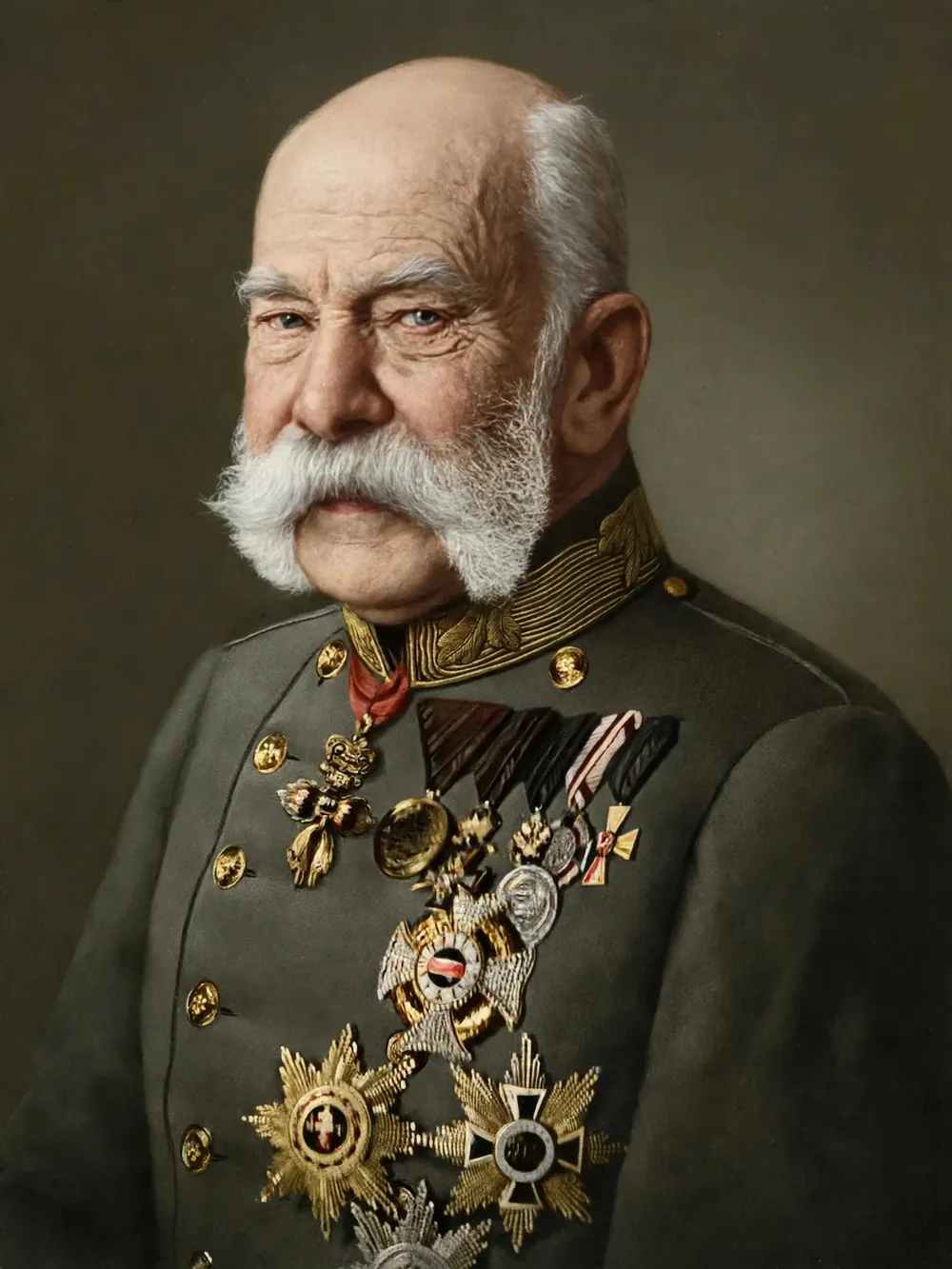
Count Gustav Kálnoky (Austria-Hungary). Austro-Hungarian foreign minister from 1881 to 1895. Kálnoky negotiated the Triple Alliance for Vienna and was the Alliance’s most consistent defender in the Habsburg government, despite his distrust of Italy. He resigned in 1895 after a dispute with the Hungarian prime minister.
Count Heinrich von Haymerle (Austria-Hungary). Kálnoky’s predecessor as foreign minister, who conducted the first soundings with Italy in 1881–82 before his death in October 1881, shortly before the treaty was signed.
Marquis di San Giuliano (Italy). Italian foreign minister from 1910 until his death in October 1914. San Giuliano kept Italy in the Triple Alliance while preserving its freedom of action, negotiated the secret understanding with France, and formulated the legal argument — that the Alliance was defensive and Austria-Hungary was the aggressor — on which Italy’s neutrality of August 1914 rested.
Sidney Sonnino (Italy). San Giuliano’s successor as foreign minister. Sonnino negotiated the Treaty of London of April 1915, by which Italy joined the Allies, and led Italy into the war against Austria-Hungary on 23 May 1915.
Conrad von Hötzendorf (Austria-Hungary). Chief of the Austro-Hungarian general staff from 1906 to 1917. Conrad regarded Italy as the Monarchy’s most dangerous enemy after Russia and repeatedly urged preventive war against Italy — a policy the emperor always rejected, but which poisoned Austro-Italian relations within the Alliance.
Frequently Asked Questions
Related articles
Sources
- Text of the Treaty of the Triple Alliance, 20 May 1882 — published text, available from the Avalon Project, Yale Law School.
- Encyclopædia Britannica, “Triple Alliance” — overview of the alliance, its renewals and Italy’s defection.
- Wikipedia, “Triple Alliance (1882)” — the treaty’s provisions, the renewals, the Franco-Italian agreement of 1902 and the July Crisis.
- A. J. P. Taylor, The Struggle for Mastery in Europe, 1848–1918 (Oxford University Press, 1954) — the classic account of Bismarck’s system and the alliance diplomacy of the period.
- Richard J. B. Bosworth, Italy and the Wider World, 1860–1960 (Routledge, 1996) — Italy’s foreign policy, irredentism and the decision to join the Allies in 1915.
- Samuel R. Williamson, Austria-Hungary and the Origins of the First World War (Macmillan, 1991) — Vienna’s policy, Conrad’s views on Italy, and the July Crisis.
- Luigi Albertini, The Origins of the War of 1914, Volume I (Oxford University Press, 1952) — the detailed diplomatic record of the Triple Alliance and the July Crisis.
- Christopher Clark, The Sleepwalkers: How Europe Went to War in 1914 (Harper, 2012).
- Margaret MacMillan, The War That Ended Peace: The Road to 1914 (Random House, 2013).