 WAR ATLAS MILITARY HISTORY MAGAZINE · WWI — WWII
Tupolev Tu-2
1. Lead
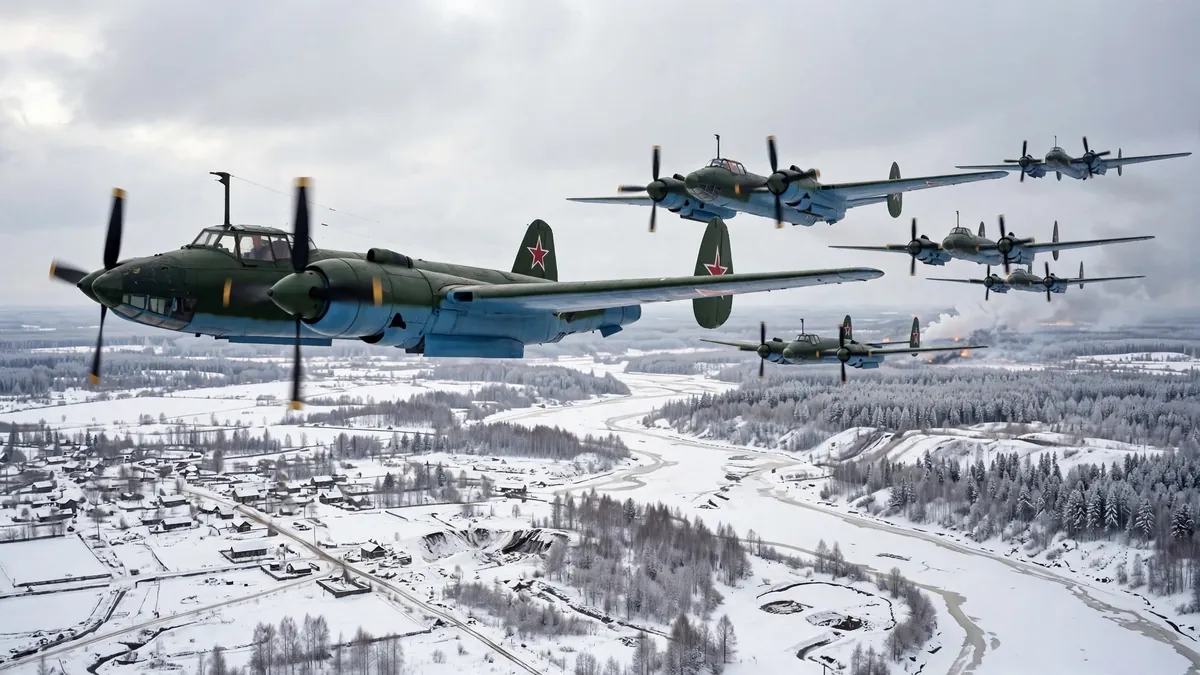
The Tupolev Tu-2 was the finest twin-engine bomber built by the Soviet Union during the Second World War, and one of the best medium bombers of the conflict as a whole. Designed in a prison design bureau by Andrei Tupolev and his team, the Tu-2 combined the speed of a fighter with the bomb load of a medium bomber: it could carry up to 3,000 kilograms of bombs, defend itself with cannon and heavy machine guns, and outrun many of the fighters sent to intercept it.
It entered service in 1942, fought at Stalingrad and Kursk, supported the Soviet advance to Berlin in 1945, and then served in the campaign against Japan in Manchuria — a career that carried it from the darkest days of the Eastern Front to the victory parades of 1945.
The Tu-2’s story is inseparable from the strange circumstances of its birth. Its designer, Andrei Tupolev, was arrested in the Great Purge of 1937 and imprisoned as an “enemy of the people”, along with many of the Soviet Union’s leading aircraft engineers.
The aircraft that became the Tu-2 was designed in the sharaga — the secret prison design bureau at Bolshevo and later in Moscow — where imprisoned engineers worked under NKVD guards on projects the state demanded. That a design produced under such conditions should have become one of the war’s best bombers is one of the ironies of Soviet aviation history, and a testament to the skill of Tupolev’s team, who built a modern, all-metal, twin-engine bomber with limited resources and under constant threat.
About 2,257 Tu-2s were built during the war and in the years immediately after it, a modest total beside the tens of thousands of Il-2s and Pe-2s that filled the Soviet skies. Yet the Tu-2 was the aircraft Soviet bomber crews preferred, and the one the German Luftwaffe respected most. It remained in service long after the war, in the Soviet Union, China and North Korea, and it flew in the Korean War — a longevity that testifies to the soundness of a design born in a prison cell.
2. Key Facts
| Role | Twin-engine medium bomber (also reconnaissance and torpedo bomber) |
| Manufacturer | Tupolev Design Bureau; built at Kazan, Omsk and other plants |
| Designer | Andrei Tupolev (in the sharaga prison bureau) |
| First flight | 29 January 1941 (as ANT-58) |
| Introduced | 1942 |
| Produced | About 2,257 |
| Crew | 4 (pilot, navigator, radio operator, gunner) |
| Engines | 2 × Shvetsov ASh-82FN radial, about 1,850 hp each |
| Maximum speed | About 521 km/h (324 mph) |
| Range | About 2,020 km (1,255 miles) |
| Bomb load | Up to 3,000 kg (6,600 lb) |
| Armament | 2 × 20 mm ShVAK cannon; 3 × 12.7 mm UBT machine guns |
| Main users | Soviet Union, China, North Korea, Poland, Bulgaria |
| Fate | Served to the 1950s; flew in the Korean War; a few survive in museums |
3. Origins and Requirements
The prison design bureau
In October 1937, at the height of Stalin’s Great Purge, Andrei Tupolev — the Soviet Union’s most famous aircraft designer, the man behind the TB-3 heavy bomber and the ANT-25 record aircraft — was arrested on charges of sabotage and espionage. He was sentenced to fifteen years and sent to work in the sharaga, the NKVD’s system of prison design bureaus, where arrested engineers were put to work on state projects under guard. Tupolev’s bureau, first at Bolshevo and later in Moscow, was given the task of designing a new high-speed twin-engine bomber, and it was there, in 1938 and 1939, that the aircraft that became the Tu-2 took shape under the internal designation ANT-58, or “Aircraft 103”.
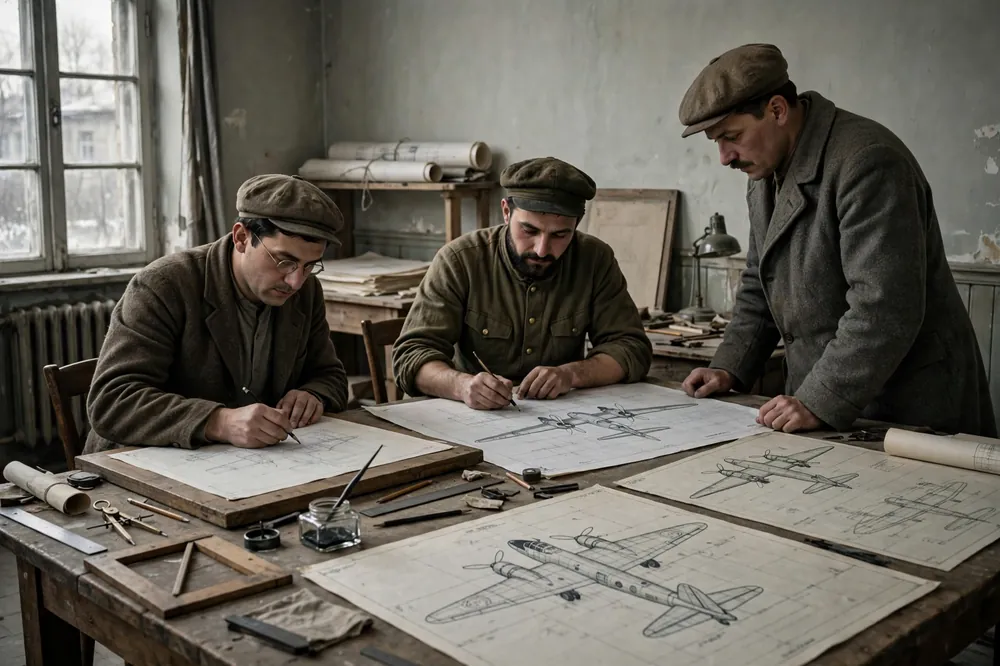
The design brief was demanding. The new bomber had to be fast — fast enough to outrun contemporary fighters — and it had to carry a useful bomb load over a long range, with a crew of four and a strong defensive armament.
Tupolev’s team, working with slide rules and drawing boards in a guarded building, produced a clean, all-metal, low-wing monoplane with two radial engines, a glazed nose for the navigator-bombardier, and a defensive armament of cannon and heavy machine guns that was far stronger than that of the Soviet bombers then in service.
The first prototype flew on 29 January 1941, and its performance astonished the officials who watched it: it was faster than the fighters of the day, and it handled well.
Delays, evacuation and production
Despite its promise, the Tu-2’s path into service was slow. The Soviet aircraft industry was already committed to the Pe-2 dive bomber and the Il-2 ground-attack aircraft, and the factories that might have built the Tu-2 were busy with those types. Then, in June 1941, Germany invaded the Soviet Union, and the entire industry was thrown into chaos as factories were evacuated eastward beyond the Urals.
The Tu-2’s production was assigned to a factory at Omsk, and the first production aircraft reached the front only in late 1942, more than a year after the prototype’s first flight. Tupolev himself was released from prison in July 1941, after the German invasion made his skills indispensable, and he was formally rehabilitated in 1955.
Production at Omsk and Kazan
Production never reached the scale of the Pe-2, of which more than 11,000 were built, but the Tu-2’s quality compensated for its numbers. About 2,257 were built in total, most of them at Omsk and later at Kazan, and the aircraft was produced in several versions, including the standard Tu-2 bomber, the Tu-2S with improved engines, and reconnaissance and torpedo-bomber variants. The production run continued after the war, and the last Tu-2s were built in the early 1950s, a decade after the prototype first flew.
4. Design and Development
Airframe and layout
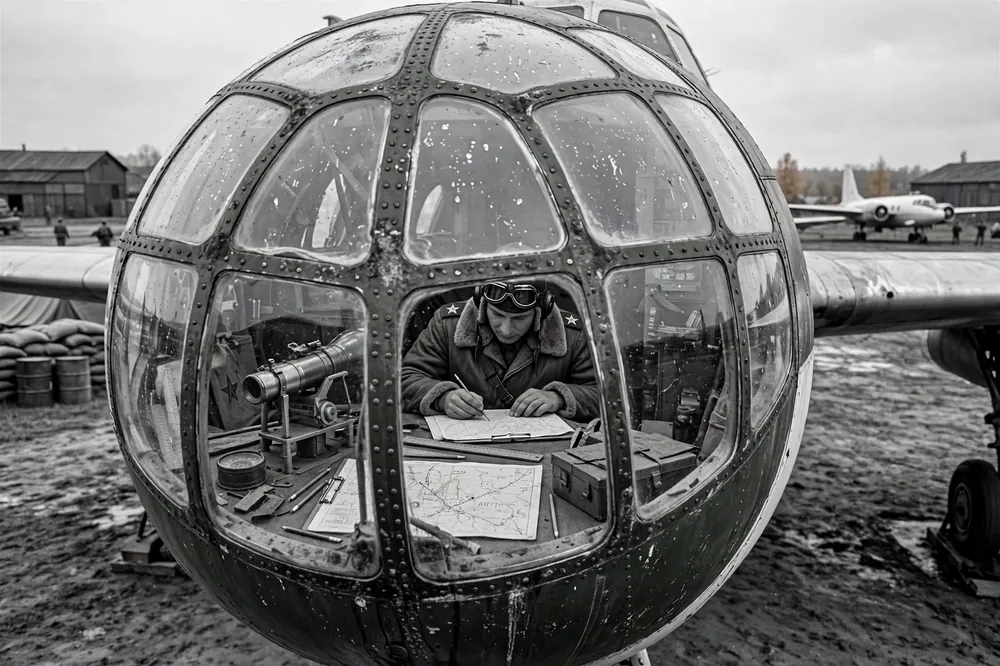
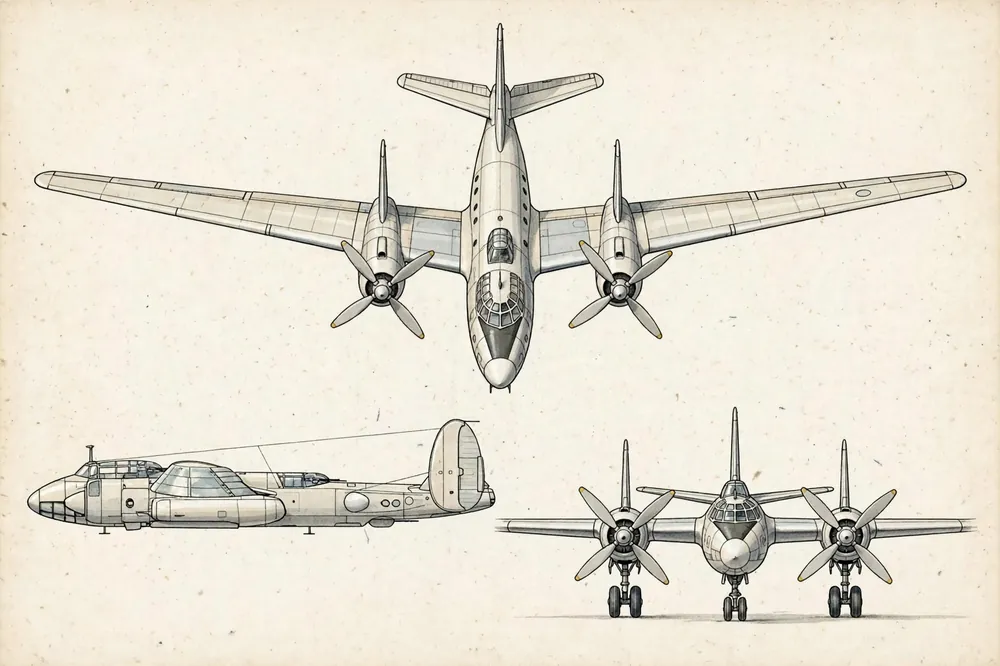
The Tu-2 was a mid-wing monoplane of all-metal construction, with a semi-monocoque fuselage and a two-spar wing. Its crew of four sat in a well-arranged sequence: the navigator-bombardier in the glazed nose, the pilot above and behind him in a raised cockpit with a good view, and the radio operator and the rear gunner in the fuselage behind the wing, with the gunner in a dorsal turret and a ventral position for defence against attacks from below.
The bomb bay, in the centre fuselage, could hold up to 2,000 kilograms of bombs internally, with a further 1,000 kilograms on external racks. The landing gear retracted rearward into the engine nacelles, and the aircraft’s clean lines gave it a speed that surprised everyone who flew against it.
Defensive armament
The aircraft’s most distinctive feature was its defensive armament. Where most Soviet bombers of the period carried only light machine guns, the Tu-2 carried two 20 mm ShVAK cannon — one fixed, firing forward, and one in the dorsal turret — together with three 12.7 mm UBT heavy machine guns in the nose, ventral and rear positions.
This was a formidable armament for a bomber, and German fighter pilots learned to respect it: a Tu-2 formation could put up a dense field of fire, and single fighters that pressed home an attack often paid for it. The aircraft also carried armour plate around the crew positions and self-sealing fuel tanks, protections that the Japanese and, in the early war, the German bombers often lacked.
Engines and the ASh-82
The Tu-2’s definitive engine was the Shvetsov ASh-82FN, a fourteen-cylinder, twin-row radial of about 1,850 horsepower, fitted with direct fuel injection. The ASh-82 was a development of the American Wright Cyclone, built under licence in the Soviet Union and progressively improved by Soviet engineers, and it was one of the most successful Soviet engines of the war: it also powered the Lavochkin La-5 and La-7 fighters, the aircraft that won air superiority over the Eastern Front.
In the Tu-2 it gave the bomber a maximum speed of about 521 km/h, a cruising speed of roughly 400 km/h, and a range of about 2,020 kilometres with a normal bomb load — figures that made the Tu-2 faster than the German Ju 88 and He 111 bombers it faced, and faster than many of the fighters sent to intercept it.
From the AM-37 to the ASh-82FN
Early Tu-2s used the less powerful AM-37 liquid-cooled engine, and later production aircraft used the ASh-82F and ASh-82FN versions, each more powerful than the last. The change to the radial engine simplified maintenance in the field, since the ASh-82 was already in wide service with the fighter force, and it made the Tu-2 more tolerant of the rough front-line airfields of the Eastern Front. The aircraft’s performance did decline with a full bomb load and at low altitude, as all bombers’ does, but even heavily loaded the Tu-2 was a fast aircraft by the standards of 1943 and 1944.
5. Technical Description
Bomb load and attack profiles
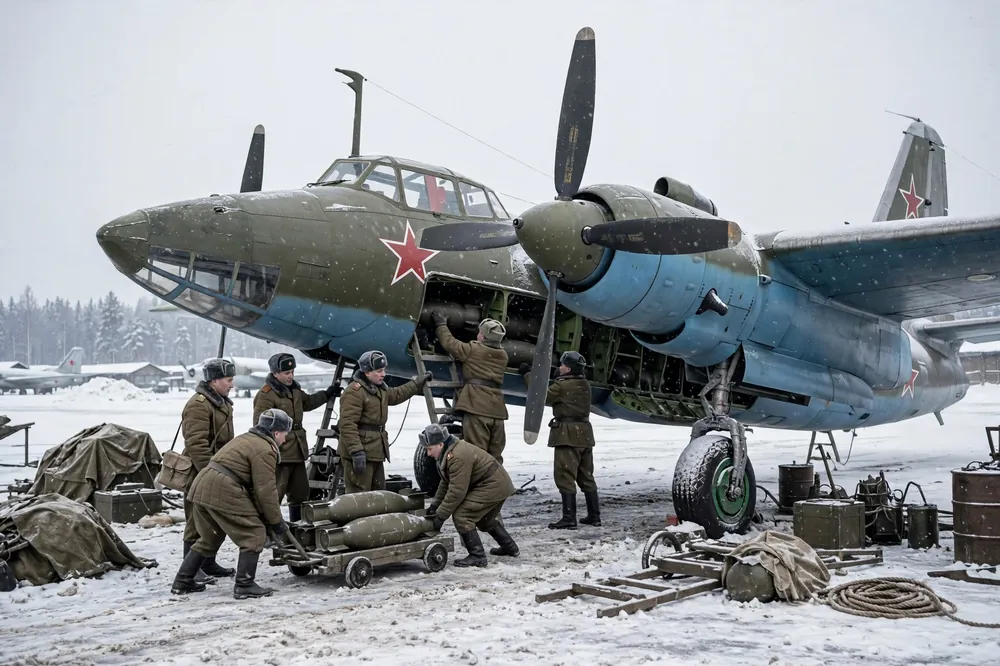
The Tu-2 was designed as a level bomber, but its strength and speed let it be used in roles its designers had not foreseen. In its normal configuration it carried up to 3,000 kilograms of bombs: 2,000 kilograms in the internal bomb bay and 1,000 kilograms on wing racks, in combinations of 100, 250, 500 and 1,000-kilogram bombs, or a single 1,000-kilogram bomb for attacks on fortified targets.
Soviet crews also used the Tu-2 as a dive bomber, putting the aircraft into a steep dive of up to 60 degrees and releasing at low altitude — a demanding manoeuvre for a twin-engine bomber, but one the Tu-2’s strong airframe could take.
Dive bombing gave the Tu-2 an accuracy against bridges, rail yards and fortifications that level bombing could not match, and it became one of the aircraft’s most valued roles in 1944 and 1945.
The navigator-bombardier aimed the bombs through a bombsight in the glazed nose, and the pilot flew the aircraft on the bombing run while the gunners watched for fighters. The aircraft’s defensive armament — the two ShVAK cannon and the three UBT machine guns — covered the forward, upper, lower and rear arcs, and the crew worked as a team, calling out fighter approaches and shifting fire between positions. Soviet accounts record Tu-2 gunners shooting down German fighters with some regularity, and German pilots’ memoirs confirm that attacking a Tu-2 formation was a dangerous business, quite unlike attacking the poorly armed Soviet bombers of 1941.
Handling, maintenance and field service
Crews liked the Tu-2. It was stable in flight, responsive on the controls, and forgiving of the rough handling that front-line operations demanded. Its landing speed was moderate for a bomber of its size, and it could operate from the short, unpaved strips that Soviet engineers built near the front — a critical advantage on the Eastern Front, where airfields were often little more than cleared fields.
Maintenance was straightforward by Soviet standards: the ASh-82 engines were familiar to every Soviet mechanic, the airframe was robust, and the aircraft could be kept flying with limited spares and simple tools. Soviet ground crews, working in the open in winter temperatures of minus 30 degrees, kept the Tu-2 in the air through conditions that would have grounded many Western aircraft.
6. Variants
The Tu-2 family included several production and experimental versions, though the differences between them were smaller than the differences in some other Soviet types. The Tu-2 itself, the initial production version, was built in modest numbers with the AM-37 engine before production switched to the ASh-82. The Tu-2S was the main wartime production version, with the ASh-82FN engine, improved defensive armament and minor changes to the airframe; most of the 2,257 aircraft built were Tu-2S machines, and it was this version that fought from Kursk to Berlin.
Other versions included the Tu-2R, a reconnaissance version with cameras in place of some of the bomb load, which served with reconnaissance regiments and proved valuable for the photographic survey of German defences before major offensives. The Tu-2T was a torpedo-bomber version for the Soviet Naval Air Force, armed with two 450-millimetre torpedoes and used against German shipping in the Baltic and the Black Sea.
Experimental versions included a high-altitude version with turbocharged engines, a night-fighter version that never entered production, and the Tu-2Sh ground-attack version with a heavy cannon armament, of which only a handful were built. After the war, the Tu-2 was developed into the Tu-6, Tu-8 and Tu-10, and its airframe was the basis for the Tu-4’s predecessor studies, though the Tu-4 itself was a copy of the American B-29.
7. Combat Service
Stalingrad and Kursk
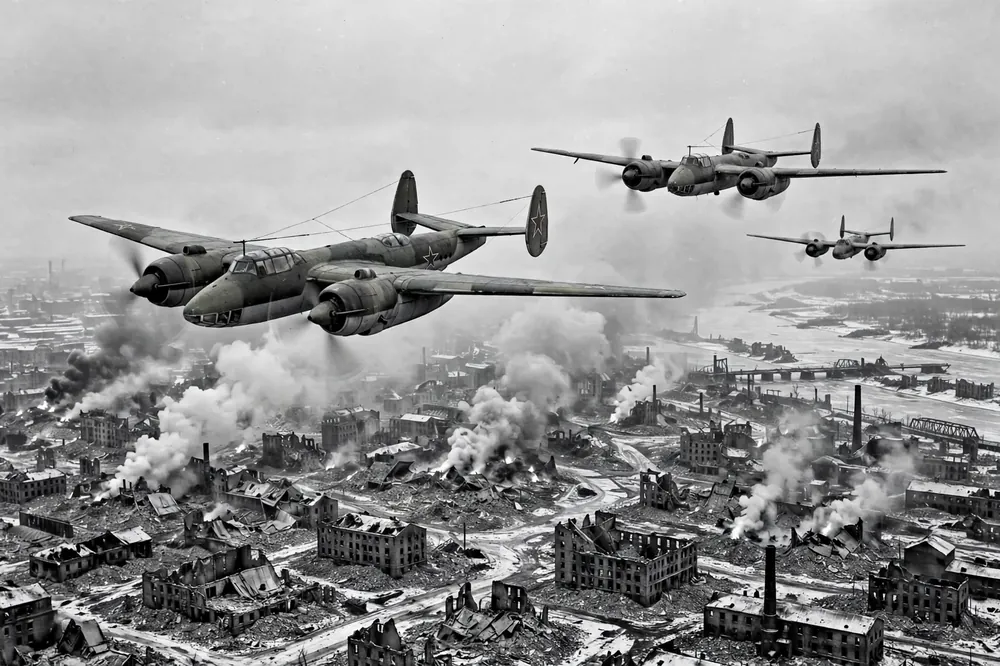
The Tu-2 reached the front in late 1942, in time for the Soviet counter-offensive at Stalingrad. The first units to receive it, including the 132nd Bomber Regiment, used it against German supply columns, airfields and troop concentrations around the encircled Sixth Army, and the aircraft’s speed and defensive firepower made an immediate impression: unlike the older SB and Pe-2 bombers, the Tu-2 could survive a fighter attack and still deliver its bombs. At Kursk in July 1943, Tu-2s flew against German armour and artillery in the greatest tank battle of the war, and their dive-bombing attacks on German positions were credited with destroying tanks, guns and supply vehicles at a rate the older bombers could not match.
The advance to Berlin
In 1944 and 1945 the Tu-2 became one of the mainstays of the Soviet bomber force. It flew in the great offensives of the summer of 1944 — Operation Bagration, which destroyed the German Army Group Centre in Belorussia — and in the Vistula-Oder offensive of January 1945, which carried the Red Army from Poland to the Oder river.
In the Battle of Berlin, Tu-2s attacked German strongpoints, bridges and troop concentrations in and around the city, and they flew some of the last bombing missions of the European war. Soviet records credit the type with a high rate of serviceability and a low loss rate relative to the older bombers, and the aircraft’s crews — many of them decorated with the title Hero of the Soviet Union — regarded it as the best bomber they had flown.
Manchuria and the post-war years
The Tu-2’s last wartime campaign was the Soviet invasion of Manchuria in August 1945, where Tu-2s of the Far Eastern air armies attacked Japanese fortifications, railways and airfields in support of the rapid Soviet advance. The campaign lasted only a few weeks, but it demonstrated the aircraft’s versatility in a new theatre, against an enemy whose air defences were weak and whose ground forces were already collapsing.
After the war the Tu-2 remained in Soviet service into the early 1950s, and it was exported widely: China received large numbers and used them in the Chinese Civil War and the Korean War, North Korea flew them in the opening months of the Korean War, and Poland, Bulgaria and other Soviet allies operated the type into the 1950s.
8. Specifications
The figures below are for the Tu-2S, the main production version. Sources differ slightly on weights and performance, and the aircraft’s figures varied with bomb load, fuel and the condition of the individual machine.
| Tu-2S | |
|---|---|
| Length | 13.80 m / 13,80 m |
| Wingspan | 18.86 m / 18,86 m |
| Height | 4.13 m / 4,13 m |
| Wing area | 48.8 m² / 48,8 m² |
| Empty weight | About 7,474 kg |
| Loaded weight | About 11,360 kg |
| Engines | 2 × Shvetsov ASh-82FN, about 1,850 hp each |
| Maximum speed | About 521 km/h |
| Cruising speed | About 400 km/h |
| Range | About 2,020 km |
| Service ceiling | About 9,500 m |
| Bomb load | Up to 3,000 kg |
| Armament | 2 × 20 mm ShVAK; 3 × 12.7 mm UBT / 2 × ShVAK 20 mm; 3 × UBT 12,7 mm |
| Crew | 4 |
Against its contemporaries the Tu-2 compared very favourably. The German Ju 88, the Luftwaffe’s standard medium bomber, was slower, carried a smaller bomb load in its normal configuration and was less heavily armed for defence. The American B-25 Mitchell, the closest Allied equivalent, was a fine aircraft in its own right, but the Tu-2 was faster and carried a heavier defensive armament. Only the British de Havilland Mosquito, a wooden aircraft built for speed above all else, clearly outran the Tu-2 — and the Mosquito carried a smaller bomb load and had a crew of two. The Tu-2’s combination of speed, payload, armament and ruggedness was, in the judgement of most historians, unmatched among the twin-engine bombers of the war.
9. Operators
The Soviet Union was the Tu-2’s principal operator, and the aircraft served in the bomber regiments of the Soviet Air Force and the Naval Air Force from 1942 until the early 1950s. At its peak, dozens of regiments flew the type, and it was the preferred bomber of the Soviet long-range and front-line bomber forces alike. After the war, the Soviet Union exported the Tu-2 to its allies and to China: the Chinese People’s Liberation Army Air Force received large numbers and used them in the Chinese Civil War, in the Korean War, and in the suppression of Nationalist-held islands in the 1950s, and the type remained in Chinese service into the late 1950s.
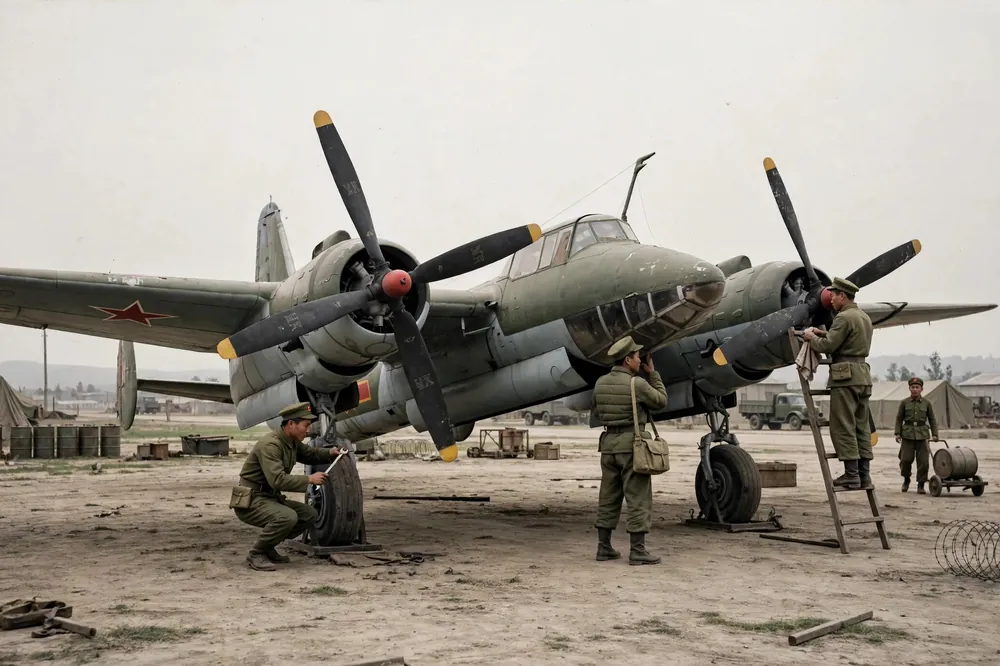
North Korea flew the Tu-2 in the opening phase of the Korean War in 1950, where a small number of North Korean Tu-2s attacked South Korean and United Nations targets before being destroyed on the ground or shot down by American fighters. Poland, Bulgaria, Romania and Indonesia also operated the type in the late 1940s and 1950s, usually in small numbers and for training and second-line roles. No Western air force operated the Tu-2, though captured examples were examined by Allied technical teams after the war, and the aircraft’s performance figures were studied with respect by Western analysts.
10. Legacy and Assessment
A design born in prison
The Tu-2’s legacy is bound up with the story of its creation. That one of the best bombers of the Second World War was designed by imprisoned engineers, working under guard in a secret bureau, is a fact that historians return to again and again — not as a curiosity, but as evidence of the resilience of Soviet engineering and of the wastefulness of the Purge, which put the country’s best designers in prison at the very moment their skills were most needed.
Tupolev was released in 1941 and went on to design the Tu-4, the Tu-95 and the Tu-104 airliner, becoming one of the great names of Soviet aviation; the Tu-2 was the aircraft that proved, under the worst possible conditions, what his team could do.
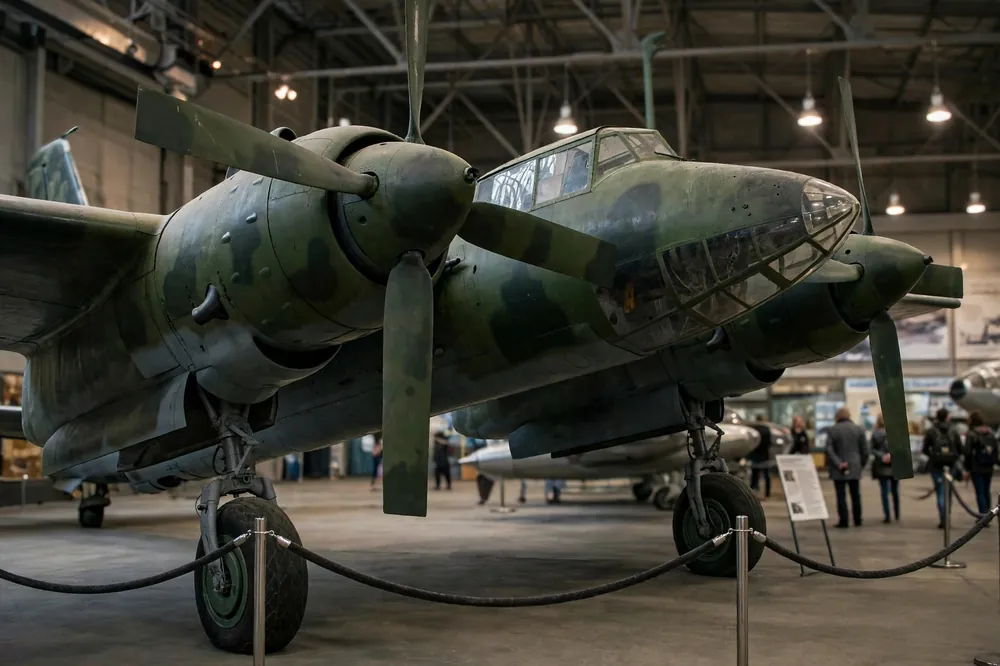
As an aircraft, the Tu-2 is judged by historians as one of the outstanding medium bombers of the war, and arguably the best twin-engine bomber the Soviet Union ever built. Its speed, its bomb load, its defensive armament and its ruggedness were a combination no other Soviet bomber matched, and its service record — from Stalingrad to Berlin, from Manchuria to Korea — speaks for itself.
Its one weakness was that it arrived too late and in too few numbers to change the course of the war on the Eastern Front, where the older Pe-2 did most of the bombing. Had the Tu-2 entered service a year earlier, and in the numbers the Pe-2 achieved, the Soviet bomber force would have been a still more formidable instrument.
Survivors
A small number of Tu-2s survive in museums, most of them in Russia and China. The Central Air Force Museum at Monino, near Moscow, displays a Tu-2, and examples are preserved in China and in Poland, where the type served after the war. These survivors are a reminder of an aircraft that was, in the judgement of the men who flew it, the best bomber the Soviet Union built during the war — and of the extraordinary circumstances in which it was created.
11. FAQ
What was the Tupolev Tu-2? / Tupolev Tu-2 là gì?
The Tupolev Tu-2 was a Soviet twin-engine medium bomber of the Second World War, designed by Andrei Tupolev and his team in a prison design bureau and first flown on 29 January 1941. It carried a crew of four, up to 3,000 kilograms of bombs, and a heavy defensive armament of two 20 mm cannon and three 12.7 mm machine guns, and it was faster than many of the fighters sent to intercept it, with a maximum speed of about 521 km/h. It entered service in late 1942 and fought at Stalingrad, Kursk and Berlin, and it was the aircraft Soviet bomber crews preferred and the one the German Luftwaffe respected most.
Was the Tu-2 really designed in prison?
Yes. Andrei Tupolev was arrested in the Great Purge of October 1937 and imprisoned in the NKVD’s sharaga system of prison design bureaus, where arrested engineers were put to work on state projects under guard. The aircraft that became the Tu-2 was designed there, under the designation ANT-58, in 1938 and 1939, by Tupolev and a team that included many of the Soviet Union’s leading aircraft engineers. Tupolev was released in July 1941, after the German invasion made his skills indispensable, and he was formally rehabilitated in 1955, going on to design the Tu-95 and the Tu-104 airliner.
How many Tu-2s were built?
About 2,257 Tu-2s were built in total, most of them the Tu-2S version with the Shvetsov ASh-82FN engine, at factories in Omsk and later in Kazan. This was a small total beside the more than 11,000 Pe-2s built, but the Tu-2 was the better aircraft and the one Soviet crews preferred, and its production was limited by the priority given to the Pe-2 and the Il-2, which were already in large-scale production when the Tu-2 was ready. Production continued after the war, and the last Tu-2s were built in the early 1950s, a decade after the prototype first flew.
How fast was the Tu-2?
The Tu-2S had a maximum speed of about 521 km/h, with a cruising speed of roughly 400 km/h and a range of about 2,020 kilometres with a normal bomb load. This made it faster than the German Ju 88 and He 111 bombers it faced, and faster than many contemporary fighters, a remarkable achievement for a twin-engine bomber carrying up to 3,000 kilograms of bombs. Its speed was one of the reasons Soviet crews liked it: it could outrun the fighters sent to intercept it, and it could survive a fighter attack and still deliver its bombs, unlike the older Soviet bombers that had been shot down in large numbers in 1941.
What was the Tu-2’s bomb load?
The Tu-2 could carry up to 3,000 kilograms of bombs: 2,000 kilograms in the internal bomb bay and 1,000 kilograms on external wing racks, in combinations of 100, 250, 500 and 1,000-kilogram bombs, or a single 1,000-kilogram bomb for attacks on fortified targets. Soviet crews also used the Tu-2 as a dive bomber, putting the aircraft into a steep dive of up to 60 degrees and releasing at low altitude, a demanding manoeuvre that the Tu-2’s strong airframe could take. A torpedo-bomber version, the Tu-2T, carried two 450-millimetre torpedoes and served with the Soviet Naval Air Force against German shipping in the Baltic and the Black Sea.
Did the Tu-2 fight in the Korean War?
Yes. Chinese and North Korean Tu-2s flew in the Korean War, with North Korean aircraft attacking United Nations targets in the opening months of 1950 and Chinese aircraft flying later in the war, in night bombing and in attacks on United Nations positions. The type remained in service in China into the late 1950s, and it was used in the Chinese Civil War and in the suppression of Nationalist-held islands in the 1950s. The Tu-2’s service in Korea, a decade after its first flight, was a testament to the soundness of a design born in a prison cell, and to the aircraft’s ruggedness and versatility in the hands of the air forces that flew it.
12. Sources
- Wikipedia, “Tupolev Tu-2” — production figures (about 2,257 built), first flight, performance data and service history.
- Yefim Gordon and Dmitri Khazanov, Soviet Combat Aircraft of the Second World War, Volume 2: Twin-Engined Fighters, Attack Aircraft and Bombers (Midland, 2006) — the standard English-language reference on the Tu-2.
- Von Hardesty, Red Phoenix: The Rise of Soviet Air Power, 1941–1945 (Smithsonian, 1982) — the Tu-2 in Soviet service from Stalingrad to Berlin.
- Mark Harrison, Soviet Planning in Peace and War, 1938–1945 (Cambridge University Press, 1985) — the sharaga system and the evacuation of the aircraft industry.
- United States Strategic Bombing Survey, The Soviet Aircraft Industry (1947) — production figures and factory data.
- Bill Gunston, Tupolev Aircraft since 1922 (Naval Institute Press, 1995) — Tupolev’s career and the Tu-2’s development.
- Dmitriy Khazanov, Tupolev Tu-2 (in Russian, with English summaries), Moscow, 2002.
- Christer Bergström, The Air War on the Eastern Front (various volumes) — the Tu-2 in combat.