 WAR ATLAS MILITARY HISTORY MAGAZINE · WWI — WWII
Cold War
1. Lead
The Cold War was the long political, military, and ideological rivalry between the United States and the Soviet Union that dominated world politics from 1947 to 1991. It was called “cold” because the two superpowers never fought each other directly in open war — but the rivalry was anything but peaceful.
It divided Europe with an Iron Curtain, split Germany and Korea into two states, fuelled wars in Korea, Vietnam, and Afghanistan, and brought the world to the edge of nuclear destruction during the Cuban Missile Crisis of October 1962. For more than four decades, every major international question — from the division of Berlin to the space race, from the price of oil to the independence of former colonies — was shaped by the contest between the capitalist West, led by the United States, and the communist East, led by the Soviet Union.
The Cold War began almost as soon as World War II ended. The alliance that had defeated Nazi Germany — the United States, the Soviet Union, and Britain — broke apart over the future of Europe. The Soviet Union, which had suffered about 26 to 27 million dead in the war, wanted friendly governments on its western border to prevent another invasion from the west.
The United States, which emerged from the war as the world’s richest and most powerful country, wanted open markets and democratic governments in Europe. By 1947 the two sides were building rival blocs: the United States offered the Marshall Plan to rebuild Western Europe, and the Soviet Union tightened its control over Eastern Europe, installing communist governments in Poland, Hungary, Romania, Bulgaria, and Czechoslovakia.
The Cold War ended suddenly and unexpectedly between 1989 and 1991. In 1989 the Berlin Wall fell, communist governments collapsed across Eastern Europe, and Germany reunified in October 1990. In December 1991 the Soviet Union itself dissolved into 15 independent republics, and the Cold War was over. The United States emerged as the world’s only superpower, and the ideological contest that had defined a generation came to an end — though its legacies, from NATO’s expansion to the division of Korea, still shape world politics today.
2. Key Facts
| Dates | 1947 (Truman Doctrine) – 26 December 1991 (dissolution of the USSR); commonly dated 1947–1991 |
| Main rivals | United States and its allies (the West) vs. Soviet Union and its allies (the East) |
| Direct war between superpowers | None — the rivalry was fought through proxy wars, espionage, arms races and propaganda |
| Key dividing line | The Iron Curtain across Europe; the Berlin Wall (1961–1989) |
| Main alliances | NATO (founded 1949) vs. Warsaw Pact (founded 1955) |
| Major proxy wars | Korean War (1950–1953), Vietnam War (1955–1975), Soviet–Afghan War (1979–1989) |
| Closest to nuclear war | Cuban Missile Crisis, October 1962 |
| Nuclear arsenals at peak | About 70,000 nuclear weapons worldwide in the mid-1980s (US and USSR combined) |
| End | Fall of the Berlin Wall (9 November 1989); German reunification (3 October 1990); USSR dissolved (December 1991) |
| Human cost | Millions died in proxy wars: about 3 million in Korea, 2–3 million in Vietnam, about 1–2 million in Afghanistan |
3. Origins: From Allies to Rivals
The Cold War was born from the victory of World War II itself. The wartime alliance between the United States, the Soviet Union, and Britain had been a marriage of convenience: all three needed each other to defeat Germany and Japan, but they disagreed profoundly about what the post-war world should look like. At the Yalta Conference in February 1945, Franklin D.
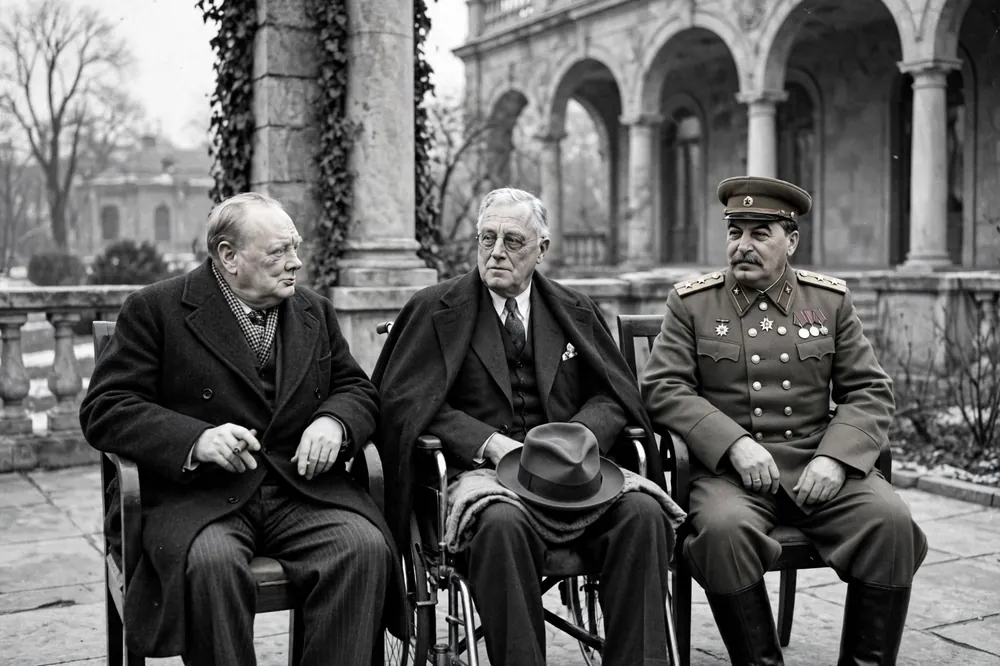
Roosevelt, Winston Churchill, and Joseph Stalin agreed that liberated Europe would hold free elections and that Germany would be divided into occupation zones. But the agreement was vague, and each side read it differently. The Soviet Union, which had lost about 26 to 27 million people — more than any other country — insisted on security above all: it wanted governments in Eastern Europe that would never again allow an invasion from the west.
The Western Allies insisted on democracy and free elections.
By 1946 the disagreement had become open. In March 1946, Winston Churchill — no longer Prime Minister — gave a famous speech in Fulton, Missouri, warning that “from Stettin in the Baltic to Trieste in the Adriatic, an iron curtain has descended across the Continent”. Behind that curtain, he said, the Soviet Union was imposing communist rule on Eastern Europe. In the same year, the Soviet Union refused to withdraw its troops from northern Iran on schedule, and crises flared in Greece, where communist guerrillas fought the government, and in Turkey, where the Soviet Union demanded control of the straits. The wartime alliance was dead.
In March 1947 President Harry S. Truman announced the Truman Doctrine: the United States would support free peoples resisting subjugation, beginning with aid to Greece and Turkey. Historians generally date the start of the Cold War to this moment. Three months later, Secretary of State George Marshall proposed the Marshall Plan — American aid to rebuild the economies of Europe. The Soviet Union forbade Eastern European countries from accepting Marshall aid, and instead created its own economic organisation, Comecon, in 1949. Europe was now divided into two camps, each with its own economy, its own political system, and its own military alliance.
Historians still debate who was most responsible for the Cold War. Traditional Western accounts blame Soviet expansionism; revisionist historians blame American economic and political ambitions; post-revisionists argue that both sides acted from fear and misunderstanding, and that the structure of the post-war world — two superpowers, each convinced the other was a threat — made conflict almost inevitable. What is clear is that neither side wanted a direct war. Both had seen what total war meant. The Cold War was the result of two powers trying to secure themselves in a world where the other seemed dangerous — and each side’s measures to feel safe made the other feel less safe.
4. The Two Blocs
By the early 1950s the Cold War had hardened into two rival blocs, each with its own military alliance, economic system, and ideology. The Western bloc was led by the United States and organised around the North Atlantic Treaty Organization (NATO), founded in April 1949 with 12 members, including the United States, Canada, Britain, and France.
NATO’s founding principle was collective defence: an attack on one member would be treated as an attack on all. The Western bloc’s economy was capitalist, based on private ownership and market competition, and its political systems were — with exceptions — parliamentary democracies. The United States stationed hundreds of thousands of troops in Western Europe and built a network of military bases around the world.
The Eastern bloc was led by the Soviet Union and organised around the Warsaw Pact, founded in May 1955 in response to West Germany’s entry into NATO. Its members were the Soviet Union, Poland, East Germany, Czechoslovakia, Hungary, Romania, Bulgaria, and Albania (which left in 1968). The Eastern bloc’s economy was centrally planned, with state ownership of industry and collective agriculture, and its political systems were one-party communist states, closely supervised by Moscow. The Soviet Union stationed large forces in Eastern Europe, and twice — in Hungary in 1956 and Czechoslovakia in 1968 — used military force to crush attempts by its allies to reform or leave the bloc.
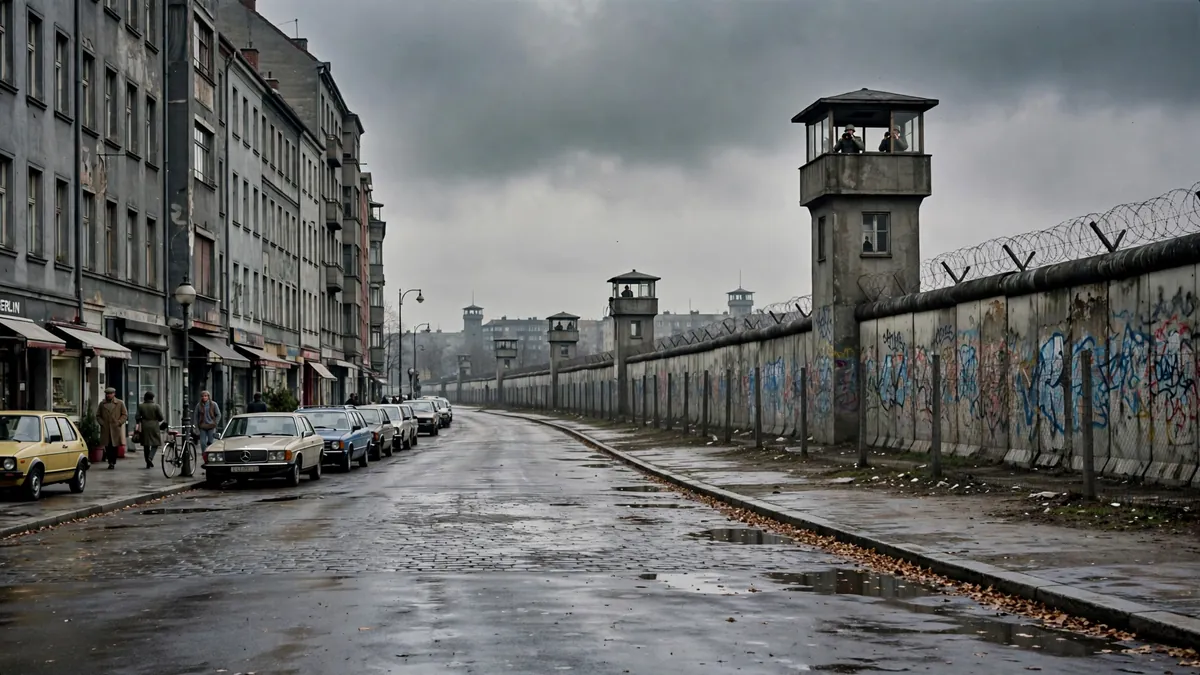
Between the two blocs lay the divided heart of Europe. Germany was split into the Federal Republic of Germany (West Germany, founded May 1949) and the German Democratic Republic (East Germany, founded October 1949). Berlin, deep inside East Germany, was itself divided into Western and Soviet sectors. In August 1961 East Germany built the Berlin Wall to stop its citizens fleeing to the West — by then about 3.5 million East Germans, roughly a fifth of the population, had left. The Wall became the most famous symbol of the Cold War: 96 miles (155 km) of concrete, barbed wire, and guard towers dividing a single city.
Outside Europe, the two blocs competed for influence across the world. The United States built alliances in Asia (with Japan, South Korea, and others) and the Middle East; the Soviet Union supported communist movements and governments in Asia, Africa, and Latin America. Many countries tried to stay out of the rivalry altogether: in 1961 Yugoslavia, Egypt, India, and Indonesia helped found the Non-Aligned Movement, which at its height included more than 100 countries. But even non-aligned states were courted, pressured, and sometimes destabilised by both superpowers.
5. Crises and Proxy Wars
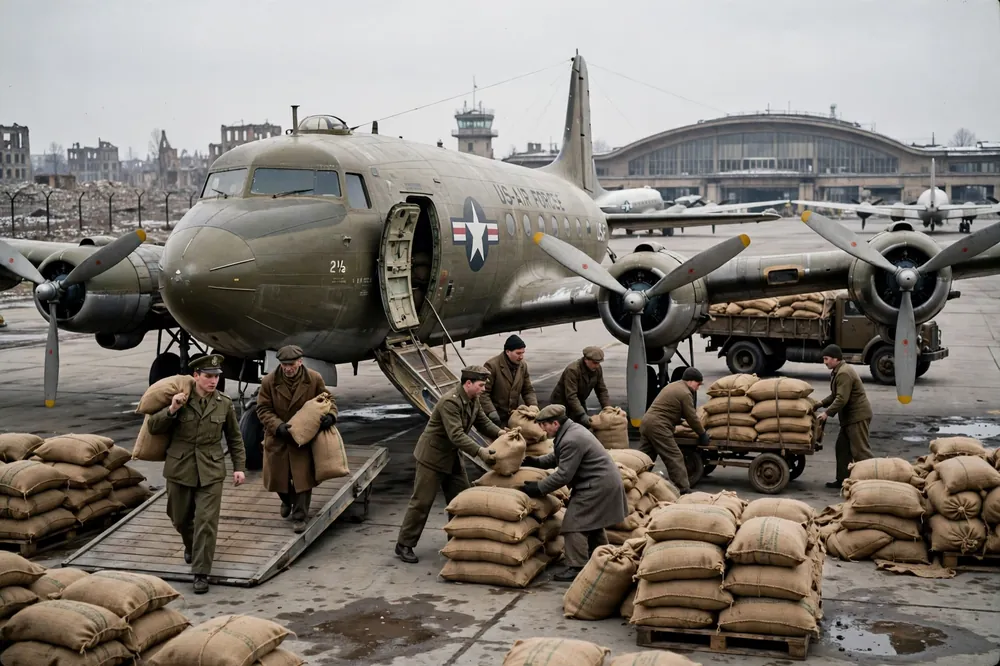
The Cold War never became a direct war between the superpowers, but it produced a series of crises and proxy wars that killed millions. The first great test came in 1948–1949, when the Soviet Union blockaded West Berlin, cutting off road and rail access in an attempt to force the Western Allies out of the city. The United States, Britain, and France answered with the Berlin Airlift: for almost a year, cargo aircraft flew in food and fuel around the clock, landing a plane roughly every minute at the height of the operation. The blockade failed, and in May 1949 the Soviet Union lifted it. West Berlin remained a Western enclave inside East Germany for the next 40 years.
The Korean War (1950–1953) was the first major proxy war. When North Korea invaded South Korea in June 1950, the United States intervened under the flag of the United Nations; China then intervened on North Korea’s side, and the war settled into a bloody stalemate along roughly the original border. About three million people died, including about 36,000 Americans and hundreds of thousands of Chinese soldiers. The war ended in an armistice in July 1953, not a peace treaty, and Korea remains divided today along the 38th parallel.
The most dangerous moment of the Cold War came in October 1962, during the Cuban Missile Crisis. After the United States discovered that the Soviet Union was installing nuclear missiles in Cuba, just 90 miles from Florida, President John F. Kennedy imposed a naval blockade and demanded their removal. For 13 days the world waited while American and Soviet leaders negotiated, with Soviet ships approaching the blockade line and American forces on high alert. The crisis ended when Soviet leader Nikita Khrushchev agreed to remove the missiles in exchange for an American pledge not to invade Cuba and a secret agreement to remove American missiles from Turkey. Historians consider it the closest the world has ever come to nuclear war.
The Vietnam War (1955–1975) was the longest and most divisive proxy war. The United States supported South Vietnam against communist North Vietnam and the Viet Cong; by 1968 more than 500,000 American troops were in Vietnam. The war killed an estimated 2 to 3 million Vietnamese and about 58,000 Americans, and it ended with the fall of Saigon in April 1975 and the reunification of Vietnam under communist rule. The war deeply divided American society and damaged American confidence for a generation.
Other Cold War conflicts included the Soviet invasion of Afghanistan in December 1979, which began a nine-year war that killed an estimated 1 to 2 million Afghans and about 15,000 Soviet soldiers, and contributed to the Soviet Union’s eventual collapse. In the Middle East, the Arab–Israeli wars of 1967 and 1973 drew in both superpowers. In Latin America, Africa, and Southeast Asia, the United States and the Soviet Union supported rival governments, guerrilla movements, and coups — sometimes with devastating consequences for the people caught between them. The Cold War was “cold” only for Americans and Russians at home; for millions of people in Korea, Vietnam, Afghanistan, Angola, and elsewhere, it was very hot indeed.
6. The Arms Race and the Space Race
The Cold War was defined as much by weapons as by politics. Both superpowers built enormous nuclear arsenals, guided by the doctrine of deterrence: each side would avoid attacking because it knew the other could retaliate with devastating force. The United States tested the first atomic bomb in July 1945 and used two against Japan the following month.
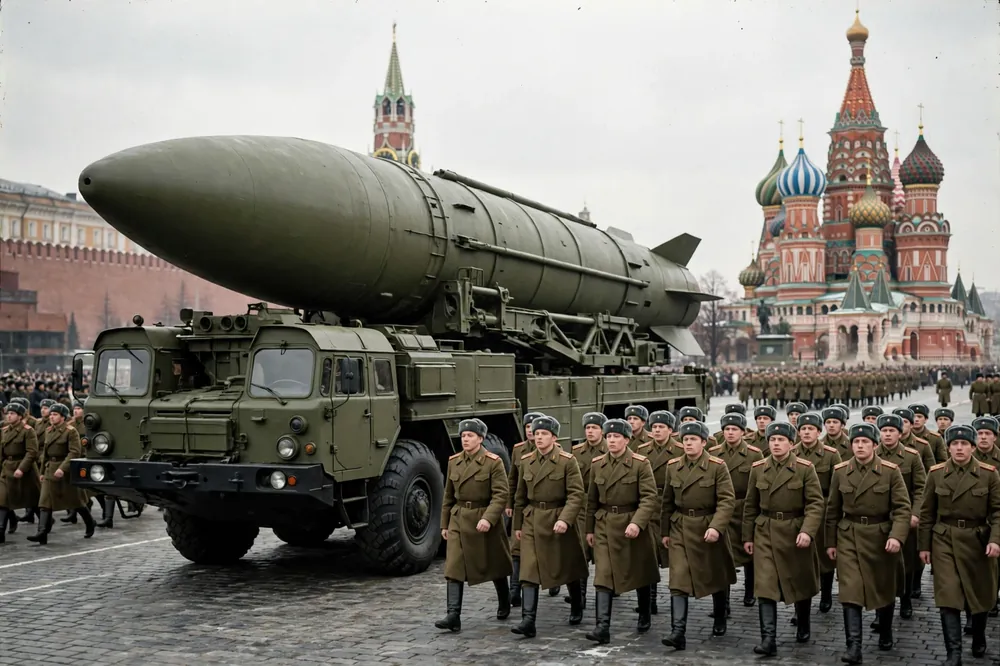
The Soviet Union tested its first atomic bomb in August 1949, ending the American monopoly years earlier than Washington expected. Britain tested its first bomb in 1952, France in 1960, and China in 1964. In 1952 the United States tested the first hydrogen bomb, a weapon hundreds of times more powerful than the bombs dropped on Japan; the Soviet Union followed in 1953.
By the mid-1980s the two superpowers together possessed about 70,000 nuclear weapons — enough to destroy civilisation many times over. The doctrine of Mutually Assured Destruction (MAD) held that neither side would start a nuclear war because both would be destroyed. The logic was terrifying, but it worked: no nuclear weapon has been used in war since 1945.
At the same time, both sides built vast conventional forces — millions of soldiers, tens of thousands of tanks, and fleets of bombers, submarines, and missiles — and spent enormous sums. At the height of the Cold War, the United States and the Soviet Union each devoted roughly 5 to 10 percent or more of their economies to military spending, and the global arms trade supplied weapons to conflicts around the world.
The competition extended into space. On 4 October 1957 the Soviet Union launched Sputnik 1, the first artificial satellite, shocking the United States and triggering a space race. In 1961 the Soviet cosmonaut Yuri Gagarin became the first human in space. The United States answered with the Apollo programme, and on 20 July 1969 Neil Armstrong and Buzz Aldrin became the first humans to walk on the Moon. The space race was partly about prestige and partly about missiles — the same rockets that carried satellites could carry nuclear warheads — but it also produced genuine scientific achievements and, later, the technologies behind modern communications and navigation.
Arms control eventually became part of the Cold War as well. The Partial Test Ban Treaty of 1963 banned nuclear tests in the atmosphere, in outer space, and underwater. The Nuclear Non-Proliferation Treaty of 1968 aimed to prevent the spread of nuclear weapons to other countries. The SALT agreements of the 1970s and the INF Treaty of 1987 limited strategic and intermediate-range missiles. These agreements did not end the arms race, but they created channels of communication between the superpowers — including the “hotline” established after the Cuban Missile Crisis — that reduced the risk of war by accident or misunderstanding.
7. Ideology, Espionage and Culture
The Cold War was a war of ideas as well as armies. The United States presented itself as the defender of freedom, democracy, and free enterprise; the Soviet Union presented itself as the champion of the working class, equality, and the eventual triumph of communism. Each side broadcast its message to the world through radio — Voice of America and Radio Free Europe on one side, Radio Moscow on the other — and through film, literature, and cultural exchange. Each side also tried to show that its system worked better: the West pointed to its prosperity and consumer goods, the East to full employment, free education and healthcare, and the absence of unemployment.
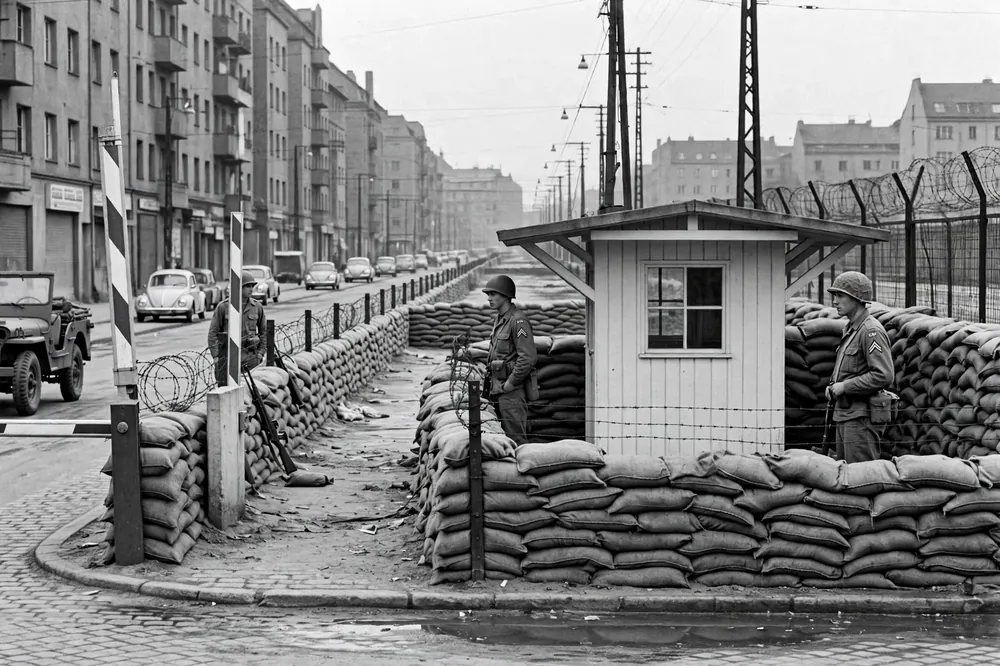
Espionage was a central feature of the conflict. The Soviet KGB and the American CIA, along with the British MI6 and other services, ran networks of spies, defectors, and double agents. Famous cases included the Cambridge Five — British officials who spied for the Soviet Union — and the American couple Julius and Ethel Rosenberg, executed in 1953 for passing atomic secrets to Moscow.
Both sides also intervened covertly in other countries: the CIA helped overthrow governments in Iran (1953) and Guatemala (1954) and attempted to overthrow Fidel Castro in Cuba; the KGB supported communist parties and movements around the world. The fear of spies and subversion shaped domestic politics too: in the United States, Senator Joseph McCarthy’s anti-communist investigations of the early 1950s ruined careers and damaged civil liberties, while in the Soviet Union dissent was punished with imprisonment, exile, or confinement in psychiatric hospitals.
Culture became a battlefield. The two sides competed in the Olympic Games — the Soviet Union topped the medal table at several Games — in ballet, chess, science, and literature. Soviet writers such as Aleksandr Solzhenitsyn, whose The Gulag Archipelago (1973) exposed the Soviet labour camp system, became symbols of resistance; American popular culture — jazz, rock and roll, Hollywood films, blue jeans — seeped into the Eastern bloc despite official bans, and became a powerful, if unintended, weapon of the West. The Cold War also shaped everyday life: schoolchildren in both countries practised air-raid drills, families built fallout shelters, and popular films and novels imagined nuclear apocalypse.
8. Détente and the Second Cold War
By the late 1960s both superpowers were exhausted by the costs of the rivalry and frightened by how close the Cuban Missile Crisis had come to catastrophe. The result was détente — a deliberate easing of tensions. In 1972 President Richard Nixon visited Moscow and Beijing, signing the first SALT agreement limiting strategic weapons and opening relations with China. In 1975 the Helsinki Accords brought 35 countries together to recognise Europe’s borders and — significantly — to commit to respect for human rights, a clause that dissidents in Eastern Europe later used to challenge their governments. Trade between East and West grew, and cultural and scientific exchanges increased.
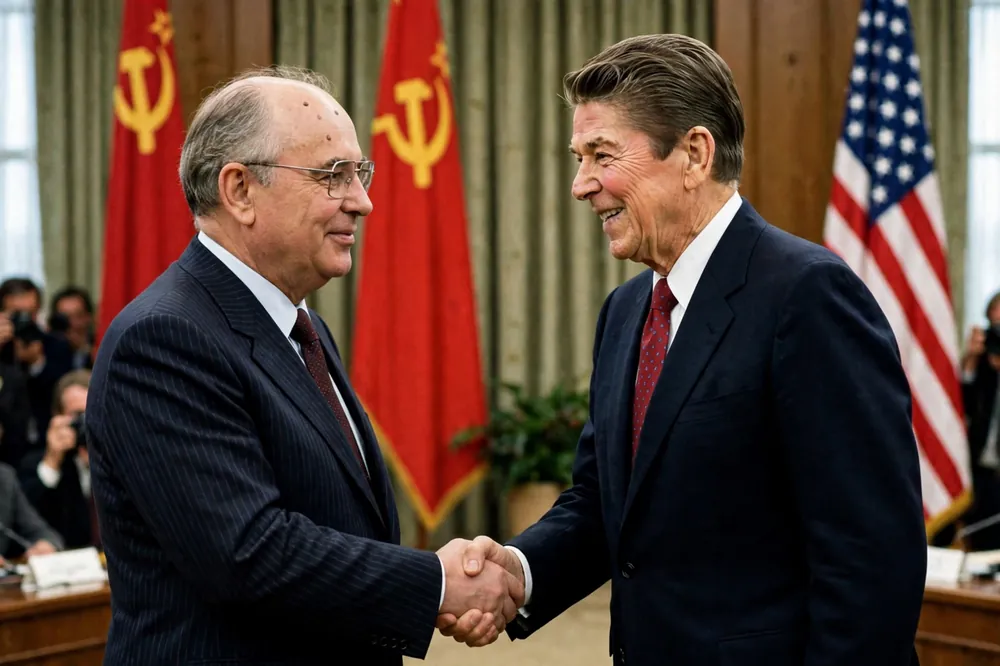
Détente did not last. In December 1979 the Soviet Union invaded Afghanistan, and the United States answered with sanctions, a boycott of the 1980 Moscow Olympics, and renewed military spending under President Ronald Reagan, who called the Soviet Union an “evil empire” in 1983.
The early 1980s — sometimes called the Second Cold War — saw a new arms build-up, the deployment of American cruise and Pershing missiles in Western Europe, and Soviet SS-20 missiles in the East. In 1983, during a NATO exercise, Soviet leaders briefly feared that the West was preparing a surprise nuclear attack; historians now regard the Able Archer incident of November 1983 as one of the most dangerous moments of the Cold War, second only to the Cuban Missile Crisis.
The turning point came with Mikhail Gorbachev, who became Soviet leader in March 1985. Gorbachev understood that the Soviet economy was stagnating and that the arms race was unaffordable. He introduced reforms — glasnost (openness) and perestroika (restructuring) — and sought agreements with the West, signing the INF Treaty with President Reagan in 1987, which eliminated an entire class of nuclear weapons. Gorbachev also made a fateful decision: he would not use Soviet military force to hold Eastern Europe in the communist bloc. When protests erupted across Eastern Europe in 1989, Soviet tanks stayed in their barracks — and the communist governments fell one after another.
9. The End of the Cold War
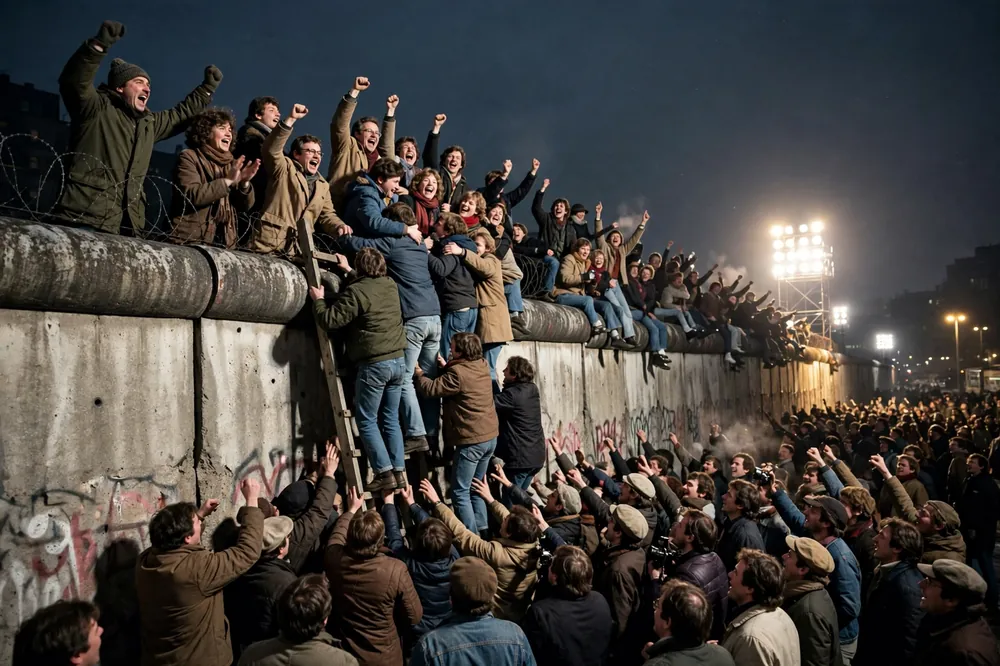
The end came with astonishing speed. In 1989, Poland held partially free elections in June, and a non-communist government took power — the first in Eastern Europe. Hungary opened its border with Austria in May, allowing East Germans to flee to the West. On 9 November 1989 the East German government announced that its citizens could travel to the West, and crowds tore down the Berlin Wall that night. Within weeks, communist governments in Czechoslovakia, Bulgaria, and Romania had fallen — in Romania, the dictator Nicolae Ceaușescu was overthrown and executed in December 1989. On 3 October 1990 Germany was reunified, and the Warsaw Pact dissolved in July 1991.
The Soviet Union itself followed. Gorbachev’s reforms had unleashed forces he could not control: nationalist movements in the Baltic republics, Ukraine, and Central Asia demanded independence, and the economy deteriorated. In August 1991 hardliners attempted a coup against Gorbachev; it failed, but it fatally weakened him, and Boris Yeltsin, president of the Russian republic, emerged as the dominant figure. On 25 December 1991 Gorbachev resigned as Soviet president, and the next day the Soviet Union formally ceased to exist, dissolving into 15 independent states. The Cold War was over — not with a treaty or a battle, but with the disappearance of one of its two protagonists.
Why did the Soviet Union collapse? Historians point to several causes. Its centrally planned economy could not keep up with the West in technology or consumer goods, and the arms race consumed resources the system could not afford. The war in Afghanistan drained money and morale. Gorbachev’s own reforms — intended to save the system — instead exposed its failures and removed the fear that had held it together. And the example of Western prosperity, visible through television, radio, and travel, undermined belief in the communist project. The Soviet system did not fall to invasion; it fell because it could no longer deliver what its people wanted, and because its leader chose not to use force to save it.
10. Legacy
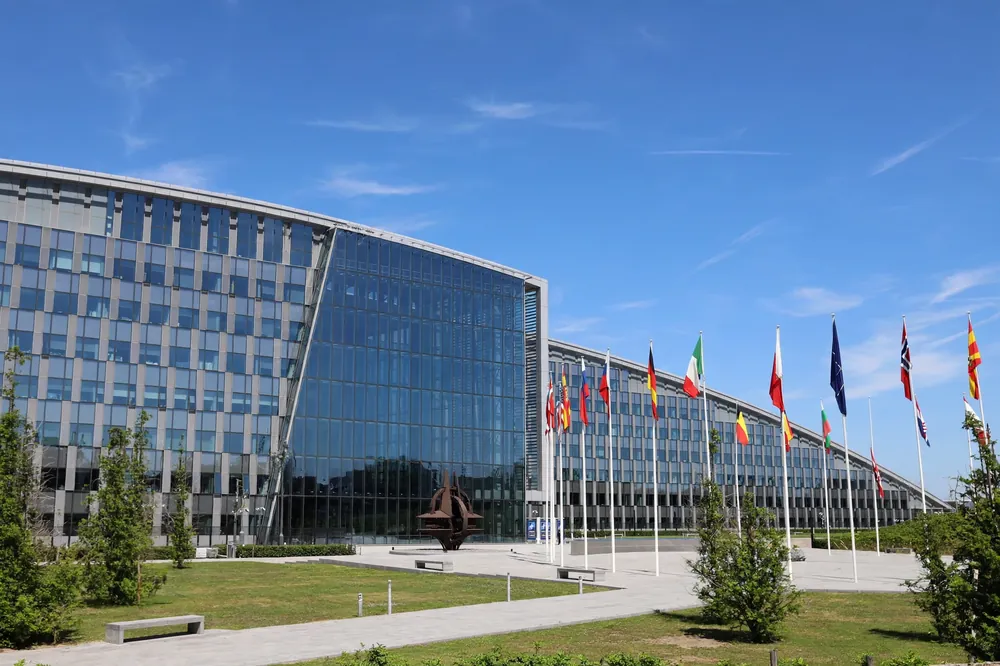
The legacy of the Cold War is still with us. NATO, founded as a Cold War alliance, survived the Cold War and expanded eastward, admitting Poland, Hungary, and the Czech Republic in 1999 and the Baltic states in 2004 — a process that Russia has viewed as a threat. The United States retained military bases around the world and the habit of global leadership it acquired during the Cold War.
Nuclear weapons remain: the United States and Russia together still hold the overwhelming majority of the world’s roughly 12,000 nuclear warheads, and the danger of nuclear war, though lower than in the 1980s, has not disappeared. Korea remains divided, and the armistice of 1953 has never been replaced by a peace treaty. The division of Germany ended, but the division of Korea did not.
The Cold War also shaped the modern world in less obvious ways. It drove the space programme, the development of computers and the internet (which began as an American military network, ARPANET), and the global spread of American popular culture. It created the institutions of the post-war order — the United Nations, the World Bank, the International Monetary Fund — and the habit of thinking about the world in terms of blocs and alliances. It left deep scars in the countries where proxy wars were fought: Vietnam, Korea, Afghanistan, Angola, and many others still live with the consequences of mines, unexploded bombs, and divided societies.
Perhaps the most important legacy is a lesson. The Cold War showed that great powers can compete intensely for decades without destroying each other — but also that the margin of safety was sometimes terrifyingly thin. The Cuban Missile Crisis and the Able Archer incident of 1983 both came close to catastrophe through misunderstanding. The Cold War ended peacefully, largely because leaders on both sides — above all Gorbachev — chose restraint at the crucial moment. Whether that lesson will be remembered as new rivalries emerge in the 21st century remains an open question.
Frequently Asked Questions
Related articles
Sources
- Encyclopædia Britannica, “Cold War” — overview, dates, crises and the end of the rivalry.
- Wikipedia, “Cold War” — chronology, casualty figures for proxy wars, nuclear arsenal figures, cross-checked against scholarly sources.
- John Lewis Gaddis, The Cold War: A New History (Penguin, 2005) — the standard concise history of the conflict.
- Odd Arne Westad, The Cold War: A World History (Basic Books, 2017) — global history of the rivalry, including the Third World.
- National Archives (UK) and the Cold War International History Project (Wilson Center) — documents on the Cuban Missile Crisis, the Berlin crises and détente.
- Vladislav M. Zubok, A Failed Empire: The Soviet Union in the Cold War from Stalin to Gorbachev (University of North Carolina Press, 2007).
- Federation of American Scientists (fas.org) — nuclear weapons stockpile figures.
- Melvyn P. Leffler, For the Soul of Mankind: The United States, the Soviet Union, and the Cold War (Hill and Wang, 2007).
- Tony Judt, Postwar: A History of Europe Since 1945 (Penguin, 2005).