 WAR ATLAS MILITARY HISTORY MAGAZINE · WWI — WWII
Iron Curtain
1. Lead
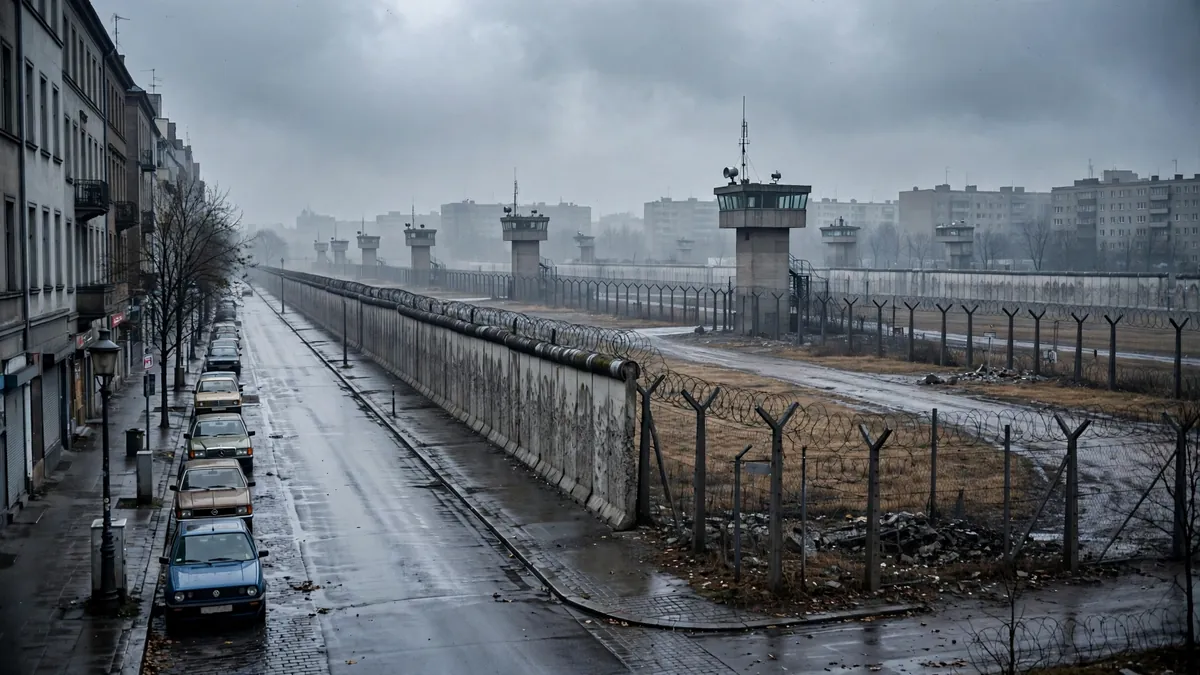
The Iron Curtain was the political, military, and ideological division of Europe during the Cold War. The phrase described the boundary that separated the communist states of Eastern Europe — dominated by the Soviet Union — from the capitalist democracies of Western Europe.
It was not a single physical barrier, though parts of it were heavily fortified with walls, fences, minefields, and guard towers; it was a line across a continent, running from the Baltic Sea in the north to the Adriatic in the south, that divided families, cities, and nations for more than four decades.
The term was popularised by Winston Churchill in a speech at Westminster College in Fulton, Missouri, on 5 March 1946: “From Stettin in the Baltic to Trieste in the Adriatic, an iron curtain has descended across the Continent.”
Behind the Iron Curtain lay the Soviet sphere: Poland, East Germany, Czechoslovakia, Hungary, Romania, Bulgaria, and Albania, along with the Soviet Union itself. In these countries, communist parties ruled as one-party states, economies were centrally planned, and travel to the West was restricted or forbidden. In front of it lay Western Europe: Britain, France, West Germany, Italy, and the other democracies, tied to the United States by the Marshall Plan and NATO. Between them stood the two German states and the divided city of Berlin, where the Iron Curtain took its most concrete form in the Berlin Wall, built in August 1961.
The Iron Curtain fell in 1989. In that year, communist governments collapsed across Eastern Europe, the Berlin Wall was torn down on 9 November 1989, and Germany reunified in October 1990. The Soviet Union itself dissolved in December 1991. The Iron Curtain is remembered today as the defining image of the Cold War — a symbol of a divided world, of the repression that kept the division in place, and of the extraordinary speed with which it ended.
2. Key Facts
| Term popularised | 5 March 1946, Winston Churchill’s “Sinews of Peace” speech, Fulton, Missouri |
| Geography | From the Baltic Sea (Stettin/Szczecin) to the Adriatic Sea (Trieste); about 4,300 km of border between East and West |
| Eastern side | Soviet Union, Poland, East Germany, Czechoslovakia, Hungary, Romania, Bulgaria, Albania |
| Western side | United Kingdom, France, West Germany, Italy, Benelux, Scandinavia and others; NATO members |
| Most famous symbol | The Berlin Wall (13 August 1961 – 9 November 1989), 155 km long |
| Border fortifications | Barbed wire, minefields, watchtowers, patrols; the inner-German border was one of the most heavily guarded in the world |
| People who fled East to West | About 3.5 million East Germans fled before the Wall was built (1949–1961); thousands more attempted to cross afterwards |
| Deaths at the Berlin Wall | At least 140 people killed at the Wall (estimates vary; the commonly cited figure is 140–327 including border deaths) |
| End | 1989: communist governments fall across Eastern Europe; Berlin Wall falls 9 November 1989; German reunification 3 October 1990 |
3. Churchill’s Speech at Fulton
The phrase “Iron Curtain” was not invented by Churchill — it had been used before, including by the Nazi propaganda minister Joseph Goebbels in 1945 — but Churchill’s speech made it famous. On 5 March 1946, Churchill, who had lost the British general election of July 1945 and was no longer Prime Minister, travelled to the small town of Fulton, Missouri, at the invitation of President Harry S. Truman.
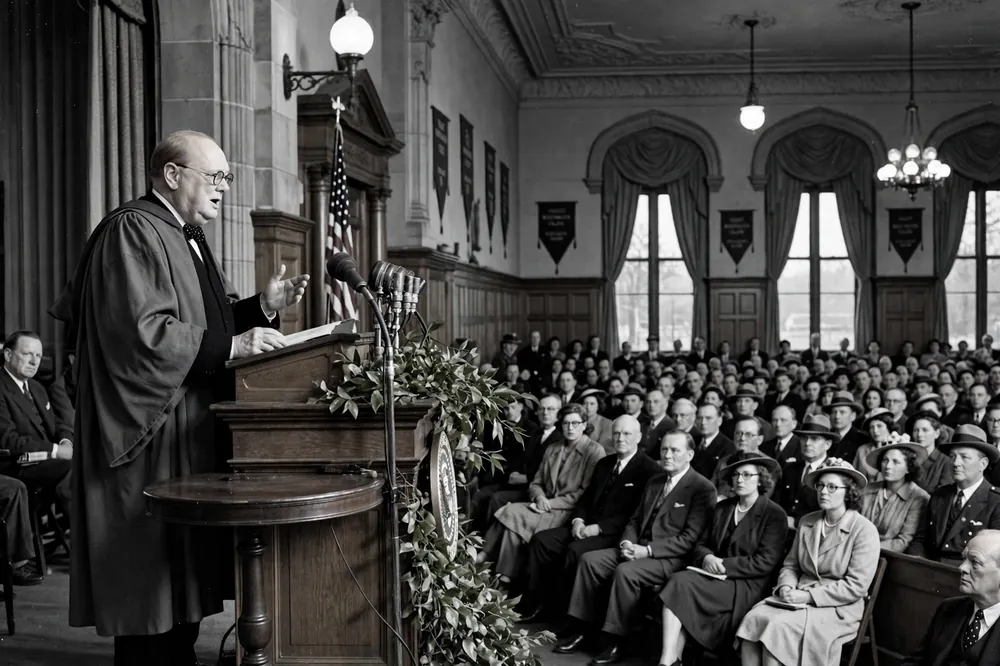
He delivered a speech titled “The Sinews of Peace” at Westminster College, with Truman sitting on the platform beside him. The speech was a warning: the war was over, but a new danger was rising, and the English-speaking peoples — Britain and the United States — needed to stand together to meet it.
Churchill’s most famous passage named the capitals now behind the curtain: “From Stettin in the Baltic to Trieste in the Adriatic, an iron curtain has descended across the Continent. Behind that line lie all the capitals of the ancient states of Central and Eastern Europe. Warsaw, Berlin, Prague, Vienna, Budapest, Belgrade, Bucharest and Sofia, all these famous cities and the populations around them lie in what I must call the Soviet sphere, and all are subject in one form or another, not only to Soviet influence but to a very high and, in many cases, increasing measure of control from Moscow.”
The speech was controversial at the time. In the United States, some accused Churchill of warmongering and of trying to drag America into a new conflict with its wartime ally. In the Soviet Union, Stalin denounced the speech as a call to war and compared Churchill to Hitler.
But within a year, events had confirmed Churchill’s warning: the Soviet Union tightened its grip on Eastern Europe, communist parties seized power in Poland and elsewhere, and the wartime alliance collapsed. The phrase “Iron Curtain” entered the language of the Cold War and stayed there for 43 years.
(Note: Vienna was in fact in the Western occupation zones of Austria, not behind the Curtain — a small inaccuracy in a speech whose larger point was correct.)
4. How the Curtain Was Built
The Iron Curtain was not built in a day. It emerged from the politics of the post-war settlement and from a series of Soviet decisions between 1945 and 1948. At the end of World War II, the Soviet Union’s armies occupied Eastern Europe — Poland, Romania, Bulgaria, Hungary, and eastern Germany.
The Yalta Conference of February 1945 had promised free elections in the liberated countries, but the Soviet Union interpreted that promise loosely. In Poland, the Soviet-backed communist government suppressed the opposition and rigged the elections of January 1947. In Romania and Bulgaria, communist parties took power in 1946–1947 through intimidation and fraud.
In Hungary, the communists used “salami tactics” — slicing away their opponents piece by piece — to take control by 1947. In Czechoslovakia, the last Eastern European democracy, the communists seized power in a coup in February 1948. By the end of 1948, every country of Eastern Europe except Yugoslavia (which broke with Moscow in 1948) and Albania (which later broke with Moscow too) was ruled by a communist party loyal to Stalin.
The division was sealed by economics and by force. The Soviet Union forbade Eastern Europe from accepting Marshall Plan aid in 1947 and created its own economic bloc, Comecon, in 1949. It created the Cominform in 1947 to coordinate communist parties, and the Warsaw Pact in 1955 as the Eastern military alliance.
It stationed large armies in Eastern Europe — in East Germany alone, the Soviet Union kept about 300,000 to 400,000 troops throughout the Cold War — and it used force to crush challenges: in East Germany in 1953, in Hungary in 1956, and in Czechoslovakia in 1968.
The Brezhnev Doctrine, named after the Soviet leader Leonid Brezhnev, declared in 1968 that the Soviet Union had the right to intervene in any socialist country where socialism was threatened — a doctrine that justified the invasions of Hungary and Czechoslovakia and kept the Curtain in place.
On the Western side, the division was sealed by the founding of NATO in 1949 and the creation of West Germany the same year. The two German states — the Federal Republic of Germany (West) and the German Democratic Republic (East) — became the front line of the Cold War, and the inner-German border became the most heavily guarded frontier in Europe. The Iron Curtain was now a fact of geography, of politics, and of daily life.
5. Life Behind the Curtain
For the people who lived behind the Iron Curtain, the division was not an abstraction but a daily reality. Travel to the West was restricted or forbidden: citizens of Eastern Europe needed exit visas that were rarely granted, and those who applied risked losing their jobs or being watched by the secret police.
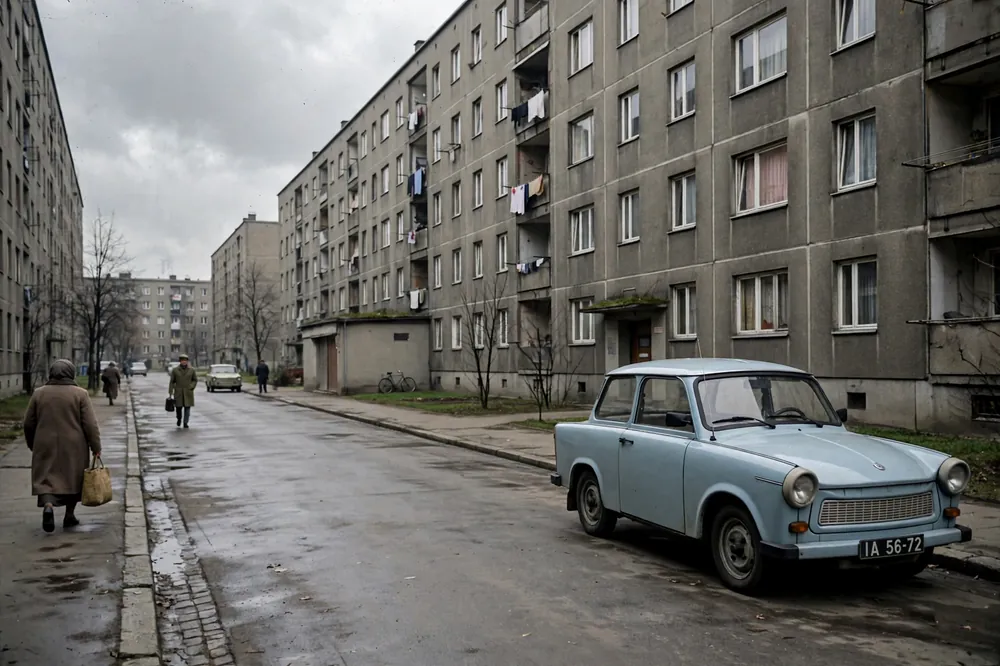
Letters and telephone calls were monitored, Western radio broadcasts were jammed, and Western books, films, and music were censored or banned. The secret police — the Stasi in East Germany, the Securitate in Romania, the KGB in the Soviet Union — maintained vast networks of informers.
In East Germany, the Stasi employed about 90,000 full-time officers and an estimated 170,000 informers, and kept files on about a third of the population.
The economies behind the Curtain were centrally planned, with state ownership of industry and collective agriculture. In the early post-war years, this system delivered real achievements: full employment, free education and healthcare, and rapid industrialisation. But over time the system stagnated.
Without market prices, planners could not tell what people wanted or what things cost; without competition, factories had little incentive to improve quality or innovate; and without political freedom, criticism that might have corrected mistakes was suppressed. By the 1980s, the gap in living standards between East and West was stark: East Germans could watch West German television and see the prosperity on the other side, while their own shops were often empty of basic goods.
In Poland, food shortages led to strikes and the rise of the Solidarity movement in 1980. In the Soviet Union, the economy grew so slowly that by the 1980s it was falling behind even in the production of basic consumer goods.
The repression was real, but so was the human cost of the division. Families were separated for decades: parents from children, brothers from sisters, by a border they could not cross. In Berlin, the Wall divided streets, houses, and even a cemetery. People died trying to cross: at least 140 people were killed at the Berlin Wall, and many more died at other sections of the border. The best-known escape attempts — tunnels dug under the Wall, hot-air balloons flown over it, cars modified to hide people — became part of Cold War legend, and the names of the dead are now commemorated at the Berlin Wall Memorial.
6. The Berlin Wall
The Berlin Wall was the most famous — and most hated — physical expression of the Iron Curtain. Berlin was a divided city inside East Germany: the western sectors (American, British, and French) formed West Berlin, an enclave of the West 110 miles inside communist territory, while the Soviet sector formed East Berlin, the capital of East Germany. Between 1949 and 1961, about 3.5 million East Germans — roughly a fifth of the population — fled to the West, most of them through Berlin, where the border between the sectors was still open. The exodus drained East Germany of its young, skilled, and educated citizens, and by 1961 the East German government was losing about 1,000 people a day.
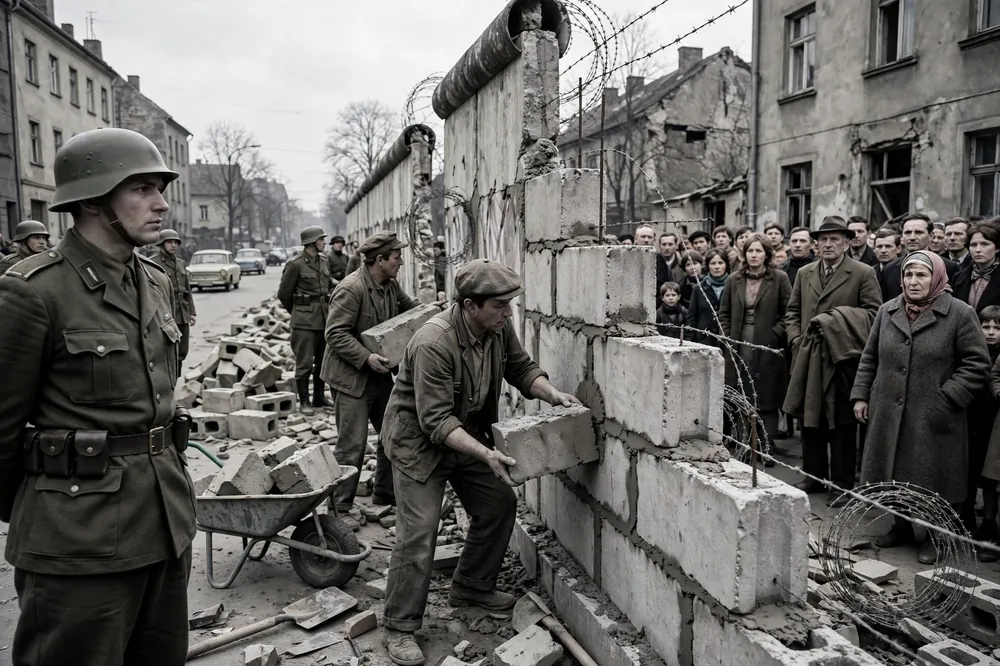
On the night of 12–13 August 1961, East German troops and workers sealed off West Berlin with barbed wire, and over the following days and weeks they built a concrete wall. The Berlin Wall eventually ran for 155 km (96 miles) around West Berlin, with 302 watchtowers, 20 bunkers, and a heavily guarded “death strip” of raked sand, floodlights, and tripwires. The Wall divided streets, cut U-Bahn and S-Bahn lines, and separated families overnight. East German border guards had orders to shoot anyone attempting to cross — the “shoot-to-kill” order was formalised in the 1970s, though the practice dated from the Wall’s construction.
The Wall became the symbol of the Cold War. American presidents made pilgrimages to it: John F. Kennedy stood before it in June 1963 and declared “Ich bin ein Berliner” — “I am a Berliner” — and Ronald Reagan stood before it in June 1987 and challenged the Soviet leader: “Mr.
Gorbachev, tear down this wall!” About 5,000 people successfully escaped over, under, or through the Wall during its 28 years; at least 140 died trying. The Wall stood until 9 November 1989, when — after weeks of protests in East Germany and the opening of Hungary’s border with Austria — the East German government announced that its citizens could travel to the West.
Crowds gathered at the Wall that night and, with the border guards uncertain of their orders, crossed through. Berliners tore the Wall down with hammers and chisels, and within a year Germany was reunified. Pieces of the Wall are now displayed in museums around the world; a section of it stands at the Berlin Wall Memorial on Bernauer Strasse, where the Wall once divided a single street.
7. Challenges to the Curtain
The Iron Curtain was never as solid as it looked. It was challenged from within, again and again, by people who refused to accept the division. The first great challenge came in June 1953, when workers in East Berlin rose up against the government; Soviet tanks crushed the uprising, killing at least 50 people (some estimates put the figure higher). In October–November 1956, Hungary rose in revolution: the government of Imre Nagy declared neutrality and announced Hungary’s withdrawal from the Warsaw Pact. Soviet tanks invaded, killing an estimated 2,500 Hungarians, and Nagy was later executed. About 200,000 Hungarians fled to the West.
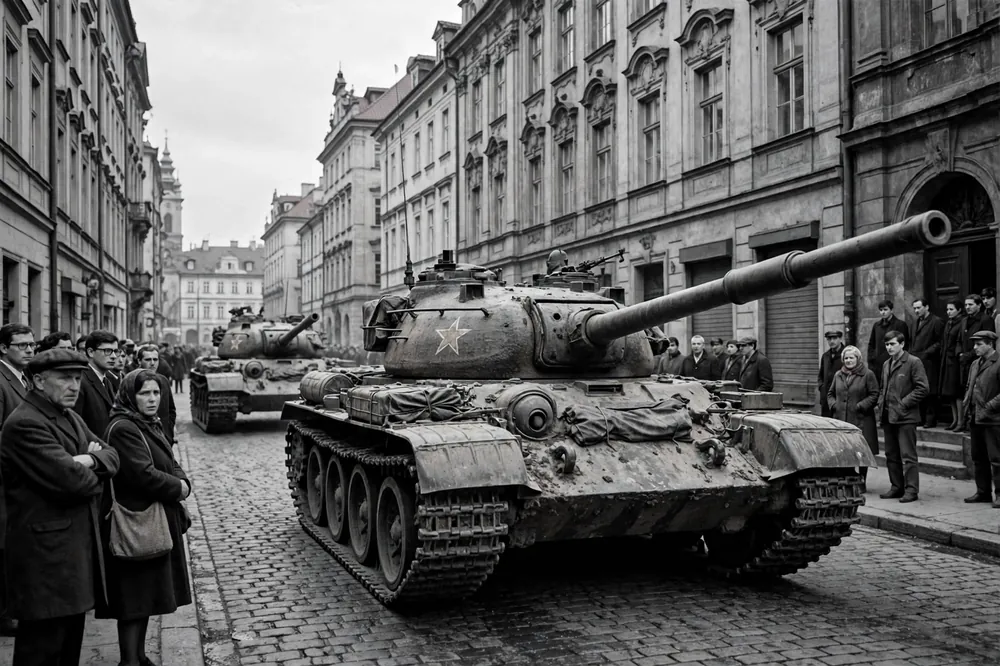
In 1968, Czechoslovakia attempted reform from within. Under Alexander Dubček, the government introduced the “Prague Spring” — a programme of liberalisation that promised “socialism with a human face”, including freedom of the press and an end to censorship. In August 1968, Soviet and Warsaw Pact troops invaded Czechoslovakia, crushing the reforms and installing a hardline government. The invasion was condemned around the world, but it succeeded: the Brezhnev Doctrine was proclaimed, and the Curtain held for another 20 years.
The most sustained challenge came from Poland. In 1980, strikes at the Gdańsk shipyard led to the founding of Solidarity (Solidarność), the first independent trade union in the communist world, led by the electrician Lech Wałęsa. Solidarity grew to about 10 million members — a third of Poland’s workforce — and became a mass movement for freedom.
The Polish government imposed martial law in December 1981 and imprisoned Solidarity’s leaders, but the movement survived underground and re-emerged in 1989, when it won the first partially free elections in Eastern Europe. Poland’s example inspired dissidents across the bloc, from Charter 77 in Czechoslovakia to the human rights activists who invoked the Helsinki Accords of 1975.
The Curtain was maintained by force, but force could not make people believe in it.
8. The Fall of the Curtain
The Iron Curtain fell in 1989, and it fell with astonishing speed. The proximate cause was Mikhail Gorbachev, who became Soviet leader in March 1985. Gorbachev understood that the Soviet system was failing and introduced reforms — glasnost (openness) and perestroika (restructuring) — that loosened censorship and allowed public debate.
Crucially, he also decided that the Soviet Union would not use military force to hold Eastern Europe in the communist bloc. When the Polish government negotiated with Solidarity in early 1989 and agreed to partially free elections in June, Soviet tanks stayed in their barracks. When Hungary opened its border with Austria in May 1989, allowing East Germans to flee to the West, Moscow did nothing.
When protests erupted in East Germany in the autumn of 1989 — the Monday demonstrations in Leipzig grew from hundreds to hundreds of thousands — the Soviet Union did not intervene.
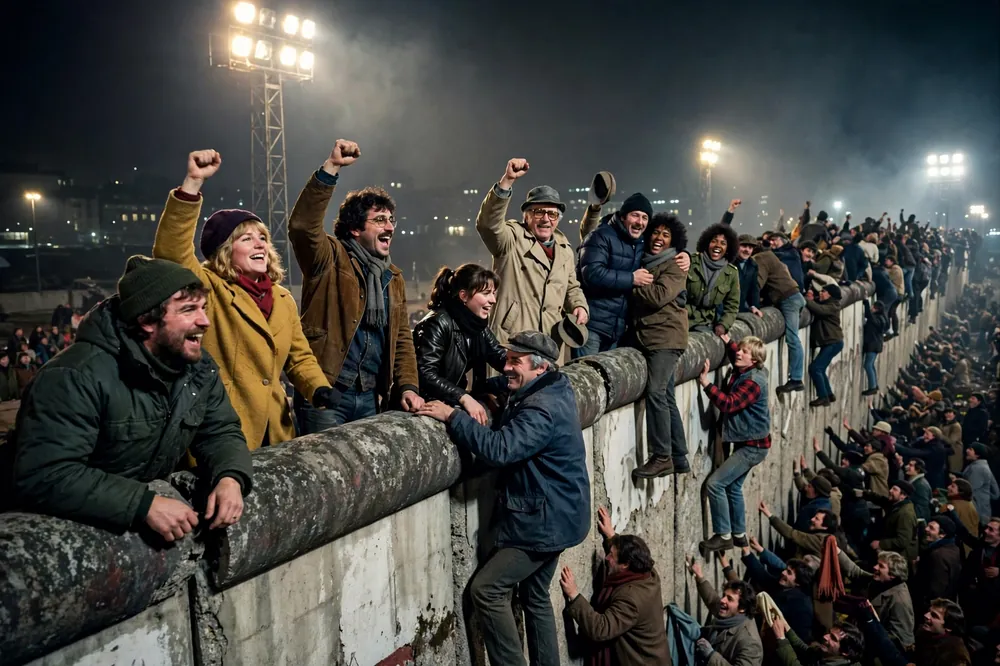
The end came in a cascade. In June 1989, Solidarity won the Polish elections and formed a non-communist government — the first in Eastern Europe. In the summer, Hungary dismantled its border fence with Austria. On 9 November 1989, the East German government, under pressure from weeks of protests, announced that its citizens could travel to the West; crowds gathered at the Berlin Wall that night and crossed through as the border guards, uncertain of their orders, stood aside.
Within weeks, the communist governments of Czechoslovakia, Bulgaria, and Romania had fallen — in Romania, the dictator Nicolae Ceaușescu was overthrown and executed in December 1989. On 3 October 1990, Germany was reunified. The Warsaw Pact dissolved in July 1991, and the Soviet Union itself dissolved in December 1991. The Iron Curtain — which had divided Europe for 43 years — was gone in less than a year.
Why did it fall so fast? Historians point to the combination of economic failure, the loss of belief in the communist project, the example of Western prosperity, and Gorbachev’s refusal to use force. The Curtain had always depended on fear: fear of Soviet tanks, fear of the secret police, fear of the consequences of dissent. When Gorbachev removed the fear of Soviet intervention, the regimes that depended on it collapsed — because they had no other source of legitimacy left. The people of Eastern Europe, given the chance, chose freedom, and they chose it peacefully: the revolutions of 1989 were, with the exception of Romania, remarkably bloodless.
9. Legacy and Memory
The Iron Curtain is gone, but its legacy remains. The division of Europe left deep marks: the economic gap between East and West, which took decades to narrow after reunification; the different historical memories of the two halves of the continent; and the political geography of today’s Europe, in which the former communist states joined NATO and the European Union in the 1990s and 2000s. The term “Iron Curtain” itself has become a metaphor for any rigid political division, and the phrase is still used to describe new dividing lines in world politics.
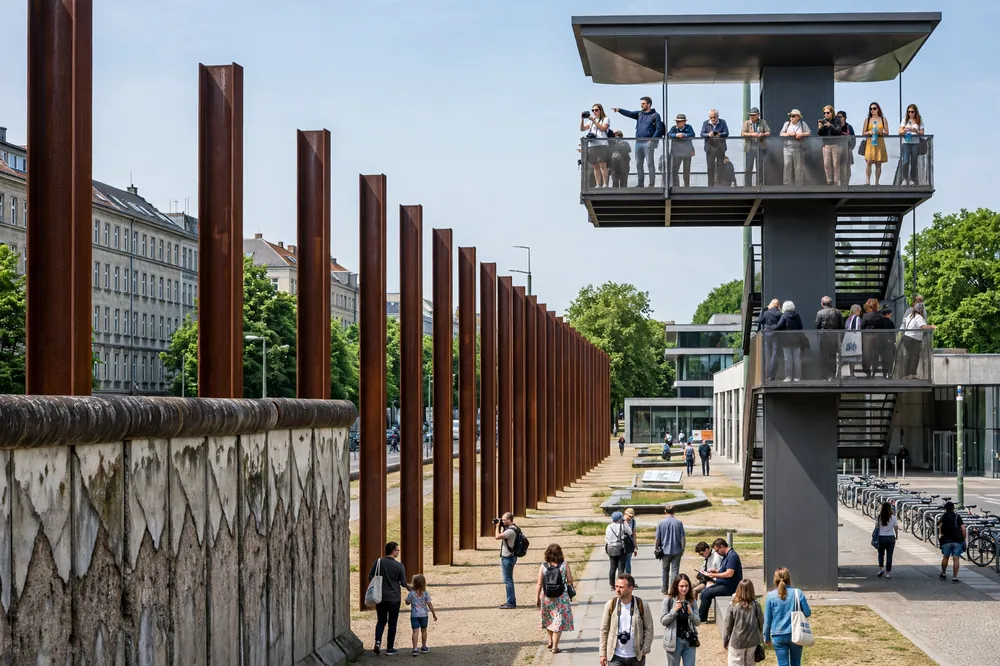
The physical remains of the Curtain are preserved as memorials and museums. The Berlin Wall Memorial on Bernauer Strasse, the East Side Gallery (a 1.3 km stretch of the Wall painted by artists), and Checkpoint Charlie are among the most visited sites in Berlin. The Iron Curtain Trail — a cycling route of about 10,000 km following the former border from the Barents Sea to the Black Sea — allows visitors to trace the line where Europe was divided. In many places, the former border strip has become a “Green Belt” of nature reserves, because the land was left undisturbed for decades.
The memory of the Iron Curtain also carries a warning. It shows how quickly a continent can be divided, how long a division can last once it is enforced by walls and armies, and how suddenly it can end when people refuse to accept it any longer. The revolutions of 1989 are remembered as proof that even the most heavily guarded borders cannot hold back people who want freedom — and that the most powerful weapon against a wall is not another wall, but the decision of ordinary people to walk through it.
10. Key Figures
Winston Churchill (United Kingdom). Former Prime Minister who named the Iron Curtain in his Fulton speech of 5 March 1946. Churchill had warned about Soviet expansion since 1945 and advocated a close Anglo-American alliance to meet it. He returned as Prime Minister in 1951–1955 and died in 1965.
Joseph Stalin (Soviet Union). Leader of the Soviet Union who built the Iron Curtain by imposing communist rule on Eastern Europe between 1945 and 1948. Stalin’s death in March 1953 did not end the division; his successors maintained it for another 36 years.
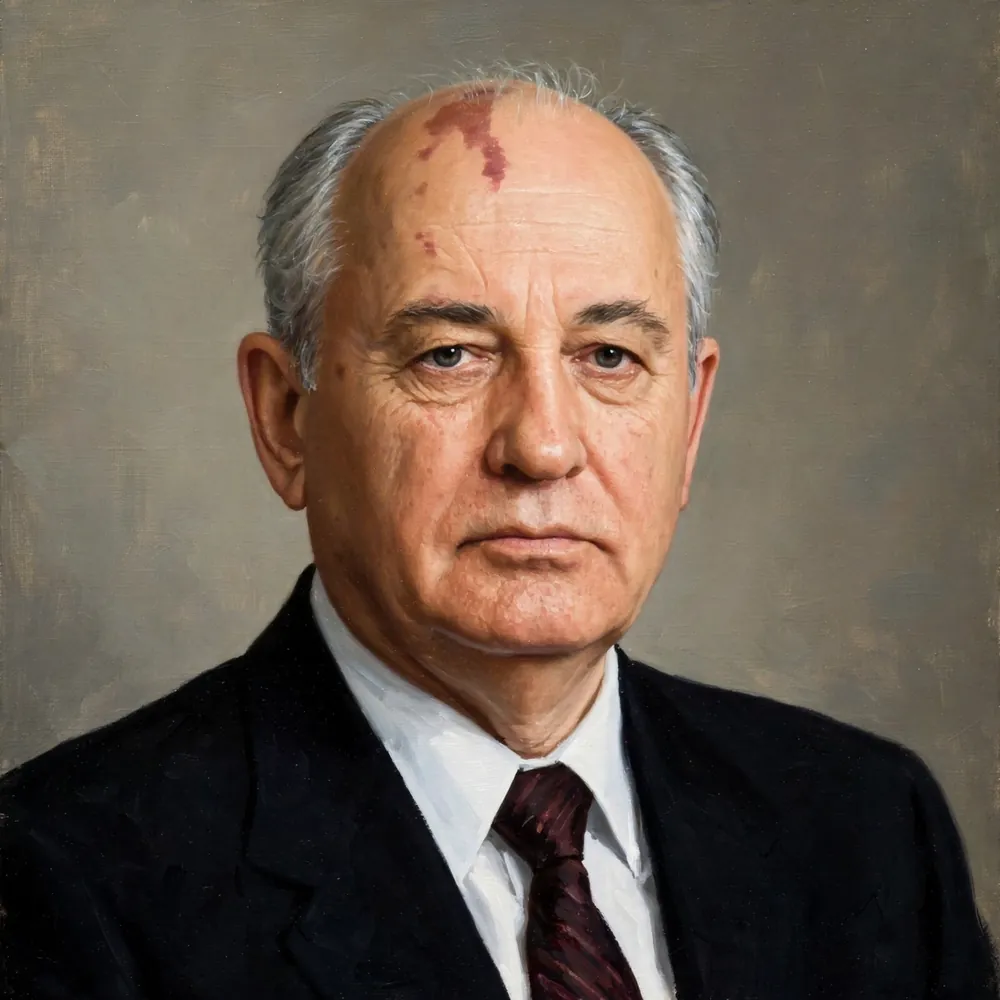
Mikhail Gorbachev (Soviet Union). Soviet leader from 1985 to 1991, whose reforms and refusal to use force in Eastern Europe made the fall of the Iron Curtain possible. He received the Nobel Peace Prize in 1990 and died in 2022.
Lech Wałęsa (Poland). Electrician and leader of Solidarity, the Polish trade union movement that challenged communist rule from 1980 and won the first partially free elections in Eastern Europe in 1989. He became President of Poland in 1990 and received the Nobel Peace Prize in 1983.
Erich Honecker (East Germany). Leader of East Germany from 1971 to 1989, who built up the Berlin Wall and the border fortifications and ordered the shoot-to-kill policy. He was forced to resign in October 1989, weeks before the Wall fell, and died in exile in Chile in 1994.
Frequently Asked Questions
Related articles
Sources
- Encyclopædia Britannica, “Iron Curtain” — the term, Churchill’s speech and the division of Europe.
- Wikipedia, “Iron Curtain” — geography, Berlin Wall figures and the fall of 1989, cross-checked against scholarly sources.
- The Churchill Project (Hillsdale College) and the National Churchill Museum, Fulton, Missouri — the text of the “Sinews of Peace” speech, 5 March 1946.
- Tony Judt, Postwar: A History of Europe Since 1945 (Penguin, 2005) — life behind the Curtain and the revolutions of 1989.
- Victor Sebestyen, Revolution 1989: The Fall of the Soviet Empire (Pantheon, 2009).
- Berlin Wall Memorial (berliner-mauer-gedenkstaette.de) — deaths at the Wall and the history of the border.
- Timothy Garton Ash, The Magic Lantern: The Revolution of ’89 Witnessed in Warsaw, Budapest, Berlin, and Prague (Random House, 1990).
- Anne Applebaum, Iron Curtain: The Crushing of Eastern Europe, 1944–1956 (Doubleday, 2012).
- Frederick Taylor, The Berlin Wall: 13 August 1961 – 9 November 1989 (Bloomsbury, 2006).