 WAR ATLAS MILITARY HISTORY MAGAZINE · WWI — WWII
Mitsubishi A6M2 Zero
1. Lead
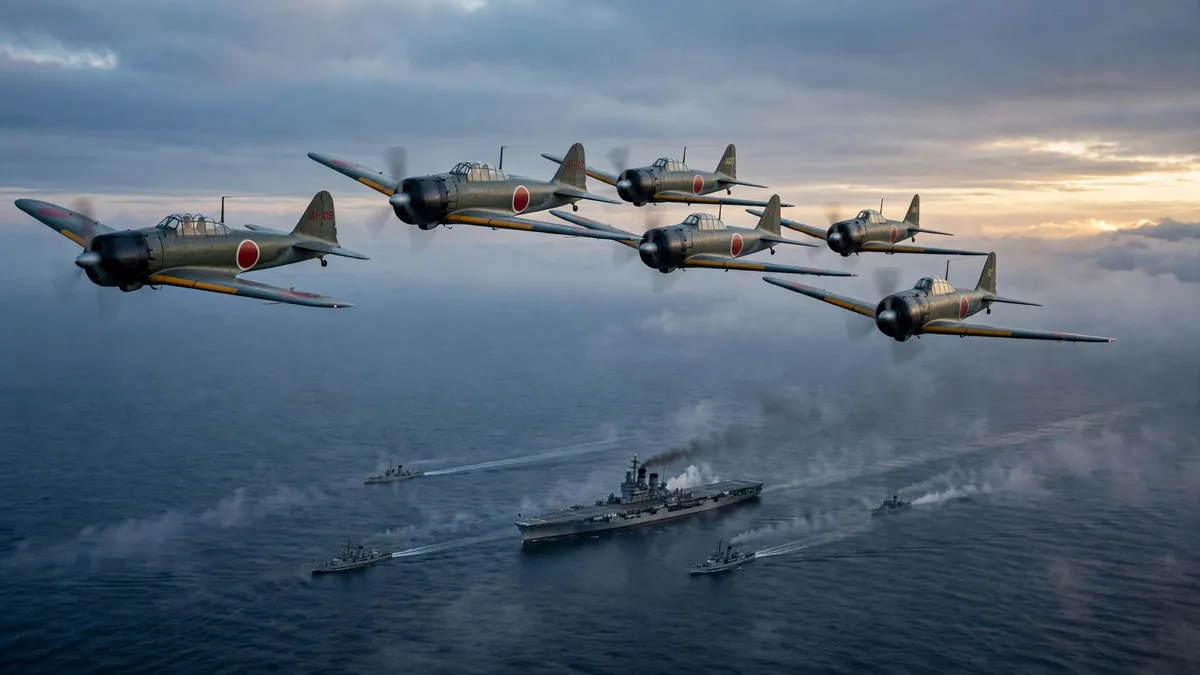
The Mitsubishi A6M2 Zero was the most famous Japanese aircraft of the Second World War, and for the first year of the Pacific War the most feared fighter in the world. Designed to a demanding Imperial Japanese Navy specification that called for a carrier fighter with the range of a bomber and the agility of a biplane, the Zero — the name is a shortening of its official designation, Navy Type 0 Carrier Fighter — delivered both, and more.
It could fly more than 3,000 kilometres with a drop tank, out-turn any Allied fighter it met, and climb and dive with a grace that its enemies found terrifying. At Pearl Harbor, over the Philippines, Malaya and the Dutch East Indies, and in the long campaign for Guadalcanal, the Zero swept the skies clean, and Allied pilots were told, in the blunt language of the time, that the Japanese fighter could not be beaten in a turning fight.
The Zero’s fame has outlived the war by eighty years, and it has become, in the popular imagination, the symbol of Japanese air power itself. That fame is deserved, but it is also incomplete. The A6M2 was a brilliant design built on a deliberate and ultimately fatal trade: it bought its range and agility by discarding armour, self-sealing fuel tanks and pilot protection, and by using a light, powerful engine that could not be improved much further.
When the Allies learned to fight it — to refuse the turning fight, to use speed and diving attacks, and to field faster, better-protected fighters such as the F6F Hellcat and the F4U Corsair — the Zero’s advantages evaporated, and its pilots, the best-trained in the world in 1941, were killed in numbers Japan could not replace.
The story of the A6M2 is therefore the story of a great fighter that was also, in the end, a dead end.
About 10,939 Zeros of all versions were built, of which the A6M2 — the version that fought the opening campaigns of the Pacific War — accounted for roughly 2,000 to 3,000 aircraft, depending on how the production sub-types are counted. No other Japanese fighter was built in such numbers, and no other is so closely identified with the war in the Pacific.
2. Key Facts
| Role | Carrier-based fighter (also land-based fighter and fighter-bomber) |
| Manufacturer | Mitsubishi Heavy Industries (also Nakajima) |
| Designer | Jiro Horikoshi / Jiro Horikoshi |
| First flight | 1 April 1939 |
| Introduced | July 1940 |
| Produced | About 10,939 of all A6M versions; A6M2 about 2,000–3,000 |
| Crew | 1 |
| Engine | 1 × Nakajima Sakae 12 radial, about 940 hp |
| Maximum speed | About 533 km/h (331 mph) at 4,550 m |
| Range | About 3,100 km with drop tank; about 1,870 km without |
| Armament | 2 × 20 mm Type 99 cannon; 2 × 7.7 mm Type 97 machine guns; 2 × 60 kg bombs |
| Main users | Imperial Japanese Navy Air Service |
| Fate | Withdrawn 1945; a few originals survive in museums; many replicas fly |
3. Origins and Requirements
The 12-Shi specification
In 1937 the Imperial Japanese Navy issued one of the most demanding fighter specifications ever written, the 12-Shi requirement for a new carrier fighter to replace the Mitsubishi A5M. The specification called for a top speed of 500 km/h, a climb to 3,000 metres in 3.5 minutes, and — most extraordinarily — a range of 2,000 kilometres with a drop tank, or 1,200 kilometres without one, together with an armament of two 20 mm cannon and two machine guns.
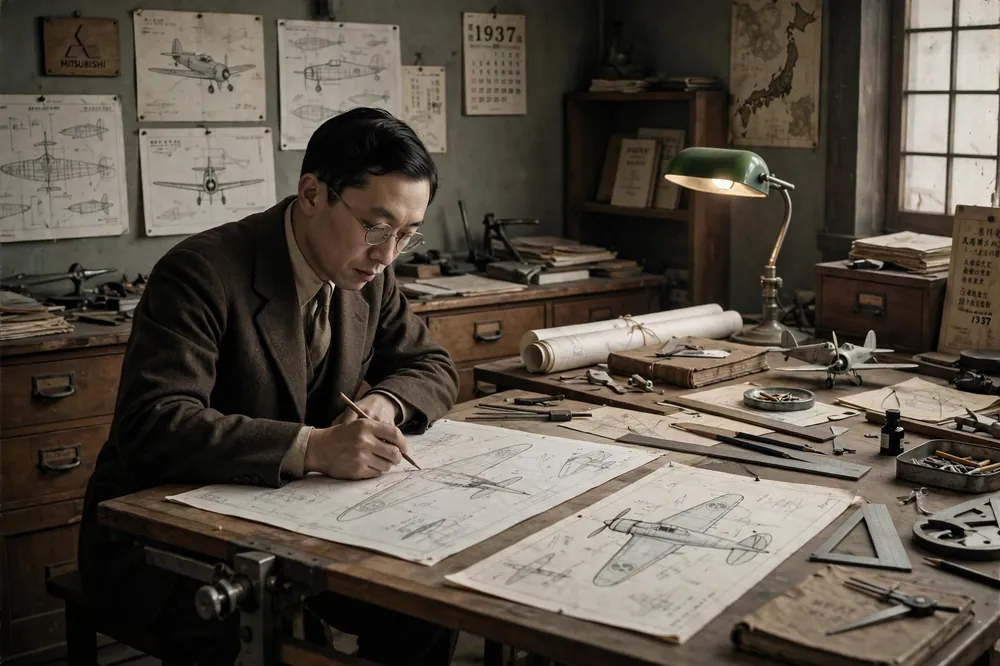
It also demanded the manoeuvrability to out-turn any fighter in the world. Mitsubishi’s chief designer, Jiro Horikoshi, and his team are said to have despaired when they read it: no existing fighter came close to meeting all of these requirements at once, and the Navy’s own engineers considered the specification impossible.
Horikoshi’s answer: radical lightness
Horikoshi’s answer was radical lightness. He designed an airframe built from a new aluminium alloy, Extra Super Duralumin, that was stronger and lighter than the alloys in general use, and he pared away everything that added weight and was not strictly necessary: there was no armour plate for the pilot, no self-sealing fuel tanks, no bulletproof windscreen and no radio of any great capability in the early aircraft.
The wings were large, giving the aircraft a low wing loading and a superb turning radius, and the engine was the Nakajima Sakae, a compact radial that was light for its power. The result was an aircraft that weighed, fully loaded, only about 2,800 kilograms — hundreds of kilograms less than its American and British contemporaries — and that met, and in some respects exceeded, the Navy’s impossible specification.
Combat debut in China
The first prototype flew on 1 April 1939, and after trials the aircraft entered service in July 1940 as the Navy Type 0 Carrier Fighter — the “0” from the Japanese year 2600, the year of its introduction. The first combat unit, the 12th Air Group, took the Zero to China in the summer of 1940, and the results were startling: in its first combat, over Chungking on 13 September 1940, thirteen Zeros shot down twenty-seven Chinese fighters — Polikarpov I-15s and I-16s supplied by the Soviet Union — without loss.
The Chinese air force, which had held its own against the A5M, was swept from the sky, and the Zero’s reputation was made before the Pacific War had even begun.
4. Design and Development
Airframe and the cult of lightness
The A6M2’s airframe was the key to its performance. The low-wing monoplane had a wingspan of about 12 metres and a wing area of about 22.4 square metres, giving it a wing loading of roughly 107 kilograms per square metre — far lower than the 150 to 170 of the American F4F Wildcat and the British Hurricane. Low wing loading meant a tight turning circle and a gentle stall, and the Zero could out-turn any fighter it met, often by a wide margin. The aircraft’s controls were light and harmonised, and its pilots described it as a delight to fly, responsive to the lightest touch and capable of manoeuvres that seemed impossible in a heavier aircraft.
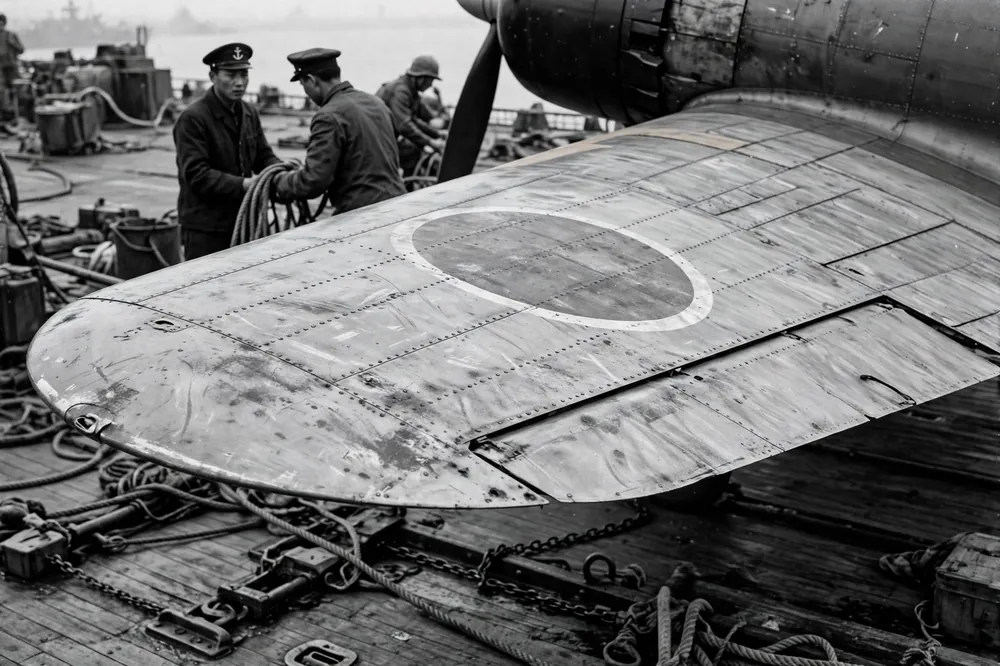
The price was fragility. The Extra Super Duralumin structure, though strong for its weight, was thin-skinned and easily damaged, and the absence of armour and self-sealing tanks meant that a few hits could kill the pilot or set the aircraft on fire.
The Zero’s ailerons stiffened at high speed, making it hard to roll at diving speeds above about 450 km/h — a weakness American pilots learned to exploit by diving away from a Zero that could not follow. The engine, too, was a limit: the Sakae 12 produced about 940 horsepower, and the more powerful engines that might have improved the design were not available in the numbers needed.
Horikoshi himself later said that the Zero’s design was a compromise forced by the Navy’s demands, and that he had warned against the absence of protection.
The A6M2 sub-types
The A6M2 was built in two main sub-types. The A6M2 Model 11 was the first production version, with a wingspan of 12 metres and folding wingtips that let it be stowed on carriers. The A6M2 Model 21, which followed in late 1940 and became the standard version, had the wingtips fixed and the span reduced slightly to about 11 metres, with a small increase in speed and a simplification of the wing structure.
The Model 21 was the version that fought at Pearl Harbor, Midway and Guadalcanal, and it is the version most often pictured in photographs of the early Pacific War. Later A6M versions — the A6M3, A6M5 and A6M7 — introduced more powerful engines, shorter wings, heavier armament and, too late, some armour and self-sealing tanks, but the A6M2 remains the classic Zero, the aircraft of the opening campaigns.
5. Technical Description
Armament
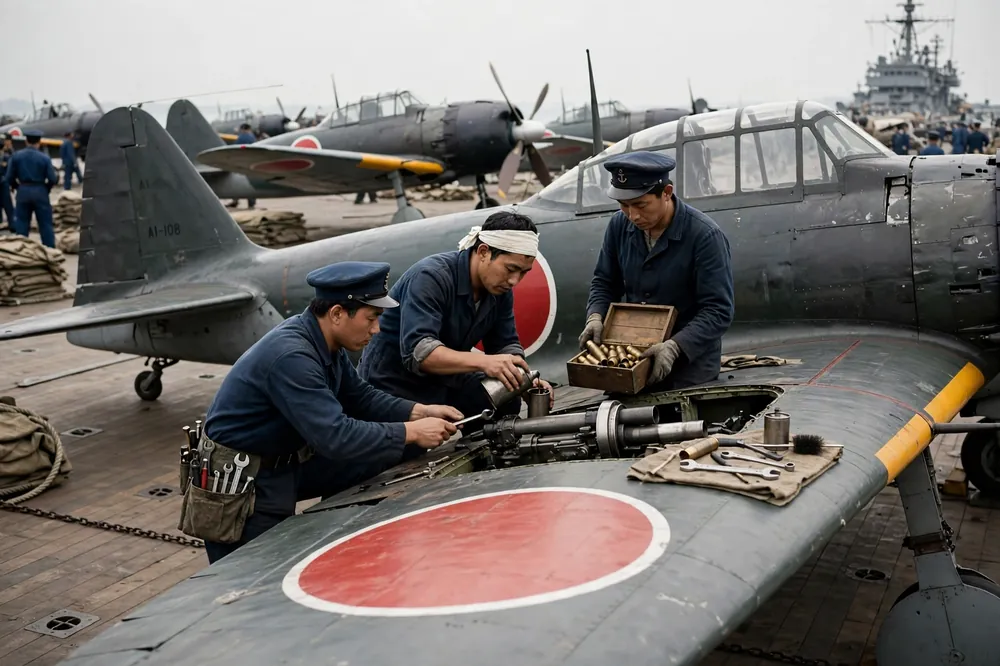
The A6M2’s armament was heavy for a fighter of its day. It carried two 20 mm Type 99 cannon, one in each wing, with 60 rounds per gun, and two 7.7 mm Type 97 machine guns in the nose, synchronised to fire through the propeller, with 500 rounds per gun.
The cannon gave the Zero a punch that Allied fighters, armed only with rifle-calibre machine guns in 1941, could not match: a short burst from the Type 99s could tear the wing off a fighter or set a bomber on fire.
The cannon’s weakness was its low muzzle velocity and its small ammunition supply — 60 rounds lasted only a few seconds of firing — and Japanese pilots learned to use the machine guns to aim and the cannon to kill. For ground attack the A6M2 could carry two 60-kilogram bombs under the wings, and later versions carried a larger bomb load.
Engine and performance
The Nakajima Sakae 12 was a fourteen-cylinder, twin-row radial engine of about 940 horsepower, driving a three-blade constant-speed propeller. It was a compact, reliable engine, and it was shared with the Nakajima B5N Kate, which simplified logistics aboard the carriers. With the Sakae, the A6M2 could reach about 533 km/h at 4,550 metres, climb to 6,000 metres in about 7.5 minutes, and cruise at roughly 300 km/h. Its range was extraordinary: about 1,870 kilometres on internal fuel, and about 3,100 kilometres with a 330-litre drop tank — a range that let Japanese carriers and land-based units strike targets far beyond the reach of any Allied fighter, and that made the Zero a strategic weapon as well as a tactical one.
Limits at high speed
The aircraft’s handling at low and medium speeds was superb, but it had limits that mattered in combat. Above about 450 km/h the ailerons became heavy and the aircraft rolled slowly, and in a high-speed dive the Zero could not follow an American fighter that dived away. Its climb was good but not outstanding, and its level speed, though adequate in 1941, was soon overtaken by the new American fighters. The Zero’s greatest strength — its turning ability — was also, in a sense, its greatest weakness, because it encouraged Japanese pilots to fight the turning fight in which they were unbeatable, and to neglect the energy tactics — diving attacks, high-speed passes, teamwork — that the Americans were learning.
6. Variants
The Zero family was large, and the A6M2 was only the second of its major versions. The A6M1, the prototype version, was powered by the Mitsubishi Zuisei engine of about 780 horsepower, and only two were built. The A6M2 Model 11 and Model 21 were the main early production versions, with the Sakae 12 engine, and it was these aircraft that fought the opening campaigns.
The A6M3 Model 32, introduced in 1942, had a more powerful Sakae 21 engine of about 1,130 horsepower and a shorter, squared-off wing, but its range was reduced and it was less popular with pilots. The A6M3 Model 22 restored the longer wing and the range, and the A6M5, introduced in 1943, became the most numerous version, with a still more powerful engine, a shorter wing, heavier armament and some protection for the pilot.
Later versions included the A6M5c with heavier armament and armour, the A6M6 with a water-injection engine, and the A6M7, the last production version, designed as a fighter-bomber and used widely as a kamikaze. A two-seat trainer version, the A6M2-K, was built in small numbers, and a floatplane fighter version, the A6M2-N “Rufe”, was developed for operations from island bases without airfields. In total about 10,939 Zeros were built by Mitsubishi and Nakajima, making the A6M the most-produced Japanese aircraft of the war and one of the most-produced fighters of any nation.
7. Combat Service
Pearl Harbor and the first six months
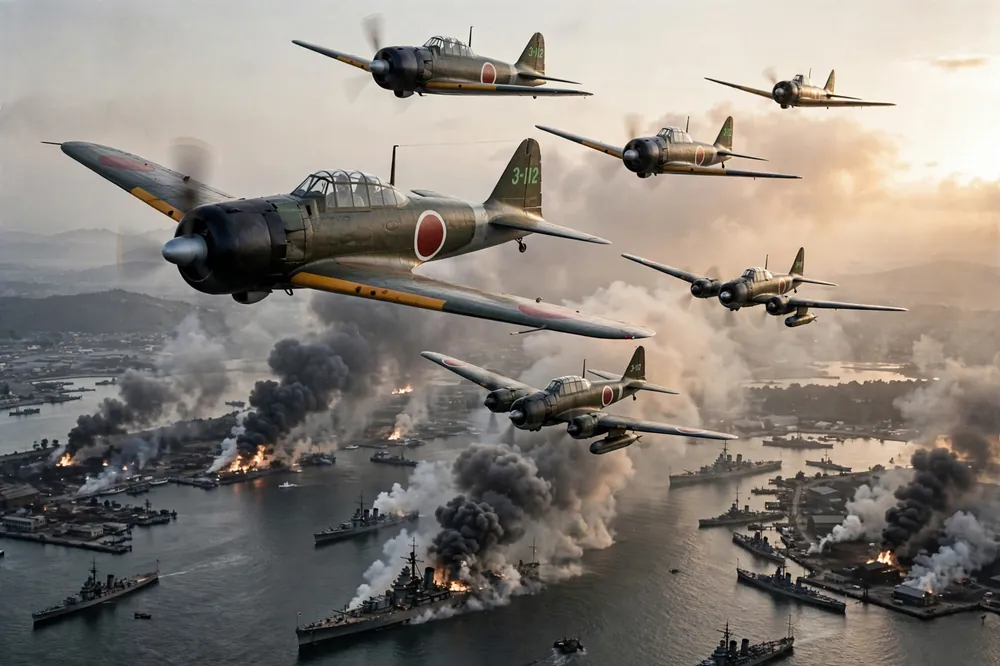
The A6M2’s war began at Pearl Harbor on 7 December 1941, where Zeros of the six carriers escorted the B5N Kate torpedo bombers and the D3A Val dive bombers, strafed the American airfields, and shot down the few American fighters that got into the air.
In the months that followed, the Zero dominated the skies over South-East Asia: over the Philippines, where it destroyed the American air force on the ground and in the air; over Malaya and Singapore, where it outfought the British Buffalo fighters sent against it; and over the Dutch East Indies, where it helped to sink the Allied fleet in the Battle of the Java Sea.
The Japanese advance, the fastest in the history of modern war, was covered at every step by the Zero, and Allied airmen who met it reported, with a mixture of admiration and fear, that it could out-turn, out-climb and out-range anything they flew.
Midway, Guadalcanal and the turn of the tide
The first serious check to the Zero came at the Battle of Midway in June 1942, where the Japanese carrier air groups, including their Zeros, were destroyed with the four carriers that carried them. The loss of the carriers was a disaster, but the loss of the pilots was worse: the men who had flown the Zero since China, the instructors and the flight leaders, were dead, and the Navy’s training system could not replace them.
At Guadalcanal, from August 1942 to February 1943, the Zero fought its longest and hardest campaign, flying from Rabaul to the island and back — a round trip of more than 1,000 kilometres that only the Zero’s range made possible — and fighting the American Wildcats and the Marine Corps pilots who held Henderson Field.
The Japanese pilots won many individual combats, but they lost the campaign: the Americans, flying from the island itself, could fight fresh and often, while the Japanese flew exhausted, at the end of a long flight, and died in numbers that Japan could not afford.
The later war: new enemies, old aircraft
By 1943 the Allies had learned how to fight the Zero, and they had the aircraft to do it. The American F6F Hellcat, introduced in 1943, was faster, better armed and far better protected than the Zero, and it was flown by pilots who had been taught the tactics — the Thach Weave, the high-side pass, the refusal of the turning fight — that neutralised the Zero’s advantages.
In the Battle of the Philippine Sea in June 1944, the “Great Marianas Turkey Shoot”, American Hellcats shot down hundreds of Japanese aircraft, most of them Zeros flown by inexperienced pilots, for the loss of a handful of their own.
After that battle the Zero ceased to be a serious threat as a fighter, and its remaining role was as a kamikaze: the A6M, light, available in numbers and easy to fly, became one of the principal kamikaze aircraft of 1944 and 1945, and it was in that role, diving onto the American fleet off Okinawa, that most of the last Zeros died.
8. Specifications
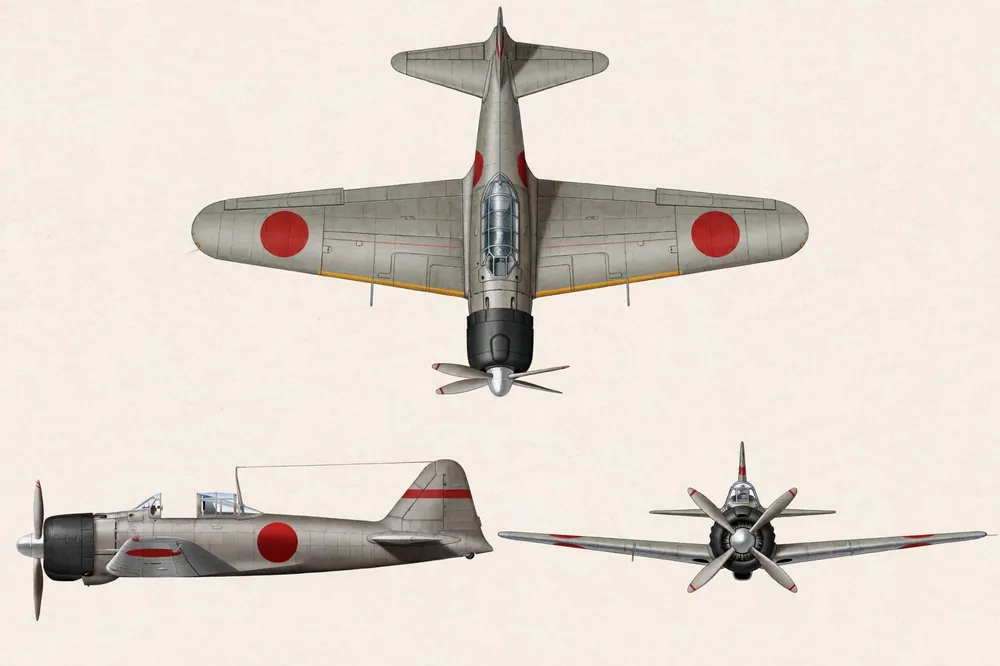
The figures below are for the A6M2 Model 21, the main version of the early Pacific War. Sources differ slightly on weights and performance, and the aircraft’s figures varied with load and the condition of the individual machine.
| A6M2 Model 21 | |
|---|---|
| Length | 9.06 m / 9,06 m |
| Wingspan | 12.00 m (Model 11); 11.00 m (Model 21, approx.) |
| Height | 3.05 m / 3,05 m |
| Wing area | 22.4 m² / 22,4 m² |
| Empty weight | About 1,680 kg |
| Loaded weight | About 2,796 kg |
| Engine | 1 × Nakajima Sakae 12, about 940 hp |
| Maximum speed | About 533 km/h at 4,550 m |
| Cruising speed | About 300 km/h |
| Range | About 1,870 km; about 3,100 km with drop tank |
| Service ceiling | About 10,000 m |
| Climb / Leo cao | About 7.5 minutes to 6,000 m |
| Armament | 2 × 20 mm Type 99; 2 × 7.7 mm Type 97; 2 × 60 kg bombs / 2 × Type 99 20 mm; 2 × Type 97 7,7 mm; 2 × bom 60 kg |
| Crew | 1 |
Against its contemporaries the A6M2 was, in 1941, unmatched in range and turning ability, and its cannon armament was heavier than that of any Allied fighter then in service. The American F4F Wildcat, its principal opponent in 1942, was slower to climb and turn, but it was faster in a dive, far better protected, and armed with six 12.7 mm machine guns with a much larger ammunition supply.
The British Spitfire, when it met the Zero over Darwin and in the Pacific, was faster and climbed better, but it could not match the Zero’s range or its turning circle. The Zero’s advantage was real, but it was narrow, and it depended on the enemy fighting on the Zero’s terms. Once the enemy refused those terms, the advantage was gone.
9. Operators
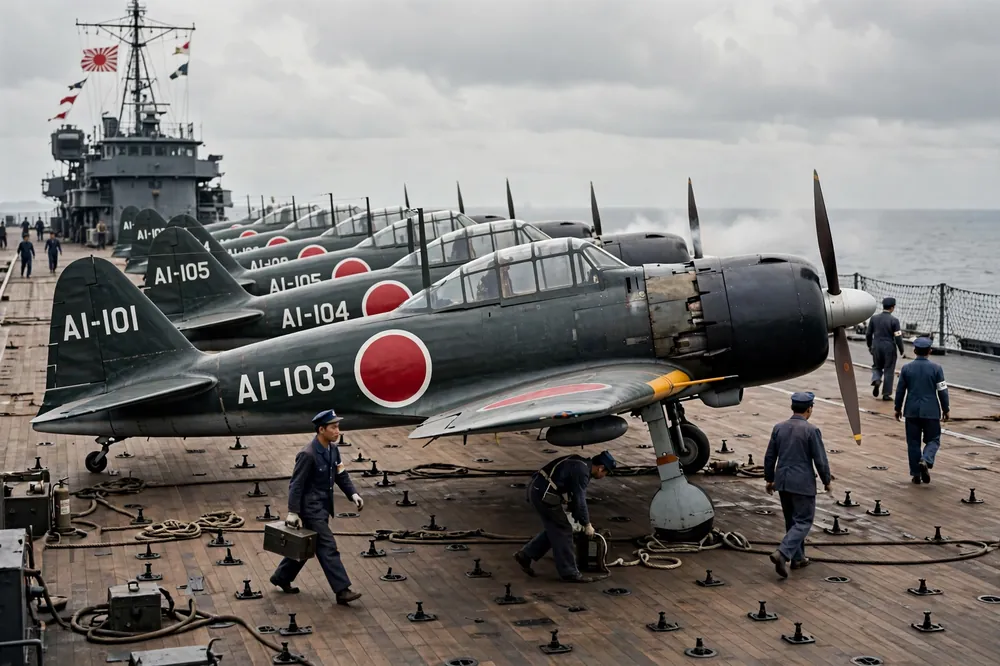
The A6M2 was operated almost exclusively by the Imperial Japanese Navy Air Service, and within the Navy it served in both the carrier air groups and the land-based air groups that fought the opening campaigns of the Pacific War. At Pearl Harbor its squadrons flew from the six fleet carriers Akagi, Kaga, Soryu, Hiryu, Shokaku and Zuikaku, and in the months that followed it flew from land bases across South-East Asia and the Pacific, from Rabaul in New Britain to the airfields of New Guinea and the Solomons. The Japanese Army, which operated its own air force, did not fly the Zero: it had its own fighters, notably the Nakajima Ki-43 Hayabusa, and the two services’ aircraft were rarely interchangeable.
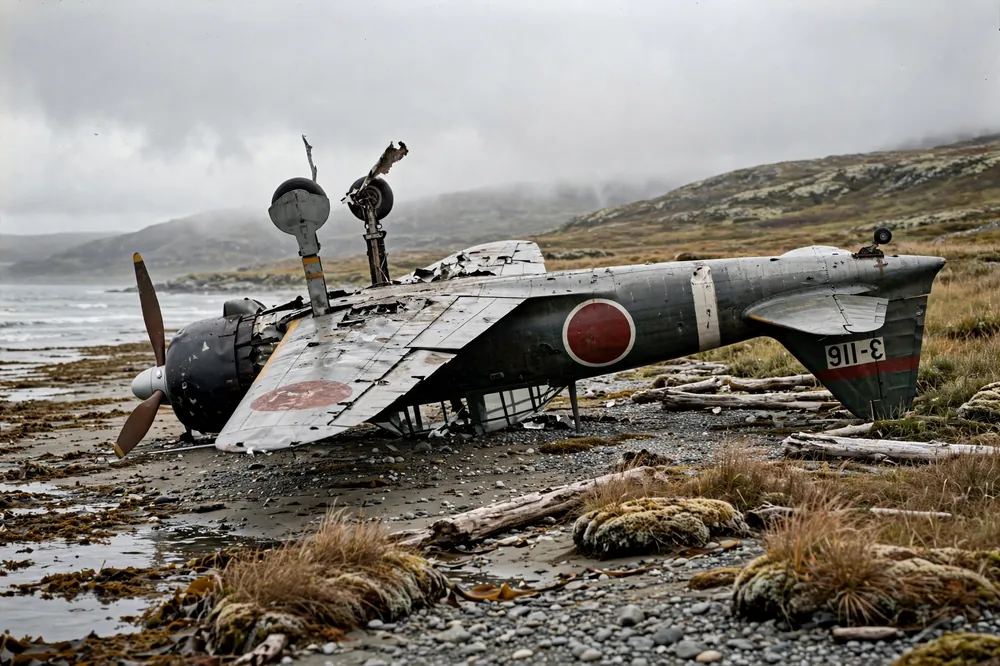
No other country operated the A6M2 in combat during the war, though captured Zeros were flown and tested by the Allies — most famously the “Akutan Zero”, an A6M2 that crash-landed intact on Akutan Island in the Aleutians in July 1942 and was recovered, repaired and flown by American test pilots, giving the Allies their first detailed knowledge of the aircraft’s strengths and weaknesses. After the war, a small number of Zeros were operated by the Chinese Nationalists and by the French in Indochina, and a few were used as trainers, but the type’s combat career ended with Japan’s surrender in 1945.
10. Legacy and Assessment
The legend and the reality
The Zero’s legend has grown since the war, fed by films, books and model kits, and it has become the archetype of the Japanese fighter in the popular imagination. The legend is not false — the A6M2 was, in 1941 and 1942, a superb fighter, and the men who flew it were among the best-trained pilots in the world — but it is incomplete without the second half of the story.
The Zero was designed for a short war, fought by a small corps of elite pilots against an enemy that would fight on the Zero’s terms. Japan got the short war it planned for, but it did not get the victory, and the Zero’s design, which had no margin for a long war of attrition, became a liability as the war dragged on and the enemy improved.
Historians judge the A6M2 as one of the great fighter designs of the Second World War, and as a warning about the dangers of optimising a design too narrowly. Its range and agility were unmatched, and its early combat record — the destruction of the Chinese air force, the sweep of South-East Asia, the long duel over Guadalcanal — was extraordinary. But its lack of protection, its limited engine development and its reliance on a small, irreplaceable corps of pilots meant that it could not survive the war it was built to fight. The Zero’s story is, in the end, the story of Japanese naval air power itself: brilliant, audacious and doomed by the very qualities that made it brilliant.
Survivors
A small number of original Zeros survive in museums, including aircraft at the Smithsonian National Air and Space Museum in Washington, the Imperial War Museum in London, and the Yasukuni Shrine’s Yushukan museum in Tokyo, where a restored A6M is displayed.
The most famous flying Zero, an A6M2 restored in the United States and flown at airshows, was built from the wreckage of several aircraft and is a reminder of how few original machines remain. The “Akutan Zero”, the aircraft that taught the Allies how to fight the Zero, is preserved at the National Naval Aviation Museum in Pensacola, Florida.
Replicas, built from American trainers and other aircraft for films such as Tora! Tora! Tora! (1970), are more numerous than the originals, and they keep the Zero’s shape in the public eye.
11. FAQ
What does “Zero” mean?
“Zero” is a shortening of the aircraft’s official name, Navy Type 0 Carrier Fighter, where the “0” came from the Japanese imperial year 2600, the year the aircraft entered service in July 1940. The Allies adopted the name, and it became the aircraft’s universal name in English, while the Japanese themselves called it the Reisen, short for Rei-shiki Sentoki, or Type 0 Fighter. The name has outlived the war by eighty years, and it remains the best-known name of any Japanese aircraft, a reminder of the system by which Allied intelligence gave Japanese aircraft simple, memorable names — “Kate” for a torpedo bomber, “Betty” for a bomber, “Zero” for a fighter.
How many Zeros were built?
About 10,939 Zeros of all versions were built by Mitsubishi and Nakajima, making the A6M the most-produced Japanese aircraft of the war and one of the most-produced fighters of any nation. The A6M2, the version that fought the opening campaigns of the Pacific War, accounted for roughly 2,000 to 3,000 of that total, depending on how the production sub-types are counted, with the Model 11 and the Model 21 as its two main sub-types. Later versions — the A6M3, A6M5 and A6M7 — were built in larger numbers, with the A6M5 as the most numerous version, and the type remained in production until the end of the war in 1945.
Why was the Zero so manoeuvrable?
The Zero was built to be exceptionally light, using a strong, light aluminium alloy called Extra Super Duralumin and discarding armour, self-sealing fuel tanks and other weight, so that its fully loaded weight was only about 2,800 kilograms, hundreds of kilograms less than its American and British contemporaries. Its large wing gave it a low wing loading of roughly 107 kilograms per square metre and a very tight turning circle, so it could out-turn any Allied fighter it met in 1941 and 1942, often by a wide margin. Its controls were light and harmonised, and its pilots described it as a delight to fly, responsive to the lightest touch and capable of manoeuvres that seemed impossible in a heavier aircraft.
What was the Zero’s weakness?
The Zero had no armour for its pilot and no self-sealing fuel tanks, so a few hits could kill the pilot or set the aircraft on fire, and its thin-skinned structure was easily damaged. Its ailerons stiffened at high speed, so it could not roll quickly in a dive above about 450 km/h, and its engine, the Sakae 12 of about 940 horsepower, could not be developed much beyond about 1,100 horsepower, limiting the improvements that could be made to the design.
American pilots learned to dive away from a Zero and to refuse the turning fight, using speed, diving attacks and teamwork, and the F6F Hellcat and F4U Corsair, faster, better armed and far better protected, outclassed it from 1943 onward.
What was the Akutan Zero? / Akutan Zero là gì?
The Akutan Zero was an A6M2 that crash-landed intact on Akutan Island in the Aleutians in July 1942, after its pilot, Petty Officer Tadayoshi Koga, was killed when his aircraft flipped over on landing in the soft ground. American forces recovered the aircraft, repaired it and flew it in tests, giving the Allies their first detailed understanding of the Zero’s performance, its strengths and its weaknesses — including the stiff ailerons at high speed that American pilots then exploited by diving away, and the lack of armour and self-sealing tanks that made the Zero vulnerable to a short burst. The Akutan Zero is preserved today at the National Naval Aviation Museum in Pensacola, Florida.
Did any Zeros survive the war?
Yes, a small number of original Zeros survive in museums, including aircraft at the Smithsonian National Air and Space Museum in Washington, the Imperial War Museum in London and the Yushukan museum at the Yasukuni Shrine in Tokyo, where a restored A6M is displayed. The Akutan Zero is preserved at the National Naval Aviation Museum in Pensacola, Florida, and several airworthy Zeros fly at airshows, though some are built from the wreckage of multiple aircraft and others are replicas converted from American trainers for films such as Tora! Tora! Tora! (1970). The originals are few, and they are among the most prized Japanese aircraft in any collection.
12. Sources
- Wikipedia, “Mitsubishi A6M Zero” — production figures (about 10,939 built), first flight, performance data and service history.
- Jiro Horikoshi, Eagles of Mitsubishi: The Story of the Zero Fighter (University of Washington Press, 1981) — the designer’s own account of the 12-Shi requirement and the Zero’s development.
- René J. Francillon, Japanese Aircraft of the Pacific War (Putnam, 1970) — the standard English-language reference on the A6M’s versions and production.
- John B. Lundstrom, The First Team: Pacific Naval Air Combat from Pearl Harbor to Midway (Naval Institute Press, 1984) — the Zero in combat in the opening campaigns.
- Eric M. Bergerud, Fire in the Sky: The Air War in the South Pacific (Westview Press, 2000) — the Zero over Guadalcanal and the learning curve of Allied pilots.
- Masatake Okumiya and Jiro Horikoshi, Zero! (E. P. Dutton, 1956) — the Japanese pilots’ account of the Zero’s war.
- Henry Sakaida, Imperial Japanese Navy Aces 1937–45 (Osprey, 1998).
- Robert C. Mikesh, Zero: Combat and Development History of Japan’s Legendary Mitsubishi A6M Zero Fighter (Motorbooks, 1994).