 WAR ATLAS MILITARY HISTORY MAGAZINE · WWI — WWII
Albert Einstein
1. Lead
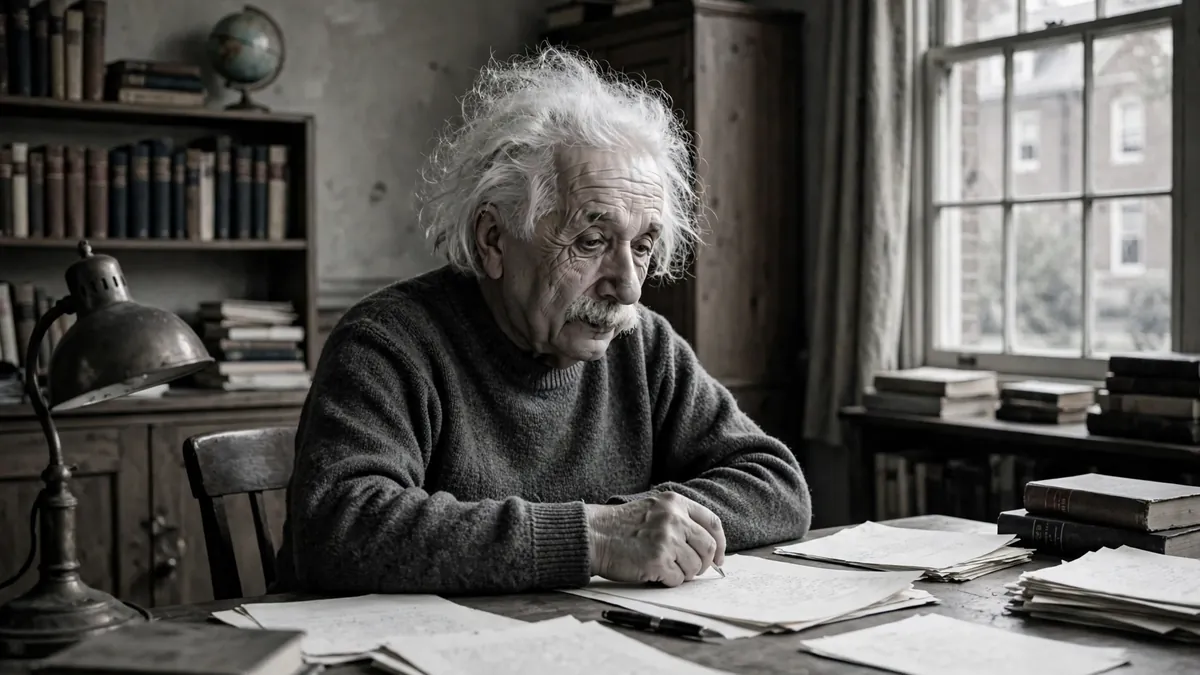
Albert Einstein (14 March 1879 – 18 April 1955) was a German-born theoretical physicist whose theories of relativity changed the scientific understanding of space, time, gravity and energy. In 1905, while working as a patent clerk in Bern, he published four papers that transformed modern physics, including special relativity and the mass–energy equivalence expressed as E=mc².
He won the Nobel Prize in Physics for 1921 — awarded in 1922 — for his explanation of the photoelectric effect, not for relativity. Einstein’s importance to the history of the Second World War is indirect but profound: as a Jewish scientist driven into exile by the Nazi regime in 1933, he became a widely known refugee of his time, and in 1939 he signed the letter to President Franklin D.
Roosevelt warning that Germany might develop an atomic bomb — a warning that helped set in motion the research that became the Manhattan Project, a project in which Einstein himself never worked.
2. Key Facts
| Born | 14 March 1879, Ulm, Kingdom of Württemberg, German Empire |
| Died | 18 April 1955 (aged 76), Princeton, New Jersey, United States |
| Nationality | German-born; later Swiss (1901) and American (1940) |
| Role / Office | Theoretical physicist; Professor, Institute for Advanced Study, Princeton (1933–1955) |
| Known for | Special and general relativity; E=mc²; photoelectric effect; Brownian motion; the Einstein–Szilárd letter (1939) |
| Nobel Prize | Nobel Prize in Physics 1921, awarded 1922, for the photoelectric effect |
| Spouse / Family | Mileva Marić (married 1903, divorced 1919); Elsa Löwenthal (married 1919, died 1936); children Lieserl, Hans Albert and Eduard |
3. Early Life and Education
Albert Einstein was born on 14 March 1879 in Ulm, in the Kingdom of Württemberg in the German Empire, the son of Hermann Einstein, an engineer and salesman, and Pauline Koch. The family moved to Munich when Albert was a year old, where his father and uncle ran an electrical engineering business.

The popular story that Einstein was a poor student is a myth: he was strong in mathematics and science from an early age, though he disliked the rigid, rote-learning discipline of the German Gymnasium and clashed with teachers who expected unquestioning obedience.
At the age of five, according to his own later recollection, his father showed him a compass, and the invisible force that moved the needle fascinated him for the rest of his life. He taught himself geometry and calculus as a teenager, reading Euclid and popular science books, and he was deeply influenced by a family friend, Max Talmud, who lent him science books and introduced him to Kant’s philosophy.
In 1894 the family business failed and the Einsteins moved to Milan, Italy, leaving the fifteen-year-old Albert behind in Munich to finish school. He soon left, without a diploma, and joined his family in Italy, spending a year largely on his own before applying to the Swiss Federal Polytechnic School in Zurich (ETH Zurich).
He failed the entrance examination in 1895 — he was two years below the usual age and weak in the non-scientific subjects — but the examiners were impressed by his mathematics and physics, and he was advised to finish secondary school first. He did so at the cantonal school in Aarau, Switzerland, where the liberal teaching style suited him far better, and he entered the Polytechnic in 1896.
He renounced his German citizenship that year and remained stateless until he became a Swiss citizen in 1901.
At the Polytechnic, Einstein studied physics and mathematics, graduating in 1900. His fellow students included Mileva Marić, a Serbian physics student who became his first wife. After graduation he struggled for two years to find an academic post; his professors, unimpressed by his independence and his habit of skipping lectures, gave him poor references.
In 1902, with the help of a friend’s father, he obtained a post as a technical expert at the Swiss Patent Office in Bern. The job, which he held until 1909, gave him a steady income, time to think, and a habit of mind — examining the practical workings of inventions, especially devices for synchronising clocks and coordinating railway timetables — that fed directly into his thinking about time and simultaneity.
In 1905 he submitted his doctoral dissertation, “A New Determination of Molecular Dimensions”, to the University of Zurich, and in the same year published the four papers that made him famous.
4. Rise to Prominence
The year 1905 is known in the history of physics as Einstein’s annus mirabilis, his miracle year. In four papers published in the journal Annalen der Physik, the twenty-six-year-old patent clerk solved four separate problems, each of which would have been enough to make a scientific reputation.
In March he proposed that light behaves as discrete packets of energy — light quanta, later called photons — explaining the photoelectric effect, the puzzle of why light striking a metal ejects electrons only above a certain frequency. In May he explained Brownian motion, the jittery movement of tiny particles suspended in a liquid, as the visible effect of molecular collisions, providing decisive evidence that atoms and molecules really exist.
In June he published “On the Electrodynamics of Moving Bodies”, introducing special relativity: the laws of physics are the same for all observers in uniform motion, and the speed of light in a vacuum is constant for everyone, which means that time and length are not absolute but depend on the observer’s motion.
In September he added a short paper deriving the equation E=mc² — energy equals mass times the square of the speed of light — showing that mass and energy are two forms of the same thing.
These papers did not make Einstein famous overnight, but they drew the attention of leading physicists, above all Max Planck, the founder of quantum theory, who recognised their importance and helped bring Einstein into academic life. In 1909 Einstein became an associate professor at the University of Zurich, then professor at the German University of Prague in 1911, and in 1912 he returned to the ETH Zurich as a full professor. In 1914 he moved to Berlin as director of the Kaiser Wilhelm Institute for Physics and a member of the Prussian Academy of Sciences — a senior scientific post in Germany — with a research position that freed him from teaching duties.
In Berlin he completed the general theory of relativity. In November 1915 he presented the general theory of relativity, which describes gravity not as a force but as the curvature of spacetime caused by mass and energy. The theory predicted that starlight passing near the Sun would be bent by a measurable amount.
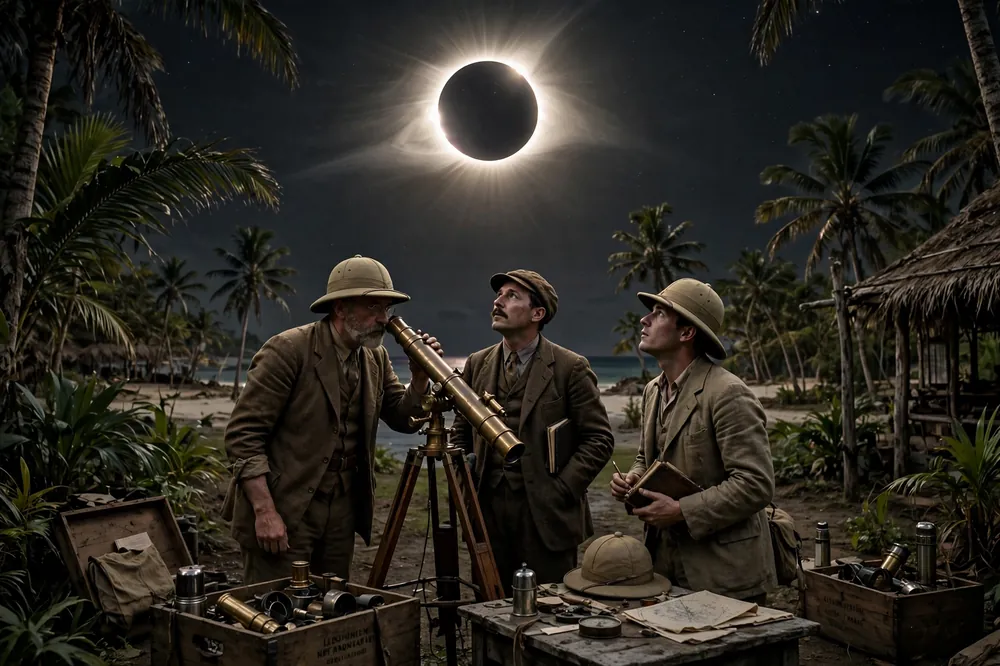
During the solar eclipse of 29 May 1919, British astronomer Arthur Eddington led expeditions that measured the bending of starlight and found it consistent with Einstein’s prediction. The result was announced in London in November 1919, and Einstein became internationally known: newspapers around the world carried his name, and photographs of him were widely reproduced.
In 1921 he was awarded the Nobel Prize in Physics for 1921 — the prize was reserved in 1921 and announced in November 1922 — “for his services to Theoretical Physics, and especially for his discovery of the law of the photoelectric effect”. The citation deliberately avoided relativity, which the Nobel Committee still regarded as insufficiently confirmed.
Einstein received the prize in person in Stockholm in December 1922 and delivered his Nobel lecture in Gothenburg in July 1923.
Through the 1920s Einstein was a widely known public figure as well as a scientist. He travelled widely, lectured in Europe, Asia and the United States, and became a public figure who spoke out on politics: a committed pacifist in the 1920s, a supporter of the League of Nations, and a prominent voice for the Zionist movement and the founding of the Hebrew University of Jerusalem, though he declined an offer to become president of the State of Israel in 1952.
His fame also made him a target. German nationalist and antisemitic campaigners attacked “Jewish physics” and relativity itself as a fraud; in 1922 his friend Walther Rathenau, the Jewish foreign minister of Germany, was assassinated by right-wing extremists, and Einstein briefly considered leaving Germany. He stayed, but the danger was growing.
5. Albert Einstein’s Role in World War II
Einstein’s role in the Second World War was not that of a general or a minister. He held no office, commanded no army and designed no weapon. His importance lies in three things: he was one of the Jewish scientists driven out by the Nazi regime, and his case received the widest international attention; he was the signatory whose name gave weight to the warning that led toward the atomic bomb; and he campaigned on behalf of the refugees the war created. Each of these deserves separate treatment.
Exile from Nazi Germany
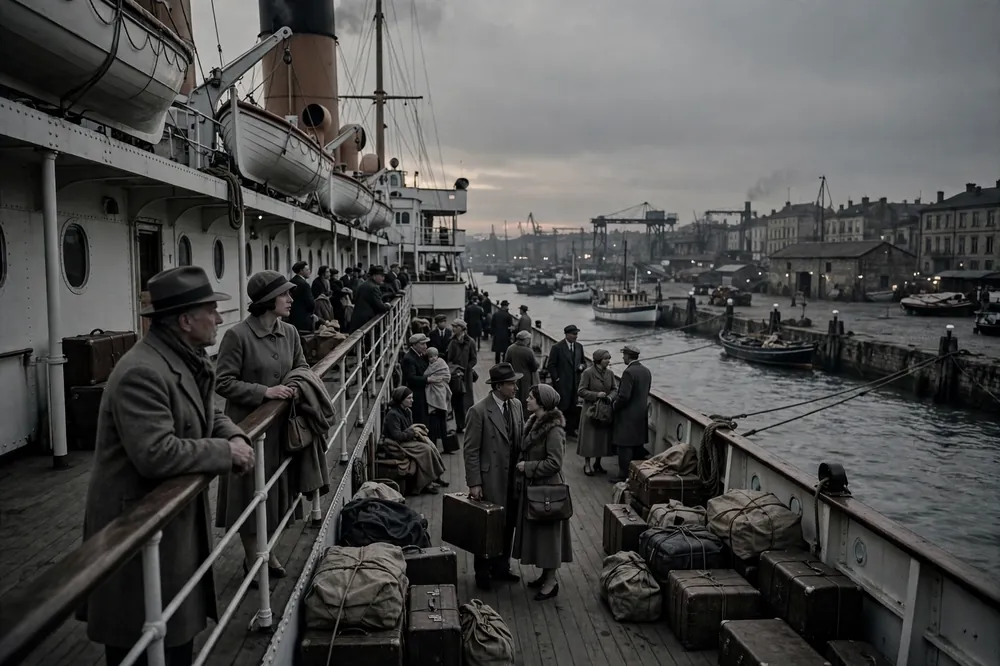
When Adolf Hitler became Chancellor of Germany on 30 January 1933, Einstein was in California, on a visiting appointment at the California Institute of Technology. He never returned to Germany. In March 1933, while he was still abroad, the Nazi regime seized his Berlin cottage, confiscated his bank accounts and placed a price on his head — according to some contemporary reports, a reward of 50,000 marks was offered for his capture.

On 28 March 1933 he resigned from the Prussian Academy of Sciences, and in October he settled in the United States, taking up a post at the newly founded Institute for Advanced Study in Princeton, New Jersey, where he would remain for the rest of his life. He became an American citizen in 1940.
Einstein was not an isolated case. The Nazi regime’s Law for the Restoration of the Professional Civil Service of April 1933 dismissed Jewish academics and other “non-Aryans” from universities, and by the end of the 1930s roughly a quarter of Germany’s physicists had been driven out.
The exodus — which included Leo Szilard, Edward Teller, Eugene Wigner, Hans Bethe and many others — transferred the centre of gravity of physics from Germany to Britain and the United States, and many of the exiles would later work on the Allied atomic project. The exodus reduced Germany’s scientific capacity and increased that of Britain and the United States.
Einstein himself understood this clearly, and he used his fame to help other refugees find posts abroad, writing hundreds of letters of recommendation and affidavits.
Einstein’s single most consequential act in the history of the war came in the summer of 1939. In July, the Hungarian physicist Leo Szilard visited Einstein at his summer home on Long Island and explained the implications of a recent discovery: German scientists Otto Hahn and Fritz Strassmann had shown in December 1938 that uranium atoms could be split — nuclear fission — and Szilard believed a chain reaction could release enormous energy and make a bomb of unprecedented power. Szilard feared that Germany, which had some of the world’s best physicists and controlled the uranium mines of Czechoslovakia after the occupation of March 1939, might build such a weapon first.
Szilard drafted a letter to President Franklin D. Roosevelt, with help from fellow physicists Edward Teller and Eugene Wigner, and Einstein signed it on 2 August 1939. The letter warned that “extremely powerful bombs of a new type may thus be constructed” and urged the United States government to secure uranium supplies and accelerate research. It was delivered to Roosevelt on 11 October 1939 by the economist Alexander Sachs.
Roosevelt replied on 19 October, telling Einstein that he had set up a committee — the Advisory Committee on Uranium, later known as the Uranium Committee — to study the question. That committee was the first, small step on the road that led, after the attack on Pearl Harbor and the entry of the United States into the war, to the Manhattan Project, the vast Anglo-American programme that built the first atomic bombs.
It is essential to be precise about what Einstein did and did not do. He did not invent the atomic bomb, he did not work on the Manhattan Project, and he was in fact denied a security clearance and kept away from it — the American authorities regarded him as a security risk because of his pacifist associations and his outspoken politics.
His contribution was the authority of his name on a warning drafted by others. Without that signature, Szilard’s letter would have been the appeal of an unknown refugee physicist; with it, it reached the President. Einstein later said he regretted signing the letter.
In a 1954 interview he called it “the one great mistake in my life” — although historians note that the remark was made after the bombs had been used on Hiroshima and Nagasaki, and that in 1939, with Nazi Germany apparently racing toward the same weapon, the decision looked very different.
Einstein and the atomic age after the war
After the war, Einstein became one of the most prominent advocates of civilian control over atomic energy. In 1946 he helped to found the Emergency Committee of Atomic Scientists, together with Leo Szilard and other physicists, with the aim of informing the public about the dangers of nuclear weapons and of pressing for international control of atomic energy.
The committee raised funds, published pamphlets and lobbied the United States government, and Einstein served as its chairman. In 1947 he wrote that the unleashing of atomic energy had “changed everything save our modes of thinking”, and that the world therefore required a new way of thinking if it was to survive.
His advocacy did not change American policy: the United States continued to develop nuclear weapons, and the Soviet Union tested its first atomic bomb in August 1949. Einstein’s position was that the bomb could not be un-invented, and that the only safeguard was political — international control, disarmament and, in the longer term, a form of world government.
These views, which he held consistently from 1945 until his death, were shared by a number of the scientists who had worked on the Manhattan Project, including J. Robert Oppenheimer, and they were opposed by others, including Edward Teller. The debate over civilian control of atomic energy, which Einstein helped to open, continued through the Cold War and remains a subject of discussion today.
Einstein and the refugees
Throughout the war Einstein worked for the victims of Nazism. He served on committees aiding refugee scholars, helped raise funds for Jewish refugees, and supported the Emergency Committee of Atomic Scientists after the war. In 1939 he also helped bring to American attention the plight of Jewish refugees aboard the SS St. Louis, though his efforts could not change American immigration policy.
During the war he publicly called for the defeat of Nazi Germany, breaking with the absolute pacifism of his youth. In 1940 he wrote that “the power of resistance which has enabled the Jewish people to survive for thousands of years has been based to a large extent on traditions of mutual helpfulness” — a theme he returned to often.
His wartime advocacy was moral rather than military, but it mattered: in an age when refugee scientists were often suspected as enemy aliens, his public support carried weight with officials and institutions.
6. Key Decisions
Leaving Germany and never returning (1933). Einstein’s decision to resign from the Prussian Academy and settle in the United States was made quickly and publicly, and it set an example that many other scientists followed. By refusing any compromise with the Nazi regime, he turned his personal exile into a political statement that the world could not ignore.
Signing the letter to Roosevelt (2 August 1939). This was the most consequential decision of Einstein’s public life. He signed a letter he had not written, on a subject — nuclear weapons — outside his own research, because Szilard convinced him that the danger was real and that only his name would make the President listen. The decision was reluctant: Einstein was a lifelong pacifist who had opposed military research, and he understood the moral weight of what he was doing. He later described the letter as his one great mistake, but in August 1939, with Germany already occupying Czechoslovakia and Poland weeks away from invasion, the case for warning Roosevelt was strong.
Refusing to work on the atomic bomb. Einstein never sought a role in the Manhattan Project, and the American government never offered him one. His exclusion was partly political — the FBI kept a file on him and regarded his left-wing associations with suspicion — and partly practical: his work was in theoretical physics, not in the experimental and engineering problems the bomb project faced. His distance from the project is an important corrective to the popular image of Einstein as the “father of the atomic bomb”: he was the author of the theory that made the bomb possible in principle, and the signatory of the letter that warned of it, but he built nothing.
Public advocacy for refugees and for a Jewish homeland. Einstein used his fame to press for the admission of Jewish refugees and to support the Hebrew University of Jerusalem. In 1952 he declined the presidency of Israel, writing that he lacked the experience and the aptitude for dealing with people in official positions — a decision that confirmed his preference for the role of moral witness over political office.
7. Controversies
Einstein’s controversies are scientific and political, not criminal, but they are real and worth stating plainly. The best-known is his long resistance to quantum mechanics. From the mid-1920s onward, Einstein argued that quantum theory, though successful in its predictions, was incomplete — that “God does not play dice with the universe”, as he put it in a 1926 letter to Max Born.
He spent decades trying to construct a unified field theory that would reconcile gravity and electromagnetism and restore determinism to physics. Most physicists concluded that he was wrong: quantum mechanics, in the form developed by Niels Bohr, Werner Heisenberg and others, became the foundation of modern physics, and experiments since the 1980s — notably tests of Bell’s theorem — have confirmed its predictions in ways Einstein would have found unwelcome.
Historians of science treat this not as a failure of intellect but as a case of a leading physicist holding to a philosophical conviction against the evidence of his own field.
A second controversy concerns Einstein’s private life and his treatment of his first wife, Mileva Marić. Their marriage deteriorated after the move to Berlin in 1914; they separated that year and divorced in 1919, with Einstein agreeing, as part of the settlement, to give Marić the money from his future Nobel Prize.
Historians have debated Marić’s contribution to Einstein’s early work: some have claimed she was a collaborator in the 1905 papers, while the documentary evidence — their surviving letters — shows her as an intellectual companion and sounding board rather than a co-author.
The scholarly consensus, based on the Collected Papers of Albert Einstein, is that the 1905 papers were Einstein’s own work, though Marić’s role as a discussant in his early years is acknowledged. The episode is also cited by biographers as evidence of a colder side to Einstein’s character: he could be distant and demanding with those closest to him, and his second marriage, to his cousin Elsa Löwenthal, was complicated by his infidelities, which are documented in his letters.
A third, political controversy concerns Einstein’s later views on the atomic bomb and his alleged sympathy for communism. After the war he campaigned for civilian control of atomic energy and for world government, positions that made him a target of suspicion during the McCarthy era; the FBI compiled a file of more than 1,400 pages on him.
He was never a member of the Communist Party, and historians generally describe his politics as democratic socialist and humanitarian rather than communist, but his willingness to associate with left-wing causes gave his critics ammunition, and his security clearance was withheld accordingly.
His 1954 remark that signing the Roosevelt letter was his “one great mistake” is itself sometimes quoted out of context: it expressed regret about the bomb’s use, not a denial that the warning had been justified in 1939.
8. Later Life and Death
After the war, Einstein remained at the Institute for Advanced Study in Princeton, working — largely unsuccessfully — on a unified field theory and speaking out on the issues of the atomic age. In 1955, shortly before his death, he joined the philosopher Bertrand Russell in issuing the Russell–Einstein Manifesto, which warned of the dangers of nuclear weapons and called on scientists to work for the abolition of war.

He continued to live simply in Princeton, in a modest house at 112 Mercer Street, walking to his office and answering the letters of schoolchildren and strangers from around the world. His second wife, Elsa, had died in 1936; his son Eduard suffered from schizophrenia and spent most of his adult life in institutions in Switzerland.
Einstein died on 18 April 1955 at Princeton Hospital, aged 76, of a ruptured abdominal aortic aneurysm. He had refused surgery, saying, “I want to go when I want. It is tasteless to prolong life artificially. I have done my share; it is time to go. I will do it elegantly.” In accordance with his wishes, his body was cremated the same day and his ashes scattered in the Delaware River, with no funeral and no grave. His brain was removed during the autopsy for scientific study — without, according to some accounts, the permission of his family — and preserved for decades, a fact that later became a subject of ethical debate.
Daily life in Princeton was deliberately simple. Einstein lived at 112 Mercer Street, a modest white house he bought in 1935, and walked the short distance to the Institute for Advanced Study, where his office was Room 115 in Fuld Hall. He answered letters from strangers, schoolchildren and fellow scientists, often in German, and he played the violin — a lifelong habit that began in childhood — for relaxation.
His sister Maja, who had followed him to the United States, lived nearby until her death in 1951, and his secretary Helen Dukas managed his correspondence and his papers for more than twenty-five years. The Einstein Archives, which Dukas helped to organise, were transferred after his death to the Hebrew University of Jerusalem, where they remain the principal source for the study of his life and work.
9. Legacy of Albert Einstein
Einstein’s scientific legacy is extensive. General relativity, confirmed by the bending of starlight in 1919 and by a century of tests since — from the precession of Mercury’s orbit to gravitational waves detected in 2015 and the first image of a black hole in 2019 — remains the best description of gravity ever devised, and it underpins technologies from GPS navigation, which must correct for relativistic time dilation, to modern cosmology.

Special relativity and E=mc² made nuclear energy possible, for good and ill, and the photoelectric effect he explained in 1905 underlies the solar cells and digital cameras of the modern world. His name entered everyday language as a synonym for exceptional intellect, and photographs of him — including the 1951 photograph in which he sticks out his tongue — were widely reproduced.
His historical legacy is more complicated. Einstein is remembered both as the scientist whose theory made the atomic bomb possible and as the humanitarian who warned against it; both as the refugee driven out by Nazi Germany and as the man whose signature helped launch the American atomic programme.
The Hebrew University of Jerusalem, which he helped to found, holds his papers; the Institute for Advanced Study in Princeton remains a leading centre of theoretical research; and the element einsteinium (element 99), discovered in the debris of a hydrogen bomb test in 1952, bears his name.
The Russell–Einstein Manifesto he signed days before his death became one of the founding documents of the Pugwash Conferences on Science and World Affairs, which won the Nobel Peace Prize in 1995. In the history of the Second World War, Einstein stands as a reminder that the war was fought not only with armies but with ideas — and that the expulsion of leading physicists from Germany reduced the country’s scientific capacity while strengthening physics in Britain and the United States.
10. Assessment by Historians
Historians of science often place Albert Einstein alongside Newton and Darwin among the most influential figures in modern science. The judgement rests not on a single discovery but on the breadth of his achievement: in one year, 1905, he produced work on the quantum nature of light, on the reality of atoms, on relativity and on mass–energy equivalence, and a decade later he replaced Newton’s theory of gravity with a new account of the universe.
The four papers of 1905, written when he was 26, remain unusual in their range. His later career is judged more critically: the unified field theory consumed thirty years without result, and his opposition to quantum mechanics placed him outside the mainstream of the physics he had helped to create.
The consensus is that his most influential work dates from his early career, including his habit of pursuing thought experiments — such as imagining riding on a beam of light — wherever they led.
Historians of the Second World War assess Einstein’s role more narrowly and more carefully. He is not credited with winning the war or with building the bomb; he is credited with lending the authority of a widely known scientist to a warning that might otherwise have gone unheard, and with illustrating, through his own experience, the effects of Nazi racial policy on science.
The German historian Fritz Stern called the expulsion of Einstein and his colleagues “the self-destruction of German science”, and the judgement has stood: the regime’s antisemitism cost Germany the physicists it needed most. Einstein’s own assessment of himself was modest.
In his Autobiographical Notes (1949) he wrote that he had no special talent, only a passionate curiosity — a claim that biographers from Abraham Pais to Walter Isaacson have treated with respectful scepticism. The verdict of history is simpler: Albert Einstein changed the scientific understanding of space, time and gravity, and his life — from the patent office in Bern to Princeton, where he lived in exile — remains widely studied by historians of science.
Frequently Asked Questions
Who was Albert Einstein? Albert Einstein (1879–1955) was a German-born theoretical physicist who developed the theories of special and general relativity and the equation E=mc². He won the Nobel Prize in Physics for 1921 (awarded 1922) for his explanation of the photoelectric effect.
What did Albert Einstein do in World War II? Einstein was a refugee from Nazi Germany and, in 1939, signed the Einstein–Szilárd letter warning President Roosevelt that Germany might develop an atomic bomb. He did not work on the Manhattan Project and was denied a security clearance.
Why did Albert Einstein leave Germany? He left because the Nazi regime, which came to power in January 1933, persecuted Jewish scientists. While he was in California, the regime confiscated his property, and he resigned from the Prussian Academy of Sciences in March 1933, settling in Princeton, New Jersey.
Did Albert Einstein invent the atomic bomb? No. Einstein’s theories made nuclear energy possible, and his 1939 letter helped start American research, but he did not design or build the bomb and never worked on the Manhattan Project.
What is E=mc²? It is the equation from Einstein’s 1905 paper on mass–energy equivalence: the energy (E) of a body equals its mass (m) multiplied by the square of the speed of light (c). It shows that a small amount of mass contains an enormous amount of energy.
How did Albert Einstein die? He died on 18 April 1955 in Princeton, New Jersey, aged 76, of a ruptured abdominal aortic aneurysm, after refusing surgery.
Related articles
Sources
- Wikipedia, “Albert Einstein” — consolidated biography: birth and death dates, annus mirabilis 1905, Nobel Prize 1921 awarded 1922, exile 1933, Einstein–Szilárd letter 2 August 1939, death 18 April 1955.
- Encyclopaedia Britannica, “Albert Einstein” (britannica.com) — biography, relativity, Nobel citation, Princeton years.
- NobelPrize.org, “The Nobel Prize in Physics 1921 — Albert Einstein” — official citation: “for his services to Theoretical Physics, and especially for his discovery of the law of the photoelectric effect”; prize reserved 1921, awarded 9 November 1922.
- University of Zurich, “Doctor Einstein” (news.uzh.ch, 2022) — annus mirabilis 1905, doctoral thesis, delayed Nobel Prize.
- Walter Isaacson, Einstein: His Life and Universe (Simon & Schuster, 2007) — standard modern biography; patent office years, marriages, exile, Roosevelt letter, later life.
- Abraham Pais, Subtle Is the Lord: The Science and the Life of Albert Einstein (Oxford University Press, 1982) — scientific biography by a physicist colleague.
- The Collected Papers of Albert Einstein, Princeton University Press / Einstein Papers Project (Caltech) and the Albert Einstein Archives, Hebrew University of Jerusalem — primary source for dates, letters and the 1939 Roosevelt correspondence.
- Franklin D. Roosevelt Presidential Library and Museum — the Einstein–Szilárd letter of 2 August 1939 and Roosevelt’s reply of 19 October 1939.
Further reading
- Jürgen Neffe, Einstein: A Biography (Farrar, Straus and Giroux, 2007).
- Albrecht Fölsing, Albert Einstein: A Biography (Viking, 1997).