 WAR ATLAS MILITARY HISTORY MAGAZINE · WWI — WWII
Essex-class aircraft carrier
1. Lead
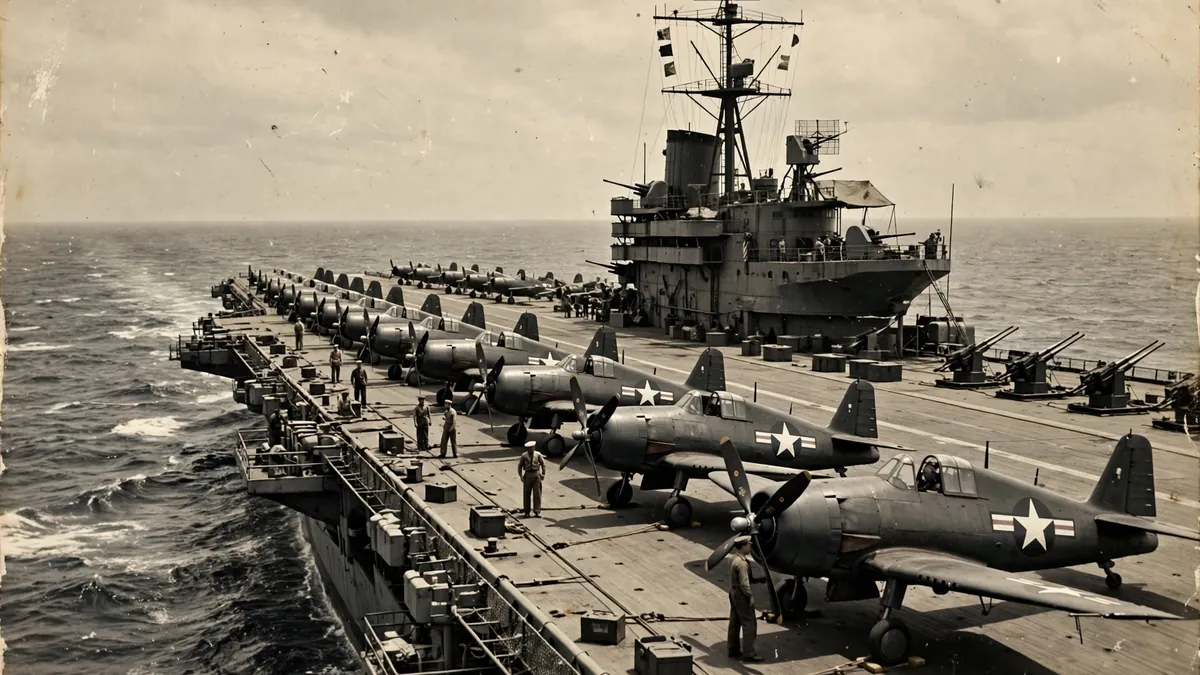
The Essex-class aircraft carrier was the backbone of the United States Navy in the Second World War, and the most successful class of aircraft carriers ever built. Designed in the late 1930s and built in large numbers during the war, the Essex class consisted of 24 ships, of which 17 were commissioned before the end of the war in August 1945, and the class formed the core of the fast carrier task forces that won the Pacific War. The Essex carriers were large, fast and well armed, they carried an air group of about 90 to 100 aircraft, and they fought in every major battle of the Pacific War, from the first raids on Japanese-held islands in 1942 to the Battle of Leyte Gulf in October 1944, the largest naval battle in history, and to the Battle of Okinawa in 1945. No Essex-class carrier was lost in the war, although several were badly damaged by kamikaze attacks, and the class remained in service after the war, in the Korean War, in the Vietnam War and in the Cold War, with some ships serving into the 1970s and 1980s. Four Essex-class carriers survive today as museum ships, and they are among the most visited naval museums in the United States.
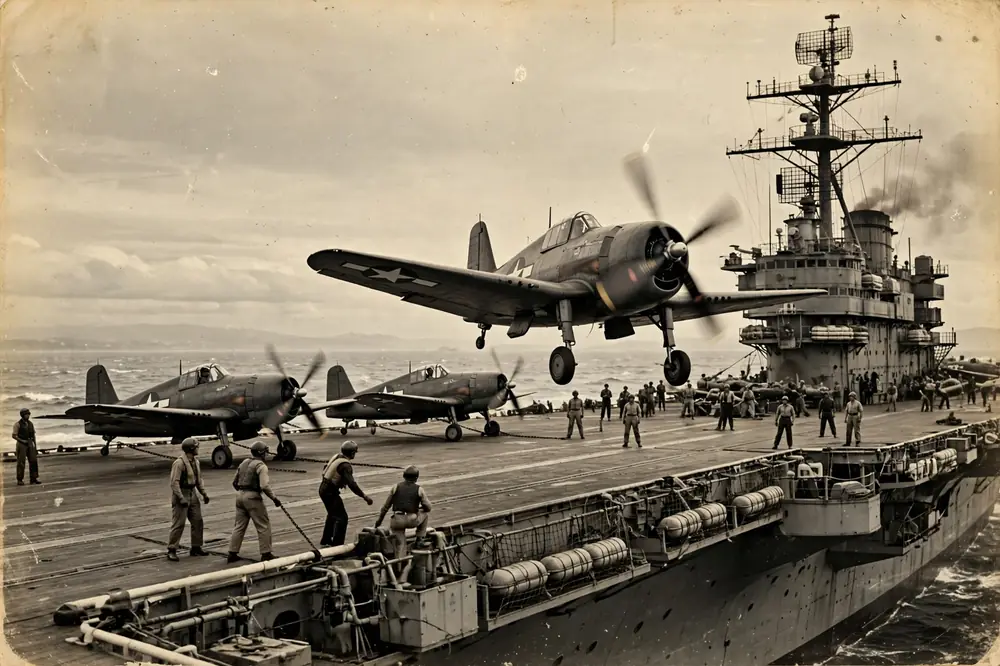
The Essex class was a product of the United States’ industrial power, and of the lessons that the US Navy had learned from its earlier carriers, the Yorktown class, which had fought at Midway and in the Coral Sea, and which had been lost in those battles. The Essex was larger, it carried more aircraft, it had better protection, and it was built in numbers that no other navy could match: 24 ships, built in shipyards from Newport News to Bremerton, in a programme that was the largest carrier-building programme in history. The Essex carriers were the ships that carried the war to Japan, and they were the ships that won the Pacific War, not by a single battle, but by a campaign of air power, in which their aircraft destroyed Japanese ships, Japanese aircraft and Japanese bases, from the central Pacific to the coast of Japan itself.
2. Key Facts
| Type | Fleet aircraft carrier |
| Origin | United States |
| Designer | US Navy Bureau of Construction and Repair |
| Builders | Newport News Shipbuilding; Bethlehem Steel (Fore River and Quincy); New York Navy Yard; Bremerton |
| In service | 1942–1991 (last ship decommissioned 1991) |
| Produced | 1941–1950; 24 ships completed |
| Displacement | About 27,100 tons standard; about 36,380 tons full load |
| Length | 265.8 m (overall); 250.6 m (waterline) |
| Beam | 28.3 m (waterline); 45.0 m (flight deck) |
| Draught | About 7.0 m |
| Crew | About 2,600 ship’s company; about 1,000 air group (wartime) |
| Propulsion | 4 × steam turbines, 150,000 shp; 8 boilers |
| Speed | About 33 knots |
| Range | About 15,000 nautical miles at 15 knots |
| Armour | Belt 64–102 mm; deck 38 mm; hangar deck 64 mm |
| Armament | 12 × 127 mm guns; 32 × 40 mm Bofors; 46 × 20 mm Oerlikon (as built, varied) |
| Aircraft carried | About 90–100 (wartime); F6F Hellcat, F4U Corsair, SB2C Helldiver, TBF Avenger |
3. Background and Development
The Lessons of the Yorktown Class
The Essex class was designed in the late 1930s, when the US Navy was learning from its experience with the Yorktown-class carriers, USS Yorktown, USS Enterprise and USS Hornet, which had been built under the Washington Naval Treaty and which had been limited in size by the treaty. The Yorktown class had proved to be successful carriers, but they had weaknesses: they were not large enough to carry the air group that the Navy wanted, their protection was limited, and they were vulnerable to damage, as the loss of Yorktown at Midway and of Hornet at Santa Cruz had shown. The Navy’s Bureau of Construction and Repair, which designed the Essex class, set out to build a carrier that was larger, that carried more aircraft, that had better protection and that could be built in large numbers, and the Essex was the result: a carrier of 27,100 tons standard displacement, with a flight deck of 45 metres in width, with a hangar deck that could hold 90 to 100 aircraft, and with armour that protected its magazines, its machinery and its hangar deck.
The Two-Ocean Navy Act
The Essex class was authorised by the Two-Ocean Navy Act of July 1940, the largest naval building programme in American history, and without that act there would have been no Essex class in the numbers that won the Pacific War. The act authorised 18 aircraft carriers, including 11 Essex-class carriers, and the programme was later expanded to 24 Essex-class carriers as the United States prepared for war, with the first ship, USS Essex, laid down at Newport News in April 1941 and commissioned on 31 December 1942, a year after Pearl Harbor. The ships that followed came fast: Yorktown, Intrepid, Hornet and Franklin in 1943, a further 12 in 1943 and 1944, and seven more after the war, built in shipyards from Newport News to Bremerton in an average of about 18 months per ship, through standardisation and prefabrication. The programme was a triumph of American industry, and its speed was extraordinary, with eight Essex-class carriers commissioned in 1943 alone and 17 in service by the end of 1944, more carriers than the Japanese Navy had ever possessed. The sections below describe first the programme for 24 ships, and then the wartime speed at which the yards built them.
A Programme for 24 Ships
The Essex class was authorised by the Two-Ocean Navy Act of July 1940, which was the largest naval building programme in American history, and which authorised the construction of 18 aircraft carriers, including 11 Essex-class carriers, and which was later expanded to 24 Essex-class carriers, as the United States prepared for war. The first Essex, USS Essex (CV-9), was laid down at Newport News in April 1941, and it was commissioned on 31 December 1942, a year after the attack on Pearl Harbor, and it was followed by USS Yorktown (CV-10), USS Intrepid (CV-11), USS Hornet (CV-12) and USS Franklin (CV-13), which were commissioned in 1943, and by a further 12 ships that were commissioned in 1943 and 1944, and by seven more that were commissioned after the war. The programme was a triumph of American industry: the ships were built in shipyards from Newport News to Bremerton, and they were built in an average of about 18 months, which was fast for a ship of their size, and which was made possible by the standardisation of the design and by the use of prefabrication.
Building at Wartime Speed
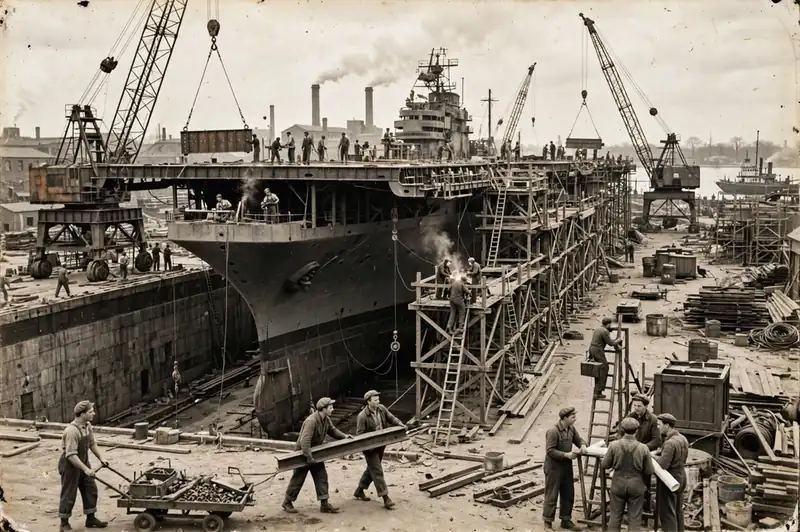
The Essex carriers were built at wartime speed, and their construction was a model of American industrial mobilisation. The ships were built in sections, which were prefabricated in workshops and then assembled on the slipway, and the shipyards worked around the clock, with three shifts, to complete the ships as quickly as possible. The first Essex carriers were commissioned in late 1942 and 1943, and they were sent to the Pacific, where they joined the fast carrier task forces that were being formed, and where they fought in the battles that won the Pacific War. The speed of the programme was extraordinary: in 1943 alone, eight Essex-class carriers were commissioned, and by the end of 1944, 17 Essex-class carriers were in service, which was more carriers than the Japanese Navy had ever had, and which gave the United States a carrier force that no other navy could match.
The Fast Carrier Task Force
The Essex carriers were designed to operate as part of the fast carrier task force, a new kind of naval force that the US Navy developed in the Pacific War, and that consisted of a number of aircraft carriers, screened by battleships, cruisers and destroyers, and that could strike at targets hundreds of miles away, with aircraft, and then move to a new target, without being caught by the enemy. The fast carrier task force, which was commanded by Admiral Marc Mitscher and which was known as Task Force 58, was the most powerful naval force in history, and it was built around the Essex carriers, which provided its air power, and which were protected by the battleships and cruisers that screened them. The Essex carriers were the core of the task force, and their aircraft were the weapons that won the Pacific War, by destroying Japanese ships, Japanese aircraft and Japanese bases, from the central Pacific to the coast of Japan.
4. Design
Flight Deck, Hangar and Air Group
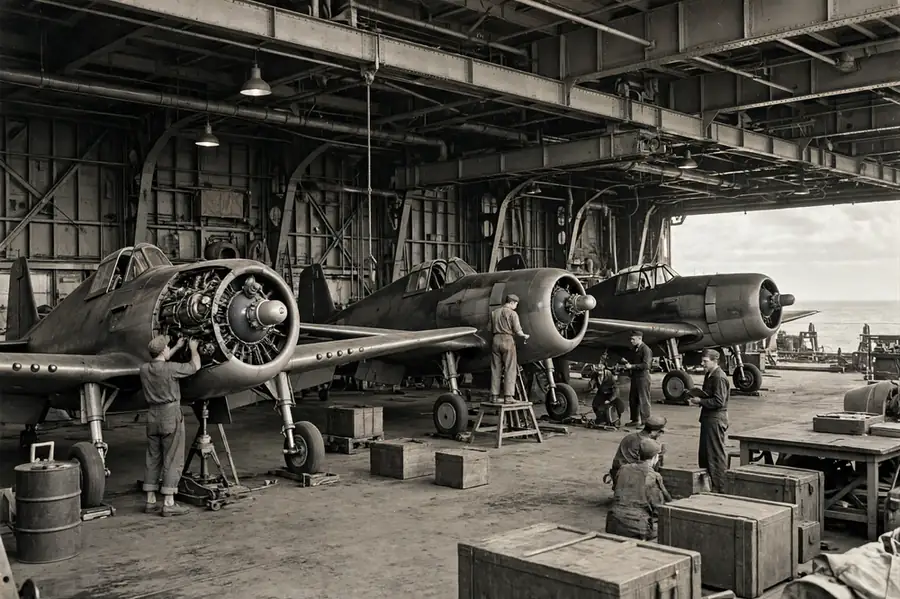
The Essex class had a flight deck of 265.8 metres in length and 45 metres in width, with two elevators on the centreline and one on the port side, which lifted aircraft from the hangar deck to the flight deck, and with a hangar deck that was 174 metres long and 29 metres wide, which could hold 90 to 100 aircraft. The air group, which consisted of about 90 to 100 aircraft, included F6F Hellcat and F4U Corsair fighters, SB2C Helldiver dive bombers and TBF Avenger torpedo bombers, and it was the most powerful air group that any carrier had ever carried. The flight deck was made of wood, which was lighter than steel and which was easier to repair, and the hangar deck was protected by armour, which was 64 mm thick, and which protected the aircraft and the magazines from bombs and from shells. The Essex’s flight deck and hangar were the heart of the ship, and they were the reason why the class was so successful: they allowed the ship to carry a large air group, to launch and recover aircraft quickly, and to repair aircraft in the hangar, even in combat.
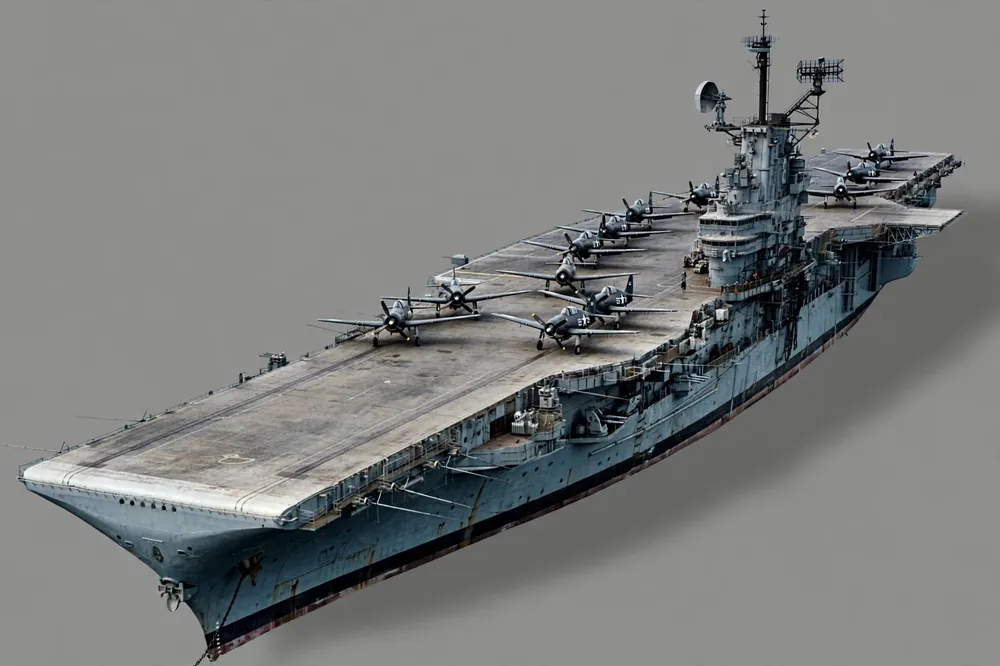
Propulsion, Armour and Armament
The Essex class was large, fast and well armed, but the figures only make sense when speed, protection and armament are considered together, because the design was a compromise in which each quality was balanced against the others. Four steam turbines gave a total of 150,000 shaft horsepower and a speed of about 33 knots, fast enough to keep up with the fast carrier task force, while the armour, a belt of 64 to 102 mm, a deck of 38 mm and a hangar deck of 64 mm, protected the magazines, the machinery and the aircraft, without the weight of a battleship’s armour. The armament of 12 127 mm guns, 32 40 mm Bofors guns and 46 20 mm Oerlikon guns was the ship’s main defence against aircraft, including kamikazes, and it was backed by the ship’s fighters, launched to intercept attackers before they reached the ship. Behind the guns stood the damage control system of pumps, firefighting equipment and trained parties, which saved Franklin and Bunker Hill after they were hit by bombs and kamikazes in 1945, and which was one reason no Essex-class carrier was lost. The sections below examine first speed and protection, and then anti-aircraft armament and damage control.
Speed and Protection
The Essex class was powered by four steam turbines, which gave a total of 150,000 shaft horsepower and a speed of about 33 knots, which was fast enough to keep up with the fast carrier task force and to outrun any Japanese surface ship, except for a destroyer. The ship’s armour consisted of a belt of 64 to 102 mm, which protected its magazines and its machinery, a deck of 38 mm, and a hangar deck of 64 mm, which protected its aircraft and its magazines from bombs. The armour was not as heavy as the armour of a battleship, but it was enough to protect the ship from the bombs and shells that it was likely to meet, and it was a compromise between protection and speed, which was the Essex’s main advantage. The ship’s armament consisted of 12 127 mm guns, which were used against surface ships and against aircraft, and 32 40 mm Bofors guns and 46 20 mm Oerlikon guns, which were used against aircraft, and which were the ship’s main defence against kamikaze attacks.
Anti-Aircraft Armament and Damage Control
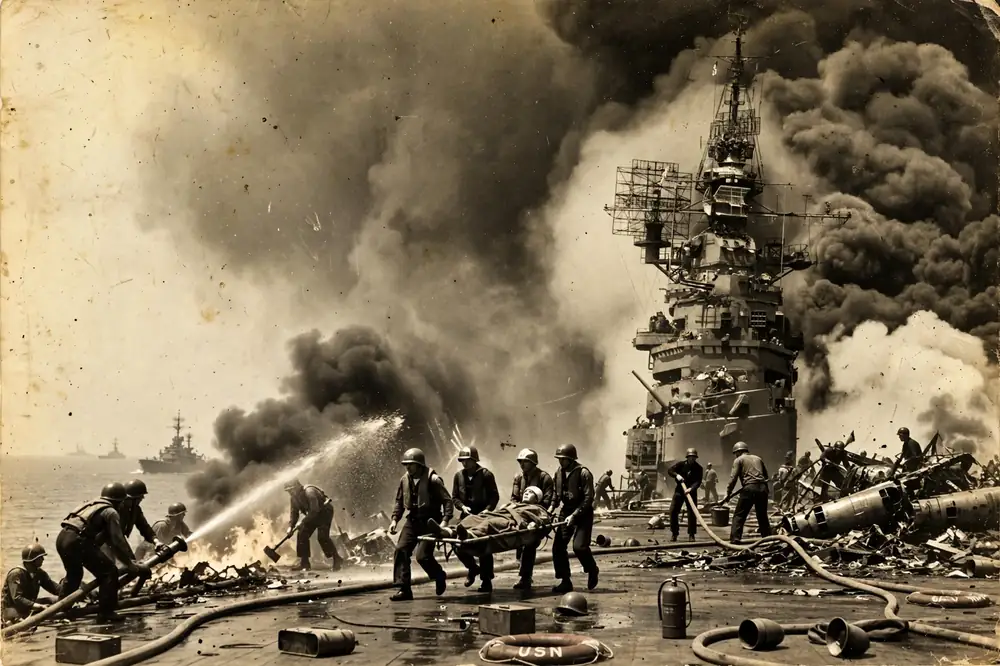
The Essex’s anti-aircraft armament was its main defence against Japanese aircraft, and it was supplemented by the ship’s fighters, which were launched to intercept Japanese aircraft before they could reach the ship. The ship’s damage control, which was the system of pumps, of firefighting equipment and of trained damage control parties, was one of the best in the world, and it saved several Essex carriers from sinking after they had been hit by bombs and by kamikaze aircraft. The Franklin, which was hit by two bombs in March 1945 and which suffered more than 800 casualties, was saved by its damage control parties, who fought fires for hours and who kept the ship afloat, and the Bunker Hill, which was hit by two kamikazes in May 1945, was also saved, although it suffered more than 400 casualties. The Essex’s damage control was a lesson that the US Navy had learned from the loss of the Yorktown and the Hornet, and it was one reason why no Essex-class carrier was lost in the war.
Life Aboard an Essex Carrier
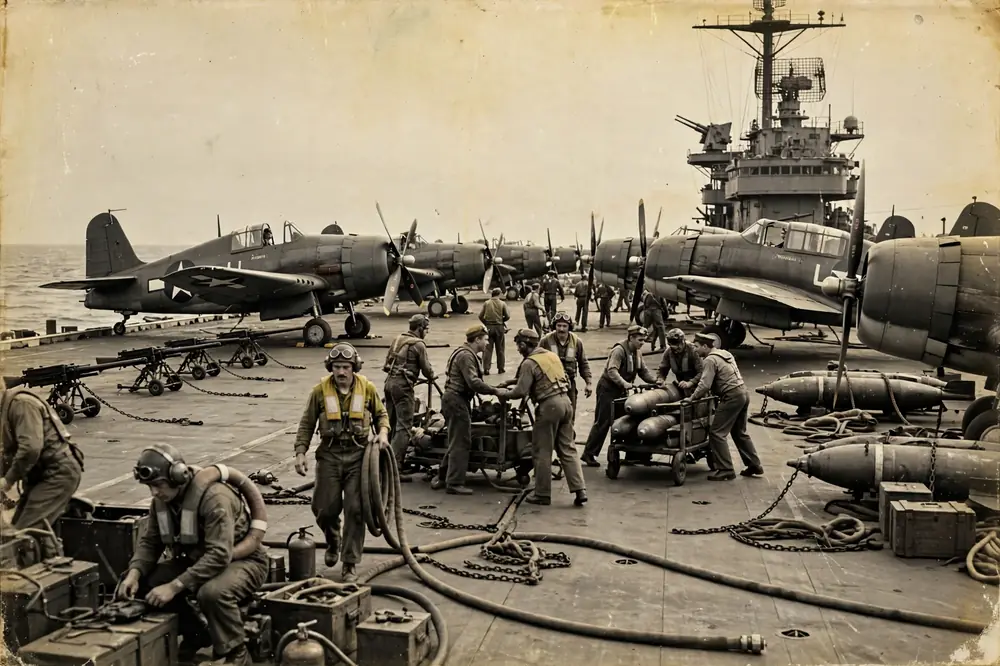
Life aboard an Essex carrier was hard, and it was typical of life aboard a large warship. The ship’s company of about 2,600 men, and its air group of about 1,000 men, lived in the ship’s compartments, which were crowded, hot and noisy, and they worked in shifts, around the clock, to keep the ship and its aircraft ready for combat. The ship’s crew included the men who operated the ship, the men who maintained its aircraft, the men who loaded its bombs and torpedoes, and the men who manned its guns, and they all worked together, in a ship that was a floating city, with its own hospital, its own galley, its own laundry and its own chapel. The men who served on an Essex carrier were young, they were highly trained, and they knew that their ship was a target for Japanese aircraft and submarines, and that their chances of survival depended on the ship’s damage control and on the skill of its pilots.
5. Variants
The Essex Class and Its Sub-Classes
| Variant | Years | Key features | Ships |
|---|---|---|---|
| Essex (short hull) | 1942–1943 | Original design; 10 ships | Essex, Yorktown, Intrepid, Hornet, Franklin, Lexington, Bunker Hill, Wasp, Bennington, Bon Homme Richard |
| Essex (long hull) | 1943–1945 | Lengthened bow; 14 ships | Ticonderoga, Randolph, Hancock, Boxer, Leyte, Kearsarge, Oriskany, Reprisal, Antietam, Princeton, Shangri-La, Lake Champlain, Tarawa, Valley Forge |
| SCB-27A | 1947–1955 | Post-war modernisation; angled deck (later); jet aircraft | Several ships |
| SCB-125 | 1950s | Angled flight deck; enclosed bow | Several ships |
| SCB-27C | 1950s | Steam catapults; angled deck | Several ships |
The Essex class was built in two main versions: the short-hull version, of which 10 ships were built, and the long-hull version, of which 14 ships were built, which had a lengthened bow to improve seakeeping and to provide more space for anti-aircraft guns. The two versions were identical in most respects, and they were used together in the fast carrier task forces, and they fought in the same battles. After the war, many Essex carriers were modernised under the SCB-27 and SCB-125 programmes, which gave them angled flight decks, steam catapults and enclosed bows, so that they could operate jet aircraft, and which allowed them to remain in service into the 1960s and 1970s, in the Korean War, in the Vietnam War and in the Cold War. The modernised Essex carriers were very different from the wartime Essex carriers, but they were the same ships, and they carried the same name and the same history.
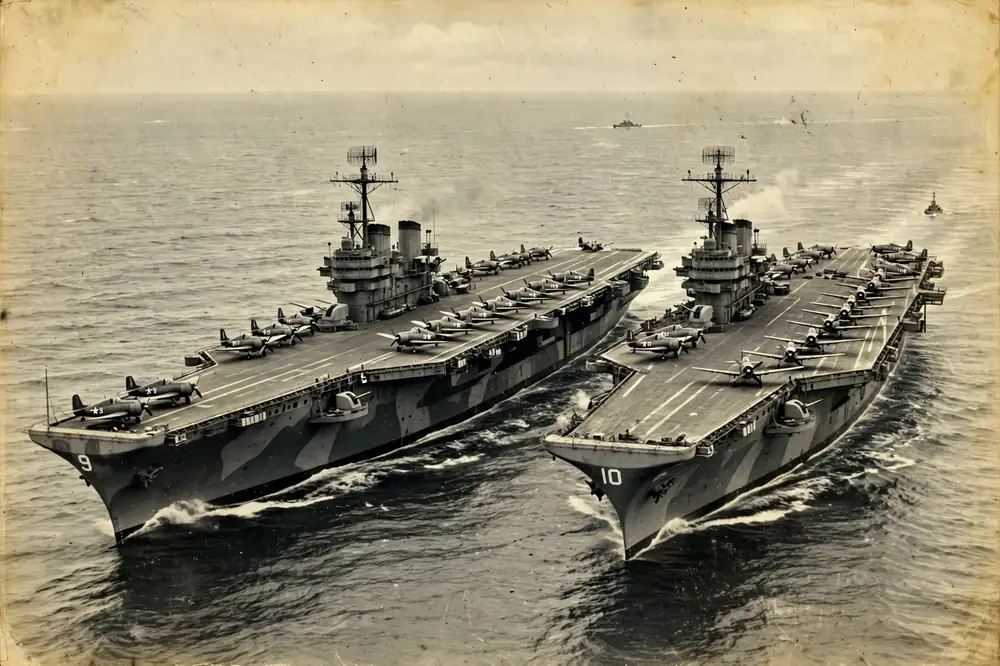
Post-War Modernisation
The Essex carriers were built for the Second World War, but their story did not end in 1945, because many of them were modernised after the war and went on to serve for decades, in Korea, in Vietnam and through the Cold War. The most important change was the angled flight deck, introduced under the SCB-125 programme and pioneered by the Royal Navy, which allowed aircraft to land and take off at the same time and made carrier operations safer and more efficient, while steam catapults and enclosed bows allowed the ships to operate jet aircraft that were faster and heavier than the propeller aircraft of the war. The modernised ships were very different from the wartime Essex carriers, but they were the same ships, and they carried the same names and the same history, serving as anti-submarine carriers, training carriers and amphibious assault ships. The last of them, USS Lexington, was not decommissioned until 1991, after 48 years of service, a service life longer than that of any other class of aircraft carriers. The sections below describe first the angled deck, and then the long service into the Cold War.
The Angled Deck
The most important post-war modernisation was the angled flight deck, which was introduced under the SCB-125 programme, and which allowed aircraft to land and take off at the same time, and which made carrier operations safer and more efficient. The angled deck, which was pioneered by the Royal Navy, was fitted to several Essex carriers in the 1950s, and it allowed them to operate jet aircraft, which were faster and heavier than the propeller aircraft of the war, and which needed a longer deck to land on. The modernised Essex carriers, with their angled decks and their steam catapults, served in the Korean War and in the Vietnam War, and they were the ships that carried American air power to Korea and to Vietnam, just as they had carried it to Japan in the Second World War. The angled deck was a British invention, but it was the Essex carriers that made it a standard feature of American carriers.
Service into the Cold War
The Essex carriers served into the Cold War, and some of them served into the 1970s and 1980s, as anti-submarine carriers, as training carriers and as amphibious assault ships. The last Essex-class carrier, USS Lexington, was decommissioned in 1991, after 48 years of service, and it is now a museum ship in Corpus Christi, Texas. The Essex carriers’ long service life is a measure of their success: they were built for the Second World War, but they were modernised and they served in three more wars, and they remained in service for almost fifty years, which is longer than any other class of aircraft carriers. The Essex class is therefore not only a class of the Second World War, but a class that served through the Cold War, and that is still remembered today, in the museum ships that preserve it.
6. Operational History
The First Essex Carriers in Combat, 1943
The first Essex carriers, USS Essex (commissioned 31 December 1942), USS Yorktown, USS Intrepid and USS Hornet, entered service in late 1942 and 1943, and they were sent to the Pacific, where they joined the fast carrier task forces and where they fought in the first raids on Japanese-held islands, in the Gilbert and Marshall Islands, in the Marianas and in the Carolines. The Essex carriers’ aircraft destroyed Japanese aircraft on the ground, sank Japanese ships in harbour, and bombed Japanese bases, and they gave the United States the air power that it needed to advance across the Pacific. The Essex carriers’ first battles were a success, and they showed that the class was a worthy successor to the Yorktown class, and that the United States had, at last, a carrier force that could take the war to Japan.
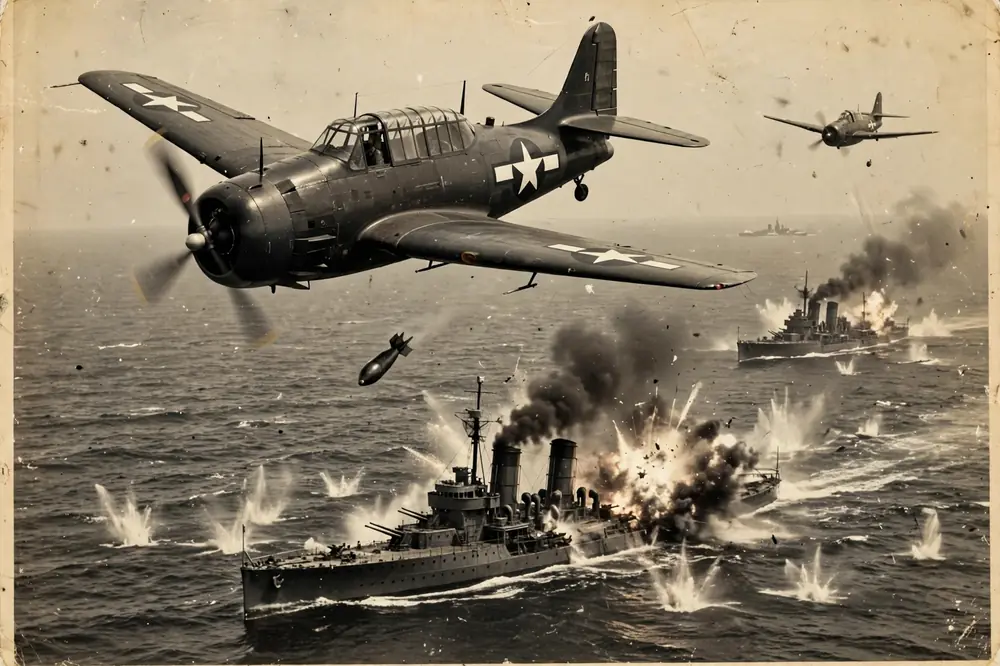
The Battle of the Philippine Sea, June 1944
In June 1944 the Essex carriers fought in the Battle of the Philippine Sea, the largest carrier battle in history, and the battle in which the fast carrier task force under Admiral Marc Mitscher destroyed the Japanese carrier air arm. The Essex carriers launched hundreds of aircraft, which shot down hundreds of Japanese aircraft in what American pilots called the Great Marianas Turkey Shoot, and sank the Japanese carriers Shokaku and Taiho, and the victory belonged above all to the Essex air groups, flown by pilots trained in large numbers, against Japanese air groups flown by inexperienced pilots. The aftermath mattered as much as the battle itself, because with the Japanese carrier air arm effectively destroyed, the Essex carriers were free to strike at Japanese bases in the Philippines, in Formosa and in Japan itself without fear of Japanese carrier aircraft, bombing airfields, sinking ships and preparing the way for the American landings in the Philippines in October 1944 and for the Battle of Leyte Gulf. The sections below describe first the Turkey Shoot itself, and then the aftermath that made the Philippine Sea the turning point of the Pacific War.
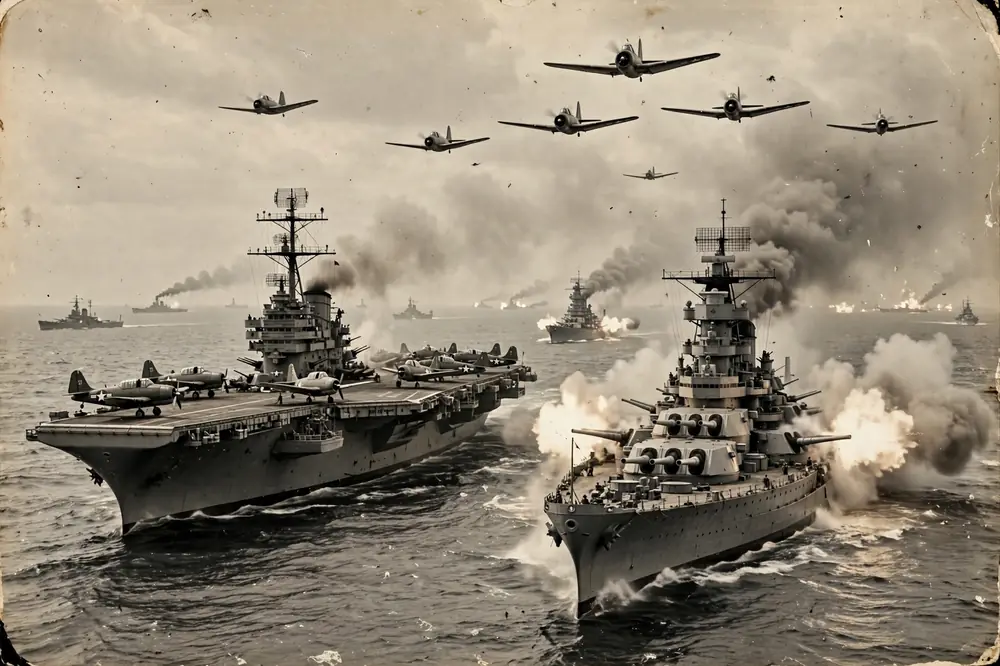
The Great Marianas Turkey Shoot
In June 1944, the Essex carriers fought in the Battle of the Philippine Sea, the largest carrier battle in history, in which the fast carrier task force, under Admiral Marc Mitscher, destroyed the Japanese carrier air arm. The Essex carriers launched hundreds of aircraft, which shot down hundreds of Japanese aircraft, in what American pilots called the “Great Marianas Turkey Shoot”, and which sank the Japanese carriers Shokaku and Taiho, and which destroyed the Japanese Navy’s ability to fight a carrier battle. The Essex carriers’ air groups, which were flown by pilots who had been trained in large numbers, were superior to the Japanese air groups, which were flown by inexperienced pilots, and the battle was a decisive victory for the United States, and it was the battle in which the Essex class proved its worth, as the core of the fast carrier task force.
The Aftermath
After the Battle of the Philippine Sea, the Japanese carrier air arm was effectively destroyed, and the Essex carriers were free to strike at Japanese bases in the Philippines, in Formosa and in Japan itself, without fear of Japanese carrier aircraft. The Essex carriers’ aircraft bombed Japanese airfields, sank Japanese ships and destroyed Japanese aircraft on the ground, and they prepared the way for the American landings in the Philippines, in October 1944, and for the Battle of Leyte Gulf, which was the largest naval battle in history, and in which the Essex carriers played a central role. The Battle of the Philippine Sea was the turning point of the Pacific War, and it was the battle in which the Essex class, and the fast carrier task force, won the war at sea.
Leyte Gulf and Okinawa
In October 1944, the Essex carriers fought in the Battle of Leyte Gulf, in which the Japanese Navy made its last great effort to destroy the American invasion fleet, and in which the Essex carriers’ aircraft sank the Japanese battleship Musashi and destroyed the Japanese carrier force, which was used as a decoy. The Essex carriers’ aircraft also sank Japanese cruisers and destroyers, and they protected the American landing force, which landed on Leyte and which began the liberation of the Philippines. In 1945, the Essex carriers fought in the Battle of Okinawa, in which they were attacked by kamikaze aircraft, and in which several Essex carriers, including Franklin and Bunker Hill, were badly damaged, but none was lost. The Essex carriers’ aircraft supported the American landings on Okinawa, and they bombed Japanese bases in Japan itself, in preparation for the invasion of Japan, which was planned for November 1945, but which was not needed, because Japan surrendered in August 1945, after the atomic bombings of Hiroshima and Nagasaki.
The End of the War
In the last months of the war, the Essex carriers bombed Japan itself, in raids on Tokyo, on Kobe and on other cities, and they destroyed the last remnants of the Japanese Navy, including the battleship Yamato, which was sunk by Essex aircraft in April 1945, on its way to Okinawa. The Essex carriers were at sea when Japan surrendered on 15 August 1945, and they were among the ships that entered Tokyo Bay for the surrender ceremony on 2 September 1945, aboard the battleship USS Missouri. The Essex carriers had fought in every major battle of the Pacific War, from 1943 to 1945, and they had won the war, not by a single battle, but by a campaign of air power that had destroyed the Japanese Navy, the Japanese air force and the Japanese economy. The Essex class was the most successful class of aircraft carriers in history, and it remains so today.
7. Performance and Specifications
Speed, Range and Air Group
| Specification | Essex-class |
|---|---|
| Displacement (standard) | About 27,100 tons |
| Displacement (full load) | About 36,380 tons |
| Length (overall) | 265.8 m |
| Beam (flight deck) | 45.0 m |
| Speed | About 33 knots |
| Range | About 15,000 nautical miles at 15 knots |
| Power | 150,000 shp |
| Aircraft carried | About 90–100 |
| Crew (ship + air group) | About 3,600 |
| Main guns | 12 × 127 mm |
| Anti-aircraft guns | 32 × 40 mm; 46 × 20 mm |
The table shows the Essex class’s strengths: it was large, it was fast, it carried a large air group, and it had a long range, which allowed it to operate far from home for months at a time. The figures are the values most commonly given in the published histories, and they vary slightly between sources, because different ships were fitted with different equipment, and because the class was modified during the war and after it. The reader should treat the numbers as approximate, and as a guide to the class’s capability rather than as exact measurements for a single ship.
Comparison with Japanese Carriers
Compared with Japanese carriers, the Essex class was larger, faster and better protected, and it carried a larger air group, and it was built in far larger numbers. The Japanese carrier Shokaku, which was the best Japanese carrier of the war, displaced about 25,675 tons standard, it was 257.5 metres long, it had a speed of about 34 knots, and it carried about 84 aircraft, which was fewer than the Essex’s 90 to 100. The Japanese carriers were built in small numbers — only a handful of fleet carriers were built during the war — and they were lost, one after another, at Midway, in the Philippine Sea and at Leyte Gulf, while the Essex carriers were built in large numbers, and none was lost. The Essex class’s advantage was not only its design, but its numbers, and the industrial power that built it, which was a power that Japan could not match.
Why No Essex Was Lost
No Essex-class carrier was lost in the war, although several were badly damaged, because the class was well designed, because its damage control was excellent, and because it was protected by the fast carrier task force, which screened it with battleships, cruisers and destroyers, and which provided it with fighter cover. The Essex carriers were also lucky: they were not present at Midway, where the Yorktown class had been lost, and they entered service after the Allies had developed the weapons and tactics that protected carriers, including radar, fighter direction and the hunter-killer groups that sank Japanese submarines. The Essex class’s survival is a measure of its success, and it is a reminder that a ship’s survival depends not only on its design, but on the force that protects it, and on the tactics that are used to employ it.
Damage Control Lessons
The Essex carriers’ damage control, which saved the Franklin and the Bunker Hill from sinking after they had been hit by bombs and by kamikaze aircraft, was one of the best in the world, and it was a lesson that the US Navy had learned from the loss of the Yorktown and the Hornet, which had been lost because their damage control had failed. The Essex carriers were fitted with pumps, with firefighting equipment and with trained damage control parties, who fought fires for hours, who shored up bulkheads, who pumped out flooded compartments, and who kept the ship afloat, even when it had been hit by bombs that had killed hundreds of men. The damage control parties were among the bravest men on the ship, and they were the reason why no Essex-class carrier was lost in the war, even though several were badly damaged, and even though the kamikaze attacks, in 1945, were among the most destructive attacks of the war.
8. Operators
The United States Navy
The Essex-class carriers were used by the United States Navy, from 1942 to 1991, and they were the backbone of the Navy’s carrier force in the Second World War, in the Korean War, in the Vietnam War and in the Cold War. The carriers were operated by the Pacific Fleet and by the Atlantic Fleet, and they were used in every major operation in which the United States Navy was involved, from the Pacific War to the Cuban Missile Crisis, to the Vietnam War and to the Cold War. The Essex carriers were American ships, built in American shipyards, crewed by American sailors, and they became a symbol of American naval power, and of the United States’ ability to build ships in large numbers and to use them to win wars. The Essex class is the most successful class of aircraft carriers in American history, and it remains so today.
Other Users
The Essex-class carriers were American ships, built in American shipyards and crewed by American sailors, but their influence reached beyond the United States Navy, and their survival today depends on the museums and foundations that preserve them. After the war some Essex-class carriers were transferred to other navies, although most remained in American service, and the class’s design influenced the carriers built after the war by other navies, including the British and French carriers, while the United States Navy used Essex carriers to train pilots for other navies and welcomed officers from many countries who studied their design and operations. The French Navy’s Arromanches is sometimes mentioned in this connection, although it was the former HMS Colossus and not an Essex, and France did not operate an Essex-class carrier. Four Essex-class carriers survive today as museum ships, operated by museums and foundations in the United States as memorials to the men who served on them and fought in the Pacific War. The sections below look first at France and the other navies touched by the class, and then at the museum ships and memorials that preserve it.
France and Other Navies
After the war, some Essex-class carriers were transferred to other navies, although most remained in American service. The French Navy did not operate an Essex-class carrier: its Arromanches was the former HMS Colossus, a British light fleet carrier, not an Essex, but the Essex class’s design influenced the design of carriers in other navies, including the British and French carriers that were built after the war. The Essex carriers were also used by the United States Navy to train pilots for other navies, and they were visited by officers from many countries, who studied their design and their operations. The Essex class’s influence was therefore not only American, but international, and it set the standard for aircraft carrier design after the war, a standard that is still followed today.
Museum Ships and Memorials
Four Essex-class carriers survive today as museum ships, and they are operated by museums and by foundations in the United States, where they are preserved as memorials to the men who served on them and to the men who fought in the Pacific War. The museum ships are USS Yorktown in Charleston, South Carolina, USS Intrepid in New York City, USS Hornet in Alameda, California, and USS Lexington in Corpus Christi, Texas, and they are among the most visited naval museums in the United States. The museum ships are a reminder that the Essex class was not only a class of warships, but a class of ships that served for almost fifty years, and that are still remembered today, by the millions of people who visit them each year.
9. Legacy and Influence
The Fast Carrier Task Force
The Essex class’s legacy is, above all, the fast carrier task force, which was the most powerful naval force in history, and which was built around the Essex carriers. The fast carrier task force, which was commanded by Admiral Marc Mitscher, was a new kind of naval force, in which the aircraft carrier, not the battleship, was the main weapon, and in which aircraft, not guns, were the weapons that decided battles. The Essex carriers proved that the carrier was the capital ship of the modern navy, and that the battleship, which had been the capital ship for centuries, was obsolete. The fast carrier task force became the standard naval force after the war, and it is still the standard naval force today, in the form of the carrier battle group, which is built around a large aircraft carrier, and which is the main weapon of the United States Navy.
Industrial Power and Carrier Design
The Essex class also showed the importance of industrial power in naval warfare: the United States built 24 Essex-class carriers, while Japan built only a handful of fleet carriers, and the United States’ industrial power was the reason why it won the Pacific War. The Essex class’s design, which was standardised and which could be built quickly, became a model for later carrier design, and it influenced the design of the Midway class, the Forrestal class and the Nimitz class, which are the carriers that the United States Navy uses today. The Essex class’s legacy is therefore not only a naval legacy, but an industrial legacy, and it is a reminder that wars are won not only by ships and by aircraft, but by the factories that build them, and by the workers who build them.
The Essex Class in Popular Culture
In popular culture the Essex class is remembered as the carriers of the Pacific War, and it appears in films, in books and in television programmes about the war, where it is shown as the ships that won the Pacific War. The museum ships, USS Yorktown, USS Intrepid, USS Hornet and USS Lexington, are among the most visited museums in the United States, and they are visited by millions of people each year, who come to see the ships that fought in the Pacific War and to learn about the men who served on them. The Essex class’s place in popular culture is a measure of its fame, and it ensures that the class will be remembered, not only as a class of warships, but as a symbol of American naval power and of the Pacific War.
The Essex Class in the Cold War
After the Second World War, the Essex carriers served in the Korean War, in the Vietnam War and in the Cold War, and they were modernised, with angled flight decks and steam catapults, so that they could operate jet aircraft, and they remained in service into the 1970s and 1980s, which is longer than any other class of aircraft carriers. The Essex carriers’ long service life is a measure of their success: they were built for the Second World War, but they were modernised and they served in three more wars, and they were the ships that carried American air power to Korea and to Vietnam, just as they had carried it to Japan in the Second World War. The Essex class is therefore not only a class of the Second World War, but a class that served through the Cold War, and that is still remembered today, in the museum ships that preserve it.
10. Surviving Examples
The Four Museum Ships
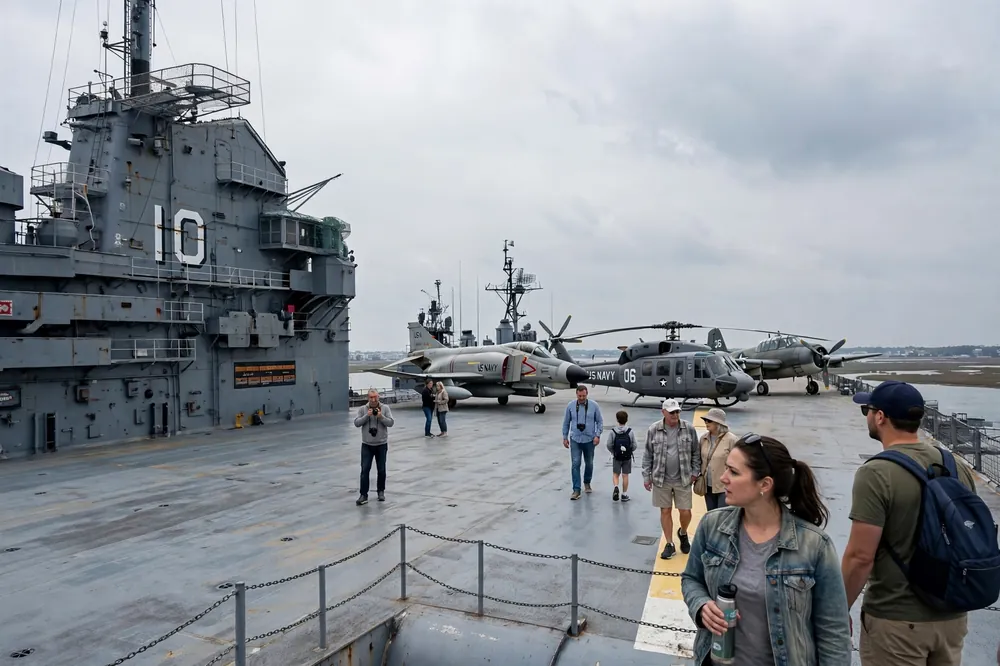
Four Essex-class carriers survive today as museum ships: USS Yorktown (CV-10) in Charleston, South Carolina, USS Intrepid (CV-11) in New York City, USS Hornet (CV-12) in Alameda, California, and USS Lexington (CV-16) in Corpus Christi, Texas. Each ship is preserved as a museum, and each tells the story of the Essex class and of the Pacific War, and each is visited by hundreds of thousands of people each year. The Yorktown is preserved at Patriots Point Naval and Maritime Museum, where it is displayed with other ships and aircraft, and the Intrepid is preserved at the Intrepid Sea, Air and Space Museum in New York, where it is displayed with aircraft and with the Space Shuttle Enterprise. The Hornet is preserved at the USS Hornet Museum in Alameda, and the Lexington is preserved at the USS Lexington Museum on the Bay in Corpus Christi, where it is displayed as a museum ship and as a memorial to the men who served on it.
Visiting an Essex Carrier Today
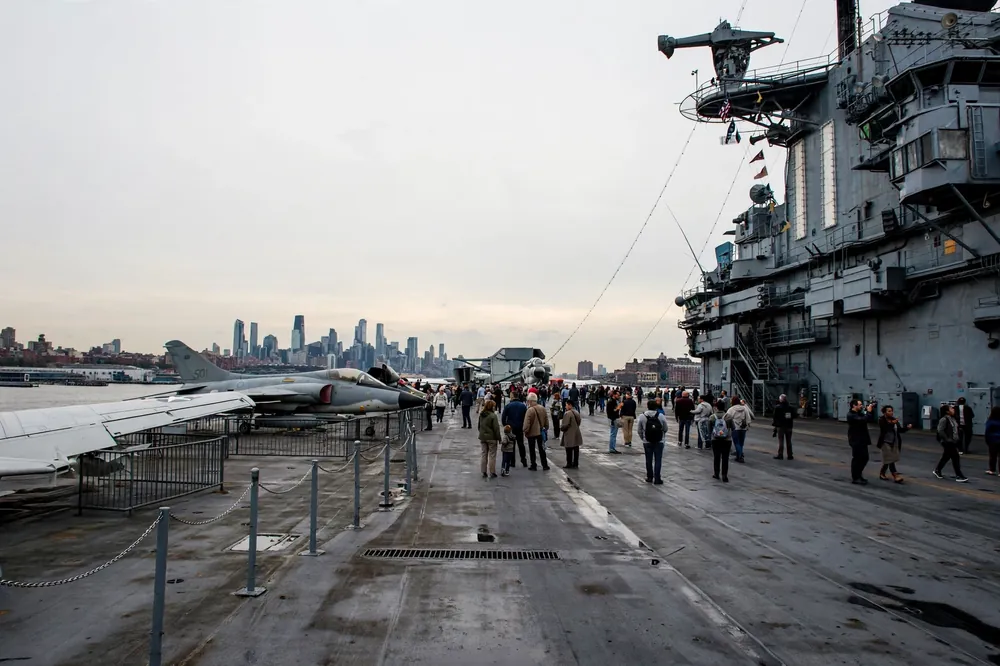
Four Essex-class carriers survive as museum ships, and they are among the most visited naval museums in the United States, which means that the easiest way to understand the class is to walk the flight deck of one of them. The most visited is USS Intrepid in New York City, visited by more than a million people each year, where the ship, its aircraft and the Space Shuttle Enterprise on its flight deck tell the story of a carrier commissioned in 1943, damaged by kamikazes and torpedoes at Leyte Gulf and Okinawa, and later serving in Korea and Vietnam before preservation as a museum in 1982. The other three are USS Yorktown at Patriots Point in Charleston, South Carolina, USS Hornet in Alameda, California, which recovered the Apollo 11 and Apollo 12 astronauts after their missions to the Moon, and USS Lexington in Corpus Christi, Texas, the last Essex-class carrier to be decommissioned, in 1991. The sections below describe first the Intrepid in New York, and then the Yorktown, Hornet and Lexington.
The Intrepid in New York
The USS Intrepid in New York City is the most visited Essex-class museum ship, and it is visited by more than a million people each year, who come to see the ship, its aircraft and the Space Shuttle Enterprise, which is displayed on its flight deck. The Intrepid was commissioned in 1943, it fought in the Battle of Leyte Gulf and in the Battle of Okinawa, it was hit by kamikaze aircraft and by torpedoes, and it served in the Korean War and in the Vietnam War, before it was decommissioned in 1974 and preserved as a museum in 1982. The museum tells the story of the Intrepid and of the Essex class, and it is a reminder that the Essex carriers were not only ships of the Second World War, but ships that served for decades, and that are still remembered today.
The Yorktown, Hornet and Lexington
The USS Yorktown in Charleston, the USS Hornet in Alameda and the USS Lexington in Corpus Christi are also visited by hundreds of thousands of people each year, and they are preserved as museums and as memorials to the men who served on them. The Yorktown fought in the Battle of the Philippine Sea and in the Battle of Leyte Gulf, the Hornet recovered the Apollo 11 and Apollo 12 astronauts after their missions to the Moon, and the Lexington served in the Second World War and in the Cold War, and was the last Essex-class carrier to be decommissioned, in 1991. For most visitors, the easiest way to see an Essex-class carrier is to visit one of these four museum ships, where the ship’s flight deck, its hangar deck and its compartments can be toured, and where the story of the Essex class and of the Pacific War is told in full.
Frequently Asked Questions
What is the Essex-class aircraft carrier?
The Essex-class aircraft carrier was the United States Navy’s fleet carrier of the Second World War, designed in the late 1930s and built in large numbers during the war. Twenty-four ships were completed, and 17 were commissioned before the end of the war.
How many Essex-class carriers were built?
Twenty-four Essex-class carriers were completed, of which 17 were commissioned before the end of the Second World War in August 1945.
How many aircraft did an Essex-class carrier carry?
An Essex-class carrier carried about 90 to 100 aircraft, including F6F Hellcat and F4U Corsair fighters, SB2C Helldiver dive bombers and TBF Avenger torpedo bombers.
Was any Essex-class carrier lost in the war?
No. No Essex-class carrier was lost in the Second World War, although several, including Franklin and Bunker Hill, were badly damaged by bombs and by kamikaze attacks.
Where can I see an Essex-class carrier today?
Four Essex-class carriers survive as museum ships: USS Yorktown in Charleston, USS Intrepid in New York, USS Hornet in Alameda and USS Lexington in Corpus Christi.
What was the fast carrier task force?
The fast carrier task force, known as Task Force 58, was a US Navy force built around the Essex carriers, screened by battleships, cruisers and destroyers, which won the Pacific War with carrier air power.
Sources
- Wikipedia, “Essex-class aircraft carrier” — 24 ships completed, specifications, service history and museum ships.
- Naval History and Heritage Command, “Essex-class carriers” — design, the Two-Ocean Navy Act and the fast carrier task force.
- Norman Friedman, U.S. Aircraft Carriers: An Illustrated Design History (Naval Institute Press, 1983) — Essex design, armour and air group.
- Clark G. Reynolds, The Fast Carriers: The Forging of an Air Navy (Naval Institute Press, 1968) — Task Force 58 and the Pacific War.
- James D. Hornfischer, The Fleet at Flood Tide (Bantam Books, 2016) — the Essex carriers in 1944–1945, Leyte Gulf and Okinawa.
- Intrepid Sea, Air and Space Museum, New York — USS Intrepid and the Essex-class museum ships.