 WAR ATLAS MILITARY HISTORY MAGAZINE · WWI — WWII
Mogador-class Destroyer
1. Lead
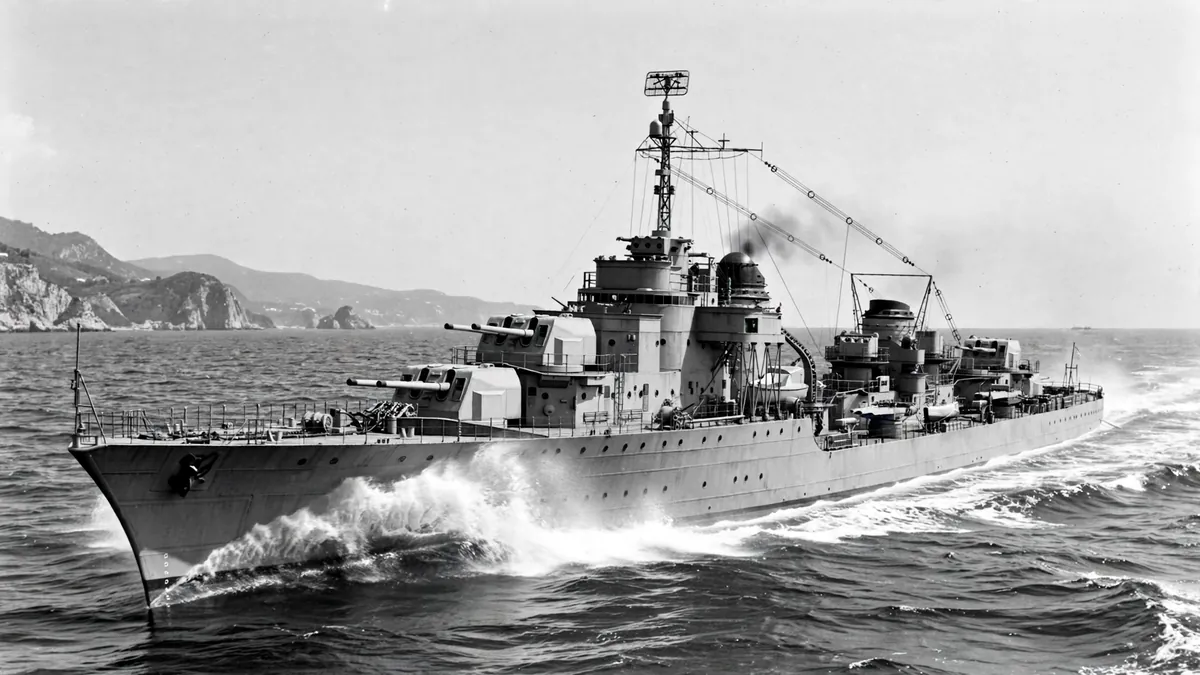
The Mogador-class destroyer was the last and most powerful of France’s contre-torpilleurs — the large destroyers, or “torpedo-boat destroyers”, that the French Navy built in the 1920s and 1930s to hunt down enemy destroyers and to lead torpedo attacks against enemy fleets.
Only two ships were built, Mogador and Volta, completed in 1938–1939, and they were among the fastest and most heavily armed destroyers in the world: eight 138.6 mm guns in four twin turrets, a speed of 39 knots, and a displacement of nearly 3,000 tons — larger than many light cruisers of the previous generation.
The Mogadors were designed for a war in the Mediterranean against Italy, and they were built to a doctrine that valued speed and gunpower above all else. But the war that came was not the war they were designed for: France fell in six weeks in 1940, and both ships spent the rest of the war in the strange limbo of Vichy France, before being destroyed — one by the British at Mers-el-Kébir, the other scuttled by her own crew at Toulon.
The Mogador class is a study in what happens when a navy builds the perfect ship for the wrong war. The ships were technically superb — fast, well-armed, and beautifully built — but they were built for a fleet action in the Mediterranean that never happened, and they were operated by a navy that was destroyed not by enemy action but by political collapse. Their story is short, from 1938 to 1942, but it is a story that says a great deal about the French Navy, about the Mediterranean war, and about the fate of a fleet caught between two sides.
The two ships also illustrate a wider truth about the French Navy in 1940: that a navy is only as strong as the state behind it. France built some of the finest warships in the world in the 1930s — the Dunkerque-class battlecruisers, the Le Fantasque-class large destroyers, and the Mogadors — but the collapse of the French state in six weeks rendered the whole fleet strategically irrelevant, and the ships that survived the collapse spent the rest of the war as pawns in a political game they had never been designed to play.
The Mogadors were the most extreme example of that fate, because they were the newest and the most powerful of the contre-torpilleurs, and because their careers were the shortest: four years from completion to destruction, with barely a year of active service against the enemy they were built to fight.
2. Key Facts
| Class | Mogador-class large destroyer (contre-torpilleur), French Navy |
| Built | 1935–1939; 2 completed (Mogador, Volta) |
| Builders | Arsenal de Lorient (Mogador); Ateliers et Chantiers de Bretagne, Nantes (Volta) / Arsenal de Lorient (Mogador); Ateliers et Chantiers de Bretagne, Nantes (Volta) |
| Displacement | About 2,950 tons standard; about 3,950 tons full load |
| Length | About 137.5 m (451 ft) |
| Speed | About 39 knots (design); trials up to 43 knots |
| Main armament | 8 × 138.6 mm guns in four twin turrets |
| Secondary armament | 2 × 37 mm; 4 × 13.2 mm machine guns; 10 torpedo tubes; depth charges |
| Complement | About 264 officers and men |
| Fate | Mogador damaged at Mers-el-Kébir, scrapped 1949; Volta scuttled at Toulon, 27 November 1942 |
3. Design and Development
The contre-torpilleur doctrine
The French Navy of the 1920s and 1930s built a unique type of warship: the contre-torpilleur, the large destroyer. Where other navies built destroyers of 1,500 tons to escort fleets and to attack with torpedoes, the French built destroyers of 2,000–3,000 tons, armed with heavy guns, to hunt down enemy destroyers and to lead the torpedo attack against the enemy battle fleet.
The doctrine was a product of French strategic thinking: France expected to fight Italy in the Mediterranean, and it expected the battle to be decided by a fleet action in which the destroyers would play a leading part. The contre-torpilleur was the French answer to that expectation — a ship that was faster than any cruiser, more heavily armed than any destroyer, and capable of fighting a gun duel with a light cruiser.
The Mogador class was the culmination of that doctrine, the largest and most powerful contre-torpilleur ever built.
The Mogador design
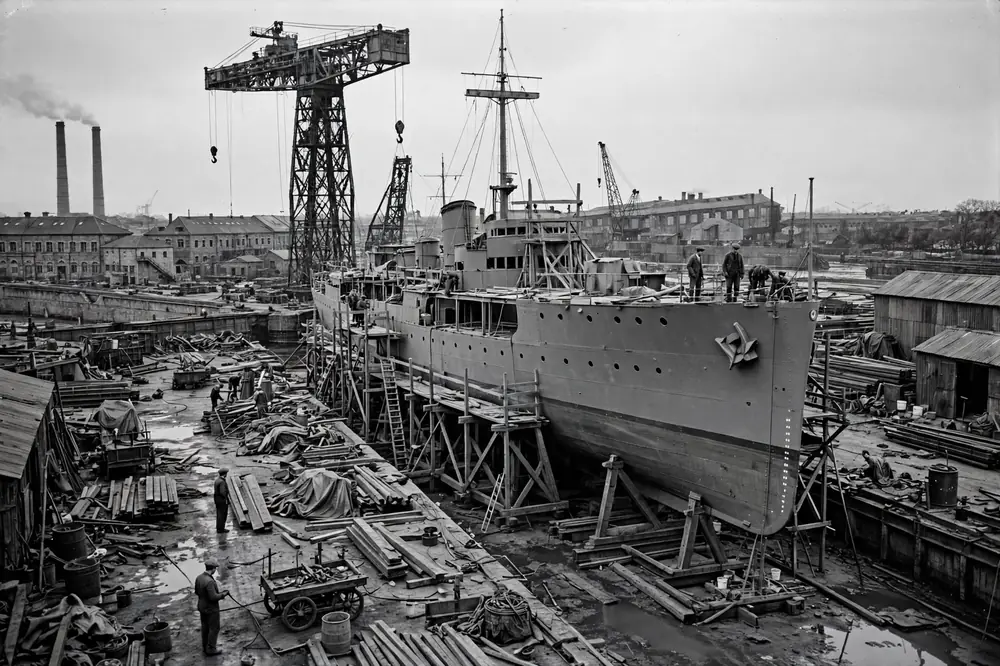
The Mogador class was designed in the mid-1930s as the successor to the Le Fantasque class, the previous generation of French large destroyers. The design was larger, faster and more heavily armed: eight 138.6 mm guns in four twin turrets, two forward and two aft, instead of the Le Fantasque’s five single guns; a speed of 39 knots, instead of 37; and a displacement of nearly 3,000 tons.
The guns were a new model, the 138.6 mm/50, with a longer barrel and a higher rate of fire than the earlier 138.6 mm guns, and they were mounted in twin turrets that were electrically trained — a first for a French destroyer. The machinery was two sets of geared steam turbines, producing about 92,000 shaft horsepower, driving two shafts.
The design was ambitious, and it was expensive: only two ships were ordered, in 1934, and they were laid down in 1935–1936.
Construction and trials
Mogador was built at the Arsenal de Lorient and Volta at the Ateliers et Chantiers de Bretagne in Nantes. Both ships were launched in 1937 and completed in 1938–1939, after a long period of trials that exposed the design’s problems. The twin turrets were unreliable: the guns were too close together, the ammunition supply was awkward, and the turrets jammed in heavy weather.
The ships were also top-heavy, with a high centre of gravity that made them roll badly in a seaway, and their machinery was temperamental. On trials, Volta reached 43 knots — one of the fastest speeds ever recorded by a destroyer — but in service the ships rarely achieved their designed speed, and their crews found them difficult to handle.
The Mogadors were beautiful ships, but they were not easy ships, and their trials were a warning that the contre-torpilleur doctrine had reached the limits of what a destroyer hull could carry.
4. Armament and Sensors
The 138.6 mm main battery
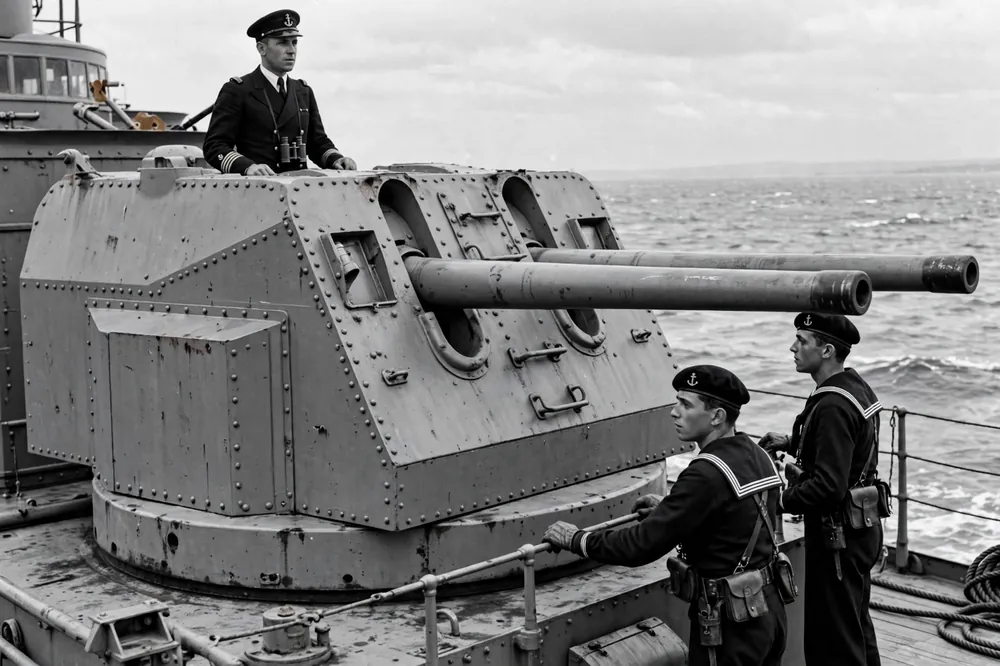
The Mogador class’s main armament was eight 138.6 mm guns in four twin turrets, the heaviest gun armament ever carried by a destroyer. The 138.6 mm gun fired a 40-kilogram shell to a range of about 20,000 metres, and it was a powerful weapon against destroyers, merchant ships and shore targets.
The twin turrets, however, were the class’s Achilles’ heel: the guns were mounted so close together that the blast from one gun interfered with the other, the ammunition hoists were slow, and the turrets were prone to jamming. In action, the Mogadors’ gunnery was less effective than their paper firepower suggested, and the ships’ crews found that the twin turrets were a liability in a fast-moving gun action.
The lesson was learned by the French Navy, but too late: the Mogadors were the last contre-torpilleurs to carry twin turrets, and the next generation of French destroyers would return to single mountings.
Torpedoes and anti-aircraft guns
The Mogador class carried ten 550 mm torpedo tubes in two triple and one quadruple mounting, a heavy torpedo armament that reflected the contre-torpilleur‘s role as a torpedo attacker. The torpedoes were the French 550 mm model, with a range of about 9,000 metres at high speed and a warhead of about 300 kilograms — a formidable weapon, and one that the French destroyers were trained to use in massed attacks against the enemy battle fleet.
The anti-aircraft armament, by contrast, was weak: two 37 mm guns and four 13.2 mm machine guns, a fit that was adequate in 1938 but hopelessly inadequate by 1940, when the air threat had become the dominant threat to surface ships.
The Mogadors received additional anti-aircraft guns during their short service, but they were never adequately protected against air attack — a weakness that would prove fatal at Mers-el-Kébir and at Toulon.
Fire control and sensors
The Mogador class was fitted with a modern fire-control system for its day, with a director on the bridge and rangefinders for the main battery, and it was one of the first French destroyers to be fitted with Asdic for anti-submarine work.
The ships had no radar when they were completed — French radar development lagged behind the British and the Germans — and they relied on lookouts and on the director for gunnery. The lack of radar was a serious handicap in the war that came, and it was one of the reasons the Mogadors were at a disadvantage in the actions they fought.
The French Navy’s failure to develop radar in time was a failure that affected the whole fleet, and the Mogador class was no exception.
5. Service Before the Fall of France
The first months of war
Mogador and Volta entered service in 1938–1939, just before the outbreak of war, and they spent the first months of the war on patrol in the Atlantic and in the Mediterranean, escorting convoys and hunting for German surface raiders. The ships were part of the Force de Raid, the French fast squadron based at Brest, which was intended to hunt down German pocket battleships and cruisers in the Atlantic.
In the winter of 1939–1940, the Mogadors escorted convoys between France and Britain, and they took part in the search for the German pocket battleship Admiral Graf Spee — a search that ended with Graf Spee‘s scuttling at Montevideo in December 1939.
The ships’ service in the first months of the war was unremarkable, but it was the service they had been designed for: fast, powerful escorts for a fleet at war.
The Norwegian campaign and the fall of France
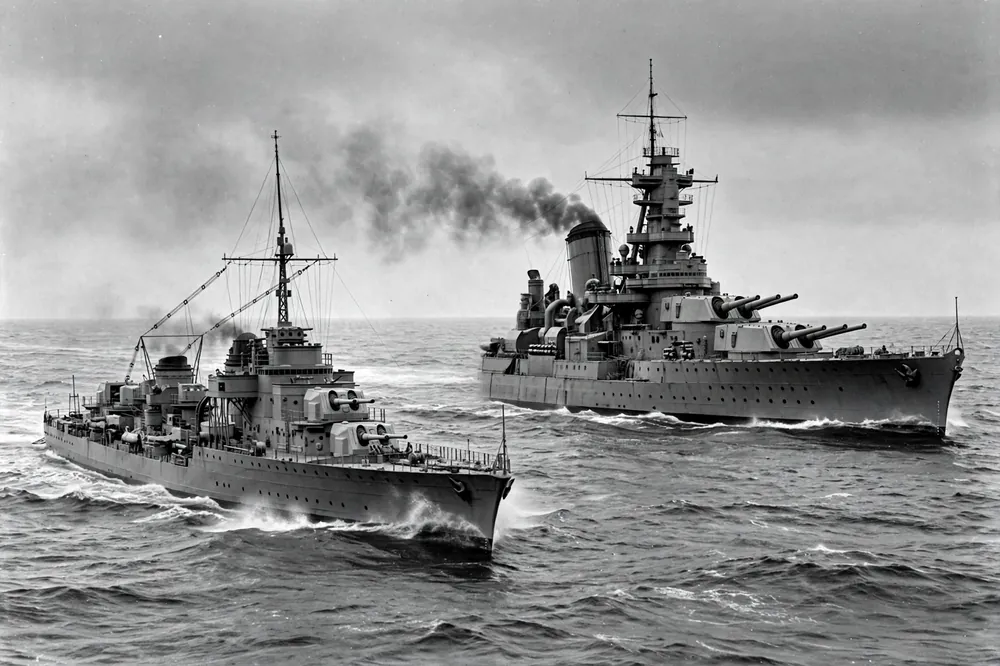
In the spring of 1940, the Mogadors took part in the Norwegian campaign, escorting the convoys that carried Allied troops to Narvik, and they were at sea when Germany invaded France and the Low Countries on 10 May 1940. The ships were ordered to the Mediterranean, and they were at Mers-el-Kébir, in Algeria, when France signed the armistice with Germany on 22 June 1940.
The fall of France in six weeks was a shock that the French Navy had never contemplated, and it left the fleet — including the two Mogadors — in an impossible position: at anchor in ports that were now under the control of Vichy France, with the British demanding that the ships be handed over, scuttled, or sailed to British ports, and with the Germans demanding that they stay where they were.
The Mogadors’ war, which had barely begun, was about to take a very different turn.
6. Mers-el-Kébir
The British attack
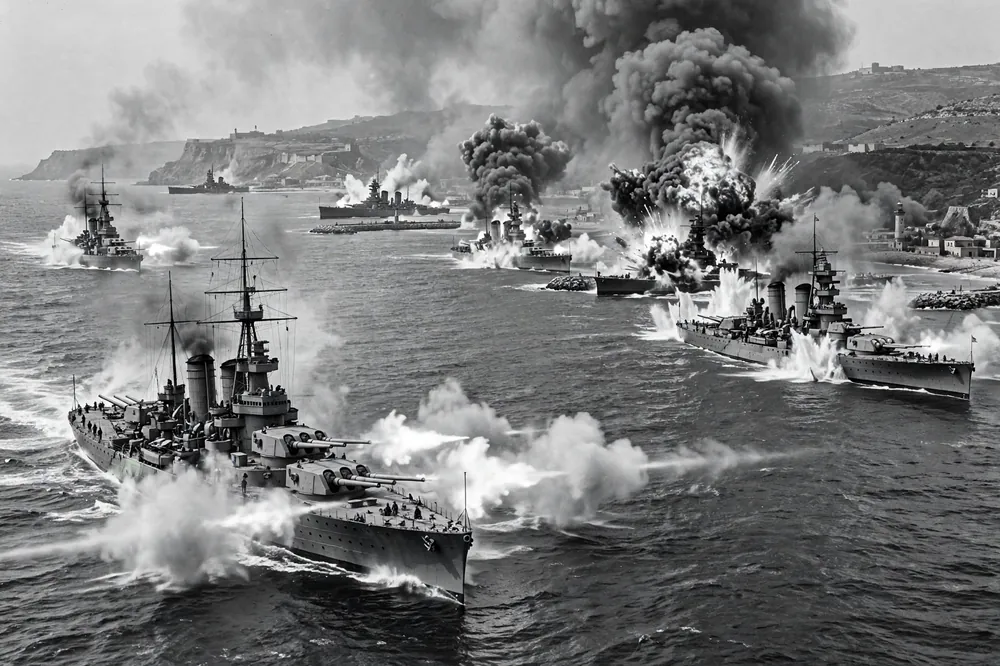
On 3 July 1940, the British Mediterranean Fleet, under Admiral James Somerville, arrived off Mers-el-Kébir and demanded that the French fleet at anchor there — including the battleships Dunkerque and Strasbourg, and the destroyers Mogador and Volta — either join the British, sail to a neutral port, or scuttle.
The French commander, Admiral Marcel-Bruno Gensoul, refused, and the British opened fire. Mogador was hit by a 15-inch shell from the battlecruiser HMS Hood, which struck her stern and detonated her depth charges, blowing off the whole stern of the ship and killing 38 men.
The ship was beached to prevent her sinking, and she was later towed to Toulon for repairs that were never completed. Volta escaped, slipping out of the harbour under fire and reaching Toulon, where she joined the Vichy fleet. The attack on Mers-el-Kébir killed nearly 1,300 French sailors, and it poisoned Anglo-French relations for the rest of the war.
The meaning of Mers-el-Kébir
Mers-el-Kébir was a tragedy, and it was a tragedy that the Mogador class embodied. Mogador was destroyed not by the enemy she was designed to fight, but by her former ally, in a harbour in Algeria, because France had fallen and her fleet was a prize that neither side could afford to lose.
The attack was justified by the British as a military necessity — the French fleet must not fall into German hands — and it was condemned by the French as a betrayal. The truth is that both sides were right, and that the attack was the inevitable consequence of France’s collapse.
For the Mogador class, Mers-el-Kébir was the end of Mogador as a fighting ship, and the beginning of Volta‘s long, inactive service in the Vichy fleet.
7. Volta and the Vichy Fleet
Two years at Toulon
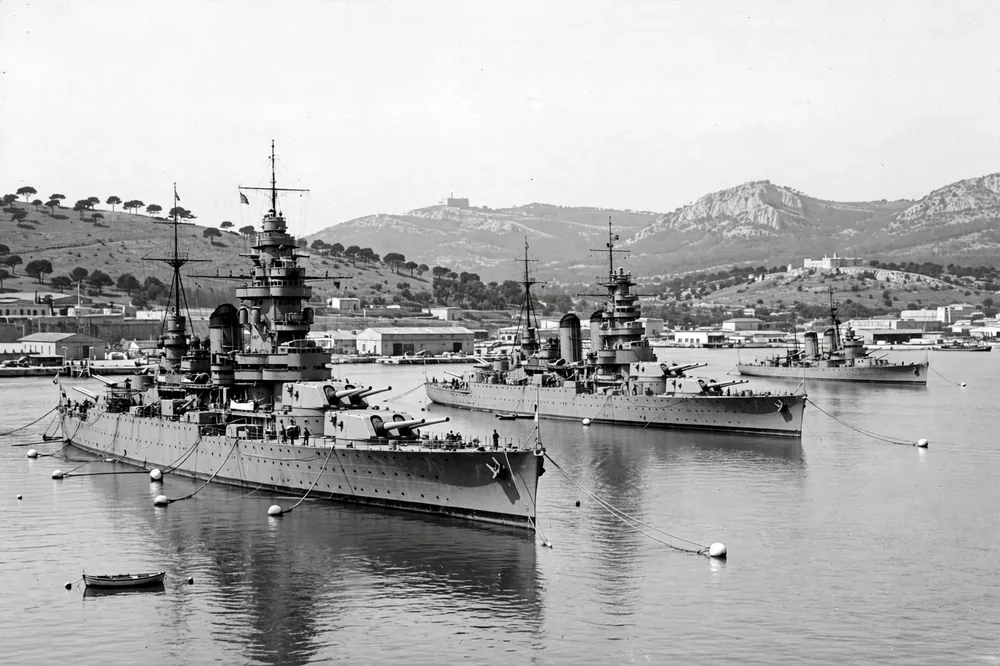
Volta spent the next two years at Toulon, the main base of the Vichy French fleet, in a state of enforced inactivity. The Vichy fleet was a fleet in being: it was not allowed to fight the British, it was not allowed to join the Germans, and it was kept in being as a bargaining counter by the Vichy government. Volta‘s crew maintained the ship, carried out exercises, and waited — for an order that never came, for a war that had passed them by.
The ship’s machinery deteriorated, her crew was reduced, and her fuel was rationed. The Vichy fleet was a fleet without a mission, and Volta was a ship without a war. The two years at Toulon were the strangest years of the Mogador class’s short life, and they were a measure of what had happened to France: a great navy, reduced to a fleet at anchor, waiting for a decision that would be made for it.
Life aboard Volta at Toulon
Life aboard Volta at Toulon, in 1941–1942, was a strange existence for a warship’s crew. The ship was kept in a state of readiness, with her boilers banked and her guns manned, but she was not allowed to sail except for short exercises, and her crew was reduced as men were transferred to other duties or demobilised.
Fuel was rationed, ammunition was limited, and the ship’s machinery, which had never been reliable, deteriorated for lack of use and of spare parts. The crew maintained the ship, painted her, and drilled, but they knew that their drills were for a war they were not allowed to fight.
Morale was poor, and it grew poorer as the months passed and as the news from the war — from Russia, from North Africa, from the Atlantic — made it clear that France’s fleet was a spectator. The two years at Toulon were, for Volta‘s crew, a slow wasting of a fine ship and of good men, and the scuttling of November 1942, when it came, was almost a relief: at last, the ship and her crew had a decision to make, and they made it.
The scuttling at Toulon
On 27 November 1942, the Germans attempted to seize the French fleet at Toulon, in Operation Lila, after the Allied landings in North Africa. The French crews, acting on standing orders, scuttled their ships rather than let them fall into German hands. Volta was scuttled at her moorings, and she sank in the harbour, a wreck that was later raised by the Italians and then sunk again by Allied bombing.
The scuttling of the fleet at Toulon was one of the great acts of the French Navy in the war — a fleet destroying itself rather than surrendering — and it was the end of the Mogador class as a fighting force. Mogador, still under repair at Toulon, was also scuttled, or rather, she was already a wreck, and she was finished off by the scuttling and by later bombing.
The two ships that had been built to fight Italy in the Mediterranean were destroyed, one by the British and one by her own crew, without ever fighting the enemy they were designed for.
8. The Wrecks and the Aftermath
Raising and scrapping
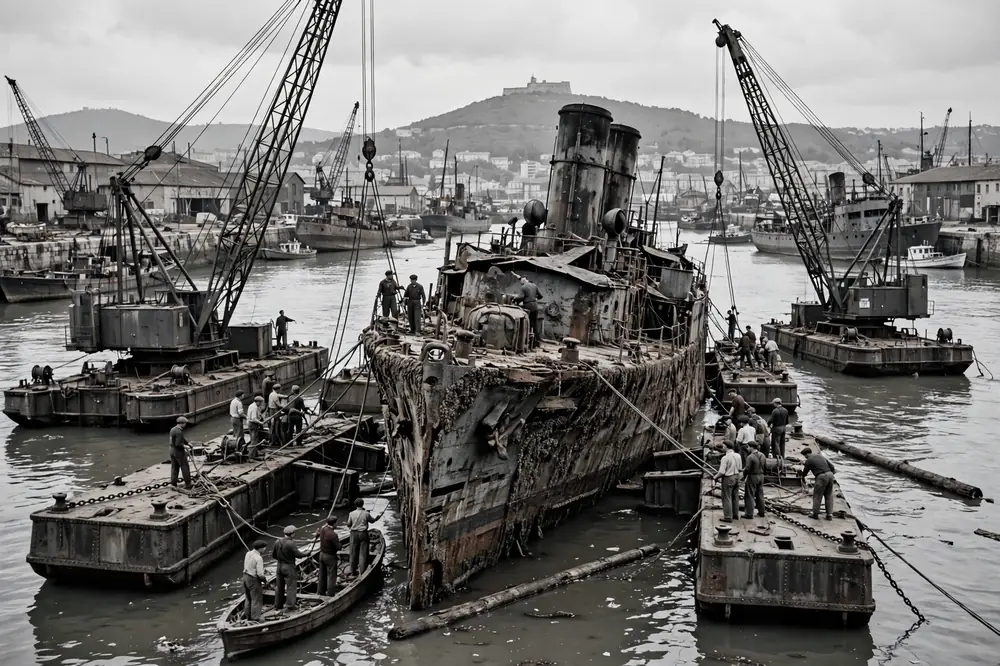
After the war, the wrecks of the Mogador class were raised and scrapped. Volta‘s wreck was raised by the Italians in 1943, sunk again by Allied bombing, and finally raised and scrapped after the war. Mogador‘s wreck, which had been beached at Mers-el-Kébir and then towed to Toulon, was scrapped in 1949. Neither ship survives today, and there is no museum ship of the Mogador class. The class exists now only in photographs, in models, and in the archives of the French Navy. The wrecks were a reminder of the fate of the French fleet in the war: a fleet that was destroyed not in battle, but by the political collapse of the country it served.
The French Navy after the war
The Mogador class was the last of the contre-torpilleurs, and the French Navy after the war abandoned the large-destroyer concept. The post-war French Navy built destroyers of a more conventional size, and it built them to a doctrine that valued anti-submarine warfare and air defence over gunpower and speed. The contre-torpilleur was a product of a particular strategic moment — the expectation of a fleet action in the Mediterranean against Italy — and that moment had passed. The Mogador class was the end of a line, and its story is the story of a doctrine that was overtaken by events: by the fall of France, by the rise of air power, and by the changing nature of naval warfare.
9. Comparison with Foreign Destroyers
Against the British and the Germans
Compared with foreign destroyers, the Mogador class was in a class of its own. It was larger than the British Tribal-class destroyer (about 2,500 tons) and more heavily armed, with eight 138.6 mm guns against the Tribal’s eight 4.7-inch guns — a broadly similar armament, but on a larger and faster hull.
It was larger than the German Type 1936 destroyer (about 2,400 tons) and more heavily armed, with eight guns against the German ship’s five 127 mm guns. The Mogador’s speed of 39 knots was faster than any British or German destroyer, and its torpedo armament was heavier. The Mogador was, on paper, the most powerful destroyer in the world in 1939.
In practice, its twin turrets were unreliable, its anti-aircraft armament was weak, and it had no radar — and those practical weaknesses mattered more than its paper superiority.
The limits of the large destroyer
The Mogador class showed the limits of the large-destroyer concept. A destroyer hull could only carry so much: the guns, the torpedoes, the machinery and the crew, and the attempt to carry more — in the Mogador’s case, eight heavy guns in twin turrets on a 3,000-ton hull — produced a ship that was top-heavy, unreliable and difficult to handle.
The British and the Germans, who built smaller destroyers, accepted less gunpower in exchange for reliability and for numbers, and they built destroyers in far larger numbers than the French. The French built 32 contre-torpilleurs in total, in six classes, while the British built hundreds of destroyers.
The Mogador class was the most extreme expression of the French doctrine, and it was also the last: after the war, no navy built a destroyer like the Mogador.
10. Assessment and Legacy
The Mogador class was a magnificent failure. The ships were fast, powerful and beautiful, and they were the culmination of a doctrine that had shaped the French Navy for twenty years. But they were built for a war that never happened, and they were destroyed in a war that was not theirs — one by the British, one by her own crew. The class’s story is a tragedy, but it is also a lesson: that a navy must build ships for the war it will fight, not for the war it expects to fight, and that the most powerful ship in the world is useless if its country collapses around it.
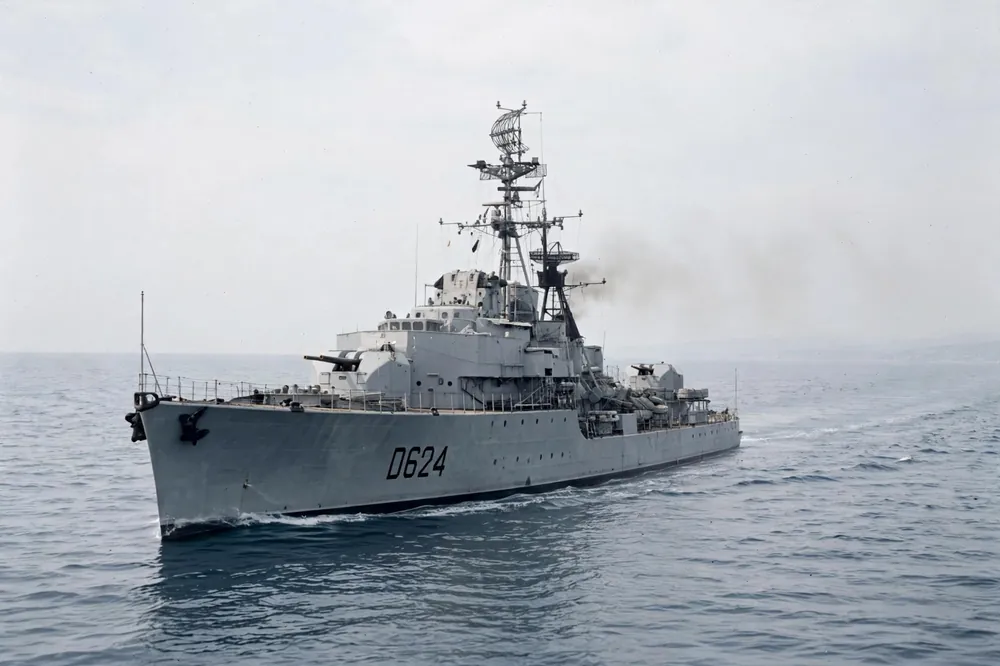
The Mogador class’s legacy is in the French Navy’s post-war destroyers, which abandoned the large-destroyer concept and built ships that were smaller, more reliable, and better protected against air attack. The class is also remembered for Mers-el-Kébir and for Toulon — for the two great tragedies of the French Navy in the war, in which the Mogadors played a central part. The ships themselves are gone, but their names — Mogador, the Moroccan port, and Volta, the West African river — live on in the French Navy, and the class remains a symbol of a navy that built beautiful ships for a war that never came.
11. Frequently Asked Questions
How many Mogador-class destroyers were built?
Only two Mogador-class destroyers were built: Mogador and Volta, completed in 1938–1939. They were the last and most powerful of France’s contre-torpilleurs, the large destroyers built to hunt enemy destroyers and to lead torpedo attacks. No further ships of the class were ordered, because the design was expensive and the French Navy was already moving towards smaller destroyers. The small number mattered because the class was meant to lead the French destroyer force, not to fill it: two ships could not be everywhere, and the loss of one left the other alone.
How fast was the Mogador class?
The Mogador class was designed for 39 knots, and Volta reached 43 knots on trials — one of the fastest speeds ever recorded by a destroyer. In service, the ships rarely achieved their designed speed, because their machinery was temperamental and their hulls were top-heavy, but they were still among the fastest destroyers in the world in 1939. The speed was the point of the design: the contre-torpilleur was built to hunt enemy destroyers, and speed was its weapon. That is why Volta’s 43 knots on trials mattered, even though the ships rarely reached such speeds in service.
What happened to Mogador at Mers-el-Kébir?
On 3 July 1940, Mogador was hit by a 15-inch shell from HMS Hood during the British attack on the French fleet at Mers-el-Kébir. The shell struck her stern and detonated her depth charges, blowing off the whole stern of the ship and killing 38 men. She was beached to prevent sinking, towed to Toulon for repairs that were never completed, and scuttled there in November 1942. Her wreck was scrapped in 1949. The loss mattered because it showed how vulnerable the French fleet was: a single shell destroyed the ship’s stern and killed 38 men, and the repairs were never completed.
What happened to Volta at Toulon?
Volta was scuttled by her own crew at Toulon on 27 November 1942, when the Germans attempted to seize the French fleet in Operation Lila. She sank at her moorings, was raised by the Italians and sunk again by Allied bombing, and was finally scrapped after the war. The scuttling of the fleet at Toulon was a deliberate act by the French crews, acting on standing orders, to prevent their ships falling into German hands. The scuttling was a deliberate act: the French crews, acting on standing orders, chose to destroy their own ships rather than let them fall into German hands.
What was a contre-torpilleur? / Contre-torpilleur là gì?
A contre-torpilleur was a French large destroyer, built in the 1920s and 1930s to hunt down enemy destroyers and to lead torpedo attacks against the enemy battle fleet. The type was larger, faster and more heavily armed than a normal destroyer — the Mogador class, at nearly 3,000 tons with eight 138.6 mm guns, was the largest and most powerful of them. The concept was abandoned after the war. The type was a French idea: a destroyer large enough to hunt other destroyers and to lead torpedo attacks against the enemy battle fleet. The Mogador class was the largest and most powerful of them.
Why were only two Mogador-class ships built?
Only two were built because the design was expensive and ambitious, and because the French Navy was already questioning the large-destroyer concept. The twin turrets were unreliable, the ships were top-heavy, and the cost of each ship was high. The fall of France in 1940 ended any possibility of further construction, and the class remained at two ships. Two ships could not form a class that mattered in a fleet action, and the class remained a pair of individual ships rather than a force. Their fates — one sunk by the British, one scuttled by her own crew — show how little the design achieved for its cost.
12. Sources
- Wikipedia, “Mogador-class destroyer” — construction figures, specifications, service history and the fates of both ships.
- M. J. Whitley, Destroyers of World War Two: An International Encyclopedia (Naval Institute Press, 2000) — Mogador class design and comparison with foreign destroyers.
- John Jordan and Jean Moulin, French Destroyers: Torpilleurs d’Escadre and Contre-Torpilleurs 1922–1956 (Seaforth, 2015) — the definitive account of the French large destroyers, including the Mogador class.
- Robert Dumas, Les contre-torpilleurs de 2800 tonnes du type Mogador (in French) — detailed design history of the class.
- Vincent P. O’Hara, Struggle for the Middle Sea: The Great Navies at War in the Mediterranean Theater, 1940–1945 (Naval Institute Press, 2009) — Mers-el-Kébir and the Vichy fleet.
- Paul Auphan and Jacques Mordal, The French Navy in World War II (Naval Institute Press, 1959) — the scuttling at Toulon and the fate of the French fleet.
- Jean Labayle-Couhat, French Warships of World War II (Ian Allan, 1971).
- David Brown, The Road to Oran: Anglo-French Naval Relations, September 1939–July 1940 (Frank Cass, 2004).