 WAR ATLAS MILITARY HISTORY MAGAZINE · WWI — WWII
Yalta Conference
1. Lead
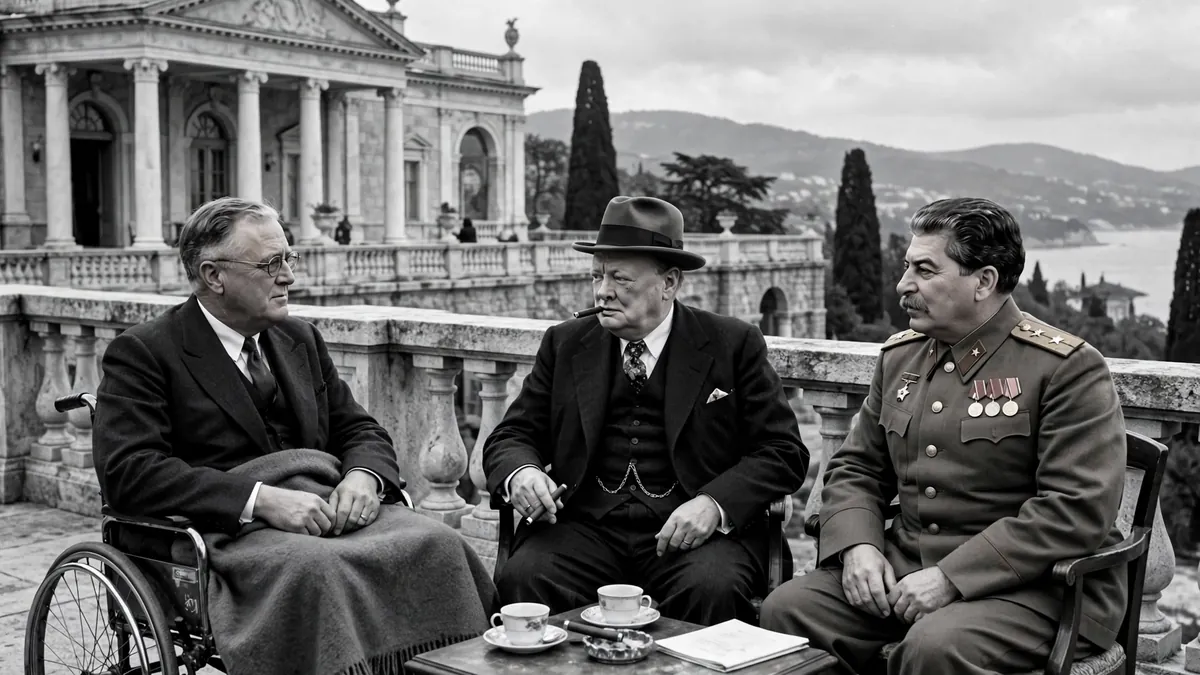
The Yalta Conference was the meeting of the three Allied leaders — President Franklin D. Roosevelt of the United States, Prime Minister Winston Churchill of Britain, and Premier Joseph Stalin of the Soviet Union — held at the former Tsar’s palace at Livadia, near Yalta in the Crimea, from 4 to 11 February 1945.
It was the second of the three great wartime conferences of the Allied leaders (after Tehran in November–December 1943 and before Potsdam in July–August 1945), and the most consequential. At Yalta, the three leaders planned the final defeat of Germany, agreed on the occupation and division of Germany, decided the future of Poland and Eastern Europe, laid the foundations of the United Nations, and secured Stalin’s promise to enter the war against Japan.
Yalta took place at a moment of Allied triumph and of growing tension. In the west, Allied armies had crossed the Rhine and were advancing into Germany; in the east, Soviet armies were 40 miles from Berlin. Victory over Germany was weeks away.
But the questions that Yalta had to answer — who would govern the liberated countries of Eastern Europe, how Germany would be treated, and what the post-war world would look like — were the questions that would divide the victors.
At Yalta, Roosevelt and Churchill made concessions to Stalin that later generations would condemn: they accepted Soviet dominance in Poland and Eastern Europe, and they agreed to territorial changes that displaced millions of people. Defenders of Yalta argue that the Western leaders had no choice — the Soviet Union already occupied Eastern Europe, and its armies could not be dislodged without a new war.
Critics argue that they gave away too much, too easily, and that Yalta was the moment when the West accepted the division of Europe.
The conference is remembered for its famous photograph — Roosevelt, Churchill, and Stalin seated together on the terrace at Livadia — and for the controversy that followed it. In the United States, Yalta became a byword for betrayal and appeasement, and the charge that Roosevelt had “given away” Eastern Europe haunted American politics for a generation.
In Russia, Yalta is remembered as the moment when the Soviet Union was recognised as a great power and the post-war order was founded. The truth, as historians now see it, is more complicated: Yalta was both a genuine attempt to build a lasting peace and the moment when the cracks in the wartime alliance became visible — cracks that, within two years, would become the Cold War.
2. Key Facts
| Dates | 4–11 February 1945 |
| Location | Livadia Palace, near Yalta, Crimea, Soviet Union |
| Participants | Franklin D. Roosevelt (USA), Winston Churchill (UK), Joseph Stalin (USSR) |
| Codename | Operation Argonaut |
| Main decisions | Germany to be divided into four occupation zones; Berlin likewise; Poland’s borders moved west; free elections promised in liberated Europe; United Nations to be founded; USSR to enter the war against Japan |
| Poland | Eastern border set at the Curzon Line; western border moved to the Oder–Neisse line; about 12–14 million Germans to be expelled from the east |
| United Nations | Founding conference set for 25 April 1945 in San Francisco; veto power for the five permanent members of the Security Council agreed |
| Japan | USSR agreed to enter the war against Japan within 2–3 months of Germany’s surrender, in exchange for Sakhalin, the Kuril Islands, and rights in Manchuria |
| Declaration on Liberated Europe | Pledged free elections and democratic governments in the liberated countries |
| Aftermath | Potsdam Conference (July–August 1945) implemented Yalta’s decisions; the Cold War followed within two years |
3. The Road to Yalta
Yalta was the culmination of three years of wartime diplomacy. The first great conference of the three leaders had been Tehran, in November–December 1943, where Roosevelt, Churchill, and Stalin agreed to open a second front in France (the invasion that became D-Day) and to cooperate after the war. Between Tehran and Yalta, the military situation had changed decisively: the Allies had landed in Normandy, liberated France, and advanced to the German border, while the Soviet Union had driven the Germans out of its territory and advanced through Poland toward Berlin. By February 1945, the war in Europe was effectively won — the only question was how it would end, and what would follow.
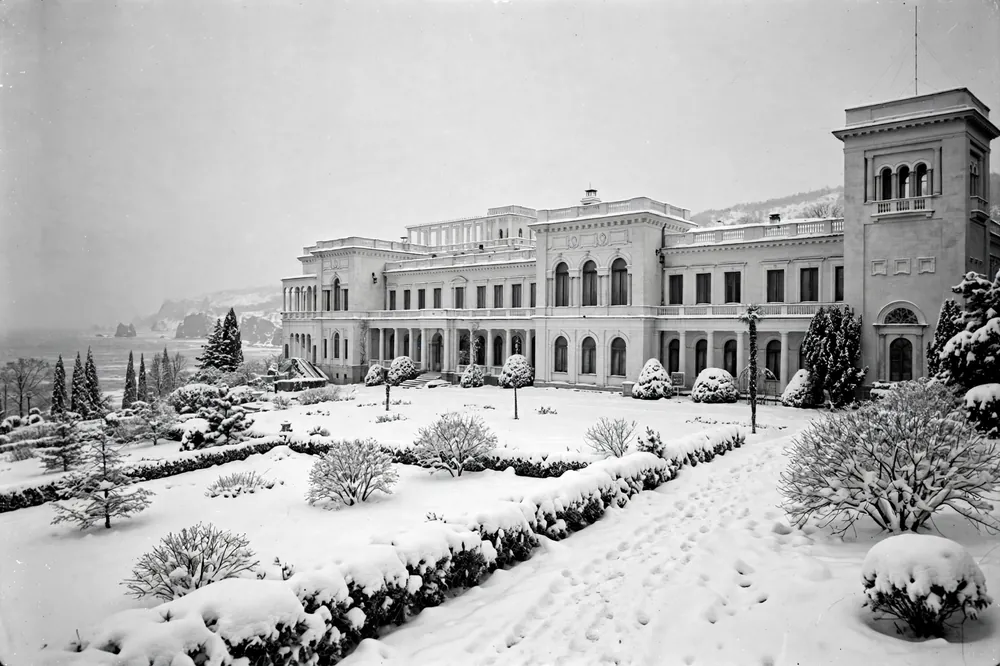
The choice of Yalta as the venue was Stalin’s. Roosevelt and Churchill had proposed meeting in the Mediterranean, but Stalin refused to travel far from the Soviet Union, citing his duties as commander-in-chief and — his doctors said — his health.
Yalta, in the Crimea, was the compromise: a Black Sea resort that had been devastated by the German occupation (the palace at Livadia was one of the few buildings still standing) and that was, in February, cold, damaged, and difficult to reach.
Roosevelt, who was seriously ill — he would die of a cerebral haemorrhage two months later, on 12 April 1945 — travelled 7,000 miles by sea and air to attend. Churchill travelled from Britain via Malta, where he met Roosevelt first. The three leaders arrived with large delegations: foreign ministers, military chiefs, and advisers, including the American diplomat Alger Hiss and the Soviet foreign minister Vyacheslav Molotov.
The atmosphere at Yalta was, by most accounts, cordial. The three leaders dined together, toasted each other, and — according to the records — genuinely believed they could build a lasting peace. But beneath the cordiality, the differences were already clear. Stalin wanted security: a belt of friendly states on the Soviet Union’s western border, and a weakened Germany that could never again invade Russia.
Churchill wanted to preserve the British Empire and to limit Soviet expansion in Europe. Roosevelt wanted a new world order based on the United Nations, and he wanted Soviet help against Japan — help he believed would save American lives in the invasion of the Japanese home islands. Each leader got some of what he wanted, and each gave up something he would later regret.
4. Germany: Division and Occupation
The most important decision at Yalta concerned Germany. The three leaders agreed that Germany would be divided into four occupation zones — American, British, French, and Soviet — and that Berlin, though deep inside the Soviet zone, would likewise be divided into four sectors. They agreed that Germany would be demilitarised, denazified, and made to pay reparations, and that its war criminals would be tried.
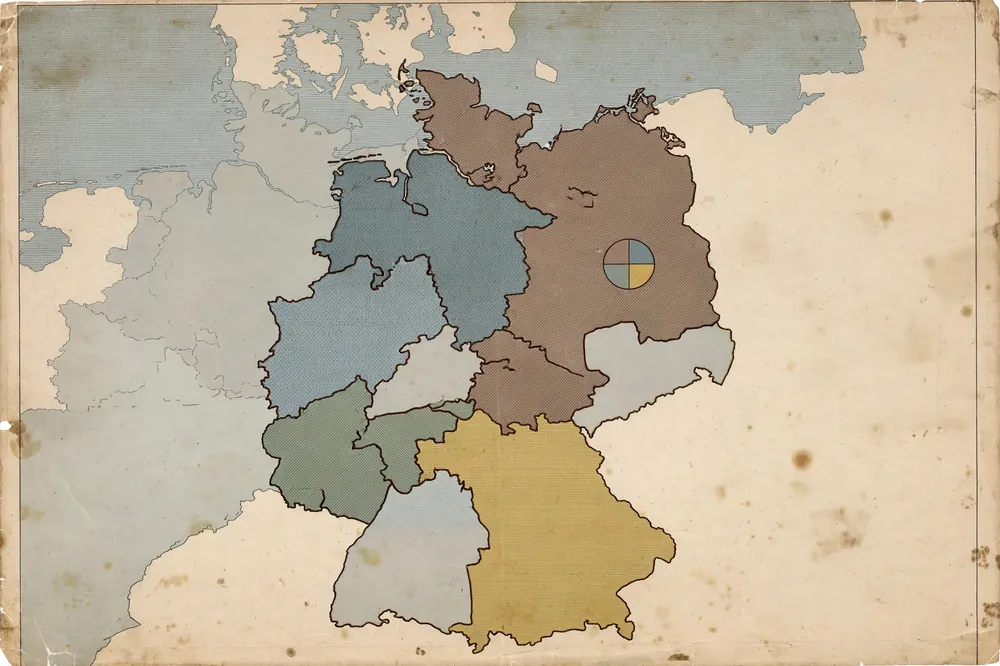
They also agreed on the principle that Germany’s eastern border would be moved west: the Soviet Union would keep the Polish territory it had annexed in 1939, and Poland would be compensated with German territory in the east, up to the Oder and Neisse rivers. The final decision on the exact border was left to the Potsdam Conference in July–August 1945, which confirmed the Oder–Neisse line.
The division of Germany was intended to be temporary — a means of administering a defeated country until a peace treaty could be signed. In practice, it became permanent. The four zones were administered separately, and the Western and Soviet zones developed in opposite directions: the West rebuilt its economy with Marshall Plan aid and became the Federal Republic of Germany in 1949, while the Soviet zone became the German Democratic Republic the same year.
Berlin, divided into four sectors, became the front line of the Cold War, and the Berlin Wall — built in 1961 — was the most visible symbol of the division that Yalta had created. Germany was not reunified until 3 October 1990, 45 years after Yalta.
The reparations decision was also fateful. The Soviet Union, which had suffered the greatest destruction, demanded heavy reparations: at Yalta, the leaders agreed in principle that Germany would pay $20 billion in reparations, half of it to the Soviet Union, though the figure was never formally fixed and the Western Allies later backed away from it. The Soviet Union extracted reparations from its own zone — dismantling factories and shipping them east — while the Western Allies, learning from the experience of Versailles, chose to rebuild West Germany rather than punish it. The difference in approach became one of the early sources of East–West tension.
5. Poland and Eastern Europe
The most controversial decisions at Yalta concerned Poland and Eastern Europe. Poland was the country for which Britain and France had gone to war in 1939, and its future was a matter of honour for the Western Allies — and of security for the Soviet Union, through which German armies had invaded Russia twice in 30 years.
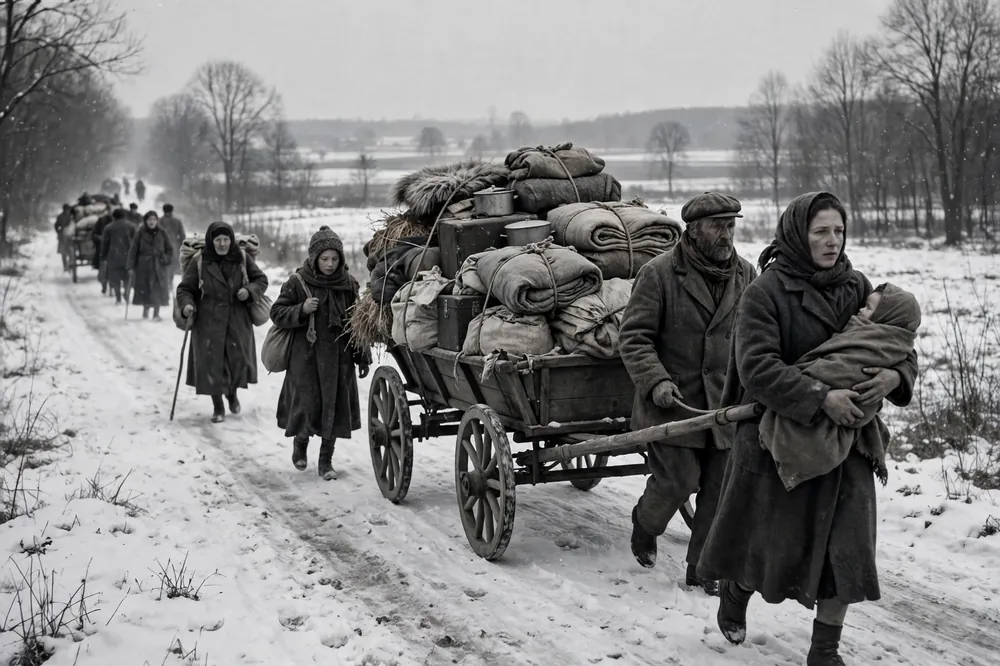
At Yalta, the three leaders agreed on Poland’s borders: its eastern border would follow the Curzon Line (roughly the line proposed by the British Foreign Secretary, Lord Curzon, in 1920), which meant the Soviet Union kept the eastern Polish territories it had annexed in 1939, and its western border would be moved to the Oder–Neisse line, giving Poland large areas of eastern Germany.
The result was one of the largest forced population movements in history: about 12 to 14 million Germans fled or were expelled from the east, and millions of Poles were moved west to the new territories.
On Poland’s government, the leaders agreed to a compromise: the Soviet-backed communist government in Lublin (the “Lublin Poles”) would be “reorganised on a broader democratic basis” to include democratic leaders from Poland and from the London-based Polish government-in-exile, and free elections would be held “as soon as possible”.
The agreement was embodied in the Declaration on Liberated Europe, in which the three leaders pledged to help the liberated peoples of Europe form interim governments “broadly representative of all democratic elements” and to hold free elections. Stalin signed the Declaration — and then ignored it.
The Lublin government was reorganised only cosmetically, the London Poles were marginalised, and the elections held in Poland in January 1947 were rigged: the communist-dominated bloc claimed 80 percent of the vote, and the opposition was suppressed. By 1948, Poland was a one-party communist state.
The same pattern was repeated across Eastern Europe. In Romania, Bulgaria, and Hungary, Soviet-backed communist parties took power in 1946–1948, despite the Declaration on Liberated Europe. The Western Allies protested, but they had no means to enforce the Declaration without a new war — and they were not willing to fight one. The Yalta agreements on Poland and Eastern Europe thus became the foundation of the Soviet sphere, and the source of the Western charge that Yalta was a betrayal. The defenders of Yalta reply that the West had no alternative: the Soviet Union already occupied Eastern Europe, and no agreement at Yalta could have changed that. The argument continues to this day.
6. The United Nations
One of Yalta’s most lasting achievements was the agreement on the United Nations. At the Dumbarton Oaks Conference in Washington in August–October 1944, the Allies had drafted a plan for a new international organisation to replace the League of Nations.
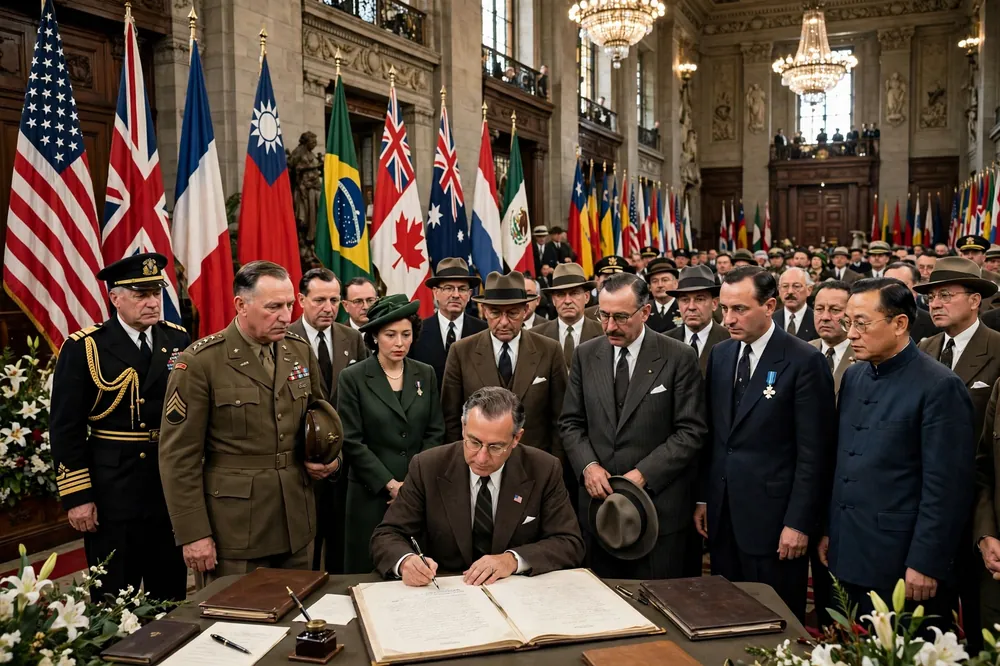
The main obstacle was the voting procedure in the Security Council: the great powers wanted a veto over decisions, while smaller countries feared that the veto would make the organisation powerless. At Yalta, the three leaders agreed on the “Yalta formula”: the five permanent members of the Security Council — the United States, the Soviet Union, Britain, France, and China — would each have a veto, but the veto would not apply to procedural matters, and a party to a dispute would abstain from voting on the peaceful settlement of that dispute.
The compromise satisfied Stalin, who had insisted on the veto as the price of Soviet participation, and Roosevelt, who believed the United Nations could not work without the great powers inside it.
The leaders also agreed that the founding conference of the United Nations would be held in San Francisco on 25 April 1945. The conference opened as planned — two weeks after Roosevelt’s death — and the United Nations Charter was signed on 26 June 1945 by 50 countries.
The United Nations came into existence on 24 October 1945, after the Charter was ratified by the five permanent members and a majority of the signatories. The veto, agreed at Yalta, remains one of the most controversial features of the United Nations: it has prevented the Security Council from acting in many crises, but it has also kept the great powers inside the organisation — which was Roosevelt’s purpose.
The League of Nations had failed, in part, because the great powers were outside it; the United Nations was designed to avoid that failure, and the Yalta formula was the mechanism.
Roosevelt’s hopes for the United Nations were high. He believed that the organisation, backed by the wartime alliance of the great powers, could keep the peace in a way the League never had. He did not live to see it: he died on 12 April 1945, before the San Francisco conference opened. But the United Nations he helped create at Yalta has endured for 80 years, through the Cold War and beyond, and it remains the central institution of the international system.
7. The Far East: The Soviet Promise
The third major area of agreement at Yalta concerned the war against Japan. Roosevelt wanted the Soviet Union to enter the war against Japan, because American military planners estimated that an invasion of the Japanese home islands would cost hundreds of thousands of American lives, and Soviet participation would tie down Japanese forces in Manchuria and shorten the war. Stalin agreed to enter the war within two to three months of Germany’s surrender — a promise he kept: the Soviet Union declared war on Japan on 8 August 1945 and invaded Manchuria the next day, three months after Germany’s surrender on 8 May 1945.
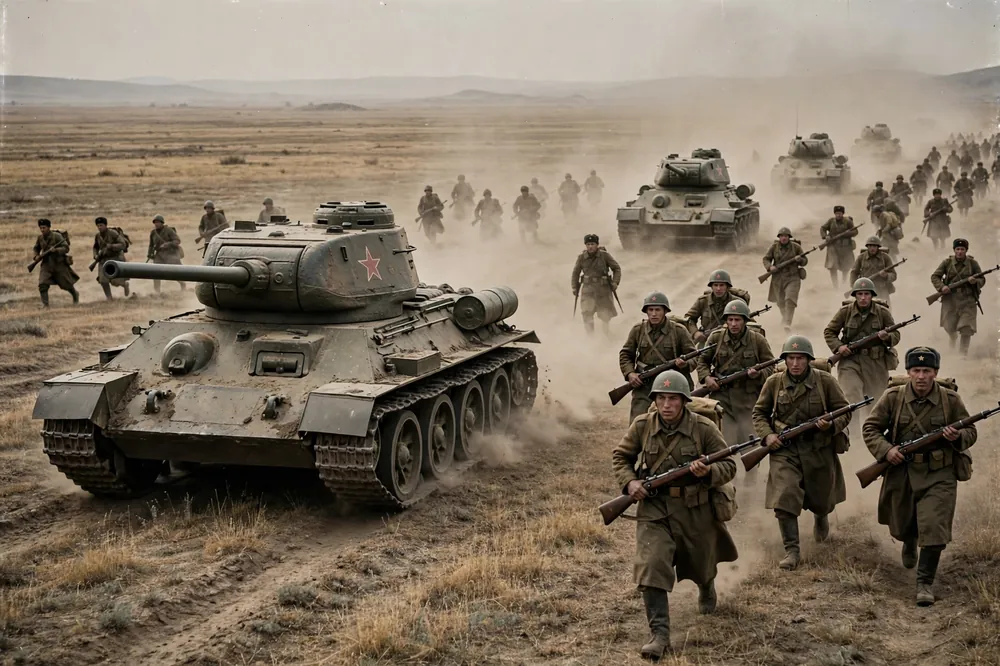
In exchange, Stalin demanded territorial concessions in the Far East: the southern half of Sakhalin Island (lost by Russia to Japan in 1905), the Kuril Islands, and special rights in Manchuria, including the use of the port of Dairen (Dalian) and control of the Chinese Eastern and South Manchurian railways. Roosevelt and Churchill agreed.
The agreement was secret — it was not revealed to China, whose territory was being bargained away, until after the conference — and it became one of the most criticised parts of Yalta. Critics argued that Roosevelt had given away too much for a promise the Soviet Union might have kept anyway, and that the concessions created the basis for Soviet influence in Asia after the war.
Defenders argued that Soviet entry into the war was worth the price, and that it helped bring the war to a speedier end: the Soviet invasion of Manchuria, combined with the atomic bombings of Hiroshima and Nagasaki, convinced the Japanese leadership that further resistance was hopeless.
The Far Eastern agreement also had long consequences. The Kuril Islands remain disputed between Russia and Japan to this day — Japan has never signed a peace treaty with Russia, in part because of the islands. The Soviet presence in Manchuria helped the Chinese Communists, who received captured Japanese weapons and used Manchuria as a base in the Chinese Civil War that followed. The Yalta agreements on Asia, like those on Europe, shaped the post-war world in ways the participants did not fully foresee.
8. The Declaration on Liberated Europe
The Declaration on Liberated Europe was one of the most idealistic documents to emerge from Yalta — and one of the most quickly broken. In it, the three leaders pledged that the liberated peoples of Europe would be helped to “create democratic institutions of their own choice”, that interim governments would be “broadly representative of all democratic elements in the population”, and that free elections would be held “as soon as possible”. The Declaration was Roosevelt’s initiative: he wanted a public commitment to democracy that would reassure the American public and the peoples of Europe that the war was being fought for freedom, not for a new division of the continent.
The Declaration was sincere — Roosevelt and Churchill meant it — but it was unenforceable. It contained no mechanism for enforcement, no definition of “democratic”, and no provision for what would happen if one of the signatories violated it. Stalin signed it, but he understood it differently: in his view, a “democratic” government was one friendly to the Soviet Union, and “free elections” were elections that produced such a government.
Within months of Yalta, the Declaration was being violated in Poland, Romania, and Bulgaria, and the Western Allies could do nothing but protest. The Declaration became a symbol of the gap between Yalta’s promises and Yalta’s reality — and, for critics of the conference, proof that Roosevelt and Churchill had been naive to trust Stalin’s signature.
Yet the Declaration was not worthless. It established the principle — for the first time in an agreement between the great powers — that the peoples of liberated Europe had the right to choose their own governments. That principle was invoked by dissidents and democrats in Eastern Europe for the next 45 years, and it was echoed in the Helsinki Accords of 1975, which committed the signatories to respect human rights and fundamental freedoms. When the communist regimes of Eastern Europe collapsed in 1989, they collapsed in part because their peoples invoked the promises made at Yalta — promises that had been broken, but never forgotten.
9. Controversy and Assessment
No wartime conference has been more controversial than Yalta. In the United States, the controversy began almost immediately. Roosevelt died two months after Yalta, and his successor, Harry S. Truman, learned of the secret Far Eastern agreement only after taking office.
In the late 1940s and early 1950s, as the Cold War deepened and China fell to communism, critics — above all the Republican senator Joseph McCarthy and his allies — charged that Roosevelt had been duped, or worse, that his advisers (above all Alger Hiss, who was later convicted of perjury in connection with espionage charges) had betrayed American interests.
The phrase “the sellout at Yalta” became a staple of American political debate, and the Yalta agreements were blamed for the loss of Eastern Europe and, by some, for the loss of China.
Historians now take a more balanced view. They note that Roosevelt was seriously ill at Yalta — he had only two months to live — and that his judgement may have been impaired, but they also note that the Western leaders had little leverage: the Soviet Union already occupied Eastern Europe, and the only way to dislodge it would have been a new war, which no one wanted.
They note that the agreements on Germany and the United Nations were genuine achievements, and that the Declaration on Liberated Europe, though violated, established principles that outlasted the Cold War. They also note that Stalin made concessions at Yalta too: he accepted the veto formula for the United Nations, he agreed to French participation in the occupation of Germany, and he promised free elections in Poland — promises he broke, but promises he felt compelled to make.
The most balanced assessment is that Yalta was neither a triumph nor a betrayal, but a compromise made under the pressure of war — a compromise that reflected the military realities of February 1945, and that could not have been very different given those realities. The tragedy of Yalta was not that the Western leaders gave away Eastern Europe — Eastern Europe was already in Soviet hands — but that they believed, or hoped, that Stalin would honour agreements he had no intention of honouring, and that the peace they were building would last. Within two years, the hope was gone, and the Cold War had begun.
10. The Three Leaders
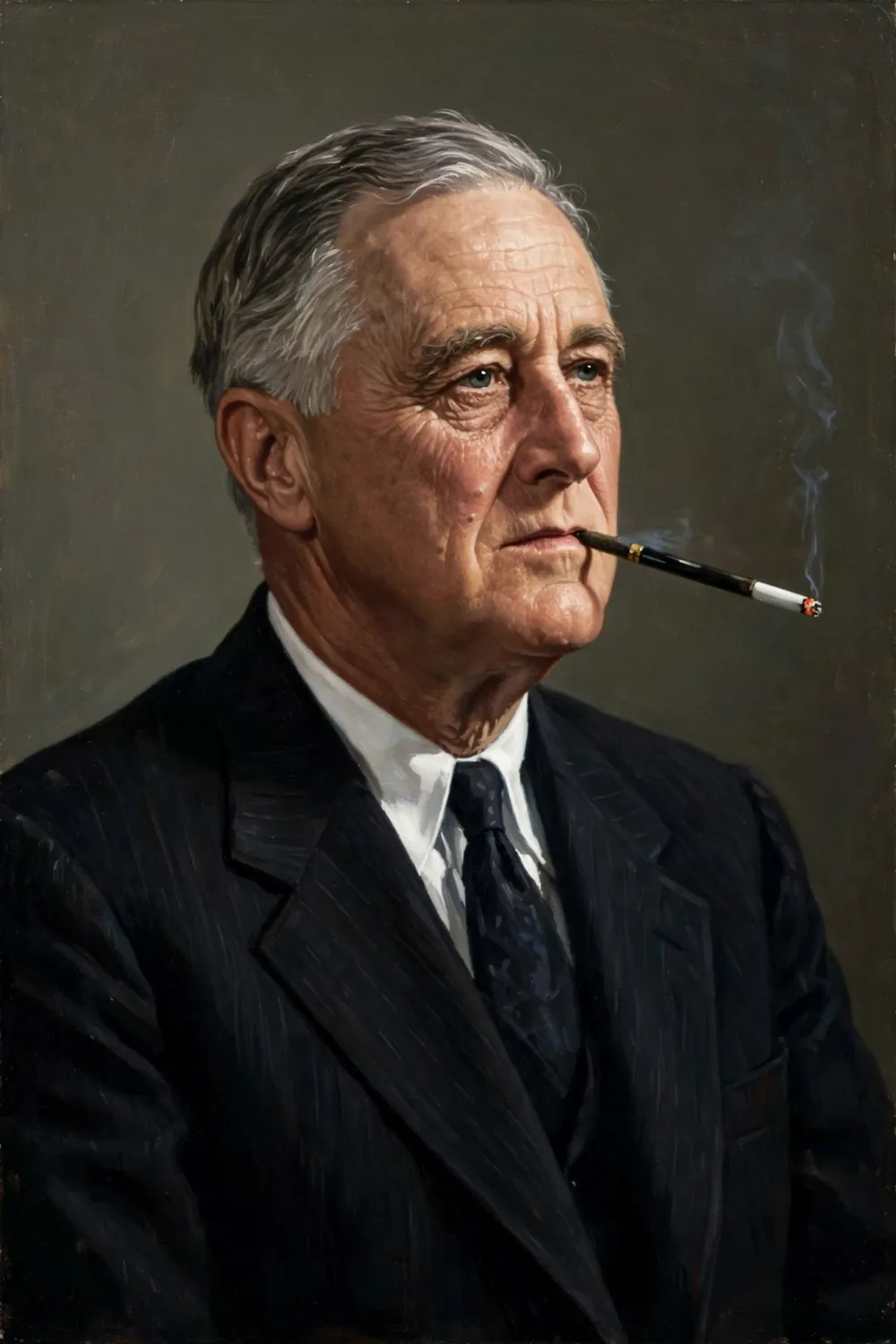
Franklin D. Roosevelt (United States). President from 1933 until his death on 12 April 1945. At Yalta, Roosevelt was 63 and seriously ill, suffering from heart disease and high blood pressure. He dominated the conference’s agenda on the United Nations and the Far East, and he made the concessions on Poland and Eastern Europe that later generations would criticise. He died two months after Yalta, before the war in Europe ended, and was succeeded by Harry S. Truman.
Winston Churchill (United Kingdom). Prime Minister from 1940 to 1945. At Yalta, Churchill was the most sceptical of the three leaders about Soviet intentions — he had warned about Soviet expansion since 1944 and had tried, at the Moscow Conference of October 1944, to agree spheres of influence with Stalin. At Yalta he fought for Poland and for free elections, but he accepted the agreements as the best obtainable. He lost the general election of July 1945, before the Potsdam Conference ended, and was replaced by Clement Attlee.
Joseph Stalin (Soviet Union). Leader of the Soviet Union. At Yalta, Stalin was in the strongest position of the three: his armies occupied Eastern Europe, and he knew the Western Allies needed Soviet help against Japan and Soviet cooperation for the United Nations. He got most of what he wanted — a friendly Poland, a divided Germany, territorial gains in the Far East — and he signed agreements on free elections that he had no intention of honouring. He remained in power until his death in 1953, presiding over the consolidation of the Soviet sphere that Yalta had made possible.
Frequently Asked Questions
Related articles
Sources
- Encyclopædia Britannica, “Yalta Conference” — dates, participants and decisions.
- Wikipedia, “Yalta Conference” — the agreements, the Declaration on Liberated Europe and the Far Eastern agreement, cross-checked against scholarly sources.
- S. M. Plokhy, Yalta: The Price of Peace (Viking, 2010) — the standard modern history of the conference.
- The Avalon Project, Yale Law School — the text of the Yalta agreements and the Declaration on Liberated Europe.
- Fraser J. Harbutt, Yalta 1945: Europe and America at the Crossroads (Cambridge University Press, 2010).
- National Archives (UK) and the Franklin D. Roosevelt Presidential Library — conference records and photographs.
- Diana Preston, Eight Days at Yalta: How Churchill, Roosevelt and Stalin Shaped the Post-War World (Picador, 2019).
- Arthur Schlesinger Jr., “The Yalta Controversy” — in The Cycles of American History (Houghton Mifflin, 1986).
- Melvyn P. Leffler, For the Soul of Mankind: The United States, the Soviet Union, and the Cold War (Hill and Wang, 2007).