 WAR ATLAS MILITARY HISTORY MAGAZINE · WWI — WWII
J. Robert Oppenheimer
1. Lead
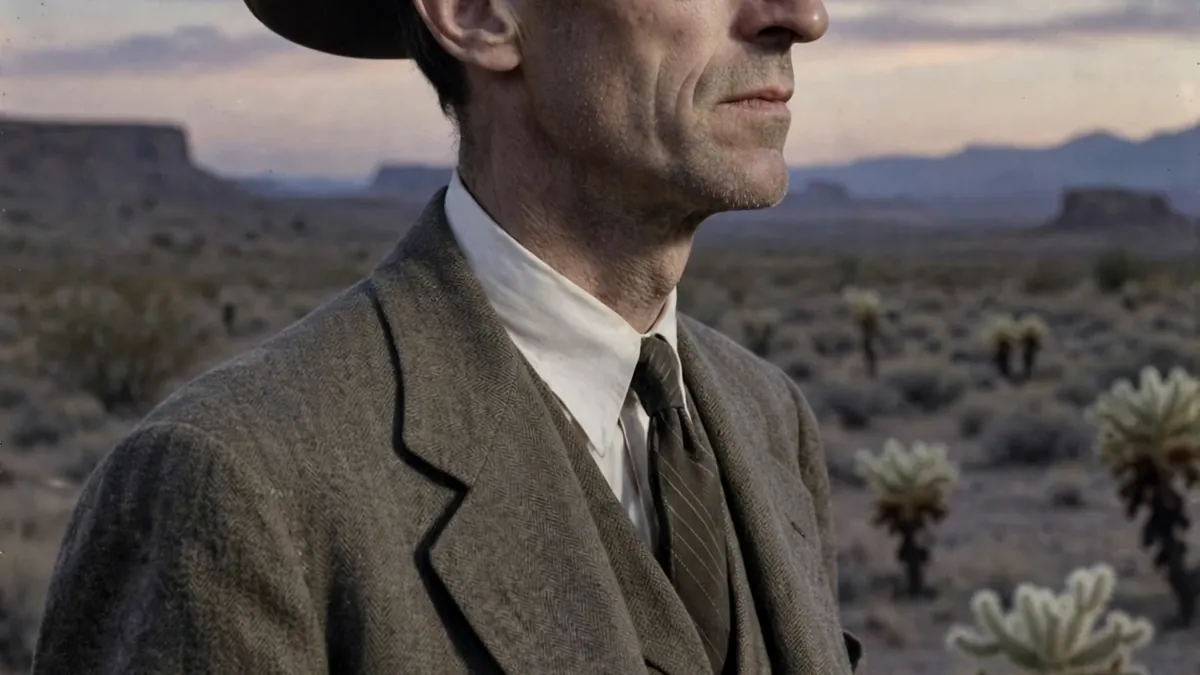
J. Robert Oppenheimer (22 April 1904 – 18 February 1967) was an American theoretical physicist who served as director of the Los Alamos Laboratory of the Manhattan Project during the Second World War, and is often called the “father of the atomic bomb”.
The laboratory he directed, at Los Alamos in New Mexico, designed and built the first atomic weapons; the first of them was tested at Alamogordo, New Mexico, on 16 July 1945, and two more were dropped on the Japanese cities of Hiroshima and Nagasaki in August 1945.
Before the war Oppenheimer was known as a theoretical physicist at the University of California, Berkeley, and the California Institute of Technology, working on quantum mechanics, astrophysics and the theory of neutron stars. After the war he became director of the Institute for Advanced Study in Princeton and chairman of the General Advisory Committee of the United States Atomic Energy Commission, where he advised against a crash programme to build the hydrogen bomb.
In 1954, during the Second Red Scare, his security clearance was revoked after a hearing by the Atomic Energy Commission that examined his past associations with the Communist Party and his conduct during the Manhattan Project. The decision was vacated by the United States government in 2022.
Oppenheimer’s life is the subject of extensive historical debate: about his scientific leadership at Los Alamos, about his political associations and the security hearing, and about his responsibility, and that of others, for the use of the atomic bomb. This article presents the record from the sources, with disputed points identified as disputed.
2. Key Facts
| Born | 22 April 1904, New York City, United States (born Julius Robert Oppenheimer) |
| Died | 18 February 1967, Princeton, New Jersey, United States (aged 62, throat cancer) |
| Nationality | American |
| Role / Office | Theoretical physicist; Director, Los Alamos Laboratory, Manhattan Project (1943–1945); Director, Institute for Advanced Study, Princeton (1947–1966); Chairman, General Advisory Committee, United States Atomic Energy Commission (1947–1952) |
| Known for | Directing the Los Alamos Laboratory and the development of the first atomic weapons; the Born–Oppenheimer approximation; work on neutron stars and black holes; the 1954 security hearing |
| Spouse / Family | Married Katherine (“Kitty”) Puening in 1940; two children, Peter and Katherine. Son of Julius Seligmann Oppenheimer, a textile importer, and Ella Friedman Oppenheimer, a painter |
3. Early Life
Julius Robert Oppenheimer was born in New York City on 22 April 1904, into a non-observant Jewish family, the son of Julius Seligmann Oppenheimer, a textile importer who had emigrated from Germany in 1888, and Ella Friedman Oppenheimer, a painter. He was educated at the Ethical Culture School in New York, where he showed ability in science, languages and literature, and entered Harvard University in 1922.
At Harvard he studied chemistry, graduating in 1925, and also studied physics, literature and philosophy. In 1925 he went to England to work at the Cavendish Laboratory in Cambridge, where he found experimental work uncongenial, and then to Germany, where he studied under Max Born at the University of Göttingen and received his doctorate in physics in 1927, at the age of 23.
His doctoral work was on quantum mechanics, then a new and rapidly developing field. In Göttingen he worked with Born on the approximation that bears both their names — the Born–Oppenheimer approximation, which separates the motion of atomic nuclei from that of electrons and remains a standard tool in molecular physics.
After postdoctoral work in Leiden and Zurich, he returned to the United States in 1929 and took up posts at the University of California, Berkeley, and the California Institute of Technology, dividing his time between the two. At Berkeley he built a school of theoretical physics, supervising a generation of students, and worked on a wide range of problems, including the theory of cosmic rays, the structure of the neutron, and, with his student Hartland Snyder, the gravitational collapse of massive stars — work published in 1939 that described, in mathematical terms, what would later be called a black hole, although the term was not used at the time.
With the physicist Richard Tolman and the student George Volkoff, he also worked on the structure of neutron stars, and the limit on the mass of a neutron star is known as the Tolman–Oppenheimer–Volkoff limit.
At Berkeley, Oppenheimer’s influence was exercised above all through his students. His doctoral students included David Bohm, Robert Christy, Philip Morrison, Hartland Snyder, George Volkoff and Willis Lamb, all of whom went on to substantial careers in physics. The group that gathered around him at Berkeley in the 1930s — known informally as his school — was the first sustained centre of theoretical physics in the United States, and it is credited in the literature with establishing theoretical physics as a distinct discipline in American universities, which had previously been dominated by experimental work.
4. Rise to Prominence
Oppenheimer’s rise to scientific prominence came in the 1930s, through his work at Berkeley and his role as a teacher and organiser of theoretical physics in the United States. Before 1939 he was known within physics but not to the public, and he held no administrative post of significance.
His political life in the 1930s is a matter of record and of controversy: he contributed money to organisations associated with the Communist Party, attended meetings, and was close to people who were members of the Party, including his brother Frank and his wife Kitty.
At his 1954 security hearing he denied that he had been a member of the Communist Party, and described himself as a “fellow traveller” — someone who agreed with many of communism’s goals but was not willing to follow the orders of a Communist Party organisation.
The extent of his involvement has been examined in detail by historians, and the documentary record supports the account he gave at the hearing: that he was sympathetic to left-wing causes in the 1930s, that he contributed money and attended meetings, and that he was not a member of the Party.
In 1942 he was recruited to work on the Manhattan Project, the American programme to build an atomic bomb, and in 1943 he was appointed director of the project’s Los Alamos Laboratory. The appointment was made by Brigadier General Leslie Groves, the military head of the project, who chose Oppenheimer despite the objections of security officials about his political associations.
Groves recorded his reasons in a memorandum of 20 July 1943, in which he directed that clearance be issued to Oppenheimer without delay, irrespective of the information held about him. Groves’s judgement was that Oppenheimer’s scientific ability and his capacity to lead a large laboratory outweighed the security concerns. The decision was unusual, and it was the turning point of Oppenheimer’s career.
5. Role in World War II
Los Alamos / Los Alamos
The Los Alamos Laboratory was established in 1943 on the site of a boys’ ranch school in the mountains of New Mexico, chosen by Oppenheimer himself. Its task was to design and build an atomic bomb, using the fissile material produced at the project’s other sites — uranium-235 at Oak Ridge, Tennessee, and plutonium at Hanford, Washington.
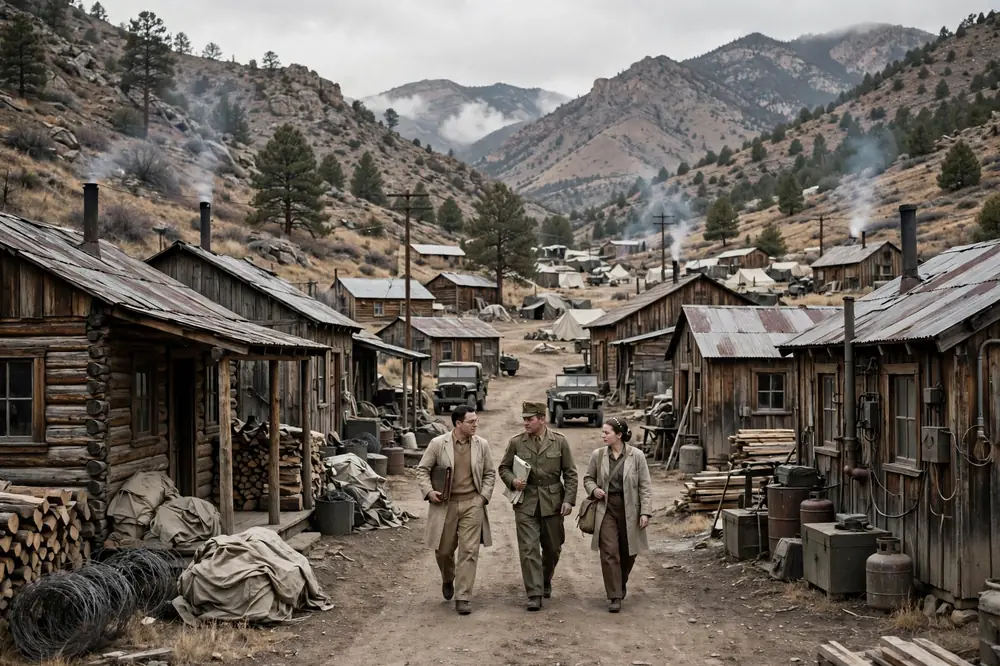
When Oppenheimer took over, the laboratory had a small staff and no clear design for a weapon. Under his direction it grew to a community of several thousand scientists, engineers, technicians and military personnel, organised into divisions covering theory, experiment, ordnance and chemistry.
Oppenheimer’s contribution was not primarily as a researcher — he published little during the war — but as a director who could follow work across many fields, make decisions quickly, and hold together a laboratory of strong-willed scientists under conditions of secrecy and time pressure.
The laboratory’s work proceeded on two designs in parallel: a gun-type weapon, in which one piece of fissile material was fired into another, and an implosion-type weapon, in which a sphere of fissile material was compressed by conventional explosives. The gun-type design was used for the uranium bomb; the implosion design, which was more difficult, was used for the plutonium bomb.
By the spring of 1945 both designs were ready, and the decision was taken to test the implosion design before using it, because it had never been tried.
The laboratory grew rapidly under Oppenheimer’s direction. From a small staff in the spring of 1943 it expanded to several thousand people by 1945, organised into divisions for theory, experiment, ordnance, chemistry and metallurgy, with a military administration under Groves’s Manhattan Engineer District handling security, housing and supply.
The organisation was compartmentalised: most of the staff knew only their own part of the work, and the full design of the weapons was known to a small group. Oppenheimer’s working method was to move between the divisions, to chair the weekly colloquia at which results were shared, and to take decisions on the spot; his colleagues recorded that he could follow arguments across fields in which he was not a specialist, and that his authority in the laboratory rested on that breadth rather than on rank.
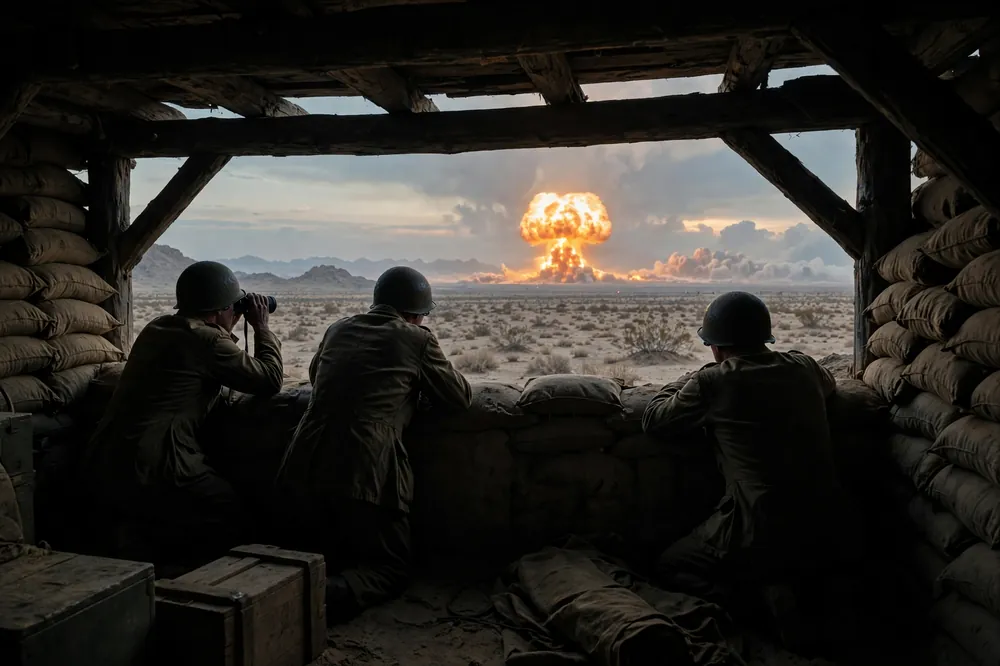
On 16 July 1945, at 5:29 a.m., the first atomic bomb was detonated at the Trinity site near Alamogordo, New Mexico. Oppenheimer had given the site the codename “Trinity”, which he later said was taken from a poem by John Donne. He was present at the test, watching from a control bunker.
The explosion produced a yield later estimated at about 20 kilotons of TNT, and a fireball and mushroom cloud visible for many miles. Oppenheimer’s later recollections of the moment are widely quoted: in a television interview in 1965 he said, “We knew the world would not be the same. A few people laughed, a few people cried. Most people were silent.
I remembered the line from the Hindu scripture, the Bhagavad Gita; Vishnu is trying to persuade the Prince that he should do his duty and, to impress him, takes on his multi-armed form and says, ‘Now I am become Death, the destroyer of worlds.’ I suppose we all thought that, one way or another.” The quotation should be read as a later recollection, recorded twenty years after the event, rather than as a statement made at the time of the test.
Another remark attributed to Oppenheimer at the test — “I guess it worked” — is reported in some accounts and not in others, and should be treated as an anecdote rather than as an established fact. The Trinity test demonstrated that the implosion design worked, and it cleared the way for the use of the weapons against Japan.
The decision to use the atomic bombs against Japan was made by President Truman and his advisers, not by Oppenheimer or by the scientists at Los Alamos. Oppenheimer’s role was to provide the weapons and to advise on their technical characteristics; he was a member of the Interim Committee’s Scientific Panel, which discussed the use of the bomb, and the panel’s recommendation was that the bomb be used against Japan without prior demonstration.
On 6 August 1945 a uranium gun-type bomb, “Little Boy”, was dropped on Hiroshima; on 9 August a plutonium implosion bomb, “Fat Man”, was dropped on Nagasaki. The numbers of dead are recorded in the sources with ranges rather than single figures: estimates for Hiroshima are generally given as about 70,000–80,000 killed by the end of 1945, rising to about 140,000 by the end of 1945 when deaths from injuries and radiation are included, and for Nagasaki as about 40,000–70,000, with the ranges reflecting different methods of counting.
Japan announced its surrender on 15 August 1945, and the formal surrender was signed on 2 September. The question of whether the atomic bombings were necessary to end the war, and whether Japan would have surrendered without them, is one of the most debated questions in the historiography of the Second World War, and the sources do not settle it: some historians argue that the bombings, together with the Soviet declaration of war on Japan on 8 August, ended the war quickly and avoided a costly invasion; others argue that Japan was already seeking a negotiated surrender and that the bombings were not necessary.
Oppenheimer’s own position after the war was that he felt a sense of responsibility for the weapons he had helped to build, and he expressed that view in private and in public, including in a meeting with President Truman in October 1945 in which, according to Oppenheimer’s own later account, he told the president that he felt he had “blood on his hands”.
Truman’s reply, as reported in accounts of the meeting, was dismissive, but the accounts of the meeting differ in detail and the exchange should be treated as reported rather than as verbatim.
The use of the bomb was debated among the scientists before it happened. In June 1945 a committee of scientists at the Chicago Metallurgical Laboratory, chaired by the physicist James Franck, produced a report — the Franck Report — which argued that a surprise atomic attack on Japan was inadvisable and recommended a demonstration of the weapon before representatives of the United Nations, on a desert site or a barren island.
The report was sent to Washington; according to the account in American Prometheus by Kai Bird and Martin J. Sherwin, it was not seen by President Truman. Oppenheimer, as a member of the Scientific Panel of the Interim Committee, did not support the recommendation of a demonstration: the panel’s recommendation was that the bomb be used against Japan without prior demonstration.
The difference between the Chicago scientists and the Los Alamos leadership on this question is a matter of record, and it is part of the history of the decision to use the bomb.
6. Key Decisions
Four decisions define Oppenheimer’s wartime and post-war record. The first was his acceptance of the directorship of Los Alamos in 1943, a post for which he had no administrative experience and which required him to manage a large laboratory under military control.
His acceptance is recorded as a fact; his reasons — a sense of duty, scientific interest, and a belief that the bomb should be built before Germany built one — are recorded in his own statements and in the accounts of those who knew him. The second was the decision to pursue both the gun-type and the implosion designs in parallel, and to test the implosion design at Trinity.
The decision consumed resources and time, but it produced a working plutonium weapon and, in the event, the test succeeded. The third was his conduct in August 1943, when he told Manhattan Project security officers that a person he did not know, George Eltenton, had approached three men at Los Alamos on behalf of the Soviet Union to obtain nuclear information.
Oppenheimer’s account of this episode changed over time: he initially gave a version that protected the identity of the person who had approached him — his friend Haakon Chevalier — and later gave a fuller account. The changing accounts were examined in detail at the 1954 hearing and have been examined by historians since; they are a central part of the record on his conduct, and they are presented here as a matter of record rather than as a judgement.
The fourth was his post-war opposition to a crash programme to build the hydrogen bomb. In October 1949 the General Advisory Committee, under his chairmanship, recommended against such a programme, on the grounds that the hydrogen bomb was a weapon of a different order of destructiveness and that its development would harm American security. President Truman overruled the recommendation in January 1950 and ordered the development of the hydrogen bomb.
Oppenheimer’s opposition, and his later statements on nuclear weapons, were among the factors cited in the 1954 hearing.
7. Controversies
The controversies around Oppenheimer fall into three groups. The first concerns his political associations and the Chevalier episode. The facts are as set out above: he contributed to left-wing causes in the 1930s, was close to members of the Communist Party, and gave changing accounts of the approach made to him in 1943.
What is disputed is the interpretation: the Atomic Energy Commission’s hearing in 1954 concluded that his conduct showed a lack of candour and that his associations made him a security risk; historians who have examined the record since have differed, with some concluding that the hearing’s findings were justified on the evidence of his conduct, and others concluding that the hearing was driven by political considerations, in particular by the chairman of the Commission, Lewis Strauss, and by Oppenheimer’s opposition to the hydrogen bomb.
The second group concerns the hydrogen bomb. Oppenheimer’s opposition to a crash programme is documented; what is disputed is whether his opposition was based on technical judgement, on moral grounds, or on a combination of the two, and whether his conduct in the debate was open or obstructive.
The physicist Edward Teller, who led the development of the hydrogen bomb, testified at the 1954 hearing that he considered Oppenheimer’s actions to have been unwise, and that he would prefer to see the country’s vital interests in hands that he understood better — testimony that is often quoted, and that contributed to the hearing’s outcome. The third group concerns responsibility for the atomic bombings.
Oppenheimer was not the decision-maker on the use of the bombs, and the decision was made by Truman and his advisers. What is debated is the extent of his moral responsibility: some historians argue that, as the director of the laboratory that built the weapons, he bears a share of responsibility for their use; others argue that responsibility lies with those who ordered their use, and that Oppenheimer’s role was technical.
Oppenheimer himself expressed, in public and in private, a sense of responsibility for the weapons, and his statements on the subject are recorded in the sources. In 2022 the United States Department of Energy vacated the 1954 decision revoking his clearance, stating that the process had been flawed; the vacating order is a matter of record and does not itself settle the historical questions above.
8. Later Life and Death
After the war Oppenheimer was appointed director of the Institute for Advanced Study in Princeton in 1947, a post he held until 1966, and chairman of the General Advisory Committee of the Atomic Energy Commission, a post he held until 1952. The security hearing that ended his government service took place in April and May 1954, in secret, before a panel of the Atomic Energy Commission.
The hearing examined his past associations with the Communist Party, the Chevalier episode, and his opposition to the hydrogen bomb. On 28 June 1954 the Commission revoked his security clearance by a vote of four to one. The decision effectively ended his access to government atomic information and his career as an adviser on nuclear policy.
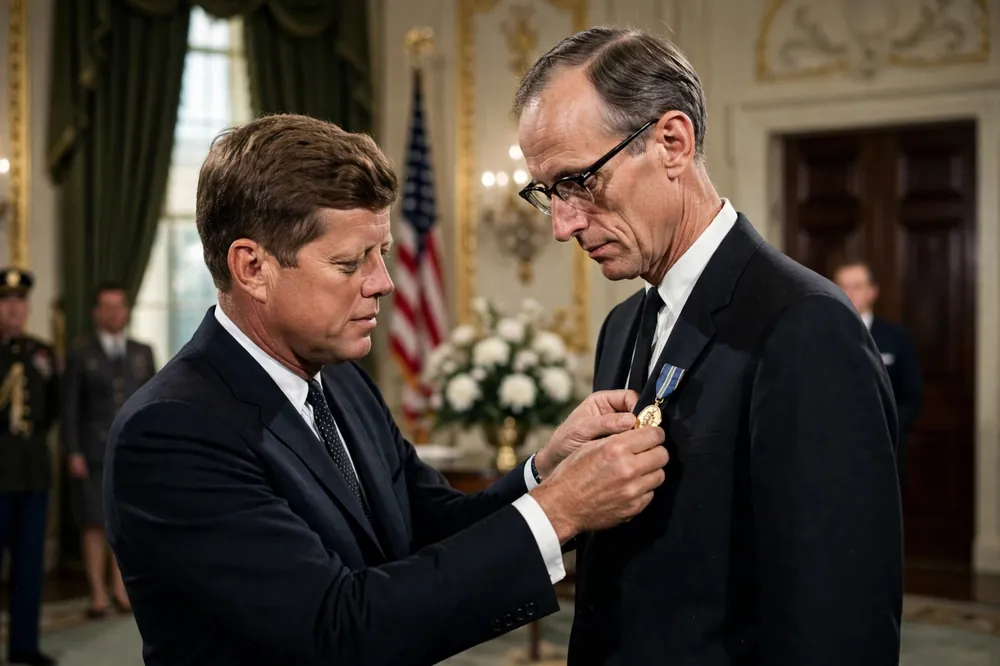
He continued to direct the Institute for Advanced Study, to lecture and to write, but he no longer held a government post. In 1963 President John F. Kennedy awarded him the Enrico Fermi Award, the highest award of the Atomic Energy Commission, as a gesture of political rehabilitation; the award was presented by President Lyndon B. Johnson after Kennedy’s assassination.
Oppenheimer died of throat cancer on 18 February 1967 at his home in Princeton, New Jersey, aged 62. He was cremated, and his ashes were scattered in the Caribbean near his holiday home on the island of St. John. In 2022 the Department of Energy vacated the 1954 revocation of his clearance, stating that the hearing had been flawed.
Oppenheimer’s public writing after the war is part of the same record. In 1952 he chaired a five-member State Department Panel of Consultants on Disarmament, which recommended that the United States postpone its planned first test of the hydrogen bomb and seek a thermonuclear test ban with the Soviet Union. In June 1953 he published an article in Foreign Affairs arguing that ever-larger nuclear arsenals had diminishing utility, and in the same year he delivered the Reith Lectures on the BBC, published as Science and the Common Understanding. These writings, and his speeches on the difficulty of managing the power of scientific knowledge, were cited in the 1954 hearing as evidence of his views on nuclear policy.
9. Legacy
Oppenheimer’s legacy is a scientific one and a political one, and the two are usually discussed together. Scientifically, his pre-war work on quantum mechanics, on the Born–Oppenheimer approximation, and on neutron stars and gravitational collapse remains part of the standard literature, and the Tolman–Oppenheimer–Volkoff limit is still used in astrophysics. The Los Alamos Laboratory he directed became the Los Alamos National Laboratory, a continuing centre of nuclear research.
Politically, his career is the most widely known case of a scientist’s loss of government standing during the Second Red Scare, and the 1954 hearing is studied as an example of the use of security procedures for political purposes — a characterisation that is itself debated, as set out above.
The vacating of the 1954 decision in 2022, and the award of the Enrico Fermi Award in 1963, are recorded as official acknowledgements that the treatment of Oppenheimer was, in the government’s own later assessment, flawed. In popular culture, Oppenheimer is widely known through the 2023 film Oppenheimer, directed by Christopher Nolan and based on the biography American Prometheus (2005) by Kai Bird and Martin J.
Sherwin, which won the Academy Award for Best Picture. The film’s account of the security hearing and of the Trinity test follows the historical record in outline, although, as with any dramatisation, individual scenes are reconstructions rather than records. The laboratory, the test site and the Institute for Advanced Study all preserve records of his work, and his papers are held at the Library of Congress.
10. Assessment by Historians
Historians’ assessments of Oppenheimer have changed over time, and they differ on the central questions. The biography American Prometheus (2005) by Kai Bird and Martin J. Sherwin, which won the Pulitzer Prize, presents Oppenheimer as a scientist whose political associations were those of a man of the 1930s, whose conduct at Los Alamos was that of an effective director, and whose treatment in 1954 was unjust — a view that has been widely accepted in the general literature, but that has also been qualified by other historians.
Richard Rhodes, in The Making of the Atomic Bomb (1986), presents the Manhattan Project as a collective achievement in which Oppenheimer’s role was that of director and coordinator, and argues that the credit for the bomb belongs to the project as a whole rather than to any single person.
Historians of the security hearing, including Barton Bernstein, have examined the documentary record in detail and have concluded that the hearing’s procedures were flawed and that the outcome was influenced by political considerations, while also concluding that Oppenheimer’s changing accounts of the Chevalier episode gave the hearing grounds to question his candour.
On the question of the atomic bombings, the historiography remains divided, as set out above, and Oppenheimer’s own statements are treated as evidence of his views rather than as a resolution of the question. The assessment that commands the widest agreement is a limited one: that Oppenheimer was an effective director of Los Alamos, that his pre-war scientific work was significant, that the 1954 hearing was flawed in procedure and influenced by political considerations, and that the historical questions about his conduct and his responsibility remain open to interpretation on the basis of the documentary record.
Frequently Asked Questions
Who was J. Robert Oppenheimer? J. Robert Oppenheimer was an American theoretical physicist who directed the Los Alamos Laboratory of the Manhattan Project during the Second World War, where the first atomic weapons were designed and built. He is often called the “father of the atomic bomb”.
What was J. Robert Oppenheimer’s role in the Manhattan Project? As director of the Los Alamos Laboratory from 1943 to 1945, he directed the scientists and engineers who designed and built the first atomic bombs. The laboratory’s work produced the uranium bomb dropped on Hiroshima and the plutonium bomb dropped on Nagasaki.
What happened at the Trinity test? On 16 July 1945, at 5:29 a.m., the first atomic bomb was detonated at the Trinity site near Alamogordo, New Mexico. The test demonstrated that the implosion design worked, and it cleared the way for the use of the weapons against Japan.
Why was Oppenheimer’s security clearance revoked in 1954? After a hearing by the Atomic Energy Commission in April and May 1954, which examined his past associations with the Communist Party, the Chevalier episode and his opposition to the hydrogen bomb, the Commission revoked his clearance by a vote of four to one. The decision was vacated by the Department of Energy in 2022.
Did Oppenheimer say “Now I am become Death”? He recalled the line from the Bhagavad Gita in a television interview in 1965, twenty years after the Trinity test, saying that he had remembered it at the time of the explosion. The quotation is a later recollection rather than a statement recorded at the time of the test.
When did J. Robert Oppenheimer die? He died of throat cancer on 18 February 1967 at his home in Princeton, New Jersey, aged 62.
Related articles
Sources
- Wikipedia, “J. Robert Oppenheimer” — dates, career, Los Alamos, Trinity, the 1954 hearing and the 2022 vacating, cross-checked against the sources below.
- Encyclopædia Britannica, “J. Robert Oppenheimer” (britannica.com) — biography, Manhattan Project and security hearing.
- Kai Bird and Martin J. Sherwin, American Prometheus: The Triumph and Tragedy of J. Robert Oppenheimer (Alfred A. Knopf, 2005) — Pulitzer Prize-winning biography; Los Alamos, the Chevalier episode and the 1954 hearing.
- Richard Rhodes, The Making of the Atomic Bomb (Simon & Schuster, 1986) — the Manhattan Project as a collective achievement.
- United States Atomic Energy Commission, In the Matter of J. Robert Oppenheimer: Transcript of Hearing before Personnel Security Board (Government Printing Office, 1954) — the official transcript of the security hearing.
- United States Department of Energy, Order vacating the 1954 revocation of Oppenheimer’s security clearance (16 December 2022).
- Los Alamos National Laboratory (lanl.gov) — history of the laboratory and the Trinity test.
Further reading
- J. Robert Oppenheimer, Science and the Common Understanding (Oxford University Press, 1954).
- Barton J. Bernstein, “The Oppenheimer Loyalty-Security Case Reconsidered”, Stanford Law Review, 1990.
- Gregg Herken, Brotherhood of the Bomb (Henry Holt, 2002).