 WAR ATLAS MILITARY HISTORY MAGAZINE · WWI — WWII
Fourteen Points
1. Lead
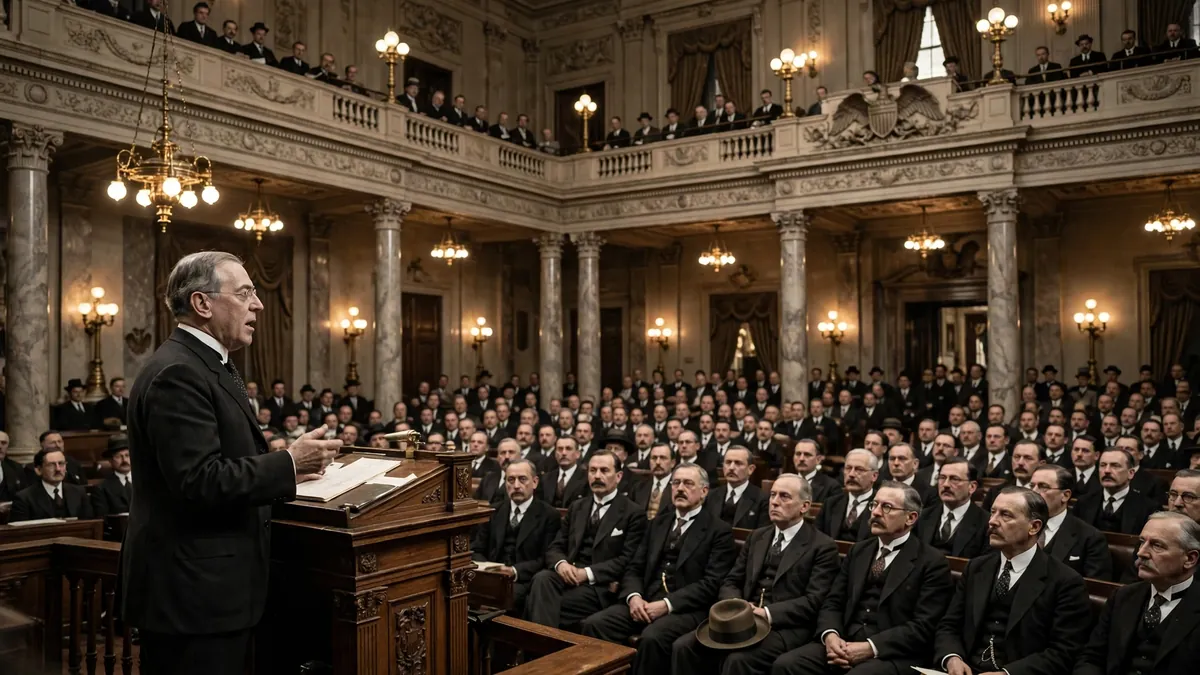
The Fourteen Points were a statement of war aims and principles for peace delivered by United States President Woodrow Wilson to a joint session of Congress on 8 January 1918, in the middle of the First World War. In fourteen numbered points, Wilson called for open diplomacy, freedom of the seas, free trade, disarmament, a fair settlement of colonial claims, the restoration of occupied territories, national self-determination for the peoples of Europe, and — in the final point — a “general association of nations” to guarantee peace: the idea that became the League of Nations.
The speech was the most ambitious attempt of the war to define what the Allies were fighting for, and it was aimed as much at the peoples of the Central Powers and of Russia as at the governments of Britain and France.
The Fourteen Points became the moral framework of the Allied cause. Printed in millions of copies and dropped as leaflets over German and Austro-Hungarian lines, they promised a peace without annexations and without revenge, and they helped to persuade war-weary soldiers and civilians in the Central Powers that surrender would not mean ruin.
When Germany asked for an armistice in October 1918, it did so explicitly on the basis of the Fourteen Points. Yet at the Paris Peace Conference in 1919, Wilson found that his allies — above all France and Britain — had made their own secret commitments during the war, and that the peace they wanted was far harsher than the one he had promised.
The Treaty of Versailles kept the League of Nations but compromised or abandoned many of the other points, and the United States Senate then refused to ratify the treaty at all, leaving America outside the League its own president had created.
The Fourteen Points thus became both one of the most influential documents of the twentieth century and one of its great disappointments — a vision of a new world order that shaped the language of peace for generations, even as its author failed to secure it.
2. Key Facts
| Author | President Woodrow Wilson of the United States |
| Delivered | 8 January 1918, address to a joint session of the United States Congress |
| Drafted with | Colonel Edward M. House and the “Inquiry” group of experts |
| Context | United States at war with Germany since April 1917; Russia leaving the war after the Bolshevik Revolution |
| Core ideas | Open diplomacy, freedom of the seas, free trade, disarmament, colonial settlement, self-determination, League of Nations |
| Point 14 | A general association of nations — the League of Nations |
| Germany’s armistice | Requested October 1918 on the basis of the Fourteen Points |
| Paris Peace Conference | January–June 1919; Treaty of Versailles signed 28 June 1919 |
| United States Senate | Rejected the Treaty of Versailles in November 1919 and March 1920; the United States never joined the League |
| Legacy | Basis for the League of Nations and the language of self-determination; precursor of the United Nations Charter |
3. Background: America, Russia and the Crisis of 1917
To understand the Fourteen Points, it is necessary to understand the winter of 1917–1918, the darkest moment of the war for the Allies. The United States had declared war on Germany in April 1917, but American troops were still arriving in France in small numbers, and it would be many months before the American army could fight at full strength. Russia, meanwhile, was collapsing.
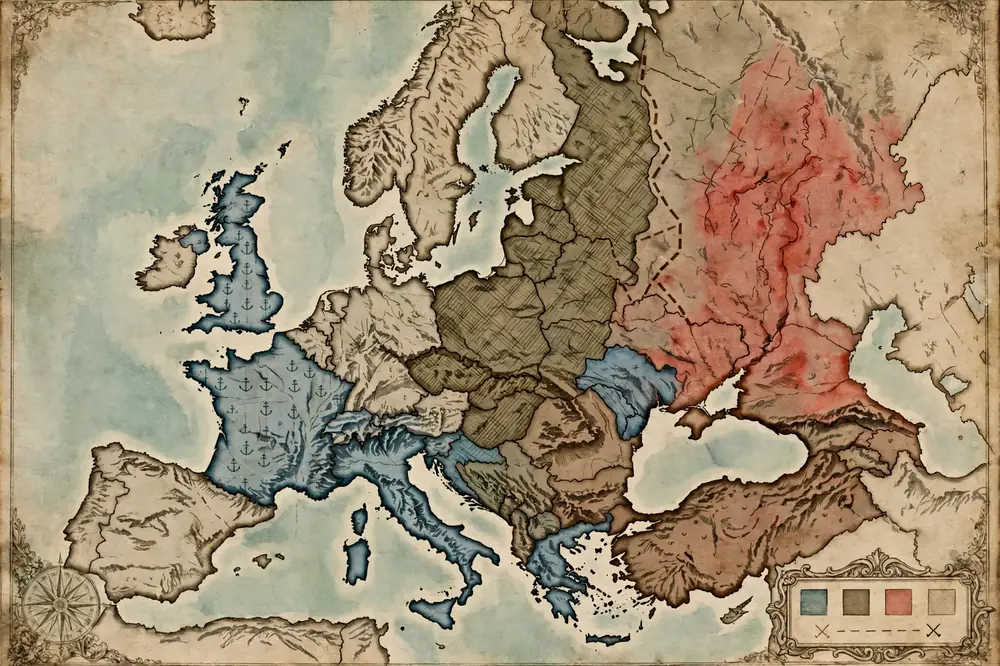
The February Revolution had overthrown the Tsar; the Provisional Government had kept Russia in the war and then itself been overthrown by the Bolsheviks in October 1917. In December the new Bolshevik government signed an armistice with Germany, and in March 1918 it would sign the Treaty of Brest-Litovsk, surrendering vast territories — Ukraine, the Baltic states, Finland and parts of the Caucasus — in exchange for peace.
Germany was suddenly free to move dozens of divisions from the Eastern Front to the west, and the Allies faced the prospect of a great German offensive in the spring of 1918 before American power could arrive.
Wilson also faced a political threat. In November 1917 the Bolsheviks had published the secret treaties of the Allies — the agreements by which Britain, France, Russia and Italy had promised each other territory and colonies as the spoils of victory — and had denounced them as imperialist.
The Bolsheviks’ own peace programme, the Decree on Peace, called for a peace “without annexations and without indemnities” and appealed directly to the peoples of all warring countries over the heads of their governments. Wilson needed an answer that would show the world that the Allies were not fighting for territory, that would keep Russia’s people sympathetic to the Allied cause, and that would give war-weary populations everywhere a reason to keep fighting.
The Fourteen Points were that answer.
Wilson had already set out his vision of peace before. In January 1917, before the United States entered the war, he had called for a “peace without victory” — a settlement in which no side was humiliated and no side gained territory by conquest. After the declaration of war, he described the war as a fight to make the world “safe for democracy”.
The Fourteen Points turned those phrases into a concrete programme. The drafting was done largely by Colonel Edward M. House, Wilson’s closest adviser, working with a group of about 150 academics and experts known as the Inquiry, assembled in the autumn of 1917 to prepare the American position for the eventual peace conference.
The Inquiry supplied the detailed territorial recommendations — where the borders of Poland should run, which peoples of Austria-Hungary should have autonomy, how the colonies should be handled — and Wilson turned their memoranda into the language of the speech.
There was also a domestic audience. The United States in 1918 was a country of immigrants, including millions of German-Americans and Irish-Americans who were suspicious of the war, and a growing socialist and pacifist movement that opposed it outright. Wilson needed to explain to the American people why their sons were being sent to die in Europe. The Fourteen Points gave the war a purpose beyond the defence of Britain and France: it was a war to remake the world on just principles, so that such a war could never happen again.
4. The Fourteen Points in Full
The speech is organised in two parts. The first five points state general principles for the peace. The next eight deal with specific territorial questions, moving roughly from east to west across the map of Europe. The fourteenth point, the League of Nations, is the capstone that was meant to hold the whole structure together.
- Point I — Open covenants of peace, openly arrived at. There should be no more secret treaties. All agreements between nations should be negotiated and published openly, so that peoples would know what their governments had promised. This was a direct answer to the Bolshevik publication of the Allies’ secret treaties, and it struck at a whole system of diplomacy in which the great powers had divided the world among themselves in private.
- Point II — Absolute freedom of navigation upon the seas, in peace and in war, except where the seas were closed by international action to enforce international covenants. This reflected the American experience of the war: German submarine warfare against neutral shipping had been the immediate cause of the American declaration of war, and Britain’s blockade was resented in Washington as well.
- Point III — The removal of economic barriers and the establishment of equality of trade conditions among all nations consenting to the peace. Free trade, Wilson believed, would remove one of the causes of war, since nations that traded freely had less reason to conquer each other’s markets.
- Point IV — Adequate guarantees for the reduction of national armaments to the lowest point consistent with domestic safety. The arms race before 1914 — above all the Anglo-German naval race — was widely blamed for the outbreak of war, and disarmament was meant to make another such race impossible.
-
Point V — A free, open-minded and absolutely impartial adjustment of all colonial claims, based on the principle that the interests of the populations concerned must have equal weight with the claims of the governments. This was the most radical of the general principles: it suggested that colonial peoples had interests that mattered, even if it stopped far short of promising them independence.
-
Point VI — Russia. All Russian territory should be evacuated, and Russia should be given a free opportunity to determine her own political development, with the assistance of other nations if she wished. Wilson was careful here: he did not recognise the Bolshevik government, but he refused to endorse intervention against it, and he promised that Russia would be welcomed into the society of nations under whatever government she chose.
- Point VII — Belgium must be evacuated and restored, “without any attempt to limit the sovereignty which she enjoys in common with all other free nations”. Belgium’s fate was the symbolic heart of the Allied cause: Germany had invaded a neutral country in 1914, and restoring Belgium was the minimum test of a just peace.
- Point VIII — France. All French territory should be freed, the invaded portions restored, and “the wrong done to France by Prussia in 1871 in the matter of Alsace-Lorraine” should be righted, so that peace could be made secure in the interest of France. Alsace-Lorraine, annexed by Germany after the Franco-Prussian War, was to return to France.
- Point IX — Italy. A readjustment of the frontiers of Italy should be effected along clearly recognisable lines of nationality. This meant the Italian-speaking territories held by Austria-Hungary — the Trentino, South Tyrol and Trieste — should go to Italy, though Wilson’s phrase “lines of nationality” would later become a source of bitter dispute, since South Tyrol was largely German-speaking.
- Point X — Austria-Hungary. The peoples of Austria-Hungary, “whose place among the nations we wish to see safeguarded and assured”, should be accorded the freest opportunity of autonomous development. Note the caution: Wilson did not yet call for the break-up of the Habsburg Empire, only for autonomy for its peoples. Within a year, the empire would collapse entirely, and the point would be overtaken by events.
- Point XI — The Balkans. Romania, Serbia and Montenegro should be evacuated; occupied territories restored; Serbia accorded free and secure access to the sea; and the relations of the several Balkan states to one another determined by friendly counsel along historically established lines of allegiance and nationality. This was the point most directly connected with the origins of the war, since the Balkan rivalries of 1912–1913 and the assassination at Sarajevo had set the war in motion.
- Point XII — The Ottoman Empire. The Turkish portions of the empire should be assured a secure sovereignty, but the other nationalities under Turkish rule should be assured an undoubted security of life and an absolutely unmolested opportunity of autonomous development, and the Dardanelles should be permanently opened as a free passage to the ships of all nations under international guarantees. Here Wilson combined self-determination for the Arabs and Armenians with continued Turkish sovereignty over Anatolia.
- Point XIII — Poland. An independent Polish state should be erected, including territories inhabited by indisputably Polish populations, with free and secure access to the sea, and its political and economic independence and territorial integrity should be guaranteed by international covenant. Poland had been partitioned between Russia, Prussia and Austria since the eighteenth century, and its restoration was one of the most popular war aims in the West.
“A general association of nations must be formed under specific covenants for the purpose of affording mutual guarantees of political independence and territorial integrity to great and small states alike.”
The fourteenth point was the only one that was not about the settlement itself, but about how future settlements would be kept. Wilson believed that the old system of alliances and secret treaties had caused the war, and that only a permanent organisation of nations, committed to collective security, could prevent another. The League would be the guarantor of the other thirteen points. Without it, Wilson argued, the peace would be only a truce.
5. Reception: Hope in the Enemy Camp, Caution among the Allies
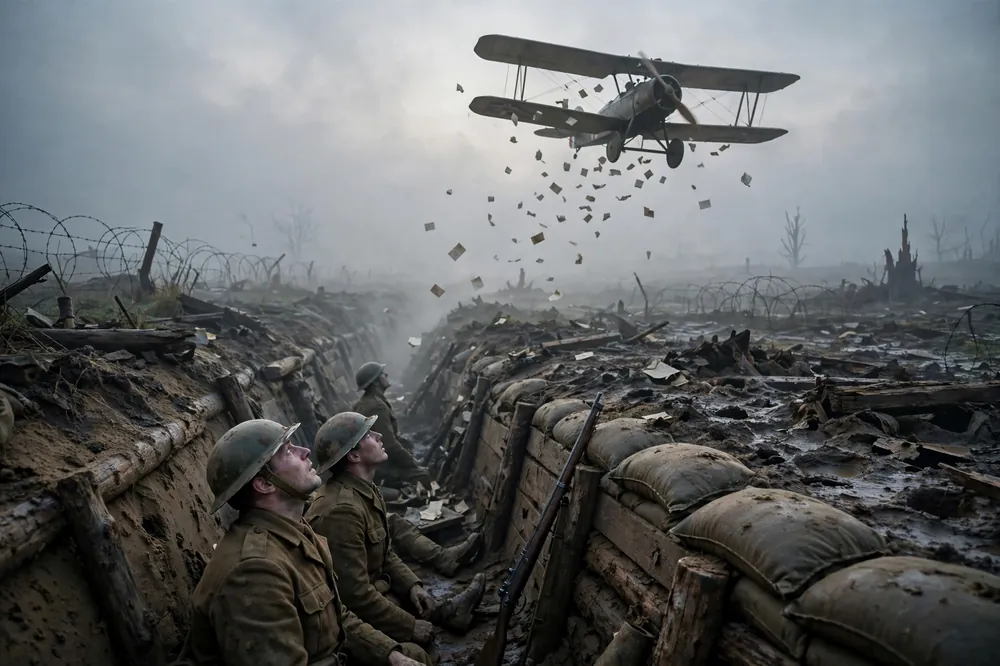
The speech was received very differently in different capitals. In Berlin and Vienna, it was read with intense interest. The German and Austro-Hungarian governments issued cautious official replies, but the speech’s real audience was not the governments — it was the peoples. The Allies printed the Fourteen Points in the millions and dropped them by aircraft and balloon over German and Austro-Hungarian positions.
For soldiers who had been fighting for four years and civilians who were hungry under the British blockade, the promise of a peace without annexations, without crushing indemnities and without humiliation was powerful. German Chancellor Georg von Hertling replied on 24 January 1918 that Germany accepted the points in principle, though with reservations — above all on the freedom of the seas, which would have ended the submarine campaign, and on the evacuation of occupied territory, which Germany treated as a bargaining counter.
Austro-Hungarian Foreign Minister Count Czernin was more welcoming, and his reply helped to open a brief and ultimately fruitless exchange of peace feelers in the spring of 1918.
In London and Paris, the reception was polite but wary. British Prime Minister David Lloyd George had set out British war aims in a speech of his own on 5 January 1918, three days before Wilson’s address, and the two programmes overlapped a good deal — but Lloyd George had been careful to promise the British public that Germany would pay for the war, and he was not prepared to abandon the secret treaties Britain had signed, including the Sykes-Picot agreement on the Middle East and the Treaty of London with Italy.
French Premier Georges Clemenceau was blunter. Asked about Wilson’s programme, he is reported to have said: “The good Lord only had Ten Commandments” — the implication being that fourteen was too many, and that the Almighty had at least been concise. Clemenceau wanted security against Germany above all else: the Rhine frontier, the return of Alsace-Lorraine, reparations and guarantees.
He regarded Wilson’s talk of a peace without victory as dangerous naivety. Neither Lloyd George nor Clemenceau publicly rejected the Fourteen Points — America was now too important to the Allied war effort for that — but neither accepted them as binding.
In October 1918, when the Allies formally accepted the points as the basis of the armistice, they did so with two explicit reservations: on the freedom of the seas, which Britain refused to concede, and on the understanding that Germany would pay compensation for the damage its armies had caused — the reservation that would open the door to reparations.
In Russia, the Bolsheviks dismissed the speech as the hypocrisy of an imperialist power, but ordinary Russians and the peoples of the collapsing empires heard something else. For the Czechs, Slovaks, Poles, Serbs, Croats, Slovenes, Finns, Estonians, Latvians and Lithuanians — peoples whose national hopes had been suppressed for generations — Wilson’s words about self-determination were electrifying.
National committees in exile and in the occupied lands quoted the Fourteen Points as a charter, and in 1918 and 1919 one new state after another proclaimed its independence in their name: Czechoslovakia, Poland, Finland, Estonia, Latvia, Lithuania, and the Kingdom of Serbs, Croats and Slovenes that became Yugoslavia.
Wilson had not intended to dissolve the Austro-Hungarian and Ottoman empires entirely — Point X spoke only of autonomy — but the peoples concerned took the principle further than he had, and events took it further still.
Wilson himself reinforced the message in the months that followed. On 11 February 1918 he delivered his “Four Principles” address, clarifying that there should be no bartering of peoples “from sovereignty to sovereignty as if they were mere chattels and pawns in a game”, and that every territorial settlement must be made in the interest and for the benefit of the populations concerned.
On 4 July 1918, at Mount Vernon, he added the “Four Ends” — the destruction of arbitrary power, the rule of law, the settlement of all questions by the free acceptance of peoples, and the organisation of peace. Together, the Fourteen Points and these later speeches formed a coherent doctrine: the peace would be just, it would be based on the consent of peoples, and it would be guaranteed by a new international organisation.
6. From Points to Armistice: The Test of October 1918
The Fourteen Points were put to their first practical test in the autumn of 1918, when the German army was collapsing. The great German spring offensives had failed; the Allied counter-offensive, with fresh American divisions arriving in large numbers, was driving the German army back along the whole Western Front; Bulgaria had asked for an armistice on 29 September; the Ottoman Empire and Austria-Hungary were close behind.
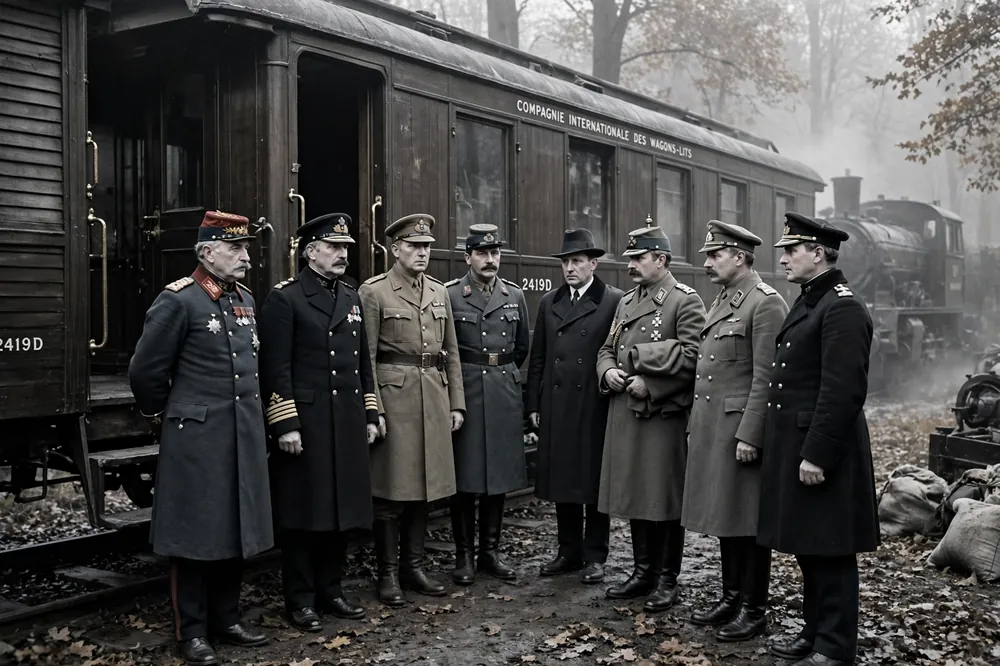
On 3 October, the new German Chancellor, Prince Max of Baden, sent a note to Wilson asking for an armistice on the basis of the Fourteen Points, and for the immediate opening of peace negotiations. It was a deliberate choice: the German government appealed to Wilson, not to Clemenceau or Lloyd George, because Wilson was the Allied leader who had promised a just peace.
Wilson’s reply was far tougher than the Germans had expected. In a series of notes exchanged during October, he demanded the evacuation of all occupied territory, the end of submarine warfare, and — in his note of 23 October — the destruction of German militarism: if the Allies were to negotiate with the existing German government, he wrote, they must be satisfied that it spoke for the German people and not for “military masters and monarchical autocrats”.
The demand was widely read in Germany as a call for the Kaiser’s abdication. On 9 November, Wilhelm II abdicated and fled to the Netherlands; a republic was proclaimed in Berlin. Two days later, on 11 November 1918, the armistice was signed at Compiègne.
The armistice terms themselves showed how far the Allies had already moved from the Fourteen Points. Germany was required to surrender large quantities of guns, aircraft, locomotives and ships, to evacuate the Rhineland, and to accept an Allied occupation of the Rhine bridgeheads. The naval blockade was maintained, so that Germany remained hungry through the winter of 1918–1919 while the peace was negotiated.
German officers who signed the armistice believed they were accepting Wilson’s programme; what they got was a military surrender on terms dictated by the Allied generals, above all by Marshal Foch. The gap between the promise of the Fourteen Points and the reality of the armistice would become, in Germany, the seed of the “stab-in-the-back” legend — the claim that the German army had not been defeated in the field but betrayed at home, and that the peace had been imposed by deceit.
7. Paris 1919: The Points under Pressure
When the peace conference opened in Paris in January 1919, Wilson attended in person — the first president to travel to Europe while in office — determined to secure the League of Nations and as much of the Fourteen Points as he could. He found himself outnumbered and outmanoeuvred.
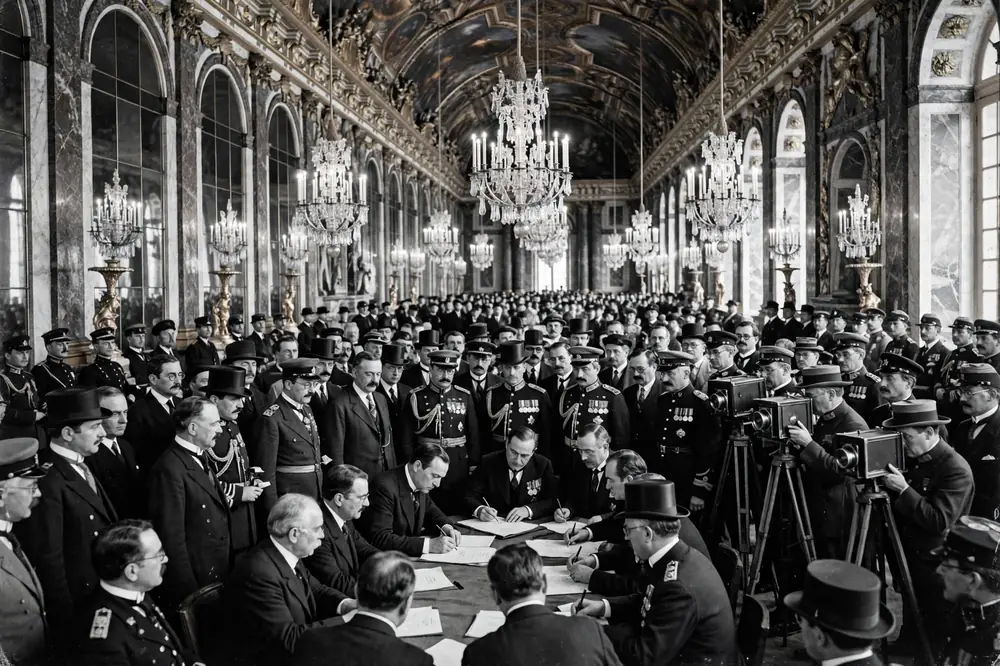
Clemenceau wanted to cripple Germany permanently; Lloyd George, facing a general election fought on the slogan “Hang the Kaiser” and “Make Germany Pay”, wanted reparations on a scale that would satisfy British voters; the Italians demanded the territories promised to them by the secret Treaty of London of 1915, including Dalmatian coastlands whose population was not Italian; the Japanese demanded the German concessions in Shandong, China, which they had been promised in 1917.
Wilson was the most popular man in Europe — crowds cheered him in Paris, London and Rome — but popularity was not power at the negotiating table, where decisions were made by the Council of Four: Wilson, Clemenceau, Lloyd George and the Italian premier Vittorio Orlando.
Point by point, the settlement compromised the programme. Point I, open diplomacy, was honoured in the sense that the treaty was published, but the conference itself negotiated in secret, and the League’s covenant did not abolish secret diplomacy in practice. Point II, freedom of the seas, was dropped entirely: Britain refused it, and Wilson gave it up.
Point III, free trade, was ignored; the treaty imposed no general free-trade regime, and the new states of Europe promptly raised tariffs against each other. Point IV, disarmament, was applied only to Germany, which was limited to an army of 100,000 men and forbidden tanks, military aircraft and submarines, while the victors kept their own armies.
Point V, the impartial settlement of colonial claims, became the mandate system: Germany’s colonies and the Arab provinces of the Ottoman Empire were handed to Britain, France, Japan, South Africa, Australia and New Zealand as “mandates” of the League, to be governed as a “sacred trust of civilisation” — a formula that postponed independence indefinitely. The peoples concerned were not consulted.
The territorial points fared better, though unevenly. Belgium was restored (Point VII) and Alsace-Lorraine returned to France (Point VIII). Poland was recreated with access to the sea through the Polish Corridor (Point XIII), though the corridor cut East Prussia off from the rest of Germany and became a lasting German grievance.
Italy received the Trentino and Trieste but not all the Dalmatian coast it claimed (Point IX), leaving Italian nationalists embittered — the “mutilated victory” that helped to poison Italian politics. Austria-Hungary had already ceased to exist, so Point X, autonomy within the empire, was replaced by the independence of Austria, Hungary, Czechoslovakia and Yugoslavia.
In the Balkans (Point XI), Serbia — enlarged into Yugoslavia — gained its access to the sea, but the new borders left large minorities on the wrong side of every frontier. The Ottoman settlement (Point XII) was left to separate treaties, and the Turkish portions of the empire were soon redefined by war: the Turkish War of Independence under Mustafa Kemal overturned the Treaty of Sèvres (1920) and produced the Treaty of Lausanne (1923), which recognised a Turkish republic in Anatolia.
And Point XIV, the League of Nations, was achieved — the Covenant of the League was written into the Treaty of Versailles — but at the price of the rest. Wilson accepted compromises on point after point in order to save the League, believing that the League could correct the treaty’s mistakes over time. It never got the chance.
8. The League of Nations and the Failure at Home
The League of Nations, created by the Covenant adopted on 28 June 1919, was the centrepiece of Wilson’s programme and the institution on which he staked his reputation. It was to be a permanent assembly of nations, with a Council of great powers and an Assembly of all members, a secretariat in Geneva, a Permanent Court of International Justice, and — crucially — Article 10 of the Covenant, under which members undertook “to respect and preserve as against external aggression the territorial integrity and existing political independence of all Members of the League”.
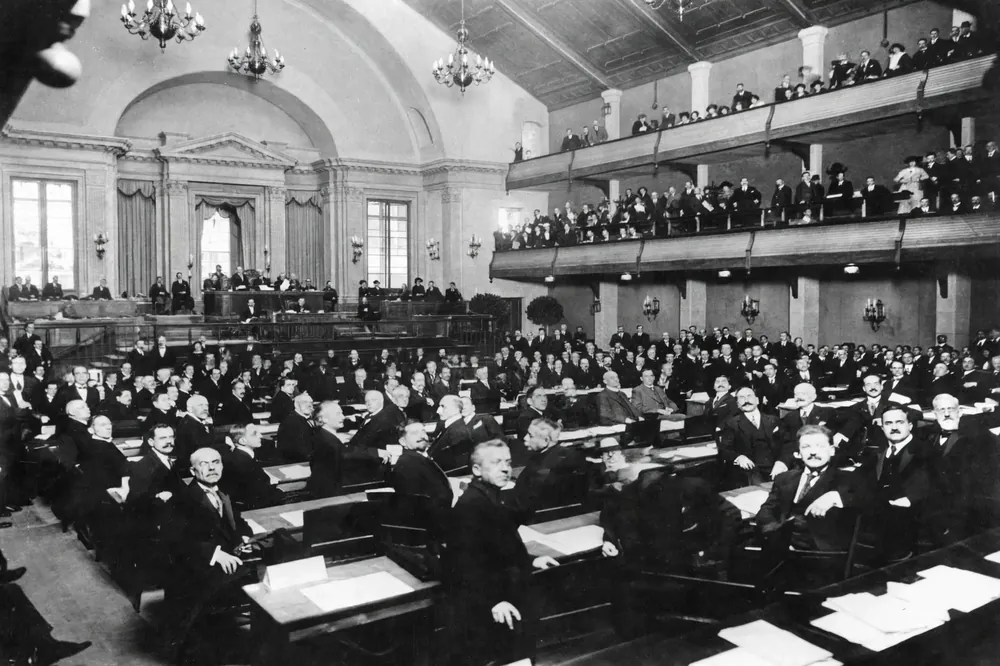
Wilson regarded Article 10 as the heart of the Covenant: it was the mutual guarantee of Point XIV made law. It was also the article that would destroy the treaty in the United States.
Wilson returned home in July 1919 to find the Senate, controlled by the Republicans, unwilling to ratify the Treaty of Versailles as it stood. The Republican leader, Senator Henry Cabot Lodge, did not oppose the League outright, but demanded “reservations” — above all a reservation stating that Article 10 did not oblige the United States to go to war without a vote of Congress, which alone under the Constitution could declare war.
Wilson, exhausted and increasingly rigid, refused to accept the reservations. He believed that any reservation would require renegotiating the treaty with the Allies, who would refuse, and that the League must be accepted whole or not at all. In September 1919 he set out on a speaking tour of the western United States to appeal to the public over the heads of the senators.
On 25 September, after a speech in Pueblo, Colorado, he collapsed, and on 2 October he suffered a severe stroke that left him partly paralysed and incapacitated for the rest of his presidency. The treaty came to a vote in the Senate in November 1919 and again in March 1920, and both times it failed to win the two-thirds majority required — the first time because Wilson’s own supporters, on his instructions, voted against the treaty with Lodge’s reservations, and the second time because neither side would give way.
The United States never ratified the Treaty of Versailles and never joined the League of Nations.
The League that Wilson created therefore began its life without its author and without its most powerful member. It did real work in the 1920s — settling border disputes, administering the mandates and the Saar and Danzig, fighting disease and the traffic in drugs and people, and providing the machinery for the Locarno Treaties of 1925 and the Kellogg-Briand Pact of 1928.
But it had no army of its own, its decisions required unanimity, and the great powers were free to ignore it. When Japan invaded Manchuria in 1931, Italy invaded Ethiopia in 1935, and Germany remilitarised the Rhineland in 1936, the League condemned and did nothing effective. The United States, outside the League, watched from the sidelines.
Wilson died in 1924, largely forgotten by the public, convinced that his work would be vindicated by history. In a sense it was: when the League failed and the Second World War came, the victors of 1945 built the United Nations on the foundations Wilson had laid, with the great-power veto that the League had lacked and with the United States as a founding member.
9. Legacy: Self-Determination and the World after Versailles
The most lasting legacy of the Fourteen Points was not the League, which failed within a generation, but the idea of self-determination — the principle that peoples should choose their own government and their own national allegiance. Before 1918, that idea had been a revolutionary slogan; after 1918, it was the language in which the map of Europe was redrawn and in which every national movement of the twentieth century stated its claims.
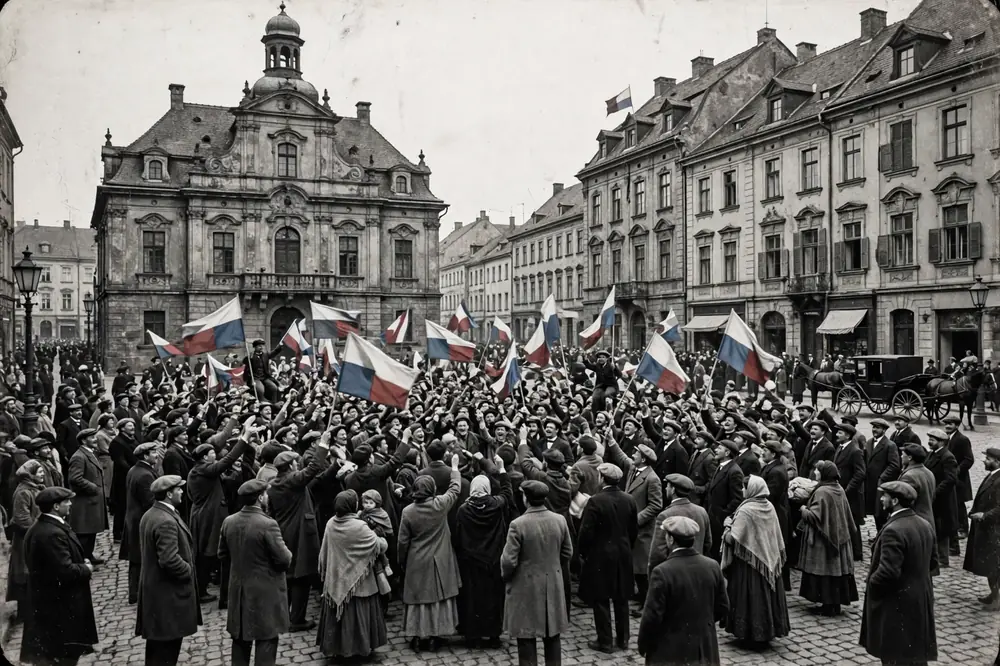
The new states of Eastern Europe — Poland, Czechoslovakia, Yugoslavia, Finland, Estonia, Latvia, Lithuania, Austria, Hungary — all owed their existence, in whole or in part, to the principle Wilson had proclaimed, even where the borders drawn at Paris satisfied no one completely.
The German minority in Czechoslovakia, the Hungarian minorities in Romania and Yugoslavia, the Polish Corridor, the division of Ireland, the unresolved status of the Kurds and the Armenians: the settlement created as many new minorities and grievances as it resolved, and many of them would return as causes of war within twenty years. Yet the principle itself survived the failures of its application.
When the United Nations was founded in 1945, its Charter proclaimed “respect for the principle of equal rights and self-determination of peoples” in its first article; when the European empires dissolved after 1945, the peoples of Asia and Africa claimed independence in the language of 1918.
The Fourteen Points also left a second legacy: the idea that peace must be organised, not merely declared. Wilson’s League failed, but the attempt itself changed what states expected of international life. The mandates system, for all its hypocrisy, introduced the idea that colonial rule was a trust to be supervised and eventually ended. The Permanent Court of International Justice became the International Court of Justice.
The International Labour Organisation, created at Paris in 1919, still exists. And the American tradition that Wilson founded — that the United States should use its power to build international institutions and to speak for universal principles — has shaped American foreign policy ever since, from the United Nations to the Universal Declaration of Human Rights in 1948.
Wilson’s critics, then and now, call the Fourteen Points naive: a set of principles that could not survive contact with the interests of the victors. His defenders reply that the principles were never given a fair trial — that they were betrayed at Paris, rejected in Washington, and then blamed for the failures of the men who betrayed them.
What is certain is that no other document of the First World War has been quoted so often, by so many peoples, for so long.
There is a final irony in the story of the Fourteen Points. Wilson delivered them to win a war and to make the next war impossible. Within twenty years, Europe was at war again — a war that began, in part, over the very settlements the Fourteen Points had created: the Polish Corridor, the Sudeten Germans, the dismemberment of Czechoslovakia.
Adolf Hitler made the grievances of Versailles the centre of his politics, and the Second World War was fought, in the end, to undo the peace of 1919. Yet the second war’s victors did not abandon Wilson’s programme; they tried to complete it.
The United Nations, the Universal Declaration, the decolonisation of Asia and Africa, the European project of reconciliation between France and Germany — all of these are, in one way or another, attempts to realise the world that Wilson described on 8 January 1918: a world of open diplomacy, of free peoples choosing their own governments, and of nations bound together in a common association to keep the peace.
The Fourteen Points failed as a peace settlement. As a statement of what peace should mean, they have never been surpassed.
10. Key Figures
Woodrow Wilson (United States). President of the United States from 1913 to 1921. A former professor and president of Princeton University, Wilson led the United States into the First World War in 1917 after campaigning for re-election on the slogan “He kept us out of war”. The Fourteen Points were his attempt to give the war a moral purpose and to shape the peace that followed. He attended the Paris Peace Conference in person, secured the League of Nations, and then saw the treaty rejected at home. He suffered a stroke in October 1919 and died in 1924.
Colonel Edward M. House (United States). Wilson’s closest adviser and the organiser of the Inquiry. House managed the drafting of the Fourteen Points and represented Wilson at Paris when the president returned to the United States in early 1919. The two men quarrelled at Paris, and their friendship never recovered.
David Lloyd George (Britain). Prime Minister of the United Kingdom from 1916 to 1922. Lloyd George supported the Fourteen Points in general but insisted on reparations and on honouring Britain’s wartime commitments, including the Sykes-Picot agreement and the Balfour Declaration.
Georges Clemenceau (France). Premier of France and the dominant figure at the Paris Peace Conference. Clemenceau, who had lived through the Franco-Prussian War and the German invasion of 1914, wanted security against Germany above all, and regarded Wilson’s idealism with open scepticism. He called himself “the Tiger” and Wilson’s programme a collection of fine words that France could not afford.
Henry Cabot Lodge (United States). Republican senator from Massachusetts and chairman of the Senate Foreign Relations Committee. Lodge led the opposition to the Treaty of Versailles, demanding reservations to protect Congress’s power to declare war. His long rivalry with Wilson, personal as well as political, helped to ensure the treaty’s defeat.
Prince Max of Baden (Germany). The German chancellor who, in October 1918, asked Wilson for an armistice on the basis of the Fourteen Points. His appeal to Wilson rather than to the Allied governments as a whole showed how far the speech had penetrated German thinking — and how bitter the disappointment would be when the peace proved harsher than the promise.
Frequently Asked Questions
Related articles
Sources
- Woodrow Wilson, Address to a Joint Session of Congress, 8 January 1918 (“The Fourteen Points”) — full text of the speech, available from the Miller Center and the US National Archives.
- Encyclopædia Britannica, “Fourteen Points” — summary of the points, their reception and their fate at Paris.
- Wikipedia, “Fourteen Points” — text of the points, background on the Inquiry, and the armistice negotiations of October 1918.
- Margaret MacMillan, Paris 1919: Six Months That Changed the World (Random House, 2002) — the peace conference, Wilson’s negotiations with Clemenceau and Lloyd George, and the compromises of the treaty.
- Arthur S. Link, Woodrow Wilson and the Progressive Era, 1910–1917 and Woodrow Wilson: Revolution, War, and Peace (Harper, 1979) — Wilson’s thought and the drafting of the points.
- Arno J. Mayer, Political Origins of the New Diplomacy, 1917–1918 (Yale University Press, 1959) — the Bolshevik challenge, the secret treaties and Wilson’s response.
- League of Nations, Covenant of the League of Nations (1919), Article 10 — the mutual guarantee at the heart of the League.
- Thomas J. Knock, To End All Wars: Woodrow Wilson and the Quest for a New World Order (Princeton University Press, 1992).
- Erez Manela, The Wilsonian Moment: Self-Determination and the International Origins of Anticolonial Nationalism (Oxford University Press, 2007).